



Abstract
The present paper examines the use of modified dual-wavelength sawtooth serrations introduced at the trailing edge (TE) of a National Advisory Committee for Aeronautics (NACA) 65 (12)-10 airfoil as a passive means for the control of airfoil broadband noise. The studies are conducted for different parameters such as serration wavelengths (λ), serration amplitudes (h) as well as (hꞌ) modified amplitude to determine the best serration parameter which provides higher noise reductions. The reduction of noise level brought by the modified dual-wavelength sawtooth serrations at the TE is about 4 dB, while it is about 3.3 dB for the simple ones. It reveals that the modified sawtooth can provide a substantial reduction of self-noise alongside the interaction noise over an extensive range of frequencies which indicates the existence of strong far-field destructive interference (i.e., feedback) from low to mid-frequency ranges (i.e., 1.5 - 5 kHz). The TE serrated airfoils show lower acoustic emissions as compared to baseline although they exhibit a common behavior for all emission angles. The large noise decrease provided by the dual-wavelength sawtooth may be because of the significant reductions in the scattering intensity of sound as well as strong far-field destructive interference owing to the presence of two roots between the two successive maximum amplitude peaks.
Introduction
The flow over realistic airfoils has received broad focus over the last many decades because of their immense uses in aviation sectors, wind turbines, submarines, drones, and fans. Many researchers have been investigating the effect of different geometric parameters of the airfoil such as nose radius, and edge modifications, encompassing both leading and trailing edges. These studies aim to discern their impact on the flow dynamics and acoustic characteristics of flat plates and airfoils. The sound produced by the airfoil limits its use in various applications, making noise reduction a key concern for researchers in this field. A primary source of noise originates from the intricate interaction between the airflow and airfoil. The main objective is to mitigate far-field acoustic emissions while imposing the least possible aerodynamic penalty.
Among various modifications, trailing edge serration has proven to be a highly effective method for reducing broadband noise.1–5 Sawtooth serration was employed in considerable works to reduce the airfoil noise levels. Howe et al. 1 predicted the sawtooth serrated edge can reduce no less than 10 x log10 [1+ (4h/λ)2] dB noise and the sinusoidal serrated edge could provide 10 x log10 (6h/λ) dB less noise as compared to un-serrated ones providing the (Strouhal number) ωh/U >> 1 condition must be satisfied where ω is the frequency, λ is the wavelength and 2h is the root-tip distance of the serration. The reduction of self-noise of the airfoil by the TE serration of four different sawtooth geometries was experimentally studied by Chong et al. 6 The observation was that the non-flat-type serrations would reduce the vortex shedding noise in the narrowband with the application of two conditions such as a large serration angle and higher serration length than that of the thickness of the turbulent boundary layer. An experimental study by Moreau and Doolan 7 showed the noise mitigation capabilities of the flat plate airfoil with sawtooth TE serrations for the Reynolds numbers vary from 1.6 × 10⁵ to 4.2 × 10⁵. The maximum noise reduction was observed in the narrowband noise level of up to 13 dB by attenuating the vortex-shedding noise using TE serrations. The performance of airfoil broadband noise decrease by utilizing the various sawtooth serrations was extensively explored by Gruber et al. 8 They showed the impact of various serration parameters variation consisting of (i) serration height and (ii) for several flow velocities and angles of attack, serration wavelength as indispensable parameters to show the noise reduction potentials. The sharper serrations could deliver optimum noise decreases at the far-field of 5 dB up to a definite critical frequency as compared to other parameters. Although few studies have investigated the influence of different TE modifications on the aerodynamic characteristics of airfoils, detailed systematic investigations of different dual-wavelength sawtooth TE serrations for improving the mitigation of broadband noise realistic airfoils are limited.
Moreover, the alteration of sawtooth serrations at the airfoil’s trailing edge is employed as a means to enhance noise reduction. Chong et al. 9 carried out an experimental investigation of airfoil self-noise reduction by implementing a non-flat plate sawtooth serration at the TE. The serration was able to provide substantial broadband noise reduction in the self-noise region and was able to eliminate high-frequency noise. They observed a blunt vortex shedding noise is less pronounced for wider angles of the sawtooth serration. To eliminate this vortex shedding noise further they used the TE serration along with woven-wire mesh. Periodic trailing edge serrations are utilized for the semi-infinite flat plate by Azarpeyvand et al. 10 to reduce the TE noise. The prediction of spectra of far-field noise was carried out for sawtooth, sinusoidal, slit, slitted-sawtooth, and sawtooth-sinusoidal serrations. Liu et al. 11 experimentally analyzed the aeroacoustics and aerodynamics behavior of NACA 65 (12)-10 aerofoil TE noise by providing sawtooth and slitted sawtooth serrations. Apart from noise reduction capability, the serrations could considerably affect the aerodynamic performance of the airfoil. The noise reductions of combed-sawtooth and simple sawtooth TE serrations of NACA 0018 were studied by Avallone et al. 12 through experimental and computational investigations. The decrement in the amount of the surface pressure variations was observed from the root to the tip for both configurations, moreover, the low and mid-frequency range noise sources are primarily situated at the serrations root. Velden et al. 13 experimentally and analytically studied the flow topology and the impact of combed teeth serration on wind turbine noise reduction. It was noticed that the standard serration provides lower noise reduction when compared to combed serrations. Further noise increases were noticed at high frequencies while serrations reduce sound pressure in the low-frequency regime. The highest noise decreases were observed at upstream angles (120◦ - 150◦). The flow past a NACA 0018 airfoil consisting of the sawtooth trailing edge by utilizing particle image velocimetry (PIV) was studied experimentally by Leon et al. 14 They studied the consequence of the establishment of secondary flow among pressure and suction side by varying the serration flap angle and airfoil incidence. They found that the existence of vortices in the streamwise that originates from the TE is primarily influenced by the serration flap angle. Leon et al. 15 observed that the modification of the reported flow parameters and the pressure variations in the streamwise direction may cause the local dispersed pressure waves to fluctuate along the serration edges. Leon et al. 16 employed the NACA 0018 airfoil’s unaltered trailing edge to investigate how different serration designs reduce noise. By observing the detail experimental analysis they found that the slitted serrations exhibit the lowest decrease in noise level, while the hybrid and Sr.20 (4 cm from peak to trough) designs exhibit the most. Leon et al. 17 examined the broadband noise produced by the turbulent flow scattering at the trailing edge of a NACA 0018 airfoil with trailing edge serrations by adjusting the airfoil angle of attack and serration flap angle. It was found that TE serrations reduce airfoil noise levels, but also lead to an increase in noise at higher frequencies, attributed to increased turbulence intensity between the serration teeth.
Alongside sawtooth serrations, modifications to simple serrations also play a substantial role in noise reduction. The acoustic and hydrodynamic analysis was computationally studied by Jones et al. 18 during the flow past a NACA 0012 aerofoil with straight and serrated TE. The study found that the serrations can lead to a decrease in spanwise correlation levels over the serrations, and that the straight TE imparts a more spanwise coherent perturbation to the turbulence in the boundary layer. Also, TE serrations significantly reduce noise amplitude above a certain onset Strouhal number, attributing it to changes in scattering and potential hydrodynamic alterations near the serrations. The numerical analysis of Romani et al. 19 examined the TE noise of NACA 64-618 airfoil for straight and serrated edges at incidence. They found that the TE noise drop was significantly affected due to the serration flap angle. An investigation by Woodhead et al. 20 showed the effect of the serrated TE with different flap angles on the aeroacoustics reactions of an asymmetric aerofoil. The study revealed that the flap-up condition significantly reduces noise in the wide range of frequencies. The sawtooth serrations were observed to redistribute turbulence sources and decrease spanwise turbulence length scales, contributing to an overall enhancement in noise reduction. Also, the complex periodic serration that attains maximum noise reduction was shown. Sivakumar 21 carried out experimental investigations of six different trailing edge serration geometries and compared them with a baseline plate to study the flow-induced noise of an airfoil. They found that the triangular serration, having included an angle less than 45o, provides 6 dB noise reduction. Further, the highest noise reduction at 5 kHz, where the self-noise region starts dominating the interaction region was noticed. Rubio et al. 22 conducted an experimental aeroacoustic study on a NACA 0018 airfoil that included trailing edge inserts that were both porous and solid, spanning 20% of the chord length. When comparing the metal foam insert with increased permeability to the solid case, planar PIV measurement of the flow over the inserts indicated an increase in the displacement thickness and boundary layer. That porous trailing edge inserts made of metal foam can effectively reduce low-frequency noise in certain frequency ranges, and that the noise attenuation is influenced by modifications in the flow field and turbulence characteristics. A novel method for evaluating noise reduction using synthetic sound was studied by Merino-Martínez et al. 23 Findings show modified wind turbine blades significantly reduce noise, emphasizing the importance of a holistic approach considering visual impact. The method has potential for assessing noise reduction in full wind farms.
The foremost purpose of the current work is to inspect experimentally the mechanism of the aerofoil noise reductions by utilization of the modification in the TE serrations. Thus the present study is to see how the geometric parameters of the modified sawtooth such as wavelengths and amplitudes are sensitive to the reductions of aerofoil noise. To investigate the broadband noise reduction performance of aerofoil, two different serration profiles such as simple sawtooth and modified sawtooth serrations are implemented. The investigation of the influence of simple sawtooth and modified sawtooth TE serrations for the minimization of interaction noise, self-noise, as well as total noise of an aerofoil is still underway. Thus, the present paper provides comprehensive experimental investigations on the acoustic characteristics of the various dual-wavelength trailing-edged serrated airfoils to determine the best edge dual-wavelength sawtooth for achieving the highest sound pressure decrements. A detailed parametric investigation is implemented for various serration wavelengths λ and amplitudes 2h provided with new amplitude hꞌ amidst serration to determine the key serration elements such as λ, h, and hꞌ of the foils which deliver significant sound pressure drops over an extensive range of frequencies.
Experimental setup
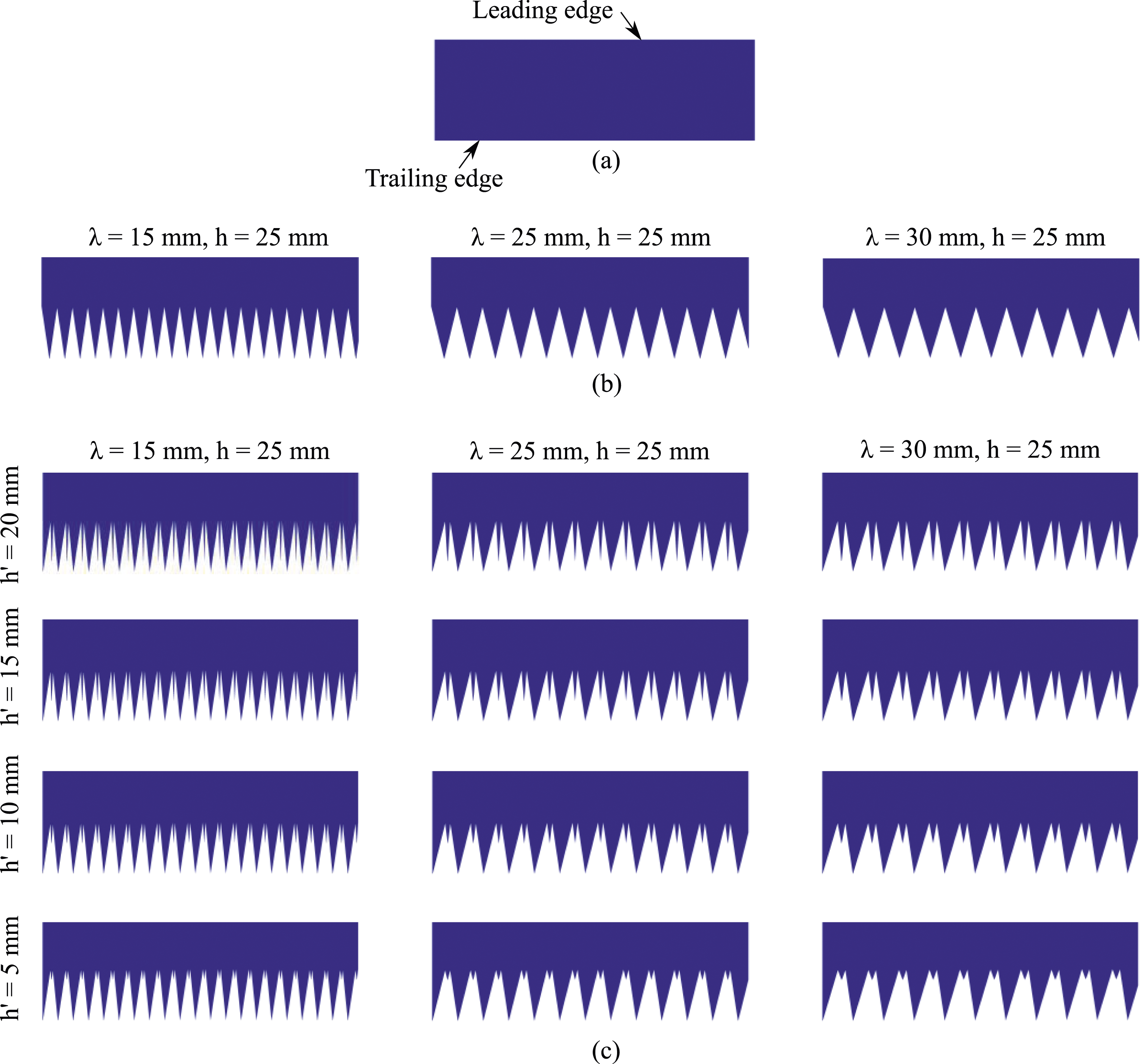
A NACA 65 (12)-10 aerofoil used for this experiment is made up of ABS (Acrylonitrile butadiene styrene) material provided with tripping tape near the LE to force transition to turbulence and a speed tape for smooth flow around the corners/joints Figure 1(a). The wing has a spanwise length (L) of about 31 cm and a chord (C0) of about 15 cm, it is also provided with a 1 cm slot at the trailing edge to put different sawtooth inserts. The sawtooth used in the present experiments are designed and fabricated by using a plastic transparent acrylic sheet with a thickness of 0.2 cm. The schematic of modified sawtooth is shown in Figure 1(b). Measurements are carried out to study the far-field acoustic characteristics of various trailing edge parameters. The quantifications of sensitivity of noise reduction performance to the serration parameters are studied. Further, a small step near the TE is formed due to the implementation of serration inserts into the airfoil slot, which could affect the flow dynamics. In order to avoid this and to get a smooth flow, the speed tapes are applied over the step. A total of 15 serration geometries (i.e., three simple and twelve dual-wavelength sawtooth serrations) as shown in Figure 2 are studied to establish the efficiency of the dual-wavelength serrations over a single wavelength on the noise mitigation levels. Photograph of (a) airfoil and (b) the schematic of the simple sawtooth serration (left) and modified sawtooth serration (right) as indicated by 2h’. Models of (a) baseline, (b) simple sawtooth and (b) modified sawtooth serration used in the experiments.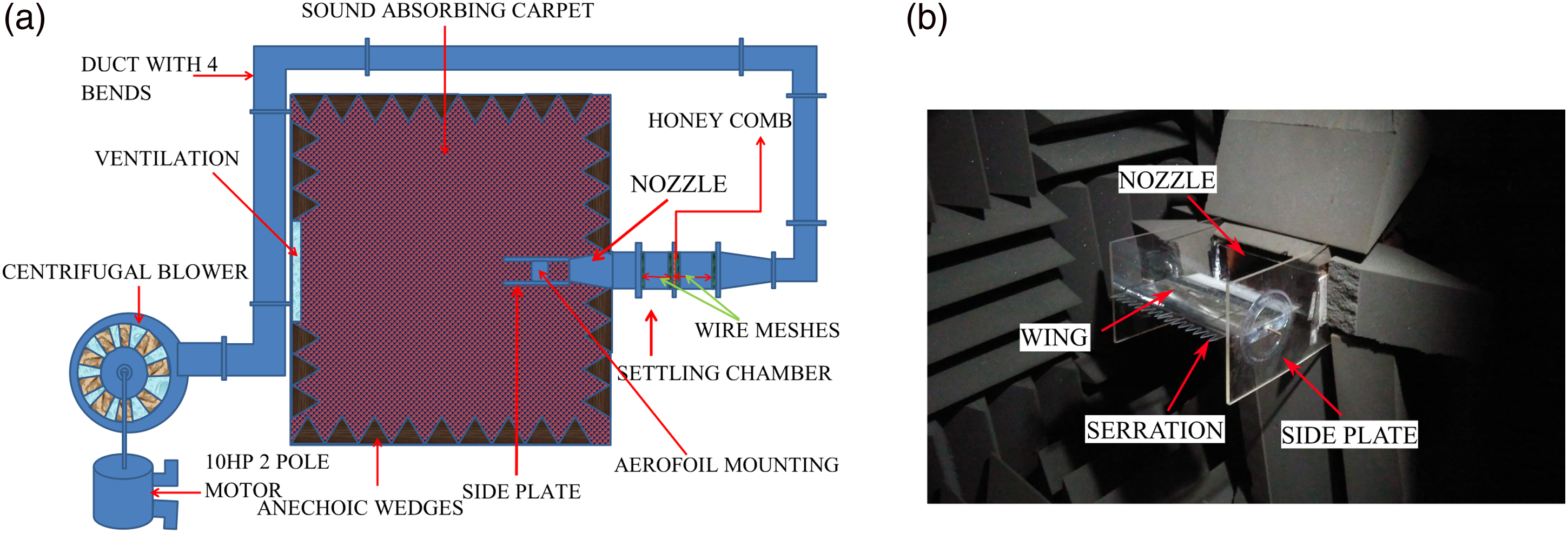
The aeroacoustic experiments on sawtooth TE serrated airfoils are conducted in the anechoic test facility developed in the department of mechanical engineering, IIT (ISM) Dhanbad, India. The polyurethane foam is used for the construction of anechoic chamber walls and ceilings and a sound-absorbing carpet is used on the floor to avoid reflections of the sound. The anechoic chamber has the tip to tip dimensions of 2.6 m × 1.7 m x 2.2 m. The centrifugal blower provides a sufficient velocity of up to 50 m/s (i.e. Mach number M ≈ 0.14) to carry out all aeroacoustic experiments. The height and breadth of the rectangular nozzle are 100 mm × 310 mm with a contraction ratio of 8:1 and are placed in the anechoic chamber for generating flow over the sawtooth serrated foils. The side plates are fixed at the nozzle exit to keep the aerofoil in the turbulent stream, which maintains a 2-D flow. The range of jet velocity, U, varies from20 m/s to 40 m/s for present sets of experiments, and the Reynolds numbers are calculated based on the chordwise length of the airfoil, which varies between 2.030 x 10⁵ to 4.060 x 10⁵, respectively. The six condenser microphones are attached to a microphone array for mapping the far-field acoustic radiations. The angle between two microphones in the array is 15° and the total angle ranges from 60o to 135o from the first to six microphones when measured in the anticlockwise directions from downstream of the airfoil and a radius or distance of array 0.65 m from the center of the aerofoil. The acoustic data is acquired using an NI DAQ system at a sampling rate of 50,000 Hz and with 10 s of sample time. Fast Fourier Transformation (i.e. FFT) is applied to the time series data to acquire the frequency data set, which can help in understanding the spectral features of the sawtooth serrated airfoils on noise reduction mechanism. To ensure a fully developed boundary layer, boundary layer tripping/rough tape is used on the lower and upper surface of the aerofoil which is placed at 20% of the aerofoil chord length from the leading edge. Before the use of the test facility, it was tested and calibrated, precisely to carry out the acoustic experiment tests. The turbulence intensity of the tunnel was measured to be 3% .
24
A detailed analysis of calibration was done by Sushil et al.
25
Figure 3(a) and 3(b) show the schematic and picture of the anechoic jet facility. In order to achieve 2-dimensional flow and to avoid tip effects, both baseline and serrated airfoils are placed between two side plates. Detailed information about the anechoic test facility is provided by Sushil et al.
25
The measured sound pressure level is uncertain only within ± 0.5 dB. Inside the chamber, the variation in the ambient temperature is within ±1°C. The inflow velocity measurement is repeatable within ±1%. (a) Schematic and (b) Photograph of the modified airfoil mounted in the facility.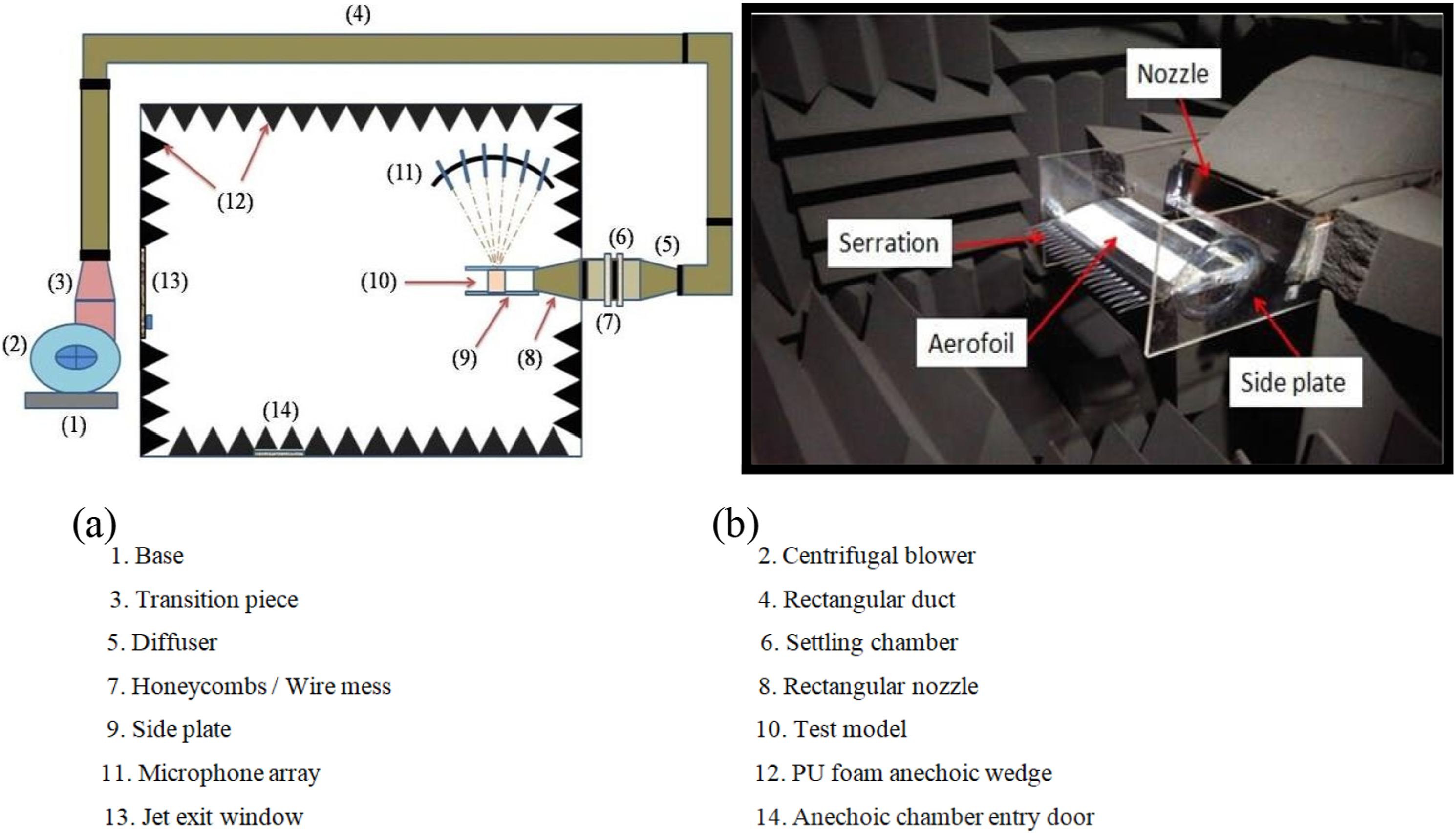
Results and discussion
Far-field noise spectral analysis
The mainframe of the work has been segregated into mainly three parts (i) it contains the spectral comparison of simple sawtooth (ii) it contains the spectral comparisons of modified sawtooth comprising dual-wavelength and (iii) it focuses on the efficacy of modified serration over simple sawtooth. The acoustic emission is conveyed in terms of sound pressure level spectrum (SPL (f)), defined in equation (1). Equation (3) is used to calculate the sound power level spectra (PWL (f)).


where a represents the speed of sound (m/s), L denotes the span of the airfoil, ρ is the density of the ambient air (Kg/m3) and R is the radius of the microphone array. As mentioned earlier, with the assumption of cylindrical noise radiation from a line source, the PWL is determined using equation (3) given by Narayanan et al.
26
as follows:

In order to show the efficiency of serration the sound power reduction level (∆PWL (f)) is calculated using equation (4), which is the difference in PWL (f) between the baseline and trailing edge serrated airfoils.

Figure 4 illustrates the PWL spectra of noise radiation emitted by the simple serrated airfoil (λ = 25 mm, 2h = 50 mm) and baseline at a zero angle of attack, presenting results for inflow velocities of 20, 30, and 40 m/s. The results are also compared with the background noise level when the airfoil is not placed in the wind tunnel. The baseline model exhibits a higher noise level across a wide range of frequency levels and tested inflow speed levels. Upon implementing the simple serration at the trailing edge, the broadband noise level decreases for a wide range of frequencies, observed consistently across all tested inflow velocities. It is noteworthy that the background noise level is considerably lower than that of the baseline and serrated airfoil conditions. However, with an increase in inflow velocity, there is a rise in broadband noise observed in the low-frequency region, though it remains lower than that of the airfoil conditions. The sound PWL spectra comparison for baseline, simple sawtooth (λ = 25 mm) at fixed h = 25 mm and background noise for velocity (a) 20 m/s (b) 30 m/s and (c) 40 m/s at 0o AoA.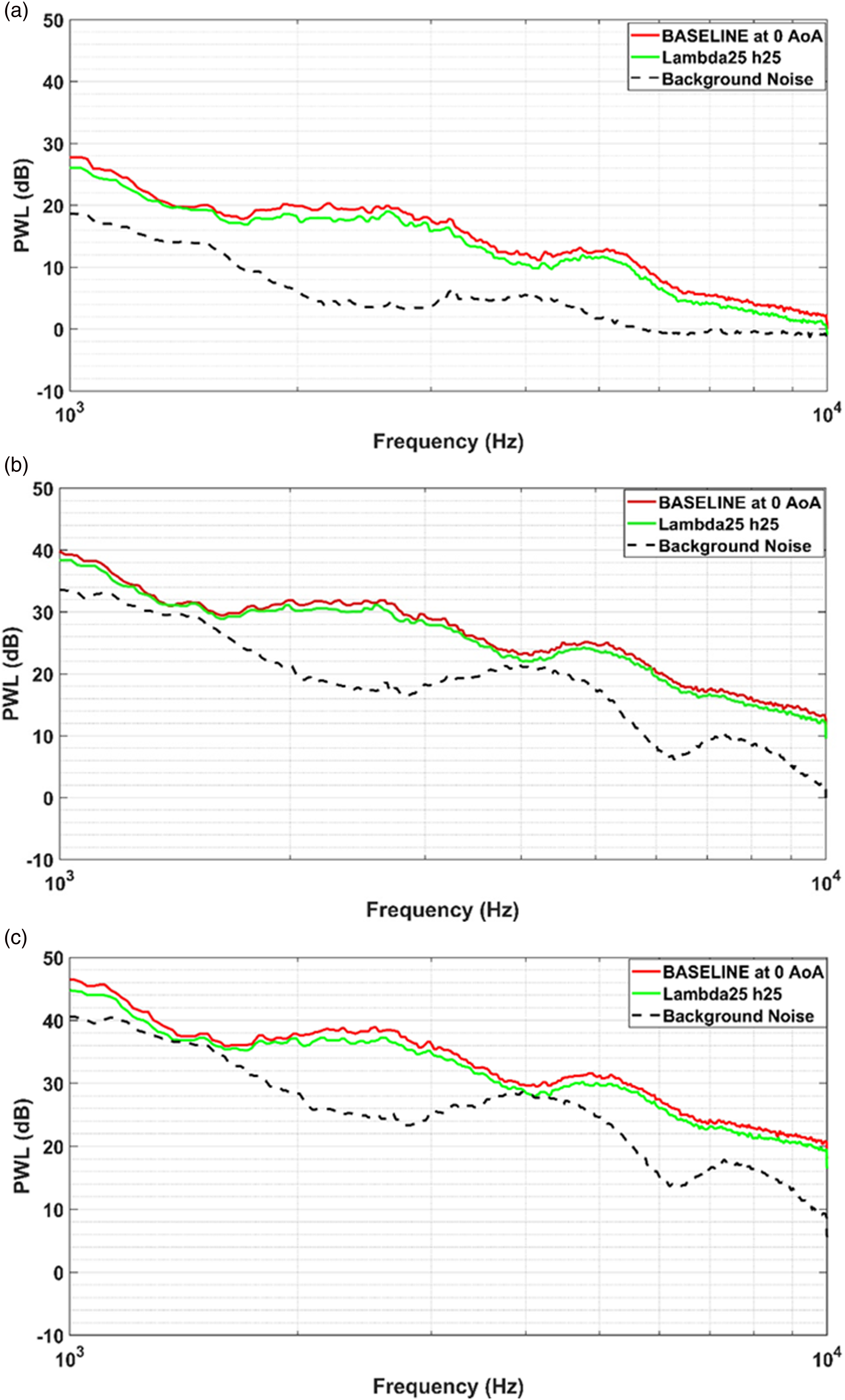
Noise reduction performance
The sensitivity of sound power decrement to the modified sawtooth airfoil is shown in this section in terms of PWL. The spectral comparisons of PWL of the modified serrated airfoil and simple sawtooth and baseline airfoils are shown in Figure 5. The effect of the variation of λ and 2hꞌ at constant 2h on spectral levels is presented for 20, 30 and 40 m/s. The results are also compared with un-serrated and simple serrated TE (λ = 15 mm, 2h = 50 mm) cases. Two different regions are indicated to identify and investigate the elite serrations which give the best noise reduction parameters and could provide substantial noise reduction for distinct noise-dominating frequency regions. For wide range of velocities, the baseline case shows the highest sound power level than the serrated cases. The interaction zone exhibits minimal spectral noise reduction across the range of velocities examined. In contrast, the self-noise zone demonstrates notable fluctuations in the amplitude of PWL. Figure 5(a) illustrates the PWL spectra at a velocity of 20 m/s, displaying a decreasing trend in PWL as frequency increases. It is worth noting that the self-noise predominantly manifests in the high-frequency range, a fact corroborated by reference.27,28 The sound PWL spectra comparison for baseline, simple sawtooth (λ = 15 mm) and modified sawtooth with varying λ = 15, 25, 30 mm and 2hꞌ = 10, 20, 30 mm at fixed h = 25 mm for velocity (a) 20 m/s (b) 30 m/s and (c) 40 m/s at 0o AoA.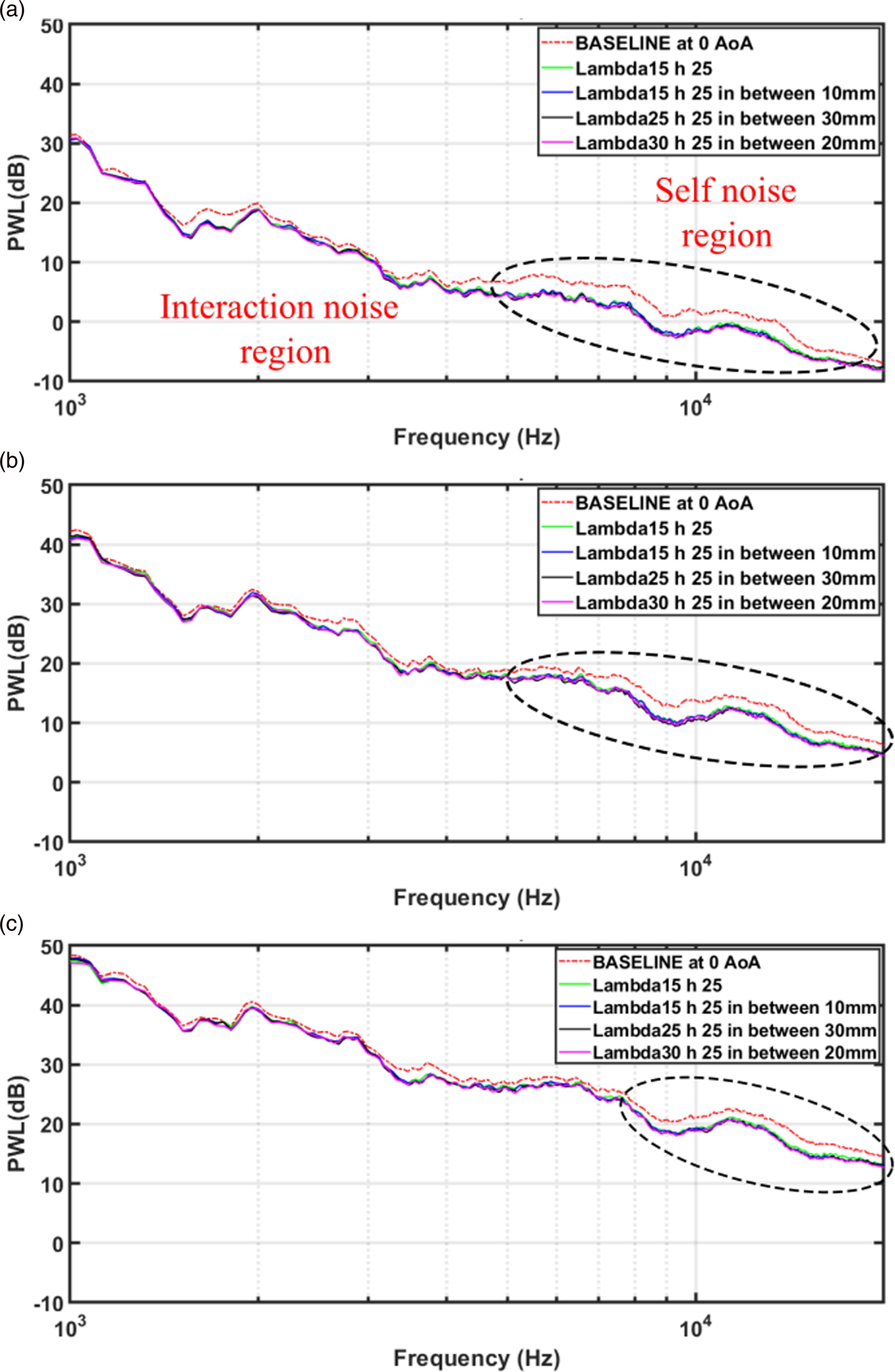
The figure underscores significant noise variations between different cases in the self-noise region, in contrast to the interaction region. As the incoming velocity increases (30 and 40 m/s), PWL also increases for all cases, in line with expectations. It is observed that in comparison with baseline, modified sawtooth (λ = 30 mm, 2h = 50 mm, 2hꞌ = 20 mm) accomplishes better noise reduction performance over the simple sawtooth (λ = 15 mm, 2h = 50 mm), in noise reduction mechanism, since modified sawtooth spectral level is lower than that of simple sawtooth. It is also observed that as compared to other serrations, the serration configuration, λ = 30 mm, 2h = 50 mm, 2hꞌ = 20 mm of modified sawtooth is the lowest spectral characteristic as compared to the baseline.
The spectral comparisons show that the modified serration with λ = 30 mm, 2h = 50 mm, 2hꞌ = 20 mm is lower in sound power when compared to the baseline. This is more prone in the self-noise region (4 kHz - 20 kHz) rather than the interaction region (1.5 kHz - 4 kHz). These results suggest that the maximum sound power level reduction can be found in the self-noise region compared with the interaction region.
The comparison of ∆PWL as shown in equation (4), for modified sawtooth serration and simple sawtooth serration is shown in Figure 6 The sound ∆PWL comparison for simple sawtooth (λ = 15 mm) and modified V- serration with varying (λ = 15, 25, 30 mm) and (2hꞌ = 10, 20, 30 mm) at fixed h = 25 mm for velocity (a) 20 m/s (b) 30 m/s and (c) 40 m/s at 0o AoA.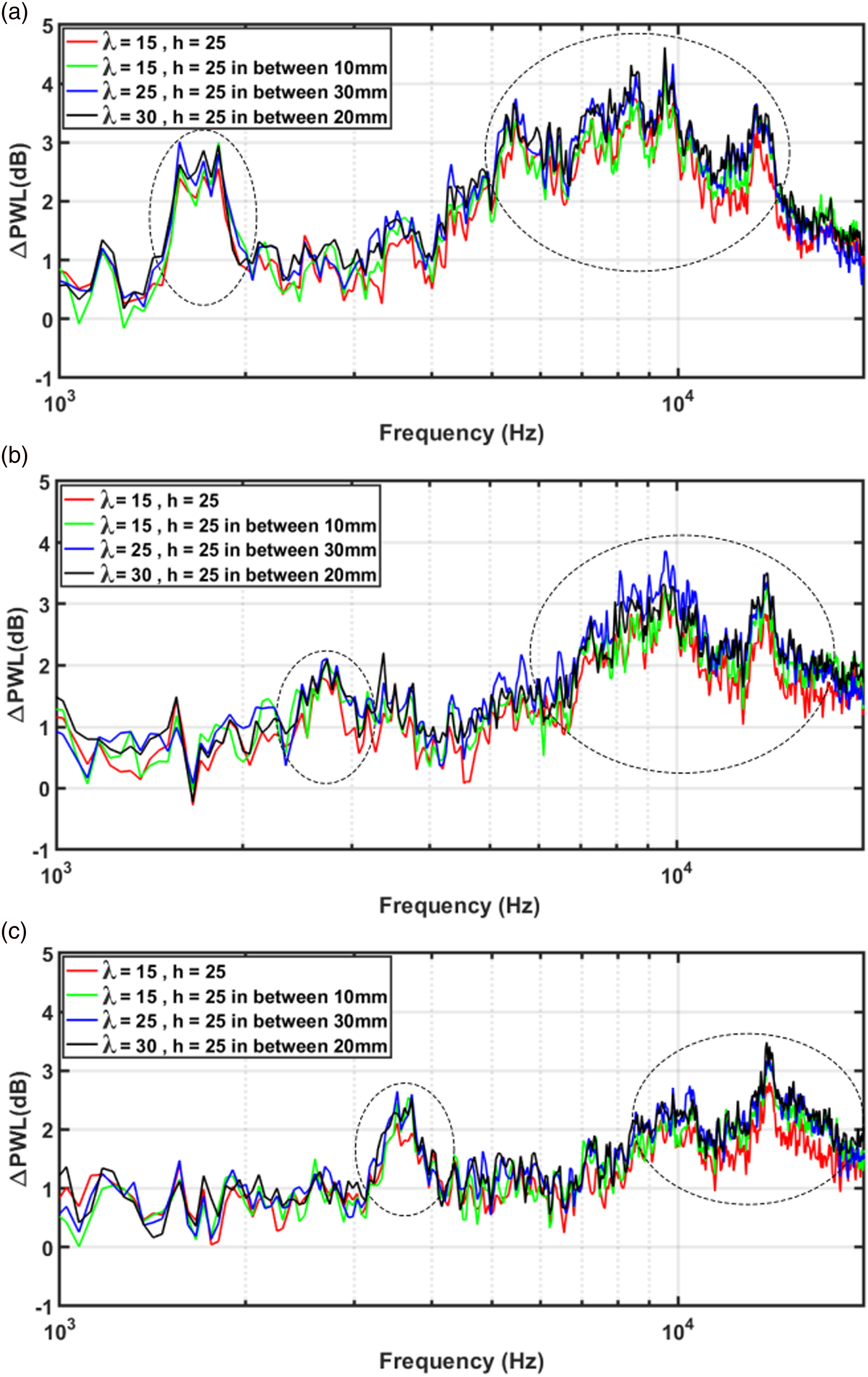
Directivity characteristics
The far-field noise radiations are measured at different emission angles (60o ≤ θ ≤ 135o) and plotted in Figure 7 to show the direction of higher noise levels. The direction of maximum noise radiation is clearly presented for different cases. It is well known from the literature that LE and TE are associated with broadband noise frequencies. In this study, the effect of serration on different ranges of frequencies that are associated with LE and TE is presented and compared. Hence the directivities of PWL at different frequencies for baseline, simple, and modified sawtooth airfoils are plotted at 40 m/s with 0o angle of attack. The directivity pattern of baseline and the sawtooth are computed and compared for the various frequencies to know the radiation pattern of the baseline and serrations and to know how the noise radiation is navigating into the far filed. At these frequencies there is a shift in the behaviour of the noise from upstream to downstream direction that is, from 60o to 105o due to the effect of some of the frequency components, although the maximum directivity is in the downstream direction for all the cases. So, to get the clear insight of the change in the directivity pattern is used these specific frequencies. The directivity study shows the PWL comparison of different wavelengths and amplitudes of the simple sawtooth (λ = 15 mm and h = 25 mm) and modified sawtooth (λ = 15, 25, 30 mm at fixed h = 25 mm and varying 2hꞌ = 10, 20 and 30 mm). The airfoil without serrations shows maximum PWL as related to the simple sawtooth as well as modified sawtooth as shown in Figure 7. These results are in line with the spectral observation of PWL as discussed earlier and this plot shows that the noise levels are similar to wide range of observation angles. They are showing a common trend of sound radiation movement from upstream to downstream directivity. A general behavior is noticed that the increase in the noise radiations of TE serrated airfoils and baseline due to increase in jet velocities. Also, lesser noise emissions are noticed for the TE serrated airfoils at all observation angles. Polar directivity for baseline, simple sawtooth, and modified sawtooth at (a)1318.4 Hz, (b) 5517.6 Hz, (c) 8496.1 Hz (d)11,035 Hz, where (-⁎-) baseline, (-⁎-) λ = 15 mm, h = 25 mm, (-⁎-) λ = 15, h = 25 mm and 2hꞌ = 10 mm, (-⁎-) λ = 25 mm, h = 25 mm, and 2hꞌ = 30 mm, (-⁎-) λ = 30 mm, h = 25 mm and 2hꞌ = 20 mm for a mean flow velocity 40 m/s at 0o AoA.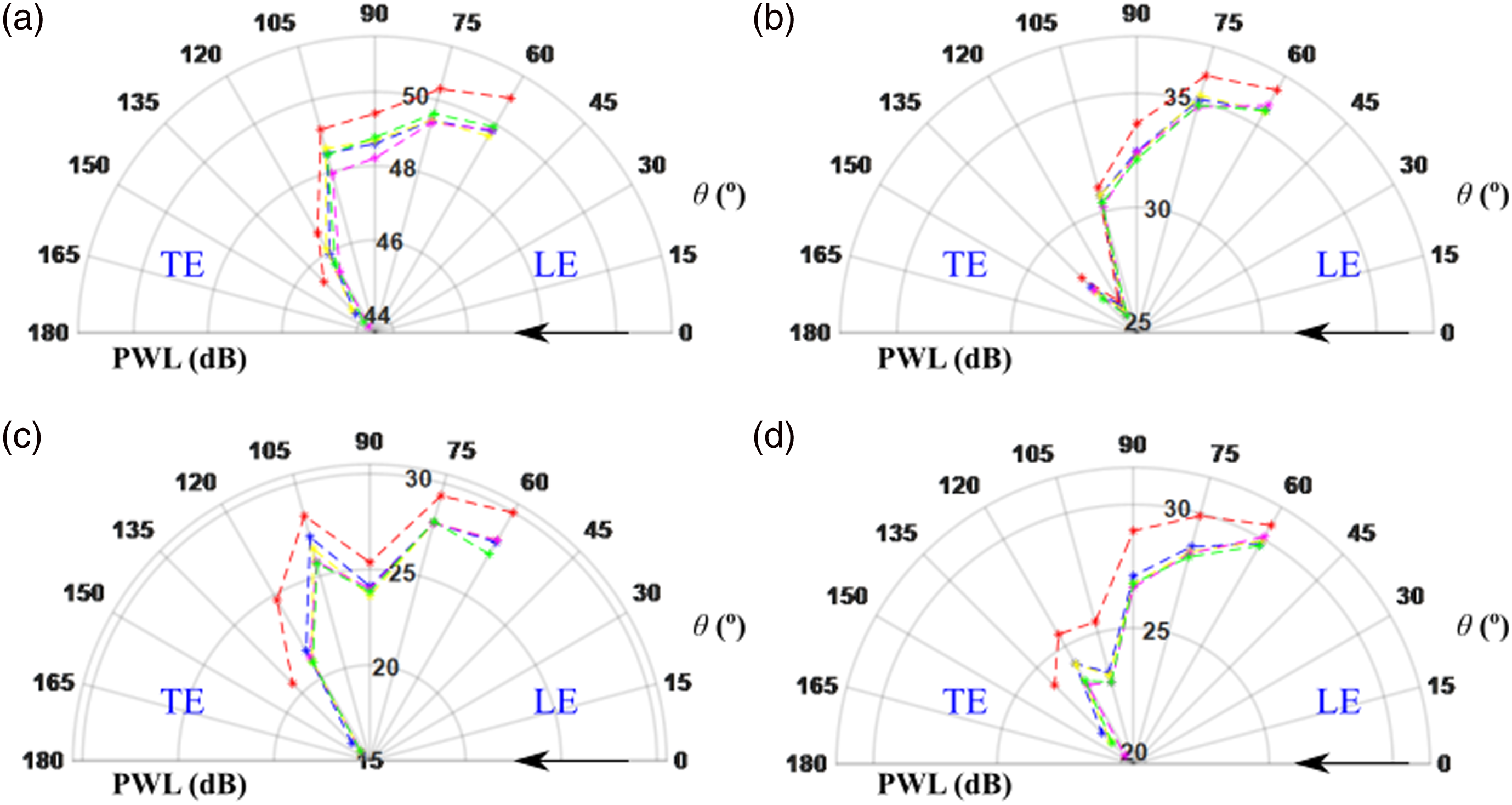
It is observed that serration with λ = 15 mm and h = 25 mm could provide substantial noise reduction from the lower emission as compared to baseline. On the other hand on providing new amplitude (hꞌ) amidst sawtooth its efficiency is enhanced and it provides better performance in noise reduction mechanism over simple sawtooth. This trend is consistent across all selected frequencies, as depicted in Figure 6. However, as the frequency of interest transitions from the interaction-dominated region to the self-noise region, PWL decreases with increasing frequency. In Figure 7(a), the directional behavior of PWL is examined for different serrations and compared with the baseline at 1318.4 Hz. Notably, significantly higher noise levels are observed for the configuration without serrations in the range of 60° ≤ θ ≤ 105°. With the introduction of serrations, noise levels are decreased for a wide range of observation angles, as indicated in Figure 7(a). Specifically, when λ = 25 mm, h = 25 mm, and 2h' = 30 mm, the serrated airfoil exhibits the minimum sound power in the range of 60° ≤ θ ≤ 105°. However, at downstream angles, the serrated cases display PWL levels similar to one another, but consistently lower than the baseline. As the frequency increases further, the baseline shows higher PWL, while the serrated configurations maintain noise levels that are relatively consistent. It is noteworthy that at 8496.1 Hz, there is a shift in the directivity behavior, manifesting as a reduced PWL observed at 90° when compared to other frequencies. This change leads to noise being directed towards 105° and upstream observation angles spanning from 60° to 75°. It is depicted that providing hꞌ lowers the noise amplitude level which proves the efficacy of the modified sawtooth over simple sawtooth. The modified serration parameter λ = 25 mm, h = 25 mm, 2hꞌ = 30 mm shows the maximum reduction of noise emissions in the interaction noise-dominating zone as well as maximum noise emissions in the self-noise-dominating zone. An astonishing outcome is depicted that this behavior of the modified sawtooth is independent of the jet velocity. Apart from the above-mentioned behavior, it is noticed that the directivity of LE (interaction noise) starts dominating at 1318.4 Hz for emission angle which varies between [75o- 90o]. Profoundly it has been found that the TE (self-noise) starts dominating at 8496.1 Hz at an emission angle of 105o and 11,035 Hz at an emission angle of 120o there is complete dominance of the TE noise.
Conclusions
This study presents the efficiency of dual-wavelength sawtooth TE-serrated airfoils to improve the broadband noise reductions of over simple sawtooth ones. The studies are conducted for different parameters such as serration wavelengths, serration amplitudes as well as modified serration amplitude, which provide maximum sound pressure reduction over broad frequency ranges for three jet velocities of 20, 30, and 40 m/s at α = 0o. The modified serration can provide substantial noise reduction for the range of frequencies from 1.5 to 5 kHz and 7-20 kHz, which reveals that it can provide overall noise benefit (i.e., interaction + self-noise). The sound power level mitigations provided by the double wavelength sawtooth serrations (i.e., λ = 30 mm, h = 25 mm, and 2hꞌ = 20 mm) is about 4 dB, while it is about 3.3 dB for the simple sawtooth (λ = 15 mm and h = 25 mm). The serrated airfoil with λ = 25 mm, h = 25 mm, 2hꞌ = 30 mm shows much-reduced noise emissions in the interaction noise dominating zone, while the one with λ = 30 mm, h = 25 mm, 2hꞌ = 20 mm indicates lower noise emissions in the self-noise dominating zone. The minimal decrease in interaction noise dominating zone in the first case is because of the destructive interference between the upstream propagating serration tip acoustic radiations with the leading-edge radiations thus creating a feedback loop, thereby reducing the leading edge interaction noise along with the self-noise, as highlighted in Singh et al. 24 The lower noise emissions in the self-noise dominating zone in the second case is possibly due to the presence of higher degree of spanwise de-coherence with reduced wall surface pressure fluctuation near the trailing edge which reduces the scattering intensity and reduces the radiation to the acoustic far fields. For all the serrations studied, it is observed that the noise mitigation level found to be minimal with an increase in jet velocity from 20 to 40 m/s. The TE serrated airfoils exhibit lower acoustic emissions compared to the baseline, despite demonstrating a consistent behavior for all emission angles. The improved sound power reductions by the double wavelength sawtooth may be because of the substantial reductions in the scattering intensity of sound due to the presence of two roots between the two successive maximum amplitude peaks, which results in higher far-field interference in contrast to the single wavelength ones.
Footnotes
Acknowledgments
The authors gratefully acknowledge that the current work (CRG/2021/000508 ECR/2016/000640) has been supported by the Department of Science and Technology (Science and Engineering Research Board (DST (SERB)), Government of India).
Declaration of conflicting interests
The author(s) declared no potential conflicts of interest with respect to the research, authorship, and/or publication of this article.
Funding
The author(s) disclosed receipt of the following financial support for the research, authorship, and/or publication of this article: This work was supported by the Science and Engineering Research Board; CRG/2021/000508.
