



Abstract
This study presents an experimental study of the effect of sawtooth trailing-edge serrations on airfoil instability noise. The far-field noise measurements are obtained to investigate the noise radiation characteristics of a NACA-0012 airfoil operated at various angles of attack: 0°, 5°, and 10°, and covered Reynolds numbers of 2.87 × 10⁵, 3.71 × 10⁵, and 5 × 10⁵. It is found that as the Reynolds number increases, the instability noise shifts from tonal to broadband, whereas as the angle of attack increases, it shifts from broadband to tonal. Furthermore, sawtooth trailing-edges are used to minimize instability tonal noise, leading to considerable self-noise reduction. Parametric studies of the serration amplitude 2 h and streamwise wavelength λ are performed to understand the effect of sawtooth trailing-edges on noise reduction. It is observed that the sound pressure reduction level is sensitive to both the amplitude and streamwise wavelength. Overall, the sawtooth trailing-edge with larger amplitude and smaller wavelength produce the greatest amount of noise reduction.
Introduction
Noise emitted from the trailing-edge (TE) of an airfoil is believed to be a major noise source in many industrial applications, such as wind turbines, high lift devices on aircraft airframes, and cooling fan blades. The character and level of trailing-edge self-noise are known to be highly sensitive to Reynolds number (free stream velocity), angle of attack, airfoil geometry, and trailing-edge bluntness (Brooks et al., 1989).
Trailing-edge noise radiated in high Reynolds number flow is typically broadband in nature (Jones and Sandberg, 2010; Williams and Hall, 1970). In contrast, TE noise has a characteristic narrowband structure consisting of a broadband hump superimposed with many tones at low Reynolds numbers with minor residue turbulence in the free stream. The convective turbulent eddies in the boundary layer will scatter efficiently into “broadband noise” at the TE if the chord length of the airfoil is greater than the acoustic wavelength. For Reynolds number of 2.87 × 10⁵ ≤ Rec ≤ 5 × 10⁵ the boundary layer on the airfoil surface is in transition from laminar to turbulent, which makes the flow unstable. Hydrodynamic instabilities, such as the Tollmien-Schlichting (T-S) waves, build in the boundary layer under specific conditions and finally scatter into noise at the trailing-edge. This mechanism of self-noise is referred to as instability tonal noise (Kingan and Pearse, 2009; Nash et al., 1999).
Tam (1974) claimed that tonal noise was caused by a feedback loop between the oscillating wake and the trailing-edge of the airfoil. A nominal two-dimensional vortex shedding will form downstream of a blunt TE once a moderate Reynolds number is reached, from which narrow-band tonal noise will be emitted from the shear layer (Chong et al., 2013; Herr, 2007). Studies on a NACA-0012 airfoil have shown that existence of a separation zone at the trailing-edge on the pressure surface is required for a broadband hump and/or tones to occur (Finez et al., 2010; Geyer et al., 2010). It was concluded that, before tonal noise becomes efficiently radiated, the incoming T-S waves must be amplified by the separating shear layer. For most symmetrical airfoils, at the back of the airfoil, an adverse pressure gradient always exists, and its magnitude is determined by the profile and angle of attack of the airfoil. These characteristics have an impact on the separation region, which ultimately affects the intensity and frequency of the radiated instability tonal noise.
To date, practically all research on trailing-edge noise in airfoils with serrations has focused on lowering broadband self-noise (Dassen et al., 1996; Moreau and Doolan, 2013; Oerlemans et al., 2009). As mentioned previously, broadband self-noise is mostly associated with turbulent boundary layers at high Reynolds numbers. On the other hand, the use of sawtooth trailing-edges in an adverse pressure gradient zone has been shown to minimize the tendency for flow separation (Gruber et al., 2013). The laminar boundary layer at the sawtooth trailing-edge will be more resistant to separation in low Reynolds number flow, which could directly affect the efficiency of the instability tonal noise radiation. As a result, using serrations to manage instability tones has the potential to be effective. It is important to note that the use of serrations to reduce instability self-noise and broadband self-noise happens through different mechanisms. This section is mostly concerned with the former and relates to an airfoil noise research conducted at low to medium Reynolds numbers.
The aim of this study is to investigate if flow separation can be avoided with the application of trailing-edge serrations, resulting in lower tonal noise instability. Because of the serrated trailing-edge’s capacity to create turbulent wake flow, this mechanism might effectively eliminate a tonal noise source in the wake. In addition, this work has the objective to establish the relationship between the level of instability self-noise reduction and the serration parameters (in terms of the spanwise wavelength λ and the root-to-tip length 2 h). Results from this experimental investigation are hoped to aid in the design of a low-noise airfoil appropriate for low to moderate Reynolds number flows.
Experimental setup
Airfoil model and TE serrations
The airfoil under investigation is a NACA-0012 airfoil with a sawtooth TE serration cut directly into the main body of the airfoil as shown in Figure 1. The airfoil model with the straight trailing-edge, Str.TE, is used as the reference configuration for all tests and so will be referred to as the reference. The chord length of the airfoil is 300 mm, and the width is 510 mm. Between the leading-edge x/c = 0 and x/c = 0.73, the original NACA-0012 airfoil model profile is unmodified, where x is the streamwise direction. Further downstream, 0.73 ≤ x/c ≤ 1.0, is a section that can be removed and replaced by either a straight or modified trailing-edge profile. Once attached, the trailing-edge section forms a continuous profile giving the appearance that the sawtooth serrations are cut into the main body of the NACA-0012 airfoil. Also, boundary layer tripping elements were applied using rough sandpaper near the leading edge on both sides of the airfoil at x/c = 0.15, as later shown in Figure 7b.
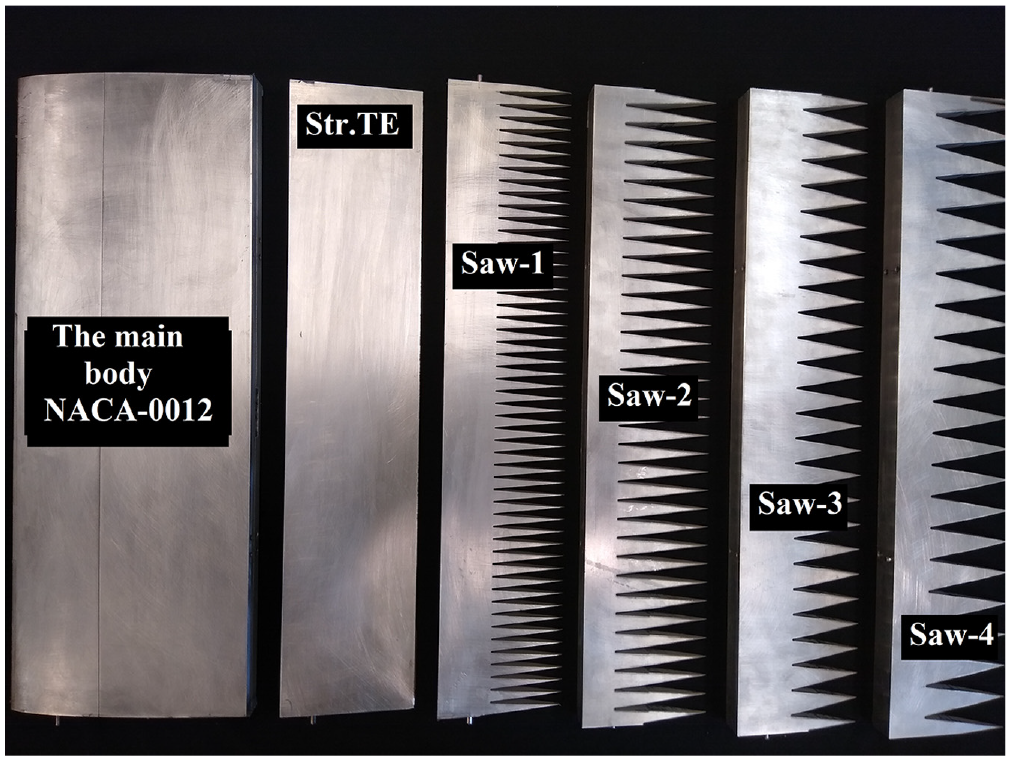
Airfoil model and trailing-edges: Straight trailing-edge (Str.TE), and Saw-1, Saw-2, Saw-3, and Saw-4.
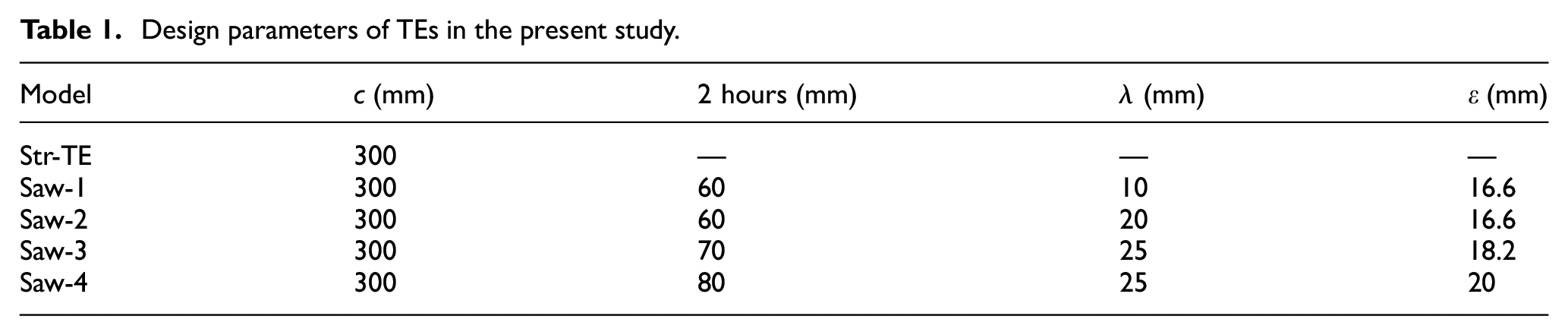
Typical parameters associated with an airfoil serrated trailing-edge geometry include the serration amplitude 2 h (longitudinal distance from serration tip-to-root), and the serration wavelength λ (spanwise distance from sawtooth tip-to-tip). A prominent feature for an airfoil with this type of serrated trailing-edge is that it has significant bluntness (ε) at the root region. Table 1 summarizes the geometrical parameters of the trailing-edge devices manufactured and investigated in this study. Note that from herein all reference to the straight trailing-edge will be represented by Str-TE, and the four sawtooth TEs will be represented by Saw-1, Saw-2, Saw-3, and Saw-4, respectively.
Design parameters of TEs in the present study.
Wind tunnel facility
The experiments were conducted in a closed loop, low-speed wind tunnel at Carleton University as shown in Figure 2. The wind tunnel has rectangular exit cross-section with a height of 0.3 m and a span of 0.73 m. The maximum velocity in the test section is about 900 rpm and the freestream turbulence intensity is about 0.27%. The airfoil model under was mounted vertically across the entire width of the test section. After taking into account the maximum velocity achievable by the current wind tunnel, a Reynolds number of 2.87 × 10⁵ (freestream velocity of 14 m/s), 3.71 × 10⁵ (freestream velocity of 18 m/s) and 5.00 × 10⁵ (freestream velocity of 24 m/s) were chosen for this study. Further details of the facility can be found in Al Tlua and Joana (2020) and Al Tlua and Rocha (2019).
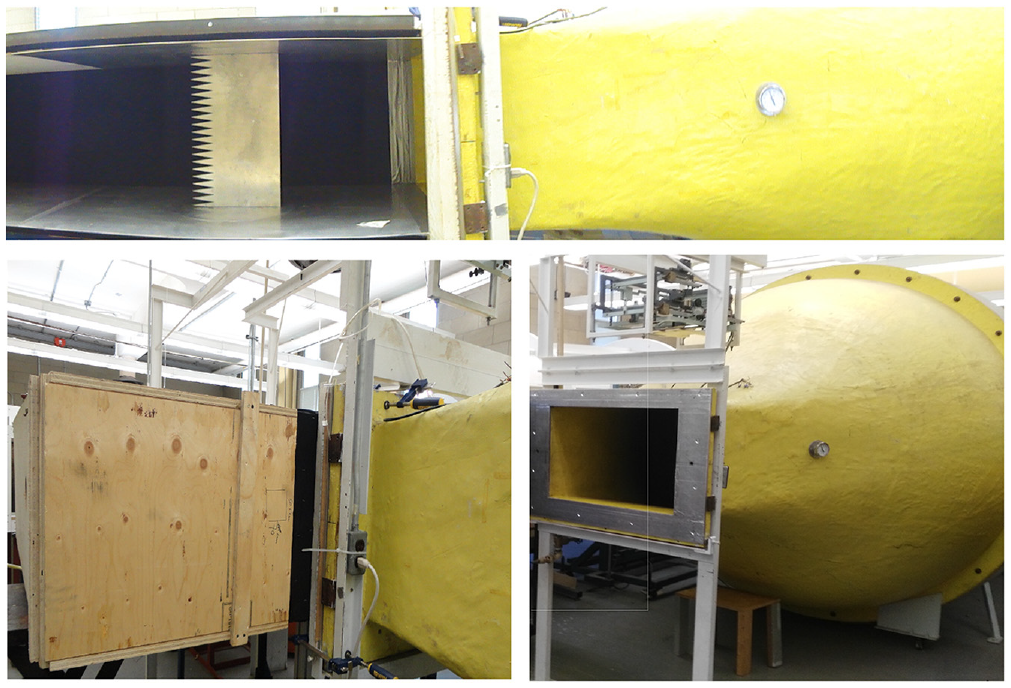
Wind tunnel at Carleton University.
Instruments and procedures
To measure the radiated self-noise from the airfoil, a single calibrated microphone (Bruel & Kjaer (B&K) 4944-A, ″) at angle of θ = 90° was used, at a distance of 1.4 m perpendicular from the airfoil trailing-edge and mid-span height as shown in Figure 3.
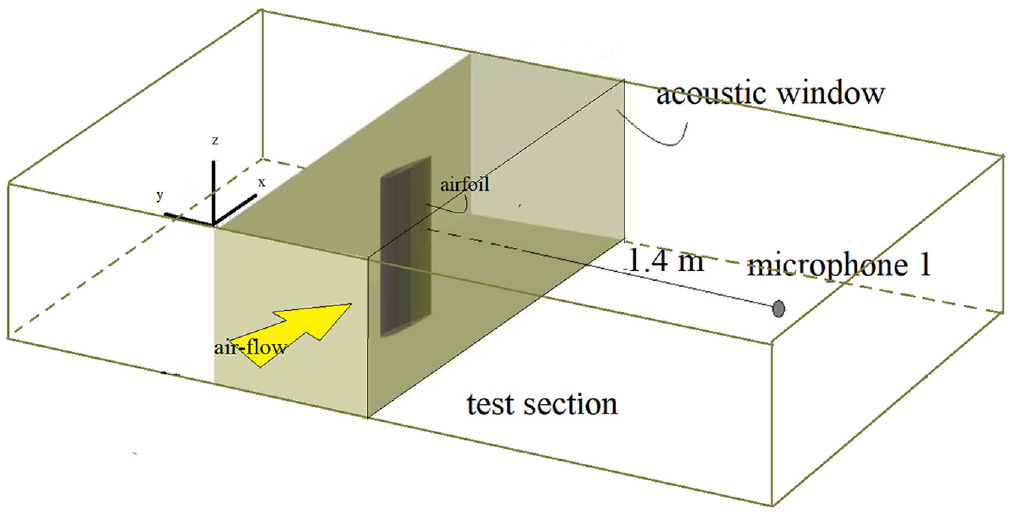
Sketch of the experimental setup for the aeroacoustic measurements.
For all acoustic results, the time and the fluctuating pressure measured by the microphone are recorded, and this is data used to obtain the sound pressure level (SPL). Signals from the microphone were amplified by a B&K Nexus amplifier before digitally stored in a pc through an A/D converter of 24-bit resolution. During the experiment, the acoustic data is sampled at 20 kHz and recorded for 30 seconds. The digitized data was passed through a time domain filter to remove low and high frequency contamination, caused by the microphone’s low frequency roll off and high-frequency aliasing. The band-pass filter used is a Butter-worth filter with the first and second stop-band frequencies of 100 and fs/2 Hz, respectively, where fs is the sampling frequency. The attenuation is 60 dB for both the first and second stop-band. The pass-band ripple is kept as the 1 dB default and the band match used is stop-band. SPL is computed using the root mean square (RMS) of filtered pressure, as follows:

where P ref is the standard reference pressure in air, 20 µPa.
The background noise of the facility, that is, an empty test section without the presence of the airfoil model, was measured prior and after the airfoil noise study. The ranges of flow speed and of angle of attack in which the tonal trailing-edge noise is observed was a key step in the characterization. The first acoustic data was registered by simply listening the sound for determining the limiting conditions of the tonal trailing-edge noise. The measurements were conducted at several velocities (14, 18, and 24 m/s), corresponding to Reynolds numbers based on the chord of 2.87 × 10⁵, 3.71 × 10⁵, and 5.00 × 10⁵, respectively. The clean airfoil exhibits several regimes of tonal noise generation. The registered data were transposed into the SPL versus frequency for different angles of attack and different flow velocities. The investigated angles of attack are 0°, 5°, and 10°.
Results
Occurrence of tones
Knowing whether tonal noise will be present for a given airfoil, Reynolds number, and angle of attack is essential for a perspective of noise output and signature. In this context, this study starts by verifying the regions of operation in which airfoil tonal noise occur. A NACA-0012 airfoil was earlier studied by Lowson et al. (1994). They proposed the involvement of a separated flow in the noise model. According to their model, the shear layer in the laminar separation substantially enhanced the T-S waves. They also indicated a range of conditions (in terms of Rec and angle of attack) where the NACA-0012 airfoil is likely to generate tonal noise. Later, Pröbsting et al. (2014). have compiled results in figure form showing the tonal region and summarizing results from various studies examining different points in and outside of this region. Many experimental observations tend to fall in between a bell-shaped envelope (Figure 4), as also reported by Desquesnes et al. (2007), where tonal noise has often been observed (solid color symbols).
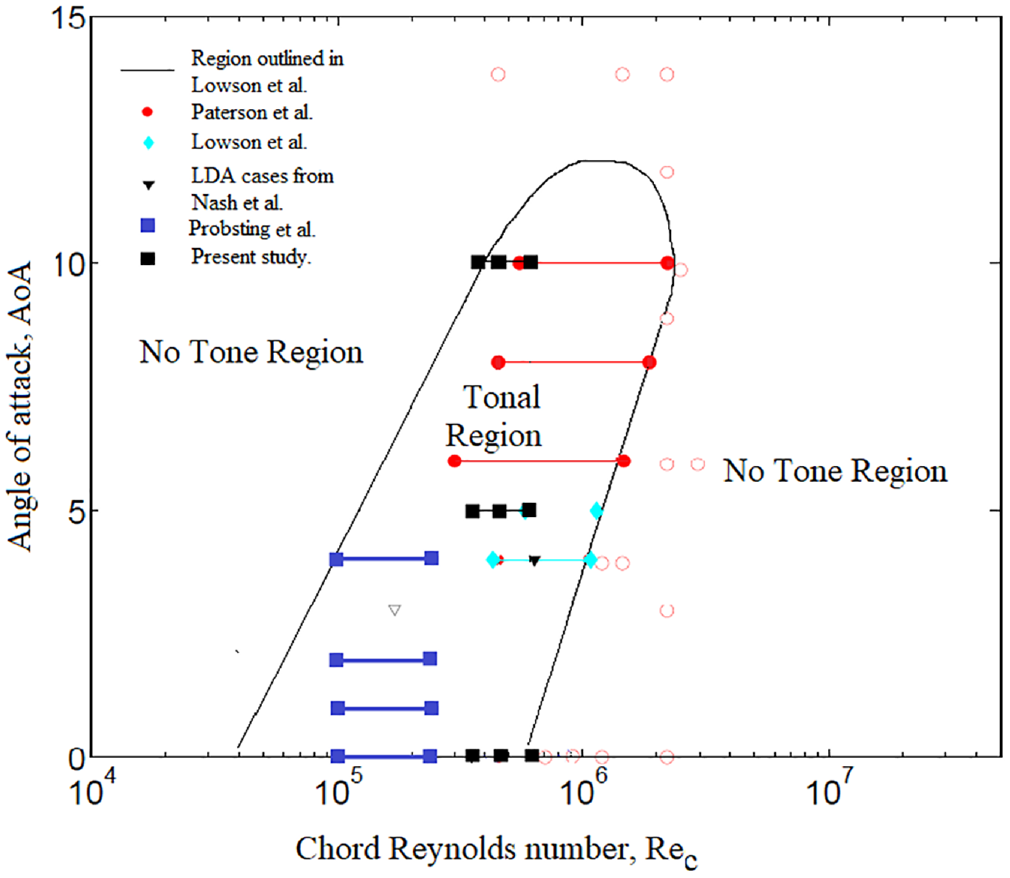
Region of Reynolds number, Rec, and angle of attack, AoA, where tonal noise can be found for a NACA-0012 Airfoil. Adapted from Pröbsting et al. (2014).
Data from the present study comprises relatively low to moderate Reynolds numbers 2.87 × 10⁵–5.00 × 10⁵, and measurement points are represented as black squares in Figure 4, and verified within the tonal region. The reduction of tonal noise for lower Reynolds numbers at α = 4° is corroborated by the data of Nash et al. (1999) and the low-Reynolds-number limit of Desquesnes et al. (2007). Separation and transition to turbulence tend to occur more upstream on both the suction and pressure sides as the Reynolds number increases, which is believed to be the cause of tonal noise suppression. Instead, the airfoil’s acoustic emissions are of a broadband nature in this domain (Paterson et al., 1973). At a Reynolds number of approximately 5.00 × 10⁵ for the NACA-0012, this limit is achieved at zero angle of attack; transition will not occur upstream of the trailing-edge.
Airfoil instability noise with a straight TE
Figure 5 shows the sound pressure level spectra (SPL) radiated by the straight airfoil for three different velocities (14, 18, and 24 m/s) at an angle of attack of 0°. At 14 m/s the broadband hump is clearly noticeable with a dominant tone at 351.6 Hz and followed by two lower tones at 455.8 and 555.9 Hz, respectively. At 18 m/s a single hump is more visible with a marked dominant tone at 545.9 Hz. A remarking point is the disappearance of the tones at 24 m/s. It is possible that at this combination of flow conditions one of the necessary components for tonal trailing-edge noise such as instability waves, feedback loop, or separation bubble is suppressed, hence resulting in the no-appearance of dominate tone.
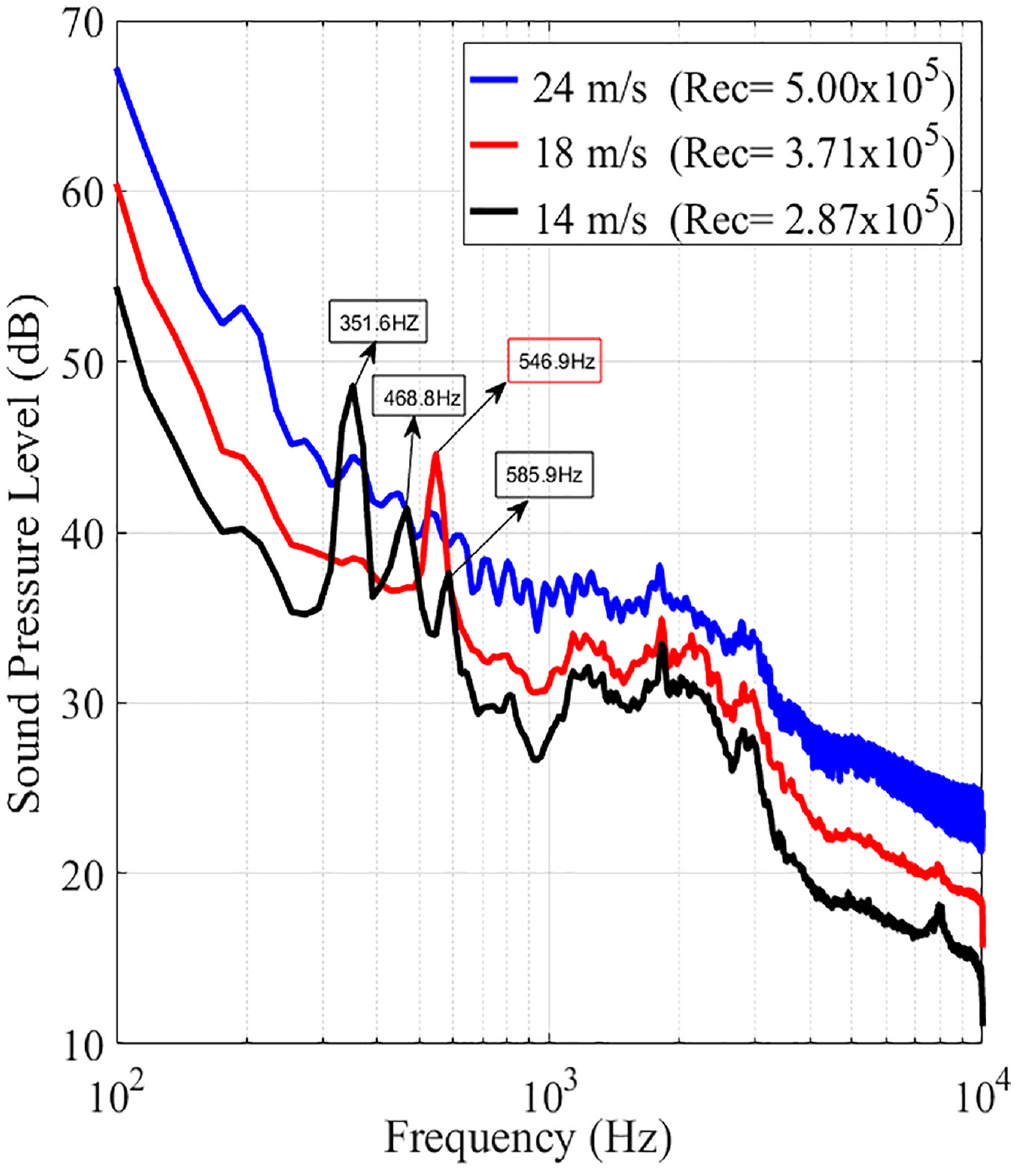
SPL spectra radiated by the straight airfoil at 0° AoA for various in flow velocities.
It is observed that the tone frequency increases gradually with increasing velocities and tone intensity increases first to a maximum value and then decreases with the velocity. It is also found that the instability noise spectra change from tonal noise to broadband noise with increasing velocities. This change can be attributed to the fact that the flow is now closer to a turbulent Reynolds number (5.00 × 10⁵).
Figure 6 shows the sound pressure level spectra SPL radiated by the straight airfoil for various angles of attack at a Reynolds number of 5.00 × 10⁵. It can be observed that there is no distinct tonal noise at 0°, while the spectrum exhibits three broadband humps at 5° between ∼300 and ∼600 Hz, and at the largest angle of attack 10°, the instability noise exhibits an intensive tone at around 449.2 Hz followed by other lower tones at 527.3 and 625 Hz. In addition, high harmonic instability noise with much lower sound level is found for angles of attack of 5° at 724.2 Hz and for 10° at 898.4 Hz. Overall, the instability noise changes from a broadband hump to intensive tonal noise with increasing angle of attack, but the frequency of the main tone does not change significantly with the angle of attack.
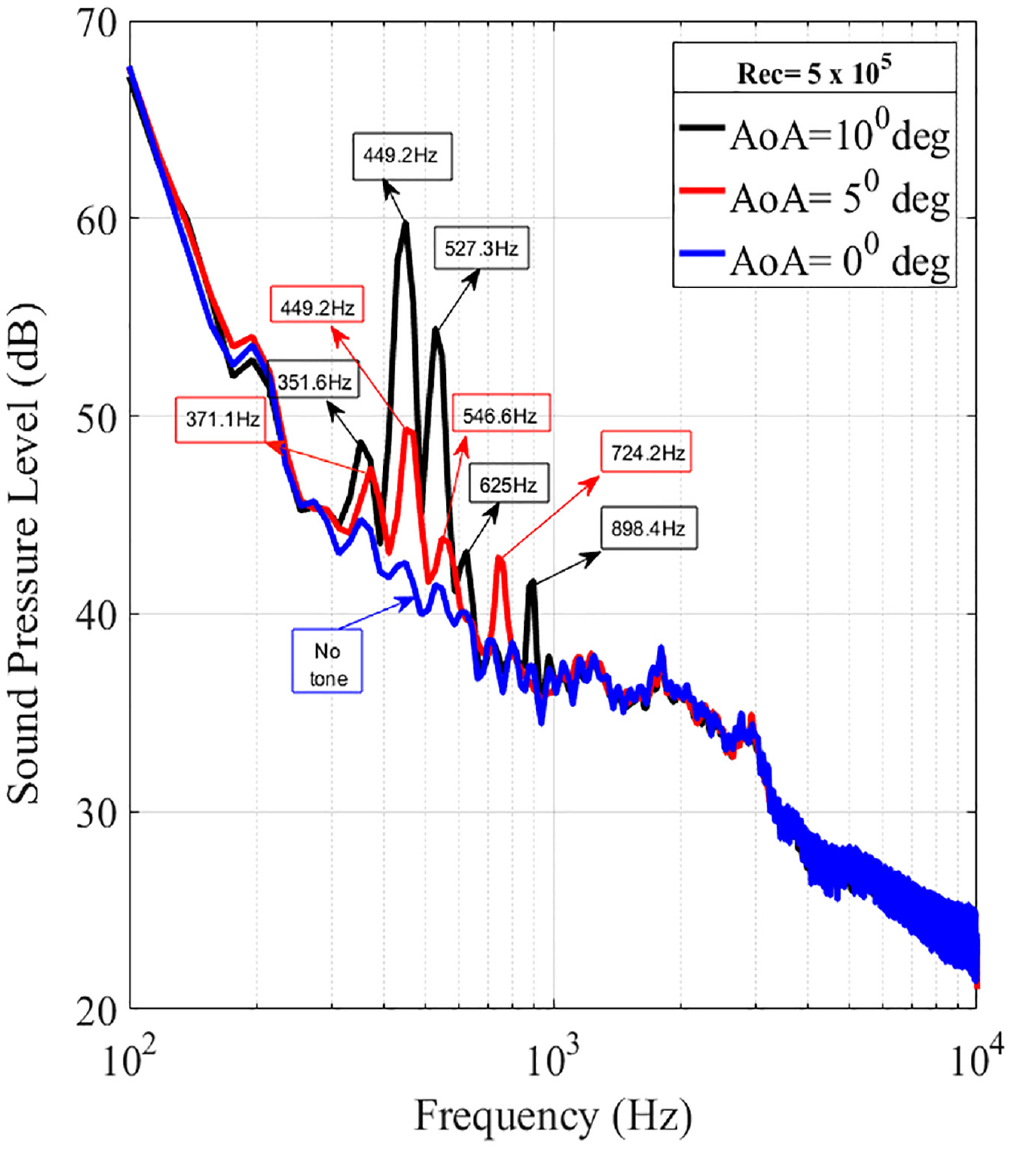
SPL spectra radiated by the straight airfoil for various AoA at a Reynolds number of 5.00 × 10⁵.
Effect of the boundary layer tripping
Figure 7(a) and (b) show the sound pressure level (SPL) spectrum of the airfoil self noise with the straight trailing-edge measured at θ = 5° AoA for the untripped and tripped cases, respectively, for the various velocities. The spectrum for the untripped case is characterized by tones for different free-stream velocities (Figure 7(a)). On the other hand, no noticeable tones are present for the tripped case, and instead broadband self noise is the dominant (Figure 7(b)). Boundary layers at both the suction and pressure surfaces are turbulent near the trailing-edge when tripping elements are applied on their respective surfaces. Without tripping, the boundary layer at the pressure surface is laminar (or separated) near the trailing-edge area, and therefore tonal noise occurs.
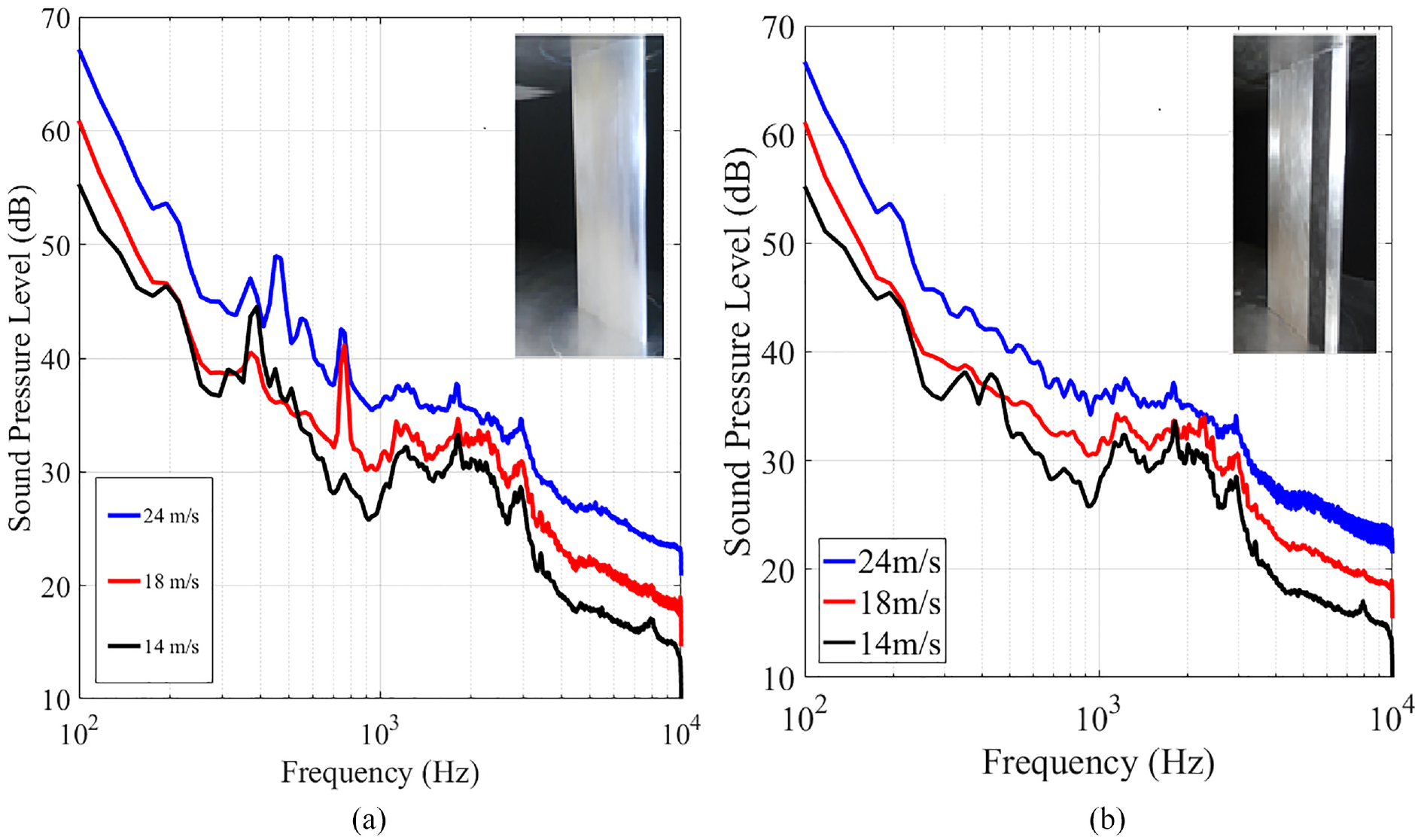
SPL measured at α = 5° AoA and U = 14, 18, and 24 m/s for: (a) untripped airfoil and (b) tripped airfoil.
Noise reduction by sawtooth TEs
The effect of sawtooth trailing-edges on airfoil instability noise is investigated and results shown in Figure 8. The angle of attack is kept at 0° with a Reynolds number of 2.87 × 10⁵ corresponded to the free-stream velocity of 14 m/s. The sawtooth amplitude 2 h ranges from 60 to 80 mm and the wavelength λ varies from 10 to 25 mm, as shown in Table 1. It is observed that straight airfoil exhibits intensive instability noise at around ∼350 Hz, followed by lower tones at ∼470 and ∼570 Hz, respectively, while these tones mechanism are almost completely suppressed by the sawtooth trailing-edges. It is noteworthy that even a sawtooth airfoil with small amplitude (Saw-1 and Saw-2) can effectively reduce the instability noise; however, a sawtooth trailing-edge with larger amplitude (Saw-3 and Saw-4) can achieve better noise reduction. A maximum noise reduction level of ∼17 dB is achieved by the Saw-4 airfoil at approximate frequency of ∼385 Hz.
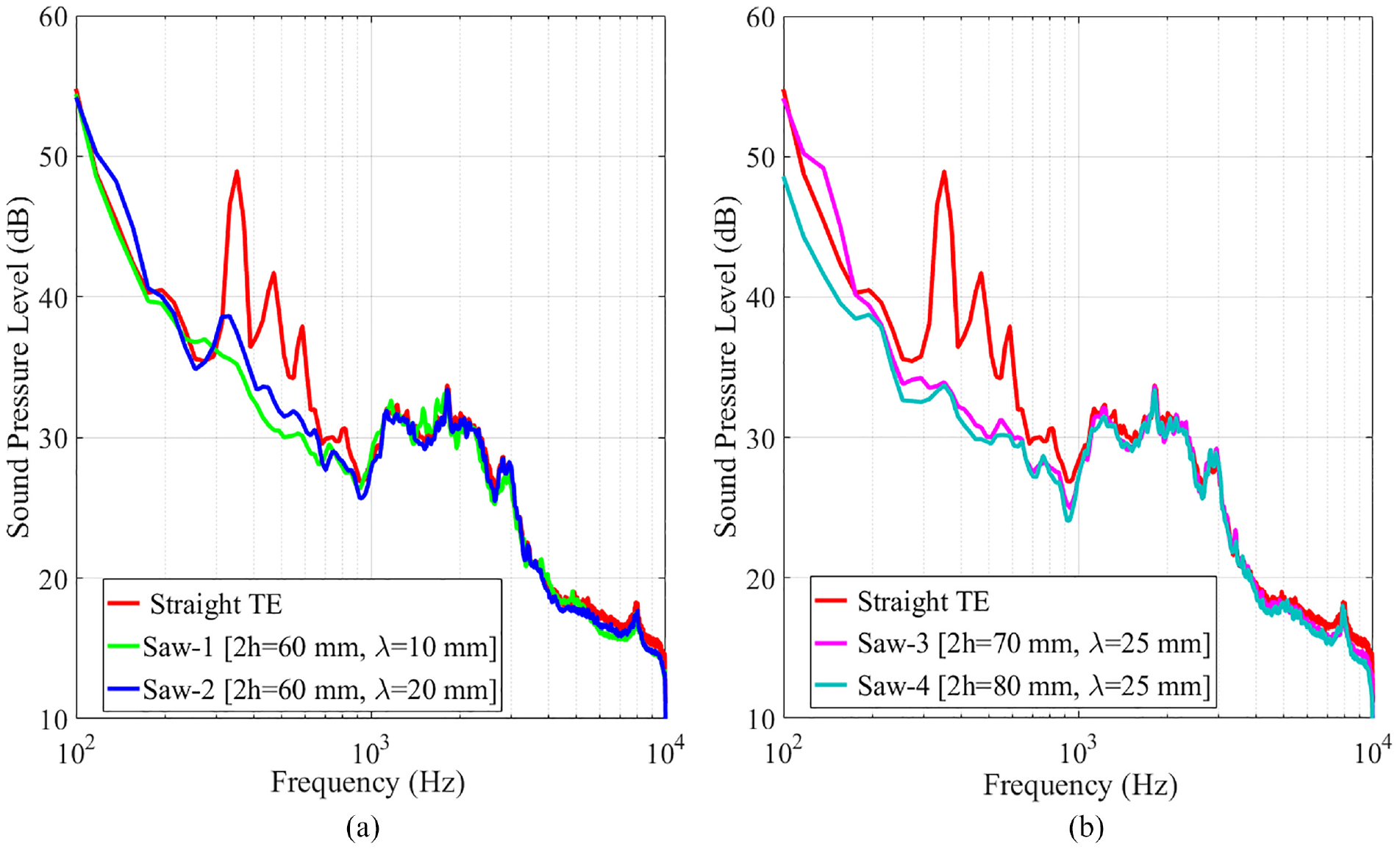
Effect of sawtooth trailing-edges on airfoil instability noise at an angle of attack of 0° and a Reynolds number of 2:87 × 105: (a) small amplitude (Saw-1 and Saw-2) and (b) large amplitude (Saw-3 and Saw-4).
For sawtooth airfoils with larger wavelengths (Saw-3 and Saw-4), the sawtooth trailing-edges can also decrease the instability noise, although the noise reduction level of Saw-3 is less than that of the trailing-edge with an amplitude 2 h = 80 mm (Saw-4). It is also observed that large serration amplitude is beneficial for noise reduction for larger values of streamwise wavelength λ, as shown in Figure 8(b).
The effect of sawtooth trailing-edges on airfoil instability noise at an angle of attack of 5° is depicted in Figure 9. The corresponding Reynolds numbers are 3.71 × 10⁵ and 5.00 × 10⁵, respectively. The sawtooth Saw-1 and Saw-2 amplitudes are fixed as 2 h = 60 mm and the wavelength are λ = 10 mm for Saw-1 and λ = 20 mm for Saw-2. As shown in Figure 9(a), when the Reynolds number is 3.71 × 10⁵, the straight airfoil exhibits intensive instability tonal noise at around ∼800 Hz. When the Reynolds number is 5.00 × 10⁵, the straight airfoil exhibits intensive four tonal noise peaks between ∼400 and ∼700 Hz.
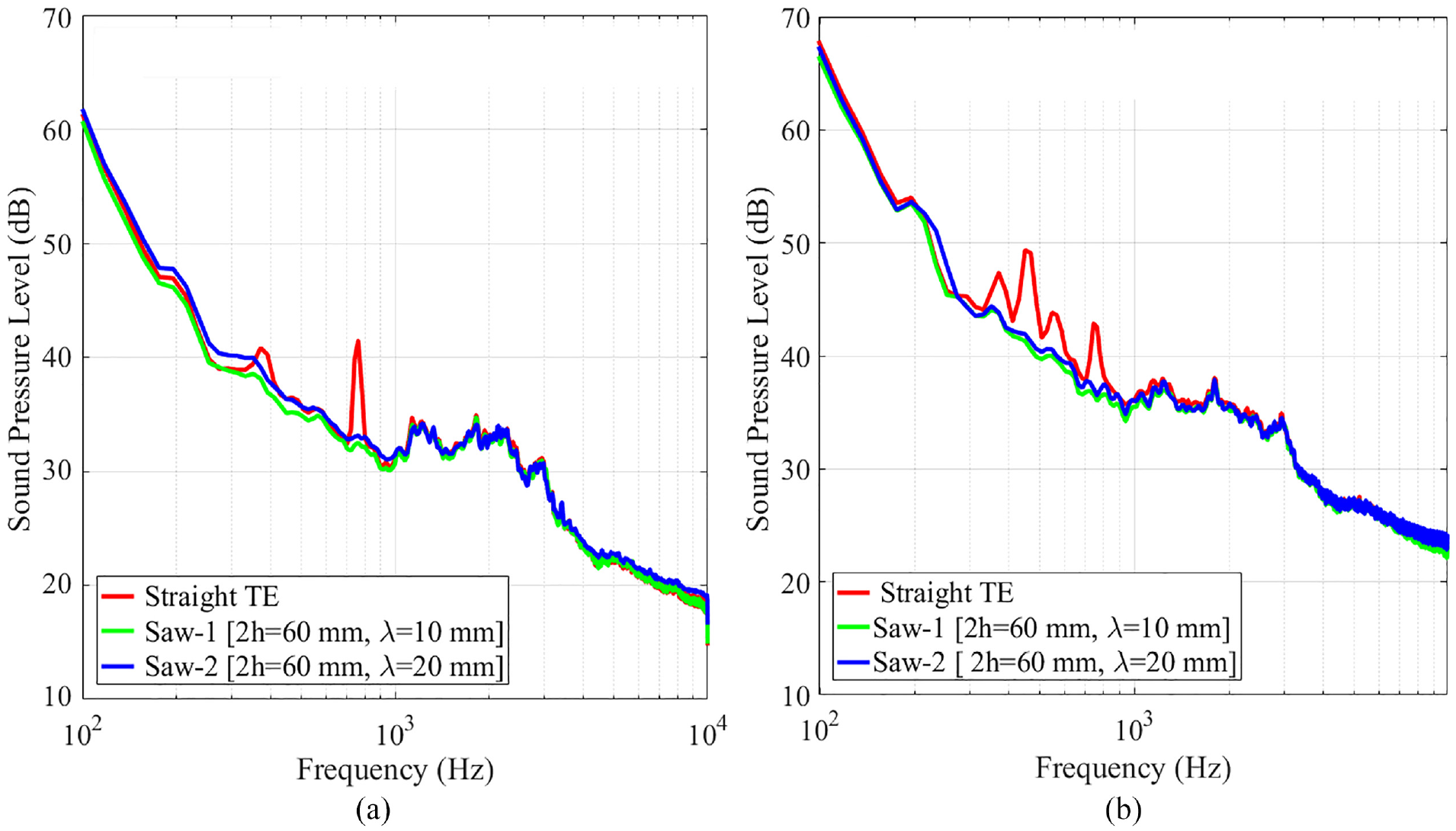
Effect of sawtooth trailing-edges on airfoil instability noise at an angle of attack of 5°: (a) Rec = 3.71 × 10⁵ and (b) Rec = 5.00 × 10⁵.
For the Saw-1 and Saw-2 sawtooth airfoils, the instability noise is eliminated, and the sound spectra exhibit broadband noise. The intensive instability noise disappears for the sawtooth airfoils as shown in Figure 9. Maximum noise reduction levels of ∼9 dB at 800 Hz and ∼8 dB at 550 Hz is obtained by the Saw-1 airfoil at Reynolds numbers of 3.71 × 10⁵ and 5.00 × 10⁵, respectively.
The noise reduction effect of sawtooth trailing-edges at an angle of attack of 10° is plotted in Figure 10 with Reynolds numbers of 3.71 × 10⁵ and 5.00 × 10⁵. At a Reynolds number of 3.71 × 10⁵, the straight airfoil radiates intensive instability tonal noise at around 300 Hz followed by lower tones at 450 and 550 Hz, respectively. The Saw-1 and Saw-2 airfoil radiates broadband noise without distinct instability noise. A maximum noise reduction level of ∼12 dB is achieved by the Saw-1 airfoil at around ∼310 Hz. At a Reynolds number of 5.00 × 10⁵, the straight airfoil radiates instability noise at around 355, 450, 550, and 800 Hz. A maximum noise reduction level of ∼18 dB is achieved by the Saw-1 airfoil at ∼490 Hz.
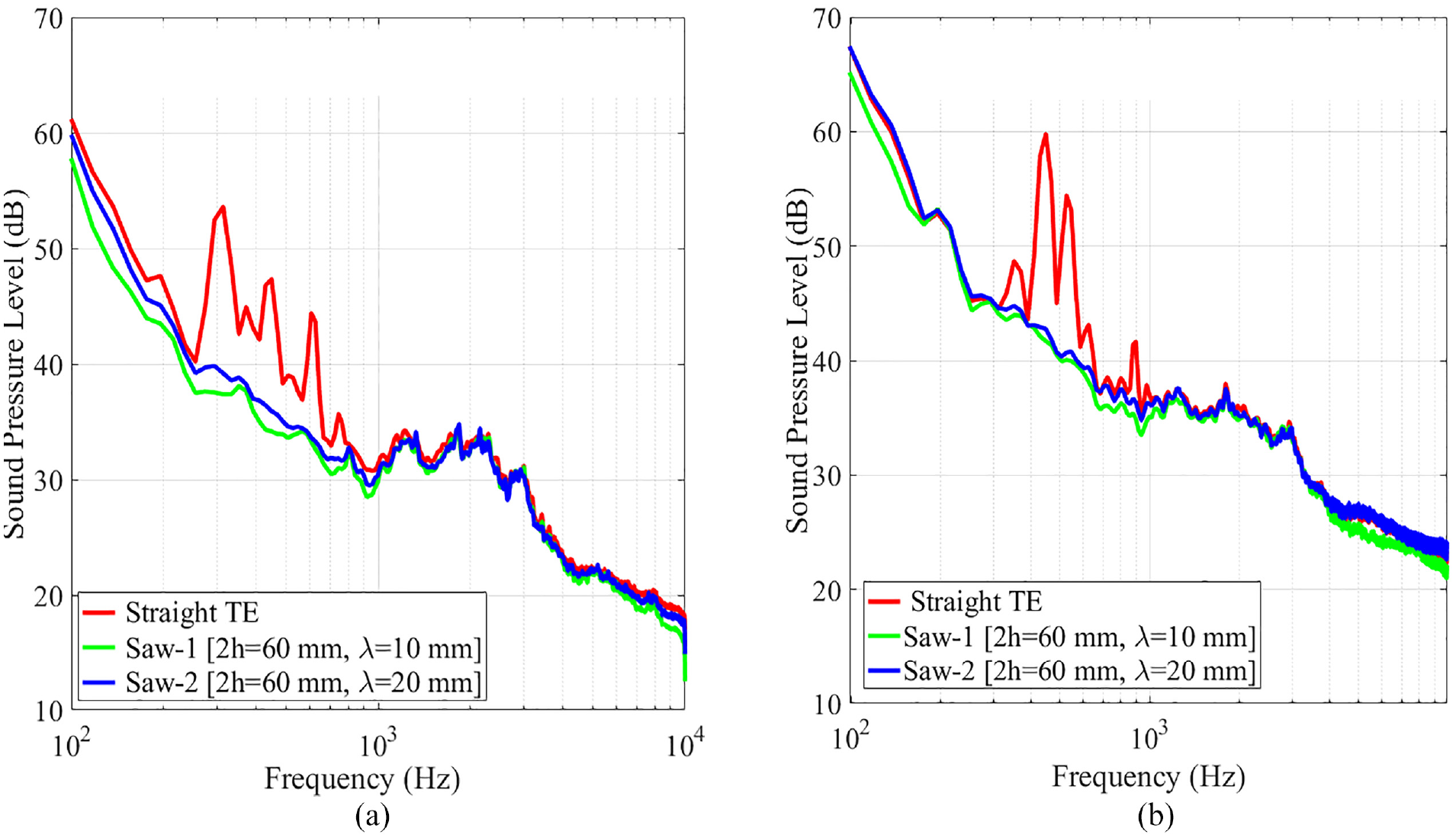
Effect of sawtooth trailing-edges on airfoil instability noise at an angle of attack of 10° and: (a) Rec = 3.71 × 10⁵ and (b) Rec = 5.00 × 10⁵.
Figure 11 further shows the effect of sawtooth trailing-edges on airfoil instability noise at an angle of 10° with a Reynolds number of 5.00 × 10⁵, for Saw-3 and Saw-4. The instability noise is significantly reduced by the two sawtooth airfoils compared to the straight TE. A maximum noise reduction level of ∼17 dB is obtained at frequency of ∼490 Hz by the Saw-4 airfoil. It is notable that broadband noise becomes dominant at frequencies higher than 1000 Hz for all cases.
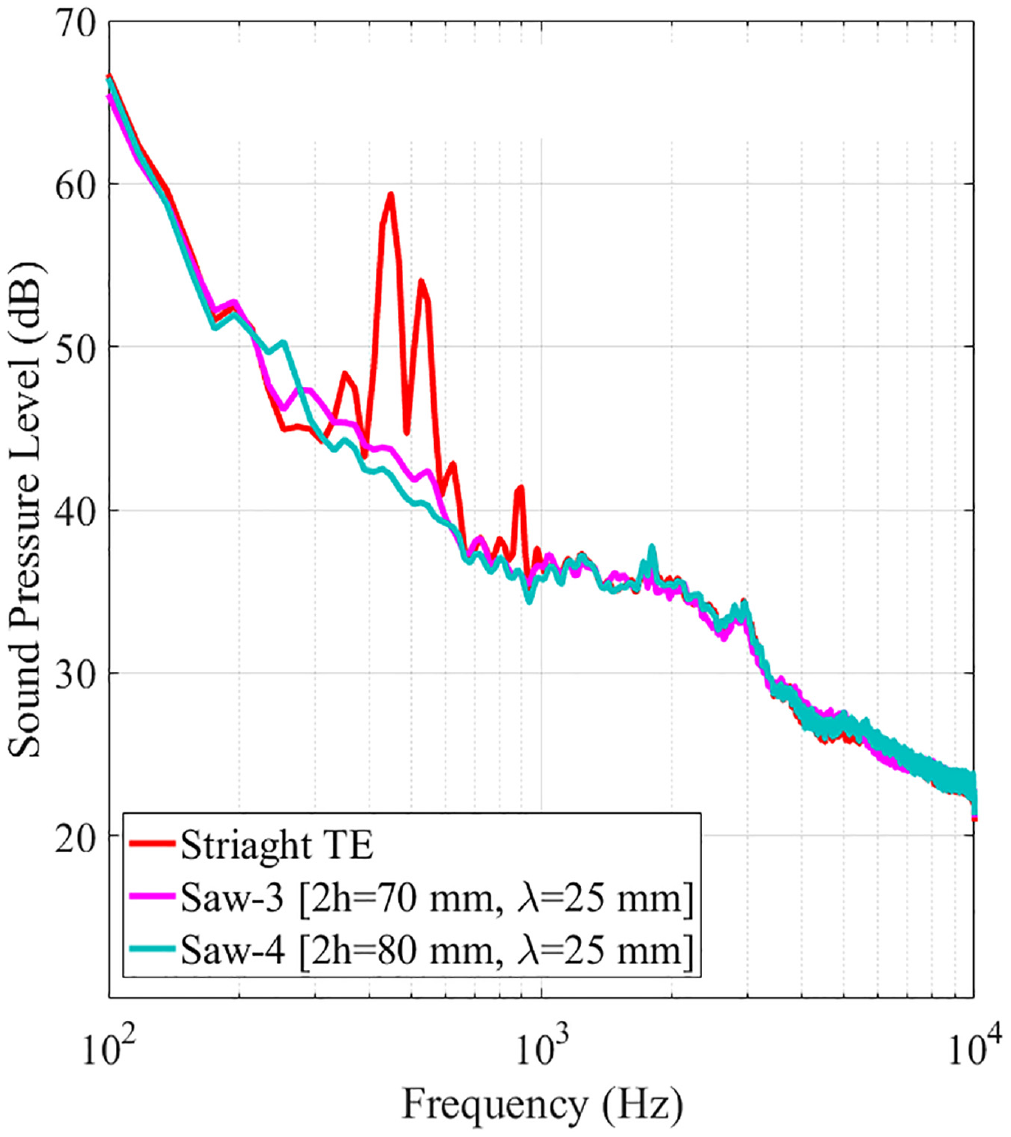
Effect of sawtooth trailing-edges on airfoil instability noise at an angle of attack of 10° and a Reynolds number of 5.00 × 10⁵.
From Figures 8 to 11, one can observe that the sawtooth trailing-edge with a larger amplitude and smaller wavelength is generally more effective at reducing instability tonal noise. On a previous study by the authors (Al Tlua and Joana, 2020), different TE designs were tested to study airfoil turbulence interaction noise reduction. From optimization and experimental tests conducted by the authors to investigate noise reduction from serrated TEs, the largest noise reduction tends be associated with the sawtooth trailing-edge of the largest amplitude and smallest wavelength. Previously, Howe’s work (Howe, 1991a, 1991b) has resulted in similar conclusions, in which a maximum noise reduction of ∼17 dB was achieved. However, the noise reduction mechanisms of the sawtooth trailing-edges on the airfoil instability noise and airfoil turbulence interaction noise are significantly different. The noise reduction mechanisms on the instability noise are mainly attributed to the strong streamwise vorticities generated by the subsidence which can suppress the laminar flow separation near the trailing-edge (Tang et al., 2019), while the noise reduction mechanisms on the turbulent inflow noise are mainly related to the source cut-off effect and phase interference effect of the sawtooth geometry (Howe, 1991b).
Conclusion
An experimental study has been conducted to investigate the noise radiation characteristics of a NACA-0012 airfoil operated at various angles of attack and low to moderate Reynolds numbers, with different TE configurations. The occurrence of instability noise was observed to be sensitive to both the Reynolds number and angle of attack. The tone frequency increased with increasing velocity, while it did not change significantly with the angle of attack. Various wavelengths and amplitudes of sawtooth trailing-edges were examined in order to suppress instability noise. This investigation has shown that sawtooth trailing-edges can successfully be used to eliminate or significantly reduce instability noise, and that sound pressure level reductions were sensitive to both the wavelength and amplitude. The sawtooth trailing-edge with a large amplitude and small wavelength appeared to be the optimum choice to reduce the instability noise.
Footnotes
Acknowledgements
The first author would like to thank his supervisor, Professor Joana Rocha, for all her guidance and support.
Declaration of conflicting interests
The author(s) declared no potential conflicts of interest with respect to the research, authorship, and/or publication of this article.
Funding
The author(s) received no financial support for the research, authorship, and/or publication of this article.
