




Abstract
Expansion in international schools globally has created a sector that is a significant force in global education. With over 14,000 such schools worldwide, serving a student cohort standing at almost 7 million, the sector has a similar number of students to a country such as Italy. Despite their increasing presence, the governance systems of these schools are under-researched. This paper contributes to this space, by focusing on international school governance structures through Actor Network Theory. We analysed data from online interviews with four educational leaders with extensive experience of governance in the international school sector. This process identified five governance network polarities (local-global; mission-money; anchor-agility; stakeholders-capabilities; authority-advisory) that outline the complex interactions between various governing body actors (both human and non-human) and how these interactions shape strategic leadership. We argue that understanding how often competing push-pulls act on these polarities provides insight (and potentially a blueprint) for international school governance networks. We conclude that if governors, chairs of governors, governance professionals and school leaders can identify the polarities acting on these networks, then they can better support the students they ultimately aim to serve.
Introduction
Expansion in the number of international schools globally has created a significant force in global education (Machin, 2020). With some 14,010 schools worldwide in 2024 and a student cohort standing at 6.9 million (ISC Research, 2024), the sector serves a similar number of students to that of Italy. Despite the increasing presence of international schools, the nature of their governance networks, and how their Governing Bodies (GBs) operate, is under-researched (see Wilkinson, 2002; James and Sheppard, 2014; Gibson and Bailey, 2021). As governance and learning are ‘indissolubly mutually interconnected’ (Ranson, 2012a: 31) there is importance in generating understandings – for practice, theory and policy – of how international school governance networks, and the maturity of their GBs, operate. Governance maturity summarises, and acts as a developmental modality for, the effectiveness and efficiency of governance networks. This maturity is not simply chronological, but recognises emotional intelligence, self-awareness, responsibility and the ability for governors and GBs to navigate complex situations with thoughtfulness and empathy (see Clapham, 2024).
This paper contributes to this space, by focusing on international school governance through Actor Network Theory (ANT). Although widely used in education (see for example Fenwick and Edwards, 2012), applying ANT to school governance (see Kamp, 2017), and particularly international school governance, is novel. We analysed data from online interviews with four educational leaders with extensive experience of international school governance networks, and mobilised ANT to understand the role of competing polarities as actors within these networks. This process identified five polarities (local-global; mission-money; anchor-agility; stakeholders-capabilities; authority-advisory) that outline the complex interactions between human and non-human actors within international school governance, where local refers to actors within a particular area or community as well as across an entire country, and global describes international, cross-national and worldwide actors. We argue that understanding how (often competing) actors work as push-pulls on these polarities can provide insight, and potentially a blueprint, for international school governance. We conclude that if governors, chairs, governance professionals (such as board clerks) and school leaders can identify the polarities acting on governance networks, then they can better support the students they ultimately aim to serve. Note that, while we use the term governor to describe governing body members, in the context of this paper the term also describes chairs, governance professionals and clerks.
Mapping International School Governance
That little attention has been paid to international school governance may be partly attributed to its complexity as a construct. It defies treatment as a unitary concept, with governance in the sector taking many different forms (James and Sheppard, 2014). This complexity is only heightened by the commensurate complexity in defining an international school (Hayden, 2011). Cambridge and Thompson (2004: 161) distinguished between ‘ideological variants’ of international education, contrasting ‘internationalist’ approaches with ‘globalist’ approaches. In the former, the purpose of education is to increase international understanding between people of different backgrounds, with society thereby changing to become more peaceful. The latter is characterised by attempts to provide opportunities to the children of an aspirant middle class.
These variants are not taken to be rigid, mutually exclusive descriptors, and are instead acknowledged to be overlapping and co-existent within the philosophies adopted by individual schools (Cambridge and Thompson, 2004: 173). However, they require ‘reconciliation’ in the practice of international education (ibid: 169) and exemplify two distinct ways of thinking about the role of an international school. Cambridge and Thompson acknowledge a specific connection between the globalist variant and the services that some international schools provide to an elite group of host country nationals (ibid: 170). The ambitions of these groups for their children are perhaps unsurprising: accession to a globally mobile, international milieu via (for instance) study at western universities and the acquisition of western cultural capital (Bailey, 2015).
Similar ideas are taken up by Hayden and Thompson (2013) who identified a tripartite typology of international schools: Traditional (catering for communities of expatriate families); ideological (established with a view to promoting global peace and understanding); and non-traditional (those that cater largely for host country nationals). That the final type is defined in the negative echoes a sentiment that occurs in work as early as that of Leach (1969), who saw the older and more traditional school archetypes as being a purer form of international school (Bunnell, 2014; Hill, 2016). Later scholars have gone as far as to question the legitimacy of these non-traditional schools as international schools per se (Bunnell, Fertig and James, 2016). Regardless, of the three types articulated by Hayden and Thompson, one subset of this third version – for-profit schooling in private ownership – is now the most prevalent (Gibson and Bailey, 2021; Bunnell and Gardner-McTaggart, 2024).
Problematising International School Governance
As there are multiple types of international school, it follows that their governance networks will also vary (Chuck, 2015; Gibson and Bailey, 2021). Chojnacki and Detwiler (2019) articulate key differences between types of international school governance networks in terms of membership: (i) elected and (ii) self-perpetuating governing bodies (meaning the current members are responsible for finding and appointing future members), and (iii) ‘hybrid’: a mix of the other two modes. Historically, parent election has been a popular means by which GBs have determined their membership (Bunnell and Gardner-McTaggart, 2024). However, while such GBs may be seen as more democratic, they can also experience tensions as the agendas of individual board members can come into conflict with each other, and with those of school leaders (James and Sheppard, 2014). The growth of for-profit proprietary schools has also seen a corresponding growth in the frequency of GBs that are ‘fully or partially self-perpetuating’ and whose membership does not involve parents of the school (ISC Research, 2022a).
A related development is the increasing prevalence of international school chains: corporate groups of privately-owned schools located either within a single national location or across several countries (Gibson and Bailey, 2021). A corporate group model is likely to invoke specific forms of ‘group’ governance; for instance the presence of ‘varying layers’ (ISC Research, 2022a). Such governance networks often have authoritative, decision-making roles held by a corporate head office representing shareholder interests. Meanwhile, school-level governance involves more of an advisory function and the participation of stakeholders such as parents and students, as discussed below.
As Gibson and Bailey (2021) continue, there are parallels between such governance networks in the international school sector and similar ‘group’ governance contexts in some state sectors; for instance, Multi-Academy Trusts (MATs) with Executive and Local Level Boards in England. In this context, Baxter and Wise (2013) note that the degree of centralisation of decision-making authority can vary between school groups, contrasting ‘hard’ and ‘soft’ forms of governance: highly centralised, top-down forms of authority versus collaborative delegated authority. In navigating the hard and soft aspects of the governance landscape in a particular organisation, such group structures can invoke tensions for governors (see Clapham, 2024).
Despite the possibility of these tensions, the number of chains continues to increase (ISC Research, 2022a), related in part to the rise of the ‘satellite college’ phenomenon (Bunnell, 2008). Here, schools that Bunnell terms ‘elite private schools’ in western countries (especially the United Kingdom) establish franchises, often in partnership with powerful corporate interests in the host countries. An example of this phenomenon is the relationship between Harrow School in England and Asia International School Limited (AISL): a holding company reportedly registered offshore in the Cayman Islands (Cheng, 2021) that has the franchise to several Harrow-branded international schools in Asia, and which was at its origin a pioneering development in the international school market. AISL’s Cayman registration means that information on the holding company’s shareholders is not publicly available; however, its subsidiaries include several companies based in Hong Kong that are involved with operating the Harrow-branded schools (Cheng, 2021). A key figure in these operations is Daniel Chiu. On AISL Harrow’s website its Chief Financial Officer describes Daniel Chiu as the ‘proprietor’ of AISL (AISL, 2025a); Chiu is also listed on the (main) AISL website as the ‘founder’ (AISL, 2025b). Chiu is, according to the Financial Times, an ‘oil billionaire’ (Langley, Staton and Olcott, 2022); he is a 70% shareholder of Fortune Oil, an ‘independent energy company headquartered in Hong Kong’ (Fortune Oil, 2025). The opaque and interwoven nature of the various entities involved in this relationship between an English public school and an oil billionaire provides an example of the reasons for Bunnell’s assignation of the term ‘crypto-growth’ to private equity’s involvement with the international schools sector (Bunnell, 2022). In the satellite college model in particular, international schools are designed and marketed as offshoots of the original school, directly aimed at a local market of aspirant families keen to access the perceived cultural capital that such an association would seem to offer (Bunnell, 2008).
Further complexity is added when considering wider policy trends. There have been recent moves by some national governments to integrate international forms of education into state-funded provision (Hayden, 2011); for instance, the Korean government’s partnership with the International Baccalaureate Organisation (IBO, 2024). Notionally, a state school operating an international curriculum might fall outside of some of the conventional definitions of an international school. The statistics on sector size from ISC Research presented above rely, for instance, on ISC’s description which is limited to ‘privately operated school[s]’ (ISC Research, 2022b). However, it has long been recognised that claims to international school status are often made on ideological grounds rather than being related to the school’s constitutional arrangements: ‘We would define international by what schools do in nurturing [multicultural] understanding; that cooperation, not competition, is the only viable way to solve the major problems facing the planet, all of which transcend ethnic and political borders. Thus, any school in the world, public or private, can be international.’ (Gellar, 1993, in Hayden and Thompson, 1995: 337).
The very definitional boundaries of the international school sector are therefore porous, thus adding yet more complexity to any analysis of their governance networks. Suffice to say, international schools (no matter what type) ‘do not operate entirely independently of national systems’ (James and Sheppard, 2014: 5). They are impacted upon by a wide range of local actors according to context, such as inspection, accountability and regulatory demands. These actors are of course further influenced by the international context of these schools as well as actors around shareholders, profits and revenue.
Theorising international school governance
As a means of theorising international school governance, we drew on Actor Network Theory (ANT) to map the interactions between actors and polarities within governance networks. ANT is a theoretical and methodological approach that examines the interconnectedness of human and non-human actors within networks. Central to ANT is that human and non-human entities (people, objects, ideas, technologies) can be actors in a network and are treated with equal importance within analysis. This is achieved by ‘decentering’ the human to understand how networks are influenced by material, metaphysical and human actors (see Hay, 2024; Unsworth, 2023).
This focus on the material and the semiotic emphasises how networks are dynamic, with complex and interconnected relationships with and between actors. ANT provides a language to describe the often ‘precarious’ networks that require significant work, effort and resources to sustain as well as to describe the linkages between actors (see Fenwick and Edwards, 2012). ANT therefore highlights how networks are formed of assemblies or gatherings of ‘myriad things that order and govern educational practices’ (Fenwick and Edwards, 2012: iv), and can illuminate how networks may be disassembled as well as assembled, and how alternative networks can form and develop.
We argue that ANT can mediate exploration of contrasting macro and micro scale polarities and (often) competing actors within international school governance networks. We drew on Annelies Kamp’s 2017 work, which used ANT to explore systems leadership in education. Kamp (2017: 778) argues that the interplay between human and non-human actors reveals a ‘sociology of associations’ that has implications for school leadership and governance. We suggest that as much as these associations are between actors, they are also between competing and contrasting polarities (that are also actors). Kamp (2017: 780) contends that the strength of ANT is that: ‘[I]n the process of making clear how very heterogeneous actants [where actant is used interchangeably with actor] – furniture, human beings, policy texts, buildings, electoral cycles, a visit by Ofsted [the Office for Standards in Education, Children's Services and Skills, which inspects services providing education and skills for learners of all ages in England], electronic devices, memories, medical diagnoses, architecture, plants, intentions and so forth – are assembled, the potential for them to be assembled anew, with new effect, is also made clear.’
As Kamp (2017: 780) continues, a key point here is how actors can work as ‘intermediaries or mediators’ with significant influence upon a network. For example, power might be devolved from central government to the local level, but accountability processes imposed by the centre interfere with local level networks (see Kamp: 783). Fox (2000) explores the interrelationship between ANT and Foucault’s work on power relations.
Kamp’s work is particularly useful in framing the use of ANT in the international school governance space in two ways. First, it highlights how models for ‘good’ governance (we prefer the term ‘mature’; see Clapham, 2024), can often act as polarities themselves: on one hand, offering a framework upon which GBs can operate, and on the other, being ‘hopelessly oppressive’ (Kamp, 2017: 784). Second, it highlights how non-human actors – for example authority and advisory actors – can (potentially simultaneously) work towards the goals of strategic leadership or thwart them (see MacBeath, 2008).
As we discuss in the next sections, ANT has been useful in highlighting the polarities (and the push-pulls acting on them) in international school governance networks. Doing so enables us to develop a framework for supporting schools to balance these polarities and to understand the interaction between actors within these networks. In the following section, we discuss the methodology and analytical frameworks we employed, and the five governance networks polarities we thus identified.
Methodology
Data were generated via interviews with four educational leaders based in different countries (or markets) with extensive global experience of international school governance, drawing on the expert interview tradition, in which the complexity of the object of inquiry provides a rationale for drawing on informants with specific knowledge of its inner workings (Von Soest, 2022). Table 1 summarises information about each participant, where pseudonyms are used to protect their anonymity. Following Von Soest, we sought to identify expert participants with experiences that provide for both ‘inside’ and ‘outside’ vantage points (ibid: 278). In the context of this study, ‘inside’ expertise stems from being actively engaged in the practice of governing in one or more international schools (Head of School, governor, or group CEO) while ‘outside’ expertise is provided by researching governance or engaging in observational or evaluative processes.
Participant information.
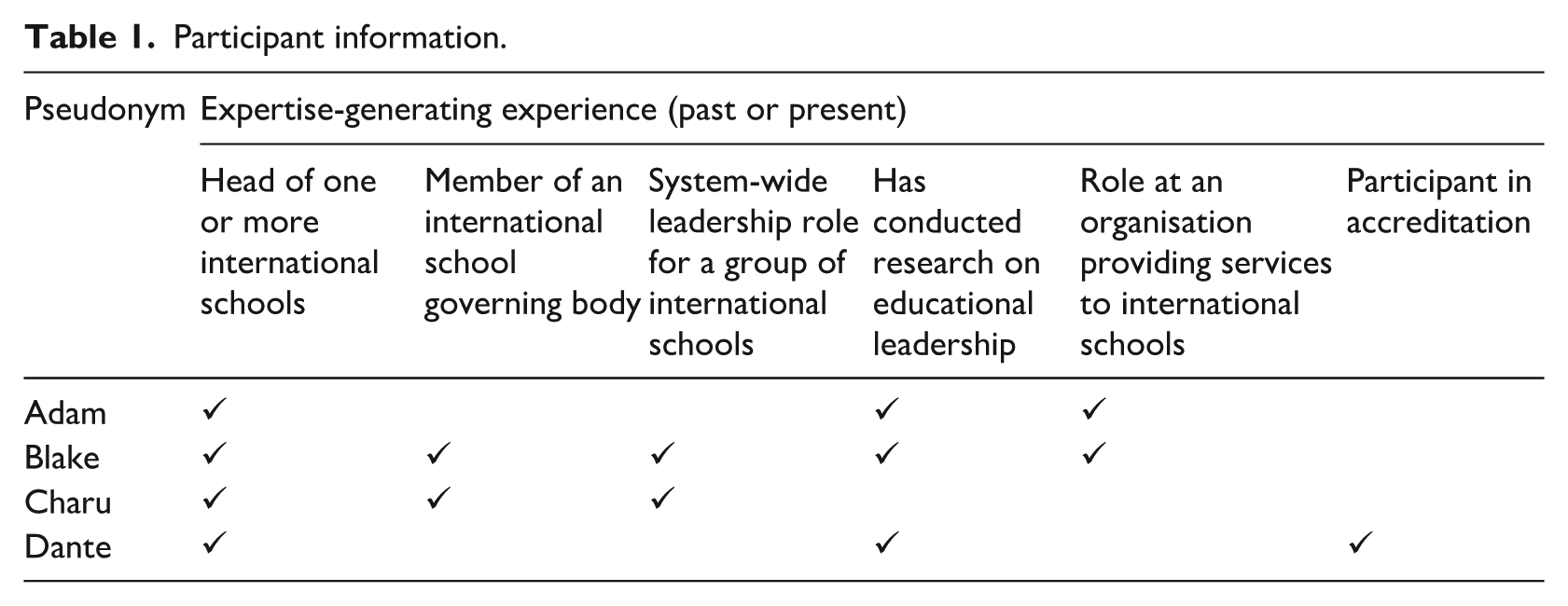
Our criteria for choosing the school leaders who participated in the project were relatively simple. They were recruited through personal connections (purposive sampling) and in strict accordance with BERA’s 2024 guidelines on Ethical Research (for example informed consent, confidentiality, possibility of withdrawing at any time). The project received Favourable Ethical Opinion form the host institution’s Ethics Committee. Participants needed to have significant (over 20 years) experience of school leadership and governance; they had to have worked across multiple international school contexts; they had to have worked (and of course, lived) in a range of different countries, each having different relationships with and understandings of international schools. Between them, the four educational leaders we interviewed had vast experience of school governance in Africa, Asia, Europe, North and South America and Australia.
Although simple, these criteria meant that the ‘pool’ of informants with the depth of knowledge and experience we felt was required for the project was understandably quite small. We were also aware that such a small cohort might potentially skew the conclusions in the direction of the merely anecdotal. To address this, we returned to the methodological literature around expert interviewing. Van Soest (2022: 277), for example, describes how expert interviews can help understand ‘complex decision-making processes’ particularly where there is a ‘dearth of data’. We argue that although small in number, the experience and backgrounds of the school leaders in this project (as noted in Table 1, three of the four have undertaken educational leadership research) means they are able to provide a significant evidence base.
From reviewing literature, and drawing on the research team’s own experience of international school governance and of wider education sector governance research (for example, Pennacchia et al, 2025) we developed an interview schedule divided into five broad sections:
Characteristics of international school governance
Informants’ experience of international school governance
Aims of international school governance
Cultural norms in international school governance
Changes to international school governance over time
The interviews were semi-structured (see Kvale and Brinkman, 2014), an approach appropriate for expert interviews (see Froschauer and Lueger, 2009). The four participants were located on four different continents, and video-conferencing software was utilised as a platform for the interviews. This provided video and audio recordings and automatically generated transcriptions via the software’s tools.
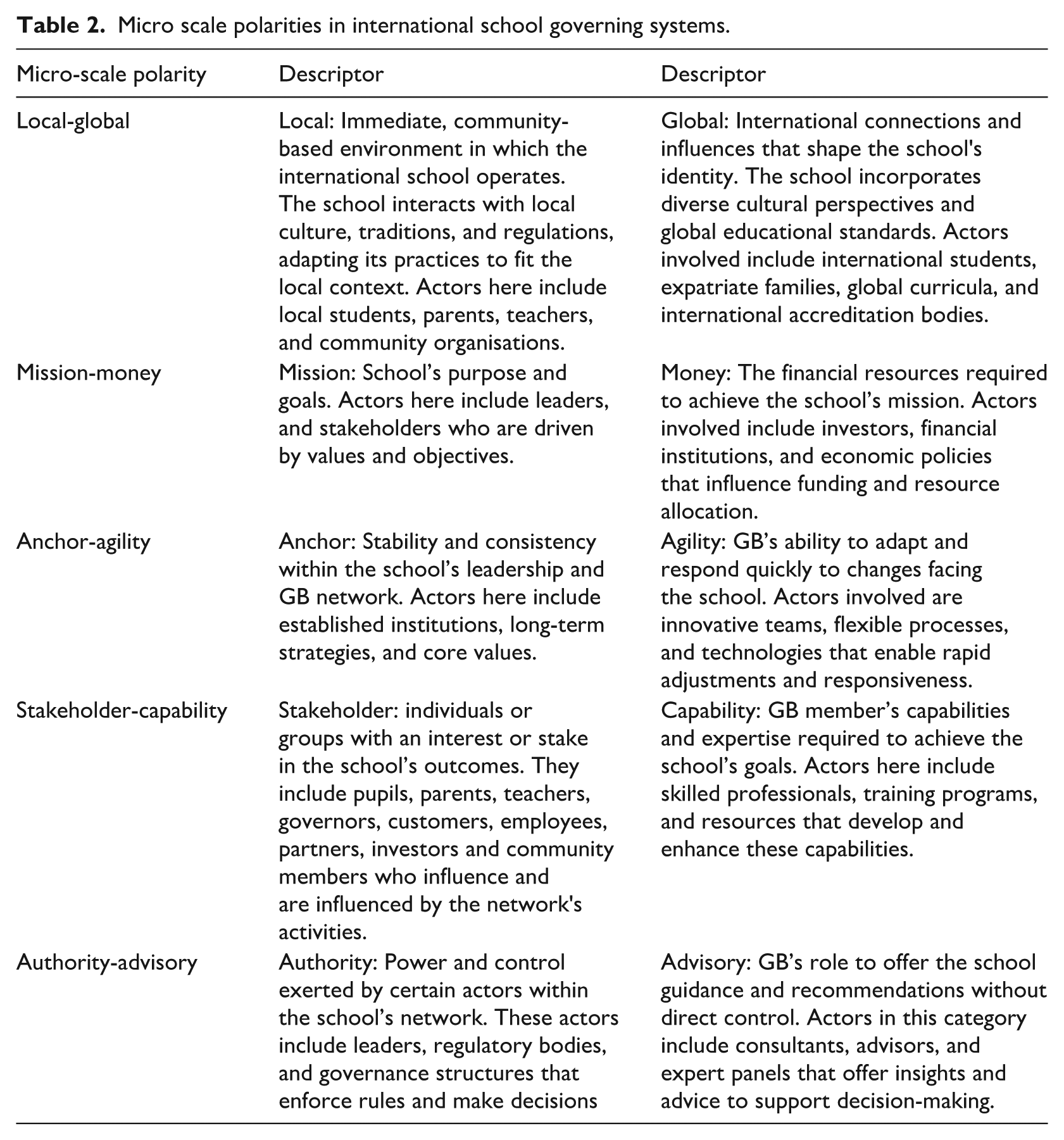
Reflexive thematic analysis (Braun and Clarke, 2021) in conjunction with critical thematic analysis (Lawless and Chen, 2019) were used as the analytical framework. In critical thematic analysis, a first stage of open coding is used to surface emergent themes and discursive patterns, and is followed by a second stage of closed coding in which the data is drawn on to ‘interlink the interview discourses with larger societal ideologies’ (ibid: 97). It is at this second stage that we identified the five polarities in international school governing systems which frame the discussion that follows (see Table 2).
Micro scale polarities in international school governing systems.
Discussion
What our analysis suggests is that as much as the (considerable) complexity of the international school sector frames its governance networks, so too do the interactions between polarities and actors within those networks. These five polarities (local-global; mission-money; anchor-agility; stakeholder-capability; authority-advisory) are high-stakes actors within the governance networks of these schools. Indeed, they are just as high-stakes as more traditional governance network actors such as school board members; heads/principals; regulatory bodies; parents and families; teachers and staff; students; donors and sponsors; local government; and policy. In the following sections we examine what each of these five polarities means for how international school governance networks operate.
Local-global
The local-global polarity reflected the nuances of ‘being’ an international school as well as the interactions between the actors in these networks. This polarity emerged from the participants’ understanding that international schools, and their actors and networks, are simultaneously global and local. They are local in that they are legally constituted in their host country. Sometimes, as Blake noted, this is because the host country establishes one or more formal categories for such organisations within its educational ecosystem, or sometimes because international schools are essentially a variant of a private school in that jurisdiction. Governance of such a school in the local context involves compliance with laws and regulations, which Dante recognised as the ‘first and foremost’ governance responsibility and a necessary precondition of a school’s continued licensure. As he put it, schools must ‘play nice’ with local government.
However, Blake also saw within this the possibility of peril, as actors such as national politics in some jurisdictions can provide a ‘minefield’ for governance networks; an example of how strategic leadership can be thwarted that MacBeath (2008) describes. The upshot of this is that local policy actors can create uncertainty and, in some cases, result in a dissonance of values. Such difficulties can threaten enrolment, meaning that, as Charu saw it, there was an imperative for international school governors to understand the local context. Blake used the metaphor of ‘navigating’ to articulate the role of school-level governance in interacting with the local political environment; Adam expressed similar sentiments in reflecting on the way in which schools must respond to the political philosophies of their locations (Lindle, 2018; Wilkins et al, 2019).
For the participants, however, to ‘navigate’ the local does not mean to accede to it in every respect. There was a sense that some level of regulatory freedom may be a specific boon of being an international school in some cases, and that such schools had the opportunity, as Charu noted, to transcend and exceed local requirements – especially if the school did not think of such requirements as representing a high standard of governance practice. On the other hand, a school distinguishing itself from its local environment is necessarily an exercise in political savvy: it requires that some things remain unwritten lest, as Charu saw it, it be seen otherwise to amount to a critique of local context, which it would be unwise to codify.
As a school’s positioning between global and local is a site of polarity, so too is representation among the participants of local-global governance. Dante noted that some international schools have written into their constitutional documents (such as articles of association) a requirement for representation by certain local groups, as an attempt to codify the ‘international’ component of the school’s identity in that school’s distinctive context. However, if these national groups are expatriate groups within the host country context, in privileging their representation on a governing body the school may be at risk of generating a disconnect between itself and the cultural composition of the host country. As Dante put it: ‘trying to offer a cellophane experience of schooling, where you’ve created a bubble and we are immune to what’s happening around us. You’re not’.
Similarly, Blake perceives the ‘danger’ of the international school becoming an ‘island’ if its board does not represent the local population (reflecting Allen’s (2002) description of international schools as ‘atolls’ in the ‘seas of culture’). Blake sees that local representation may help to ‘ground’ a board in its local environment and yield potential networks with actors who possess cultural capital in the host country. This was an opportunity also seen by Adam, who feels that such local representatives were the ones who were ‘engaged with what was going on’ in the host country. However, local representation (which may involve greater ethnic and cultural homogeneity than is evident in the wider school community) may in turn yield an ethnic disconnection between the board and other elements of the community. In these respects, ‘international’ school governing bodies, just like the schools they serve, are poised between the international and the local. This leads Dante to wonder whether international schools in some jurisdictions are ‘really now local schools’; especially since, as Adam points out, international schools are increasingly serving families who are host country nationals (see ISC Research, 2023).
Considering the different constituents, expatriate and local, that may be served by international schools, divergent perspectives exist with respect to what obligations an international school may owe to students’ future lives. Adam highlights the experience of some students who may feel dislocated from what they perceive to be their ‘home’ country if they have attended an international school elsewhere. As a result, international schools may be obligated to help students to prepare to return ‘home’ to the specific cultural and linguistic context in question. Contrastingly, Charu saw the obligations of schools as being more location-agnostic, aspiring to a more generic concept of ‘global citizenship’. In a sense, both perspectives may generate tensions in the context of governing an international school.
The local and global polarity also plays out in a school’s connection to broader policy networks. International schools are influenced by cross-national policy borrowing (Ball, 2012) as well as by local policy actors. All participants identify a repertoire of ‘good governance’ practice, such as agendas, minutes, a subcommittee structure, reports, annual budgeting, designated leads for certain risk management issues, as being shared across different schools and school systems. For example, Dante identifies accreditation bodies as playing a role in spreading and encouraging the repertoire across the sector internationally, especially by insisting that governance practices at each school are properly codified so that they can then be scrutinised. However, the positioning of the school is often a liminal one, as the repertoire of internationally shared practice encounters specific cultural backdrops in each host country. In Dante’s view, accrediting bodies recognise that they cannot change ‘deeply rooted civilizational cultural frames of reference’, but at the same time seek to ‘navigate’ the ‘micro politics’ of such situations to find practicable means of addressing the polarity.
The balance between local and global polarities and actors significantly impacts the governance of international schools. Governance networks must simultaneously navigate the demands of actors such as local cultural elements and compliance with local regulations, while maintaining globally recognised educational standards and practices. Decision-making processes often involve diverse stakeholders, including local families, international students, and regulatory bodies, which can both complicate governance and also enrich it. Additionally, these governance networks must address the challenges of cultural sensitivity and language. The demands of these multiple actors require governance networks that are adaptable and inclusive, leading to strategic leadership that reflects both local community needs and global educational goals.
Mission-money
Much like local-global actors, the mission-money polarity highlighted the unique nature of international school networks. Unlike state-funded (not-for-profit) schools, or indeed, for-profit local level schools, the mission-money polarity was a high-stakes actor within international school networks. The interactions between mission-money actors played out across the network, with accountability being a particularly high-profile example. The participants saw governance as a means of accountability as much as strategic leadership. Charu saw this as a matter of governors needing to ensure that the school is ‘delivering on what they’ve promised their customers: their parents and their students’; Adam expresses a similar sentiment in positioning the governors as verifying ‘whether it’s delivering in terms of . . . what the school is marketing itself as and promising to be’.
As needed, governors challenge the school – especially the leadership, whom, as Adam points out, they often are responsible for appointing. Dante holds that the governors are there to ensure that a school ‘performs’. They may even take this performance personally, especially in a proprietary model. Adam recounts how one school proprietor showed high levels of personal disappointment that no students in a particular graduating class received admission to the universities of Oxford or Cambridge.
What this means is that the indicators used to define and judge performance are not only high-stakes but also highly contentious. For the participants, accountability as an actor highlights how different philosophies and practices around mature governance interact. As all the participants point out, there is no agreed definition of an international school, therefore no consistent definition of international school governance, and therefore no single best model for it. What may allow for some commonality in the definition of performance is, as Adam articulates, that governors are working to ensure alignment with a school mission. Dante expresses similar sentiments in describing governors as the ‘custodians’ of those guiding statements: ‘I see [the role of governors] as being North Star setting. It’s the school board that sets the direction, and therefore those charged with executing on that – the educational leaders, the CEO, the teachers, the programming, the extracurriculars – however that’s accomplished, have to serve that cause.’
Similarly for Blake, the guiding statements are significant actors in that they ‘drive everything’, as well as reflecting ‘what . . . international education is about’, such as the ‘international’ ideas of peace and diversity.
However, participants also recognised that the way school performance should be judged needs to be set against corporate imperatives as well as moral and ethical considerations. In Dante’s view, the ‘tensions’ between the school’s educational and social mission and the question of what resources should be made available to serve it needs to be ‘talked out’ in governance discussions. Blake recognises that this tension creates a need for ‘balance’. As increasing competition and the commodification and ‘mass production’ of education – for instance through franchising (Bunnell, 2008) – place corporate pressures on governors, both Dante and Blake recognise that the sustainability of the entire international school sector is at stake. The tension between actors in this polarity reflects other work looking at school governance; for example, the push-pulls between governing bodies and regulatory actors such as Ofsted (see Clapham, 2024). In these examples, on the one hand governing bodies must be engaged in the school’s mission and educational outcomes, while at the same time remaining pragmatic to help manage the school’s performance against regulatory actors.
This polarity also relates to the increasing prevalence of for-profit international schools within the sector (Bunnell, Fertig and James, 2016; ISC Research, 2023). Adam points out that some schools that are ostensibly not-for-profit may be part of the for-profit phenomenon, based on ‘great ways of channelling the funds in and out’. Participants see ‘good governance’ in the for-profit context as being a corporate asset. Charu notes that investors in for-profit schools want good governance because it makes for ‘stable schooling’ and is the subject of much ‘due diligence’ prior to an investment being made. Equally, investors are themselves actors with influence on the governance process itself. Charu is clear that they have a ‘big voice’ around the boardroom table, on which they invariably sit, which adds ‘complexity’. They may bring professionalism, according to Blake, and they may (by choice) adopt the above-mentioned repertoire of good governance (per Charu’s experiences of governance in the for-profit context). Equally, where values dissonance occurs between the corporate and educational actors, this becomes the basis for obvious problematisation: ‘We used to notice when we were working with [networks of international schools], the most problematic schools to deal with and also the schools where there were the greatest challenges for teachers, and the biggest turnover of kids, often were the proprietary for-profit schools (Adam).’
In such schools, governance tends to involve an ‘internal’ approach whereby governing body members are close to the corporate entity, thus leading to these actors exerting a powerful sway on the entire network.
The mission-money polarity exemplifies how international school governance must balance the moral and ethical demands of its educational mission with financial sustainability. This means that a host of actors are in play, actors that are simultaneously push-pulling the school's mission with its financial goals. Of course, there is a vested interest between these actors as the educational excellence (real or otherwise) provided by international schools is imperative to maintain if financial viability is also to be maintained. The intersection between actors within the mission-money polarity therefore requires governors to have a particularly sophisticated set of capabilities; a clear understanding of what constitutes ‘good’ education, as well as what makes a viable business.
Anchor-agility
Unlike the previous two examples, the anchor-agility polarity was less obviously unique to the international school context. Mature governing bodies (in the private, public, third sector alike) must offer both safe and considered strategic leadership, whilst also being agile and risk-taking when necessary (Pennacchia et al, 2025). Nonetheless, participants described examples of the way governance as an anchor (actors such as articles of association; governance reviews; succession planning) and agile governance (being proactive to events; changing investment strategies; risk taking) played out in international schools.
Blake saw mature international school GBs as an anchor providing stability. They were ‘custodians’ and a ‘safe pair of hands’, tasked with maintaining the school amid external, and sometimes internal, pressures. Charu agreed by describing how external actors may create regulatory changes, meaning GBs must provide anchorage against these changes (thus ensuring the school is acting lawfully). For Blake, meanwhile, anchored governance was able to resist the vested interests of actors; he gave the example of parent stakeholders who want to ‘get into management’ and advocate something that is of specific benefit to their child. In such circumstances, governance can provide a ‘check and balance’, weighing the subjective interests of the individual stakeholder against the ‘objective’ interests of the school’s network.
However, participants also saw agility as an important characteristic of international school governance. Charu gave the example of the recruitment crises generated by global teacher shortages, and Blake described the growing prevalence and impact of digital technology (particularly AI). Evident in all the participants’ comments was the view that the ‘safe pair of hands’ of anchored governance could easily become myopic, staid and anything but agile.
What was clear from their comments was that it is highly problematic when governing bodies cannot offer future-focused and strategic leadership because they are too large (as Blake observed) or because they have become subject to stasis through a lack of new members (as cited by Adam). Adam also notes that some governing bodies may appear to have more breadth in capabilities and expertise than they have in practice. For Dante, it may be a point of tension that some forms of innovation – for instance, embracing the educational possibilities of artificial intelligence – generate challenges to compliance and regulation. Navigating this polarity is, for Dante, about governing bodies: ‘recognising that they might have a compliance responsibility but equally recognizing that they have a responsibility towards creativity and adaptability, and those two things not necessarily being straightforward and having to be held in suspension.’
A paradox is created in which governance must act both to ensure readiness for change while also ensuring that things stay broadly the same. In navigating this, governance is managing risk either way. Blake recognised that governing bodies are increasingly called upon to manage a growing number of crises (as also identified in Gross, 2024). In doing so GBs may be accountable for making institutional changes following review of a school’s practices, and simultaneously accountable for making sure that practices are strong in the first place, and therefore enduring and unchanging.
International school governance therefore must balance the need for strategic leadership with the ability to remain agile. Governing bodies must establish clear, long-term vision and strategic plans that guide the school's direction and priorities, while maintaining governance structures flexible enough to respond to changing circumstances. Failing to do so means that international schools become staid, rear-view, unresponsive and unadaptable to the dynamic educational landscape. As Charu maintained, whether it is because a governing body fails to anchor the school, or because it fails to shift values fast or far enough, when ‘governance goes wrong it goes wrong big’ (Charu).
Stakeholder-capability
The stakeholder-capability polarity, and tension between actors in it, is prevalent across governing bodies of international schools or other forms of school (see Ranson, 2012b; Wilkins, 2015, 2016; Wilkins et al, 2019). Community-based school governance involving a wide range of stakeholders can increase transparency and accountability in decision-making processes. Similarly, the inclusion of diverse perspectives leads to more comprehensive and inclusive decisions. The counter argument, however, is that the capacity and expertise of stakeholders involved in governance may be limited.
In the specific context of international schools, parent-governed schools are considered as following a traditional model (see Bunnell and Gardner-McTaggart, 2024) of communitarian governance (Ranson, 2012b). Here, stakeholders from the school community hold an authority over what happens at the school; usually via election to several specified board positions. Blake and Adam both judge this mechanism to be intended to ensure ‘equal representation’ of some sort. As the New Public Management paradigm has shifted state-sector schools in western countries to a more professionalised, capabilities-based model (see, for instance, Ranson, 2012b; Wilkins, 2015; Wilkins, 2016), so the international school sector has seen similar changes (as referred to by both Adam and Blake).
For Adam, in the international school context this trend is linked less to changes applicable at the level of individual schools, and more to the opening of brand new schools, which has shifted the centre of gravity across the sector. Corporate groups, venture capital, and proprietorships have driven enormous sector-wide growth. Opening in large numbers across the world and especially in Asia (Hayden, 2011; ISC Research, 2023), Adam viewed such schools as disproportionately likely to bring with them non-stakeholder governance models. Where stakeholder models exist, they require ‘investment’, as Charu terms it, to ensure that the boundaries between governance and management are observed; a new and expanding industry of board training providers having arisen to satisfy this need.
Though some level of crossover between governance and management may be inevitable in some areas (for instance, Dante noted that the management of financial resources may stem from the fiduciary responsibilities governing bodies may hold), in most other areas a credo of separation exists to guard against board members straying into operational matters (Gerrard and Savage, 2022). Adam sees a danger that GB members with individual agendas may crowd out the wider needs of the organisation. Though structure and policy may aid in preserving the relevant role distinctions, Charu avers that it may be group culture and the enforcement of behavioural expectations on the individual level that ultimately ensures the separation of management from governance. Where vested interests exist, there are risks that such behaviours will become problematic, for instance in relation to confidentiality (as cited by Dante) or administrative overstepping (per Adam).
Some new developments or reforms are a ‘nightmare’ to ‘get past’ stakeholders, according to Blake. A long-standing concern about governing bodies that lack maturity is that, when members are also beneficiaries of the school’s practices in the present, they have little or no incentive to plan or contemplate the school undergoing (potentially difficult) transitions from which they might not benefit in the future. Blake’s reflections included an experience of working with a group of schools to advance a particular innovation: ‘Trying to get [it] all through their individual [governing bodies], because you had all the stakeholders, it was a nightmare . . . that word, “tension”, I think it happens a lot more when you’ve got that stakeholder model’
Despite the challenges, Adam saw stakeholder representation as ‘critical’ in governance networks (see also Ranson, 2012a, 2012b; Gerrard and Savage, 2022). In contrast, Blake felt that where stakeholders are absent from the boardroom, there can be greater independence, consistency, and diversity, helping a board to rise to increasing expectations – especially those expectations that ramp up corporate liability. Simultaneously, Charu argued that capabilities-based appointments should be subject to some level of deference to educational voices around the table. Not to do so fails to recognise that schools must be strategically led differently from organisations in other industries. School leaders can, according to Blake, ‘convince’ appointed members of their perspective and, with the political cover that comes from having board backing, can enact changes that would otherwise not pass muster with stakeholders. As a result, a segregation of expertise arises in which educational matters can readily be left to the executive, being the professional educators who, Blake reported, will often be the actual authors of the school’s educational strategy. In contrast, corporate and organisational governance is the preserve of a group of skilled and ‘dispassionate’ (again Blake’s description) expert governors.
The stakeholder-capability polarity therefore highlights this segregation between actors. This phenomenon is illustrated by Adam’s experience of a proprietary international school in which the board was designed to appear to represent the community’s needs. However, in practice it was operating in a network with a high level of centralised control: ‘When you look at the people on that board, they are appointed. There’s really only three people pulling the strings. The rest of them are nominally on the board, but they’re all people with big financial interests and so on . . . the board ostensibly has about twelve people on it, but there’s really three of them running the show.’
Having a wide range of stakeholders on international school GBs offers several advantages. Diverse perspectives can lead to more comprehensive and inclusive decision-making, enhanced transparency and accountability, and stronger community ties. However, this community-based model can also present challenges. There is the possibility of resource disparities, representation issues, difficulties in establishing clear accountability, and limited expertise and capabilities of stakeholders in managing school operations.
Authority-advisory
The last of our five polarities is concerned with governance as an authority-advisory actor. When acting as an authority actor, GBs must enforce rules, make binding decisions, hold the executive to account and set the strategic direction of the school without micromanaging day-to-day operations. In contrast when acting in an advisory capacity, GBs might provide input into the creation and revision of policies, give guidance on budget planning and school performance, and facilitate communications between the school and community. Once again, the way these actors interact is very much reliant on the type of school that is being governed.
In some ‘traditional’ stakeholder models of governing bodies, the members take on specific legal liabilities, for instance by becoming Directors of a limited liability company (Chuck, 2015). By virtue of them holding this level of legal responsibility, such governing bodies have – as Blake commented – been the holders of the final decision on key issues. For example, such governing bodies have been required to entertain escalations of issues beyond the head of school where s/he has not been able to resolve them. Charu was clear that with increasing levels of risk, and concomitant increased expectations placed on governors, international school governors who hold this level of responsibility bear a weighty burden. Similarly, Adam noted that GBs might well be responsible for the oversight of considerable level of financial resourcing, such as where the school is engaging in significant capital expenditure on campus development.
Even in the context of this more ‘traditional’ type of board, however, authority is sometimes opaque – particularly insofar as the roles of the board are or are not delineated from those of the Head of School. In this case, the Head can ‘work out how to navigate the board’ (Blake), with the effect that a strong relationship with the board allows him/her to ‘get things done’. Particularly in national settings, certain practices that are part of mature governance can, as Blake observed, help to mute disagreement and allow the passage of ideas to the point of ratification. For Blake, Heads acting with sufficient stratagem can ‘plant’ strategic ideas that emerge in discussion with the board selectively into the school’s strategic work in service of his/her intentions. Similarly, Charu noted an emerging trend in which more junior leaders (for instance, Heads of Department) being groomed for senior roles are exposed to governance contexts as part of their professional development, presumably to learn early how one can ‘navigate the board’ as part of such a role.
Notably, this polarity is also found in the ‘complexity’ of the ‘dual governance’ setting created by the corporate group (Charu notes this), which may often designate advisory bodies at the school level as an alternative to a school-specific board possessing legal trusteeship. Charu also reports that, in for-profit groups in particular, it is common for members to be ‘appointed’ rather than elected. The role of an advisory board is in keeping with the conceptualisation of governance as a source of accountability. As such, advisory board members therefore ‘have a say’ (again as noted by Charu) through receiving presentations on various forms of data (for instance, academic attainment) and helping to question in the spirit of ‘high challenge, high support’. However, in a for-profit context members of an advisory board may well not make decisions about financial matters. In fact, in Charu’s experience members of such a board do not view the organisation’s financial information at all. These GBs are not there to govern the corporate aspects of the organisation but rather are an extension of a central (corporate) authority’s interests in increasing the educational attainment outcomes (and thereby, the customer satisfaction and likelihood of future profitability) in each of its sites.
The dual role of governing bodies as both an authoritative and advisory actor presents several challenges. Firstly, maintaining objectivity can be difficult. Governing bodies must hold the Head accountable for school performance, while also providing supportive advice which can lead to conflicts of interest (especially if governing body members have personal ties to the school). Secondly, balancing power dynamics is crucial. Governing bodies need to assert their authority without undermining the Head’s leadership. Thirdly, ensuring effective collaboration can be challenging, as GBs must foster a cooperative environment while making potentially unpopular decisions. Linked to this is that successfully navigating policy and compliance actors requires governors to stay informed and up-to-date with educational regulations, which can be time-consuming and complex. Lastly, recruiting and training governors with the right capabilities and knowledge to undertake these activities is essential but often difficult.
Towards a model of governance network polarities
The five polarities we have identified are of course broad categories. For example, the authority-advisory polarity is a highly complex governance network with many actors at play (for example statutory regulations and non-statutory guidance; relationships between the Head, chair of governors and the clerk or governance professional). What our work also suggests is that, whilst some aspects of these polarities may be unique to international school governance networks, others are applicable to both international and non-international schools. Again, using the authority-advisory polarity as an example, there is work that similarly examines how governors of state-funded schools in England are simultaneously advisory and authoritative actors (see Wilkins, 2015; 2016).
Findings like this are in many ways what we set out to explore. Put simply, school governance – of international schools or otherwise – is a comparatively under-researched phenomenon. If we put aside the importance of governance as offering strategic leadership of organisations that have a fundamental effect on young people’s lives, there is also the money factor. The schools’ budget in England for 2024-2025 was around £64,000,000,000 – that is just for England (not the United Kingdom), and just for schools. The strategic leadership and accountability frameworks for this significant amount of public funding is undertaken by volunteer governors often with little or no experience of governance. However, the United Kingdom’s Department for Education is not even sure how many governors there actually are in these schools.
As we have already highlighted, there is a similar lack of research exploring international school governance networks. If we again focus in on money (and conservatively estimate, based on our experience, an average international school tuition fee of £10,000 per annum, for 7 million students, thus giving a sector with income of £70,000,000,000), the lack of understanding around the governance of how these fees are spent is problematic. It is hardly surprising that this lack of research also means a lack of consensus as to the most mature models of governance for these schools. The five polarities we have discussed here go some way to offering some ‘guardrails’ within which research exploring school governance networks can take place. In doing so, the highly complex actions, interactions and reactions of the wide array of actors within these networks can become less opaque than they presently appear to be.
Conclusion
Before our concluding remarks about international school governance, there are some general points to be made about Actor Network Theory. Actor Network Theory is a valuable tool for analysing the polarities in international school governance networks and how interactions between human and non-human actors contribute to those networks. What our work suggests is that competing polarities, and the push-pulls upon them, are very much actors within networks. Although the ANT literature is explicit about non-human actors, categorising polarities as such is novel. While set within the international school sector, our work suggests that exploring the polarities within networks (and considering those polarities themselves as actors) is applicable to any actor network analysis. Clearly there is more work to be done on this. However, directing ANT toward the intersections and interactions between polarities as actors mediates a new understanding of how networks can work.
So, what of international school governance? Well, it is fair to say that things are complicated. Taking each of the five polarities in turn suggests the following.
International school governance is highly influenced by local and global actors
There is significant interplay between the core actors of educational mission and financial sustainability
Governing bodies must establish long-term vision, whilst maintaining adaptable governance structures
Diverse governance can lead to inclusive decision-making, but at the risk of limited school governance capabilities
Governing bodies can be both an authoritative and an advisory actor
Drawing these together highlights how GBs need to be sharply aware of the intersections between actors within local and global governance networks. An international school is simultaneously local and global. It interacts with local culture, traditions, and regulations, adapting its practices to fit the local context. At the same time, it is highly attuned to the international connections and influences that shape the school's identity. Somewhere in the middle of these polarities are the governance actors (which themselves are both local and global) that offer strategic leadership to the school network. Understanding how (often competing) drivers act as push-pulls on these networks can provide insight, and potentially a blueprint, for international school governance. Ultimately, if governors can identify the push-pulls acting on their governance networks, they will be better placed to support the schools, teachers, Heads and students they ultimately serve.
Footnotes
Funding
The authors received no financial support for the research, authorship, and/or publication of this article.
