




Abstract
This article arises from a research study that aimed to contribute to a better understanding of the essential nature of collaborative relationships between English as an Additional Language (EAL) and mainstream subject teachers at an international secondary school in Ukraine. The research focuses on how EAL teachers support EAL learners in the mainstream classroom through collaborative practices. The article draws on qualitative data from interviews and field notes with Language & Literature, Science and EAL teachers. The interviews investigated how EAL and mainstream collaboration help support EAL learners in the mainstream classroom, and which co-planning strategies most effectively encourage collaboration, as well as EAL and mainstream teachers’ views and experiences about co-planning and working collaboratively. Arising from these data, discussion focuses on the disconnect between collaboration in theory and in practice. The article concludes that although effective collaborative strategies often exist, school language policies need to include scheduled collaborative planning time between EAL and the mainstream, and that professional development for mainstream teachers should be led by EAL teachers in order to foster more balanced content and language classroom teaching.
Introduction
The academic school year 2021-2022 commenced after more than a year of COVID-19 pandemic-related disruptions to learning. Ever since the beginning of the pandemic, the international school featured in this study, like all schools around the world, had been adversely affected. In March 2020 all schools in Ukraine were closed, remaining so for the 2019-20 academic year, and a remote mode of learning ensued. This had a significant impact on English as an Additional Language (EAL) learners as all support consequently took place remotely. The development of EAL collaborative strategies therefore became more important than ever, not only in classroom practice but also within the emerging online remote learning platforms. The development of collaborative strategies is a key consideration for a school’s language policy with regards to supporting EAL learners in mainstream classrooms (Leung, 2005: 97; Mijailovic, 2017; Flynn & Curdt-Christiansen, 2018). With a focus on the development of collaborative strategies of co-planning and co-teaching, the EAL department worked with mainstream subject teachers to inform a better practice of support for EAL learners.
How language policies shape EAL support
Four key themes emerge in the literature with regards to how language policies shape EAL support: the implementation of EAL, the inclusion of EAL learners in mainstream schooling, the challenges of EAL teachers collaborating with mainstream teachers, and the role of leadership support in fostering collaborative partnerships.
One of the main features in identifying how EAL support is implemented in international schools is to recognise how EAL policies have been implemented throughout the years in various contexts. England, for example, has experienced three phases of EAL policy over the past sixty years: EAL and assimilation; EAL and withdrawal; and EAL and mainstreaming (Costley, 2014). English language support for non-English speakers in England was primarily implemented along the lines of sheltered instruction; learners unaccustomed to the English school system were pulled out of the mainstream classroom and provided with additional English support. This approach, whereby students could be taught in separate language centres for up to eighteen months (Leung, 2005), was criticised as such learners were not considered to be gaining enough access to the mainstream curriculum. By the 1970s, EAL learners were integrated into the mainstream, and in the 1980s a policy of mainstreaming was established to ensure equity for EAL learners with their peers while accessing mainstream standards (Leung, 2016). Since the National Curriculum was introduced in the late 1980s, EAL learners have been expected to follow the mainstream curriculum along with their native English speaker peers (Leung, 2005).
Some schools in England provide additional EAL lessons for beginners in English, while others have in-class support provided by teaching assistants (Leung, 2016). The advantages of the more traditional ‘pull-out’ model for beginners are that the EAL classroom is a safe haven and encourages greater risk-taking, instruction is targeted at the right language level, and EAL learners can acclimatise to the new culture of the country while preserving features of their home culture and language (Bell & Baecher, 2012: 489). However, there is a growing trend for collaborative planning between EAL and mainstream subject teachers. The advantages of a collaborative model are that EAL learners stay in the mainstream classroom with their peers and suffer less marginalisation, social discourse is improved as they are communicating with their native speaker peers, and they do not miss any valuable instruction by being pulled out (Bell & Baecher, 2012: 489). In England, inclusion based on all learners studying the National Curriculum English programme has done much to eradicate the stigma of immigrant learners and racist attitudes (Leung, 2005).
There can however be a disconnect between general policies that encourage collaboration and the lack of a specific policy as to how language and content should be integrated in practice (Creese, 2010: 100). Many international schools, which are largely English-medium, attempt to do more to integrate language learning for EAL students given the high proportion of non-native English speakers (Carder, 2007), although it is argued that more should be done to integrate language learning in the mainstream for EAL learners (Alderfer & Alderfer, 2011). Many international schools, just like in England (Leung, 2005), have a language policy determining that all mainstream teachers are language teachers. However, mainstream teachers frequently do not have relevant qualifications and expertise to be able to plan for language content in their lessons and a school’s language policy may not be backed up by actual practice (Spencer, 2021). Given the significant numbers of EAL learners and non-native speaker students in international schools, many schools are trying to improve on the contemporary models of pull-out classes, peripheral to mainstream classes (Carder, 2014: 2). Despite the growing culture of policies of collaboration between EAL and mainstream subject teachers, there are significant barriers to such practices.
Innumerable challenges surrounding integrating English language pedagogy into the mainstream classroom have been highlighted, such as those described by Alderfer and Alderfer (2011) regarding the different attitudes that mainstream and EAL teachers have towards EAL learners; the findings of Alderfer and Alderfer recognised that many teachers favoured a pull-out model of EAL rather than collaborating formally or frequently with subject teachers, highlighting the frequent lack of collaboration between mainstream and EAL teachers. Described by Davison (2006) as pseudo compliance, or passive resistance, mainstream teachers often prefer a traditional pull-out programme in order not to have to embrace the practice of teacher collaboration. This position is the polar opposite of the creative co-construction attitude Davison describes, whereby EAL and mainstream teachers create collaborative partnerships involving co-planning and co-teaching.
Further challenges preventing collaboration include instances where EAL learners are deemed a threat to standards (Leung, 2016: 160), implying that the differentiated support EAL learners require is somehow unfair to non-EAL learners or does not meet the standards of the lesson. Greater awareness from mainstream teachers of the need for language provision in their classrooms, as well as a shared understanding of the role of EAL teaching and learning, and mechanisms for monitoring, evaluation and feedback are frequently not in place (Houston & Neal, 2013; Carder, 2014). In the context of England, Leung (2005, 2022) has argued that not enough focus on language teaching for EAL learners in the mainstream has been initiated, and that there is a need for more explicit development of EAL teaching and learning within the mainstream curriculum context.
The subordination of EAL within the confines of the content area and curriculum content teacher (Davison, 2006) can present additional challenges in relation to collaboration. An environment where the mainstream teacher does not understand the role of the EAL teacher can foster distrust which both teachers can experience (Turner, 2016: 572). Additionally, EAL teachers can tend to become marginalised in their teaching support roles (Creese, 2010) if the transmission of subject expertise has higher status. When the EAL teacher, as may occur frequently in international schools, shares the first language of the EAL learners, they can be marginalised even more (Turner, 2016).
Leadership support is crucial in fostering effective and collaborative partnerships. Training must be provided or made available, as well as opportunities for EAL and mainstream subject teachers to work together to co-plan lessons (Bell & Baecher, 2012); a lack of sufficient training for subject teachers to cope with the needs of EAL learners stymies the support that they need as second language learners (Hamann, 2008). Furthermore, the importance of leadership support in introducing a culture of collaboration is an essential factor for mainstream subject teachers, especially regarding workload and the misconception that planning for EAL learners takes up too much time (Davison, 2006).
Content and language teaching in the classroom
As discussed above, there is evidence that a language policy can effectively influence the nature of planning for the content of a subject in connection with the language needs of learners, for example through the implementation of CLIL (Content and Language Integrated Learning). CLIL promotes the learning of academic content and a foreign language simultaneously (Vazquez & Ellison, 2018: 68). The concept of CLIL also advocates for a greater learning experience in general, due to the enriched learning environment of additional language in conjunction with content learning. Not only are L2 (second language) competencies improved but cognitive ability in L1 (first language) also improves (Lorenzo et al, 2009). There is also evidence that students in CLIL classes outperform their mainstream peers, and a significant benefit from CLIL instruction (Perez-Canado, 2012) is that students learn the L2 better in terms not only of fluency but also of increased content knowledge. CLIL boosts risk-taking, problem-solving, vocabulary skills, grammatical awareness and motivation (Vazquez & Ellison, 2018: 69); there is no detriment to the mother tongue through implementing CLIL (Van de Craen et al, 2007).
A focus on language awareness plays an important role in mainstream classrooms. Schools that do not implement a clear strategy of language learning within the mainstream sustain an imbalance between content teaching and language teaching. Subject teachers tend to be concerned with delivering content while EAL teachers are concerned with the language (Creese, 2006), whereas EAL learners need both together in their instruction. Language support focuses more frequently on the how of the learning experience rather than on the content, or subject, learning. A negative knock-on effect exists for EAL learners if there is a lack of a focus in mainstream teaching on the know-how of learning at the expense of the what (for instance too great a focus on the content or subject learning) (Creese, 2010). An ideal collaboration between EAL and content-area teachers requires the integration of content-based EAL teaching and EAL-conscious content teaching (Davison, 2006: 457).
The continuum presented in Figure 1 demonstrates the opposing ends of language and content (subject) teaching and learning (Creese, 2010), describing specific discourse communities where pedagogy and subject knowledge are viewed differently (Creese, 2006). Content can be used as a shell for language learning, a meeting in the centre of the content/subject and language/methodology continuum (Stoller, 2002). The more language you learn, the more content you are able to master and the more content you master, the more you are able to master language skills (Stoller, 2002).

Subject-focused vs language-focused continuum (Creese, 2010).
The design of appropriate tasks for EAL learners within the mainstream classroom can be more problematic than at first glance; overly simplified texts might not only lead to a lack of content knowledge but also inhibit growth in language knowledge. The importance of planning collaboratively cannot be overestimated as this is when language learning through content works best, as opposed to when done on an ad hoc basis (Creese, 2010). The lack of status and trust in the EAL teacher to teach content, and weariness of innovation, are further barriers to effective collaboration (Bell & Baecher, 2012). De Lano et al (1994) argue for innovation in EAL teaching, exploring responsibilities for change, professional development and improvement.
Studies of communication between EAL departments and mainstream teachers have identified that EAL is all too often designed to complement mainstream classes, and no formal agreed levels are established as to what EAL students should be able to achieve (Houston & Neal, 2013). It is also crucial to understand the nature of interactions in classrooms where there are multiple teachers in the room and how they influence initiation, response, feedback (IRF) routines (Creese, 2006); positioning of teachers within the classroom is a vital consideration, both in terms of teacher-to-teacher space and co-relationships, as well as between student and teacher. Turner (2016) elaborates on how the EAL teacher’s relationship to the mainstream classroom in terms of positioning can play a large role in the efficacy of language support. How mainstream teachers position themselves as collaborators with EAL specialists is important, as is how they begin to understand where the gaps in their own language knowledge are and how those gaps can be filled by positioning themselves as collaborators.
The nature of collaboration in schools varies, although it is the quality of and opportunity for collaboration rather than the programme model that is most important (Bell & Baecher, 2012). Furthermore, when collaboration functions at some level, it can easily disappear with changing staff and administrations that do not support collaboration that has already been implemented (Carder, 2014). Professional development in EAL should be disseminated to all teachers, whether EAL specialists or mainstream teachers (Hamann, 2008). Davison (2006) refers to Australia and Canada with respect to collaborative models, though stressing that it is linguistic demands that have been researched and studied rather than the process of co-planning and co-teaching. A further example highlights training practices in Pakistan and the lack of support for professional development in EAL, arguing that collaborative action research (CAR) should act as an alternative model to the existing training programmes (Kasi, 2010). A form of action research, as described by Crookes (1993), involves schools researching for themselves the best models of collaborative practice. Collaborative action research practices aim not only to improve EAL learners’ learning experiences but also to promote professional development between teachers and encourage teacher leadership, as described by Dove and Honigsfeld (2010).
The research in this study draws on the concept of partnership teaching, as described by Creese (2010), which is a mode of collaboration whereby the EAL teacher and the subject teacher plan together before the lesson, developing a method of co-planning and co-teaching between EAL and the mainstream. Both teachers subsequently work with all students but at different times during a lesson. The concept for the model of the two-teacher classroom allows for the EAL and mainstream teachers to complement each other (Creese, 2006). Not only does the integration between content and language improve; it also promotes greater interdepartmental collaboration (Lorenzo et al, 2009: 19). Push-in and pull-out models can work side by side, and it is advisable to create long term planning and objectives based on student needs if collaboration is to become meaningful (Bell & Baecher, 2012). Subject teachers and EAL teachers learn improved lesson delivery and better differentiated instruction, as noted in research by Englezou and Fragkouli (2014) where, when teachers were observed and interviewed, it was demonstrated that they used a variety of techniques to include the EAL children.
This article explores the experiences of collaboration between EAL and mainstream subject teachers. The research on which it is based focuses on understanding how effective collaborative strategies are, as well as on the working relationship between EAL and mainstream subject teachers. The questions derived from the issues surrounding collaboration that drove the research, specifically in the context of the one international school in which the research was conducted, are as follows:
How does EAL and mainstream collaboration help support EAL learners in the mainstream classroom?
Which co-planning strategies most effectively encourage collaboration?
What are EAL and mainstream teachers’ opinions and experiences about co-planning and working collaboratively?
Methodology
The research took place at an International Baccalaureate (IB) World School in a major city in Ukraine, at a time when there were 537 students at the school in classes K-12, with 269 students in the secondary school comprising 47 nationalities. There was a total of 39 EAL students from a student population of 207 students enrolled in IB MYP (Middle Years Programme) classes, Grades 6-10, making an EAL learner population of a little over 20 percent. The EAL department had three full time secondary teachers and one teaching assistant. As the researcher, the author of this article, was at the time of data collection the head of EAL at the school, there was an opportunity both to develop the implementation of EAL through drawing on relevant literature to influence the growing culture of collaborative partnerships with mainstream colleagues and to steer the EAL department towards such practice through the implementation of new departmental goals. The secondary school comprised eight mainstream subject departments. Table 1 shows the number of full-time teachers in the MYP for the secondary school according to subject.
Number of MYP teachers according to subject.

The term EAL is used in this study as opposed to ESL (English as a Second Language) or EFL (English as a Foreign Language) because it is a support subject studied in addition to the learners’ own home language. EAL is not a graded subject and does not constitute a part of the IB curriculum. New students to the school in question are placed in the EAL programme for English language support if they have a composite score (speaking, listening, reading and writing) below 5.0 out of a maximum 6.0 in the WIDA (World-Class Instructional Design and Assessment) standardised test. English language support at the school consisted of MYP Language Acquisition English lessons and extra EAL classes, as well as push-in support with the teaching assistant for EAL students in mainstream lessons. After June 2021 extra EAL lessons were no longer scheduled as the EAL teachers wanted to provide EAL support through collaborative planning with mainstream subject teachers. Beginning in August 2021, EAL teachers were tasked with setting up scheduled co-planning meetings with mainstream teachers in order to co-plan for differentiated content and assessment methods within the mainstream classroom. From the beginning of the school year, it was clear that the EAL department would need to form a very close working relationship with the Language & Literature (L&L) department, as EAL learners would be enrolled in the L&L classes for the first time and would need support provided through the close collaboration of the two departments.
This study comprises data generated through focus group discussions and interviews with mainstream subject teachers regarding co-planning and collaboration, as well as field notes taken by the researcher in co-planning meetings. The study researched the efficacy of collaborative and co-planning practices as well as how such practices might have an effect on institutional policy and classroom contexts (as discussed by Costley & Reilly, 2021).
To understand the real-world practices of how English language support can be implemented in the mainstream classroom it was important to focus on the study as a social inquiry with regards to the routine of teachers’ collaborative practices (Hammersley, 2007). The research took place over an entire academic year in order to track the development of collaborative practices through reflective conversations between the researcher and the mainstream subject teachers. Figure 2 shows a timeline of when the researcher met with L&L, Science and EAL colleagues throughout the school year to discuss and reflect on collaborative strategies, as well as significant events that took place. Science was also highlighted as a subject of priority regarding co-planning and collaboration with EAL because the leadership team had requested more language support strategies for EAL learners in the subject due to low attainment.
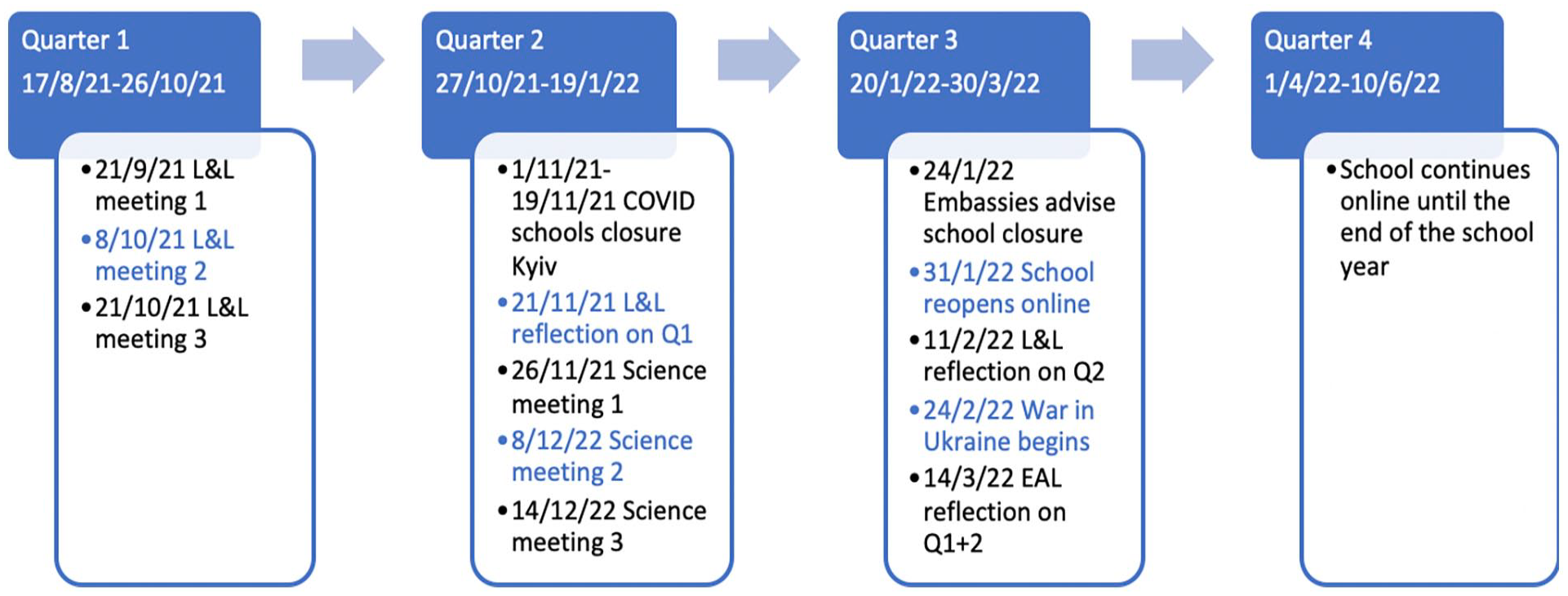
Timeline of meetings and significant events in the school year 2021-22.
By gathering social research from real world contexts in small scale groups, the functions of teacher actions and an understanding of participants’ perspectives (Maybin & Tusting, 2011) would present a clear picture of an analysis of how social factors negotiate the meaning of local instances of language use in context (Perez-Milans, 2016).
By focussing on locally situated research, the orientation of teacher-participant research allowed for data to be drawn from different perspectives throughout the academic year (Richards, 2009). Data collection through the use of qualitative interviews generated new analytical angles and findings, and allowed for interpretative and opinion-based data. The repeated practice of interviewing and generating field notes allowed for different descriptions of the same situations or events (Copland & Creese, 2015).
Data analysis and preliminary findings
The qualitative data, generated from interviews led with mainstream subject teachers by the researcher, are presented here in coded form to ensure the anonymity of the participants. L&L T1 refers to Language & Literature Teacher One. Where field notes are drawn on in the presentation of data, the subject, RFN (research field notes) and date notes were made are included. Extracts from teachers are verbatim quotes.
Quarter One – August 2021 to October 2021
Figure 3 shows the five key themes which emerged from the reflective discussions and researcher’s field notes from quarter one.
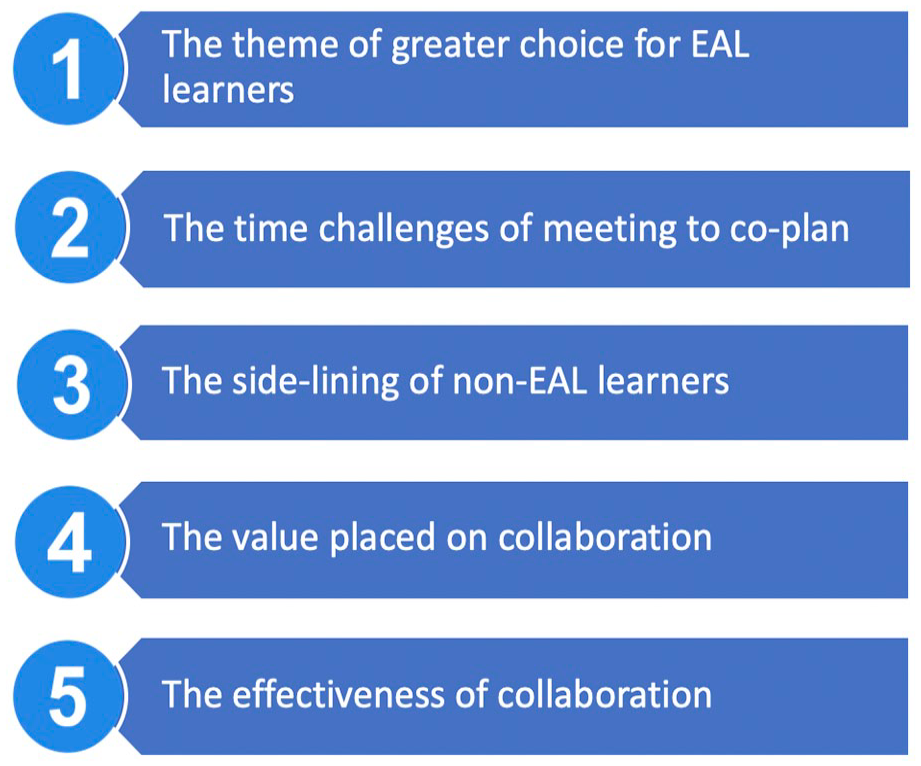
Five key themes emerging from quarter one.
The EAL and L&L departments met in mid-September 2021 to discuss guidance on modifications for assessment and how to deal with emergent level EAL learners in the L&L course. The matter of greater student choice was discussed with regards to reading texts and the production of texts, as well as how to grade EAL learners in the L&L course, as shown in the following extract:
L&L RFN 21/9/21: 3 levels of proficiency choice – formative and summative – could be a good idea. The idea being that at the moment there is no choice with regards reading text or production of text. This would be an inclusive option not only for EALers but also for learning support and lower ability native speakers.
It was felt here that student choice would have a significant impact on progress for EAL learners in the L&L course as they would need texts that they could access at their language level as well as being allowed to produce written texts at their language level.
Trying to schedule meetings between subject teachers and EAL teachers at mutually free periods in the schedule proved to be difficult and, whereas EAL teachers had more time freed up in their schedules to support and co-plan with mainstream teachers, the mainstream subject teachers themselves had busy schedules and needed free periods to plan as well as to co-plan with the EAL department. Mainstream subject teachers discussed the time pressures and the potentially added time pressure of co-planning with the EAL department:
L&L T2: What is the challenge, obviously, is the time . . .
Each EAL teacher scheduled co-planning meetings once per six-day teaching cycle with the L&L teachers in order to support with differentiated learning and to plan the kind of in-class support that EAL learners in the L&L class might need.
EAL T1: [W]e need to have collaborative time scheduled during our PD sessions. So, if that time is kind of provided and there is this understanding of EAL teachers being equal stakeholders, then it becomes easier for [us] not just to listen to what we are expected to do but also to kind of share ideas and be equally responsible for the whole class.
In early October two EAL teachers and two L&L teachers met with the MYP coordinator to plan the next Grade 6 L&L unit: a poetry unit. Teachers had some pull-out time from their schedules to plan together for the first two weeks’ teaching in detail, for instance planning each lesson. This pull-out time was thought of as highly beneficial for planning a unit in advance rather than the usual practice of weekly planning:
L&L T2: [T]hat one half-day for Grade 6 was really helpful to get the unit started. And that bought us time to get ahead of things . . . you know, we’re framing those lessons with your input and with what you and [xxxx] and [xxxx] suggested. But it’s all being in the room together for an extended amount of time.
There was a common understanding by all teachers that the existing Grade six poetry unit needed adaptions for EAL learners:
L&L RFN 8/10/21: We looked at the slides that currently exist for the unit and understood that the unit needs to be broken down a lot more to take into consideration accessibility for EALers/learning support and other students because of language issues.
One of the L&L teachers, who was new to the school as of August 2021, expressed concern regarding the amount of support that was being offered to the EAL learners and Learning Support students to the detriment of other learners in the class:
L&L T1: [T]his is where I’m struggling as, yes, I have to advocate for the EAL students, but I also have to advocate for my students who don’t get that kind of support and they could benefit from that as well. So, I don’t know where we are right now at that.
This kind of comment had previously been noted by the researcher in a previous planning meeting:
L&L RFN 21/9/21: [xxxx] mentioned that you need to challenge students and is it fair for those students who don’t get supports to be side-lined?
Overall, by the end of quarter one the collaboration between the EAL and L&L departments was deemed to be useful:
L&L T1: I think that having this close collaboration has been really helpful in terms of reaching them in the best possible way. So, it has been very helpful. L&L T2: Because, you know . . . the idea of now that we’re virtual, letting you go in on those unit slides and then adding links to things that you think any kid could benefit from, that is really, really helpful.
As well as the long-term planning, the weekly planning and support from the EAL teachers had had a positive impact in the L&L classroom:
L&L T2: And that actually came up today after my Grade 9 class with [name of colleague], ‘cause I have all four of the 9s in my one class, and she was very much like, ‘This is really working. I can see my kids can access things.’ L&L T1: [xxxx] and I have been working closely with Grade 8 as well, 8.1, and for her, looking at my assessments and then scaffolding it for the EAL students has been really helpful.
The fact that EAL teachers knew the EAL learners so well through their teaching in the Language Acquisition English class was also seen as positive:
L&L T1: [S]he knows the students better at this point because she is also teaching them as language acquisition, so I feel like she knows exactly how to better support them and meet their needs.
Quarter Two – November 2021 to January 2022
Following the reflective discussions at the end of quarter one, the EAL and L&L teachers continued to develop their co-planning strategies. Six key themes emerged from the reflective discussions and researcher’s field notes from quarter two: the need for more structured co-planning time, the efficacy of planning ahead more, the changing nature of the lessons, issues surrounding grading, the role of EAL collaboration and teacher frustrations.
More than ever, L&L teachers felt there needed to be a more structured approach to co-planning time for all teachers:
L&L T1: I also feel like Wednesdays could be used at least once every two months because that’s like the amount of time that we normally take for a unit, like seven weeks, six weeks, and we can really sit down and talk about the next unit.
The issue of developing co-planning strategies for units in advance was also noted to be an effective strategy and was recommended as standard practice across the curriculum:
L&L T1: I think that the last quarter has definitely improved compared to the first quarter. I think that especially for Grade 6 (I can’t speak for Grade 10), but for Grade 6 [xxxx] and I have planned ahead, and you knowing way ahead what we were going to do in class, I think it helped you plan on what best strategy to offer for [xxxx].
L&L teachers also reflected on the change in their own practice they had experienced with regards to differentiation for EAL learners:
L&L T2: I have been linking in visuals, simplified, like anchor charts, videos of reminders of the concepts we’re doing that focuses on the language, so they have the words . . . So [xxxx] found a great, like, anchor chart that is just a reminder and a real clear . . . almost like a graphic organiser of what’s in the exposition.
In addition, L&L teachers remarked on how collaborative strategies between their department and the EAL department had improved and become more effective in the second quarter:
L&L T2: And I think it only gets better and better because it’s not just collaborating with you ahead of time for those specific students. And then the more we work with you, the more that [xxxx] and I, or [xxxx] and I, you know, we can anticipate how to plan so that students are supported from the beginning. L&L T1: I think the level of flexibility that we have, that allows you to decide if the activity that was planned for Grade 6, for example, is that something that [xxxx] can do with support versus something that you feel like needs to be modified right away? I think that that has been a very positive thing.
From the EAL teacher point of view, the co-planning strategies for language differentiation were well received and had a positive effect on changing the existing poetry unit into a unit that all learners could access:
L&L RFN 8/10/2021: [T]he level of breaking down and chunking exercises for EAL/LS students was openly received and created to adapt the materials. The lessons went from being more of a lecture style to more inclusive lessons that focussed on the appreciation of poetry more.
Issues that had arisen regarding the supporting of EAL learners new to L&L summative assessments and supporting them in L&L style analytical writing as well as grading for reports were also reflected upon:
L&L T2: But when there are certain ones that require more analytical writing and they haven’t had that background, you’re able to support that because you understand that’s a skill for Lang & Lit that they haven’t had yet. So, I feel like that is a bridge that’s really helpful.
L&L teachers reflected on the language nature of their course with regards to assessment:
L&L T1: [H]ow did they take the feedback from me and then revise for the summative, from a language perspective, ‘cause I think that’s the thing that would really help. I think that would be something that would be really helpful, if that could be built in.
The teacher in quarter one who had queried the fairness of the levels of support within her class also commented on the difficulties of grading fairly for emergent level EAL learners within the L&L programme:
L&L T1: I’m not sure if this is related to you or what you are looking for here, but for me grading is still a big, big struggle because they are being reported as MYP Lang & Lit students and they’re not being graded as MYP Lang & Lit students. So . . . I’m trying to wrap my mind around it still with my kids that are in this situation . . .
In November 2021 there was a three-week closure of schools in the city in Ukraine where the research took place due to a spike in COVID numbers. Once teaching in school returned, the researcher was tasked with collaborating with the Science department in order to see if co-planning strategies and planning for differentiation might have an impact with regards to EAL learners who were struggling in Science. The researcher met with the Science department and the head of Learning Support in order to discuss where differentiation strategies could be implemented with regards to English language support. The Science team at this stage tended to rely on the researcher as head of EAL and on the head of Learning Support to differentiate assessment tasks:
Science RFN 26/11/2021: There is still a bit too much reliance on asking us to look at/adapt assessments and for the time being we will help out with that as we are at the beginning of our collaboration.
Just as an L&L colleague had queried in quarter one, a Science colleague questioned how fair it was to be differentiating his whole lesson for the two EAL learners in his class:
Science RFN 26/11/2021: [xxxx] queried whether it was valid to change the whole lesson just for two EAL students. I countered that it was not dumbing down the lesson and that there could be plenty of scope for differentiating for the needs of gifted and talented learners too.
The researcher agreed to meet with two Science colleagues to co-plan the beginning of a new Grade six unit. The researcher drew on the co-planning of the Grade six poetry unit with the L&L team to contribute ideas for how the Grade six students could experience the Science differently in the first lessons. The use of the EAL teaching assistant who had already worked previously with Science teachers to create differentiated worksheets was also discussed. This was gratefully received by the teachers who cited time as the biggest problem for why there was not always the level of differentiation they would have liked:
Science RFN 8/12/2021: [xxxx] said that [xxxx] might not have time to meet as he is so busy with lots of things; I observed that collaboration looks easy on paper, harder to do in practice; [xxxx] said it’s impossible (with a grin). [xxxx] said that he was snowed under with kids not doing the work he set and he had lots of emails to write.
The mood and purpose of the meeting was generally positive and the Science teachers appreciated the support:
Science RFN 8/12/2021: Lots of supports in place and teachers seemed happy that those supports would have a positive influence on students learning the Science, especially the language and how that would fit in with the poem.
A further planning meeting was set up with a third Science colleague. The teacher felt frustration with his students and felt he already had enough support in place for his students, such as exemplars, essay templates and class discussions:
Science RFN 14/12/2021: Our conversation frequently came around to what he said students are doing wrong. It was hard from my point of view to focus the discussion towards what we will try to do to support students with writing – mostly because [xxxx] believes he is doing everything he can already.
The researcher suggested students could come to the EAL department during lunchtime drop-in sessions to work on their Science writing. However, at this moment a student came in to present his extended essay with the teacher and the meeting abruptly ended.
Quarters Three and Four – February to June 2022
With the geopolitical situation in Ukraine worsening, on 24th January many embassies told their citizens to leave Ukraine with immediate effect. It was therefore important for the EAL department to meet regularly online in order to review the collaborative practices that had taken place thus far and to discuss how to adapt these practices for remote learning. From the reflective discussions that took place, three key themes emerged regarding EAL collaboration for remote learning: the changing role of the EAL teacher, student choice and online classroom support.
Firstly, there were several strategies from the first semester that the EAL team considered to be essential to continue with going into the remote phase of learning, such as co-planning with mainstream teachers:
EAL T1: So that understanding that co-planning, co-teaching cannot happen effectively without co-planning, otherwise we’re just like bodies in the room. EAL T2: There needs to be a lot of choice in place by subject teachers . . . and having the choice allowed us to strategically support them because those options were available. . .and not all students were required to produce the same piece of speaking or writing.
In addition to the continuing of collaborative practices regarding co-planning, the EAL department discussed the potential advantages of remote learning for EAL learners:
EAL T1: I think it is more possible for me to be in classes during remote learning . . . you can drop into classes. If you turn your camera off you have that partial sense of anonymity and you don’t make any of the students uncomfortable by existing in the classroom. EAL T2: Since everything is happening remotely, you can share documents and you can suggest ideas for co-planning in that space. It allows me more time and flexibility to support students more frequently and to support teachers in the ways they want. Like, breakout rooms can happen easily . . . you don’t have to find a space outside to work in. So, space is not a constraint. There are more choices that students also have, and they can decide what breakout rooms they want to be a part of.
The focus of the EAL department was to support EAL learners as much as possible in their mainstream classes by using breakout rooms, offering one-on-one support during ‘office hours’ support sessions and continuing to collaborate with mainstream teachers as much as possible. The nature of this collaboration was less of a co-planning model and more of a push-in support role. The nature of differentiation tended to go back to the more traditional role of the EAL teacher reviewing worksheets and assessments and taking responsibility for creating differentiated materials for the mainstream teachers. This EAL model continued for the rest of the school year.
Discussion and implications for further research
In this section each of the research questions and associated findings will be considered in turn.
How does EAL and mainstream collaboration help support EAL learners in the mainstream classroom?
In response to this first research question, the data indicate three key findings: offering students greater choice in the mainstream classroom is advantageous to EAL learners, partnership teaching is crucial to EAL success, and EAL and mainstream teachers complementing each other in the classroom is an effective strategy to support EAL learners.
The data indicate that both EAL and mainstream teachers place great value on student choice. The collaborative strategy of planning for a variety of exercises and more inclusive, chunked exercises echoes the notion of variation of technique as mentioned by Englezou and Fragkouli (2014). Choices such as the kinds of reading texts EAL learners are given, along with a choice of text production type, as well as differentiated formative and summative assessments, allow for a more inclusive classroom where EAL learners can follow the content of a mainstream subject with appropriate language support.
Regarding the strategy of partnership teaching, the data indicate that EAL and mainstream teachers place great value on the benefits of co-planning and co-teaching partnerships. EAL and mainstream teachers planning and teaching together can foster an effective working relationship (Creese, 2010) and greater interdepartmental collaboration. This type of integration between departments can lead to the kind of EAL-conscious content teaching, as mentioned by Davison (2006: 457), which when practised consistently helps support EAL learners in the mainstream classroom.
The third key feature emerging from the data indicates how EAL and mainstream collaboration can lead to effective support through teachers complementing each other in the classroom (Creese, 2006). EAL teachers also referred to the advantages of breakout rooms on the remote learning platform which allowed them to support EAL learners in a mainstream lesson in a different but nevertheless effective way. The data indicate that in an effective EAL-conscious mainstream classroom, the EAL and mainstream teacher crucially play complementary roles as long as the lesson has been co-planned accordingly.
Which co-planning strategies most effectively encourage collaboration?
In response to this second research question, the data indicate three key features: the changing nature of mainstream lessons regarding the language/content continuum, the importance of co-planning ahead, and the need for more collaborative planning time for EAL and mainstream subject teachers.
The data indicate that the use of differentiated visuals, and a more simplified approach to teaching the Grade six poetry unit, had significantly contributed to an improved and more inclusive way of teaching. The notion that there was a greater focus on language than had previously existed echoed Stoller’s (2002) emphasis on the need for EAL and mainstream co-teaching to meet in the centre of the subject and language continuum. Furthermore, teachers appreciated the changing nature of lessons, moving from a lecture style to more of an appreciation of literature, where students discussed their favourite poems and why they enjoyed them. By including performance and translanguaging strategies students could share poetry in their home languages, which encouraged a greater sense of inclusivity in the classroom.
Regarding the emphasis placed on EAL and mainstream teachers co-planning, the data indicate that teachers placed great value on establishing routines of collaboration, as mentioned by Hammersley (2007). Such a strategy allowed them to be more prepared in their efforts to support EAL learners effectively, rather than the more ineffective type of support offered on an ad hoc basis (Creese, 2010). Despite the concern teachers raised about the continuing lack of scheduled collaborative planning time (Bell & Baecher, 2012), the data indicate that planning ahead not only helps EAL learners in the classroom but also helps teachers anticipate how to plan effectively so that students are supported from the beginning rather than retroactively.
The third key feature emerging from the data indicates how deeply sought-after more collaborative planning time is. The data suggest that there is a need for stronger support from leadership to implement more consistent planning times together, for example during staff professional development time every other week after school. This fits in with the notion of developing more formal meeting times (Dove & Honigsfeld, 2010; McDougald, 2015) which allow EAL and mainstream teachers to be in the same room together to co-plan. Such a notion corelates to the development of collaboration, as mentioned by Bell and Baecher (2012), with leadership providing time not only to plan and collaborate but also to implement the kind of training necessary for collaborative practices between EAL and the mainstream to take place.
What are EAL and mainstream teachers’ opinions and experiences about co-planning and working collaboratively?
In response to this third research question, the data indicate two key features: the role and positioning of the EAL teacher, and teacher frustrations with supporting EAL learners.
Data indicate that where effective scheduled co-planning took place the role of the EAL teacher within the mainstream classroom embraced equal responsibility for the class. Such a positive belief in co-teaching echoes Houston & Neal’s (2013) and Carder’s (2014) emphasis on the importance of a shared understanding of the role of the EAL teacher. However, further data regarding the Science teachers indicate that there was too much reliance on the handing over of the responsibility for differentiation to EAL teachers with regards to formative and summative assessments. Such positioning and lack of clarity of the role of the EAL teacher implies that planning for EAL learners takes too much time and is the sole responsibility of the EAL teacher (Turner, 2016), and favours a pull-out style model whereby the mainstream subject teacher takes little responsibility for their EAL learners. The data also indicate that despite the collaboration that had taken place, once remote learning started the positioning of the EAL teacher in the mainstream classroom tended to revert back to more of a support role in breakout rooms, with the lesson being planned and conducted entirely by the mainstream subject teacher.
Numerous frustrations were felt by mainstream teachers with regards to supporting EAL learners. Firstly, the data indicate that some teachers felt it was unfair to devote too much time to planning for EAL learners when they had other students in the class to think about, with one teacher questioning if it was fair to the other students in the class to have to change the lesson for just two EAL learners. This indicates the underlying issue of the misconception that there is a threat to standards when EAL differentiation must occur (Leung, 2016: 160). Further frustrations included the difficulties surrounding grading for EAL learners, in addition to students not responding to supports that already existed. Such frustrations indicate insufficient training for mainstream subject teachers, as mentioned by Hamann (2008), and the lack of promoting professional development or encouragement for EAL teachers to take up more of a leadership role with regards to EAL training for subject teachers (as noted by Dove & Honigsfeld, 2010).
Conclusion
The findings discussed in this article indicate that there are many collaborative strategies that can be developed between EAL and mainstream departments which can effectively be implemented to support EAL learners in the mainstream, for example through co-planning ahead and having a clear definition of the role of the EAL teacher. The findings in this small-scale study, however, do indicate that effective and close partnerships between EAL and the mainstream are forged when teachers make the time to collaborate; this time is frequently not scheduled as part of a teacher’s teaching hours. The question therefore arises as to how consistent and scheduled collaboration can take place between EAL and mainstream departments for the benefit of all teachers.
As this study shows, there is a need for leadership teams to evolve their schools’ language policies to develop more embedded collaborative practices between EAL and the mainstream. The scheduling of collaboration may not be part of a school’s language policy, which may tend to focus more on language standards that guide an EAL department. In addition to the lack of directed collaborative time, a school’s language policy must provide for regular professional development and training regarding collaborative strategies for mainstream teachers with the EAL department. Such training could be led by EAL departments as part of a school’s weekly professional development meetings. The training could potentially go a long way to rectifying the misconceptions some mainstream teachers have voiced in this study regarding differentiation and standards in the classroom, in addition to helping mainstream teachers to create EAL-focused classrooms where necessary. As this study has shown, teaching partnerships can effectively co-plan existing mainstream units by implementing a range of strategies to focus on a meeting of language and content to best support EAL learners; enabling the time for this to occur with consistency is key for it to become common practice.
Footnotes
Funding
The author received no financial support for the research, authorship, and/or publication of this article.
