




Abstract
This article highlights the need to understand mainstream international secondary school teachers’ attitudes to and experiences of accommodating English as an Additional Language (EAL) learners, and what current collaborative relationships there are between mainstream and EAL teachers in terms of co-teaching and co-planning. The article draws on data collected from a questionnaire sent to secondary teachers at an international school in a major city in Ukraine and to other international schools that offer International Baccalaureate programmes in Eastern Europe. The questionnaire investigated English language training in education, attitudes to EAL in mainstream subjects and participants’ collaboration with EAL teachers. Further follow-up qualitative data collected from a focus group in the school in Ukraine investigated the topics of competencies, responsibilities and collaboration with respect to EAL in the mainstream classroom. Building on this data, the discussion ultimately focuses on the challenges for mainstream teachers and how collaboration with EAL teachers is often confused and lacks definition in terms of current practice and ways forward. Recommendations for next steps of research are made.
English as an Additional Language contexts
The population of English as an Additional Language (EAL) learners around the globe is expanding. In his Review of Research in English as an Additional Language (2009), Andrews cited figures drawn up by the National Association for Language Development in the Curriculum (NALDIC) from an audit of EAL implemented in 2008. The review stated that from 2004 to 2008 there was a population increase in EAL learners in the UK of twenty five percent. The audit findings indicated a population of over one million EAL learners, who speak some three hundred and sixty languages in primary and secondary schools (NALDIC, 2014: 3). As of 2020 there are 1.56 million EAL learners in England aged five to sixteen, and in around one in eleven schools EAL learners constitute over fifty percent of the school population (The Bell Foundation, 2020).
Schools in Canada, the USA and Australia are comparable with regards to expanding populations of EAL learners. Recent figures (Cardoza, 2019) describe thirty percent of state school children in Canada as immigrant or having one immigrant parent, with twenty three percent of school children in the USA also falling into that category. A study in Australia by Gilmour, Klieve and Li (2018: 172) demonstrated that forty nine percent of the population were either born in another country or had one parent born in another country. Twenty one percent of the population spoke a language other than English at home, thus demonstrating an ever-increasing number of school children classed as having English as an Additional Language or Dialect (EAL/D). The growth in EAL learners in schools is therefore a global one and not confined to any one English-speaking country or region.
There is a wealth of teacher-led action research undertaken in the USA (see for instance De Lano et al, 1994; Mitchell 2003; Lytle et al 2009; Borg, 2009) and Canada (as discussed in Giampapa, 2010; Cummins & Persad, 2014), promulgating a clearer understanding of EAL, as much of the research comes directly from classroom practice. Such papers commonly describe school districts that have a very high percentage of immigrant children who are EAL learners. Evidence of the problems involving EAL in mainstream classrooms in the US is palpable – mainstream being defined as the central portion of students and classes that do not have special educational needs, such as learning disabilities or language needs (IGI Global, 2019). Descriptions of the varying degrees of success of teacher-led models, involving collaboration between EAL and mainstream subject teachers, are evident in the research.
In comparison to the studies relating to EAL in the USA and Canada, Australia and the UK have seen comparatively little teacher-led research into teachers’ attitudes to EAL learners in the mainstream classroom (Dobinson & Buchori, 2016). There is a lack of recognition of EAL/D learners’ needs in the monolingual classroom (2016: 33) as well as a lack of a clear plan for how EAL teachers should support mainstream teachers (Carder, 2008). This is despite the growth in numbers of EAL/D learners, which is as high in Australia as it is in the USA and Canada. The UK has also been indicated as having specific gaps in EAL research with regards to understanding how EAL is implemented in the mainstream classroom. This is in addition to the training needs there might be for better supporting EAL learners in mainstream subjects and encouraging more collaboration between EAL and mainstream teachers. Despite the growing need for EAL provision in the UK, the NALDIC audit also indicated the following specific gaps in EAL research (Andrews, 2009: 9):
a) Little research into pedagogic practices has been conducted in EAL teaching involving more than individual case studies, involving larger-scale studies, longitudinal studies, studies with a balance of qualitative and quantitative date and comparative studies.
b) There is a gap in studies that focus on the 11-18 age group; there is little or no research into the professional development needs for teachers involving EAL issues.
c) A lack of research into plurilingualism and its practices. All in all, this leaves a picture of highly differing levels of research into EAL in English-speaking countries around the world.
As well as in English-speaking countries, there is a significantly high number of EAL learners in international schools. In addition to the sharp increase in the EAL populations in the UK, USA, Canada and Australia, Brummitt and Keeling (2013: 27) recorded that in the year 2000 there were 2,584 international schools worldwide with approximately 988,600 students. By 2013 the total market had risen dramatically to 6,400 schools and 3.2 million students. Although there are no reliable figures for the number of EAL learners in international schools, it is clear, as noted by Sears (2015), that students in international schools come from a wide variety of linguistic backgrounds, many of whom need EAL provision. In addition, Houston and Neal (2013: 2) observed that despite a significant increase in research in international schools there are very few studies on the development or integration of EAL within an international school context. EAL studies have generally focused on the role of the mainstream teacher rather than on how EAL functions as a support subject or department in international schools. Carder’s (2008) recommendations for an EAL model based on observations of the development of EAL in the USA, Canada and Australia did go some way to address this concern by calling for a ‘three programme model’ (Carder, 2007). This involves a programme taught parallel to the mainstream, a programme of language and content awareness for mainstream teachers, and a mother-tongue programme. This is a model that exists in many international schools on paper, although to what extent it is fully implemented in all three areas is not clear and requires further research. Furthermore, the wide variety of curricula offered by international schools, from one or more of the International Baccalaureate (IB) programmes to the curriculum of America, Canada, England and Australia, means that there are many ways in which international schools form their language policies, including their EAL policy and programme. There is clearly a pressing need for more teacher-led research into how EAL teachers can best support mainstream teachers by developing more integrated and collaborative programmes.
Supporting EAL learners: training and collaboration
It is essential for mainstream teachers that, along with successfully delivering their curriculum content, they are equipped to cope with supporting EAL learners in the classroom. Due to a lack of specific training in EAL there is ‘a tendency to treat EAL in terms of classroom strategies’ (Leung, 2001: 45). In other words, mainstream teachers need to understand their role in delivering not only mainstream content but also language content.
The Teachers’ Standards in England do not require teachers to have taught EAL learners but only to have experienced understanding and awareness of EAL learners (Costley, 2014: 288). The NALDIC Guidance for Initial Teacher Training (Davies, 2012) applauds the explicit recognition in Standard 5 (still current as of 2020) of the Teachers’ Standards (Department for Education, 2011: 12) that every teacher should be able to make appropriate provision for pupils with EAL in their classroom (Davies, 2012: 7). It is crucial to recognise the discrepancy between the need for provision for EAL learners in the mainstream classroom and the lack of training in EAL provided in initial teacher training (ITT). As yet there is still no national pre-service education regarding EAL in England (Leung, 2016: 170). In-roads have however been made in the Scottish education system whereby a Curriculum Extension is now offered on a voluntary basis in order for student-teachers to understand education issues beyond their main subject, such as for EAL in the mainstream classroom (Foley et al, 2013: 194). This forms a part of ITT in the shape of two-hour weekly sessions in each of the eighteen weeks during which student-teachers are at university. It covers lectures on theory, debates concerning EAL issues and specific case studies on the needs and issues of EAL learners (Foley et al, 2013: 196).
In addition to the issues of pre-service education in EAL, as well as the lack of training that newly qualified teachers have in EAL, specialist EAL teachers (for example in the UK and in many international schools) are often not used to supporting EAL learners, and language assistants are used (Carder, 2014). The question therefore also arises as to whether such language assistants are receiving specialist training in order to support EAL learners. The following examples represent some of the inconsistencies in the training of EAL language assistants: in Scotland BTAs (Bilingual Teaching Assistants) are trained at local level and there exists no mandatory national level training (Foley et al, 2013: 193). In Ireland LSTs (Language Support Teachers) are also given training at local level, although as recent studies suggest (Wallen & Kelly Holmes, 2006; Murtagh & Francis, 2012), LSTs often feel that they have not been given adequate training to deal with the often complex nature of supporting EAL learners new to the country. Classes frequently have high teacher-student ratios; for example, in a study in seventeen Galway schools the average teacher-student ratio for EAL was 21.3:1 (Wallen & Kelly-Holmes, 2006). In a comprehensive study in the north of England of EAL provision in primary schools, conducted in accordance with six local authorities by Wardman (2012), it was found that schools were often unaware of the local funding and training available to them. There were significant differences (Wardman, 2012: 10-11) in the training and support available to EAL teaching assistants. A clear picture is forming that, although there are direct recommendations in the Teachers’ Standards on a national level and there is funding available, if in an inconsistent way, at local level, there is no mandatory and consistent teaching of pre-service EAL provision for mainstream teachers and language teaching assistants in England.
In comparison, trying to determine the pre-service training in EAL that teachers in international schools have had is highly challenging, for the following reasons: the teacher turnover rate is much higher, making consistent data collection more problematic; with over 6,400 international schools worldwide there is no one governing body and the nature of EAL policies and programmes differs from school to school. Carder (2015) argues that it is paramount for international schools to have highly qualified EAL teachers and an EAL department with equal status to other departments, providing professional development sessions within schools (Carder, 2011; Carder, 2015). The importance of recognising and understanding pre-service EAL training of mainstream subject teachers (or lack thereof) and how, if any such training is evident, it can be nurtured in collaboration with an EAL department is a profoundly important question that needs answering.
Furthermore, a common situation in international schools is that many mainstream teachers are unaware that they are a part of the EAL process (Houston & Neal, 2013) and that greater awareness is needed on the part of mainstream teachers regarding language provision. There is therefore a need to understand the abilities that mainstream teachers in international schools have to deal with the language needs of the EAL learners in their classes, including understanding any EAL training they have received going all the way back to their ITT. Once such abilities – or, likewise, training needs – are identified, the basis is formed of a platform from which meaningful and more effective support and collaboration between an EAL department and mainstream subject departments can take place.
There is a growing awareness and need for EAL to be less on the periphery of and more integrated into the mainstream curriculum, especially in international schools where EAL learners are more frequently in a non-English speaking environment outside of school (Alderfer & Alderfer, 2011; Carder, 2014). There is the added complication for many international school students, besides keeping up the native language and learning English, of also coping with the local language. As mentioned by Davison (2006), there has often been a general focus on teaching techniques in supporting EAL learners in the mainstream classroom rather than on co-planning and co-teaching. A more long-term planning approach, where the EAL teacher regularly meets with the classroom teachers, would help both the mainstream teachers modify the language of their content and EAL teachers to use the content of mainstream lessons for their instruction. As studies have shown, non-native language acquisition is a long-term process (Scott & Erduran, 2004) and attempts to hurry along such a process under pressure from parents or leadership can be highly challenging or at worst unrealistic (Murtagh & Francis, 2012). As data from further studies have shown, it can take two years for EAL learners to acquire social English fluency but full academic competency, whether in the National Curriculum of England or in international programmes, can take between five and seven years (Cummins, 1999; Demie, 2013).
Processes of collaboration do exist, such as the EAL Profile of Competence introduced in schools in England, which is updated and reviewed twice a year by EAL teachers in collaboration with classroom teachers (Foley et al, 2013). This enables teachers to track progress made by EAL learners in listening, talking, reading and writing through stages of competencies (which may differ in description from region to region). However, this is largely a collaboration in assessment and observation rather than a collaboration in planning and teaching. Davison (2006) recognises the challenges of collaboration, especially if it is mandatory collaboration imposed by leadership rather than more meaningful collaboration whereby EAL and mainstream teachers regularly meet to plan together. There can also be the added challenges of a lack of time to meet and plan, as well as a lack of support from school leaders. As Carder (2014) also mentions, staff and leadership turnover in international schools is frequently higher than in other schools, and when collaboration already exists it can disappear or not continue with the full support of the incoming staff.
One of the most important prerequisites of EAL teachers collaborating with mainstream teachers is the understanding of each other’s role in the EAL process. Dove and Honigsfeld’s (2010) descriptions of the St Paul district in Minnesota and its English as a Second Language (ESL) co-teaching models present an example of how the EAL teacher’s and mainstream teacher’s roles can become interchangeable. They have established seven models of co-planning and co-teaching. In accordance with such models, teachers share the students and take responsibility for the class, rather than having a group that is permanently withdrawn for extra language support. The model put into practice depends on the needs of the students and requires regular scheduled collaboration (2010: 10). Leadership must also provide for teachers to be given the opportunities to plan for collaboration, involving teachers both alternating between being the lead teacher and support teacher, and assigning different groups between themselves.
While presenting an undeniably thorough list of possible ways for EAL and mainstream teachers to collaborate, a key feature for the success of such a model has to lie in the amount of time that teachers are able to devote to planning. In addition, the relationship between teachers and mutual willingness to work closely together are crucial. Finally, the type of school (such as, for instance, English National Curriculum, US, or International Baccalaureate) must surely also play a role when determining a model for more integrated EAL teaching and learning. Mainstream teachers naturally bring their experiences of classroom practice into the school in which they work, and their previous approaches to teaching EAL learners will play a role in the setting up of collaborative models of supporting language in the mainstream classroom.
Context of the research
The context for the research described in this article is an international school that offers International Baccalaureate programmes in a major city in Ukraine, together with other schools that are also members of the Central and Eastern European Schools Association. The school comprises approximately four hundred and fifty students in grades K-12 from more than forty nationalities, with a local population of around thirty percent Ukrainian students, and was founded by a group of expatriate parents to be run as a not-for-profit organisation. The school has been authorised since 2000 to offer three of the IB programmes: Diploma Programme, Middle Years Programme and Primary Years Programme. The school is a member of the Central and Eastern European Schools Association (CEESA), which comprises thirty two schools, all of which offer one or more IB programmes.
At the time of writing there are fifty one EAL students in the secondary school, accounting for approximately eleven percent of the secondary school population from grades 6 to 12. The secondary school has its own EAL department, consisting of two full time teachers and one full time teaching assistant. As the school is an English medium school it is vital that all students can access the curriculum in that language, and that new learners of English who join the school are given sufficient EAL support in order to be able to complete successfully the Primary Years Programme, Middle Years Programme and Diploma Programme.
From the literature review above, the following research questions were formed:
How well qualified are mainstream subject teachers in teaching non-native English speaking learners?
What are mainstream subject teachers’ attitudes towards EAL learners?
How do mainstream subject teachers collaborate with EAL teachers?
The research uses quantitative and qualitative methods, comprising a quantitative method based on a questionnaire, followed by the qualitative structured interview undertaken with a focus group. The questionnaire for the school in Ukraine and CEESA schools included questions on the topics of English language training in education and initial teacher training, attitudes to EAL in mainstream subjects, participants’ experience collaborating with EAL teachers, and participants’ background information. The focus group interview that took place in the school in Ukraine included questions derived from the findings of the questionnaire and focused in more detail on the topics of mainstream teachers’ competencies to deal with EAL learners, responsibilities of teaching EAL learners in the mainstream classroom and how participants collaborate with EAL teachers.
The selection of participants for the questionnaire was firstly based on all secondary teachers, including leaders (Middle Years Programme and Diploma Programme coordinators and secondary headteacher), giving a potential sample size of thirty-one teachers. In addition to this selection, the same questionnaire was then to be shared with all thirty-one other CEESA schools, allowing for an unspecified but much larger sample. The selection of participants for the focus group was based on inviting one teacher from each of the following mainstream subjects: mathematics, science, design technology, individuals & societies, and the arts. English and foreign language staff were not invited as they do not have EAL learners in their classes, and neither the head of EAL nor leadership members were invited in order to allow the invited speakers to speak more candidly about their attitudes and beliefs towards EAL. The head of EAL was invited to submit written comments to the same questions that had been prepared for the focus group. This gave the focus group five participants, a number that was manageable so that each participant could have their say, and which represented a cross-section of all relevant mainstream subject areas.
The questionnaire was piloted with primary teachers from the researcher’s school, mostly in order to gain feedback as to how understandable the question items were. The feedback obtained was invaluable in terms of having a fresh set of eyes look at the flow and the wording of the question items for clarity of understanding. This was essential as the questionnaire was to be shared not only with secondary teachers at the researcher’s own school but also with secondary teachers at other schools in the CEESA region. After sharing with all secondary teachers at the researcher’s school, an identical questionnaire was sent out to all schools in the CEESA region. The questionnaire was shared in two ways: firstly, through the researcher’s secondary headteacher sharing the questionnaire via the CEESA headteachers’ listserve (an email group), to be then passed on to secondary teachers in their schools. The next means of sharing the questionnaire with as many teachers as possible in CEESA schools was via the CEESA ESL listserve and asking EAL/ESL teachers to forward it to teachers in their secondary schools. This two-pronged approach of sharing the questionnaire was intended to ensure that as many teachers in the CEESA region as possible would complete and submit the questionnaire.
Once the data had been collated from both questionnaires, a focus group interview was implemented in order to discuss more deeply the findings of the quantitative data. Eleven questions were developed from data from the three main research areas of the original questionnaire in order to elicit more detailed responses and gain qualitative data. The design of the focus group followed these principles: attendance was voluntary, and the discussion was to be moderated by the researcher but allowed to develop into any topics related to EAL in the mainstream classroom. Discussion time was allowed between thirty and forty-five minutes, participants understood that the focus group discussions were to be recorded, and participants understood that their anonymity would be assured. The qualitative findings came from a small sample and the findings are therefore not generalisable. A mixed-methods approach was used in order to gain deeper insight into the findings of the quantitative data and to help generate the discussion, implications for further research and conclusion. Table 1 summarises the data collected.
Summary of total number of participants in the study.

Presentation of results and analysis
Based on analysis of the results, what follows is the presentation and analysis of the following topics: teacher profiles, examining teaching experiences and training in EAL; teacher attitudes towards EAL, regarding responsibilities of planning for EAL learners and the type of support such learners receive both in and outside of the classroom; collaboration between EAL and mainstream subject teachers, involving co-planning and co-teaching.
To clearly differentiate between data from the international IB school and that from other CEESA schools, the former school is referred to as IBWS A (International Baccalaureate World School A). Focus group speaker participants are referred to as FGS and their corresponding number from the transcript of the discussion; for instance FGS3 is focus group speaker three. IBWS A and CEESA schools’ data will be compared with regards to how participants responded to questions generated from the research questions in order to consider consistency of the data between the two data sets.
Participants were asked how long they had been teaching. Figure 1 shows that for both IBWS A and CEESA teachers the highest percentage of teachers had been working for more than 20 years. The data for CEESA teachers show a steadily increasing percentage from 9% of participants with 6-10 years’ experience to 36% with more than 20 years’ experience, with a generally increasing percentage of IBWS A teachers from 17.4% with 0-5 years’ experience up to 34.8% with more than 20 years’ experience. The only exception to the general increase in percentage was that of IBWS A teachers with 16-20 years’ experience which was 8.7%.
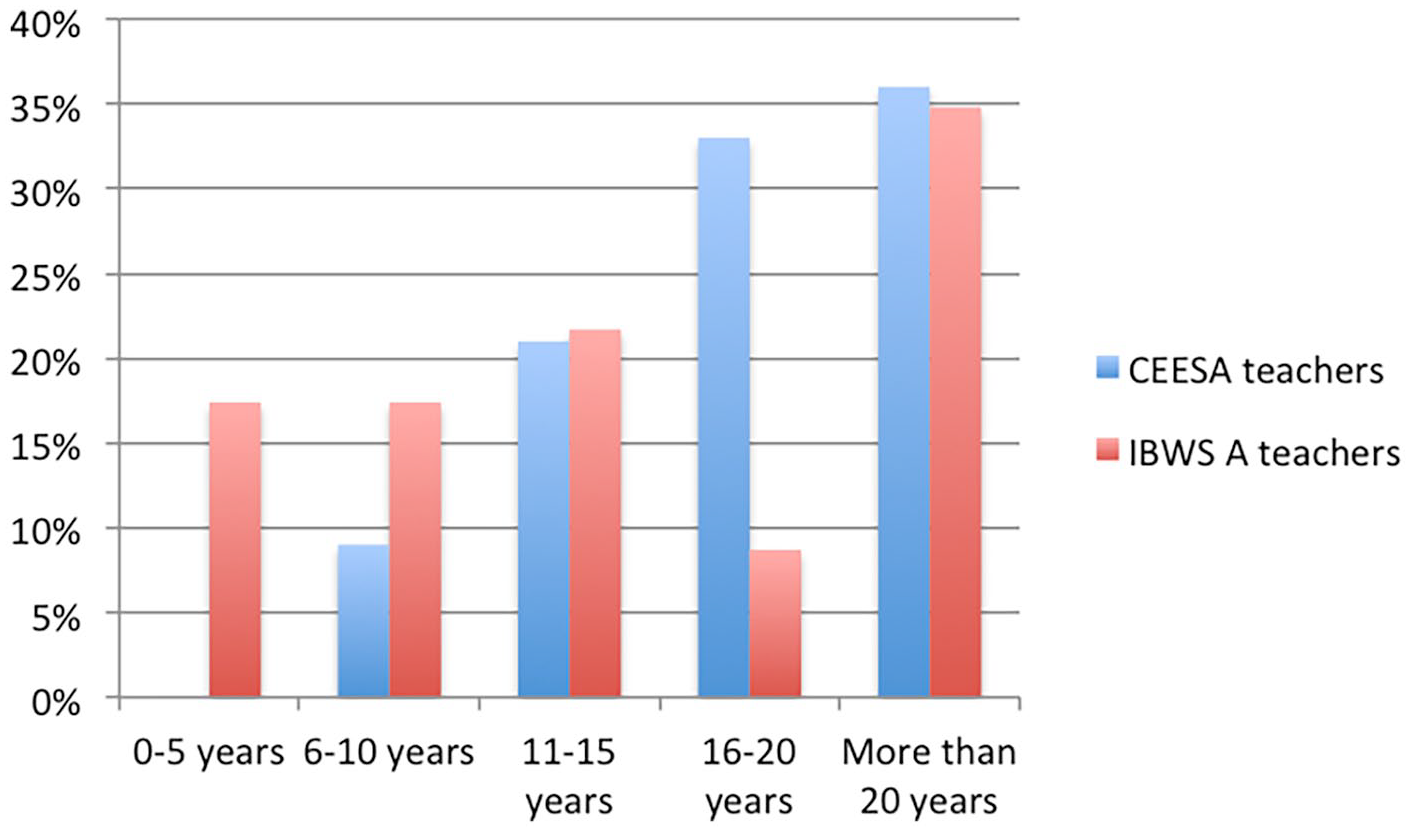
IBWS A and CEESA teachers’ years of teaching experience.
Participants also reported how long they had been teaching in international schools. The data for IBWS A teachers (Figure 2) show a general decrease in percentage from 47.8% of teachers who had 0-5 years’ experience in international schools to 4.3% of teachers who had 16-20 years’ experience, followed by a slight increase up to 13% of teachers who had more than 20 years’ experience in international schools. The data for CEESA teachers showed that after the 15% of teachers with 0-5 years’ experience in international schools, the percentages of teachers’ experience gradually falls from 30% of teachers having 6-10 and 11-15 years’ experience respectively down to 6% of teachers having more than 20 years’ experience in international schools. Figure 1 and Figure 2 clearly show a difference between the number of years teaching in total and the number of years teaching in international schools. Such an inverse trend invites the question as to how important the kind of experience of teaching is to an EAL learner.
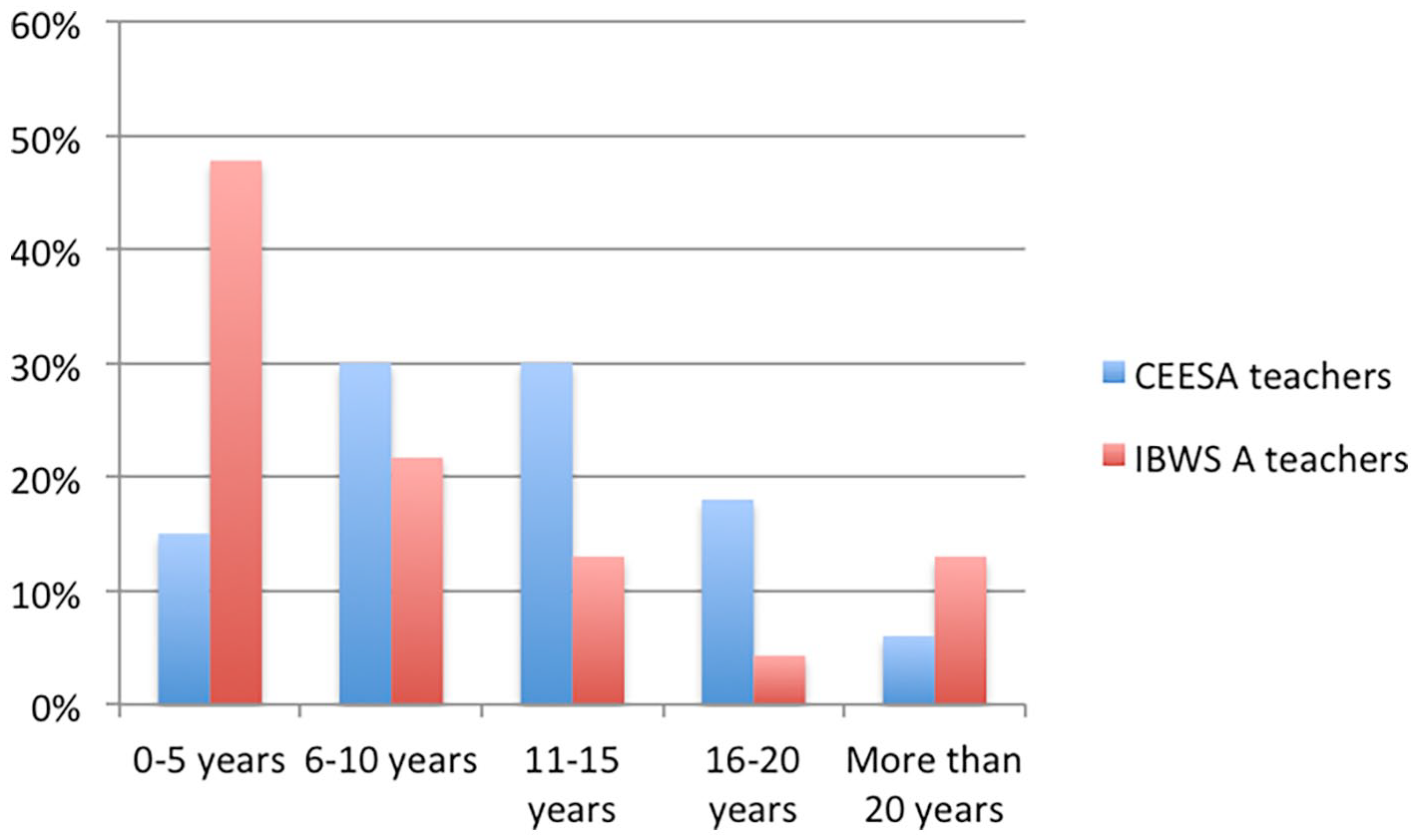
IBWS A and CEESA teachers’ years of international school teaching experience.
Asked whether they had received any training in English language provision for non-native speakers in their initial teacher training, 56.5% of IBWS A teachers answered that they had not and 43.5% that they had. In response to the same question, 39.4% of CEESA teachers answered that they had not received such training and 60.6% of participants answered that they had.
The next question asked those who had received such training to give a brief description of the nature of their EAL training in initial teacher training; participants gave short written responses to these questions. Only one participant each gave the following answers: workshops, public school district in-house, licensure process, teacher orientation week, classes in school, professional development (PD). The most frequent answer given, written in a variety of ways, involved courses for the provision of English for non-native speakers, which thirteen participants gave as their answer. The next most frequent response was that of BA/MA degrees in EAL and linguistics, from six participants. The third most frequent response was CELTA/DELTA/TESOL/TEFL/TESL certification, from five participants. Such qualifications are English language teaching qualifications and, while they are often attractive to potential employers when considering applicants for international school posts, they are not a part of any initial teacher training programme and are not generally offered as professional development for international school teachers. Such a high response level regarding training that clearly is not part of initial teacher training indicates a high level of misunderstanding or misinterpretation of what constitutes EAL training in initial teacher training. This demonstrates a lack of consistency in teachers’ understanding of what qualifies them to teach EAL learners.
In addition to the wide range of what participants believed to be inclusive of EAL training, there were varying responses in the focus group discussion regarding experiences of training in how to teach EAL learners in pre-service initial teacher training: two participants who had trained in Florida reported that EAL training had been mandatory (FGS4) and that it was necessary to renew your teaching licence (FGS2). The teacher from California had had little in the way of EAL training but felt it would have been very helpful (FGS3). The teacher from Ontario, Canada had participated in some ESL courses when training, which were mandatory (FGS5). These responses highlight the differences in mainstream teachers’ experiences with regards to EAL/ESL training in initial teacher training and paint a similar picture to responses from the questionnaire.
Asked whether it was the responsibility of mainstream subject teachers to be aware of the type of subject-specific vocabulary EAL students needed in lessons, the majority of IBWS A participants agreed, with 17.4% strongly agreeing, 56.5% agreeing and 13% partly agreeing. CEESA participants also agreed in the majority, with 30.3% strongly agreeing, 39.4% agreeing and 27.3% partly agreeing.
Focus group participants discussed in further detail the extent to which thinking about vocabulary to support EAL learners was a part of regular planning. They indicated that when vocabulary is implicit in unit planning it is often regarded as new for all students. One teacher said there was a vocabulary component in unit planning but it was not specifically for EAL learners (FGS4). Another teacher said that they used support for words by showing examples through images of mathematics vocabulary, which is a regular part of their planning and teaching (FGS2).
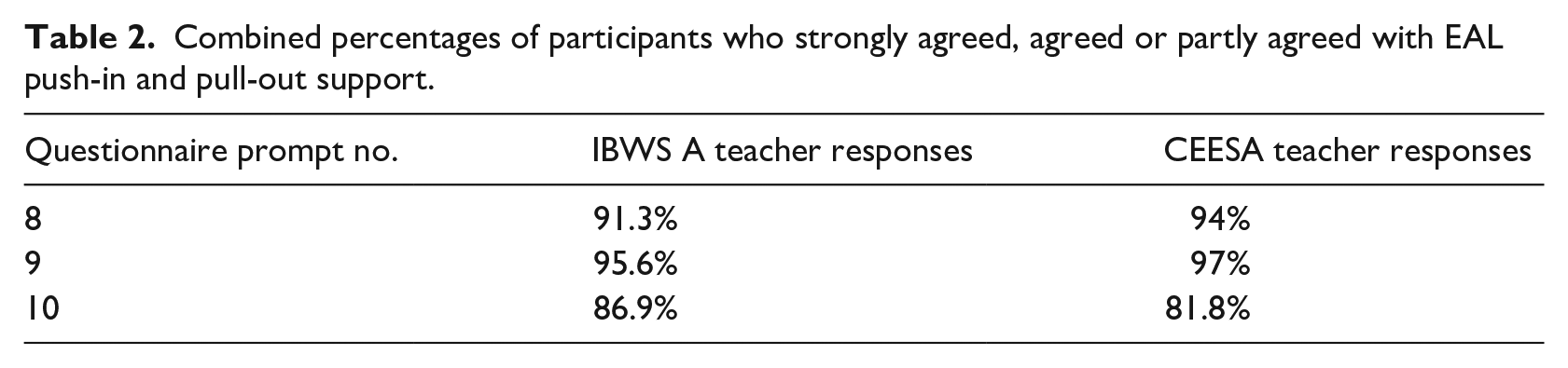
Participants were asked how much they were in favour of push-in support, whereby the EAL teacher or teaching assistant supports EAL learners in mainstream classroom subjects, or pull-out support, whereby the EAL teacher or teaching assistant takes the EAL student out of a mainstream classroom to provide additional English language support. The three prompts (with the same numbering as in the questionnaire) that participants were asked to comment on in terms of whether they strongly agreed, agreed, partly agreed, partly disagreed, disagreed or strongly disagreed, are as follows:
8. Beginner level EAL students benefit from having an EAL teacher supporting them in the classroom in all mainstream school subjects
9. EAL learners who have a beginner’s level of English benefit from individual pull-out support
10. EAL students benefit from having teaching assistants supporting them in all mainstream school subjects
Table 2 shows the results of the three prompts for both IBWS A and CEESA participants, based on combined percentages of strongly agreed, agreed and partly agreed responses.
Combined percentages of participants who strongly agreed, agreed or partly agreed with EAL push-in and pull-out support.
Focus group participants were asked to discuss why some questionnaire respondents might have only partly agreed or disagreed with push-in and pull-out support. The discussion highlighted concerns that mainstream teachers have with another teacher/a teaching assistant being in the room, with concerns potentially focussing on ‘an outsider’ coming into the classroom. One teacher expressed concern about the efficacy of having one-to-one push-in support, describing situations they had experienced with regards to students who had become too dependent on the support they received from the teaching assistant in the classroom. The quantitative data regarding attitudes to weekly collaboration to plan lessons between EAL and mainstream teachers were overwhelmingly in favour of weekly collaborative meetings to plan modified content for EAL learners, with 13% of IBWS A participants strongly agreeing, 39.1% agreeing and 34.8% partly agreeing. 27.3% of CEESA participants strongly agreed, with 24.2% agreeing and 27.3% partly agreeing.
IBWS A and CEESA participants were then asked how they had collaborated with EAL teachers, and gave written responses. Only one participant each gave the following answers: planning an interdisciplinary unit; there is not time to collaborate. Three participants answered that they emailed EAL teachers or shared information through Google docs; six participants answered that they collaborated by asking, speaking to, referring to EAL teachers in an informal way or to share ideas. Seven participants answered that they had weekly or monthly planned meetings with EAL teachers, and eleven participants answered that they regularly met with EAL teachers to plan, but not in scheduled meetings.
In connection with the quantitative data, focus group participants were asked to explain how they had collaborated in terms of regular planning sessions with the EAL department. One teacher said that they regularly met to talk about EAL learners (FGS5), while another teacher felt that although there was awareness about the issues of EAL learners, there was no collaboration between teachers in terms of sharing strategies with each other regarding individual EAL learners and building on what works from subject to subject (FGS3). The main reason for lack of collaboration cited in the quantitative data was lack of time, and teachers in the focus group suggested they wanted to be able to access EAL support materials easily for their subjects (FGS5). They proposed streamlined, bite-size strategies that EAL teachers could pass on to mainstream teachers on an individual basis, allowing teachers to find a suitable time together to review language content and EAL strategies rather than EAL collaboration being based on structured weekly meetings. The quantitative data findings indicate that although the vast majority of teachers (95-98%) agree to a greater or lesser extent that strong collaboration is important between mainstream and EAL teachers, there appears to be far less willingness to co-teach with EAL teachers, with 30.5% of IBWS A teachers in particular disagreeing to a greater or lesser extent.
In the focus group discussion, one teacher suggested that some teachers do not want to give up their power or space, or that if another teacher is in the room then a mainstream teacher might feel they have time taken away from what they themselves need to cover in the lesson. Another said they were in favour of having someone there to co-teach, as an EAL specialist, because as a language specialist they would be able to best teach the language that students need to learn. They added that it might be a problem at IB Diploma level (grades 11-12) because of the ‘high stakes tests’ that they need to pass and the pressures of covering content. However, at IB MYP level where there are no end of course examinations the pressure was less, and having a co-teacher could work. The first teacher also added that two different teachers can ‘play off each other’ when they come with differing teaching strategies (FGS3). Another teacher suggested that two teachers co-teaching might not come to a consensus on how to deliver the lesson, and that a possibility would be for the mainstream teacher to present what they have planned to the EAL teacher and the EAL teacher could ‘come in and say “Okay, these are the ways I can help you to deliver that more effectively, especially to the EAL learners”’ (FGS5).
Asked what an incentive might be, given the difficulties, for a mainstream teacher and an EAL teacher to collaborate on planning and co-teaching, the following responses were given by the focus group. One teacher felt that ‘lightening the load’ would be needed as the teaching load would be increased, and that if that were the case more support would be needed and the workload would need to be cut in other areas. The same teacher struggled to think of existing lessons that an EAL teacher would be able to cope with teaching. Another teacher noted that although they had taught 80-minute lessons that had mostly covered language and vocabulary, they were unsure how much time would be freed up as the mainstream teacher would still need to meet with the EAL teacher for planning purposes. The same teacher reiterated that they felt it was necessary to streamline how strategies were disseminated to save time, for example making PD training more practically-based in terms of what mainstream teachers can take away and use in the classroom. FGS2 expressed the same view. FGS5 also mentioned the ease of using and usefulness of resources such as the readability tool (a tool for gauging reading level of a text) on the school website. FGS2 suggested using the EAL students as a resource by having them come to the EAL lesson with the new vocabulary they had learned in mainstream lessons that week, and participating in an EAL lesson based on those new words.
Discussion and implications for further research
In this section each of the research questions and associated findings will be considered in turn.
1. How well qualified are mainstream subject teachers in teaching non-native English speaking learners?
With regards to teacher profiles, the comparison of years of general teaching experience to years of teaching experience in international schools paints a picture of a group of teachers who have substantial teaching experience but an inverse amount of experience of teaching in international schools. As argued by Carder (2015), staff turnover at international schools is generally higher than that of other schools and EAL training and collaboration is paramount for the effective support of EAL learners in the mainstream classroom; given that teachers in international schools inevitably experience challenges of teaching their content to EAL learners, one question to be addressed is how experienced are teachers in their ability to modify the language of their lessons in order to support EAL learners?
With around 50% and 60% of teachers answering that their initial teacher training had not included the provision of support for EAL learners, there appears to be a contradiction in how well-trained teachers originally are in providing EAL support in their mainstream classroom in contrast to the environment of largely non-native speakers in which they work. With the third most common response in the quantitative data being CELTA/DELTA/TESOL/TEFL/TESL certification, there was also a lack of understanding for some participants as to what was meant by the question regarding training for EAL provision in initial teacher training. This indicates that for some teachers, training in EAL provision for mainstream teachers is still often viewed as something that is not provided during initial teacher training but rather is acquired through professional development or postgraduate studies; such an indication supports the view that many teachers do not have a clear understanding of their part in the EAL process (Houston & Neal, 2013).
With the highest proportion of teachers surveyed having 20 or more years’ experience, it is most likely that these are teachers who were not initially trained to provide EAL support and yet have gone on to teach in international schools. The qualitative data also suggest that there is a lack of consistency with respect to which teachers have received EAL training in ITT, as previously identified by Leung (2001, 2016) and Foley et al (2013); the focus group findings indicate that whether there is any training available can depend upon where teachers come from, and whether such training is a requirement for renewing a teaching licence, for instance, rather than for supporting EAL learners.
The implication of these findings is that the relative lack of international teaching experience does not necessarily give EAL learners access to the best qualified teachers according to their language needs. In addition, the lack of clarity as to what constitutes appropriate EAL training in international schools, as well as the potential lack of EAL training in ITT that international school teachers have experienced, suggests that the leadership of international schools need to be more aware of issues relating to EAL and their staff. A further question arising from these findings is whether teacher attitudes are forged more strongly by their initial training or by work experience. It would be invaluable to research more deeply how the EAL needs of particular schools are met by leaders actively employing teachers best qualified not only to teach their subject but also to consider the language needs of their EAL learners.
2. What are mainstream subject teachers’ attitudes towards EAL learners?
The findings on teacher attitudes towards EAL provision in the classroom indicated inconsistencies between attitudes and practice. Participants’ answers in the quantitative data with respect to awareness of subject-specific vocabulary for EAL learners, which were overwhelmingly in agreement, were inconsistent with responses in the qualitative data. Focus group findings paint a picture of the kind of planning that includes new vocabulary for all students, methods of introducing this vocabulary and modelling vocabulary through pictures on wall displays, but does not involve planning for modified vocabulary for EAL learners. This demonstrates how participants can answer in theory one way and yet provide an answer with respect to practice and experience in a very different way. The ‘awareness of subject-specific vocabulary’ that teachers have does not translate into actual planning of modified vocabulary content.
The implementation of push-in and pull-out support, which participants overwhelmingly favoured, similarly showed differences between the quantitative and qualitative data. When asked about the concerns that might have been expressed by the small number of teachers who had disagreed that the provision of such support was a good idea, the focus group elicited responses such as: teachers being protective of their space, the room getting too crowded, EAL learners being too dependent on push-in support teachers or, as similarly mentioned by Carder (2014, 2015), assistant teachers not being effective or viewed as being effective. This again represents the contradictions between a seemingly unified and overwhelmingly positive response in the quantitative data and a very different data set from the focus group. When the surface is scratched as to which concerns teachers might have, even a relatively small focus group of teachers reveals a whole host of concerns that are not reflected in the questionnaire data.
The implication of these findings is that mainstream subject teachers in this international school do not always uphold the notion of ‘international school teacher as language teacher’. Given the apparent contradictions between mainstream teachers’ practice and their intentions, a further question arises as to how the professional culture of the school can be steered by leadership. Additional research into how a culture of ‘subject teacher as language teacher’ could be fostered as a whole school culture would be beneficial to the EAL learners of such schools.
3. How do mainstream subject teachers collaborate with EAL teachers?
With regards to collaboration between EAL and mainstream subject teachers, the quantitative data suggested general agreement that weekly planning meetings between EAL teachers and mainstream teachers are important. In addition to expressing their view, participants were asked to provide a written response as to how exactly they collaborated in terms of planning with EAL teachers. Given that scheduled planning meetings was only the second most frequent answer – after more informal, unplanned meetings – it appears that the favourable view of weekly planning meetings is contradicted by the actual practice of regular, but unplanned and more informal, collaboration. This is supported somewhat by the qualitative findings which again demonstrate how collaboration happens, not only in the generally informal and ad hoc way suggested by the quantitative data, but also indicate a lack of consensus as to whether such collaboration consistently takes place. Some participants disagreed that they had experienced much collaboration with the EAL department, and noted lack of time as a factor, as well as a preference for sharing related resources rather than setting up formal, weekly meetings.
In addition, factors such as lack of time for planning and issues of having another teacher in the room seem to be real concerns that teachers have when asked if they would co-teach with an EAL teacher. Further concerns highlighted in the focus group discussion included that EAL teachers may not have the necessary content knowledge of a mainstream subject lesson and that, as well as the time it would take for the two teachers to plan such a lesson, it might take up more of the class time that the mainstream teacher has to cover all the curriculum content with their students, reflecting much of what has already been written (Davison, 2006; Foley et al, 2013; Carder, 2014) about EAL in the mainstream classroom and the lack of co-planning and co-teaching that can exist between EAL and mainstream teachers.
The implication of these findings is that opportunities for mainstream teachers and EAL teachers to collaborate are missed. In order for mainstream teachers to be satisfied with both the appropriate allocation of time to cover course content as well as the ability of the EAL teacher to co-teach course content in connection with meeting students’ English language needs, there needs to be a more structured professional culture of effective collaboration. Such a culture is necessary in international schools to foster effective planning and teaching in collaborative partnerships. Further research is needed as to which methods would be most effective according to both curriculum and language needs.
Conclusion
There is a definite case to be made that further research needs to be undertaken in order to find a solution to the challenges of EAL and mainstream teachers planning and collaborating to support EAL learners to the fullest potential. The main challenge appears to be how to transform the willingness and desire of mainstream teachers to work more closely with EAL departments into more practical and permanent solutions of collaborative planning and teaching. With many EAL departments in international schools being relatively small in size, and the time pressures and high expectation for academic results cited by mainstream teachers as further challenges, there is a need for research into practical solutions to aid EAL teachers as professionals whose role it is to support EAL learners in their time at school. The mainstream subject teacher will ultimately benefit from their EAL learners having stronger and more integrated English language support to enable them to better access mainstream curriculum content. With an ever-increasing population of international school EAL learners, it is essential that the message now be made very clear: more must be done to support EAL departments and mainstream teachers in order for EAL learners to cope better in the mainstream classroom. The small scale of this study has highlighted the concerns in one region of eastern Europe; it is imperative, as a global concern, that such issues regarding EAL be more thoroughly researched at local level around the world.
Supplemental Material
sj-docx-1-jri-10.1177_14752409211033749 – Supplemental material for Understanding EAL: International Secondary School Teachers’ Experiences and Attitudes in Ukraine and Eastern Europe
Supplemental material, sj-docx-1-jri-10.1177_14752409211033749 for Understanding EAL: International Secondary School Teachers’ Experiences and Attitudes in Ukraine and Eastern Europe by James Spencer in Journal of Research in International Education
Footnotes
Funding
The author received no financial support for the research, authorship, and/or publication of this article.

Author Biography
References
Supplementary Material
Please find the following supplemental material available below.
For Open Access articles published under a Creative Commons License, all supplemental material carries the same license as the article it is associated with.
For non-Open Access articles published, all supplemental material carries a non-exclusive license, and permission requests for re-use of supplemental material or any part of supplemental material shall be sent directly to the copyright owner as specified in the copyright notice associated with the article.
