




Abstract
In this study, one current and three former British Columbia (BC) offshore school principals were interviewed to seek their insights on how they contended with being compelled to censor material and disallow topics of conversation while administering a Canadian curriculum in an international context. Using a research design consistent with an interpretative phenomenological analysis (IPA) methodological framework, the data were interpreted using three reduction cycles to generate five categories: disillusionment, anger, struggle, expedience, and subversion. The participants’ responses were synthesized through the five categories in light of the phenomenon of moral distress, which occurs when a person is hindered from following a course of action consonant with their own moral judgement. Participants’ reflections on leading Canadian high schools outside of Canada offered meaningful insights into their lived experiences abroad and provided a basis for a more robust consideration of how principals make sense of morally distressing situations in their schools.
Keywords
Introduction
Seven Canadian provinces currently offer their programs of study in Canadian-accredited schools abroad, employing provincially certified teachers and administrators to deliver curricula identical to those found in the provinces themselves. Though they are working within a school system familiar to them, Canadian educators working in such schools sometimes find themselves far removed from the cultural mores to which they are accustomed. Principals of these Canadian-accredited schools abroad may work within a cultural milieu informed by social and political values ranging from slightly incongruent to antithetical to their own, which has significant implications for how they administer their programs and lead their schools. The principals must navigate tensions that can exist between the convictions they hold and the political realities which underlie the tenets of the host culture. In a Canadian-accredited school abroad, the principal must manage any such disparate values and mediate any resultant discord publicly and pragmatically, as well as work through this dissonance at a deeply personal level to reconcile external policy constraints with their own ethical convictions.
According to the Ministry of Education of British Columbia (BC), one of the seven Canadian provinces, the offshore school program is supported by Memoranda of Understanding between the province and the national governments of eight countries in Asia, Europe, and South America to ‘provide opportunities for all students to develop global understanding and intercultural competencies’ (British Columbia Ministry of Education, 2021). The program aims to smooth the transition into Canadian post-secondary institutions for international (non-Canadian) students, with the belief that exposure to Western pedagogical methods at the high school level will translate into fewer challenges for the students when they move to Canada to enrol in college or university.
In the countries which host Canadian-accredited schools abroad, there are different levels of ideological presence by the state in all aspects of how their societies operate and of how, and what, its citizenry thinks. Public discourse may be monitored closely and state narratives may be promulgated widely, and certainly differently than what is seen in Canada. Consequently, what students learn within schools may be controlled tightly by the host national Ministry of Education. Local principals may work closely in their schools with functionaries of the ruling political party to ensure only topics and pedagogical methods deemed appropriate by the state are engaged. While the host governments and the British Columbian Ministries of Education have agreed to terms by which BC programs are allowed to operate within host schools to offer a Canadian program of study to local citizens, there are continuous negotiations, always infused with political shifting and nuance, regarding the actual administration of the programs. Memoranda of Understanding between these countries and Canada are words on paper; the realities of mitigating how the host state periodically seeks to assert itself into the delivery of the BC curriculum are a necessary component of the BC offshore principal’s role. Specifically, the expectation of ideological alignment with the educational vision for its citizens may be more tightly controlled in the host country, which presents both pragmatic and philosophical conundra for Canadian school principals based in these international contexts. These BC offshore school principals must navigate between disparate political systems, as the cultural and political adherence to discourse controlled tightly by the host state may be antithetical to BC’s call to foster students who can assess, evaluate, and interpret information to then express informed and critical opinions.
As the Canadian education that the international students experience in their BC offshore school classrooms is often misaligned with the cultural and political ideals promulgated by the local government, the BC principals are compelled to either acquiesce or delicately resist the constraints mandated by the host state, essentially operating in an organizational gray area (Bruhn, 2009). Fransson and Grannäs (2013) recognized that educators may be involved in ‘micro-political manoeuvres in their everyday practices’ (p 9). These manoeuvres and acts of resistance may be political in nature and imbued with an ethical architecture consistent with the philosophical tenets that underlay an education system such as that of BC in which citizens are free to be openly critical, to access and interpret all information, and to engage in discourse that may contradict their government’s position.
My research interests are rooted in the lived experiences and critical reflections of Canadian school principals leading offshore schools and delivering a Canadian curriculum abroad. I spent nine years working in Canadian-accredited schools abroad, with one year as a vice-principal, then five years as principal of two different BC offshore schools. Through my international tenure, I developed professional relationships and friendships with a number of principals from the other 47 BC offshore schools. I invited four principals from this network to participate in this study. In the interviews conducted, I chose to focus on the following research question: How do BC offshore school principals contend with being compelled to censor material and disallow topics of conversation while administering a Canadian curriculum in an international context?
In some of the countries which host Canadian-accredited schools abroad, there are clearly defined lists of restricted topics and narratives, with explicit directives by the host governments to actively censor any reference to them. Balancing BC’s call to guide students to be able to assess, interpret, and evaluate information, while not falling afoul of the host governments’ regulatory bodies which have the final authority on the offshore programs’ ability to remain operational, is a nuanced undertaking, with pragmatic and philosophical considerations for the BC offshore principals.
Literature Review
There is a body of scholarship within the health care (specifically nursing) literature regarding moral distress, an affective state arising when nurses perceive that administrative or institutional directives compel them to follow a course of action different from the course they believe to be ethically correct (Hamric, 2012; Morley et al, 2019). When policies, procedures, or political realities hinder nurses’ abilities to act in accordance with their own moral reasoning and judgment, there are concomitant feelings of frustration, powerlessness, anxiety, and sometimes depression (Oh & Gastmans, 2015; Hamric, 2012). While education, like nursing, is considered to be a fundamentally moral enterprise (Cranston et al, 2006; Walker et al, 2007), this phenomenon of moral distress had only tangentially been considered in research literature with regard to educators who are prevented from acting in a manner compatible with their own conceptions of ethicality. As a former principal of a Canadian offshore school in an international context, I often encountered barriers, both tacit and overt in policy and expectation, based on the prevailing political and cultural beliefs of the host government, which could cause me repeated frustration, sometimes to a degree of great moral consternation.
These experiences informed the research question which grounded this study. When the constraints experienced by a principal following an ethically sound course of action are based on the cultural beliefs drawn on by a host government to inform and implement policies at odds with that administrator’s own sense of moral reasoning, there may result a clash of values and expectations which has a significant effect on the principal. If affective and psychological reactions related to moral distress contribute to school principals’ hastened departures from their roles, as these reactions to moral distress have been correlated with nurses leaving their profession (Hamric, 2012; Morley et al, 2019; Oh & Gastmans, 2015), then the incidence and severity of moral distress felt by international school principals is an important area for research. That is, the insights offered by the respondents in this study could represent meaningful contributions, both theoretical and practical, to an understanding of how not only Canadian offshore principals but also international school leaders more widely navigate disparate paradigms in the wider international context.
That education is a moral enterprise is often proposed in scholarship, and the premise that school leadership is, among all of its practical and political realities, a fundamentally moral endeavour is equally prevalent. Cranston et al (2006) maintain that ‘educational leadership has a moral purpose’ (p 107), a sentiment echoed by Walker et al (2007), who hold that the role of a school leader is to foster in students a moral imagination ‘which enhances contextual sensitivity, logical processes and skills, knowledge, virtue, and reasoning’ (p 389). As heads of schools, principals are responsible for cultivating and fostering a common moral purpose within the school, one which is clearly communicated and imbued with processes of participatory dialogue and self-reflection, collective efficacy, relational trust, and just action (Demerath, 2018; Walker et al, 2007; Levinson, 2015). Demerath (2018) further asserts that an educator’s moral purpose is rooted in affect, shaped by experiences of the expression of agency, and that the emotions of educators are ‘inseparable from their moral purposes and their ability to achieve these purposes’ (p 491).
Levinson (2015), invoking the work of John Rawls, states that moral purpose guides just action, which is ‘the justice built into the basic structure of an ideal society’ (p 209). In order to maintain the ‘phronetic equilibrium’ necessary for the full expression of moral purpose in leadership, principals ‘try to make the most just decisions in the moment while maintaining their loyalty to their students, school, and profession by subverting unjust policies, institutions, or structures’ (Levinson, 2015: 214). It is here, with reference to barriers or constraints to following a course of action which one believes to be ethically just, that one may see an analogy for BC offshore school principals, and for international school leaders worldwide, with the existing nursing literature regarding moral distress. The imperative of principals to exercise both voice and agency is crucial to the commission of their duties within schools and the preservation of their own moral and professional integrities. BC offshore school principals are beholden to leadership standards compelling both instructional leadership and moral stewardship; they must ‘foster and demonstrate clear and consistent alignment between the ethical and moral purpose of education’ (British Columbia Principals’ and Vice-Principals’ Association, 2021). When there is a disequilibrium between their professional obligations and their ethical principles, manifesting practically as a dilemma in which significant complexity requires much nuanced consideration and to which external constraints on right action are imposed, there exist the conditions for what some (Hamric, 2012; Oh & Gastmans, 2015) have characterized as moral residue, a term Levinson (2015) reconceptualized as ‘moral injury’ (p 207).
Levinson (2015) contends that moral injury is deleterious to a person’s cognitive and emotional state, and precipitated damage to one’s moral integrity. Before engaging with health care scholarship relating to moral distress, I was aware of the deep consternation I felt while being ordered by local government officials to engage in censorship as a kind of ethical tension. On those occasions, I was forced by an external agency to act in a manner diametrically opposed to the course of action dictated by my own deeply held beliefs. In Oh and Gastmans’ (2015) review of ‘the available quantitative evidence in the literature on moral distress experienced by nurses’ (p 15), the authors’ synthesis of thirty years of scholarship found that nearly all studies referred to the frequency and intensity of moral distress. Nurses often reported moral distress in these studies, felt by them at varying levels of intensity. This is a testament to the ubiquity both of nurses’ moral reasoning in decision-making and the incidence of institutional or policy constraints on their right action. In response to their moral distress, there is in the literature a wide range of psychological and affective reactions attributed to nurses, including higher levels of stress and agitation, emotional exhaustion, feelings of powerlessness and self-doubt, and generalized anxiety (Oh & Gastmans, 2015; Hamric, 2012; Morley at al, 2019). Oh and Gastmans (2015) reported that ‘as nurses experienced moral distress more frequently, they experienced higher levels of emotional exhaustion and depersonalization towards patients’ (p 24), while Hamric (2012) asserted that repeated incidents resulting in moral distress over time ‘can erode care providers’ moral integrity, resulting in desensitization to the moral aspects of care’ (p 42).
It is in these responses to moral distress that I envisioned a point of strong conceptual intersection between nurses and international school leaders, as much of the nursing scholarship affirmed that withdrawal from the profession was a means of coping with the lingering effects of moral distress (Oh & Gastmans, 2015; Hamric, 2012; Morley at al, 2019). Similarly, Levinson (2015) contends that educators experiencing feelings of continued moral injury may ‘find jobs in schools or districts that do not confront them with repeating cascades of unjust options, or, in the extreme, they leave the profession altogether’ (p 208). That is, as the effects of instances of moral injury compound over time, educators may decide that remaining in their chosen profession exacts a price they are unwilling to pay.
Being compelled to engage in acts of censorship can be a troubling proposition for educators, one that may well be correlated with undue affective reactions and constraints on teachers’ professional autonomy and agency. McLaughlin and Hendricks (2017) maintained that ‘banning or limiting access to reading materials without legitimate pedagogical concern and due process is antithetical to important student rights’ (p 11). In interviews with art teachers in a California public high school, Hallquist (2008) found that teachers often disregarded their personal stances on the appropriateness of students’ expression in order to follow external guidelines, citing job security as a concern. One of the respondents stated that ‘if problematic content were to emerge from her classroom, she would have to answer to parents, administrators, community members, and even the school board’ (Hallquist, 2008: 44). Though referring to university professors in Turkey, Aktas et al (2019) made an assertion that was also germane to educators and administrators in Canadian offshore schools internationally; that is, certain government policies place educators in ‘a very precarious position’ (p 184). In their study, Aktas et al (2019) described the social exclusion of educators who refused to comply with government mandates which they believed would constrain their expression and academic freedom. They also detailed the plight of educators who acquiesced to policies in spite of their own personal convictions, reporting ‘a pervasive sense of resignation and lack of motivation’ (Aktas et al, 2019: 184).
Methodology
In seeking to understand how BC offshore school principals reconciled the tension that arose when they were mandated by the host state to act in opposition to their own ethical agency, I employed a phenomenological framework, interviewing principals in order to ‘gain valuable insight into the structure of how people understand their experiences’ (Bliss, 2016: 14). More specifically, I utilized an interpretative phenomenological analysis (IPA) approach, suitable ‘when one is trying to find out how individuals are perceiving the particular situations they are facing, how they are making sense of their personal and social world’ (Smith & Osborn, 2015: 55). I was interested in how the Canadian principals dealt with local dicta regarding censorship as a means to understand their sense-making processes while contending with political values and ethical positionalities far different than what they knew from Canada. Using censorship as a vehicle to examine the principals’ navigation between the mandates of a more ideologically orthodox state and the democratic ideals of access to information and freedom of expression which infuse the BC curriculum, I endeavoured to understand whether the BC offshore principals felt that forced compliance with local policy constituted a challenge to their own professional agency and had detrimental effect on the moral stewardship they were obligated to provide. (Note: a pointed examination of whether these democratic ideals are actually realized in Canadian curricula, schools, and society is outside the scope of this paper, but is certainly grist for future scholarship.)
To properly utilize the interpretative phenomenological analysis methodology, one must collect rich data from an appropriate number of respondents, with the exact number dependent on the shared experiences of the participants and the depth of analysis achieved by the researcher (Smith et al, 2009). For this small study, I interviewed four participants one time each, utilizing a nearly identical interview schedule each time. Due to geographical realities and logistical concerns, interviews were conducted via Zoom. The four respondents, three male principals and one female principal, each worked in the same international context. The data in IPA are both the evocative descriptions of the participants’ own experiences and the interpretation of those experiences by the researcher.
IPA is anything but prescriptive; rather, it is ‘an approach which benefits from detailed engagement with a small sample, from accessing the chosen phenomenon from more than one perspective, or at more than one time-point, and from the creative and reflective efforts of participants’ (Smith et al, 2009: 56). IPA methods call for nuanced analyses, born of much reflexivity and constant awareness of the processes of creating meaning and making sense of the phenomenon itself. Smith et al (2009) maintain that IPA analysis is ‘inevitably a complex process. It may be an experience which is collaborative, personal, intuitive, difficult, creative, intense, and conceptually demanding’ (p 80). After conducting four interviews for this study, each lasting less than one hour, I attest to the demanding intellectual and emotional nature of such detailed engagements.
Methods
The research design consisted of conducting a semi-structured interview with each of four different respondents over a period of six weeks. As Merriam and Tisdell (2016) advise, this type of study is consistent with my own epistemological and ontological stances, in which social reality, one’s way of being in the world, is a construction informed by multiple interwoven perspectives. Understanding is moulded by context, by culture, by affect, and by modes of engaging others that are unique to each individual. It is also consistent with the theoretical underpinnings of the IPA methodology. IPA seeks ‘in-depth descriptions and interpretations of the research participants’ lived experiences vis-à-vis how the phenomenon which is being studied has impacted the lives of the research participants’ (Alase, 2017: 12).
Yuksel and Yildirim (2015) assert that ‘individuals selected to participate in the phenomenological study should have significant and meaningful experiences of the phenomenon being investigated’ (p 9). Drawing from the network of former and current BC offshore school leaders with whom I had maintained contact since leaving my own international principalship in July 2019, I reached out to five former peers. Four of these respondents no longer worked abroad and had settled back in Canada, while one respondent was [then] a current BC offshore school principal. Ultimately, three of the four former offshore principals agreed to participate, as did the still-serving principal. I chose these particular respondents for two reasons: firstly, because of our existing relationships I anticipated their willingness to participate in the study; and secondly, their length of tenure and breadth of experiences leading Canadian-accredited schools in an international context were substantial (see Figure 1: all names are pseudonyms).
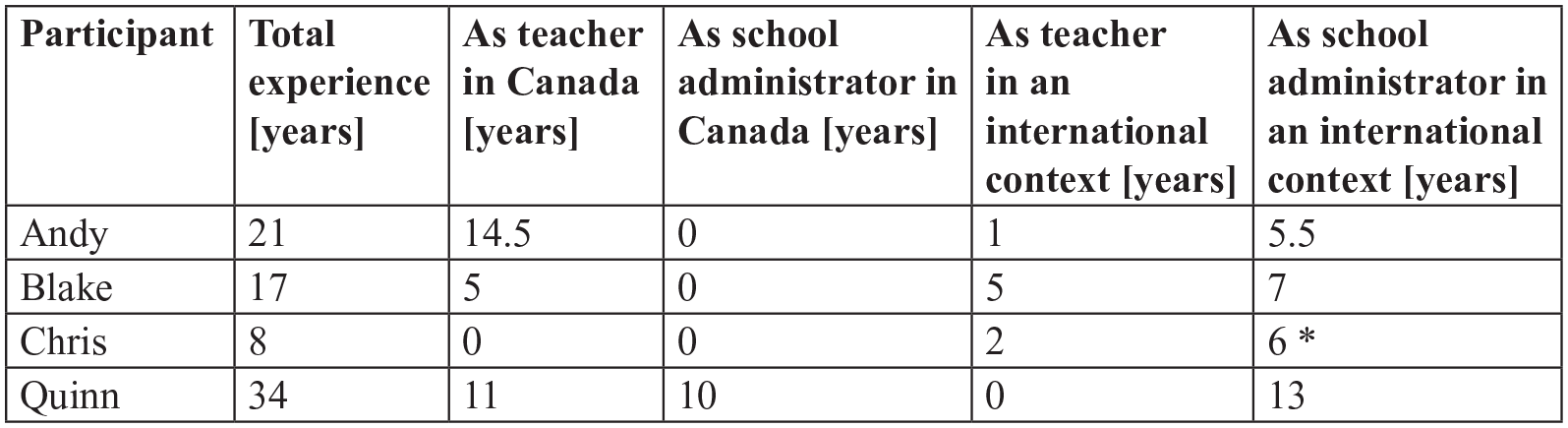
Participants’ years of professional experience.
I was cognizant from the outset that interviewing principals with whom I had an existing professional relationship may have had both positive and negative effects, which became apparent as I proceeded with the study. To the benefit of the process, a rapport already existed between each participant and me. The mutual respect and trust infusing these relationships allowed for an ease of conversational flow and a high level of candidness in the participants’ responses. Conversely, my familiarity with each participant may have ensured that the commonality of our professional experiences abroad allowed for certain responses to go unprobed by me. Glesne and Peshkin (1992) maintained that with backyard research (research in a place where one already has connections), pre-existing relationships may affect the dynamics and influence the researcher’s interpretations of data. I recognize now that the depth of unspoken understandings between myself and each participant meant that I missed opportunities to probe a response in assuming a clarity that I should have confirmed. This awareness will inform future research I undertake in this area.
I approached each of the respondents in the same way, and respondents learned from me that I was also interviewing three or four others for the purpose of this small study. After asking the respondents separately if they would be interested in participating and assuring them of confidentiality so that both their identities and the names of their schools would be removed prior to any publication, I sent each of them an introductory email. To that email, I attached a Letter of Information and an Adult Participant Consent Form. As well, in an informal chat before the interviews on Zoom, which were recorded with participants’ explicit consent, I assured each respondent that their participation was voluntary and that no identifying information would appear in any written representations of the collected data. These assurances aligned with the ethics approval requirements that had been granted for this study by the University of Alberta. I also reiterated that should they wish, they had the right to withdraw from the research prior to a date approximately three weeks after the day the interview was actually conducted. Also attached to the introductory email were two more documents: a short paper I had written to explain my research interests, and the interview schedule, containing the actual questions I intended to ask the participant. I felt that providing these two documents ahead of the recorded interviews would serve to hone the interview process itself.
Merriam and Tisdell (2016), citing Patton’s (2015) typology, elucidated six categories of interview questions. For the interview schedule in this study, I employed four of those categories, with the final question outside of this typology but inviting each respondent to make any additional comments or observations that they wished. In each case, that final question did lead to continued conversation and produced what I believe to be important insights from the respondents. The first question posed was a background/demographic question to establish the respondents’ professional experience and tenure as the principal of a Canadian-accredited school abroad. The second question was an experience and behaviour question, in response to which I hoped the respondents would detail some of their particular experiences with concrete examples. The third question, a feeling question, was posed to elicit an affective response from the respondents about the actions they were compelled to take by the host country authorities. The fourth and fifth questions were both opinions and values questions (Merriam & Tisdell, 2016). I chose to include two questions of this type because I sought to understand how these BC principals navigated the dissonant space between incongruous imperatives.
At least one month passed between the first interview and the other three, during which I reflected on the first interview process, noting that I would alter the schedule for future respondents, as while the types and number of questions seemed appropriate for an initial interview, I needed to re-word the questions to be more pointed, less abstract. The interview with the first respondent had flowed differently from what I had envisioned, and my lack of deftness with follow-up questions and prompts served to stilt the conversation. Ellis (2006) contended that ‘the purpose of interpretation is to discern the intent or meaning behind another’s expression. To do this one uses everything one knows to inform interpretation’ (p 115). In my own reflective journal, I posited that the original wording of the questions may have combined with inefficient prompts and less than adequate follow-up questions to amount to a lost opportunity to discern more nuanced meaning from the first respondent.
With further reflection, however, I decided to utilize the same interview schedule for each of the four respondents. I saw this study as an opportunity to learn not only about the respondents’ lived experiences, but also about research design and how I could best engage these interviews in an authentic and meaningful way. Rather than changing the questions, I focused on developing more effective prompts and follow-up questions to foster a better conversational flow. Each subsequent interview felt more natural than the one before it.
I made notes as I was interviewing each respondent, then crafted a summary of my own interpretations shortly after each recorded session. After transcribing each interview, I sent to the interviewee a copy of my summary, the actual transcription, and my questions about any points of clarification I sought. Each respondent acknowledged receipt and answered the questions I asked. These steps bolstered the trustworthiness of the data, as each respondent was encouraged to clarify any misinterpretations I may have made.
In order to be consistent with the kind of data coding and analysis typical of IPA, I followed Alase’s (2017) method of data reduction through ‘three generic cycles’ (p 16). Firstly, after transcribing an interview and reading through the transcription multiple times, I looked for ‘meaningful chunky statements or sentences’ (Alase, 2017: 12). In the second cycle, I sought condensation of those larger chunks into smaller phrases, attempting what Alase (2017) characterized as an ‘opportunity to extrapolate in very few tangible words the true ‘gist’ (or ‘core essence’) of what the research subject matter has meant to the ‘lived experiences’ of the participants’ (p 12). Lastly, in what Alase (2017) termed ‘the category phrase’ (p 12), I sought to further reduce the smaller phrases of the second cycle to one or two words. These small units were not necessarily words that literally appeared in the transcriptions; rather, they were my interpretations of the essence of the participants’ responses. As Alase (2017) described this process, it allows the researcher to be both methodical and meticulous in breaking down participants’ responses ‘without diminishing or misrepresenting the core meaning of their responses or “lived experiences”’ (p 12). From my interpretations of the participants’ responses in this pilot study, I generated five categories: disillusionment, distress, struggle, expedience, and subversion.
Findings
Each of the four respondents presented pseudonymously here, all Canadian citizens working as principals in a Canadian-accredited school outside of Canada, reported being disillusioned when they were compelled to censor materials and disallow topics of conversation in the offshore schools they led. The vehemence of their feelings about this disillusionment ranged from resigned to impassioned. Andy said ‘I felt disheartened. I just felt it was wrong. Just simply wrong’. Andy also declared that censorship felt dishonest, as the local authorities were ‘taking something away from someone that [the students] should have access to, so that they can make the best decisions that they can make’. Throughout the interview, Andy expressed often feeling at a loss for words when serving as a Canadian principal abroad. When hearing from the host state’s educational authorities about expected actions to align with the local education bureau’s expectations, Andy’s eyes would figuratively widen, shaking their head in resignation and often reduced to exclamations like ‘wow’.
Similarly, Blake recalled that ‘deep down, I had problems with the censorship. This wasn’t the quality of education I wanted [the students] to have’. Disallowing conversations about important people and world events bothered Blake greatly, as it did for Chris. Chris said being forced to steer students away from these discussions ‘brought up a lot of mixed, mixed feelings’. There was disbelief and sadness, especially as Chris maintained that ‘I have a lot of integrity’. Quinn also mentioned having high levels of integrity, as well as being a naturally easy-going and optimistic person. Quinn talked about numerous occasions on which their emotions ran high, with these situations characterized by Quinn as difficult to process emotionally. Having to contend with repeated edicts from the local education authorities results in ‘a real crystallization of what I’m in control of and what I’m not in control of’. Innumerable interactions with the host country’s bureau of education over a thirteen-year tenure abroad changed Quinn’s focus from one solely about pedagogy and the best interests of students and staff, to one in which the primary consideration was self-preservation. This is reminiscent of Hamric’s (2012) assertion that over time a desensitization or depersonalization may occur due to repeated constraints on acting in accord with one’s own moral judgement. Rather than being resigned about this shift, however, Quinn reported feeling ‘inner anger’ and being ‘absolutely full of venom’. Thinking better of it at the last moment before leaving, to ensure an easier work environment for the incoming principal, Quinn recalled considering ‘going out in a blaze to give them my honest opinion about what I felt about them’.
Andy and Chris both used the words distress or distressed on more than one occasion in their interviews. For Andy, the distress contributed to an unease with even remaining in the profession, regardless of whether that be in an international context or back in Canada. Disillusionment gave way to distress because of the magnitude of feelings which arose from repeatedly being constrained from following a perceived right course of action. Back in Canada after a six-and-a-half-year tenure abroad, Andy stated: I would say, as far as you talked about . . . moral distress in a job? I’m kind of in this situation right now, where I left [the international context] and actually kind of left the education industry in a way because of this. The idea of moral distress and teaching, I feel like I’m living it. I feel like that’s exactly what I feel right now. That’s why I’m not teaching right now. I mean, I’m doing some substitute work, but I’m not taking a job right now, because I just don’t feel good about it.
Chris referred to feeling distressed due to the fear of never knowing exactly what the consequence for a transgression might be in their adopted home country. Chris discussed the fact that being able to return to Canada for winter and summer holidays alleviated some of the distress; that is, it was a source of solace to know that at numerous times in the year they were able to return to a place where strict ideological mandates that did not align with their own moral reasoning need not be heeded. As Chris summed it up, ‘that’s what keeps you going’.
Though not using the words distress or distressed per se, Blake felt that their time as a Canadian principal abroad ‘eroded my values a little bit’. Many of the dictats being issued from the local education bureau ‘didn’t align with my core values and bothered me’. When asked whether these mandates hindered the principal’s professional judgment and agency, Blake responded that ‘they were always trying to keep me within their blinders, within what they wanted me to do. It was hard for me to steer the ship in the direction I wanted to’. As with Andy, these experiences had, for the present time, dissuaded Blake from pursuing a school leadership position in Canada, though Blake did currently hold a full-time teaching position in a high school in British Columbia.
Quinn was the most vehement of the four participants in expressing the distress felt when mandates were imposed by the host country authorities. Quinn used phrases like ‘hang you out to dry’, ‘throw you under the bus’, ‘they don’t give a ... about us’, and ‘they never gave a ... about me’. Quinn characterized many of the relationships made with local officials as collegial and seemingly genuine at the time. Now, in reflection, these relationships were seen as less than authentic, just as a means by which the authorities ensured Quinn’s continued cooperation and compliance with the host state’s dicta.
Each of the four respondents referred to their experiences leading a BC offshore school using words and metaphors connoting struggle. Andy discussed the constant pressure of ensuring that none of the BC teachers acted in contravention of any local expectations. Blake talked about trying to not go against the system, for to do so would likely have led to an immediate dismissal from the principalship and an expulsion from the country. In moments of feeling overwhelmed, Chris often asked ‘why are they allowing us to come in here and educate these young minds?’ The constant ideological struggle between Canada’s and the host state’s educational systems and inherent political paradigms forced Chris to question the very purpose of the endeavour. Again using evocative turns of phrase, Quinn conceptualized the struggle to lead a BC offshore school as constantly having to tread water or always being between a rock and a hard place.
Three of the respondents framed their experiences in metaphors of expedience. Blake talked about having to put aside personal convictions to fulfill their professional obligations, many of which consisted of administering the BC curriculum in harmony with the host country’s expectations. Blake mentioned having ‘to put on my principal’s hat’ and ‘constantly having to play the politics, which was always kind of stressful’. Chris acknowledged even working outside Canada and being in their adopted home country in the first place was a choice to play their game. Quinn spoke of having to consider people’s motives to try to understand whence the leverage would be applied when interacting with the local school owners and the local education bureau. Quinn also used specific game metaphors, talking of many times feeling like a pawn in a chess game. As Quinn’s time abroad increased, they contended they became more adept at playing the game and knowing how and when ‘to move the playing field markers’.
In my interpretation of our conversations and through my own process of making sense of the participants’ responses, I created a fifth category which I designated subversion. Each of the participants spoke of having private conversations with curious students, usually students who had some experience travelling widely or attending schools outside of their home country. Blake referred to the ‘more international-style students, like maybe they spent time in Canada or the US, maybe Malaysia or Hong Kong. So, they’re not the domestic students’. Each of the respondents recounted numerous occasions in which they held one-on-one conversations outside of regular instructional time with students who approached them, with both Blake and Chris describing their offices as safe spaces. Both Andy and Chris detailed processes of invoking subject matter about human rights concerns or freedom of expression set in contexts other than the host country, then hoping that the intellectually curious students would make connections to local events without being specifically prompted to do so. Chris stated that ‘I hope, sometimes, that the subversive message is that they can connect that on their own, which is higher-level thinking’. All of the respondents believed that their employment would have been terminated immediately if the local educational authorities had discovered that they were entertaining discussions with students, yet each respondent felt that these conversations were important enough to take such a risk.
Discussion
Guba (1981) maintained that there are ‘criteria for judging the trustworthiness of inquiries conducted within the naturalistic inquiry paradigm’ (p 75), the paradigm in which IPA is situated. One must consider the truth value; that is, how one establishes confidence in the credibility of the findings. Member checks were an important mechanism here; checking my interpretations of the respondents’ own processes of sense-making was crucial. Guba (1981) also asserted the importance of considering the applicability and transferability of research findings. That is, one ‘does not attempt to form generalizations that will hold in all times and all places’ (Guba, 1981: 81); instead, one considers the degree of alignment between contexts. As a methodological framework that is ‘interpretative, interpersonal, and interactive in nature, IPA is endowed with a lot of features that can help equip its studies (and researchers) with rich abundance of data insight and holistic flavour to the stories that are being explored’ (Alase, 2017: 13).
It is the rich, descriptive accounts of the lived experiences of these BC offshore principals contending with incongruous mandates and value systems between those which underlay the Canadian curricula and those inherent in the host country that I sought to engage in this study. The respondents in these interviews provided much insight into their own sense-making processes, offering concrete examples and considered reflections on being compelled by local authorities to censor material and disallow topics of discussion in their schools.
It is incumbent on these BC offshore school leaders to be attuned to both the ethos and principles which imbued the curriculum they administered as well as the social, cultural, and political values and expectations of the international context they worked in. A charge sometimes leveled at those working in offshore and international schools is that there is a pervasive, usually unconscious, cultural bias that clouds an ability to consider challenges from the inherent cultural framework and positionality of the host country. This amounts to a kind of moral imperialism and is premised on the notion that the values and tenets which undergird the curriculum of delivery are an imposition of the beliefs and moral standards of one culture onto another culture. In the case of Canadian offshore schools abroad, these are fundamentally Canadian/Western values that Canadian/Western teachers and leaders wish to share with citizens of a country whose government does not hold those same beliefs. As this study focused on the participants’ sense-making process while contending with censorship mandated by the local education authorities, an explicit discussion to gain insight into how these school leaders made sense of the notion of moral imperialism in the context of leading a Canadian-accredited school abroad was outside the scope of this limited study.
The processes of interviewing, and interpreting the resultant data, though small-scale and introductory at this point, elicited for me a deeper sense of the respondents’ feelings, opinions, and values as they reflected on their time leading a Canadian-accredited school abroad. I believe that their responses and insights about censorship and professional agency touched on a number of themes which revealed the phenomenon of moral distress. Towards future interviews with more respondents, this small study experience helped frame both how I conducted interviews and how I interpreted what I heard, so that any insights garnered would become meaningful contributions to an important area of scholarship.
Limitations
At the time of this study, my own engagement with the IPA methodology and research design was nascent. I recognized that I had much to learn about the dynamics of effective interviewing and maintaining a conversational flow which allowed respondents to be fully at ease. In that vein, I also reflected upon my selection of participants. Drawing from a network of current and former Canadian offshore principals with whom I had pre-existing relationships ensured high participation in this limited study. My familiarity with these school leaders and their specific contexts did allow for many shared understandings to bolster our conversations. Conversely though, I am aware that drawing from such a highly defined group, BC offshore school principals, raised issues about the transferability of any insights I offer. That is, with regard to a larger scope of research questions about contending with imperatives antithetical to a school leader’s own personal convictions, moral distress, and whether moral distress contributed to shortened leadership tenures, further interviews would be required with other groups (non-Canadian international school leaders abroad, Canadian principals in Canadian schools, for example) to ensure a wider transferability of findings. The four BC offshore school principals I interviewed each offered a wealth of insight worthy of further consideration. I suspect that school leaders in other international contexts, regardless of the curricula they are responsible for administering or the country in which they work, might relate to being compelled to act in a manner disconsonant to their own moral positionality; for those educators, I hold that there is something of relevance and interest, something very relatable, in this study.
Footnotes
Funding
The author received no financial support for the research, authorship, and/or publication of this article.
