



Abstract
This article studies the impact of a submerged interface-piercing perforated barrier in a two-layer fluid flowing over a permeable bottom. We investigate oblique wave scattering, trapping and radiation due to the structure focusing on the bottom permeability. The dead water phenomenon is analysed with the consideration of the bottom permeability, which results in a higher variation of the interfacial wave due to the bottom permeability. The matched eigenfunction expansion method and the least square technique are used to calculate various hydrodynamic coefficients. Wave energy identity relation is derived for the scattering scenario, and the associated energy loss due to the barrier is calculated. In order to attain the maximum wave dissipation, an ideal porous-effect parameter of the barrier is proposed for consideration, and it is observed that larger values of porous-effect parameter result in the lowest feasible pressure distribution. A good comparison with a prior result justifies the current semi-analytical procedure. Furthermore, the verification of the energy-identity terms aid in the validation of the computed results. Additionally, wave trapping in a confined region is examined by investigating reflection coefficients by considering a rigid wall. The thin perforated barrier model is further considered for examining the radiation aspect while considering its slow motion. For various porous-effect parameters of the barrier, the amplitude ratio of the radiated potential is investigated, and it is clearly observed that higher frequency significantly lowers the amplitude for both free surface and interfacial propagating modes. The impact of the perforated barrier is analysed by investigating the essential hydrodynamic coefficients, namely, added mass and damping coefficient.
Background and introduction
Important works and motivation
The interaction of water waves with a submerged or floating impediment, such as a breakwater, has a variety of marine engineering applications. There has been an increasing interest in investigating this phenomenon since the 1960s. Porous media are increasingly being used in science and engineering. Filtration, acoustics, geo-mechanics, soil mechanics, rock mechanics, petroleum engineering, hydro-geology, geophysics and biophysics are just a few disciplines that exhibit numerous benefits of use of porous media. Fluid transfer, particularly across porous media, has piqued the curiosity of many scientists and engineers. Perforated structures reduce the impact of waves on harbours, ports, inlets and other structures, rendering the wave behaviour much calmer. Perforated structures are hence used as breakwaters to protect harbours, ports, inlets and beaches from extreme wave impact in coastal areas, including shoreline and harbour regions. These assure the safety and stability of various activities, including cargo handling at ports.
Sollitt and Cross 1 came up with the first known wave-induced porous medium flow model in 1972. Later, the potential theory was employed to solve boundary value problems for the scattering of waves in a porous medium.2,3 For rubble-mound breakwaters, Sulisz 4 used the boundary element method to build an approximation of the correct solution. Dalrymple et al. 5 were the first ones to observe that the dispersive roots in a porous medium might overlap with one another, and they devised the Green’s function approach to deal with this problem. Chwang 6 presented a pioneering work in developing a thin porous breakwater model based on thin piston-type porous wavemaker theory. The thin porous breakwater model was developed and used by Yu, 7 Lee and Chwang, 8 Sahoo et al.,9,10 Manam and Sahoo, 11 Behera et al., 12 Panduranga et al. 13 and Zhao et al. 14 etc. Barman and Bora 15 examined the impact of a flexible structure as a breakwater in finite ocean depth for a two-layer fluid. However, the impact of diffraction and radiation in the presence of thin perforated structures is not available in the literature as per the best knowledge of the authors.
A more realistic situation of water waves interacting with perforated materials in a stratified ocean has not been appropriately addressed earlier, which now needs to be highlighted. The density ratio for a two-layer fluid containing freshwater and salty water should ideally be greater than
This theoretical investigation attempts to look at the effects of a vertically placed perforated barrier on water waves propagating in a two-layer fluid across a permeable bottom. The wave-structure interaction problem is solved by using the matched-eigenfunction expansion and the least square approach. The dead water analogue is addressed in the light of the bottom permeability consequences. The waveload, reflection coefficients and other physical variables are then computed. For such a complex model, the energy identity is derived with the help of Green’s integral approach, and the role of the barrier in energy dissipation is conscientiously examined. By considering different physical values, the angle of incidence and other physical factors related to the geometric configuration, we investigate the hydrodynamic coefficients. A rigid wall is considered at a finite distance from the perforated barrier, which sheds light on wave trapping in the confined region. Additionally, the radiation aspect is investigated and assessed to concentrate on a few crucial components of the barrier problem while considering a small amplitude motion. To the best of the authors’ knowledge, a permeable sea-bed has not been taken into account in any work with respect to the interaction of gravity waves with perforated substances in a two-layer fluid. The results of this research are expected to influence how marine facilities are to be designed in order to lessen the wave power that strikes the infrastructure.
Practical applications
The ‘thin’ perspective issue appears here due to the consideration of comparative length scale in the domain. The whole geometry in considered in large scale
More complex designs, including perforated plates, have also surfaced to enhance the performance of breakwaters. The Jarlan-type caisson, which consists of layers of vertical porous plates erected in front of a perforated caisson and is often filled with porous materials like sand, is a well-known design example. The caisson and plates will trap the input wave, increasing the local wave amplitude and resulting in wave energy dissipation. Wang et al. 34 illustrated a Jarlan-type caisson in their research. Neelamani et al. 35 examined a double-layered slotted wall prototype for a perforated barrier. Moreover, surface waves in reservoirs or lakes induced by landslides during earthquakes are being studied by using the thin porous-wavemaker hypothesis, which has numerous applications in the research of surface waves in such water bodies. Landslides produce water waves by moving vertically at an angle or horizontally during the part of their journey. A vertical landslide was simulated by Noda 36 by using a two-dimensional box lying at the bottom at the end of a semi-infinite canal. Consideration of a porous box or wall would be more suitable when the majority mass of a landslide comprises rocks and soils. Another possible use of the current approach is when the barrier is subjected to some structural limitation on the highest permitted force, and the efficiency of the barrier is of primary importance. As the porous-effect parameter grows, a perforated barrier may help in lowering the overall load and dropping the wave amplitude. The thin plate inhibits the vertical motion of water oscillations so efficiently that it may significantly lower wave amplitudes. Wu et al. 37 proposed an engineering application in which a horizontal plate might be connected to an existing sea-wall to lessen wave reflections. A pitching plate may be designed as part of a wave controller, according to Yip and Chwang. 38 They further considered a porous wall breakwater with an internal horizontal plate. Apart from the one-layer fluid flow problem, there are many instances of two-layer fluid flow systems with thin structure interaction problem (See Refs.11,12,39–41) All these works consist of thin porous structures interacting with two layer fluid using linear water wave theory.
Another fundamental problem is that numerous porous breakwaters have the requirement to buoy themselves. These breakwaters must be supported by foundations, often permanent and difficult to remove. Hybrid designs of permeable and floating breakwaters have been developed to address this drawback. This allows for the use of a lighter mooring system. The floating breakwater ideas are divided into seven forms in the review article by Dai et al. 42 : box, pontoon, frame, mat, tethered float, horizontal plate and others. When paired with the porous breakwater ideas, these floating breakwaters combined the benefits of both kinds to provide several innovative designs that had both mobility and improved energy dissipation. For instance, Qiao et al. 43 affixed slotted walls to a floating breakwater as a box. Under a floating dual-pontoon breakwater, Ji et al. 44 erected nets and filled a porous substance. In order to provide a barrier against the waves, Kou et al. 45 connected an outer layer of ring-shaped slotted walls to the floating VLFS. Wang and Sun created a unique porous breakwater made of porous diamond-shaped blocks in their 2010 experiment (See Wang and Sun 46 ). Due to their modest weight and ability to float, these blocks may be utilised to maintain stations using mooring lines rather than a gravity-based foundation. A unique floating breakwater was presented by Wang et al. 47 with layers of L-shaped tubes running through the breakwater hull, enabling water to oscillate within the tubes and further dissipating wave energy. Floating breakwaters have shown improved hydrodynamic capabilities using porous components, including decreased wave transmission, lower wave reflection and decreased wave stresses on the structure. In this article, we model a thin perforated barrier along with the consideration of the bottom permeability. Looking at the applications as detailed above, the current work is expected to aid in additional engineering applications.
Mathematical formulation
The interaction of surface waves with a vertically placed floating perforated barrier in a two-layer fluid over a permeable sea-bed is investigated in this paper by employing linear water wave theory. In Figure 1(a), the geometric sketch of the model is set up in a right-handed Cartesian system with the
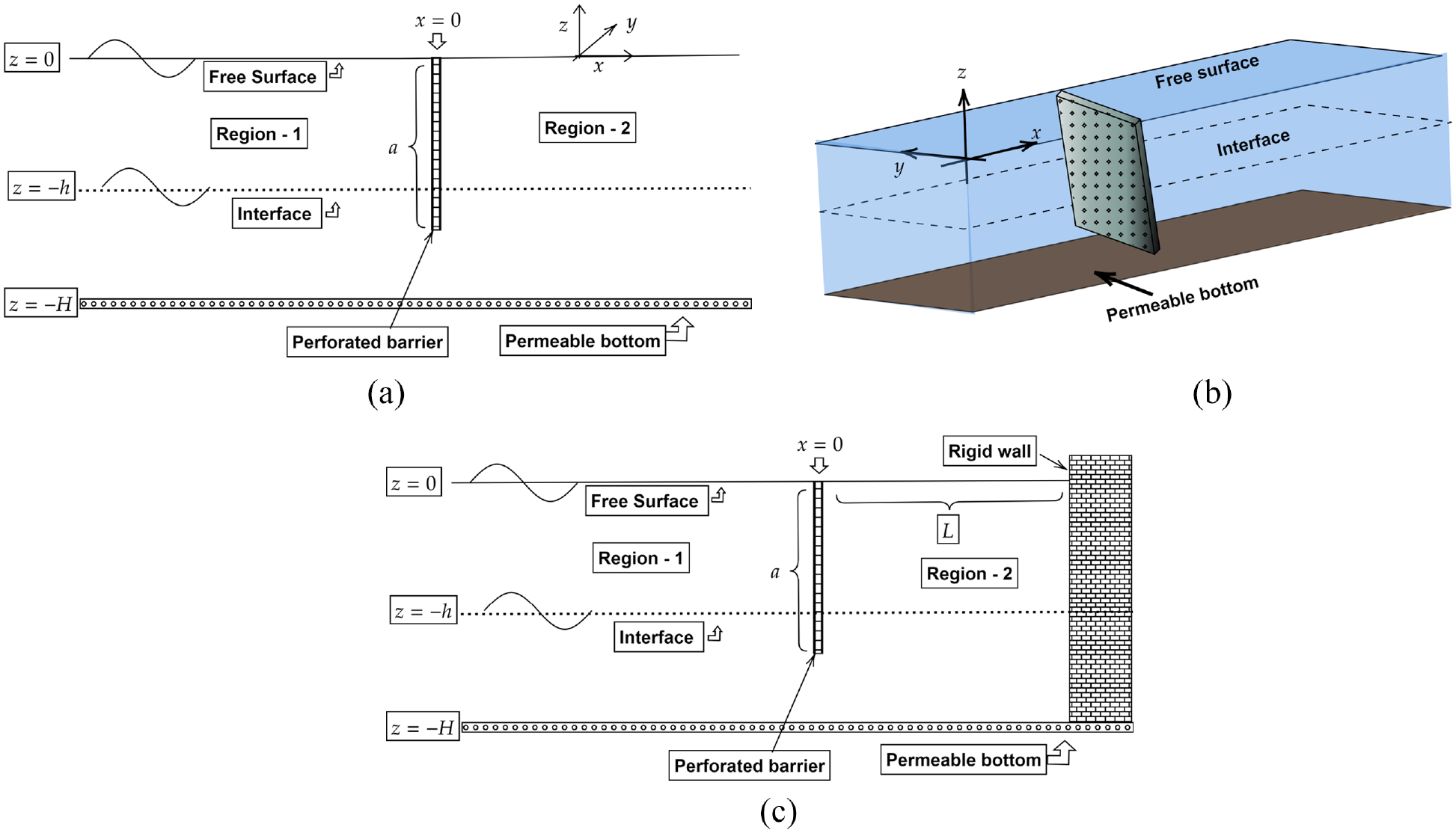
Sketch of (a) wave scattering model with a perforated barrier in geometric cross-section, (b) three-dimensional view and (c) wave trapping model in geometric cross-section.
For layer-wise elucidation,

where the potentials corresponding to the upper and lower layers are denoted by the superscripts
For forming and solving the boundary value problems (BVP), the modified Helmholtz equation is to be used as the governing equation:
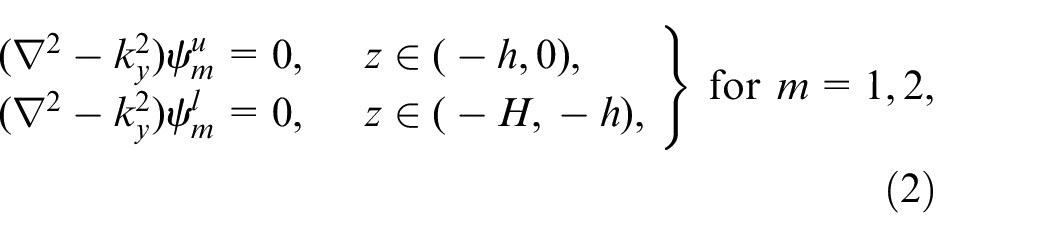
where
At

where
We obtain the boundary condition at the bottom

where
Since the lower layer fluid has a higher density and hence considering

Perforated barrier condition
There are various theories already available with respect to the perforated barrier. If we consider the perforated barrier as a thick porous plate consisting of small and uniform pores, then following Yu,
7
the thick plate assumption can be converted to a thin one by doing non-dimensional analysis along the
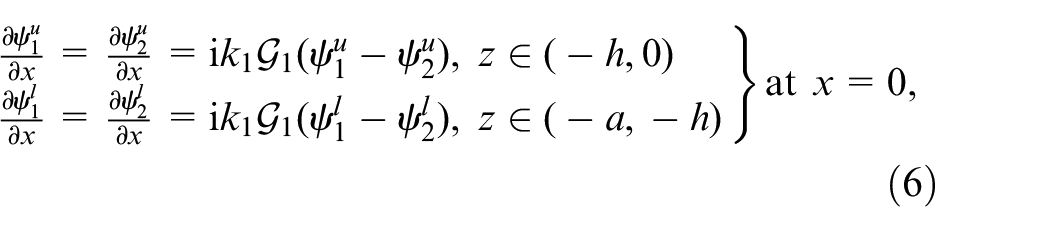
where
Furthermore, the potentials satisfy the continuity of velocity and pressure along the gap at

Rigid wall condition
When waves encounter coastal structures or sea walls, they lose substantial energy via run-up and reflection. Additionally, the amplitude of the incident wave gets boosted near the sea wall by a maximum amount of twice the height of the wave. Because of the scouring that occurs at the base of the wall, safety measures must be contemplated to prevent the wall from collapsing. Therefore, efforts are being made to provide a quiet zone with reduced stress on the existing infrastructure by using perforated structures at a certain distance from the sea wall or coastal infrastructures, thus reducing the potency of the surface gravity waves. The wave trapping model considered next, as shown in Figure 1(c), is thus also taken into consideration in order to investigate the bottom and barrier effect and reduce the force on the wall. The potential

Plane wave approximation
Progressive wave solution
Following the governing equation (2) and the respective boundary conditions (3)−(5), the velocity potentials

with
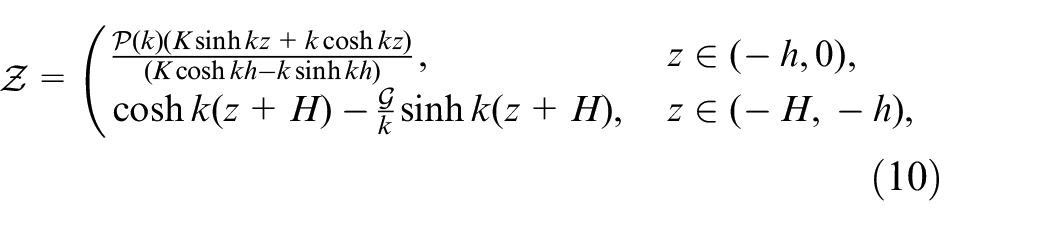
where
Following the second equation of (5), we obtain the dispersion relation
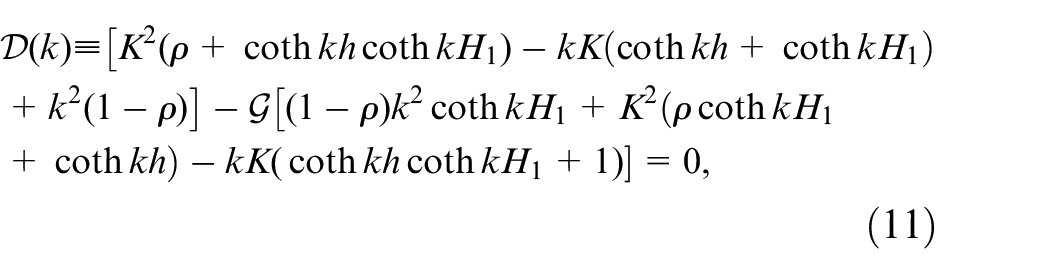
where
Discussion of the dispersion relation
The dispersion relation (11) yields two pairs of real symmetric roots,
Finding the roots of the dispersion relation with complex
Furthermore, it was found that the HP technique attained convergence faster, corresponding to the same number of iterations and with a tiny inaccuracy in terms of the values of the wavenumber. The methodology of Mendez and Losada
58
can be adopted due to the consistency of the results in both ways, ignoring the computational cost. Furthermore, the direct application of the Newton-Raphson-based algorithm through Matlab would provide with the roots. Still, it may be accompanied by a reasonable amount of complication while guessing the suitable initial value. In addition, for
Effect of bottom permeability on dead water analogue
One of the fascinating features of two-layer fluids is the dead water phenomenon, which creates excessive wave resistance in ships. Since minimal changes in potential energy are needed to produce internal waves, an imposed disturbance, which slowly moves on or below the free surface so that its free-surface signature can hardly be noticed, may be very effective in generating large-amplitude waves on the interface. This effect is closely related to the so-called ‘dead-water’ phenomenon, where slow ships often lose their speed and steering capabilities when moving in regions of strong density stratification. The density stratification may occur due to salinity or temperature. Physically it is an analogue which results in a high-amplitude internal wave with a low amplitude at the surface. This usually occurs irrespective of water depth when the densities of the two fluids are close to each other. This phenomenon is well-known to sailors. This type of still water situation where it is difficult to row a boat was mentioned in the Latin literature by Tacitus, who experienced such problems in Scotland and Germany (see Mercier et al. 60 ). However, the Norwegian Arctic explorer Fridtjof Nansen provided the first well-documented report on the dead water phenomenon (see Nansen 61 ), who encountered this phenomenon while sailing in his ship Fram near Nordenskild island in 1893. A proper scientific explanation of such abnormal behaviour was not provided until Ekman, 62 motivated by the report of Nansen, investigated the phenomenon in detail with the help of experiments. His experiments confirmed that the massive resistance experienced by the slowly moving ship was mainly because of the generation of internal waves and that the maximum drag resistance occurred when the speed of the ship matched with that of the internal waves. Miloh et al. 63 developed a linear explanation for the occurrence of dead water in a two-layer fluid with restricted depth. A nonlinear theory was developed by Grue et al. 64 Due to the dead water analogue, two drag phenomena were observed by scientists. The first, Nansen 61 wave-making drag, causes a constant, abnormally low speed. The second, Ekman 62 wave-making drag, is characterised by speed oscillations in the trapped boat. Recent research shows that these speed variations are due to the generation of specific waves that act as an undulating conveyor belt on which the ship moves back and forth. The scientists have also reconciled the observations of both Nansen and Ekman. They have shown that the Ekman oscillating regime is only temporary: the ship escapes and reaches the constant Nansen speed. Moreover, when the densities of both layers are very close, the energy concentration at the interface will be extremely high compared to that on the free surface. A significant area of the theory is to examine the impact on floating structures such as VLFS (very large floating structures) or breakwaters, which are large thin structures designed to utilise ocean space for various purposes. Especially in tropical regions where salinity and temperature differences stratify the water Yuan et al., 65 this theory would apply to mathematically model wave-structure interaction systems.
Other dead-water related works
Hughes and Grant 66 took advantage of the dead-water effect to study the impact of interfacial waves on wind-induced surface waves. The study relates the statistical properties of surface waves to the currents induced by internal waves. Maas and van Haren 67 investigated if the dead-water effect could also be experienced by swimmers in a thermally stratified pool, offering a plausible explanation for unexplained drownings of experienced swimmers in lakes during the summer season, but found no effect. One can argue that the stratification considered might have been inadequate for swimmers to generate waves and mainly led to the thermocline mixing. An energetic budget is given in a more detailed and idealised study Ganzevles et al., 68 where the authors also observed some retarding effects on the swimmers. In a slightly different perspective, Nicolaou et al. 69 demonstrated that an object accelerating in a stratified fluid generates oblique and transverse internal waves; the latter can be decomposed as a sum of baroclinic modes with the lowest mode always present. Shishkina 70 further showed through experiments that the baroclinic modes generated propagate independently in such a dynamical evolution. However, bottom permeability effects become necessarily significant when the amplitude of the internal waves increases.
We try to illustrate the dead water analogue as well by examining the impact of bottom permeability in it. We consider one-dimensional wave form of the amplitudes
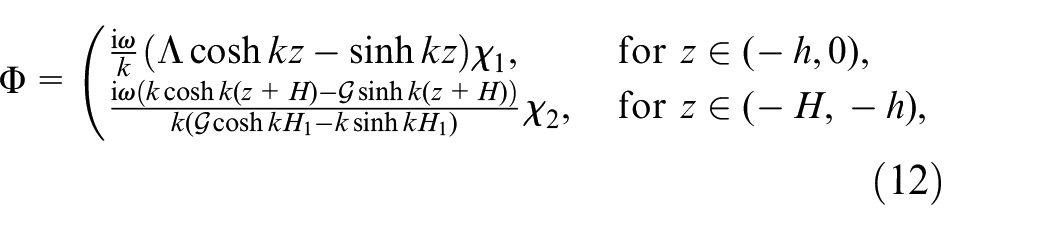
where

Furthermore, the amplitude ratio is expressed as

where
Equation (11) can be represented as a quadratic equation in

where

Equation (14) results in two propagating modes, such as

where
Figure 2(a) and (b) illustrate the impact of bottom permeability and wavelength in dead water analogue. The amplitude ratio is quite large as
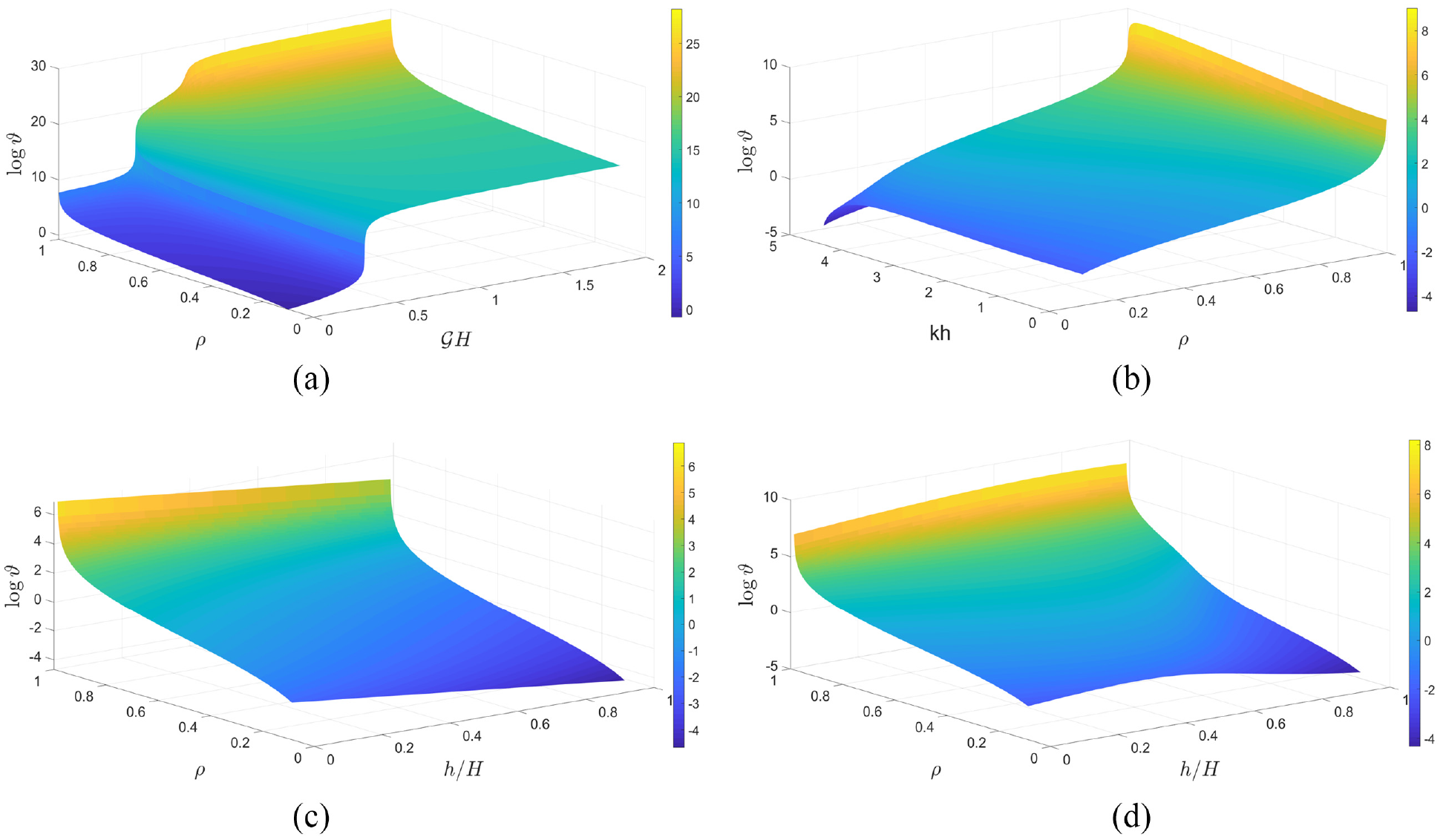
Non-dimensional ratio of amplitude
Furthermore, while varying the wavenumber, we can observe that the dead water impact decreases for the case of deep water waves as compared to shallow water waves. This is due to the lower impact of
In Figure 2(c) and (d), the elevation ratio is illustrated for two different values of
Further, all the graphs depict that, when the densities of both layers are very close, the energy concentration at the interface will be extremely high compared to that on the free surface. Nevertheless, the dead-water phenomenon does not correspond to a constant amplitude ratio evolution. The dynamical study of the problem is thus much more prosperous than in the rigid bottom case. However, it is essential to mention that the bottom permeability implies changing the effective force on the wave interaction system. Without permeability, the effect of the bottom would be a constant one. The permeability is not included in previous studies and seems to be an essential characteristic of the dead-water phenomenon.
Scattering problem
Method of solution
Our main aim is to utilise the eigenfunction expansion method to find solutions by using the orthogonality of eigenfunctions. In the scattering problem, we can express the spatial velocity potentials as follows:


where the unknown coefficients
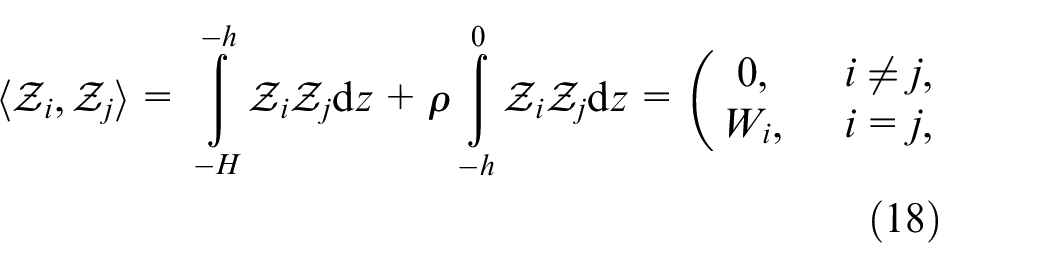
where
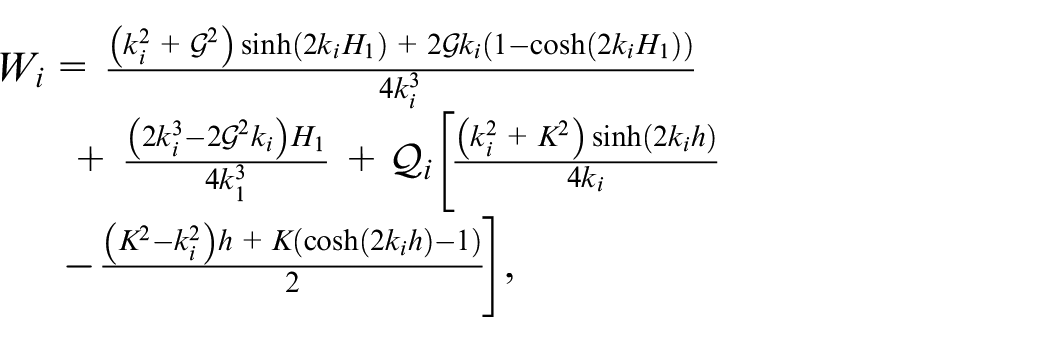
with

We utilise the orthogonality of the eigenfunction in the continuity condition of velocity in (7), which yields

Using the relation (19) for the second part of equation (6) and equality condition of


where
Dalrymple and Martin
71
used the least square approach to find the unknown coefficients in equations (20) and (21). For this task, a new quantity

where
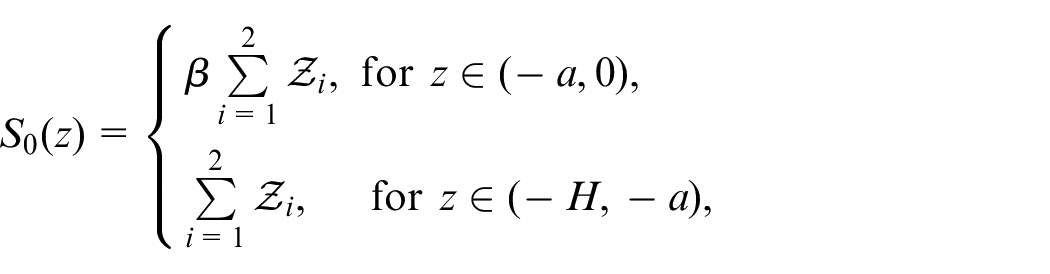

The following relationship must hold in order for this approach to work:

Following this, we minimise equation (23) with regard to each and every

with
We arrive at the following system of linear equations after integration:

where
Equation (25) yields a system of linear equations of order

Solving the above system of equations gives us
The free surface and interfacial reflection coefficients are denoted by
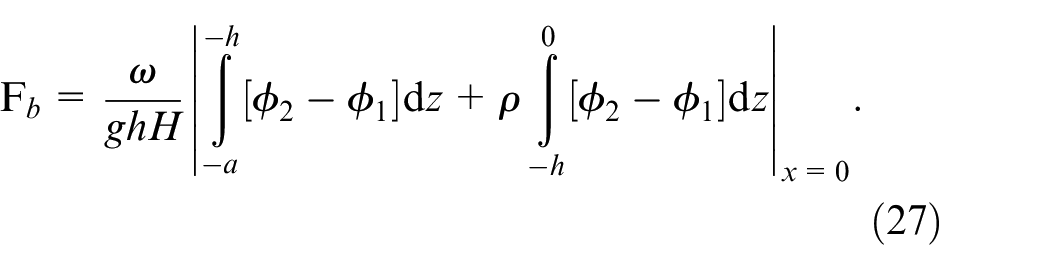
The amplitudes at the free surface and interface are obtained, respectively, as

The non-dimensional pressure distribution at the surface of the perforated structure in each layer may be calculated by using the formula below:

where
Energy identity relation for scattering problem
In order to grasp the relationship between the hydrodynamic coefficients and subsequently to confirm the correctness and application of the computational results, energy identities must be constructed. We utilise Green’s integral theorem to develop energy identities.
As seen below, the whole fluid domain is separated into two bounded contours:
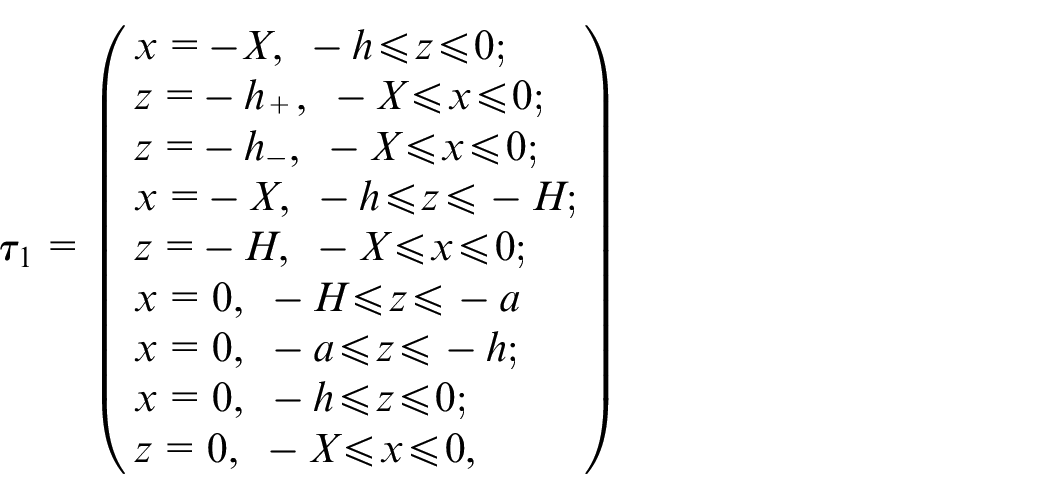
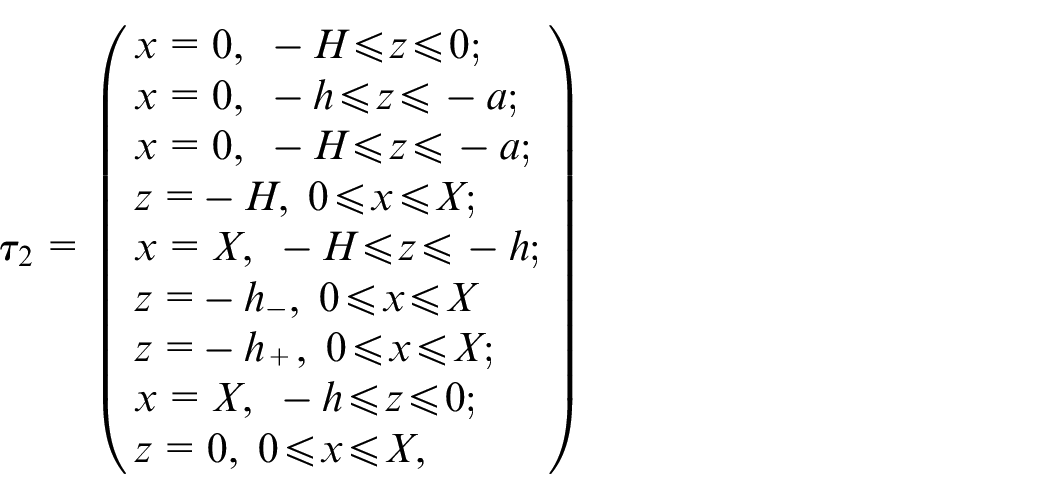
where the upper and lower layers are denoted
Using Green’s integral theorem, we obtain
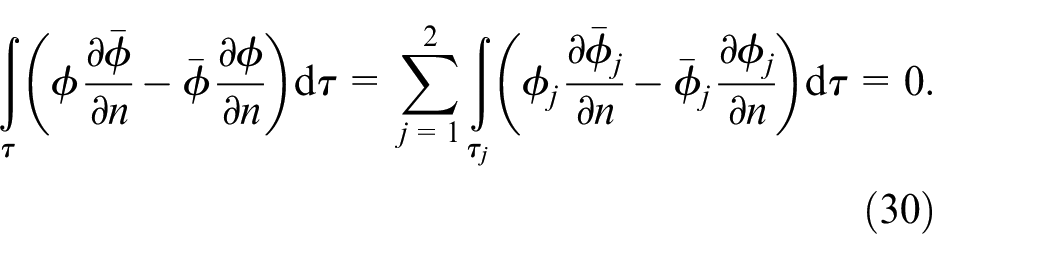
The contribution of (30) along each line is determined by using the technique of Das et al. 72 At the interface, we obtain
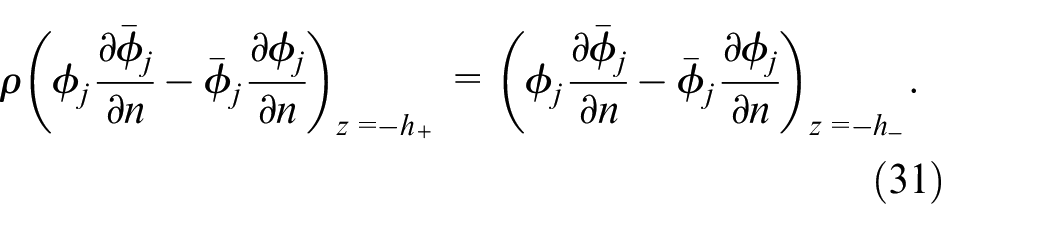
Using equation (31) in equation (30) gives rise to zero contribution along
By allowing


The contribution along
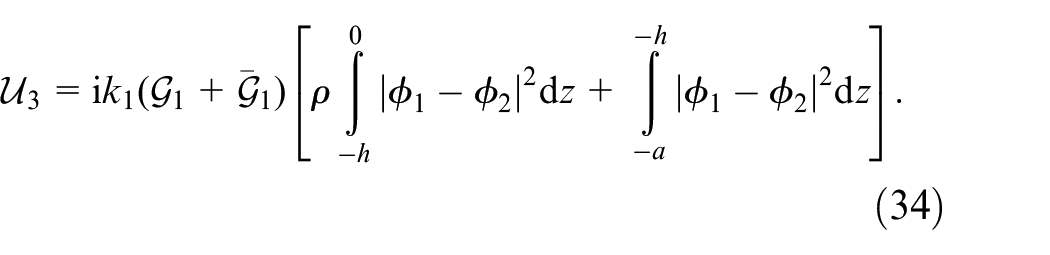
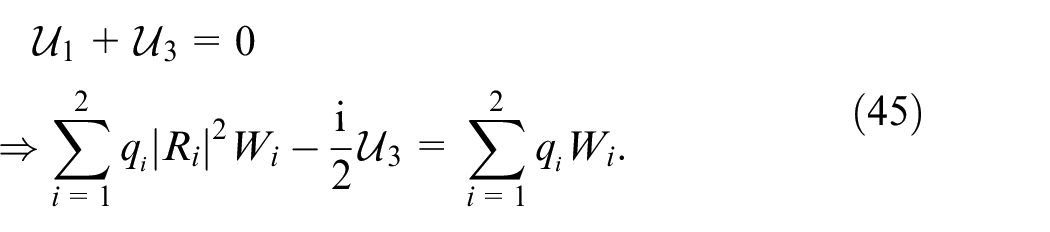
Summing all the integrals, the final form of the energy balance relation is obtained as
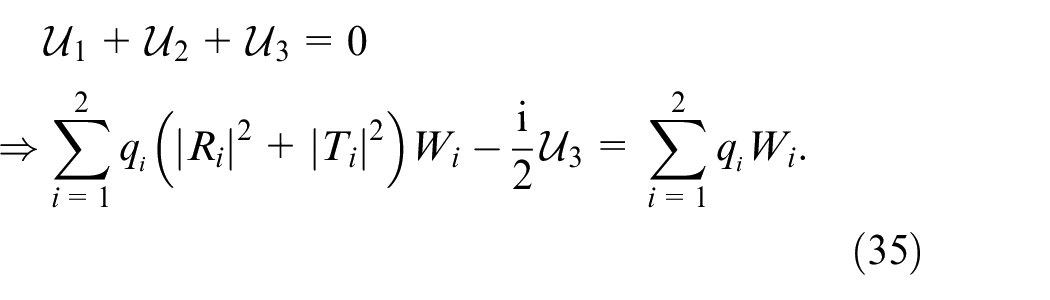
Let
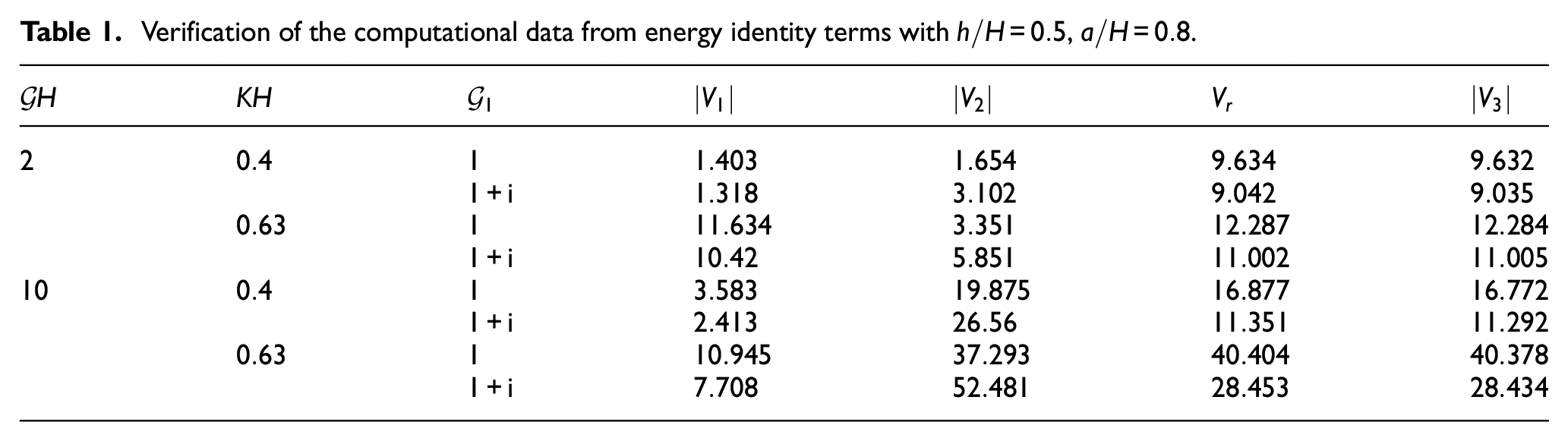
The energy identity terms are compared to determine the validity of the solution. Table 1 clearly shows that the computational data are of a higher order of accuracy.
Verification of the computational data from energy identity terms with
Trapping problem
Method of solution
For the trapping problem, the only change will occur in

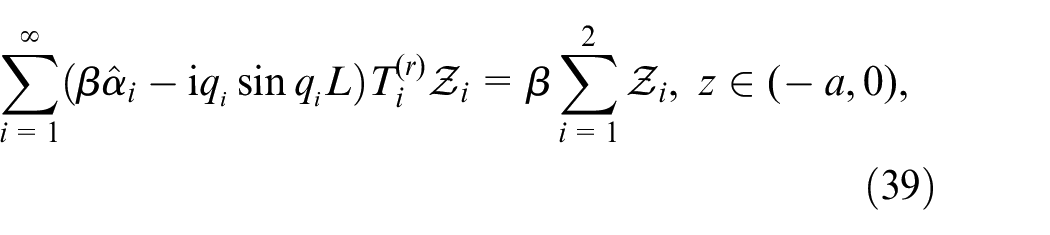
Now, utilising the orthogonality of

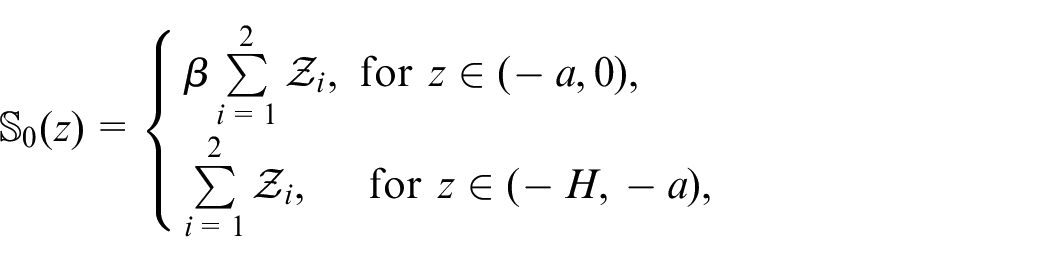
Analysing (37), we can conclude that

Moreover, for a normal incident wave,

where
A new quantity

where

The following system of linear equations results from integration with regard to

where
Equation (42) yields a system of linear equations of order

Solving the above system of equations gives the unknowns, which can be used to obtain different physical values of interest. The following formula is used to compute the non-dimensional horizontal wave force

Energy identity relation for trapping problem
The contribution of
Special case: Radiation problem due to perforated barrier
There are six motions that a floating structure may produce: (i) three translational motions known as surge, heave and sway along the
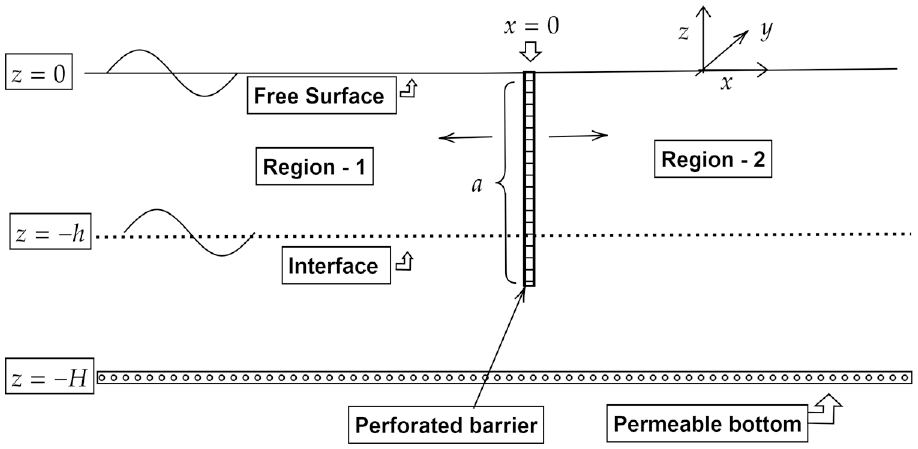
Schematic diagram of radiation problem.
Mathematical formulation and method of solution
The radiation problem of the thin barrier is based on considering the small motion of the thin barrier. Similar consideration can be observed in Lee and Chwang. 8 Why only the surge motion is taken into account in this arrangement and not also the heave motion, the following explanation is provided for justification:
Because the barrier is thin, the waves interacting with it are negligible from the


where the coefficients
The perforated structure has horizontal velocity

Using the orthogonality of depth function in

Using relation (49) in equation (48) and equality condition of


Following a similar approach,

where


Integrating with respect to each

where
Equation (53) can be written equivalently as a linear system of complex matrix system of size

The amplitude to stroke ratio, that is, the ratio of the amplitude of the radiated potential to the amplitude of barrier stroke in both propagating modes, can be defined by
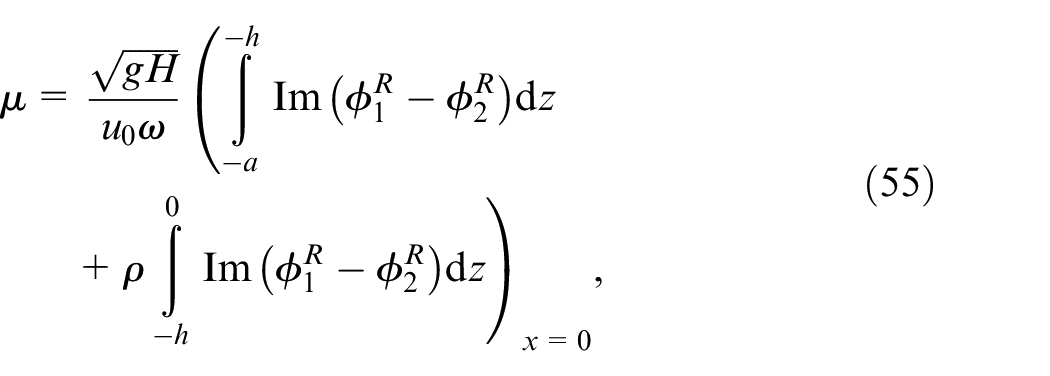
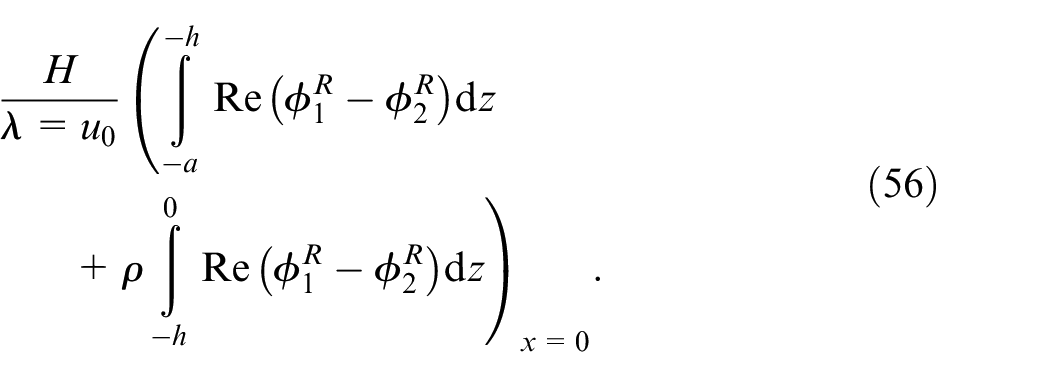
Solving the radiation problem yields key hydrodynamic coefficients such as added mass and damping coefficients. These coefficients are derived from the real and imaginary components of the hydrodynamic response loads on the body induced by the specified body motions. Added mass refers to the weight added to a system in a fluid as a result of an accelerating or decelerating entity having to transfer some volume of surrounding fluid with it as it travels. Damping is a phenomenon that decreases, limits, or stops oscillations within or on an oscillatory system. The hydrodynamic forces in the
Numerical results and discussion
We numerically compute the solution of (26) by using Matlab R2019a with some parameter values as follows:
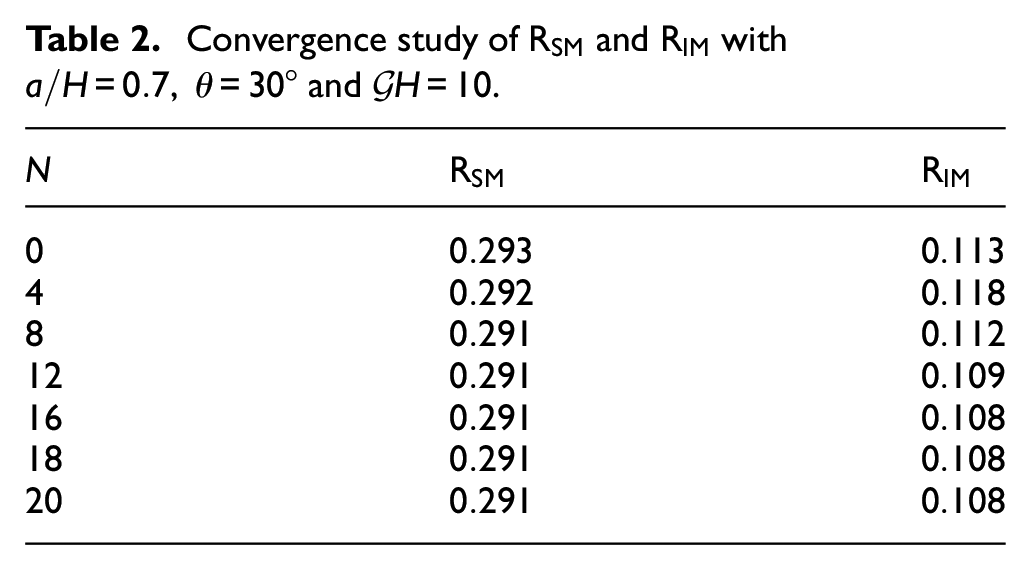
Convergence of evanescent modes
The number of evanescent modes
Convergence study of
Scattering problem
Effect of porous-effect parameter of the barrier on reflection coefficients
Ideal structural porosity minimises the fluid passing across the barrier, and the damping effect minimises the waveload on the shoreline. The impact of porous-effect parameter
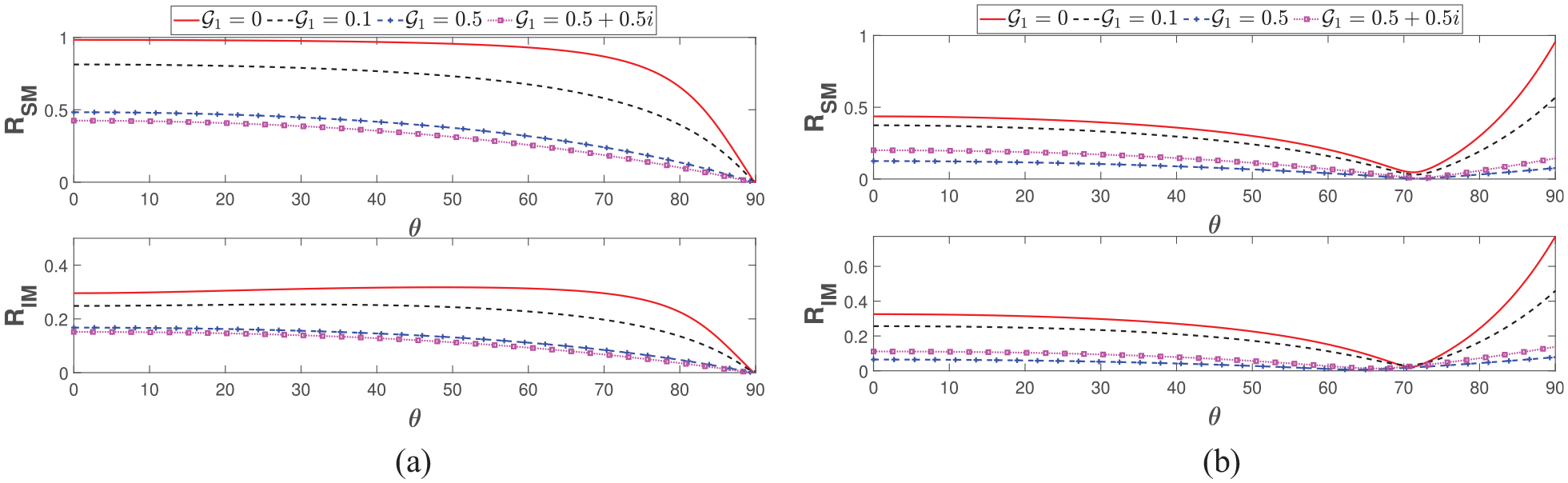
Impact of bottom permeability (a)
Effect of density stratification on reflection coefficients while varying frequency
Figure 5(a) and (b) show the effect of density stratification on hydrodynamic coefficients against the incoming wave frequency. When
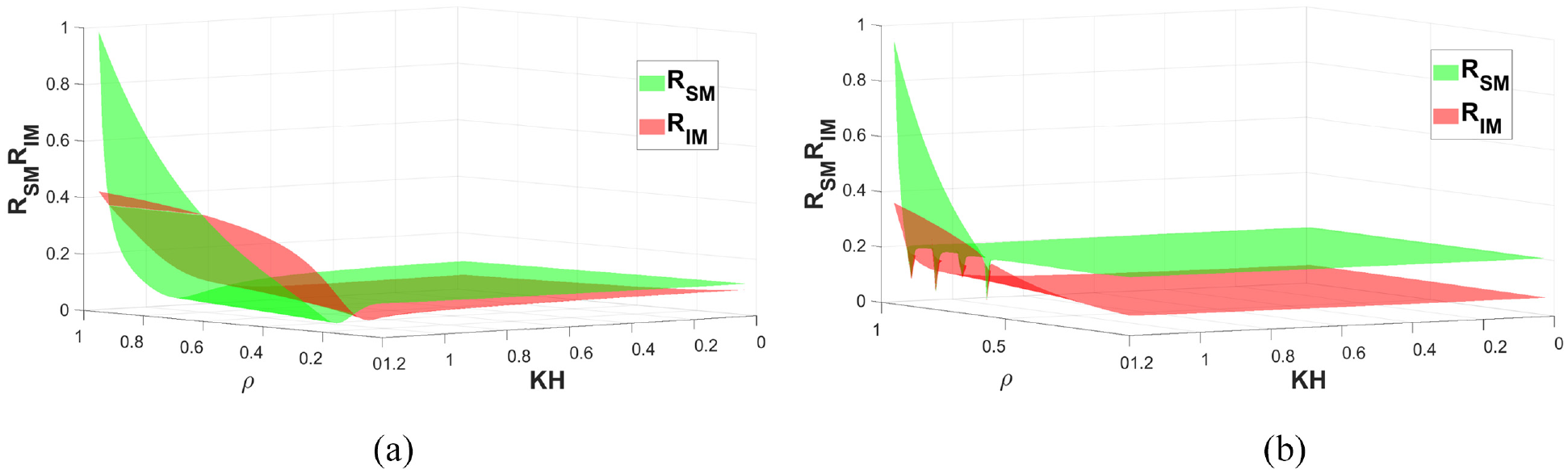
Non-dimensional reflection coefficients versus
Comparison with homogeneous fluid model
We approximate our model for a homogeneous fluid framework. For Figure 6(a) and (b), we consider
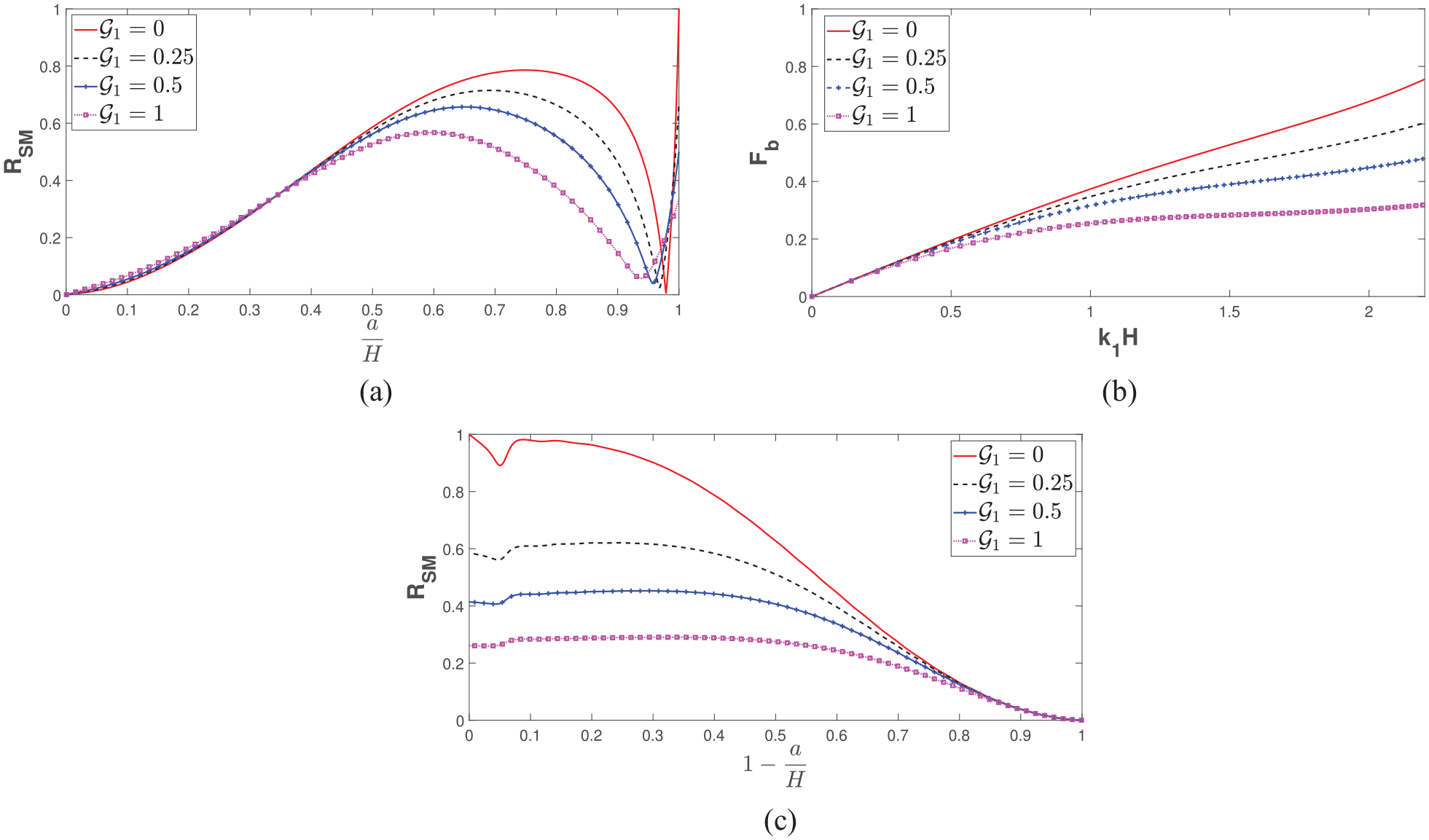
(a)
Effect of porous-effect parameter of the barrier on waveload and pressure
For increasing angular frequency, the influence of the porous-effect parameter on waveload
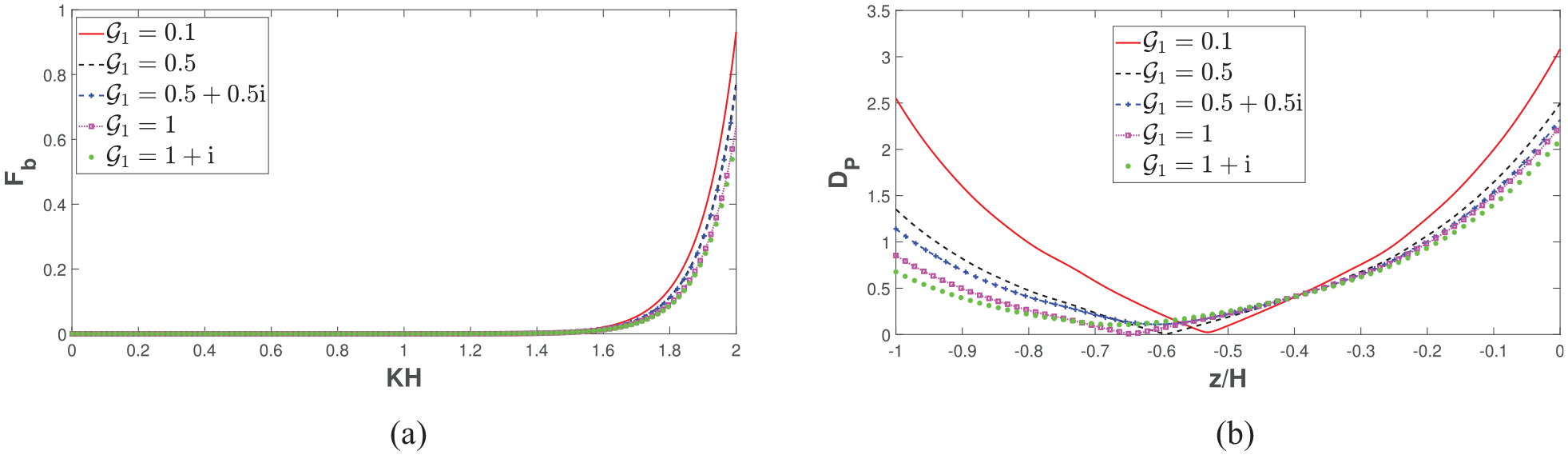
Non-dimensional waveload on the structure (a)
Effect of the porous-effect parameter of the barrier on the free surface and interfacial elevations
Figure 8(a) and (b) demonstrate how various values of the porous-effect parameter
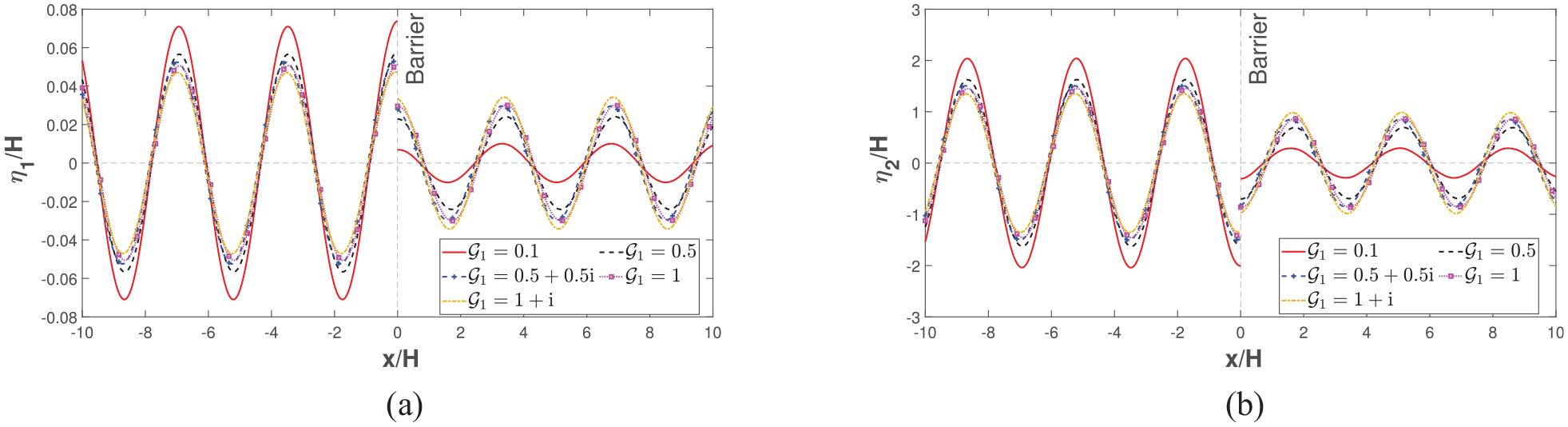
(a)
Effect of porous-effect parameter on the energy contribution of the barrier
Figure 9(a) and (b) show the variation in
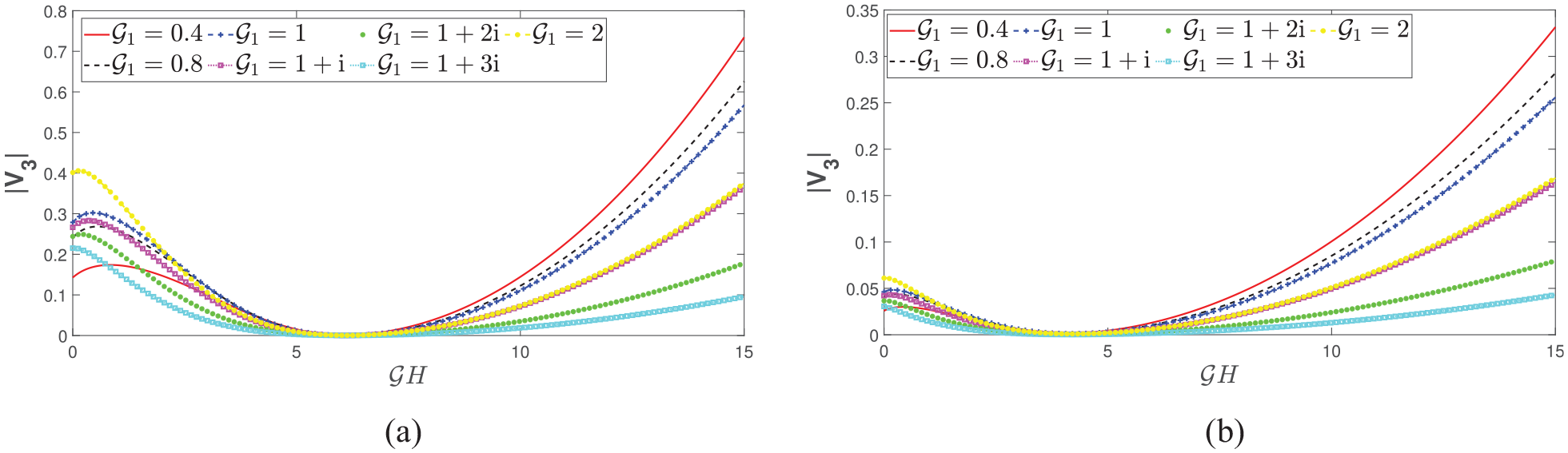
Trapping problem
Effect of
on reflection coefficients
In Figure 10(a) and (b), the influence of the porous-effect parameter
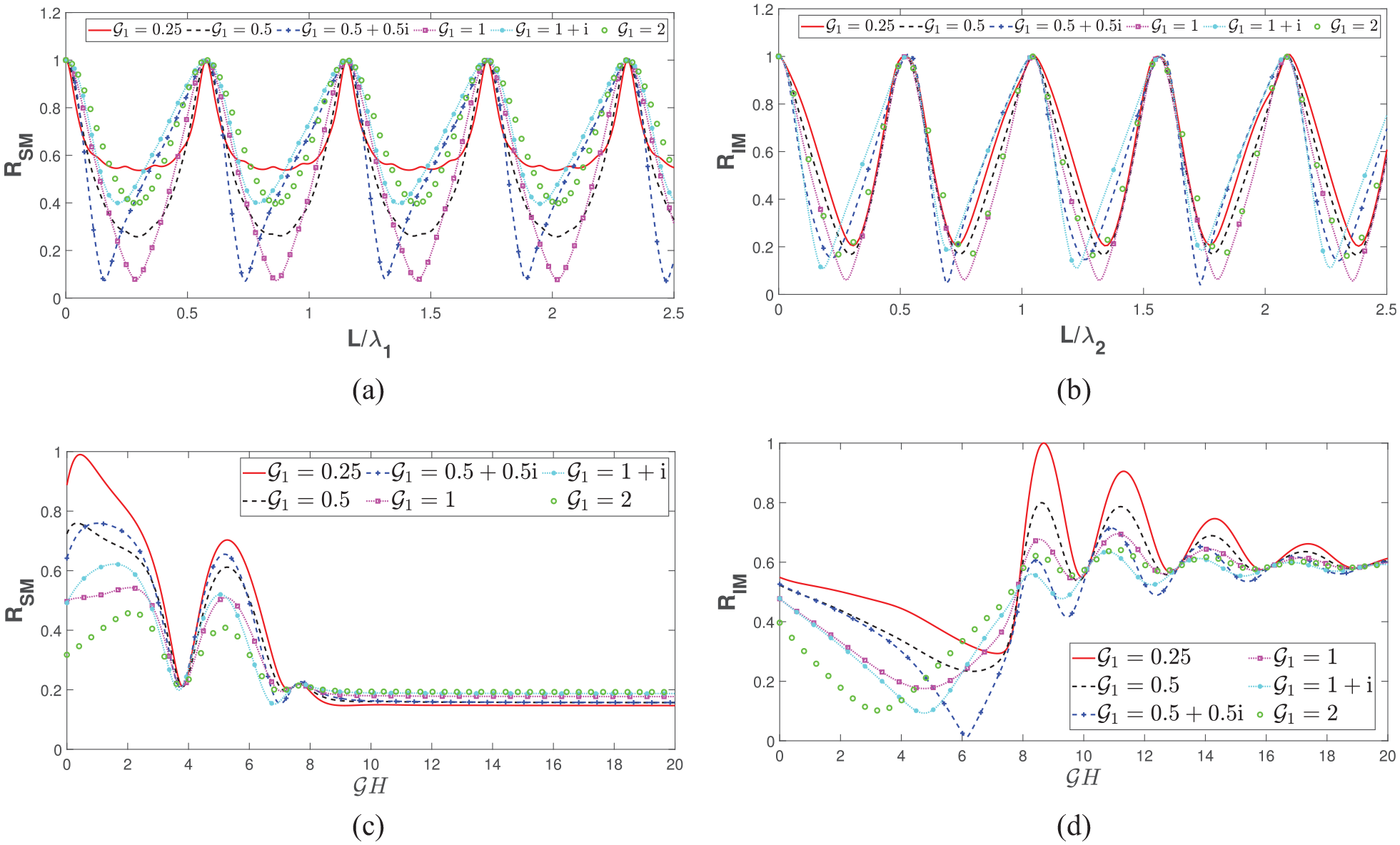
Impact of
Comparison with a homogeneous fluid model
We approximate our model in a homogeneous fluid framework by considering
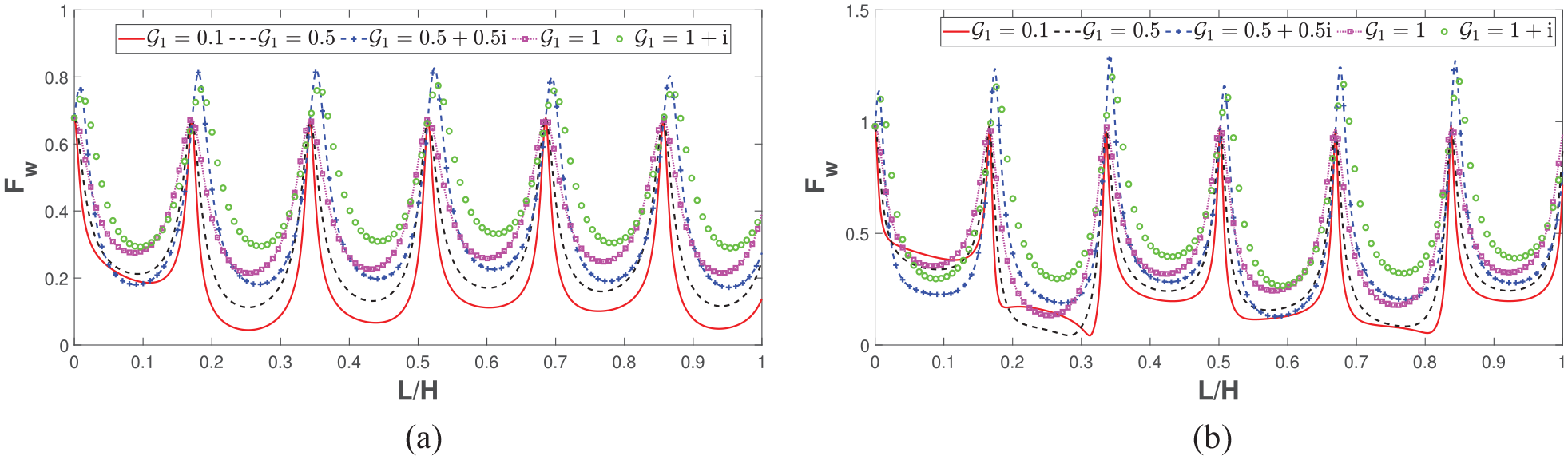
Effect of porous-effect parameter of the barrier on waveload
The impact of the porous-effect parameter
Radiation problem
Numerical validation of the barrier model
We compare our present barrier model to a prior one by eliminating the permeability of the sea-bed from the formulation so as to compare with the existing wavemaker model of Manam and Sahoo.
11
To convert the permeable bottom into an impermeable one,
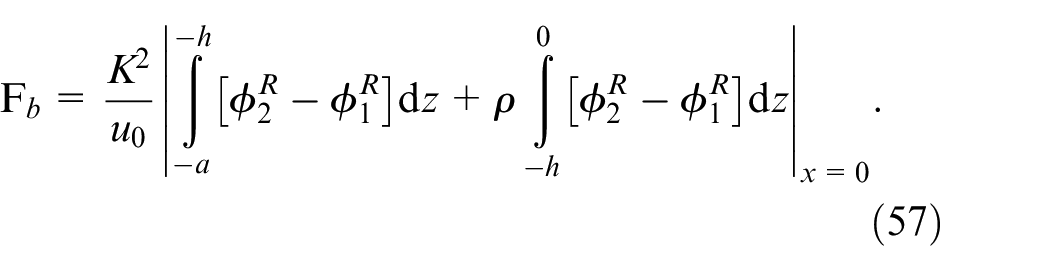
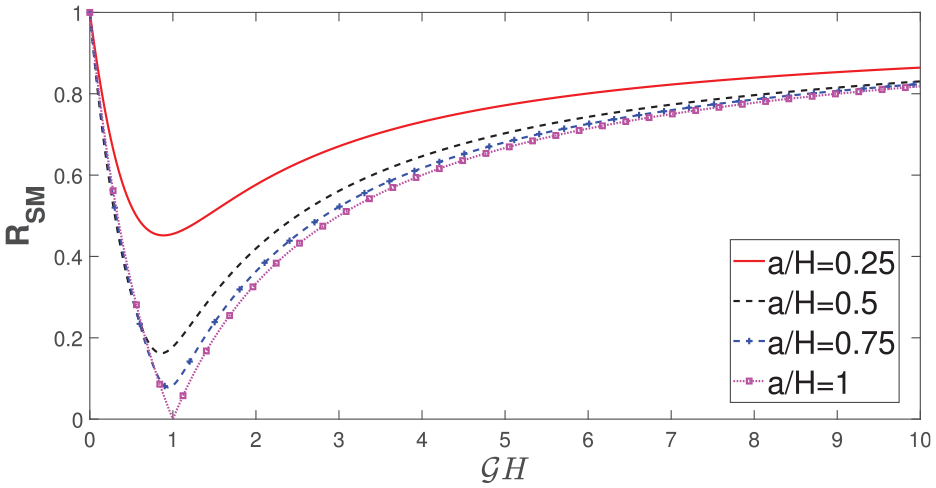
In such a scenario, we use the following parameter values to approximate a comparison:
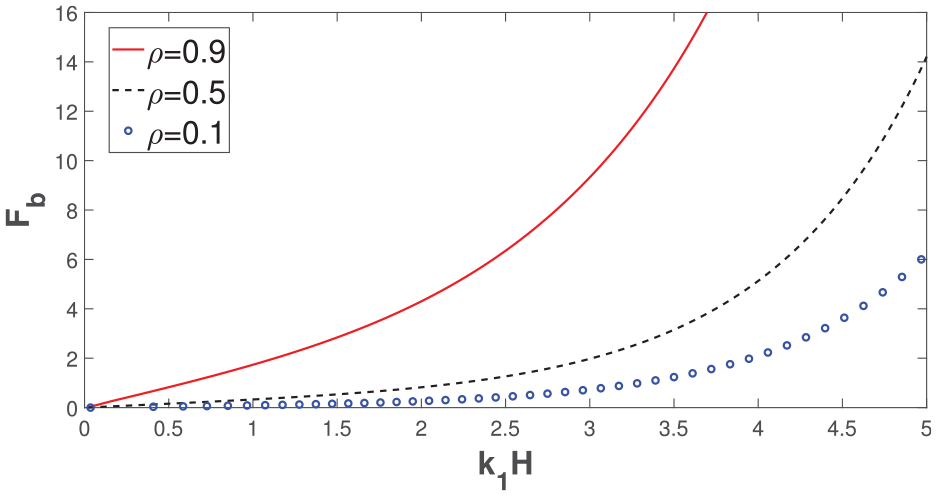
Non-dimensional waveload
Effect of
on radiated wave amplitude stroke ratio
The efficiency of the barrier is evaluated by comparing the amplitude to stroke ratio for various values of the porous-effect parameter
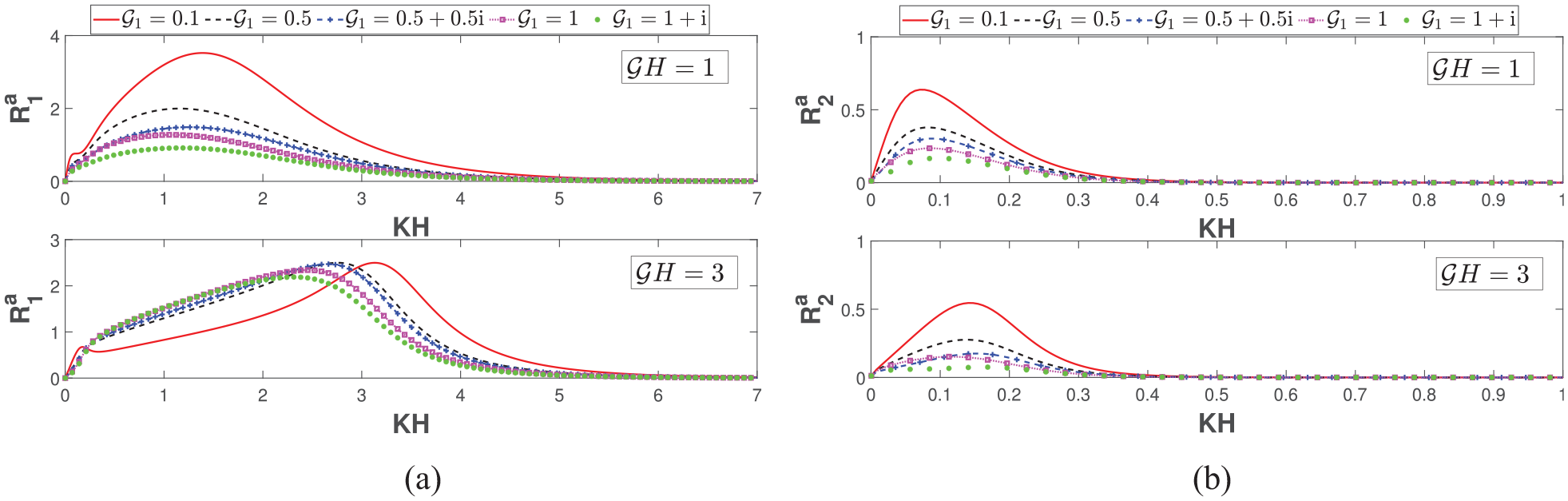
Amplitude of stroke ratio for radiated potentials for (a) free surface mode and (b) interfacial mode versus
Effect of
on added mass and damping coefficient
For the barrier, added mass and damping coefficient vary against the dimensionless angular frequency
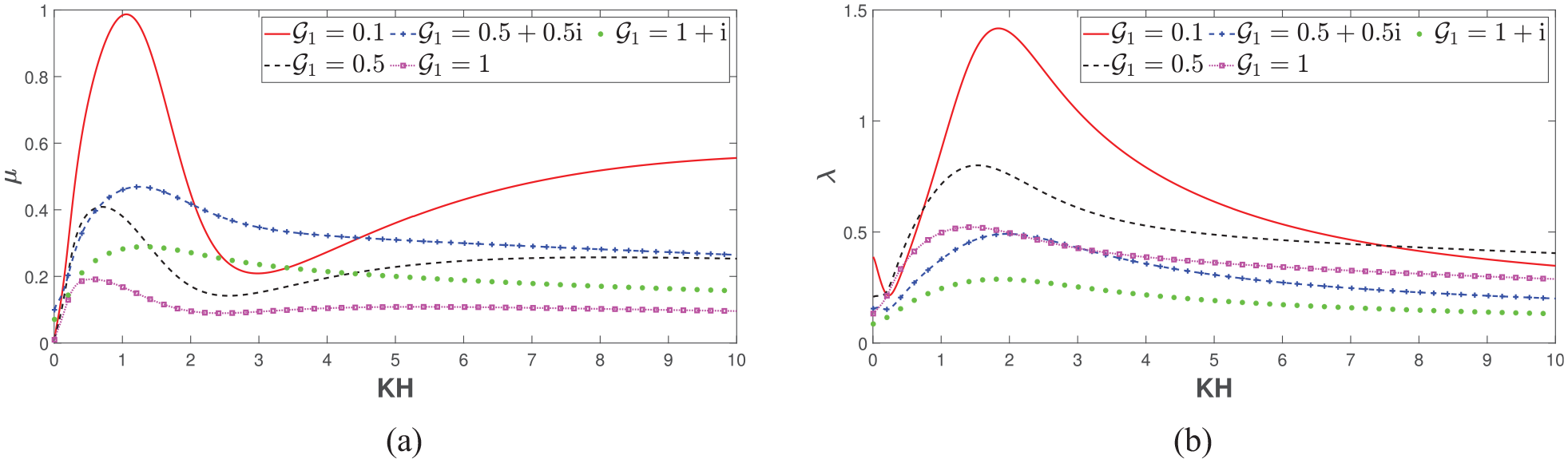
(a) Added mass and (b) damping coefficient versus
Conclusion
The current research focuses on the interaction of oblique water waves with a perforated barrier in a two-layer fluid flowing over a permeable bottom. The solution to the relevant scattering, trapping and radiation problem is found by using matched eigenfunction technique along with the least square approach. Mathematically, the bottom permeability appears as embedded in the propagating wave modes and the velocity potentials, and consequently, the effect can be observed in dead water analogue and energy identity terms. The physical impact of the bottom can be clearly observed in the hydrodynamic coefficients. Geometrically, the fluid region is divided into a number of sub-regions, and the specified equations and matching conditions are used to create a system of linear algebraic equations that are solved to get and evaluate certain vital conclusions, which are listed below:
By selecting suitable structural porous-effect parameters, it is possible to obtain the maximum dissipation of energy and lower elevation than for the case of a similar rigid barrier. Higher damping of the perforated barrier results in lower wave elevation for both propagating modes. Moreover, higher
From energy dissipation results for various porous-effect parameters, the following observations may be noted: (i) the barrier produces higher energy contribution for lower
Study of the elevation amplitude ratio to discuss dead water analogue shows that the bottom permeability is very significant in shallow water waves and intermediate waves. However, for long waves, the bottom permeability is rendered ineffective.
Water wave trapping in the confined region shows the periodic behaviour for hydrodynamic coefficients. However, a major part of wave dissipation occurs due to bottom permeability, resulting in less waveload.
The current research is expected to add to our knowledge of the mechanism of a barrier in motion. The analysis of radiated potential amplitude establishes that the radiated potential in free surface mode contains a higher wave flow of energy with increasing frequency. It also shows that the impact of the perforated barrier produces radiated outgoing waves of lower amplitude in both propagating modes.
The analysis of added mass and damping coefficient establishes that the porosity of the barrier plays a crucial role in energy dissipation. The complex porous-effect parameter of the barrier may give rise to the higher added mass. The higher frequency of the barrier results in a smooth nature for both characteristics.
In a nutshell, the study of water wave interaction with perforated structures enables us to properly understand the influence of such structures that aid in creating a calm zone for the protection of coastal infrastructure. A realistic scenario can be envisaged when both the reflection and radiation of waves are considered.
Footnotes
Acknowledgements
Both the authors are thankful to the Editor-in-Chief and the Reviewers for their effort and suggestions to improve the manuscript. The corresponding author thanks Indian Institute of Technology Guwahati for providing him with a research fellowship for 5 years, which enabled him to finish this study as part of his PhD programme.
Declaration of conflicting interests
The author(s) declared no potential conflicts of interest with respect to the research, authorship, and/or publication of this article.
Funding
The author(s) disclosed receipt of the following financial support for the research, authorship, and/or publication of this article: No specific funding was utilised in completing the manuscript. However, the first author received junior research fellowship (2017–2019) and senior research fellowship (2019–2022) from Indian Institute of Technology Guwahati, India (Through Ministry of Education, Government of India) for his PhD.

Data availability
The data supporting the findings of this study are available from the corresponding author upon reasonable request.