




Abstract
Following the updated global sulphur emission cap from 1 January 2020, shipowners are facing an increasing cost burden to comply with the new regulation in a tough shipping market. This research compares the lifespan costs of three main alternatives, all of which can satisfy the 2020 global sulphur emission regulation. A lifespan cost analysis model is built considering several cost items across the three alternatives, including the initial cost of investment, maintenance cost and fuel consumption cost. Two vessels with a capacity of 5000 and 10,000 TEUs are selected as case study vessels. The @risk software is utilized to conduct an uncertainty analysis with respect to the fuel price and the discount rate to test the three alternatives in different circumstances. The results indicate that the larger the vessel, the lower the discount rate, and the greater the price of Mixed Fuel Oil (a mixture of Very Low Sulphur Oil and Marine Gas Oil), the more attractive the scrubber option. Quantitatively, if the refining technology of low-sulphur fuel improves in the future and the price differential between Mixed Fuel Oil and Heavy Sulphur Fuel Oil decreases to $29 per ton for the 5000 TEU vessel or $27 per ton for the 10,000 TEU vessel, the fuel-switch alternative will be as competitive as the use of a scrubber in terms of the lifespan cost. Additionally, as the discount rate increases, the cost gap between the use of a scrubber and the other two alternatives gradually decreases.
Introduction
Emissions from ships account for a majority of air pollution in ports and sea areas around the world. Ship emissions, especially sulphur oxides (SOx), have the highest growth rate of the emissions.1,2 The SOx comes from the oxidation of sulphur in the fuel oil used by diesel engines. In order to reduce the environmental impacts caused by SOx, like acid rain, the International Maritime Organization (IMO) set a new global sulphur cap of 0.5% m/m in MARPOL Annex IV. 3 The sulphur emission regulation states that most ships are expected to utilize new blends of fuel oil which will be refined to comply with the 0.5% limit on SOx emissions. The regulatory reduction is a decrease from the 2012 level of 3.5% to the new limit of 0.5%, and it was implemented from 1 January, 2020. 4 This sulphur emission limit in the Emission Control Areas (ECAs) remains the same at 0.1%. Figure 1 shows the evolution of sulphur emission limits from the beginning of the 21st century.
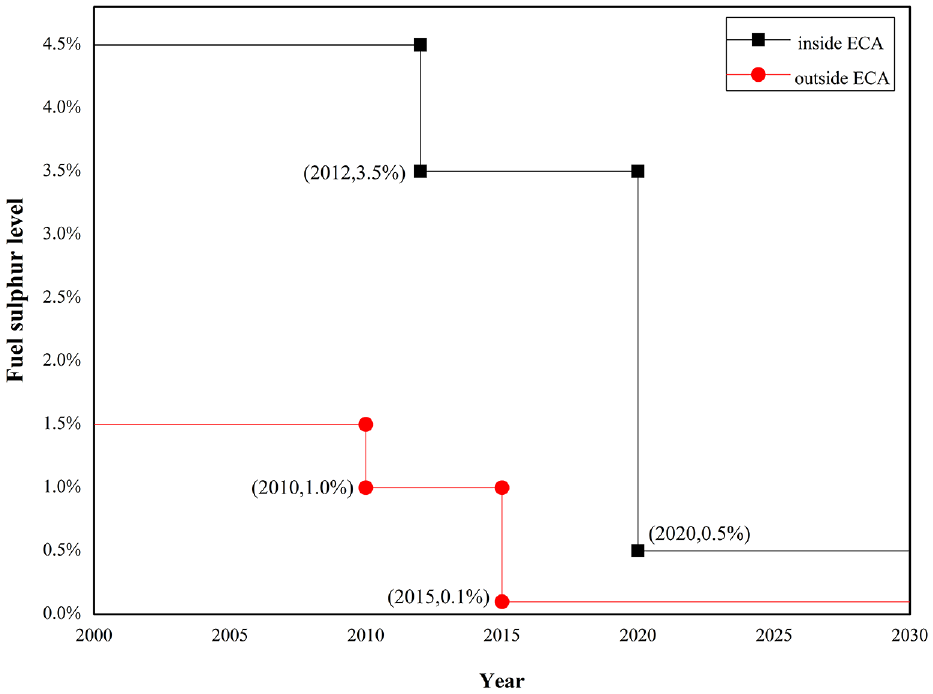
The evolution of sulphur emission limits.
The implementation of the 2020 sulphur regulation will undoubtedly increase the associated fuel and equipment costs of shipping companies. Although some of the increased costs can be reduced in the form of a Low Sulphur Fuel Surcharge, shipping companies still need to find the best way to control the increase in their costs. As sulphur emission limits have become more stringent, different alternatives have emerged in practice. Therefore, shipowners must choose from a suite of options to comply with the new emission limit. Some companies quickly adapt to the regulation through the adjustment of the sailing pattern, while others prefer to use other technologies to meet the requirements of relevant laws and regulations.
There are generally three realistic alternatives that are widely accepted by the maritime community as effective ways to reduce sulphur emissions from ships. These are the use of low-sulphur fuel oil (LSFO), the installation of exhaust gas cleaning systems (scrubbers), and the use of liquefied natural gas (LNG) as ship fuel. The first alternative entails using LSFO instead of heavy fuel oil (HFO) (fuel-switch). This method requires appropriate modifications to the engine room of the ship to adapt to the conversion of fuel oil. Very Low Sulphur Fuel Oil (VLSFO) and Marine Gas Oil (MGO) are the two main kinds of LSFO. However, the price of LSFO is generally much higher than that of Heavy Sulphur Fuel Oil (HSFO).
The second alternative is installing exhaust gas cleaning systems (scrubbers). Scrubbers can address the sulphur contents in ship emissions when HSFO is utilized as fuel oil. The purchase and installation of scrubbers requires an additional investment but can potentially save money when compared to the fuel consumption costs of VLSFO. Vis 5 discussed the viability of scrubbers for different vessel types from an industry insight. It is concluded that fitting scrubbers was fully justified under all circumstances of their case studies. The only exception seemed to be for Mega Container carriers, where, if it was possible to pass the additional cost of using low sulphur fuel on a per-container basis to the customers, the fitting of scrubber could be avoided.
The third alternative utilizes LNG as fuel. Apart from complying with the sulphur emission limit, the use of LNG can also control NOx and PM emissions. 6 This option also needs substantial initial investment to install an LNG fuel converter for container ships and a high fuel consumption cost of LNG. Aside from increased costs, the supply of LNG and restricted long-distance navigation will be the limiting factors to take this option.
Any one of the three outlined alternatives can satisfy the amended MARPOL Annex VI regulation. 7 Compared with HFO, in the fuel-switch alternative, using VLSFO and MGO can reduce SOx emissions by about 80% and 96%, respectively. Installing a scrubber has a better effect, reducing 95–98% SOx emissions. Utilizing LNG as fuel oil is the most effective way, reducing 95–100% SOx emissions. No matter which compliance alternative is selected, additional costs will be incurred, including the capital, operating, and maintenance costs. It may be a challenge for shipowners to face the costs associated with compliance, especially in the competitive shipping market. They have to comply with the sulphur emission limit with a minimized cost. 6
Recently, many researchers have carried out qualitative or quantitative comparative studies on these possible solutions.7–9 Abadie et al. 8 compared switching to LSFO with installing a scrubber under uncertainties. Their Net Present Value (NPV) was calculated as an evaluation criterion. The results showed that the newer the vessel was, the more often it navigated in ECAs, and the longer it operated at sea, the more attractive the alternative of scrubbers became. Zhu et al. 9 also compared the NPV of MGO and scrubbers, selecting a 19,000 TEU vessel as a case study. Two possible price spreads between HFO and MGO were identified to make MGO as attractive as scrubbers. They suggested that their research could be extended to compare the two alternatives for other vessel sizes or sailing routes.
However, there are limited studies that examine the lifespan costs of the alternatives and even fewer that compare total lifespan costs, taking uncertainties into account. This research aims to compare the lifespan costs of the three main alternatives to the global sulphur emission regulation in an uncertain circumstance, to provide a comprehensive decision-making reference for shipowners.
The rest of the paper is structured as follows. Section 2 reviews the existing literature in terms of comparing three compliance options. Section 3 proposes a lifespan cost analysis model for three alternatives. The lifespan cost analysis model is validated based on two case vessels in Section 4. Uncertainty analysis and scenario analysis are discussed in Section 5, and finally, the conclusions are presented.
Literature review
Before the 2020 global sulphur cap, the sulphur emission limit in ECAs set by IMO and China’s SOx Emission Control Areas (SECAs) came into force on 1 January 2015. The literature concerning methods for complying with the regulation of the ECAs and China’s SECAs is helpful to the compliance of the 2020 global sulphur cap. Chen et al. 10 elaborated the pros, cons and challenges of different sulphur limit alternatives in fulfilling the requirement of China’s SECAs. Jiang et al. 11 found that installing scrubbers was a cost-effective option compared with MGO. Gu and Wallace 12 incorporated the ship’s sailing pattern into life cycle cost analysis of the fuel-switch alternative. They found that the effectiveness of scrubbers was potentially overestimated in the previous studies due to the disregard of the ship’s sailing pattern. Since the sulphur emission regulation in an ECA is much stricter than outside an ECA before 1 January 2020, the ship’s sailing pattern has a significant influence on the life cycle cost of the alternatives. Fan and Gu 13 developed a cost-minimizing method to compare MGO with scrubber systems in China’s SECAs and found that the installation of scrubbers was an effective alternative to satisfy the 0.5% global sulphur cap. The speed optimization method was incorporated into the fuel-switch option by considering different speeds in different sulphur emission limit areas. Atari and Prause 14 recognized and assessed existing investment risks of SECA emission abatement technologies of shipowners. Atari et al. 15 proposed a real option analysis of abatement investments for SECA compliance. In order to assess the cost of the enforcement of the SECA regulation, the expense of SECA regulation post-2015 enforcement was calculated using the Baltic Sea as a case study. 16
The methods used to assess different alternatives to comply with the 2020 global sulphur emission cap can be generally divided into three categories by evaluation criteria, namely multi-criteria assessment, cost-benefit analysis, and single criterion, usually economic criterion. Researchers may choose a different indicator as a sole economic criterion, such as NPV, return on investment (ROI), or total cost. The single criterion method is most suitable for stakeholders to make a quick and easy decision, but it may neglect other significant issues. Multi-criteria assessment provides a comprehensive perspective while the decision-makers have to make a trade-off between different criteria. The cost-benefit analysis could be regarded as a special kind of multi-criteria evaluation, including two criteria which are the cost and benefit, where decision-makers usually consider the ratio of benefit and cost. Considering the capital cost, sulphur content, loss of cargo carriage capacity, maintenance requirement, operational difficulty, and LSFO supply need in SECAs, a multi-criteria assessment method is developed combining Analytical Hierarchy Process (AHP) and a Technique for Order of Preference by Similarity to Ideal Solution method for shipowners to choose the best alternative for reducing NOx and SOx. 17 Based on Yang et al. 17 and the single economic criterion, Schinas and Stefanakos 18 proposed an adapted multi-criteria assessment approach to evaluate the compliance options. The approach combined the AHP method and the analytic network process. The advantage of multi-criteria based assessment is that it can simulate the comprehensive consideration of the decision-making process while the challenge is that expert judgement is often needed to decide the weight and score of each criterion. The AHP method is frequently employed to obtain the weights of different criteria.
The cost-benefit analysis is also a typical method to assess the alternatives to the sulphur emission regulation. Wang et al. 19 assessed the cost and effectiveness of three sulphur emission control policies under seven scenarios in the existing SECAs. In the same year, benefit-cost ratios of policy measures to reduce sulphur emissions were investigated on the west coast of the USA. 20 The result showed that the benefit-cost ratio ranged from 1.8 to 3.36. Considering both economic costs and the environmental benefits from emission reductions, the two sulphur reduction options: Scrubbers versus MGO, are compared. 11 They revealed that the scrubber alternative was better than MGO from the perspective of NPV based on their case study. However, MGO became a better choice when the price differential of MGO and HFO was less than €231 per ton.
Other researchers analysed the alternatives merely from an economic perspective. DNV introduced the choices and challenges ahead to satisfy the 2020 global sulphur cap. 7 The ROI of scrubbers or LNG regardless of the time value, was used as the assessing criterion in DNV’s report. Panasiuk and Turkina 21 compared the cash flows of the installation of scrubbers and low sulphur fuel oil methods with a particular vessel type. They carried out the comparison in a five-year time as opposed to the total life cycle. Some researchers have included the life cycle assessment (LCA) when comparing different alternatives. 22 Bengtsson et al. 23 assessed the environmental performance of HFO, MGO, gas-to-liquid fuel, and LNG with LCA.
There are high uncertainties in the price of HSFO, MGO, VLSFO and LNG. When the different alternatives are evaluated, uncertainties should be considered, where possible. Adamo 24 assessed the business case for using LNG-capable ships versus other options, such as exhaust gas control systems and low-sulphur oil to comply with emission regulations to determine whether it was an attractive investment option given different scenarios. The research demonstrated that LNG-capable vessels were competitive investments and, in some cases, outperformed other options to achieve compliance with SOx and NOx emission limits.
Even though sulphur compliance alternatives, lifespan costs, and uncertainty analysis have been studied, no research combines all the aspects to determine the most suitable choice in specific circumstances for shipowners.
Lifespan cost analysis model
The lifespan cost analysis model of the three alternatives for second-hand vessels is developed based on a number of assumptions. The same cost items among the three alternatives, such as the capital cost of the vessel and port charges, are not considered because they do not impact the comparison.
Assumptions
Three assumptions are made as follows to build the lifespan cost analysis model.
Speed differentiation in different sulphur limit areas is not considered in the lifespan costs of the fuel-switch method. For ECAs set by IMO, the difference of sulphur emission limits between inside ECAs and outside ECAs has decreased tremendously from 3.4% (3.5% − 0.1%) to 0.4% (0.5% − 0.1%). Therefore, it is assumed that the speed differentiation strategy does not have a significant influence on the lifespan cost of the fuel-switch method.
The alteration of the ship’s engine room or installation of a scrubber on the ship’s loading capacity does not decrease the loaded cargoes, which means that the revenue of the ship will remain the same. Therefore, the alternative with the minimum cost is the most profitable one.
Fuel consumption is not considered to vary depending on the fuel type used.
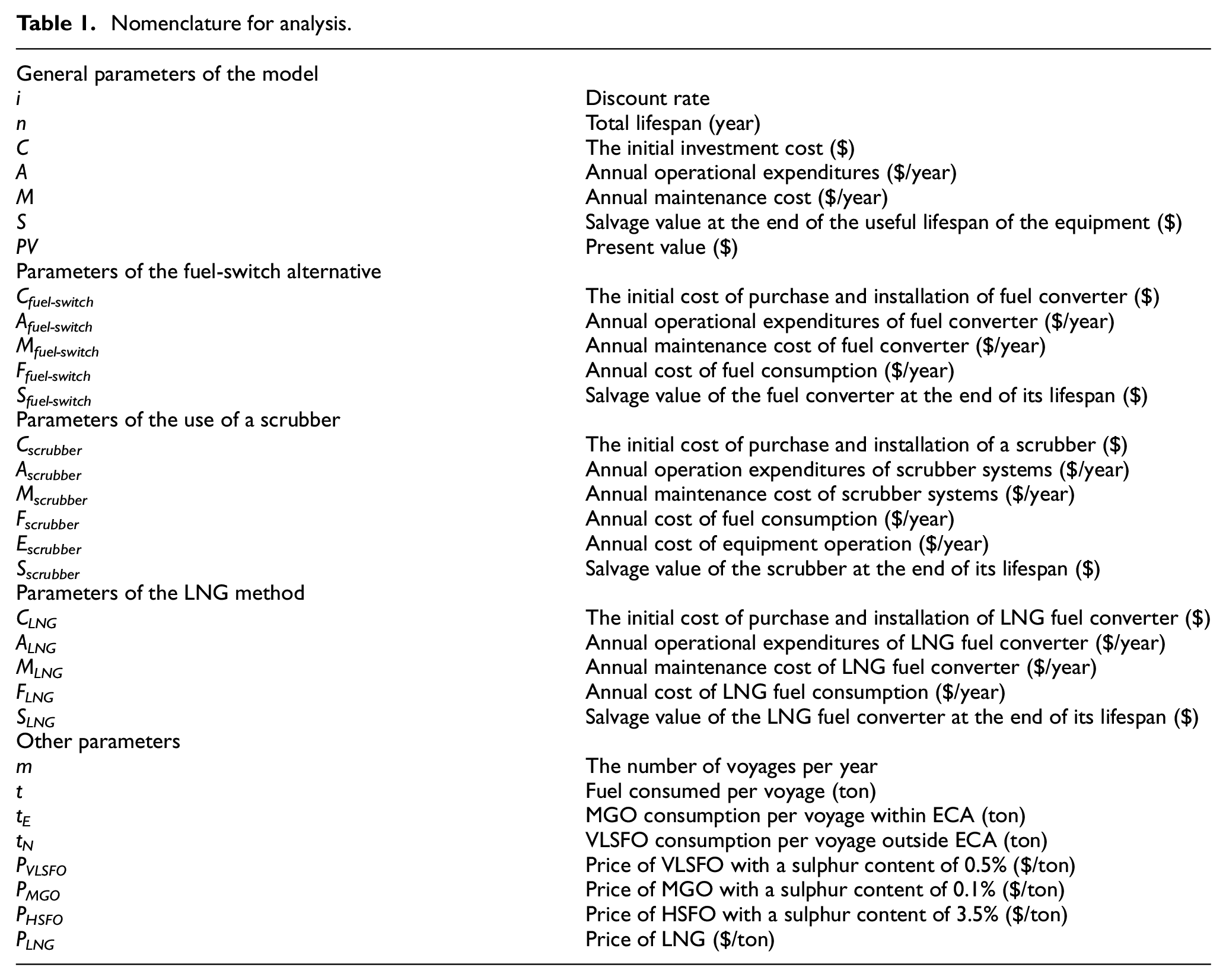
Nomenclature
Table 1 outlines the notations and terms utilized in the analysis.
Nomenclature for analysis.
NPV of lifespan cost
Here the initial investment cost, annual operational and maintenance cost and the salvage value of the equipment are considered. The NPV of all the cost items and the salvage value is utilized to represent the lifespan cost and is formulated step by step. Firstly, the present values of a series of equal payment represent the value of a series of equal operational and maintenance expenses generated during the lifespan of the equipment is formulated as equation (1):

The salvage value is the future value of a vessel’s new equipment at the end of its lifespan. It is discounted to the present value, as shown in equation (2):

By summing the present value of the initial investment, operational, and maintenance cost, and subtracting the present value of the salvage value, the NPV of lifespan cost with a period of n years can be obtained through equation (3):

Lifespan cost embodied in three alternatives
Lifespan cost analysis estimates the NPV of relevant costs throughout the study period, including the initial cost of investment, maintenance, repair and replacement costs, fuel costs, and salvage values. equation (3) is a general formula, and the cost A is the annual operational cost and will be represented by specific cost items given the three alternatives.
Cost of fuel-switch
The total cost of the fuel-switch alternative (TCfuel-switch) is equal to the sum of the initial cost, equipment maintenance cost, and fuel consumption cost:

In this alternative, VLSFO with a sulphur content of 0.5%, which most suits the 2020 global sulphur emission cap, is utilized as the primary fuel outside the ECA, MGO with a sulphur content of 0.1% is used as fuel when ships travel within the ECA areas. According to the definition in Table 1, the annual fuel consumption cost equals m (the number of voyages per year) multiplied by the sum of the fuel consumption costs of MGO and VLSFO per voyage. The cost of fuel consumed inside ECA is obtained by multiplying tE (MGO consumed per voyage) and PMGO, while the cost for the fuel used outside ECA is obtained by multiplying tN (VLSFO consumed per voyage) and PVLSFO as shown in equation (5).

In this option, the annual operational cost is the fuel consumption cost and is demonstrated by equation (6).

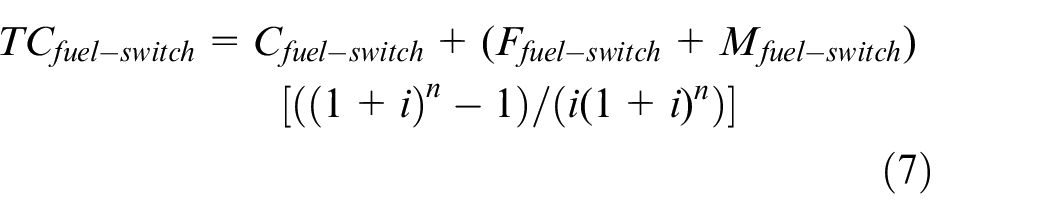
Considering the time value of cash, the costs cannot be directly added together until the annual fuel consumption cost (Ffuel-switch) and equipment maintenance cost (Mfuel-switch) are discounted to the initial time:
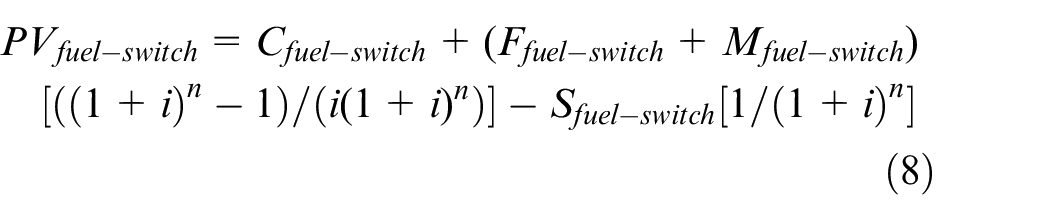
Apart from the cost outlined in equation (7), the salvage value of the equipment should be considered. Thus, the present value of the fuel-switch (PVfuel-switch) option can be obtained:
Cost of using a scrubber
Besides the fuel cost, the scrubber incurs another cost of reagent during the voyage, which is symbolized as Escrubber. Thus, the total cost can be formulated as:

Referring to equation (5), the fuel consumption cost of the scrubber alternative can also be calculated as:

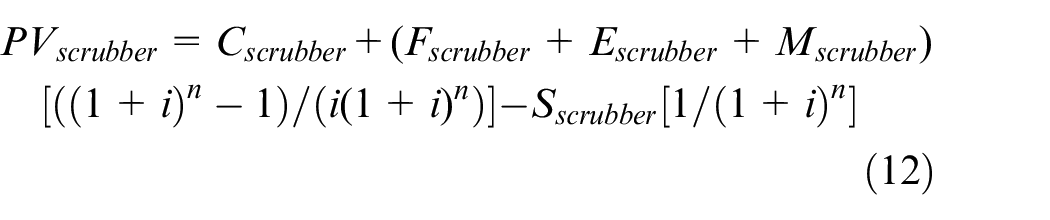
The annual operational cost of installing a scrubber includes the fuel consumption cost (Fscrubber) and the annual cost of the scrubber operation (Escrubber). Therefore, equation (11) is obtained:

Incorporating equations (9)–(11) into equation (3), the present value of the scrubber option (PVscrubber) is:
Cost of LNG
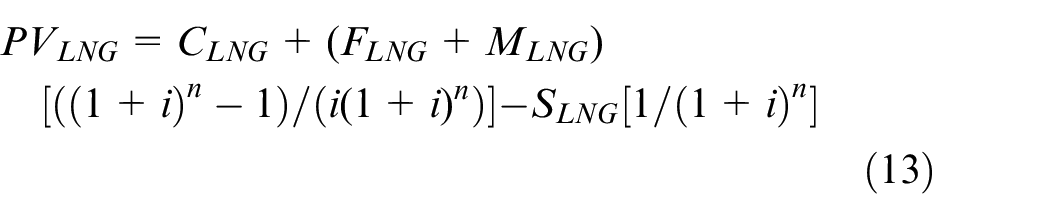
The lifespan cost analysis model of using LNG as fuel oil is similar to that of the fuel-switch option. PVLNG is formulated as follows:
Test case
Two types of container ships are utilized in this research as case study vessels. One is a 5,000 TEU vessel which services between Shanghai and Pointe Noire. The other is a 10,000 TEU vessel which sails between Shanghai and Los Angeles. Both of them are 5-year-old second-hand vessels. The vessel particulars and voyage data are collected from China COSCO Shipping, and the data about scrubber systems is provided by Clarkson. 25 The 5000 TEU vessel sails three times a year, consuming 3500 tons of oil per voyage, and the 10,000 TEU vessel sails six times a year, consuming 3000 tons of oil per voyage. Relevant information of the two vessels and voyages are shown in Table 2.
Data relating to the two vessels (5000 and 10,000 TEU).
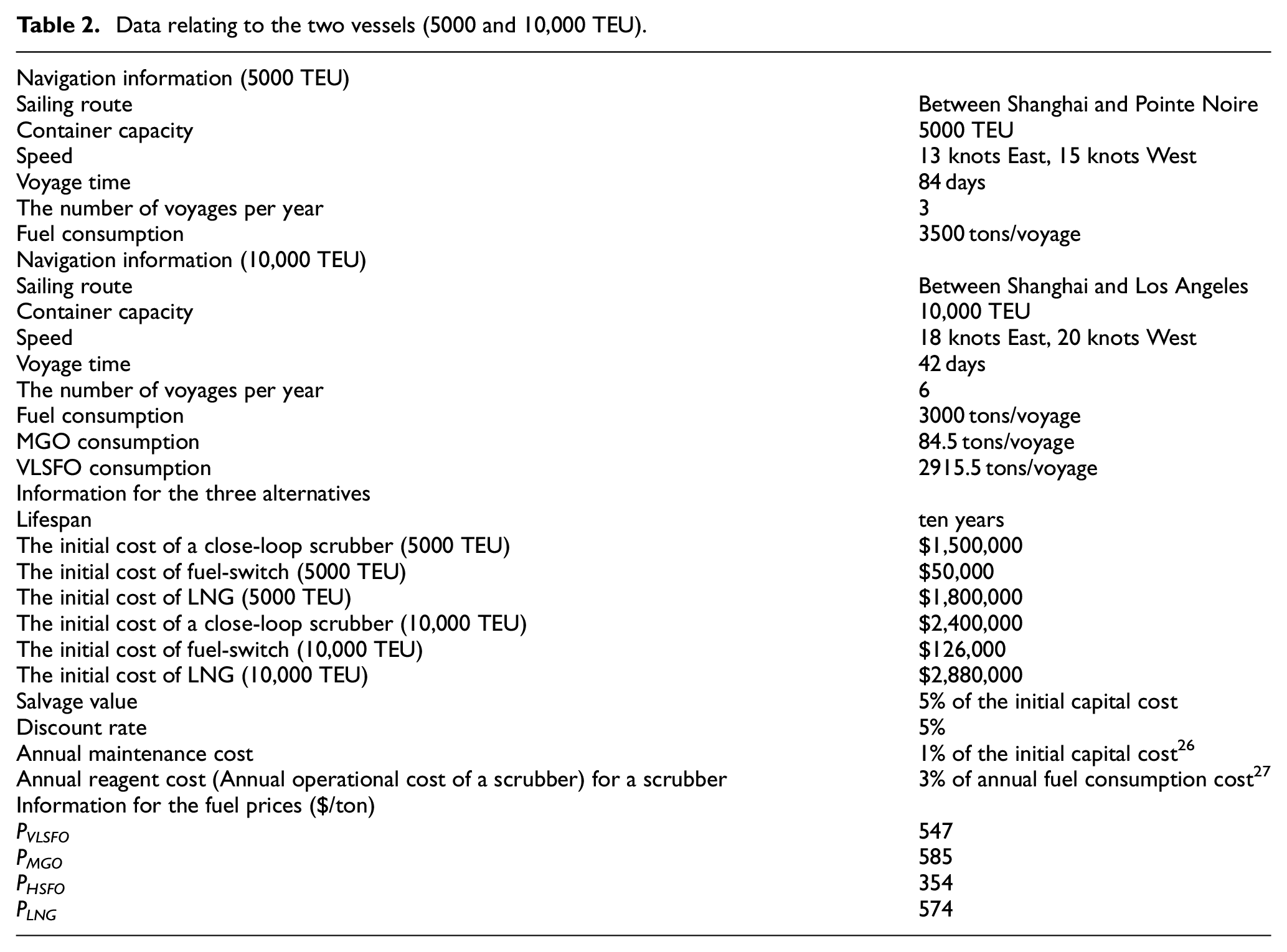
In the test, the service life of the scrubber, which is 10 years, is taken as the lifespan length. The initial cost of the three alternatives mainly includes equipment purchase cost and installation cost. The initial capital cost of the fuel-switch alternative is the cost of the modification of making the original main engine adapt to low sulphur oil. In order to facilitate the calculation, the salvage value rate of fixed assets is usually used for prior estimation, and 5% of the original value of the equipment is generally selected. Meanwhile, the annual maintenance cost of the corresponding equipment for the three alternatives can also be defined as 1% of the initial capital costs, according to Entec. 26 The annual reagent cost of a scrubber is defined as 3% of the initial capital cost of the scrubber. 27 The price of fuel oil fluctuates with the market. Thus the price that is currently around the trend of the market fluctuation is selected for the analysis.
The lifespan cost of the fuel-switch alternative with the 5000 TEU vessel is calculated step by step to illustrate the lifespan cost analysis model in Section 3. Data related to the fuel-switch alternative in Table 2 is extracted as the input data and presented in Table 3.
Input data and NPV of the fuel-switch alternative.
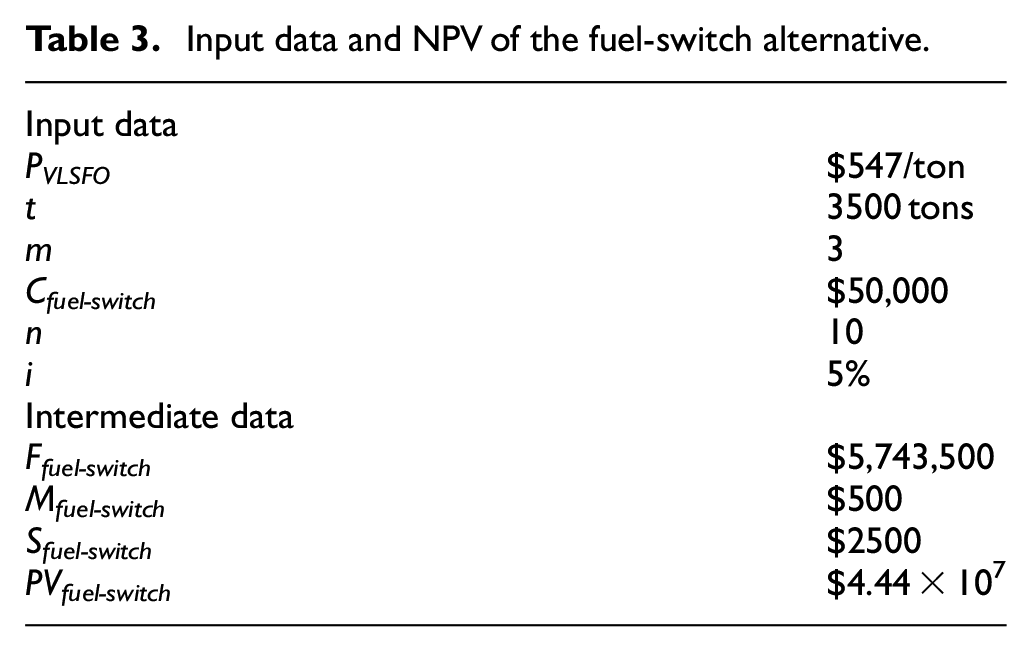
Using equation (5), the annual fuel consumption (Ffuel-switch) can be calculated as $5,743,500.
According to the initial cost of the fuel-switch alternative and its relationship with annual maintenance cost (Mfuel-switch) and the salvage value (Sfuel-switch) shown in Table 2, Mfuel-switch and Sfuel-switch are obtained and listed as intermediate data in Table 3.
Finally, using equation (8), the present value (PVfuel-switch) is calculated and shown in Table 3.
Similar to the calculation process above, the lifespan costs of other alternatives and cases are also calculated with the data in Table 2. The lifespan costs of three alternatives in the two cases are illustrated in Figure 2. The results indicate that it is the most comparative choice to install scrubbers in both cases, followed by the fuel-switch option, with LNG demonstrating the highest cost for both vessel sizes.
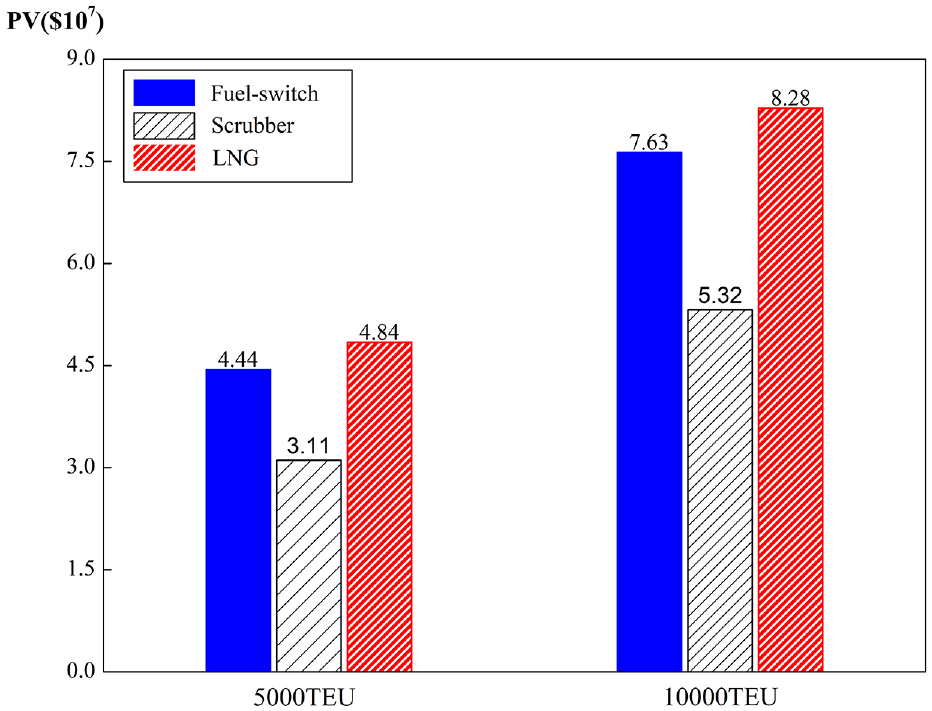
The lifespan costs of the three alternatives.
Discussion
Uncertainty analysis
The price of fuel oil can be volatile depending on the market, and the discount rate varies with the financial circumstances of the stakeholders. To demonstrate the choice for scrubbers or the fuel-switch method, two kinds of fuels, which are MGO and VLSFO used in the fuel-switch method, are treated as mixed fuel oil (MFO). The price of MFO is the weighted average price of VLSFO and MGO. The weight of each oil is defined by its proportion used in the voyage, respectively.
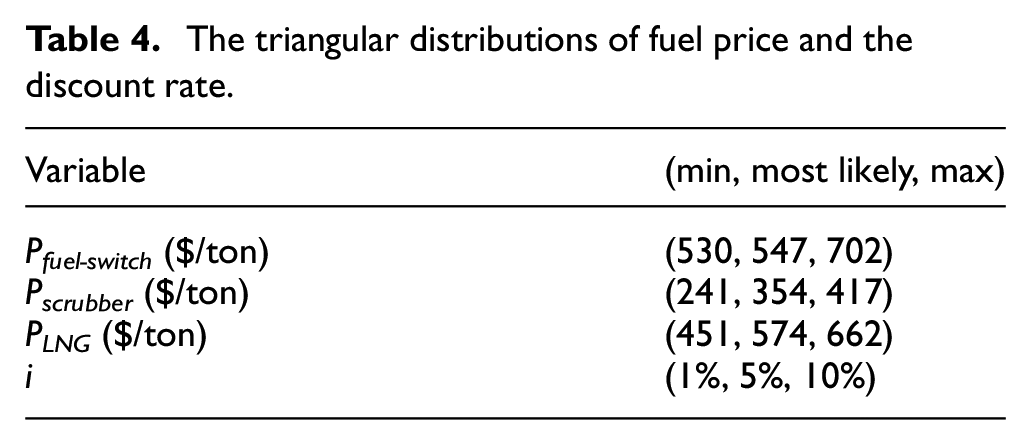
The uncertainties of fuel price and the discount rate are analysed with the @risk software. In this software, variables are formulated as probability distributions. The triangular distribution (min, most likely, max) is the most frequently used distribution in uncertainty analysis. 24 Thus, it is assumed that the random variables of fuel price and the discount rate follow a triangular distribution. In section 4, the discount rate is 5%, which is the most likely value. The triangular distribution of the discount rate in the form of min, most likely, and max is 1%, 5%, and 10%, respectively. The triangular distributions of the prices of different fuel oils together with the distribution of the discount rate are listed in Table 4. Following 1000 simulations in the @risk software, the cumulative probability distribution functions of the lifespan costs of the three alternatives with the 5000 TEU vessel and the 10,000 TEU vessel are illustrated in Figure 3.
The triangular distributions of fuel price and the discount rate.
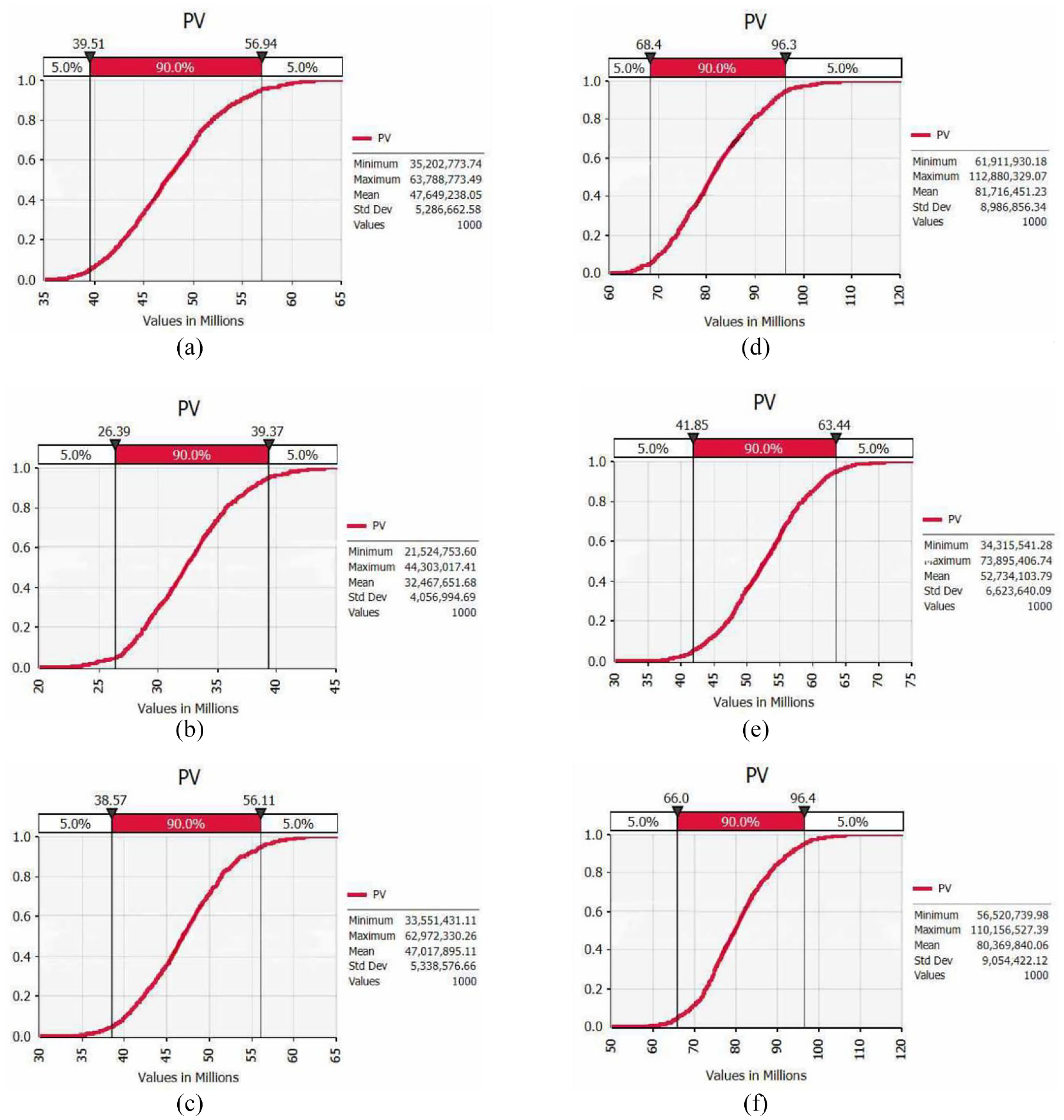
Cumulative probability density distributions of the lifespan costs of three alternatives with two vessels: (a) fuel-switch (5000 TEU), (b) scrubber (5000 TEU), (c) LNG (5000 TEU), (d) fuel-switch (10,000 TEU), (e) scrubber (10,000 TEU), and (f) LNG (10,000 TEU).
According to Figure 3, when the fuel price and the discount rate change at the same time, the lifespan cost of using a scrubber is the lowest. It is worth noting that there is still a small interval (outside the 90% probability interval) where the cost of using a scrubber is higher than that of the fuel-switch alternative. The LNG option has a comparatively high cost with the fuel-switch alternative.
In addition, it can be found that the lifespan cost of installing a scrubber has a more considerable advantage over that of the fuel-switch when the vessel size increases to 10,000 TEU. In other words, the larger the vessel, the more attractive the use of a scrubber.
Scenario analysis of fuel prices and discount rate
The scenario analysis is performed by comparing different price scenarios of the fuel oil and the discount rate. The lifespan costs of the three alternatives under different HSFO and MFO price scenarios are shown in Table 5 with a discount rate of 5%. Figure 4 reflects the linear relationship between the lifespan cost and the fuel price. In Figure 4, the horizontal line of PV = 3.11 × 10⁷ crosses with the lifespan cost lines of the 5000 TEU vessel, which means that if the three alternatives have the same lifespan cost of $3.11 × 10⁷, then the corresponding price of HSFO, MFO, and LNG are $354 per ton, $383 per ton, and $361 per ton, respectively. As the relationship between the lifespan cost and the fuel price is linear, it can be concluded that when the price differential of MFO and HSFO is $29 per ton, the fuel-switch alternative and the use of a scrubber have the same lifespan cost in the 5000 TEU vessel case. It is the same situation for the 10,000 TEU vessel with a PV value of $5.32 × 10⁷. The use of MFO does not produce a low cost for shipowners until the price of MFO drops significantly. To sum up, if the refining technology of VLSFO and MGO improves in the future and the price differential between MFO and HSFO decreases to $29 per ton for the 5,000 TEU vessel and $27 per ton for the 10,000 TEU vessel, the lifespan cost of the fuel-switch alternative and the use of a scrubber will be equal. Regarding LNG alternative, when the price of LNG approaches HSFO, LNG has the same lifespan cost as scrubbers. That is, if the LNG refining technology improves in the future, it will be an environmentally friendly and economical choice to use LNG as an alternative fuel.
Scenario analysis of fuel price (i = 5%).
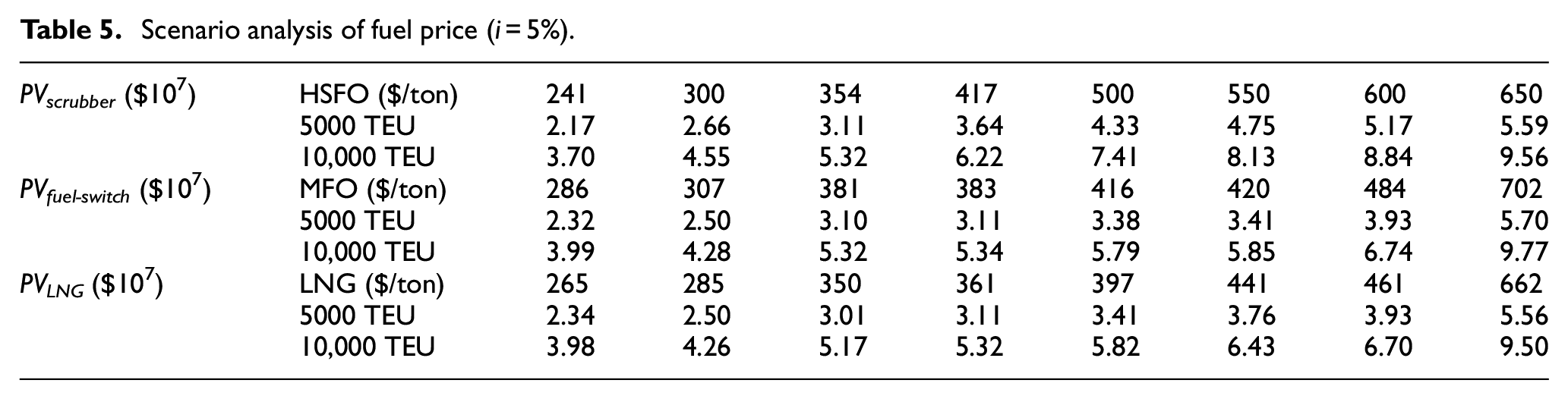
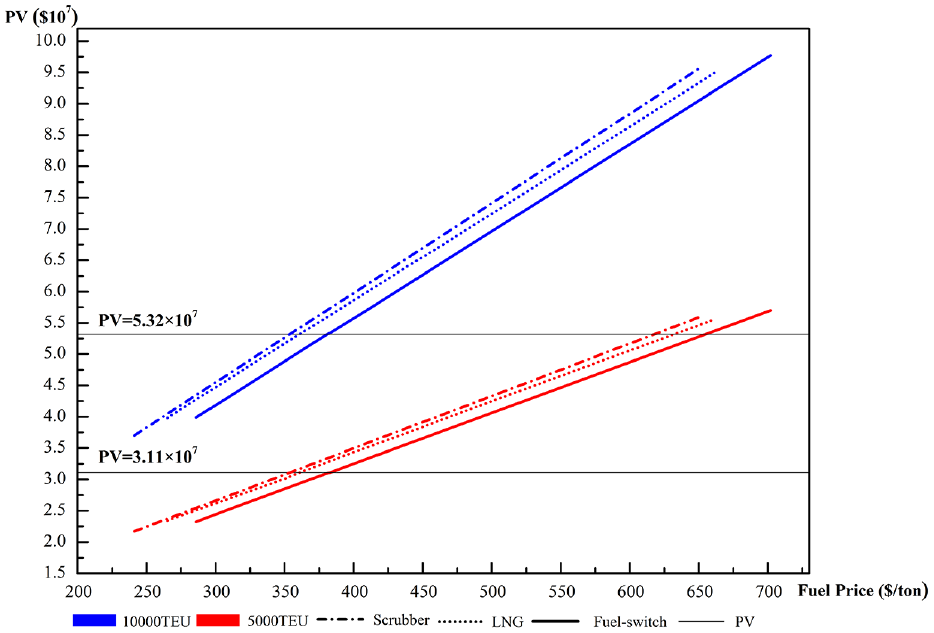
The lifespan cost analysis of fuel price fluctuations.
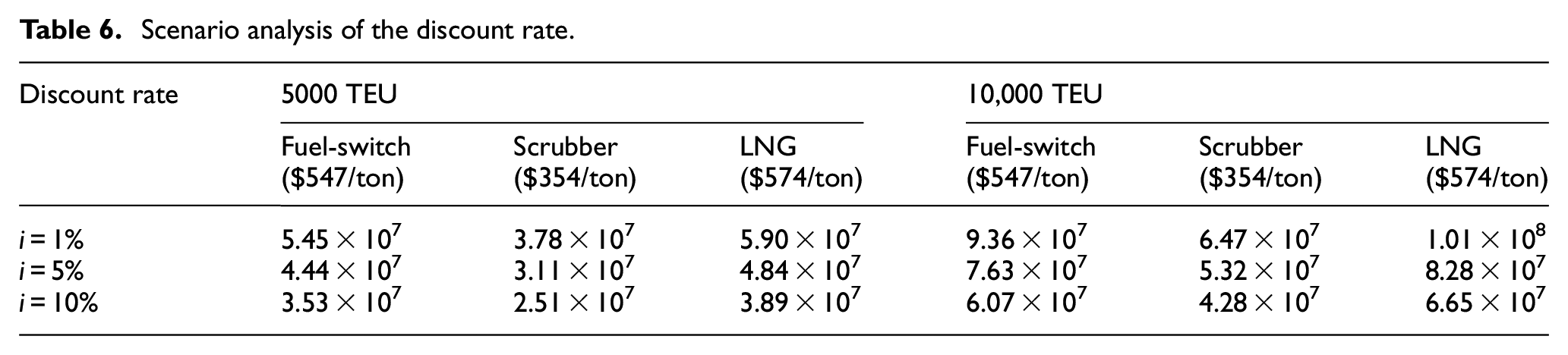
Through the scenario analysis of the discount rate, it can be found that under all the selected discount rate levels, the use of a scrubber has a significant advantage over the other two alternatives as shown in Table 6 and Figure 5. As the discount rate increases, the cost gap between the use of a scrubber and the other two alternatives gradually decreases. Moreover, the cost gap of large ships is more sensitive to the discount rate. As a consequence, installing scrubbers has a cost advantage for shipowners who take a lower discount rate. Besides, for larger container ships, the use of a scrubber has obvious cost advantages. For example, when the discount rate is 5%, the cost differential between the use of a scrubber and the fuel-switch method is $2.3 × 10⁷ for the 10,000 TEU vessel and $1.33 × 10⁷ for the 5000 TEU vessel.
Scenario analysis of the discount rate.
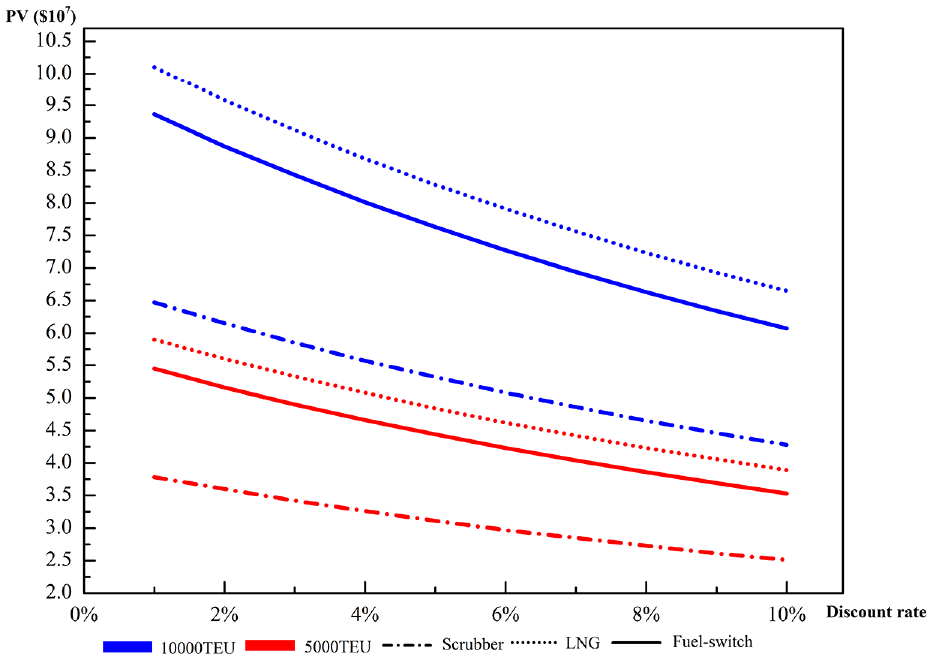
The lifespan cost analysis of discount rate fluctuations.
Conclusion
This research assesses the lifespan costs of three main sulphur limit compliance options under uncertain circumstances. The results show that the effectiveness of the alternatives is affected by the fuel price and the discount rate. However, it can be concluded that the bigger the vessel, the lower the discount rate, and the greater the price of mixed fuel oil (MFO, a mixture of MGO and VLSFO), the more attractive the use of a scrubber. Also, if the refining technology of low-sulphur fuel improves in the future and the price differential between MFO and HSFO is less than $29/ton for the 5000 TEU vessel or $27/ton for the 10,000 TEU vessel, the fuel-switch alternative will be more attractive than the use of a scrubber in terms of the lifespan cost. Additionally, the sensitivity analysis of the discount rate is considered in our paper. As the discount rate increases, the cost gap between the use of a scrubber and the other two alternatives gradually decreases.
Regarding LNG, it is not attractive as for lifespan cost merely considering sulphur limit. However, with the stricter emission regulation on NOx, SOx, and COx, it may be an attractive technique to comply with the regulations on different types of emissions.
Footnotes
Acknowledgements
The authors would also like to thank Shi Yifan from China COSCO Shipping to provide shipping voyage data and research scientist Li Shengyuan from Clarkson China to provide data about scrubbers.
Declaration of conflicting interests
The author(s) declared no potential conflicts of interest with respect to the research, authorship, and/or publication of this article.
Funding
The author(s) disclosed receipt of the following financial support for the research, authorship, and/or publication of this article: The authors would like to acknowledge the financial supports from MOE (Ministry of Education in China) Liberal Arts and Social Sciences Foundation [Grant no. 19YJCGJW003]. This study is partially supported by the European Union’s Horizon 2020 research and innovation programme under the Marie Skłodowska-Curie grant agreement no. 730888 (RESET).
