




Abstract
The rise of international university alliances, such as those within the European University Initiative, suggests that the supranational dimension of university collaboration is now self-evident, at least in Europe. Yet this trend is unfolding alongside the emergence of local university alliances. The following paper addresses two cases based in European capital cities: Berlin University Alliance (BUA) and Paris Sciences et Lettres (PSL). We analyse them as objects of local, national, and European knowledge policy strategies. Which roles and functions do local university alliances have in and for the cities they are located in, and how, in return, do capital cities leverage these alliances to position themselves as ‘knowledge metropolises’? The article addresses this issue from the viewpoint of the historical and discursive geography of science. Relying on desk-based document analysis and ethnographic fieldwork, our multi-scale analysis reveals that the institutionalisation of BUA and PSL involves the mobilisation of elements from local, national and international ideological repertoires, including capital city narratives, the race for excellence, national and linguistic identities, and competitiveness through globalisation. We make known the complex integration of these two university alliances in tangled scales that contribute to the establishment of Paris and Berlin as ‘knowledge metropolises’.
Keywords
Introduction
It seems to be a truth universally acknowledged that university collaboration is on the rise – at least in Europe. Given the general trend of the EUI (Gunn, 2020; Lambrechts et al., 2024), the idea of creating local university alliances sounds counterintuitive (Powell and Dusdal, 2017). And yet, many alliances have been developed in recent years, some on a regional scale (EUCOR in the tri-national Upper Rhine region), others even on a city-wide scale (Moawad and Gollanek, 2026); some have even maintained themselves over time, as has the University of London since 1836. This paper focuses on the roles and functions of two university alliances for the metropolises they are located in: Berlin University Alliance (hereafter referred to as BUA) in Berlin and Paris Sciences et Lettres (PSL) in Paris. As examples of the development of strategic partnerships between higher education institutions (HEIs) in Germany’s and France’s capitals, these two alliances openly aimed at designing a collaborative advantage for their member universities (Gunn and Mintrom, 2013). We want to challenge this narrative by historicising and spatialising it. Berlin having a unique history of division and reunification, conflicts between universities have prevented a joint strategy until recently (Brake, 2004; Franz, 2008). This was further complicated by the Länder’s prerogative in matters of higher education (HE). The recent remodelling of the Parisian HE landscape, for its part, was not only the result of a political willingness to make small and medium-sized highly selective institutions visible. It was also a sign of a top-down recentralisation of knowledge-producing structures (Musselin, 2017; Paivandi, 2019). In the following pages, we investigate what these higher education and research (HE&R) recalibrations (Benneworth, 2019) make visible, and on what scales. Which roles and functions do local university alliances have in and for the cities they are located in, and how, in return, do capital cities leverage these alliances to position themselves as ‘knowledge metropolises’?
Based on the principle that institutional theories are solid in explaining the shaping and continuity of HE forms (Brunsson and Jacobsson, 2002; Maassen et al., 2023), we have chosen to emphasise a historical (Page, 2006; Pierson, 2000) and discursive (Schmidt, 2008) perspective to approach the geographical and institutional variations and changes encountered by these two university alliances and the cities they are based in. The geographical location and institutionalisation processes of knowledge-producing structures can hardly be disentangled (Gieryn, 2018; Livingstone, 1995). The present study thus aims to draw attention to the close relationship between these two dimensions, as revealed by the analysis. Against this theoretical framework, we investigate the integration of BUA and PSL within Berlin and Paris, hypothesising that these are two ‘knowledge metropolises’. This assumption necessitates examining the locations of universities at multiple scales, specifically within cities, regions and nation-states (Geipel, 1968; Meusburger, 1998), and considering the relationship between universities as place-based institutions and broader globalisation processes. By carrying out a qualitative content analysis of official documents and press articles, supplemented by ethnographic fieldwork, we reveal what lies behind the university alliances’ strategies put in place at different levels by two HE&R institutions that are still rarely investigated. To do this, we begin by describing their spatial organisation at the city scale. This is followed by a multi-scale analysis of the development of the two university alliances, looking more specifically at the institutional discourses produced by and on BUA and PSL. Our focus is on the narratives of both capital cities, the strategies they implement in the race for excellence on a national scale, the language policy of the alliances and their impact on the construction of national identities. We examine all this in the context of two cities whose status we question, between knowledge metropolises and global knowledge cities. We summarise our analysis in an empirically grounded typology which takes account of the institutional recalibrations of BUA and PSL in their geography, history and discourses, before concluding our presentation and opening up the debate.
Research approach and concepts
Research approach
The growth of research into international university alliances, such as those within the EUI (Gunn, 2020; Lambrechts et al., 2024; Marques and Graf, 2024), suggests that the international dimension of university collaboration is now self-evident, at least in Europe. Literature on alliances as research collaborations (e.g. mergers and cooptations), interest groups (Vukasovic and Stensaker, 2018), or inter-institutional arrangements (Harman, 1989) is abundant and reveals interesting dynamics as well as a more predictable incrementalism. Symptomatic of the obvious international nature of knowledge and knowledge policies, little research has been conducted on regional university alliances and even less on those at the local level (with some notable exceptions, such as Musselin and Dif-Pradalier, 2014). When they are mentioned, it is often as members of a university-policy-industry nexus, or as orchestrators of innovation networks (Mignoni et al., 2023). By contrast, the analysis we are carrying out in the following pages is in the tradition of the spatial turn, as we try to give ‘constitutive significance to place and space, site and situation, locality and territoriality’ (Livingstone, 1995) to local university alliances. The idea of science having a geography used to go ‘against the grain’ (Livingstone, 2013: 1), but the academic field has now become sufficiently well-established for the relationship between places and the credibility of scientific beliefs and claims to be now firmly entrenched (Gieryn, 2018). Conducting a thorough analysis of university alliances and their interactions with the capitals in which they are integrated can thus be regarded as a strategic decision. The tradition of geographical research into the expansion of universities on a national scale, indeed, dates back several decades. Examples include studies in the US (Harvey, 1958), the UK (Balchin, 1959; cited by Heffernan et al., 2018), France (Vassal, 1969) and Germany (Mayr, 1979). Many recent works continue to specifically focus on the nexus between universities and their location (Eckert et al., 2014; Romano and Van Damme, 2008). But this seems not to have reached university alliance studies, perhaps because the latter focus on the transnational dimension of those institutions, particularly in the case of European university alliances (Harrison et al., 2016), potentially neglecting the local anchorage. In an attempt to revive this tradition, the following paper aims to compare two university alliance processes in two European capital cities. BUA and PSL are examples of the development of strategic partnerships between HEIs in the capitals of Germany and France, respectively, which aim to design a collaborative advantage for their member universities (Gunn and Mintrom, 2013). The subsequent objective of this paper is to determine whether this advantage trickles down to the two capitals as a whole, helping to establish them as what we define below as ‘knowledge metropolises’.
We combine this spatial approach to science with an institutional-theory-driven perspective that we deem to be solid in explaining the shaping and continuity of HE forms (Brunsson and Jacobsson, 2002; Maassen et al., 2023). Hereafter, we emphasise a historical (Page, 2006; Pierson, 2000) and discursive (Schmidt, 2008) approach to institutional variation and change in order to address the geographical embedment of university alliances. The historical institutionalist approach allows us to consider the phenomena of universities’ working-together by underlining the conflictual dimension of institutions from both power-distributional and a cultural-sociological perspectives (Schneiberg and Clemens, 2006; Thelen, 2003: 35). In the case of local university alliances, taking historical elements into account enables us to understand the mechanisms by which our two university alliances become persistent and long-lasting entities (Selznick, 1957). Drawing on this, we look at the institutional variations, path dependencies, learning and coordination effects, and adaptive expectations of BUA and PSL within Berlin and Paris, as well as the narratives accompanying them. The discursive institutionalist approach, for its part, allows us to highlight the role of ideas as the substantive content of political discourse. Simultaneously, it offers a dynamic framework for institutional variation and change, particularly examining legitimisation processes of university alliances, for instance, through the mobilisation of elements of local or national ideological repertoires (Lieberman, 2002) such as capital city narratives, the race for excellence, national and linguistic identities, or competitiveness through globalisation. In our case, it provides us with theoretical tools to identify meaning contexts in the coordinative discourse of policy actors ‘involved in the creation, elaboration, and justification of policy and programmatic ideas’ (Schmidt, 2008: 310) within the metropolises, as well as in the communicative discourse of and around BUA and PSL, which we expect to be more political as it legitimises both the alliance and its location. All these features reflect at all scales, making it necessary to consider the locations of university alliances within cities, regions and nation-states (Geipel, 1968; Meusburger, 1998), and the relationship between universities as both place-based institutions and wider globalisation processes (Brankovic, 2018). By focusing on these two university alliances and their locations, this article thus follows in the tradition of the historical (and, we would add, discursive) geography of scientific institutions (Livingstone, 1995).
Conceptual framework
In the following paper, we introduce the notion of the ‘knowledge metropolis’, which lies at the crossroads between the spatial turn and institutional theory. This notion provides a substantial framework for understanding the relationship between institutions and their location. Our starting point is the idea that universities and HE organisations are recognised as important catalysts as well as driving forces of socio-political transformations in their respective environments (Benneworth et al., 2010; Fernández-Esquinas and Pinto, 2014) and that they can therefore be seen as knowledge cities (Carrillo, 2006) or knowledge spaces (Moulaert and Sekia, 2003). But we would like to take this further by adopting a geographical definition – in this case, a multi-scale one – of the two capital cities analysed, by approaching them as ‘knowledge metropolises’. This notion has already been used sporadically in France and Germany. In the case of Germany’s Ruhr Valley, it serves as an advertising slogan for a political success story, the ‘(Green) Knowledge Metropolis Ruhr’ (Eiringhaus, 2020: 271). For the French city of Toulouse, it refers to a political project with a ‘clearly defined’ vision, the development of the local knowledge-based economy escaping this vision and being ‘rather the result of a combination over time of a set of different economic policies’ (Peyroux et al., 2009: 201). In subsequent pages, we attempt to make an analytical use of this notion, referring to the traditional characteristics of the metropolis in the context of alliances between knowledge-producing institutions. Firstly, both Berlin and Paris are large urban areas that provide their respective regions with command, organisation, and impetus, enabling them to integrate with the rest of the world. They also drive more or less complex urban systems with nested hierarchies. Moreover, they perform specialised functions in political, economic and innovation fields. Finally, depending on the level considered, from regional to global, their high-value-added services serve a more or less vast area (Geoconfluence, 2020). Our aim is to explore how Paris and Berlin present themselves as metropolises, focusing not only on the ideological repertoires they mobilise, but even more on how these are anchored in the territory. Both directly and indirectly, the spatial arrangement of a city makes its self-image legible.
Following this definition, we wonder whether and how BUA and PSL enable the two cities to move from ‘metropolises’ to ‘knowledge metropolises’. First, we examine the spatial organisation of the two university alliances and their members within the urban systems of Berlin and Paris, and consider what it reveals about governing beyond local boundaries (Nelles, 2012) in the two metropolises, both in terms of structure and agency (4.1). Moreover, we adopt a multi-scale frame of analysis by first approaching the capital cities’ narratives produced by BUA and PSL as ideas rooted in the territories of Berlin and Paris. We believe that these HE institutions ‘emerge from and are embedded in concrete temporal (we add “spatial”) processes’ (Thelen, 1999: 371). On a national scale, we then propose reading the race for excellence of the two local university alliances as yet another variation of the centre-periphery model, which reinforces the discourses of differentiation and distinction that originated in Paris and Berlin. We also look at how the language and linguistic policies of BUA and PSL either reinforce or undermine national identities, and either confirm or challenge Berlin and Paris in their roles and functions as knowledge capitals. Finally, we return to the possibility of the co-presence of universalising and particularising tendencies within the two local university alliances, given that both BUA and PSL have publicly declared their intention to compete on a global scale. Just as capitals are expected to perform specific functions for their nation-states (as a multiple hinge, see Daum, 2005), such alliances within Berlin and Paris may be a sign of ‘wannabe global city regionalism’ (Cochrane, 2018), whereby the two cities attempt to transition from knowledge metropolises to global knowledge cities (4.2).
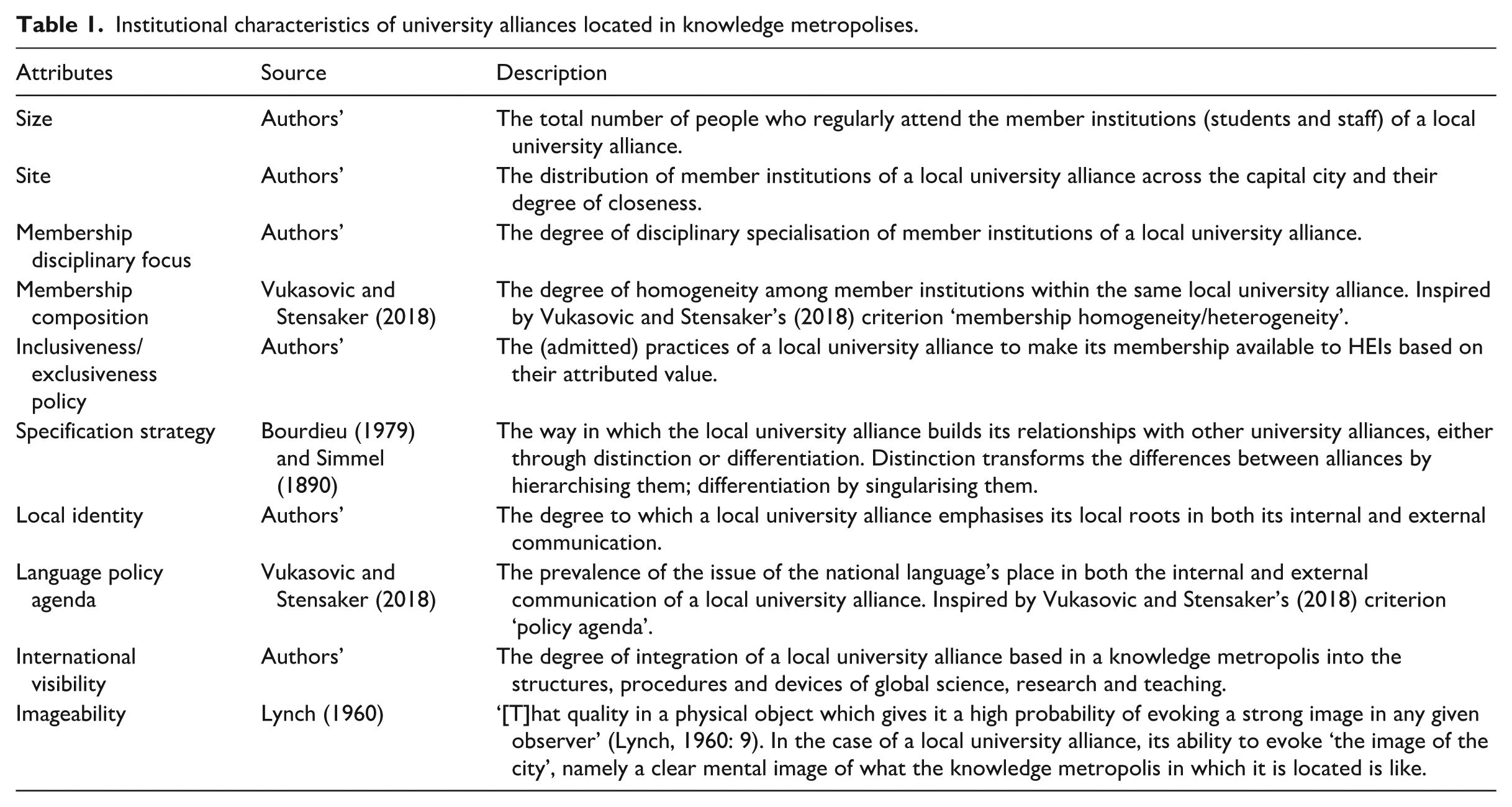
To expand on this concept, we build a typology of institutional characteristics, or attributes, that we consider key to university alliances located in knowledge metropolises (see Table 1), and we test its validity in the cases of BUA and PSL in the last part of our empirical analysis (4.3). The attributes ‘Size’, ‘Site, ‘Membership disciplinary focus’ and ‘Membership composition’ derive from our analysis of the spatial anchoring of the two alliances proposed in 4.1. The attributes ‘Inclusiveness/exclusiveness policy’, and ‘Specification strategy’ are more cross-cutting and are found in both 4.1 and 4.2. The attributes ‘Local identity, ‘Language policy agenda’ and ‘International visibility’ are largely deduced from part 4.2 of our analysis. Finally, the attribute ‘Imageability’ is derived from all the conclusions drawn about the roles and functions BUA and PSL seem to have in and for the knowledge metropolises they are located in. All are treated as indicators of the importance of BUA and PSL for the cities in which they are located, and of how, in return, Paris and Berlin leverage these alliances to position themselves as knowledge metropolises.
Institutional characteristics of university alliances located in knowledge metropolises.
Data and methods
Methods
To do this, we rely on an extensive and varied range of materials. For the first part of our analysis (4.1), we use two main sets of data. Firstly, we extract data from the official websites of the member institutions and associated institutions, supplemented by statutory and procedural documents such as annual activity reports, strategic plans, and mission statements. We also consult governmental databases, such as the German and French national registers of companies. Based on this information, we compile a list of the member institutions of the two alliances and their locations in their respective cities. The spatial distribution of BUA and PSL institutions in Berlin and Paris is depicted on maps that we produced using Magrit, an open-source thematic cartography software (https://magrit.cnrs.fr). The two base maps in GeoJSON format are also open-access, taken from the Open Database License (ODbL) of the City of Paris for the Paris map (https://opendata.paris.fr/) and from the Open Data Information Center for the map of Berlin (https://daten.odis-berlin.de/). Regarding size, that is, the total number of students and staff, finally, all numbers below 1000 are rounded to the nearest 10; numbers above 1000 to the nearest 100. This institutional data is supplemented by active fieldwork in Berlin and Paris, comprising informal discussions, field notes and pictures. These is the result of an alternating presence in the two cities (2023–2025) as well as the two authors’ autobiographical impressions over a longer period (2014–2025). The idea was to experience the everyday life of both capital cities to better explain the purpose of local institutions, and to have a glimpse of the cultural practices and beliefs within BUA and PSL. Regularly alternating between the two cities allowed us a ‘casual, unstructured sensing our surroundings’ and helped us to ‘see things the locals have come to take for granted or may never have discerned’ (Zelinsky, 2001: 6). We have tried to capture this sense by including photos of, and retracing the recent debates surrounding two BUA and PSL buildings. To us, these buildings seem to sum up all the ambiguities of these alliances for the two ‘knowledge metropolises’, balancing consolidation, competition and cooperation (Nelles, 2012: 3).
For the second part of our analysis (4.2), we draw on a qualitative content analysis (Mayring, 2004) of secondary sources, in particular press articles, press releases and communiqués from networks that both support and oppose these university alliances. We review articles containing ‘Berlin University Alliance’ or ‘Paris Sciences et Lettres’ in their title and/or subtitle in two press databases (Europress and LexisNexis) from the time of their first appearances until January 2024, in order to see how these two alliances are presented at regional, national, and even European levels (NBUA = 41; NPSL = 54). We are aware of the limitations of our research into the written press, which is still very much a matter of political communication. Indeed, many of the meetings that led to the creation of these two alliances were either informal or took place behind closed doors. This is why they were always counterbalanced by communiqués from networks critical of these alliances, as well as informal interviews, so that we could triangulate the information and see to what extent they are, eventually, complementary. This allows us to construct a multi-dimensional account of reality through the development of ‘dialogic explanations’ (Mason, 2006). Finally, the third part of our analysis (4.3) fleshes out a typology by collating the information extracted from all the above-listed documents. While BUA could be considered an example of a university consortium and PSL an example of a university merger, neither is a pure ideal-type (Weber, 1934) nor a predictive ‘constructed type’ (Becker, 1940), as we will discuss in the conclusion. Instead, our typology is empirically grounded, since it incorporates both empirical knowledge and references to previous literature (Kluge, 1999), as specified in the conceptual framework (2.2). To be quoted here, all documents have been translated into English, either manually or using an AI tool (Deepl) whose propositions were checked, modified and validated by the authors. However, only the original version is binding.
Case sample
In our paper, we focus on the roles and functions of two university alliances for the metropolises they are located in, namely the Berlin University Alliance (BUA) in Berlin and the Université Paris Sciences et Lettres (PSL) in Paris. Berlin and Paris allying universities are not exceptions: many other European capitals have seen the emergence of university alliances in their midst, sometimes as early as the 19th century (Moawad and Gollanek, 2026). However, BUA and PSL can be seen as paradigmatic examples: the former of what a university consortium would look like in a federal state, the latter of a merger in a centralised state – even if other characteristics bring them together. Furthermore, France and Germany have some of the largest HE and science systems in Europe and host some of the ‘most prestigious and productive science organizations worldwide’ (Powell and Dusdal, 2017; see also Oleksiyenko, 2014). This is partly due to the academic prestige of individual HE&R institutions, such as the Humboldt-Universität zu Berlin or the Max Planck Gesellschaft for Berlin and the Sorbonne or the Institut Pasteur for Paris, where the university becomes a ‘spatial marker’ for the city (Vadelorge et al., 2022: 20). Surprisingly, however, there is little scientific literature on these two alliances, despite the huge press coverage they received when they were created. Research on BUA is in its infancy, with studies primarily conducted by researchers within the member institutions themselves (Akbaritabar, 2021; Lüdtke et al., 2024) and supported by a self-reflexive internal policy that is very proactive in terms of self-evaluation, as shown by its Objective 3 (Berlin University Alliance website). The case of PSL is more disputed: while the recent remodelling of the French HE landscape and the recentralisation of knowledge-producing structures under the umbrella of a few higher-ranked ‘flagship’ world-class institutions (particularly in Paris) have been the subject of a few studies (Musselin, 2017; Paivandi, 2019; Rocha et al., 2019), we identified only scattered studies that focused specifically on PSL (Basset and Heuser, 2019).
That is to say, our two cases deserve to be introduced. The Berlin University Alliance (BUA), founded in 2019, is part of a project to strengthen academic and scientific cooperation between several of Berlin’s leading institutions. It is based on a strategic partnership between four renowned research universities: Humboldt-Universität zu Berlin, Technische Universität Berlin, Freie Universität Berlin and Charité, Berlin’s university hospital (Berlin University Alliance, 2018). Paris Sciences et Lettres (PSL), for its part, is a group of HE&R institutions founded in 2010 to promote academic and scientific excellence internationally. The alliance brings together 13 prestigious, highly specialised schools, ranging from the humanities and social sciences to the natural sciences, mathematics and engineering (Collège de France, Conservatoire National Supérieur d’Art Dramatique – PSL, Dauphine – PSL, École des Arts Décoratifs de Paris – PSL, École nationale des chartes – PSL, École Nationale Supérieure d’Architecture de Paris-Malaquais – PSL, École nationale supérieure de Chimie de Paris – PSL, Mines Paris – PSL, École normale supérieure – PSL, École Pratique des Hautes Études – PSL, ESPCI Paris – PSL, Institut Curie, Observatoire de Paris – PSL), with three research institutions (CNRS, Inria and Inserm) and allows association of academic partners (Université PSL (Paris Sciences & Lettres), 2013). Cross-national comparison between France and Germany may be common practice when it comes to HE&R policy (Winkler and Sackmann, 2020); the following paper is, nevertheless, a distinctive contribution to the field. Beyond studying two university alliances integrated into two different HE&R systems, it canvasses their integration in two capital cities with different histories, geographies and sociological profiles (Charle, 1999, 2018). Ultimately, we argue that returning to the local scale enables us to better consider the inclusion of universities in transnational networks by integrating a multi-scale perspective (Fumasoli et al., 2018; see also Schendzielorz and Moawad, forthcoming). Regarding the latter, we wondered if we should not qualify our analysis as ‘transcale’ rather than ‘multiscale’. The issue is not just highlighting the nesting of scales (local-national-regional-global), but rather the interactions of these scales in space, which do not always respect the nesting order (Ghorra-Gobin, 2012). For the sake of readability, however, we remained with the more usual term ‘multi-scale’.
Presentation of research, results
We adopt a three-step approach to study the contribution of the two university alliances to the cities where they are based, and vice versa, in the construction and affirmation of Paris and Berlin as knowledge metropolises. To study the superimposition of several logics within the same two urban territories, we adopt a descriptive-based geographical argument, giving an overview of the situation (4.1), which opens to a gradual multi-scale analysis from local to global (4.2), before drawing up a typology based on the elements of analysis identified (4.3).
Spatial organisation of the two university alliances
The spatial configurations of the two alliances within Berlin and Paris are fundamentally different. These differences reflect particular historical circumstances (North, 1990) and provide fertile ground for the analysis of institutional variations and changes in both HE landscapes. The following maps represent the distribution of all the institutions involved in each alliance at the scale of each city (Figures 1(a) and 3(a)).
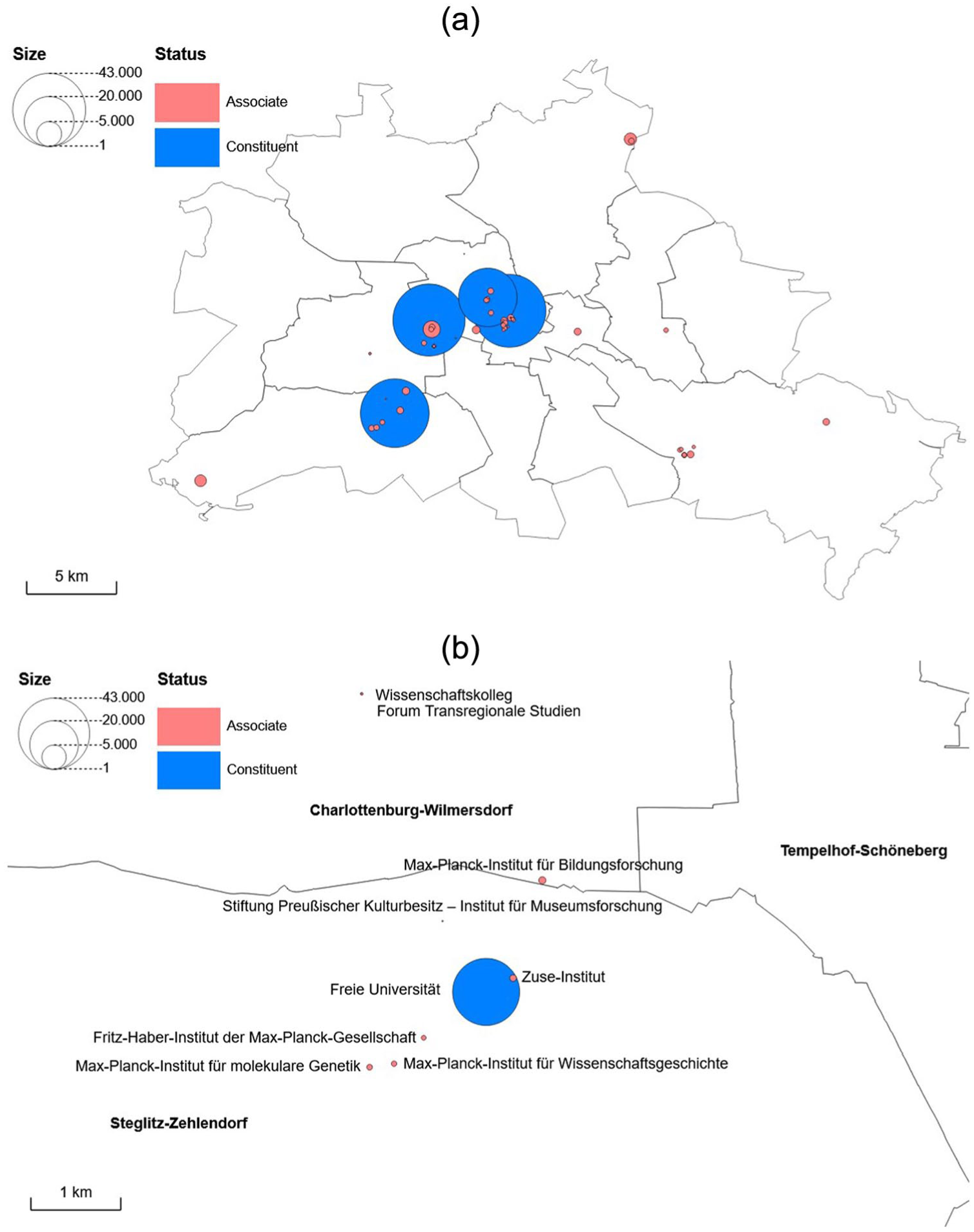
(a) Spatial representation of the distribution of BUA institutions in Berlin by size and status. (b) Spatial representation of the distribution of BUA institutions by size and status in Dahlem (Steglitz-Zehlendorf).
BUA in Berlin: A multi-polar university landscape
Berlin is a specific case with a unique history of division and reunification, as reflected by the distribution of BUA institutions throughout the city (see Figure 1(a)).
It seems necessary, first of all, to emphasise the Humboldtian and therefore interdisciplinary heritage of Berlin’s university tradition. Indeed, the University of Berlin (Alma Mater Berolinensis) was founded by Frederick William III of Prussia in 1809 at the behest of the theologian Friedrich Daniel Ernst Schleiermacher, the diplomat and linguist Wilhelm von Humboldt, and the philosopher Johann Gottlieb Fichte. Humboldt’s understanding of a holistic academic education was put into practice in a place designed to reunite teaching and research, safeguard academic freedom and nurture world citizens (Von Humboldt, 1964). But Berlin’s university landscape also bears the scars of the Cold War. In fact, the Freie Universität of Berlin was explicitly founded in 1948 as the Western continuation and counterpart of the University of Berlin, which was located in East Berlin and renamed the Humboldt-Universität in 1949 (Boesch, 2018). The fall of the Wall played a major role in the city’s replanning, resulting in both material and immaterial changes to its geography. A new physical configuration was revealed, pitting two half-cities against each other that had both been destroyed by war. It also gave Berlin a new identity as a capital city. At the time of reunification, in the context of the ‘Hauptstadtdebatte’ (literally ‘capital city debate’, see section 4.2), Berlin thus asserted itself as the central ‘place of memory’ (Nora, 1984–1992) of reunified Germany. Considering this unique history, the concurrence between Berlin universities had prevented a joint strategy until the end of the 2000s (Brake, 2004). The creation of the BUA is based, at least in part, on this line of thinking. According to its presentation in the Berlin-based newspaper Tagesspiegel, ‘the Berlin universities and the Charité have been working together for decades on many different levels - especially in research. In their relationship with each other, however, competition and rivalry have often taken centre stage’ (Tagesspiegel, 2019). Unter den Linden, especially, became the symbol of this ambivalent reunification of universities (Vom Bruch and Tenorth, 2010–2013), with, in particular, the Humboldt Forum (see Figure 2). Built on the site of the 15th century Berlin Palace (Stadtschloss), that originally served as the central residence of the Hohenzollerns, the building was damaged by Allied bombing during World War II and demolished by the East German authorities in 1950. In the 1980s, the newly constructed Palace of the Republic, it was intended as a multiple-use structure influenced by the socialist concepts of Palaces of Culture and People’s Houses (Holfelder, 2008). It was demolished again in the 2000s and reconstructed as a near replica of the original Berlin Palace in the 2010s (Dieckmann, 2015). Now hosting the Humboldt Forum - the first floor of which houses the Humboldt Lab – ‘it presents research by the excellence clusters of the Berlin University Alliance and other renowned Humboldt-Universität institutes and departments’ (Humboldt Forum, 2013). The Humboldt Forum thus embodies the institutional adaptability of BUA and the city of Berlin, both of which are facing ‘a past that won’t pass’ (Conan and Rousso, 1994).
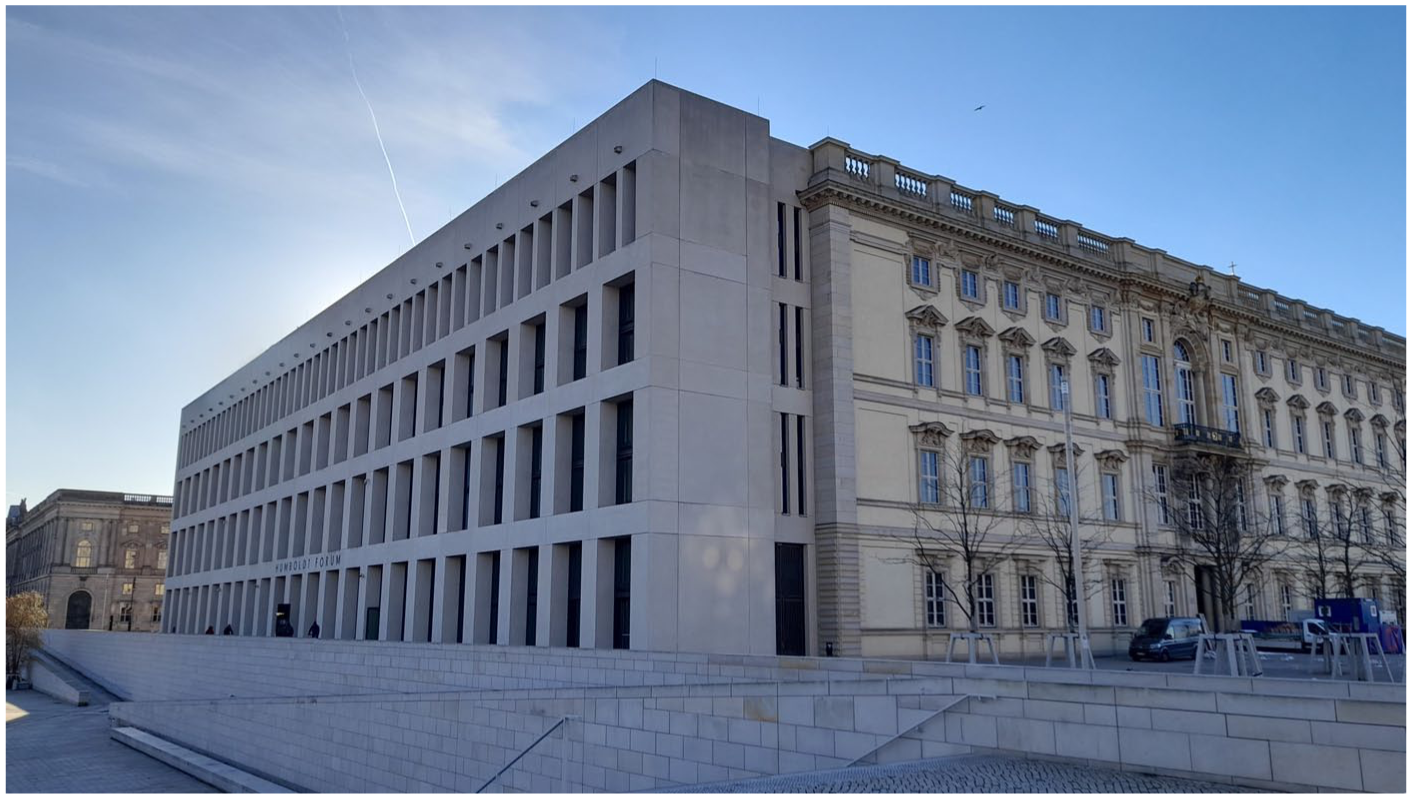
Humboldt Forum, 13 January 2025. © Moawad, 2025.
Figure 1(a) illustrates the composite nature of Berlin’s university landscape, showing that the BUA is scattered across the city. ‘Unlike Oxford or Bologna, these old established university cities, and unlike Harvard, Yale, and Stanford, whose campuses were designed on the drawing board, the academic buildings in Berlin are spread across the entire city’ (Scholz and Borsutzki, 2019). In fact, while some historic institutions are located, as one might expect, in the city centre, other university centres have been built up over time in outlying boroughs. One example is Dahlem in southwestern Steglitz-Zehlendorf (see Figure 1(b) for a closer look at one geographic segment of the wider BUA area). When the Freie Universität Berlin was established in the American Sector of West Berlin in 1948, it initially acquired several private properties through expropriation (Nolte, 2023). It now includes numerous BUA institutions, starting with the Freie Universität Berlin (constituent), as well as heterogeneous associate BUA members: Max-Planck-Institut für Bildungsforschung, Institut für Museumsforschung, Fritz-Haber-Institut – Max-Planck-Gesellschaft, Max-Planck-Institut für Wissenschaftsgeschichte, Max-Planck-Institut für molekulare Genetik and Zuse-Institut Berlin. Nevertheless, the origins of the Dahlem campus, which also became known as the ‘German Oxford in the countryside’, date back to the Kaiser Wilhelm Society. Founded in 1911, it was the first German institution for non-university basic research and the forerunner of the Max Planck Society. And yet, during the National Socialist era, it provided an alleged scientific legitimisation for the National Socialist racial policy. BUA is thus inscribed in ‘a long history of rapprochement’ as summarised by the Berliner Zeitung: ‘For many years after the fall of the Berlin Wall, they were bitter rivals - for funding, staff, and subjects. In 1990, the Freie Universität (FU) in Dahlem, in the western part of the city, still had around twice as many students and professors as the Humboldt-Universität (HU) in the East, on Unter den Linden. But in the years that followed, the FU was downsized, with student and staff numbers almost halved. At the time, some regarded the FU as a “quarry” for the development of the HU in the East. There was talk of an existential threat’ (Berliner Zeitung, 2019). Dahlem, with its supposedly unbroken success story, is, as can be seen, also the site of competing memories (Large, 2002).
PSL in Paris: A relatively centralised university landscape
The case of Paris, illustrated in Figure 3(a), is emblematic of an alliance and merger process that differs from the Berlin case in more ways than one.
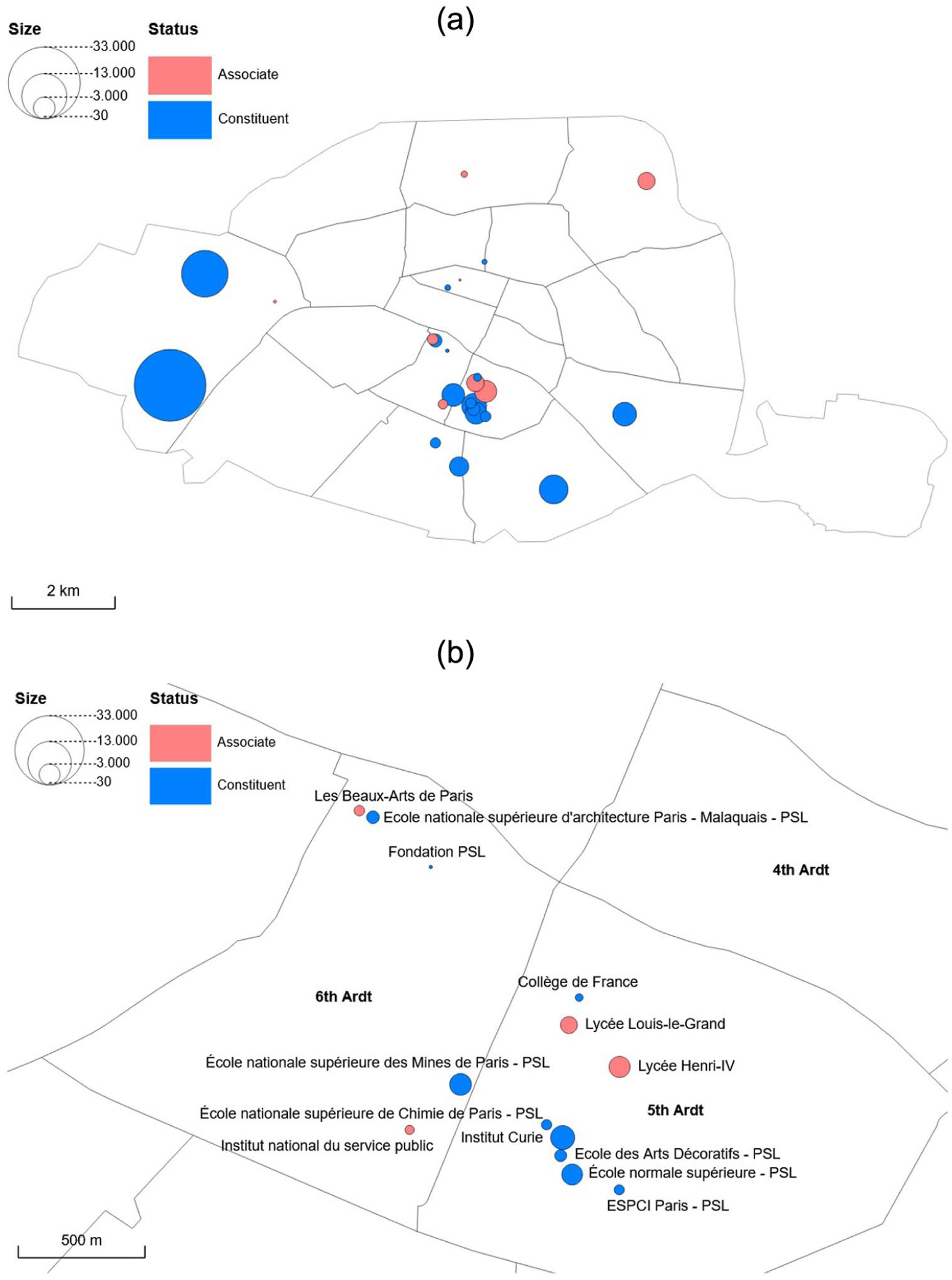
(a) Spatial representation of the distribution of PSL institutions in Paris by size and status. (b) Spatial representation of the distribution of PSL institutions by size and status in the Latin Quarter (fifth and sixth arrondissements).
Paris is an almost ideal-typical Westphalian capital: it is indeed the seat of political institutions, a historical capital with a long-standing tradition, the most populous French conurbation and the main economic metropolis (Laporte and Montès, 2015). PSL, quite logically, underlines the richness of teaching and research in the Parisian landscape by taking a long-term view. For example, in the ABC on the official website, under the heading ‘H for History’, we find the following description: ‘Founded in 2010, Université PSL is a young institution. Its origins, however, reach far into the past to when its centuries-old constituent institutions were born: Collège de France in 1530, Observatoire de Paris - PSL in 1667, Ecole Pratique des Hautes Etudes - PSL in 1868, Ecole des Mines de Paris - PSL in 1783, Ecole Normale Supérieure - PSL in 1794, etc. Over the centuries, and given their close geographical proximity, these institutions developedformidable scientific relationships based on their shared values. That they now find a common home within Université PSL is the culmination of a longstanding scientific, artistic and cultural undertaking, an adventure that continues each day to be written into history’ (PSL official website). The figure above echoes the intellectual image of the Latin Quarter (Humain-Lamoure, 2007) and the elitist nature of Paris’s HE&R system, to which PSL aligns itself. This district, situated on the left bank of the Seine, has a very high concentration of constituent institutions (Collège de France, Ecole nationale supérieure de Chimie de Paris – PSL, Ecole normale supérieure – PSL, ESPCI Paris – PSL, Institut Curie, Ecole des arts décoratifs Paris – PSL) and associated ones (Lycée Louis-le-Grand, Lycée Henri-IV) of PSL. The geographical proximity of these facilities, all of which are located on the Montagne Sainte-Geneviève, is seen as proof of an obvious, highly exclusive association (see Figure 3(a) for an overview, and Figure 3(b) for a closer look at one geographic segment of the wider PSL area). The primary aim of the scientific cooperation foundation, originally named ‘Paris Sciences et Lettres - Quartier Latin’, was to ‘perpetuate the Quartier Latin as an exceptional place for higher education and research’ (Collège de France, 2010), as well as to create a genuine ‘university district, a pioneer in the dissemination of knowledge, the digital university, openness, and scientific and intellectual life’, according to Monique Canto-Sperber, director of the ENS at the time (Polony, 2010). In this cooptation process, similar norms and values are here to preserve their historical institutional identity (Labianca et al., 2001). As Bourdieu points out, ‘“programmed” individuals - endowed with a homogenous programme of perception, thought, and action - are the most specific product of an educational system. Those trained in a certain discipline, or a certain school, have in common a certain “mentality” as the “arts” or “science” mentality or, in France, the normalien or polytechnicien mentality. Minds thus patterned in the same way are pre-disposed to immediate communication and understanding among themselves’ (Bourdieu, 1967). Significantly, the Collège de France first proposed motto for PSL was ‘Let’s share what is unique about us’ (Collège de France, 2010), before ‘Sapere Aude’ was finally chosen. From the outset of the project in 2009, it was identified as a ‘VIP club reserved for a few establishments on the Montagne Sainte-Geneviève’ (Jay, 2009). The impression that this concentration of institutions is an entre-soi is reinforced by the many material traces that form the basis of a kind of ‘territorial ideology’ (Di Méo, 1996). PSL, for example, pertains to monuments with a research function that has been evident since their origin, such as the Pavillon des Sources at the Institut Curie, where Marie Curie used to work, in the same street as the ENS (Figure 4). After much controversy, the small building, which was due to be completely demolished to make way for a larger building as part of a project to expand the Pierre-et-Marie-Curie-Val-de-Grâce campus of Sorbonne Université, was supposed to be dismantled and rebuilt ‘stone by stone’ 20 m further on (Cazi and Rosier, 2024). In the latest twist, it seems that the move will not proceed, and instead, the Pavillon will be incorporated into a new cancer research building, serving as a cultural space for the Musée Curie (Ministère de la Culture, 2024). However, heritage protection groups and local residents have filed an appeal against the project, which they believe jeopardises the ‘architectural integrity’ of the site (SOS Paris, 2025). Thus, the Pavillon des Sources can be seen as a sign of institutional path dependency for both PSL and Paris.
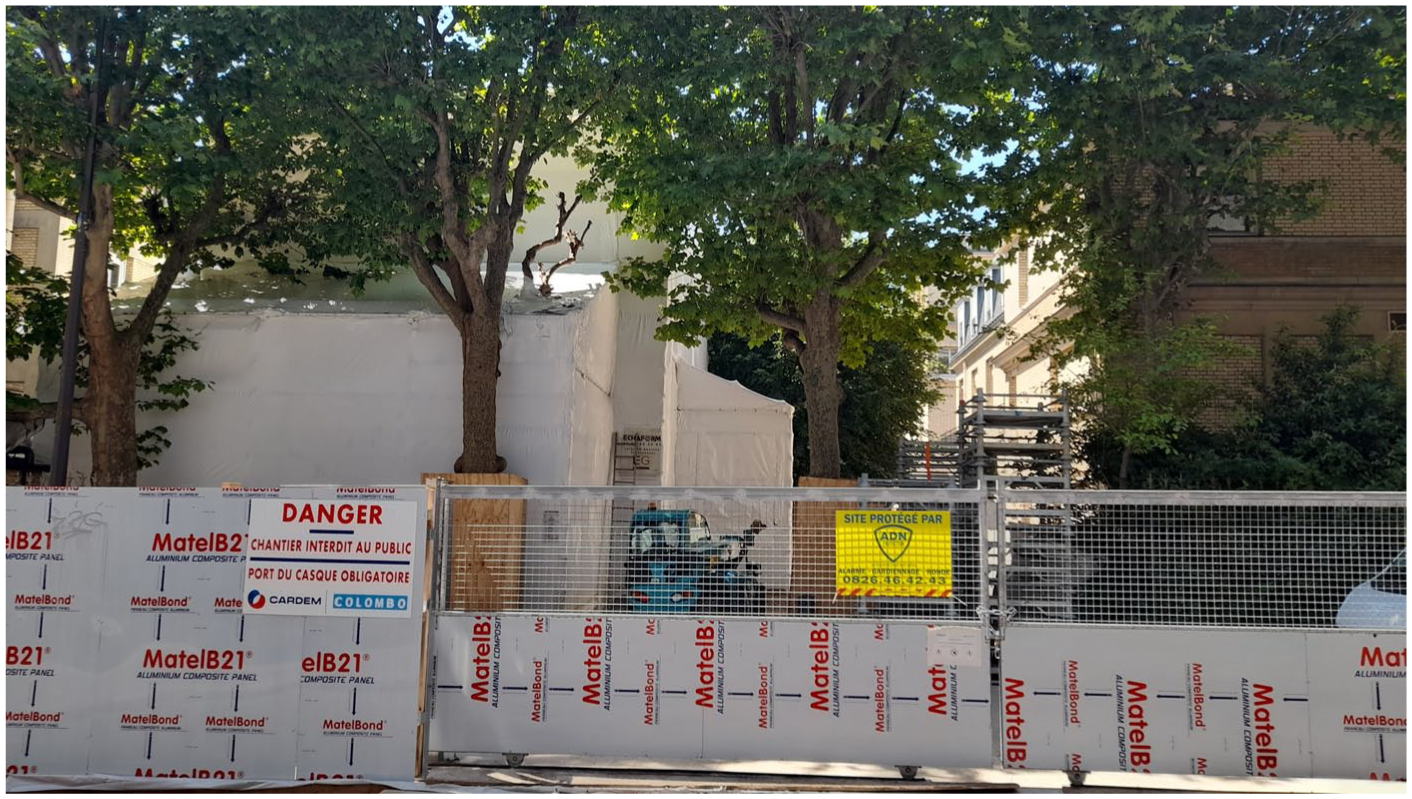
Pavillon des Sources, 23 June 2024. © Moawad, 2024.
Similarly, the fact that none of PSL’s institutions, even those associated with it, are set in the banlieues (the suburbs) is a further manifestation of the separation and aggregation mechanisms identified by Bourdieu (1989), which both consecrate and isolate the elites in training. Coincidence or not, the headquarters of the Ministry of Higher Education and Research, which itself speaks of PSL as a ‘partnership between scientific players on the Montagne Sainte-Geneviève with strong and promising potential’ (L’Yonne Républicaine, 2010), is located in the same district, in the former premises of another grande école, the École Polytechnique.
In this descriptive section, we presented the local geographical anchors of the two alliances. The conclusions are fairly predictable: the PSL alliance is more centralised in Paris, where the district mentality is much more stable and linear, than the BUA alliance is in Berlin, where the city’s geography is more dynamic and discontinuous.
Multi-scale analysis of historical and discursive institutional developments of the two university alliances
In the following section, we approach the two university alliances BUA and PSA as being constitutive of ‘knowledge metropolises’ and test this notion at several scales. We examine which elements of local, national, and international ideological repertoires (Lieberman, 2002) are mobilised by the alliances, such as capital city narratives, race for excellence, national and linguistic identities and competitiveness through globalisation. This allows us to assess whether the alliances rise to the challenge.
Ideas rooted in the territory: The capital city narratives
Not only are BUA and PSL located within cities, they are actually based in capital cities that are seeking to assert themselves on a national scale. To achieve this, each has developed a specific narrative, as reported in the respective media. In the case of Berlin, the creation of the BUA is, as we wrote aforehand, a continuation of the Hauptstadtdebatte (capital city debate). The decision to transfer the governmental institutions from Bonn to Berlin in 1991 made the latter a constitutional capital of disputed legitimacy (Laporte, 2016; Laporte and Montès, 2015). Even if ‘[e]ach side could invoke many symbols to argue that their city was the appropriate synecdoche for the new Germany’, and if Berlin could have been seen as ‘hav[ing] served as the capital of the monarchy, a failed democracy, and two dictatorships’, it was the only one who had straddled the division of Germany and was therefore ‘the best place to heal the wounds of division’ (Ladd, 1997: 224–225). In this context, BUAs’ stated vision is for Berlin to ‘become the most important science metropolis in Germany’ (Scholz and Borsutzki, 2019). However, the gamble is far from won, as for all its virtues, Berlin has its drawbacks: ‘The fact that the city is so diverse - and confusing, often dysfunctional - has always been its advantage. Sabine Kunst [the president of the Humboldt-Universität from 2016 until 2021] calls this the “Berlin mentality”: “If you have a great idea, the political system will favour it”. This is particularly true for science. It needs chaos, it promotes the search for knowledge’ (Scholz and Borsutzki, 2019). Thus, it would appear that BUA is merely an opportunity to confirm Berlin as the capital of Germany. As far as Paris is concerned, however, the question does not arise. The national divide between the capital and the province (meaning ‘outside the Paris region’) is yawning and is not closing over time. The statistics of the various PSL establishments make a distinction between students from Paris and those from the province. Mines Paris – PSL, for example, includes this data in its ‘admissions diversification policy’ in the same way as female and foreign applicants (see Mines Paris – PSL, 2024). The ENS – PSL, too, deplores the ‘low number of applicants from universities, for whom the student entrance exam was created, as well as applicants from the province’ (ENS, 2023), as stated in one of the reports of the committee for the student entrance exam (the university track) where, in reality, it is mainly students from classes préparatoires who apply. 1 Only the EPHE – PSL has campuses and ‘offers courses [. . .] in Paris, the province and French Polynesia’, yet the distinction between the capital city and the rest of France persists (EPHE, 2023). For BUA as for PSL, the idea of a local university alliance is therefore strongly rooted in the territory of the capital city.
Centre versus periphery: ‘Excellence’ as a motive for differentiation and distinction
In our study of the (self-)positioning of BUA and PSL as knowledge centres, the narrative of excellence also deserves to be briefly examined. For Berlin, the BUA is an opportunity to assert itself in relation to other German university centres, in addition to resolving intra-Berlin university conflicts. Berlin’s universities had already taken part in competitions focusing on the excellence of their projects: the 2007 elite competition precipitated a new surge in prestige at Berlin’s universities. In 2007, the Freie Universität was designated Berlin’s inaugural University of Excellence as an ‘International Network University’, while the Humboldt-Universität required two attempts to also become a University of Excellence in 2012, with its ‘Education through Science’ concept based on Humboldt’s ideas (Berliner Zeitung, 2019). However, it was not until 2016 that they planned to cooperate within the framework of the Exzellenzstrategie (strategy of excellence). Other locations than Berlin were indeed considered to have the potential to become knowledge metropolises, and all were waiting to apply for the first call for the Exzellenzstrategie, a federal-state agreement designed to strengthen top-level research and international competitiveness of German universities. Hannover, which came as a surprise, passed the first round of applications but failed in the second; Bonn-Köln decided not to apply as it had more to gain as individual clusters of excellence; and München was almost predestined but did nothing (Schulenburg et al., 2023). Ultimately, Berlin benefitted most from the fact that no one else was willing to take the plunge and that the government was still keen to trial this new funding line: the BUA was therefore a test case. The desire to see if it can work is growing and funding is pouring in from various sources. In this way, Walter Wübben, patron of the Kiel-based Damp Foundation, intended to donate 30 million euros to Berlin’s universities and partner institutes to ensure that Berlin could ‘better compete with internationally renowned science metropolises, for example in the USA or Great Britain’; the state of Berlin was also providing funding (15 million euros) to appoint top international scientists (Berliner Zeitung, 2019). Therefore, in the case of Berlin, the general idea seems to be to take advantage of a window of opportunity that has fortunately opened up, to showcase its differences without deliberately doing so to the detriment of other knowledge cities. In the case of PSL, on the other hand, the Parisian university alliance took an offensive stance from the outset to distinguish itself from the rest of the French institutions. In 2009, a report submitted to the President of the French Republic set out the ambitions of the future Investissements d’avenir programme (PIA) for higher education and research. The idea was to ‘create, from [five to ten groupings of higher education and research establishments selected by an international jury], multidisciplinary campuses capable, thanks to this exceptional funding, of competing with the best in the world’ (Juppé and Rocard, 2009). The central mechanism of this programme was the ‘Initiative of Excellence’ (IdEx) call for projects, launched in 2010 and PSL was awarded in 2011 as part of the PIA 1. This label rewards ‘research universities of world renown with a scientific power and impact of the highest order in broad fields of knowledge’ (Udice, 2023), and PSL was one of the three winners from the outset, alongside the universities of Bordeaux 1 and Strasbourg. Despite demands from trade unions denouncing the territorial imbalance (Soulé, 2012), the alliance was continued under PIA 2 (2013) alongside 9 other establishments, and continued under PIA 3 (2017) and PIA 4 (2021). In both cases, the metropolisation of knowledge functions as a selective process that benefits those areas that are already the best endowed, in a form of Matthew’s effect (Merton, 1968; see also Carayol and Maublanc, 2025). The ‘excellence’ motive raises the question not only of the existence of a centre-periphery logic in our two case studies, but also of the relationship between the centres and peripheries and the strategies they develop for specification: a horizontal one, based on differentiation, for BUA; a vertical one, based on distinction, for PSL.
Setting boundaries: Building (inter)national identities through language
Language has also been leveraged by BUA and PSL to build and affirm their identities as key players in the knowledge sector, and to reinforce the status of Berlin and Paris as knowledge capitals and of Germany and France as nation-states. Interestingly, however, the use of English especially responds to distinct logics within PSL and BUA. Studying the names of the two university alliances is therefore highly instructive, as seems to be confirmed by the written press reviews mentioning the expressions BUA and PSL. For instance, the name ‘Berlin University Alliance’ and its acronym (BUA) do not seem to have been the subject of much opposition. Although, in 2016, the Berlin University Alliance was still seen as a ‘working title’ (Kühne, 2016), it has subsequently been referred to exclusively by this name in all official documents, with a few variations. And if the title is in English, it is above all for pragmatic reasons: ‘The title “Berlin University Alliance - Crossing Boundaries towards an Integrated Research Environment” [is indeed] formulated in English for the international experts in the Excellence Strategy’ (Burchard, 2018). Conversely, each institution retains its own name, without mentioning the BUA. The Humboldt-Universität zu Berlin, for example, lays claim to the Humboldtian heritage, whose model radiated throughout Europe, while the name of the Freie Universität Berlin reflects West Berlin’s status as part of the free world during the Cold War. The Paris case, for its part, is more complex for a number of reasons, not least because language is linked to the law in France, with the form and function of language being legislated directly (Judge, 1993). Although the scientific cooperation foundation was originally named ‘Paris Sciences et Lettres - Quartier Latin’ (Légifrance, 2010), a few years later it changed its name to ‘Université de recherche Paris sciences et lettres - PSL Research University’ (Légifrance, 2015). It even appears in some international rankings (see section 4.3) under its English name alone. On 21 September 2017, following requests from associations defending the French-speaking world (Association Francophonie Avenir, 2017), the Paris Administrative Court ordered PSL to remove the words ‘Research University’ from its logo in all media, in accordance with the Toubon Law on the use of the French language (Légifrance, 1994). Another difference is worth noticing: unlike BUA, the constituent member institutions of PSL were obliged to present themselves under the denomination ‘Name of the member-PSL’. This undoubtedly strikes the best balance between affixing an identifiable PSL brand – particularly in international competition with the Sorbonne brand in terms of reputation – and preserving the individual identity of each institution. Regarding the evaluation of the PSL structure, the use of French does not appear to be problematic, since all of the evaluators appointed by the High Council for Evaluation of Research and Higher Education, both internal and external, are French-speaking (HCÉRES, 2022; see also the LinkedIn post by Alain Fuchs, President of PSL University, dated 22 February 2024). Few member institutions, such as the CNRS, explicitly call on and support an international evaluation committee (CNRS, 2023). This feeling is reinforced by the fact that publication policies differ greatly between countries. For instance, the French academic field favours publications in the original language, whereas this is not the case in Germany, particularly in Berlin, where there is even less pressure to publish in German than in English due to an unresolved Ostkomplex (‘GRD complex’) (Hick, 2016). The rationale behind the use of English in BUA and PSL is therefore quite distinct. As can be seen, French language policy is fuelled by francophone organisations and the nostalgia for French as the lingua franca of research (Mackey, 1994), whereas this does not seem to be such a priority in German (HE&R) policies, which prioritise integration into a global academic network. But in both cases, language contributes, albeit in different ways, to the positioning of Berlin and Paris as knowledge metropolises.
The ‘glocalization’ argument reinvented: From knowledge metropolises to global knowledge cities?
But are BUA and PSL really part of a global network, which would make Berlin and Paris knowledge global cities – the term ‘global cities’ being borrowed from Sassen (2001) – and if so, in what way? Both cities are seeking to become part of globalised flows and exchange networks (Ghorra-Gobin, 2007). Similarly, the two university alliances and their individual members are part of dense academic networks, starting with the European university alliances. However, just as the BUA actors consider that ‘the alliance is an interesting model for the whole of Europe’, in the words of Karl Max Einhäupl, Charité’s former director (Scholz and Borsutzki, 2019), so those at PSL position themselves on a different scale from the outset. In their ABC self-presentation, the letter ‘I for International’ reads: ‘Paris is, along with London and Boston, one of the world’s great scientific capitals’ (PSL’s ABC on the official website), thus exposing PSL’s global ambitions. While globalisation is undeniably welcome, PSL members continue to emphasise the city’s historical role and its long-term cultural influence, seemingly fearing that globalisation would erode their cultural distinctiveness. In the case of BUA, and reflecting the fact that any collaboration is made even more complicated simply by the Länder’s prerogative in HE matters, the priority is to create a united local and regional identity above all else. This can be seen in the way some of the BUA’s Objectives are communicated. Major societal challenges are addressed via the ‘development of a citywide agenda for collaborative research on global societal challenges in Berlin’; and knowledge exchange by ‘establishing and promoting a network [. . .] with Berlin at its core’ (Berlin University Alliance website). The importance attached to international rankings in public statements further illustrates the real or perceived difference between BUA’s and PSL’s ambitions with regard to their inclusion in a global network. University ranking indicators can obscure complex historical realities, as just one example shows. The Freie Universität and the Humboldt-Universität were unable to agree on how many Nobel Prizes they had been awarded before the Second World War. Neither institution recovered them, and neither appeared in the QS Rankings for this reason alone. Rankings are much more beneficial to PSL, as its member institutions no longer appear individually (unlike those of the BUA) after the alliance. Whereas only certain grandes écoles had previously appeared in the rankings (ENS and Mines), their small size was a disadvantage; PSL enables all of them to gain international visibility (see also Docampo et al., 2015). Press releases on the 2025 results mention PSL’s new equals: ranked 24th in the QS Ranking 2025, it is in the same league as ‘Princeton University (22nd) and Yale University (23rd), as well as EPFL, École Polytechnique Fédérale de Lausanne (26th)’ (Université PSL (Paris Sciences & Lettres), 2024a). As for the THE 2025 one, PSL is ranked 42nd and ‘remains in the select circle of the world’s top fifty universities alongside prestigious international institutions such as the University of Melbourne (Australia), McGill University (Canada) and the University of Leuven (Belgium)’ (Université PSL (Paris Sciences & Lettres), 2024b). PSL’s current president, El-Mouhoub Mouhoud, has recently stated his desire to see PSL ranked among the world’s top 10 universities by 2035 (Université PSL (Paris Sciences & Lettres), 2025). In a nutshell, in both the Berlin and Paris cases, there is a co-presence of universalising and particularising tendencies. Globalisation induces a reinvention of locality, which some authors subsume under the ‘glocalization’ argument (Robertson, 1992; Swyngedouw, 1992).
Typology
Based on our observation of the institutional variations and changes that Berlin and Paris underwent after the creation of the BUA and PSL, we identified a set of criteria (size, site, academic culture/disciplinary focus, inclusiveness/exclusiveness policy, local identity, imageability) to deduce an empirically grounded typology of local university alliances in knowledge metropolises. The following table summarises the findings of our analysis (Table 2).
Institutional characteristics of BUA and PSL.
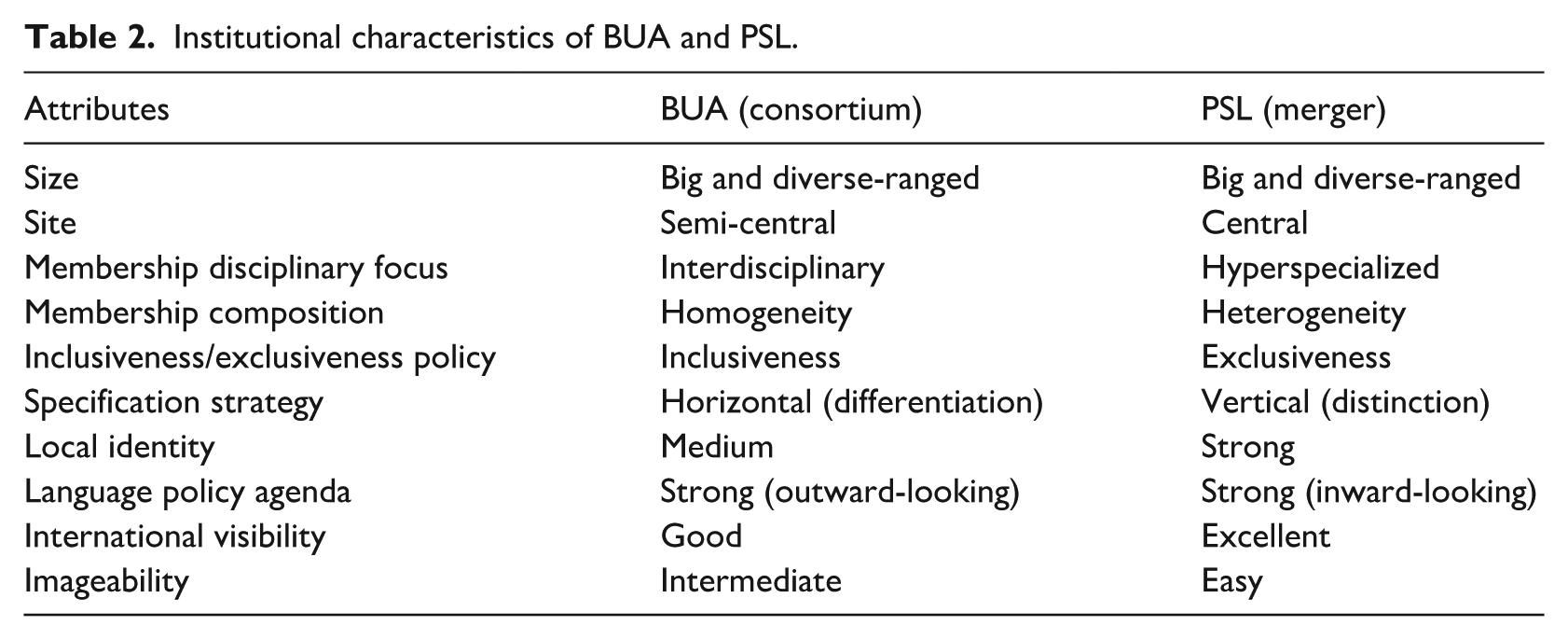
As can be seen, both BUA and PSL are large and diverse institutions, but they differ in terms of structure, identity, and strategic orientation. BUA is semi-centrally located and emphasises interdisciplinarity, homogeneity in membership and an inclusive, horizontally differentiated strategy. It projects a medium local identity, a strong outward-looking language policy agenda, good international visibility and an intermediate level of imageability. PSL, by contrast, is centrally located and characterised by hyperspecialization, heterogeneous membership, and a more exclusive, vertically distinctive strategy. It has a strong local identity, a strong inward-looking language policy agenda, excellent international visibility and high imageability. The analysis leading to the above table also revealed that the motivations for working together are complex. The status of the knowledge metropolis Berlin is historically controversial, whereas that of Paris is obvious. The interdependencies are not always apparent, particularly given the complicated historical past of the Berlin university landscape and the difference in status between universities and grandes écoles in France. Furthermore, different principles of performance coexist, with excellence serving as a principle of both differentiation and distinction for BUA and PSL. We observed that, in both cases, collaborations were affected by selective proximities between knowledge-producing institutions and knowledge-demanding institutions (Akbaritabar, 2021; Rammer et al., 2020), should they be linguistic (Avdeev, 2021), geographical (Katz, 1994), or regional (Luukkonen et al., 1992). Additionally, we noted that collaborations were also affected by the congruence of contextual (Sonnenwald, 2007), social (Smith-Doerr et al., 2017), and epistemic preferences (Akbaritabar et al., 2020). Both BUA and PSL are formed according to a principle of legitimacy based on status and reputation (Meyer and Rowan, 1977). Overall, both university alliances rather largely capitalise on what makes their specificity, namely their historical and cultural heritage – or that of their member universities. PSL, as our mapping work has confirmed, just goes much further than BUA in terms of the cultural characteristics usually affecting the persistence of university alliances (Muthusamy and White, 2005). Moreover, both alliances are indeed willing to make the most out of their broad range of disciplinary coverage – nevertheless, for distinct socio-political and historical reasons in Paris and Berlin. Hyperspecialisation is rather Paris’s trademark, with Mines being an engineering school, the Ecole des Arts Décoratifs being an establishment devoted to artistic disciplines and the ENS and the CNRS focusing on fundamental research; Berlin’s hallmark is its interdisciplinary heritage (see the Humboldtian model of research).
Conclusion
In this multi-scale analysis, we established that the institutionalisation of BUA and PSL involves the mobilisation of elements of local, national and international ideological repertoires (Lieberman, 2002) such as capital city narratives, the race for excellence, national and linguistic identities, and competitiveness through globalisation. Despite their different and often complex motivations, both alliances are proving to be fully integrated into the two ‘knowledge metropolises’ that they contributed to establishing as such and from which they benefit. Historical approaches helped us grasp the concrete temporal and, in our case, spatial processes from which institutions emerge and in which they are embedded (Thelen, 1999) by pouring over the structures of the two university alliances. What is more, paying attention to their discourses allowed us to focus on the dynamics between the two alliances and the two capital cities, as well as on the agency of all the actors involved in the negotiations. We examined these HE&R institutions as structures that can be traced in memory; we considered internalised rules and norms; we questioned the representations that the alliances and cities have of themselves and others, and the ways ideas are embodied. This paper’s predominantly geographical method, for its part, enabled us to draw conclusions relating to the history of science, the sociology of knowledge and HE&R policies. Overall, this analysis confirms our commitment to a historical (we add discursive) geography of science. We are aware that the weight of history and the interpretability of discourses are regularly mentioned both as a justification for and as a limitation of typologies. But we believe that these aspects are crucial for understanding the similarities and differences between our two case studies at present, and that we have avoided the main pitfalls of determinism.
In that respect, our analysis shows that BUA and PSL are the logical continuation of local university collaborations within two ‘knowledge metropolises’ as well as the result of multiple constraints. Firstly, this is due to environmental expectations and pressures (Scott, 2014). Both are strategic alliances, in the sense that university members ‘co-opt’ others and make competitors their allies (Chan, 2004), but for different purposes: internal competition (BUA) versus external competition (PSL), at least in their public presentation. Secondly, they follow a trend in the academic environment that demands converging organisational adaptations (Deiaco et al., 2009), in a form of positive synergy and in the hope of achieving the success observed in other alliances. Finally, they are a response to variables such as a fierce international competitive climate in the academic sector (external pressure for change, increased competition and reduced predictability). However, by trying too hard to harmonise these practices, the two university alliances may come up against limits that would negate these positive synergies. We hereby align with Benneworth’s (2019) conclusions that reducing the number of institutions decreases institutional diversity, and that homogenisation, as the maintenance of a very particular form of HE – namely the most prestigious – is a normative process. We recognise that our results are fairly difficult to generalise, given that each of our case studies has several unique characteristics (BUA as a consortium in a federal state; PSL as a merger in a state with a highly centralised political culture). Nevertheless, the empirically grounded typology that we have proposed may pave the way for the analysis of other local university alliances also located in knowledge metropolises. Above all, our analysis points to the need to consider the complexity of the tangled scales of analysis of such alliances as an asset rather than a difficulty to be avoided. Another considerable challenge for university alliances, regardless of their specific constellation (local or international, homogeneous or heterogeneous, inclusive or exclusive and so on), is finding adequate governance. Indeed, the difficulty of governing university alliances seems to lie in the constant equilibrium that actors have to find between consolidation, competition and cooperation (Nelles, 2012: 3). Lastly and in addition to historical and discursive layers, spatial layers might add to the complexity of analysing how university alliances are governed. Discussing this here would go beyond the scope of this article, but it is also analysed in the project and a separate publication on this subject is already planned.
Footnotes
Acknowledgements
The authors express their deep gratitude to the two anonymous teachers in history and geography for their invaluable advice and feedback on the maps, from the research design to the software used to generate them. The authors would also like to thank the two anonymous reviewers for their very precise and highly constructive comments, the organisers of the Panel “The European Universities Initiative between consolidation and expansion” at the ECPR General Conference 2024 for their trusting invitation, as well as David Joshua Schröder and Meta Cramer for their additional, best-informed and to-the-point remarks.

Funding
The authors disclosed receipt of the following financial support for the research, authorship, and/or publication of this article: Both authors acknowledge the support by the project-funding of the Berlin University Alliance (303_Innovationsgruppe_HU) and by the Robert K. Merton Center for Science Studies.
Declaration of conflicting interests
The authors declared no potential conflicts of interest with respect to the research, authorship, and/or publication of this article.