




Abstract
This article focuses on the role of the principal in facilitating inclusive education policies in Sweden and Finland since 1990. It does so by analysing education union journals in both countries. These journals are taken to represent principals’ collective professional voice concerning the dynamics of major educational reforms. The findings show surprisingly similar attitudes towards inclusive education in both Sweden and Finland. According to the journals, inclusive education can only be accommodated by defining student disabilities and disadvantages and training special educators to take charge of separate special education environments. During the 1990s, resistance to inclusive education within the journals was very explicit. More recently their arguments have softened. Inclusive education is in principle a worthy aspiration, but the realities of school systems do not allow for it. These findings are explained by the classic special education theory of Thomas Skrtic, who argues that general education builds on various types of bureaucracies aiming to maintain the stability of their organisation at scale. In summary, the journals discussions regarding inclusive education can be generalised in three specific concerns: the student should be in focus, the organisational form of inclusive education is crucial, and responsibilities and resources must be clearly articulated.
Keywords
Introduction
Inclusive education is a much-debated issue in European education systems. At the heart of the matter is the question of every child’s right to education. Including children of different ability levels in regular classroom teaching forms part of a wider political discourse on education and democracy. Since UNESCO’s (1994) Salamanca Statement launching inclusive education as a policy, the subject has been part of the global education agenda (Ainscow et al., 2019; Wermke et al., 2020) and has been ratified in several additional international policy documents (e.g. UN DESA, 2023; UNESCO, 2015; United Nations, 2006).
However, the issue of inclusive education is much more complicated than these international policy documents (and the nation states formally committing to them) may indicate, and public education is inherently complex (Magnússon, 2023), even without ambitions for inclusion, accessibility, and equity. Changes in education occur slowly and often with different outcomes than intended (Ball, 1993; Tyack and Cuban, 1995). As a result, it is not surprising that the development towards inclusive education is slow, both on a national and global scale (Tøssebro et al., 2020).
Aside from the difficulties in implementing and enacting a policy formulated on an international level into national and local practice (Magnússon, 2023), one explanation for this phenomenon is that the lacklustre adoption of inclusion is a result of the internal workings of the school and its staff. This is why Wermke et al. (2020) suggest that to implement inclusive education, a better image of how different school professions feel about inclusion is needed. There is a growing body of research examining the role of teachers (cf. Beneke et al., 2020; Buli-Holmberg et al., 2023; Lindqvist and Nilholm, 2014; Saloviita, 2022) and their ambivalent outlook on inclusion. There is a plenitude of research on special educators’ role in the implementation of inclusive schools (cf., Cameron et al., 2024; Wermke et al., 2024a). However, more research is needed about the attitudes of one particular group of educational professionals, namely principals. (Dahle and Wermke, 2024; Lindqvist and Nilholm, 2014). Our own systematic literature search revealed only a little scientific production focusing on the role of principals in the implementation of inclusive education. The article at hand is part of a research project funded by the Swedish research council which among other aims to fill this knowledge gap (Nordholm et al., 2022).
Principals, who are placed squarely between inclusive schooling regulations and practical implementation challenges, must decide on policy changes and then seek to implement them, even if they are not explicitly defined (Magnússon and Pettersson, 2021). Research has shown that educational leadership has a major impact on school change and development (Dahle and Wermke, 2024). Principals are expected to not only implement inclusion as policy. They are also expected to provide sufficient special educational support, ensure the continuous development of the inclusive learning environment and assure the quality of the school’s work and its attainment outcomes. In decentralised education systems, such as the Swedish and Finnish ones, this means that the responsibility and accountability for these decisions lie often with the individual principal. Hence, principals are important stakeholders in interpreting and enacting education policies in general and inclusion policies in particular.
To cope with such an extended and complex responsibility, school professionals such as principals will rely on the back-up of professional associations and unions (see Jarl et al., 2012; Ullman, 1997), which results in harmonisation and standardisation of professionals’ perspectives and behaviour (Persson, 2008). Consequently, we argue that it is not sufficient to study the influence of individual principals in inclusive education. Rather, the collective voices of principals must be considered. Thus, professional organisations can serve as important mouthpieces for principals’ views. School leader unions, and the principals they represent, can be seen as policy actors, attempting to influence the governance of schools and whether or not and how, that might be changed (Troedson and Wermke, 2024).
As Sundberg (2025) argues in this journal, these representatives aspire to mediate between policy and practice, both nationally and locally. We follow her example and focus on principals as collective actors by examining the output of education unions in their own professional journals, which claim to represent principals’ opinions in various contexts. Against this backdrop, the aim of this article is to increase the understanding of how inclusive education is perceived and described by school leader union journals in Sweden and Finland.
There is a plethora of interpretations of what inclusive education means in practice, both in the field of research (Amor et al., 2018) and among policy actors (Magnússon et al., 2019). The varying definitions encompass everything from the pupil group in focus for the policy, the relationship to special education, the role of placement, to the choice of curriculum and teaching (Magnússon, 2023). Rather than take a position ourselves against which we measure the empirical materials, we look for different interpretations of the concept in the data and try to illustrate how it is represented.
The cases of Sweden and Finland make for an interesting comparison of school leader views on inclusion for different reasons. Both Nordic countries have implemented large-scale education policy reforms regarding children/pupils in need of support in the past two decades. In Sweden, the most important recent policy was implemented through the Education Act (Law, 2010:800) and in Finland through the introduction of a three-tiered model of support (Law, 642/2010), both in effect since 2011. Sweden has, however, followed a path of market-governance of education, whereas Finland has long resisted that trend (Hansen et al., 2020). Although inclusive education is a political ambition that affects both systems, Finland and Sweden have had very different ways to organise special educational support; Swedish policy emphasises in-classroom support whereas Finland relies on individual and/or small group teaching by special education teachers. The differences and similarities between these two contexts are intended to serve as an analytical device to illuminate the relationship between contextual particularities and the unions’ responses to the requirement to implement inclusive education at scale.
Our research is based on an examination of two union journals – Läraren, published by Finland’s Swedish Teachers Union and Skolledaren, published by the Union of Swedish School Leaders – between 1990 and 2024. In the 1990s the journals covered the United Nations’ EFA Declaration 1990 and the Salamanca Declaration in 1994. In the 2000s, they have covered the UN Convention for the Rights of People with Disabilities, followed by further policy and practice declarations and reforms. Our findings on the role of principals and their unions are important. National governments control how inclusion is organised and governed through laws and regulations. Education policy negotiations are to a certain extent influenced by education unions (Troedson and Wermke, 2024). Thus, this paper attempts to provide an explanation of principals’ view of inclusive education as collective actors through their unions. This article begins by contextualising the development of inclusive education in Sweden and Swedish-speaking Finland. Second, the theoretical approach is presented and the materials and methods explained. The results are then presented for each country and a comparative theoretical interpretative analysis then follows. The article concludes by discussing the generalisation of the findings in relation to specific concerns when discussing inclusive education.
Inclusive education in context
Finland
Prior to 2011, special educational support in Finland was provided in two tiers: general and special education (Honkasilta et al., 2024). Special education was reserved for pupils whose difficulties in school were caused by disability, illness, mental ill health, functional deficits or a lack of social support. This provision for special education was introduced in 1998 with the Basic Education Act 628/1998 (Honkasilta et al., 2024). In 2011, a three-tiered support system was introduced. This shifted focus on to the role of special educational support and how it would be provided. The first two tiers of the system are focused on preventative measures. The third tier is considered only when the interventions on the other two tiers have been deemed insufficient. The interpretation and realisation of this three-tiered support framework is up to the municipalities.
In contrast, local schools are relatively autonomous (Honkasilta et al., 2024). Since principals and teachers have considerable decision-making authority (Pulkkinen and Jahnukainen, 2016), decisions can vary across different educational contexts and differences within the system can emerge as a result. This is not least due to the fact that the arrangements for support must take available resources into consideration (Pulkkinen and Jahnukainen, 2016).
When examining principals’ view of inclusion in Finland, the preferred pedagogical method of support is education in special groups (Jahnukainen, 2015). This means that most special education teachers in Finland spend a majority of their time educating pupils with special educational needs (SEN) in segregated settings (Sundqvist et al., 2019) However, some educational leaders may see it as financially preferable to provide support in general education groups, the reality is that segregated placements in teaching have not decreased. Rather, the number of pupils with special education needs (SEN), and thus the right to separate education, has increased (Pulkkinen and Jahnukainen, 2016). The problem in the Finnish case is that each municipality adopts a different practice. Centralised governance remains vague and top-down decision making conspicuously absent. The Finnish inclusion effort has therefore been largely eviscerated (Honkasilta et al., 2024). In fact, in 2025 Finland is on the verge of abandoning the three-tier system and returning to a traditional two-tier system, that is, a clear-cut distinction between general and special education (RP, 114/2024).
Sweden
A special needs support system is not explicitly described in Sweden’s education regulations or curricula. Instead, the Education Act (Law, 2010:800) states that a pupil at risk of not achieving their educational goals shall receive appropriate support. Support should be in the form of ‘extra adaptations’ as far as possible and be provided within the standard classroom. If these measures are not enough and the pupil is still failing to achieve the curricular goals, they can become the subject of ‘special support’ (cf. Barow and Magnússon, 2024). Such special support necessitates an intervention plan based on assessments from different professional actors. The decision to provide additional support is primarily the responsibility of the principal.
Since 1994, school reform in Sweden has focused on the achievement of expected learning outcomes. The emphasis within educational circles has been to increase pupils’ ability to reach agreed educational goals. This results focus has increased the gap between regular and special education (Isaksson and Lindqvist, 2015; Magnússon and Pettersson, 2021). Even though support measures in Sweden are largely delivered in the regular education setting, there are still a number of options where segregated education can take place (Giota et al., 2023; Sansour and Bernhard, 2018). There is also a growing political will to increase the use of segregated measures for special education (Barow and Magnússon, 2024; Taneja-Johansson and Powell, 2024). Such shifts in both opinion and resources affect the funding available for special education support and principals’ opportunities to arrange such support (Magnússon, 2023). The Swedish school system is characterised by complex multilevel governance and decision making at both the national and municipal levels (Jarl et al., 2024). However, special educational needs assessments and support are handled most often at the school level (Nilholm et al., 2013). This is why principals have a very significant role in defining the shape and conduct of inclusive and special education (Göransson et al., 2019; Magnússon and Pettersson, 2021).
Theory
In this article we investigate the relationship principals have with inclusive education. We build the study on the premise that the establishment of inclusive education is the result of organisational and professional decisions. Therefore, we will apply a theoretical approach regarding school organisations and special education based on the works of Skrtic (1990, 1991). While Skrtic’s ideas might look dated, we argue that theories are often stable while contexts are not. Skrtic’s understanding of school organisations was developed under social and societal conditions very similar to what we see today. In the United States in the late 1980s, education was strictly divided between special and general education, each with strong leadership bureaucracies at various levels. At the same time, inclusive education was often touted as a civil society ambition. Critical education research argued increasingly for inclusion, a movement whose efforts eventually culminated in the Salamanca Declaration (Ainscow et al., 2019). Today, inclusive education has once again become an ideological battleground, and Skrtic’s theories, we suggest, can help to explain the tensions that exist between these two educational approaches. Previous work in other contexts has also shown the fruitfulness of Skrtic’s conceptual work for an explanation of the contemporary relationship between special and general education (Magnússon, 2015; Wermke et al., forthcoming, see also Lempinen, 2018; Lindqvist and Nilholm, 2014).
School organisations, according to Skrtic (1991), can be understood as consisting of two parallel organisational structures. The material structure conforms to the technical demands of the organisation and the normative structure consists of the internal cultural demands of an institutionalised environment. Skrtic (1990) calls the outer structure machine bureaucracy and the internal normative structure professional bureaucracy. The outer bureaucratic structures in a school organisation are tightly coupled, meaning that the processes and actors within a bureaucracy are directly connected to all of its other elements. Changes to the system, therefore, will invariably affect every other part of that system. The professional bureaucratic structure, on the other hand, is loosely coupled. This means individual actors (the professionals) are autonomous and independent from one another to a greater degree. According to Skrtic, these two systems are decoupled from one another; machine bureaucracy primarily affects the rules and prerequisites governing a school while the inner professional bureaucratic structure is largely the result of the professionals themselves (Skrtic, 1990, 1991).
Skrtic (1991) went on to elaborate that schools, as public organisations, were obliged to respond to public (and political) demands for change. Such demands could be communicated to schools through the alteration of educational policies, such as in the case of educational reforms. That said, organisational changes often affected the outer structure, that is, the machine bureaucracy. However, since the machine bureaucracy is decoupled from the actual work of the professional bureaucracy, this change may be symbolic with little concrete effect on the everyday practices of professionals.
Another way the system changes to accommodate new public or political demands is, according to Skrtic (1991), by adding separate programmes or creating new specialisations to deal with the specific demands for change. By taking advantage of the decoupled system, a new subunit with a different specialisation can be added to the school organisation without the need for a reorganisation of activities or a comprehensive change of practices. As an example of such supplementary measures, Skrtic cites the special education profession. This profession can be seen as a separate subunit while the general teaching continues as usual. Hence, students who do not fit into general classroom teaching receive special educational interventions, which are primarily conducted by a separate professional group (Skrtic, 1990).
Skrtic’s theoretical concepts provide robust analytical value for understanding the role and purpose of principals in school organisations, a position which is challenged by the political requirement to implement inclusive education at scale.
Materials and method
Our study examines two education union journals: Läraren is published in Finland by the Finland’s Swedish Teachers’ Union (FSL), representing the principals of the Swedish speaking minority in Finland. Skolledaren is published in Sweden by the Swedish School Leaders’ Union (Sveriges Skolledare), the sole union in the country representing principals. According to Troedson and Wermke (2024), the role of a union press is to form the agenda and affect public opinion by selecting the most important topics according to the occupational groups they represent. The selected topics can then be seen to represent the ‘voice’ of the union in a specific context and at a particular time. The journals thus act to represent for the attitudes of the union and its members in society (Troedson and Wermke, 2024).
The selection of Finland and Sweden is threefold. First, they represent two different ways of approaching education and special education, while still remaining within the basic tenets of the so-called Nordic Model (i.e. a comprehensive system for all social classes and groups, late differentiation, and equity as a prioritised value (Blossing et al., 2014). However, both countries approach the provision of special educational support and organisation of inclusion very differently (e.g. Giota et al., 2023; Honkasilta et al., 2024; Pulkkinen and Jahnukainen, 2016). Second, the marketisation of the Swedish system has had far-reaching consequences, including increased segregation, fiscal cut-backs, and a decentralisation of the responsibility of the education system (Jarl et al., 2012). Finally, Swedish is a primary language in both Sweden and in particular regions in Finland, meaning that we could access and understand the journals without needing translators or other types of assistance.
We have performed in this study a comparative methodology. Following Frederick Erickson’s classic work, Qualitative Methods in Research on Teaching, from the 1986 edition of the Handbook of Research on Teaching, we (i.e. humans) do not realise the patterns in our actions as we perform them. Anthropologist Clyde Kluckhohn (in Erickson, 1986) illustrated this with the following aphorism: ‘The fish would be the last creature to discover water’. Comparative interpretative research, through its inherent reflectiveness of the contingency of practice, helps us to make the familiar strange and interesting again. The commonplace becomes problematic. Everyday events taken for granted can become visible and be documented systematically. This, of course, has consequences for empirical data acquisition. The focus on the context of actions is intrinsic to interpretive research on schools, where interpretative researchers seek to understand how education professionals and students, in their actions, constitute and understand their environment and one another. While it is universal that regularly interacting sets of individuals possess the capacity to construct cultural norms by which their social ecology is organised – face to face, and in wider spheres up and out to the level of the society as a whole – the particular forms that such social organisations take are specific to the set of individuals involved. Thus, we can say that social organisations have both local and nonlocal characteristics (Erickson, 1986).
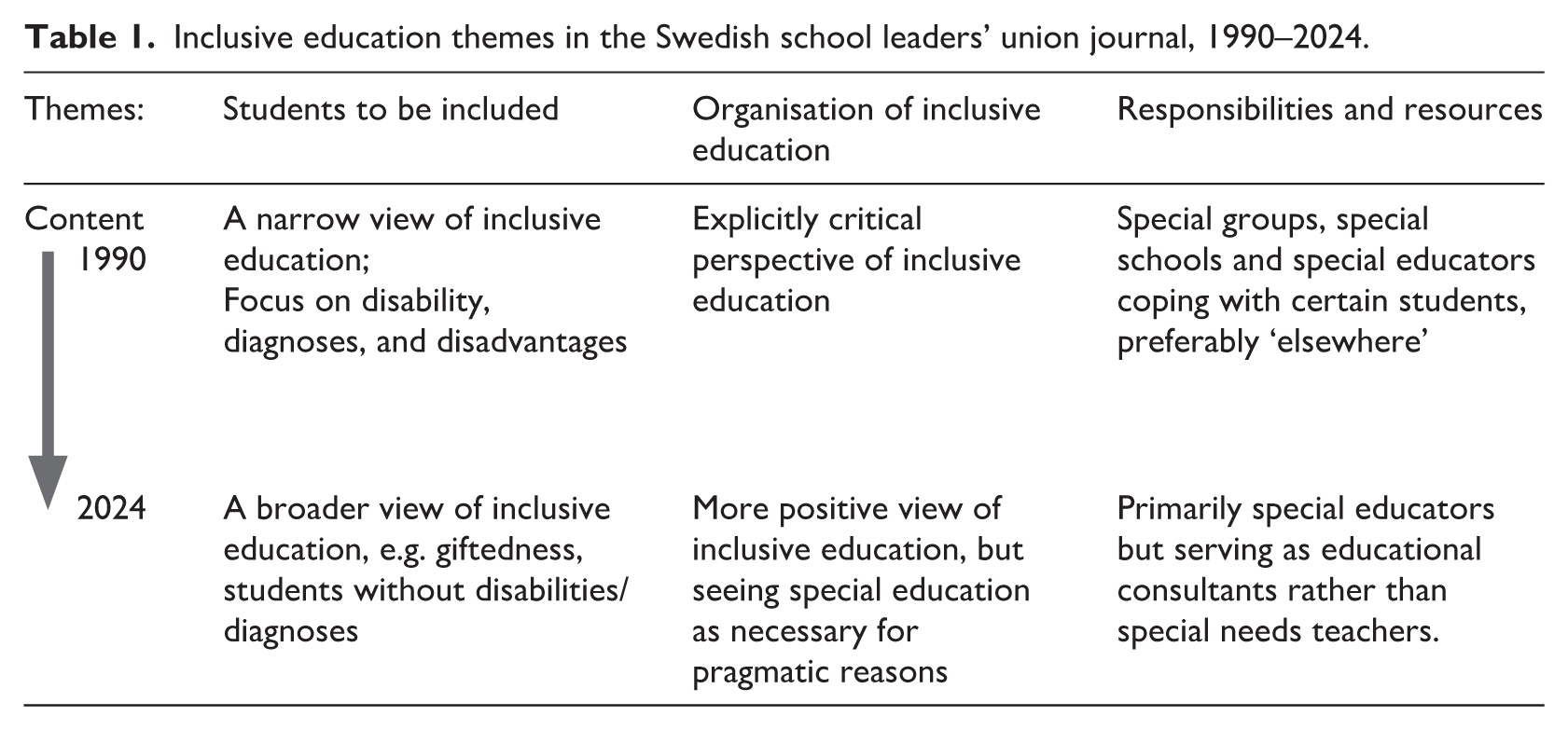
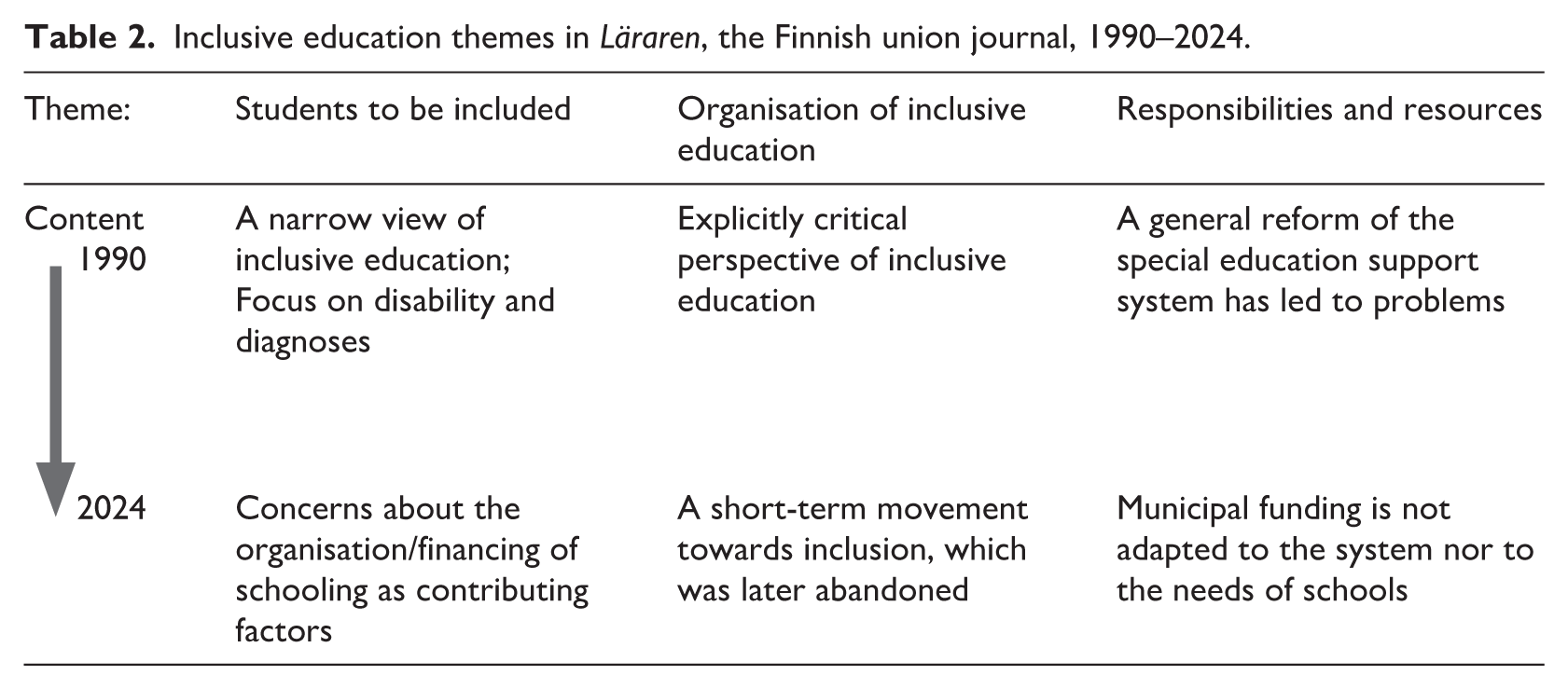
The material employed was collected during an extensive period of library and archive work during autumn 2023 and spring 2024. The Finnish material is stored in the archives of the Swedish Cultural Foundation in Helsinki; the Swedish material can be found in the National Library of Sweden, in Stockholm. Neither of the two journals were digitised and therefore read manually. Even though we started our work based on theoretically formulated assumptions based on the organisation of inclusive education, our categorisation is built on the steps of inductive thematic analyses. This means the categories presented in this article have evolved from our data analyses and have not been previously formulated. Journal examples of principals’ work with inclusion and inclusive education were used as the overarching topics for selection of the articles. The collection of data resulted in the identification of 255 (n = 255) articles from 310 volumes of Skolledaren and 434 articles (n = 434) from 822 volumes of Läraren. The material was analysed using the model of thematic analysis described by Braun and Clarke (2006). This process started with a thorough reading of all of the identified articles with the objective of becoming familiar with the material and understanding its primary players and issues. In the next step, the coding of the selected articles resulted in 10 different codes connected to the overarching theme of principals’ work with inclusion and inclusive education. The codes identified were, for example, special education, special education categories, inclusive education facilitators and inclusive education barriers. The codes were then put together in the next step, where they were reviewed and combined into three themes for each country. These themes are summarised in Tables 1 and 2.
Inclusive education themes in the Swedish school leaders’ union journal, 1990–2024.
Inclusive education themes in Läraren, the Finnish union journal, 1990–2024.
The quantity of journals consulted to identify the articles included in this study is assumed to cover a majority of the output relating to inclusion and inclusive practices published by these two journals. Alongside the quantity of the material, its quality is also considered to be both a reliable and accurate. Both Sweden and Finland have high publication and journalism standards. A significant limitation of the selected empirical material, however, is the fact that FSL and its journal Läraren represent only teachers and principals in Finland who are part of the Finnish Swedish-speaking minority. That said, the FSL is an independent part of the Finland-wide education union, the Professional Association of Teachers (Opetusalan Ammattijärjestö, OAJ), with representatives in both the council and the board of OAJ. It therefore feels safe to assume that the FSL also represents the viewpoints of the OAJ regarding questions not pertaining to specific Swedish-speaking school matters in Finland. It is also important to have in mind that the union journals act as interest organisations for the principals organised in the unions. This in turn means that the unions selected topics and issues reflect the collective in specific contexts at different times. This does not mean that the unions are not influential in the policy making process taking place in different settings. Wikman (2008) states that what is reported in the union press is more likely to be more comprehensive than in the daily press. What the journal covers are therefore topics relevant and influential at particular times.
Results
The coded material from the Swedish and Finnish journals can be grouped together into three themes. The first theme regards the students who were to be the object of inclusive education. The second theme regards the practical organisation of inclusion, and the third theme the responsibility for the operationalisation of inclusive education and the resources it would require. Despite this thematic coherence, depending on country and time period, the articles reflected nuances and differences. For example, between 1990 and 2024 the terminology of inclusion changed. The popularity of the term ‘integration’ in the 1990s soon gave way in the 2000s to the term ‘inclusion’. There has been a broader discussion of such terminological shifts in special education theory (see, e.g. Tøssebro, 2004). However, in the context of these education union journals, they mean the same thing. According to the journals, integration (or inclusion) is the physical placement of students with particular functional variances, which can also be for ethnic reasons, in general education classes. This definition also expresses the approach to the operationalisation of inclusive education used in both journals. Due to the broad meaning of inclusion (or integration), both theoretical and practical, our analysis uses the word ‘inclusive’ but leaves the original formulation in the empirical material unchanged.
Swedish principals and inclusive education
Students to be included
In the early 1990s, most articles in the Swedish journal that are of relevance for the topic of inclusion discussed special (segregated) solutions for different pupil categories. At the time, pupils with neurological disabilities were referred to as having ‘MBD injuries’ (Minimal Brain Dysfunction), for example, that a number of schools were to be started for students with MBD injuries in the south of Sweden. One article in the early 1990s describing MBD stated that, MBD, minimal brain dysfunction, leads to functional disorders in the central nervous system, leading to motor difficulties and a lack of concentration and, thus, difficulties in assimilating knowledge. The cause may be a birth injury, but this is not completely clear. (Skolledaren, 1992(11), p. 12)
This is a clear example of an overarching differentiation around a concept of specific disability as a generalisable principle. Another example of such reasoning from the early 1990s is the presentation of a project focusing on dyslexia. In this case, a report in Skolledaren shows that funding had been obtained to facilitate the construction of regional municipal competence centres for pedagogy to support reading and writing disabilities. Each municipality is putting together its own dyslexia group and seeking its own model to work according to the Swedish National Agency for Education’s requirements. (Skolledaren, 1994(2), p. 8)
A similar method of differentiation by separating student groups was used to describe the relocation of ‘disorderly pupils’. In 1998, an article in the journal outlined the approach being taken with students for whom the regular school system was not designed to cope.
Some of the young people who cannot cope with regular schools come . . . to Villa Ljungbacken. [. . .] They are young people with school, family or behavioural problems who are placed there with the support of the Social Services Act or LVU, the Act for the Care of Young People. (Skolledaren, 1998(7–8), p. 10)
Articles from the 1990s also discussed, in typically derogatory and racist terms, a planned implementation of a special school for children with Roma backgrounds. The common theme running through these articles is that regular schools are not equipped to handle specific pupil groups, most commonly those who have been identified as disadvantaged in some way.
In the 2000s, reports regarding inclusive education shifted focus to include not only disadvantaged students, but also students with disabilities. Discussions also took place regarding the need for special classes for gifted children.
Special classes for gifted problem children. Such exist in France. There, the experience has been that children with high intelligence often suffer from school difficulties. (Skolledaren, 2005(4), p. 22)
The categorisation of students according to disability or learning difficulty, but also giftedness and even ethnicity, is, according to this union journal, a meaningful way to differentiate education. This perspective remains more or less stable throughout the entire period. The resilience of this perspective is even more interesting because articles in Skolledaren demonstrate an awareness of the problematising of this purely categorical response to inclusive education. At one point in the 2000s, the journal discusses a report from the School Inspectorate which argues that, to a certain extent, the selection of students for special education support is largely arbitrary. In half of the schools audited by the Inspectorate, students received adapted teaching outside the classroom once or more often every week, either alone or in groups with special teachers. As the article points out, according to the Education Act, having an official diagnosis is not supposed to influence the provision of support; students without diagnoses are also entitled to educational support. In an article from 2016, however, the journal’s attitude is very telling: Student diagnoses are important for support at school. That’s what every second principal is saying in the Swedish National Agency for Education’s new report on support for students with a disability. Even though the School Act or other regulations do not require it. (Skolledaren, 2016(8), p. 6)
Organisation of inclusive education
The organisation of special education is to a large extent related to the notion of organisational and professional expertise. Simply said, inclusive education is to be organised by special education. From Skolledaren’s perspective, both approaches are probably the same thing. Approval of special education’s control of inclusion is evident in the journal throughout the entire period. The arguments became more explicit with the release of a government report in 2005. A committee had been set up to investigate the requirements of special schools for pupils with intellectual disabilities, with the idea of potentially liquidating this school form (cf. Bergfjord et al., 2024). In Skolledaren, an article is very critical of any moves towards liquidation, arguing that segregation is in the students’ best interests.
It must never become a goal in itself to integrate [. . .]. Today, special education students are actually, locally, operationally, group, and individually integrated. For some young people, this works well. But we have also seen examples of how individuals have been diminished and scarred for life! (Skolledaren, 2005(3), p. 2)
Adjusting general teaching to special education needs in regular schools does not, in fact, lead to increased inclusion of all students’ differences. As the journal points out in 2009, this approach in fact can lead to exclusion, where: the result has rather been standardization in the form of more work on one’s own without direct teacher support. Individualization, in this sense, negatively affects students’ results and makes support from home more crucial. (Skolledaren, 2009(12), p. 16)
A negative attitude towards placing students in regular classes is a perspective which is regularly articulated throughout this period of the Swedish journal’s publication. That said, the arguments do change. Later in the 2000s, for example, the opinion is presented that while special schools may not be the best way to move forward, they are still needed in the municipalities. Inclusive education is not the problem, the educational ‘reality’ is.
Sweden’s School Leaders’ Association decision to say yes to the proposal that certain elementary schools in a municipality will be given the opportunity to set up resource schools where students with special support needs can attend. The goal should, however, be that all students are educated in mixed groups to the greatest extent possible. As the Association also writes in its response to the consultation. (Skolledaren, 2020(5), p. 5)
Responsibilities and resources
In the early 1990s, Skolledaren devotes considerable space to reports regarding disabled children and inclusive education. It reports that a government agency, the Swedish Institute for Disability Issues in Schools (SIH), is concerned that disabled people will be disadvantaged by decentralisation, state subsidies, municipal finances, school fees and independent schools. Poorer support is likely to be offered, for example, to children with visual impairments.
It is becoming more and more difficult to be able to give visually impaired children and young people support in preschool and school, according to the board of Tomtebodaskolan, now known as a resource centre for visually impaired children and young people. [. . .] If ‘powerful measures’ are not put in place, the integration of these children into the schools of their hometown is now at risk, the board says. (Skolledaren, 1990(5-6), p. 15)
Skolledaren goes on to report that regional resource and competence centres have been started for several types of educational difficulties that need to be handled within the framework of school operations: The National Education Agency is giving the municipalities of Gothenburg, Karlstad and Umeå, 1 million SEK each for special education centres. With this money, the municipalities undertake, among other things, to run a special educational centre for students with dyslexia, MBD/DAMP and similar learning disabilities for at least three years. (Skolledaren, 1994(4), p. 6)
This illustrates that the discussion of special educational support and the potential for inclusive education is tied to the issue of economic incentives and the funding of the educational system. For instance, the principals’ decisions are influenced by the fact that it will be cheaper for an individual school to refer a student in need of special support to a joint municipal support unit rather than arranging on-site support at the school. The economic nature of these discussions also relates to the question of who should be involved in special education: special educators generally command a higher salary and work with smaller student groups. In a survey carried out by the journal in 2014 with different school professions, reports show how opinions differ on what support should look like, who should do what and how.
Eighty to 90 percent of the class teachers and subject teachers believed that the special education teacher should work with the individual child or children in a group outside the regular class. [. . .] Primarily the special educators themselves, but to some extent also the principals, believed that the special education teacher should support the other teachers and work on developing the school’s organization. (Skolledaren, 2014(7), p. 14).
In the same article, it also reported that clearer guidance on the differences between regular educational support and special support could lead to a reduction in the number of individual student education plans in general education. Principals are described as very important for ensuring that students receive the right support. According to the survey, 85% of school leaders believe that special support worked well for the most part. This perspective is particularly interesting because principals are legally accountable for the provision of support.
Finland
Students to be included
As in Sweden, the ‘students with Minimal Brain Dysfunction’ (MBD), or what is today called neuropsychiatric disabilities, who are expected to be the subject of special education in the Finnish education union journal of the early 1990s.
But when we talk about MBD, it’s important to remember that we’re talking about a group term. Children who have mild brain damage are very different, depending entirely on where the damage is in the brain and how extensive the damage is. (Läraren, 1990(28), p. 5)
In the early 1990s several articles express concerns about diagnostics, suggesting that schools need help from external professionals, such as psychiatrists, psychologists and counsellors. New findings about neurodevelopmental disorders are also brought to light. Dealing with these is believed to require early preventive efforts. Teachers must have sufficient knowledge to be able to handle children and adolescents of all types.
Pupils with special problems are too often integrated into regular classes, but the schools are not given additional resources to cope with the integration. [. . .] It seems as if the reason for integration in the normal class was primarily financial gain, not pedagogical development. The number of problem students also seems to be increasing in the school. General concerns and unruly students are a frequent topic of discussion. (Läraren, 1998(8), p. 3)
This can be seen as an expression of the opinion that the educational provision for these students requires expertise, and that inclusion is closely linked to the supply of economic resources. Despite these concerns, the use of special educational measures seems to be common in the early years of the Finnish journal. In 1998, according to reports, the number of students transferred to special education has increased dramatically while their education is less often conducted in segregated environments. It is also reported that parents of students in need of support frequently campaign for special schools, but that the ‘ideal of inclusion’ stipulates otherwise and special schools may be forced to close.
These special schools are perceived as expensive, but the costs today are pure savings in the future. [. . .] Today, it is considered natural to help and support children with all other forms of disability except the socio-emotionally disabled. (Läraren, 1998(7), p. 9)
The journal also reports that special education measures are decreasing even though the students with special needs keep increasing. For children with learning difficulties, articles advocate increased special education provision; it also, makes the point that agencies involved in supporting youths with other impairments and behavioural problems equally desire this education to be handled in special schools: In parallel with these integration efforts, many disability organizations in the Nordic countries have also actively fought for their own schools and their own culture. At present, this applies, for example, to the hearing impaired and young people with behavioural disorders. (Läraren, 1990(23), p. 6)
At this time Läraren reports concerns among child neurologists that increasing class sizes will lead to increased learning difficulties among students. Reporting about child mental illness and also the increasing prescription of medicine for children with neurodevelopmental disorders also became more prominent. Schools being adapted for students with autism and ADHD are reported favourably, and as benefitting all of the students in these schools. In the late 2000s, however, the journal reminds its readers that there are high-achieving students who must not be forgotten in the school’s work with inclusive education.
Don’t forget the high achieving students! Finland should invest in both excellence and equality. Then it will once again reach top results and regain its position as a model for other countries. (Läraren, 2018(14), p. 5)
Organisation of inclusive education
The debate on inclusive and special education in Finland is, unlike the Swedish debate, more focused on the organisational features and prerequisites required for inclusion in the school system. In the early 1990s Läraren published a large number of articles about special education. As in Sweden, the debate here is whether or not to emphasise inclusive education or to adopt a special approach through clinics and classes. The journal believes that inclusive education will not be possible with larger classes and that, as a policy, it will not always serve the students who need it in the best possible way. The proposal to adopt inclusion was called the Rasila model. The editorial in Läraren believes in this policy . . .hits hard against integrated special education and favours class-based education. [. . .] A working model must address the real need for special education and not a technocratic view of how special education should be managed. (Läraren, 1990(14), p. 2)
As we showed above, inclusion is mostly discussed in the context of educating disabled students. In the late 1990s, there are discussions in the journal about transferring the basic teaching of students with severe disabilities to the general education system. Some articles suggest that the needs created by this inclusive approach will only be possible by implementing smaller classes and recruiting more teaching assistants. Another article suggests that inclusion is only possible if competence and resource centres are set up to deal with less common disabilities, an approach considered in other Nordic countries.
In the 2000s the resistance towards inclusive education in reports weakens. It reports that the Finnish Ministry of Education is proposing that support for regular education and investment in adapted education should increase and that fewer students should receive special education. A bill on an amendment to the Education Act, the so-called three-tier model, is presented.
Initially, these suggestions are not greeted critically. As reported in the mid-2000s, Earlier this summer, the Ministry of Education announced measures to reduce the number of students receiving special education. In particular, they want to reduce the number of students transferred to special education. (Läraren, 2008(16), p. 2) The bill talks about preventive and early support, early identification of support needs and appropriate support and the development of forms of support for individual students as follows: general support, intensified support and special support. (Läraren, 2010(14), p. 2)
This more positive attitude towards inclusive education is short-lived. Soon arguments against inclusive education are presented again. By 2021 the union journal is reporting that the parliament’s cultural committee believes that special schools are going to be needed in the future. This was proposed following a new approach to special education to strengthen the students’ right to systematic education support. The negative view of the union is this aligning itself with the government’s growing scepticism. The increasing problems associated with inclusion and the declining results seen in schools are reported in Läraren as leading to a new reform of the three-tier model. Bringing the model to an end with her comments after the publication of the PISA results in 2021, the Minister of Education Li Andersson said, The number one priority for the next election period is to reform the three-stage support model. My idea is to introduce a new model for what support should look like and how it should be financed so that all students’ right to support is fulfilled. (Läraren, 2021(17), p. 6)
Responsibilities and resources
Over the course of these 25 years, the Finnish school leaders’ union has a clear opinion. Its overall perspective is that small classes with a large proportion of special education teachers is the recipe for successful education, not just for students in general education, even for those in need of additional support. This approach includes early evaluation and interventions, and support in normal education which were seen as preferable to special classes and special schools by the union journals.
The integration of disabled students has progressed strongly in recent years. The school for the visually impaired works here on two levels, as it is a special school that also serves integrated students. (Läraren, 2000(8), p. 3)
A number of interesting arguments are put forward against inclusive education. One article in the journal debates whether or not segregation of students is always ‘bad’. It puts forward the danger of normalisation pressure. Another article highlights parental resistance to far-reaching inclusion. In yet another article it is suggested that inclusive education is more common in Swedish-speaking Finnish schools, while special classes are more common in Finnish language schools.
The statistics show that 30 percent of those who have been transferred to special education [in Swedish-language schools] are fully integrated in general classes, 38 percent are partially integrated, and 32 percent are in special classes. In Finnish education, special classes are much more common: as many as 60 percent of students attend special classes. (Läraren, 2005(17), p. 3)
Soon after its implementation, however, the three-tiered model of special education becomes one of the union’s prominent enemies. Läraren quickly begins reporting that the (new) support system has led to increased administration and workload for teachers. It also reports that the support is ineffective and that it leads to increased stress and uncertainty for students. Research is also cited as demonstrating that students do not get the support they need because schools are unable to provide it. According to the journal, the authorities in Finland believe that intensified support (in the form of the three-tier model) has led to fewer students receiving special support. However, resources are not provided for this by the municipalities.
The law is clearly a good reform for students – especially for students with special needs. But now we are seeing that the distribution of resources in the municipalities does not follow the requirements set by the law. (Läraren, 2013(7), p. 2)
The need to manage this new system, the journal argues in its articles, keeps principals occupied with tasks that distract them from their primary role and duties.
For a school to function, strong pedagogical leadership is required. This is also a guarantee for the well-being and energy of teachers and students. Unfortunately, pedagogical leadership is in a bind because principals rarely have enough time for that part. [.. ] A principal cannot change how the municipality provides resources to schools. (Läraren, 2020(2), p. 3)
Läraren elsewhere addresses the issue of access to special teachers. In an article discussing a proposal to the Ministry of Education and Culture from Åbo Akademi about the need to educate more special teachers it is written: It is a question of justice. All children in all parts of Finland, including Swedish-speaking Finland, have an equal right to meet competent and knowledgeable teachers. Right now, that is not the case. (Läraren, 2019(19), p. 4).
Conclusion and discussion
As policy actors, principals are responsible for ensuring the implementation and interpretation of, among other things, inclusive policies (Hall et al., 2024). One of the biggest influences on inclusive practices, also evident in the union journals, is the attitude school leaders take towards inclusive education. Principals, in other words, are highly influential in how inclusive education is implemented and carried out (DeMatthews et al., 2020; Gallagher et al., 2025; Skutil and Strouhal, 2024).
However, the picture emerging from the union publications, according to our findings, expresses explicit scepticism towards policies of inclusive education. When addressing the issue of inclusive education, the union journals primarily discuss special education. Unfortunately, this is a realistic reflection of both the Swedish and Finnish school systems. In both countries, education legislation is framed around educational support to the individual child rather than formulating an explicit and systemic perspective to operationalise inclusive education. The result is that increased special educational support risks leading to incremental exclusion (e.g. Barow and Magnússon, 2024). Educational structures in place in both countries demonstrate a similar individual approach. Although not a requirement or explicitly stated in legislation or policy, official diagnoses carry considerable weight for education professionals in the assessment and provision of support. This is particularly visible in the number of reports regarding neurodevelopmental disorders in the countries’ journals.
Following our theory (Skrtic, 1990), the journals emphasise the principals’ need to follow the principle of standardisation and work within the existing machine bureaucratic structures. This means they are expected to maintain special educational practices as a standard element of the general educational system. Consequently, principals have a complementary relationship with schools’ special education professionals. Together with special educators, principals maintain the inner structure of professional bureaucracy. This is a consistent attitude reflected across both union journals during the research period. Special educators also has a long professional history and today garners significant status in comparison to other educational professions (Wermke et al., 2024a).
The most surprising result of our comparative study is the overwhelming similarity of the attitudes in both Nordic contexts. When encountering inclusive education both Finnish and Swedish principals trigger their education unions united and public resistance, an ideological position which more or less remains in place for over 20 years. This contrasts with the political winds favouring inclusive education, at least until the 2010s (Wermke et al., 2024b).
We argue that when unions do not advocate a particular policy (in our case, concerning inclusive education), that reluctance or ambivalence is certainly reflected in national laws and regulations. The current alignment in matters of inclusive education between the opinions of education unions and the legal structures regulating the educational system is the reality in both of our Nordic cases. For instance, Paju et al. (2016) show that, in Finland, working with students with special educational needs is the exclusive task of special teachers, while Sansour and Bernhard (2018) conclude that the separation of children with special educational needs into exclusive settings still forms part of what in Sweden is defined as inclusive education. In the words of Hjörne (2004), the systems are ‘excluding for inclusion’.
As stated earlier, one can argue that Skrtic (1990) theory is outdated or even obsolete. But in the light of our results, we consider it still useful and relevant today. The school systems in Sweden and Finland still operate in the same manner as they did in the 1990s. This although there have been significant changes in both countries through the years. Governments largely control the outer machine bureaucracy through legislation and curriculum. While municipal politicians and officials execute the governing.
Our results indicate that the union journals advocate for specialised solutions, including special schools and targeted education interventions. This, although they are in favour of inclusive education. In the light of Skrtic (1990), this is an example of the loosely coupled system between the machine bureaucracy and the professional bureaucracy. The principals are obliged to conform and adapt to the concept of inclusive education. However, to achieve this, they still collaborate with professions other than regular teachers in regular classrooms. The interpretation of inclusive education, as seen in the journals, is equal to the use of the special education professions. On the other hand, changes to the systems seem to have influenced the rhetorics, curricula, and policies regarding the school system. Ratifying the UN Convention on the Rights of People with disabilities, CRPD (2006) has obliged the governments to work for inclusive education. While the union journals of the same time and onwards recognise the need for more specialised education practices.
This also points to the way Skrtic (1990) describes the outer governing systems and the inner practices of schools. The systems are decoupled from one another. Inner structures govern themselves, and the decisions made are largely up to the professions themselves. Principals use special education professionals to deal with issues of inclusive education and are backed by the unions, as expressed in the journals. Still working in favour of special education practices while promoting a view of inclusive education as an ideal.
Skrtic (1990) offers an explanation as to why there are similarities between schools in different contexts and even between countries. Thereby also the similarities between principals’ decision-making and organisation regarding inclusive education. We thereby assume that the theoretical foundation by Skrtic (1990) is still highly relevant when looking at the principals’ work with inclusive education.
Finally, what is the added value of our comparison? In the words of Erickson (1986), this search is not for abstract universals arrived at by statistical generalisation from a sample to a population but for concrete universals, arrived at by studying specific cases in great detail. The assumption is that when we see a particular instance of a certain leadership practice, some aspects of what occurs are seen as generic, that is, they apply cross-culturally.
The concrete universals of Nordic principals’ collective perspective, visible in our study, are the following. Today, inclusive education is in retreat in both Sweden and Finland (Barow and Magnússon, 2024), and school leader unions are not optimistic about these recent developments. When inclusive education is discussed, it is often hedged about with specific concerns, in particular (1) the student should be the focus, (2) the organisational form of inclusive education is crucial, and (3) responsibilities and resources must be clearly articulated.
(1) In both Finland and Sweden, the discussion of the category of students intended for special educational measures and the debate on inclusive education is marked by a perceived necessity to define and demarcate the students with preconceived categorisations along the lines of disability and diagnoses and, in the Swedish case, also of disadvantage in general. This approach can be understood with the help of our theoretical framework. First, the rationalisation and formalisation of the school’s bureaucratic structure places boundaries around prespecified sets of activities and outcomes. Professionalisation and formalisation draw on a finite number of standard programmes to meet a finite set of expected client needs. This means that those students with needs that fall on the edge or outside of the standard programmes must be either pushed into or squeezed out of the classroom (Skrtic, 1991). Organisational responses to anomalies, such as student failure (Hopmann, 2008), put the responsibility for what is actually a system failure on to society, parents or the students. Putting the argument of Wright Mills (1956) the other way around, social issues become personal troubles. This is accomplished by designating students with social categories such as ‘gifted’, ‘disadvantaged’, or ‘disabled’. In order to simplify the everyday work of the ‘regular’ school, these categorisations are used to differentiate the educational work needing done and the exclusion of different students to other educational services (e.g. special education). Special education services are thus decoupled from the regular school’s operations; they are added on or removed gradually as social values change over time (Skrtic, 1990). We see such patterns in our materials in both countries, advocated by their respective education unions.
(2) The generally pessimistic attitude of principals towards inclusive education leads to the call for a varying degree of advanced institutional responses, in the form of organisational features and solutions, to special education. Because education is itself an organised social institution, it inevitably follows institutionalised logics. Students’ need for extra educational support can therefore be read as a matter of not fitting the standard programme of the prevailing paradigm of a professional culture. In other words, extra support is an organisational pathology, a problem which the educational organisation handles by treating this school failure as a human pathology (Skrtic, 1991). Special education is a response to this ‘personal trouble’. Culturally, special education obscures the anomaly of school failure and thus preserves the prevailing paradigm of school organisation (Skrtic, 1991). The standard approaches to teaching are passed on from teacher to teacher in an institutionalised environment. These standard programmes are simply artefacts of a professional subculture.
The success of a school reform effort depends on human agency, on the values, commitments, expectations and actions of the people who are working towards it (Skrtic, 1990). In both Finland and Sweden, we can see how the pre-existing organisational forms of special education are viewed as a standard point of reference in the debates on inclusive education. In other words, previous categories of student disability are used to make sense of new societal demands on schools to accommodate student diversity. However, while articles in Skolledaren discuss these issues in relation to political proposals and in terms of an ideological critique, the articles in Läraren relate the new demands to a much higher degree to the fiscal prerequisites for inclusion and the consequences of austerity politics for regular schooling. While the Swedish examples may express doubt about whether or not it is the best policy for the pupils in question, the Finnish examples are more concerned about the organisational consequences of inclusion for regular schools.
(3) The responsibility for inclusive education and the resources it requires is a final theme within the education union journals. To some extent, educational professions set their standards and operate with few restraints in their everyday work. In return, they are expected to serve the public good and to exert higher standards of discipline and behaviour than other groups (Abbott, 1988). In order to train specialised experts, public education needs to become more bureaucratised and greater control of the professional bureaucracy’s standard problem solutions emerge in the process. That is why education professionals like principals need to adjust the problems they meet to fit the solutions they have access to. Solutions that actually are controlled from outside (Wermke and Salokangas, 2021). The bureaucratic structure of the school organisation, with its specialised professions, may not be able to fulfil the social goals of an equitable school providing a high-quality education for all. There is, though, an unreflective acceptance of the assumptions that underlie our social practices, for example, special education, as a way to manage students who do not fit mainstream education (Skrtic, 1991). The education union journal arguments presented here, therefore, express the respective zeitgeist concerning inclusive education.
This study has provided one explanation as to why the development of an inclusive school is so slow and why, at times, it feels like an impossible endeavour. The opinions expressed in school leader journals, representing the voices of critical gatekeepers for successful inclusive education, appear to be that there must be exclusive practices for the school to fulfil its mission of inclusion. This is certainly a fruitful ground for further research.
Footnotes
Acknowledgements
The authors would like to thank the people of the EduKnow research group at Tampere University for providing feed-back on the early drafts of this article.
Declaration of conflicting interests
The authors declared no potential conflicts of interest with respect to the research, authorship, and/or publication of this article.
Funding
The authors disclosed receipt of the following financial support for the research, authorship, and/or publication of this article: This paper is supported by the Swedish Research Council [grant number 2022-03017].
