




Abstract
Adolescent identity formation is significantly shaped by social and institutional spaces, with schools playing a central role. This paper examines the identity formation of students in two minority schools in the German-Danish border region. Based on an ethnographic case study, 15 qualitative interviews and five group discussions were conducted with students, teachers and parents, alongside observations in Danish schools in Germany and German schools in Denmark. The analysis reveals that identification with a minority occurs on different levels: through family traditions, emotional belonging, and the perception of minority schools as an educational resource. While the German minority in Denmark tends to base its identity on cultural and familial ties, many members of the Danish minority in Germany view minority schools primarily as a means of educational and social mobility. Moreover, minority schools provide adolescents with a protected space where they can develop a bicultural identity without having to choose between national affiliations. These findings highlight the significance of minority schools as sites of identity formation and raise the question of whether such models could be applied to other minority groups and educational contexts.
Introduction
Identity formation in adolescence is closely tied to social and institutional spaces. Alongside families and peers, schools are among the most important environments where young people spend their lives, learn and develop their personalities (Freire et al., 2009; Verhoeven et al., 2019). Schools are typically state and public institutions with specific social functions (e.g. Berg, 2007; Fend, 2008). In Europe, these institutions have historically evolved in close relation to the respective nation-state, and today, schools and nation-states are still closely intertwined. However, there are inherent contradictions in how schools simultaneously socialise and discriminate against students (Bradbury, 2014; Castro Varela, 2022; Doğmuş and Geier, 2024; Taylor and Clark, 2009; Vehse and Wischmann, 2024).
Fend argues that schools have a formal socialisation task, integrating all pupils into society or enabling them to participate in it. This task at least implicitly assumes a homogeneous concept of society as a nation, whose (democratic) values and norms are (supposed to be) reproduced and internalised through schooling (Doğmuş and Geier, 2024: 135). Similarly, Castro Varela (2022) highlights that schools, as mass educational institutions in modern states, are assigned to this role. Yet, the society equated with the nation is an imagined community that presupposes the ideal of a homogeneous population, which does not correspond to reality, but nevertheless attempts to create and maintain the ideal (Moffitt and Juang, 2019).
Discourses of national belonging as well as their reproduction in and through the education system and schools vary according to national contexts (Healy and Richardson, 2017; Wiberg, 2024; Wieser, 2023). This creates a specific form of desired belonging to which students, parents and teachers are expected to conform. If institutions are assumed to have a stabilising function, reproducing social order through routine, it is necessary to ask how schools maintain a social order that produces inclusions and exclusions and shapes patterns of perception. Research has shown that this can be accompanied by mechanisms of institutional discrimination (Bradbury, 2014; Gomolla, 2006; Taylor and Clark, 2009). The setting of language norms can also be understood as the processing of belonging (Cho, 2017; Rühlmann and McMonagle, 2019).
In this context, school also functions as a space for identity formation (Ghazali, 2012; Oliver and Exell, 2020). When it comes to minority schools, we encounter a specific constellation of these spaces (Nguyen, 2022; Skutnabb-Kangas, 1989). This paper analyses minority schools as particular educational and social spaces within the European education area. One of the members of a minority-school board we interviewed stated the following: [To teach and learn in a Danish-German minority school] means that we privide pupils also identity, minority identity, and the opportunity to formalise it in a school-degree. (. . .) Hence, I have two A-levels, one German and one Danish. This is a very good career opportunity. That, I think, is the most important task we have, to teach the students well to be prepared to use their opportunities, and that’s what we do.
This quote sketches the perspective of many in the minority school system in the Danish-German border region. It states a correlation between schooling and identity-formation. But what exactly is meant by identity in this context? To explore minority schools and their relevance for identity formation as institutions ‘in between’, we conducted two comparative ethnographic case studies (Bartlett and Vavrus, 2017), one in Denmark and the other in Germany. Case studies are not bound to a specific set of methods but can employ a variety of research tools depending on the particular case. We used a range of qualitative, ethnographic approaches (Mills and Morton, 2013), including semi-structured narrative interviews, analysis of policy documents and websites and observations of classes and meetings, to gain ‘insider perspectives’.
An inductive approach was used to draw the boundaries of each case study, with teams engaging in a process of progressive focussing (Chadderton and Torrance, 2011). Both cases involved secondary schools defining themselves as Danish or German minority schools. A team of six researchers and two assistants visited the schools for 2 weeks (for each case), working in smaller groups to observe subject lessons, leisure activities and extra-curricular events and to conduct interviews. In total 20 interviews were conducted with headmasters, teachers, students and parents, supplemented by several hours of observation logs and memos.
In this paper we will focus primarily on the interviews with students and teachers, as we are interested in the internal spaces of the schools. The memos and logs serve to complement the perspectives presented.
Schools as spaces for (adolescent) identity formation and national institutions
Adolescence is a crucial phase in life, during which young people develop a specific identity (Côté, 2009; Crocetti, 2017; Klimstra et al., 2010). It plays an important role in the face of complex and rapidly changing demands worldwide. At the same time, this phase is deeply embedded in social and cultural structures, such as the organisation of the education system and access to participation, as well as constructions of gender differences (Bagnall, 2015). Within these contexts, young people must find ways to address both individual and societal challenges that are crucial to gain future ability to act (Geipel et al., 2025). This statement is simultaneously normative – in the sense that young people use it to articulate how things should be – and analytical – because it describes how they actually experience and make sense of their identity. In other words, the young people not only adopt this perspective as a value-laden stance but also reproduce it as part of their everyday reflections, thereby blurring the line between lived experience and analytical categorisation.
Although circumstances differ globally and may not seem comparable at first glance, dealing with diversity, heteronomy and social disparities is a worldwide concern. It is important to examine both global and local mechanisms to support young people who are at risk of social exclusion. Thus, first, adolescence should be understood as a global phenomenon, specifical shaped by increasing mobility, and second, cultural differences not only impact adolescence but also fundamentally structure it as part of young people’s everyday lives (Koller et al., 2010).
Identity formation is a crucial developmental task in adolescence (e.g. Durkheim, 2009; Erikson, 1994). However, there are different approaches and definitions of identity. We understand identity as a relational and dynamic concept (Kaplan and Garner, 2017), which enables individuals to understand and present themselves as particular personalities and to identify with relevant contexts, groups institutions and settings.
Jürgen Straub developed a concept of identity that does not conceive of the subject as identical with itself but rather as engaged in a permanent confrontation with the other (Straub, 2006). Nevertheless, there is something that allows the subject to say ‘I’ – something that encompasses continuity, coherence but also contingency, and which must be constantly redesigned. Straub, drawing on Ricœur’s narrative theory, argues that narrative has a constitutive function in this context; for example, continuity is ‘formed’ through narrative (Straub, 2006: 23). The identity of the subject would thus be the answer to questions such as ‘Who am I? Where do I come from? Who do I want to be?’ Such questions must always be understood within a temporal context and are not always answered in the same way – yet nevertheless allow the subject to recognise itself as an ‘I’. According to King (2013: 85), ‘Identity in this sense refers to the competence to repeatedly achieve forms of coherence, continuity and consistency in a dynamic field of conflict between the self and internal and external objects’.
The concept of the subject itself is anything but unambiguous. Following King (2013), the psychosocial space of possibility thus contains the potential for the emergence of something new – that is, new fundamental figures of the relationship to the world and the self. Yet it also entails a considerable element of risk.
This highlights why it is useful to retain the concept of identity, as it addresses how individuals position and shape themselves as described above. The focus here is on processes of separation and demarcation during adolescence. These processes always require an authority, as an intergenerational other from which the adolescent can distance themselves. They also imply the possibility of a new anchoring in terms of continuity, coherence and contingency. According to King, if these possibilities are unavailable or inaccessible, the consequences for the adolescent can be ‘catastrophic’ (King, 2013: 42). This concept of adolescence is itself a social euro-centrist construction and has a normative effect and at the same time describes this normativity.
These individual aspects of identity formation are not only related to social conditions but also to particular collective identities, whether regional, cultural, national or religious. According to van Stekelenburg (2013: 220), ‘Collective identity at the collective group level concerns the shared definition of a group that derives from members’ common interests, experiences, and solidarity’. Taylor and Whittier (1992) differentiate between collective and social identities: An individual has several social identities (e.g. as a sportsperson or family member) that are part of their overall identity. In contrast, collective identity is more concrete and explicit, relating to a particular group a person identifies with. The ‘individual’s identification with a group can be studied in its own right as well as by examining the individual’s beliefs, sentiments, commitment to the group, use of symbols, participation in rituals, and so on’ (van Stekelenburg, 2013: 219).
The German minority in Denmark and the Danish minority in Germany can be understood as groups with which young people – in this case, those attending minority schools – identify. These minorities identify with particular narratives woven through the complex history of the Danish-German border region over the past centuries (Kühl, 2022). To belong to one of these minorities requires a degree of commitment. This is formalised through registration at a minority school or institution. Schools thus play a crucial role, not only regulating membership but also formally reproducing the minority beyond informal belonging gained through birth, marriage or simple feelings of belonging.
School in general promote a particular school culture (e.g. Erentaitė et al., 2018; Hargreaves, 1995; Helsper, 2000) to which students must relate. This institutional and organisational culture is tied to national and cultural identities. In the case of minority schools, the reference to the minority is explicit – yet it manifests in different ways. Language plays a central role, but so too do rituals and festivities and the ways in which they are practiced.
As stated above, identity – both individual and collective – is not static. It retains a degree of coherence but is dynamic. Given the performed differences between minorities and majorities in the border region and the school systems, it is helpful to draw on the work of Bhabha, 2015; Easthope, 1998) regarding hybridity and identity. Bhabha argues that identities are not only diverse but also fluid and necessarily hybrid. There can be no mono-identification with a single ‘culture’ or nation-state, as these constructs are themselves hybrid. Understanding the constructedness of the group is crucial to understanding the role of minority schools in shaping both collective and individual identities.
The border region and its education system
The project focuses on Germany and Denmark, and more specifically on schools within the educational landscape of the German-Danish border region of North Schleswig-South Schleswig. Germany and Denmark are two democratic European states. Accordingly, the German and Danish parts of the region share many similarities, including geographical features, socio-cultural characteristics and economic structure.
From a global perspective, the contexts of schools in the rural areas of these capitalist-democratic societies appear largely similar. They share comparable ethno-cultural figurations and ideas about ethnic affiliation, language and religion (Auge et al., 2023).
Much of this is rooted in a shared history in which affiliations shifted and intensified, especially during and after the Second World War (Auge et al., 2023). However, the education system in the German-Danish border region has a distinctive situation. Its history, marked by military conflict, has resulted in comparatively far-reaching minority rights since the defeat of German fascism. The co-existence of both majority and minority schools in both countries is unique in Germany and rare across Europe (Kühl, 1998, 2004; Weber, 1997). The schools are well funded by both, German and Danish administration and offer access to both academic systems. In addition to the national mainstream school systems, there are 46 Danish schools in Germany and 13 German schools in Denmark. Although the structures of the two minorities – and of those who choose minority schools – are not identical, the ‘dual status’ and far-reaching ‘sovereign rights’ granted to minority schools create an excellent field for international comparative research. Danish schools in Germany follow the Danish curriculum (while also offering German school-leaving qualifications), employ mainly Danish staff and use Danish as the dominant language of instruction. The situation is the same for German schools in Denmark, but in reverse.
Minority schools and their pedagogy have a long tradition in the German-Danish border region, spanning more than 100 years (Kühl, 2004).
It all began in 1920, after the end of the First World War (Kühl, 2022). A referendum was held to redefine the border between Denmark and Germany. As there had already been repeated conflicts and claims of affiliation in the Schleswig region in previous years, the Treaty of Versailles stipulated that a referendum should now determine the new border. The vote took place in two zones of the region. After the referendum, the area was divided into North and South Schleswig, with North Schleswig returning to the Danish crown and South Schleswig remaining with Germany (Elklit and Tonsgaard, 1989; Kühl, 2019, 2022; Pedersen and Wung-Sung, 2019).
As a result of the referendum, the first minority group emerged: people who did not align with the majority vote but wished to continue to live according to their respective traditions, culture, values and, above all, languages (Knudsen, 1994).
Danish-minded parents in South Schleswig founded the dansk skoleforening in Flensburg in May 1920 (Kühl, 2022). Its purpose then, as now, was to ensure that children from the Danish minority could attend Danish schools on the German side. In the same year, the first German School Association for North Schleswig was founded to preserve German tradition, culture and language.
A few years after the referendum, Denmark was occupied by the Nazis during the Second World War. After the war and the reconstruction of both countries, the Bonn-Copenhagen Declaration (Kühl, 1998) was signed in 1955 by German Chancellor Konrad Adenauer and Danish Prime Minister Hans Christian Hansen. The purpose of this declaration was to protect each minority group’s culture, tradition, politics and language and to recognise them as equal (Elklit and Tonsgaard, 1989; Kühl, 2019, 2022).
The decision to belong to a minority is a matter of personal choice and cannot be questioned. Identification with a minority is based on an individual decision or feeling of belonging (Oettingen, 2012). This means that anyone may feel German or Danish and be recognised as such (Adriansen, n.d). Furthermore, minority groups must not be restricted in their use of language or be discriminated against. These principles are rooted in a history of oppression, particularly during the Second World War and the years preceding it. 1
The declaration also influenced the development of minority schools in the border region. Both school systems have grown steadily since 1955. In addition to the cultural aspect, they differ from national schools in their education system.
The dansk skoleforening for South Schleswig is a state-recognised private school system that is financially supported by Germany and Denmark. The schools are spread across the districts of Leck, Flensburg, Süderbrarup, Eckernförde, Schleswig and Husum. There are 46 Danish schools in total, two of which include upper secondary school school. As of 2024, the German minority in North Schleswig maintained 13 public schools, one high school and a boarding school in Tinglev. The DSSV (Deutscher Schul- und Sprachverein Nordschleswig) schools are organised into four districts: Haderslev, Aabenraa, Sønderborg and Tønder. The German schools are categorised as public but are recognised by the Danish Ministry of Education.
One notable feature of these schools is that pupils graduate with both German and Danish degrees (double qualification). While modelled on the Danish school system and using its teaching materials and subjects, the schools also integrate content relating to the minority culture and associated traditions.
In addition to bilingual education, topics such as culture and identity are central to minority education (Kühl, 2015; Oettingen, 2012). Historical and social awareness of minority issues in the border region is fostered across generations (Oettingen, 2012). Identity formation in the German-Danish minorities is particularly characterised by its flexibility, as members do not have to choose between being Danish or German. However, with regard to minority institutions, questions arise about how far minority identity can be taught and learned and what role these institutions play in that process (Oettingen, 2012).
Methodology and analysis
This study draws on data from a pilot study conducted between February and April 2024. The pilot study was conducted within a research community consisting of six researchers. All of them were involved in conducting interviews and were part of the interpretation team. It followed an ethnographic approach and included participant observations, 15 interviews and five group discussions. The interviews were conducted in German. All researchers speak German and two of them also Danish. These were supplemented by analyses of various school curricula in both German and Danish. However, this paper focuses exclusively on the interview data, as individual and shared aspects related to identity formation are articulated most clearly there and can therefore be reconstructed.
The research field includes two minority schools in the German-Danish border region, both of which offer an upper secondary level that was closely examined for the study. The German minority school in Denmark teaches approximately 200 pupils. German is the main language of instruction, except during Danish lessons. Teaching is based on the Danish school system, which has a particular impact on the curriculum and the way exams are conducted. Graduates receive double degrees and can continue their studies in either Germany or Denmark.
The German minority school also offers a boarding school for pupils whose families live on islands or other distant areas. Meanwhile, the Danish school in Germany teaches around 600 pupils and offers both a Fællesskole (community school) and an upper secondary level. In contrast to the German school in Denmark, the language of instruction is Danish. However, this school also offers double degrees.
The target group for the interviews included pupils, teachers, head teachers and parent representatives from two minority schools in the German-Danish border region. The interviews were semi-structured and incorporated biographical-narrative elements. A total of 20 interviews were conducted and used for the analysis. Individual interviews were conducted with teachers and school administrators in order to gather their professional perspectives. Group interviews or individual interviews were conducted with students and parents, always using the same guidelines.
The interview data were analysed using the Grounded Theory Method (Strauss and Corbin, 1996). The analysis followed a multi-step coding process: beginning with open coding to identify key concepts in the data, followed by axial coding to explore relationships between categories, and finally selective coding to develop a core category related to identity formation. Throughout the process, constant comparison was used to refine categories across interviews. Conversation analysis complemented this by reconstructing interactional patterns and contextual meanings within the participants’ accounts.
Since identity formation is a relational process within the school, occurring between the individual and the collective, we sought to capture this complexity by including not only the pupils’ perspectives but also those of teachers and parents. In the following section, we present the results of our analysis, supported by selected examples from the sample.
Results
As already outlined, belonging to minority groups poses a significant challenge, especially for adolescents and their identity formation. This challenge is rooted in historical events and remains relevant today. The group identity of the minority must be continuously reproduced by its members, and thus adolescents must deal with these issues in addition to the developmental psychological aspects of identity formation and the associated crises (Erikson, 1993). Hence, the formation of their identity must be understood with regard to their minority status. The different forms of identity formation within the minority in the German-Danish border region are described in detail below.
Intergenerational minority inheritance
In a group interview conducted at a German school in Denmark, the pupils described their approach to the minority and the minority school as follows: Well, I think it’s very individual—and it also depends on how much you engage with the minority yourself. My family has always lived here and stayed connected to the German side. My father also went to a German minority school, so for me it just felt natural to be part of the minority. But I think it really varies—how active someone is in the minority. (Student at German minority school) For me, it was more or less a given, because I’m part of the German minority myself. Like the others, I went to a German minority school before coming here to the Gymnasium. Many of my relatives—uncles, aunts, cousins, great-uncles—also have that background. Then I spent a year at a Danish college, and when you’ve been away for that long, well, you start to miss home—die Heimat. I began to miss the minority community a bit, and the German culture, and I was actually happy to come back. (Student at German minority school)
These accounts illustrate access to the minority through intergenerational inheritance. Both pupils state that their families have been part of the minority for generations and have lived in the border region for a long time. They identify themselves through their family times and emphasise the importance of both German and Danish to feel complete, as otherwise one part would be missing. In this case, identity is socialised through resources provided by the family (Burrmann, 2008, 2018), which is why we can speak of familial inheritance (Perlinger, 2024).
Due to the family’s access to the minority, the children are born into its structures and perceive them as normal. In addition, there is the need to be part of the family collective or to imitate previous generations to consolidate their own identity (Brown, 2006; David and Bar-Tal, 2009; Durkheim, 2009). In these cases, minority identity reflects a cultural tradition that is normatively passed on and maintained through families and minority institutions (e.g. schools and sport clubs) that ‘naturally’ belong to their way of living.
Identity as a feeling
Identity, both individual and collective, is related to feelings and thus emotional. It might be a rational decision to send children to a minority school, but to position oneself as a member of a minority – German or Danish – requires more than that. Analyses of the interviews show that inclusion within the minority subculture, especially through schools, is linked to identity formation.
The previous principal once said, a minority is anyone who wants to be part of it. And that means: if you feel like you belong to the minority, then you are part of it. [. . .] We’re in a Danish sports club, the grandparents are in the rowing club, and my child is in a Danish sports club too. I try to lead by example—that it’s a really nice sense of belonging, that you’re connected not just through school, but also outside of it. And that’s something truly beautiful. Many people even compare it to being part of a kind of cult. (Teacher at Danish minority school)
In the interview with a teacher from the Danish minority, it became clear that there are no formal requirements for belonging to the minority. All that is needed is the feeling of belonging and a commitment to it – not least by using the particular language. The reference to a religious group indicates both emotional relatedness and the need for belief. In a religious setting, this would involve not only commitment but also confession. According to this statement, identity is formed through an attitude towards life, to which pupils at a minority school must strongly commit themselves.
Um, I’d say the Danish minority. . . anyone can be part of it, really. It’s about the feeling—whether you feel Danish. It’s about that sense of belonging. We’re not Danish by background—biologically, so to speak—but my family, for example, we’ve been part of the minority for a very long time. So we feel kind of half-Danish. My parents are members, and of course, I am too. And I think that’s what the minority is about—this openness, this sense of community. (Student at Danish minority school)
This pupil also emphasises that belonging is about a feeling. However, they do not define what it means to feel Danish. They differentiate between biological and ‘felt’ Danishness, implying that there might be biologically Danish individuals. However, biology is not crucial for belonging to the minority; feeling is, particularly if the feeling is persistent. The transgenerational feeling of belonging makes membership seem natural (‘of course, I am too’). Thus, identify formation in the minority realm is both an individual and subjective process as well as a transgenerational, traditional one. The family has proved its belonging both to the community and to itself.
However, this subjective feeling, alongside the intergenerational tradition of commitment – or the lack of it – leads to discussions within the minorities, as the following example shows: It’s definitely a minority school—it’s not really meant for students coming from Germany. There used to be a debate about how many German students you can actually accept and still be considered a minority school. (Student at German minority school)
This quote reveals a distinction between members of the minority school. A difference is drawn between the ‘real minority’, those who belong through tradition and family heritage, and those who moved to Denmark and were formerly part of the German majority. This latter group cannot refer to a minority history. Whether or not they feel a sense of belonging is not explicitly questioned, but the quote highlights a struggle of and within the minority. It is unclear what constitutes the ‘real’ minority. Is it the tradition, or is it a feeling? Can there be a ‘real feeling of belonging’? As more pupils from the border attend, minority identity is no longer self-evident but needs to be (re)defined.
Minority identity: A solution to the challenges of binational identity belonging
National identity has been an important issue in the modern era of nation-states. Without the idea of a national state and a national identity, there would be no idea of national minority identity. According to David and Bar-Tal (2009: 356), national identity can be defined as a collective identity: ‘[T]he term collective identity in this sense indicates a joint awareness and recognition that members of a group share the same social identity’. Hence, it is not enough to formally belong to a group, such as being a citizen or subscribing to a minority. Once again, a sense of belonging – a ‘feeling’ – is crucial. Within the realm of national minorities, national identity expresses itself in different ways (Ghazali, 2012).
Studies of immigrants have pointed to a feeling of ‘being in between’ or even torn, with an anticipated urge to adapt (Boekestijn, 1988; Günther et al., 2010; Wischmann, 2023). In our case, the situation differs, as adolescents have spaces to live their binationality and multilingualism within the minority schools. Binationality appears particularly important for identity formation in the minority group.
For me, it means that when I came to Denmark, I was kind of given permission to be who I am. Because I am—regardless of whether I get a Danish passport or wave the Danish flag—I’ll never be completely Danish. I speak German, my family is German, and all of that. If I moved to Copenhagen, people would see me as the German. But if I moved back to Germany, I’d suddenly be the odd one out—because I have Danish citizenship. That’s what the minority gives you: the permission to just be who you are, without being put in a box or always having to be the ‘other.’ You can just be someone who belongs to both. And really, we all are both. You don’t have to choose. Like I said—you can always be both. (Student at German minority school)
In this quote, the meaning of a protected space becomes visible: a space where one is not forced to choose between two nationalities or languages. The minority offers a framework that does not require unambiguous self-assignment to one nationality. Instead, it offers the possibility of an alternative identity formation that creates opportunities through its openness to belonging. Adolescents are not, unlike most members of minority groups.
That really means we’re on the path to becoming a post-national minority. And that ties directly into your question—not that I’m here saying, ‘I’m German, German, German,’ and I want to prove that to the Danish environment. It’s more about saying: it’s not either-or, it’s both. And that, I think, is the most important thing. (Teacher at German minority school)
Here, the question of belonging is strongly addressed. Similar to the student’s quote, the teacher emphasises that the minority offers the opportunity to demonstrate an alternative form of national identity formation, as the members cannot be categorised into a national scheme.
Hence, both pupils and teachers relate to the binational and multilingual space the school offers. There is no need to decide, and this is experienced as a collective identity. Whether the term ‘post-national’ is appropriate at this point is, in my opinion, an open question. Although the school opens up a space of dual belonging, the national contexts remain and are also marked as explicit references – that is, as German or Danish.
Identification of minority culture as a resource
In our interviews, different forms of minority membership emerged. One is the ‘traditional minority’, defined as a group of German-speaking Danish people or Danish-speaking Germans who have lived in North or South Schleswig for generations under different national regimes. Another group consists of those who are not ‘biologically’ or ‘naturally’ part of the minority but still feel they belong, sometimes across several generations. Here, it becomes clear that the lines between minority and majority in the border region are blurred. The third group comprises the ‘new members’ who opted for the minority for reasons other than heritage – for example, because the school concept seemed convenient or because families decided to leave the majority society for political reasons, such as dissatisfaction with Germany’s Covid-19 policies a few years ago.
In addition to the traditional aspects of minority identity, there are also alternative forms: I didn’t really choose it myself. I mean, I would’ve chosen it anyway, but it was mainly my mom and dad who decided to send my older sister to the Danish kindergarten, and then later to the Danish school. After that, it was just the natural path. (Student at Danish minority school) Well, my parents definitely looked into the Danish kindergarten for my sister, and that’s how we ended up in the Danish system. They didn’t really like the German one—it just didn’t appeal to them. The Danish one felt much more personal. And when we moved on to school, as a family we just felt the Danish school system was better. It’s more personal, and the structure is definitely different. (Student at Danish minority school)
Both quotes show that minority membership is often based on positive prescriptions and projections towards the Danish school system (Budde and Klenk, 2025). Education and upbringing appear to play fundamental roles in choosing to commit to the Danish minority. Minority schools are perceived as better than majority schools, particularly because they are seen as more personal.
Thus, minority membership here is less about personal identity and more about the perceived and expected benefits of the minority’s culture and school system. The children’s well-being and personal growth are presented as the main reasons for school choice and thus for commitment to the minority. Belonging to the minority identity is therefore necessary to gain the resources of the minority system and community.
This understanding of the minority (school) as a resource is problematised by teachers within the Danish minority. They indicate that an increasing number of families do not speak the language of instruction at home, which diminishes the level of Danish in school.
Most of the students come from German-speaking households, where German is spoken at home—which is a bit of a shame. Even parents who can speak Danish often don’t use it much. But we do have a few really nice examples of true minority families, where one parent speaks Danish and the other doesn’t, so there’s a real mix of languages at home. (Teacher at Danish minority school)
The situation in the German school in Denmark is different, although here too the level of Danish is decreasing. We can observe that in both minorities, the composition – and with it the culture (including language use) – is changing. This also affects the practice of minority culture and language within families. Thus, what is concretely valued as a resource of the minority school is perceived differently within different groups. The minorities are far from being homogenous groups; rather, they are continuously negotiating what actually belongs to their identity, what is worth preserving and what must be adapted.
Discussion
Our analysis reveals four dimensions of the relevance of identity. These dimensions are relevant to both minorities but manifest in different forms and to varying degrees.
Minority identity is a hybrid and shifting construct that changes over time and is constantly negotiated by its members. What is clear is that belonging to the minority is consistently perceived as a positive feature that opens up opportunities for adolescent identity formation without the compulsion to commit to a supposedly coherent identity. The often-stated feeling of being ‘in between’ or ‘torn’ can be avoided or even overcome within minority institutions like schools. The analysis thus shows that even after almost 100 years, belonging to a minority is still essential for the formation of identity, as Kühl (1998) outlined in his writings.
These institutions themselves are permanently forced to adapt because the minority communities they serve are changing. There is a tension between so-called traditional minority members and new minority members. This tension and the associated changes differ between the two minorities and therefore affect their schools differently.
Upon closer examination of the interviews and the resulting core categories, it becomes apparent that fundamental approaches and motivations towards minority identity differ between the two minorities. As illustrated in Figure 1, the analysis reveals that the German minority in Denmark tends to identify with the minority primarily through a cultural and, to some extent, familial sense of belonging. The minority serves as the foundation for their identity formation and social belonging. This is reinforced by the strategy of offering a space where members are not forced to choose a national identity, thus providing a particular characteristic.
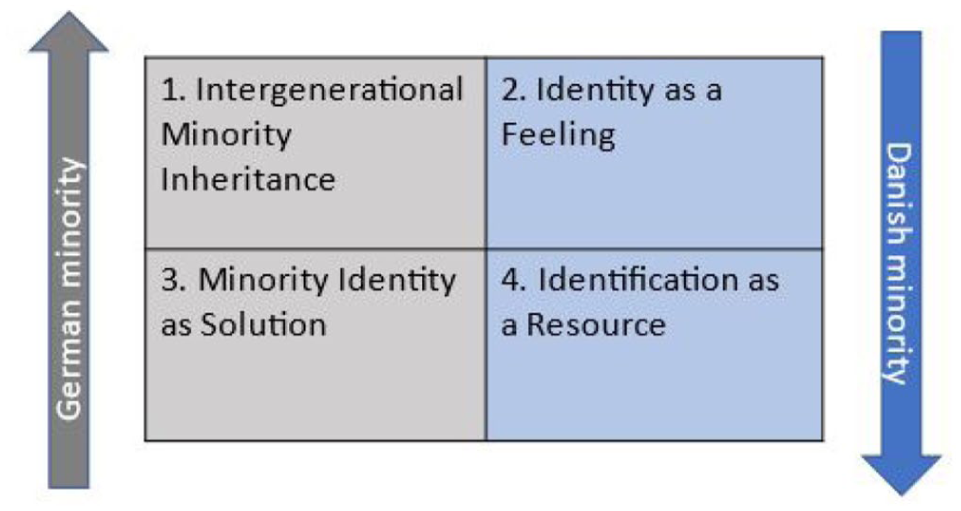
Functions of minority for identity formation.
In contrast, the Danish minority in Germany places greater emphasis on the minority as a resource, particularly influenced by changes in minority culture. The interviews reveal less evidence of familial socialisation and more of a motivation to identify with the minority to access the resources associated with a supposedly better school and education system. Therefore, the focus is less on culture, identity or socialisation and more on minority identity as a prerequisite for resource acquisition. Despite the different approaches to the respective minority, both minorities are united by being ‘different’ to the majority society.
Hence, our data show differences between the minority groups in terms of adolescent identity formation. At the same time, it is clear that the opportunities offered by a binational, bilingual and culturally multisided institutional space are valued by members of both minorities. Unlike other minority groups in Denmark and Germany, the groups we refer to here are relatively privileged. This raises the question of whether education systems could offer similar spaces to other minority groups by following the model of minority schools – rather than reinforcing national and monolingual structures. Especially in light of current trends towards nationalistic politics, it is crucial to highlight alternatives that enable young people to explore, question and reshape spaces of learning to form democratic and open perspectives. Due to their history and structure, minority schools provide opportunities to sensitise pupils to diversity. This potential must be further strengthened to counteract exclusion within society and the school system.
Another challenging aspect of the pilot study was the different school systems and the differentiation from the normative school system, as both schools are obviously orientated towards the Danish system. Following on from the data collected so far, it would therefore be of great interest to conduct additional interviews and observations of mainstream schools on the German and Danish side of the border and to contextualise these in relation to the minority schools.
At the same time, our findings must be situated within broader debates on minority and language rights in Europe. The Danish–German border region has often been described as a ‘success case’ of European minority policy, in part due to the Bonn-Copenhagen Declarations of 1955, which secured cultural and linguistic rights for both minorities. This case demonstrates how minority schooling and bilingual institutional arrangements can serve as living examples of the European Charter for Regional or Minority Languages (Council of Europe, 1992) and the Framework Convention for the Protection of National Minorities (Council of Europe, 1995). Our study shows how these rights are not only preserved in legal or institutional frameworks but are actively mobilised by young people in their identity formation. This confirms earlier findings in the European context (e.g. Extra and Gorter, 2008; Hogan-Brun and Wolff, 2003), which highlight the centrality of schools in maintaining linguistic diversity and providing spaces where minority identities can flourish.
By revisiting these rights-based frameworks, it becomes clear that the Danish–German minorities occupy a privileged position compared to other minority groups in Europe. While many minority and migrant communities struggle for recognition or face assimilationist pressures, the two minorities examined here are institutionally embedded, politically acknowledged, and educationally supported. This raises important comparative questions: to what extent can the model of minority schooling in the Danish–German borderland be transferred to other contexts where minority and language rights are less established? Furthermore, our findings resonate with recent scholarship on language rights and educational equity (Alcalde, 2015), which stresses the need for multilingual educational practices as a way to foster social cohesion rather than division.
In this sense, our contribution lies not only in analysing adolescent identity formation within two historically established minorities but also in showing how the institutionalisation of minority and language rights continues to shape identity work across generations. This perspective strengthens the argument that minority schools are not simply pedagogical alternatives but are central sites where European commitments to linguistic and cultural diversity are enacted, negotiated, and renewed.
Footnotes
Acknowledgements
We would like to thank Lina Wunderlich for her support during the writing process. We would also like to thank our cooperation schools where we were allowed to conduct research and our research community.
Declaration of conflicting interests
The authors declared no potential conflicts of interest with respect to the research, authorship, and/or publication of this article.
Funding
The authors disclosed receipt of the following financial support for the research, authorship, and/or publication of this article: The study was funded by the Centre for Education, Teaching, School and Socialisation Research (ZeBUSS) at the Europe-University in Flensburg.
Ethical approval and informed consent statements
For the research and thus for this article, consent was obtained from the respective schools in accordance with the data protection regulations in Germany. In addition, all data was anonymised before further processing in order to guarantee the anonymity of the school, teachers and pupils. As this is not an invasive study, no ethics application was submitted as part of the pilot project.

Data availability statement
The data collected was anonymised after the survey and stored on an external storage location at the University of Flensburg. In order to rule out any reconstruction of the schools or individuals involved, the data cannot be passed on for secondary analysis outside the research group.