




Abstract
This article draws upon a large international study which involved 536 first in family university students who were enrolled in universities in Australia, the UK, Ireland and Austria. This paper focuses on the Australian cohort (n = 376), all of whom were in the final stages of an undergraduate degree. Adopting a narrative inquiry approach, participants were encouraged to reflect deeply on their passage into and through university, including the barriers and detours encountered. The overarching study examined how learners persisted in what could be alien and somewhat isolating environments, with this article reflecting on the ‘journey narratives’ that learners told. Whilst students from more diverse backgrounds are encouraged to access university to fulfil widening participation or social inclusion objectives, certain types of university learner identities continue to be normalised and valorised across higher education systems. There is often an unspoken expectation that the ‘ideal’ student will study full-time, prioritise studies over all other activities and move efficiently through the system and into employability. In the research featured in this article, the narratives told by participants offer an alternative to this idyll of the ‘turbo’ student highlighting the disjointed pathways that many students took and the ways in which the material realities of life significantly impacted on their educational decision making.
Introduction
Retaining students in higher education is a key policy initiative within most university sectors. Across the Australian student population, attrition has consistently hovered at about 15% of the total cohort, but for those learners from under-represented or disadvantaged groups the risk of early departure is much higher (Australian Bureau of Statistics (ABS), 2022). One of these ‘at-risk’ groups are students who are the first in their family to attend university, as many of these learners fall into multiple equity categorisations (O’Shea, 2024). We know that early departure from university can have significant financial implications including what Norton et al. (2018) refer to as ‘debt and regret’ (p. 3). Nearly one third of the early leavers in Norton et al’s study believed they had received little or no benefit from enrolment and nearly 40% indicated they would not recommence a degree due to these experiences (Norton et al., 2018).
Rather than focus on departure or attrition, this article draws upon research conducted in Australia that sought to deeply explore how one cohort of first in family students experienced university progression. Using a narrative inquiry approach, the overarching project encouraged participants to deeply reflect upon the capitals (Bourdieu, 1986) and capabilities (Sen, 1993) that had been leveraged to enable persistence within the academy. Sen’s capability approach is described as a ‘framework of thought’ or a ‘normative tool’ rather than a ‘fully specified theory’ (Robeyns, 2003: 62–63). Applying this perspective provided an opportunity to consider the particular capabilities required to achieve ‘educational/pedagogic rights’ (Wilson-Strydom, 2015: 58). Within the educational equity field, the capability approach allows us to look beyond ‘access’ to university and instead focus on each person’s capability to function equally in this environment. In other words, the ability to not only access higher education but also participate and succeed in this system. By combining the work of Sen with Bourdieu’s concepts (capitals, habitus and field), the research detailed in this article provides nuanced insights into how inequality is not only experienced but also how this state is sustained by existing processes. A perspective echoed by Molla and Gale (2023) who argue how the ‘synthesis of conceptual tools from Bourdieu and Sen provides a productive way of thinking about educational disadvantages. . .’ (p. 106).
Student narratives were used to explore alternative, but equally valid, experiences of ‘being’ and ‘doing’ whilst at university. This article deliberately adopted an in-depth narrative inquiry approach in recognition that unless we have a deeper understanding of the educational biographies and back stories of our equity cohorts, it is difficult to provide the support and assurances required to succeed at university. Based upon student reflections of the pathways taken into and through university, the intricate negotiations and multiple detours that characterised educational journeys are detailed. The research study focussed on how the agency of individuals and the variable nature of context and personal circumstance interact to inform educational decision making and, educational outcomes. This focus is timely as with the onset of the recent pandemic, the constructed and fragile nature of university practices and expectations have been highlighted (Milana et al., 2021; O’Shea et al., 2021). The repercussions of this health disruption have thrown into sharp relief the realities of contemporary university experiences including the precarious nature of university engagement for students from more diverse backgrounds. As Zecca and Cotza (2020) explain, COVID-19 ‘triggered poverties that have previously been latent or dormant’ (p. 34). Unsettling the expected or valorised progression and attendance patterns at university provides an opportunity to rethink what is valued in higher education settings and how shifts arising from the pandemic could usefully inform how we support students in patterns of engagement and reengagement with learning.
To contextualise the data that follows, the article will firstly provide an overview of the ways in which students’ progression into and through university has been considered broadly before problematising these assumptions from an equity perspective. This problematisation will be grounded within the lived experience of first in family students, many of whom identified multiple equity indicators. These students’ narratives highlight how educational trajectories were characterised by interruptions and detours. This interrupted progression was often manifestly due to the material realities of life. Drawing upon key learnings from the pandemic (O’Shea, et al., 2021), the article will then conclude with discussion about how we might better prepare and support students for university pathways that are ‘swirling’ or ‘zig zags’ rather than considered only in terms of linearity (Harris et al., 2006; O’Shea et al., 2012).
Considering student progression
Student progression at university is largely defined in terms of numerical data, often in the form of attrition and retention statistics. This type of analysis fails to consider the uniquely subjective experience of higher education participation and such reporting remains largely reliant on an expectation of students proceeding in a direct fashion through university. Twenty years ago, Robinson (2004) pointed out the need for a longitudinal focus on the “educational process” of student progression’ (p. 2). This author pointed to the lack of understanding about the ‘pathways’ that students ‘take through their courses’ (p. 2) within Australia. Such limited insight continues to be the case. In Australia, and other countries, there is an ongoing focus on single points of progression, rather than examining the continuity of this enrolment throughout the student life-course.
Arguably, this one-dimensional approach to recording progression provides a relatively partial understanding of university student trajectories. With limited scope to consider the long-term enrolment patterns of individual students, there are gaps in our understanding about the pathways taken into and through university. As Robinson (2004) points out: A longitudinal analysis of student progression can indicate information on important aspects of course performance such as transfers to or from a course within or between institutions, the timing of failures and repeating of units of study, dropout, and withdrawal. (p. 3)
The complexity of these student journeys remains somewhat obscured and there seems to be an underlying and remaining assumption that most students will proceed through university in a linear and time bound manner. In countries such as Australia, this is rarely the case. The most recent Australian longitudinal data points to the diversity of national university completion rates: after 4 years of study (the average full-time duration of a degree) only 40.9% of all university students had successfully graduated with 37.39% still enrolled. After 6 years, completion rates had increased to 61.77% with a significant percentage (12.88%) still enrolled, at nine years of enrolment nearly 70% have completed with 4.5% still enrolled (Australian Department of Education, 2023). What this data demonstrates is that students in Australia take a significantly longer period to complete their studies compared to the anticipated and expected 3 or 4 years. Most degrees in Australia continue to be marketed and messaged to students in terms of a time-bounded commitment, and whilst universities do offer part-time study options, there are clear constraints around this choice. For example, government student income support remains tied to full-time study, meaning that it may be financially unviable to choose part-time studies, particularly for older students with caring responsibilities (Gair, 2018).
Within Australia, university policies and funding models also tend to privilege full-time enrolment. Core institutional funding is typically linked to full-time equivalent (FTE) student load rather than actual headcount, placing institutions with significant part-time cohorts at a financial disadvantage. This funding emphasis is further exacerbated by a lack of institutional mechanisms to support flexible patterns of student progression, including the absence of seamless entry and exit points. Despite recommendations from the Australian Productivity Commission (2022: 107) for a nationally coordinated system of ‘orderly and low-cost’ exit pathways, little progress has been made toward enabling greater fluidity in study trajectories. Such flexibility would require inter-institutional systems that recognise prior learning and uphold the legitimacy of non-linear educational pathways (Raciti et al., 2024). While these proposals reflect a broader imperative to reconceptualise degree progression, the structural reforms necessary to enable such transformations have not eventuated.
Data has repeatedly indicated how concluding a degree within a 4-year or even a 5-year period is not achievable for many students (Norton et al, 2018; Warburton, 2023). Australia is not alone in this regard. Similarly, lengthier progressions have been noted globally, with significant gender differences between completion times for men and women (OECD, 2022). But what the statistical or numerical data cannot capture is the ‘why’ behind these attendance patterns. This includes the many detours or variations that may have occurred over the course of the degree.
Gaps in understanding about the nuanced and complex nature of university journeys are particularly significant when it comes to those learners who are derived from under-represented or equity groups. Many of the students who are currently marginalised in higher education systems have had particularly complicated university experiences. The next section will explore reasons for complexity in participation and progression for equity bearing students with specific reference to the first in family cohort.
Student participation and progression from an equity perspective
Globally, research data is clear about how university access and opportunity is differentiated. Despite decades of outreach initiatives and sector reviews, the opportunity to attend university remains delineated by factors related to wealth, biography, and location. For those students who have less material or financial resources, the financial burden of attending university is significant; this is particularly the case in Australia where this research occurred. For example, a recent Australian survey highlighted that whilst 60% of young people planned to go to university after school, 20% of young people felt finances were a barrier to achieving this goal (Mission Australia, 2021). Currently, Australia ranks 23rd amongst the 31 OECD countries in terms of students’ ability to finance their education costs as measured by the ratio of tuition and living costs to available individual funding. Instead, the use of private resources and funds to complete tertiary education in Australia is almost double (60%) that of the OECD average of 30% (Education at a Glance, 2022). Such material differences have significant implications for university participation for students from economically disadvantaged backgrounds, where debt aversion and fiscal fears makes higher education participation inherently ‘risky’ (Raciti, 2019).
Finances are only one element of a range of issues impacting university participation within Australia. Higher education statistics for rural participation are particularly damning. Simply, if you live in a major city, you are almost twice as likely to attain a bachelor’s degree compared to those in a rural or remote setting (ABS, 2022). University participation rates for this cohort have also declined sharply, despite overall student enrolment growth (Australian Department of Education, 2022). Funding and three national reviews (Halsey, 2018; Napthine, 2019; Productivity Commission, 2019), have not altered the fact that where you live in Australia impedes educational opportunities, this is particularly the case for higher education attendance.
Aside from issues of wealth and location, another factor that impacts on university participation is family biography. For example, one recent Australian study considered the post-school aspirations of school students across both primary and secondary year groups (Gore et al., 2022). The Aspirations Longitudinal Study (2012–2018) recruited participants from government funded schools where it was found significant numbers of the students surveyed did not have parents with degree qualifications. The results of this study pointed to how attending university ‘is barely imaginable for young people in some parts of Australia’ (Gore et al., 2022: 9); as a result, those with a family biography of university attendance had more than 1.6 times the odds of holding aspirations for university when compared to their first in family peers (Gore et al., 2022). However, it would be wrong to assume decisions to attend university are simply related to issues of educational access. Covarrubias et al. (2019) highlight the invisible but potent tension faced by students who must reconcile the autonomous demands of higher education with familial obligations grounded in interdependence (p. 383). A dynamic further complicated by cultural incongruities between students’ intrinsic motivations and the normative expectations of academic institutions (Covarrubias et al., 2019; Patfield et al., 2023).
Socioeconomic class has also been repeatedly identified as a ‘formidable barrier to widening participation’ (Miller and Schulz, 2014: 84) in the university setting. In the more traditional or established universities, long-held institutional traditions and embedded cultures of class and privilege are both highly restrictive and largely invisible barriers to success (Reay, 2016; 2017). Students are often expected to understand and engage with unfamiliar, class-constructed culture or knowledge, with the level of access, or indeed lack of access, to such knowledge impacting on overall achievements and retention (Reay, 2016). Indeed, the Community Cultural Wealth Framework (Yosso, 2005) recognises how there are many different capitals or knowledges that learners may utilise in enacting academic success, not all of which are valued or celebrated within the higher education system. Hence, despite the evidence of expansion in global higher education systems, there clearly remains hidden structural stratification which curtails equal participation across all student cohorts (Lehmann, 2013; Lessky et al., 2021, Marginson, 2016).
Once these students enter the university environment, educational progression, and career trajectories are also impacted by factors related to biography and resourcing (Jack, 2024; Loveday, 2015; Stich, 2014). Adopting the lens of the student life cycle, Tomaszewski et al. (2022) point to how enduring and systemic barriers impact individuals from more marginalised backgrounds at all stages of university including the access, participation, and post-participation stages. These authors argue that ‘at each of these stages, individuals from socio-economically disadvantaged backgrounds will exhibit poorer outcomes than individuals from more socio-economically advantaged backgrounds’ (p. 134). Typically, these students may have had fewer educational or other opportunities for movement beyond, what Lehmann (2009) has referred to as their familial ‘station in life’ (p. 147). This has enduring and intergenerational impacts, requiring more expansive understanding of ‘disadvantage’ that recognises this is not ‘a static state, but rather as a cumulative process that unfolds over the life course’ (Tomaszewski et al., 2022: 134).
Considering the first in family cohort within different stages of the university life cycle better recognises how these learners often experience repeated ‘sensitive and critical periods’ (Tomaszewski et al., 2022: 135) throughout their degrees which influence the level and type of engagement experienced. The ways in which these ‘critical and sensitive’ periods play out for students directly impacts upon the nature and rate of progression through the higher education system. For example, within the United States (US) it is calculated that those who are the first in their family to attend university comprise a quarter of the 16 million students entering higher education (Capannola and Johnson, 2022) but recent US research indicates that first in family students are more likely to depart early from university prior to achieving a degree (LeBouef and Dworkin, 2021). Equally, UK research (Henderson et al., 2019) highlights significantly higher levels of attrition for this cohort as well as lengthier progression through their studies. Analysing a longitudinal data set which followed young people over eight waves of data collection, the UK’s Next Steps survey commenced in 2004 when students were aged 13/14 years old and concluded when they were at age 25 (Henderson et al., 2019). Whilst the report points to many differences, of particular note is the disparity in the timeframe for completions, the data emphasising how those students who have a graduate parent are 52% more likely to get a university degree by age 25 compared to only 22% of their first in family peers.
These significant findings traverse countries and locations. The evidence clearly demonstrates how the trajectories of different student cohorts vary considerably depending on life circumstances. Yet despite this evidence there is a continued tendency to valorise the concept of the ‘turbo’ student (Von Prummer, 1993) by creating circumstances that encourage individuals to proceed swiftly or directly through their studies. As mentioned, within Australia access to student income support is limited to those who are studying full-time (Services Australia, 2024), similarly within the UK, fees for part-time study have increased dramatically leading to significant falls in the numbers of part-time enrolments (Hubble and Bolton, 2022). For many students in the UK, particularly those from under-represented backgrounds, part-time study is simply not possible due to the costs involved (Hubble and Bolton, 2022). Such disparities have only increased since the onset of the health pandemic in 2020. COVID-19 foregrounded the ‘fragilities and inequities in global higher education’ exposing ‘long-standing systemic inequalities’ entrenched within organisations (Purcell and Lumbreras, 2021: 1). The next section will consider the disruptions caused by COVID-19 and the repercussions of these for higher education systems.
COVID-19 and the higher education setting
Undoubtedly, the health pandemic introduced a level of disruption to every facet of university business, equally challenging educators to innovate and adapt as well as necessitating changes to entry requirements and the notion of access. A number of issues that arose worldwide had previously been solely considered in the context of student equity; particularly approaches to recognising and catering to the unique life circumstance of our more diverse learners. Issues such as poor access to technology, precarious employment or material disadvantage, often previously considered as minority ‘equity’ issues, become mainstream, and could no longer be sidelined or ignored (O’Shea et al., 2021).
Within Australia, factors such as the resourcing of higher education, the future of international student enrolments, online course delivery, and changes in admissions policies coalesced under the rigours of the pandemic and the resulting institutional closures. This global health crisis impacted the entire student population across higher education (Bassett and Arnhold, 2020) leading to higher levels of student disengagement (Drane et al., 2020); a loss in learning (Bare et al., 2021) and importantly, higher rates of attrition (Norton, 2023). Nandy et al. (2021) summed up this situation succinctly by stating that COVID-19 had ‘not caused cracks’ but had rather simply ‘revealed them’ (p. 4). Universities continue to negotiate the repercussions of this health crisis and in some cases, this renegotiation has triggered a critical interrogation of accepted forms of being and doing within the university setting. As Tesar (2020) reflected: Overnight, we have shattered the overall structure of our degrees and programs and units, our plans, our academic rules and processes. (p. 557).
Certainly, the pandemic provided a unique space from which to question established norms and trial alternative modes of delivery. We know that hidden injustices exist in education, but these have often been accepted or simply ignored by many. The onset of COVID-19 forced a reconceptualisation of how learning occurs and arguably how this is intrinsically biased against certain populations, ultimately revealing ‘the endemic nature of educational exclusion’ (O’Shea, 2025 – in press).
One of the ways this exclusion plays out is through the valorisation of certain forms of academic progression. The continued need for students to proceed quickly and directly through their university studies belies the complexities of their everyday realities. To provide an alternative but equally valid perspective on this issue, the next section will detail a study that explored the ways in which students considered their participation at university and how this participation was in many ways contrary to expected pathways or progression rates. Whilst the study deliberately focussed on persistence, the reflections of participants, most of whom were nearing the end of their degree studies, revealed the intricate negotiations that this act required. The study and the data that follows detail alternative perspectives on university progression with the final section of this article discussing implications for the broader university community.
Details of the research
Research in the field of university participation and progression has often focussed on the reasons for student attrition or poor academic outcomes rather than considering alternative forms of success or the unique and individualised nature of persistence. Recently, a small body of research has emerged that more clearly articulates strengths-based understandings of first in family student cohorts (e.g. Forsyth et al., 2022; O’Shea, 2018, 2024; Patfield, 2022). This article builds upon these existing scholarly foundations and draws upon research that sought to understand the capitals and capabilities that first in family students indicated underpinned their degree attainment. The term ‘first in family’ is being used in this study to refer to those students who have had no family member previously attend university, this includes parents, partners and children.
The project was funded by the Australian Research Council (DP170100705) and it built upon related findings that outlined how first in family students apply existing cultural, familial and knowledge capitals during their transition into, and engagement with, university (e.g. O’Shea, 2018, 2016; O’Shea et al., 2017, 2018). Data was collected across 12 universities between 2017 and 2018 in four locations: the majority of universities were in Australia (n = 9), with one university located respectively in the United Kingdom, Ireland and Austria. Adopting a cross-country comparative approach provided rich findings as the locations chosen were similarly characterised by a high volume of first in family students and also, comparable university systems. The universities chosen were not classed as ‘elite’ or ‘redbrick’ relative to the norms of the respective country, instead all were teaching-research institutions servicing large diverse student populations. This article will focus on the Australian data given the volume of responses and the geographic spread, with further publications planned that will focus on the comparative nature of this data as this applies across the different countries.
Data was collected via in-depth narrative biographical interviews or surveys in each location. The use of surveys was deliberate as this ensured participation regardless of geographic location or time zone. Across the entire study, 536 first in family students took part in the research; 440 participated via surveys and 96 were interviewed. Within the Australian study, which this article focuses on, a total of 306 students participated in surveys with a further 70 interviews conducted. Table 1 below shows the geographic span of the data collection, this includes the institutional attrition rate at the time of data collection (2017).
Data collection summary.
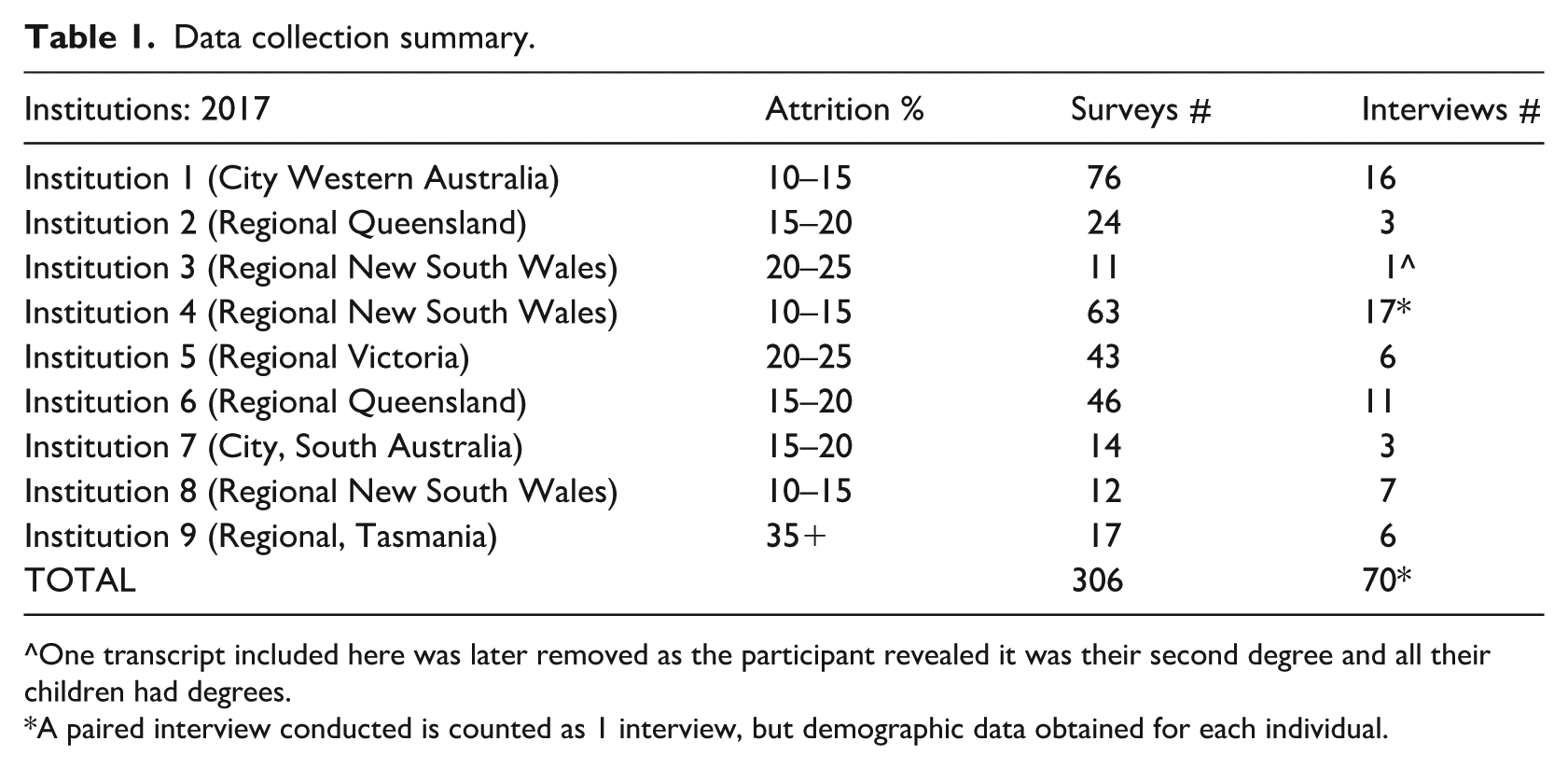
One transcript included here was later removed as the participant revealed it was their second degree and all their children had degrees.
A paired interview conducted is counted as 1 interview, but demographic data obtained for each individual.
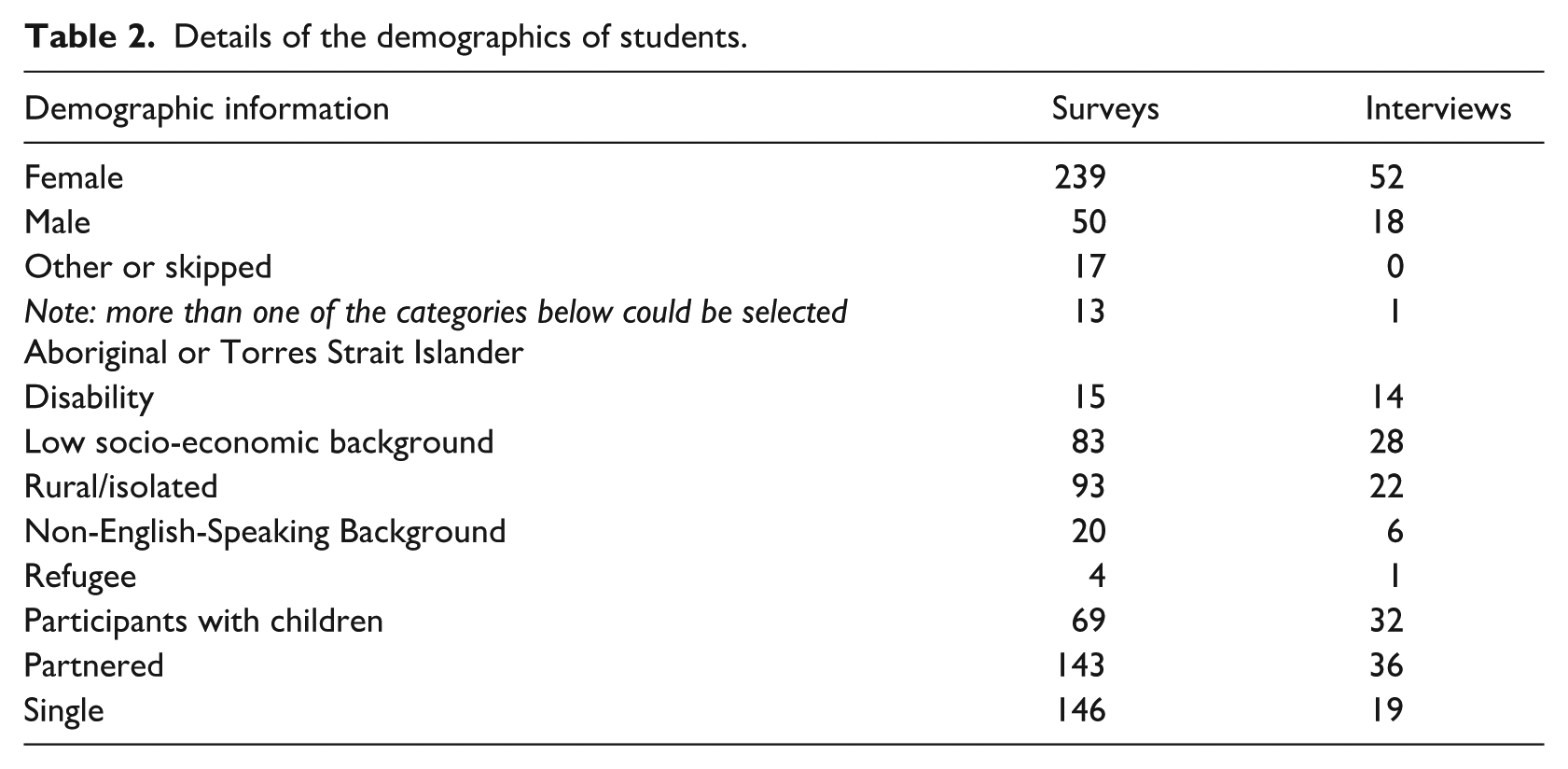
Within this Australian data, participants were predominantly female, and the majority older, often with multiple caring and work responsibilities. Of the 306 surveys returned: 239 were female, 50 were male and 17 participants elected not to disclose gender orientation. The 69 interviews (with 70 interviewees, i.e. one paired interview) included 52 females and 18 males. Participants self-selected the equity categories applicable to them. In addition to this, 69 survey participants had children, 143 were partnered and 146 were single; 32 interview participants had children, 36 were partnered and 19 were single (Table 2).
Details of the demographics of students.
This study received ethics approval from the lead institution in Australia (HREC#2017/178), and this approval was accepted by all participating institutions. Participants were invited to the study in accordance with institutional protocols, which varied from email invitations, university-wide student communications, digital signage, student organisations or recruitment information presented to students in lectures. Participants who met both the criteria of being the first in the family and, in the latter stages of their degree were invited to either complete an online survey or to contact the researchers for an interview (in-person or by telephone). These interviews were recorded, transcribed and deidentified with each transcript undergoing member-checking with any requested changes made. Survey and interviews were imported into NVivo 11 and analysis was conducted in an inductive manner by engaging deeply with the words and stories of the students.
This inductive analysis was framed by capital theory (Bourdieu, 1986) and the capabilities approach (Nussbaum, 2006; Sen, 1992). This theoretical lens assisted in ‘opening up’ the data and deeply explore and focus on the actual lived contexts of learners. Sen’s Capabilities Approach centralises ‘agency’ within educational access and participation fields, providing a necessary ‘space’ to consider the range of capabilities needed to ensure ‘educational/pedagogic rights’ (Wilson-Strydom, 2015: 58). At the heart of this approach is the recognition that ‘capabilities’ refer to the actual ‘freedoms’ that individuals have to achieve what it is they value (Sen, 1999). This analytical focus centred not only on what students ‘do’ but also on how life situations or apriori experiences relate to the stratified nature of university environments. The work of Pierre Bourdieu (1930–2002) further contextualised this understanding by exploring how learners’ existing capitals interact with university systems and settings. Bourdieu (1986) identifies various forms of capital which include: economic, social, cultural and also, symbolic capital, the latter generated though manifestations of prestige (e.g. qualifications, art forms, etc). Certain types of capitals inform privilege or advantage in social settings, so while individuals may acquire capital through education it is unclear how individuals ‘convert’ existing capitals into those valued in new settings, such as universities (Naidoo, 2004: 56).
Drawing upon both Sen and Bourdieu enabled a dual focus on both what individuals ‘actually do’ (or the capabilities and freedoms they are able to access) as well as understanding how this access can be curtailed by other fundamental but often invisible factors related to the social, economic and cultural structures they exist within, which dictate the types of capitals they can access. As Bowman (2010) has argued: ‘Bourdieu’s concepts . . .enable understanding of the processes that enable and constrain choice’ (p. 14) and when combined with Sen’s work on capabilities can provide ‘more finely grained insights into the processes and experience of inequality.’ (p. 14). By focussing on the journey narratives of the learners, this deep analytical focus revealed the ways in which structural inequalities shape student agency and access, including the character of educational trajectories. Adopting a narrative inquiry approach, the interviews intentionally created a space for students themselves to deeply consider their journey through university, which was characterised by what I termed as, ‘zig zags’ and ‘spirals’, rather than linear pathways.
This was a rich dataset, which was framed by biographical detail and narratives of contemplating, arriving at, and progressing through university. Encouraging individuals to narrate their own lived experiences arguably allowed a renegotiation of ‘power differentials’ within the interview (Elliot, 2005: 17). Both the interview and survey guiding questions were the same, although each adopted an open-ended format to enable aspects of the experience to be explored in more depth. Both began with eliciting demographic information, followed by open-ended questions around three broad areas: self-reflections as a student; reflections on higher education; higher education participation and support from family/community, the institution, and others. All survey respondents were also invited to attend an interview to further elaborate on their responses, with instructions about this provided at the end of the survey.
The study design was also participant-centred, not only were all interview scripts member-checked but all participants (survey and interviews) were invited to comment on the draft persistence framework, which was one of the outputs from the overarching study. This feedback further informed the outputs of the study and findings. Such a democratic approach arguably provided an opportunity to foreground alternative and perhaps, hidden, understandings about how university progression is experienced on an individual lived level. The following sections provide insights into the nuances of this participation and details the detours that occurred for many during this journey.
Findings
Participants in this study had often experienced disrupted or limited educational pathways, a gamut of interruptions characterised their entire educational journey, rather than only occurring at the university level. Many had left school early or had experienced long absences from formal learning due to ill-health, poverty, or family caring responsibilities. As a result of these experiences, the reflections provided in both interviews and, via surveys were often characterised by a common observation that university had been perceived as an almost impossible destination. Many of these learners had been repeatedly told that university was simply not achievable. This messaging was derived from a variety of sources that included peers, teachers, employers and family members. Mahalia (43, B. Social Work) reported a collective and potent negative response that ultimately delayed her own journey to university: University was probably something that I always wanted to do. When you haven’t got people that have been there before, it’s that whole stigma of “What do you want to do that for”, because it’s out of the norm so there’s not much encouragement. . .
As a result, any decision to attend was often extinguished even before it had a chance to be considered, a situation succinctly defined by both Bailie and Brett: When you are relatively consistently told that with your demographic, your background, you’re specifically more likely to fail it sort of sets up that whole culture of low expectations. (Bailie, 26, B. Arts/Law) Growing up in a regional centre which is focused on industry and particular political ideals. . . you’re kind of set on a path which is predetermined by your familial background, your social networks and generally the town that you associate with. (Brett, 33, B. Business)
For those who did attend, it is perhaps not surprising that this was a route characterised by significant interruptions and detours. When discussing this journey into and through university, three key themes emerged in the data that related to the nature and character of this pathway. The findings section will focus on these three themes to highlight that while experiences were profoundly unique, equally there is commonality across this cohort. Such commonality is key as it provides a foundation for how we consider the best ways to support and engage students from more diverse backgrounds, recognising that unless we have a deeper understanding of the educational biographies and back stories of our equity cohorts, it is difficult to provide the support and assurances required to succeed at university.
The three themes that will guide this section are:
Once the key findings are presented, the article will then discuss the implications of these before suggesting how institutions might consider supporting these learners as we contemplate higher education sectors in post-pandemic times. Of note is the fact that these learners all did persist to the end of their academic studies. By foregrounding the non-linear and disrupted nature of these educational trajectories this article exposes nuanced lived experience of attending university for one cohort of students from under-represented backgrounds.
Given that all these students were the first in their families to attend university it is perhaps not surprising that there were some gaps in knowledge or understanding about the institution. However, the student reflections exposed the enduring and persistent nature of these gaps, which often shadowed the students as they both entered and moved through the university landscape. One example is Mahalia, who was a sole parent of three children studying social work. Mahalia lamented the fact that no-one had explained to her that part-time study was an option for her degree. As a result, she reflected how she had effectively ‘lost a year of my kids’ lives’ explaining: . . .had I known that I could take one or two subjects and just ease into it and understand the lingo and understand how everything works – even just navigating around their site, you know how to find your work and stuff and how to submit stuff. If I had just done one or two subjects, just learning those and having just enough workload, I think it would have been a lot less stressful because I didn’t have any parents, I didn’t have anyone around me that could tell me how it worked. . . I mean when you’re just starting uni, you’ve got all these assumptions and ideologies of what it’s going to be like. . . . (Mahalia, 43, B Social Work)
Whilst the ability to study part-time might seem like an obvious or normalised activity across higher education systems, Mahalia was not the only participant to reflect how this option was not made explicit. Belinda, who had also returned to study later in life, equally revealed how she ‘didn’t understand that you could still be flexible within uni by doing just one subject and slowly ticking things off’. Belinda attributed her lack of understanding about attendance patterns to her own biography, explaining: Maybe growing up in a rural community, maybe because my parents weren’t academics, I didn’t really understand you even had options with uni. . . (Belinda, 43, B Social Work)
Not having a family tradition of attending university was frequently highlighted as being a factor in not gaining an understanding of the ‘inner’ workings of university progression. For example, Bradley, in the third year of an Arts Degree, described how his university attendance was ‘difficult because I don’t have that ultimate level of understanding at home or within a family circle’ (Bradley, 20, B. Arts). These isolating aspects of university attendance were further compounded by the ways in which certain understandings and assumptions were taken for granted or implicit in the institution. For Jennifer, not having ‘parents [who] are university educated’ meant that there was little opportunity to discuss: what it’s like to go to uni, what happens at uni, you know, what experiences you might have, what might be your day-to-day life. . . there is none of that conversation in regard to what it could be like or what it is like. (Jennifer, 28, B. Teaching)
Gaps in knowledge pervaded learners’ experiences, this included misunderstandings about entry pathways, financial support available or study options. The role of schools in providing this information was described as somewhat erratic or absent. Fiona (24, B. Medicine) explained that she was not ‘prepped that much by school or anyone that really knew what to expect’, a situation echoed by Isabel (28, B Nursing) who explained how she did not feel that her schooling adequately prepared her to navigate a pathway to university and this also lowered her sense of belonging once she arrived: In my class at university, we had to do a survey and in my class of 30 students, only two of us came from public schools so it just shows that different upbringing really. . . with high school, we never did an excursion to the university, ever, so the first time I went to a class at university was the first time I’d ever been to a university . . . I feel like going to public school was a barrier for me because they didn’t socialise me to want to go to university early enough. . .It was sort of like, ‘What do you want to do when you grow up? You want to be a hairdresser? Awesome, go be a hairdresser’. It wasn’t like ‘You could be a doctor, you could be a marine biologist, you could be whatever you want to be.’ (Isabel, 28, B. Nursing)
Whilst this quote and others indicated the disparities in how schools might prepare or encourage their students to attend university, the intent of this article is not to debate these differentials but rather to point to the very different biographies and understandings that learners had upon entry to university. For some, such differences fed into a much lower sense of belonging, or ‘less stickiness’ to the university setting, and as a result thoughts of leaving can consistently pervade university careers. The next section explores how students considered the act of attrition as well as their rationale and drive for staying on at university.
Constantly contemplating departure: “I wanted to throw it in again. . .”
Life was complex for the participants in this study, many had multiple demands on their time as well as significant caring and financial obligations. These responsibilities competed with university throughout their studies: these were not transient or temporary distractions but rather the realities of day-to-day life. Narratives of extreme hardship were common across the data, health issues, poverty or bereavement were referenced repeatedly in both surveys and interviews; yet often such experiences are considered to be the exception rather than the norm within university settings.
During data analysis one of the strongest themes to emerge was named ‘barriers imposed by life matters and events’; this node had over 170 references as students indicated deeply traumatic and difficult experiences in life. Such as Erin who explained: My university journey has been somewhat difficult in the sense that I’m bipolar too so throughout my university experience, having to meander through a divorce as such, child custody, and deal with my mental health and all the other burdens that come with studying have been really difficult. . . . (Erin, 32, B. Arts)
Erin had been accepted to do a double degree in psychology and education after completing high school but because ‘no-one else went to uni in my family’ she ‘was very scared’ and so, did not accept the offer. After years of admin and office jobs which made her feel ‘miserable. Absolutely bloody miserable’ she returned to university as a sole parent. Despite achieving high grades and university awards, Erin’s university studies are tenuous in the sense that this journey is dogged by obstacles. She was not alone in this experience.
Given the difficulties that had been encountered in their lives both prior to and during their university studies, it is perhaps not surprising that there were multiple exit points considered throughout the student journey. Merelyn (39, B. Education) reflected on how she often ‘wanted to throw it in’ whilst Jennifer described regular cyclic or spiralling patterns related to exit decisions: Every semester that I’ve done, I get to about Week 9, Week 10, I’m like “Oh my God. I just want a break and I just wish I wasn’t doing this anymore” and I have those thoughts but then I kind of just keep on going and just keep plodding through. . . . (Jennifer, 28, B.Teaching)
Attending university seemed to be a particularly tenuous undertaking for these students, thoughts of departure were never far from mind, or as Finn (33, B. Business/Law) explained: ‘I shouldn’t say “giving up” but taking a break’. Absence or departure were often a result of a fragile connection with the institution, as there seemed to be multiple points in educational careers where leaving was seriously contemplated.
Lara, a mother of two, felt that her parenting status was elided and unrecognised within the university environment, explaining how ‘there was not much empathy. I nearly did quit then . . . and if I see my children and my husband really struggling with it then sometimes, I think, “What am I doing? Why am I doing this?”’ (Lara, 46, B. Science). Similarly, Helen (45, B. Education) explained that the pressure of studying full-time alongside work and ‘all the other things you have to do as a mum, cleaning the house and mum’s taxi jobs’ meant that she regularly contemplated ‘. . .putting it off, finishing it just to focus on my family.’
This type of interrupted and seemingly transient progression was also characterised by deeply emotional undertones. Lucy explained the struggle to keep going and a growing sense of defeat: Half the time I feel like the biggest sack of shit because I just feel like I’m constantly failing, I feel like constantly there’s just another thing to get done. (Lisa, 21, B. Nursing)
Undoubtedly many students encounter difficulties and obstacles in their studies but what was striking in these stories was the extent and multiplicity of these issues. Repeatedly, participants reflected on self-doubt and remained questioning of their decision to attend higher education, particularly when there had been multiple different attempts at undertaking university studies. The next section highlights the ways in which university may have been previously experienced, as whilst all the students who participated in this study were on track to graduate, their progression was sometimes characterised by either a spiral or circular movement within the institution or resembled a ‘zig zag’ across various programs or institutions.
Whilst all the participants were in the final stages of their undergraduate degrees and on the brink of graduation, the interviews and surveys also contained references to previous educational experiences with less positive outcomes. These were stories of false starts and hasty, upsetting departures, which often had repercussions for the students involved, such patterns of participation often ‘zig zagged’ across their university experience. One survey respondent described having ‘three false starts at university, dropping out within the first year immediately after high school then two years later and again two years after that’. Another explained how the initial decision to ‘quit’ occurred in the first week whilst trying ‘to work out my timetable – it was so overwhelming. I was accepted to do a science degree, but this was not for me’. For this individual, they simply wished ‘. . .someone had been there to guide me in the direction it took me ten years to find’ (Survey Respondent). Participants also reflected on how they had ‘zig zagged’ between various institutions and degrees, sometimes having multiple attempts at different qualifications or providers before finding the right ‘fit’. This instability in progression did not only have an academic or financial toll but also an emotional one, with extreme highs and lows punctuated by a questioning of whether this was the most appropriate undertaking.
The reasons for such zig zags were manifold and included ‘family circumstances’, ‘mental health issues’ and ‘financial reasons’. A failed assignment in the first year of university led to a quick exit for one survey respondent who explained: ‘I was not made aware of any support avenues available’ and instead withdrew. The memory of that failed assignment stayed with this individual for over a decade, almost prohibiting a return to university. After successfully managing a small business, the student finally felt confident enough to recommence their university education, but equally lamented the negative impact of this initial enrolment: [I] kept the fail assignment for 10 years before commencing university again. . . In those 10 years I managed a childcare centre and gained invaluable life experience and experience working with children. (Survey Respondent)
Not surprisingly, leaving was an emotive action – students referred to feeling ‘drained’; being ‘devastated’ or even carrying this failure for a significant period, slowly eroding their confidence in their ability to succeed in higher education.
I was devastated after my first two failed attempts at university. . .If I had ended my higher education journey there, I would not be the inspired, enlightened and enthusiastic person I am today. (Survey Respondent)
Of course, the multiple entries and exits, or zig zag progression, did not only have repercussions on the learners but equally the family and those closest to the student were also impacted. As one survey respondent explained: ‘. . .my family lost hope that I would complete university after two withdrawals from courses. . . .’ Repeatedly in interviews and surveys, participants reflected on several attempts at university, often with significant emotional, material and temporal repercussions: I had first attempted uni when I finished school but didn’t enjoy it. I tried to go back into a different course when my first child was a baby but found it difficult. This is my third attempt and I’m in my last year. (Survey Respondent) I’ve had a couple of breaks . . . When I first started, I was a single mum and then met my partner and then had another child, as you do, and have been working full-time ever since I started. (Merelyn, 39, B. Education)
Like others, Eleanor (29, B. Arts) also described an initial enrolment in a diploma at a local university but then needed to drop-out due to ‘the anxiety and instability of my life’. Eleanor reflected upon a disrupted childhood, a mentally unwell parent with another parent simply categorised as a ‘drug dealer’; she ended up in an abusive relationship at a young age and was later homeless. Despite these difficulties, Eleanor did not give up her dream of a university degree and she circled back to university when the time was right, after meeting her current partner. Now in the third year of her degree, Eleanor had just received an award for being in the top 15% of her cohort, explaining that while she stills feel like an ‘outsider’ in the institution, university is quite simply her ‘lifeline’.
Discussion
Stories like Eleanor’s shine a light on the hugely transformational opportunity that higher education offers to people but, what remains hidden or in the shadows, is the convoluted, and complex routes in and out of university studies that learners from more diverse backgrounds frequently experience. Despite institutions targeting students from more diverse backgrounds through comprehensive outreach and widening participation initiatives, some of the very fundamental barriers to equal participation frequently remain unchanged. One of these is the fact that commencing students are generally still encouraged to enrol in degree programs in a full-time capacity and there is little opportunity to dip in and out of study seamlessly. The students in this project reflected on their journeys through university not in singular or linear senses but instead in terms of zig zags or spirals, pathways that may meander, stop and then start again, involving more than one institution or program of study. This can be challenging in an educational environment that generally valorises or foregrounds more direct or straightforward educational trajectories. As both Mahalia and Belinda reflected, learners unfamiliar with university settings may not even necessarily know that enrolment can be part-time or that leave is possible. We cannot assume this type of insider knowledge particularly if the only experience of study has been within a school environment, which of course does not offer part-time or leave options.
The actual design of undergraduate degree may also prohibit more fluid progression that takes into account the breaks in study patterns often needed by more diverse student cohorts. For example, some degrees have requisite subjects that must be completed before learners can proceed to the next stage of the degree; the timing of these required subject often assumes a linear, time bound pathway. Beyond degree structures, there are other fundamental and structural barriers to this more fluid progression. For example, there may be limited scholarships available for part-time study and if an internship is required, in many universities in Australia, these generally have to be completed as full-time blocks. These structures act as a hidden barrier for learners who have more complex and competing demands in their lives – such as older students or those who are less wealthy. We know that entry to university alone is never sufficient: as the Capability Approach indicates an individual’s real freedom of educational choice depends not only on access but also the freedom to choose what is valued or preferred or as Walker and Unterhalter (2007) so succinctly point out ‘. . .evaluation of equality must take account of freedom of opportunities as much as observed choices’ p. 5).
Such invisible structural barriers can act as a type of ‘bottleneck’ to student progression, effectively limiting or regulating passage through university study. Fishkin (2014) draws upon the notion of ‘bottlenecks’ to consider how opportunity structures are constricted, as he explains: Whenever some people’s opportunities are constrained relative to those of others, something in the opportunity structure is doing the constraining. Something is interacting with some characteristic of the relevant set of people in a way that cuts them off from many opportunities. That something, whatever it may be, constitutes what I am calling a bottleneck. (Fishkin, 2014, p.143)
I would argue that one embedded and somewhat hidden bottleneck, relates to the need for all students to attend university in largely linear and exact volumes. Expectations that learners will complete degrees within a certain timeframe continue to be accepted as the norm even when we know that a degree in Australia can take 6 years or more to complete (Australian Department of Education, 2023; Warburton, 2023). This subtle, but continued, emphasis on ‘fast’ progression elides and ignores the very complex lived realities of many and relies on an outdated and mythic ideal of who students are and the lives that they lead. This begs the question as how the sector can better recognise and support progressions that are characterised by spirals or zig zags, thereby reflecting the attendance patterns of all students, rather than only those with the resources and circumstances to facilitate that linear enrolment pattern.
COVID-19 exposed the very different circumstances of all university learners, as we witnessed students forced to study from carparks or fast-food restaurants to access wifi; or those who had no space at home to engage in Zoom calls or complete online learning (O’Shea et al, 2021). However, beyond this disparity in relative material resources exists a far more foundational difference, namely access to necessary academic capitals, or constructed and institutionalised forms of cultural capital (Naidoo, 2004: 458). The participants in this study repeatedly referred to gaps or silences in their knowledge at the most fundamental level, which both impeded their progress and were enduring in nature. We know that certain types of capital can lead to certain forms of advantage, but equally important are the ways in which individuals manage to ‘convert’ cultural capital into forms of capital valued within the new environment (Hart, 2012: 56).
Jack (2016) identifies how schools have a key role to play in plugging these gaps or assisting in this conversion, this author differentiates between the ‘privileged poor’, who may have been derived from low incomes but received an ‘elite’ education and the ‘doubly disadvantaged’ who attend schools with less resourcing. The results of Jack’s (2016) study indicating that being the first can be mitigated by access to elite education as this provides the necessary cultural and social capital needed to navigate the higher education setting or provide the necessary capital conversion. Applying a capabilities and capital lens to this situation highlights how entry to the university domain will always be partial for some learners if requisite knowledges relating to accepted discourses, behaviours and expectations remain hidden or tacit. Such partial entry was eloquently described by Fiona and Isabel, both of whom highlighted how the schools they attended did not provide the necessary academic capitals needed to manage their transition into the higher education environment.
As institutions, we need to remain mindful of the lived realities of learners from diverse backgrounds as well as actively bridging the cultural divide between university practices or expectations and these apriori life experiences. This is particularly important when considering an individual’s ‘capability to reach agency goals’ (Vaughan, 2016: 212) because if we do not consider the contexts and conditions under which goals are developed then there is no true assessment of the substantive freedoms people actually have to perform or enact their desired aspirations (Vaughan, 2016). Ivemark and Ambrose (2021) argue that adopting a ‘life-course’ perspective offers a clearer understanding of the diverse resources learners draw upon to navigate higher education systems. They emphasise that the social environments encountered at various life stages – particularly during early socialisation – can profoundly shape students’ adjustment patterns within university contexts.
Existing social and educational structures then determine the ‘freedoms’ that people have to achieve what they consider to be valuable, which in turn, limits their agency. Whilst the participants in this study had each managed to achieve a similar outcome to their more advantaged peers, as all were on track to complete their studies, their experiences of HE, their particular life contexts and also, capability sets were arguably quite different and largely disregarded in institutional structures and policy. Arguably, the ‘freedoms’ that each had to make the choices or take the actions they desired, were manifoldly curtailed. Indeed, the onus remained on the individual learner to change for the university system rather than the system accommodating this diversity. A situation highlighted by Forsyth et al. (2022) who argue how: ‘First generation students are often problematised as the ‘others’ who need to change to fit in with the prevailing habitus.’ (p. 316).
If we accept that the system needs to change for the learner, then one of the most obvious modifications is the need to facilitate more wide-ranging choices related to progression and completions. As the participants in this study repeatedly indicated, there were numerous critical stages where thoughts of departure surfaced, often related to the complexity of their lives beyond university. For some of these learners, this complexity remained unacknowledged within the university, this absence or silence exacerbating already difficult situations. Again, given that COVID-19 foregrounded the very complex circumstances our students often contend with, this post-pandemic era offers an ideal time to build such understanding into systems and supports, rather than continue to ignore or elide the realities of students. Rejecting the assumption that it is the students that ‘have’ problematic transitions and instead recognising how systems and expectations are inappropriately built upon false presuppositions concerning learners, is the first step to recognising our equity learners in the post-pandemic university.
One simple but effective measure would be to use this period of change in this post-pandemic era to surface alternative narratives about who our students are and consider the ways that university might be experienced in ‘bite sized’ experiences rather than only constituted in terms of an entire qualification. This requires a significant overhaul of the ways in which degrees are conceptualised and administered, and to ensure that exits and entries are scaffolded in a coordinated manner so that learners have the option of nested or partial qualifications if the duration of the degree becomes too problematic. As Purcell and Lumbreras (2021) argue, COVID-19 has impacted and disrupted the accepted business model that higher education systems have long operated under, thereby ‘drawing attention to the interconnected and hyper-dependent nature of universities and colleges with the public, private and plural sectors’ (p. 2). Creating more fluid movements and pathways between educational institutions and providers, as well as a variety of qualifications across the degree lifecycle, ultimately places students in a position of power, with the freedom to follow their own learning journey, regardless of whether this is linear, spirals or zig zags, rather than being confined to outdated and time-bound degree structures.
Footnotes
Declaration of conflicting interests
The author declared no potential conflicts of interest with respect to the research, authorship, and/or publication of this article.
Funding
The author disclosed receipt of the following financial support for the research, authorship, and/or publication of this article: The study in this article was funded by the Australian Research Council Discovery Project Scheme (DP170100705).
