




Abstract
This paper examines the process and outcomes of an action research study conducted within the scope of the Escol@s Digitais Project, aiming to foster the active participation of teachers in curriculum development and implementation, with a focus on strengthening teacher agency in integrating digital competence in primary education. The study involved 15 teachers from nine School Groups in the municipality of Amadora, Portugal, and was structured into three research cycles: preparation, development, and experimentation. The preparation cycle produced a provisional competence matrix based on documentary analysis of curricular guidelines. During the development cycle, a collaborative working group refined this matrix, culminating in publication of a Student Digital Competence Framework for Primary Education. In the experimentation cycle, teachers tested and shared interdisciplinary activities grounded in this framework. The findings suggest that action research offers meaningful opportunities for teacher involvement in curriculum deliberation; however, its long-term impact on teacher agency warrants further investigation. While digital platforms facilitate initial engagement, their role in sustaining collaborative networks over time remains uncertain. Addressing these challenges is crucial to ensure that curriculum policies effectively support teacher-driven digital education initiatives.
Keywords
Introduction
The emergence of innovative curriculum models that highlight teachers as active agents in curriculum design and development offers an alternative to the traditional “center-periphery” model (Mills, 1980). In this context, the teacher`s view as a mere technician or script executor has given way to the concept of teacher agency (Cavalcanty Dos Santos and Leite, 2020; Dieudé and Prøitz, 2024; Wang, 2022), emphasizing teachers’ capacity for autonomous decision-making and action within their professional contexts. The present study, conducted in the context of the Escol@s Digitais Project, explores this perspective, recognizing teachers as curriculum co-designers rather than mere implementers (Binkhorst et al., 2015, 2017, 2018; Trinter and Hughes, 2021).
The Escol@s Digitais Project, a partnership between the Amadora municipality and the Institute of Education of the University of Lisbon (Portugal), aimed to support digital transformation in all public primary education schools within the 12 School Groups (SGs) 1 that make up the Amadora municipal network. From 2021 to 2024, this project positioned digital technologies as drivers of change and innovation in various aspects of pedagogical practices. A central project activity, detailed in this paper, involved an action research process to promote active teacher participation in the recontextualization of the Curricular Guidelines for Information and Communication Technologies (CG-ICT), specifically in defining the digital competencies to be developed by students throughout primary education.
Despite rhetoric favoring innovation and curricular change, teachers remain largely excluded from curriculum decision-making (Karalis Noel and Gorlewski, 2022). This is exacerbated by the growing influence of neoliberal and technological approaches, which often relegate teachers to mere technical implementers (Taylor, 2023). In some circumstances such approaches limit teachers’ professional autonomy and centralize decision-making power in the hands of large technology providers and algorithmic systems. Selwyn (2016) critically examines this phenomenon, arguing that the expansion of digital education is frequently accompanied by a shift in control away from educators and policymakers, toward corporate interests, and technological infrastructure. This “hidden politics” of digital education risks positioning teachers as passive recipients of externally imposed digital solutions, rather than as active participants in shaping meaningful technology integration.
A concrete example of this trend is the pilot project announced by the São Paulo State Secretariat of Education (Brazil), which aims to use ChatGPT to “enhance” the digital classroom content distributed to state network teachers (Freitas, 2024). Although assurances exist that artificial intelligence-generated material will be reviewed by a team of curriculum teachers, the initiative is generating significant debate regarding the potential reduction in the teacher’s role and the risks associated with using fallible AI technologies. This case underscores Selwyn’s (2016) concerns, highlighting the tension between top-down technological interventions and the need to safeguard teachers’ agency in digital education.
This study contributes to the literature by illustrating how action research can empower teachers to act as curriculum designers in the digital era. Through their involvement in curriculum recontextualization and the collaborative development of a digital competence framework, this work provides a grounded example of teacher agency in practice. Building on this approach, the study explored how collaborative processes and structured support mechanisms can strengthen teachers’ role in curriculum decision-making. The study involved 15 teachers and was developed in three iterative cycles: preparation, development, and experimentation. The first cycle focused on analyzing curricular guidelines to develop a provisional competency matrix. In the second cycle, a collaborative working group refined this matrix, leading to the publication of a Student Digital Competence Framework for Primary Education. The third cycle engaged teachers in testing and reflecting on interdisciplinary activities based on this framework, offering insights into the integration of digital competence into primary education.
The remainder of this paper is organized as follows. Section 2 provides a literature review on teacher agency, examining its conceptual foundations, role in the curricular integration of digital technologies, professional development models that support teacher autonomy, and specificities of the Portuguese educational context regarding curricular decision-making. Section 3 outlines the methodological approach, action research design, and collaborative processes involved. Section 4 describes the three research cycles, highlighting key actions, emerging challenges, and teachers’ engagement in shaping the Student Digital Competence Framework for Primary Education. Finally, Section 5 discusses the challenges of fostering digital competencies in schools, emphasizing the critical role of teacher agency in curriculum design, while highlighting the need for systemic support structures that enable meaningful and sustainable digital integration. Additionally, it acknowledges the study’s limitations and outlines directions for future research, particularly on the conditions that support the sustainability of collaborative curriculum development practices and the effective integration of digital competencies in diverse educational contexts.
Literature review
Assuming that teachers play a central role in shaping the curriculum, this literature review examines how the concept of “teacher agency” is reflected in pedagogical practices and curricular decision-making processes, including those related to the integration of digital technology in teaching.
Conceptualization of teacher agency
In the context of educational innovation, teacher agency has emerged as a fundamental concept for understanding the role of teachers as agents of curricular change. It is widely used in empirical studies to analyze teachers’ capacity to influence curriculum reforms and shape the ecological conditions that impact their professional autonomy (Dieudé and Prøitz, 2024; Wang, 2022). However, the literature also emphasizes that teacher agency is not a fixed trait, but rather a dynamic process that results from the interaction between past experiences, present contextual conditions, and future projections (Sang, 2020).
Priestley et al. (2015), recognized for their studies on teaching agency, proposed an ecological model that describes agency as a situated phenomenon structured in three interdependent dimensions: iterational, practical-evaluative, and projective. The iterational dimension describes the experiences that a teacher has amassed throughout their career, including the information gained, pedagogical principles, and prior methods that inform choices. The practical-evaluative dimension focuses on the contextual conditions in which teachers operate, encompassing institutional, political, and cultural factors that may support or hinder their actions. Lastly, the projective dimension concerns teachers’ ability to envision and plan for the future by setting objectives and devising strategies for their teaching practice.
This perspective reinforces the idea that teacher agency does not manifest in isolation but rather through a continuous process of negotiation between individual and structural factors (Wang, 2022). Sang (2020) contends that teacher agency is a relational construct, shaped by teachers’ interactions with educational policies and institutional contexts. It is embedded in broader structures of collective participation where professional collaboration and reflective dialog are fundamental. Novoa-Echaurren (2024) further reinforces this view, emphasizing that agency is cultivated through sustained professional interactions and the co-construction of pedagogical knowledge.
Moreover, according to Priestley et al. (2015) and Trinter and Hughes (2021), teacher agency is more than just following the curriculum; it is an active process of critical engagement with educational policies, where teachers not only interpret, but also redesign and adapt these policies to address new pedagogical challenges. Nevertheless, as Wang (2022) and Trinter and Hughes (2021) point out, maintaining this agency requires providing teachers with the assistance they need for continuous introspection and evidence-based decision-making. This viewpoint underscores the critical role of granting teachers’ autonomy in enabling them to actively contribute to transforming the educational landscape (Trinter and Hughes, 2021; Wang, 2022). It also signals a shift from hierarchical curriculum implementation to a more inclusive and responsive model for specific educational contexts.
Achieving this transition demands greater investment in meaningful professional development initiatives and the creation of collaborative spaces for peer learning (Novoa-Echaurren, 2024; Wang, 2022). In the present study, teacher agency was particularly evident in the collective processes of interpreting and operationalizing educational guidelines. By working together to develop the Student Digital Competence Framework for Primary Education, teachers actively made sense of curricular directives and shaped them into meaningful and contextually relevant practices. This illustrates the dynamic nature of teacher agency, which emerges in professional communities through dialog, adaptation, and mutual understanding (Priestley et al., 2015; Wang, 2022).
Teacher agency and curricular integration of digital technologies
Building on the understanding of teacher agency as a dynamic and relational process, its role becomes even more evident when considering how teachers make curricular decisions about digital technology, ensuring that its integration is meaningful, context aware, and aligned with students’ learning needs (Laurillard et al., 2018; Priestley et al., 2015). Novoa-Echaurren (2024) frames this agency as a process of reflective practice, through which teachers critically examine the role of digital technologies across three interconnected levels: professional, departmental, and institutional.
At a professional level, teachers reflect on how technology aligns with their subject area and instructional goals, carefully considering its potential to enrich (or sometimes complicate) student learning. At the departmental level, agency is expressed in collaborative discussions, where teachers share ideas, strategies, and challenges in both formal and informal settings. At the institutional level, the potential for significant technological integration is shaped by leadership, infrastructure, and school policy. Thus, teacher agency develops through ongoing negotiation within a broader educational landscape.
While these dimensions illustrate the complexity of teachers’ decision-making processes regarding technology, research shows that collaboration is central to strengthening teachers “agency in this area. As Sang (2020) argues, teacher agency is not an individual attribute, but rather an emergent phenomenon shaped by the interplay between agentic capacity and agentic spaces, which include societal changes, institutional expectations, and professional networks. Within this framework, structured opportunities for collaborative reflection increase teachers” confidence in adapting curricular guidelines to digital affordances and navigating challenges, such as resource limitations or institutional barriers (Novoa-Echaurren, 2024).
Laurillard et al. (2018) further highlight the role of technology in fostering collaboration by enabling “new ways to share great teaching ideas” through learning designs. By making teachers’ intuitive pedagogical processes more visible, learning design approaches can support the co-construction of innovative teaching strategies and strengthen teachers` agency in digital education. However, despite growing recognition of this potential, several challenges persist. Teachers frequently encounter institutional constraints, limited time for reflection and experimentation, and a lack of professional development opportunities that are truly aligned with their technological and pedagogical needs (Cruz, 2015).
To counterbalance these limitations, Selwyn (2016) argues that institutional support should not only focus on technological access, but also on fostering critical engagement with digital tools, ensuring that teachers actively shape rather than passively adopt digital practices. Addressing these challenges requires systematic and sustainable support structures that empower teachers as active curriculum designers rather than mere implementers of externally imposed digital strategies (Trinter and Hughes, 2021). This leads into the next discussion on professional development models that support teacher agency in the digital era.
Empowering professional development models
As mentioned in the previous sections, collaboration seems to be essential to the realization of teacher agency, particularly regarding the integration of digital technologies into the curriculum. Teacher agency involves teachers` ability to make informed decisions and act autonomously, especially in the creation and adaptation of learning environments. In this sense, approaches to ongoing professional development that enable educators to actively participate in curriculum design and respond to the demands of innovation and curriculum adaptability are required (Wang, 2022). According to Costa et al. (2022a), these models should not only encourage teacher collaboration but also provide organized spaces for teachers to consider their methods, welcome change, and address new pedagogical issues.
Teacher Design Teams (TDTs), proposed by Binkhorst et al. (2015), are a noteworthy approach in this regard and have been recognized as a potential strategy for improving professional development. According to studies by Binkhorst et al. (2017, 2018), participating in TDTs helps make decisions that are more thoughtful, creative, and context-sensitive, which leads to curriculum modifications that are better suited to the challenges facing education today. An analysis of this model in light of the theoretical framework of Priestley et al. (2015) on teacher agency reveals that TDTs can reinforce the three dimensions of agency, namely, the iterational dimension, where teachers bring their prior knowledge and pedagogical experiences into the collaborative process; the practical-evaluative dimension, where participation in teams enables critical analysis of institutional, policy, and technological conditions that influence teaching practice; and the projective dimension, where teachers develop new curricular approaches aligned with the demands of contemporary education.
However, collaboration within TDTs also faces challenges. The need for greater clarity and structure in collaborative work, including a clear definition of roles, goals, and procedures, was identified as one of the main obstacles by participants. These challenges do not undermine the potential of TDTs but indicate areas that need further attention to improve the effectiveness of these professional development models (Binkhorst et al., 2017, 2018).
In line with contemporary approaches to curriculum (Cavalcanty Dos Santos and Leite, 2020), the reviewed studies contribute to changing the role of the teacher, previously conceived as a mere executor of prescribed curricula, into an active agent in shaping curricular decisions. This shift represents a paradigmatic change that recognizes the importance of teachers’ professional autonomy, allowing them to make context-sensitive decisions aimed at making schools more inclusive and responsive to the diverse needs of students and educational contexts. The goal of engaging teachers as curriculum designers is reflected in the educational policies of several countries, which advocate for teachers as experts responsible for curriculum implementation and argue that they should have the professional freedom to make autonomous decisions, particularly regarding teaching methods and instructional materials (Binkhorst et al., 2018). This understanding is reflected in various ways in curriculum organizations and classroom management. However, this implies that teachers, when confronted with real-world situations, must be able to contextualize and adapt the prescribed curriculum (Cavalcanty Dos Santos and Leite, 2020).
A practical example of this type of support is the Curriculum Planning Tool (CPT), a digital platform created to close the gap between the national Norwegian curriculum and its local implementation (Bernotaite and Ottesen, 2025). Teaching objectives, curriculum content, pedagogical approaches, and assessment are all part of the organized model that CPT offers to help teachers prepare their sessions. This makes it possible for educators to adapt their lesson plans in response to their pupils’ unique requirements and the educational environment in which they work. Nevertheless, as with other approaches described in the literature to strengthen teachers’ roles as curriculum designers (Laurillard et al., 2018; Masterman et al., 2013; Masterman and Manton, 2011; Pozzi et al., 2020), CPT faces challenges that continue to be debated within the scientific community, namely the tension between providing structure and allowing flexibility in the tools given to teachers to facilitate lesson planning (Pozzi et al., 2020).
Portuguese context: from prescriptive implementation to curriculum autonomy
In Portugal, there is a noticeable shift toward viewing teachers as active agents in curricular decision-making, as reflected in the current curriculum framework. This transition represents a deliberate move from a historically predominant individualistic and disciplinary approach to teaching toward more collaborative, interdisciplinary, and context-responsive practices (Costa et al., 2022a). Within this context, collaboration among teachers plays a central role in shaping educational policies, particularly in pedagogical and curricular matters. These policies encompass various aspects, including the selection of teaching and learning strategies, assessment methods, and the organization of schedules and spaces for pedagogical activities, while aligning with the overarching goals of the curriculum.
The current curriculum framework in Portugal is grounded in the inclusivity, equity, and holistic development of students, as outlined in two key documents: the Essential Learnings 2 and the Student Profile at the End of Compulsory Education, 3 which together serve as the foundational pillars of curriculum development. These curricular guidelines emphasize the importance of developing transversal competencies, such as critical thinking, collaboration, problem solving, and digital literacy, to prepare students for the complexities of the 21st century. Additionally, the framework promotes flexibility and autonomy at the school level, enabling institutions to adapt up to 25% of the curriculum to local contexts through innovative, interdisciplinary, and collaborative projects (Decree-Law n.º 55/2018). 4
Therefore, to empower teachers in curricular decision-making, it is essential to establish a supportive environment that fosters both individual growth and collective collaboration within educational institutions. Although there are indications that some schools are empowering teachers in this regard (Tinoca, 2023), it remains crucial to assess working conditions and provide alternatives to facilitate curricular decision-making, planning, and evaluation (Costa et al., 2022a). In fact, research has highlighted that many teachers still perceive the curriculum as a prescriptive imposition.
This disconnection between curricular autonomy promoted by policies and teachers’ perceptions of their role can be attributed to the persistence of more conservative school cultures, a lack of resources, or the absence of adequate training needed to build teachers’ confidence in curricular design. Studies suggest that despite the current legislative framework, teachers often view the curriculum as a set of rigid guidelines to be followed, rather than as a flexible foundation for pedagogical innovation (Cavalcanty Dos Santos and Leite, 2020). To address this challenge, it is essential to create more robust support structures that promote teacher empowerment and facilitate collaboration between teachers in curricular decision-making (Costa et al., 2022a). Without this support, the ideal of curricular autonomy will remain, for many teachers, a rhetorical ideal rather than a practical reality. This is especially pertinent to the identification of digital competencies that students should progressively develop throughout the first 4 years of compulsory education, as recommended by the current curricular framework. To achieve this goal, as explored in the following section, we argue that action research can strengthen teachers’ capacity to shape and develop the school curriculum, particularly in designing meaningful learning opportunities that foster students’ digital competencies throughout primary education.
Epistemological assumptions and context of the intervention
This section outlines the epistemological foundations and the practical context of the Escol@s Digitais Project. Rather than adopting a traditional research framework aimed at answering specific questions, this study followed an action research approach designed to address practical challenges in curriculum recontextualization. The section is organized into three main parts: the project’s overarching objectives and scope, methodological foundations guiding the intervention, and ethical considerations that informed the research process.
Objectives and scope of the Escol@s Digitais Project
The research that served as the basis for this study was carried out from September 2021 to May 2022 within the Escol@s Digitais Project. This initiative, which ran from 2021 and 2024, resulted from a partnership between the Municipality of Amadora and the Institute of Education of the University of Lisbon. Its primary goal was to facilitate digital transformation across public primary education schools within Amadora’s municipal public-school network.
Assuming digital technologies as enhancers and inducers of changes and innovations in various aspects of pedagogical practices, the project aimed to (1) value the work developed within schools during the digital transition, distinguishing and promoting successful practices; (2) strengthen the sustained integration of teaching and learning dynamics with digital tools, both in classrooms and local contexts; (3) recognize and assess students’ digital competencies (DCs) based on the Portuguese Profile of Students Leaving Compulsory Schooling; and (4) monitor project activities and understand their impact on students’ learning, motivation, and success (Costa et al., 2022b).
This study highlights a specific project activity: the recontextualization of the Curricular Guidelines for Information and Communication Technologies (CG-ICT), which is intrinsically aligned with the project’s objective of promoting and certifying students’ digital competencies. This activity involved a group of teachers in defining the digital competencies that students should develop throughout primary education, considering the local conditions and needs of the participating schools.
Thus, in this study, curricular recontextualization refers to the process of interpreting, adapting, and transforming central curriculum guidelines to align them with the specific contexts in which they will be implemented (Cruz, 2015). It can be viewed as an act of curriculum mediation undertaken by teachers, school administrators, or other educational agents who reinterpret official guidelines (macro-level) and translate them into concrete pedagogical actions within schools (meso-level) and classrooms (micro-level). Furthermore, Krause et al. (2025) and Hordern (2021) emphasize that curricular recontextualization involves dynamics of agency, as it requires educators to make critical decisions about what to teach, how to teach, and why, based on the normative guidelines provided by central entities such as the Ministries of Education.
At the time this study was conducted and up until the writing of this paper, Portugal lacked a centrally established benchmark defining the digital competencies students were expected to achieve. Specifically, in the context of primary education, curricular guidelines for the development of “essential learning” in ICT are in place and remain effective. These guidelines establish four “areas of work” and a diverse set of “strategic teaching actions” aimed at fostering “basic digital competencies” (DGE, 2018: 2).
Despite the existence of these general guidelines for the ICT curriculum area, educational authorities assigned teachers the responsibility of determining how essential learning would be developed over the 4 years of primary education, considering the students’ characteristics and interests as well as the school’s infrastructural conditions. Taking advantage of these favorable conditions, the research team of the Escol@s Digitais Project identified a unique opportunity to stimulate collaborative curricular planning practices and strengthen teachers’ autonomy and capacity for action in curriculum design and development (Cavalcanty Dos Santos and Leite, 2020).
To achieve the goal of developing a local curriculum project, it is essential to position teachers as central actors in defining digital competencies, ensuring alignment with the specific characteristics of their students, and the resources available in their schools (Castro, 2021). Moving beyond a simplistic, instrumental view of curriculum objectives, this approach recognized the inherent complexity of curricular decisions and their dependence on socio-material contexts (Bernotaite and Ottesen, 2025; Dieudé and Prøitz, 2024). By actively involving teachers in the curriculum design process, the project emphasized that knowledge is co-constructed through interactions within specific environments (Trinter and Hughes, 2021; Wang, 2022). This contrasts with traditional top-down models of curriculum development, by fostering teacher agency in shaping and implementing curricula that include digital competencies in school learning (Bernotaite and Ottesen, 2025; Dieudé and Prøitz, 2024).
Methodological foundations: Action research approach
For the involvement of a group of teachers in the specific task of curricular recontextualization of the existing guidelines for the ICT area, the team chose an action research methodology. This approach is particularly suited for integrating curriculum decisions at multiple levels (macro, meso, and micro) and fostering innovative and participatory practices. It facilitates a deliberative process that empowers teachers to make informed decisions about what is taught and learned in their schools (Efron and Ravid, 2013; Oranga and Gisore, 2023; Riel, 2019).
As defined by Efron and Ravid (2013), “action research is a powerful strategy for enhancing educators’ professionalism and improving the quality of their students’ learning, thereby empowering educators to become active partners in leading school change and powerful agents of educational renewal” (Efron and Ravid, 2013: v). Through this approach, it is possible to create opportunities for teachers’ professional growth, empowering them to become agents of positive change and contributing to the revitalization of school communities, as well as society at large (Oranga and Gisore, 2023).
In this study, this approach allowed teachers to interpret and adapt central curricular guidelines to the realities of their schools in a collaborative, reflective manner, with support from the research team. As detailed in Section 4, this approach also enabled the creation of context-specific pedagogical strategies that respect the unique characteristics of the students and the resources available at each school. Ultimately, this methodology served as a pathway for the sustained appropriation of centrally established curricular proposals, enabling teachers to interpret, adapt, experiment, and reflect on the implementation of innovative ideas while considering the constraints with a constant focus on benefiting their students.
Ethical considerations
This project received prior approval from the Ethics Committee of the Institute of Education at the University of Lisbon to ensure adherence to the ethical principles governing scientific research. All participants voluntarily agreed to participate in the study and provided their informed consent. They were fully informed about the research objectives, roles, and rights, including guarantees of confidentiality and anonymity.
Given the collaborative and iterative nature of the methodology employed, the following section provides a comprehensive overview of the action research process conducted within the scope of the Escol@s Digitais Project. In addition to detailing the three action research cycles developed in this study, including the processes and instruments used to support the intended objectives, we also address the emergent results in context, considering the dynamics of collaboration, reflection, and experimentation that characterize each cycle.
Action research process and results
Given the inherently collaborative and iterative nature of the methodology adopted, this section provides a comprehensive overview of the action research process conducted within the scope of the Escol@s Digitais Project. As illustrated in Figure 1, the research unfolded through three distinct but interconnected: preparation (Cycle 1), development (Cycle 2), and experimentation (Cycle 3). Beyond describing the specific stages of each cycle, this section elucidates the processes and tools deployed to achieve the study’s objectives, while situating the emergent results within the broader context of the project’s collaborative, reflective, and experimental ethos.
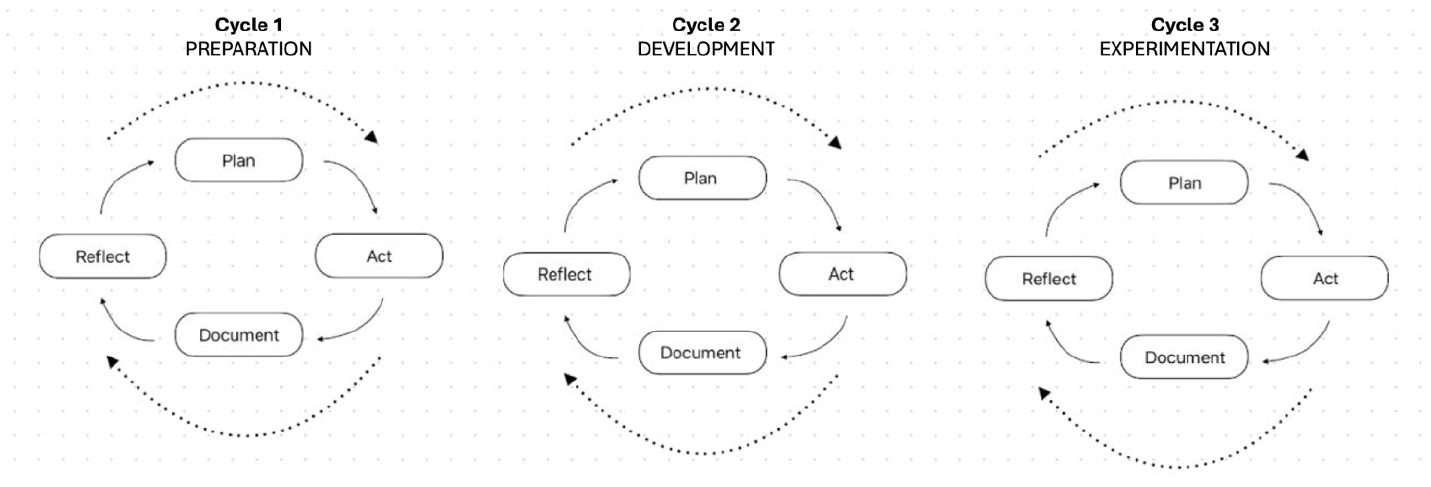
Action research cycles.
Overview of the three interrelated cycles (Preparation, Development, Experimentation) and their shared iterative structure (plan–act–document–reflect).
Each cycle is presented as a dynamic and evolving process, encompassing a series of targeted activities, clearly defined objectives, and significant outcomes. Together, they contributed to establishing a learning environment that emphasizes and empowers the critical role of teachers as active curriculum designers. This iterative process was systematically structured around four key actions—planning, acting, documenting, and reflecting—which provided the methodological backbone of the study, ensuring rigor, adaptability, and sustained critical engagement across all stages of the action research.
Cycle 1—Preparation
The first cycle of action research, developed between September and October 2021, focused primarily on two key tasks: the selection and organization of materials that could serve as a basis for the work intended to be developed with teachers, and the creation of a basic structure to support the process of reading and interpreting the Curricular Guidelines for ICT.
Plan
During the planning phase of the first cycle of action research, significant effort was put into meticulous preparation of documentation to involve teachers. This phase was critical for key decision-making, particularly regarding the selection and organization of documentation, as well as supporting materials that could facilitate the recognition and assessment of learners’ digital competencies. To guide this effort, the research team first explored the current Curricular Guidelines for Information and Communication Technologies (CG-ICT), followed by systematic mapping of essential learning in the digital domain. In line with the principles of coherence and sequential learning—which help ensure equal access to the essential curricular learning—the research team chose not to limit this mapping to primary education (first 4 years of schooling), but also to include the subsequent cycle (covering the fifth and sixth years of schooling).
Act
Building upon the planning phase, this first cycle of action research centered on analyzing the Guidelines and Essential Learning for ICT, covering both primary and lower secondary levels. This detailed analysis of official curriculum documents was aimed at mapping the knowledge, skills, and attitudes outlined in the ICT area, considering the progression throughout different years of schooling.
Document
The document analysis was rigorously recorded and structured to identify how digital competence is articulated in both primary and lower secondary education. In conducting this analysis, an analytical approach was adopted to compile the learning outcomes recommended in the official documents mentioned above, organizing them in a tabular structure to facilitate the identification of patterns, inconsistencies, and gaps. In broad terms, the analysis highlights the presence of some descriptors with ambiguous wording, the lack of evident progression from year to year, some inconsistencies in the terminology used to define learning domains, and a predominance of procedural learning outcomes over factual and, above all, attitudinal learning.
Reflect
Based on the internal reflection carried out by the team of researchers—and supported by the results of the document analysis—a provisional competency matrix was developed to stimulate a critical reading of the digital competencies outlined in the current curricular documents among teachers. This matrix provided a foundational tool that enabled teachers to visualize and question the coherence and coverage of digital competencies. In addition to incorporating the competencies set out in the ICT Curricular Guidelines, the provisional competence matrix introduced two important innovations: (i) the organization of the competencies recommended in the guidelines into three categories: Knowledge, Skills, and Attitudes, and (ii) a proposal for a structured clarification of the targeted competencies per year of schooling. This reflective stage fostered a shared understanding within the team and set a critical baseline for subsequent collaborative refinement during the next cycle.
Cycle 2—Development
Cycle 2 of the action research, conducted from November 2021 to January 2022, culminated in the collaborative publication of the Student Digital Competence Framework for Primary Education (Cruz et al., 2022). This phase was characterized by a collaborative and iterative approach, emphasizing the teacher’s central role in decision-making about “what” should be learned at school, particularly in the digital sphere. The results of this cycle reflect the collaborative refinement of the digital competence matrix and the teachers’ active involvement in defining a practical and contextually grounded framework.
Plan
To promote the professional development of teachers within the project network, the research team designed a flexible initial plan that allowed for dynamic adaptation to the interaction established with teachers throughout the process. This plan outlined three virtual meetings, each lasting 1 h and 30 minutes, complemented by autonomous tasks aimed at developing materials and ideas between sessions. The decision to conduct the sessions online was deemed appropriate given the ongoing challenges posed by the COVID-19 pandemic during this period, which continued to influence the organization of collaborative work and professional development activities. 5 Once this preliminary structure was in place, directors from 12 School Groups (SGs) in the municipality of Amadora were invited to nominate teachers for participation. Teachers were fully briefed about the project’s goals, methodology, and the nature of their involvement, and informed consent was obtained. Ultimately, 15 teachers from 9 SGs joined the initiative, demonstrating a strong commitment to collaborative engagement.
Act
Once teachers’ registrations were formalized, the research team started virtual work sessions, which took place between November and December 2021. The sessions focused on refining a shared understanding of digital competencies across primary education. The initial sessions focused on clarifying the project’s goals and methodology, followed by the formation of four “specialist groups,” each aligned with one of the domains of Digital Competence. These groups critically examined the competencies assigned to their domains and proposed adjustments based on their classroom experiences. In the final session, teachers’ contributions were synthesized into a shared framework, which was then published as the Student Digital Competence Framework for Primary Education on the project’s website (Cruz et al., 2022).
Document
Throughout the process, documentation was a fundamental part of recording and monitoring the development of activities. From the outset, detailed records of each step were retained, including records of virtual sessions, participant input, analysis carried out throughout the process, and records of decisions made. Moreover, materials and resources used during the working sessions were compiled, such as presentations, supporting documents, and examples of digital competencies discussed. This documentation not only enabled the smooth progression of the work but also facilitated retrospective analysis and the identification of critical areas, as discussed in the next section. All documents were stored in an organized and accessible manner in Google Classroom to ensure both the transparency and continuity of the process over time.
Reflect
Reflection, while formally concluding the cycle, was an ongoing process. A key outcome was the consensus on structuring the framework into two proficiency stages: Stage 1 (first 2 years) and Stage 2 (final 2 years) of primary education, providing greater clarity and ensuring developmental progression. Teachers’ contributions underscored the practical importance of including foundational skills such as “turning equipment on and off correctly,” highlighting the necessity to ground digital competence in everyday technological interactions. The emphasis on Domain 1 (“Safety, Responsibility, and Respect”) as a transversal dimension was a significant insight, reinforcing the ethical aspect across all digital activities. This collective reflection consolidated the framework’s practical value, reinforced its usability in varied classroom contexts, and reaffirmed the importance of teacher agency in the co-construction of meaningful digital competence development.
Cycle 3—Experimentation
The third cycle of action research, conducted between January and May 2022, continued the research process with a strong emphasis on practical application and the design and implementation of interdisciplinary activities. These activities aimed to develop students’ digital competencies (DCs) in alignment with the essential learning outcomes recommended in the official primary education curriculum. The outcomes of this cycle include teacher-designed interdisciplinary activities, structured using the Activity Planning with Technologies (APT) model, 6 and valuable insights into the challenges of aligning assessment strategies with curricular and digital learning objectives, as well as the recognition of the potential for collaborative work to enhance interdisciplinary integration and deepen pedagogical reflection among teachers. Below is an overview of the key decisions, procedures, and results achieved during each phase.
Plan
To test the framework previously developed in a real classroom setting and assess its suitability as a support tool for planning strategies intentionally designed to foster students’ DCs, the research team created an APT model. Based on previous studies (Costa et al., 2017), this model was designed to provide a robust, yet flexible structure for lesson planning. Specifically in this phase, the focus was on designing interdisciplinary activities that leverage the pedagogical potential of digital technologies. The APT model was structured to highlight key curricular elements, including the careful selection of digital competencies and integration of essential learning outcomes from other subjects within the primary education curriculum.
Act
With the APT model prepared and incorporated into the overall research strategy, the teachers were invited to design and share an activity relevant to their classroom context. To support this process, the research team provided a structured template, an example of a completed activity based on the same model, and references for inspirational work. Given the time constraints at the end of the school year, it was decided that lesson plans would be developed individually. Nevertheless, to encourage social learning, a digital wall was created to facilitate the sharing of activities designed by teachers, using the Student Digital Competence Framework for Primary Education. Among the 15 participating teachers, 13 developed and shared lesson plans, and some provided documentation on the implementation of their activities.
Document
During this phase, the research team focused on compiling, organizing, and analyzing the activities designed by teachers. The digital wall mentioned earlier served as an open repository, enabling knowledge exchange among the participants. Each lesson plan was characterized and analyzed according to the curricular elements embedded in the APT model. Overall, the activities covered all years of primary education. Most (12 out of 13) incorporated DCs across multiple domains and aligned them with essential learning outcomes from different areas of the curriculum. However, none of the activities included learning outcomes related to English or Physical Education. Regarding assessment strategies, teachers employed a variety of instruments, including evaluation grids, surveys, interactive questionnaires, and student-produced work. However, these strategies were often generic and did not explicitly focus on assessing learning outcomes related to DCs or the curriculum subjects identified in the lesson plans. In some cases, assessment focuses more on aspects of the teaching and learning process, such as compliance with rules or task engagement, rather than on evaluating student learning itself. This points to a need for greater coherence between the learning objectives, activities, and assessment strategies. Furthermore, the documentation phase revealed challenges in articulating learning outcomes in clear and measurable terms, which may have hindered the design of more robust evaluation tools.
Reflect
Reflecting on the work developed throughout the third cycle of action research, the APT model has emerged as a valuable tool for guiding teachers in the creation of interdisciplinary activities aimed at developing students’ DCs. As highlighted in the teachers’ reflections after the project (Luís et al., 2024), the model was appreciated not only for its role in structuring lesson plans, but also for encouraging deeper reflection on pedagogical practices. However, the analysis suggests that further refinement is needed to better support the design of activities that foster the development of DCs within the curriculum more explicitly and meaningfully. Additionally, there is an opportunity to strengthen guidance on assessment strategies, ensuring that they are more directly aligned with the learning outcomes identified in lesson plans, particularly concerning both DCs and essential learning from different subjects. Another key insight emerging from this cycle is the importance of collaborative work among teachers during the design process, as collective reflection and co-construction of activities could foster more comprehensive and intentional interdisciplinary integration, making it easier to embed digital competencies across curricular areas.
To summarize, the implemented work approach showed promise in encouraging teachers to actively engage in curriculum creation and execution. However, there are areas that could be improved, specifically by strengthening the incorporation of DCs across different subject areas, adjusting evaluation methods to better match curriculum objectives, and reinforcing the connection between innovative curricular practices and collaborative professional development among teachers.
Concluding discussion
This study sheds light on the persistent challenges associated with the intentional promotion of digital competencies in school contexts, underscoring the pivotal role of teachers as curriculum designers and creators of pedagogical strategies. However, placing the burden on teachers to interpret and implement sometimes complex curricula with ambiguities, gaps, or inconsistencies is an oversimplification. As noted by Priestley et al. (2015), teacher agency is not an isolated trait but rather a situated practice shaped by institutional, structural, and cultural factors. Thus, fostering teacher agency requires not only structural models but also systemic support mechanisms that encourage sustained professional development and reflective practices.
Action research conducted within the scope of the Escol@s Digitais Project offered a valuable opportunity to explore and recontextualize the Curricular Guidelines for Information and Communication Technologies (CG-ICT) in the specific context of primary schools in the municipality of Amadora. Based on the principles of action research (Efron and Ravid, 2013; Riel, 2019) and the assumptions of the Escol@s Digitais Project (Costa et al., 2022b) our dynamic and participatory approach actively engaged teachers in critical reading and recontextualization of curricular guidelines adapted to their specific needs and realities (Costa et al., 2024).
Acknowledging the inherent challenges in fostering collaborative dynamics, characterized by the formation of adaptable work teams (Binkhorst et al., 2015, 2017, 2018), the research team opted for a structured curricular deliberation model to guide and facilitate coordination among participants. Thus, in the initial preparation cycle, significant effort was devoted to the selection and organization of materials, establishing a basic structure to guide the process of reading and interpreting curricular guidelines.
Subsequently, the process transitioned to a developmental cycle culminating in the publication of the Student Digital Competence Framework for Primary Education (Cruz et al., 2022). This phase of action research was defined by the creation of a collaborative working group, which continuously interpreted and adapted existing curricular guidelines to ensure a practical and context-aware approach responsive to the needs of primary education students and the available school resources.
Despite concerted efforts to encourage an inclusive approach and enhance coherence between pedagogical practices across different contexts, documented evidence reveals a significant limitation of the project: limited representation from certain schools in this curriculum recontextualization process. This underscores the challenges related to acknowledging the significance of teacher agency and raises concerns regarding the necessity of ensuring that all schools facilitate moments conducive to curricular decision-making (Cavalcanty Dos Santos and Leite, 2020). As Selwyn (2016) critiques, the increasing centralization of digital education policies tends to shape technology adoption in ways that often overlook teachers’ professional judgments, reinforcing the need for structural support mechanisms that enable meaningful curricular adaptation. Therefore, this study further suggests that fostering teacher agency in digital education must go beyond policy recommendations, requiring institutional strategies that integrate professional learning communities and long-term mentorship programs to address the systemic constraints highlighted in Selwyn’s analysis.
During Cycle 3, dedicated to testing the previously constructed framework, teachers demonstrated strong appreciation for the APT model. As indicated by teachers’ reflections following the project (Luís et al., 2024), this model was valued not only for its role in structuring lesson plans to enhance digital competencies, but also for fostering deeper pedagogical reflection. The use of the model enabled teachers to critically assess the effectiveness of strategies implemented using technologies and pinpoint areas for enhancement. Thanks to its structured yet flexible design, the APT model emerges as a valuable resource for advancing curriculum development in educational contexts that aim to promote students’ digital competence by means of collaborative planning. However, as Vongalis-Macrow (2008) notes, ensuring that teachers act as transformative agents requires more than structural models; this transformation requires ongoing institutional support, professional learning communities, and policy alignment. While our findings suggest that professional collaboration facilitated through structured digital platforms has the potential to support curriculum innovation, further investigation is needed to determine the long-term sustainability and impact of these networks.
Additionally, the encouragement of sharing practices through a digital platform has proven to be a fundamental strategy for transforming teacher interaction and collaboration. This approach, akin to other strategies supporting lesson planning with digital tools (Masterman et al., 2013; Masterman and Manton, 2011; Pozzi et al., 2020), likely facilitates the transition from predominantly individual to online collaborative practices, making knowledge exchange more accessible. Nevertheless, the sustainability of such initiatives remains a challenge, as research has shown that collaboration is most effective when supported by structured reflection and professional dialog within school communities (Novoa-Echaurren, 2024). While this study observed initial engagement with digital collaboration platforms, additional research is needed to assess whether these practices persist beyond the scope of structured interventions.
As this study was carried out in a specific context (public primary schools in Amadora, Portugal), its contextual nature constitutes a limitation regarding broader applicability. Therefore, rather than focusing on the refinement of frameworks, future research should prioritize the conditions that enable teachers to adapt and implement these frameworks effectively, ensuring their relevance across diverse educational settings (Novoa-Echaurren, 2024; Priestley et al., 2015). Furthermore, the small sample size (15 teachers) should be acknowledged as a methodological limitation, as it constrained the diversity of the perspectives. In this sense, future research should examine how teacher agency develops across diverse institutional settings, focusing on the durability of collaborative digital practices over time. Investigating the long-term impact of action research on curriculum deliberation and teacher agency also offers deeper insights into the structural limitations that need to be addressed to foster meaningful and lasting changes.
Building on these reflections, this study provides empirical evidence of how teachers, when supported by collaborative action research, can take on an active role in recontextualizing national digital competence guidelines into locally meaningful curriculum practices. Theoretically, it contributes to the literature on teacher agency and digital competence by offering a situated example of curriculum recontextualization. Practically, it illustrates a scalable methodology for supporting teachers in the integration of digital competence into everyday pedagogical design. These contributions are particularly relevant considering the increasing demands placed on teachers to respond to national policies while maintaining pedagogical coherence with their local contexts.
By illustrating how the reading, analysis, and recontextualization of curricular frameworks and guidelines can be enhanced through collaboration between teachers and researchers, particularly in fostering students’ digital competencies in primary education, we hope that this study will contribute to a deeper understanding of teachers’ roles as curriculum designers. Engaging teachers, researchers, educational policymakers, and other stakeholders is crucial in renewing curricular and pedagogical practices. Only through such collaborative efforts can we bridge the gap between official curricular expectations and actual classroom practices, fostering pedagogical models that empower both teachers and students to navigate digital learning environments. As highlighted by Priestley et al. (2015), sustaining teacher agency and meaningful digital integration requires ongoing institutional support, professional collaboration, and policy alignment.
Footnotes
Acknowledgements
The authors would like to acknowledge the support of FCT – Foundation for Science and Technology, I.P., through national funds under the project UIDB/04312/2020, which contributed to the dissemination of this research.
Declaration of conflicting interests
The author(s) declared no potential conflicts of interest with respect to the research, authorship, and/or publication of this article.
Funding
The author(s) received no financial support for the research, authorship, and/or publication of this article.
