




Abstract
European educational research is heterogeneous. It contains diverse areas of inquiry, types of disciplinary knowledge, methodological approaches, and philosophical foundations. This raises questions about what European educational research is about and where its boundaries lie. On the occasion of the European Educational Research Association’s 30th anniversary, and by use of the data mining technique topic modelling, this paper presents the results of an analysis of the abstracts database of the European Conferences on Educational Research (ECER; 1998–2024). In doing this, this paper uses the ECER abstracts database as a window to reflect upon and discuss the state and futures of the European educational research field. This study identifies 100 distinct topics in European educational research, defined as clusters of words that tend to be used together within the ECER abstracts. In addition to this, the study analyses the trajectory of these topics’ prevalence over time. Based on these findings, we highlight four central thematical evolutions in order to instigate a debate about the scope, focus and future of the field. In a response to these four clusters, we identify three key issues for the research field: the effects of policy and funding programmes, the ongoing diversification, and the question of the centrality of education.
Keywords
Introduction
European educational research is a house with many rooms. It is a vast, multifaceted field that contains diverse areas of inquiry and specialisation. The European Educational Research Association (EERA) has acknowledged this heterogeneity of educational research since its very beginning in 1994. Indeed, from the outset, EERA was envisioned as an umbrella organisation ‘that could encompass all the different strands of educational research’ and was consequently based on ‘a broadly defined, unrestricted concept of educational research’ (Gretler, 2007: 176). However, this also makes it a challenge to understand the field, that is: to know and discuss what European educational research is about. In a response to this and on the occasion of EERA’s 30th anniversary in 2024, this paper presents and discusses the findings of an analysis of the abstracts of the European Conferences on Educational Research (ECER).
In a content analysis of the extensive ECER abstracts database, the aim of the project was to identify the most important themes or research topics (substantive, theoretical and methodological) that have been addressed in three decennia of ECERs to create insight into the very diverse work that has already been done in the field. In doing so, the aim was also to open up for a broader discussion on the scope and focus of the field. The empirical analysis of the ECER abstracts database was done through the automated content analysis technique topic modelling (Blei et al., 2003; Griffiths and Steyvers, 2004), which is specifically designed for the analysis of a large collection of texts (i.e. a corpus). Topic modelling is a powerful text mining technique that enables to analyse latent (i.e. hidden or not manifest) meaning from a body of text by investigating large patterns over multiple texts. It allows to reduce the complexity of a corpus by finding ‘topics’ as groups of words that tend to be used together in texts throughout the corpus (Barde and Bainwad, 2017). This means that while such an approach is not able to provide detailed insights into the nuances of individual texts, it does allow to study large patterns over multiple texts, in line with the aims of this study.
In addition to merely studying the abstracts database itself, this study also uses the abstracts database as a window into the wider field of European educational research. In doing this, we acknowledge that no single window offers a comprehensive view. Indeed, despite ECER’s size and scope, conference abstracts can always only offer a partial view of a research field. However, in this paper we argue that analysing the ECER abstracts database (as empirical object) does allow us to gain valuable and important insights into the wider European educational research field (as knowledge object). In doing this, the present paper first of all provides an insight into the dominant topics in European educational research and how their prevalence has evolved over time. However, in educational research there is an important distinction to be made between ‘knowing that’ and ‘knowing how to go on’ (see e.g. Ruitenberg, 2012; Smeyers, 2013). We argue that this distinction is also valid for knowledge about educational research. This means that the results in themselves do not say anything about ‘how to go on’ with European educational research. For example, knowing that topic A or B has become more prevalent in the field in itself says very little about how to go on (e.g. whether or not that increase in prevalence should be applauded or criticised and in what way). In this light, we emphasise that the results of the topic modelling should not be interpreted as a guide, but rather as a support (cf. Allen, 2018) that allows to open up a debate about the present and future of the European educational research landscape. We believe that the specific inductive methodological approach allows to question what might have been taken for granted and in doing so open up new pathways for debate regarding what European educational research is or should aim to achieve. The goal is thus to instigate and enable questioning, discussing, and building (cf. Latour, 2004) concerning the objectives and scope of European educational research, including its present focus and future direction. In the words of Simons et al. (2005) on critical educational research: ‘To let appear the present as a question [. . .] exposes the present and brings it out of position’ (829). This paper thus first of all puts something on the table to discuss and intends to open up and instigate a debate about the state and future of European educational research as a whole. To that end, the paper builds further on a panel discussion at ECER 2024 in Nicosia to present and offer an initial discussion of the results of the topic modelling analysis. 1
The paper continues with an elaboration of the study’s object of knowledge – European educational research – and its relation to EERA. This is followed by a discussion of the methodological approach in Section 3 and an initial results section in which we present the findings of the topic modelling (Section 4). In the subsequent Section 5, we further delve into the topics and present four thematic clusters in order to open a debate about the field. In the discussion Section 6, we then continue by identifying three key issues for European educational research. The goal here is thus not to settle any discussion, but to tease out various aspects and perspectives so that the debate can continue with focus and clarity. The paper ends with a future-oriented conclusion.
European educational research and EERA
The notion of European educational research is not necessarily a self-evident one. Indeed, whether or not there should be any limits to what we call educational research and what precisely is meant by European educational research is not set in stone. Furthermore, both questions are related. For instance, the different understandings between Anglo/American and continental traditions in Europe in how education is either seen as a field of practice to be researched through other disciplines or as a discipline in its own right (pädagogik/didaktik) have a profound impact on the research conducted (Alexander, 2009; Biesta, 2011; Kvernbekk, 2023). In addition to the existence of different traditions, there is the question of the existence of a European educational research space. The EERA mission states that this space requires that research not only acknowledges its own context but also recognises wider, transnational contexts with their social, cultural and political similarities and differences. But the requirement that an abstract for the ECER conference must reflect a European dimension has throughout the history of the organisation been contested. For some, ‘European’ means addressing relevant educational themes beyond a national context, for others, the requirement is redundant, thinking their educational research is generic. Related, historical observations on the founding of EERA (Gretler, 2007) underline the fundamental need to establish cooperation and communication between the various educational research communities in Europe. Indeed, European educational research can be traced back to different national and regional contexts and research cultures and thus to different disciplinary perspectives and a variety of theoretical and methodological approaches (Keiner, 2006; Knaupp et al., 2014). To enhance communication between these research communities, thematic networks within EERA have been established and evolved over time (Figueiredo et al., 2014) and the European Educational Research Journal (EERJ) was initiated (Lindblad, 2014) with the aim of creating a European research area (Lawn, 2002). However, while throughout the years a stable space for European educational research has been formed (Lawn, 2014), disparities in participation and research output are a concern. Kenk (2003), for example, points to the dominance of conference participants from Western and Northern Europe and Bouillet and Jokić (2019) describe the necessary development of research activity in the post-socialist countries of Europe. Scholars from Western and Northern Europe continue to dominate the discourse, leaving researchers from Southern, Eastern and post-socialist countries less visible in the broader European research arena. Furthermore, there are challenges related to language barriers, funding disparities, and access to research infrastructure that hinder full participation from less-advantaged regions. Keeping such inclusivity issues in mind, the present paper takes a specific approach in investigating what European educational research is about by empirically analysing the ECER abstracts database as window into European educational research.
Methodology
Introducing topic modelling
Central in this study is the use of the powerful text mining method topic modelling (Blei et al., 2003; Griffiths and Steyvers, 2004) to analyse conference abstracts. Topic modelling allows to do an automated content analysis of large collections of texts by identifying ‘topics’ as ‘collections of words that have a high probability of co-occurrence’ within texts throughout the corpus (Jaworska and Nanda, 2018: 11). Topic modelling is a form of ‘distant reading’ in which a large collection of texts is analysed for the bigger picture, as opposed to ‘close reading’, in which individual texts are read (cf. Moretti, 2000; Wiedemann, 2013). Indeed, topic modelling enables to analyse latent meaning from texts by investigating large patterns over multiple texts. This latent meaning comes in the form of topics, clusters of ‘words that have a high probability of co-occurrence and not topics as we understand the term in everyday language’ (Jaworska and Nanda, 2018: 11). Indeed, ‘the interpretation of these clusters [of words] as themes, frames, issues, or other latent concepts (such as discourses) depends on the methodological and theoretical choices made by the analyst’ (Jacobs and Tschötschel, 2019: 471). This study applies a probabilistic method for topic modelling: latent Dirichlet allocation or LDA (Blei et al., 2003), one of the earliest and more frequently used topic modelling methods (Vayansky and Kumar, 2020).
The basic idea behind topic modelling is that texts are constructed from a finite set of topics and that texts address these topics to varying degrees which is reflected in the word use of these texts (Jaworska and Nanda, 2018). This means that, hypothetically speaking, when an author writes a text, s/he first decides what topics s/he will write about from a finite number of topics, for example about the topics agriculture and food. Each of these topics consists of a limited number of words. The topic on agriculture, for example, consists of the words farm, cow, milk, field and tractor; the topic on food consists of the words milk, beef, vegan, lunch. In a second step, the author uses a selection of words from the two topics s/he chose to construct the text. Topic modelling’s aim is to reverse this process through using algorithms that ‘analyze the words of the original texts to discover the themes that run through them’ (Blei, 2012: 77). It is important to emphasise that the topics are not given a priori (Rosen-Zvi et al., 2004). The topic modelling technique applied is unsupervised which makes it a highly inductive method that allows for empirical surprises. The main outcome of topic modelling consists of a list of topics as clusters of words that have a high probability of occurring together in texts in the corpus. In addition to this, the output also provides insight into the topic proportions per document and through this gives the possibility to, for example, analyse temporal differences within a corpus.
ECER abstracts database
In this study, topic modelling was applied to the ECER abstracts database which was made available to us by EERA in spring 2024. 2 ECER is a yearly European conference on educational research which has been hosted in various locations across Europe since its first edition in 1992 in the Netherlands, attracting scholars from a diverse array of countries. The ECER database contains contributions from authors from 118 countries (Christ et al., 2024). 3 Since the beginning of the database, ECER has seen a substantial growth which is also reflected in the corpus analysed in this study, as is visualised in Figure 1. The available database of ECER abstracts contained abstracts of all ECERs since ECER 1998. This entails 25 editions. Because ECER 2020 was cancelled due to COVID-19, the 2020 abstracts were not added to the database since there was a significant overlap with the abstracts submitted for ECER 2021 and doubles in the database have a negative impact on topic modelling. The study being conducted in spring 2024, it was possible to supplement this database with the accepted abstracts for ECER 2024 in Nicosia (Cyprus). In total, this resulted in an initial raw and uncleaned database of 43,219 contributions spanning 26 editions over 27 years. 4 Of this uncleaned database, a number of contributions still needed to be excluded, which will be elaborated in the next section on methodological choices. The final corpus for topic modelling contained 35,172 abstracts.
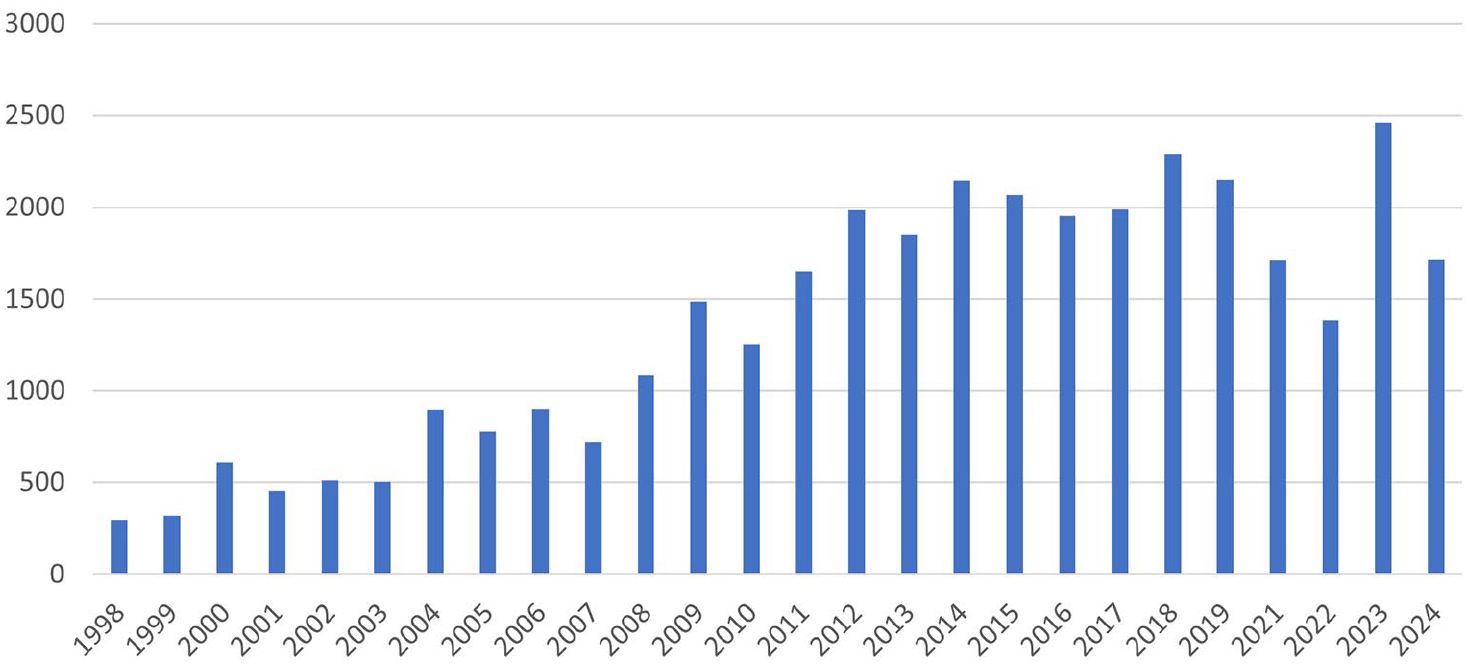
Evolution of number of abstracts per year in the cleaned corpus.
There are a number of strengths and limitations involved in the choice for ECER abstracts as object of study. We acknowledge that ECER is not fully representative for the field as a whole, that there are other conferences on educational research in Europe with varying focuses, and that conferences (let alone conference abstracts) do not offer a full view on what research is and does. Indeed, no conference can cover the full scope of European educational research regarding research topics and approaches. Relatedly, as already discussed in relation to European educational research, it is important to keep in mind that not all voices are represented in conferences as, for example, not every researcher or research environment has the resources to attend conferences and this might correlate with geographic location and/or research focus. However, based on the above-mentioned wide focus of EERA/ECER in combination with the wide scope and spread of the conference we argue that the ECER abstracts database offers a unique window into European educational research and hence also offers a unique opportunity to empirically analyse and discuss it.
Methodological choices
Topic modelling does not remove the researcher out of the equation. Concerning database curation, cleaning of the abstracts, and the actual topic modelling itself, a number of important choices are to be made and tested throughout the process. This section briefly elaborates upon those choices. It is important to note that these steps are part of an iterative process consisting of curating and cleaning actions, alterations of the topic modelling parameters, running new models, and analysing the topics.
The initial uncleaned database entailed 43,219 contributions. However, a number of contributions needed to be excluded before the topic modelling could commence. The exclusion criteria for this curation of the initial database related to two aspects. First of all, every included abstract should allow us to say something about what educational research is about. Secondly, topic modelling has some technical requirements for the database: ‘the unit of analysis should be a segment of text that is large enough to measure word co-occurrences but small enough that it can reasonably be assumed to contain a small number of themes’. (Jockers and Mimno, 2012: 6) and it is rather sensitive for texts occurring more than once in the corpus. Taken together, this means that contributions were excluded if they had been rejected, withdrawn or cancelled, contained fewer than 200 letters, were not an actual ECER abstract (e.g. no network sessions, EERA sessions, Emerging Researchers Conference paper), occurred more than once in the database, 5 or were not in English. 6
In addition to curating the corpus as a whole, individual abstracts also need to be cleaned in order to prepare the data for the topic modelling. A number of steps were taken: All punctuation and numbers were removed from the corpus. Stopwords were removed from the abstracts by means of a basic English stopwords list. Stopwords are commonly used uninformative words that do not contribute in meaningful way to answering the research question. Removing them is a common step in any natural language processing technique (Sarica and Luo, 2021). 7 Additional words were removed as well because they muddled or skewed the results of the topic modelling (i.e. resulted in less interesting topics in function of the central research question). 8 Furthermore, words were lemmatised using a standard dictionary with some custom alterations. 9 The spelling of all words was changed to British English so that differently-spelt words would be recognised by the software as the same word. Certain multi-word terms were connected to be recognised as one word in the topic modelling (e.g. higher_education). Finally, the corpus was pruned in order to remove words that only occurred in 20 or fewer abstracts.
The actual topic modelling itself was done in MALLET, an open-source, java-based package for natural language processing which uses so-called vanilla LDA for topic modelling. 10 Many different topic modelling solutions were analysed in function of evaluating the curating and cleaning actions described above and in function of deciding upon the right topic modelling parameters. The most important choice to be made regarding these parameters is to decide the amount of topics that should be identified. This has an impact on the granularity of the results. A solution with few topics will provide general topics whereas a solution with a lot of topics will result in small and very specific topics. Trials with solutions between 50 and 300 topics were ran and the interpretability of the topics for these solutions was assessed in relation to the research question at hand. Based on this qualitative assessment, the decision was made to settle for a 100 topics solution as this provided a balanced level of granularity: Topics that offer a meaningful and nuanced insight into the corpus while still allowing to have overarching discussions about the field. In addition to this, we ran 3000 iterations with hyperparameter optimisation every 400 iterations and a burn-in at the 600th iteration.
In a next step, every topic was given a descriptive label. The interpretation of the topics was done through a combination of inductive reasoning and the authors’ expertise of the field based on (1) the analysis of the top 20 words of every topic and (2) the analysis of the most prominent abstracts of every topic. The latter move allows to investigate how the top words are used in a written context. Because topic modelling incorporates polysemy (Jacobs and Tschötschel, 2019), words have different meanings in different contexts which implies context-sensitivity in the interpretation of the topics is important.
Finally, based on the topic composition of the abstracts, the yearly average prevalence of words related to every topic was calculated. This allowed to trace how the topics’ prevalence in the corpus has evolved since 1998. Because the starting point is the topic composition of every single abstract, varying abstract lengths do not affect the calculations (i.e. long abstracts do not have more weight in the calculations than short ones). In addition to this, because the prevalence per year is not expressed in absolute but in relative terms, the rising number of ECER contributions per year is taken into account. This means that a topic with a constant prevalence throughout the years is actually growing in absolute terms.
General description of the results
Overview of the topics
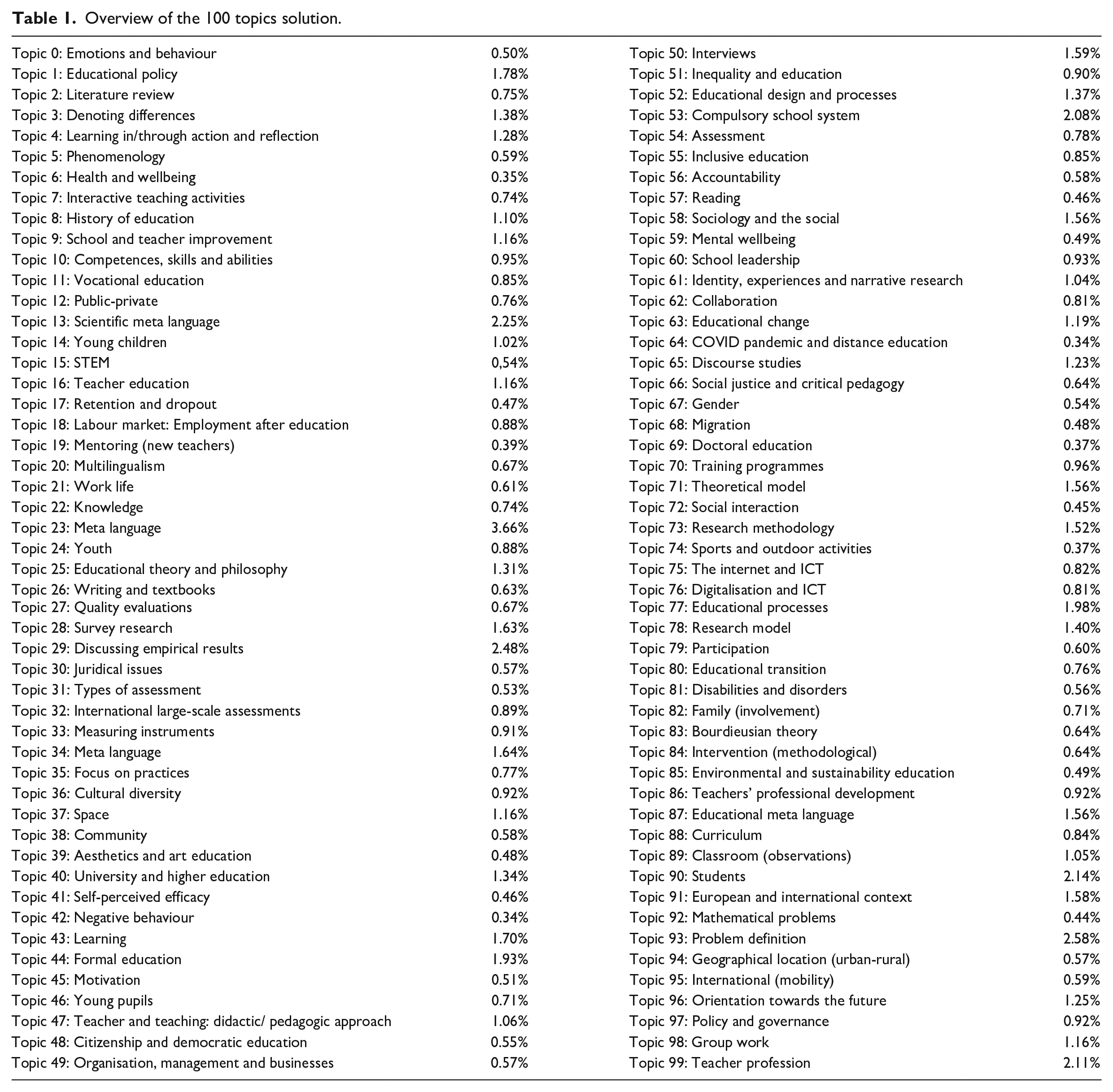
Through topic modelling, we identified 100 topics in the ECER abstracts. Table 1 provides a general overview of these 100 topics (topics 0–99 11 ) with their respective descriptive labels and relative prevalences (in %) in the corpus. Topic 0 on emotions and behaviour, for example, has a relative prevalence of 0.50% in the corpus. A full overview of all topics including their top 15 words is provided in Appendix 1. 12
Overview of the 100 topics solution.
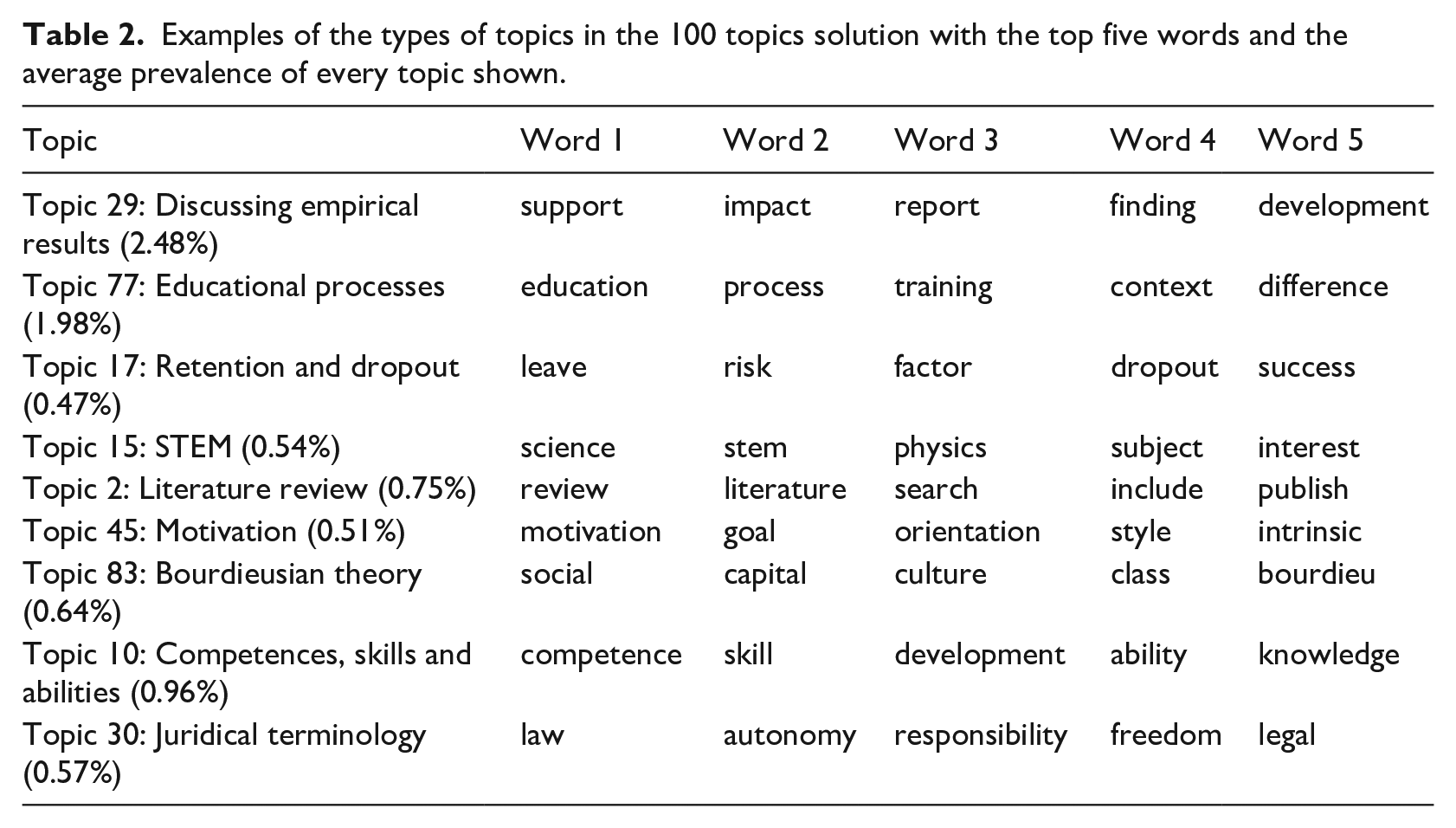
As can be seen in Table 1 and Appendix 1, the extracted topics vary considerably in scope and focus. In order to offer a first insight into the results, we will start by exploring some examples. Table 2 gives an overview of the top five words of these examples. First of all, some topics can be described as meta language, for example the discussion of empirical results (topic 29). Such topics can also be expected in other social science abstracts databases. While some topics address general themes such as educational processes (topic 77), other topics denote very specific research interests such as retention and dropout (topic 17), or specific educational content such as STEM (topic 15). Some of the topics represent specific methodological approaches such as literature reviews (topic 2) or characterise thematic interests such as motivation (topic 45). Finally, some of the topics deal with specific theoretical approaches such as Bourdieusian theory (topic 83) or point at specific ways to approach education such as competences, skills and abilities (topic 10) or a juridical point of view (topic 30).
Examples of the types of topics in the 100 topics solution with the top five words and the average prevalence of every topic shown.
Most influential topics
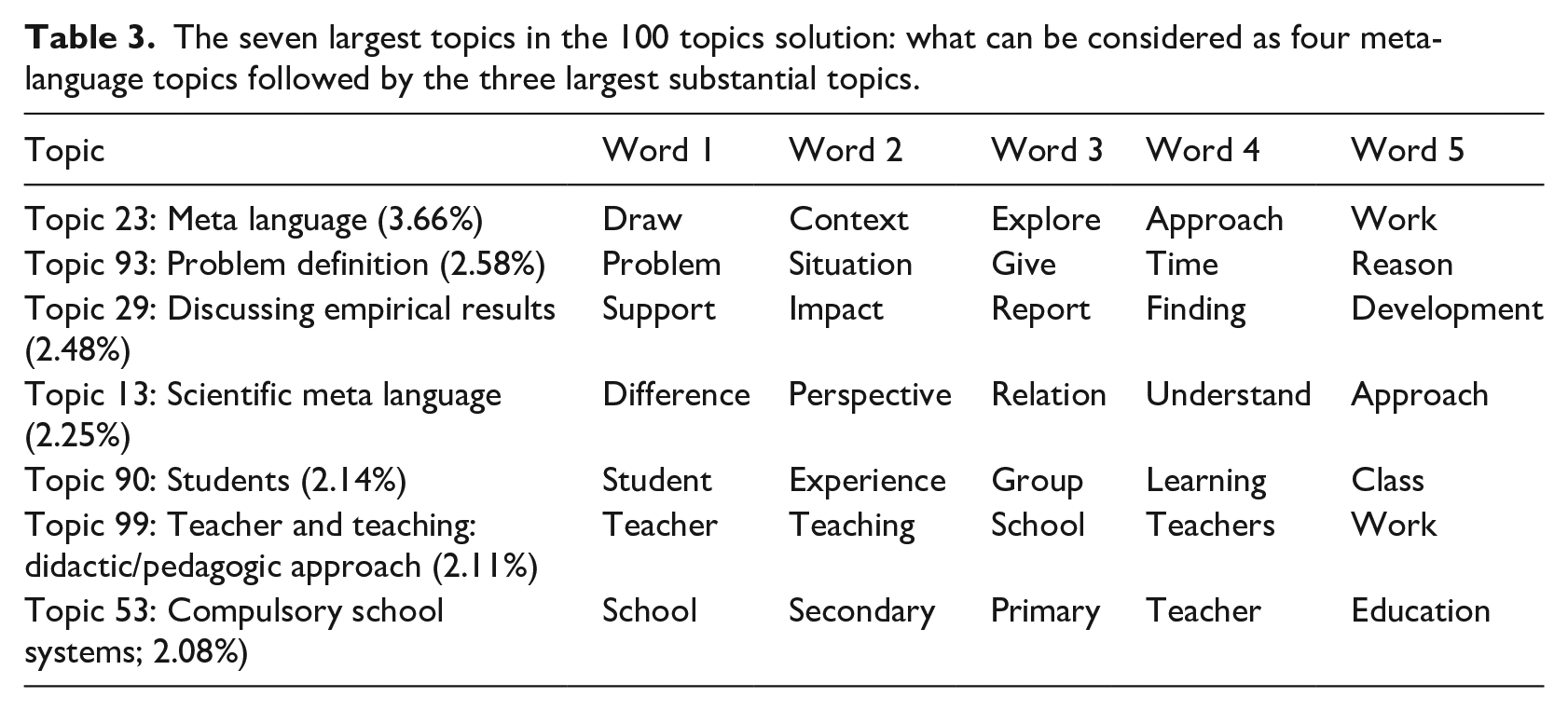
In a 100 topics solution, the topics on average have a prevalence of 1%. However, the topics vary considerably in size. Whereas the largest topic has a prevalence of 3.66% (topic 23, meta language), the smallest topic only represents on average 0.44% of the content of the abstracts (topic 42: negative behaviour). Zooming in on the largest topics gives us a first meaningful insight into the abstracts database. The four largest topics in the 100 topic solution can be understood as so-called meta language topics. These are topics that do not specifically reflect aspects of education and educational research in themselves. The largest topic (topic 23), for example, contains top words as draw, context, explore, and approach. The second largest topic can also be described as a meta-language topic but relates closely to scientific problem definitions and how they can be addressed (topic 93). This is followed by the discussion of empirical results (topic 29) and more general scientific meta language (topic 13). It may be clear that in these meta language topics, education does not play a (central) role. If we look past these four topics, we find the top three substantial topics of the corpus: students (topic 90), the teacher profession (topic 99), and compulsory school systems (topic 53). Table 3 provides an overview of these largest topics.
The seven largest topics in the 100 topics solution: what can be considered as four meta-language topics followed by the three largest substantial topics.
Thematical clusters in the topics
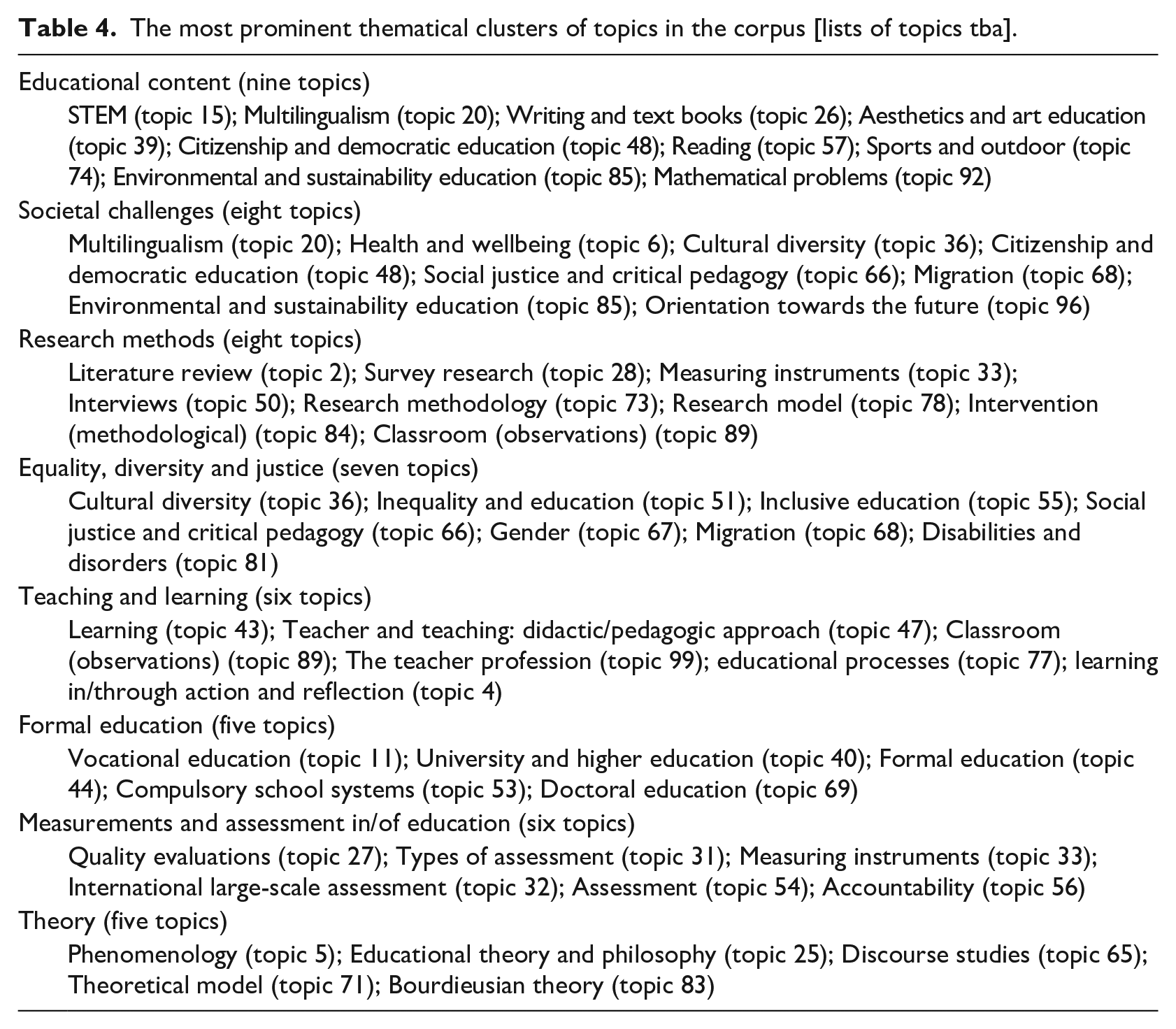
In addition to the meta language topics, it is possible to identify a number of other overlapping clusters in the topics. Zooming in on a number of these clusters allows to provide a further insight into the ECER abstracts database. Table 4 provides an overview of the most prominent thematical clusters in the 100 topics solution and shows the variety of types of topics addressed in the corpus. The largest cluster holds nine topics that focus on specific areas of educational content such as STEM (topic 15). A second important thematical cluster is formed by eight topics on (education focussed on) societal challenges such as sustainability (topic 85). Research methods (eight topics) and theory (five topics) are also prominent in the results, just as more traditional educational research themes such as teaching and learning (six topics) and topics related to formal education systems (five topics). Seven topics address a wide array of themes related to equality, diversity and justice such as the relation between inequality and education (topic 51). A final large thematical cluster centres around measurements and assessments, both of and in education (six topics). Here we find topics such as quality evaluations (topic 27) and types of assessment (topic 31).
The most prominent thematical clusters of topics in the corpus [lists of topics tba].
Evolution of topics
In addition to merely identifying topics, topic modelling also allows to analyse how topics have evolved over time (Griffiths and Steyvers, 2004). This means that we can trace how attention for particular topics has increased or decreased in the ECER abstracts database since 1998. The evolution of the 100 topics is presented in Appendix 2 and was calculated based on the topic proportion per document output of MALLET. An example of the evolution of a topic is shown in Figure 2 for international large-scale assessments (ILSAs) such as PISA and TIMSS (topic 32 (0.89%) with top words country, PISA, international, OECD and education). Figure 2 shows a clear peak in 2011 (1.40%) and a steady decline since with a prevalence of 0.56% in 2024. Zooming in on the evolution of topics provides valuable insight into how the attention a topic receives varies over time and allows to connect this to other research on the field or on wider societal evolutions. Our findings regarding ILSAs, for example, are in line with the results of a recent study on attention for ILSAs based on Google searches showing that the global interest in ILSAs has peaked in 2012 and has declined since (Jerrim, 2024).
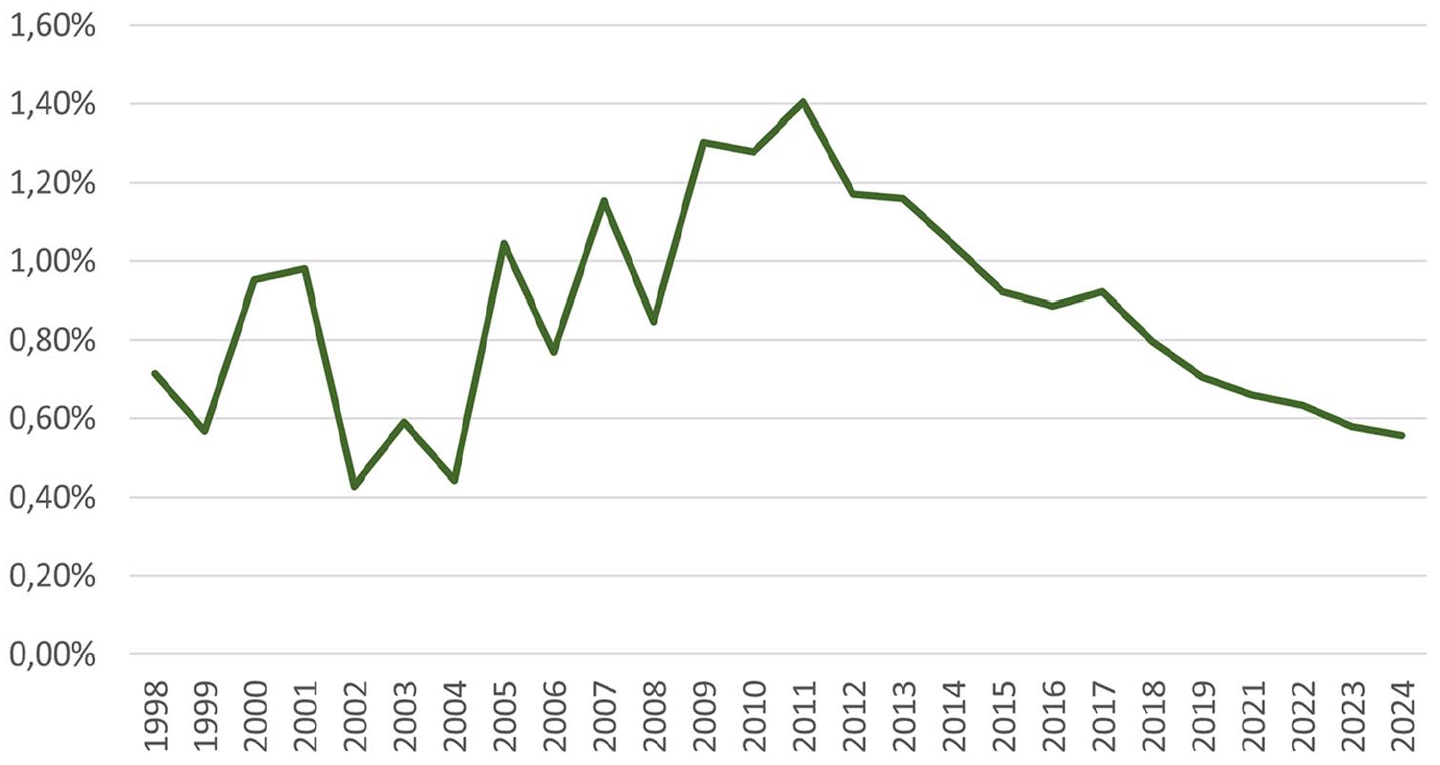
The evolution of attention for international large-scale assessments (topic 32).
In interpreting the evolution of the topics over time, it is paramount to also take the considerable increase in the number of abstracts per year in the ECER abstracts database into account (as discussed in Section 3). This means that a decline in relative numbers in terms of prevalence does not imply a decline in absolute numbers. Furthermore, different topics require a different interpretation. Whereas the growth in topics on specific themes such as multilingualism (topic 20) primarily implies that more abstracts deal with this topic, the decrease of prevalence of a topic such as theoretical model (topic 71) primarily implies that authors dedicate a smaller portion of their abstracts to describing their theoretical models, approaches or frameworks.
Especially interesting in the temporal analysis of scientific topics, is to zoom in on so-called hot and cold topics in the field, topics that are respectively marked by an increasing or decreasing linear trend (see e.g. Bitterman and Fisher, 2018; Vander Beken et al., 2021). In combination with the thematical clusters presented in the previous section, a number of these hot and cold topics will be in the spotlight in the next section.
Delving into the topics
This paper intends to present elements for discussion in order to open a debate about the state and future of European research. While the results presented in the previous section and in Appendices 1 and 2 shed some light on the ECER abstracts database and, by extension, on what European educational research is (and is not) about, the sheer size of the dataset and scope of the study make it impossible to meaningfully discuss every noteworthy aspect of the findings. In line with – and inspired by – the panel discussion at ECER 2024 in Nicosia, in the present section we further delve into the topics. We do this by focussing on four thematical clusters in the results: (1) educational research and societal challenges; (2) methodology and theory; (3) formal educational structures and (4) teaching and learning. Zooming in on what we consider to be four crucial themes in the findings will allow for a meaningful discussion on what these findings might imply for the field.
Societal challenges
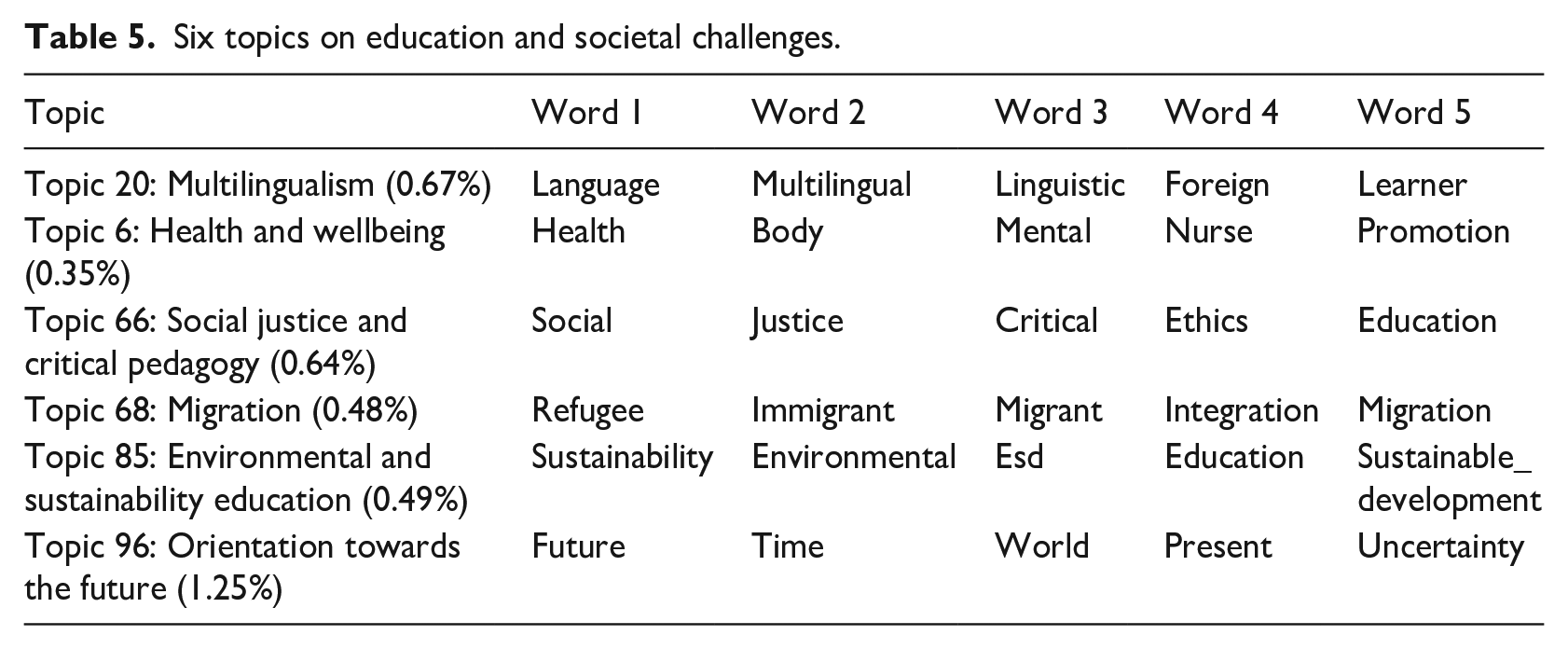
First of all, our findings show that educational research has an increasing attention for wider socio-political challenges. Topics such as environmental and sustainability education (topic 85), social justice and critical pedagogy (topic 66), health and wellbeing (topic 6), migration and multilingualism (respectively topic 68 and topic 20), and even orientation towards the future (topic 96) all show a stark growth in prevalence in the corpus. It should be noted that other societal challenges also come to the fore in the topics, but are not hot topics, that is: they do not show a notable increase in attention. Indeed, citizenship and democratic education (topic 48) and cultural diversity (topic 36) have a close connection to societal issues but have not increased in prevalence within the corpus. Table 5 gives an overview of the six hot topics on societal challenges with their prevalence (in %) and top five words.
Six topics on education and societal challenges.
The growth of these topics implies that the addressing of societal issues is moving more to the foreground in European educational research. It can be understood as an acknowledgement of the responsibility education and educational research have towards such wider societal issues. However, the present study does not allow us to say something about how these challenges are addressed, for example whether or not education is approached in an instrumental and linear way in order to solve these issues, or if education is seen to address these issues in a different way. Further research is necessary to find out whether this shift of educational research towards more attention for societal challenges also brings with it alternative understandings of what education is, does, and can do.
Methodology and theory
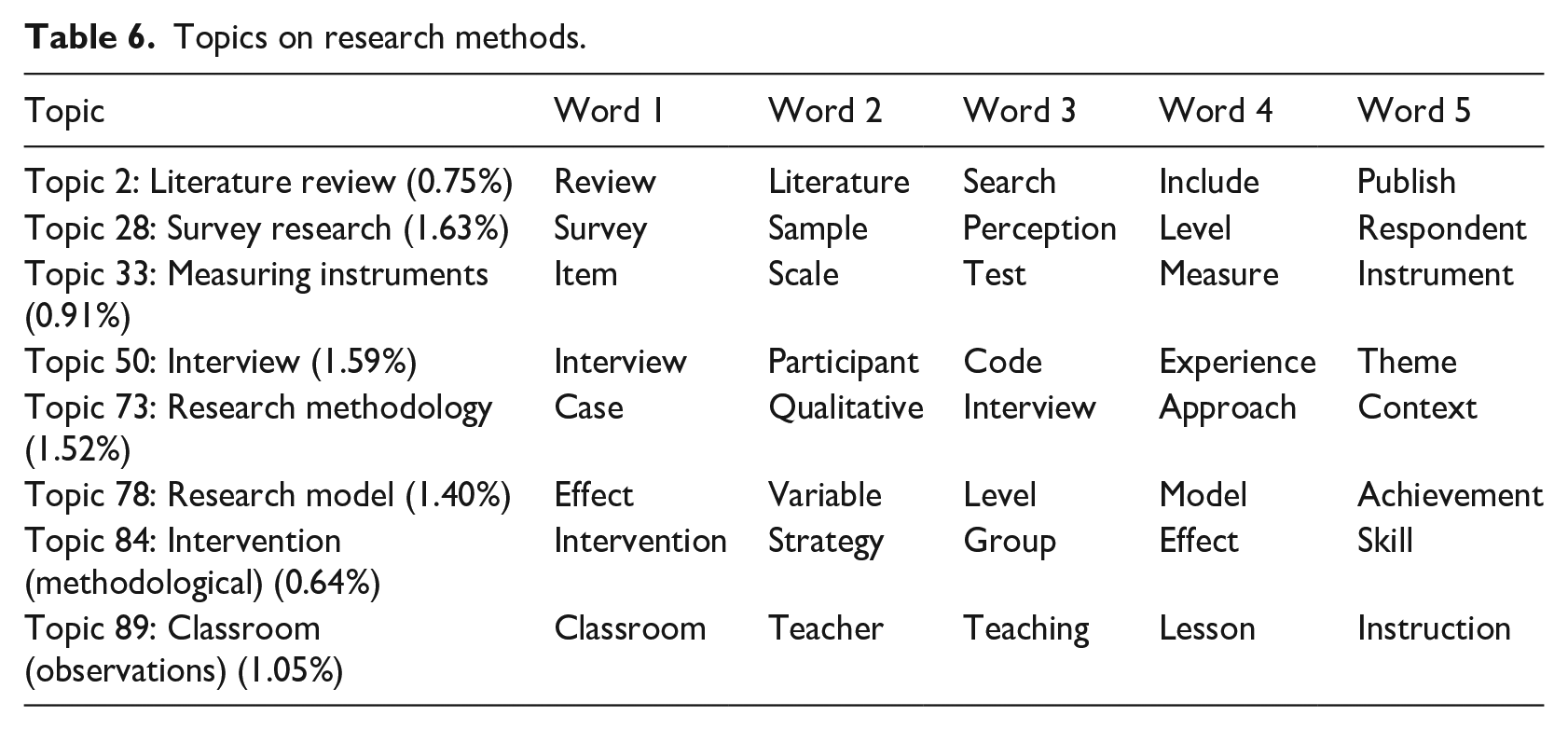
A second thematical cluster in the topics has to do with research methodology and theoretical frameworks which are at the centre of respectively eight and five topics. Table 6 provides an overview of the topics dedicated to methods and methodology, showing that both qualitative and quantitative approaches to educational research are represented in the corpus. Indeed, besides the more generic topic on research methodology (topic 73), the two data gathering methods surveys (topic 28) and interviews (topic 50) come to the fore as the most important methodological topics, closely followed by research model (topic 78). This is complemented by literature reviews (topic 2), measuring instruments (topic 33), interventions (topic 84), and classroom (observations) (topic 89). The latter is not purely a methodological topic, but focuses on what happens in the classroom and how this can be the empirical object of research.
Topics on research methods.
Overall, the attention for methodology in the ECER abstracts has grown throughout the years. This can partly be explained by the changing ECER abstracts requirements in which more attention has been giving to research methodology. However, of the eight methodological topics, only two show a clear and consistent increase in prevalence in the corpus and can thus be described as hot topics: literature reviews (topic 2) and interviews (topic 50). This is represented in Figure 3 in which can be seen that both topics approximately have tripled in size: the major increase for interviews starting around 2010 and the peak for literature reviews starting around 2017. The COVID crisis might be an explanation for some of the increase in literature reviews after 2021 (as data collection was complicated) but cannot account for it all of it. This implies that an important shift has taken place in European educational research towards the use of interviews and literature reviews as data gathering methods.
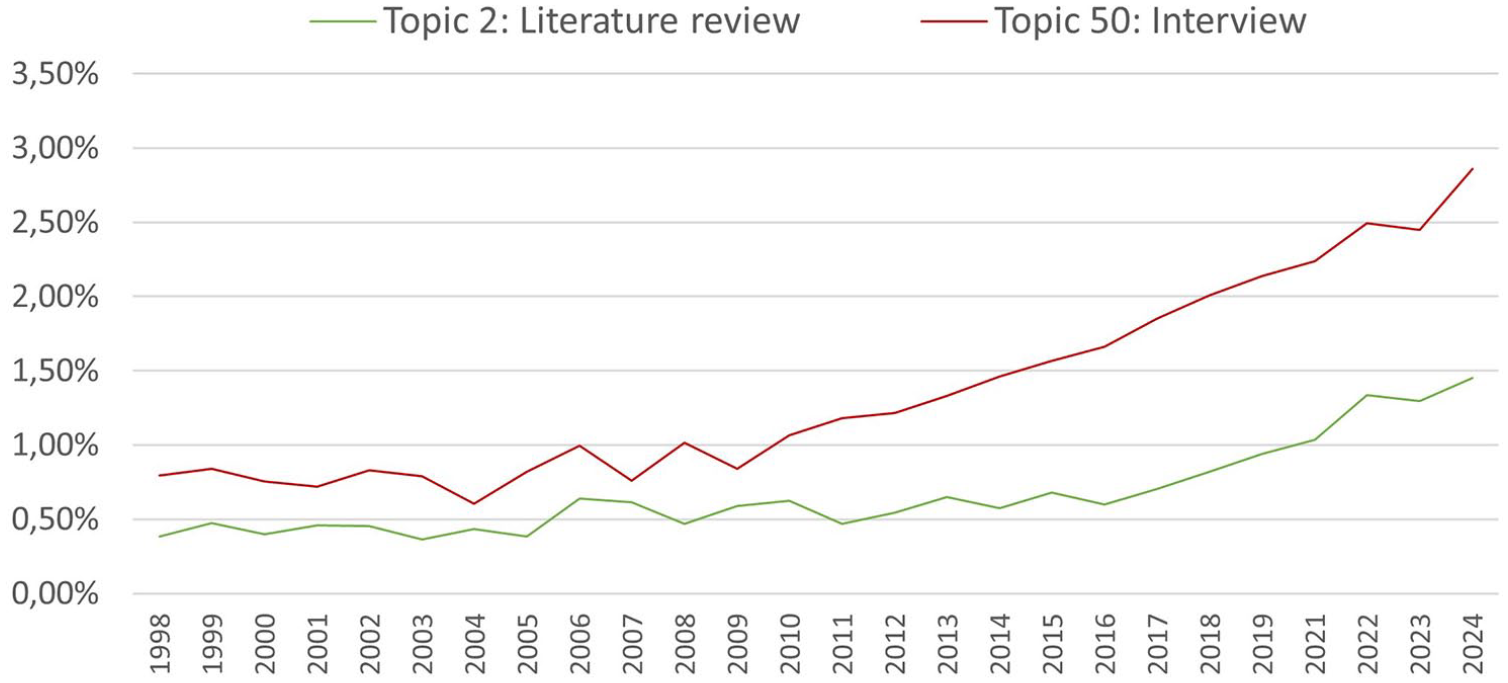
Evolution of literature review (topic 2) and interview (topic 50).
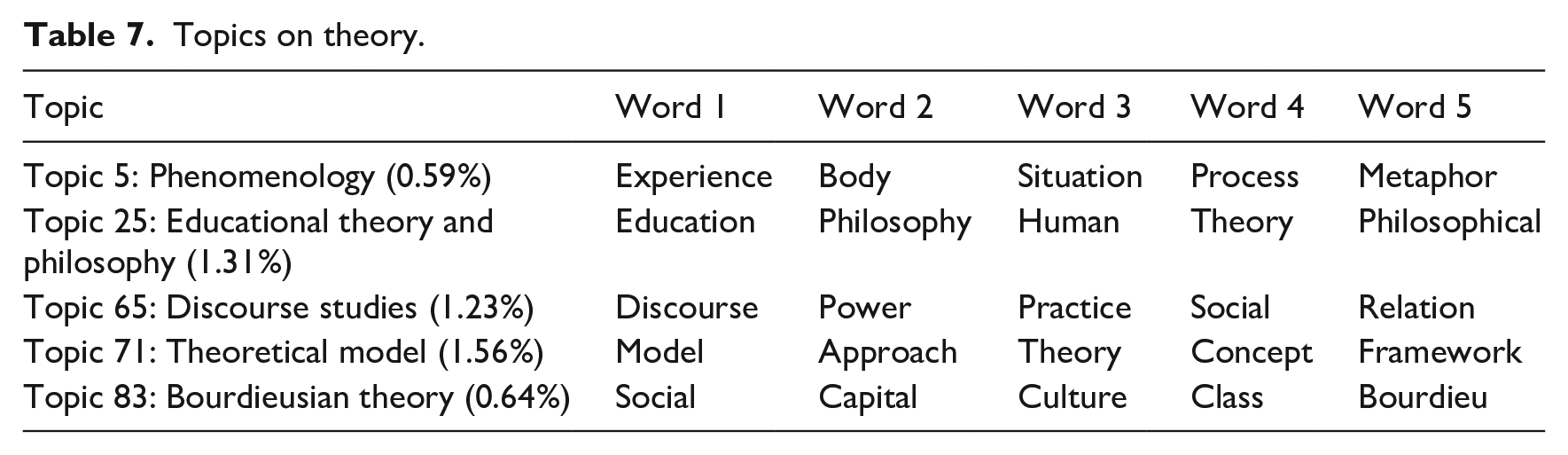
Five topics in the 100 topic solution have a direct link to theory. These topics are presented with top words in Table 7. Three of these topics, phenomenology (topic 5), discourse studies (topic 65) and Bourdieusian theory (topic 83), denote a specific theoretical stance or approach, of which discourse studies is the most prominent one (1.23%).
Topics on theory.
In addition to this, topic 25 focuses on educational theory and philosophy and topic 71 describes the theoretical models, frameworks and approaches used in studies. Given their overarching focus on the theoretical backbone of the field, it is worthwhile to have a closer look at the evolution of the latter two (see Figure 4). Whereas theoretical model (topic 71) still had a prevalence of 2.12% in 2009, it has decreased and flatlined in the past years around 1.30%. A similar evolution can be seen for educational theory and philosophy. Taken together, this implies that less importance is given to the theoretical backbone of educational research. We find this an alarming observation that warrants further investigation.
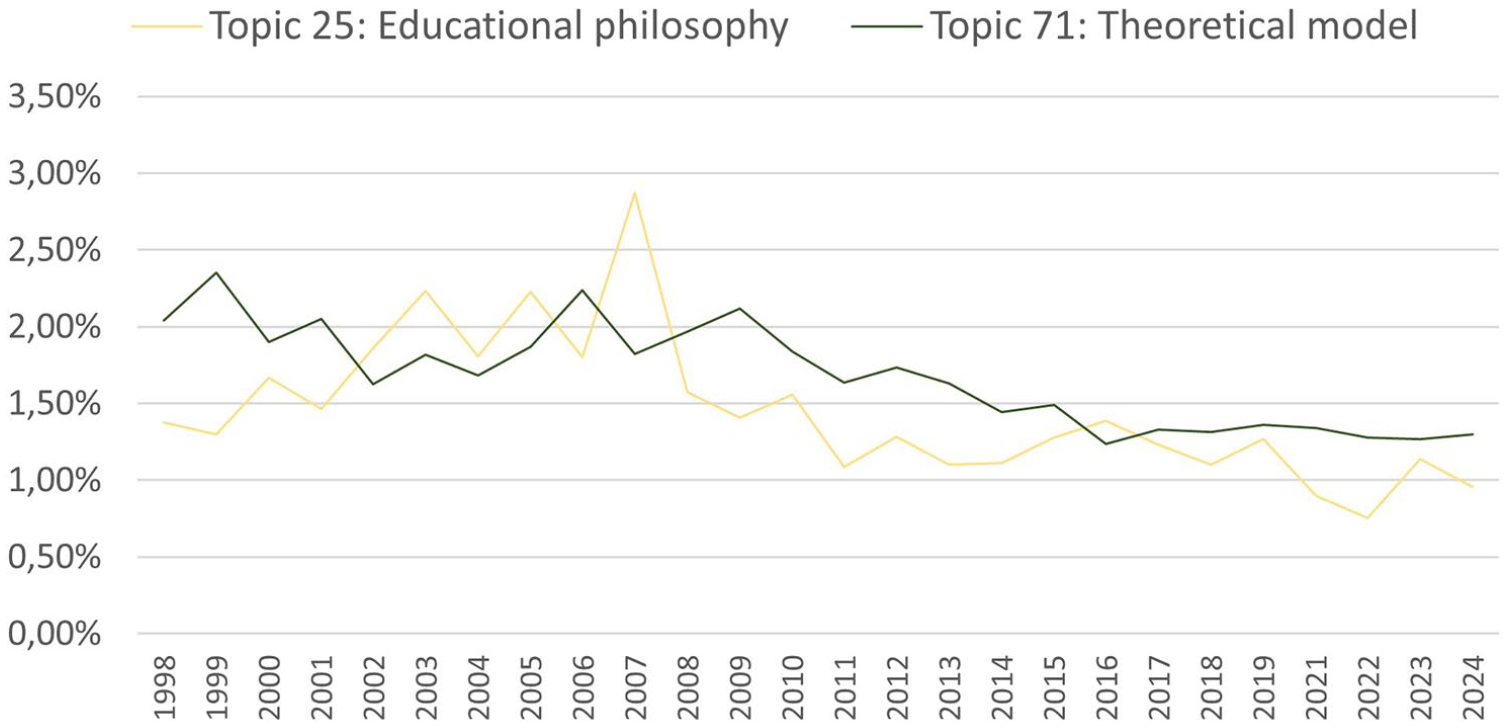
The prevalence of educational theory and philosophy (topic 25) and theoretical model (topic 71).
Formal education
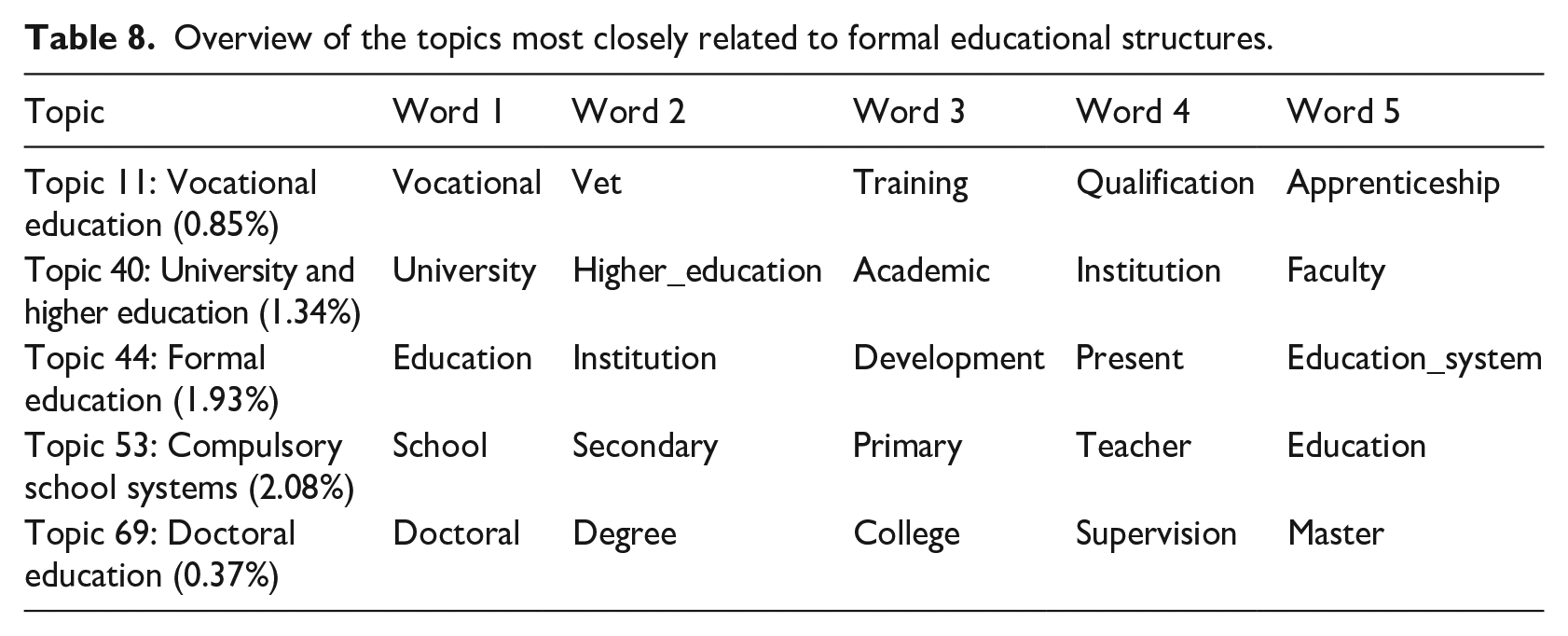
A third important thematical cluster we wish to zoom in on focuses on formal education. Quite a number of topics are to a varying extent related to formal education and formal educational structures. Table 8 offers an overview of the topics that are most directly related to formal educational structures: a more generic formal education topic (topic 44), compulsory school systems (topic 53), and three topics dedicated to vocational education (topic 11), university and higher education (topic 40) and doctoral education (topic 69). In addition to these five topics, many other topics are also related to this wider theme of formal education, for example school and teacher improvement (topic 9), teacher education (topic 16), teachers’ professional development (topic 86) and the mentoring of new teachers (topic 19), school leadership (topic 60), educational change (topic 63), curriculum (topic 88), educational transitions (topic 80), and retention and dropout (topic 17).
Overview of the topics most closely related to formal educational structures.
It may be clear that a significant part of the topics in the 100 topic solution are related to formal education. However, many of these topics have decreased in prevalence. Figure 5, for example, shows the downward trend for educational change (topic 63) and curriculum (topic 88), two closely-related topics.
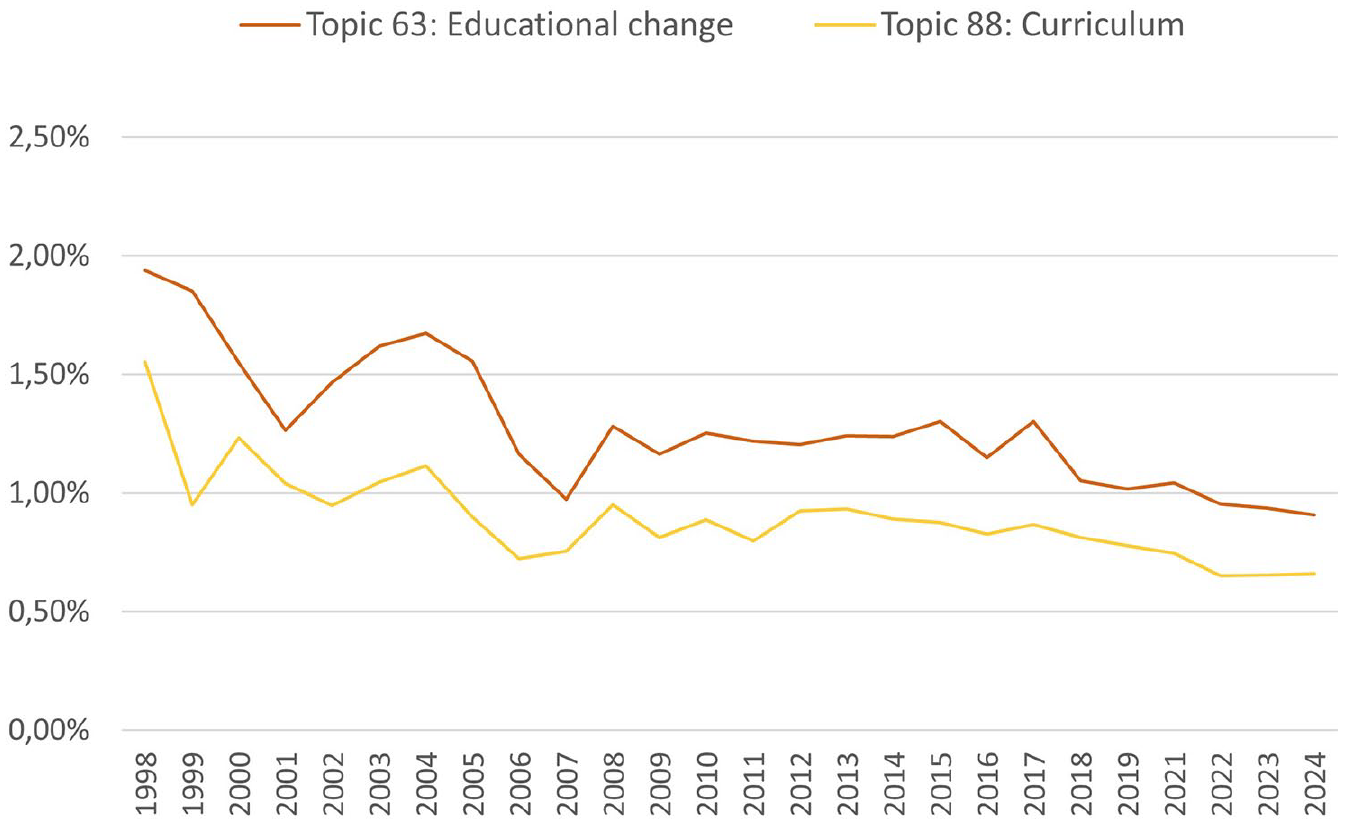
Downward trend for educational change (topic 63) and curriculum (topic 88).
This general move away from formal education can be explained in a number of ways. First of all, it can be understood as the mere consequence of the diversification of the research field. Per definition, when some topics grow, others have to shrink. As new areas of inquiry, such as societal challenges, digital transformation, and inclusive education, gain prominence, the focus on more traditional topics like formal educational structures inevitably diminishes. The expansion of research into interdisciplinary areas results in a redistribution of scholarly attention, with newer issues often overshadowing longstanding areas. Furthermore, the increasing volume of annual research contributions has, to some extent, balanced this shift in absolute numbers. However, evidence suggests there may be more at play. It could also reflect deeper changes in societal values, where education is seen as part of broader systems addressing global issues such as inequality, sustainability, and technological change. The declining attention to formal structures might indicate a reimagining of education as more fluid, responsive, and integrated with lifelong learning and informal education pathways. This suggests research is needed about formal education remaining relevant, even if its traditional structures are increasingly perceived as needing adaptation to fit into a rapidly changing global context.
Teaching and learning
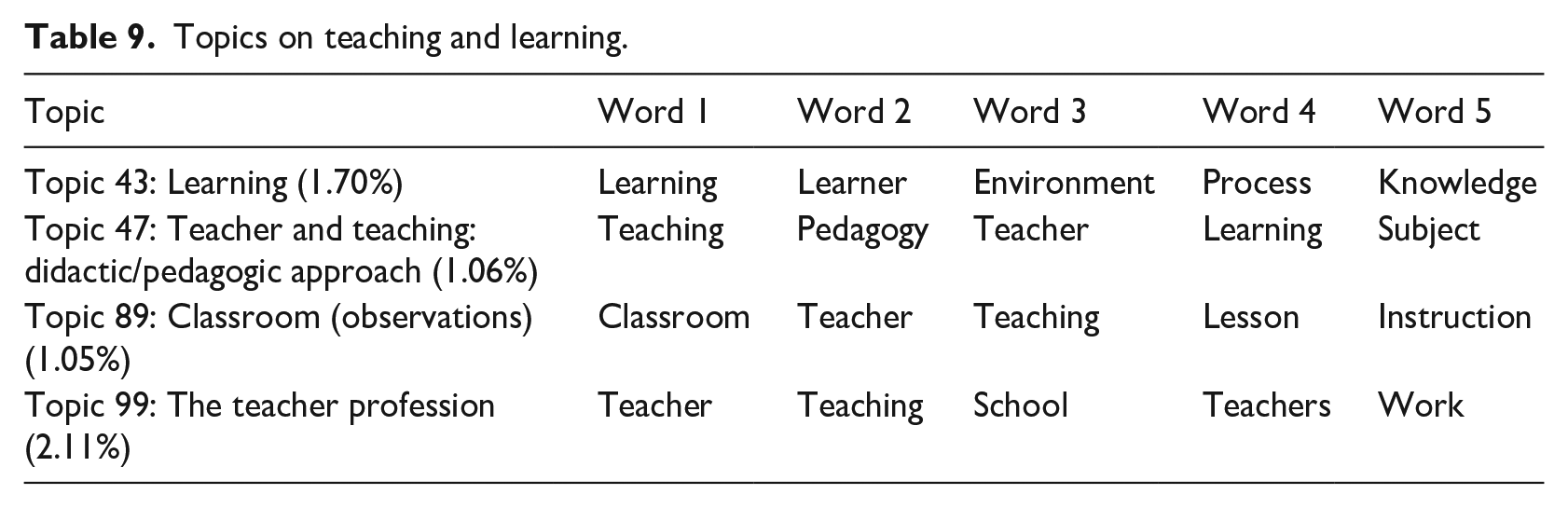
A fourth and final important thematical cluster that we wish to put on the table in this section centres around teaching and learning. Quite a number of topics are directly or indirectly related to teaching and/or learning. Topic 43 is the only topic specifically dedicated to learning. Teaching, on the other hand, has two dedicated topics: one with a focus on the teacher profession (topic 99) and one with a more didactical and pedagogical focus (topic 47). Topic 89 combines attention for what happens in the classroom with the observation thereof through empirical research. These four topics are presented in Table 9. Other topics closely related to teaching and learning activities, albeit less directly or with a more specific focus, are educational processes (topic 77) and learning in/through action and reflection (topic 4).
Topics on teaching and learning.
While topics 47 and 89 have remained stable over the years, the findings show a notable decrease in attention for learning (topic 43) and the teacher profession (topic 99), which does indicate a decreasing attention for teaching and learning in European educational research. This downward evolution is visualised in Figure 6. Again, a number of causes (or a combination thereof) might account for this move away from teaching and learning. First of all, similar to formal education, the decrease in these topics can be understood as another consequence of the diversification of the field. The decrease in attention for learning (topic 43) can also be related to the heavy critique on the so-called learnification of education (Biesta, 2010, 2017). However, this discussion only emerged after the decline in attention for learning had already commenced (see Figure 6). In line with this, this evolution might also be an indication of gradual shift in discourse away from teaching and learning within which a new vocabulary is developed to write about these phenomena. Nonetheless, we find this a striking evolution that warrants further investigation.
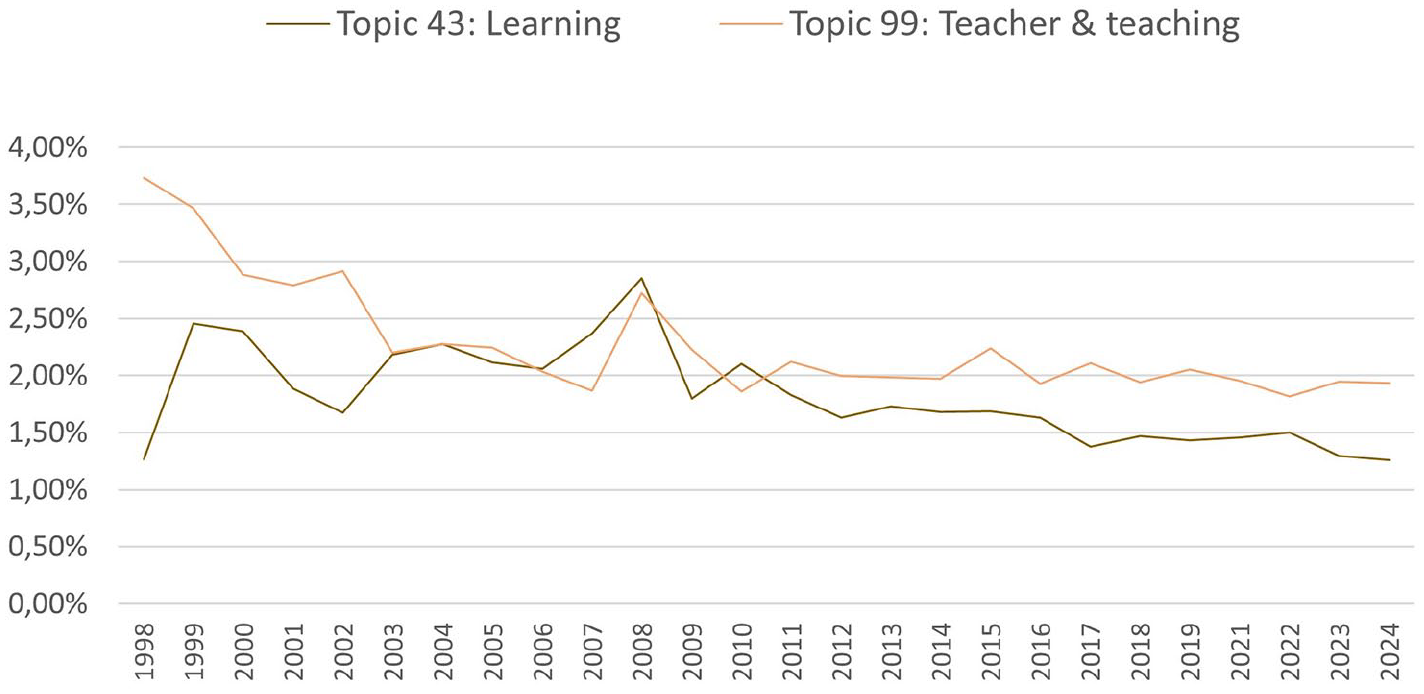
The downward evolution of learning (topic 43) and Teacher and teaching (topic 99).
Key issues for European educational research
The initial aim of the study was to put a novel perspective on European educational research on the table which could allow for a renewed debate on the past, present and future of the field. The results of this study offer a new approach to what European educational research is about, show which themes are central, and shed some light on where the field is heading. However, the results pose way more questions than they answer, and this is something this paper cannot cover in and by itself (nor is it our intention to do this). For instance, the findings allow us to connect to central debates in and critiques of the field, but further work is needed to investigate what precisely this means for educational research. Well aware of the scope of the findings, this discussion section is limited to three overarching themes: (1) the effects of (educational) policy and funding programmes on European educational research, (2) the growing diversification of the field, and (3) the question of education as common denominator of the research field.
The effects of (educational) policy and funding programmes
The way in which a number of topics have become more prevalent hints strongly at the relationship between policy and research, and more precisely at the effect of policy changes and funding schemes on what kind of research is done and how this research is described (i.e. the words being used). The above-mentioned growing focus on societal challenges can for example be related to funding programmes such as Horizon 2020 and Horizon Europe, of which the latter ‘facilitates collaboration and strengthens the impact of research and innovation in developing, supporting and implementing EU policies while tackling global challenges’. 13 Indeed, funding agendas and requirements have been described as having a strong impact on the content and type of educational research (see e.g. Stentiford et al., 2021 for a discussion of the British context). In addition to this, also governments and related bodies and stakeholders put demands on educational research, for example in providing research that is directly useful to policy or that is evidence-based (Stentiford et al., 2021; Whitty, 2006). The increase of systematic reviews, as became evident in this study (topic 2), can also be related to such a ‘what works’ agenda (Stentiford et al., 2021).
Further work needs to be done to investigate to what extent funding programmes and policies affect the kind of educational research that is done, in what way, and with which purposes. Indeed, while policies and funding programmes might orient researchers’ work, we argue that it is important to go full circle and in turn also make these policies and programmes an object of study. In addition to investigating what is prioritised by policy makers, it is equally important to also investigate how and why things are prioritised by policy makers and how this might affect education and educational research.
Diversification, specialisation and fragmentation
The move away from traditional subjects such as formal education and teaching and learning towards new themes such as societal challenges show a diversifying field with an increasing specialisation into (sub-)themes, topics and approaches. This shows that the research field is becoming more heterogeneous. The growing number of networks in EERA mirrors this evolution (with 34 networks in 2024). The increasing specialisation of research can in this light be understood as a sign of European educational research becoming a mature research field. However, we wish to point to the risk that this diversification might also lead to a fragmentation of the field. A possible sign of this fragmentation is the increasing amount of literature reviews (topic 2) which, almost by definition, have a narrow focus and try to demarcate a novel research theme. A fragmented research field without enough interaction between researchers focussing on different themes risks nullifying the increasing breadth and richness of the field described above.
Putting education central
The central question of this paper was ‘What is European educational research about?’. Through identifying 100 topics, this question has been answered and further complicated at the same time. This is because several of the trends we have discussed so far sketch the image of a research field that is slowly drifting away from its original core business: education. While we have explored several alternative hypotheses on what might cause these evolutions, we can state that traditional educational topics on for example teaching, learning and formal education are receiving a decreasing amount of attention while other topics are growing. The question thus emerges of what still binds the field (or what should bind the field). What are the Wittgensteinian family resemblances of European educational research? The 100 topics identified in this study could be understood as 100 family resemblances, but this is hardly a satisfying answer. While we acknowledge that it is good to keep on adding on to the family, as it makes the field richer, it is important to keep in mind what the family is about. In this light, we argue that, in the end, educational research’s most important characteristics might be (1) to have education as an object of study or as an object of knowledge and (2) to have a responsibility towards education at its core. Or in other words: research on and for education (cf. Whitty, 2006).
The primary purpose of this tentative demarcation is to offer an initial vantage point to enable a self-reflective discussion on the field. Among other things, it raises important questions on how to think about the four thematic clusters of topics presented in the previous section from an educational point of view. The growing attention for societal challenges in education, for instance, is not (and should not be) undebated. On the one hand, for example, Masschelein and Simons (2013) called the burdening of schools with the responsibility to solve societal problems a politicisation of the school (i.e. ‘both young people and the subject matter become the means by which social problems are addressed in a project of political reform’ (p. 95)) and thus a taming of the school. On the other hand, in the Bildung tradition for example, education and society have always gone hand in hand. While we do not wish to delve further into this specific example, it does make clear how novel evolutions are deeply rooted into the rich history of our discipline and emphasises the importance of an ongoing self-reflective discussion on the field. In addition, we believe such a discussion should also be theory-based, which makes it especially problematic that our findings show that attention for the theoretical backbone of educational research has been declining.
Conclusion
This paper presented a novel empirical analysis of European educational research. It used the data mining technique topic modelling to analyse the ECER abstracts database which was used as a window onto the wider research field. We acknowledge that this methodology has its limitations: Through topic modelling you lose the specificity of individual studies (cf. distant versus close reading) and despite the size and scope of the European Conferences on Educational Research, conference abstracts always only offer a partial view of a research field. Despite these limitations, we have argued that the results of this study do offer a unique and valuable insight into the field of European educational research. In addition to identifying 100 topics, we explored four major themes and discussed three overarching key issues in an attempt to open up for future debate. We strongly believe that these key issues are paramount in how the field will evolve in the coming years and that they should be approached and further discussed and investigated with great care and attention. This relates closely to a recent significant increase in interest in the future of education, fuelled in particular by the ‘Futures of Education’ initiative supported by UNESCO and the related report, Reimagining Our Futures Together: A New Social Contract for Education (UNESCO, 2021). This report explores the role education can play in shaping our common world and shared future, while also arguing that, in order to shape peaceful, just, and sustainable futures, education itself must be transformed. While it is undoubtedly true that research has a primary responsibility in guiding and fostering this transformation, it is evident that the debate on the future of educational research has received less attention, particularly regarding the possibility of an epistemological paradigm shift in response to a rapidly evolving landscape driven by new challenges such as environmental sustainability, socioeconomic equity, the deterioration of democracy, technological acceleration, and the risk of pandemics.
This paper highlights a fundamental reason for the difficulty in directly addressing the future of educational research. A topic modelling analysis of ECER abstracts reveals that, over the past 30 years, research has evolved to broaden its focus beyond its original ‘core business’ of teaching and learning in formal educational settings. This evolution reflects the pressure to assign education increasing responsibility for addressing the multiple social challenges mentioned above. However, this transformation has remained largely incomplete, creating a contradiction within the discourse on education and its purposes, which inevitably influences the field of research (Lingard, 2018). Simplifying, we can say that a polarisation has emerged between those who view education primarily as individual learning and those who see it as a tool to foster greater social justice through empowerment. The first perspective has the advantage of clearly identifying the research focus, but it risks becoming locked into an essentially technocratic and instrumental vision of education. The second perspective allows research to centre on an engaged approach to education as a means of addressing the challenges of contemporary society, but it exposes it to the risk of fragmentation and loss of identity.
The openness of the ECER abstracts database and text mining through topic modelling makes it possible for the educational research community to ‘read’ the more than 30,000 available ECER abstracts in a ‘distanced’ way, enabling a novel approach to disciplinary self-observation (Keiner, 2010). 14 In this regard, the findings presented here raise many interesting questions that suggest possible directions for further investigation. For example: What factors determine the rise (or decline) of a particular topic? Does the choice of the annual ECER theme influence this? What role do networks play in aggregating and stabilising interest in certain topics? How has EERA evolved over time in terms of geographic representation and inclusion of diverse voices? And, last but not least, what remains unrepresented? Is there something important that continues to be left out of the debate? Answering these questions could certainly help us better understand the possible future directions of European educational research and support central stakeholders in the field (e.g. reviewers, journal editors and EERA network link-convenors) in responding effectively to these issues.
Supplemental Material
sj-docx-4-eer-10.1177_14749041251346817 – Supplemental material for Mapping European Educational Research: Insights from topic modelling of ECER abstracts
Supplemental material, sj-docx-4-eer-10.1177_14749041251346817 for Mapping European Educational Research: Insights from topic modelling of ECER abstracts by Maarten Deleye, Carmen Carmona, Lucian Ciolan, Fabio Dovigo, Maria Figueiredo, Petra Grell, Christoph Schindler and Marit Honerød Hoveid in European Educational Research Journal
Supplemental Material
sj-docx-5-eer-10.1177_14749041251346817 – Supplemental material for Mapping European Educational Research: Insights from topic modelling of ECER abstracts
Supplemental material, sj-docx-5-eer-10.1177_14749041251346817 for Mapping European Educational Research: Insights from topic modelling of ECER abstracts by Maarten Deleye, Carmen Carmona, Lucian Ciolan, Fabio Dovigo, Maria Figueiredo, Petra Grell, Christoph Schindler and Marit Honerød Hoveid in European Educational Research Journal
Supplemental Material
sj-pdf-1-eer-10.1177_14749041251346817 – Supplemental material for Mapping European Educational Research: Insights from topic modelling of ECER abstracts
Supplemental material, sj-pdf-1-eer-10.1177_14749041251346817 for Mapping European Educational Research: Insights from topic modelling of ECER abstracts by Maarten Deleye, Carmen Carmona, Lucian Ciolan, Fabio Dovigo, Maria Figueiredo, Petra Grell, Christoph Schindler and Marit Honerød Hoveid in European Educational Research Journal
Supplemental Material
sj-pdf-2-eer-10.1177_14749041251346817 – Supplemental material for Mapping European Educational Research: Insights from topic modelling of ECER abstracts
Supplemental material, sj-pdf-2-eer-10.1177_14749041251346817 for Mapping European Educational Research: Insights from topic modelling of ECER abstracts by Maarten Deleye, Carmen Carmona, Lucian Ciolan, Fabio Dovigo, Maria Figueiredo, Petra Grell, Christoph Schindler and Marit Honerød Hoveid in European Educational Research Journal
Supplemental Material
sj-pdf-3-eer-10.1177_14749041251346817 – Supplemental material for Mapping European Educational Research: Insights from topic modelling of ECER abstracts
Supplemental material, sj-pdf-3-eer-10.1177_14749041251346817 for Mapping European Educational Research: Insights from topic modelling of ECER abstracts by Maarten Deleye, Carmen Carmona, Lucian Ciolan, Fabio Dovigo, Maria Figueiredo, Petra Grell, Christoph Schindler and Marit Honerød Hoveid in European Educational Research Journal
Footnotes
Acknowledgements
We thank the attendants of the panel discussion at ECER 2024 in Nicosia (28 august 2024) for their questions and comments on the preliminary results, the research environment TePlab for their insightful input on the project during the early stages of writing, and finally the related project Edutopics: ECER for technical input and consultation.
Data availability statement
The ECER abstracts are accessible on https://eera-ecer.de/ecer-programmes. The database is intended to be made available in consultation with the ongoing related project Edutopics: ECER (Christ et al., 2024). Digitally shareable materials necessary to reproduce the reported methodology have been added to the paper as supplemental material.
Declaration of conflicting interests
The author(s) declared the following potential conflicts of interest with respect to the research, authorship, and/or publication of this article: All authors are or have been affiliated to the European Educational Research Association e.V. to some extent.
Funding
The author(s) disclosed receipt of the following financial support for the research, authorship, and/or publication of this article: The first author’s work was supported by the European Educational Research Association e.V. The other authors received no financial support for the research, authorship, and/or publication of this article.
Ethical approval and informed consent statements
The study does not involve human participants and informed consent is not required.
Any other identifying information related to the authors and/or their institutions,funders,approval committees,etc,that might compromise anonymity
None.
ORCID iDs

Supplemental material
Supplemental material for this article is available online.
Notes
Author biographies
References
Supplementary Material
Please find the following supplemental material available below.
For Open Access articles published under a Creative Commons License, all supplemental material carries the same license as the article it is associated with.
For non-Open Access articles published, all supplemental material carries a non-exclusive license, and permission requests for re-use of supplemental material or any part of supplemental material shall be sent directly to the copyright owner as specified in the copyright notice associated with the article.
