




Abstract
This study fills significant gaps in knowledge around how familial dynamics shape First-in-Family students’ educational pathways, inform how they engage with the higher education setting, and drive them to break intergenerational cycles of educational attainment. Twenty-seven interviews with First-in-Family students in four public universities in Austria revealed three drivers: aligning with familial expectations, leaving one’s social milieu and emancipation from familial orientations. The paper argues that these drivers inform not only the why but also the how they organise their social contacts during their university education (e.g. different forms of engagement and connection to their family milieu and community outside of university). The findings suggest that we need to take these subjective dimensions into account if we aim to improve targeted support and to enhance the quality of learning experiences for all higher education students. Furthermore, we need to acknowledge that a growing diversity in the student population might also mean a greater diversity in the reasons to pursue a higher education, which should be accompanied with critical reflections on how the needs of these students can be met in the post-pandemic university to foster student retention and success.
Keywords
Introduction
Despite growing interest over the last three decades in research on First-in-Family university students, that is, those who are the first in their immediate family (or even within their community) to attend university, the most recent studies examining the profound social, spatial and temporal changes brought about by the COVID-19 pandemic as well as the cost-of-living crisis in Europe and beyond, have shown the multiple forms of inequities these students (still) face and the need to continue research that focuses on this student cohort (Adamecz-Völgyi et al., 2023; Ajjawi et al., 2022; Atherton, 2021; Dodd et al., 2021; Koopmann et al., 2023; Marczuk and Lörz, 2023). The latest research argues that we need to gain a deeper understanding of how educational pathways are built and shaped to dismantle barriers and move towards a more inclusive higher education system (Delahunty and O’Shea, 2020; O’Shea et al., 2021, 2024; Nairz-Wirth et al., 2021; Raaper et al., 2022).
While intergenerational transmission of educational attainment levels has been extensively studied in the past (Groeger, 2021; Hadjar and Gross, 2016), little is known about how individuals break intergenerational cycles and what enables them to do so (Gofen, 2009; Labede et al., 2020). Recent research into the sociology of education argues that exploring dynamics within the family and their role in shaping educational pathways has been neglected in higher education studies so far (Hermes et al., 2023; Lessky, 2023; Miethe et al., 2014). These dynamics have already been fleshed out in the school context (Labede and Thiersch, 2014; Silkenbeumer and Wernet, 2017), but scholars have argued that though focusing on milieu and social class as dominant factors influencing educational pathways is important, it risks oversimplifying the complexity of the social and cultural contexts in which students are embedded (Silkenbeumer and Wernet, 2012; Stahl and McDonald, 2022).
This article addresses this issue by shedding light on how familial dynamics can shape students’ educational journeys and how the ways in which students navigate these dynamics can serve as drivers for breaking intergenerational cycles of educational attainment. It draws on interviews with 27 First-in-Family students from four public universities in Austria conducted between 2018 and 2023 and applies a Bourdieusian perspective (Bourdieu and Passeron, 1977) in combination with a theoretical understanding that has emerged around research exploring familial capital and interactions (Gofen, 2007, 2009; Silkenbeumer et al., 2017). By doing so, this paper illuminates the complex nature of familial dynamics and the ways they can contribute to shaping First-in-Family students’ educational pathways by asking the following research question: How do familial dynamics, and the ways in which individuals navigate these dynamics, shape First-in-Family students’ pathways to university?
To answer this question, I used a hermeneutical approach (Froschauer and Lueger, 2020; Reiter and Sardadvar, forthcoming; Wernet, 2014, 2021) to analyse the empirical data, identifying three reconstructed types of subjective drivers that emerged from the students’ narratives about navigating familial dynamics. These drivers constitute their perceptions of why they go to university and what studying means to them and their families. The reconstructed types of drivers are: (1) aligning with familial expectations, (2) leaving one’s social milieu and (3) emancipating from familial orientations. Furthermore, findings show that these types also can contribute to explaining how First-in-Family students organise their social contacts during their university education (e.g. different forms of engagement and connection to their family milieu and community outside of university).
This paper demonstrates that illuminating familial dynamics and the ways in which students navigate these dynamics can shed light on factors shaping educational pathways alongside milieu and social class. In line with the latest research, this study shows how students view the purpose of higher education as being much more than just employability and graduate careers; it is also a space for personal growth, gaining autonomy, emancipating from familial orientations, desiring to achieve upward social mobility and fulfilling parent’s expectations, among other things. This variation of purpose partly mirrors current developments in the diversification of the student body in higher education (Marginson, 2024; Schäfer, 2024).
This paper also makes a theoretical contribution by combining the work of Bourdieu (1987, 1990) with theoretical considerations (Labede et al., 2020; Rademacher and Wernet, 2014) that have been applied to reconstruct educational upward mobility in the school context. Combining these two theoretical perspectives contributes to understanding how familial dynamics can serve as drivers for First-in-Family students breaking intergenerational cycles of educational attainment. This article concludes with implications on how we can gain a deeper understanding of First-in-Family students’ pathways to university, and reflections for how we can better support diverse learners and create a more inclusive higher education system.
This paper is organised as follows: first, I will present the characteristics of First-in-Family learners and review the current literature about the role of familial dynamics in shaping First-in-Family students’ pathways to university. Second, I will describe the theoretical considerations drawing on Bourdieu and others in the field of education sciences and sociology. Third, I discuss the national context in which this study took place, and the methodology and data that were used in this research. Fourth, I present the findings focusing on the reconstructed types of drivers for breaking the cycle of intergenerational transmission of educational attainment and discussing how these drivers shaped students’ experiences. Fifth, this paper concludes with final remarks on the theoretical implications as well as policy recommendations.
Literature review: First-in-Family students and the role of familial dynamics
I begin this section with defining the term First-in-Family students and discussing the current scientific discourse around this student group (see ‘Characteristics of First-in-Family students and scientific discourse around this student cohort’ section). I then focus in more depth on recent studies that focus on the role of familial background regarding First-in-Family students’ pathways to university (see ‘Role of familial dynamics in shaping First-in-Family students’ pathways to university’ section).
Characteristics of First-in-Family students and scientific discourse around this student cohort
First-in-Family students, also often called First-Generation students, are defined as students who are the first in their immediate family attending university, including parents as well as siblings, partners and children (O’Shea, 2016). Over the last three decades there has been a growing interest in researching these students (Beattie, 2018). Some reasons for this are an increasing diversity of students’ educational and social backgrounds, rising efforts in enhancing student success and, at the same time, enduring social inequalities around access to, persistence in and completion of higher education. There have been several systematic literature reviews aimed at synthesising existing research on First-in-Family learners (see, e.g. Larsen et al., 2013; Saenz et al., 2007; Smith and McLellan, 2023; Spiegler and Bednarek, 2013; Tym et al., 2004). They showed that studies’ primary foci can be located in one of the following areas: choice of institution and field of study, pre-college characteristics, student experiences along the student life cycle (transition into, through and out of university); student attrition, persistence and success; as well as mental health.
Studies have shown that First-in-Family learners are predominantly older, from less privileged socio-economic backgrounds and often choose less prestigious institutions and fields of study (Lessky et al., 2022; Triventi et al., 2017). Furthermore, empirical evidence indicates that they tend to work more often alongside their studies (Lessky and Unger, 2022), receive less financial support from their caretakers, carry a higher risk of attrition (for literature reviews focusing on attrition see, e.g. Larsen et al., 2013; Quinn, 2013; Quinn et al., 2005; Sarcletti and Müller, 2011) and might have greater difficulties in integrating into their academic field of choice and building a student identity (Orbe, 2004) compared to students whose parents have completed a university education. In addition, they can face additional barriers in accessing the kind of valuable study-related information that is shared informally (Lessky et al., 2021) as well as professional opportunities associated with their studies (Crozier and Reay, 2011; El-Mafaalani, 2012; Quinn, 2013; Read et al., 2003; Schmidt and Akande, 2011).
While the majority of these studies focus on the reproduction of social inequalities in one way or another, there is still limited knowledge about how First-in-Family learners actually break intergenerational cycles of educational attainment and enact educational upward mobility. This appears to be an important question since the numbers of First-in-Family university learners are rising globally, but we still know little about what enables them to go to university and how they achieve success.
In this regard, recent research has started to add more depth and complexity to the topic of First-in-Family students. Some scholars, for example, started to challenge the deficit discourse around this student group that portrays First-in-Family learners as somehow lacking compared to other students (Bauer et al., 2024; O’Shea, 2016). Such research highlights the capitals these students bring to the university environment (Groves et al., 2022; Lehmann, 2019; O’Shea et al., 2024) and reconstructs the habitual transformations these students might undergo when going to university (El-Mafaalani, 2014, 2017a, 2017b; Lehmann, 2021; Spiegler, 2015), as well as the ways they engage with the social spaces of higher education (Ajjawi et al., 2023; Gravett et al., 2023; Romito, 2022). Some studies also report a strong sense of belonging and perceived cultural fit at the chosen institution (Käpplinger et al., 2019; Miethe, 2017) in contrast to previous research focusing on feelings of alienation and experiences of habitual conflicts among First-in-Family students (Lehmann, 2007, 2013). In addition, they emphasise that perceived discrepancies of family and university life (‘living in two worlds’) may lead to occasional tension, but that these conflicts do not constitute the central experience of First-in-Family students. It is argued that navigating between these two worlds is not only seen as a problem to be overcome but also as a source of competency the interviewed students highly value. This competence lies in the ability to move between two worlds, which can be seen as a professional advantage, as individuals may need to work with people from different social groups throughout their careers (Hurst, 2010; Käpplinger et al., 2019; Miethe, 2017).
To summarise, while social inequalities that shape First-in-Family students’ access and persistence at university still persist, newer research also focuses on how First-in-Family learners were able to break intergenerational cycles by going to university and how they successfully engage in and navigate the university environment. Also, the role of the family and how they contribute to students’ educational success is being explored, which I highlight in the next section in more detail.
Role of familial dynamics in shaping First-in-Family students’ pathways to university
One major concern when looking more closely at the heterogeneity within the group of First-in-Family learners and what enabled them to seek higher education are the relationships and environments outside of university – predominantly parents and siblings. So far, only a few qualitative studies have addressed the positive impact of familial networks on the educational pathways and academic success of First-in-Family students (Nora, 2001; O’Shea, 2016; O’Shea et al., 2024). A significant contribution to this area came from Anat Gofen (2007, 2009), who specifically investigated the role of the family and what the author referred to as ‘support capital’. Gofen (2007, 2009) conducted interviews with 50 Israeli First-in-Family students, offering a shift in perspective compared to previous studies by viewing First-in-Family students’ family background as a positive potential for educational upward mobility. The author argues that the families of First-in-Family students are often a key resource in enacting educational success rather than a constraint. The author also identifies parents’ attitudes towards education as a crucial factor in perceived parental support. The parents of the interviewed individuals generally exhibit a positive attitude towards their children’s decision to pursue higher education. This positive outlook partly arises from parents’ desires to enable their children to pursue goals they were denied in their own lives or to help their children escape economically precarious circumstances through education. Some students in Gofen’s study also expressed valuing education for its own sake, independently of economic benefits after gaining a higher education degree (Gofen, 2009).
Byrom and Lightfoot (2012) similarly demonstrated that their interviewed First-in-Family students gained motivation to attend and pursue university studies due to the constant emotional and/or financial support by their families. The authors conclude: ‘This could be representative of generational habitus shifts [. . .] where there is increased acceptance of HE participation amongst families without a previous history of education at that level’ (Byrom and Lightfoot, 2012: 132). Other scholars have shown that attending university against familial career expectations towards a more vocationally-oriented pathway outside of higher education can also be a source of motivation for First-in-Family students to attend university (Hurst, 2010; Lehmann, 2013; Nairz-Wirth et al., 2017). In this regard, Schäfer (2024) has shown the heterogeneity of purpose for students in higher education. Based on 95 interviews with students in business, medicine and musicology, the author reconstructed a typology, including six types of what students understand as the purpose of higher education: (1) Occupational: expertise and specialisation; (2) Occupational: a form of vocational training; (3) Occupational: a mere symbolic paper; (4) Personal: self-actualisation and independence; (5) Personal: Bildung 1 and critical thinking; (6) Societal: contribution to society. In a recent study by Hermes et al. (2023), interviews with First-Generation students in Germany showed that there is a close connection between family socialisation and students’ educational pathways and the way they integrate into the university environment. The authors argue that fundamental orientations to education, learning and personality development within the families shape educational decisions and corresponding (occupational) biographical actions.
To summarise, these studies have brought two major contributions to existing literature: first, they challenge the assumption that First-in-Family learners are successful despite their parental educational background; they may be successful because of it. And second, they emphasise the significance of familial socialisation as a crucial component for shaping students’ educational pathways and subjective reasoning for breaking intergenerational cycles by attending university. These studies emphasise that it is necessary to consider values, routines and beliefs incorporated into students’ individual habitus, which is mainly formed by familial socialisation, and thus shapes students’ subjective reasons for attending university and how they value it.
However, there is still a notable gap in the literature when it comes to illuminating how families that hitherto have no shared history of university attendance shape First-in-Family students’ individual habitus and their educational pathways. By exploring these complex dynamics, we not only gain a more nuanced understanding of how First-in-Family students break intergenerational cycles of educational attainment and the complexity of their educational pathways, but we are also better able to make recommendations on how to better support diverse learners and create a more inclusive higher education system.
Theoretical considerations: Thinking with and beyond Bourdieu
Bourdieu’s relational theory
Previous research in education sciences and sociology has made extensive use of Bourdieu’s relational theory in examining inequalities in educational outcomes for First-in-Family and working-class students (Bathmaker et al., 2016; Ingram et al., 2023; Reay et al., 2009). Bourdieu’s conceptual tools have proved fruitful in analysing the challenges that these students may face in higher education and in shedding light on the mechanisms by which existing inequalities are perpetuated. A prevailing argument posits that the habits, tastes and attitudes (habitus), as well as the resources (capital), cultivated by individuals from less privileged backgrounds during their formative years are less recognised or even rejected within the (higher) educational system (field), compared to their counterparts from more advantaged backgrounds who inherit a legacy of and thus affinity to university attendance (Bourdieu, 1983, 1990). Essentially, this perspective suggests that the habitus and the inherited practices of individuals from privileged backgrounds align more seamlessly with the performance and behavioural requirements of the educational system than those of individuals from less advantaged backgrounds.
While using this theoretical perspective has been proven to be very fruitful for shedding light on the barriers and discrimination these students can face throughout their educational journeys and the conflicts of habitus they might experience, it falls short when explaining the additional capitals that these students bring to the university environment and their successful engagement with this environment (O’Shea, 2016). Therefore, attention is frequently drawn not just to the inertia but also to the adaptability of habitus, field and configurations of capital, as well as the nuanced nature of experiences (Atkinson, 2021; Lahire, 2003). For example, as highlighted in the previous section, some scholars have argued that conflicts of habitus or a lack of sense of belonging do not necessarily reflect the dominant experience of First-in-Family students in higher education (Miethe, 2017).
As a result, a growing body of literature combines Bourdieu’s theory with other theoretical perspectives, such as Sen’s (1999) capabilities approach or Yosso’s (2005) cultural wealth model. Such research aims to illuminate the heterogeneity within this student group and to grasp both aspects – reproduction and transformation of habitus, capitals and the educational field (El-Mafaalani, 2017b; Lehmann, 2007; Miethe et al., 2015; O’Shea, 2016; Soremski, 2014). In this regard, scholars contend that a more comprehensive examination of the intricate and dynamic interplay between individual subjects and their socio-cultural context is warranted – especially when aiming to explain First-in-Family students’ educational pathways that, by being the first going to university, do not represent the social reproduction of their parents’ educational heritage (Rademacher and Wernet, 2014; Silkenbeumer and Wernet, 2012).
Familial dynamics and individual habitus
Rademacher and Wernet (2014) posit that while individuals are undoubtedly shaped by prevailing social structures, their choices are not solely governed by the logic of structural replication. A distinction arises between the structures that engender a realm of diverse actionable possibilities (social space) and the structuring principles underpinning subjective decisions. Choices are undertaken within a socially structured environment, yet they concurrently adhere also to other principles or logics derived from interactions with family, friends and other contexts, such as school (Oevermann, 2012).
To illuminate these alternate principles or logics, Rademacher and Wernet (2014) advocate that the development of habitus and the accumulation of capitals are not exclusively subject to the environmental influences of the milieu; even though they evolve within a social space of prevailing lifestyles (milieu), they are also shaped by familial and scholastic orientations and dynamics that may significantly diverge from class- or milieu-specific orientations and dynamics. Lahire (2003, 2015) also points out that we have to look at the multiple socialisation contexts that individuals have been and are situated in: their family, their school, etc. These additional socialising arenas must therefore be regarded as autonomously structured in relation to the milieu’s impact, meaning that socialisation, in the sense of identity formation, is shaped by both milieu conditions and familial dynamics.
Therefore, the mechanisms of subjective formation of habitus and all the ways it can manifest need to be explored further (Kramer, 2017; Rehbein, 2006; Thiersch, 2020). Helsper et al. (2014) and Kramer (2017) emphasise the need to differentiate between an ideal type of habitus and the actual subject. Rademacher and Wernet (2014) argue that both the subjective motives for educational upward mobility and the manner in which upward mobility is approached are significantly shaped by a subjective habitus that is formed based on the foundation of familial relationships. While Bourdieu distinguishes between a collective and an individual habitus, the individual habitus, however, was not conceptualised as being separate from one’s social position. Rather, the individual habitus was considered as a homologous variant of a ‘class or group habitus’. Therefore, Rademacher and Wernet (2014) propose the concept of individual or subjective habitus that is not merely conceived as a variant of an objective, that is, class- or milieu-specific, habitus but rather exists separately and sometimes in tension with the objective habitus. Habitus formation is not solely subject to milieu-related influences; it unfolds not only in a social space of prevailing lifestyles but also in a social space of familial and educational interactions (e.g. at school).
Consequently, the trajectories of First-in-Family learners within the educational landscape can be understood as a social process steered by the interplay between various life spheres, such as family, school and friends (Thiersch and Wolf, 2020). Lahire (2015) emphasises that it is especially in the family-the loving but also conflictual relations with and between parents and other kin, sometimes in competition with other actors such as carers and school staff – where fundamental dispositions and desires are first formed. This is not a seamless transmission of resources or the passive absorption of tastes but rather a question of struggles, identifications and rejections (Atkinson, 2021). While acknowledging that there are multiple spheres influencing an individual’s educational pathway (e.g. school), in this paper, I focus on how familial dynamics shape a student’s subjective reasoning for attending university and breaking intergenerational cycles of educational attainment. While other spheres have already been studied extensively (Helsper et al., 2014; Kramer, 2017; Lessky, 2023; Thiersch, 2020) there is still a considerable gap in the literature about how familial dynamics shape First-in-Family students’ pathways to university and their engagement with and belonging in the higher education environment (O’Shea, 2024a, 2024b). Furthermore, during the analysis, the empirical data very strongly indicated the importance of familial dynamics for educational decisions, which will be described further in the next section.
This study contributes to understanding how and especially why First-in-Family students gain a higher education degree, using the theoretical considerations described above as a lens to guide the empirical analysis of their narratives. Research emanating from such a vantage point holds the potential to untangle the intricate ways through which the families of First-in-Family students contribute to their educational inclinations and perseverance within the university setting (Helsper, 2012).
Methodology and data
In the Austrian context in which this study took place, four types of public and private higher education institutions exist. However, almost 75% of students attend one of the 22 public universities (Statistics Austria, 2024). In contrast to other European countries, for example, the UK, higher education only provides long-cycle courses above ISCED level 5. EU citizens do not have to pay tuition fees at public universities as long as they do not exceed a certain duration for their studies. Domestic students can receive a study grant if their parents’ income is not sufficient to support them or if they can prove that they have maintained themselves through gainful employment for at least four years. This form of scholarship has also contributed to the fact that there is a relatively high proportion of students in Austria who start their university studies late, that is, not immediately after leaving school. Therefore, the average age of all students is 27 years (excluding doctoral students) and about 40% of students are older than 25 years (one of the highest proportions in Europe, see also Hauschildt et al., 2024; Zucha et al., 2024). The share of students whose parents have not obtained a higher education degree (almost 60%) is also among one of the highest in Europe due to relatively low educational attainment in the parental generation (Hauschildt et al., 2024; Zucha et al., 2024).
The data for this study come from 27 biographical-narrative interviews conducted with First-in-Family students at four public universities in Austria between 2018 and 2023 in two distinct yet interrelated research projects. Fourteen interviews stem from the author’s PhD project (Lessky, 2023). These interviews were conducted between 2018 and 2021 in the eastern part of Austria at three institutions. An additional 13 interviews with students at one institution in the western part of Austria stem from the author’s follow-up research project carried out in 2023 (Lessky and Wernet, 2023).
In both projects, the narrative interview format (Froschauer and Lueger, 1992; Küsters, 2009) was chosen due to the research interest in the biographies of individuals, the familial dynamics embedded therein and the processual nature of educational upward mobility among First-in-Family students. At the time of the interviews, participants ranged from 20 to 44 years old and were in various stages of the student life cycle. Regarding gender, 18 people identified as women and nine as men. Interviews took place at the respective universities and lasted typically between 90 and 240 minutes. The introductory interview question serving as a narrative-generating prompt in both projects was: ‘When did the idea of going to university first occur to you?’ This question had already proven suitable in previous studies (for further explanations, see Lessky, 2023; Lessky et al., 2022). Interviews were recorded and transcribed verbatim following Lueger’s (2010) transcription guidelines (p. 259) using f4 software.
For the purpose of this study, the data sets from both projects were combined and coded using the computer program NVivo (Version 14). The analysis focused on family-related relationships as this sphere plays a crucial yet understudied role in processes of upward educational mobility (see also previous section). Table 1 summarises the analysis process.
Data analysis process.
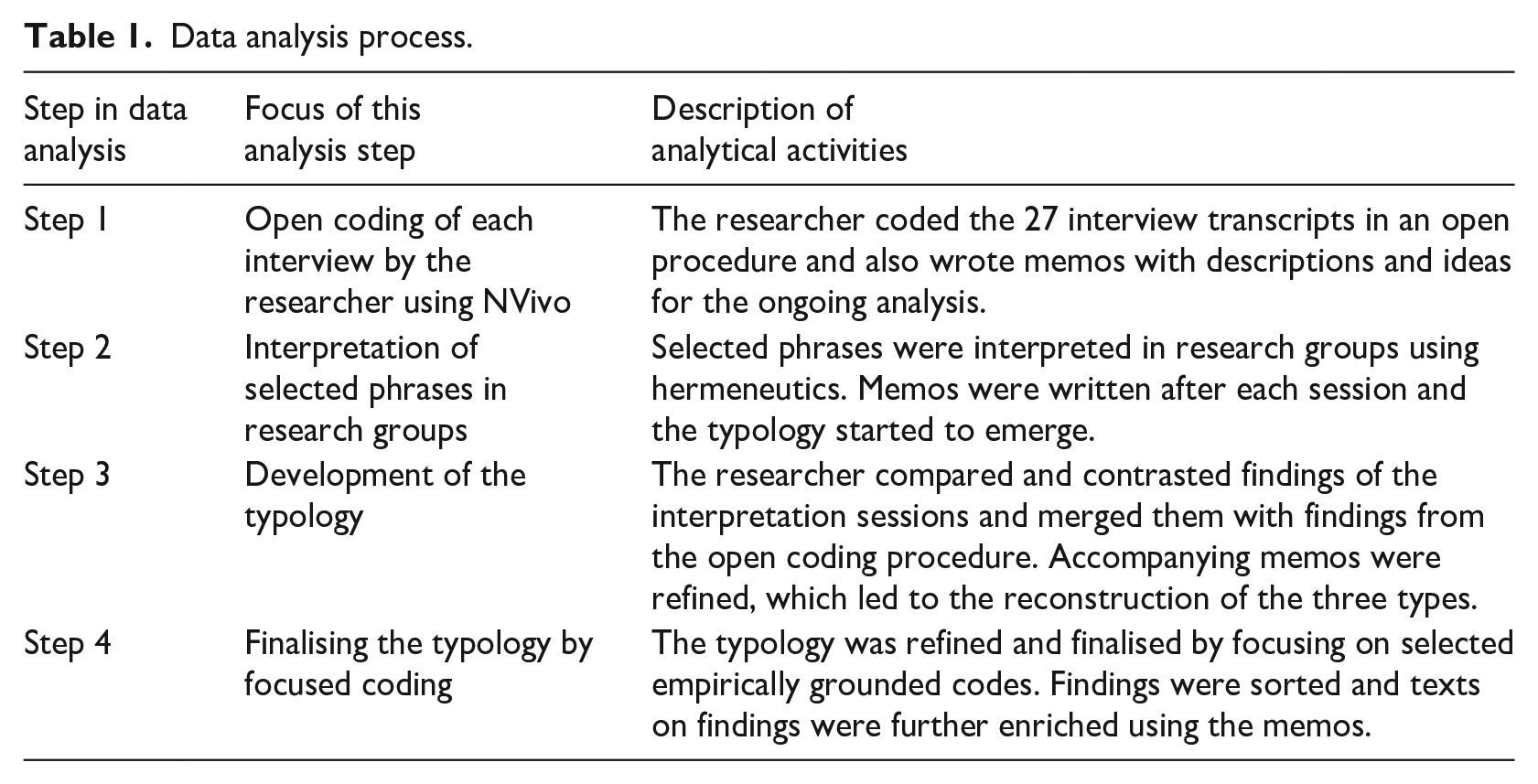
The first coding procedure, known as ‘Initial Coding’ (Saldaña, 2013) or ‘Open Coding’ (Charmaz, 2006), led to a set of 77 codes (see also step 1 in Table 1). In the next step, those codes were used to choose specific phrases for in-depth interpretation by applying hermeneutics (see step 2 in Table 1). The phrases were selected on the basis of maximum variation in narratives about family relationships and study experiences. After each interpretation session, the next phrases were selected on the basis of either high similarity or strong contrast to the interpreted phrases. Hermeneutics was chosen in order to shed light on latent structures of meaning underlying the respective text (Froschauer and Lueger, 2020; Oevermann, 1996; Reiter and Sardadvar, forthcoming; Wernet, 2014, 2021). These structures are not wilfully produced by the actors but are grounded in the context of the utterances (Kleemann et al., 2009). Hermeneutics appears suitable for the present study as they allow for the examination of congruences and associated potential experiences of familial dynamics from an actor-centred perspective that focuses on individuals’ actions.
During this step of the analysis, the phrases selected from the material (interview transcripts) were analysed in a sequential procedure aimed at capturing (latent) meanings. The goal was to enable an extensive interpretation of the analysed text units. Hermeneutic methods are based on the assumption that every linguistic utterance contains information that goes beyond the immediately said, allowing inferences about the thinking and behavioural patterns of the respective individual (for the specific procedure of the method, see e.g. Froschauer and Lueger, 2020; Wernet, 2021). Hermeneutics is particularly well-suited to moving beyond the individual case (e.g. an interview with one student) by reconstructing structures (e.g. familial dynamics) which can lead to a typology or theoretical generalisation (Lueger and Hoffmeyer-Zlotnik, 1994). During this step of the analysis, phrases were interpreted in research groups and memos were written after each session. A comparative analysis of nine reference cases (selected according to criteria of theoretical relevance and contrast) led to the development of a typology on the basis of the interpretation of those individual cases. During this step, the first driver was reconstructed on the basis of five cases, the second driver emerged from the analysis of two cases and the third driver was developed based on the analysis of two additional cases.
The typology was further developed in the next step of the analysis by comparing, contrasting and merging the findings of the interpretation sessions with findings from the open coding procedure (see step 3 in Table 1). During this step, additional cases were linked to the typology. Finally, the typology was finalised by focusing on selected empirically grounded codes, ultimately resulting in the following drivers and their distribution among the sample (Table 2):
Description of the typology and distribution of the sample across the three types.
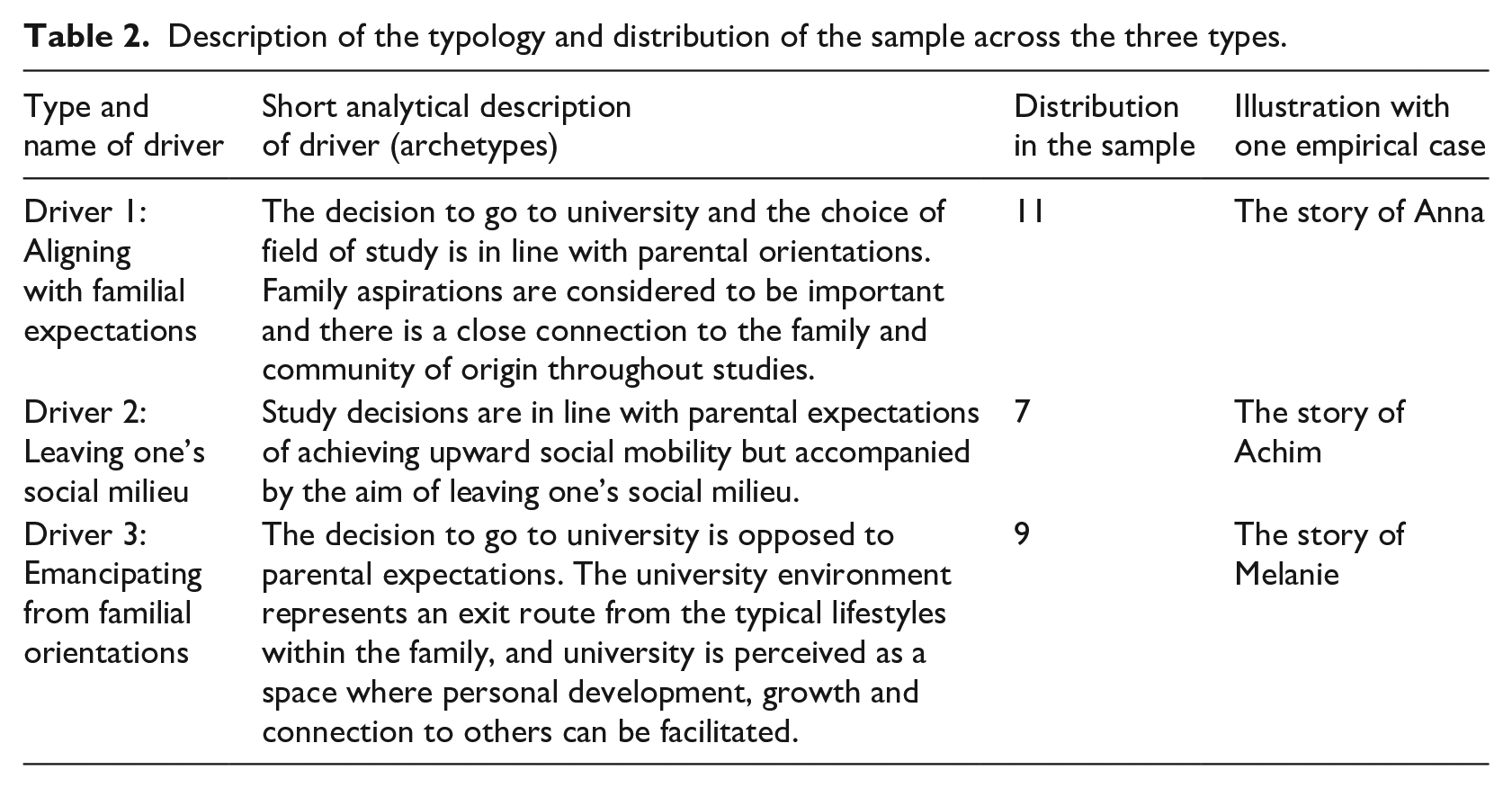
It should be noted that the reconstructed drivers can intersect in the individuals’ biographies or change over the students’ life courses. The distribution among the sample therefore shows only the respective driver that was most prominently articulated at the time of the interview. In the findings section I present the drivers as analytically distinct to illustrate their unique characteristics (archetypes). I then selected three cases to show maximum variation in familial dynamics and to empirically illustrate the differences between the three drivers. It should also be mentioned that the three cases all represent stories of mature students. This is partly attributed to the national context in which this study took place (see first paragraph of this section) and to the intersectionality of First-in-Family participants, who are traversed by demographic and social factors (e.g. delayed entry into higher education). This is not to suggest that younger students did not share similar experiences, but they can differ according to previous educational trajectories. However, students from various age groups and genders are represented in all three types of drivers.
Findings: Typology of drivers for breaking intergenerational cycles
In this section, I present a typology of reconstructed drivers for breaking intergenerational cycles of educational attainment that have emerged through the analysis of the empirical material: (1) aligning with familial expectations, (2) leaving one’s social milieu and (3) emancipating from familial orientations. Each type of driver is, firstly, analytically described as an archetype, and secondly, empirically illustrated by the story of one particular student to better understand how these drivers emerge through familial socialisation. In addition, I show how this typology can help us to better understand First-in-Family students’ experiences at university and their different forms of engagement, sense of belonging and feelings on a continuum of closeness to and distance from the family.
The notion ‘driver’ is used because it refers to a force that can intentionally but also subconsciously promote change (Boyatzis and Akrivou, 2006). In this regard, I propose that familial dynamics contribute significantly to drivers of behaviour that can lead students to break intergenerational cycles of educational attainment. As mentioned earlier, it is especially the family that forms dispositions and desires (Lahire, 2015). During the process of individuation students position themselves in relation to beliefs, values and expectations within the family. It is those dynamics that can become a motivational core and the locus of drivers within a student’s self, nurturing their subjective motives and behaviours for breaking the intergenerational cycle of educational attainment.
Driver 1: Aligning with familial expectations
Analytical description of driver 1
A key characteristic of the driver ‘aligning with familial expectations’ is that the decision to go to university and the choice of field of study are closely aligned with parental expectations. This means that attending higher education and the choice of study programme are perceived as valuable within the family in terms of a future professional career (e.g. becoming a doctor or teacher). Students receive both emotional and financial support from their parents and they make efforts to stay close to their family during their studies. By spending much of their time in their communities of origin, students actively counter potential processes of alienation and distancing from the family milieu. Upon graduation, students express a strong desire to live and work closely to family and friends.
Due to the strong familial bonds, engagement with the university environment is not perceived as a primary requirement for academic success. While students of this type integrate academically at the university (e.g. gaining good grades), their social engagement at the university is less pronounced and creating a sense of belonging at university is considered less important. Instead, social relationships are mainly cultivated and maintained outside of the university environment.
Empirical illustration of driver 1: Anna’s story
Anna is 30 years old and had almost completed her medical studies by the time of the interview. She grew up in a city in Austria, where she went to school, got her high school diploma and attended university. Throughout her educational journey she has been consistently supported by her parents. She recounts how she was not only emotionally encouraged but also financially assisted in her pursuit of becoming the first in her family to receive a high school diploma and attend university. Throughout her studies, Anna has maintained strong familial connections, including regular communication with her family members. When talking about why she chose to study medicine, she narrates her selection of a medical major as an autonomous decision, uninfluenced by her parents’ preferences: My parents didn’t have any requirements and in the end they’re super proud.
However, the analysis reveals that her choice of field of study is in great alignment with shared family values and norms, facilitated by the fact that both her parents occupy roles in the medical field. The familial sense of pride associated with the esteemed profession of a doctor further accentuates this connection: And erm regarding choosing medicine, yes, they were certainly very happy because they worked in that area and of course their daughter is [going to be] a doctor – that would probably be something that is cool, I guess.
Anna’s decision to pursue university education is best understood as a collective family endeavour, involving the active participation and contribution of multiple family members, such as her aunt, who is an elementary school teacher and supports her with writing essays. Due to Anna’s close ties to her family, aligning with their values and positive orientations towards (university) education can be seen as a main driver for her breaking the intergenerational cycle.
Because of her strong desire to stay connected to her family and align with their expectations, going to university is mainly a means for her to be academically successful and she draws a close connection between her university and family life. Therefore, she is mainly oriented towards her academic achievement, without putting much emphasis on social connections at university.
I didn’t really develop any deep friendships at university. [. . .]. I already had my friends, and my time was already full.
She receives most of her emotional and academic support from family and friends outside of the university environment and she is able to mobilise capitals within this environment to persist at university (e.g. academically with the help of her aunt, emotionally with the support of her best friend). The strong alignment with values and norms within the family and her close connections to friends outside of university drives the breaking of the intergenerational cycle of educational attainment without Anna leaving her community of origin. On the contrary, staying connected to them was and is an important part of her journey.
For me, it was clear from the very beginning, also regarding my studies, that I wanted to stay in Austria, I wanted to stay at home, I wanted to stay in [city]. From the start, it was clear to me that I didn’t want to do a semester abroad, it just didn’t interest me. I didn’t want to be away from family and friends. And it still doesn’t interest me now.
This is, however, in contrast to the second driver that is described below.
Driver 2: Leaving one’s social milieu
Analytical description of driver 2
The driver ‘leaving one’s social milieu’ is characterised by strong parental expectations that their child achieve upward social mobility. Going to university is therefore aligned with parental expectations. However, these students – in contrast to the story of Anna – aim to leave the social milieu they were born and raised in. Rather than wanting to remain close to their family, this driver is nurtured by students’ aspirations to achieve a better economic and social life through education. In this regard, distancing and detaching oneself from the family and community of origin is viewed as necessary.
A university degree is predominantly viewed as a strategic investment in one’s professional future. During childhood and adolescence, these students often experienced familial relationships as fragile (e.g. due to parental separation or relocation). After completing their studies, they are willing to be mobile depending on where the best career opportunities can be expected. Due to both an ‘internal’ detachment from the family and an ‘external’ separation from their parents’ social status, these students engage extensively with the university environment. They aim to integrate both academically and socially, and hope to gain insights into how ‘the rules of the game’ (Bathmaker et al., 2013) work. Students who are driven by leaving their social milieu primarily focus on building relationships within the university environment and mobilise these connections to achieve their desire for upward social mobility.
Empirical illustration of driver 2: Achim’s story
Achim is 27 years old and similarly to Anna, he was in the last stage of his medical studies by the time of the interview. He grew up in a small town in Germany and lived with his parents until they got divorced and he transitioned to Gymnasium (academic secondary school) at the age of ten. After completing his apprenticeship to become a nurse, he moved to Austria to study medicine at university. Achim is deeply committed to achieving upward social mobility through education. His parents have actively cultivated this narrative of Achim being someone who is one of only a few people in the family who could be able to achieve social and economic upward mobility. According to Achim, nurturing this narrative has put considerable pressure upon him to complete higher education: So, I was already predestined by the whole family: ‘You have to study. That’s the only thing that helps and we see all the successful ones we know - they have all gone to university, and you should do it too.’
Mirroring the experiences of Anna, Achim’s decision to pursue university education aligns with his parents’ expectations. Yet, distinct from Anna, Achim’s interactions with his parents are characterised by fragility. He recounts multiple familial episodes that he had experienced as challenging.
My mother neither did laundry, nor cooked food, nor cleaned anything, which means I was really responsible for myself and for others too, basically for my mother and her boyfriend.
Despite fulfilling his parents’ aspirations of attending university, Achim is progressively seeking to disentangle himself from his familial milieu by achieving social mobility via university education. In contrast to Anna, Achim’s educational aspiration signifies a transformative shift, encapsulating a departure from his familial milieu. When he talks about transitioning to the Gymnasium, he states that he had felt the need to cut ties with his friends with whom he played soccer with due to the great ‘distance’ between these two social milieus.
And
Achim’s interview underscores a state of ambivalence stemming from his desire to adhere to parental orientations towards education on one hand, while concurrently aspiring to transcend the familial milieu through educational advancement on the other. He grapples with a sense of not fully aligning with the social sphere he aspires to integrate into, juxtaposed with a perception that the milieu his parents belong to is inadequate for his personal trajectory.
I didn’t like that social class I knew from the Gymnasium. I felt, back then, rather different, and this class appeared a bit arrogant to me – many arrogant people and many simply didn’t know the perspective I knew, this poverty. [. . .] And I was afraid to talk to people; German was already difficult for me because I mostly spoke [language] with my parents, which also had a bad influence on me.
Nevertheless, this tension extends beyond the mere imposition of a burden due to the social ‘distance’ traversed. It is primarily kindled by Achim’s deliberate efforts to distance himself from the influence of his parents and the social milieu they are embedded in.
I had to work my way up and I built up more self-confidence. And learned for myself that I have to fight for myself.
This process of detachment profoundly drives Achim’s orientation upon entering the university and underscores the significance of achieving social upward mobility. Therefore, for Achim, engaging with the university milieu and the successful completion of his studies are pivotal roles in delineating the boundary between his familial ties and his individual pursuit. He mainly focuses on his academic achievement and socialising with peers and faculty to gain valuable insights into how ‘the rules of the game’ are being played.
Driver 3: Emancipating from familial orientations
Analytical description of driver 3
This driver differs from the other two described above in that going to university represents behaviour opposed to parental expectations. Students’ decisions to pursue higher education can be understood as a continuing process of emancipation from the dominant lifestyles within their families. In this context, familial tensions are conducive rather than inhibiting drivers for breaking intergenerational cycles of educational attainment.
Such students aim to distance themselves from familial expectations by attending higher education institutions and by forming new and meaningful connections with others at university. Attending university is perceived as offering the possibility to pursue self-discovery and personal interests. Integrating academically and socially at university and engaging with peers are therefore highly important aspects of studying, as their relationships within the university also help them navigating familial tensions.
Empirical illustration of driver 3: Melanie’s story
Melanie is 29 years old and in the third semester of studying education sciences. She was born in a rural area in Austria, and she describes her family background as highly achievement-oriented, especially towards physical labour (i.e. blue-collar work). At an early age she already felt the need to be independent as her mother could not provide her with the attention and support that she would have liked to receive.
Yes, that was a big topic because I became independent very quickly and I just had to be independent in some way because my mom basically, exaggerated now, breastfed two children and had one in her hand. How can one satisfy all needs under these circumstances?
Even though Melanie wanted to continue with high school, she did an apprenticeship at the age of 15 and started working full-time. After a couple of years, she decided to obtain a higher education entrance qualification and went to university to study education sciences. Her decision to continue academic education rather than adopting her familial history of educational attainment can be contextualised within her process of familial emancipation.
Experiences of distance have resulted in a process of estrangement, which nurtured her drive to explore new pathways outside of familial orientations towards formal education and work. During the interview, Melanie describes familial conflicts that have arisen connected to her family’s low regard for her decision to go to university.
When I said I would quit [work] this year [to go to university]. That was . . . So, she [her mother] almost cut off the conversation immediately, because she was so . . . shocked that I was giving up the good job at [the hospital] and like ‘How can someone do such a thing?’ Then I tried to explain to her again why I’m doing this and why studying is so important to me, and that’s still very difficult for her to understand.
In contrast to the story of Anna and Achim, Melanie’s decision to attend university does not align with her parental norms and values, which is why her decision receives little familial appreciation. Going to university can be understood as a continuing step of emancipation from her family’s way of life, influenced by Melanie’s experiences of familial distance.
And the first time I really thought about it, first of all, why has the situation with my family been so difficult since I started studying. Or actually not just since I started studying, but always, because I was somehow the only one who wanted
For Melanie, her educational pathway represents the opportunity to explore life trajectories beyond what she knows from her family, thereby imbuing the subjective significance of her studies with an emancipatory character.
Actually, in studying, it’s not about getting that degree; it’s about getting to know yourself.
Her main subjective motivation for going to university is personal growth and socialising with other students to explore different ways of life. She increasingly uses the life plans of individuals who are also studying as reference points for structuring her own life and she receives most of her emotional support from peers at university, which is why fostering belonging through meaningful connections at university is very important to her.
Discussion
This study investigated how familial dynamics can shape students’ educational journeys and how the ways in which students navigate these dynamics can serve as drivers for breaking intergenerational cycles of educational attainment. Three types of drivers were reconstructed: The first type, ‘aligning with familial expectations’ is characterised by students making study decisions and subject choices in line with their parental orientations. Despite existing tendencies for individuation, they want to fulfil their families’ aspirations and stay closely connected to them as well as their community and milieu of origin throughout studies. The second driver, ‘leaving one’s milieu’ is characterised by students making study decisions in line with their parental expectations of achieving upward social mobility, but aiming to leave the social milieu their families are embedded in. The third driver, ‘emancipating from familial orientations’ is characterised by students who make their decision of going to university opposed to their parental expectations, who would have envisioned their child choosing a pathway in alignment with the dominant lifestyles within the family (e.g. completing an apprenticeship and working full-time) instead of going to university and choosing an unknown pathway with no concrete professional outcome. These students perceive their university education as an exit route from the typical lifestyles they know within the family, and as a space where they can experience personal development, growth and connection to others with different lifestyles and visions for their future. Since students in this type receive less emotional and financial support from their families, they put emphasis on seeking meaningful connections at university where they can feel understood and supported.
This study contributes to recent research and ongoing theoretical debate in three ways: Firstly, reconstructing drivers for breaking intergenerational cycles has shed light on how students’ subjective motives and reasons for attending university can emerge in a context of having no familial experience of university education. These drivers underlie what studying means to the interviewed First-in-Family students (i.e. the perceived purpose of higher education). Drivers can be understood as incorporated practices of a student’s individual habitus that is not just a ‘variant’ of an objective, that is, class- or milieu-specific habitus but is shaped by various social spaces such as familial interaction (Rademacher and Wernet, 2014; Thiersch and Wolf, 2020). As discussed by Mayr et al. (2014) study-related subjective motives can also have different effects on study progress and success. The authors argue that for students who predominantly pursue studies to fulfil parental expectations, legitimacy issues may arise. These students may begin to question the meaningfulness of their studies and their life plans. When studies are undertaken contrary to parental expectations, this requires more effort from the student due to minimal emotional and financial support, but the perceived meaningfulness, in turn, can strengthen their motivation for studying.
Secondly, this study contributes to the literature by showing that these subjective motivations that are part of the drivers for breaking intergenerational cycles also inform the ways students aim to engage with and want to belong at university. Students who aim to keep close to their family and friends outside of university (driver 1) tend to integrate academically but do not necessarily wish to establish social belonging. In contrast, students primarily aiming to achieve upward social mobility through higher education (driver 2) put more emphasis on creating social bonds at university, hoping to gain ‘hot knowledge’ (Ball and Vincent, 1998) and learning how to ‘play the game’ (Bathmaker et al., 2013). In contrast, those who perceive their university education as a space where they can experience personal growth and development (driver 3) mainly seek connection and belongingness for the purpose of being inspired and supported by others and to create a new vision for their future. This finding underlines that the diversity of First-in-Family students’ perceptions regarding engagement and belonging is partly linked to the reconstructed drivers for breaking intergenerational cycles and students’ subjective reasoning for attending university. Ajjawi et al. (2023) and Gravett et al. (2023) have put emphasis on this personalised nature of belonging, showing that students define, curate and experience multiple senses of belonging in diverse and sophisticated ways, but that these approaches are often invisible or marginalised within common university discourses of what belonging requires.
In line with their research, this article shows that the reconstructed drivers for breaking intergenerational cycles of educational attainment informs the ways students want to belong. Their subjective purpose of attending university goes beyond the employability narrative that emphasises students predominantly attend university to gain graduate employment. Instead, many of the interviewed students view higher education as a space where they can grow personally and navigate individuation as well as familial expectations. As Marginson (2024: 5) argues, ‘higher education is and always has been a process of cultural formation through immersion in knowledge’, and for some of the interviewed students, this is what they are predominantly looking for when entering university.
Thirdly, this study offers novel insights into potential processes of First-in-Family students’ feelings of alienation and experiences of habitual conflicts. In previous literature the emergence of such feelings is described as part of a processes initiated by university socialisation in which First-in-Family students’ relationships with their families can shift as they negotiate a balance between different social worlds (Bettencourt et al., 2020; Lehmann, 2013). By going to university, many First-in-Family students are essentially disrupting their family history, an experience which can engender an intense emotional burden, particularly when family members see this pathway as threatening the anticipated life course (Patfield et al., 2022). In this regard, Hurst (2010) describes several strategies for how students navigate such processes, ranging from remaining strongly committed to their familial roots to seamlessly moving between different worlds. However, by reconstructing the drivers for breaking intergenerational cycles of educational attainment my study shows that such adaptive strategies are deeply rooted in familial dynamics. Feelings of increased distance therefore do not necessarily start to emerge when students attend university but are rather an expression of an ongoing individuation and emancipation process in which university attendance can be one way of navigating such processes and the accompanying feelings (see e.g. driver 3).
Furthermore, these findings emphasise students’ agency in shaping such processes by illuminating how they actively maintain close relationships with their families and friends to counteract alienation towards their families (see driver 1); or how they gradually leave their social milieu while progressing with their educational journeys when feelings of distance have already arisen early in their biographies and nurtured their desire to break the intergenerational cycle of educational attainment (see driver 2). In this regard, this study’s findings provide novel insights into how students’ individual habitus are shaped by familial dynamics and how such habitus not only guide students’ educational decision-making but also how they process potential experiences of alienation and habitual conflicts.
However, these findings need to be reflected in light of the national context the interviewed students are embedded in. As the average age of students in Austria is relatively high compared to other European countries, this could partially be mirrored in the findings as many of the interviewed students were already more independent from their families when they decided to attend university and had already reflected about certain dynamics within the family. Nevertheless, as ‘being first in the family to attend university’ can be connected to common experiences, for example, higher education representing relatively new and uncharted territory, the findings of this study provide more broadly applicable insights in this regard which can be considered as relevant for other country contexts as well as theory development.
Conclusion
In the aftermath of the pandemic and an ongoing disruption of higher education (e.g. rising costs of living, increasing student debt) calls for policymakers to equalise and widen participation for historically underrepresented student groups (such as First-in-Family students) have grown more pressing in western countries and beyond (Asia-Europe Foundation, 2021; Atherton, 2021; Australian Government, 2024; OECD, 2023). However, little was known about how familial dynamics shape First-in-Family students’ pathways to university and what drove them to break intergenerational cycles of educational attainment (Gofen, 2009; Labede et al., 2020).
This paper addressed these issues by reconstructing drivers for university attendance, exploring students’ subjective motivations and what they perceived as the purpose of higher education. The results show that First-in-Family students are not a homogeneous group but offer a variety of drivers for university attendance as part of their individual habitual orientations, which also inform how they choose to establish belonging in and engagement with the field of higher education. These nuances in the experiences of First-in-Family students point to a broad diversity of habitus. Embracing how students navigate familial dynamics contributes to understanding how and why some First-in-Family students break intergenerational cycles while others might align with their parents’ educational heritage, and sheds light on the constitution of one’s individual or subjective habitus (Rademacher and Wernet, 2014; Thiersch and Wolf, 2020). Therefore, reconstructing drivers for breaking intergenerational cycles based on familial interactions can serve as a starting point for illuminating the diversity of First-in-Family learners’ educational pathways that unfold in a complex interplay of various life spheres, such as family, school and friends, and the dynamics these spheres inherit.
When critically reflecting upon what universities could do to drive forward equitable access and success in higher education, we need to take the subjective dimension of what studying means for the individual student and what drives them to aspire to go to university into account (e.g. university as a space where education for a specific occupation is provided, university as a space for personal development and connectedness, university as a space to negotiate individuation from family). In addition, we need to acknowledge that the growing diversity of the student population also increases the diversity of what the purpose of higher education might be for the individual learner (Schäfer, 2024) and critically reflect on how we can provide targeted support in alignment with these notions to enhance the quality of the learning experience for all higher education students.
Footnotes
Declaration of conflicting interests
The author declared no potential conflicts of interest with respect to the research, authorship, and/or publication of this article.
Funding
The author disclosed receipt of the following financial support for the research, authorship, and/or publication of this article: This work was supported by the Faculty of Educational Sciences of the University of Innsbruck.
Ethical approval
This study was approved by the University of Innsbruck Research Ethics Committee (approval no. 13/2023) on February 21, 2023. Respondents gave written consent for review and signature before starting interviews.
