




Abstract
Mature-age students who are the first in their family to attend university have navigated a challenging road to higher education. The aim of the present study was to understand the influence and interaction of familial and personal stories of this cohort and their choices about university study – why they initially did not go after high school, and what brought them to university years later. Six first-year students at an Australian university completed qualitative interviews which were thematically analysed. Findings indicated that early in life families discouraged higher education, but students were able to integrate these familial stories with new, life-affirming, personal stories. Students’ choice to attend university was related to psychological capital and agentic abilities via the stories of optimism, hope, efficacy and resilience. Familial stories acted as forerunners to resilience-building for envisioning life-affirming stories about future opportunities for university study and for stability a university degree represented.
Keywords
Introduction
Australian universities have seen more enrollments of adult learners aged 25 years and above or mature age (MA), who comprise approximately 40% of commencing bachelor’s degree students (Harvey et al., 2016). Many of these students also belong to other equity groups, including being the first in their family to attend university (FiF), meaning they do not have a parent who is university-educated. It can be reasoned that transitioning to the rigours and expectations of university life as a mature learner, often while balancing work and family, is challenging and for students from a family whose members do not have university experience there are added challenges (Delahunty & O'Shea, 2021).
On returning to higher education MA students may perceive themselves as “imposters” (Holden et al., 2021; Stone & O'Shea, 2019). Conceivably, the experience of feeling like an outsider could be exacerbated by being both MA and FiF, contributing to feelings of anxiety about academic ability (Delahunty & O'Shea, 2021). This expanding participation in the Australian higher education landscape towards a more diverse student body, specifically an increase in MA, FiF learners’ transition to higher education necessitates greater investigation to discover how MA FiF students succeed in this environment (Chapin et al., 2023).
FiF students often confront more significant difficulties because less time is spent at university due to job commitments leading to lower attendance rates, and less participation in extracurricular activities, potentially contributing to a lower grades, and the reduced likelihood of earning a bachelor's degree (Kim et al., 2020). FiF university students are often less academically prepared, are unfamiliar with academic and institutional expectations, and have less familial and financial support (O'Shea, 2016). FiF students who are also MA encounter additional disadvantages including lack of appropriate support services, lower confidence, and balancing family responsibilities with study (O'Shea et al., 2017). There is a considerable amount of extant quantitative research into the nature and impact into the ways in which Australian universities facilitate access for equity groups. So far, this has failed to provide evidence to illuminate how one's “choice” to attend university is generated and/or shaped by personal or familial stories (e.g., Patfield et al., 2022), therefore the current study will contribute to the understanding of the winding pathways leading to university for mature-age students who are the first in their families in university.
Theoretical Framework
As university access has expanded, it has highlighted the inequities of how accessible it is to particular social groups. Many researchers have used Bourdieu's (1986) social capital theory as a starting point for explaining how students experience the transition to university differently. Social capital encompasses resources, networks, and experiences that give some students an advantage at university. Later researchers theorized the importance emphasizing that the problem low social capital lies within university structures that privilege students with backgrounds that are associated with higher levels of social capital, and view students with lower levels of social capital as deficient or lacking in their ability to succeed. Diverse students draw upon resources and other forms of capital for academic success that are less recognized (O'Shea, 2016). Prospective FiF students out of high school are often at a disadvantage because they have not had access to experience and resources through their families (Pires & Chapin, 2022), and this partly explains lower levels of enrollment in higher education and why our MA FiF did not go to university immediately. Social capital has the effect of constraining the choices of MA FiF students (O'Shea, 2015).
However, MA students have come to university at a later stage in life and this can be framed through social cognition theory based on the constructive power of the individual's agency. Linked to Bandura's (1999) work on human agency, agentic capabilities allow individuals to motivate themselves to plan and manage their actions to realize personal goals (Cenciotti et al., 2020). Cognitive theories such as this have been extended, through the literature in positive psychology, utilising four attributes of agentic engagement: resilience, efficacy, optimism and hope (Luthans et al., 2007a; Jiang & Zhang, 2021). This construct has been empirically tested and named psychological capital (Luthans et al., 2007a; Luthans et al., 2007b).
Educational Choices
Mature-age students are defined by two key decisions 1) they did not go to university after high school; and 2) they chose to return years later. This is an oversimplification of a myriad of factors over the lifetimes of the individuals. It is not within the scope of this study to review all the factors, but to focus on the role of family narratives.
Not Going to University
Post-high-school choices are shaped early in life as individuals inhabit different educational and social contexts (Patfield et al., 2021). The overriding belief that anyone can choose to go to university is an illusion, with students’ background dictating very different conditions in which to make a choice about university. For students with university-educated parents and/or from middle or high SES backgrounds, university is an embedded choice, and they do not decide if they will go, only what they will study and at which institution; they are also less often burdened by other responsibilities that would inhibit studying. However, for students from working-class and low-SES backgrounds, they are less likely to experience family narratives about going to university. For these students, university is a contingent choice and young people have to consider other options for life after high school, as well as factors like finances, family responsibility, whether they will fit in, and dozens of other factors. These students may have an unclear idea about what university is like and are full of doubt and uncertainty about the future.
Families who possess generational university experience instill an acceptance that university is a predetermined choice and thus a non-decision (Ball et al., 2002), implying that young people from families without university experience grow up with very different messages about education after high school. Numerous studies have shown the fundamental function family plays, and parents’ role in forming the career and educational ambitions of children and young people in low socio-economic status communities (Bok, 2010; Gemici et al., 2014). Thus, one could sensibly contend that a parent's influence impacts dependents’ career aspirations. O'Shea (2015) also highlighted the influence of family on FiF students’ educational aspirations, that some FiF students experience discouragement at a young age. This study was about FiF students’ reasons for attending university, and there was less depth in understanding the initial decision to not attend university and the role of the family, supporting the need for more research. Laming et al. (2019) found because MA students’ age-range is so wide there were varying economic, social, and educational contexts influencing the original decision to not attend university. In their study, students’ reasons were diverse – job opportunities that did not require a university degree, lack of career plans, personal and family obligations, and illness. For students who left high school early (without a qualification or graduating), there were additional barriers.
Some families without university education can discourage young people from going to university, because they feel that further education is not necessary, the children can find work right after high school, and their lack of knowledge about university can be a barrier (Pires & Chapin, 2022). Other studies have also found that MA FiF students reported a lack of understanding from their parents about their educational aspirations (O'Shea 2015; O'Shea & Stone, 2012). Understanding more about the family narratives that influenced MA students to initially not attend university is an important aim of the current study.
Deciding to Return to Education
Mature-age students are motivated to return to education for a range of personal and social reasons. O'Shea and Stone (2012) found women returning to university as MA students have a catalyst for action that is their driver, which included financial, career, or personal interest or “yearning.” Often they reported that their family and circumstances were aligned and they had the time and space to study. Many were motivated by dreams, encouraged by family, desire for a change in job opportunities, or wanting to create a new identity following divorce. Laming et al. (2019) found MA men's motivations could be categorised as past-oriented (achieving dreams, making up for missed opportunities, improve on current employment status) and future-oriented (being a role model, work or career interests) though the two interacted and overlapped for many individuals.
The decision to go to university is influenced by an individual's life experiences, the effect of schooling, parents, and significant others, and students’ personal and familial stories, which may help or hinder engagement towards one's goals and perceived satisfaction (Pásztor, 2009). However, how students crossed the years between their initial decision to forego university and later decision to enroll warrants further research.
The Current Study
This research defines personal stories as an individual's raw experiences, convictions, or lore transformed and codified into stories, that an individual tells themselves (and/or others) about themselves. Familial stories encompass the raw experiences, convictions, or lore held by family members about other family members that have found their way into the family canon to be “told and retold” (Stone, 1988). These stories connect one to an emotional, behavioral, and cognitive response. Familial stories affect our sense of self, values, and identity, and therefore shape our behavior. Sometimes the familial narratives are embraced, and other times they are rejected and both processes impact individual development. Individuals crave to find meaning in complex experiences and the family is the first source of the stories told to explain experiences.
Using oral history as a process and a methodology, the aim of this research is to discover the ways in which the stories students know and tell, influence the quality and the shape of their lives. In order to gain a clearer understanding of how the decision to pursue university is interconnected with and shaped by student histories, culture and context, the following questions should be broached: How do MA FiF students construct their current narratives about university study, specifically:
How have familial stories (social relational process) shaped MA FiF students’ choice to attend university? How have personal stories (agentic influences) shaped MA FiF students’ choice to attend university?
Methodology
This qualitative study relied on a narrative psychology methodology. This methodology suited this study because participants were asked to reflect on their experiences over a period of many years and the interview process required them to provide a summarized version of events. Not being able to recount every detail to an interviewer, individuals engage in creating stories or personal narratives about how they interpret and understand the events of their lives (Reissman, 2008; Willig, 2022). The interviewer also played a role in creating narratives by posing questions and inviting participants to reflect and respond naturally, allowing them to digress, make chronological jumps, and through the conversation they co-create the story. The participants’ decision to begin university was related to both family and individual factors, so this approach allows participants to construct layers of narrative consisting of family stories and individual narratives and then coalescing into a personal story about how and why they pursued their goal.
An interpretivist theoretical perspective informs this study. In the process of gleaning meaning, we constitute our world by engaging with our experience in a movement back and forth of interpretation (Crotty, 1998). Such a methodological approach is a good fit for this research question and sample because it addresses the positioning of MA FiF students as an underrepresented, non-traditional student cohort, at times more vulnerable than other traditional student cohorts, and gives voice to MA FiF student experiences.
Participants
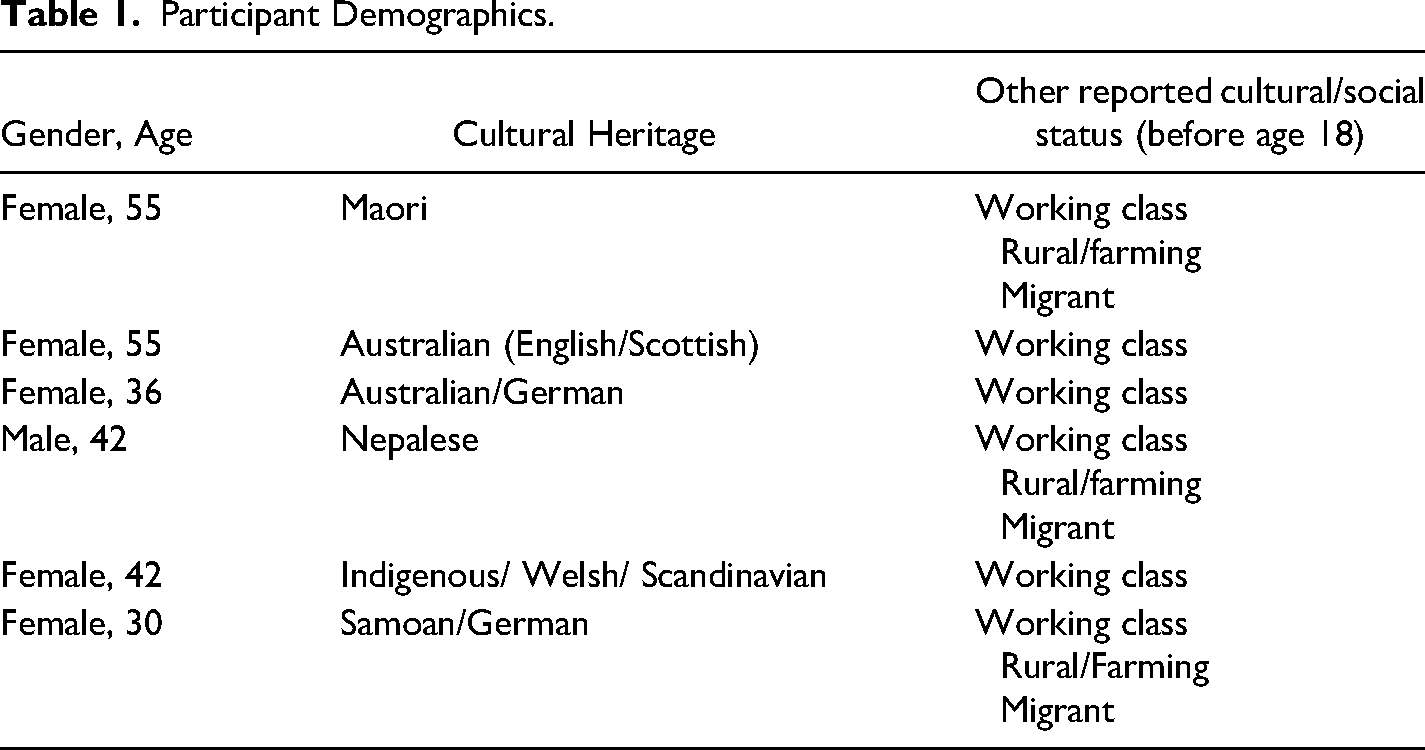
The six participants were first-year undergraduate psychology or social work students nearing the end of their first year (it was not intended to be limited to these courses). Five participants were female, and one was male and the mean age was 43 years (see Table 1 for demographics).
Participant Demographics.
Procedure
The Victoria University Human Research Ethics Committee evaluated and approved the study (Application ID 18–211). Potential participants learned about the study through online university class announcements and through email communications to students who previously participated in an orientation program for FiF students conducted at the university and facilitated by two of the authors. Six students who identified as over age 25 volunteered and provided their written informed consent. Participants were informed they could stop participating at any time and were provided with external psychological resources should they feel triggered as a result of their participation. Interviews were conducted via Zoom. Participants received a movie ticket voucher in appreciation of their time.
Semi-structured interviews with the opportunity for open-ended responses were an ideal way to allow the participants to tell their stories. Sample interview questions included “What was the story that inspired you to pursue University study?” The average length of an interview was 75 min with a range between 45 and 90 min and were audio recorded and transcribed verbatim. Because stories were very personal and demographics from the interviews included some identifying details, the writing of the findings has been careful to protect confidentiality.
Data Analysis
Following Braun and Clarke's (2019) thematic analysis guidelines, decisions were made to define the scope of this study. Primarily, in relation to the epistemological stance of the research question, themes emerged in relation to how personal and familial stories influenced participants’ choice to pursue university study. Analysis combined ongoing reflective writing and memoing. Categories were grounded within the narratives to develop insights into their social processes. Themes were discussed with the first two authors in stages during the analysis and continued until the saturation point.
Findings
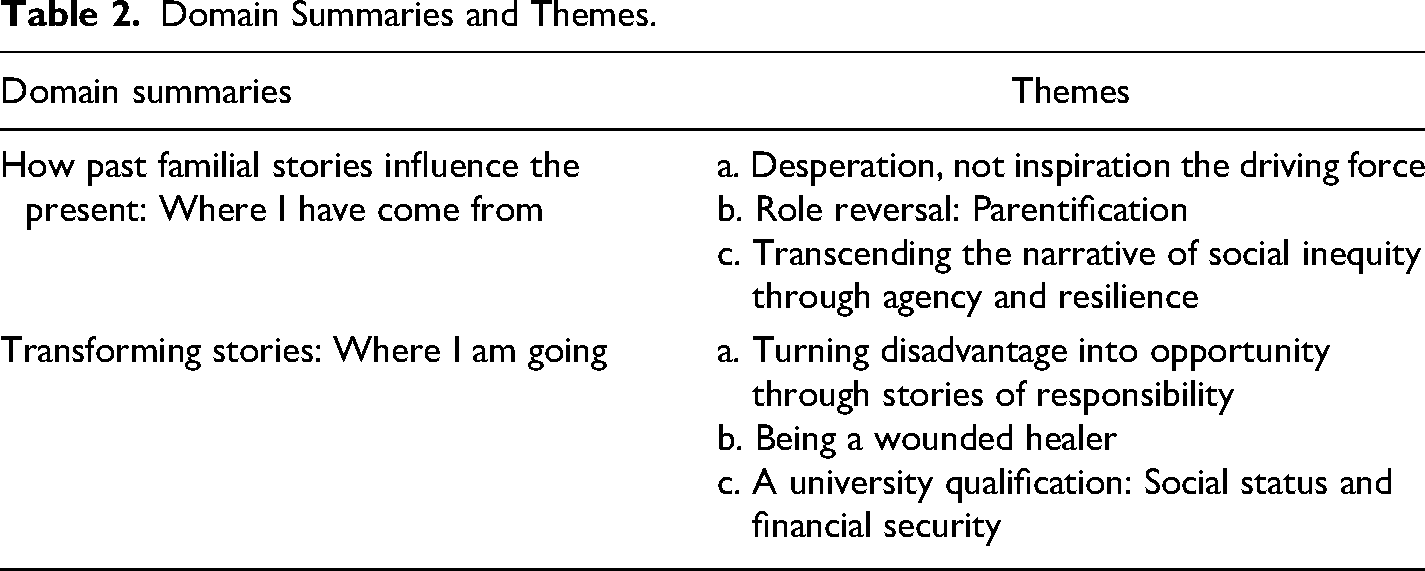
Participants’ narratives centred in two overall domain summaries or overarching themes and each had three related themes (see Table 2). All participants expressed interest in identifying where their old story began and also challenged the “taken for granted” beliefs and the unhelpful internalized messages that in the past influenced them not to attend university. Likewise, all participants decided to inhabit new stories by making decisions to pursue university study which would make “their future selves proud,” allowing new stories to emerge.
Domain Summaries and Themes.
How Past Familial Stories Influence the Present: Where I Have Come From
All participants recognized that internalized, past familial and negative personal narratives they subscribed to during childhood and adolescence were unconsciously dragged into adulthood, and negatively influenced their attitudes, confidence, and education choices. Only as adults did they come to realize how they took on negative messages and how it impacted their subsequent choices about education. As one participant noted: “There were unhelpful stories repeated from my dad. And those negative stories became like a suit of armour that helped me move through the world.” This analysis highlights participants’ need to “reckon with the past;” to examine and interrogate their stories with a sense of “compassion,” “forgiveness” and in so doing, challenge the tenets and expectations of family, community, and religious traditions. As one participant noted: “I used to have that negative self-talk - that I wasn't smart enough, because I never had someone to give me that positive reinforcement that I needed growing up…You get comments about - that you're stupid, that you're not good enough, that you’re always wrong.”
Desperation, Not Inspiration the Driving Force
Negative family stories shaped participants’ stories about university education and affected how they later pursued a university education out of desperation to improve their situation. Participants’ decision to choose university study as an adult arose, as one participant remarked from feeling, “I can’t keep on doing what I’m doing.” Participants were not satisfied with their current circumstances and education was seen as an opportunity and an intrinsic motivating force for action. One participant described an abusive and unsafe home, running away at 15 and their mum dying at 18, and yet education was important: “But I kept telling myself, I was to get an education. It was like I said - an escape. I had to escape from the life I knew.”
Some participants simultaneously expressed an existential interest and a dissatisfaction in their “dead-end” jobs, despite rewards of security. One participant had a child when she was 21 and was supporting herself financially, and was balancing the responsibility to care for the child and going to university: I just thought, if I don’t do it, I’m never going to know - and live with regrets. [. . .] I suppose I never really got the opportunity to go to university when I was a young… I didn’t really have parents that backed me up, or anything, so they didn’t say “You could do this”
Parentification: Role Reversal
This theme relates to how taking on family duties (i.e., taking care of siblings, domestic chores, contributing to family finances) at a young age prevented them from pursuing university following high school. This role affected their desire for a different path in life motivating them to go back later and pursue education as MA students.
One participant, who raised her siblings, internalized a competent ‘parentified’ self, where in the domain of academia, she doubted her performance, felt underserving of her university admission, and considered herself an imposter. She noted: “With the impact of the intergenerational trauma of my family and the cultural load, I decided that I wanted to be better - better myself - like, go back and do my undergrad.”
Transcending the Narrative of Social Inequity Through Agency and Resilience
This third theme relating to past familial stories conveys the ways in which participants focus on strengths to find solutions in order to change their personal stories and challenging circumstances. Whilst entrenched intergenerational social disadvantage, low levels of education, unemployment and mental health problems affected participants’ families and community, participants did not feel defined by their familial stories of disadvantage. Comparatively, they believed in their capability to be successful, as one participant noted, “it's not rich people or the system keeping us down, it's our own families.”
Participants saw themselves as active decision-makers where past stories were renegotiated and new narratives for the future began. Factors such as family narratives, ethnicity, marital status, social status, and contextual factors were not as powerful as personal resilience. It is notable that social forces and factors, like social and cultural capital that are outside of their control, were not part of most of their narratives. From this perspective, their academic identity was not determined by their background but by their decisions. This is most saliently expressed by a participant who described a childhood of exposure to domestic violence, verbal abuse, and feelings of inadequacy, yet: I made a choice and that's in the past now and I never use my circumstances as an excuse. [. . .]. And so, part of me now, in the back of my mind is thinking oh, [my foster parents would be] pretty happy that despite everything, I'm going to university, that I’ve beat [sic] the odds. “You can blame the system, but nothing's gonna [sic] change, if you don’t tell the system that it's broken – like, there's [a] victim mentality built into the system, so why would I want to be around that anyhow? Sometimes, you've gotta [sic] not rely solely on the system and go it alone.” Like I've had a couple of times during the first year of uni, [sic] I've said “…What am I doing here? I can’t do this [university study],” but then I think of where I’ve come from - what's behind me. . . I had to rebuild my ship and Uni's [sic] doing that; I have white collar job prospects now. There's stigma where I’ve come from, but also, I’ll never not own my story.
Transforming Stories: Where I am Going
Participants wanted to be free from their childhood narratives. This second domain examines participants’ re-imagining of their own stories and the ongoing process and choices that brought them to university. All were determined not to allow “history to repeat itself” or remain “trapped in the limiting stories of [their] past.” As one participant noted, “My early life was not the right story. And we have the tendency to do things over and over again - but I chose to be the hero of my story now.” In so doing she looked to a future with possibilities. As another participant said: “I always say to mum, ‘I'm not going to be barefoot and pregnant and tied to the sink’ like her. I don't want to be that person, you know, I want to be better than that.”
Turning Disadvantage into Opportunity Through Stories of Responsibility
This theme highlights the way in which participants bore the burden of responsibility. They realized that while they could not change the facts of their childhood, or that they often faced an unfair disadvantage in comparison to traditional-age students, they were able to change their relationship to the stories that parents had imparted. In doing so, they were able to envision their university and vocational goals. As one participant noted: You know, because you're thinking, “oh, gee, I didn’t finish school, I'm not good enough for uni, I can’t have that goal.” So, for me, I think, well, how do I fix that self-belief? For me, I just go into fix-up mode and do. [. . .] It's, interesting, where our ambition comes from, you know? And I think sometimes we can turn that sense of injustice, perhaps into a positive, like: “I'm going to show you! I'm going to be the best and I'm going to be better than you!”
The Wounded Healers
This theme highlights how participants turned their challenging life experiences into a strength and were motivated to pursue helping professions in the service of others. Though it was not intended in the study recruitment, the participants were all studying social work and psychology, so there might be a bias. By pursuing careers to “sacrifice [themselves] to help others,” those childhood challenges meant something. This motivation provided participants with a future life-affirming story, moving them from victim to victor. As one participant noted: It's good that I’ve sort of experienced some of this stuff, learned the hard way and they were difficult lessons . . . and [I’ve] healed from that to a different place, through therapy myself, and I suppose one day, I hope I can relate to others and maybe even inspire other people… that [those] experience[s] [are] not in vain.
A University Qualification: Social Status and Financial Security
There was widespread agreement amongst participants that people do have innate emotional needs for social status, related to overcoming a sense of inadequacy and gaining a sense of control. As one participant noted: Maybe it's… lacking in self-confidence - that you feel like you need to - you need a uni [sic] certificate to prove, you know, [yourself] … That sort of judgment [from] people that sort of judgment people have - like, that's the first thing people ask you, when they meet - is “What do you do?”
Growing up in unpredictable households, led to participants’ need for security and one way to gain it was to “weatherproof [themselves] against life by preparing for the worst.” They believed that a university degree was related to favourable income prospects. As one participant noted: “I think I need more stability, like financially for like, my future self. A uni [sic] qualification would make things easier. I didn’t really think about the pros and cons as to what, would happen.” Despite not being motivated by passion, a few participants noted that the future reward of financial stability was worth the short-term sacrifice. This sentiment was captured by this participant's comment: “But it will be worth the long-term gain. I’m not doing it because it's what I’ve always wanted to do – in the end it will give me financial security.”
Discussion
The aim of this study was to explore how MA FiF students’ personal stories (agentic influences) and familial stories (social relational processes) shaped participants’ choice to attend university. Findings revealed that while participants grew up without access to social or first-hand knowledge about university, participants developed and kindled motivations to attend university later in life. Participants were able to give their familial stories meanings and write new narratives based on their personal identities and yearning for a different future.
Compelled by Agentic Abilities: A Belief in Personal Stories
Participants reported that familial stories were generally negative in regard to education, which felt life-negating. These stories communicated idiosyncratic myths and convictions that families were often reticent to surrender. Instead of allowing negative familial stories to distort their self-belief, lose motivation or feel disillusioned, such stories based on the collective, intergenerational experiences of parents, were interpreted by participants as ‘what not to do’ propelling participants to push towards their goal to pursue university and a professional career as they made sense of the world beyond the family (Seligman, 1992). This reflects findings from O'Shea and Stone (2012), but adds more depth to how FiF MA students had to acknowledge and own the negative stories before re-writing the narratives.
Participants reported that their current personal stories, which were focused on education and betterment, were life-affirming. Participant reports supported all four attributes of psychological capital (Luthans et al., 2007) as well as agentic engagement (Jiang & Zhang, 2021). Efficacy, hope, and optimism, were apparent, however resilience was most evident, captured in the theme: “Transcending the narrative of social inequity through agency and resilience.” The findings suggest that students’ experiences and orientations characterized by possessing confidence (self-efficacy) to take on challenging tasks, make positive attributions about their future (optimism), and persevere towards their goals (hope) acted as forerunners to resilience-building and the intrinsic motivation to attend university. Research supports the findings, that intrinsic motivation is associated with higher levels of effort, and task performance, including the inclination for challenge (Patall et al., 2008). This indicates that MA FiF students have developed characteristics contributing to resilience that allowed them to overcome the lack of social capital.
Participants’ experiences also supported Seligman's (1992) theory of learned optimism, revealing that how we tell stories about ourselves is as significant as the storylines. Specifically, the following attributional approaches were evident: (1) interpreting negative events as temporary, (2) possessing the ability to compartmentalize helplessness, and (3) obviating the internalization of negative stories. Such abilities converged to form an attitudinal pattern which informed personal stories whereby persisting in the face of adversity. Therefore, participants’ belief in personal stories were pivotal in shaping their motivations to pursue university over and above the influence of negative familial stories.
MA FiF Students’ Journey to University
Findings reveal MA FiF students upheld the importance of familial and social contexts. In spite of unsupportive family stories, students were driven to change their circumstances, revealed in the theme “desperation not inspiration, the driving force.” MA FiF students experienced a fragmented pathway from high school to university with considerable pre-existing issues (Pires & Chapin, 2022). The theme “role reversal: parentification” offers an explanation as to the reason participants were less likely to attend university immediately after high school. Specifically, this finding confirms those of earlier studies which have demonstrated that children with significant adult roles are often from impoverished, neglectful families, (McMahon & Luthar, 2007). Education is often the last priority for these young people. Previous studies of MA students have focused on their current decision to attend university (O'Shea & Stone, 2012; O'Shea, 2015), so these findings contribute to the literature by also considering the initial decision not to go to university. One unique finding of this research was a pattern which revealed that parentification was embedded in familial stories and maintained. This particular experience was so common and explains how university felt impossible for them at age 18, causing them to delay university study to get a job.
While much literature has examined the social structures that limit the education choices of young people (e.g., Patfield et al., 2021), this study provided a family perspective that contributes to a fuller understanding of factors contributing to lower tertiary participation among prospective FiF students. Social forces that privilege some students over others were not part of their narratives. The participants in this study were able to discuss the role of their family narratives and how their experience growing up initially to undermined their choices to pursue university study in the first place. Participant stories revealed in the theme “transcending the narrative of social inequity through agency and resilience” uncovered participant's opposition to the narrative that ‘social inequity’ affected their choices. Preferring autonomous control rather than a social system beyond their control, participants felt the recipe for success was making responsible decisions. It was evident that participants felt commitment to a personal story that rejected an oppressed victim identity.
The theme “turning disadvantage into opportunity through stories of responsibility,” saw all participants draw upon their psychological capital and level of agentic will to overcome their family stories. This finding supports previous FiF studies highlighting the resilience of students. For example, students draw on motivational strengths frequently employed from earlier challenging life experiences that assist them in thriving at university (Edwards et al., 2022). Despite the disadvantage of having to navigate the university system without social capital, Devlin and O'Shea (2011) argue that FiF students possess non-cognitive characteristics like motivation, grit, and determination which can be credited to academic success.
While social and human capital theories might explain why participants did not go to university initially, findings also revealed something about the psychological capital or mindset of these students once they arrived at university. Particularly, that the pursuit and successful acceptance into university was achieved through participants’ ability to be motivated, future focused, and goal orientated. This finding is similar to O'Shea and Stone (2012), where participants identified many barriers to beginning university study, yet they persisted. The current study adds considerable understanding of how they drew on past discouragement and adversities to inspire themselves to aspire to university. Using Yosso's (2005) community cultural wealth framework, O'Shea (2016) found the FiF students recruited prevailing and established capitals in the transition to university. Such capitals relate to current research findings explained by the theories of agentic engagement (Jiang & Zhang, 2021) and learned optimism (Seligman, 1992) which utilizes constructs of resilience, efficacy, optimism and hope.
For example, ‘aspirational capital,’ a form of resilience that involves nurturing possibility and relates to MA FiF students’ ability to maintain optimism, hope and resilience despite the obstacles (Yosso, 2005). Furthermore, ‘Resistance capital’ a dispositional process referring to challenging the status quo which relates to MA FiF students’ ability to maintain efficacy to inform their convictions and break from familial tradition. In relation to the theme “A university qualification: social status and financial security,” participants based the assessment of their community standing by evaluating their career achievements or lack thereof. Participants perceived themselves as unqualified with few opportunities upwards and social comparisons compared to their university-trained peers. Such status inconsistencies only served to propel them towards choosing university study (Evans & Kelley, 2004; Laming et al., 2019).
In relation to the theme “being wounded healers” and in alignment with the literature, Brown and Bloom (2009) argue that a wounded healer's maternal role may establish an identity “script” that can motivate a desire to be a caregiver. By doing so, participants took on beliefs that they were only deserving of care if they cared for others (Greenberg & Mitchell, 1983). In this way, participants’ wounds served as a stimulus to pursue university study in helping professions in order to heal the problems of others – because the act of helping others in their community was a vital part of their own recovery (Farber, 2013). This analysis also contributes depth understanding the aspirations of MA students.
Strengths and Limitations
An important strength of this research is recognizing the significance of lived and subjective experience to contribute to understanding complex social processes. The narrative psychology methodology allowed the stories of those who regarded themselves as traditionally outside the domain of university to generate spaces within which students could deconstruct their perceived and negotiated choices to undertake university study, as well as explore their cultural identities and personal strengths (Sonn et al., 2014). In so doing, participants’ individual memories and deep knowledge, while idiosyncratic, nonetheless had the potential to illuminate personal strengths and aspirations, familial and cultural myths, and public histories.
One limitation of the current research was the single interview with each participant. Narrative methodology is rather personal and individuals might benefit from having time to reflect and revisit topics more than once (Willig, 2022). All but one participant were female, which does align with similar findings that FiF and MA students tend to be women (O'Shea et al., 2017). Previous research has also found that MA FiF students tend to be in “caring” professions, which aligns with the participants all studying psychology and social work. Gender is an important factor in work, education, and opportunity and there might have been different findings with more men (Laming et al., 2019). Therefore, the sample might be a reasonable reflection but not representative of all MA FiF students. Future research should include a wider range of academic disciplines to provide more understanding of MA and FiF students.
Conclusion
This study revealed that a belief in one's personal stories – whose words (reflected one's psychological condition) sought to validate what individuals wanted, (instead of life – negating parental stories, whose words gave rise to condemnation). This unique finding promotes a shift away from the dominant notion that often lays the blame on an inequitable system that fails to support MA FiF students or MA FiF students’ families for failing to offer adequate social and human capitals. There is a dearth of literature that discusses unsupportive parents who discouraged FiF students from attending university, including the role of parentification. Thus, there is an argument to be made for further research which quantifies this pattern.
Another implication of the current research is the power of narratives in motivating the pursuit of education. This can be utilized in supporting students of all ages and their families. Helping people to create their own stories can help them to set and achieve goals, and this can be integrated in programs and interventions at many levels of education.
Footnotes
Declaration of Conflicting Interests
The author(s) declared no potential conflicts of interest with respect to the research, authorship, and/or publication of this article.
Funding
The author(s) received no financial support for the research, authorship, and/or publication of this article.
