




Abstract
This study explores the integration of migrants in education and the labour market from the perspectives of professionals working with young migrants in Swedish rural municipalities. It compares interview data referring to the situation during the refugee crisis in 2015 with data referring to the period 2019–2022. It addresses the organisation of teaching, how professionals talked about integration in relation to the local labour market and how integration-related practices and discourses developed from 2015 to 2022. The findings indicate a major change over time in the educational integration strategies and practices. Migrant children were mainly taught in separate preparatory classes in 2015, but by 2019–2022 there was a general aim to integrate them rapidly in regular classes. In terms of labour market integration there was also a discursive change. In 2015 the main hope was that the migrants’ reception would create short- and long-term jobs for the local population and contribute to the survival of local services and life. In contrast, in 2019–2022 the main expressed hope was that migrants would stay permanently and contribute productively to their new societies’ labour forces.
Introduction
Numerous studies (e.g. Dubois-Shaik, 2014; Linde et al., 2021) have shown that education is a major structural factor, crucial for migrants’ social integration, and a key enabler of their integration in other public sectors, such as the labour market. However, many factors may influence their integration, schooling and effects of education. A major recent factor with multi-dimensional effects was the refugee crisis of 2015, when millions of migrants came to Europe. Sweden received 163,000 refugees, including 70,000 school age children (Bunar, 2017; Swedish Migration Agency). The refugees were unevenly distributed geographically by the Swedish authorities, and sparsely populated rural municipalities with poor conditions for their reception and labour market integration (including relatively few employment and housing opportunities) received more refugees per capita than other regions (Hudson et al., 2021). Providing education for refugees, and in the longer term introducing and providing access to the local labour market for those who received asylum status, was highly challenging due to the material and structural constraints (Hudson et al., 2021). A clear consequence was that substantial demands were placed on schools in the receiving municipalities.
The strong inflow of refugees to Europe was temporary. In March 2016, an agreement between the European Union (EU) and Turkey came into force that slowed the inflow. In addition, Sweden introduced a temporary law limiting the possibility of obtaining a residence permit in Sweden (Government Bill, 2016), thereby bringing Swedish regulations more into line with those in the other EU countries (Dahlstedt et al., 2019). The inward movement of migrants significantly fell. Numbers of young refugees declined, but migration and integration continued to be highly topical, politically charged issues and facilitating integration remained a major element of educational and labour market professionals’ missions.
Against this background, the aim of the study presented here was to explore integration of migrants in discourse and practice from the perspective of professionals working with young migrants in Swedish small rural municipalities (i.e. teachers, principals, school leaders and staff responsible for educational and integration-related services at municipality level). ‘Discourse’ refers in this context to how ideas and hopes about integration and reception of refugees were expressed in oral conversation, and ‘practice’ to how education for young refugees was organised on an everyday-basis. We mainly addressed integration in education. However, educational and labour market integration are closely linked (Dubois-Shaik, 2014), and education, as also indicated by interviewed professionals’ responses, often plays a key role in integration in the labour market. Therefore, we included discourses on labour market integration in our analysis of what we call schooling for integration – integration in and by means of education. We also recognised a need to assess potential changes with time in associated discourses and practices since both numbers of received refugees and political attitudes have substantially changed in the last decade. The idea of the value of pluralism and multiculturalism in society has weakened in political debate, and both immigration and integration policies have become more restrictive (Dahlstedt and Neergaard, 2019). Thus we have compared data referring to the situation in 2015 with data referring to the period 2019–2022. We specifically address two research questions (RQs). First, how was teaching of migrants organised and how did professionals talk about integration in education and labour in relation to the great refugee wave in 2015 and the period 2019–2022? Second, how did integration-related practices and discourses develop in the period between 2015 and 2022?
Research on education, migration and integration has addressed migrants’ participation in primary and secondary school (Tajic and Bunar, 2023), and the transitions between primary and secondary school (Linde et al., 2021), adult education (Rosvall et al., 2022), higher education (Kontowski and Leitsberger, 2018) and VET (vocational education and training) (Kurki et al., 2018). The research has included studies of the processes in various local, regional and national contexts from a policy perspective (Dubois-Shaik, 2014), perspectives of the migrants themselves (Hartonen et al., 2024) and perspectives of professionals, such as teachers and trainees (e.g. Costa et al., 2021; Vieira et al., 2017). We aim to contribute here by illuminating the processes and relationships involved in a specific Swedish rural context (small rural municipalities in Sweden), and potentially important changes over time.
Background: European and Swedish migration policies and practices
This study addresses aspects of what Taylor and Sidhu (2012) call ‘forced migration’ of families and unaccompanied children, adolescents and young adults who are refugees and seeking asylum in a receiving country. We focus particularly on newly immigrated refugees and asylum seekers, and specifically people who arrived in Sweden at most 4 years before the data collection period of the empirical element of our study. 1 The challenges faced by these refugees and recipient communities are highly charged and pertinent, because of a sharp upsurge in forced migration in recent years globally as instability and insecurity have led to mass migrations of people looking for a better and decent life (Udayar et al., 2021).
In 2015, 2.8 million people sought refuge or asylum in European countries (UNICEF, 2016). During that year, Sweden, with its roughly 10 million inhabitants, received 163,000 refugees, mainly from Syria, Iraq, Afghanistan and Northwest African countries. Of these, approximately 70,000 were minors under the age of 18 years. Approximately 35,000 were unaccompanied children, mainly from Afghanistan (Bunar, 2017; Swedish Migration Agency). At this point the Swedish government moved larger numbers of refugees per capita to rural municipalities than to large cities. However, as also noted in the literature, rural and sparsely populated municipalities did not oppose this and frequently welcomed high numbers of refugees per capita to counter problems associated with depopulation (Hudson et al., 2021).
Proietti and Veneri (2021) identify placement of refugees in rural areas as a recent trend in several OECD regions. Due to unfavourable material and structural characteristics in many rural European municipalities in the mid-2010s it was challenging to provide education, and in the longer term introduce those who received asylum status to the local labour market and provide access to it. Key elements for efforts to meet these challenges are schools, as they are major meeting points in young people’s everyday lives and institutions that convey national knowledge and understandings, both generally and in Sweden (Nilsson and Bunar, 2016). Moreover, immigration of refugees affects many social and economic sectors, and education plays a major role in their integration both socially and economically. Local schools were particularly important for integration in the focal period because many of the refugees received by Sweden were school-age children and youths, and some came without parents.
The rapid rise in inward migration in 2015 was not permanent. In March 2016, an agreement between the European Union and Turkey came into force that significantly slowed the inflow of migrants. In July that year Sweden introduced a temporary law limiting the possibility of obtaining a residence permit in Sweden (Government Bill, 2016). As a result, the immigration of families and influx of young migrants dramatically fell in Swedish rural municipalities and schools, and the proportion of migrants in Swedish rural municipalities is significantly lower today than in 2015. Rural municipalities continue (to varying extents) to receive quotas of refugees and there is some family reunification immigration, but the numbers are low. However, local communities still have needs to facilitate migrants’ integration and it remains a topical, emotionally charged issue in local politics and public debate. Presumably at least partly for these reasons the law restricting immigration has been retained and is still being applied.
Before the new law, recognition of a right-to-family-life was an important foundation of migration and asylum policy. However, in an effort to adjust regulations to a minimum EU level the government introduced a temporary law that discarded the right to family reunification for asylum seekers who lacked protection under the Geneva Convention (hereafter Geneva Convention refugees). Up to 2016, there had only been two restrictive changes. The first, in 1997, restricted possibilities to bring in family members outside the so-called nuclear family (Government Bill, 1997) and the second, in 2010, introduced a requirement for financial support (Government Bill, 2009) (Bech et al., 2017). In comparison with recent policy changes across Europe these were rather minor restrictions, in both scope and content, but those implemented in July 2016 drastically cut family reunification rights.
The government stated that to ‘limit the refugee flow and put pressure on other EU countries to take their share of the refugee burden’ asylum seekers would only be granted temporary residence: 3 years for Geneva Convention refugees, and one for persons with alternative protection status (Government Bill, 2016). The right to join close family members became available to Geneva Convention refugees provided they submitted an appropriate application within 3 months of being granted asylum, and those with other grounds for protection lost the right (Bech et al., 2017). In addition, a referee had to be able to maintain incoming family members financially. Quota refugees and children were exempted from the support requirement, as were asylum seekers who had submitted their application before 24 November 2015. This led to an increase in the number of unaccompanied adolescent refugees.
The Swedish Conservative party (Moderata samlingspartiet) welcomed the stricter rules and thought the government should have gone much further, as did the rightwing populist Sweden Democrats, who criticised the proposal for being ‘too little, too late’ (Government Bill, 2016). Parliament accepted the proposal on 21 June 2016. It took effect a month later, on 20 July 2016, and severely weakened a major element of previous Swedish immigration and integration policy: the presumption that immediate security of residence is the best way to promote integration. Thus, the costs of receiving more than 160,000 refugees in a single year and experience of doing so with little help from other EU partners, besides Germany, had triggered a substantial shift in the country’s asylum lawmakers’ fundamental presumptions.
Although Swedish migration policy has become more centralised, local municipalities still play an important role in refugees’ reception and (in accordance with the UN Convention on the Rights of the Child) providing schooling for refugee children (Hudson et al., 2021). As summarised by Tajic and Bunar (2023), all children have the same rights to education, under the same conditions, as Swedish-born children, even while awaiting residency decisions. In addition, their previous school experiences and subject matter knowledge must be screened no more than 2 months after reception in a municipality/school.
National recommendations state that newly arrived migrant students must be placed in either a mainstream school class or separate preparatory group (Skolverket, 2008). However, both academic studies and government investigations have found that some local variants are hybrids of the two approaches (Nilsson and Bunar, 2016; SOU, 2017). The time in a preparatory group must not exceed a year (two in special or extraordinary circumstances), and the students must be offered at least some instruction together with students in mainstream classes while in preparatory classes (Skolverket, 2008). However, there are no regulations concerning either the hours per week they must spend in these classes, or their subject matter. Newly arrived migrant students also have a right to multilingual classroom assistance (Skolförordning, 2011:185; Skollag, 2010:800). Although the government provided financial support for the receiving municipalities in the mid-2010s to support migrants’ schooling, the uneven distribution of migrants (with rural municipalities receiving most migrants per capita) has undoubtedly created strain in some places.
Theoretical framework
Integration is a broad, contested concept with many interpretations in the literature. For example, European educational and migration researchers have addressed it in terms of ‘membership’ (e.g. Dubois-Shaik, 2014) and associated ‘citizenry rights and responsibilities’ (e.g. Ager and Strang, 2008). Specific domains or spheres that are highlighted as particularly crucial for integration in the literature include education, employment and housing (Ager and Strang, 2008).
Here, we focus mainly on integration in education, in the sense of inclusion and participation in education. As education is interwoven with integration (and segregation) in the labour market domain (Dahlstedt, 2017), we have also included discourses on labour market integration in the analysis. We understand and address educational segregation as the detached or separate teaching of a group of students from ordinary teaching. We highlight the material structures and practices that influence educational integration and segregation. Our analysis draws on the idea that integration involves ‘overlapping processes’ that vary widely, depending on the contexts and spheres of receiving communities and societies (Castles et al., 2002: 126), due to effects of numerous factors associated with time and place. Relevant factors include diverse aspects of the local culture, and the significance of signs, symbols, material production and both the production and reproduction of ideological relations in regional, national and global political and socio-economic contexts. This prompted us to focus strongly on the characteristic structures and practices in our interviewees’ settings (temporal and spatial).
Our theoretical understanding of context/place is inspired by Massey (1994), who recognised that the material and social conditions at a given place and time, and relations of the place with the outside world, significantly influence (and are dualistically reflected in, reproduced by, and mediated through) situated discourses and practices. This directs attention to ways that social phenomena, such as the organisation of education for the reception of new young refugees, are configured in situ, and promotes an essentially dialectical materialist approach to analysis of cultural phenomena, as well as local histories and geographies. Here we apply such an approach (with consideration of the material bases of integration in domains including both education and the labour market) in an exploration and analysis of schools’ roles in the process of integrating migrants in the local society. Drawing on the findings we discuss in whose, which or what interests integration occurs.
Data and methods
The study was designed to address discourses and practices about integration of migrants in two contrasting temporal contexts. One was the year 2015, when there was a major upsurge of immigration into many countries globally, including Sweden. The other was the period around 2020, when the refugee situation differed in scope and character, the ideological and political climate in Sweden had changed, and Swedish immigration and integration policy had become more restrictive (Dahlstedt and Neergaard, 2019). Empirically, the study is based on interviews with teachers, principals, school leaders, staff responsible for educational and integration-related services at municipality level (henceforth ‘professionals’) conducted in two Swedish research projects – both designed and carried out in accordance with the Swedish Research Council’s ethical guidelines. The first project, entitled Rural youth – education, place and participation, 2 was an ethnographic study that examined rural youths’ and professionals’ views of education, future and social relationships in six rural municipalities spread geographically across the country. The project was not initially designed to investigate the reception and education of young refugees, but as data were collected in 2015 and refugees from Syria, Afghanistan, Iraq and Northwest African countries arrived at the researched schools while the research team was doing fieldwork in them, issues related to young refugees’ reception and education were observed and addressed in the interviews with professionals.
The second project, Education and integration of newly arrived migrants in rural areas, 3 was designed to address education and integration of young migrants in rural municipalities. During the period 2019–2022 4 the research team conducted interviews with professionals in the six municipalities included in the earlier project, and to obtain data with wider scope we added interviews with professionals in a further 15 rural municipalities that (like the initial six municipalities) received a large number of new arrivals of school age in 2015. The municipalities were selected to be spread geographically across the country and to represent a variety of rural settings according to central authorities’ categorisation of Swedish municipalities (SKL, 2011; SKR, 2017). The municipalities varied in size, geographic location, economic infrastructure and labour market conditions. They included towns with varying degrees of industrialisation (or de-industrialization), small villages in sparsely populated areas, and small rural towns with significant tourism sectors. A selection of characteristics such as geographic location (indicated as ‘North’/‘South’), 5 total number of inhabitants, total number of foreign-born inhabitants and foreign-born aged 0–20 (2016 and 2020) 6 is presented in Table 1.
Data overview.
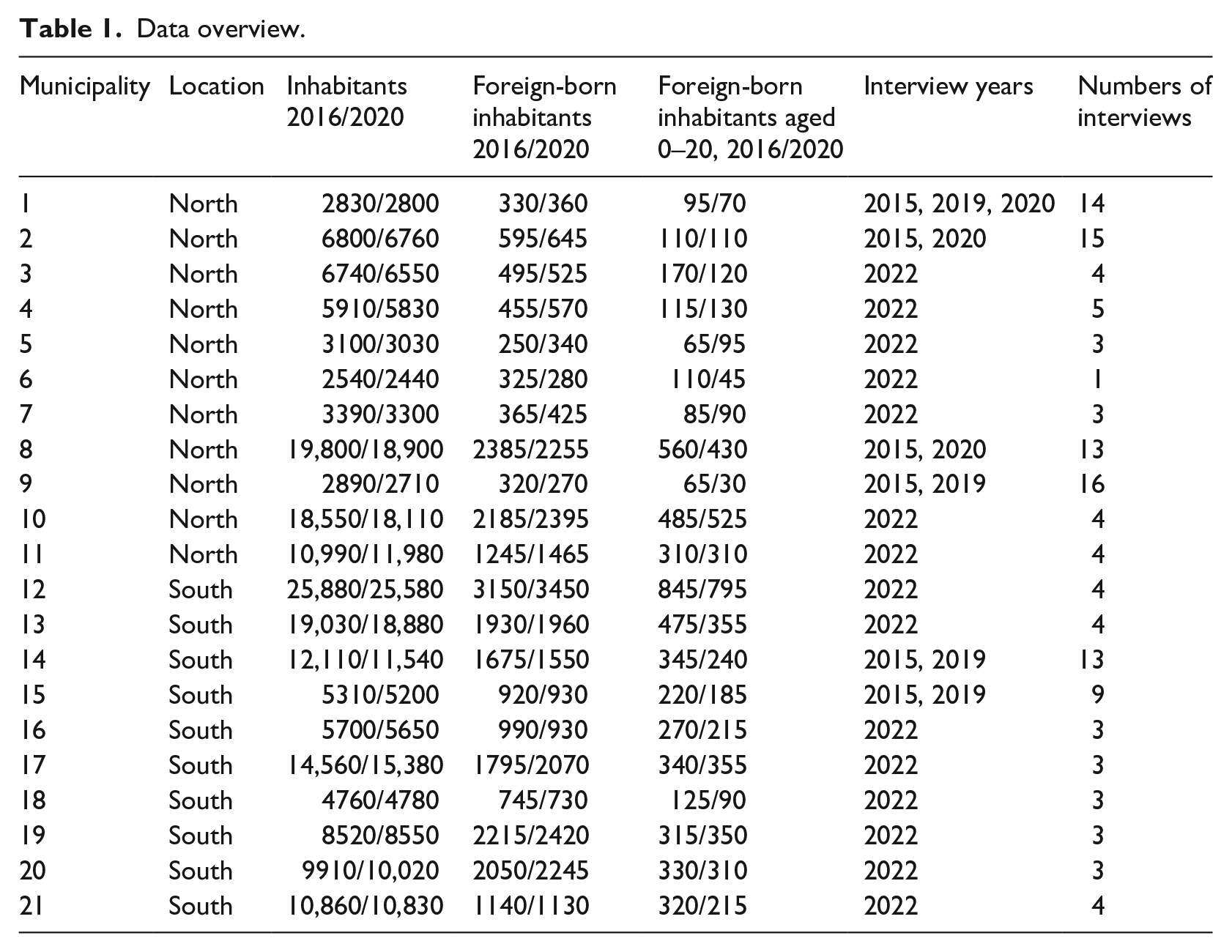
In total, the analysis presented in this article draws on 131 semi-structured interviews with professionals, 35 in the first project and 96 in the second project. In six municipalities interviews were conducted on two occasions (in 2015 and 2019–2022), and in the remaining 15, interviews were conducted on one occasion (during the period 2019–2022). The professionals were teachers, principals and heads of the municipalities’ schooling. They had worked in their respective municipalities for varying lengths of time, and many had lived in the region for a long time and had a history connected to the place. They worked with young refugees of different ages, with compulsory comprehensive school students aged 7–16 years, and some also worked in adult education. A few had responsibilities for addressing migration and integration related issues also in other domains than education (e.g. heads of reception/integration activities and labour market interventions). For an overview of the data see Table 1.
The interviews were recorded and transcribed, then interviewees’ responses were coded and thematised, focusing on how professionals discussed and worked with integration in 2015 and more recently (RQ1) to develop core elements associated with each theme, following the approach described by Braun and Clarke (2006). We then analysed developments over time with a materialist perspective (addressing RQ2). As described in the following (Findings) sections we identified two main themes regarding integration in 2015, and two regarding integration in 2019–2022. To protect the professionals’ privacy their names and the research sites have been anonymised. Quotations were selected to well illustrate general patterns of discourses and practices over time, and even distribution of citations between municipalities was not aimed at. Since questions about integration were not asked as systematically in the first project as in the second one, the most illustrative quotations origin from the second project in which the interviewees both talked about the reception of refugees in 2015 and in recent years. When quotations are provided, the professional’s occupation is stated together with the interview year and number assigned to the municipality as listed in Table 1. This does not mean that occupation was a core element in the analysis – change or continuity over time was the focus of the analysis. We aimed at a diverse group of professionals with various competencies and interests as we sought a diverse picture of the reception of refugees. However, in terms of consistency, comparability and reliability, the study would have benefited from groups of professionals who worked with similar tasks in the different municipalities, but that was not possible due to the municipalities’ different sizes and different organisations. Moreover, difficulties to get hold of professionals to interview in some of the municipalities meant that the number of interviewees differs between the municipalities, something that must also be taken into account when reading the findings.
Findings regarding integration in 2015
Integration practised through separate preparatory classes
In 2015, by far the most common form of organising teaching was to put young migrants in separate preparatory classes. These classes were taught by staff with varying education in secluded school buildings or adjacent buildings. The classes included students of various ages, backgrounds (cultural, ethnic and migrant), previous formal education, subject knowledge and linguistic skills. Newly arrived young refugees from Syria, Iraq, Afghanistan and Northwest African countries were placed in the same classes as children and youths with parents from Central Europe or Eastern Europe who had migrated to improve their lifestyle and had lived in the municipality for some time. Despite the migrant students’ diversity, as they were placed in one class or group they were frequently discussed as a homogeneous group in relation to other students. Similar homogenising discourse on migrants in the educational sphere have been noted in several previous studies, for example, at national policy level by Dubois-Shaik (2014).
One stated reason for placing the migrant students in separate preparatory classes was to prepare them for integration in regular classes (cf. Öhrn et al., 2023). As one informant described it afterwards, the newly arrived refugees needed basic language skills (Swedish), basic subject knowledge and introduction to Swedish schooling before entering a regular class: When it comes to the knowledge base in Swedish, [it is important] to give them a base [. . .] so you [teachers] have to give them the base before they can get out. Then you can go out [into a regular class], then you should go out, you have to meet [other students] and you have to be able to participate, but you can never keep up [in terms of learning] if you don’t have the [knowledge] base, and how are you supposed to be able to participate in a [social] context [without basic language skills and knowing the school culture]? (Principal, Municipality 1, 2019)
The preparation for regular class was considered easier if the migrant students knew English or had a mother tongue or skills in a language that had at least some similarities with the Swedish language: Progress is faster for students who can communicate, for example, in English or who have a mother tongue that is very similar to ours, for example if they know German [. . .] or the alphabet. Language is the biggest barrier when they are at this [lower secondary] age, and then of course culture can be a barrier. (Teacher, Municipality 1, 2019)
Looking back at the situation 2015, it was emphasised that the students needed basic language and subject skills, and had to be introduced to Swedish schooling, in a caring, protective and safe environment with a permanent teacher together with other migrant students so they could establish ‘social bonds’ (cf. Ager and Strang, 2008). The teachers stressed that many children were traumatised by their flight and thus needed smaller classes and socialisation with children of similar backgrounds: a ‘safe start’ (Tajic and Bunar, 2023: 12). The preparation thus focused not only on knowledge and cultural skills, but also social integration with other young people of migrant backgrounds. The speed of their transfer to regular classes depended on their assessed subject knowledge, ability to communicate in Swedish, and adaptation to Swedish school culture. Generally, they were first integrated in regular classes in practical aesthetic subjects, such as arts and sports, before successive integration in theoretical subjects like mathematics, natural science and social science. This was despite recognition that participation in practical-aesthetic subjects also required good Swedish language skills in order to learn skills and, in some subjects, avoid injuries and accidents: [Placement in] practical aesthetic subjects first, even if those subjects also require good language skills, it usually works well to integrate students with a solid school background, more difficult with those who lack it, those who may have only attended for example a Koranic school for a few years. Students with a school background are also often good at maths, so this is a subject that they can get into quite quickly, and it provides a good gateway for them. But there are risks with direct integration, I am a physical education teacher and I’ve been involved in accidents due to a lack of language skills, in orienteering but also two drowning incidents in the pool. (Principal, Municipality 7, 2022)
Another stated argument for placing the migrant students in separate preparatory classes, and in our view perhaps the most important reason, was of organisational, material and financial character. The simultaneous arrival of large numbers of young refugees was accompanied by enormous challenges for the small schools and municipalities in terms of organisation (cf. Öhrn et al., 2023). Including the newcomers in ordinary, existing, school classes would have required complete require organisation of the schools’ classes and schedules. By creating special classes for the newcomers, the existing class organisation and time schedule (for students and teachers) could be maintained.
You organised the teaching in the preparatory class? How come?
There were so many people, it wouldn’t have been possible to do it any other way, then we would have had to re-arrange the whole organisation, we had two classes in each year, it wouldn’t have been possible to fit the newcomers into existing classes, it would have been necessary to add a third class and that would have required a completely new organization, new schedule and so forth. (Teacher, Municipality 4, 2022)
Thus, it was simply organisationally easier to create separate classes for newly arrived students than to include them in existing regular classes. It was also a simpler solution in terms of human resources, particularly available teachers and other staff. Many of interviewees described the situation in 2015 as ‘chaotic’, and testified to feeling powerless in the face of extreme challenges that they were left to deal with as best they could, such as recruiting qualified personnel. In particular, it was hard to recruit teachers of Swedish as a second language, teachers of migrants’ native languages, and study supervisors when the schools had such large inflows of migrants (cf. Öhrn et al., 2023). It was also financially beneficial to place migrants in separate preparatory classes, at least when a school had a large number of students with a migrant background:
It [separate preparatory class] is resource-saving in that you don’t need to have any other form of support.
So you mean that if you have a reasonably large group of new arrivals, then it’s sort of more economical to have them in a preparatory class?
Yes, yes, absolutely. (Principal, Municipality 1, 2019)
Thus, the professionals seemed to regard segregation of the migrant students in separate preparatory classes as essentially a practical necessity to cope with the large numbers of new arrivals, given the limited time the schools had to prepare for their reception.
However, the speed of admitting newly arrived students into regular classes varied somewhat among the municipalities, and one in particular seemed to strive to start teaching them in regular classes relatively quickly. This municipality had long experience of receiving students with a migrant background and, as according to the principal, had already developed routines to receive large numbers of refugees when the large wave occurred in 2015. Instead of a separate class where Swedish and basic subject skills were taught, newly arrived students were placed in an introductory group where they were taught Swedish (and no other subjects), as described by Swedish as a second language teacher: We had an introduction group [for the new arrivals], I think it was eight weeks [. . .] where they were taught Swedish, and they had other subjects in the class they would later be placed in. Then they got Swedish as a second language lessons with me. (Teacher, Municipality 2, 2020)
Reception of migrants hoped to create jobs for the ‘locals’
The reception of refugees increased needs for personnel with expertise in teaching, for example teachers of Swedish as a second language. Qualified personnel were also needed for administrative positions, to provide services such as addressing migrants’ housing needs (cf. Vallström and Vallström, 2017), using government funds allocated to municipalities for the reception of refugees.
The positions that accompanied the reception of migrants were hoped to create jobs for the local populations not only during the refugee crisis 2015, but also in the long run, as the professionals envisioned a continuous reception of refugees, and correspondingly continuous local work requirements. For many years the municipalities had suffered from declining populations, and closure of industries and services. With a history of shrinking local populations and closure of services, the reception of migrants was seen as a provider of a greater customer base for both municipal and private services and as creating jobs for the local population. Furthermore, the reception raised a general hope for the survival of local villages and small towns. The interviewees expressed hopes that the migrants would turn the local villages and small towns into more ‘lively places’, as expressed by a head of schooling: We opened up because we were also selfish. Because here we have empty apartments. The village is dying. We want them [the refugees] here, we want something to happen. We opened up our community and welcomed the refugees with open arms. (Head of schooling, Municipality 14, 2019)
Thus, the reception of refugees was considered, by many interviewees, to be beneficial for the municipalities, as it would help to maintain services and create jobs for the ‘locals’ (cf. Hudson and Sandberg, 2021). Most interviewees in 2015 did not think that the migrants would stay on a long-term basis, even if some expressed such a hope (cf. Johansson, 2017). Consequently, there was a weak link between refugees’ integration in education and working life in their talk, as they did not talk much about refugees as members of their municipalities’ future workforces. They talked more about reception of refugees creating jobs for the local population. How the reception of refugees would contribute to strengthening the local labour market was not always specified, but when interviewees explicitly mentioned such a role it was mainly in terms of the associated creation of jobs for the local population. A similar discourse has been identified in media representations of refugee reception in rural regions. According to Hudson and Sandberg (2021), in inland areas of northern Sweden refugee reception has emerged as a strategy for ‘municipal survival’ (alongside strategies related to tourism) since it is expected to provide not only job opportunities but also support for local services.
Findings regarding integration in 2019–2022
Integration practised through regular classes
In 2019–2022 there were much stronger efforts in the researched communities to place young migrants directly in regular classes than in 2015. In practice ‘directly’ meant after a few weeks, as teachers needed time to prepare for newly arrived migrants’ reception in the regular class: For the teachers’ sake, it’s good to have them there for a short time, to have time to find out knowledge levels and other things. We have to consider the teachers’ working environment, they must have time to prepare themselves. (Teacher, Municipality 4, 2022)
In discourse, the professionals contrasted the new practice (fast placement in regular classes) with the former practice of teaching migrant students in separate preparatory classes: [. . .] above all there’s an integration idea behind shortening the time in separate classes as much as possible, we don’t want to keep them segregated. (Teacher, Municipality 4, 2022)
The new practice was justified by the idea that placement in separate classes risks delay, and even discourages, social integration with students in regular classes. In this respect the interviewees emphasised the importance of social connections with the host community (‘social bridges’) for integration (cf. Ager and Strang, 2008).
Another narrated reason for this new practice was that the schools had acquired more knowledge and developed better routines to receive and teach migrants, so they were better prepared to receive them in regular classes. Since 2015, the professionals had obtained great experience in receiving refugees and developed local routines and action plans. In contrast with the situation in 2015, they also had support from guidelines and materials produced by national authorities. In some of the municipalities, professionals had completed courses designed by the National Agency for Education to support school staff in reception and teaching of refugees. The courses were considered helpful for both education of newly arrived refugees and the implementation of new rules and guidelines related to migrants’ education and integration: All these courses and materials from the National Agency for Education, we benefited greatly from them, we also got to learn about language disorders and autism and all that, we learned a lot that we benefit from when teaching second language learners [. . .] all teachers participated, that was great, we all got access to the same knowledge and experience. (Teacher, Municipality 2, 2020)
In addition, remote digital services for interpretation, home language teaching and study guidance had been developed. The schools found these material and pedagogical services to be very helpful not only for meeting refugees’ individual needs, but also for meeting national authorities’ requirements. Furthermore, the professionals had developed routines for collaborating and sharing resources between local municipalities’ administrative centres.
We now collaborate with a couple of neighbouring municipalities in both recruiting and employing native language teachers and language tutors. The municipalities share services and it works well. (Principal, Municipality 20, 2022)
The schools also benefited from earlier reception and education of migrants when recruiting native language tutors and assistants: The teacher assistant is a former student of the school and the first who came during the immigrant wave that spoke Tigrinya. When the new quota of immigrants came from Eritrea he worked at the supermarket, and we asked him if he was interested in working as a teacher assistant. (Head of Municipality 9, 2019)
Another stated argument, and in our view the most important reason for placing the young refugees in regular classes, was that the influx of migrants was smaller and more dispersed over time than in 2015. When the number of migrants dwindled and only a few arrived, often only one family at a time, young migrant students’ integration in regular teaching became easier to implement in practice. In 2015, the schools more or less had to adopt hasty segregation-based solutions, whereas new practices in terms of teaching organisation were possible in the years around 2020. One of the teachers narrated this new practice and its relation to the number of migrants as follows: We don’t work with preparatory classes today and won’t in the future either unless we’re forced to. If a lot of people were arriving at the same time again, or if something else extraordinary happened, we might be forced to do it again, but otherwise, no [. . .] We’ve set a limit of 15, if there are more than 15 [in the school] we’ll probably have to put them in a preparatory group, but they must not be in that group for longer than a month. (Teacher, Municipality 4, 2022)
However, although inclusion of newly arrived migrant students through direct immersion in mainstream classes may be theoretically appealing, it is challenging in practice. Fast integration in regular classes requires good organisation, cooperation between all staff (including teachers of curricular subjects, Swedish as a second language and mother-tongues), with acceptance that they all have responsibilities for teaching migrants and associated tasks (cf. Nilsson and Bunar, 2016). Similarly, Tajic and Bunar (2023: 4) noted that: ‘Without tailored support, language and content integrated learning, mentors, limited or non-existent multilingual language assistance, cooperation with parents and local communities, this policy of “sink or swim” lays the ground for the emergence of zones of exclusions’. The interviewees accepted substantial degrees of personal responsibility, as professionals, to support social integration and help the migrants to feel socially included, but they also emphasised that students themselves (both ‘local’ and migrant students) have some responsibility for their social integration. Our respondents’ comments indicated that the students seemed to find such integration more difficult during breaks than during classroom time. Variations in the staff’s organisation, composition and cooperation, amongst both municipalities and schools, added further complications in some cases.
Integration is tricky. During lessons integration often works OK, they’re included, no-one’s left out, but it’s more difficult outside of lessons, you can work with the students to be polite, decent, have common sense and good manners, and so on, common values work, but you can’t force someone to become friends with someone else. Also, not everyone wants to be integrated. It’s usually easier in the lower grades than in upper secondary school (Principal, Municipality 7, 2022)
Previous authors have recorded similar approaches and views of social integration. For example, Castles et al. (2002: 113) describe integration as a ‘two-way process’ as it ‘requires adaptation on the part of the newcomer but also by the host society’.
Hopes that reception of migrants will ameliorate local labour shortages
While the reception of migrants in 2015 evoked hopes that it would generate jobs for ‘locals’, the professionals’ discourses had somewhat changed by the time of the interviews in 2019–2022. At this time the municipalities were increasingly struggling to maintain basic municipal services, such as care for the elderly, and there were hopes that reception of migrants would ameliorate local labour shortages. The rationale was that if migrants were provided basic education and intense vocational education they could rapidly become employable and integrated into the local labour market. We understand this shift in discourse as related to the long-term demographic developments of Swedish rural municipalities in terms of an ageing population, which had increased labour shortages in sectors such as health and care. Poor replacement of workers leaving posts in these vital sectors for local society was already a reality in 2015, but the situation had greatly deteriorated by the end of the decennium. An urgent need for care workers was expressed as follows: ‘Our new arrivals work in health and social care. We wouldn’t manage to provide such basic services without the new Swedes’. (Integration administrator, Municipality 5, 2022).
In some municipalities there were also hopes that migrants would ameliorate labour shortages in both municipal and private sectors: We’re in a depopulation area, we depend on immigrants, nationality doesn’t matter.[. . .] We have [. . .] a local company that’s constantly in need of hiring, and they employ new arrivals, we also have labour needs in municipal activities such as health and care. Generally, we need people of working age so that we don’t lose population. (Integration and labour market manager, Municipality 7, 2022)
To enable migrants to access the local labour market rapidly, educational programmes tailored to provide qualifications for specific employment opportunities, supported by the municipality and national labour market institute, were created and offered to promote labour market integration. These educational investments were directed towards basic municipal service jobs, in sectors such as care for the elderly. The municipalities also collaborated with companies and entrepreneurs, and organised vocational training programmes and courses to meet needs in the local private sector: We also run projects to integrate new arrivals into working life, municipal activities and companies [. . .], shorter training courses to learn forestry work, cleaning, care and other jobs, these are projects aimed at both new arrivals and others who are far from the labour market. (Integration secretary, Municipality 5, 2022)
In some of the municipalities in northern Sweden needs for labour had increased sharply since the mid-2010s, particularly in urbanised coastal sites and a few selected inland locations following massive international industrial investments in energy-intensive business sectors (Eriksson and Tollefsen, 2018; Lundmark et al., 2023; Rönnlund and Tollefsen, 2023). In the municipalities close to sites of giga-investments, bringing in migrant labour was regarded as important not only for the municipalities’ survival, but also for keeping up with growth in neighbouring areas. Due to the labour requirements that accompanied expansion in the region, the municipalities strove to train new arrivals for work in municipal services. Professionals working for the municipality at administrative level also partnered with private companies to train refugees for industrial jobs, and witnessed changes in views and attitudes of established entrepreneurs in the municipalities towards refugees as labour.
We’re also now seeing a different attitude among entrepreneurs, even they [private entrepreneurs] are now open to probationary employment of new Swedes, the companies are expanding, they need labour and now see new arrivals as a resource. There has been an increase in the diversity of the workforce [of the private companies]. (Integration administrator, Municipality 5, 2022)
The hope that the migrants would stay and become part of both the local community and workforce (private and municipal) is interesting and contrasts to some extent with a restrictive national immigration policy. The investigated rural municipalities wanted to receive migrants and had a need for them. They wanted and needed them to stay and be integrated into the local labour market. In particular the private business sector seemed to see migrants as a potential labour force, and wanted to hire them soon as possible: I work a lot with companies and they’ve become more interested in hiring, they don’t care that they [migrants] don’t know Swedish very well. They recruit, they make sure to train them properly, and expect them to learn the language while they work, they see the need to get them into businesses, so migrants are now sought after as labour, sometimes more than Swedes, as they work hard, are loyal and so on. (Integration secretary, Municipality 4, 2022)
Thus, comparison of the respondents’ comments related to immigration and integration processes in 2015 and the period 2019–2022 indicates a clear increase in hope that migrants could be quickly provided with sufficient education to enable their rapid employment, at least in low-skilled jobs (cf. Benerdal et al., 2021).
Discussion
As outlined in the background section, there are two main organisational forms of teaching for migrants: segregated preparatory classes and regular classes (Skolverket, 2008). This study has shown that both forms were practised during the focal period in rural Swedish municipalities, but with local variations (cf., Nilsson and Bunar, 2016). They also reveal a clear change over time: teaching in separate preparatory classes dominated in 2015, and fast integration in regular classes dominated in 2019–2022.
The latter practice is in line with Swedish educational policy on integration. To facilitate social integration migrants should not be segregated for too long in separate preparatory classes and offered at least some instruction together with students in mainstream classes as soon as possible after arrival at the local place/school (SOU, 2017). As discussed by Nilsson and Bunar (2016), regular classes potentially offer better chances of (social) integration with Swedish-speaking youths, and separate preparatory classes raise risks of further isolation from other students. However, there is no optimal model, both approaches have pros and cons. For example, direct integration in regular classes can also result in social exclusion, and meeting refugee students’ specific needs without ‘othering’ them (cf. Bunar, 2017; Nilsson and Bunar, 2016; SOU 2017; Taylor and Sidhu, 2012: 53) seems to be very challenging in practice.
Moreover, the organisation of teaching seems have been strongly influenced by material and structural conditions. In 2015, the migrants arrived with only a few days’ notice and the professionals had to provide them with education within a month, in places where there was often only one school and it was already difficult to recruit trained staff. The professionals were left to handle a very difficult situation themselves, with very little time for preparation, pedagogical support or guidance from authorities (cf. Öhrn et al., 2023). As noted in previous studies, the professionals felt that they were on the receiving-end of European and national policies beyond their control, and that the government authorities lacked understanding of rural conditions (cf. Rosvall et al., 2022).
By the end of the decennium, the situation in our sample of rural municipalities was different. Fewer refugees were arriving, and only a few families at a time, allowing a more integration-oriented form of teaching. Furthermore, the professionals had had time to accumulate knowledge, acquire competence and develop their own routines. They also had access to work materials, courses, policy and training programmes etc. In addition, remote digital services for interpretation, home language and study guidance had been developed, and become important assets for rural municipalities that lacked relevant personnel or competence, and enabled collaboration between institutions within and between municipalities. Overall, the improvements in material conditions enhanced the professionals’ readiness to receive young refugees and provide them with adequate, high-quality education. They had better material conditions to include the migrants in ordinary classes.
The study presented here contributes to research on education, migration and integration through its longitudinal perspective, showing changes over time. It also contributes to political, public and professional debates on these issues. Although we did not examine these aspects explicitly, the study highlights education’s great potential to facilitate social integration and provide a gateway for migrants’ integration with the local and wider society (cf. Dubois-Shaik, 2014). It also highlights education’s potential to ease migrants’ integration in the labour market, which seems to be highly dependent on the characteristic material structures and practices in the times and places of migrants’ reception and integration (Hudson et al., 2021). Regarding temporal aspects, in 2015 the main hope concerning the labour market expressed by the interviewees was that the migrants’ reception would create short- and long-term jobs for the local population and contribute to the survival of local services and life (cf. Hudson and Sandberg, 2021). In 2019–2022, however, the hope was more linked to migrants staying permanently – they were seen as potential contributors to their new societies in terms of labour. Similar shifts in discourse have been identified in previous studies on migration into Swedish rural regions, indicating that international migration is increasingly seen by municipalities’ representatives as a solution to problems associated with depopulation and skill shortages (Hedlund et al., 2017). This is consistent with integration policy at national level. Integration through work, which has been an important element of Swedish integration policy for a long time (Brännström et al., 2018), has become increasingly important in recent years, and discourses on integration are increasingly equated with establishment in the labour market (Eriksson, 2019). Government support is provided for migrants for 2 years to enter and establish themselves in the labour market. After that it is up to the municipalities to provide further support for employment, such as offers of short training courses and internships for migrants mentioned by our respondents. This trend in Swedish migration policy mirrors a change in the political climate. Integration policies in Sweden differed considerably from those of other EU countries (such as The Netherlands, Germany, Denmark, the United Kingdom and France) (Wiesbrock, 2011) until the mid-2010s. However, the Swedish policies have now become at least as restrictive as those in other EU27 countries, with a neo-liberal integration orientation towards promoting migrants’ quick employment in low-paid jobs in sectors with substantial labour shortages (Dahlstedt and Neergaard, 2019). For example, as indicated in the interviews, there is not much policy focus on the skills that the migrants bring with them, or how their skills and competences contribute to the Swedish welfare state in various ways. In such a political climate there are clear risks of failure to allow migrants to realise their educational and labour potential, with consequent funnelling of even those who with high academic or vocational training into low-paid work with low educational requirements.
Although we focused mainly on common patterns in integration-related discourses and practices and changes over time, rather than differences between municipalities, some differences between municipalities should be mentioned. These differences were not related to the education domain (how teaching was organised) but to labour market integration, and most clearly orally expressed regarding the later period (2019–2022). There was a stronger emphasis on the need for migrants in the local labour market in some northern municipalities than in other municipalities. Our interpretation of this finding is that the discourses and practices in these northern municipalities were affected by major ongoing industry investments in the surrounding region as part of the global economy (cf. Rönnlund and Tollefsen, 2023). Thus, the variation illuminates places’ relations with the outside world, or what Massey (2005) discusses in terms of ‘relational space’.
Concluding remarks
In this final section we address the issue raised at the end of the theoretical framework section: in whose, which or what interests was integration practised in the focal municipalities? Some statements by our respondents, especially in relation to the period 2019–2022 and some northern municipalities, indicate that migrant education and labour integration efforts were primarily oriented towards economic growth. Local labour markets are affected by the national-level economic and political agenda, and interwoven with global market forces that produce and reproduce differences to some degree, but also drive changes in labour markets and migration policies (Eriksson and Tollefsen, 2018). From a local perspective, migrants’ establishment in the (local) labour market, as entrepreneurs or employees in public or private sectors, may indeed play important roles in the salvation of many rural municipalities. However, in terms of social justice, the migrants’ position in local labour markets is often vulnerable, they are overrepresented in unskilled occupations and part-time and temporary positions. Hasty education and integration may exacerbate these deficiencies, and failure to develop their full potential, with detrimental effects for both the migrants and recipient communities.
Footnotes
Acknowledgements
None.
Declaration of conflicting interests
The author(s) declared no potential conflicts of interest with respect to the research, authorship, and/or publication of this article.
Funding
The author(s) disclosed receipt of the following financial support for the research, authorship, and/or publication of this article: The research the article is based on is funded by the Swedish Research Council, grant refs 2013-2142 and 2018-03970.
Ethical approval
The study was designed and carried out in accordance with the Swedish Research Council’s ethical guidelines.
