




Abstract
This paper offers first-hand accounts of refugees beyond the age of compulsory education having arrived in Austria during the last five years. Their accounts were collected using qualitative interviews and a visual method to allow for different approaches towards their educational biographies. Nine individual and two group interviews (altogether with 16 young people) were conducted, where the majority of the young refugees are from Afghani background. All interviewees were older than 16 years. In addition, five expert interviews were conducted. Their experiences having arrived in a new country, the importance of education for them, and their aspirations in the new system became visible in the interviews. Arbitrary provision and the one-sided language focus of the system present challenges to the core of a (school) system that has proved resistant to the influx of pupils from many different cultural backgrounds for years. The results of this qualitative study show that educational segregation is common for this group, including having less chances to obtain a university entrance exam.
Keywords
Introduction
In the summer and autumn of 2015, Austria (together with Germany and Sweden) was among the countries in which high numbers of refugees sought refuge from war and crises in Syria, Afghanistan, and Iraq (see Facts and figures on the arrival of refugees in Austria in 2015/2016). Their wish is to lead a life safe from violence and fear. Among those having arrived in Austria in 2015, there is naturally a high number of children and young people, some of them unaccompanied (see section 3). Young refugees – who are at the core of this paper – wish for the possibility to start, continue, or further their education in order to lead a better life than in a war-torn country where educational options are often close to zero (Sator, 2016). Thus, this paper focuses on the educational prospects of young people having arrived in Austria as refugees in the course of the last three to four years.
Among the other main topics that will be discussed, is Austria’s focus on German as the primary language of instruction. Despite Austria’s long history as a destination for work-based and other migration, including refugee movements (for example, Bosnian refugees in the 1990s), educational systems have remained unresponsive to multilingual and multicultural approaches. The findings of our analysis have to be discussed in the context of constant change due to ongoing efforts to include newly arrived refugees (in fact, all groups of migrants). 1 Furthermore, Vienna is the biggest city in Austria and has the highest number of refugees living, studying, and working there. Though the school structure is the same throughout the country and possible school pathways are the same for all places, bigger cities have the advantage that all school types are accessible, while educational provision can be far away if a young refugee lives or has to live in a rural part of Austria.
The paper aims to make the voices of young former refugees heard and to offer them a platform to share their experiences and prospects related to education. The age restriction for this study stems from Austria’s school system, which only offers compulsory education until the age of 15 (or when nine years of schooling have been completed). Those beyond the age of 16 are confronted with what could be referred to as an arbitrary, non-transparent system of selective accessibility as schools are no longer legally bound to accept refugees. What motivates this paper is the need to point to a void in the educational provision for young refugees after compulsory education. This is even more striking for those with low, or no, history of formal schooling or alphabetisation. Taking into consideration that many of those arriving as young refugees in Vienna are beyond the age of 16 and, therefore, not automatically entitled to attend a school, their educational future is at risk. This holds especially true as austerity measures tighten the situation for those living in Austria without adequate levels of education (and often without work).
Language, schooling, and heterogeneity
A guiding principle for this paper is the ubiquity of homogeneity in the Austrian school system. As in the German school system, the pertinence of German as the only and singular language of instruction remains in place. This feature of the German and Austrian school systems was set out 30 years ago already, and – as seen in the analysis of the interviews with the refugee students and experts – remains strong. The “monolingual habitus”, as Gogolin (1994) has put it, is very much a reality in 2017 Austria. However, schools nowadays expect not only monolinguality in German, but also a good knowledge of English. English was already an important foreign “language of schooling” (Aalto et al., 2011) at the time of Gogolin’s analysis, but its importance has increased tremendously since then. As will be shown, this causes even more challenges for those entering the Austrian school system from very different school systems or without previous schooling.
School also has a “monocultural habitus” (Wenning, 1999). However, nowadays, the factual reality of heterogeneity in first languages, cultural backgrounds, ethnicity, schooling, etc. is seen as the “abnormal” situation, 2 as opposed to the “normal” classroom situation with students sharing one first language, a similar cultural background, and similar paths of schooling (Krüger-Potratz, 2004). The ideal student is still the student with German (or the language of schooling) as a first language. Therefore, all students who do not fulfil this ideal are seen with normative eyes and they have a “problem”, and they are a “problem”. Thus, as these students presumably have and cause a problem, school aims at providing support for these individual students but is very reluctant to change the underlying normative homogeneity ideal (Fürstenau and Gomolla, 2011: 15).
On the other hand, a factual heterogeneous reality has entered into the school system. Multilingual learners, not just those with a refugee background, have to adapt to a linguistically (and culturally) homogenous school system (Fürstenau & Gomolla, 2011: 40). Because of school systems still being shaped, to a large extent, in accordance with homogeneity in age, language, culture, religion, etc., institutional discrimination in schools is a fact in Germany as well as in Austria for students with a migrant background, including refugees (see, for example, Gogolin and Neumann, 1997; Gomolla and Radtke, 2009; Hejazi, 2009). Institutional discrimination against students with a different language and cultural background is visible not only during schooling, but also in vocational training (see Bielefeld, 2007: 12; Hofer et al., 2015). Many of the empirical findings in research and statistics do not differ between students with a general migrant background or specifically with a refugee background. Generally speaking, the school system in Austria shows that students with a migrant background have less success with their school marks, are less likely to enter an upper secondary school, are less likely to pass the university entrance requirements, and, therefore, are also less likely to start and finish university studies (see Bruneforth et al., 2016; OECD, 2016). 3
This form of heterogeneity, which does not suit the Austrian school system, also has other side effects that concern all students. In order to obtain good school results, many students are forced to seek private tuition outside of school. There are no reliable statistics, but earlier (German and international) research seems to point to the fact that at least 25%–35% of students make use of this “shadow system” (Bray and Lykins, 2012; Dohmen et al., 2008).
Current efforts in the context of inclusive education are to be mentioned in relation to this paper’s discussion. Austria is a signatory to the United Nations (UN) Convention on the Rights of Persons with Disabilities and is thereby obligated to provide access to all levels of education to children, regardless of their cognitive and physical ability. In a broader sense, inclusion in education goes beyond a mere focus on disability, and thereby offers opportunities to also reframe the discussion regarding steps for the further integration of pupils with a refugee and/or migration history.
Facts and figures on the arrival of refugees in Austria in 2015/2016
Austria has been a country with a long history of immigration, although up to now it has tried to deny this fact (see Currle, 2004). Therefore, migration management (including in the educational sector) is still underdeveloped and ineffective (Muttonen, 2008: 125). This is true for migration as such, and this is especially true for incoming refugees.
In 2015, 89,089 refugees arrived in Austria, with 8277 unaccompanied minors (UMR). The numbers officially given by the Ministry of Interior (Bundesministerium für Inneres (BMI)) include the following information: in 2015, there were 215% more refugees seeking asylum than in 2014; and in 2014, there were 60% more refugees seeking asylum than in 2013. This means that during 2014 and 2015 more refugees arrived than during the years 2008–2013 inclusive. In 2016, as was seen in Germany and Sweden (and other countries throughout Europe), a much smaller number of refugees arrived in Austria, namely 39,618 persons, of whom 4316 were UMR. 4
A specificity of the Austrian refugee statistics is the circumstance that no age groups are registered. Naturally, the BMI has very detailed information on the age groups of refugees seeking asylum in Austria, but no official statistics can be obtained. Therefore, it is not absolutely possible to provide detailed numbers of students with a refugee background who are in compulsory and further schooling. Estimates by the Ministry for Education and Women (Bundesministerium für Bildung und Frauen (BMBF)) indicate that, during the school year 2015/2016, about 14,200 newly arrived refugee students started attending compulsory schools (Sator, 2016). At the moment, there are no official numbers about schooling after compulsory school, not even educated guesses, as not all young refugees in this age group attend school (see The Austrian school system).
What the BMI does process is the number of UMR. The number was 8277 minors in 2015, of whom 9% were under the age of 14. The UMR accounted for about 10% of the arriving refugees. For all young UMR above the age of 15 and under the age of 18 some type of education is provided, normally starting with German courses.
Vienna is the city in which the highest percentage of refugees live, at least as soon as they have their positive asylum decision. Before this, refugees are bound to live in the places to which they are assigned, an issue that caused a lot of tension in Austria during 2016. The arrival of higher numbers of refugees resulted in a situation where all the federal states were expected to fulfil a quota for accepting a certain number of refugees. This was not easily put into practice. The attraction of the capital, Vienna, for refugees, but also for all groups of migrants, is also visible in the school statistics. School statistics do not collect information about the status of students, but they ask for nationality and whether German is spoken at home or not. For the school year 2014/2015, in Vienna, there were about 100,000 students without German as a first language in all school types, while this number for Austria as a whole is about 240,000. Therefore, about 40% of all the migrant student population live and attend school in Vienna. In several Viennese districts, 5 the percentage of students with a migrant background is higher than 65% (Statistik Austria, n.d.).
Another relevant issue is the political climate that can be summarised by a significant change from exemplary cordiality, with volunteers clapping at refugees arriving at train stations, to right-wing motivated tensions in the run up to the presidential elections and the economic crisis. An aspect that seems highly relevant for the topic of education is the fear of (uneducated) refugees or migrants taking (lower-qualified) jobs or living on benefits. In schooling, there is a fear of these newly arrived children reducing the chances for the Austrian students. These fears affect current opinions on refugees and their (educational) integration. 6
The Austrian school system
As will be mentioned in several case studies, the Austrian school system is difficult to understand for newly arrived students. 7 Especially after compulsory schooling, the system and the possibilities for schooling are extremely diversified, and there are school types with or without the possibility of obtaining a “Matura” (university entrance exam). 8 The Figure 1 shows a very simplified picture of the Austrian school system. 9
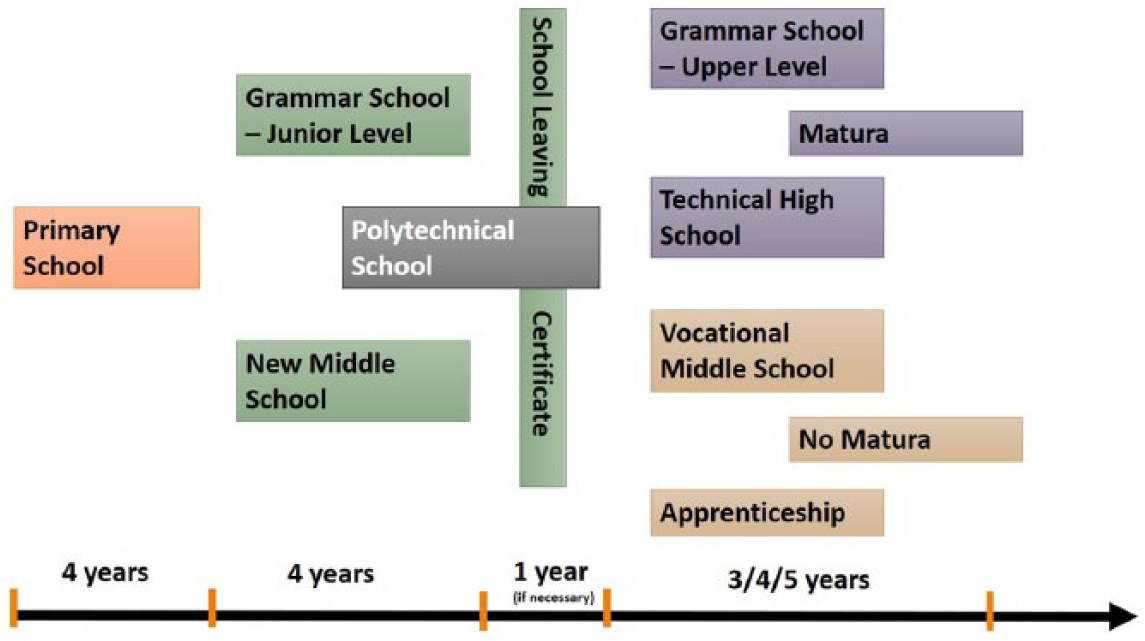
The Austrian school system.
Primary school lasts for four years. After that, at the age of 10 years, students and their parents have to choose between two different school types, the lower-level grammar school and the new middle school. In grammar school, after two school years, students have to choose again which school path they want to take. The two school types for the second part of compulsory schooling show not only differences in the curriculum, but also in aspects of school organisation.
There is specificity in the Austrian school system that intrigues newly arrived students and parents. Compulsory schooling in Austria covers the age span of 6–15 years or the fulfilment of nine school years (when a student is younger than 15 years). The school leaving certificate, on the other hand, is based on eight school years and is also taken after eight school years. Students with a school leaving certificate can then choose different upper secondary schooling possibilities. Students without a school leaving certificate or students who do not fulfil the age requirements/school year requirements can choose to finish their schooling at the polytechnic school, which is a special school type that covers one year of schooling (because of the requirement of nine years of compulsory schooling).
The options in upper secondary schooling are extremely difficult to understand for newly arrived students and their parents. In summary, the biggest difference lies between schools that lead to a Matura and schools that do not lead to a Matura. Austria also has a dual educational system of vocational training, where students work in specific jobs (for example, carpenter, hairdresser, and many more) as well as attending “Berufsschule” (schools for apprentices) part-time. At the moment, there are more students applying for this educational model than there are open positions. 10 More often than not, students with a minority background and/or bad grades in the school exams have no chance of getting vocational training (Hofer et al., 2015: 71).
Furthermore, upper secondary schooling does not necessarily have to happen in schools for young people, especially refugees and migrants, who are regularly put in adult education courses. These courses include German courses, courses to fulfil the school leaving certificate, courses to find a job, courses to prepare young people for vocational training, etc. From September 2016, Austria has decided to expand compulsory schooling through a “duty to education” for all young people between the age of 15 and 18 years. This new measure is now being prepared and will be executed firstly for the student group that finishes compulsory schooling this school year (2016/2017). 11
For students who do not speak the language of tuition, the status of “newly arrived” student (“außerordentlicher Schüler”) is part of the Austrian school system. This status is equally possible in compulsory and in upper secondary schooling and can be granted for a maximum of two school years. During this period, teachers are not obliged to set marks on the competences in the different subjects. Furthermore, the subjects are not interdependent, so teachers (in consultation with the student and the parents) can start marking some of the subjects earlier than others. While this status is not granted automatically, it is decided very freely, especially in the upper secondary schools. Still, even during compulsory schooling, schools decide independently and there are no official guidelines or rules as to who is given this status and for how long (see Rechnungshof, 2013).
Having many students with the status of “newly arrived” in the primary school and the new secondary school can be of organisational advantage for the schools: how many lessons per week of German language tuition are paid for correlates with the number of students who are officially “newly arrived”. Also, other additional supports are paid by the national authorities and they are easier to obtain with a high number of newly arrived students (Englisch-Stölner and Plutzar, 2015).
Unfortunately, there seems to be a tradition not to offer language tuition (to which these students are officially entitled) to all these newly arrived students. 12 During the school year 2010/2011, only 40% of these students had received language tuition (Rechnungshof, 2013). There are no recent numbers, and the reasons for this low number have not been yet analysed. Naturally, this poses a problem for the individual student in obtaining a satisfying level of German.
Research methodology and process, data analysis, and accompanying counselling
The authors refrained from interviewing newly arrived refugees and also those arriving unaccompanied in order to safeguard them from re-traumatisation and exhaustion. The young refugees who took part in the interview study were beyond the age of compulsory education when they arrived and began to live in Austria – more specifically, in Vienna. All our interview partners had been given a positive asylum decision during their first year after their arrival in Austria. The young people were invited to participate in individual or group interviews and to visualise their educational pathway so far. The study participants were over 16 at the time of the research, which took place between winter 2015 and autumn 2016. The study has a strong focus on Vienna, as all the young study participants involved live and attend educational facilities in Vienna.
Data was collected during nine individual interviews with young refugees, two group discussions with young refugees, and five interviews with experts (see Table 1 and 2). All interviews with young refugees were conducted without translators and with young people who have already lived in Austria for at least one year. 13 Their level of German was at least B1. The group discussions were partly motivated by organisational/structural factors (time constraints in the institutions) and the wish of some young refugees to conduct the interview in a more confident group situation. The authors saw group discussions as a possibility to extend the authors’ own analysis of the individual interviews with the “conjunctive experiential space” (Bohnsack, 2008) which this specific group of young people express in the group discussion. As a means to induce the discussion, an “average” journey map was used (Lindsay, Proyer & Walter 2015). This average journey map was designed using the information from all journey maps from the individual interviews.
Background information about the young refugees interviewed in this study.
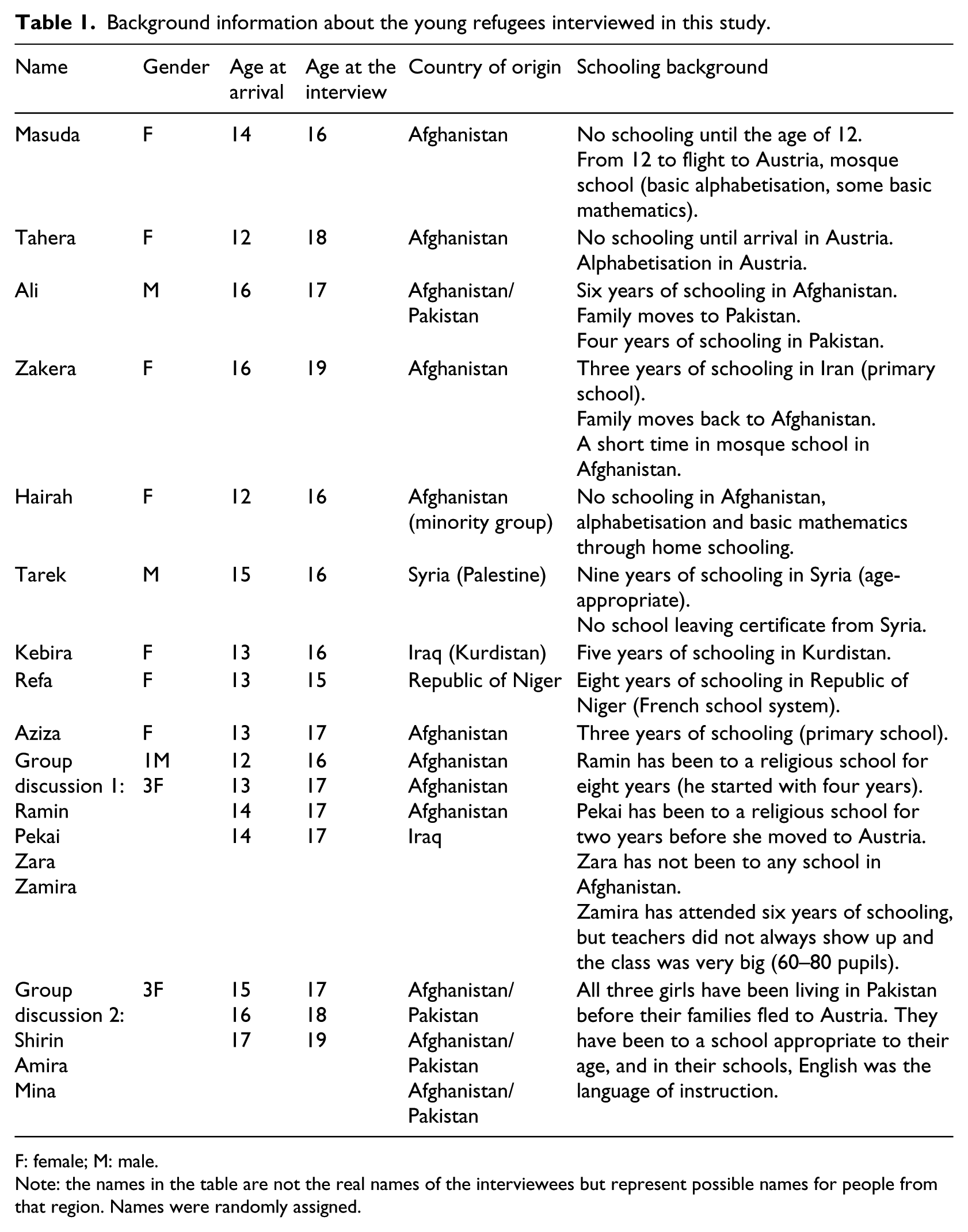
F: female; M: male.
Note: the names in the table are not the real names of the interviewees but represent possible names for people from that region. Names were randomly assigned.
Background information about the experts interviewed in this study.
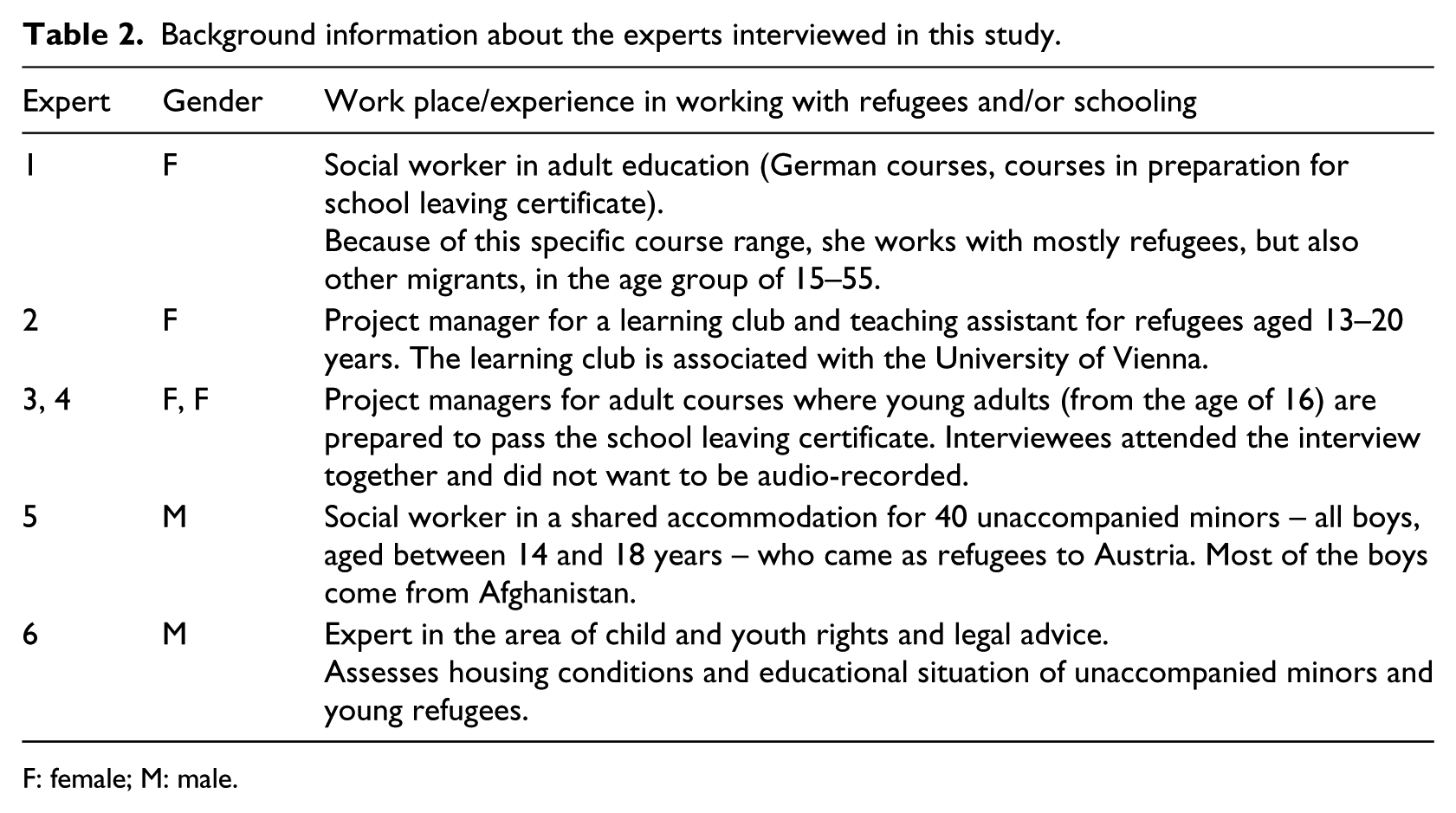
F: female; M: male.
The participants were sourced through a structure that offers after-school learning support and cultural activities. Despite the high workload of the staff, the collaboration proved to be very successful. In return, the two researchers (also the authors of this paper) offered education-related counselling in terms of choices for education pathways to the students and offered further collaboration with the organisation.
The individual interviews took between 10 and 25 minutes and were conducted in German. Exclusion criteria for the interview were the need of the students to have reached a level of German at the European Language Scale of B1, as the data for this publication was collected without any further funding and, therefore, prevented the researchers from involving professional interpreters. The decision not to involve recently arrived refugees was also fuelled by the idea that service provision is currently rather chaotic and many of the newly arrived students are in need of manifold supports. An interview concerning the personal issue of education might put additional unnecessary stress on the young people.
Additionally, the authors interviewed experts in the field of education and refugees/migration who are working in Austria’s capital in order to embed the young people’s voices in current structural challenges and political perspectives. Some of the experts were not directly involved in educational matters and/or explained that they believed that other issues such as the clarification of legal status or the work on trauma-related challenges proved to be of higher importance.
The group discussions took about 45 minutes and were induced with the average journey map. The young people were asked to read through it and share their thoughts, whereafter the discussion in the group developed to the students expressing their own experiences, comparing them with the average journey map, and discussing their similar or different experiences before and after their arrival in Austria. At the end of the group discussion, the group was asked to visualise their own thoughts and their results in the group in a joint journey map. 14
The researchers applied a methodology that is actually used in the area of marketing research to map people’s consumption behaviour and their satisfaction with goods as well as the choices they take after they have (not) been satisfied with a service provision (Howard, 2014; Richardson, 2010). The methodology offers a chance to map and review customers’ navigation through a vast variety of options and the paths they take. Considering the diverse backgrounds of the research participants, the steps taken in relation to education since they have arrived in Vienna, and the – theoretically – vast options they have to further it depending on their age, the authors considered the methodology useful. Additionally, the clear visual imagery offered a participatory approach and easy access to the often-formalised setting of research. During one of the group interview settings, a huge piece of paper was offered to the students in order to draw their own, or an invented, journey map.
The students in our interviews were living with their families in Vienna at the time of the interview. Three students came to Austria as refugees, but already had a father living and working here. Depending on their situation, about half of the students do not have a father anymore. In most cases, the father has died in the home country.
As an example, we show the journey map for Zakera (see Figure 2).
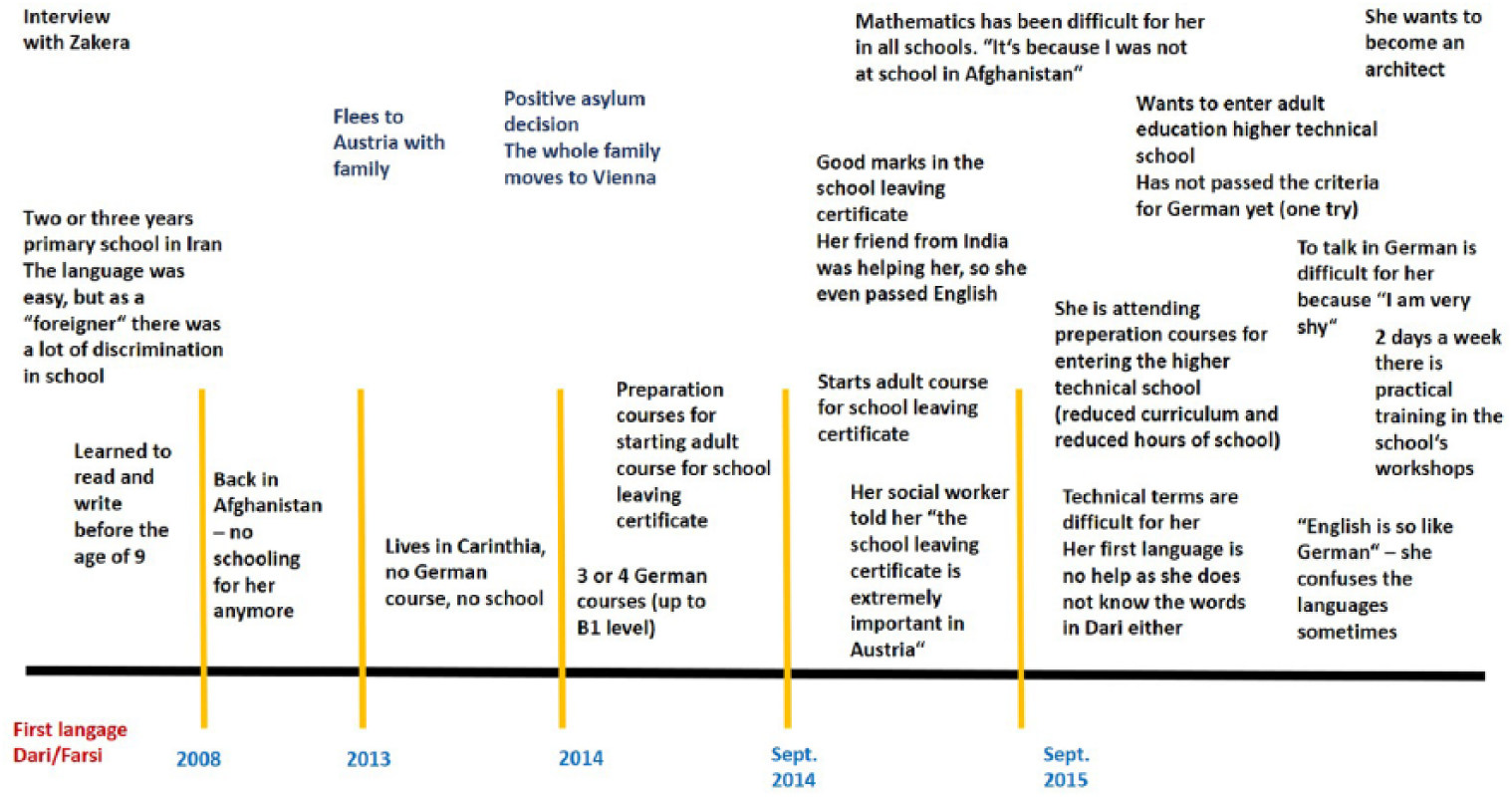
Zakera’s journey map.
All the transition points are mapped out here: not only the young woman’s schooling biography, but also her (school) choices, her wishes, and the important people involved in her decision-making. As previously mentioned, we did not force a chronological interview about recounting the educational pathway. Instead, the interviews were freely shaped by keeping to the question of education. Afterwards, in the journey map, the chronological timing becomes visible. Zakera had some schooling in Iran before the family went back to Afghanistan. Because of her sex, she was not allowed to attend school in Afghanistan. At first, after her arrival in Austria, especially in Vienna, she was able to start learning German, to obtain a school leaving certificate and to pursue adult education. Her wish is to become an architect, which is why she chose an adult education higher technical school. At the time of the interview, she was still attending preparation courses for this school. It was extremely interesting to see that she chooses a technical school with strong demands on mathematics, as well as other technical subjects, even though mathematics has always been difficult for her. Her own reasoning about her difficulties with mathematics is that this is the case because of all the years that she could not attend school in Afghanistan.
The initial results after conducting and analysing the interviews are shown in the Table 1, which displays the schooling possibilities for young refugees. This table was used in counselling the young refugee students when they had questions about their educational possibilities, and the authors referred to it when presenting the research project, when talking with teachers, headmasters, etc. Some other publications aimed at helping and providing guidelines to refugee parents are available (in different languages, produced by the Ministry of Education, the Employment Service Austria, etc). The UN Refugee Agency (UNHCR) has since worked on a brochure in several languages, which will help refugee parents understand the Austrian school system (UNHCR 2017).
Analysis of the individual interviews: The “homogeneity” of the school system
After creating individual journey maps for every young person that we interviewed, in the following step, we extracted text passages on the topics of how the school system stays homogenous in the face of this very heterogeneous student group. These include information about schooling that focus on how difficulties can arise for individual refugee students because of this homogeneity. In this section, we do not describe the situation of every individual student as a case, but summarise aspects that play a role for all, or almost all, of them.
“Being special, being separated”
The students who had arrived at an age beyond compulsory schooling told us about their satisfaction with their German courses and German teachers. They got the option of attending specific youth courses (for young people aged 15–21 years or 15–25 years, depending on the institution in question). This was the case when they were living in Vienna; during their time in rural Austria, this option was not always offered.
Zakera: Yes, I have been learning German during that time [in rural Austria], in a school. During the first year [in that school] I only learned German.
15
Interviewer: Only German? Zakera: Yes, only German. Interviewer: And where was that? What was that? Was that at a school or was it a course? Zakera: No, it was only a course. At the beginning I simply, I mean for the first seven months I was just at home, not at a school or in a course. I only studied German at home, and then I started in a course when I came here. Interviewer: To Vienna, right? Zakera: Yes, in Vienna, I have started German in Vienna, and then I registered in [a language learning institute], I did three [courses] to level B, namely B1.
16
Here we have the case of a young and motivated student who did not get the chance to learn German until she moved to Vienna with her family. Also, the courses that Zakera attended (up to B1) took about one year. During this year Zakera predominantly studied with other refugee or migrant students and was, therefore, separated from her Austrian peer group.
The students told us that often they were the only refugees in the class or in the whole school, and that even the number of regular migrants who were newly arrived students was very low. 17 German classes were often organised for all those newly arrived students together, sometimes even without differentiating between levels of German. For the older students, in several cases, there was no provision of a German course at all, which was also often the case for the parents.
The separation from “Austrian” students is also visible when students are placed in regular schools, not in course systems as in the case of Zakera. Especially at the beginning, when the students have many German classes and are not together in their own regular class throughout the whole school day, it is difficult for them to be part of the class and to know the classmates. This is especially true in the case of refugee classes (“Flüchtlingsklassen”), which are classes that are open for refugee students only. Students in these classes are not assigned to regular classes at all. Instead, these refugee classes have their own teachers and their own curriculum and students do not mix with the “regular” classes in the school. The idea behind these classes is that such classes will enable students to “catch up” in order to start in a regular class the year after.
18
Although it was not the preferred model in Austria before 2015, it has been extensively used in and after 2015. Now (in 2017) the numbers of these classes have again dropped to only a few.
19
Interviewer: Were you together with your class or in an extra class? Ali: No, the refugees had extra classes. Interviewer: You had your own class? Ali: For refugees, there was an extra class. Interviewer: How many students were you? Ali: Eight or so Interviewer: And you had your own extra teacher? Ali: Yes, an extra teacher too. Interviewer: And which subjects did you have with the other classmates? Ali: Only German, English and Maths, only these three. Interviewer: And always just refugees, not [together] with the other classes? Ali: No, no, always alone, just refugees.
Here, the interviewer does not immediately understand that the student really attended a refugee class in his new middle school. This particular student had been to three new middle schools (and other schools thereafter) as he was moving around in Austria, and in one of the other new middle schools he was part of a regular class with extra language tuition.
As newly arrived students have the right to not be graded in all or some of the subjects (“außerordentliche SchülerIn”), even this “help” can be experienced as separation. These students do not take part in test situations or, if they do take part, they do not get a mark. It is not the student or the parents who decide whether and in which subjects the student can be evaluated. This seems to always be the decision of the school/the subject teachers. On the one hand, missing marks in the school leaving certificate can lead to problems when entering further schooling or finding a job or apprenticeship. Still, for some students this status presented the possibility of entering upper-level grammar school. In these cases, the teacher and/or the headmaster had advised the students to choose not to be graded by virtue of their newly arrived status. This dependence on good/fitting counselling is seen in the case of Tarek, as expressed by him (see Aspect: “schooling outside of schools”). Upper secondary schools are highly selective. It is difficult to enter a higher technical school or upper secondary school without positive marks in all subjects. There is the possibility for ungraded students (during their first two years after arrival) to obtain a place in such a school, but in the cases of the interviewed students, this happened on very few occasions.
Shirin: [The headmaster] if your English [mark] is good and your German [mark] is normal, and perhaps you only have no mark [not graded] in Mathematics, then I would go with you and speak [with the other school’s headmaster] it would be possible [to get a school place there], but now you do not have marks, that is a problem and you have to go to this school, and I said ok, fine. (Group discussion 2)
Shirin does not know the regulations that would allow her to enter an upper secondary school, even without the marks, as she is a newly arrived student (“außerordentliche SchülerIn”). She depends on the counselling that she gets from her headmaster at the new middle school, as the highly diversified school system is difficult for her to understand. The same situation happened to Masuda and she was counselled to stick to not being graded in the subjects in order to be able to start upper-level grammar school. Even in Masuda’s case, the school’s headmaster contacted the headmaster of the new school directly, which is how Masuda obtained her school place.
For the students in the upper secondary school, being older than their classmates can lead to a feeling of separation. In Vienna, there are almost no schools without classes that are organised by age group. As older, newly arrived students over the age of 15 do not always have the possibility (because of their level of German, nostrification of school exams, etc.) to enter school in classes with their age group, this can happen quite regularly.
“Schools that enable, schools that hinder”
Educational opportunities for young refugees are currently often related to luck and the type of school they attend. As soon as pupils pass the age-related threshold of nine years of schooling/15 years of age, they are more often than not subject to the engagement of individuals or the past experience certain educational facilities have had with the integration/inclusion of students with a migration background.
Depending on which school type and which individual school the students were attending, the number of German lessons per week differed greatly. Also, some of the schools are more restrictive with entry requirements and only allow students with a German language level of maximum A2 in their German classes for newly arrived students.
Interviewer: Ok, you did not have an extra teacher or extra classes for German? Hairah: No, no. Interviewer: You were always with the rest of your class [for German lessons]? Hairah: But the school had German courses at A1, or A2 level I think, and I was much better than that. Interviewer: Oh, so you were already better than that. Where did you learn German? Hairah: I learned alone at home, there was no course for me.
Furthermore, some schools offer tuition in “difficult” subjects (German, Mathematics, English), which is an option that helps students with difficulties in these subjects. These tuition classes are open to all students, not just the newly arrived students, but the school/teachers decide on which students are allowed to participate. Therefore, not all the young people that we interviewed were offered this tuition, even though all of them expressed the need for help with learning these subjects, for tests and for homework. One of the experts leads a project undertaken by the Kinderbüro at the University of Vienna, where young refugees can get help with their learning, but where workshops about scientific topics and excursions about different aspects of life in Vienna are also offered.
We seem to be the only ones to offer tuition free. All of our young people that go to school, all of them need help. We always have voluntary students teaching German, English and Mathematics. We also have Study Buddys who can help with special subjects or special questions, like chemistry or for preparing a VWA (pre scientific work).
20
Even the adult education courses have started ringing us, whether they can send their students to us for free tuition.
21
(Expert 2)
The classmates were portrayed as enabling when they helped the students with organising their learning, answering questions, or explaining subject matter. This was true for a long time for schools that have had a very heterogeneous (migrant and refugee) population (as, for example, in the new middle school). In a school with a homogenous population, classmates were portrayed as not enabling. They did not want to answer questions or share their knowledge with the refugee students.
Masuda: [There is no private tuition for me anymore] the teachers said, you can look around and if you can pay, then you can pay for private tuition yourself. Then you can go there and learn. But when I need help, I can go to my class teacher (“Klassenvorstand”), he is so nice, he always helps me, he always explains anything that I need. Interviewer: Ok, so the class teacher is a big help? Masuda: Yes. Interviewer: And otherwise, is the school helpful or good or …? Masuda: The students, they are not like in my new middle school. Interviewer: No? Masuda: No, they are not like that. No, they do not help as much. They prefer to study on their own and they say, when we study by ourselves, alone, then we learn more than when we sit together and learn together. Interviewer: And you are the only one who does not speak German so well in your class? Masuda: Yes, I am the only one.
As seen in this extract, some teachers/principals are greatly engaged in finding good schooling possibilities for their students and they actively help the students to enter further educational institutions. Individual schools and teachers invest time (and money) to provide support for newly arrived students. This includes extra classes (in German for example) or extra time to discuss the subject with the individual student outside of the classroom.
The upper-level grammar school in particular is a school type which still has an exclusive image as a school for the “intellectual elite”. Many of these schools include a school path that leads to a Matura in three languages (“neusprachliches Gymnasium”): German, English, and a further (modern) language. Even in the other school paths, normally two foreign languages have to be learned. The difficulty of developing competences in three languages (almost) simultaneously is too strenuous for many of the newly arrived refugee students. This is especially true for students with little or no previous schooling who have little or no knowledge of English. For them, schooling in Austria means starting to learn German and, quite soon after, starting to learn English, too. In the group discussion 1, Pekai has started upper secondary schooling, while Zara has actively decided against a school place in upper secondary schooling.
Pekai: I want to study medicine, but when I have to study three or four languages, then perhaps I will never be able to study medicine [because I will not pass the Matura]. Zara: I wanted to start upper secondary level and they [teachers and headmasters] told me, that I will have to choose a language, French or Spanish. But I am so sure that I will not be able to master another language. French, English, German, and then also all the other subjects, Mathematics. That is not possible, only for Austrians.
“Schooling outside of schools”
Through the interviews, but also through official statistics, it becomes clear that the end of compulsory education at the age of 15 leads to very specific developments for refugee students. Many of them do not, in fact, enter state-organised upper secondary education. As previously mentioned, these schools are allowed to choose their students, and in some cases there is also an entrance exam. There is no obligation to accept refugee students, to let them continue their schooling in that school, to give them German classes, to provide any other form of supporting tuition, etc.
Nonetheless, many refugee students after the age of 15 are in some kind of educational programme, mostly in programmes that are part of adult education (“Erwachsenenbildung”). Even in programmes that aim specifically at young refugees, the age span often covers 15–25 years of age. In these educational programmes, the students have access to German classes (up to B1 level) and courses in preparation for the school leaving certificate. In Vienna, both schemes are free of cost for the students. Therefore, adult education is currently a “collecting pond” for young refugees that are not educated in state schools. These adult programmes end after the school leaving certificate. So, for this group, there is the big question and problem of transition to further training or schooling. The fact that the situation is not really positive is expressed by this social worker in one of the expert interviews: I am not sure about the chances for our refugee students. I had a very bright student, she did very well in the school leaving certificate and in German. She applied for a vocational course for working in afternoon childcare for school children. The course entry required a B1 German. When she went there for the interview, they told her that her German was not good enough. But, she has already the level B2+, so, I don’t know. If she does not get a chance, what will we do with all the others who do not reach a good level in German? […] All the courses they get [paid for by the AMS, Employment Service Austria] after they finish their German courses and the school leaving certificate. Sometimes I feel that their social workers only see that chances are low for these people. So they train them to pass the time until they are eligible for state money, but no job. How to use your time when you have nothing to do. (Expert 1)
In all the previous aspects, the question of which schooling possibilities are open, taking into account the age of the refugee students, was mentioned. As seen in our cases, but also in recently published school statistics, arriving before the end of one’s 14th year gives one the chance to obtain a school place immediately.
22
This possibility does not depend on age at arrival, but on when the bureaucracy around staying in Austria is settled (which means getting a positive asylum decision). Entering schooling before the age of 14 is not dependent on asylum status. Entering schooling, especially vocational training, after the age of 14 is very dependent on asylum status. This has to do with the fact that compulsory education is in accordance with human rights regulations with regard to education for children. Therefore, compulsory schools are open to all students, regardless of their status. The role of age at arrival is seen clearly in the following interview: Amira: I have been learning German since last year, since I came to Vienna. Interview: You did not have a German course before, in Styria? Amira: No, nothing. Interview And you [to Mina], you were at school? Mina: Yes I was at school, a polytechnical school. Amira: I learned German with Google, and Mina told me some of what she learned. Mina: Because that was not a normal school, I was there only two or four hours, and then I went to another school for a German course. (Group discussion 2)
The age limit makes the possibilities for these two sisters extremely different. Students that arrive after the age of 15 vary a lot in where they start their education (upper secondary school, pre-vocational education, adult education) and in their further educational path. Much depends on where in Austria the students start their schooling, because not all theoretical possibilities are practical possibilities in different parts of Austria. The bigger cities have many more schooling opportunities to offer. Also, the counselling through social workers, educational institutions, etc. has a big impact on which path the students choose. The complex schooling system in Austria is often difficult to understand for students and their parents, but also for the counselling personnel. In Austria, students do not only have to choose different school types, but also different school specialisations. For foreign students and their parents, the possibilities of choices can easily become unclear because of their complexity. The differentiation in school types/school specialisations with and without the possibility of obtaining the Matura is difficult to grasp, as is the question of job opportunities that come through different educational paths.
You know, I do not know, I do not understand, but I need help from someone, someone with knowledge and who tells me, this [school or course] is good for you. I do not know where to go, which job to choose, which university studies are good, which school to choose. (Tarek)
Tarek tells us this after explaining that he is attending the course for the school leaving certificate in order to obtain a Matura in the end. His personal goal is to study at the university, but he expresses uncertainty as to whether the educational path he is on will lead him there. He also expresses his dependence on “help”, on counselling for education. It was also through counselling that he found the place in adult education for the school leaving certificate. Even though he could attend school in Syria appropriate to his age, he could not transfer his certificate from Syria to Austria, which forced him to obtain his school leaving certificate again.
What is also relevant in this context is a lack in the provision of out-of-school services for the group of students, beyond compulsory education, and also the coordination of and information regarding these services. As Expert 3 indicated, the need for a gateway had been identified at an early stage, but not realised until recently (at the time of the interview).
Conclusion
Summarising the main findings from young refugees’ accounts – still an exceptional case in research (Hek, 2006) – on their educational pathways since arriving in Austria, and even before that, the authors were able to identify aspects involving the concept of borders, implying whether the young refugees were either in or out and felt included or excluded, respectively: they are either in regular schooling or out of it; they are either in out-of-school/non-formal education settings or not. There is a harsh dichotomy that leads to the fact that young refugees might remain outside of the general education system as such, or are lucky to get access to out-of-school education tracks. This represents a highly selective and non-inclusive approach towards a specific group, which should be at the focus of educational efforts, considering the diverse background of the recently arrived youngsters and their prospects in society. If young refugees are too old – even if it is only for a couple of days – for compulsory education, their further education is subject to arbitrary conditions, such as supportive stakeholders, the level of experience of educational facilities dealing with them, etc.
An interesting aspect is that, although our research did not focus on language acquisition and language development, the topic of learning the majority language (and further languages) is a major topic in all the interviews and for all these young people (and their parents). This points towards an oddity of the Austrian school system, as has been elaborated in this paper. The Austrian education provision poses an interesting answer to a complex question. The answer to diversity in pupils is a continuous homogenous approach to school provision. The findings mirror the current social discourse for representatives of the group at the core of this paper: first German language acquisition, then education!
To summarise our findings, we can stress that the young refugees interviewed have a strong belief in the good of education. They do not wish to be educated in segregated classrooms, as is the case for many beyond the age of 15 (see the„monolingualer Habitus” as stated by Gogolin 1994; see also Wenning 1999). Not only through different kinds of excluding and non-formal educational provision (in German courses, in adult education), but also through institutional discrimination (when refugee students are not allowed to participate in the German course or in the tuition offered, when they are exempted from scholarships, etc.), the Austrian educational system shows that it furthers the monocultural, monolingual, homogenous classroom as its schooling entity. This is evident in the fact that many young refugees in the age group of upper secondary schooling attend adult education. Even though adult education (in Vienna) starts at the age of 15/16 years, and even though young refugees are part of their age peer group, these provision tracks are highly segregating as refugees and migrants have very little chance to engage with the Austrian peer group (who attend regular upper secondary schooling).
The young people that we interviewed experience difficulties in understanding the Austrian school system and in finding the most suitable schooling path for themselves. The dependence on counselling, but also the (un-)desired effects of counselling, become visible. The wish for (high) education, including the “Matura” (school leaving exam) and university education (in a country where studying at university is still free 23 ), contradicts the researched (and statistical) reality of under-representation of students without German as a first language in upper secondary and further education.
Even though the interviewed young refugees have been living in Austria for as little as one year, they already understood the necessity of private tuition in order to pass schooling. This “shadow” system of education – which is very strong in Vienna – is a necessity for these students who do not have the socio-economic capacity to pay for private tuition. Therefore, offers for free tuition are highly sought after and appreciated, as the interviewees are trying to pursue the path to good education and to achieve high educational goals.
Taking into account that the Austrian government has recently changed and ideas for future provision include the further implementation of segregated systems, the authors want to express their fear of the manifestation of exclusive tendencies. Segregation in “their own classroom” in order to “learn German” (see Regierungsprogramm, 2017) will lead to even less contact between the different cultural and language peer groups sharing the same space in Austrian society. We find that this is not what young refugees in this country want or wish for, and that this will not improve their possibilities for good education and a good life in the new country.
Footnotes
Declaration of conflicting interests
The author(s) declared no potential conflicts of interest with respect to the research, authorship, and/or publication of this article.
Funding
The author(s) received no financial support for the research, authorship, and/or publication of this article.