




Abstract
This research investigates how international educational collaboration (IEC) as a social activity adapts to global crises: COVID-19 and the Russian’s invasion in Ukraine. We focus on Finnish higher education institutions (HEIs) and non-governmental organisations (NGOs) that actively provide IEC activities, such as student exchange, education export and educational capacity building abroad. Drawing from the sociology of conventions (SC) and the concept of social practices, we formulate a multidimensional framework that connects regimes of justification, and social practices that emerge in crises. Considering crises as a critical test, we analyse how IEC cope with unexpected situations that require establishing new justifications of public accountability and morality, and practices that fit the crises situation. Our empirical data collected through a two-stage open-ended questionnaire in 2021 and 2022 enables us to consider the recent trends and potential future(s) of IEC. Empirically, we conclude that coping with global crises requires IEC actors to make changes in IEC practices. Analytically, we theorise that regimes of justification and social practices that emerge during crises (crisis practices) are interconnected. Thus, this study contributes to practice-oriented frame by considering accountability of practices in the unexpected circumstances, enhancing the understanding of how different organisations adapt to turbulent times.
Keywords
Introduction
International educational collaboration (IEC) is strongly dependent on global circumstances. This became particularly evident with the sudden spread of COVID-19, which caused an immediate impact on (physical) expert and student mobilities across national borders by disturbing travel plans and ongoing mobility periods and moving IEC activities to the online form (Tsiligkiris and Ilieva, 2022). Recently, IEC has also encountered geopolitical tensions (Altbach and de Wit, 2022) to an increasing extent, the most significant one for Europe being the Russian’s invasion in Ukraine. These unexpected situations have caused a shift in the operational environment of higher education institutions (HEIs) and non-governmental organisations (NGOs) which practice IEC.
In this study, we focus on IEC activities of Finnish HEIs and NGOs during two major international disruptions, COVID-19 and the ongoing war in Ukraine. For the purposes of this study, IEC is defined as HEIs’ student and staff exchanges, education export projects, and NGOs’ development cooperation activities (Brandenburg, 2020; Juusola and Nokkala, 2022; Nokkala, 2007; Reinikka et al., 2018). The latter includes, for example, humanitarian collaboration projects supported by public funding (government, international bodies such as EU) or private donations and voluntary work abroad (Reinikka et al., 2018). Therefore, the main scope of this study is related to international physical and virtual mobility pertaining to educational activities. The target group of this study are influenced by varying strategic and national priorities (Reinikka et al., 2018; Santos et al., 2022). For example, HEIs increasingly view IEC activities as means of attracting international students and enhancing international research collaboration that contributes to economic development (de Wit and Altbach, 2021). This development is visible also in Finland (Jokila et al., 2019; Juusola and Nokkala, 2022), although in the Finnish context, internationalisation of higher education has been closely linked to student exchange, often supported by programmes like the Erasmus+ (Nokkala, 2007; Weimer and Mathies, 2022). On the contrary, many NGOs operating in the field of IEC have focused solely on international humanitarian collaboration (Reinikka et al, 2018). However, education and development policy objectives have increasingly converged in recent years as there is a growing need to emphasise the social, cultural and educational benefits of IEC (de Wit and Altbach, 2021; Tsiligkiris and Ilieva, 2022). Thus, in this study, HEIs and NGOs are interpreted as established actors in the IEC, contributing to IEC policy initiatives while simultaneously creating and envisioning activities appropriate to their own organisational objectives (see also Wolrf et al., 2020).
HEIs and NGOs operate within a specific environment that involves various underlying principles through which they justify their decisions and activities (Imdorf and Leemann, 2023). However, these principles are not stable or immune to external changes. Unexpected events require HEIs and NGOs to evaluate the suitability and moral relevance of their existing principles in crisis situations (Ye, 2022). They must also adapt daily operations to respond to and manage these crises, which according to Werron and Ringel (2020) and Ye (2022) are unexpected, unpredictable and involve uncertainty. According to dictionary definition, however, crisis does not automatically connote a disaster, but
This article includes the following sections. Firstly, we describe the Finnish context of IEC by presenting the main characteristics of education policy priorities and the national response to COVID-19 and the war in Ukraine. Secondly, we discuss the analytical lenses that combine the sociology of conventions and the concept of social practices. Thirdly, we introduce the qualitative longitudinal data collection method and study participants. Fourthly, we present empirical findings by considering practical responses of IEC actors to the crises, which is followed by the discussion part. Finally, we draw the main conclusion by considering both the empirical findings and analytical interpretation.
IEC in Finnish educational context
International educational collaboration has long been one of the education policy priorities in Finland (Nokkala, 2007). Traditionally, since the 1990s, IEC in the higher education context has focused on international student exchange and attracting international students to Finland (Kinnunen, 2003), indicating that focus of internationalisation has been on pragmatic and economic values (Ferenc et al., 2022). At the same time, an important driver for Finnish IEC has been the stronger integration into the European higher education area (EHEA) (Nokkala, 2007). One effective means to achieve this integration has been through the European Commission’s Erasmus Plus mobility program (formerly known as Erasmus), which provides external funding and institutional tools to intensify international collaboration and enhance national competitiveness (Ala-Vähälä et al., 2021). In addition to EHEA integration, the Finnish IEC’s strategic target areas have included other countries such as other Nordic countries and Russia (Ministry of Education and Culture [MEC], 2022b; Nokkala, 2007).
In recent years, there has been an increasing variation of the (policy) goals and objectives set for IEC in the Finnish context. IEC has been expected to facilitate national labour market policy needs (Mathies and Karhunen, 2021), increase national revenue (Haapakoski and Stein, 2018) and expand the global networks of Finnish HEIs (Moisio and Kangas, 2016). Also, IEC has also been identified to strengthen the internationalisation of degree programmes, thereby improving education quality (Jokila et al., 2019). At the same time, there is a growing demand for development policy perspectives in education (Reinikka et al., 2018), such as in education export operations of HEIs (Lönnqvist et al., 2018). For example, in the latest international strategy for Finnish higher education, there is a strong drive to boost the reputation of Finnish higher education and promote research and expertise about it abroad. This is to be achieved through various means, including international alumni as well as through establishing a set of information centres in various countries to represent Finnish higher education and research and share best practices as well as facilitate student and academic mobility to Finland (MEC, 2017). Likewise, human capacity building through education and training has been one of the central goals throughout the history of Finnish development cooperation (Ainamo and Lind, 2013). Finland, along with major Finnish NGOs working in the field of development cooperation and humanitarian aid, has committed to the Sustainable Development Goals (SDG) set out in the United Nations’ Agenda 2030. Their aim is to eradicate extreme poverty and ensure well-being for all while respecting planetary boundaries and promoting environmental sustainability. Based on the latest voluntary national review, the achievement of the SDG goals is a central starting point for the activities of both HEIs and NGOs in Finland, but at the same time Finland should pay more attention to the compatibility of political goals so that the achievement of the SDG goals is systematic (Prime Minister’s Office, 2020).
Unexpected spread of COVID-19 in the beginning of 2020, and Russian invasion in Ukraine, in February 2022, caused notable changes in the IEC landscape in Finland. In general, COVID-19 significantly affected IEC activities. For example, the Finnish government announced lockdowns and legitimised its actions as necessary measures to protect the lives of its citizens (Moisio, 2020). The government’s decision in March 2020 forced the closure of HEIs and restricted travel within Finland and abroad (Finnish Government, 2020). Many IEC activities switched to remote mode as physical mobilities, and social contact were restricted. Furthermore, NGOs engaged in humanitarian work changed the focus of their IEC activities towards COVID-19 protection by sharing information about the virus and responding to the urgent calls for hygiene supplies (Finnish Development NGOs, 2020). Additionally, the European Commission allowed administrative flexibility in funding programmes such as the Erasmus Plus, meaning that activities could be postponed or carried out virtually (Finnish National Agency for Education [FNAE], 2020a).
When Russia invaded Ukraine in February 2022, HEIs and NGOs were still adapting to the changes caused by COVID-19 (FNAE, 2022). Understandably the national attention suddenly focused on Finland’s geopolitical position (Ministry of Foreign Affairs of Finland [MFAoF], 2023a). After the war began, Finland announced the suspension of institutional cooperation with Russian higher education and research institutions (MEC, 2022a). This was a significant change for some of the HEIs because Russia was considered one of the key target areas for HEIs’ international activities (MEC, 2017). The Finnish government had also funded a bilateral mobility programme to support this (Mäkinen, 2023). All student exchange programmes were suspended (Tampere university [TAU], 2022a), and several research projects, including those concerning climate change, were frozen (Koivurova et al., 2022). However, it was possible to continue individual projects with Russian participants living outside Russia and holding a non-Russian bank account (Koivurova et al., 2022). At the same time, some HEIs established new activities to support, for example, students fleeing from Ukraine (TAU, 2022b) and through the nationally funded Team Finland Knowledge programme, a separate funding call was opened in spring 2023 to support Finnish HEI’s cooperation with Ukrainian partners with the aim of supporting Ukraine in developing and rebuilding its higher education sector (FNAE, 2023). Finnish NGOs also redirected their activities towards providing emergency aid, both in Ukraine and its neighbouring regions, as well as in Finland, to support people displaced by the war. They also focused on supporting critical infrastructures and civil society actors in Ukraine (MFAoF, 2023b).
Analytical frame
Regimes of justification
COVID-19 and the war in Ukraine have forced IEC organisations to consider moral and ethical questions relating, for example, to security (FNAE, 2020b) and social wellbeing of students (Ye, 2022) as well as personnel and volunteers (Olsen, 2022). Drawing from the sociology of convention (SC) (Boltanski and Thévenot, 2006; Diaz-Bone and de Larquier, 2022; Imdorf and Leemann, 2023), this means that IEC organisations need to consider how their policies and practices address crises by justifying them for various external and internal stakeholders, such as national governmental bodies that partly fund the IEC activities or for all staff and students (Juusola and Nokkala, 2022). We approach this kind of actors’ (IEC actors) engagement in the complex environment by applying the concept of regimes of justification (Boltanski and Thévenot, 2006) that provide a frame to consider how IEC organisations navigate their action in unexpected situations. IEC actors in our study indicate individuals who are responsible for the strategic development of the IEC in their organisations.
Previous SC studies (Imdorf and Leemann, 2023; Juusola and Nokkala, 2022; Ye, 2022) show, that IEC actorsoperate in an environment comprising multiple underlying principles (conventions) that indicate contesting perceptions among HEIs and NGOs, states and stakeholders on the aims and values of IEC (Ye, 2022). In SC terms, this kind of plurality of conventions forms regimes of justification (Boltanski and Thévenot, 2006), which in our study refers to the analytical public sphere, where IEC actors seek approval for their activities by relying on conventions. Conventions are seen
In the previous SC studies, eight different conventions have been identified to highlight the different modes of value (relational qualification) and accountability (justification): civic, industrial, domestic, inspiration, industrial, market, fame, project and green conventions (Boltanski and Chiapello, 2005; Boltanski and Thévenot, 2006; Diaz-Bone and de Larquier, 2022). In the IEC settings, these conventions represent social (global) responsibility and equity (civic), efficiency and standardisation (industrial), local traditions and mutual trust (domestic), innovation and creativeness of education (inspiration), entrepreneurship and commodification (market), prestige and international visibility (fame) and flexibility, short-term activities and internationalnetworks (project) (Imdorf and Leemann, 2023; Juusola and Nokkala, 2022). Green convention emphasising (environmental) sustainability has so far been absent in IEC research applying SC theory, but this is likely to change due to the increasing number of educational studies concerning climate crises and ecosocial justice.
Crisis as a critical test for IEC
In everyday situations, the plurality of conventions stabilises the organisational activities and sets a socially constructed frame according to which IEC actors evaluate, coordinate and interpret the situation (Diaz-Bone and de Larquier, 2022). Therefore, established IEC arrangements, governed by the underlying conventions, are often considered taken for granted (Diaz-Bone and de Larquier, 2022; Imdorf and Leemann, 2023). However, conventions are not immune to critique or change. Instead, conventions in situations take multiple forms and become visible in the situation of uncertainty (Diaz-Bone and de Larquier, 2022).
Analytically, uncertain situations in which HEIs and NGOs are forced to review their underlying principles can be considered a critical test (Ye, 2022). As Stark (2020) and Ye (2022) note, when organisations are in a test, it becomes clear what they stand for. However, the outcome of the test is never known in advance (Boltanski and Thévenot, 2000). Therefore, IEC actors must be able to interpret the situation and develop a suitable approach to cope with the uncertainty. Crises, in this study, have created unforeseen test situations for IEC (Ye, 2022), requiring IEC actors to adapt to unexpected circumstances without knowing the outcome, but still considering the overall organisational goals. This may involve reforming or transferring activities to better address the crisis while also considering the long-term impact of crises, for example, on the well-being of IEC staff.
According to Boltanski and Thévenot 2000 (also Boltanski and Chiapello 2005) actors are seen to have the capacity – based on a plurality of conventions (Diaz-Bone and de Larquier, 2022) to make value-based decisions aimed at common good (Boltanski and Thévenot, 2006). This is especially important in the cases of COVID-19 and the war in Ukraine. These crises have resulted in contentious political recommendations at national and international level, and thus call for IEC actors to consider the moral dimension of IEC activities (Ye, 2022). As a result, IEC activities and underlying principles that support coordination and govern the activities will be re-considered in regimes of justification (Imdorf and Leemann, 2023; Ye, 2022).
Crisis practices of IEC
Our analytical assumption is that potential changes in underlying principles (conventions) governing IEC has also connection to IEC activities. We approach this by considering IEC activities as a bundle of social practices (Nicolini, 2009), that make COVID-19 and the war in Ukraine socially significant (Werron and Ringel, 2020). Drawing from normative concept of practice, we focus on interaction of performance and their accountability (Rouse, 2007). According to Rouse (2007: 48), this means that ‘a performance belongs to a practice if it is appropriate to hold it accountable as a correct or incorrect performance of that practice. Such holding to account is itself integral to the practice and can likewise be done correctly or incorrectly. If done incorrectly, then it would appropriately be held accountable in turn. That would require responding to it in ways appropriate to a mistaken holding-accountable and so forth’. Rouse (2007) also states that practices are intentionally directed and accountable to something. We believe that these normative notions to consider practice (Rouse, 2007) is especially relevant in crisis situations, which necessitate IEC actors to reassess their priorities in unexpected circumstances and do appropriate changes in their IEC activities.
For Rouse (2007), normative approach to social practices also intersects with circumstances. Because of this, practices and the performance of those practices, should be interpreted while considering the situation in which they take place. In this research, we focus on IEC practices that have emerged during the COVID-19 and the war in Ukraine. Similar kind of setting is stressed by Werron and Ringel (2020), who draw from practice theory to illustrate the presented analytical frame for the changes in practices caused by spread of the COVID-19. Werron and Ringel (2020) categorise pandemic practices into four groups: primary practices, responsive practices, adaptive practices and meta-practices. Primary practices involve instructions and recommendations from authorities. Responsive practices adapt to new situations, sometimes supporting or challenging primary practices. Thus, there is a constant negotiation between the practices, for example, regarding which practices are maintained responsively or primarily. Adaptive practices existed before the pandemic, or in the case of our analysis, before the crises, but may evolve during them. Meta-practices are discursive practices that connect and evaluate other practices, enabling their interconnectedness and serving as resource for legitimation (Werron and Ringel, 2020). While Werron and Ringel (2020) do not stress normative aspect of practice as Rouse (2007) does, we interpret Werron and Ringel’s (2020) category in terms of performance that requires accountability especially in a crisis. We also note that practices emerging at different timespans can have potential to cause long-term effects on IEC.
Given the above definition, we argue that the SC theoretical approach (Boltanski and Thévenot, 2006; Diaz-Bone and de Larquier, 2022; Imdorf and Leemann, 2023; Ye, 2022) can contribute practice-theoretical understanding (Nicolini, 2009, 2016; Rouse, 2007; Werron and Ringel, 2020) by providing a frame to consider accountability and performance of social practices in public sphere. In our study, this framework serves as a pragmatic heuristic model for studying how IEC actors operate amidst crises. Therefore, as described in Figure 1, we analytically assume that unexpected disruption to the status quo forms a critical test for HEIs and NGOs (Ye, 2022), where the governing underlying principles (Imdorf and Leemann, 2023; Leemann, 2018) will be critically reconsidered (Diaz-Bone and de Larquier, 2022) in regimes of justification including a plurality of conventions.
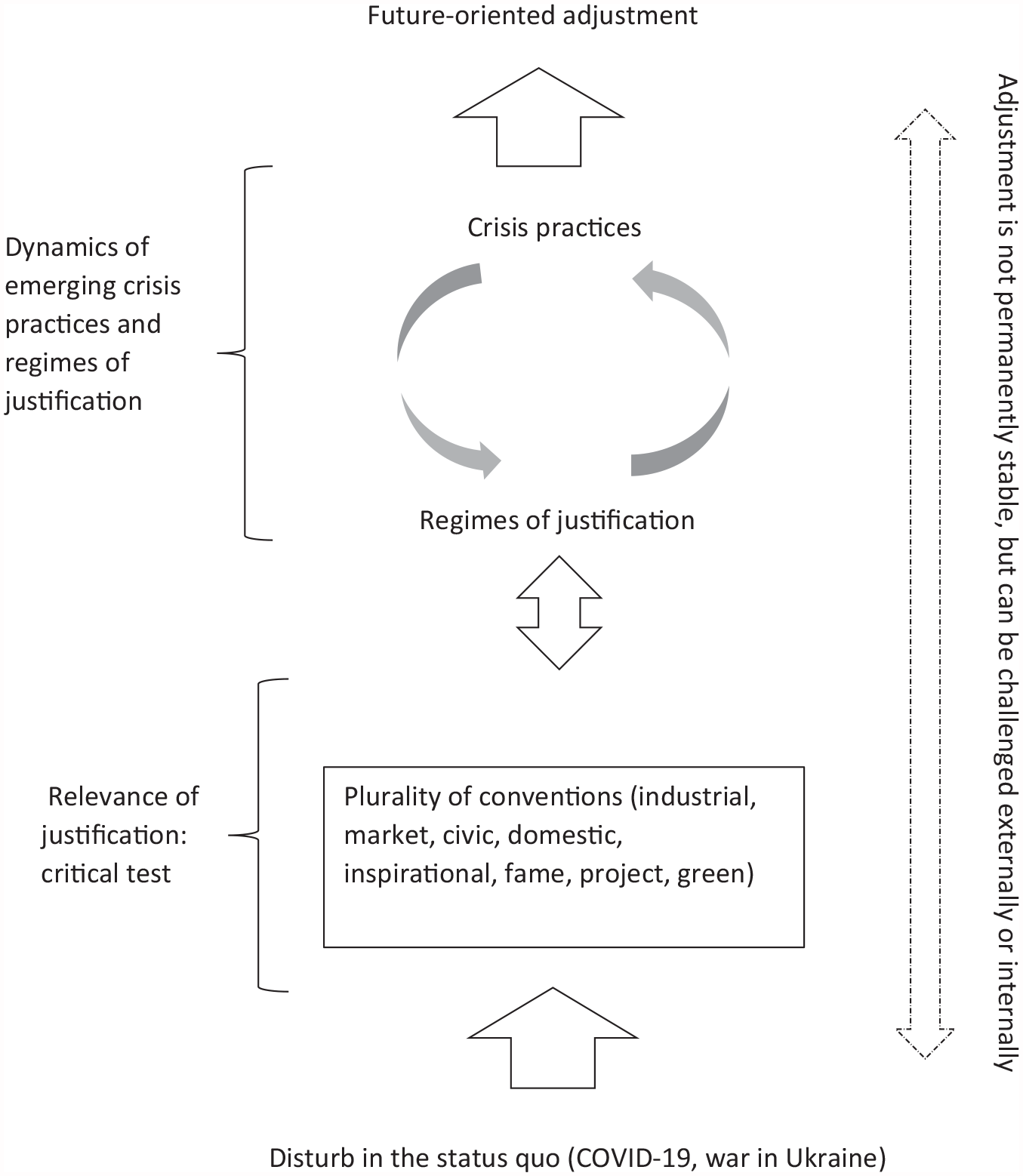
Analytical frame for regimes of justification, critical test and crisis practices.
An outcome of the critical test is unknown (Boltanski and Thévenot, 2000). Critical tests potentially cause changes to both underlying principles (conventions) and practices. We also assume that any crisis practice can potentially become a permanent practice after the crisis if it is combined with the other social practices (Werron and Ringel, 2020) and its underlying principles are suitable (accountable) for the existing situation (Boltanski and Thévenot, 2000; Ye, 2022). In addition, notions of justification and crisis practices can indicate future-oriented adjustment of IEC. As Mandich (2020) has stated, possible future – and past – narratives coexist in the present: in daily lives (practices) and currently relevant regimes of justification.
Data and methods
Our empirical data is collected from Finnish HEIs and NGOs through a two-stage open-ended questionnaire in 2021 and 2022. Two-stage design indicates a longitudinal study (Audulv et al., 2022), where the focus is on the organisational reactions to two unexpected external changes: the global COVID-19 pandemic (the first questionnaire) and the war in Ukraine (the second questionnaire). The original aim of our research was to study longitudinally the impact of COVID-19. However, during the study the Russian invasion of Ukraine took place, which we expected to have a significant impact on the activities of Finnish IEC actors, and we wanted to note this unexpected element as part of the already ongoing study. We are aware that this kind of approach does not represent a linear research process, but by bringing this point to the fore we recognise, like Aarnikoivu and Saarinen (2021), the typically unfocused nature of qualitative research process. Empirically, COVID-19 interrupted (physical) mobilities across national borders, but the war in Ukraine has increased geopolitical tensions especially in Europe. This is why these two crises are different in nature: COVID-19 was a globally shared external threat, although the response to it varied from country to country. The war in Ukraine affects Europe and NATO countries in particular and does not have the same kind of global impact. However, considering that both unexpected crises happened within a 2-year period, we assume that the impact of these two crises is somewhat intertwined, especially in terms of the longer-term plans of the organisations. Moreover, our analytical perspective for examining two crises is based on justification (Boltanski and Thévenot, 2006) and crisis practices (Werron and Ringel, 2020), from which we examine two separate crises (see similar research strategic solution e.g. Nikula et al., 2023: 140).
Both questionnaires were sent to the same participants, who were asked to describe the current state of international educational cooperation and to envision the future from the perspective of their organisation. The first COVID-19-related questionnaire was sent to the participants in the spring of 2021. Participants represented nine heads of international affairs or experts in a similar position responsible for the strategic development of the organisation’s international educational cooperation. The selection of the studied organisations was based on our previous research projects, within which we were already familiar with. This was thought to increase the response rate. The respondents represented universities of applied sciences located in different parts of Finland (four), universities (three) and non-governmental organisations engaged in international activities (two). The second questionnaire was sent to the same participants in the spring of 2022. In this case, the questionnaire focused on the war in Ukraine. In the questionnaires, respondents were asked to describe in their own words the impact of crises on the practices and strategy of the organisation’s IEC, because respondents wanted to be given the opportunity to interpret the starting points of COVID-19 and the war in Ukraine from their own organisational starting points. Respondents were also asked in the second questionnaire to reflect on their previous answers, which each respondent received individually in their e-mail, and to identify, if possible, which changes were due to COVID-19 and which were due to the war. This made it possible for the respondents to recall their earlier answers and reflect on the current situation if they wanted to. By the given deadline, we received responses from a total of seven participants from three universities of applied sciences, three universities and one non-governmental organisation.
In the two qualitative questionnaires, participants produced descriptions in which they explored their organisations’ IEC activities, outlined operational changes caused by the two crises respectively, and envisioned the future development of IEC. In the first question, participants were asked to describe the recent changes in mobilities across the national borders. In the second question, we applied the empathy-based stories method (Wallin et al., 2019) and asked participants to imagine a situation after 2 years, in which they were asked to describe the international activities of their organisation to their imaginary manager. As Wallin et al. (2019) have pointed out, empathy-based stories can describe culturally bound tacit knowledge, reflecting reality bound to context and time (Wallin et al., 2019). Therefore, an empathy-based story provided a creative starting point to explore participants’ experience-based assumptions about the future.
The descriptions about IEC reflect the respondents’ personal experience of organisational situations where the reality of IEC is constructed through narrative (Mertova and Webster, 2020). In this study, however, the respondents’ written descriptions of the changes caused by the spread of COVID-19 and the war in Ukraine and their views on the future are personal, but the meanings of the description are connected to the broader context of international educational cooperation (Eakin and Galdstone, 2020). From a temporal perspective, the two crises overlapped: part of the shock caused by COVID-19 had subsided, but at the same time, the war in Ukraine had brought new changes to IEC activities.
The data was analysed by applying value-adding analysis (Eakin and Gladstone, 2020), indicating qualitative processes that combine aims to theorise and create generalisable concepts, researchers’ reflexivity and ability to consider context-related layers. By following Eakin and Glastone’s (2020) notion of value-adding analysis, we abductively acknowledged our previous understanding of IEC (Juusola and Nokkala, 2022), the longitudinal approach of data generation (Audulv et al., 2022) and our methodological underpinnings to focus on particular situations of the spread of COVID-19 and war in Ukraine. Therefore, in the analysis processes, we specifically focused on both those immediate responses caused by the crises as well as descriptions of the future that reflected the continuity of IEC activities and long-term adaptation to the prevailing situation. We also considered the specific characteristics of the different types of organisations, although organisational similarity or difference was not directly the object of this analysis. Rather, we followed the Eakin’s and Gladstone’s (2020) starting point and asked what kind of broader phenomena the examples identified from the data potentially represent (and why).
Findings
In general, crises have brought morality and ethical judgements to the forefront of IEC activities (Ye, 2022), forcing IEC actors to critically consider appropriate practices (Rouse, 2007) and decisions in terms of dynamic relations of action, situation and social relationships (Luft, 2020). To approach these dynamics, we analyse empirical findings and interpret them in the context of the nonlinear chain of crisis practices (Nicolini, 2016), which includes primary, responsive and adaptive practices (Werron and Ringel, 2020). First, we describe the crisis practices that emerged during IEC actors’ response to the spread of COVID-19 in 2021. Then, we introduce crisis practices employed by IEC actors in response to the war in Ukraine in 2022.
The research findings are grounded in the premise that crises have had a substantial influence on the mobility-related approaches of both HEIs and NGOs. Based on the descriptions provided by research participants, before the crises, mobility-related activities were based on well-established settings. For HEIs, IEC activities were often facilitated through various mobility programs, such as Erasmus+, which offered HEIs various opportunities to provide student and staff exchange possibilities. It also allowed them to attract international students and establish strategic partnerships with foreign HEIs. Previous studies have highlighted that these starting points emphasise the development of a European knowledge-based society with standardised ‘free mobility’, which primarily benefits Europe (Weimer and Mathies, 2022). In SC terms, this stresses industrial convention, emphasising efficiency and the market convention, describing competitiveness (Juusola and Nokkala, 2022). Similar conventions have also been emphasised in commercial-based education export activities (Juusola and Nokkala, 2022). Regarding NGOs in this study, IEC mobility-related practices typically aim at contributing democratic values (Kontinen et al., 2022) and mitigating ‘global learning crises’, with a focus on enabling high-quality and accessible education for all, especially in the Global South (Santos et al., 2022). In SC terms, we interpret this as a global social responsibility (civic convetion) while taking into account local needs (domestic convention) (see also Imdorf and Leemann, 2023).
Crises practices in the unexpected spread of COVID-19
After the spread of COVID-19, outgoing staff travel abroad was typically cancelled entirely or delayed significantly due to national travel restrictions, decisions of lockdowns and constant flow of new information pertaining to the spread and risks of COVID-19 in official speeches by national and international authorities, but also reporters in the newspapers and via debates in social media platforms (Werron and Ringel 2020). Based on the study participants’ descriptions, primary (COVID-19) practices were therefore linked to the cancellation or delay of travel related to different types of IEC activities in a non-linear way because the COVID-19 recommendations and restrictions in different regions and countries varied, which made (every day) responsive practices difficult to plan in advance. As one of the participants described: The processes related to study exchanges (both incoming and outgoing) progressed at different paces, as we received guidelines during the changing corona situation. The most annoying thing was to inform the students at the last minute that you will not be able to attend study exchange, when they had already managed to get the plane tickets, book the accommodation, and pay the advance/first rent. The regulations at own and partner university, as well as the national and regional policies of different countries also affected whether students were allowed to go out into the world and whether they were received. (Participant 7, HEI, UAS)
The description above illustrates how the responsive practices carried out by the HEIs had consequences for the activities of both partner organisations and individuals (such as students). This formed accountability of performance for several different stakeholder groups indicating a chain of transnational responsive practices, for example in terms of how and when incoming and outgoing exchange students are welcomed and accepted to HEIs or what kind of support services are available to them.
Travel delays or cancellations also affected other activities. For example, in the case of HEIs, negotiations on education export projects with international partners were delayed or done remotely via online platforms, making it challenging for HEIs to ensure the available facilities in the target location and build mutual trust with new partners. In this case, using online platforms, such as Teams or Zoom for negotiations was an immediate responsive practice with a direct connection to the spread of COVID-19 because online platforms were not in use or the subject of development on such a large scale earlier. Similarly, NGOs introduced different types of responsive practices for remote training, such as using radio as an educational ‘tool’. While radio was not necessarily new equipment for development cooperation training (Ginsburg and Arias-Godinez, 1984) it was ‘reinvented’ due to COVID-19. Providing training via radio in minority languages also enabled NGOs to tailor the training to the needs of a wider range of participants.
At the same time, responsive practices related to online education or operating remotely established another set of social practices, such as training staff members to use online platforms more effectively in remote education. While these ‘supplementary’ or ‘supportive’ practices were no longer directly stimulated by COVID-19, they can be interpreted as an indirect consequence of COVID-19-related primary practices and a direct consequence of online-related responsive practices. They also make visible/illustrate how practices are inherently embedded within a complex interconnected web, as Nicolini (2009) has stated.
As the COVID-19 situation progressed and the primary practices changed to again allow travel, distance education options were not completely abandoned. Instead, some distance education options, such as providing education via Zoom, seem to have developed into an adaptive practice that continues regardless of the COVID-19 restrictions being lifted. Therefore, responsive, and adaptive practices in IEC operations overlap to some extent. Responsive practices can become adaptive practices, in which case they can replace an activity that was previously organised differently. At the same time, there seems to be a solid connection between responsive and primary practices, that together construe a crisis (such as COVID-19) as a social problem or a significant social limitation for IEC operations.
Crisis practices after the Russian invasion in Ukraine 2022
In the case of the war in Ukraine, the participants described in May-June 2022 the immediate organisational reactions after the Russian invasion of Ukraine in February 2022. Finland condemned Russia’s actions immediately on 24th February (President of the Republic of Finland, 2022), and following the European Union’s approach, the Finnish Ministry of Education and Culture called on March 8th the freezing of institutional, educational cooperation with Russian organisations (MEC, 2022a). The statements given by the national authorities represented the most central primary practice for IEC actorsto reconsider their IEC activities.
Also, in this crisis the immediate responsive practices were linked to the well-institutionalised IEC practices as summarised in the Table 1. For example, bilateral student exchange between Finnish and Russian HEIs was previously supported through an externally funded mobility programme (Mäkinen, 2023). As a responsive practice, in the spring 2022, some of the exchanges were interrupted by the Finnish HEIs, and outgoing students in Russia were asked to return to Finland. However, incoming students from Russia were allowed to stay in Finland until the end of spring 2022 if they wished to do so, although the institutional collaboration was suspended for an unknown period. As one participant described: We did not have exchange cooperation agreements with Ukrainian universities, so there was no immediate danger to our students after the war started. Exchange students studying in Russia were asked to return and exchange programs were suspended for both students and staff. Russian exchange students in Finland were allowed to continue to the end of their semester, but no new visitors were accepted. The application of the Russian colleague who registered for International Staff Week could not be accepted. Education exports to Russia were discontinued, agents no longer accept students/applicants. All institutional cooperation with Russia was frozen. However, individual Russian applicants still have the opportunity to apply as a student at [anonymized higher education institution]. (Participant 5, HEI, UAS)
Examples of crisis practice in COVID-19 and war in Ukraine.
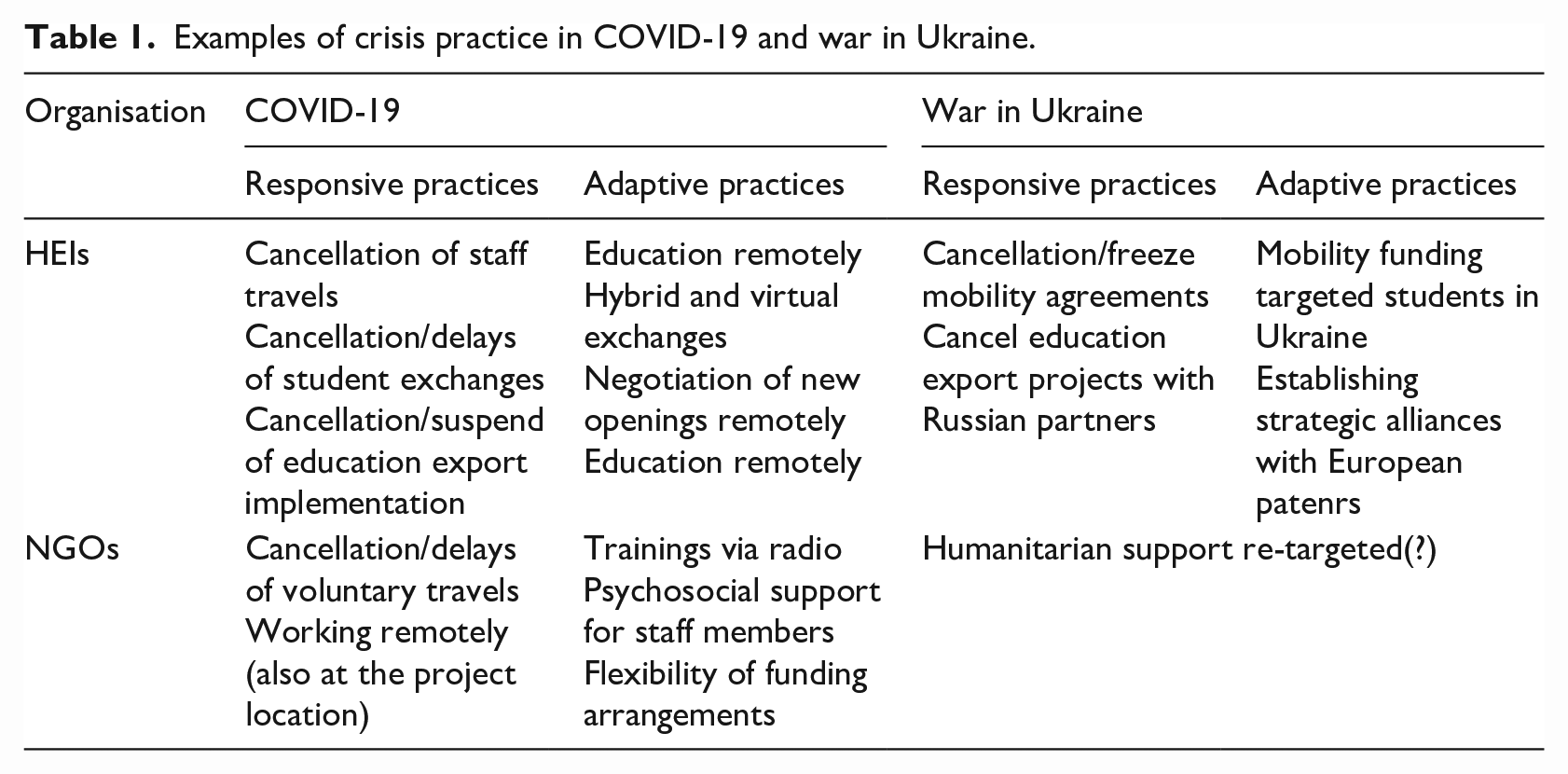
The war in Ukraine also brought changes to other IEC activities. For example, in some cases, HEIs in other countries had reservations about Finland’s safety, which led to cancellations of education export projects with Finnish HEIs and incoming student exchanges to Finland. This is a significant change from Finland’s image as a safe society (Juusola and Nokkala, 2022) prior to the war in Ukraine. In addition, the war in Ukraine also led to redirecting the available (external) mobility funding to support students fleeing the war. As stated by one of the participants: One education export project was cancelled / postponed because Finland was not considered a safe destination. Incoming exchanges have also been cancelled for the same reason. Enabling the use of Erasmus funding to help Ukrainians led to a new application period at our university, and at the same time a new round of processing applications. (Participant 6, HEI, UNI)
Therefore, the HEIs’ responsive practices resulting from the war in Ukraine indicate at least potential strategic reconsideration of IEC activities in which Russia is – for self-evident reasons – no longer one of the strategic target regions for Finnish HEIs.
For NGOs participating in this study, the war in Ukraine did not stimulate significant responsive practices compared to the rapid spread of COVID-19. One explanation arising from the responses is that the most important strategic target areas were elsewhere than in Russia or Ukraine (at least before the war). In addition, it is unlikely that all possible responsive practices were known at the time of the data collection (May-June 2022). On the other hand, NGOs in this study are internationally well-networked or a part of a broader international organisation, which is why the ‘sister organisations’ responses to the war in Ukraine can also have implications to Finnish NGOs practices. As described by one of the participants: The war in Ukraine currently has no direct impact on the international mobility of people in our organization. Some experts from our international organization have been directed to humanitarian activities necessitated by the war, in which case we have had to transfer the trainings offered by experts to another time, but these have been isolated cases. (Participant 3, NGO)
Discussion
Crisis situations required HEIs and NGOs to ‘test’ whether the prior underlying principles are morally and ethically justified (Ye, 2022), and if the practices are appropriate in the given circumstances (Rouse, 2007). Analytically this is embedded with regimes of justification that consist of plurality of underlying principles (conventions) (Imdorf and Leemann, 2023). In addition, the dynamics of the practices and underlying principles during crisis can indicate the future orientation of IEC. The latter is based on our assumption that the future at least partly exists in the daily lives (adaptive practices) (Werron and Ringel, 2020) that are supported by currently relevant regimes of justification (Diaz-Bone and de Larquier, 2022; Imdorf and Leemann, 2023).
Our study indicates that COVID-19 significantly limited global physical mobilities, which had implications for the underlying principles (conventions). For example, IEC actors were required to follow the local guidelines and consider potential health risks. In SC terms, this indicates the domestic convention in which local traditions and hierarchies are emphasised (Imdorf and Leemann, 2023). However, mobility-related instructions and health risks varied by organisation, regionally, nationally and globally. Therefore, HEIs and NGOs followed partly different conventions. For HEIs (local) health risk instructions, travel guidelines and the HEI’s role as a responsible employer (domestic conventions) as well as concerns related to students’ wellbeing (civic conventions) were relevant. This was despite the fact that during the COVID-19, HEIs were concerned about mobility figures as an indicator of measurable performance, which follows industrial convention (Imdorf & Leemann, 2023). However, neither industrial convention, nor market convention, which tends to be significant for educational export activities (Juusola and Nokkala, 2022), formed the main conventions for HEIs to consider in their IEC, as the mobility restrictions and health risks were their primary concerns.
For NGOs, IEC is typically based on the partnerships and capacity building with foreign partners (Reinikka et al., 2018; Santos et al., 2022) indicating global social responsibility and human development (civic convention) as well as considering local values and norms (domestic convention). However, during the rapid spread of COVID-19, the IEC was either completely suspended or continued partially online, indicating flexibility and remote implementations (project convention). At the same time, part of the IEC projects continued site, because development cooperation is typically a long-term endeavour, and thus experts are in the target country for a long period of time. In this case, for NGOs the solidarity and local needs were relevant even during the pandemic, emphasising social responsibility (civic convention) and local starting points (domestic convention).
The war in Ukraine has posed a new kind of moral concern for IEC actors, which are in many respects interlinked with geopolitics (indicating domestic convention). For example, Finland’s geographical and political position has traditional played a role in what kind of target regions are considered nationally relevant to Finnish HEIs (MEC, 2017). Likewise, Finnish NGOs have been performing vital work for decades to support Russian civil society, and they continue to do so after the Russian invasion of Ukraine (Suomi-Venäjä Seura, 2022). On the one hand, these starting points are related to the fact that a significant number of students from Russia came to Finland before the war (Mäkinen, 2023), and on the other hand, to the fact that Russian speakers are the largest linguistic minority in Finland (Renvik et al., 2020). Thus, the connection between Finland and Russia includes at the individual and family levels close contacts (Renvik et al., 2020). During the war in Ukraine, HEIs and NGOs have applied a moral responsibility to support social development (indicating civic convention) for example by providing Ukrainian students study places at Finnish HEIs or sustaining humanitarian support in the region that suffers the most from the Russian invasion. However, justifying social support is still mainly based on geopolitical positions (therefore indicating domestic-civic convention).
As summarised in Table 2, the 2021–2022 form the timeframe of this study where the participants make sense of the consequences of the two crises, interpret the (partly conflicting) expectations of the stakeholders, plan the future of IEC and navigate practical concerns of uncertain situations (Nicolini, 2009; Ye, 2022). These aspects do not necessarily align harmoniously (Nicolini, 2009). Instead, different crisis practices may indicate a different combination of conventions in regimes of justification (Boltanski and Thévenot, 2006; Imdorf and Leemann, 2023), and vice versa. Furthermore, based on the analytical interpretation of the empirical study findings, it appears that crises have altered the previous underlying principles of HEIs´ IEC activities. As noted in the previous studies (Alavähälä, 2021; Juusola and Nokkala, 2022), IEC activities, particularly in terms of mobility programs and education exports, were before the COVID-19 and war in Ukraine predominantly driven by effectiveness (the industrial convention) and competitiveness (the market convention). However, based on the findings of this study, there have been fewer changes in the underlying principles of NGOs’ IEC activities, rather for them, the crisis practices it seems constitute a refinement of their focus.
Dynamics of temporality, future-oriented practices and regimes of justification.
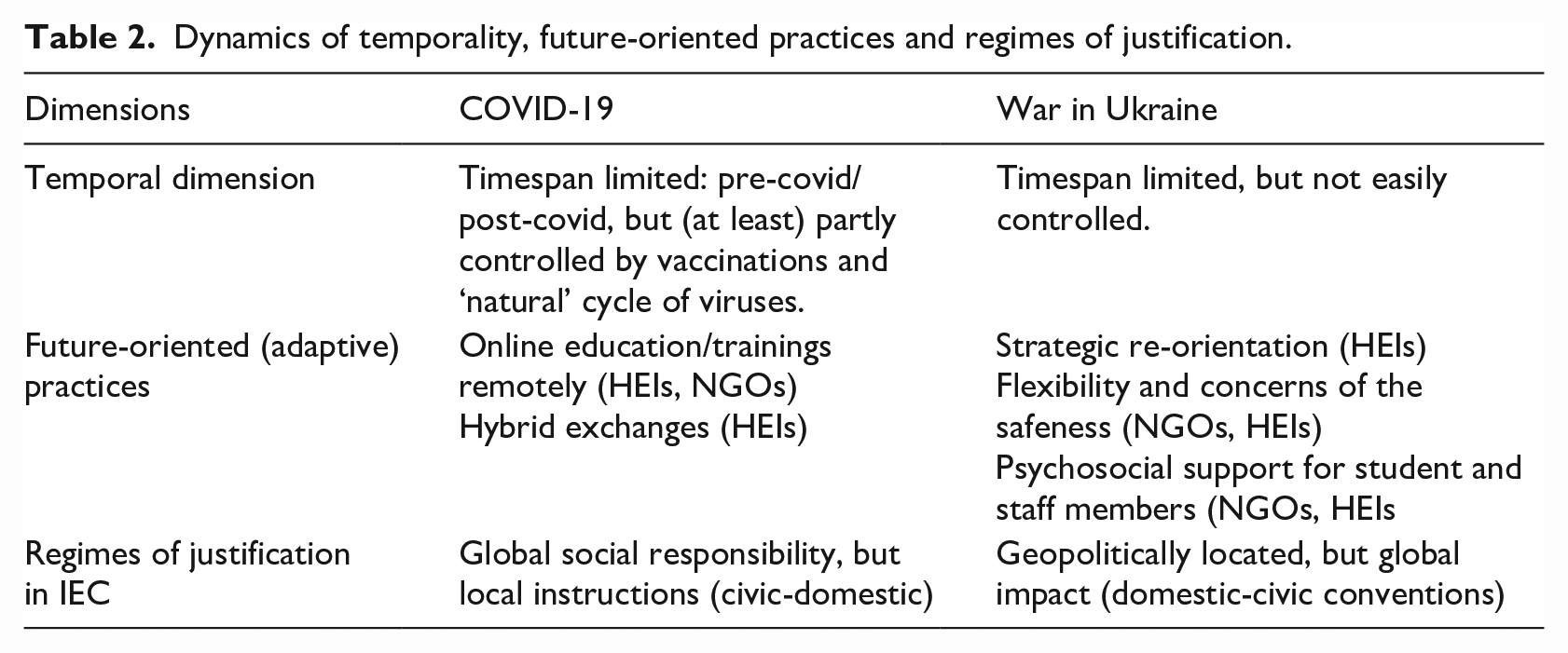
When considering the dynamics between the regimes of justification and future-oriented practices it seems that, conventions can strengthen the development of practices. Our findings Indicate that different remote solutions have evolved into future-oriented adaptive practices. However, the ways in which remote practices will be developed depends on the stakeholders’ needs and what fits to the situation (Rouse, 2007). For example, market relevance and efficiency (indicating market-industrial convention) or accessibility (indicating civic convention) can both equally be applied in remote practices, but the way in which remote practices will be developed can depend on whether it is meaningful in terms of commodification of education or in terms of equal opportunities and social responsibilities. Therefore, a crisis is not only a threat, but can also be an opportunity. For example, COVID-19 has accelerated desirable trends such as the digital transition, which can help promote a more ecologically sustainable way of life and enable social inclusion in education and elsewhere. At the same time, both COVID-19 and the war in Ukraine have made global interdependencies more visible, for better or worse.
Conclusion
In this study, we explored how Finnish HEIs and NGOs responded to COVID-19 and the war in Ukraine by considering the dynamics of the crisis practices (Nicolini, 2009, Rouse, 2007; Werron and Ringel, 2020) and their embeddedness in regimes of justification (Boltanski and Thévenot, 2006; Diaz-Bone and de Larquier, 2022; Imdorf and Leemann, 2023; Ye, 2022). Our findings indicate that in unexpected circumstances, IEC actors are required to interpret the situation and apply appropriate practices in a morally justified way. At the same time, IEC actorsneed to have reasonable flexibility and capacity to reconsider their operations. This is particularly meaningful in crises that concern health issues or geopolitical tensions in which the IEC practices aim for the common good. For example, remote education, which became more common during COVID-19, only works if it is accessible to the target groups.
These empirical study findings must be considered in light of some limitations, though. For example, the study group consisted mainly of heads of international affairs at HEIs. As a result, the participants’ perspectives were limited to the starting points typical of HEIs’ international affairs offices, such as student exchange programmes. While this provided an insightful view of how HEIs international affairs offices have coped with the crises, it’s crucial to consider a wider scope to grasp the comprehensiveness of IEC fully. This could include units involved in international research collaboration or expanding the understanding of NGOs’ IEC activities.
On the other hand, our findings provide insight into the future of IEC. We assumed that the potential future coexists in the presence (Mandich, 2020). Based on this interpretation, the future orientation of the IEC is linked to virtuality, stronger alliances and questions of social relevance. This is in line with the other recent IEC studies. For example, Brandenburg (2020) has emphasised the importance of social responsibility and a wider approach to public engagement in IEC, which can enhance social integration and prevent discrimination. Considering that the participants of this study represented different types of organisations (HEIs, NGOs), future research could support organisational learning in the IEC context.
Finally, our research presents analytical lenses that combine regimes of justification (Boltanski and Thévenot 2006; Diaz-Bone and de Larquier, 2022; Imdorf and Leemann 2023; Ye, 2022) and the concept of social practices (Nicolini, 2009, Rouse, 2007; Werron and Ringel, 2020). By adopting ‘connected situationalism’ (Nicolini, 2016: 102) and by focusing on crisis circumstances that disturb the status quo (Ye, 2022), we were able to analytically identify the interconnections between regimes of justification (including a plurality of conventions) and crisis practices and argue that underlying principles (conventions) can affect which crisis practices are considered morally relevant. We also concluded that conventions may affect how practices will be developed. However, confirming this would require a more comprehensive longitudinal data set.
Footnotes
Declaration of conflicting interests
The author(s) declared no potential conflicts of interest with respect to the research, authorship and/or publication of this article.
Funding
The author(s) received no financial support for the research, authorship and/or publication of this article.
