




Abstract
This editorial argues that scholarly communication impels global progress, and articulates recent IJCE contributions and developments.
Rigorous, Informed and Open Communication
Any person who has plied their trade or life across national, cultural or academic borders knows there is no such thing as globalisation. There are many globalisations. Our world is full of infinite futures.
As even casual discussion at a hotel lunch buffet brings this out, teacher time is scheduled differently at schools in the same city, let alone around the world. Cultures parcel learning into incommensurate curriculum and credits. National or institutional policies rarely synchronise in harmonious ways, even when doing so would make basic sense. There is no single graduation ceremony—some sing or dance, others pray. Negative numbers are taught to children in some countries at seven years, while others must wait until 13. ‘Retirement’ practices make little sense across borders.
Even tiny differences can swell into challenges which make international exchange difficult, complex, or seemingly dangerous. Rigorous, informed and open communication is essential to overcoming and making sense of the infinite globalisations which undergird our thriving world. Indeed, it is close to impossible to understand weird and complex things without inquiry and engagement, as thousands of years of education learning and development make clear.
Of course, just talking doesn’t ensure change or progress. Centuries of cultural formation toughen people against the dissolution of difference. Big, old and strong cultures make formations which take years to understand, even superficially. As education researchers know well, change can be glacial even with the most flexible systems and people. Still, dialogue is a necessary foundation step for making possible worlds real and avoiding preventable decline or disaster.
It follows that informed scholarly analyses and debates make hugely important contributions to educating humans and making their world, as do the institutions, platforms and people who make it all happen. Informed discourse is certainly needed now, a time of transboundary volatility, risk, and opportunity. Education systems, teaching practices, research infrastructure and scholar mobility are being shocked in multiple directions simultaneously, carrying implications for decades to come.
Steady IJCE Developments
Sustaining informed education dialogue is the core message emerging from recent developments in and around the International Journal of Education Research (IJCE). Heading into its 15th year, IJCE stands as an established beacon of global discourse about education problems, solutions, and futures.
After ongoing reform and service, IJCE has emerged stronger, more vibrant and more venturesome than ever. It confers a stable platform for global research into education in China, and for helping people around the world understand one of the largest and oldest education systems. IJCE springs from the foresight of its founding editors Xie Weihe and Shi Jinghuan, whose guidance continues to this day. It has firm roots at the Tsinghua University School of Education. The Editorial Office and SAGE Publishing have made dozens of articles each year openly accessible to anyone with the internet.
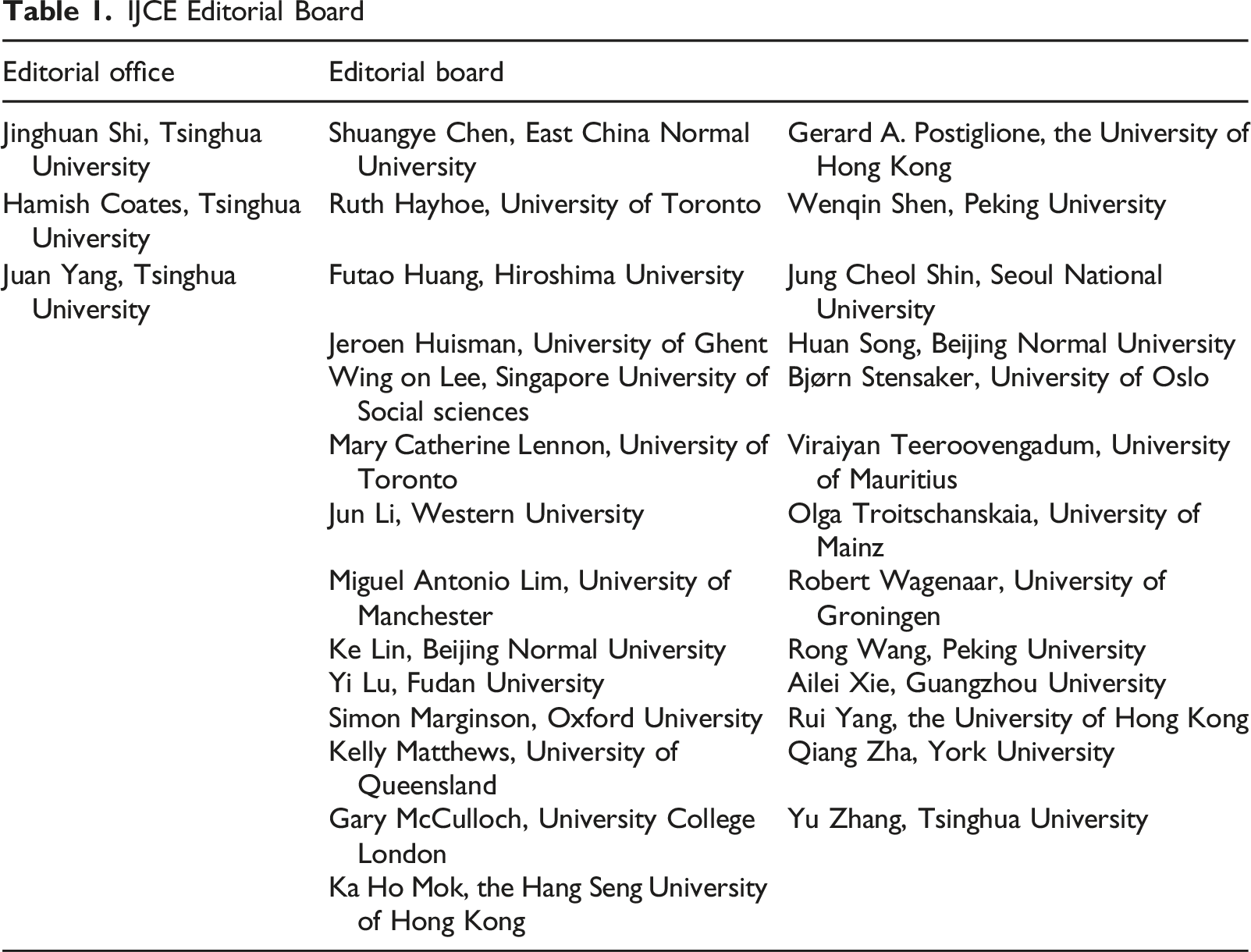
IJCE Editorial Board
Impact is evident in the bibliometrics. Figure 1 shows rapid and steady growth in full-year readership (downloads, thin line) and use (citations, think line), especially after shifting to full open access from 2021. Indeed, much of the engagement with articles before 2021 has happened since. IJCE articles have been read over half a million times, and cited over a thousand. Underneath these headline figures, there are an increasing breadth of papers being cited, increasing topic and geographic diversity, growing impact, and increasing submissions and selectivity. Accumulation of Downloads (Thin Line) and Citations (Thick Line)
Curated Contributions
Among a suite of compelling recommendations made by the Editorial Board and was the pursuit of special issues on important topics. To this end, members each proposed ideas, a shortlist of which will be pursued in coming years largely in synch with related scholarly seminars and colloquia. These include the reform of education finance, international education exchange, artificial intelligence and education, Chinese overseas education scholars, gifted and selected education, exploration of distinctive Chinese learning styles, the status of teacher education, and graduate education and early career research.
Such curations of course add to the ongoing flow of naturally submitted articles. Recent contributions include a fascinating study by Gonzalez and colleagues into the impact of boarding schools on rural students, Ruano-Borbalan’s analysis of the role of artificial intelligence in reshaping knowledge and learning, Yousefi, Zhang and Jiang’s analysis of the impact of transformational leadership on teaching performance, Duffy’s exploration of expatriate academics working in China, Chen and Goel’s analysis of new rural migrant schools, and Lam’s analysis of culturally relevant models for localising western general education with Chinese characteristics.
Review to Improve
There are many ways to engage with the scholarly dialogues which inform and give impetus to contemporary globalisations. Writing and publishing is of course very important. Reading and implementing is vital. Any article worth publishing is worth promoting. Spreading the word about good research is critical.
Reviewing, however, though silent and often confidential, is the plinth stone of all science and progress. Reviewing underpins every facet of science and scholarship, from funding, employment, admissions, promotion, publishing, and recognition. Published research is invariably only 10-20% of all written papers, and even less of all research given that much is never submitted in the first place. Reviewers look beneath the tip of the iceberg at the real world of research. They engage with the fundamental challenge of rejection and falsification which undergirds all science and education improvement. They are the lifeblood of global scholarship and progress.
Private deliberation often shapes the informed scholarly analyses and debates which make hugely important contributions to the education and the world. Indeed, robust peer reviewers could have reshaped history had they stepped up during the plight of the writer and official Qu Yuan, whose tragedy gave rise to the Dragon Boat Festival which has been celebrated during the week this editorial was written.
Please enjoy and contribute to IJCE, a robust global platform for bringing sound ideas and infinite futures into action.
