




Abstract
A prerequisite for learning is that instructions and other learning activities take place in a language that you understand. This may seem self-evident, but fact remains that most learners in Sub-Saharan Africa (SSA) are taught in a European second language (L2) that they are unfamiliar with. Frequently, the role of the home languages in the classrooms has been completely subtracted leading to very unfavourable learning situations for many pupils, something which in turn results in failures and early drop-out. The current paper takes up some of the challenges, dilemmas and consequences of current medium of instruction (MoI) policies as illustrated by theories and previous studies. Part 2 gives an outline of the analytical framework being developed under the Understanding project financed by the Swedish research Council. The purpose of the framework is to help reveal strengths, shortcomings and mismatches in current language-in-education policies. Focus lies on how different policy levels acknowledge the challenges involved in learning and teaching through a second language in SSA contexts. The model provides a systematic framework for explorations of how language-in-education policy outcomes (mis)match intentions. The framework, though adapted for SSA contexts, has direct relevance to the analysis of language-in-education polices in Western education systems.
Keywords
Introduction
A prerequisite for learning is that instructions and other learning activities take place in a language you understand. This may seem self-evident, but fact remains that a vast majority of learners in Sub-Saharan Africa (hereafter SSA) are taught in a European second language (hereafter L2) that they are unfamiliar with. Frequently, the role of the home languages in the classrooms has been completely subtracted (so-called subtractive transition), leading to very unfavourable learning situations for a majority of pupils, something which in turn results in failures and early drop-out, according to the The World Bank (2021: 8–9). Thus, in spite of enormous improvements in access to education in the last decades, inappropriate language of instruction policies remain a major factor contributing to continued learning poverty in SSA (The World Bank, 2021). Put simply, getting a greater number of children to attend school is not enough to increase the knowledge capital if the quality of education (the fourth of the UN sustainable development goals (SDGs)) is not improved, and here language issues play a major, but overlooked, role.
Teaching and learning through a L2 contributes greatly to educational inequity in the SSA region. As pointed out by Robertson and Graven (2019: 604), many children from relatively wealthy backgrounds do well in L2 medium of instruction (hereafter MoI) systems since they often have access to the L2 outside school and support from home. This is rarely the case for less privileged groups, however. The academic register in the L2 used in school is additionally challenging for marginalized students who speak minoritized languages outside of school. These groups face a double challenge in acquiring the L2 and the academic register (Kerfoot and van Heerden, 2015).
Current language of instruction policies create several linguistic barriers for effective access to education. Many learners do not understand what is said in the classroom, and written texts are often designed for learners with native language proficiency. Excluding the L1 from the classroom makes learner-centred pedagogy based on interactive exploratory talk (Barnes, 2010), a hallmark of quality education, almost impossible. Examination through an unfamiliar language creates further challenges. The exclusions of local languages, and the world they represent, also isolate schools from the local community (Zelime and Deutschmann, 2019). For example, L2 MoI excludes the support of parents, family and friends from the learning process on linguistic grounds (Trudell, 2016). This is especially true in rural areas and/or among groups with low socioeconomic status. In this way, current language of instruction policies obstruct ‘linguistic citizenship’, undermining the authority of subaltern actors and the mobilization of collective agency (Kerfoot, 2011).
The negative impact of current policies is well documented (see Ndamba et al., 2017; Nzasabimfura and Andala, 2022; The World Bank, 2021; Trudell, 2016). Apart for some notable exceptions (see, e.g. Erling et al., 2021; Msimanga and Essien, 2021; Rubagumya et al., 2021), systematic research of exactly where current language policies in SSA fail, and how this can be remedied, is however, relatively unexplored territory. For example, systematic models for how local languages in different types of transition systems can be used to support learning of content through a L2MoI are still largely missing, and acceptable, sustainable and scalable models for multilingual education (MLE) in the region are still to be developed.
The focus of this paper lies partly on an exploration of motivation and consequences of current L2 MoI policies in SSA. It is our belief that a better understanding of the complexities involved in such policies opens up for potential reforms aimed at breaking current status quos and loosen the grip of the European languages in the medium of instruction landscape of SSA, a landscape with few structured models to support children and teachers to meet the challenges involved.
Further, contributing to this understanding, the article will also present what can best be described as ‘introductory explorations of an analytical framework’, that is being developed under the newly embarked Understanding project. 1 The aim of this framework is to provide a more systematic tool to reveal policy shortcomings, challenges and potential solutions related to language-in-education issues in various African transition contexts. As will be discussed below, most SSA contexts grapple with what many African scholars call the language question (Bamgbose, 1991; Mfum-Mensah, 2005). The balancing of local and global interests, issues of local and national language identities, neocolonial ideologies and strained economic realities, often lead to a mismatch between intentions and outcomes in language-in-education policies. While overarching policy documents generally recognize linguistic rights and promote the role of local languages in education, the implementations of such policies falter in the field, leading to unfavourable learning situations for millions of children in these contexts (Zelime and Deutschmann, 2018). Given the current situations, a systematic framework for analysing and pinpointing where and why intentions are not realized is a priority, and a prerequisite for constructive work that goes beyond merely ascertaining that things are wrong.
While the emphasis of this paper is the SSA context, we will also draw comparative parallels in our final discussion to the situation in many European schools, where multilingualism is gradually becoming the norm rather than the exception.
Part 1: Current policies
In the sections below, we start with a summary of the theoretical frameworks that form the basis for our descriptions of the role of language in learning. We then give a brief overview of some of the transition systems currently operating in SSA and draw attention to some of the drawbacks of these. We continue with a discussion of reasons for the continued persistence of subtractive transition, systems which researchers have pointed out to be problematic for decades. On a more hopeful note, we finish Part 1 with an overview of a few of the alternatives to traditional subtractive systems that are being explored in SSA.
The role of language in learning: Learning through a language versus learning a language
In our discussions below we assume a sociocultural theoretical perspective on learning (Vygotsky, 1978). In this model, language plays a fundamental role. There is a central emphasis on the social nature of language, how language develops through social interactions with others, and how children learn through language by engaging in conversations, discussions and other forms of social communication with more knowledgeable individuals, such as parents, teachers or peers. In addition, language is not just a means of communication but also a tool for thought (Vygotsky, 1962). Language allows individuals to represent, organize and manipulate their thoughts, and through language, children can internalize and control their own behaviour and mental processes, leading to higher-order thinking skills. In sum, language acts as a vital bridge between social interactions and cognitive development, shaping how individuals think, learn and understand the world around them. Viewed through this theoretical lens, language is essential to learning, and native proficiency in the language through which learning takes place is obviously highly desirable.
In the context of language and learning, Halliday (2004), recognizes three ways of thinking about the relationship between learning and language: learning a language, learning through language and learning about language. While all three of these aspects are relevant in educational contexts, they need to be kept apart. Learning English is not the same thing as learning through English or learning about English, for example.
One example of where these different aspects of language and learning have not been kept apart is in the application of Krashen’s (see, e.g. Krashen, 1981, 1982, 1985) theories on second language acquisition in SSA. Krashen proposes a number of hypotheses, which arguably have had a direct influence on many of L2 MoI models we see in SSA today. According to Krashen (1982: 20–29), learners acquire language best when they are exposed to ‘comprehensible input’, that is, language that is slightly beyond their current proficiency level but still understandable. This type of exposure helps learners acquire language naturally, without the need for explicit instruction. Additional important aspects of Krashen’s theories in the context of L2 MoI and subtractive transition are the Monitor Model and the Critical Period Hypothesis. In the former of these hypotheses, Krashen describes the relationship between acquisition (subconsciously acquired language) and learning (explicit knowledge about language rules). He argues that the acquired system is responsible for fluent, natural language use, while the learned system (the monitor) acts as an editor, checking and correcting language output based on learned rules. This, in combination with the Critical Period Hypothesis, which suggests that there is a pre-pubertal biologically determined period during which language acquisition must occur for learners to achieve native-like proficiency, has possibly (inappropriately) motivated early subtractive transition systems.
According to Robertson and Graven (2019: 606), Krashen’s emphasis on ‘acquisition’ rather ‘learning’, has arguably led to a disregard of the challenges teachers face in helping students become sufficiently proficient in an L2 to cope academically. Instead, various immersion and early-age subtractive transition programs are motivated by the ambition to help students become proficient in the target language by (super-)exposing them to the L2 in various contexts and subjects, thereby enhancing their language skills. This may well be the long-term effects as far as language learning is concerned, but at the severe expense of more general aspects of learning through language.
According to Erling et al. (2021), many pedagogic critiques of the current subtractive systems rely on the work of Cummins (2000), and the concepts common underlying proficiency (CUP) and cognitive academic language proficiency (CALP). These theories maintain that CALP builds on the CUP in the L1, and that sufficient CALP needs to be developed in the L1 before learners fully can grasp content through an additional language. An added problem related to CALP is the fact that the exclusion of local languages from education directly or indirectly often leads to the exclusion of the local context from the learning process (Trudell, 2016; Zelime and Deutschmann, 2019), which risks invalidating learners’ prior ‘common sense’ knowledge acquired outside of school, and lowers to the potential for teachers to make connections to what learners already know, according to Barrett and Bainton (2016). It is thus apparent that learning through an L2 represents a major obstacle for the application of some of the central theoretical principles of sociocultural learning.
Systems of subtractive transition
Most systems in SSA employ various so-called subtractive multilingual transition models (Trudell, 2016). In these systems, the learners’ familiar language and/or previous language of instruction (L1) is more or less removed (subtracted) from the learning context, often quite abruptly, and is replaced with a European language of instruction. Stages when this happens differs from context to context, and there are several different types of MoI frameworks that can be identified in the SSA region.
Firstly, many contexts employ what Cummins (2007: 165) refers to as ‘sink-or-swim’ programs of immersion. Immersion, in these contexts, entails an educational approach where students are plunged, or submerged, into a learning environment where a (European) L2 is used as the primary medium of instruction, with little formal support, from the first day of school. This means that all subjects, including Mathematics, Science and Social Studies etc., are taught in a L2 which students are often (more or) less proficient in. Motivating immersion programs, is the idea this type of model will help students become proficient in the target language (c.f. discussions above).
Based on their work from South Africa in the subject of Mathematics in Grade 4 classes, Robertson and Graven (2019: 604) acknowledge that immersion has been successful in schools in wealthier areas. Immersion does, however, not acknowledge the challenges faced in less privileged contexts, where experiences from students and teachers of this type of system is rather one of ‘submersion’. Examples of these systems include Angola, Mozambique, Senegal and some parts of South Africa (Trudell, 2016: 96).
Another popular model are the so-called early subtractive transition systems. The shift towards recognizing and incorporating local languages into education gained momentum after many African countries achieved independence in the mid-20th century. National governments, educational institutions and researchers began to acknowledge the significance of using local languages as a medium of instruction, especially in the early stages of education. This recognition was influenced by the desire to break with the colonial past and preserve cultural heritage, promote inclusivity and improve learning outcomes by providing instruction in languages that children understand.
However, in an increasingly globalized world, the enthusiasm for promoting local languages in education has gradually subsided (see e.g. Brock-Utne, 2010: 637; Deutschmann and Zelime, 2022), and home languages are now rather seen as steppingstones for acquiring literacy in the colonial languages. Generally, early transition, involves teaching in the local languages the first 2–4 years of primary education after which teaching switches to a colonial language, often abruptly without formal support. Examples include the majority of SSA countries, for example, Kenya, Zambia, Rwanda, Uganda, the Seychelles and many parts of South Africa (Trudell, 2016: 96).
A few African countries apply so-called late transition, where the transition of MoI to European languages takes place relatively late, often in secondary school. Ethiopia, by many researchers considered to have the most progressive language-in-education policies on the continent (Trudell, 2016: 107), employs over 30 languages as mediums of instruction or subjects in primary schools. Some languages are used in teacher training, and three are used as medium of instruction beyond primary level. This inclusive and decentralized system has been shown to support effective teaching practices, utilizing rich linguistic resources in the regions according to Heugh et al. (2007: 7). However, it has been pointed out that these ambitious language policies are often difficult to implement, and the majority of the political elite send their children to English and French medium of instruction schools (Ambatchew, 2010: 204).
Major challenges within the current systems
The consequences of the linguistic and cognitive barriers to effective learning caused by subtractive approaches are well documented (Brock-Utne, 2017; Clegg, 2019; Deutschmann and Zelime, 2021; Trudell, 2016; The World Bank, 2021). Most obviously, students who do not have a strong command of the second language experience difficulties in understanding and expressing complex concepts, hindering their overall learning experience. Furthermore, learning subjects in a non-native language increases the cognitive load on students, making it harder for them to grasp new concepts and engage effectively in the learning process (see Kerfoot and van Heerden, 2015). Proficiency in the language of learning is also a prerequisite for what Barnes calls ‘exploratory talk’ as opposed to ‘right answerism’, where the former affords students opportunities to ‘relate new ways of thinking to . . . existing preconceptions’, ‘a ready tool for trying out different ways of thinking and understanding’, and ‘to think aloud . . . to talk their way into understanding’ (Barnes, 2010: 7–9). In addition, testing and assessing in a L2 that learners are not fully proficient in might not accurately reflect students’ knowledge and skills, leading to unfair evaluations (see Clegg, 2005: 42).
Through mechanisms such as these, current systems exacerbate educational inequities. As pointed out above (Robertson and Graven, 2019: 604), students from privileged backgrounds often have better access to resources, such as tutoring or English-speaking environments at home. In contrast, in less privileged contexts, parents who are not proficient in the second language face challenges in helping their children with homework or engaging effectively in their education, reducing overall parental involvement. Effects like these, inevitably lead to high drop-out rates and failures, especially amongst already vulnerable groups (Milligan et al., 2020).
Second language instruction potentially also results in a disconnect between the curriculum and students’ cultural backgrounds, making it harder for them to relate to the content being taught (see Zelime and Deutschmann, 2019). Subtractive models do not support the development of the local language in education, which in turn, as pointed out by Baker (2011: 72), has negative social effects that include ‘less positive self-concept, loss of cultural or ethnic identity’.
As pointed out in several reports (The World Bank, 2021; Trudell, 2016), there is an urgent need for increased focus on multilingual teaching and teaching through a second language. For example many teachers are ill equipped to teach through a second language, and appropriate learning materials are largely missing. Addressing challenges such as these to ensure that students have equitable access to quality education requires comprehensive adaptations of teacher training programs, language policies and curricula. However, and in spite of the obvious importance of language in teaching and learning contexts, the role of language is seldom considered central in policy work in the region (Brock-Utne, 2010: 636). Confusing and inconsistent language policies (see e.g. Brock-Utne, 2010; Zelime and Deutschmann, 2016), as well as difficulties in policy implementation across regions and schools thus makes this adaptation work difficult.
Consequently, the focus of our project is exploring methods for analysing shortcomings in current language-in-education policies and finding ways to address these. Describing the structure of this analytical framework is the focus of Part 2 of this paper.
Reasons for persistence
Given the disadvantages associated with the current systems one can wonder why they persist. The answer is complex and there are several historical, social and practical factors motivating the current status quo (see e.g. Akumbu and Chiatoh, 2013; Bagwasi, 2017; Kamwangamalu, 2013, 2018). Firstly, there is little doubt that colonial legacy plays a great part in current language policies. Many of the current education systems were established during colonial times and were simply retained due to their established ideological and physical presence. In addition, there is arguably an interest among the middle and ruling classes to maintaining these systems, so-called elite closure, that is, when ‘the elite successfully employ official language policies [. . .] to limit access of nonelite groups to political position and socioeconomic advancement’ (Myers-Scotton, 1993: 149). But this is not the only reason for the current situation.
As highlighted by several authors, a strong argument for continued focus on European L2 MoI practice in SSA is that of globalization (Batibo, 2004; Deutschmann and Zelime, 2021; Kruger, 2009; Laversuch, 2008; Trudell, 2016). Trudell (2016: vii), for example, points out that the influence of globalization has boosted the role and prestige of especially English in education, a language which is now seen as ‘the gateway to global citizenship, economic progress and enhanced social standing’. Here, the economic arguments weigh heavily and there is little doubt that proficiency in the colonial languages can enhance job prospects, especially in sectors that require international communication, such as trade and tourism.
Another reason that is often brought forward for retaining the colonial languages as MoI in SSA is that that this affords a means of coping with the complex linguistic diversity in the region (see van Pinxteren, 2022, for a summary). Arguments put forward include that adopting a common language of instruction helps in standardizing the educational system across regions, thereby ensuring uniformity in the curriculum, evaluation methods and educational standards. This is also cost effective, and educational materials, including textbooks and online resources, are more readily available in major international languages. Using these languages as the medium of instruction thus simplifies the process of curriculum development and resource distribution. In contrast, it is often logistically challenging and resource-intensive to develop educational materials and teacher training programs for each of the hundreds of languages in the region, and L2 MoI is thus often chosen for practical reasons. Furthermore, many universities in SSA use English, French, or Portuguese as the medium of instruction. Therefore, using these languages in primary and secondary education prepares students for higher education, ensuring continuity in their academic journey.
Many also maintain that L2 MoI practice helps political stability (see Trudell, 2007: 554, for example). In multi-ethnic countries, choosing a neutral language as the medium of instruction can help in avoiding favouritism towards any particular ethnic group’s language, potentially reducing ethnic tensions. Fundamental to our approach is the acknowledgement that understanding and gaining insights into the complex ideological and practical reasonings for maintaining current systems is essential in order to bring about change.
Finally, it is important to note that while these factors contribute to the retention of second languages as mediums of instruction, there is active critique and ongoing debates in many countries to promote indigenous languages in education to preserve cultural heritage and linguistic diversity (see e.g. van Pinxteren, 2022; Williams, 2014). Solutions meeting these challenges are, however, relatively unexplored and as mentioned above, systematic research from SSA of multilingual education (MLE), and how to support learning of content through a L2MoI in different types of transition systems is largely missing, although there are some notable exceptions (see Erling et al., 2021; Msimanga and Essien, 2021). Some of the current efforts and more multilingual approaches to education that are being implemented in the region are summarized below.
Alternative systems
As discussed, multilingual education in Sub-Saharan Africa presents a complex landscape, with various theoretical frameworks and teaching approaches striving to address the linguistic diversity within the region. One alternative model gaining traction in this context is additive multilingual education (MLE), which incorporates multiple languages in the delivery of curricular content. Unlike subtractive bilingualism, where the introduction of a second language (L2) as the medium of instruction diminishes the importance of the first language (L1), additive MLE validates and builds upon learners’ existing linguistic resources, encompassing local language forms and varieties (Erling et al., 2017). Within the realm of additive MLE, a distinction can be made between fluid languaging, and the more fixed language approaches represented by pedagogical translanguaging, that is, the pre-planned use of multilingual instructional strategies to enhance learning (Cenoz and Gorter, 2021: 18).
Fluid languaging, rooted in the translanguaging (García, 2009) and ubuntu (Makalela, 2019) frameworks, promotes the use of all available semiotic resources in the classroom without strict boundaries between languages. There is significant evidence that various fluid multilingual practices are taking place unofficially in SSA (e.g. Chimbutane, 2013; Clegg and Afitska, 2011; Makgato, 2014; Mokgwathi and Webb, 2013; Probyn, 2009). While such multilingual practices generally are pedagogically spontaneous, they represent a potentially rich resource to build on when developing more structured models.
However, critics such as Heugh and Stroud (2020) caution that fluid approaches might overlook the linguistic realities in many parts of Sub-Saharan Africa, hindering students’ access to standardized varieties of languages necessary for higher education and high-level employment. To bridge this gap, the concept of functional multilingualism has been proposed, emphasizing multi-directional communication while also acknowledging the importance of mastering academic writing in at least one standardized language (Heugh et al., 2017).
One such approach based on pedagogical translanguaging, language supportive pedagogy (LSP), has been developed for science education in L2 contexts in countries like Tanzania and Rwanda. LSP recognizes the role of European L2s in the classroom but also leverages the L1 to support content learning. This approach focuses on amplifying meanings through strategies such as discussing topics in the L1 informally and providing structured support for formal L2 discussions and adapting teaching methods to match students’ proficiency levels (Clegg and Milligan, 2021). However, critiques have emerged, suggesting that these approaches, while aiming to legitimize multilingual resources, often tend to lead to a predominantly monolingual outcome.
In the context of Sub-Saharan Africa, where language ideologies and specificities play a crucial role, these models require careful evaluation. The region’s linguistic diversity, coupled with the need to address social equity, demands a nuanced and flexible understanding of multilingual practices. This understanding is vital to develop effective and inclusive educational policies. Importantly, these discussions emphasize the need for localized approaches that consider the various and disparate linguistic realities of Sub-Saharan Africa. As new innovative multilingual education models are proposed and implemented, ongoing research and evaluation are imperative to refine these models and align them with the unique challenges and opportunities presented by the region’s diverse linguistic landscape.
In sum, multilingual education in Sub-Saharan Africa is a multifaceted endeavour, necessitating a careful balance between embracing linguistic diversity and preparing students for the global stage. By critically examining and adapting multilingual frameworks and educational approaches, tailored solutions can be developed to ensure that education in Sub-Saharan Africa is not just multilingual, but also equitable and empowering for all learners, regardless of their linguistic background.
Part 2: Analysing the language-in-education matters – Towards a systematic framework for policy analysis
The framework below is underpinned by a conceptualization of policy from critical policy studies (e.g. Ball, 1994), which define policy expansively to extend beyond policy documents and texts to encompass policy discourse, processes, actions and outcomes (Taylor et al., 1997). Two models that further build on this idea are Spolsky (2004) and Goodlad et al. (1979). Spolsky (2004) proposes that three components of language policy can be identified in any speech community: language beliefs or ideology – the beliefs the speech community has about languages and their use; language management/planning – specific efforts made to modify or influence the practices of the speech community; and language practices – the languages that a speech community selects as part of its linguistic repertoire and the ways in which these are used and any specific context. These levels are reflected in our framework of analysis (see below).
Goodlad et al. (1979) divide the curricula into five different domains. Firstly, the Ideological domain relates to the abstract political and socio-political level. Secondly, the Formal domain, greatly influenced by ideology, refers to a curriculum that has gained official approval by the state and exists in written form, and which in turns forms the starting point for practical implementation. According to Goodlad et al. (1979: 61), when such domains are analysed ‘one finds those beliefs, values, attitudes, and the like, which society or some dominant group in society wishes the young to acquire’. Thirdly, there is the Perceived domain, which stipulates that the formal curriculum is rarely identical to what other stakeholders such as teachers, parents, students and politicians perceive to be in the curriculum. The Operational domain refers to the teaching and learning activities in the classroom and the school. It can vary between teachers and subjects. Finally, the Experiential domain concerns the learners’ experience and their cognitive, emotional and social processes. In the proposed framework below, we try to include all of these domains.
Given the multi-layered nature of policy and curricula, the analysis of policy contexts calls for a mixed-methods approach which allows for various purposes, but also triangulation, ‘thereby eliminating the bias inherent in the use of a single method’ (Riazi and Candlin, 2014: 144). The methodological approaches included in framework are summarized below.
Framework of analysis
Our framework consists of two separate levels of analysis. In Level 1, the framework focuses on policy documents, curricula, learning materials, examination tasks, etc. Of primary importance here is an analysis of the match/mismatch of learning goals in the L2 MoI subject curriculum, and the linguistic requirements needed to learn through the L2 in various subjects, but also the provisions made in the curricula for support in learning and examination in local languages (c.f. Hallidayan model above, that is learning a language and learning through a language). Another important aspect of analysis are the ideological structures that have informed the policy making. This level represents the Language management component in Spolsky’s model and the Formal domain in Goodlad et al.’s model.
Level 2 of the framework analyses the Operational domain and language practices in the classroom. These investigations include observations of actual practice, but also interviews with teachers to elucidate their perceptions and interpretations of curricula (the Perceived domain), their ideological stances, and practical aspects such as class size and infrastructural factors that affect their methodological choices in the classroom. The framework also considers the learners’ experiences (the Experiential domain) and empirically tests whether they are equipped linguistically to learn in the L2 in specific subjects. The framework is summarized in Figure 1 below and specifics are outlined in the sections that follow.
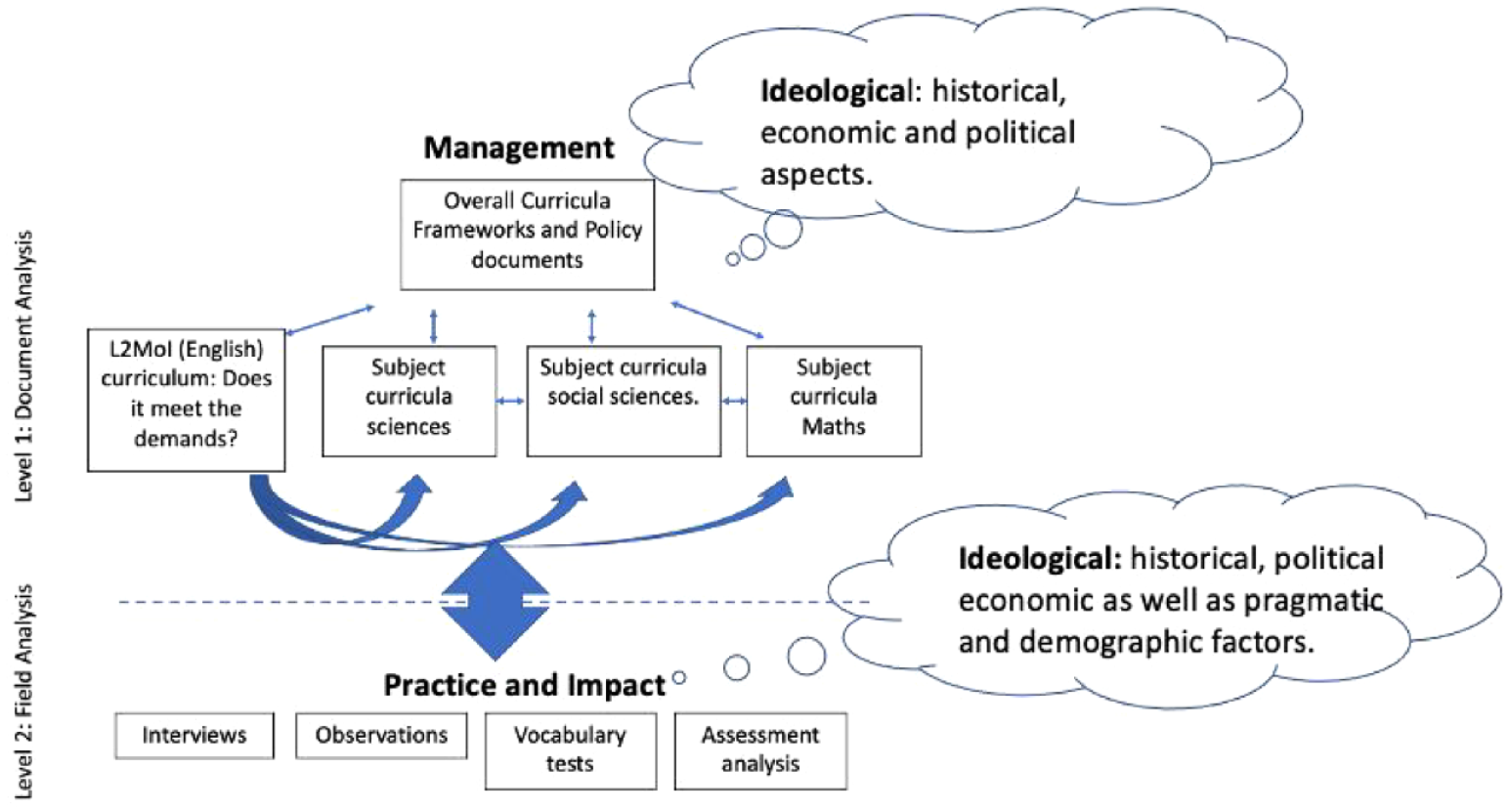
Framework of analysis.
Mapping of the language ideological context
It is crucial to be aware of the language ideologies that operate in a particular context if one wants to understand the mechanisms that influence practices. Regardless of what official language policy dictates, interpretations/perceptions and operationalization of the same are affected by language ideologies. From our own studies in the Seychelles (see Zelime and Deutschmann, 2018), for example, we can conclude that although the curriculum framework clearly advocates the use of the local language as support medium, teachers are disinclined to do so as they consider it inappropriate to use the language in class. This view is also mirrored by school inspectors who condemn the use of Kreol Seselwa in teaching even though the language is advocated for support in the national curriculum framework (Zelime and Deutschmann, 2016: 57). This clearly shows that any changes of formal language policy towards more multilingual practices have to be preceded by careful ideological and prestige planning.
Level 1: Systematic review of policy documents
When reviewing policy documents the following questions are of relevance: Firstly we have to ask ourselves what assumptions regarding learners’ language proficiency, language learning and valued language practices are embedded in policy steering documents, including curriculum frameworks. Are potential challenges and complications related to L2 MoI recognized in the policy document? For example, are there any provisions made for language support in class and during examinations?
Closely related to the above questions is the specific recognition of learner needs in the L2 MoI subject curriculum. Do the learning goals include a mastering of the academic genres needed to succeed at school, and are the specific specialized vocabulary needs for different subjects recognized? Here the framework advocates a systematic review of curriculum documents, textbooks and national examination papers for selected subjects that compares proficiency expectations with language learning objectives of the English curriculum.
In the review of policy documents, analysis should also evaluate what provision, if any, the education policy makes for teacher education, vocational training, management and resourcing in relation to L2 MoI. Are teachers trained to teach through an L2 and are they getting the support they need?
Methods used in the pursuits above include close readings and comparative analyses of various documents in combination with interviews of key policy makers and managers, and stakeholder who actively influence teachers’ practice, including school inspectors/quality assurers and teacher educators.
Level 2: Exploring practice – Field observations and interviews from a teacher’s perspective
The next level of analysis of the framework focuses on what is happening in the classroom and how management and the formal policy domain impact on practice. Questions here include how teachers experience the demands put on them, but also how their language beliefs are influenced by, but also influence, policy interpretations and how this is turn translates into actual practice. Analysis also tries to capture practical aspects that may influence practice. Poor infrastructure, large classes, lack of relevant learning materials etc., for example, are likely to have a direct impact on practice.
Methods in this part of the analytical framework include observations, narrative interviews and focus group discussions focused on language learning experiences in higher education and professional training, classroom practices, lesson planning, challenges encountered, etc. The framework also proposes stimuli-initiated discussions, where recordings from particularly interesting observations illustrating multilingual teaching can be used to discuss and reflect over practice. Lesson observations should thus be particularly attentive to monolingual and multilingual languages practices, movement between languages and registers and strategies that teachers use to integrate language and subject learning. The ambition with the above is thus to capture good examples from the field of how language challenges can be solved. It is important to make the teachers’ voices heard in this context.
Exploring impact: Field observations, interviews, testing and learner perspectives
The framework also tries to capture learner experiences, the Experiential domain, and learning outcomes, the Impact domain. Here qualitative as well as quantitative data form the basis for the analysis.
Methods include focus group interviews with learners immediately following observed lessons to capture their classroom experiences. We also propose longer activity-based, focused discussions on experiences of transition in the language of instruction, for example interviews with recent school graduates, who have or haven’t succeeded in the systems.
Another important data set that is needed to evaluate learning prerequisites is the vocabulary proficiency in the different subject domains. Previous research demonstrates that knowledge of vocabulary is a reliable indicator of conceptual understanding and language proficiency (Yu, 2010). Vocabulary tests can be readily administered to large numbers of learners and analysed to identify school effects. When used together with respondent metadata, school and demographic effects can be measured using Multilevel Modelling. This allows for questions related to what extent subject learning outcomes differ for different groups of learners (boys/girls, higher/lower SES, rural/urban, ethnolinguistic identity), as well as school effects.
Applications of the framework
Under the current project, we will test and modify the preliminary framework described in this paper by applying it to the analysis of language-in-education policies in different transition systems in the Seychelles, on Zanzibar and in mainland Tanzania. Systems represented by these contexts include first-day immersion, early transition and late transition. In the project, focus lies on how the framework can illuminate inconsistencies in language-in-education policy systems thereby pinpointing where efforts may be needed and be particularly beneficial.
One example of how the framework can be applied based on preliminary findings and previous studies includes the disparate interpretation of the language support policy stated in the national curriculum framework of the Seychelles. In this curriculum framework, using the local language Kreol Seselwa for support in the classroom is actively encouraged, but the policy is lost when interpreted and applied by inspectorates and teachers alike; negative language ideologies towards the local language (see Zelime and Deutschmann, 2018) hinder the constructive MLE models that actually are sanctioned by current formal policies. Efforts such as language ideological discussions and clearer directives as to how the local language can be used for support are thus motivated. Another example from our preliminary findings concerns the level of English achieved in the language subject compared to the level needed to learn through English in other subjects. From analysis of textbooks of English and Biology in Tanzania, the level goals of the subject English in Form 1 (A2–B1), do not correspond to the levels of proficiency required to follow subjects such as Biology without support (C1–C2). Here solutions could include producing better adapted learning materials and/or using language support in the local language/s.
These are just two examples of how the framework can be applied. Important to point out at this stage is that although we have the resources to conduct holistic analyses of various levels and different transition systems under the project framework, this may not be the case for most SSA contexts. However, as the project progresses, we note that relatively small efforts of analysis can expose serious shortcomings in language-in-education policy systems, shortcomings which often are unintentional and a result of lack of attention to language issues in policy making and implementation, combined with a lack of communication between different stakeholders. Here it is important to note that we do not believe that there are any universal solutions to the current policy challenges facing the region. Any future models have to be flexible and relevant to the local linguistic context, and we believe that the proposed framework allows for this.
Discussion and concluding remarks
The language of instruction in schools is a critical aspect of education that significantly impacts learning outcomes and educational attainment. Despite this, specific attention to the role of language in the attainment of quality education surprisingly continues to be lacking. The language question, for example, is not explicitly addressed in the description of any of the 10 sub-targets that define SDG 4, Quality Education (i.e. to ensure inclusive and equitable quality education and promote lifelong learning opportunities for all). 2 This is surprising, since SDG 4 opens up several possible pathways to impact, feeding into several other SDGs, such as Goal 10, the reduction of inequality. In short, L2 MoI systems counteract SDG 4 by inciting socio-linguistic inequality, where access to L2s is limited in relation to intersecting characteristics such as poverty, rurality, gender, ethnicity and disability, in turn leading to increased inequality (thereby counteracting SDG 10) and stunting economic development and growth in the region (SDGs 1 and 8). This conundrum is relevant in all L2 MoI contexts in the SSA region, and elsewhere.
The framework of analysis being developed under the Understanding project is arguably of broader relevance. Challenges related to language-in-education policies are not limited to the African continent. In Europe, for example, global mobility and forced migration has led to superdiverse linguistic landscapes in many schools, and a growing number of learners are taught through second language (L2). Re-evaluating traditional monolingual policies and praxis to acknowledge this diversity and the linguistic needs and rights of minority groups in Global North contexts is overdue; here frameworks of analysis such as the one proposed are needed to expose shortcomings in current systems and to prevent language issues from hindering learners’ access to education.
While the ambition of the current project does not include the development of new models of practice, we would argue that Europe also has a lot to learn from experiences in the diverse language landscape in various parts of Sub-Saharan Africa in their explorations of models for more inclusive multilingual education. The experiences from teachers in the region and some of the practical multilingual educational approaches that are being practised are a potential rich source that Europe can draw from. African educators’ understanding of working in extremely multilingual education systems, where attention to factors such as cultural and linguistic diversity is essential, is increasingly relevant to Western educators, especially given the increasingly diverse language situation in many European cities. Furthermore, the African dilemma of balancing the preservation of cultural heritage with the need for proficiency in global languages for economic opportunities provides important knowledge that European nations can learn from.
Sub-Saharan Africa has also faced challenges related to infrastructure and resources, leading to particularly innovative teaching methods. In regions with limited access to textbooks and formal materials, teachers often resort to creative, interactive and community-based teaching techniques. Europe can learn from these inventive strategies, promoting interactive and inclusive learning environments even in less well-funded schools. Furthermore, emphasizing teacher training in innovative pedagogies can enhance student engagement and improve learning outcomes.
Africa’s experience also sheds light on the importance of contextual relevance in education. European countries can benefit from incorporating locally culturally relevant content in curricula, content that reflects the diverse backgrounds of a particular student group. Understanding and valuing learners’ knowledge and traditions can foster a sense of belonging and pride among students, making learning more meaningful and impactful.
In conclusion, Europe can learn significant lessons from Sub-Saharan Africa’s language of instruction situations. By embracing linguistic diversity, incorporating innovative teaching methods, promoting cultural relevance and finding a balance between local and global languages, European education systems can become more inclusive, effective and reflective of the diverse societies they serve. For this to happen, much more collaborative international research is needed to find systematic and flexible models for the assessment and comparisons of language-in-education policy shortcomings and needs in diverse educational systems. Such analytical systems are a prerequisite for informed design, implementation and evaluation of changes needed to address the language challenges facing educational systems in Africa and Europe alike.
Footnotes
Declaration of conflicting interests
The author(s) declared no potential conflicts of interest with respect to the research, authorship, and/or publication of this article.
Funding
The author(s) disclosed receipt of the following financial support for the research, authorship, and/or publication of this article: We gratefully acknowledge project funding from the Swedish Research Council (VR-2022-03715).
