




Abstract
This study examines implementation factors of a pioneering plurilingual policy designed to foster language development in early childhood education and care in Luxembourg. Using a mixed-method design, combining qualitative expert interviews and a quantitative survey, it offers insights from both policy- and practice-level perspectives on factors that may facilitate or hinder policy implementation. The study shows horizontal and vertical sectorial disparities among ministerial stakeholders at the policy level, and disparities between different organizational forms at the practice level. These multi-level variations highlight the complex nature of policy implementation and the factors acting as facilitators or barriers to its success. This research suggests (1) a more tailored approach to policy implementation to consider organizational diversity; (2) a more epistemological framework for policy guidelines to avoid ambiguities between policy and practice; and (3) promotion of continuous professional development and exchange groups among different practice-level sectors to facilitate policy implementation in practice.
Keywords
Introduction
In recent years, early childhood education and care (ECEC) has received growing attention as an intervention field for social policy to tackle persistent disparities in educational achievement as a major source of inequalities over the life course (see Hadjar et al., 2021). More and more educational policies in terms of social policies (see Hadjar et al., 2021) address the underlying causes of such (educational) disadvantages originating from families of lower social socio-economic status (SES) and/or immigrant background (Naumann, 2014; Passaretta et al., 2022). Such ECEC policies aim at fostering children’s overall development, influencing learning experiences, and setting the course for future trajectories (United Nations Educational, Scientific and Cultural Organization, 2023), representing a shift toward more education-oriented goals alongside social and labor market-related functions in ECEC (see Papakosma, 2023). The implementation of ECEC policies thus plays a vital role in determining children’s educational opportunities and outcomes, providing a stronger basis for lifelong learning and improving their life prospects. However, policies can only show expected effects—such as enhancing educational opportunities of disadvantaged groups—if they are properly implemented. Regarding this concern, at least two obstacles should be noted. (1) Barriers to implementing educational policies arise in the alignment between policy intentions and internal/external representations so that the interpretation and understanding of policies depends on various lines of communication (Spillane, 2005). (2) However, within the multilevel structure of education systems, practitioners have agency to make policy-related choices based on their personal and professional orientations (i.e., attitudes and dispositions), emphasizing the significance of linking (i.e., coupling) policy and practice level (Yair, 1997).
With the aspect of educational policy implementation at the forefront, this study centers on the following research question, emphasizing the importance of its multifaceted approach that combines both policy- and practice-level perspectives to gain deeper insights into the complexities of educational policy implementation, studying Luxembourg’s emerging plurilingual education policy in ECEC as a case: What are the facilitators and barriers to the implementation of the plurilingual education policy in the non-formal ECEC sector in Luxembourg?
This policy marks a shift in the Luxembourgish ECEC system from a predominantly monolingual (Luxembourgish or French) to a multilingual approach (Luxembourgish, French, and children’s home languages) to language education, and aims to increase the uptake of education for disadvantaged groups (low SES, immigrants) by fostering language development in a multilingual education system. As diversity, including cultural and language diversity, is increasing across European education systems, the Luxembourgish case, exemplified by its implementation of a national plurilingual education policy in ECEC, represents the future of other education systems. As we will describe in more detail below, Luxembourg is a multicultural and multilingual country with Luxembourgish, French, and German as official languages. The policy aims at fostering children’s language development in Luxembourgish, French, and their respective home languages.
Theorizing policy implementation: Meso- and micro-level concepts and state of research
While Hill and Hupe (2022) define implementation as a late stage of the policy process primarily focusing on carrying out a certain policy and giving practical effect to it to realize the policy’s goals, this paper adopts a more comprehensive perspective on policy implementation. Drawing on Winter’s (2011) conception, policy implementation encompasses both the policy process and outcomes, influenced by multiple stages (e.g., policymaking, enforcing, communicating, transforming, etc.), variables (e.g., validity of the policy design, choice of policy instruments, etc.), and actors (e.g., different interests, power relations, etc.) at both the meso (institutional) and the micro (individual) level. Similarly, Signé (2017) views policy implementation as having a “multi-staged, developmental character” (Signé, 2017: 10) that underlines the transformative nature of the dynamic process of policy implementation. The author thus perceives policy implementation as an action-oriented process that aims at executing a policy from its initial decision-making stage to its actual practical implementation, and claims that understanding policy implementation demands the analysis of its complexity through more than a single theory (Signé, 2017).
Exploring the implementation of the plurilingual education program, and considering how organizational research in education and policy implementation overlaps, a general concept to analyze policy implementation considering different levels of analysis is Lipsky’s (1980) street-level bureaucrats theory that emphasizes the role of the practitioners in shaping and implementing policies. Practitioners directly influence the delivery and access to governmental rights and benefits. Based on their responsibility for translating policies into practice, practitioners’ attitudes and actions appear to be of considerable importance in the process of policy implementation (Lipsky, 1980). Following this concept, our theoretical framework draws on two different level-specific approaches. From a micro-level perspective, the theory of planned behavior (TPB) (Ajzen, 1985, 1991, 2002; Fishbein and Ajzen, 1975) explores how attitudes shape intentions and behavior, shedding light on practice-level agents’ inclination to implement the policy. From a meso-level perspective, the theory of coupling (Meyer and Rowan, 1977; Orton and Weick, 1988; Weick, 1976) examines the interconnection of policy elements and their influence on one another in terms of policy implementation in practice. The combination of both offers a comprehensive understanding of policy implementation mechanisms.
Theory of planned behavior
To explore the factors that either support or hinder policy implementation from the perspective of early childhood practitioners, the TPB (Ajzen, 1985, 1991; Fishbein and Ajzen, 1975) allows analysis of the relationship between attitude toward the plurilingual education policy and the perceived degree of implementation of this measure.
Based on the TPB, three factors affect individuals’ behavior: attitudes (behavioral beliefs), subjective norms (normative beliefs), and perceived behavioral control (control beliefs). Behavioral beliefs are assessments of results or repercussions of engaging in a particular way that may have a positive or negative impact on one’s attitude toward that behavior. Normative beliefs arise from perceptions of societal expectations, such as significant others’ approval or disapproval of a certain behavior, which might give rise to a sense of subjective norms as social pressure in relation to that behavior. Control beliefs refer to the degree of perceived capability and effectiveness of engaging in a certain behavior (e.g., facilitators and barriers), which may have an impact on behavioral performance.
In addition to these individual-level determinants of implementation behavior, Lyon et al. (2019) contend that examining implementation processes should take structural-level determinants (e.g., organizational factors) into account as well.
In Figure 1, we depict the conceptual framework for our quantitative sub-study on the implementation of the plurilingual education policy within different ECEC organizational forms. The model is an adaptation of the TPB (Ajzen, 1991, 2002), omitting the dimension of subjective norms and including the factor of organizational forms.
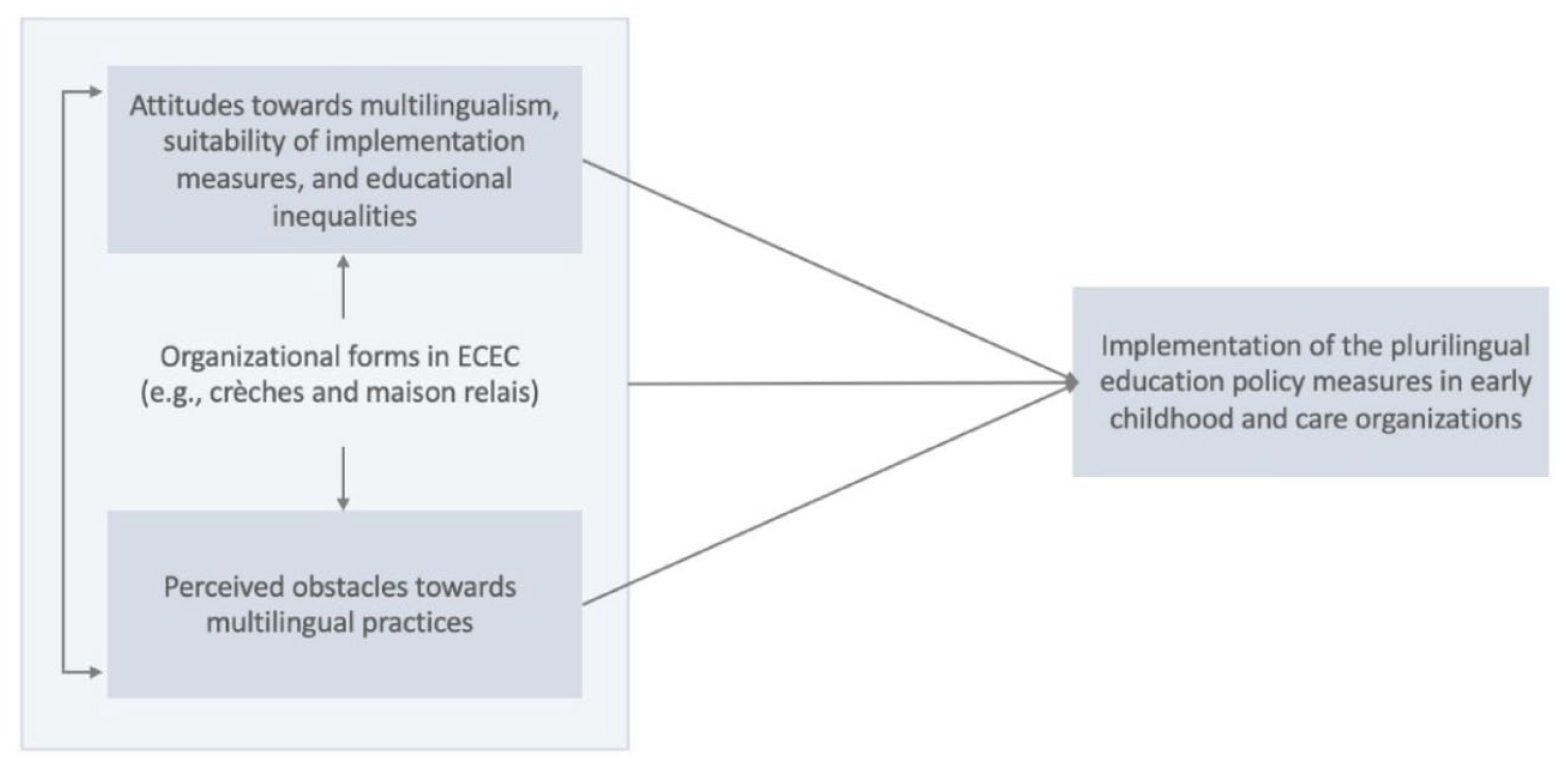
Adaptation of the theory of planned behavior.
Based on multilevel determinants, this TPB model can demonstrate which variables are significantly more likely to hinder or facilitate policy implementation. By merging these aggregated determinants, the TPB generates indicators of engagement in particular behavioral goals (Lo et al., 2019), which provides a viable framework for policy implementation studies.
Built on this conceptualization, the likelihood of engaging in a particular behavior, such as implementing policy measures, is influenced by attitudes toward that specific behavior (e.g., multilingual practices). These attitudes are shaped by beliefs about the effectiveness and outcomes of a behavior (e.g., language development) and individual or organizational factors that enable or hinder the execution of a behavior (e.g., facilitators and barriers to implementation).
The first theoretical lens adopts a micro-level perspective (Ajzen, 1991), concentrating on individuals’ perceived behavior that drives change and linking it to some extent to the meso level (organizations; Lyon et al., 2019). This is complemented by the theoretical approach that explores organizational responses to policy change from a macro-level perspective.
Coupling theory
The notion of coupling refers to the transformation of social structures and organizational cultures with regard to cognitive understandings (e.g., communication and interpretation of objectives/intentions), norms (e.g., values and expectations), and routines (e.g., practices) (Coburn, 2004; Weick, 1995). Building on Weick’s (1976) framework, Hasse and Krücken (2014) define coupling within organizational contexts as the extent to which elements or events (e.g., decision-making, planning, budgeting, curricular activities, programs, policies, etc.; see Amdur and Mero-Jaffe, 2017) in organizations are interconnected so that changes in one component influence changes in others (Hasse and Krücken, 2014: 4).
According to Orton and Weick (1988), educational organizations have been distinguished by a mixture of coupling elements, some of which are more loosely or tightly coupled than others. Based on a multi-dimensional approach, the authors suggest that tight coupling in one part of an organization is necessarily followed by loose coupling in a different part of the same organization. This acknowledges that coupling involves a certain degree of connection between elements (e.g., in regard to authority, communication), while uncoupling implies a certain degree of disconnection between elements (e.g., in regard to autonomy, geographical separation). Consequently, educational organizations exhibit a pattern of tightly and loosely coupled elements that vary in their degrees of coupling along a continuum that characterizes the complexity within organizational dynamics (Hasse and Krücken, 2014).
Approaching analysis of the plurilingual education policy implementation through a multidimensional framework of coupling (see Trein, 2017; see also Orton and Weick, 1990; Weick, 1976) seeks to understand the relationships within organizations, between organizations and their environment, and between intentions and actions as either tightly or loosely coupled. It examines both organizational (e.g., structural and procedural adaptation) and interpersonal (e.g., communication and sense-making—i.e., how the policy is interpreted and implemented in practice) mechanisms and responses in order to analyze policy implementation from different angles, including within (horizontal) and across (vertical) policy and practice levels. Regarding the factors that may facilitate or hinder implementation, this approach assists in navigating the complexities of ECEC by providing insights into the trade-off mechanisms involved in different implementation responses (e.g., adaptations, buffering, conformity, etc.). Additionally, the coupling theory allows uncovering underlying intentions underpinning the plurilingual education policy. It delves into whose interests are represented, who might be privileged or deprived—respectively, advantaged or disadvantaged—and how policy is communicated and interpreted (i.e., implemented) in practice.
State of research on policy implementation
Previous research has highlighted that teachers’ orientations toward policies can differ (Yair, 1997) and that their attitudes and beliefs play a significant role in policy interpretation and implementation, even under similar conditions (Spillane et al., 2002: 54). However, prior studies on policy implementation did not apply the lens of the TPB (Ajzen, 1991), while the loose coupling approach (March and Olsen, 1976; Weick, 1976) is a concept frequently employed.
Educational organizations are frequently described as loosely coupled, displaying a lack of integration and coherence in their processes (March and Olsen, 1976; Weick, 1976). Yet, according to the literature, the concept of coupling is understood and applied in various ways, notably within the discourse on change in educational organizations, in which the discussion over educational organizations’ looseness is frequently disputed (see also Amdur and Mero-Jaffe, 2017; Fusarelli, 2002; Hasse and Krücken, 2014; Shen et al., 2017). Although the studies on coupling within education do not particularly center on policy implementation, they offer valuable insights into organizational factors that are significant for related processes.
Findings show, for example, loose coupling between school-level governance (e.g., administration and curriculum planning) and classroom-level practices (e.g., teaching and classroom organization). This often results from weak centralized monitoring processes and a lack of coordination between bureaucratic and professional aspects (see Amdur and Mero-Jaffe, 2017; Shen et al., 2017). Fusarelli (2002) further elaborated on the characteristics of loose coupling in school systems, building on the research of Meyer and Rowan (1977) and Weick (1976, 1982). Key aspects of loose coupling in schools include conflicting and uncertain goals within school governance, a tendency to disregard regulations, inconsistent participation among school members, limited monitoring of teaching and administrative practices, absence of internal coordination in curriculum planning and teaching methods, lack of teacher-to-teacher interaction across different grade levels, and significant variations in the implementation of educational policies across different schools. When applied specifically to policy implementation, leaning on Yair (1997), the concept of loose coupling suggests that the translation of policies into classroom practices and teacher-student interactions can be highly unpredictable, with teachers displaying diverse orientations toward policies and educational approaches.
The concept of tight coupling in schools has been predominantly supported by institutional analyses which claim that educational organizations have become more tightly coupled due to globalization and processes like isomorphism, which from a new institutional perspective refers to a trend toward similarity in rules, norms, and practices among organizations, driven by similar environmental conditions and forces (Amdur and Mero-Jaffe, 2017). Meyer and Rowan (1977) highlighted various aspects, such as school organization, curriculum design, scheduling, teacher recruitment, and student credentialing, as being tightly linked dimensions within schools. Amdur and Mero-Jaffe (2017) drew on multiple studies to argue that the rise of standardized testing and increased emphasis on professional development have contributed to tighter coupling of schools. Yair (1997) further cited several studies showing tight coupling in school administration, characterized by hierarchical and bureaucratic processes, as well as in school reforms, resulting in more standardized monitoring. From this viewpoint, he suggested that schools often have limited discretion when it comes to forming educational policies at the local level, leading to reduced teacher autonomy and a tendency toward uniform orientations in policies and educational approaches.
In terms of institutional change, scholars who perceive education systems as loosely coupled suggest that loose coupling serves as a strategic buffer against external changes or pressures such as the implementation of new policy reforms (Shen et al., 2017). This approach enables schools to adapt to external shifts and expectations without relinquishing their core practices, offering teachers a degree of autonomy within their classrooms (Nohl and Somel, 2016). Consequently, diverse values and interests across various levels can coexist without direct conflicts (Bush, 2017). As suggested by existing research on loose coupling, bureaucracy has only limited means to influence classroom practices directly (Yair, 1997).
Scholars who perceive loose coupling as a problem to be addressed advocate shifting toward a tightly coupled education system as a solution (Fusarelli, 2002; Shen et al., 2017). From this viewpoint, educational improvement should extend beyond loose coupling and instead promote tight coupling to ensure a more well-structured top-down approach to policy implementation at the classroom level (Shen et al., 2017). Notably, certain dimensions within schooling exhibit a degree of tight coupling, especially at the formal level, as schools align themselves with structural norms and regulations (Amdur and Mero-Jaffe, 2017). However, Amdur and Mero-Jaffe (2017) question whether tight coupling genuinely leads to school development, a primary aim of policymakers. In light of the existing body of research on tight coupling, it is suggested that teachers’ autonomy in their practices is constrained by the hierarchical structure of educational systems, resulting in shared perspectives on policy across different schools (Yair, 1997).
Finally, Shen et al. (2017) highlight that the coupling theory in educational research has primarily been applied to the analysis of formal school settings. In contrast, our study applies this conceptual approach within non-formal education settings which, from both an organizational and institutional point of view, differ significantly from formal education settings.
Contextualization: The ECEC system in Luxembourg and the plurilingual policy
Luxembourg aligns with the Council of Europe in viewing linguistic diversity as a valuable resource that should be actively fostered (Gogolin, 2007). Echoing this perspective, the Council of the European Union (2019) highlights that low language proficiency may impact children’s future educational and societal trajectories and that investing in ECEC can play a significant role in mitigating this.
Given that language proficiency is essential for academic and societal success, students from disadvantaged socioeconomic or immigrant backgrounds lacking proficiency in school languages may face more disadvantages when entering school since they do not meet the education system’s linguistic standards. Plurilingual education has become an essential component of the EU’s language policy unit with a view to acknowledging diversity and language development as a human right and encouraging verbal communication. This focus aligns with the broader goal of fostering academic achievement, social inclusiveness, and social justice (Council of Europe, 2023). Considering Luxembourg’s multilingual school system and the linguistic diversity of its student body, which is exceptional compared to most other countries (Engel de Abreu et al., 2015), language proficiency represents a key factor influencing educational disparities in terms of academic achievements (Simoes Loureiro et al., 2019).
Luxembourg has recently seen a significant focus on multilingual pedagogies (see Kirsch and Mortini, 2023; Kirsch and Seele, 2020; Kirsch et al., 2020) due to the growing number of children who do not speak Luxembourgish and the performance gaps brought on by language barriers (Simoes Loureiro and Neumann, 2020). Given that it is known that early language acquisition affects subsequent language abilities in a significant way (see Becker and Klein, 2021), attention to multilingualism is not limited to the school system but extends to ECEC. As ECEC has increasingly become a key aspect in national and international discussions in terms of political and professional concerns, the challenges related to managing linguistic diversity have become a prominent topic in these deliberations. Investment in ECEC thus tries to address educational inequalities, focusing on origin-related disparities (e.g., Naumann, 2014; Passaretta et al., 2022). Consequently, policymakers have been prioritizing linguistic diversity as a valuable resource by emphasizing plurilingual development in early childhood policies to promote equality and inclusivity (Simoes Loureiro and Neumann, 2020). While official languages retain their significance in education systems, children’s home languages and the importance of promoting linguistic flexibility are being acknowledged more, indicating a shift toward a more inclusive approach to multilingualism. Luxembourg follows this trend by establishing policy guidance in both formal and non-formal early childhood by means of the plurilingual education program in response to the country’s linguistic diversity (MENJE, 2018).
The early childhood education system in Luxembourg has undergone a significant change at its political-administrative level since 2013. Responsibilities for both formal education (compulsory schooling) and non-formal education and care have shifted from a split system, managed by different ministries, toward a more integrated system characterized by a central authority—the Ministry of Education (Bollig, 2018; Neumann, 2018). The system is rated “somewhat integrated” into the country (like Germany, Denmark, Latvia, or Spain) by Motiejunaite (2021), with universal entitlement for ECEC, a place guarantee for publicly subsidized ECEC, and increasing importance of educational guidelines for ECEC.
While early childhood education in Luxembourg is found in both the formal and non-formal sectors, the two comprise different organizational forms and types: the formal sector includes précoce (voluntary school year before pre-school, children aged three) and préscolaire (compulsory pre-school, children aged 4–6), while the non-formal sector is grouped into services d’éducation et d’accueil (Education and Childcare Services, SEA), including nurseries (crèches, children aged 0–4), and day and after-school care facilities (maison relais pour enfants (MRE), children aged 0–12). The non-formal sector further divides into economic sectors like profit, non-profit, and municipal, which may have varying degrees of contractual agreement (conventionné/partially or fully state-funded and non-conventionné/non-state-funded; see Achten and Claude, 2017; Bollig et al., 2016). In addition, daycare organizations in Luxembourg vary in several respects, including their structural attributes (e.g., size and staff numbers), financial aspects (e.g., funding sources), and service dimensions (e.g., the variety of offerings, linguistic and social characteristics, and target age groups; Wiltzius and Honig, 2015).
Considering different staff categories, the organizations providing the compulsory year of early formal education (préscolaire at the age of four) employ pre-primary and primary education teachers with a 4-year undergraduate (Bachelor) degree. Organizations that provide the non-compulsory year of early formal education (précoce at the age of three) employ in addition to these teachers social and childhood pedagogy professionals with either an undergraduate (éducateur/éducatrice gradué(e)) or (post-)secondary degree (éducateur/éducatrice diplomé(e)) as teaching assistants. Early non-formal education organizations such as nurseries (crèches) and day care facilities (MREs) employ social and childhood pedagogy professionals with an undergraduate or (post-)secondary degree as well as care assistants and care workers with an upper-secondary apprenticeship (de Moll et al., 2024).
While the formal education system in Luxembourg is built on a trilingual regime—Luxembourgish, French, and German (Horner and Weber, 2008)—the non-formal ECEC sector did not have an official language policy until 2017. Before introducing the plurilingual education policy, state-funded non-formal early childhood organizations required practitioners who were bilingual in at least two official languages, including Luxembourgish. This emphasis on Luxembourgish aimed to promote the language, particularly for immigrant children who did not speak it at home (see Neumann, 2012, 2015). Private commercial organizations had lower quality criteria and allowed a variety of languages, in order to also address parents’ needs (Honig et al., 2015). As a result, the non-formal sector was dominated by rather monolingual institutions: state-funded organizations (secteur conventionné) primarily used Luxembourgish, while French was more prevalent in private commercial ones (secteur non-conventionné; Bollig, 2018). Nevertheless, studies (e.g., Honig et al., 2013) have also shown different language practices among ECEC organizations that go beyond a monolingual approach (e.g., translanguaging; see Simoes Loureiro and Neumann, 2020), which reflects distinct approaches to managing linguistic diversity in the Luxembourgish ECEC system.
Ensuring high process quality after the governmental shift toward an integrated approach is contingent upon structural quality, which in Luxembourg is overseen by the Direction Générale du secteur de l'enfance/General Management of the Childhood Sector, part of the Ministry of Education (MENJE), operating under the regulations of the Act on Relations between the State and Social, Family and Therapy Organizations (ASFT) in 1998 (see Journal Official du Grand-Duché de Luxembourg (JOL), 1998). On the other hand, the Division Innovation of the Service national de la jeunesse (National Youth Service, SNJ), following the Youth Act (Loi de la Jeunesse) in 2008, is responsible for initiatives aimed at enhancing process quality (see JOL, 2008).
The SNJ initiates various measures to enhance process and orientation quality, including quality development and monitoring, with a focus on non-formal education (MENJE, 2018). This involves implementation of the National Framework for Non-Formal Education in Childhood and Adolescence as a guideline defining core pedagogical objectives and principles that must serve as the foundation for all pedagogical practices used by SEA practitioners. To ensure implementation, quality assurance measures are in place, such as the presentation and assessment of pedagogical concepts by regional agents of the SNJ. Once approved by the MENJE, these concepts are published and made accessible to external stakeholders. The emphasis on plurilingualism is associated with the process quality standards (Achten and Claude, 2017). While linguistic diversity and plurilingual education have been mentioned in various parts of the national framework for non-formal education (MENJE and SNJ, 2018: 24), the implementation of the plurilingual education program has particularly highlighted plurilingualism, making it a significant aspect of the SEA (Simoes Loureiro and Neumann, 2020).
The plurilingual education program in the SEA targets children aged 1–4 years, before they reach compulsory school age. The program was proposed in September 2016 and gained a legal basis in October 2017 under the Youth Law (Art. 38; MENJE, 2017), aiming to ensure educational quality and systematic monitoring of the quality process (MENJE, 2018; SNJ, 2021). Although the policy encompasses three pillars—children’s language development, partnership with families, and networking with local school, social, and medical services (MENJE, 2017)—this study focuses solely on the first pillar.
Following the 2017 law (Art. 10), the SEA is legally required to establish the following implementation measures. (1) Each service must establish a local concept on plurilingual education (Concept Local sur l'Éducation Plurilingue) incorporating the three previously mentioned pillars and integrate it into a general action concept (Concept d’Action Générale; SNJ, 2018). Implementation of the plurilingual education program was expected in 2018, and the local concept needed to be integrated into the general action concept and daily practices by the beginning of 2019 (SNJ, 2021). (2) In addition, each education and childcare service must keep a logbook (Journal de Bord) to track implementation of the general action concept. This logbook helps practitioners to ensure that their practices align with the general action concept and includes internal regulations, task distribution, and documentation of pedagogical offers related to the pillars of the local concept (JOL, 2017; MENJE and SNJ, 2018). (3) Implementation of the plurilingual education program also involves a designated pedagogical referent within each SEA who undergoes professional development to coordinate and support the program’s implementation into practice (MENJE and SNJ, 2018). The referent’s role also involves ensuring continuity and functions as a reference point for parents and external stakeholders related to the program (SNJ, 2021). (4) Additionally, each SEA is required to have at least one person proficient in Luxembourgish and one person proficient in French, both at the C1 level of the Common European Framework of Reference for Languages (Council of Europe, 2020). The goal is to provide children with a vibrant and authentic linguistic environment, allowing them to acquire both languages naturally. This requirement entails ensuring continuous exposure to both languages through daily pedagogical offers, amounting to 40 hours/week (JOL, 2017). (5) To ensure successful implementation of the plurilingual education program, the state provides funding for additional resources to support the pedagogical practitioners in the SEA under a childcare voucher scheme (chèques services accueil). This funding can be for up to 10% of the total working hours of the staff, either to hire more practitioners or increase the working hours of existing staff members (MENJE and SNJ, 2018).
Methodology
Focusing on the non-formal ECEC sector, this study analyses the implementation of the plurilingual education policy by employing a fully integrated mixed model design, systematically combining qualitative and quantitative approaches (see also Teddlie and Tashakkori, 2009: 156). This comprises two sub-studies: expert interviews with policy-level stakeholders and a quantitative survey with early childhood practitioners.
While the design is based on triangulation—not following a validation approach, but aiming at capturing “a more complete, holistic, and contextual portrayal of the unit(s) under study” (Jick, 1979: 603)—to analyze the research questions in a holistic manner (see Kuckartz, 2014; Teddlie and Tashakkori, 2009), it was a central requirement that each methodology should operate independently. We analyze different research questions using specific methodologies. This multi-strand parallel design nevertheless allows mutual influence and impact through meta-inferences, drawing on different methods, data sources, and theories at different stages of the research (Teddlie and Tashakkori, 2009: 75).
The next section begins by discussing expert interviews, which offer insights from a policy-level perspective that also reflects on the practice level. Following this, the quantitative online survey solely examines the practice-level perspective of policy implementation. The mixed-method study’s findings are ultimately presented using a triangulation approach to combine the results from the qualitative and quantitative perspectives and address the research questions in a holistic matter.
Qualitative design
The qualitative sub-study aims to identify facilitators and barriers to implementation perceived by different stakeholders involved in policymaking and implementation, with an additional focus on the salience of reducing educational inequalities. It uses the concept of coupling (Weick, 1976) as an analytical framework, which helps to define the relationships, distinctions, and interactions among various coupling elements and actors involved in the policy implementation. Expert interviews are particularly valuable when studying complex systems (see Bogner and Menz, 2009: 12), as is the case with the non-formal education ECEC sector, in which insider knowledge originating from specific organizational roles and functions (see Gläser and Laudel, 2010: 11; Kaiser, 2014) is essential for delving into a relatively unexplored field. According to Bogner et al. (2014), expert knowledge can be categorized into technical, process, and interpretation knowledge. These categories are crucial to understand the plurilingual education policy. Technical knowledge pertains to comprehending the content and context of the policy. Process knowledge focuses on understanding the implementation procedures. Interpretation knowledge involves subjective evaluations of the situation, including identifying facilitators and barriers during implementation, which is the focus of this study. These aspects collectively play a crucial role in gaining insights into the plurilingual education policy. On this basis, the analysis is guided by specific sub-questions to explore the perspectives of these key actors:
What are the facilitators of policy implementation?
What are the barriers to policy implementation?
How do the facilitators and barriers to policy implementation relate to reducing educational inequalities?
Policy actors were selected based on their professional role and function within an organization (see Helfferich, 2011) to include those who, as defined by Meuser and Nagel (2005), may deliver implicit knowledge about a particular field of action, such as decision-making processes, organizational strategies, and implementation practices that shape social practices (e.g., policy implementation). The snowball sampling approach (Seidman, 2013: 58; see also Gläser and Laudel, 2010: 117) was used to identify and contact 27 potential participants, including members of the Ministry of Education’s scientific advisory board (SAB) for the plurilingual education policy, representatives from the Ministry of Education (MENJE and SNJ), funding agencies from the private non-profit sector (NPO), and a large international profit organization. From the original sample, a total of nine semi-structured expert interviews were conducted with individuals from various organizations (two SAB members, one from MENJE, one from SNJ, five from five different NPOs), providing valuable perspectives on the policy’s implementation.
The expert interviews were conducted as guided (non-standardized) semi-structured interviews (Gläser and Laudel, 2010; Kaiser, 2014) and adhered to a rule-based, multi-stage process aimed at maintaining data quality and balancing between an open approach and theoretical guidance (Helfferich, 2011; Kruse, 2015). The interview guidelines covered six content sections including personal questions (position and function), organizational questions (role and areas of action), questions related to multilingualism (attitude and disposition toward multilingualism in general, in Luxembourg, and ECEC), and policy implementation-oriented questions (policy goals, measures, success factors, and challenges). Each interview systematically covered these thematic blocks. Given the constraints of the COVID-19 pandemic and the prevalence of remote work arrangements, the interviews were conducted via Webex during late autumn and winter 2020/2021.
Following Mayring’s (2015: 66) approach, content analysis was used to identify and systematize the expert interview data. A combination of deductive and inductive approaches was employed, using a step-by-step model. A pre-established coding scheme based on the different sections of the interview guidelines was used to initially identify and group coding units. For this study, we focused on two categories: facilitators and barriers. In a next step, a deeper analysis was conducted following an inductive approach. This involved a thorough examination of the interview data to identify new themes and patterns that emerged beyond the predetermined categories and eventually to develop subcategories. By contrasting the data and codes, clusters of coding units were identified, revealing similarities, differences, and general patterns (see also Bowen, 2009: 144). The coding scheme evolved into a hierarchical system, enabling a comprehensive understanding of the data (see Schiellerup, 2008).
Quantitative design
The quantitative sub-study aims to analyze the influence of organizational- and individual-level factors on the implementation of a plurilingual education program in non-formal ECEC settings. Framed by the TPB (Ajzen, 1985, 1991; Fishbein and Ajzen, 1975, 2002), it analyzes early childhood practitioners’ attitudes (behavioral beliefs), perceived obstacles (control beliefs), and implementation (perceived degree of implementation) of the plurilingual education policy measures. In addition, it considers organizational forms of ECEC settings as organization-level factors, drawing on the rationale from the state of research in Luxembourg wherein ethnographic research conducted in Luxembourg (e.g., Neumann, 2011, 2012, 2015; Simoes Loureiro and Neumann, 2020) has revealed that the SEA traditionally adhered to an institutionalized monolingual approach prior to implementation of the plurilingual education program. This approach promoted either Luxembourgish or French, with variations often related to organizational forms (communal, private non-profit, or private commercial). Alongside research showing a monolingual tradition in the SEA, studies (Honig and Neumann, 2011; Neumann, 2011; Neumann and Seele, 2013; Neumann et al., 2012; Seele, 2013a, 2013b) have also indicated differences in pedagogical language practices in different ECEC settings. Consequently, the TPB (Figure 1) has been adapted to take organizational level factors into account alongside individual beliefs in the implementation process. On this basis, the survey is guided by a research question and subsequent hypotheses to explore practitioners’ perspectives comprehensively: How do attitudes toward the suitability of the implementation measures, multilingualism, educational inequalities, obstacle perceptions, and organizational forms shape implementation of these measures?
Drawing on Ajzen’s (1985, 1991) conceptualization, this research question revolves around investigating specific hypotheses related to behavioral and control beliefs influencing the implementation of plurilingual education policy measures:
H1: The more positive the attitude toward the suitability of the implementation measures, the stronger the implementation of the policy measures.
H2: The more positive the attitude toward multilingualism, the stronger the implementation of the policy measures.
H3: The more positive the attitude toward educational inequalities, the stronger the implementation of the policy measures.
H4: The lower the perceived obstacles to multilingual practices, the stronger the implementation of the policy measures.
To investigate the research questions under study, data relevant for testing these hypotheses were gathered through a cross-sectional survey in the form of a quantitative questionnaire study. The standardized questionnaire was collaboratively developed, merging three different research projects into a single survey. This approach was adopted to prevent oversaturating the practitioners and to improve the response rate across the research studies. After data collection, three reduced data sets were created based on each research focus. This study utilizes the reduced data set focused on multilingualism and implementation of the plurilingual education program. Due to the COVID-19 pandemic, the quantitative questionnaire was designed as a standardized online survey during winter 2020/21 and made available online for a 3-month period. A total of 736 SEAs were contacted via email, from which 1200 individuals participated.
From the initial dataset—which included practitioners from various types of non-formal organization for children aged 0–12 (N = 1200), —the sample for this study (N = 411) was reduced to early childhood practitioners in crèches and MREs, addressing children aged 4 and under. The reduced data set shows a nearly equal distribution among the two organizational forms (crèches = 202 (49.1%); MREs = 209 (50.9%)).
To address the research question and test the hypotheses, multiple linear regressions were employed to analyze the associations between practitioners’ attitudes and perceptions of obstacles, and the organizational form, with the (perceived degree of) implementation of various aspects of the plurilingual policy.
Operationalizations and descriptive statistics can be found in Table 1.
Measures and descriptive statistics.
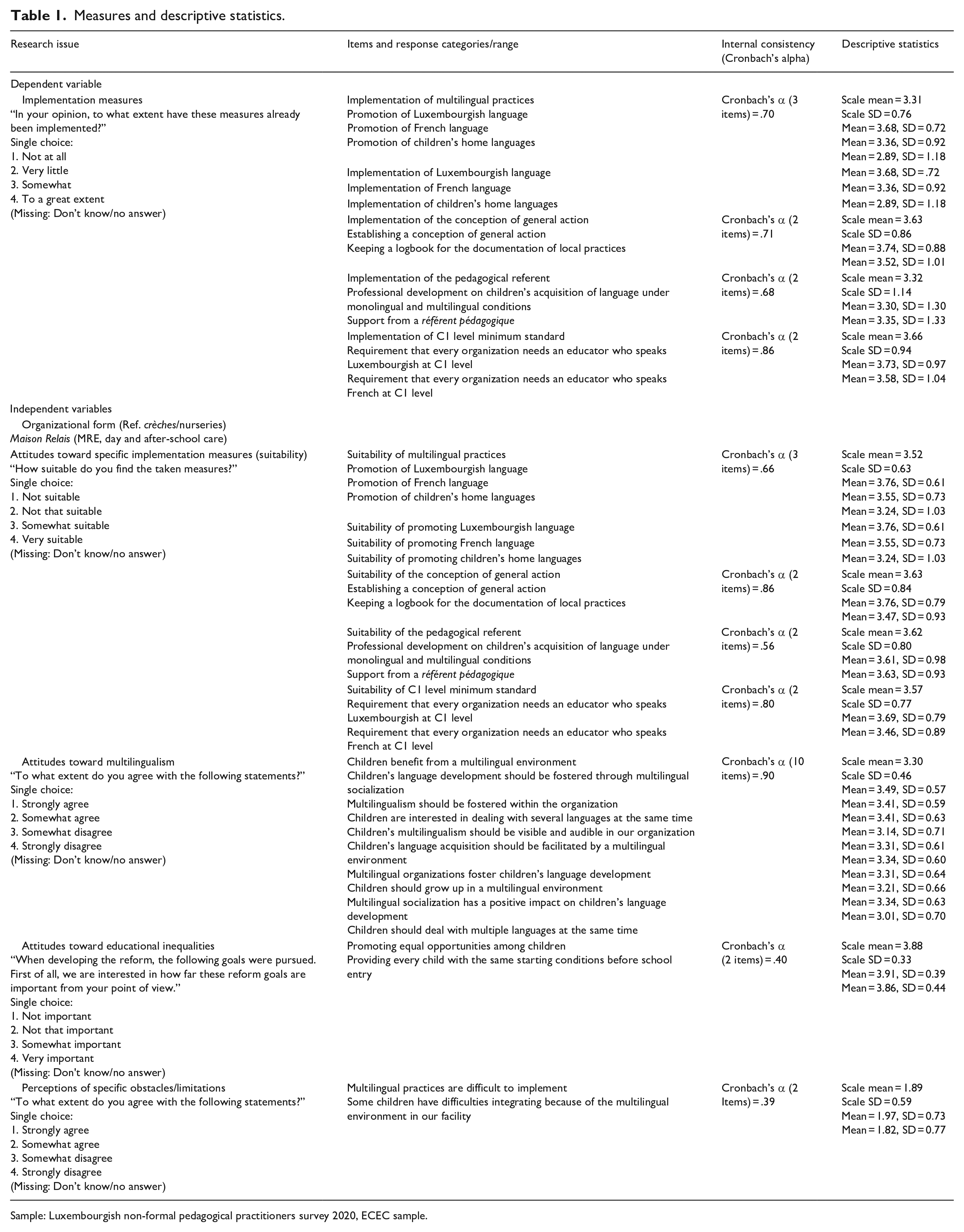
Sample: Luxembourgish non-formal pedagogical practitioners survey 2020, ECEC sample.
Results
Facilitators and barriers to policy implementation: An empirical analysis based on expert interviews
Facilitators to policy implementation
Sequential top-down bottom-up approach
For policy implementation on a national level, according to the National Youth Service (SNJ), adopting a sequential top-down bottom-up approach in particular represents a facilitator. A top-down initiation is used to convey fundamental ideas of the policy to practitioners. A bottom-up reflection and adaptation take place subsequently, considering the unique contexts of each SEA. This sequential twofold approach is thought to enable the effective implementation of quality assurance procedures, such as the national framework and its integrated plurilingual education program, which can be illustrated by the following quote: When it comes to implementation [. . .] top-down [approach] is a certain success if you do it on a national level, to bring an idea to the people. And then from a certain point it starts to become difficult to implement from a top-down level. An implementation (.) [. . .] in one structure is again a completely different implementation in another structure, because everyone has to work with different contexts and framework conditions. That means [. . .] in the implementation, at some point [. . .] one must use the bottom-up approach. (SNJ, personal communication, August 31, 2021)
Shifts in attitudes and dispositions toward multilingual education
Linked to the top-down approach, according to various stakeholders (e.g., MEN, 2020, personal communication), a key objective of the plurilingual education policy is to ensure that the attitudes and principles outlined in the policy are effectively communicated. This is done through the professional development of pedagogical referents and continuous exchange groups. These policy implementation measures play a crucial role in bridging the gap between policy intentions and practical implementation in the SEAs. According to several NPOs (e.g., NPO, 2021a, personal communication; NPO, 2021b, personal communication; NPO, 2020b, personal communication), the effective conveyance of attitudes toward the policy and multilingualism in practice have led to notable shifts in attitudes and dispositions. The integration of multilingual approaches alongside common pedagogical offers (e.g., literacy, singing rituals, puppetry, etc.), for example, effectively made multilingualism a standard component of practices in the SEAs. Multilingual practices extend beyond these daily practices, with NPOs and SEAs also implementing targeted pedagogical initiatives designed to foster multilingualism (e.g., multilingual dictionaries in partnership with parents, establishing mobile libraries with multilingual early childhood literacies and media, etc.). The effectiveness of these changes is attributed to the consistency and standardization of investing in pedagogical initiatives related to the plurilingual education program. Consequently, there appears to be a noticeable shift in how multilingual education is perceived and implemented. This shift is characterized by an increased awareness of and sensitivity to the significance of multilingualism in ECEC. This effect, as stated in the following excerpts, was not evident prior to the policy implementation: [. . .] I see it on the one hand in the activities they offer, in which different things are regularly included as a standard. I see it in the reflections and in the questions that come up in the professional development. [. . .] So these are reflections which five years ago would not come up [. . .] or their consideration [. . .]. (NPO, personal communication, October 12, 2020a) [. . .] attitudes of the practitioners have really changed in relation to multilingualism. Multilingualism is now perceived much more as a resource, as something positive, which they also want to promote, which they also want to value in the institution [. . .]. (SAB, personal communication, September 24, 2020)
Barriers to policy implementation
Horizontal variation on policy level
Given that the establishment and implementation of this policy involved various stakeholders at the policy level, representing either the formal or non-formal sector, distinct viewpoints on language education resulted in policy level tensions. This horizontal variation on policy level can be seen in the following quotes: [. . .] of course, we had a whole process of exchanges with the sector to explain it, and so on and so forth, to prepare them to implement it. [. . .] that was an exciting process too . . . (laughs). To take people along on the journey. We did a bit—we did fight a bit. (MEN, personal communication, November 13, 2020) There are still many different opinions on what is non-formal education and what is formal education. (SNJ, personal communication, August 31, 2021)
Vertical variation between policy and practice level
Varying notions of non-formal and formal education and lack of clarity regarding the distinctions between the two concepts could also implicitly impact how the plurilingual education program is understood and put into practice, leading to a vertical variation. As a result, one potential risk lies in interpreting non-formal education as a laissez-faire approach, while another risk is implementing the plurilingual education program in a school-like manner, which contradicts the essence of non-formal education and aligns more with formal education principles.
Ambiguities leading to adopting different pedagogical approaches
Given this context, the presence of ambiguities in the plurilingual policy implementation raises the risk of adopting pedagogical approaches to language development that may not truly benefit the children and might, in fact, overwhelm them, as highlighted by the National Youth Service (SNJ, 2021). These approaches vary between adopting an adult-centered perspective based on predefined areas of action of the national framework and a child-centered perspective based on observations of children’s specific needs (SNJ, 2021). Consequently, different perspectives on the policy goals at the practice level further contribute to the lack of clarity surrounding the concept of plurilingual education, as explicitly indicated in the following excerpt: [. . .] we do not always only follow our program and try to adopt it into everyday life, but . . . we go the other way around, . . . we observe the child, and [I seek] to crystallize the issues that are really important to the child in line with its current developmental stage, and then adjust my areas of action or my plurilingual education or my inclusion to it. (SNJ, personal communication, August 31, 2021)
Sectorial differences
Furthermore, since the plurilingual education policy was established for both the formal and non-formal sector, the data also indicate horizontal variation on a practice level based on sectorial differences it addresses—namely crèches and MREs in the non-formal sector, and précoce in the formal sector. According to the SNJ’s perspective, the plurilingual education program in the formal early childhood sector aims for a formal approach to language learning, with the secondary goal of preparing children for school. In contrast, the policy in the non-formal early childhood sector seeks a non-formal approach, emphasizing increased exposure to and familiarization with Luxembourgish, French, and children’s home languages to enhance their resources and encourage integration into the Luxembourgish context in daily life. The following excerpt highlights these sectorial differences concerning policy goals and language approaches: [. . .] in précoce it is clearly about formal education in order to learn the languages. Or that one should prepare the children to learn those languages. And in non-formal education, we assume much less that the children have to learn the languages in that time, but it is much more about the contact with those languages, be it with the Luxembourgish or French language, or even the own family languages. That strengthens the resources of the child and also the everyday life, to live the Luxembourgish context in everyday life. (SNJ, personal communication, August 31, 2021)
Sectorial differences are also noticeable concerning policy intentions and implementation measures. While the C1 level requirement, for instance, is viewed by the MENJE as valuable for children’s language development, the SNJ points out that it lacks consideration of the feasibility of implementation. According to the SNJ (2021) and an SAB member (SAB, 2020, personal communication), the implementation heavily depends on various organizational conditions, such as the size of the SEA, the size of groups, and geographical location. These factors influence the difficulty of recruiting pedagogical practitioners with the required language proficiency (C1 level) in either Luxembourgish or French. The following interview excerpt with the SNJ illustrates this perspective: Depending on how big the structure is, there is only one person in each group. This means that the child’s real use of the language is not so great. Then it depends on the area in which you live in the country—you have more people or fewer people, which means that C1 has for me just an initial dynamic to put it in place, but the implementation is still a bit misleading. (SNJ, personal communication, August 31, 2021)
Some NPOs (2021a, personal communication; 2020a, personal communication) share this concern, revealing that implementation may also differ depending on the state agreement of the SEAs (conventionné or non-conventionné). For Luxembourgish-dominant-speaking SEAs, the main challenge lies in recruiting French-speaking practitioners, while for French-dominant-speaking SEAs, the challenge is in recruiting Luxembourgish-speaking practitioners. Consequently, regardless of the type of state agreement, the main challenge in recruitment lies in finding pedagogical practitioners with both language and pedagogical competence, which is referred to as double competence (NPO, 2020a, personal communication). The following quote from the expert interview with a stakeholder illustrates this issue: So we don’t just want good language skills. We want good educators who also have good language skills. And . . . we find good educators (. . .) but who, based on their biography, had not much to do with francophone languages. Or we find people who speak good French but never had anything to do in the educational context [. . .] we simply have difficulty finding the double competence, an educator, a good educator, and good language skills. (NPO, personal communication, November 26, 2020a)
All in all, as pointed out by an interviewed SAB member, there is no one-size-fits-all approach to implementing the plurilingual education policy in all SEAs. The following excerpt highlights the perspective of this stakeholder: So there is not the early multilingual education that looks the same in all organizations. (SAB, personal communication, September 24, 2020)
Policy-related attitudes, perceptions of obstacles, and implementation at the practice level: An empirical analysis based on survey data
The two models used in multiple linear regression show the effects of the SEAs’ organizational forms (crèches versus MREs) as an organization-level factor focusing on institutional differences (Model I), and effects of attitudes toward the suitability of the implementation measures, multilingualism in general, and educational inequalities (behavioral beliefs), as well as of the perception of obstacles/limitations regarding the specific implementation measure (control beliefs) on the individual level (Table 2).
Attitudes and the implementation of different policy measures (linear regression models).
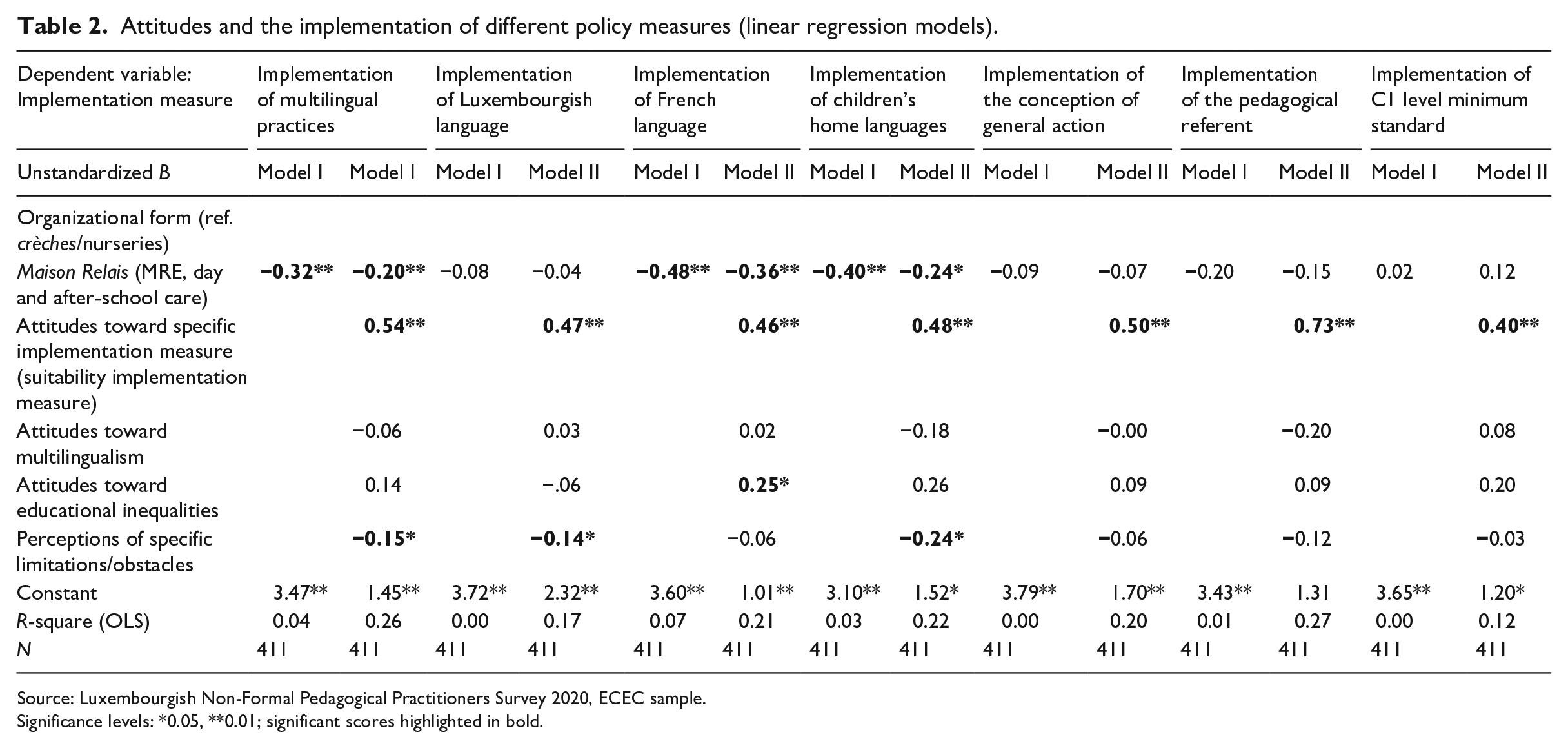
Source: Luxembourgish Non-Formal Pedagogical Practitioners Survey 2020, ECEC sample.
Significance levels: *0.05, **0.01; significant scores highlighted in bold.
Early childhood practitioners in crèches are more likely to implement multilingual practices to promote children’s language development than practitioners in MREs (Model I, Table 2). Controlling for attitudes and perceived behavior control in Model II, this difference remains significant. In Model II (Table 2), three of the predictor variables significantly contributed to the model. The more suitable the policy measure is perceived to be, the more likely it is to be implemented. The perception of limitations/obstacles regarding multilingual practices in the SEA also has a significant effect on the implementation of multilingual practices. This means that perceiving fewer limitations/obstacles in multilingual practices among and with children in the SEA enhances the implementation of multilingual practices. Neither attitudes toward educational inequalities nor attitudes toward multilingualism in general contribute significantly to the implementation of multilingual practices.
Focusing on implementation of the Luxembourgish language in ECEC, there are no significant differences among crèches and MREs (Model I). If the implementation of Luxembourgish is perceived as suitable, promoting the Luxembourgish language is more likely. Attitudes toward multilingualism in general and toward educational inequalities also show no significant effect here. However, perceiving limitations/obstacles regarding multilingual practices in the SEA shows a significant effect on the implementation of the Luxembourgish language in this case, whereas perceiving fewer limitations/obstacles in multilingual practices among and with children in the SEA enhances the promotion of Luxembourgish (Model II).
Regarding implementation of the French language, early childhood practitioners working in crèches are more likely to promote the French language (Model I). As in the case of Luxembourgish, if the implementation of French in early childhood organizations is perceived as suitable, promotion of the French language is more likely. In addition, the more salient reducing educational inequalities is perceived to be, the more likely it is that French will be implemented. The predictor variables regarding attitudes toward multilingualism in general and perceptions of limitations/obstacles do not show any significant effect in contributing to variance (Model II).
Considering the measure to foster the implementation of children’s home languages, crèches are more likely than MREs to do this (Model I). Attitudes toward educational inequalities and toward multilingualism in general do not appear to be linked to the implementation of children’s home languages. The perception of control beliefs appears to play a significant role in the implementation, whereas perceiving fewer limitations/obstacles in multilingual practices among and with children in the SEA enhances the promotion of children’s home languages (Model II).
The organization does not show any effect regarding implementation of the concept of general action, the pedagogical practitioner, and the C1 level requirement—that is to say, crèche practitioners do not differ from MRE practitioners in these areas. Again, if implementation of the policy measure is perceived as suitable, perceived implementation is higher; however, general attitudes toward multilingualism and educational inequalities and the perception of measure-specific obstacles do not play any role.
Triangulation of the qualitative and quantitative data
The main results are outlined in Table 3. From a policy-level perspective, the qualitative findings summarize the reconstructed insights and viewpoints of policy-level experts. From a practical perspective, the quantitative findings provide a systematic sample of early childhood practitioners’ attitudes and perceptions regarding the implementation of policy measures.
Research matrix triangulation.
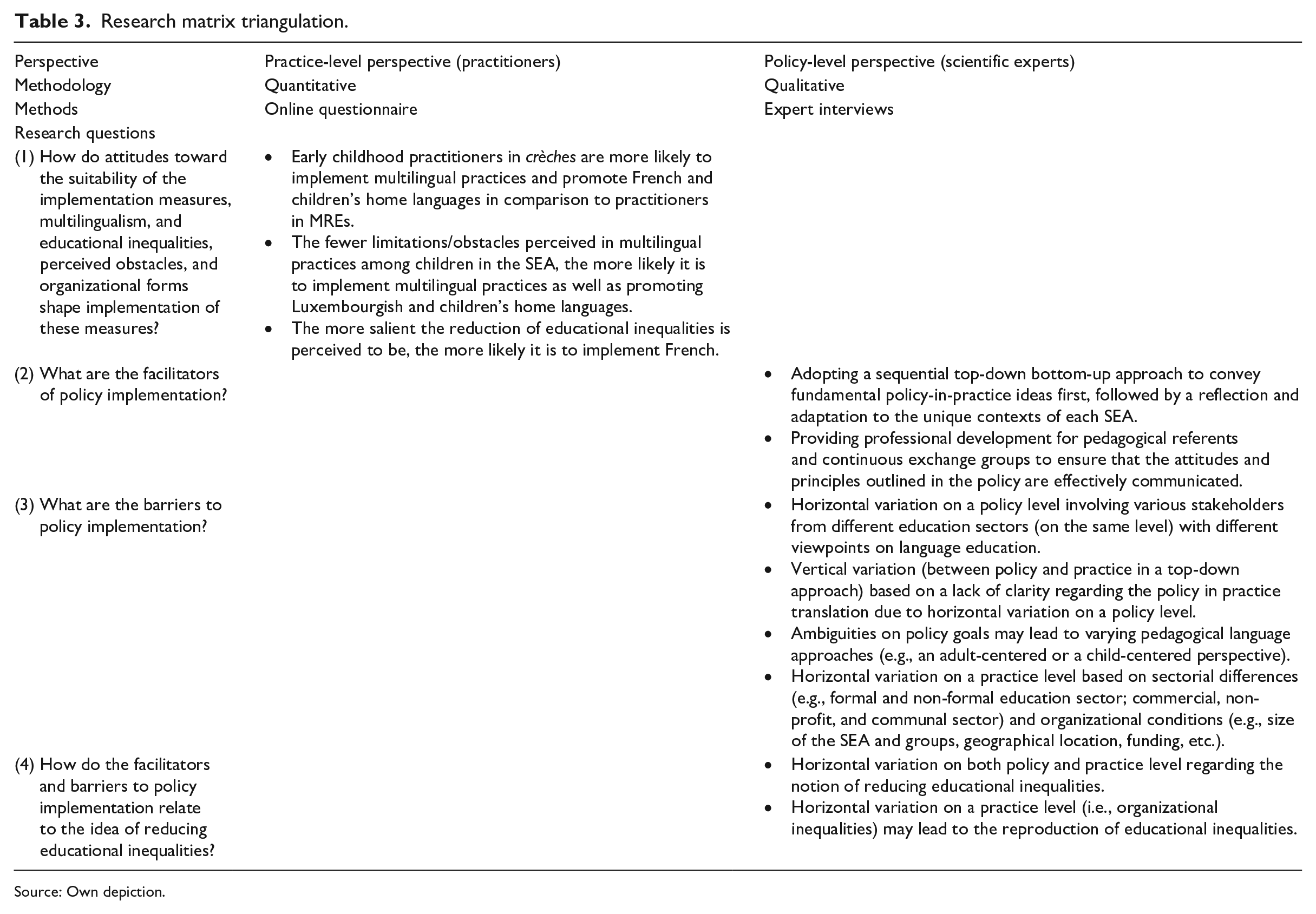
Source: Own depiction.
In terms of policy implementation, the qualitative data emphasize the importance of providing professional development for pedagogical referents and maintaining continuous exchange groups to ensure effective communication of policy attitudes and principles, which is linked to the initial top-down approach of the sequential policy implementation design. This aligns with the quantitative findings, which reveal that attitudes toward multilingualism and educational inequalities have, for instance, a significant impact on the likelihood of implementing certain policy measures. Attitudes toward the suitability of the policy measures significantly impact the likelihood of implementing all measures of the plurilingual education policy. Nevertheless, the qualitative data also show that ambiguities in policy goals may result in varying notions of language education, indicating that vertical variation in policy clarity (e.g., ambiguities) can impact the translation of policy into practice, and thus policy implementation.
Furthermore, the quantitative results indicate that the likelihood of early childhood practitioners implementing multilingual practices as well as promoting French and children’s home languages is higher in crèches than in MREs. While the quantitative data do not provide an explicit explanation for these differences, the qualitative data indicate horizontal variation on a practice level, particularly based on organizational conditions, which contribute to these distinctions. The organizational differences encompass factors such as funding mechanisms (e.g., conventionné or non-conventionné), the size of the ECEC service/SEA (e.g., children-practitioner ratio), geographical location, and especially differences regarding institutionalized monolingual practices: state-funded organizations like MREs and crèches (conventionné) primarily used Luxembourgish before the implementation of the plurilingual education policy, while French and multilingual practices were more prevalent in private commercial crèches (non-conventionné) due to the lower quality criteria bounded by the state (see Bollig, 2018). On this basis, while the qualitative findings highlight the adoption of a sequential top-down bottom-up approach in conveying policy-in-practice ideas, this implementation approach allows the adaptation of policy measures to the unique contexts—that is, accounting for organizational differences across the SEA.
In regard to the salience of reducing educational inequalities, horizontal variation on a practice level, which relates to organizational disparities, may lead to the reproduction of educational inequalities. Variations in conveying different notions of plurilingual education may thus be influenced by different views on reducing educational inequalities based on horizontal variation at the policy level. In addition, the quantitative results suggest that when reducing educational inequalities is considered more salient, there is an increased likelihood of implementing French as a language policy measure, which is also linked to organizational factors. Accordingly, employing a sequential top-down bottom-up approach enables adaptation to policy implementation by aligning policy requirements with organizational circumstances and therefore being more adaptive to reducing educational inequalities.
In summary, the triangulation of qualitative and quantitative results underlines the significance of acknowledging organizational conditions, implementing agents’ attitudes, and ensuring policy clarity in the process of policy implementation. This highlights the importance of tailoring the implementation approach to address the particular barriers and focus on facilitators of policy implementation within each SEA, especially with the goal of reducing educational inequalities.
Discussion and conclusions
This research underlines the significance of acknowledging organizational factors in the analysis of policy implementation, shedding light on how these factors shape attitudes, perceived obstacles, and the implementation of policy measures. Integrating the organizational dimension into the TPB framework allows a deeper understanding of the complexities and dynamics of policy implementation. This conceptual framework enables researchers and policymakers to examine the interplay between organizational- and individual-level factors in influencing policy implementation outcomes. A more holistic view on the implementation process offers insights into the mechanisms through which organizational conditions may impact individual behaviors regarding the implementation of policy measures. By considering both dimensions, policymakers can develop more effective strategies to support successful implementation of policies in practice.
Furthermore, this research shows that the extent of coupling depends on the interpretation, the clarity of policy goals/intentions, and the organizational conditions. These may determine whether the practice is tightly or loosely coupled to the policy, thereby determining whether policy measures act as facilitators or barriers to policy implementation. Drawing on Weick’s (1982) coupling perspective, this research shows a multifaceted response to policy implementation. On the one hand, policy guidelines encourage a certain degree of responsiveness and adaptability; on the other hand, it must be ensured that the practice does not completely disconnect from the policy implementation measures. Such disconnection may lead to unintended coupling processes, creating a paradox between the policy intention and policy implementation. Consequently, this research contributes to the existing literature on coupling not only by identifying elements of tight and loose coupling in educational policy implementation but also by highlighting a paradox between intended coupling mechanisms at the policy level and the unintended contrasting effects of coupling at the practice level. As a result, the study emphasizes the importance of considering both policy and practice levels when analyzing the implementation of a policy.
Limitations
Qualitative expert interviews
Varying subjective perceptions and subjective theories on the policy and its implementation of the people interviewed may limit generalizability (in terms of patterns; Strübing et al., 2018, or in terms of a collective; Lewis and Ritchie, 2003). The collective of an institution may not be represented sufficiently, as—except for the members of the Ministry of Education’s scientific advisory board (SAB)—each organization was represented by just one interviewee based on their expertise in the area under research. However, there was no response from the private commercial sector, which is a significant part of the ECEC sector in Luxembourg. On this basis, facilitators and barriers discussed in the interviews mainly pertain to the public and private non-profit sector.
In addition, although the same guidelines were used in each interview, the questions differed slightly based on the interviewee’s organizational context and role in the policy implementation process. This made it difficult to identify consistent patterns when looking at the interviews as a whole. Consequently, it is methodologically challenging to make assumptions about commonly perceived facilitators or barriers across interviewees, as these seem to be very context specific.
Finally, social desirability bias was considered, a common issue in qualitative research. An open approach of asking unbiased and non-threatening interview questions represented a way to avoid interviewees’ social desirability bias (see Bergen and Labonté, 2020). Additionally, it was considered whether the answers related to the experts’ role in representing their organization or if the response was their individual opinion.
Overall, it is important to consider the timing of data collection, which coincided with the early stages of policy implementation and took place during the COVID-19 pandemic. Policy implementation was not prioritized during this time. Implementing agents faced various challenges beyond the plurilingual education program’s implementation. It is important to note that the policy and its implementation evolved over the course of this research, which becomes evident in the interviews with experts, who expressed more barriers than success factors during the early stages of policy implementation.
Quantitative questionnaire survey
By adhering to the General Data Protection Regulation (GDPR), certain questions, like those related to the regional location of SEAs, could not be included. This constraint hindered the gathering of data that could have offered valuable insights into the linguistic context of SEAs in Luxembourg. In addition, the data lacked a nested structure regarding organization, preventing us from identifying practitioners within their organizational contexts. Thus, multilevel analyses could not be performed.
The implementation variables—as outcomes according to the conceptual lens of the TPB (Ajzen, 1991)—related to the perceived implementation by respondents from certain ECEC institutions. The correspondence between individual attitudes toward implementation measures and the perception of the extent to which these measures have already been implemented may be low if respondents do not take into account individual implementation behavior, but instead a higher level such as implementation at the level of their organization or the Luxembourgish system. However, as there are significant effects between individual attitudes and implementation, the measurement (item) seems to be understood in the intended way.
Regarding data collection, while organization-level variables such as organizational types and forms were collected, most could not be utilized in the quantitative analysis due to the wrong categorization of MREs by respondents: for instance, as private or non- conventionné when they are public and conventionné. Additionally, although the mailing list included many SEAs from the private commercial sector, practitioners from this sector might be underrepresented in this study.
Consequently, despite the online survey offering valid measurement instruments to analyze practitioners’ implementation of policy measures, the study’s limited information about organizational conditions prevented an analysis of which specific organizational factors might influence attitudes toward or perceptions of implementing the policy.
Final conclusion and recommendations for policy and future research
In its qualitative data, this research revealed a sequential top-down and bottom-up implementation approach, which, however, entails horizontal sectorial variation between ministerial stakeholders at the policy level and between communal, non-profit, and commercial sectors at the practice level. Adopting a sequential top-down and bottom-up approach serves as a facilitator. While the initial top-down process conveys the fundamental ideas of the policy to practitioners to foster a shift in attitudes and dispositions toward multilingual education, subsequently bottom-up reflection and adaptation allow for taking into account the unique contexts of each SEA. The sectorial variation at the policy level has been shown to lead to vertical sectorial variation concerning policy intentions and implementation practices. The quantitative data corroborate the results regarding horizontal variations on a practice level in implementing policy measures based on different organizational forms. Such variations on different levels underline the complexity of policy implementation and the determination of facilitators and barriers to policy implementation.
Based on these findings, the following policy recommendations emerge. Firstly, there is a need for a tailored approach to policy implementation that takes into account the different organizational contexts by aligning policy implementation measures to the distinct ECEC organizational forms. Tailored approaches could help to avoid unintended consequences that may arise during the implementation of policies in practice. Secondly, a more epistemological framework for policy guidelines should aim to eliminate ambiguities that may arise from different perceptions, attitudes, and behaviors within the diverse linguistic and organizational contexts at both policy (ministerial differences between formal and non-formal education) and practice (organizational ECEC differences between conventionné and non-conventionné) levels by gaining clarity for more effective implementation, in particular when considering the salience of reducing educational inequalities. Thirdly, promoting professional development and exchange groups among different practice level sectors (e.g., private commercial, private non-profit, and communal organizations) may be highly beneficial. This approach not only recognizes the linguistic diversity among children as a valuable resource, but also acknowledges the organizational diversity within the field of ECEC.
As there is a general lack of data and analyses regarding policy implementation, and considering the shortcomings of our study, more research on policy implementation particularly in the ECEC sector is needed. Given the complex societal and organizational contexts shaping educational policies, future research should aim at a comprehensive perspective on policy implementation covering stakeholder, practitioners, and children perspectives, involving mixed-method designs. This could include more detailed analyses of crucial organizational conditions by conducting quantitative multilevel analysis to model how various organizational factors influence the plurilingual education policy’s implementation across different types of organizations embedded and operating under different contextual and organizational factors. Considering the increasing interest in investing in plurilingual education policies in ECEC, beyond the Luxembourgish context, conducting a comparative research project with other countries implementing multilingual education policies (even on a local or regional level) could provide valuable insights, offering a comprehensive understanding of various implementation strategies in different cultural and educational settings.
Footnotes
Declaration of conflicting interests
The author(s) declared no potential conflicts of interest with respect to the research, authorship, and/or publication of this article.
Funding
The author(s) disclosed receipt of the following financial support for the research, authorship, and/or publication of this article: The research was part of the umbrella project CALIDIE, funded by the FNR - Luxembourg National Research Fund.
