




Abstract
The article discusses main contributions and results of the monograph Enrichment: A Critique of Commodities, written by the French sociologists Luc Boltanski and Arnaud Esquerre. Boltanski and Esquerre focus on the strategy to transform ‘the past’ (patrimony, luxury objects, tradition, collections) into new sources of richness. The book focuses on valuation forms and valuation discourses. Enrichment links Boltanski’s work again to the socio-economic movement of the economics and sociology of conventions (in short, EC/SC), which is part of the new French social sciences and regards conventions as logics of valuation and interpretation. This approach of EC/SC is introduced as a frame to evaluate the recombination of pragmatism and structuralism which is proposed by Boltanski and Esquerre. Finally, open questions and desiderata are addressed from the standpoint of EC/SC.
Introduction
The book Enrichment by Luc Boltanski and Arnaud Esquerre analyzes recent trends in contemporary capitalism which seek to invent new strategies to explore new fields and branches to mobilize profit. Enrichment is about transforming ‘the past’ into value and worth (Boltanski and Esquerre, 2020: 71). This book on the enrichment economy continues the collaboration of Luc Boltanski with co-authors on developments of contemporary capitalism and on social practices and logics of valuation. The work of Boltanski and his collaborators has contributed to the so-called new French social sciences, which can be conceived as an innovative theoretical movement and as a pragmatist or (more precisely) neopragmatist sociology (see Barthe et al., 2013; Corcuff, 2011; Nachi, 2006). 1
Enrichment links Boltanski’s work again to the socio-economic movement of the economics and sociology of conventions (in short EC/SC), which regards conventions as logics of valuation and interpretation (Diaz-Bone and Larquier, 2022). 2 Luc Boltanski was an early contributor to this scientific movement and has worked out in collaboration with co-authors monographs which are regarded as important contributions to EC/SC. In On Justification, together with Laurent Thévenot, he worked out a model of ‘orders of justification’ or ‘orders of worth’, which can be regarded as logics not only of critique and justification but also as different logics of valuation (Boltanski and Thévenot, 2006). In The New Spirit of Capitalism, Boltanski and Chiapello (2005) extended this line of work and identified a new form of economic management and valuation, in which labor and value were based on a logic of collaboration as project. 3 Management thereby transformed the critique against standardized and monotonous industrial labor conditions by ‘enriching’ labor. In this way, the critique was captured by new forms of management. The tension and interrelation between critique, justification and value can be regarded as a continuous strand in the work of Boltanski and in his different collaborations, but instead of locating the task of critique with intellectuals and scientists, the neopragmatist position is to evaluate the adequacy of forms of valuation, to test, to justify value and to exert critique as a competence of everyday actors in real situations (Boltanski, 2011). 4 In Enrichment, this interrelation between critique, justification and value is continued and further elaborated.
In fact, this interrelation was emerging in France in the wider context of a transdisciplinary, neopragmatist institutional approach of EC/SC to which Boltanski has been related since the middle of the 1980s. 5 It has to be recognized that it is this early entanglement of Boltanski with this approach which offers a more comprehensive understanding of Enrichment and of most of its theoretical and analytical aims. Therefore, in this article, Enrichment will be framed by and discussed from the standpoint of this approach of economics and sociology of conventions. Thereby, a special focus will be devoted to a recombination of pragmatism and structuralism and the role of discourse for valuation, because these are – again – links to foundations and developments of EC/SC. 6
In the following section, the specific approach of Enrichment to reconcile the sociological analysis of the relation between society and the economy will be introduced, and thereby it will be shown why Enrichment offers a new approach to the analysis of economy, placing (varying constellations of) forms of valuation and not social structure or social inequality at its center. This opens the perspective to discuss Enrichment in the next section in the wider frame of EC/SC and to discuss the similarities and differences between EC/SC’s notion of convention and the notion of forms of valuation in Enrichment. In the final section, desiderata and open questions of Boltanski and Esquerre’s approach are addressed.
Enrichment Economy and Capitalist Dynamics
Enrichment presents an integrating theoretical perspective not only for the study of different forms and trends of Western economies (as industrial economy, deindustrialization, neoliberalism) but also for more recent economic mechanisms and cultural phenomena. Examples are the growing importance of luxury industries, upscale tourism, high-level gastronomy and luxury food, patrimonialization and festivalization, gentrification and heritage creation, the growing importance of art trade and art exhibitions (Boltanski and Esquerre, 2020: 11f), which have been treated so far in a more dispersed and isolated manner in different subdisciplines of sociology. The new capitalist strategy of enrichment consists in systematically using traditions, historical narrations, and cultural heritage as an economic basis for forms of valorization, in order to valorize those ‘objects’ that are characterized by rarity and entailing an added value that cannot be attributed to the cost of their production, their exchange value or utility. It is objects (products, businesses, buildings, places), but also people, events and practices with ‘history’ that are the subject of valorization in the enrichment economy and that are distinguished from newly produced objects. These valorization strategies then serve as new sources for profit generation and their control serves the appropriation of profit: We shall use the term ‘enrichment economy’ to designate this type of economy, playing on the ambiguity of the word ‘enrichment.’ On the one hand, we use the word in the sense in which one speaks of enriching a metal, enhancing a lifestyle or a cultural asset, showcasing an article of clothing, or bringing together a set of objects in a collection, to emphasize the fact that this economy is based less on the production of new things than on an effort to enrich things that already exist, especially by associating them with narratives. On the other hand, the term ‘enrichment’ refers to one of the specific characteristics of this economy, namely, that it draws upon trade in things that are intended above all for the wealthy and that thus also constitute a supplementary source of enrichment for the wealthy people who deal in them. (Boltanski and Esquerre, 2020: 2–3)
Intended for the analysis of widely deindustrialized Western countries, such as France, the book offers also a new perspective on mechanisms which advance existing inequalities, because it is mainly the wealthier class fractions which can profit from their possession of objects with ‘ancestral tradition’, objects as part of the ‘cultural heritage’ and ‘patrimony’, objects of value for collections (as art works) or luxury objects which are unique and singular (Boltanski and Esquerre, 2020: 42f) – similar to the notion of singularity invented by Lucien Karpik (2010) and worked out by Reckwitz (2020). When the enrichment economy is oriented towards the wealthy (Boltanski and Esquerre, 2020: 39), then the ‘losers’ and ‘servants’ are those with low ‘memorial power’ (Boltanski and Esquerre, 2020: 306), such as the former industrial workforce, immigrants, and the short-term and precarious employed: [. . .] all those who belong to groups whose anchoring in the past has not been the object of a collective work of valorization, or even of shaping, so that memorializing that past, which is at best strictly a family or community affair, not only brings no external benefits but can even stigmatize the group. [. . .] The enrichment economy is associated in this way with the formation of something like a ‘proletariat,’ but one whose contours have little in common with those of the industrial proletariat. Scattered and transitory, the new proletariat is virtually devoid of organization. (Boltanski and Esquerre, 2020: 305, 307)
But all in all, the analysis of Boltanski and Esquerre is not centered on the social structure and class dynamics in (Western) contemporary capitalism, unlike Society of Singularities by Andreas Reckwitz (2020), which also discusses the transformation of the valuation of goods and the emergence of singularity as a form of valuation for the new middle-class fraction. Although Reckwitz refers to competing forms of valuation as life-style principles, he mainly focuses on singularity as a form of valuation, on the related new middle-class fraction as well as on new tensions and relations between class fractions. Here, the focus is on social structure and its transformation driven through cultural change. In contrast to this, in Enrichment the strategies of valuation and its different forms are related to cultural and economic practices and to the relation of price and value in different economic branches and epochs. Here the focus is on the relation of economy and society. One aspect why Enrichment documents an important approach to the analysis of economic change and societal dynamics in general is to avoid such an explanation relying on class conflicts and the inequality of ownership of resources that social groups inhabit (e.g. economic, cultural and social capital), as Pierre Bourdieu did in his influential study Distinction (Bourdieu, 1984). Instead, Boltanski and Esquerre point to the need of economies and of Western capitalism to rely on forms of valuation which societies have established as agreed upon ways of coordination, interpretation and valuation in production, distribution and consumption of goods and services. The enrichment economy is about the new constellations of forms of valuation, which structure declining or prospering economic fields and branches. The driving forces are enterprises (supported by state politics, as in France) which seek new sources for profit in domains such as arts and culture, luxury or high-level tourism. These enterprises rely on new forms of valuation and commodify ‘the past’ into expensive goods (or – at least – into surplus value, which can be turned into extra profit). This way, capitalist dynamics, and therefore social change, is explained in Enrichment by the change of dominant forms of valuation and the rearrangement of their constellation in branches and in the economy as a whole. It is not explained by class struggles in the sphere of culture, by practices of cultural distinction (Bourdieu) or by the emergence of one new middle-class fraction and the decline of other class fractions (Reckwitz). Boltanski and Esquerre point to the empirical weakness of the notion of class for their study: In relation to the object of our study, it is thus only in a very vague sense that we can call on the idiom of social class. Partial communities of interests and equally partial affinities of lifestyles no doubt exist within the various clusters we have sought to identify, starting from stereotypical examples of ‘losers,’ ‘servants,’ rentiers, and creators. But since these clusters are not objectified either in law or by administrative and statistical conventions, they retain a virtual character. (Boltanski and Esquerre, 2020: 328)
Therefore, it is coherent when Harris and Savage state that Enrichment presents not a sociological analysis, which regards the mechanisms and the dynamics of social inequalities as the core issue of the analysis, but which aims to reconcile ‘social theory and ‘the economic” (Harris and Savage, 2021: 2).
Relating ‘Enrichment’ to Economics and Sociology of Conventions
The approach of EC/SC is part of the so-called new French pragmatist social sciences (Corcuff, 2011; Diaz-Bone, 2018; Nachi, 2006). These are characterized by a reorientation of economic and sociological institutionalism to pragmatism since the 1980s, which is why one can speak of a French neopragmatism too. As pragmatism did, French neopragmatism highlights actors’ reflexive competencies, the role and impact of objects for coordination and cognition, and the plurality of ways of coordination and valuation. Unlike classical pragmatism and the American tradition of pragmatist sociology (e.g. Herbert Blumer, Anselm Strauss, Howard S. Becker), French neopragmatism points to tensions, conflicts and practices of critique and of justification. The structure of new French pragmatist social sciences is not organized by leading scholars and their schools but must be conceived as networks between scholars and institutions. One consequence of this more network-like structure is its difficulty in being recognized adequately, especially from abroad. EC/SC was founded by the economists François Eymard-Duvernay, Olivier Favereau, André Orléan, Robert Salais and Laurent Thévenot (Eymard-Duvernay, 2006a, 2006b; Orléan, 2004; Storper and Salais, 1997). From its beginnings sociologists such as Boltanski and statisticians such as Alain Desrosières were close collaborators (see Diaz-Bone, 2018; Dosse, 1999). 7 In this context the notion of convention as a logic of coordination, interpretation and valuation was worked out to study economic production, distribution and consumption. 8 This concept was soon linked to issues of justice, fairness and adequacy (Boltanski and Thévenot, 1989). The study On Justification presented the ‘grammar’ of these conventions as logics: how the worth of persons, actions or objects is socially mobilized in situations of coordination. The different orders of worth orient collective coordination, critique and justification toward specific forms of a common good. Examples are the protection of the integrity of the natural environment (green convention; see Lamont and Thévenot, 2000), aiming for equal rights as a common good (civic convention) or efficient allocation of resources (industrial convention; see Boltanski and Thévenot, 2006). 9 These orders of worth can also be regarded as quality conventions, which can be applied in real situations to the collective construction of the value of goods, services, events and persons. In opposition to the transaction cost approach of Oliver Williamson (1985), which derives the best institutional arrangement for the production from objects’ asset specificities, EC/SC conceives of quality conventions as the origin of product properties, because the quality conventions structure economic production and they enable in the production process (as orders of worth) the social construction of worth and value.
Boltanski and Esquerre present in Enrichment the concept of forms of valuation, which is introduced as being close to EC/SC’s notion of convention. As it is pertinent for quality conventions, the different forms of valuation and their constellation in economic branches, markets and sectors cannot be explained by pre-given material properties of ‘goods’. Instead, forms of valuations can be considered as specific rationalities on how to evaluate and interpret goods and services: A form is a structure that makes it possible to connect things with the perspectives from which they must be envisaged if they are to be correctly appreciated. Considered from the outside – that is, from a disengaged overall vantage point – forms can be identified with the conventions with which the constructivist economics of conventions is concerned. (Boltanski and Esquerre, 2020: 102–103)
Boltanski and Esquerre present the forms of valuation by introducing two oppositions, which help to distinguish them. The first opposition, analytic presentation versus narrative presentation, refers to the way an object is presented: ‘it can be described in two types of language: on the one hand, in the language of analysis (focusing on distinct properties that can in principle be measured and codified); on the other hand, in the language of narrative (featuring events and/or persons)’ (Boltanski and Esquerre, 2020: 103). And it would be a misunderstanding only to conceive of the narrative presentation as a discursive one; it is in fact both presentations that rely on discourses to unfold their effect and power to evaluate things (Boltanski and Esquerre, 2020: 339). 10
The second opposition, negative or positive commercial potential, refers to the expectation about the future development of the object’s value. Table 1 presents the four forms of valuation: the standard form, the trend form, the asset form and the collection form. The authors explain many of the more recent economic phenomena of the enrichment economy by the growing importance of the collection form. 11 But the collection form has not marginalized the other forms of valuation. There is a co-existing plurality of the four forms in the economy, but their constellation varies depending on economic branches and markets.
Forms of valuation.
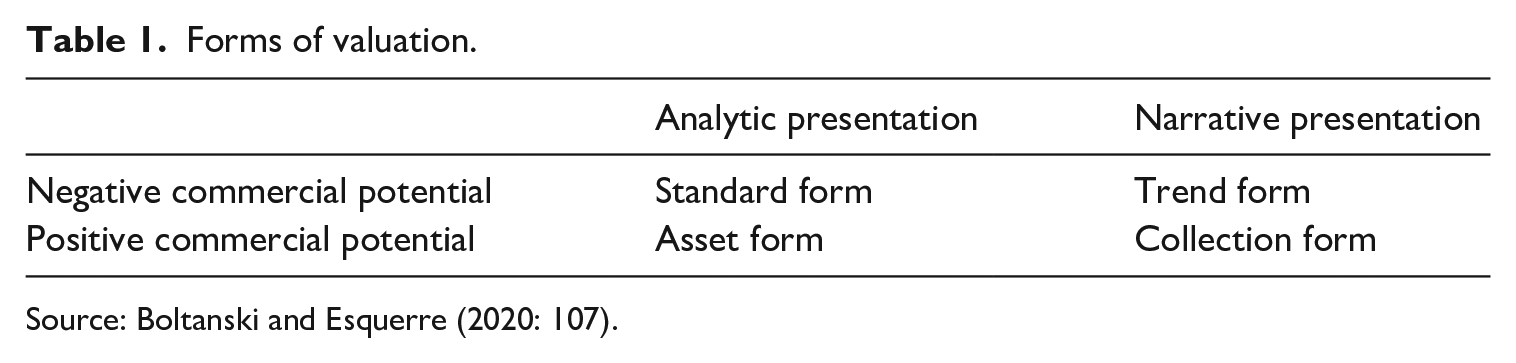
Source: Boltanski and Esquerre (2020: 107).
Boltanski and Esquerre do not assume a substantial link between their concept of forms of valuation and a common good as it was introduced by EC/SC and in the collaborative works of Boltanski and Thévenot (2006) and of Boltanski and Chiapello (2005). The neopragmatist dimension of practical normativities and critique enters through the concepts of metaprices and by bringing in an important difference between value and price. Metaprices are not real prices but benchmarks for actors to evaluate the adequacy of requested prices as already paid prices for the same goods (as paid elsewhere by others) or estimates of value. Metaprices offer orientation for actors when they enter negotiations and are involved in price formation processes (Boltanski and Esquerre, 2020: 86–88). But it is the socially constructed value of a good which justifies the price, and for this construction actors in economic processes rely on the four forms of valuation, and actors refer to the cleavage between values and prices to criticize prices (Boltanski and Esquerre, 2020: 92ff).
The four forms of valuation are discussed in Enrichment also as structures of commodity exchange (Boltanski and Esquerre, 2020: 103f, 343). As some representatives of EC/SC have made aware, the notion of convention has already been interpreted as such a structure (Diaz-Bone, 2018; Gomez and Jones, 2000). Conventions can be regarded as the deeper patterns of social interaction, which equip social organizations and social networks with regular and interpretable orders. The influential study On Justification has many similarities with Michel Foucault’s outstanding structuralist study The Order of Things (Foucault, 1989). Foucault discovered the deeper cultural and socio-cognitive structures as discursive orders (which Foucault calls epistemes) in the sciences of linguistics, economy and biology (and its precursors) in three different scientific epochs (Foucault, 1989). In a very similar manner and applying a methodology close to Foucault’s, Boltanski and Thévenot discovered six orders of worth as deeper discursive orders. Here, one finds a remarkable continuity, because it offers evidence for the ongoing influence of structuralist thinking, which is still present in new French pragmatist social sciences. 12 Structuralism and pragmatism, as well as their developments 13 and variations, can be conceived of as two ‘megaparadigms’ in the social sciences for many decades. To name them ‘megaparadigms’ means not only to point to their continuous presence and influence for a long period of time, but also to accentuate their fundamental role as underlying theoretical background resources for many articulations in the complex theoretical landscape of social sciences. (Seen this way, a megaparadigm is not to be confused with ‘grand theory’.)
Enrichment is located at the crossroads of (neo)pragmatism and (neo)structuralism. Boltanski and Esquerre propose to name their theoretical position ‘pragmatic structuralism’. 14 One important reference is the seminal work of the founder of structuralism in the social sciences, Claude Lévi-Strauss’ book The Elementary Structures of Kinship (Lévi-Strauss, 1969), which first applied this view of deeper structures to the social practices of marriage, economy and discourse. For Lévi-Strauss and Foucault, these structures articulate themselves in a pre-reflexive and unconscious way in actors’ practices and in actors’ perceptions. 15 In contrast to this, Boltanski and Esquerre emphasize the reflexive competences of actors and their capacities to critically evaluate these structures (conventions and forms of evaluations). Also, the importance of objects for actors’ coordination and the involvement of tests for the evidence of value can be regarded as major differences to structuralist analysis. 16
Besides these differences to classical structuralism, the continuity with structuralism shows up with the forms of valuation as exchange structures (another structuralist mode of theorizing is to characterize these forms by ‘deeper’ and fundamental oppositions; see Table 1). Also, the renewal of the notion of discourse and language is another remarkable commonality to structuralists’ theorizing. In Enrichment it is especially the ‘discourses of valuation’ which play an essential role in valuation. Practices and forms of valuation have to enter the realm of discourse to exercise valuating effects (Boltanski and Esquerre, 2020: 131, 338f). Still, the inclusion of discourses has to be worked out in EC/SC, because the notion of discourse here is still underdeveloped. Also, in this regard, Enrichment can be considered as a valuable contribution to EC/SC, which thus far lacks a systematic integration of notions of discourse. 17
Desiderata and Open Questions
Enrichment is an important contribution to contemporary sociology, especially to economic sociology and sociological theorizing. But as indicated above, Enrichment gives reason to question some parts of its conceptualization and theorizing work. There are two main issues to be addressed:
(1) The missing link between forms of valuation on one side and an organized normativity, which is represented as the common good to be aimed for, on the other side. Not to link the forms of valuation to a common good, as it was done for the quality conventions in former works of EC/SC (among them in the mentioned works of Boltanski himself) is to split the sphere of ‘the economy’ from its wider social and cultural contexts in which it is embedded. This way, the discursive power released by referring to the idea and the promise of a common good is obscured for economic sociology. An example is the valuating power of the green convention, which impacts on the markets for organic food. Without this embedding, organic food markets and their valuation processes could not be understood. The four forms of valuation worked out by Boltanski and Esquerre do not seem to be able to grasp this resource of valuation, which is entailed in the notion of quality conventions and orders of worth.
(2) The reality, structure and properties of discourses of valuation. The four different forms of valuation are conceived of as structures which pattern the valuation of sets of commodities. And it is convincingly referred to the importance of discourses for the processes of valuation. But there are not many remarks about the properties of these discourses and their ontology in Enrichment. Boltanski and Esquerre rightly argue, for example, that the field of discourses should have some properties so that discourses can serve for the differentiation of qualities: To function, the field of discourse of valuation has to be both pluralized and unified, and it has to be based on categories whose structure is maintained even though it is the object of rule-governed transformations. If there were only a single discourse of valuation used for everything [. . .] the comparison between things would not have enough reference points to allow criticism or justification of the price of each thing. Everything would be comparable with everything else, and this would tend to pull the cosmos of commodities toward an amorphous and chaotic state. (Boltanski and Esquerre, 2020: 131)
But beyond such remarks, the theorizing of discourses and more detailed attention to their inner structure are still a desideratum. In structuralist approaches, there are well worked out theories of discourse and discursive practices, as in the work of Michel Foucault, which assign agency to discourses themselves. Boltanski and Esquerre (2020: 343f) offer an appendix with a formalization of forms of valuation in relation to commodities but neglect a similar effort for the analysis of the related discourses and discursive practices. The two scholars (Boltanski and Esquerre, 2020: 339) instead have to locate the power outside of discourses (which is in line with pragmatists’ positions), but the question arises: who is able to exercise this power, and by which practices? To offer a more profound theorizing of discourses of valuation to the work presented by Boltanski and Esquerre can be evaluated as a second desideratum.
But besides these two points raised, it is concluded here that this work continues strands developed by EC/SC and its contributions to problematizations in EC/SC – as the issue of relating (neo)pragmatism and (neo)structuralism (Diaz-Bone, 2021), or power and valuation (Bessy, 2019) – which are well appreciated.
Footnotes
This article is part of a Theory, Culture & Society special section, ‘Boltanski/Esquerre on Enrichment’, edited by Rainer Diaz-Bone.

This article is part of a Theory, Culture & Society special section, ‘Boltanski/Esquerre on Enrichment’, edited by Rainer Diaz-Bone.