




Abstract
Job profiles in German adult education are manifold, and the requirements for engaging in professional activity are only minimally regulated by the state. It is primarily the providers in adult education who decide on access to the professional field and influence the historical development of job profiles. The article presents findings from a historical longitudinal analysis of job advertisements and other historical documents, focusing on the historical genesis of job profiles in adult education in the Federal Republic of Germany. The analysis draws on theoretical concepts from “Economics of Convention” (EC) research on occupational categories, intermediaries, and labor markets. The results demonstrate that the conception, dissemination, and long-term establishment of a specific job profile for adult education were only made possible through the interaction of different actors, each taking on different intermediary functions.
Keywords
Introduction
The broad field of adult education encompasses many diverse job profiles, such as teacher, trainer, program planner, educational manager, coach, tutor, etc., which vary significantly in international comparison. Individual job profiles and their corresponding job titles represent expressions of the specific institutional and provider structures in each country. Despite variations in such structures, it is striking that adult education is generally much less regulated by the state, compared to primary, secondary, and tertiary education (Egetenmeyer, 2015; Federighi, 2013; Sgier and Lattke, 2012). This also applies specifically to access to the field, which is only partially regulated by governmental and political actors (Boffo et al., 2016; Nittel and Schütz, 2016). While the selection of teachers in schools is controlled by educational administrations, allowing schools limited autonomy, the labor market of adult education can be described as open. Although some countries have national standards for adult education job profiles, formulated by government agencies or professional associations and sometimes legally binding, it is primarily the providers and institutions of adult education themselves that select personnel and thus decide on access and necessary prerequisites (Research voor Beleid and Plato, 2008). Their recruitment practices, particularly the use of published job advertisements, influence the overall shaping of job profiles. This open nature of professional access and the (relative) autonomy of providers when hiring help explain why professionalization in adult education is generally less pronounced compared to other educational sectors (Ioannou, 2023).
In this paper, we examine how specific job profiles in German adult education have emerged and historically evolved as a result of the interaction of providers, associations, and institutional frameworks in the Federal Republic of Germany. Our particular interest lies in more closely examining the actors involved in the process of shaping job profiles and the influence they have exerted.
To investigate these questions empirically, we draw on the methodological premises and theoretical concepts of French pragmatic sociology and the economics of convention (EC), which have established themselves as a transdisciplinary research field since the 1980s in French social and economic sciences (Boltanski and Thévenot, 2006; Diaz-Bone, 2015).
Building on some sociological studies of conventions on labor markets and the emergence of occupational categories, we assume that the social recognition and scope of job profiles in adult education depend on legal regulations, intermediaries such as associations, as well as the continuous reference of individual providers (Berner, 2019; Bessy, 2022; Diaz-Bone, 2009). The central focus of our study is on the professional role of full-time pedagogical staff with predominantly planning and organizational tasks. This job profile, developed in Germany in the context of educational reforms in the 1960s and 1970s (Nittel, 2000; Seitter, 1999), emerged in stark contrast to the predominant form of employment in the adult education sector at the time: part-time teachers working as freelancers or volunteers. This demarcation persists to this day. 1 The professional role of full-time pedagogical staff with planning and organizational tasks remains a strong figure in the field of publicly funded adult education. At the same time, teaching in adult education is mostly done on a part-time, freelance, or volunteer basis, without permanent employment. 2 Although discourses have emerged to establish professional standards for adult education teachers as well (e.g. Lencer and Strauch, 2017; Zagir and Mandel, 2020), studies show that teachers in German adult education often find themselves working under challenging conditions characterized by insufficient fee rates with unpaid preparation times, lower working hours, and a lack of inclusion in social security systems, leading to associated risks of poverty (Martin and Schrader, 2021). Depending on the specific work situation, such uncertainties can accumulate into precarious working conditions. Although the country-specific contexts and conditions vary, this topic is also discussed in studies of adult educators in Portugal (Santos and Ferreira, 2012), Ireland (Evoy, 2021), and Turkey (Yagan, 2022). In the North American context, particular attention has been paid to the precarity of English instructors (Breshears, 2019; Sun, 2010).
Our interest in understanding how the full-time job profile with planning and organizational responsibilities emerged and was differentiated from part-time, freelance, or volunteer teaching roles in Germany holds explanatory potential for understanding how this historical separation has structurally contributed to precarious working conditions in adult education. 3
To this end, we first provide a brief overview of the historical professionalization of adult education in the Federal Republic of Germany in order to highlight aspects of this development specific to Germany (Section “Historical and contextual background”). Then, we present the central theoretical concepts from the EC that guide our analysis (Section “Theoretical framework”). Subsequently, we present the research design of our study, focusing on historical job advertisement analysis and analysis of historical documents (descriptions of job profiles, legal foundations, and strategic papers from adult education associations) (Section “Research design and methodological approach”). This is followed by the results section, in which we present key findings obtained through the convention theory-based analytical perspective (Section “Selected findings”). In the two final sections we draw conclusions and show the potential of this analytical perspective for questions of historical professionalization in educational research (Sections “Discussion of the findings from the EC perspective” and “Conclusion and outlook”).
Historical and contextual background
Before full-time job profiles began to develop in the 20th century, there were no fixed forms of employment in adult education in Germany (Nittel, 2000). Teaching or managing and program planning in educational organizations for adults was predominantly carried out on a voluntary basis or as a side-job.
Historically, the first signs of voluntary or part-time teaching activities with professional expectations can be observed in the context of “popular education” (Volksbildung) lectures in the 19th century. It was pastors, university scholars, or schoolteachers who, alongside their main professions, engaged in educating broader segments of the population, especially those from lower social classes. A stronger institutionalization and professionalization of adult education then took place in the transition from the 19th to the 20th century. After World War 1, the adult education movement and the promotion of adult education in the Weimar Constitution of 1919 led to the establishment of municipal adult education centers (Volkshochschulen) throughout Germany. This specific type of center was assigned the task of promoting lifelong learning for the entire population (Hinzen and Meilhammer, 2018). Other institutions and academies linked to churches or trade unions were also established during this time. In the wake of this institutionalization, an additional professional form of activity emerged, focusing more on organization in the newly founded educational institutions (Seitter, 1999). Institutionalization was accompanied by efforts to advance professionalization, primarily initiated by actors within the adult education movement. During the 1920s, they formed associations and provided training programs, which were mostly targeted at teachers. A few universities also worked toward the academic professionalization of adult education. Despite these developments, the field of adult education remained rather undefined. This was also due to the fact that some currents within the adult education movement opposed the formalization of professional adult education work, understanding such work instead as a vocation or calling to be pursued by volunteers. Unsurprisingly, no generally applicable quality standards for professional practice or fixed job profiles can be identified during this historical period (Seitter, 1999). With the rise of the National Socialists in Germany, the institutions and associations of democratically oriented adult education were suppressed. After 1933, the majority of adult education centers were closed and most of the leading figures in adult education were dismissed. Some were even persecuted and killed.
The 1960s and 1970s saw a renewed push for professionalization in adult education in West Germany. Historiographically, this period is considered the era of educational reform, during which adult education benefited greatly (Gieseke, 2018; Nittel, 2000). Almost all of Germany’s federal states (Bundesländer) enacted their own laws for adult education, to enable social participation and promote equal opportunities for all population groups. These laws regulated the permanent institutional funding and the expansion of full-time positions in adult education. Adult education centers (Volkshochschulen), which had already been identified by name and assigned a special role in the promotion of lifelong learning in the Weimar Constitution of 1919, were granted a municipal educational mandate by the adult education laws and therefore enjoyed an exclusive position compared to other publicly oriented providers (Hinzen and Meilhammer, 2018). This exclusivity was reflected in the establishment of many new centers and higher staffing levels (Schrader, 2011). 4 The expansion of full-time positions was focused on the job profile of full-time pedagogical employees, primarily responsible for the organization and planning of educational programs. The associations of adult education centers and other stakeholders in adult education advocacy were involved in shaping this job profile, distinguishing it from teaching roles in adult education that continued to be filled by part-time or volunteer teachers (Schrader, 2011). Additionally, professionalization in this era was driven by the establishment of university chairs and diploma programs focusing on andragogy (Nittel and Schütz, 2016: 569). 5
Statistical data on German adult education centers, collected through comprehensive surveys and published annually since 1962 by the German Institute for Adult Education, 6 documents the expansion of full-time positions during the educational reform era (Deutsches Institut für Erwachsenenbildung, n.d.). The following figure illustrates the historical development of positions for full-time center directors, part-time or volunteer center directors, full-time pedagogical staff, and temporary pedagogical staff at German adult education centers from 1962 to 2021 (see Figure 1). 7
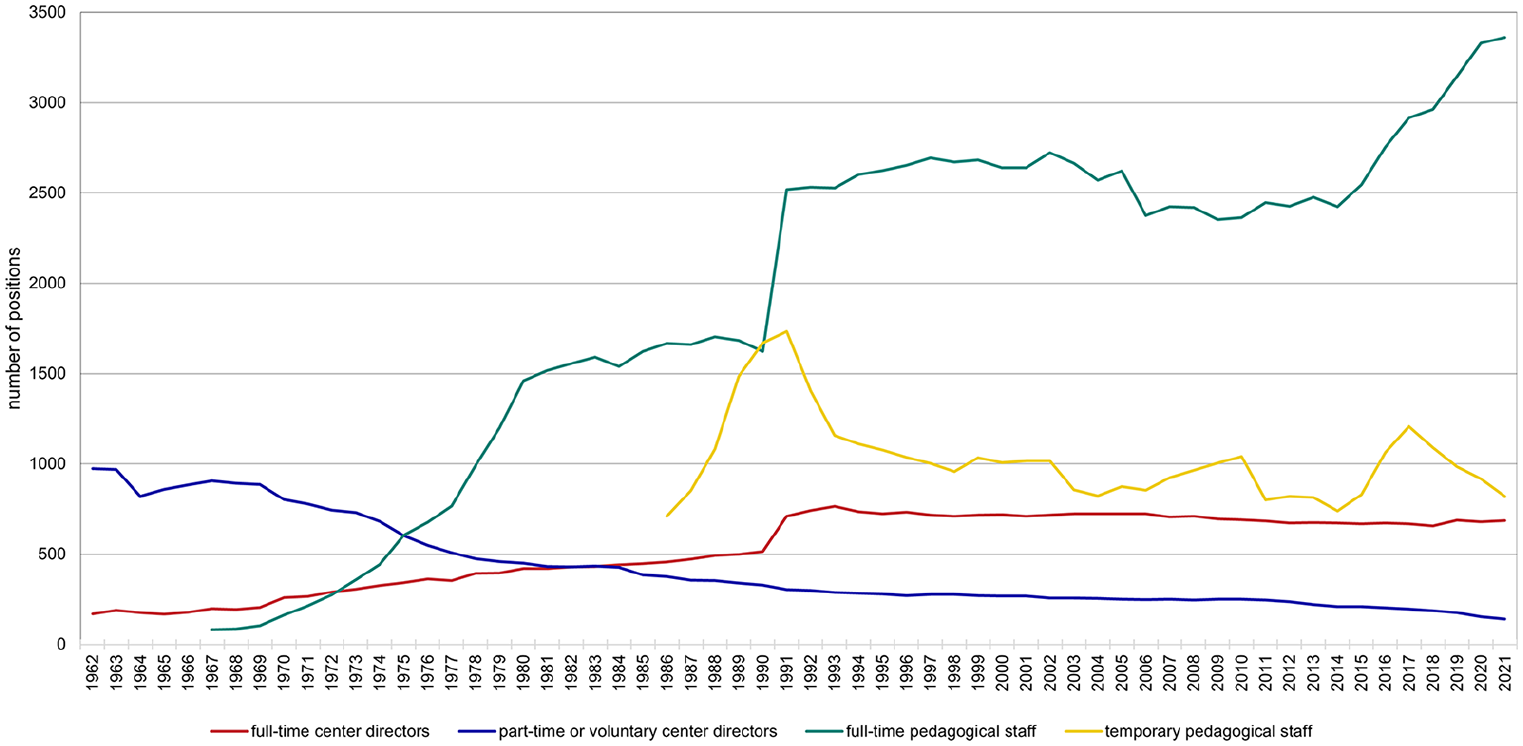
Development of job positions in adult education centers (Volkshochschulen) in Germany based on the adult education center statistics.
As the statistics from the early 1960s illustrate, the vast majority of adult education center director positions were initially filled part-time or by volunteers. Only a few adult education centers reported any full-time staff in those early years. Beginning in the 1970s, full-time positions increased as a result of the educational reforms. Following this era of expansion, later phases of professionalization described in the historiography of adult education become visible (Nittel, 2000; Gieseke, 2018; Seitter, 1999). The 1980s were characterized by stagnation as the previous rapid growth in positions drew to an end. Then, in 1986, a new category for temporary, externally funded pedagogical staff positions was introduced in the adult education center statistics. The accompanying historical texts highlight that until this point, the single category of salaried pedagogical staff had not reflected distinctions in staff contracts regarding duration (temporary or permanent) or external sources of funding (PAS, 1987: 1). By introducing this category, the necessary differentiation is taken into account. The increase in temporary positions in the 1980s is likely linked to the implementation of government funded vocational qualification measures (Seitter, 1999). Following the reunification of Germany, the adult education centers in East Germany were integrated into the statistics starting in 1991, which explains the dramatic expansion of positions in that year. Subsequently, a temporary decline in the overall number of positions can be observed. The fluctuations over the following years reflect the impact of neoliberal reforms in public administration during that period. Institutions were expected to act more market-driven and public funding stagnated during this period, which led to setbacks in professionalization (Gieseke, 2018). Since 2015, the number of full-time pedagogical staff positions has been increasing. This can be attributed to adult education centers receiving additional resources from political authorities due to societal challenges and transformation processes such as migration and digitalization (Käpplinger and Reuter, 2019). The concurrent rise in temporary positions reflects the short-term expansion of projects offering language and integration courses that were organized in the wake of the refugee movement in 2015/2016. As of 2021, there are a total of 858 adult education centers across Germany, most of which have several full-time employees.
This historical outline emphasizes the centrality of adult education centers in the historical professionalization of adult education in Germany. Given their privileged status as the model type of adult education organization, they offer a particularly suitable context for our study. In focusing on the emerging labor market for full-time staff that grew out of the comprehensive expansion of adult education centers during the educational reform era of the 1960s and 1970s, we seek to understand the processes that shaped specific full-time job profiles for staff with planning and organizational responsibilities.
Theoretical framework
French pragmatic sociology and the economics of convention (EC), also called the sociology of convention (SC), provide the theoretical and methodological framework for our study. Central to this framework is an understanding of conventions as historically evolved, socioculturally embedded logics which allow actors to coordinate their actions. “Thus, for EC/SC, actors refer and rely on conventions to coordinate in situations. Conventions can be regarded as the result of a process of agreement as well as a tool or device (French ‘dispositif’), which actors use to achieve common interpretations, shared evaluations, and to construct situations” (Diaz-Bone and de Larquier, 2022: 4).
Each convention is characterized by a specific value and coordination logic that claims general validity and thereby makes actions appear appropriate. Thus, conventions cannot be reduced to functional arrangements that only serve the purpose of reducing complexity and uncertainty. Beyond that, conventions generate a normative order that forms the basis for appropriate and moral behavior and quality standards (Diaz-Bone and de Larquier, 2022: 12; Leemann and Imdorf, 2015: 290).
Against this theoretical background, our study draws on three analytical concepts delineated within EC to examine the historical formation of job profiles in German adult education: situation, form investment, and intermediaries.
In EC, the situation is introduced as the central unit of analysis, within which actors’ dynamic interactions with conventions, as well as the general emergence and stabilization of conventions, can be examined. Situations are not limited to individual interactions but are seen as historical constellations with relative duration and scope (Diaz-Bone, 2011: 49). Drawing on this theoretical understanding, we view the outlined phase of expansion during the educational reform era of the 1960s and 1970s as a distinct situation in the historical professionalization and institutionalization of adult education in the Federal Republic of Germany. It is important to note that the respective constellation of a situation can be shaped by various conventions, actors, objects, and institutional arrangements, and that these can change and expand within the situation. Methodologically, EC does not consider causal relationships to be predetermined. Rather, it is the task of empirical analysis to reconstruct the constellations and the efficacy of conventions within a particular situation (Diaz-Bone, 2011: 49, 2015: 328).
The concept of form investment describes the socio-technical stabilization and generalization of a convention, such as through technologies, standards, categorizations, or classifications (e.g., Boltanski and Thévenot, 2006; Diaz-Bone, 2015: 155ff; Thévenot, 1984). Accordingly, actors can invest in forms by referring to conventions, resulting in the manifestation of conventions in specific form expressions. This allows for the permanent coordination of actions and reduces the likelihood of uncertainty and conflicts (Bessy, 2022: 114). At the same time, the normative order of a convention is permanently stabilized through form investment, thereby displacing or eliminating other conventions (Diaz-Bone, 2015: 98). Investing in forms also enables standardization across situations, allowing for different situations to be compared and for the applicability of standards to be expanded to different contexts. Job profiles can be understood as an example of form investments. The aim of job profiles is to define the scope of activities, responsibilities, prerequisites, and qualifications of individuals working in the field, and thus to establish professional standards.
In EC research, law and legislation have also been described as form investments with a wide scope and binding character, particularly in relation to classification and categorization processes (Diaz-Bone and Favereau, 2019: 11–13; Gonon and Zehnder, 2016; Thévenot, 2012). On the one hand, laws and legal judgments can stabilize categorical specifications. On the other hand, legal determinations can turn out to be provisional. Therefore, contracts and (other) legal rulings are considered by EC to be illustrative of the interpretative incompleteness of rules (Berner, 2019: 317–319).
Within the framework of form investments, intermediaries play an important role, to which we pay special attention in our study. In general, EC refers to actors who mediate between different conventions and facilitate necessary coordination processes as intermediaries (Bessy and Chauvin, 2013; Diaz-Bone, 2015: 110–114). They often have easier access to information, enabling them to promote understanding and arrange compromises. However, they should not be viewed as neutral facilitators, because through their mode of mediation (including as a service), they are involved in the attribution and construction process of conventions. They are to be understood as actors who are particularly involved in investing in forms. Therefore, intermediaries can significantly influence the reach and prioritization of conventions, the arrangement of compromises, as well as the enforcement of criteria and categories (Diaz-Bone, 2015: 110–114).
Boltanski (1990) reconstructed the significance of intermediary actors in the context of the professional group of “cadres” (managers). He demonstrated that this occupational category could establish itself historically through the symbolic mediation of intermediaries such as professional associations and personnel agencies. Especially in relation to the establishment and transformation of labor markets, such intermediaries play a central role by providing information or reducing search costs for recruitment through offering matching services (Pongratz, 2022). In principle, intermediaries can assume specific mediation tasks in all different societal domains. With respect to the field of education, for example, Leemann and Imdorf (2019) demonstrated in a study on the development of the Swiss specialized middle school how intermediaries were involved in the public attribution and enforcement of values and qualities by defining standards and developing categorical forms, such as school models, that contributed to institutionalization.
Research design and methodological approach
In our study, we examined two data corpuses using content analysis to gain insight into the emergence of full-time job profiles in adult education during the expansion phase of professionalization in the era of educational reform. Our first data corpus comprises 635 job advertisements for full-time pedagogical staff at adult education centers that were published between 1952 and 1989 in the magazine “Volkshochschule im Westen” (Adult education centers in the West). Parallel to our job advertisement analysis, we also examined a second data corpus consisting of 112 historical documents including professional concepts, association strategy papers of intermediaries, and legislative texts from the same time period. This broad time frame allowed us to examine the expansion phase as well as the preceding and following years.
Job advertisement analysis has been used in EC to examine the conventions that structure labor markets in different sectors, the intermediaries involved, and the occupational categories and classifications that prevail (Bessy, 2022; Bessy et al., 2000; Eymard-Duvernay and Marchal, 1997; Marchal and Torny, 2002). In the context of our research project, we consider job advertisements to be form investments that reveal traces of conventions within a particular industry, offer insights into the influence of intermediaries, and represent specific occupational categories and professional standards. Building on the concept of situations, our analyzed data corpus of job advertisements thus reflects the industry-specific labor market of adult education centers at a specific historical point in time.
The magazine “Volkshochschule im Westen,” from which the 635 analyzed job advertisements originate, served as the central publication organ of the German Adult Education Association (Deutscher Volkshochschul-Verband) between 1949 and 1989. Each issue of the magazine contains a separate job section where advertisements from adult education centers and related educational institutions were published. The association magazine can thus be understood as a central medium for recruitment during this time, providing a particular reflection of the job market in the adult education sector. While the magazine was initially renamed after German reunification in 1990, it was subsequently discontinued after 2 years. Only a few job advertisements can be found in those final issues.
The job advertisements were analyzed using qualitative-quantitative content analysis with the help of MAXQDA software (Kuckartz, 2018). The focus of this analysis was on the qualitative development of clusters, bundling similar job profiles in the material. In the individual clusters, certain tasks and requirements were thus mapped at a higher level of abstraction. Analyzing the clustering provided insights into the formation of full-time job profiles in the adult education sector. Subsequently, the cluster categories were interpreted based on the theoretical concepts from the sociology of conventions described in the section “Theoretical framework.”
It can be assumed that intermediary actors contributed to the societal formation and representation of full-time work in adult education by defining, for example, idealized job profiles, professional standards, and entry requirements. Given this context, our second data corpus consists of 112 historical documents from intermediaries that we view as form investments. The focus of the document analysis was on historically documented professional concepts as well as strategy and position papers from adult education associations. Additionally, the analysis included the adult education laws of the states, since such legal foundations contribute to the institutionalization of social categories and classifications of professional groups (Berner, 2019; Gonon and Zehnder, 2016). As with the job advertisements, these historical documents were analyzed using content analysis with the help of MAXQDA software.
With respect to the findings of our analyses of both data corpuses, we were particularly interested in examining the relationship between (a) the occupational categories and idealized professional profiles defined by intermediaries (historical document analysis) and (b) the job profiles that were developed in adult education centers (job advertisement analysis). This relationship reveals the degree to which the intermediaries and form investments, particularly the adult education laws, contributed to the formation and representation of full-time occupation in adult education and to what extent the adult education centers were open to referencing these concepts when advertising positions. The results also highlight the central conventions that have historically been influential in the field.
Methodologically, it should be emphasized that the analyzed job advertisements and the other historical materials are documents whose creation is linked to specific aims independent of our research (Hoffmann, 2018). Job advertisements are primarily written to acquire new employees according to the needs of an advertising organization and to present that organization as an attractive employer. Their main function is therefore recruitment. At the same time, job advertisements are very standardized documents whose sometimes abstract descriptions are not necessarily congruent with the actual tasks and requirements of the advertised position. Nevertheless, our research rests on the premise that the analysis of historical job advertisements and associated documents, particularly in the breadth undertaken, can provide insights into industry specific priorities and thus into the occupational categories and job profiles developed, adapted, and strengthened during the analyzed historical period. In the following section, we present selected findings from our study.
Selected findings
Based on the results of our job advertisement analysis, we first outline how a specific labor market for full-time employees at adult education centers emerged during the phase of increasing professionalization in the era of educational reform (Section “Emergence of a labor market in the era of educational reforms”). Furthermore, based on our clustering of job advertisements, we describe the central job profiles that developed during this historical situation (Section “Central occupational categories of the labor market”). Incorporating the results of our document analysis, we then illustrate what role intermediaries and laws as form investments played in the formation of the labor market and specific occupational categories (Section “Intermediaries and investments in a new job profile”).
Emergence of a labor market in the era of educational reforms
Based on data from the adult education center statistics, we have already shown that the staffing levels at adult education centers significantly increased due to the educational reforms in the 1960s and 1970s (Section “Historical and contextual background”). This documented historical increase in full-time positions is also reflected in the analyzed corpus of historical job advertisements. Particularly in the 1970s, a significant growth in job postings can be observed in the association magazine (see Figure 2). Thus, the association’s structures facilitated the establishment of a labor market for full-time pedagogical staff at adult education centers during this period, which became visible through the association’s magazine.
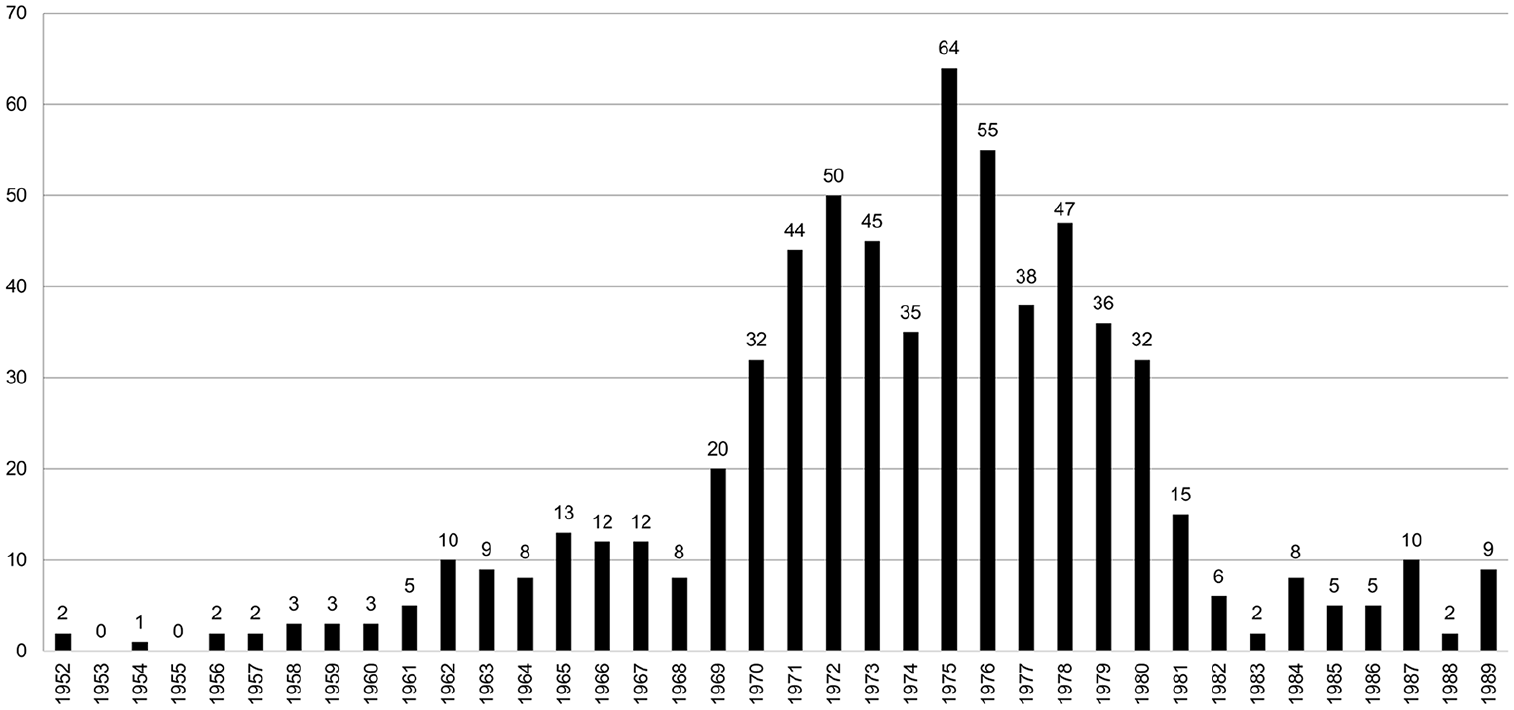
Number of job advertisements for full-time pedagogical staff in German adult educations centers (Volkshochschulen) (n = 653).
As previously mentioned, the increase in job advertisements in the 1970s was mainly due to the passing of adult education laws in many federal states (Bundesländer), which stipulated the creation of permanent positions in adult education based on specific criteria (Lower Saxony 1969, Saarland 1970, Hesse 1970/1974, Bremen 1974, Bavaria 1974, North Rhine-Westphalia 1974, Rhineland-Palatinate 1975, Baden-Württemberg 1975) (Rohlmann, 1994: 357; Section “Historical and contextual background”). In our data corpus, 63.7% of the job advertisements were from the state of North Rhine-Westphalia. This can primarily be attributed to the fact that North Rhine-Westphalia’s new legislation required local municipalities to establish adult education centers to ensure basic adult education services for their citizens. Additionally, the law granted such municipal adult education centers more funding in comparison to other providers of adult education (Rohlmann, 1994: 365). 8 Another likely explanation for this overrepresentation is that the Adult Education Center State Association of North Rhine-Westphalia was primarily responsible for publishing the national association’s magazine “Volkshochschule im Westen” (Adult Education Centers in the West). 9 While the magazine itself addressed all adult education centers in the entire Federal Republic of Germany, and many issues included announcements encouraging the submission of job advertisements to be published, a distinct connection to the adult education centers in North Rhine-Westphalia still remains evident. Thus, the job market depicted in the magazine is skewed regionally. Additionally, the association’s magazine also indicated that the association was interested in addressing all institutions of adult education. Therefore, advertisements from other providers, such as religious or political institutions of adult education, were also published. This confirms that the association aimed to represent the entire spectrum of providers and institutions, rather than establish an exclusive job market only for adult education centers. In the overall picture, however, there were few job advertisements from other providers, and the focus remained on adult education centers.
Central occupational categories of the labor market
As part of our analysis, we conducted a clustering of the job advertisements published between 1952 and 1989, grouping categories of full-time employment at adult education centers. Within the historical job advertisements (n = 653), we identified a total of five clusters, each reflecting a specific occupational category 10 :
Slightly over half of the job advertisements (n = 363, 55.6%) were for full-time pedagogical staff positions with a focus on specific subject areas. The tasks included planning and organizing educational events, selecting part-time teachers, providing guidance to participants and in some cases teaching in the designated subject area. Figure 3 displays a typical job advertisement of this type from 1971 (VW159). 11
One-third of the job advertisements (n = 235, 36%) were for adult education center directors. The overall pedagogical and organizational responsibility for the adult education center was emphasized as their central task.
Eighteen job advertisements were for deputy director positions of adult education centers (2,8%). In some job advertisements, in addition to the deputy leadership role, responsibility for a specific subject area was mentioned.
Twelve job advertisements were grouped in a cluster for other pedagogical staff (1.8%). This included positions in temporary projects or permanently employed teachers.
Seven job advertisements were for administrative staff positions with some additional pedagogical tasks (1.1%).
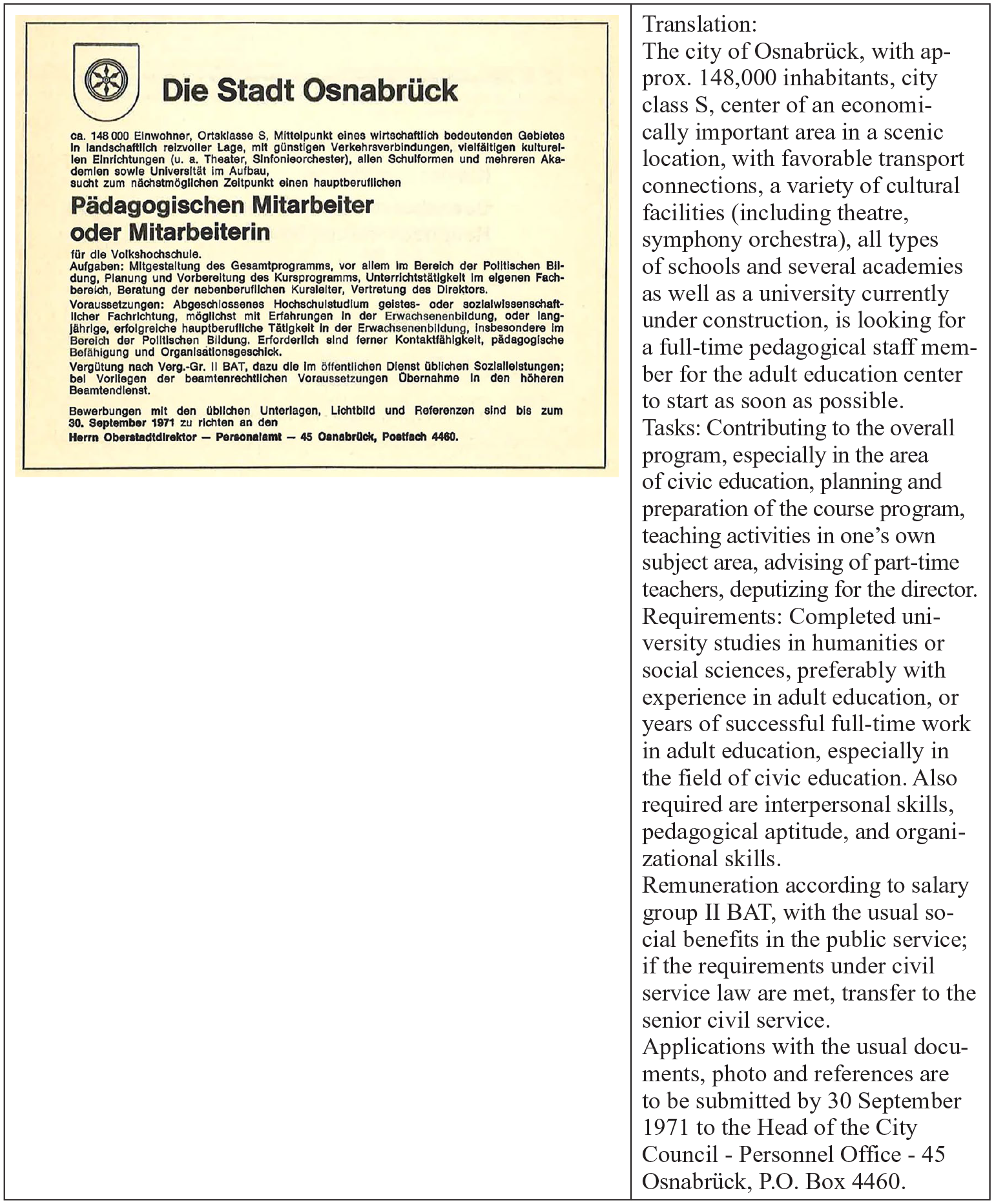
Job advertisement VW159: Full-time pedagogical staff member for the Adult Education Center Osnabrück.
The quantitative distribution clearly shows that the established job market for adult education centers primarily focused on positions for full-time pedagogical staff (n = 363, 55.6%) and leadership positions (n = 253, 38.8%). These are the two central categories that the new job profile in adult education, developed in the 1960s and 1970s, has revolved around.
In the following sections, we will delve deeper into the actors involved in creating the job market and establishing the job profile during the expansion phase. We will also examine the structuring conventions that have primarily shaped the historical situation.
Intermediaries and investments in a new job profile
It is evident that the associations of adult education centers played a central role in the creation of a specific job market for adult education staff. As described, they established a forum through their umbrella association magazine to publish job advertisements from individual organizations. From the perspective of our theoretical framework, the associations can be considered intermediaries that have taken on an important mediation function for the organizations. Due to the funding structures established by the new laws, the organizations were dependent on new personnel. This especially applies to the municipalities legally obliged to establish new adult education centers. The association magazine provided them with a format for recruiting directors and full-time staff for the newly founded organizations. However, the intermediary function of the associations is not limited to the mediation between job seeking professionals and recruiting organizations. The associations also played a significant role in shaping and disseminating a new job profile in adult education, both in terms of content and structure. Additionally, there are other intermediaries that have invested in the professional profile and contributed to its reach. In the following subsections, we will examine these individual intermediaries and look at the fixation of occupational categories in the adult education laws in more detail.
Intermediaries of conceptual development and dissemination
Within the structures of the associations of adult education centers, there was a central intermediary that significantly advanced the formation and representation of professional work. This intermediary was the Pedagogical Work Center of the German Adult Education Association (PAS), which was established in 1957. The central task of the institute was to support the adult education center associations in the federal states as well as the pedagogical work of individual adult education centers (Volkshochschule im Westen, 1958 in Nuissl 2008: 4).
The influence of the PAS is primarily evident when considering the adult education statistics, which the institute manages (see Section “Historical and contextual background”): since 1962, all adult education centers within the German Adult Education Association have been annually requested to provide key data about their personnel. The provided categories used in the surveys serve as a reference point. It is plausible that this process strongly influenced the internal categorization and profiling of positions within the organizations over time. Additionally, the influence of the PAS on the conception of professional profiles is particularly visible in the “Blätter zur Berufskunde” (Leaflets on Vocational Knowledge; abbreviated as BzB). The BzB was an informational brochure about career paths published by the Federal Employment Agency 12 until the year 2003. It was widely distributed throughout the entire Federal Republic of Germany and provided extensive information on more than 700 individual occupations and study programs over 50 years (Büschenfeld, 2014: 116). In 1964, the first brochure focusing on professional profiles at adult education centers was published. It was authored by the PAS 13 and released in seven editions (BzB, 1969, 1972, 1976, 1983, 1988, 1994). Thus, under the leadership of the PAS, conceptions of the tasks and areas of activity of full-time employees at adult education centers were publicly formulated for the first time. The dissemination of this idealized occupational concept through the informational brochure should not be underestimated, as it facilitated its contextual integration into the general labor market. At the same time, the Federal Employment Agency itself served as an intermediary by giving lasting visibility to the published model of full-time employment at adult education centers.
In all seven editions of the brochure, tasks, and responsibilities, as well as the prerequisites and qualifications for professional work at an adult education center, are addressed. The basic structure of the brochure remained unchanged, but the explanations became more detailed in the subsequent editions.
While the brochure differentiates various occupational categories, the main focus is on full-time adult education center director positions and full-time pedagogical staff positions with planning responsibilities. Part-time and volunteer lecturers, those responsible for teaching the majority of courses offered, are mentioned only marginally. The brochure does not examine their tasks or requirements in any detail. This not only directs attention to the new, idealized job profile but also strongly emphasizes the differentiation and distinction between full-time and part-time or volunteer positions.
In the context of defining full-time director and pedagogical staff positions, the brochure describes various developmental stages of the establishment and differentiation of organizational structures within adult education centers (see, e.g., BzB, 1983: 18). Noteworthy is the introduction of a systematization of seven ideal-typical subject areas to organize the educational work at adult education centers. The centers were encouraged to establish these subject areas and employ sufficient full-time pedagogical staff for program planning and development. In the third edition from 1972, the job title “Fachbereichsleiter” (subject area manager) is introduced, which in turn is increasingly found in job advertisements in the following years (see, e.g. BzB, 1972: 17–19, 1976: 17–20; Figure 4).
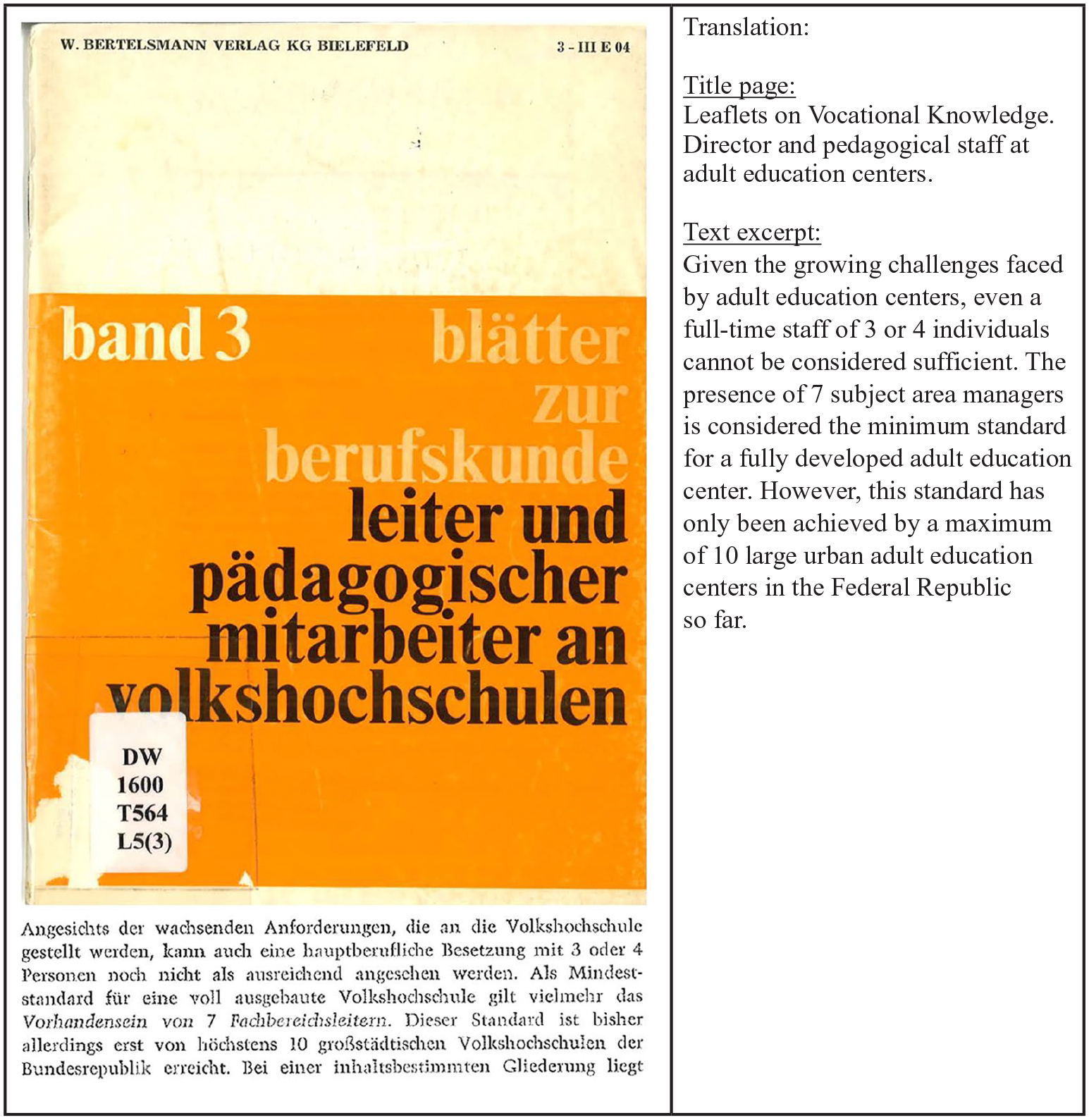
Title page and text excerpt from the Leaflets on Vocational Knowledge 1972.
With regards to the results of the job advertisement analysis, it can be concluded that the analyzed job advertisements often reflected the differentiated structures, job titles, and responsibilities outlined in the brochure. This indicates that recruiting organizations and municipalities referred to this conceptual framework when formulating job descriptions and establishing organizational structures. The high number of job advertisements for center directors and full-time pedagogical staff positions also reflects the focus of the brochure.
Compared to the precise definitions of tasks and organizational structures given by the brochure, the descriptions of the necessary requirements and qualifications for full-time personnel are formulated much more openly. Regarding professional qualifications, the brochure emphasizes that there are no binding regulations for working in adult education. Overall, while a completed university degree is recommended, particularly in the social sciences and humanities, the open access to careers in adult education is underscored (see, e.g. BzB, 1964: 12–15, 1988: 30–32). The brochure also indicates the importance of having a subject-specific degree in order to be able to take on the role of a subject area manager (see, e.g. BzB, 1972: 24–25). Though a diploma program focusing on adult education that was first established in 1969 is mentioned as a qualification option, it is not emphasized. It represents one access path among others.
Such descriptions in the analyzed brochures regarding the requirements and qualifications for working at an adult education center align with the findings from our job advertisement analysis. While a university degree is usually required for full-time directors and pedagogical staff positions, the descriptions remain open-ended, emphasizing the importance of experience in adult education. Following the establishment of the adult education focused diploma program in 1969, this degree is only occasionally mentioned. For positions involving the management and planning of a specific subject area, a degree relevant to the field is often expected.
Adult education laws as form investment
As already mentioned in the section “Theoretical framework,” laws serve as a central vehicle for stabilizing classifications and certain conventions. Against this background, the adult education laws that have been enacted by federal states can be considered important form investments for the permanent establishment of the described occupational categories. As previously mentioned, the adult education laws, primarily enacted in the 1970s, stipulated the funding of permanent positions in adult education. Some of the legislative texts distinguish between full-time center directors and pedagogical staff. Additionally, there is commonly a legally fixed differentiation between full-time and part-time or freelance personnel, especially with respect to different financing structures. Taken as a whole, the descriptions in the legislative texts are relatively general. Similarly to the PAS brochures, they do not provide specific information about the required qualifications to work in adult education. However, it is evident that the legislative texts refer to the concept of full-time pedagogical staff, in distinction to part-time or freelance personnel, and they solidify and reinforce this structural division. Through the support and funding of positions by the federal state laws, the concept was eventually adopted nationwide. At the same time, this gave rise to a new job market, which the corpus of job advertisements makes visible.
Other intermediaries
In our research and analysis, we have come across additional actors who have embraced the concept of full-time employment in adult education, such as trade unions or local associations and interest groups. One particularly influential intermediary is the “Kommunale Gemeinschaftsstelle für Verwaltungsvereinfachung” (KGSt), 14 an organization appointed by the Federal Ministry of Education and Research, which prepared and published a report on the establishment of adult education centers in 1973. The objective of the report was to provide guidance to municipal administrations regarding establishment of adult education centers required by the new adult education laws (Bundesminister für Bildung und Wissenschaft, 1973; Schrader, 2011: 22–23). The report covered topics such as the purpose and organization of adult education centers, typical job positions, staffing, and financing. The report adopted and further developed the organizational and subject area structures formulated in the PAS brochures. It also introduced new metrics for calculating staffing needs and described full-time profiles in detail. The PAS brochures from 1976 onwards contained numerous references to the KGSt report. It is noteworthy that the KGSt report indicates that adult education centers also require permanently employed teachers, for example, for subjects with high demand or when no part-time or freelance teachers can be found. However, it emphasized that part-time or freelance teaching would remain the standard (Bundesminister für Bildung und Wissenschaft, 1973: 53). It is also significant that even in the extensive KGSt report, only one page is dedicated to the required qualifications of full-time pedagogical staff. As in the PAS brochures and the adult education laws, the qualifications are described relatively generally (Bundesminister für Bildung und Wissenschaft, 1973: 66).
Discussion of the findings from the EC perspective
Based on the presented findings on the examined historical situation, it can be concluded that various intermediaries invested in the new job profile and contributed to its dissemination. As an outgrowth of the umbrella organization for adult education center associations, the PAS assumed a leading position in terms of conceptual work by developing an outline of the new job profile to serve as a reference model. The reliance of municipal administrations on this model when establishing organizational and personnel structures for their newly founded adult education centers underscores the conceptually programmatic nature of the PAS’s mediation. Another reinforcing factor that likely influenced the internal categorization and profiling of positions within organizations was the establishment of occupational categories in the adult education center statistics developed by the PAS. In addition to the PAS, the Federal Employment Agency and the KGSt took on important intermediary roles, contributing to the widespread dissemination and adoption of the professional profile. Form investments such as the new adult education laws and the KGSt report particularly strengthened the distinction between full-time employees with planning and management tasks and part-time or freelance teachers. These guidelines, coupled with the associated funding of full-time positions, strongly incentivized adult education centers to align themselves with the reference model. With the legal fixation in almost all federal states, the foundation was thus set for permanently establishing the job profile in the entire Federal Republic of Germany.
Through our analysis of job advertisements, we found that recruiting organizations and municipalities increasingly referred to the occupational categories outlined in the historical documents. At the same time, the job postings reveal a search process, for example, with regards to job titles. Although the occupational categories established by the PAS and stipulated in the laws were frequently adopted by the organizations, many job advertisements also feature alternative job titles as well as diverse combinations of categories (more detailed: Alke, 2020). Although a consistent use of occupational categories such as job titles cannot be observed, our clustering of job advertisements clearly indicates that positions for center directors and full-time pedagogical staff, in line with the ideal-typical job profile, predominated. In keeping with the fact that permanent employment for teachers in adult education represented only a marginal topic during the educational reform era and was not (legally) enforced, there are also few job advertisements for such positions in the data corpus.
Building on our convention theoretical framework, the educational and association policy claim to establish uniform occupational categories and binding standards for full-time pedagogical staff, as well as systematic organizational structures, can be interpreted as a form investment based on the industrial convention. In particular, the strong emphasis on planning and organizational tasks in the occupational profiles, the orientation toward the principle of expertise, the ideal-typical systematization of subject areas as well as the increasingly complex differentiations in the editions of the PAS brochure and the establishment of association statistics, clearly refer to the guiding principles and qualities of the industrial convention (see for an overview: Diaz-Bone, 2015; Imdorf and Leemann, 2023).
From a convention-theoretical perspective, the era of educational reform can be interpreted as a critical situation in which various actors relied on standardized forms and principles of equivalence (Diaz-Bone, 2009: 41). This is particularly well illustrated by municipal administrations, which were called upon by the new laws to establish adult education centers in their communities. They depended on the concepts and support provided by intermediaries such as adult education associations to implement provisions. At the same time, it can be assumed that educational policy expected structures within adult education centers to be established on a broad scale and based on professional standards. In this regard, the associations took on an important intermediary function in securing the legitimacy of the sector with regards to politics and the public.
In addition to these points, the outlined openness regarding qualifications helped to advance the establishment of the professional profile. As described, formulations of the profile focus mainly on systematizing areas of activity, tasks, and organizational structures, rather than on specific qualification requirements. In the discourse of adult education, this openness has been interpreted as a lack of determination to establish a pedagogical professional culture (Nittel, 2000: 116–117). However, considering the findings of Boltanski’s (1990) study on the formation of the category of “manager,” it can be assumed that this openness contributed to making the job profile adaptable for municipalities and adult education centers, enabling them to hire a broader spectrum of professionals. In this context, it should be noted that during the described expansion phase, many organizations were dependent on new personnel and thus stood in competition with each other. This is also evident in the historical job advertisements, given that incentives and advantages, such as favorable location and city infrastructure, are described in addition to the advertised position (compare Figure 3). Additionally, it is important to remember that at this historical time, there were not yet many graduates from study programs that focused on adult education. This also necessitated being more open in terms of qualifications and competencies when hiring. At the same time, the openness of the job profile has implicitly led to recruiting organizations holding the power to define qualifications and competencies.
Conclusion and outlook
The aim of this article has been to examine the historical development of job profiles in adult education in the Federal Republic of Germany, focusing on the example of full-time pedagogical staff with planning and organizational tasks. Based on historical documents and job advertisements, we were able to reconstruct the actors and institutional conditions that influenced the conception, dissemination, and implementation of this specific occupational profile for adult education. Building on studies of the development of occupational categories and the functions of intermediaries, we were able to reconstruct the specific roles of the intermediaries involved. These range from traditional matchmaking functions for recruitment and labor markets to conceptual-programmatic functions, such as the formulation of job profiles by associations. Further functions, such as those fulfilled by the Federal Employment Agency, relate to the dissemination, stabilization, and enforcement of categories. In addition, legal regulations have contributed to the stabilization and enforcement of occupational categories.
Our findings contribute to EC research by providing insights into the specific mediation services provided by intermediaries in educational contexts that, while only partially regulated by the state, are also shaped by the (relative) autonomy of organizations and other mechanisms, such as economic expectations. By drawing on theoretical and methodological premises from EC research, it was possible to consider aspects of the implicit value systems and quality principles invested in the conceptual development and implementation of the occupational profile.
Our historical analyses show that increased appreciation in the form of permanent, legally fixed funding and support has applied to and continues to apply only to full-time pedagogical staff with planning and organizational tasks in the Federal Republic of Germany. It is true that some historical documents refer to the need to promote full-time teachers in adult education. However, no corresponding, sustained investment by intermediaries or similar legal securement has taken place that would have led to equal status. As a result, structural prerequisites for precarious working conditions were established, which are related to the lack of permanent employment and further challenges, with which teachers in adult education are confronted to this day. As mentioned before, a similarly precarious situation of such personnel is also found in other countries. Against this background, our study offers points of connection for historical international comparative research on occupational profiles, labor markets, and employment situations. In particular, the specific concept of situations makes it possible to empirically analyze constellations of actors at different levels of action and processes of institutionalization in the education sectors of different countries in their historical context. In our view, this is where the particular analytical potential of EC lies. In addition, discourse analytical studies could be used to consider the impact of adult education science. Our focus has been primarily on intermediary organizations and legal foundations, but it is likely that academic discourses and academic professionalization at universities have also exerted influence on the development of job profiles and labor markets, for example, through academics’ participation in educational policy commissions and conceptualizations.
Currently, we are analyzing job advertisements from adult education centers and other documents from a second historical situation (2013–2022, n = 1493). We already see initial trends indicating that the job profile developed in the 1960s and 1970s is undergoing significant changes, although its outlines remain visible to this day (Alke and Uhl, 2021). While the findings from our historical analyses primarily point to country-specific contextual conditions, our current evaluations reveal clear influences of worldwide developments, such as neo-liberalism or the digital transformation, which affect job profiles, labor markets, and the employment situation of those working in adult education. In connection with this, new forms of precarious employment are becoming visible, such as the expansion of hybrid full-time job profiles at the intersection of administrative and pedagogical tasks, which offer comparatively lower remuneration. The role of the intermediaries has also changed, particularly in the case of the associations of adult education centers. While the legal foundations for the promotion of full-time positions at adult education centers still exist at the state level, the job market has shifted significantly to online job boards, leading to new, sometimes international actors fulfilling intermediary functions for adult education centers and exerting influence on the job market. At the same time, the German adult education landscape has diversified considerably in recent decades and is currently differentiated into public, community-based, church and other ideologically bound adult education providers as well as commercial and in-service training and continuing education providers (Schrader, 2010). It is worth asking what influence the ideal-typical occupational profile of full-time pedagogical staff developed in the educational reform era in the context of public adult education centers has had and continues to have on other continuing education contexts (NGOs, churches, companies, vocational training) in Germany and whether there are perhaps even multiple (sub-)labor markets in existence today, each with its own specific characteristics. This could be shown for the recruitment of freelance teachers (Schrader et al., 2023). The current developments also open up perspectives for international comparative research. International policies and governance approaches to lifelong learning must thereby also be given greater consideration.
Additionally, the insights gained into the development of job profiles in public adult education offer connections to findings from studies of comparative pedagogical occupational research, which refer, among other things, to the lower social recognition of adult education as an occupational field compared to other pedagogical fields (Nittel et al., 2014). The extent to which there is a connection here to the ambiguity of job profiles in adult education could be examined. This could include taking a closer look at how professional biographies and professional self-images of adult educators are influenced by occupational categories. Under the assumption that individual and collective professionalization are related to each other, this could provide new insights into questions of professionality.
Footnotes
Acknowledgements
We sincerely thank our student employee, Kilian Troidl, for his assistance in researching and processing the research data. Additionally, we express our gratitude to the editors, Diana Holmqvist and Kathryn Telling, for their appreciative, insightful, and highly beneficial feedback on our contribution.
Declaration of conflicting interests
The author(s) declared no potential conflicts of interest with respect to the research, authorship, and/or publication of this article.
Funding
The author(s) disclosed receipt of the following financial support for the research, authorship, and/or publication of this article: The study is part of the research project “Formation and change of professional full-time occupations in public adult education between ideal-typical occupational concepts and specific job profiles of organizations” (StellA), which is funded by the German Research Foundation (DFG) from 2022 to 2024 (AL 1954/1-1, project number: 471204135).
