




Abstract
In this article, key aspects of Basil Bernstein’s theory of elaborating and restricted codes are analysed within the Icelandic context to determine whether it can be employed when researching socio-economic inequities in upper-secondary education in Iceland during the COVID-19 pandemic. Drawing on empirical data, the article applies and tests the work of Bernstein on how understanding of restricted codes related to education controls access to the modalities of pedagogic discourse. According to Bernstein, different social groups have different access to education related to their socio-economic status. The analysis is based on a critical examination of the literature and an experiment where certain parts of Bernstein’s theoretical framework are tested. It is argued that Bernstein’s theory is useful in the chosen setting and exposes issues in parents’ different abilities to understand the information needed to be able to assist their children when studying at home during school closures due to COVID-19.
Introduction
Educational equity and inclusion are fundamental principles in the Icelandic and other Nordic education systems (Buchholtz et al., 2020; Jónasson et al., 2021b). Emerging literature indicates that the COVID-19 pandemic amplified educational inequality around the world, resulting in students from lower socio-economic backgrounds falling even further behind (e.g. Delès, 2021; Dimopoulos et al., 2021; Metsämuuronen and Lehikko, 2023; Rudling et al., 2023). During the first year of the pandemic, the arrangement of teaching and learning resulted in students having to rely to a greater extent on their parents or others from their close network for assistance (Frohn, 2021; Pierre, 2020). The socio-economic status of parents may have impacted their ability to discuss their children’s learning and influenced their access to the educational system.
A small body of literature is available on equity in education in Iceland, but it is a growing field (e.g. Auðardóttir and Magnúsdóttir, 2021; Eiríksdóttir et al., 2022; Magnúsdóttir and Kosunen, 2022). Rapid social change and ongoing disruptions call for further research. Theoretical ideas about equity in education in recent Icelandic research seem to be dominated by Bourdieu’s (1990) argument that class is constituted by economic, cultural, and social capital (Magnúsdóttir et al., 2020; Magnúsdóttir and Kosunen, 2022). Bourdieu himself questioned whether the education system operates as a disruptive and emancipatory force in society since it is reflective of dominant groups and therefore a social reproduction force itself.
While Bourdieu has dominated the research field on sociological understandings of the significance of social class for educational outcomes, Basil Bernstein tends to only be cited in passing in Iceland. Only a handful of researchers in Iceland have used Bernstein’s ideas (Bjarnadóttir et al., 2019; Bjarnadóttir and Geirsdóttir, 2018; Geirsdóttir, 2011; Jóhannsdóttir, 2007, 2008; Nylund et al., 2018), and they have relied on selected aspects, with none having explored different access of various social groups to education. This is noteworthy because Bernstein’s starting point was when he, as a school teacher in 1950s England, kept asking himself why students from working-class homes did worse in education than those from middle-class homes (Moore, 2013). However abstract and complicated his ideas since became, the core question circulating his theoretical ideas is how education works and what can be done to improve it. His on-going search for an approach that would fully describe the mechanisms within the sociology of education, or the pedagogic discourse, represented his critique of reproduction theories. Although Bernstein does share the basic concerns of theories about the reproduction of social differentiation and inequity within and through education, what he adds is the search for ways to break the vicious circle of class reproduction (Bernstein, 1990/2003). 1
Before experimenting with Bernstein’s ideas, researchers should assess the applicability of his ideas in their chosen settings. Bernstein developed his theory in the latter part of the 20th century in England, where the educational system and social environment were very different from what they are in present-day Iceland. In this article, key aspects of Bernstein’s theory about language and social groups will be analysed within the Icelandic context of school closures due to the COVID-19 pandemic. The aim of the article is to determine if and to what extent Bernstein’s theory is applicable to analyse inequity in education in Iceland during the first year of the pandemic. Interviews with 12 parents of upper secondary school students from three schools will be used, analysing their usage of specialised vocabulary related to education as an indicator of their access to the upper secondary school system.
Background
Class in Iceland
When Oddsson (2022) reviewed class research in Iceland from the beginning of the 20th century to the present day, he concluded that Iceland was arguably the most egalitarian democracy in the world from the time it gained independence in 1944 until the mid-1990s. However, the onset of neoliberal reforms has since then significantly increased income inequality and concentrated wealth. While it is apparent that class awareness did decrease in Iceland through the last century, recent research shows that it has increased again over the last 20 years and people are now more aware of class division than they were twenty years ago (see also: Oddsson, 2020). Also, during the last 20 years, the number of immigrants has risen substantially in Iceland, from 1.8 to 13.9% of the overall population, or from 4807 people in 1995 to 57,126 in 2021 (Statistics Iceland, n.d.). Immigrants are in many ways marginalised in Icelandic society and make up a large portion of the unskilled workforce (Hoffmann et al., 2021) and are more likely than non-immigrants to be concentrated in the lowest socio-economic layers of society, barely able to survive on their income (Oddsson, 2022). It is also apparent that their children are much less likely to finish upper-secondary education (Garðarsdóttir et al., 2022).
Class differences among parents of compulsory school students increased significantly between 1997 and 2016 according to recent research on the distribution of economic and cultural capital, and ethnic background among parents in different school districts in the capital area (Magnúsdóttir et al., 2020). This systematic social stratification within the education system provides a particular reason to take a closer look at parents’ socio-economic background and their possibilities to assist their children in their studies, particularly during the COVID-19 pandemic. These findings brought together seem to go against the discourse that Iceland is a classless society (Benediktsson, 2022), a discourse rooted in ideas of ‘the death of class’ (Pakulski and Waters, 1996) and individualisation arguments (Beck, 2002). When analysing socio-economic groups in Iceland it is essential to segregate the middle class using scaled socio-economic indices since two-thirds of the population is middle class, including both university-educated professionals and unskilled service workers (Ólafsson and Kristjánsson, 2017).
Upper secondary education in Iceland and equity
The central issue in educational policy for Iceland is to ensure an inclusive and comprehensive system. Almost all upper secondary schools are operated by the central government. Education is mandatory for children between the ages of 6 and 16 and students have right to attend education in upper secondary schools until the age of 18. The system of upper secondary schools is however open to all students of all ages, but the majority of students are between the age of 16 and 19 (Jónasson et al., 2021a, 2021b; Jónasson and Óskarsdóttir, 2016; Ragnarsdóttir, 2018).
Although the upper secondary school system is open to all students, there is fierce competition for places in some of the schools in the Reykjavík capital area, especially grammar schools and more established comprehensive schools with strong academic profiles. Students with high socio-economic backgrounds are more likely to get into the selective schools, but more diverse comprehensive schools (Eiríksdóttir et al., 2022) and small rural schools (Bjarnadóttir and Ragnarsdóttir, 2021) are in a constant battle for students and are often left behind in the competition due to strong market forces. As a result, only a small proportion of students actually have a true school choice which goes against the policy of inclusive education (Eiríksdóttir et al., 2022). That is further confirmed in research where upper-secondary school choice in Iceland and Finland is explored and how it is marked by the relationship between habitus and field and how this shapes students’ identities and reproduces the middle class when students choose the ‘right’, usually highly selective schools (Magnúsdóttir and Kosunen, 2022).
During the COVID-19 pandemic, Icelandic upper secondary schools operated under different restrictions or closure policies controlled by the Department of Civil Protection and Emergency Management. All upper secondary schools were closed from mid-March 2020 until the beginning of May 2020 and operated with restrictions from May until the end of term. In the autumn term of 2020 from September through December all upper secondary schools were again closed. Then through the spring term from January 2021 until June upper secondary schools operated under different restrictions and were closed for a short period of 2 weeks in April. When the upper secondary schools were closed, teaching and learning were undertaken from teachers’ and students’ homes in various ways (Ragnarsdóttir and Storgaard, 2023).
Analytical framework
Aspects of Bernstein’s theoretical ideas
According to Bernstein, codes are ideas, actions, thoughts, behaviours, and rules, which are created in interactions. They shape our understanding and consciousness and are passed on through every form and channel of social interaction and are either elaborating or restricted. The principles of elaborating and restricted codes involve access to meanings. In restricted codes, meaning is symbolically condensed and restricted to those sharing common bodies of knowledge. In elaborating codes, meaning is semantically expanded and exchanged with those not sharing the same body of knowledge. There is no hierarchical order between the two codes, and both can be used to communicate the same meaning, whether in a restricted or elaborating manner (Bernstein, 1990/2003, 2000). Imagine a scenario where a teacher sends a message home to parents that includes the phrase: ‘assessment will be formative this semester’. Here, a specialised education-related vocabulary, a restricted code, is used and some parents might need to ask the teacher to elaborate on the meaning of ‘formative assessment’. The reply would (should) be without the restricted codes, explaining in an elaborating manner by unpacking the meaning of the term ‘formative assessment’ as being a method to measure students learning frequently during the learning process where feedback is provided at an individual level, and so on. In an overview of the development of Bernstein’s code theory, Gamble and Hoadley (2011) explain the difference between elaborating and restricted codes by referring to elaborating codes as context-independent and restricted codes as context-dependent. Elaborating and restricted codes in education mainly relate to entry into the modalities of pedagogic discourse and, through them, access to knowledge and information. According to Bernstein (1971/2003, 1973/2003), different social groups have different possibilities to understand restricted codes in the pedagogic discourse, causing inequality in access to education.
As pointed out by Ivinson (2018), restricted codes in Bernstein’s ideas have wrongly been referred to by some scholars as codes used by those who are restricted cognitively. She has pointed out that even in his earlier papers, Bernstein provided a range of examples of restricted codes as an interaction between people in different social groups sharing common understanding emphasising that ‘restricted codes are not necessarily linked to social class. They are used by all members of society at some time’ (Bernstein, 1971/2003: 128). As early as 1971, Bernstein’s ideas about restricted and elaborating codes seem to be quite clearly explained by him when he stated that ‘restricted codes have their basis in condensed symbols, whereas elaborated codes have their basis in articulated symbols’ (Bernstein, 1971/2003: 176). Bernstein’s use of the term ‘elaborated code’ in his earlier papers possibly led some critics to incorrectly use elaborated as an adjective rather than a verb. To try to avoid that misunderstanding, Bernstein changed the usage of the term from elaborated code to elaborating code, emphasising the understanding of the term as a verb. In an interview late in his career, Bernstein (2001) comments on this misunderstanding, insisting that ‘all that old nonsense of people claiming that elaborated code is middle class oriented is based on people’s unwillingness or inability to read’ (p. 371).
Scholars have argued that it is challenging to apply Bernstein’s ideas to the diversity of actual social problems since they are abstract, ambiguous, and vague (Atkinson, 1985; Dowling, 2009; Ivinson, 2018; Power, 2010). Confusion can (and usually does) arise from reading his writings due to the way his ideas evolved through time and how he uses certain concepts differently in different contexts. Under the influence of Ruqaiya Hasan and Michael Halliday in the late 1960s, Bernstein (1990/2003) became more occupied with the meaning of codes rather than the formulation of sentences. Also, Bernstein’s ideas about class evolved into a discussion of social groups that might be intersectional. There is, therefore, value in experimenting with the modern understanding of his ideas (Donnelly and Abbas, 2018; Ivinson and Singh, 2018), using a semantic rather than syntactic approach in contemporary Iceland when analysing qualitative data gathered during the COVID-19 pandemic. Donnelly (2014, 2018) highlights the usage of Bernstein’s code theory and criterion rules when evaluating inequality in UK’s higher education system; here, applicants to high-ranked universities are expected to talk and behave in interviews in a certain manner and using a certain vocabulary. In his concluding remarks, Donnelly argues that developing a higher level of familiarity with the higher education system for all students would be valuable, including educating applicants about ‘legitimate’ forms of dialogue and communication.
Even if Bernstein’s ideas of differential access to the educational system have not been used in recent Icelandic research, an empirical test of Bernstein’s socio-linguistic model was conducted by Þórlindsson (1987), almost half a century ago. He observed a correlation between social class, family interaction, IQ, and school performance in a sample of 15-year-old students in Iceland’s capital, Reykjavik, but concluded that important revisions need to be made to Bernstein’s model, specifically his methods for measuring elaborated and restricted codes. Þórlindsson’s examination and rejection of Bernstein’s model was based on Bernstein’s (1962b, 1962a, 1964, 1966, 1970) earlier papers on elaborated and restricted linguistic codes using syntactic analysis, rather than the semantic idea he later developed. Bernstein’s (1962b, 1962a, 1964, 1966, 1970) first papers in the 1960s did receive some criticism (Atkinson, 1985; Davies, 1995; Rosen, 1974), later referred to as misunderstanding and misrepresentation by Bernstein’s followers (Christie, 2007; Ivinson, 2018; Moore, 2013). The primary source of reference to his work in this article will be the four volumes of Class, Code and Control, published from 1971 to 1990 (Bernstein, 1971/2003, 1973/2003, 1990/2003), and the second edition of Pedagogy, Symbolic Control and Identity: Theory, research, critique (Bernstein, 2000).
Aim and research questions
When analysing Bernstein’s work, Moore concluded that the fundamental question Bernstein was constantly seeking to answer was: ‘what is the relationship between social structures and symbolic systems and how does the differential positioning of groups within those relationships shape consciousness, experience and identity?’ (Moore, 2013: 34). The aim of this article is to determine if and to what extent Bernstein’s theory is applicable to analyse inequity in education in Iceland during the first year of the COVID-19 pandemic; the research questions addressed in this article are the following:
How is parents’ socio-economic status related to the usage of the restricted code of education when discussing their children’s education during the pandemic?
What evidence suggests that parents had different possibilities to support their children during the pandemic because of different access to the upper secondary education system through the restricted code of education?
Methods
This article is based on individual interviews conducted with 12 parents, none of whom was in a relationship with any other of the interviewed parents. The interviews are part of a larger study on upper-secondary education during the COVID-19 pandemic 2 in Iceland. Three upper-secondary schools were selected for the research and to maintain anonymity they are identified as schools T, C, and R. One of the schools was a traditional grammar school in the Reykjavik capital area with high-achieving students in academic programmes (School T), and two were comprehensive schools, one in the capital area (School C) and the other in a rural area (School R). The three schools included in the research were purposefully selected (Palys, 2008) for their differences. Diversity is a crucial component of the research design, providing wider perceptions of the stratification in the Icelandic upper-secondary school system with regard to school types and location. The interviewees (hereafter referred to as the parents) were purposefully selected to recruit a diverse group of parents with respect to gender, family type, socio-economic background, education, Icelandic language skills and as parents of students with different school attainments. Four parents were interviewed from each of the three schools. They were numbered from 1 to 4, based on their socio-economic position (see Table 1). Each parent’s identity in this article is therefore indicated by a combination of the school’s letter and the number indicating their socio-economic rank.
Categorisation of the parents based on their profile as presented in the interviews.
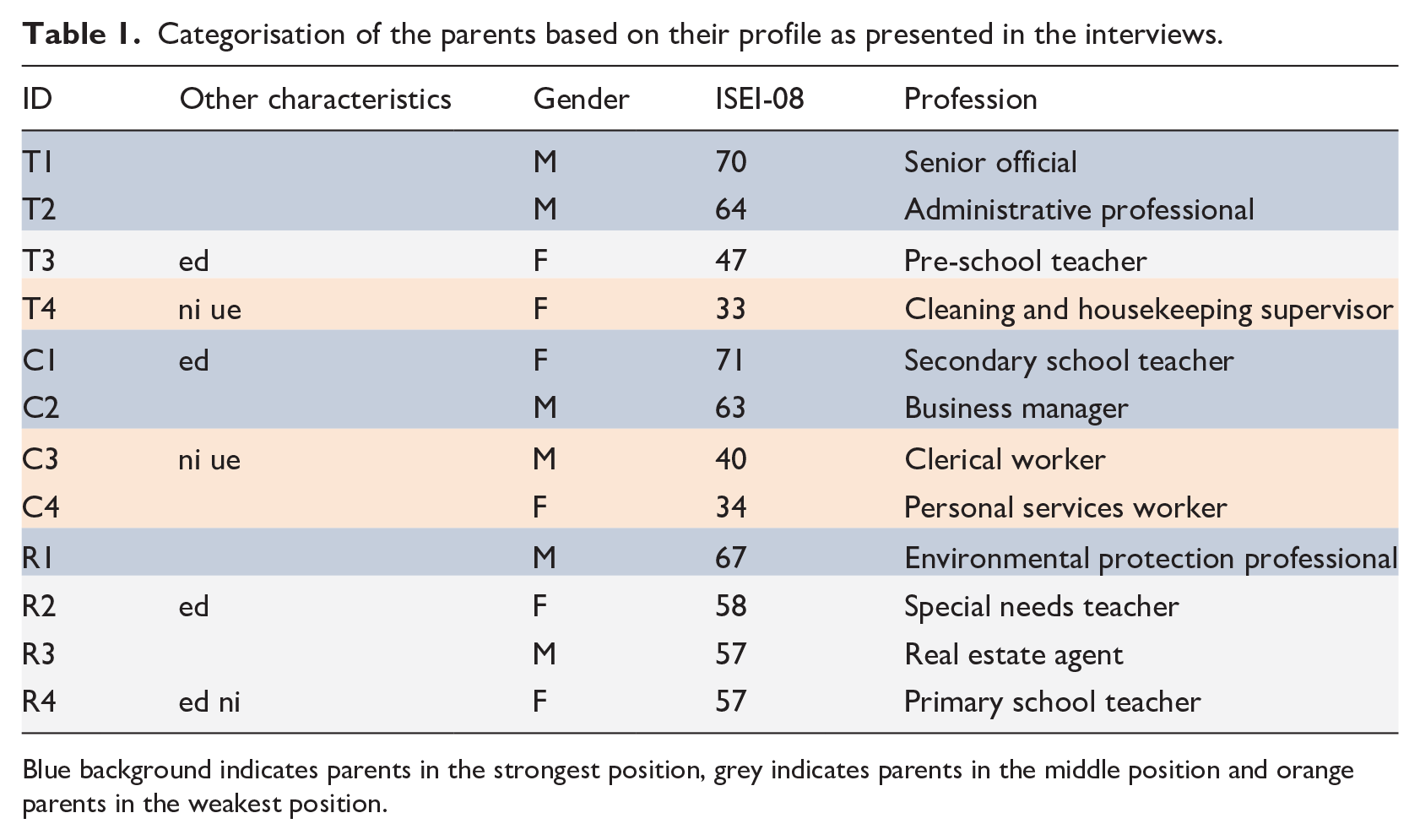
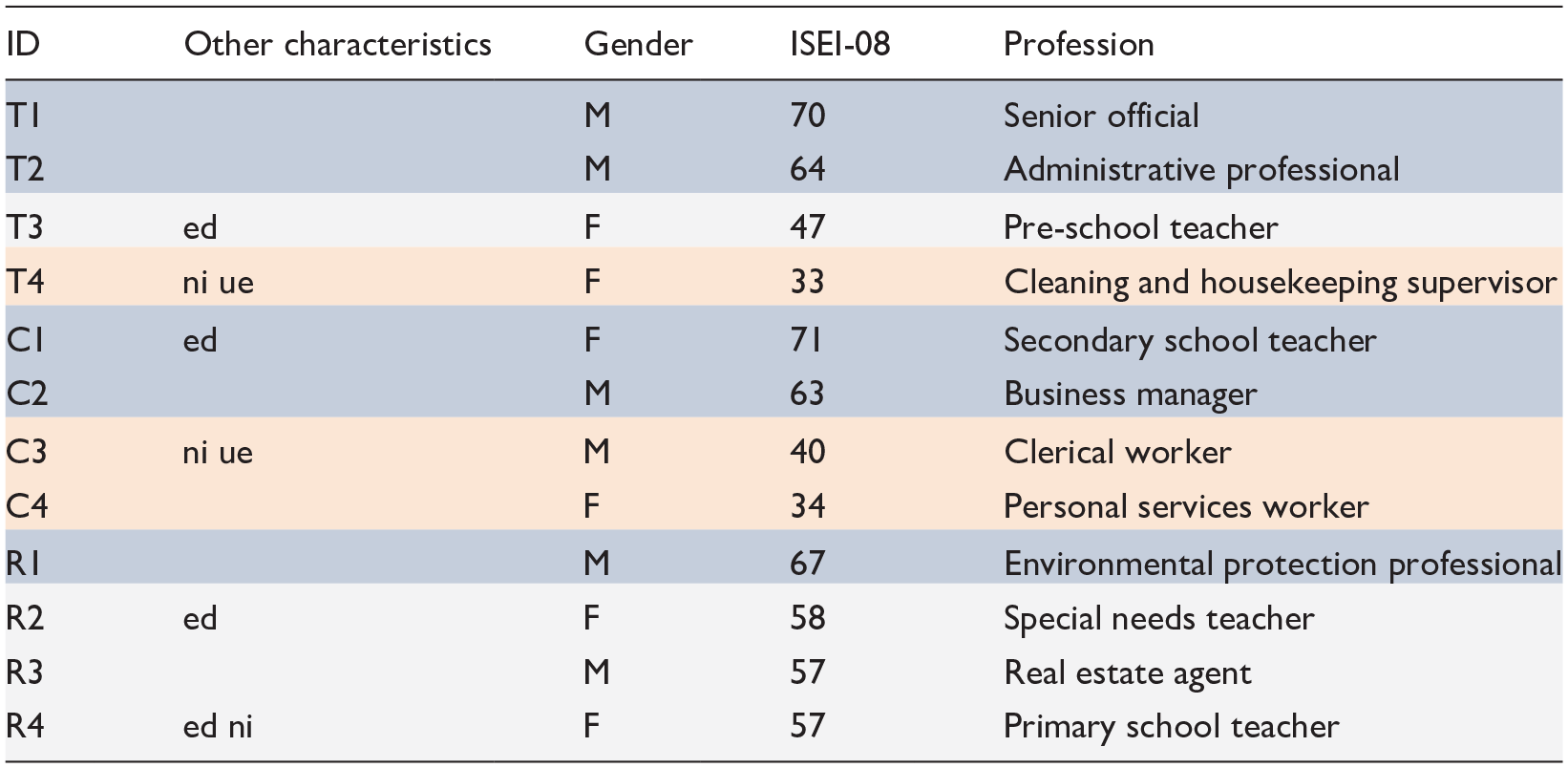
Blue background indicates parents in the strongest position, grey indicates parents in the middle position and orange parents in the weakest position.
To provide a deeper understanding of the interplay between home life during the pandemic and experiences with distance teaching and learning, the interview framework consisted of questions related to students’ learning but also questions about the parents’ backgrounds, facilities at home, and parents’ and students’ general well-being. Specialised vocabulary related to education was avoided when the interview framework was constructed and when interviews were undertaken. When seeking parents’ opinions and ideas on distance-teaching and learning, wording such as the following was used: ‘What are your thoughts on the teaching that took place?’, ‘How did the structure set up by the school suit your child?’ and ‘How did teachers address your child’s educational needs?’.
The parents selected the place to meet for the interview and whether the meeting was face-to-face or by video conference. The interviews lasted from 34 to 83 minutes. They were audio-recorded to ensure accuracy and transcribed (Yin, 2009). Atlas.ti (qualitative data analysis software) was used in the analysis process. In the interviews the parents were asked questions about their children’s schools and how teaching and learning changed when the school buildings were closed, and all the teaching shifted to distance settings. They were also given every opportunity to discuss education, teaching and learning during the pandemic and to share their ideas about their children’s schools and how education might develop in the future. Three research team members conducted the interviews, using the same interview framework to maintain consistency. The researchers are professionals within the educational sector, so this requires them to engage in reflection (Berger, 2015), examining their own roles and biases in the interview process. Since the study primarily focuses on analysing word usage, the most important thing to ensure is that all parents were given the same opportunity to express their views and use their education-related vocabulary.
Profiling the parents
The International Socio-Economic Index of Occupational Status (ISEI-08) was used to identify the socio-economic status of the parents, based on their professions (Ganzeboom and Treiman, 2010). The index has been used in recent research on school choice and social justice in Iceland (Eiríksdóttir et al., 2022). By analysing background information about the parents in the interviews, a profile of each household was constructed. The ISEI-08 index was used to arrange the parents from the highest score, representing the strongest socio-economic position, to the lowest score, representing the weakest position. Similar to other socio-economic indices (see, e.g., Ganzeboom et al., 1992; Hodge, 1981), ISEI-08 is based on adding socio-economic characteristics, such as education and income, to occupational indices (Ganzeboom et al., 1992). Table 1 presents a list of the parents with their given identity, gender, ISEI-08 index, and profession. Parents working in the education sector are marked with ‘ed’, parents who did not speak Icelandic as their native language are marked with ‘ni’ and parents who were unemployed at the time when the interview was conducted are marked with ‘ue’.
Five parents scored above 60 on the ISEI-08 index (the strongest position), four parents between 41 and 60 (the middle position) and three parents below 40 (the weakest position). This categorisation is shown in Table 1, where a blue background indicates parents in the strongest position, grey indicates parents in the middle position and orange parents in the weakest position. There are three families where parents do not speak Icelandic as their native language, one from each school and two of those parents were placed in the weakest position according to the ISEI-08 index. Only one other parent in a weak position spoke Icelandic as her native language. In the findings below, the parents are arranged into an order using the ISEI-08 index. It is important for the study to use a clear and transparent index, but there is information in the interviews that is useful for further profiling the parents. Some of that information, such as family characteristics, Icelandic language skills and parents’ experience, is used in discussing the parents’ socio-economic status and their usage of the specialised vocabulary related to education.
General vocabulary and restricted codes in the interviews
To analyse the parents’ ability to use restricted codes in the interviews, the conceptual content analysis method (Mayring, 2022) was employed. All words in the interviews were categorised based on their individual meaning or the meaning of the context in the sentence in which the word was used. Using data analysis software made it possible to extract all words from the interviews for each of the parents, capturing various details on word usage, including counts. Given that the interviews followed a semi-structured format and aimed to gather information on a broad spectrum of topics related to schooling during the pandemic, all words were initially grouped into categories related to education, the pandemic, the facilities at home, the students’ social lives, the students’ mental well-being, the parents’ work-life balance and words lacking specific contextual meaning. Icelandic is a complex language with various grammar components resulting in a single word appearing in text in many different forms. For example, the word school (skóli) is apparent in the interviews in 15 different forms based on cases, definite article and number. Verbs conjugate for a person, number, tense and mood, for example, and nouns are declined in four cases, as well as for singular and plural and embedded definite article. Therefore, the same word may be apparent in the Icelandic language in many different forms. Another difference from English that might affect counting of words in Icelandic is that the Icelandic language is rich with composed words; for example, the term for a ‘school year’ is one word (skólaár). There are 32 words in the interviews with school as a prefix including ‘school rules’ (skólareglur), ‘school day’ (skóladagur) and ‘school authorities’ (skólayfirvöld).
One of the categories the words were put into was vocabulary related to education. The parents used from 3500 to 11,500 words in their interviews, and each parent used words from a vocabulary related to education 82–350 times. Words such as ‘school’, ‘subject’, ‘teacher’, ‘class’ and ‘assignment’ are part of a general vocabulary related to education and would not be considered a restricted code. In total, the parents used 669 different words or forms of words related to education 2323 times in all the interviews. Bernstein (1990/2009) did use the method of counting the frequency of isolated units of language and identified the value of that method. The outcome of counting the frequency of words belonging to either general or specialised vocabulary related to education will be presented in figures and compared with parents’ socio-economic position.
There are various possible methods available to identify a specialised vocabulary related to education, that is, the restricted code of educational discourse. A specialised vocabulary consists of low-frequency words that are used within a specific domain. There is an available list of professional terms in education in Icelandic, but it is rather narrow and limited, serving as a tool to elaborate on and make up new terms or translations within the profession. In this article, the authors’ professional evaluation was used to subcategorise words into a specialised vocabulary related to education. In the end, 180 words or forms of words used by the parents were considered part of a specialised vocabulary related to education. Examples of words in that sub-list are ‘pedagogy’, ‘dyslexia’, ‘literacy’, ‘formative assessment’ and ‘developmental language disorder’ (one word in Icelandic ‘málþroskaröskun’). Table 2 presents a list of the 18 words from the specialised vocabulary containing words used five times or more across the parents to indicate the conception of the group belonging to the specialised vocabulary related to education.
A list of the most frequent words categorised as a specialised vocabulary related to education.
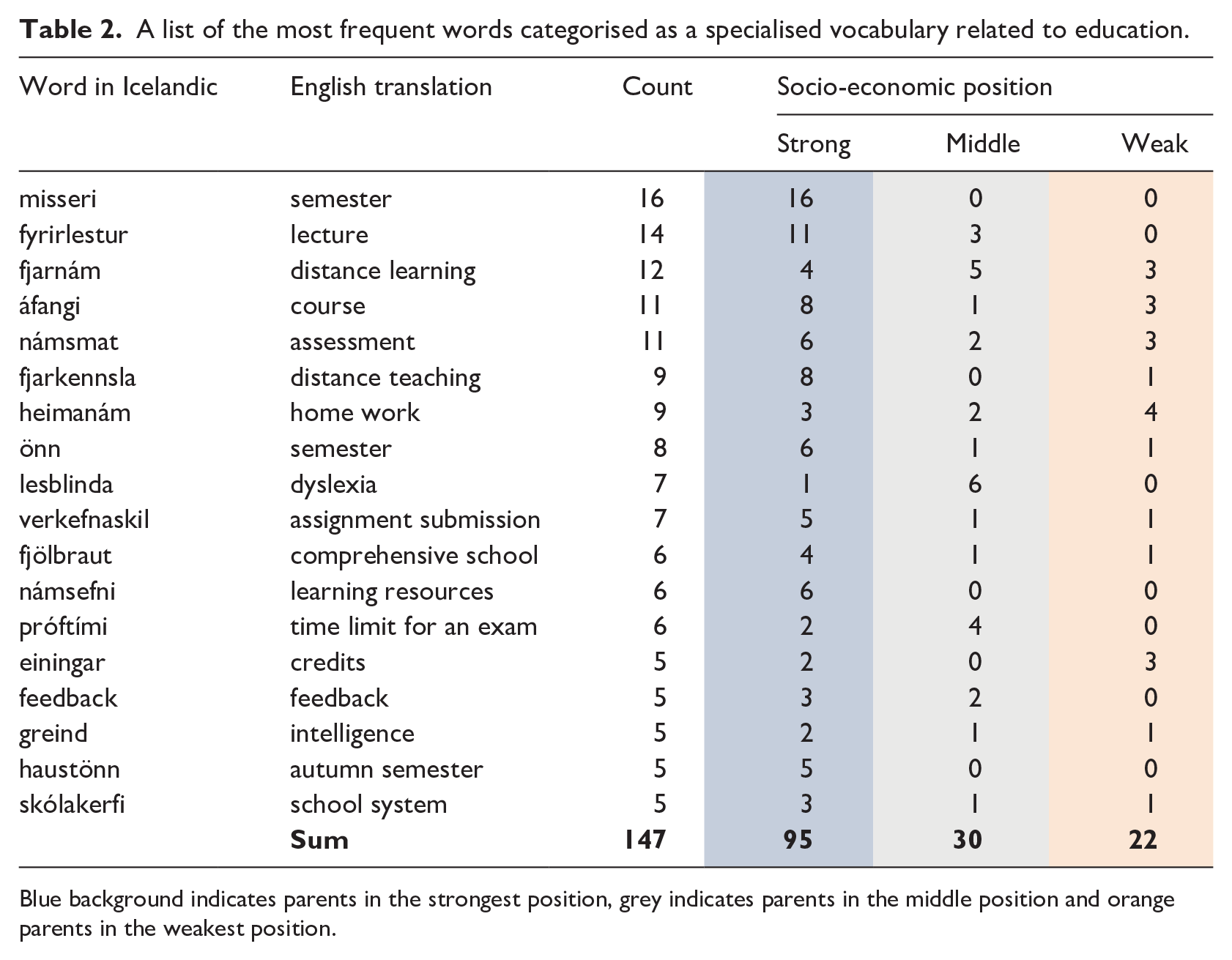
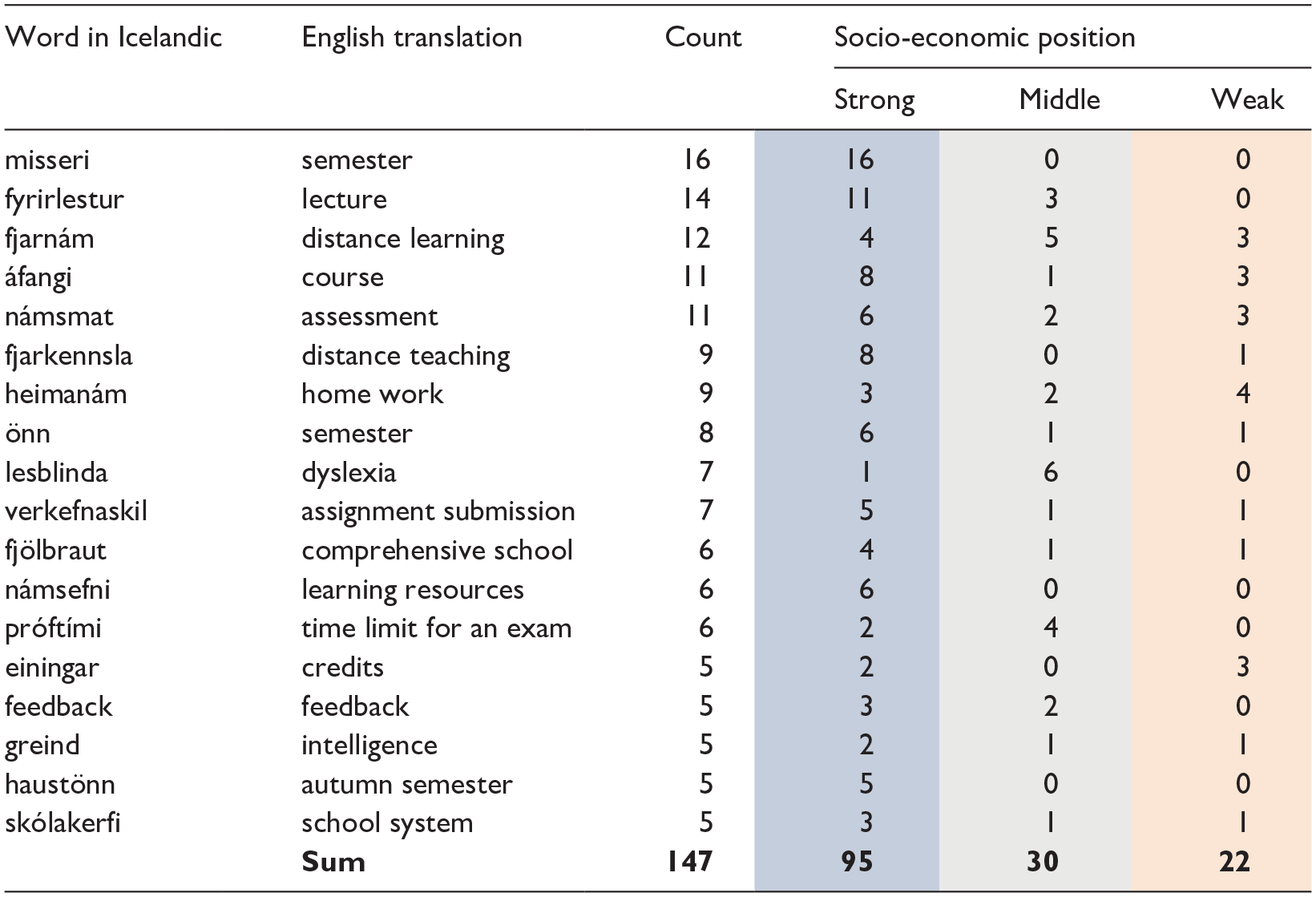
Blue background indicates parents in the strongest position, grey indicates parents in the middle position and orange parents in the weakest position.
The 18 words from the specialised vocabulary in Table 2 were used a total of 147 times by all the parents. The 180 words categorised as being specialised vocabulary were used in total 303 times by the parents, so most of the words were only used once across all the interviews.
Triangulating the code counting
Bernstein (2000) insisted that researchers experiment with his concepts and ideas as he did himself. In an overview of the development of code theory, Bernstein (1990/2003) responded to the criticism that counting the frequency of isolated units of language lacks the qualitative analysis that is needed. His critics considered it a weakness in his method (Stubbs, 1983). Although Bernstein did continue to defend his method, he also accepted the criticism to a certain extent by suggesting the possibility of analysing the text further in its context. To triangulate the findings from the counting of instances of general and specialised vocabulary in the interviews, a further qualitative analysis will be made in this article. The interviews were coded and thematically analysed following the six steps proposed by Braun and Clarke (2013). In the end, two main themes were developed based on Bernstein’s framework of family involvement in students’ education. The framework of family involvement can be useful for providing a refined theoretical language for describing the dynamics of school and family relationships and the social positions formed but, in this article, it was only used to develop the themes for the qualitative analysis. The themes developed in the analysis were about parents’ understanding of the means of education and acceptance of the ends (Bernstein, 2000), reflecting parents’ attitude towards the education during school lockdown and the methods used by the schools. The theme for parents’ understanding of what students were learning was ‘The rules of the game’ and ‘Everybody is doing the best they can’ for parents’ acceptance of the methods used. Since four of the parents were professionals within the education sector, special attention was given to their responses in the first section of the qualitative analysis.
Findings and discussions
Parents’ socio-economic status
The parents were grouped into three different socio-economic groups (strongest, middle, weakest) depending on their ISEI-08 scores. To give examples, the highest score was 71, given to C1 ed, a single mother who was an upper secondary school teacher. As such, she should be considered a member of the ‘specific domain’ being researched according to Bernstein (1971/2003) but her position in the strongest socio-economic group is according to ISEI-08. Apart from C1 ed, three other parents were educational professionals (T3 ed, R2 ed and R4 ed ni). Their ISEI-08 score ranged from 47 to 58, indicating different socio-economic statuses, where the pre-school teacher had the lowest score and the special needs teacher the highest. In between was the compulsory school teacher. All the educational professionals except C1 ed were placed in the middle socio-economic group and were not considered to be members of the field being researched. The lowest-scoring parent was T4 ni ue, a single mother, scoring 33 points. She was unemployed when the interview took place, but her score was based on her latest job.
Usage of general and specialised vocabulary related to education
Figure 1 shows the usage of words categorised as a general vocabulary related to education in each interview. General vocabulary related to education was not considered a part of the restricted code. However, there was still a noticeable relationship between socio-economic grouping and usage of vocabulary related to education when the number of words was counted. Parents in the strongest socio-economic position (blue dots), according to ISEI-08, used more words related to education in the interviews than those in the weakest socio-economic position (orange dots). Generally, the tendency was that parents in stronger socio-economic positions used more words in the interviews. On average, the parents in the strongest socio-economic position used around 7200 words in each interview, while parents in the middle and weakest position used around 5500 words. When examined as a percentage of the words used in each interview, there was no significant difference in the parents’ usage of general vocabulary related to education across different socio-economic groups. Since the analysis is about counting the usage of specific words, the total word count is considered a more appropriate method than the percentage of words used.
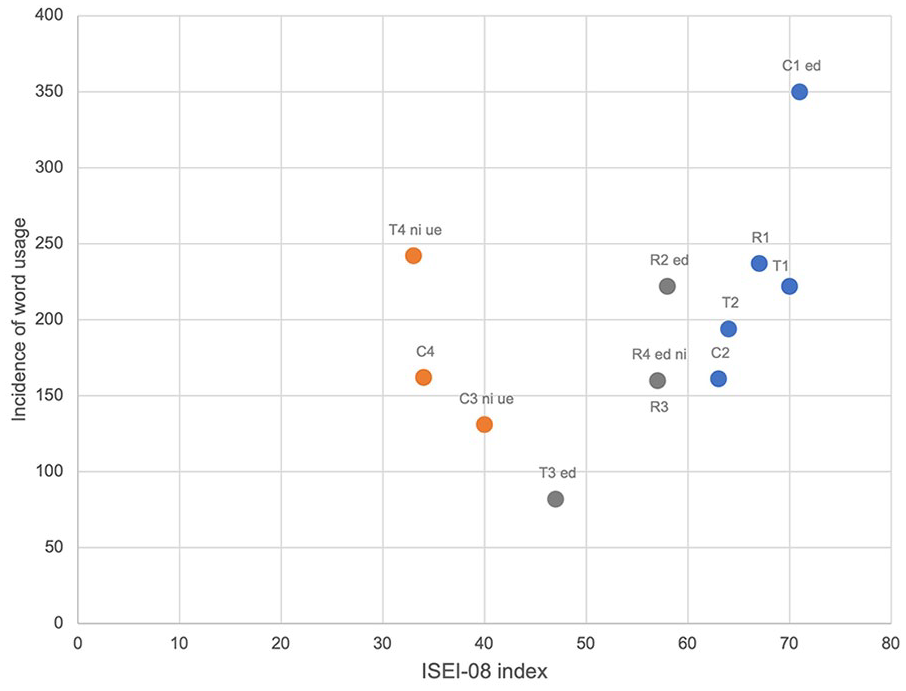
Parents’ usage of general vocabulary related to education.
There are three notable outliers in Figure 1. T4 ni ue was an unemployed single mother who did not speak Icelandic as her native language. In the interview, she spoke in Icelandic and English. She used English words within the general vocabulary as well as Icelandic but only Icelandic words within the specialised vocabulary. It can therefore be assumed that her lack of usage of the restricted code does not derive from a lack of language skills since she switched to English when she needed the right words to express her views. An example of words she used in Icelandic from the specialised vocabulary related to education were words like ‘bilingual (tvítyngdur)’, ‘intelligence (greind)’ and ‘academic performance (námsárangur)’. Then she used words from the general vocabulary in English like ‘learn’, ‘class’ and ‘school’.
Another notable outlier in Figure 1 was T3 ed, a pre-school teacher who used only 4469 words in the whole interview, around two-thirds of the average. When analysing the interview with her, it was clear that it was hard for the interviewer to motivate the discussion related to her son’s learning. She repeatedly said that her son took care of it himself and often diverted the discussion towards his mental well-being, his mask usage due to the pandemic, or his sports practice. As the interview progressed, the mother managed to answer many questions with only ‘yes’ or ‘no’ when the interviewer pushed for explanations by giving alternatives. The last notable outlier was C1 ed, a mother who was an upper secondary school teacher. She used by far the most words related to education while she discussed both her son’s learning and her teaching practices during the pandemic. She was also the parent who used the most words in all the interviews: 11,530 words.
The number of words used by each parent, that is, how much the parents had to say, indicated how interested, knowledgeable or able they were to discuss educational matters. When it came to the usage of restricted codes (words categorised as specialised vocabulary related to education), the difference was more apparent between the groups, as can be seen in Figure 2. Parents T1, T2, C1 ed, C2 and R1 were all categorised as parents in the strongest socio-economic position (blue dots) and used, on average more than twice as many words belonging to a specialised vocabulary related to education compared to the group of parents in the weakest position (orange dots). In contrast to the general vocabulary related to education, the difference between parents in the strongest and weakest socio-economic groups remains evident when examining the usage of specialised vocabulary as a percentage of all words used by each parent. Approximately 0.55% of words used by parents in the strongest socio-economic group were from the specialised vocabulary. Conversely, only 0.29% of the words used by the parents in the weakest group fell into that category.
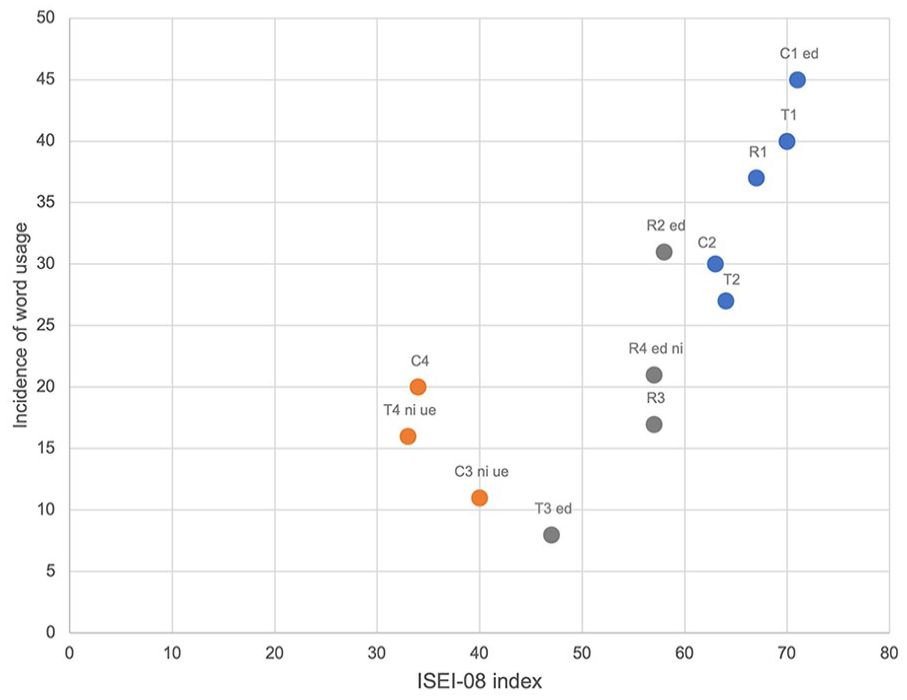
Parents’ usage of specialised vocabulary related to education.
According to Bernstein (1990/2009), it can be assumed that the parents in the strongest socio-economic position had better access to the pedagogic discourse and the modalities of education through access to the restricted code. In the COVID-19 pandemic, parents were overnight put in the situation to support their children in studying at home during the resulting school closures (Delès, 2021; Frohn, 2021; Pierre, 2020). Access to the restricted code would therefore most likely mean that the parents in the strongest socio-economic position would be better able to assist their children when studying from home and understand information provided by the schools.
Qualitative analysis of restricted codes and socioeconomic status
The following qualitative analysis will focus on the parents who were education professionals and those in the strongest and weakest socio-economic positions. The use of specialised vocabulary related to education was more prominent among all parents in the strongest socio-economic position than others but not necessarily among parents who worked within the education sector (Figure 2), except for C1 ed who was in the strongest socio-economic position of all 12 parents according to ISEI-08. The other parents who worked within the education sector used the specialised vocabulary more linked with their socio-economic position than their profession. C1 ed, R2 ed, T3 ed, and R4 ed all worked within the education sector and represented the full range of socio-economic positions. C1 ed was the only educational professional working within the upper-secondary school system or the actual field of education being discussed in the interviews.
Parent R2 ed was a special needs education teacher in a compulsory school and did use the restricted code, but less than parent C1 ed. Still, it was interesting how she was occupied with discussing educational matters from the viewpoint of her sons’ needs rather than in general terms. She explained how it suited her sons to hand in projects in other ways than written and how some teachers did adapt to more varied project options during the pandemic. When she was asked about the lessons learned and how the upper secondary school level would develop in the future, she replied in general terms that technology might play a more significant part and teachers would hopefully proceed with their flexibility. Parent R2 ed did go to great lengths to support her sons through their studies during the pandemic. She acknowledged their advantage since she, through her job experience, knew students in different positions, without the support she could offer her sons. When asked how she could assist her sons she said: ‘In Icelandic, I read over their work before they submit the assignments, simply assisting them with correcting spelling and such. Helping them to practise for tests, organise themselves for test readings and similar activities’. Parent R2 ed did use the specialised vocabulary to some extent in the interview and did show some understanding of the means and ends of education even though her ideas were more focused on her sons’ needs rather than the demands the school made on her sons.
Parent R4 ed was a compulsory school teacher who did not speak Icelandic as her native language. She clearly lacked access to the restricted code. When asked about the solutions the school employed during the pandemic, she replied in very general terms by answering ‘They just started attending the school through their computers. I thought this was very clever’ (R4 ed), rather than discussing further arrangements for teaching and learning. Finally, of the parents working within the educational sector, parent T3 ed was a pre-school teacher and was the parent who used restricted codes the least of all the parents. As already mentioned, she was reluctant to discuss her son’s studies. In the interview, she discussed an incident when her son was failed in one subject because of some technical issue, according to her explanation. When asked if she contacted the school to gather information about the incident or to explain the technical issue, she just replied ‘no’, indicating she was not confident in communicating with the school. Some of the other parents spoke about how to resolve issues with the school and knew where to seek assistance but not parent T3 ed. She did not show much understanding of the means of her son’s education. She did accept the ends and said she thought it was important for him to finish his education.
Since parent C1 ed is a teacher in a comprehensive secondary school, it can be assumed that she would be familiar with the restricted code of education, and she was. In the interview, she not only spoke about education related to her son’s learning but also about how she found her way as a teacher during the pandemic. She was able to reflect on her son’s education and on education in general. When asked what the upper-secondary education system could learn from the COVID-19 period, she spoke about project-based learning led by students where they could meet their teachers in small groups rather than ‘a massive some kind of a lecture or a presentation or something – that will become digital’. C1 ed not only expressed deep knowledge of the education system and the arrangements during school closures, but she also praised the outcome and expressed very positive attitudes toward her son’s school. She knew the means of education and accepted the ends. The specialised vocabulary related to education she used consisted of words like ‘direct teaching’, ‘oral assessment’, ‘on-site teaching’ and ‘distant education’. These are words used to explain in a condensed way what is going on in a school, whereas the other parents who work within the education sector in compulsory schools and a pre-school used the specialised vocabulary to a lesser extent and mainly to explain their children’s situation, using words like ‘dyslexia’, ‘developmental disorder’ and ‘phonological awareness’.
The rules of the game
The parent using the highest number of specialised education words, apart from C1 ed, was T1, a senior official. He and his wife had gone, some decades before, to the same upper secondary school that their daughter now attended. He spoke eloquently about his daughter’s education and the education system in general. When asked, he was able to reflect on teaching and learning without only considering his daughter’s needs or situation, using a wide range of specialised vocabulary related to education. In the interview, one of the questions was if the bar had been lowered, during the COVID-19 pandemic, to accommodate the changed circumstances, and T1 answered by saying ‘progress through the syllabus might have slowed down’ and ‘the assessment was perhaps more lenient in some ways than it would have been’. This indicates how T1 not only had access to the restricted code but also used specialised vocabulary related to education to express his opinion on how teaching and learning were practised. T1 was able to demonstrate access to the restricted code and to knowledge in the field of upper-secondary education. He was well aware of whom to contact in the school to get information or solve any issues that arose; he knew how to navigate within the system contrary to T3 ed, already mentioned above.
R1 was also in the group of parents in the strongest socio-economic position. He scored high, but he used the same word 15 times out of 37 within the specialised vocabulary (Ice. ‘misseri’ – Eng. ‘semester’). The variety in the specialised vocabulary was much more apparent in the list of words used by the other parents in the strongest socio-economic group. Still, R1 explained how he and his wife did support their daughter more during the COVID-19 period than before. Much of what they did was keeping the routine going and assisting their daughter to plan her distance study. In the interview, he discussed how the school was flexible and the teachers solution-oriented as they tried to keep the students occupied in studying rather than putting too much pressure on them. R1 expressed understanding of the complicated situation the teachers were dealing with and said ‘everybody was trying to do the best they could’, but still mentioned that some teachers could have adopted new methods to engage students further and that the ‘pedagogy’ used might not have been the best for ensuring social adjustment and support from the teachers. R1 was critical of the methods used but still accepted the content and goals of the teaching and learning.
Even if T2 and C2 were not the highest scorers in their schools on the ISEI-08 index, they were still placed in the group of parents in the strongest socio-economic position. Their use of the restricted code was above average, but when analysing their interviews, it was apparent that they were very critical of the methods adopted by the schools or certain teachers. T2 was a technology specialist within a university, and C2 had just finished a university degree where distance learning was employed. Some of the specialised vocabulary that C2 used was when he was discussing his own education, but he was also able to explain his daughter’s study and how the arrangement of the academic part of her study differed from the arrangement of her vocational study. He made clear the distinction between ‘distance learning’ and ‘self-learning’ and complained about how hard it was for his daughter to access her teachers through the new arrangements. T2 was not concerned about his son’s learning during the pandemic period. His son was an excellent student and independent in his studies. Still, T2 thought the arrangement of the teaching and learning was tedious, unvaried, and not suitable to engage students in their learning. He discussed methods not used by his son’s teachers, and he also mentioned various approaches that teachers used to assess students, using specialised terms such as ‘written exams’, ‘electronic exams’, ‘open exams’ and ‘take-home exams’. T2 and C2 demonstrated knowledge about their children’s learning but were critical of the arrangements.
Everybody is doing the best they can
Three parents grouped in the weakest socio-economic position scored 40 or below on the ISEI-08 index. Their usage of the restricted code was well below the average number of words used by all the parents. C4 only used the specialised vocabulary related to education on 20 occasions but still provided a strong argument that supports reproduction theories. When asked about her opinion on students’ different access to assistance at home during the pandemic, she questioned if it was right to blame parents since some of the parents ‘did not have the support they needed themselves [when they were children] and therefore did not know how to provide support’. C4 did tell her children to work hard and supported them in adapting to new arrangements. She was positive towards the school and thought all teachers and other staff were working hard to accommodate the students’ needs. The only criticism she made was about the external planning of the school day rather than the core of the teaching and learning. When she was asked about what the upper secondary school could learn from the time during the pandemic, she answered: ‘Well, maybe try not to change as much regarding lessons . . . because it is hard enough for them [the students] to follow the arrangements’ Contrary to T2 and C2 in the strongest position, C4 was rather positive about the school, and her criticism was aimed at the arrangement of learning and teaching rather than what students were learning or how this was assessed.
The two other parents in the weakest position did not speak Icelandic as their native language. T4 ni ue had completed post-secondary non-tertiary education but, like so many immigrants, she had not been able to find a job in her preferred profession (Hoffmann et al., 2021). It was evident in the interview that she was dedicated in supporting her children through two of the most sought-after upper-secondary schools in Iceland with the highest rate of students with strong socio-economic backgrounds (Eiríksdóttir et. al., 2022). She showed great interest in her children’s education but, as can be seen in Figure 2, she still lacked some of the specialised vocabulary related to education. In the interview, she spoke about encouraging her daughters to work hard and trying to assist them in any way she could. T4 ni ue was resourceful even if she herself referred to it as luck to be able to have her neighbours assisting her daughters and said: ‘If I didn’t have this help around me, I wouldn’t have the financial means to get the help’. Similar to T4 ni ue, R4 ed ni was also not a native Icelandic speaker; she discussed that she found herself in the situation of being incapable of assisting her daughter in her study. Contrary to T4 ni ue, R4 ed ni was well aware of the support her daughter could receive from the school. T4 ni ue had said in the interview that she and her daughters could ‘manage’ on their own. When asked why she did not ask the school for support, T4 ni ue said it did not ‘cross her mind’ because she ‘was dealing with it’.
C3 ni ue did score 40 on the ISEI-08 index. He was unemployed or partly employed as a freelance translator. His wife had completed compulsory education but had received no further education. She was like her husband, unemployed. Given their unemployment status and the fact that both of them were non-native Icelandic speakers, C3 ni ue should be considered to be placed in the weakest position in school C even if his ISEI-08 score was higher than parent C4 (Hoffmann et al., 2021; Oddsson, 2022). C3 ni ue only used specialised vocabulary related to education 11 times in his interview, and it was noticeable that in four of those instances he used words previously used by the interviewer in a question, that is, repeating words rather than using his own vocabulary. Immigrants’ children in Iceland are less likely to finish upper secondary education than others (Garðarsdóttir et al., 2022) and when asked if his son would finish his upper-secondary education with a matriculation degree, C3 ni ue replied, revealing his lack of knowledge, saying: ‘I think so, he will graduate as a matriculation certificate, yes with a matriculation certificate’. Like the other parents, C3 ni ue did his best to encourage his son in his study. Still, he acknowledged that he did not have the means to assist him as much as he would have liked to, saying that his son had surpassed him academically. Similar to C4, C3 ni ue was more occupied with assisting his son in keeping the routine going and monitoring how he spent his time rather than getting to grips with what learning was occurring. When asked to elaborate on that, he said: ‘Sometimes I see him, for example in bed, watching Teams or Zoom . . . he wakes up and listens. But what I want for him is to be encouraged, or an encouragement to learn more. Not just all day on mobile and computer’. Like the other parents in the weakest position, C3 ni ue emphasised the importance of his son finishing upper secondary education. In that way, he accepted the importance of the education but was still only able to reflect on what it was about to a limited extent.
Apart from the fact that the parents did use the restricted code related to education to a different extent based on their socio-economic position, it was also evident that the parents used their vocabulary to discuss their children’s studies in a different manner, related to their socio-economic position. Parents in the strongest socio-economic position were more critical and expressed more concerns about the core of teaching and learning, revealing their understanding and sometimes critique of the education system (Bernstein, 1990/2003). Conversely, parents in the weakest position were more occupied with encouraging their children to work hard and only raised some concerns over the arrangement of the study during school closures. Some of them were not aware of the support their children could get from the school and did not have the means to seek that support. They did accept the teaching and learning arrangements but were not able to reflect on what it was about. Therefore, they were clearly in a weaker position to assist their children with studying. These findings support Bernstein’s (2000) notion that the educational system is structured to grant people differential access to it through language, based on their social group or socio-economic position.
Conclusions
The aim of this article was to determine if and to what extent Basil Bernstein’s theory of language and social groups was applicable in Iceland during the upper-secondary school closures due to the COVID-19 pandemic. In that period, students had to rely on support from their parents when studying at home. Since Bernstein’s theory is about the interplay between students, parents and the school and how students’ backgrounds affect their possibilities to benefit from the opportunities the school offers, the period of school closures is exceptionally suitable for investigating his theory. It can be assumed that parents’ effects on students’ learning were intensified during school closures (Frohn, 2021; Pierre, 2020), and research shows that inequity in education increased during the pandemic period (Delès, 2021; Dimopoulos et al., 2021; Metsämuuronen and Lehikko, 2023; Rudling et al., 2023). When parents’ usage of specialised vocabulary related to education is analysed and linked with their socio-economic position, it is clear that those in the weakest position have worse access to the specialised vocabulary (the restricted language code). Parents in the strongest position use, on average, twice as many specialised words than the parents from the weakest position. According to Bernstein (1990/2009), it can be assumed that parents in the weakest position have worse access to the pedagogic discourse and, through that, to the educational system. The results give strong support to using Bernstein’s ideas in Icelandic surroundings during school closures due to the COVID-19 pandemic and beyond the pandemic.
When further analysed qualitatively as suggested by Bernstein, it is evident from the interviews that parents’ socio-economic position is not only related to their ability to use the restricted code but also to their knowledge of and attitude towards education and the education system. Parents from weaker socio-economic positions are to a lesser degree familiar with the content of their children’s study but still accepted it, whereas the parents in the stronger positions were more critical but also more knowledgeable. It would be interesting to further analyse qualitatively the different attitudes using Bernstein’s (2000) frame of family involvement to explore how families contribute to how students identify themselves and how various roles are taken on by students shaped by their social positions. Since this article only explores parents’ different abilities to make use of the restricted code related to education, it might also be useful to analyse information sent from the schools to parents to determine to what extent such information is likely to have been useful for different groups of parents.
The findings in this article expose issues related to students’ access to assistance during the COVID-19 school closure periods. Parents in the weakest socio-economic position needed the support from the schools more than other parents but were clearly in the most challenging situation to navigate the education system and seek for assistance. It is important that school authorities take into consideration how students are, to different extents, able to benefit from opportunities offered to them. It is not enough to make sure all students have the same opportunities. It is also important to make arrangements to ensure all students can use the opportunities offered to them. That can be helped by awareness of parents’ different abilities to use the restricted code, that is, specialised vocabulary related to education. At this stage, the findings have important implications for practices that might have benefitted more students in upper-secondary schools during the COVID-19 pandemic in Iceland. While the pandemic heightened the significance of parental support in their children’s studies, the findings continue to hold broader implications, both in the context of Iceland and beyond.
Footnotes
Declaration of conflicting interests
The author(s) declared no potential conflicts of interest with respect to the research, authorship, and/or publication of this article.
Funding
The author(s) disclosed receipt of the following financial support for the research, authorship, and/or publication of this article: This work is a part of the research project Upper secondary education and COVID-19: crisis, challenges, and adaptability. The research project received a grant from the Icelandic Research Fund 2021–2023 (grant number 217900-051).
