




Abstract
European education and training policies have gained momentum with the debt crisis and soaring youth unemployment. In 2013, the ‘European Alliance for Apprenticeships’ was launched. In Germany, a role model for apprenticeship training in Europe, a national ‘Alliance for Initial and Further Training’ was signed just one year later. Both Alliances represent a new, experimentalist governance mode, in which a novel steering entity orchestrates stakeholder cooperation. What explains the parallel evolvement of alliances for apprenticeships in Germany and at the EU level? Studying developments around the Alliances in the last two decades, we trace and critically discuss four theorised drivers: (1) German-driven VET governance reforms with a strong influence of German best practices, (2) EU-driven cooperation that influences German VET policies, (3) cross-fertilising reforms and (4) externally driven, parallel reforms in response to governance mega-challenges. Our analysis supports a prevalence of the fourth driver: increasingly complex policy problems push both the EU and Germany to implement policy innovations such as the Alliances for apprenticeship training. In an experimentalist setting that often entails a governance by (seemingly neutral) numbers, benchmarking and learning, this also gives leeway to Germany to present itself as a pioneer of the EU’s focus on dual training.
Keywords
Introduction
Although education can be seen as integral to the rise and reproduction of nation states (Hobsbawm, 2007; Tröhler, 2016), education and training have also been part of European integration since its beginnings (Rohde-Liebenau, 2020). Governance of training – with its rationale of occupational qualifications and training of skilled workers clearly aligned with the early understanding of the European project as an economic one (Antunes, 2016) – has already been explicitly mentioned in the Treaty of Rome in 1957. The advancement of a European governance model of Vocational Education and Training (VET) has been further promoted by the Lisbon European Council (2000) in claiming that the European Union should become ‘the most competitive and dynamic knowledge-based economy in the world’. In the case of cooperation around VET specifically, the European Commission emphasises that Germany is one of few member states with ‘world-class VET systems’ (European Commission, 2012). In recent years, the EU further enhanced its involvement in education and training through the strategic framework for European cooperation in education and training 2020 (ET 2020). Crucially, in 2013, the European Commission launched the European Alliance for Apprenticeships, which was renewed in 2020 (European Commission, 2020b). The European Alliance was initiated to strengthen apprenticeship training in member states and its goal is to increase VET quality, supply and attractiveness by linking relevant stakeholders, VET providers and think tanks at the European and national levels. The Alliance is managed by the European Commission and relies on the implementation of national commitments and stakeholder pledges (Antunes, 2016; Poulsen and Eberhardt, 2016). Strikingly, a German Alliance for Initial and Further Training (‘Allianz für Aus- und Weiterbildung’) was signed only one year after the European Alliance and is referred to as a ‘national equivalent of the European initiative’ (European Commission, 2017b: 66). This German Alliance, renewed in 2019 (AAW, 2019), was launched by the federal government, businesses, unions, German states (Länder) and the Federal Employment Agency (BMBF, 2013a).
Given these strikingly similar and almost parallel developments in German and EU VET governance, the paper explores to what extent Germany or the EU have been drivers in the evolvement of the two Alliances – or whether alternative driving forces are more relevant: What explains the parallel evolvement of alliances for apprenticeships in Germany and at the EU level? In addressing this question, this paper also contributes to a better understanding of the extent to which German and European VET governance reforms are interlinked.
This paper focuses on the alliances for apprenticeships with the two Alliances as nested cases. Analysing parallel developments in Germany and at the EU level, we also shed light on an emergent European VET governance model (Graf and Marques, 2022; Powell et al., 2012). We adopt a governance perspective, which is interdisciplinary in nature and implies that we consider a broad range of literature, while focussing on VET governance. The existing literature (Antunes, 2016; Busemeyer, 2015; Poulsen and Eberhardt, 2016) remains rather vague regarding different drivers in the evolvement of the Alliances and especially their relationship. Reviewing the literature, we argue that the Alliances represent a new mode of governance (Héritier and Rhodes, 2011; Walkenhorst, 2008) and a shift towards experimenting (Sabel and Zeitlin, 2012b) in both EU and national VET governance. We contribute to the literature by theorising four possible drivers of VET governance reforms towards experimenting at the EU and national level, pointing to (1) nationally driven reforms, (2) EU-driven ones, (3) a cross-fertilisation or (4) externally driven reforms due to governance mega-challenges, for instance, around liberalisation and globalisation, technological change and digitisation, or ecological transformations of economies. The theorisation of drivers contributes to uncovering the black box of European education policymaking (Souto-Otero, 2015) beyond the specific case. The drivers we develop here can inform studies on the European education area and European soft coordination and integration in nationally dominated policy fields beyond the case of VET governance.
In the empirical study, to trace the prevalence of the different drivers, the paper analyses the emergence and structural and thematic set-up of the two Alliances relying on German and EU policy documents as well as semi-structured interviews with German and EU officials. Process tracing reveals a prevalence of external driving forces (Driver 4) or, more precisely, the evolvement of the respective Alliance as a parallel, but separate response of the EU and Germany to similar mega-challenges. Governance reforms towards such soft, experimentalist governance to deal with uncertainties in view of increasingly complex policy problems make it possible for both the EU and Germany to trigger policy innovations inspired by best practices. This then still gives leeway to Germany to present itself as a best-practice VET system and a pioneer of the EU’s focus on dual training.
Theoretical framework: Four drivers of governance reforms
In line with the Bologna (1999) and Copenhagen (2002) processes for higher education and VET integration, a European model of education and training is emerging (Antunes, 2006; Graf and Marques, 2022; Kushnir, 2016; Powell et al., 2012; Telling and Serapioni, 2019; Ursin et al., 2010; Walkenhorst, 2008). It needs to be put into practice in a governance field traditionally regarded as a stronghold of the nation-state. A governance perspective (Scharpf, 1997) is crucial for this research, as it allows us to look at coordination of both public and private actors as well as present ways of steering for the specific case of alliances for VET governance and thus focuses on tasks rather than governments as an institution (Souto-Otero and Beneito-Montagut, 2016). In the following, we theorise four drivers of governance reforms from the existing interdisciplinary literature to provide a holistic picture of possible interactions between the European and national governance levels – in our case, referring to VET governance and specifically, the reforms towards alliances for apprenticeships. The four drivers are: (1) German-driven VET governance reforms with a strong influence of German best practices supplied to the EU level; (2) EU-driven cooperation given the EU-wide demand for VET integration and in turn, EU-driven developments of policies in German VET governance; (3) cross-fertilising VET governance reforms signifying a mutual influence; and (4) externally driven VET governance reforms that – each in their own right – respond to more general governance mega-challenges VET systems are facing (e.g. around liberalisation, digitisation and ecological transformations) in similar ways. These four drivers serve as the analytical grid of the empirical study. We see them as ideal types and expect to see interactions between them when looking at the empirical cases of alliances for apprenticeships.
Germany’s VET governance as role model
In Germany’s dual apprenticeship training, a defining part of the country’s education system (Greinert, 2010; Wieland, 2015), school and workplace-based training is combined. German VET governance is defined by decentralised cooperation (Culpepper, 2003; Emmenegger et al., 2019), that is, a decentralised, multi-actor approach, involving business associations, chambers, unions and state actors. Germany’s corporatist VET governance means that both private and public (state and federal) actors cooperate to provide collective goods, which include portable skills and a safety net for young people (Culpepper, 2003; Di Maio et al., 2019; Shavit and Muller, 2000). This also implies that those who complete training usually have very good labour-market opportunities. The fact that Germany’s VET system is attuned to employment policies has received praise across countries, in particular for its success in addressing youth unemployment (Busemeyer and Trampusch, 2012; Thelen, 2014).
Germany is understood as having an exemplary, ‘world-class’ VET system and as playing a key role in European VET integration (Paterson, 2011; Powell et al., 2012). It could supply good practices to the EU level (Euler, 2013; Fortwengel and Jackson, 2016) and functions as a role model for a European governance model of VET, facilitating policy learning in other member states. In line with theories on decentralised cooperation and the empirical observation that Germany’s VET system is perceived as exemplary, Germany could be a driver for European governance reforms in VET in general and a European Alliance for Apprenticeships in particular, potentially pushing major elements of its own VET model at the EU level and across member states (Driver 1: Germany). With Germany being a hypothesised dominant player in the emergence of the Alliances, the theoretical expectation is that in our process-tracing analysis, we see an influence of German governance practices on the establishment or configuration of the European Alliance. This influence should be explicit in interviews or policy documents, either directly and pointing towards alliances, for example, interviewees arguing that German officials advocated for the establishment of an alliance in the European context, or indirectly and pointing towards VET governance in general, with German practices being cited as role-model practices the EU should ideally follow.
Demand for EU soft coordination and relationship between EU and national governance reforms
In the emergent European education and training model (Powell et al., 2012), VET policies aim at enhancing global competitiveness, but are also seen as crucial for achieving better socio-economic outcomes (O’Reilly et al., 2015; Telling and Serapioni, 2019). The European Alliance for Apprenticeships is one European policy initiative among several, such as the ‘European strategy for smart, sustainable and inclusive growth’ (Europe 2020), the Youth Guarantee or the ET 2020 framework (cf. Antunes, 2016; Eeva, 2021).
In the last decades, for arenas in which EU-level legal and/or significant political action was out of scope, as is the case for EU governance of VET, the EU has increasingly relied on new modes and soft forms of enhancing cooperation and coordination (Héritier and Rhodes, 2011; Walkenhorst, 2008). The Open Method of Coordination (OMC), initiated in 2000 for arenas in which EU-level legal and/or significant political action was limited, is a prime example of a ‘soft’, non-hierarchical EU policy-making instrument (Lange and Alexiadou, 2007). The European Commission as the prime orchestrator of such coordination can rely on soft forms of incentivisation and comparison: change is pushed through seemingly neutral indicators and benchmarking (Grek, 2010; Tveit and Lundahl, 2018), progress is assessed (Nóvoa, 2013) and a lack of progress flagged. Ultimately, learning should be achieved (Eeva, 2021; Grek, 2008), which is often based on administrative exchange rather than (top-down) political action.
In recent years, European VET cooperation has mostly taken place in ET 2020 aiming to ‘identify, spread, measure and compare’ (Nóvoa, 2013) across countries to facilitate learning. Today, a European Education Area Working Group on VET and the green and digital transitions continue the OMC-style peer-learning activities (European Commission, 2022). Members of such Working Groups are mostly member-state officials who receive guidance for national policy reforms and support EU and national policy making (European Commission, 2019a, 2019b). More recently, the European Skills Agenda absorbed parts of the previous ET 2020 framework (European Commission, 2020a) and called member states to join forces and ‘foster cooperation’ through the Pact for Skills, which the European Alliance is a part of. Today, soft coordination remains central for employment, education and other policy areas (de la Porte and Pochet, 2012; Eeva, 2021; Gilardi and Radaelli, 2012; Lange and Alexiadou, 2007; Lodge, 2007; Maggetti and Gilardi, 2014; Prpic, 2014).
While nations are still largely sovereign in VET, European integration through soft coordination can be described as one of ‘creeping competence’ (Pollack, 1994) or ‘covert action’ (Murphy, 2003). A push towards a European model could result in member-state policy learning and possibly a partial convergence of VET governance because seemingly soft governance platforms provide potent tools for European actors to influence educational policies in the member states. Here, multiple studies show how European governance is influencing national education systems (Alexiadou and Lange, 2015; Bieber, 2010; Eeva, 2021; Grek, 2008; Maggetti and Gilardi, 2014; Nóvoa, 2013). Recent examples in VET are the establishment of the European Qualification Framework or the European Credit System for Vocational Education and Training (Cort, 2010; Elken, 2016; Graf, 2015).
Considering how EU-level VET governance is becoming influential through soft coordination, EU-level soft cooperation is likely to be driven by the EU (here: the European Commission), which in this very context pushes Germany to implement VET governance reforms such as the establishment of the German Alliance (Driver 2: EU). Hence, for this driver, the theoretical expectation is that we see an explicit influence of the EU level, and possibly the European Alliance specifically, in the evolvement of the German Alliance. While this happens through soft coordination, there could still be a perceived push by the European Commission towards forming a national alliance, which we expect to be expressed by interviewees or in documents if existing.
Cross-inspirations in German and EU VET governance
Modern education and training systems need to reconcile demands for quality education, social inclusion and (economic) efficiency (Carstensen and Ibsen, 2021; Mayer and Solga, 2008). At the EU level, a demand for integration is visible in VET: the EU increasingly sees education – and especially apprenticeship training – as a means to enhance social cohesion (Graf and Marques, 2022; Protsch and Solga, 2017). EU soft coordination can provide a forum for mutual policy learning through a voluntary, transnational exchange of experiences (Egeberg and Trondal, 2009) in the form of experimentalist governance (Sabel and Zeitlin, 2012b). In cases of multi-polar power distribution and strategic uncertainty (Kristensen and Morgan, 2012; Sabel and Zeitlin, 2012b), hierarchic goal setting for policy reforms is unfeasible and ‘command and control (. . .) play a minor role’ (Héritier and Rhodes, 2011). In a more experimentalist set-up, a principal typically orchestrates (Blauberger and Rittberger, 2015) an iterative policy cycle and both monitors and benchmarks experiences emerging from the ground to improve the cycle. In this experimentalist cycle, instead of hierarchical goal-setting, which is limited in cases of strategic uncertainty and multi-polar power distribution (Kristensen and Morgan, 2012; Sabel and Zeitlin, 2012b), the top level (here: European Commission or nation state) learns from experiences on the ground. In forums for soft coordination such as the aforementioned Working Groups, the most common tools are comparisons (Nóvoa, 2013; Tveit and Lundahl, 2018) and learning (Lange and Alexiadou, 2010) to support EU and national policy making (European Commission, 2019a). As intermediary platforms between different governance levels (European, national and subnational), the two Alliances for apprenticeships enable various stakeholders to come together and deliberate on innovative policies and concrete activities. How EU member states react to and use ‘best practices’ for recursive learning is hence key to European integration of education and training.
While soft coordination can provide the European Commission with leeway to push a certain agenda (in line with a ‘driver EU’ as theorised above), soft coordination also provides a channel for uploading elements of the German apprenticeship governance model to the EU level and for an exchange and learning at the EU level – in the sense of a mutual influence. In the case of Germany’s best-practice VET system of decentralised cooperation and dual training, it is important to note that this system relies heavily on its historically evolved institutional embeddedness (Emmenegger et al., 2019; Hall and Soskice, 2001; Thelen, 2004): decentralised cooperation needs stable public policies, intermediary platforms and shared logics of action. Considering again the soft governance mechanisms in place at the EU level, it is possible that Germany’s VET governance practices inspire and get hybridised (Padgett, 2003) through deliberations.
Taken together, a cross-fertilisation in the sense of a mutual influence of German and EU-level VET governance reforms can take place (Driver 3: Cross-fertilisation). The theoretical expectation following this driver is that a mutual influence of German and EU governance reforms is expressed in the empirical material, for example, in descriptions of mutual learning related to the formation of the European and German Alliances. That is, Germany’s ‘good practices’ as part of the national Alliance’s set-up could get deliberated on and hybridised at the EU level. At the same time, EU-driven developments could inspire the structural set-up of the German Alliance. Ultimately, such a cross-fertilisation – mutual learning between the EU and national levels rather than a clear direction as hypothesised in Driver 1 and 2 – could lead to innovations from and for lower and higher echelons of governance (Marks and Hooghe, 2016; Scharpf, 2001). For VET, a cross-fertilisation of best practices also seems likely due to the outlined demand for European integration in this policy field.
External drivers for VET governance reforms
As opposed to the first three possible drivers, this section argues that the set-up of the Alliances could be driven by increasingly complex governance challenges that can no longer adequately be addressed through more traditional modes of governance. Mega-challenges create a new level of uncertainty regarding adequate policy responses and actors seek new ways to deliberate on and explore policy avenues together at (and across) relevant governance levels (Sabel and Zeitlin, 2012b). In this regard, while external challenges could in principle be important as part of the other three theorised drivers as well, we hypothesise here that prevalent external challenges lead to parallel, but independent governance reforms in the absence of a clear driving force of the national or EU level or of cross-fertilisation.
Indeed, the challenges that VET governance faces are manifold. At the European level, VET and its governance have gained particular momentum in light of the financial crisis and soaring youth unemployment in several EU member states (European Commission, 2012). Today, VET systems are expected to provide young people with general analytical skills for them to thrive in a knowledge society and to attract young people despite an ongoing academisation in most European countries (Baker, 2014). Increasing the permeability between VET and higher education, providing employment opportunities to young people and addressing questions of social inequality are of paramount importance (Baethge and Wolter, 2015; Graf, 2018; Powell and Solga, 2010). Policy initiatives such as a Youth Guarantee for good-quality offers of education, training or employment (EP, 2018) or the ‘Pact for Skills’ (European Commission, 2020a) underline the need to seek new governance solutions at the European level.
Despite being a role-model VET system, Germany’s traditional decentralised mode of governance is also increasingly being challenged. Germany’s VET system specifically is struggling with migrant integration, the provision of general analytical skills and its attractiveness in the face of academisation (Graf, 2018; Thelen, 2014). Improving the quality of apprenticeship training should tackle unemployment and advance economic stability and social cohesion (Bonoli and Wilson, 2019). In this context, Germany’s lack of permeability between VET and general education is seen to delimit educational and employment opportunities for young people and raises questions of social inequality (Ertl, 2020; Powell and Solga, 2010). More generally, even in Germany’s exemplary VET system, a need to (re-)connect relevant stakeholders beyond traditional corporatist governance structures (Martin and Graf, 2019) has been observed given mega-trends such as digitisation, liberalisation and marketisation and ecological transformations of economic sectors (Höpner, 2005; Solga et al., 2013; Streeck et al., 2005). Here, less hierarchical and local approaches play an increasingly important role in addressing governance mega-challenges that transcend national borders (Jørgensen et al., 2018).
In this context, new modes of governance (Héritier and Rhodes, 2011; Sabel and Zeitlin, 2012a; Walkenhorst, 2008) share the goal of utilising diversity and of combining space for innovation on the ground with benchmarking at higher governance levels. They allow public-private interactions and grant an important role to intermediary platforms. Voluntary commitment of stakeholders – and of nation-states more generally – is central to allow innovative policy practices. In VET governance specifically, state actors increasingly network with private and lower-level public actors and quasi-markets have been introduced in education and training (Gornitzka, 2006; Mattei, 2012).
Novel, more experimentalist forms of stakeholder engagement and interaction can emerge simultaneously at different governance levels with or due to the outlined mega-challenges that traverse education sectors (e.g. general education, VET, adult or ‘lifelong’ learning) and various policy activities that accompany or compete with economic policies for (youth) employment. In this regard, separate developments towards VET alliances – and more generally, towards experimentalist forms of governance in the VET policy field – could be externally driven by increasingly complex governance challenges (Driver 4: External). Governance mega-challenges can hardly be addressed through the traditional governance configuration and its key actors alone. Arguably, they require a vertical reallocation of authority and a horizontal inclusion of new, for example, private and third-sector actors (Hooghe and Marks, 2003; Kohler-Koch and Rittberger, 2006) in more experimentalist governance set-ups. Following this hypothesised driving force of external pressures, the theoretical expectation is that we see a recurrence to governance mega-challenges in interviews and policy documents at both the EU and German levels and that these are framed as requiring novel policy responses and experimentalist governance set-ups leading to the separate evolvement of alliances for apprenticeships at each level.
Figure 1 above provides an overview of the four possible drivers theorised from the literature that inform our subsequent process tracing and, ultimately, future research on policy reforms in multi-level governance settings. To carve out the prevalence of a specific driver or a combination of them, the study of each Alliance’s emergence (e.g. pointing to dominant players in this process) is particularly important. Aiming to explain the parallel evolvement of the Alliances, we also analyse the structural set-up (e.g. detecting best practices that come from or feed into other contexts) and the thematic set-up (e.g. showcasing topics perceived as pressing challenges that need to be solved).
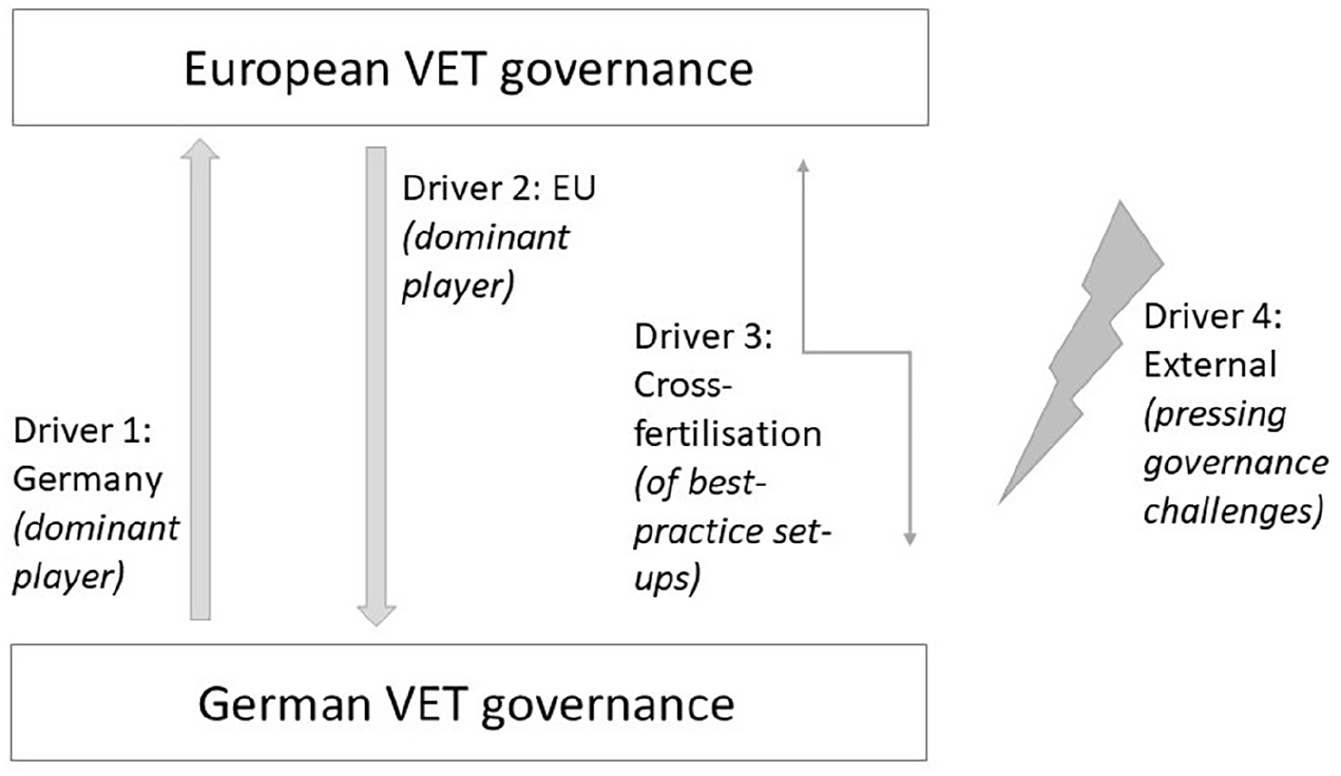
Theorised drivers of VET governance reforms towards alliances for apprenticeships.
Data and methods
To study how VET governance reforms unfold, the following empirical analysis intensively describes (Panke, 2012) the emergence and set-up of the German Alliance for Initial and Further Training and the European Alliance for Apprenticeships. In doing so, it carves out and compares potential drivers in their evolution. Hence, the paper studies the pathway case (Gerring, 2008) of reforms towards alliances for apprenticeships with the two Alliances as nested cases to be analysed and compared in their evolvement and set-up.
The project applies process tracing to ‘diagnose or explain individual or historical cases’ (Bennett, 2008: 4) with a fairly ‘deterministic’ ontological outlook: we expect at least one of the four theorised drivers (in the language of process tracing: mechanisms) to be present but assess this expectation critically in the empirical analysis. Epistemologically, we aim at developing a deep understanding of the case (and its two nested sub-cases) to (dis-)confirm these very mechanisms (Beach, 2016). Our process-tracing analysis focuses on practices (Pouliot, 2015) – that is, institutionalised, recurrent patterns and interactions – and moves beyond exploring the singular causal mechanics of a (more confined) process.
For an in-depth analysis of case evidence (Beach and Pedersen, 2013), we rely on policy documents (EU policy documents, for example, directives, reports or press releases) as well eight semi-structured interviews conducted from late 2019 to late 2021. 1 With interviewees being German and EU civil servants whose work is related to the European Alliance, German Alliance or both, the interviewees are considered experts/elite (Littig, 2009) who can provide us with causal process observations (Collier et al., 2004). We acknowledge that the concept of ‘experts’ who share ‘their’ expertise is questionable: expertise itself is a powerful political tool (Nóvoa, 2013) and interview accounts should not be taken at face value. Nevertheless, the ‘process-oriented interviews’ help us to uncover the organisations’ biography (Tavory, 2020) and to collect causal process observations and thus, particularly meaningful insights from within the process (Collier, 2011). Crucially, our analysis of documents triangulates the interview data and puts the insights received from experts into perspective. We chose a qualitative thematic approach for the data analysis (Flick, 2014), which increases the reliability of results. To this end, relevant pieces in interview transcripts and documents were coded by focussing on extracting themes (Flick, 2014; Maxwell and Chmiel, 2014) related to the theorised drivers and further topics.
In sum, the research project acknowledges that explanations resulting from process tracing are provisional (Bennett, 2008) but exhibit a high level of internal validity. Our process-tracing analysis of our pathway case provides us with deeper knowledge of multi-level VET governance. The results inform theory building and future empirical research by tracing systematic components of a mechanism from this specific case (Beach and Pedersen, 2013: 16). Therefore, the theorised drivers can – as outlined above – inform studies on other education sectors or even soft coordination in other policy fields.
Empirical analysis: Alliances for apprenticeships and drivers in German and European VET governance
To shed light on drivers of alliances for apprenticeships in Germany and at the EU level, we trace the emergence and the structural and thematic set-up of the European Alliance (Section 4.1) and the German Alliance (Section 4.2). In a subsequent more comparative Section (4.3), we discuss the extent to which our study has provided evidence for the four drivers. We find a prevalence of external driving forces of pressing governance challenges that make it possible for both the EU and Germany to trigger separate policy initiatives in line with experimentalist governance.
The European Alliance for Apprenticeships
In the following, we trace the emergence and set-up of the European Alliance, focussing on dominant players throughout the process as well as the structural and thematic set-up of the Alliance. First, it is worthwhile to look at the Alliance’s establishment: the European Alliance for Apprenticeships, renewed in 2020 by the European Commission, was originally launched in 2013 at the WorldSkills conference in Leipzig, Germany (European Commission, 2017b). The launch in Germany suggests an involvement of Germany in its establishment, which could point to Germany being a dominant player and a driver as hypothesised above. However, the empirical analysis did not confirm this link. Neither policy documents on the Alliance’s emergence (e.g. BMBF, 2013a; Council of the European Union, 2013; European Commission, 2018) nor interviewees argued that there has been a clear push by a specific country or actor to establish the European Alliance.
An EU official interviewed argued that „social partners say they initiated it, a colleague also says she initiated it. Germany and others have used [the] WorldSkills [competition in 2013] in Leipzig, the opportunity, to initiate the Alliance. That [Leipzig’s WorldSkills] was in fact a launch event without having planned a follow-up” (Interview_6). Somewhat contradicting this statement, another interviewee (Interview_5) claimed that the European Commission was the player who initiated the European Alliance. Overall, with regards to the European Alliance’s emergence, we see some evidence for the EU (here: Commission) being a dominant player in the Alliance’s establishment, which is not surprising for a policy initiative at the EU level, but we see less evidence for Germany being a dominant driving force.
Second, this leads us to the structural set-up of the Alliance that is intended to enable an increase in the supply of apprenticeships – in countries with and without an established tradition in this form of work-based training (Graf and Marques, 2022). The European Alliance was launched by a joint declaration of European Social Partners, European Commission and the Presidency of the Council of the EU (European Commission, 2017b). Thus, the Alliance resembles Germany’s VET model of bringing together relevant stakeholders in voluntary, decentralised cooperation: following its establishment, the European Alliance has been relying on the proclamation and ultimately implementation of national commitments by 37 countries (as of 2021) and on a growing number (362 as of 2021) of stakeholder pledges (European Commission, 2021a, 2021b). With the focus on voluntary commitments of member states and other, often private stakeholders located at the subnational level, the Alliance functions as an intermediary platform and the Commission acts as orchestrator. The Alliance aims at linking governments, VET providers, social partners and other relevant stakeholders at the European and national levels (European Commission, 2020b).
While this is a striking similarity to German VET governance, a clear driving force (in the sense of a push towards the establishment of the Alliance) or an explicit inspiration (by Germany’s decentralised cooperation model) in the case of the European Alliance is not visible. This has also been confirmed in expert interviews: ‘there is still not enough interface’ (Interview_6) between EU and national level, ‘this is something we also want to strengthen’ (Interview_6). Hence, regarding the general structure of involving various stakeholders, it seems most likely that the Alliance’s set-up is in line with a general trend towards soft policies and coordination (Warleigh-Lack and Drachenberg, 2011). Our analysis of the structural set-up also clarifies the new mode of governance that the European Alliance stands for: following theories on new modes of governance (Héritier and Rhodes, 2011; Walkenhorst, 2008), voluntary, public-private interactions around innovative policy practices are at the centre of the Alliance.
Third, regarding the thematic set-up, the European Alliance was originally established to strengthen apprenticeship training in member states at a time when youth unemployment moved up on the political agenda of both European Commission (Interview_5) and member states. The renewed Alliance of 2020 (European Commission, 2020b) aims to increase VET quality, supply and attractiveness. More generally, in its soft coordination, the European Commission aims to ‘cover the topics of the future’ (Interview_6) and both for the European Alliance and for VET governance in general, interviewees mentioned a shift of the political agenda from a perceived need to tackle youth unemployment to a focus on tackling a skills shortage (potentially to be met by migrants). The two salient political topics imply very different challenges to European skill formation systems, but interviewees agreed that they demonstrate that there is a need – both at the EU level and within member states – for improved apprenticeship training as well as a demand for a dual VET model (Interview_1; Interview_6). This is the case regardless of whether a country focuses more on youth unemployment or on skills shortage.
Thus, a prevalent external driving force of governance mega-challenges is clearly visible for VET governance. For the case of the European Alliance, our analysis shows that the perceived pressure to address these challenges functions as a motivator for establishing (European Commission) and participating in (EU member states) the European Alliance. With regards to specific governance mega-challenges that should be addressed in the Alliance, both interviewees and documents mentioned, among others, innovation and digitisation as pressing topics and also alluded to the European Commission’s Green Deal (e.g. Interview_6; European Commission, 2021c). Furthermore, continuing and lifelong training are mentioned as crucial at the EU level (e.g. Interview_7). The themes are reflected in the Commission’s recent focus on opportunities to re-/upskill and on apprenticeships for adults (European Commission, 2021c) and most importantly, in the aforementioned Pact for Skills of 2020 that now also formally entails the European Alliance. Lastly, a stronger involvement of the regional level in tackling these challenges and a strengthening of local-level networking is alluded to (e.g. European Commission, 2017a).
Finally, with regards to the emergence as well as the set-up of the Alliance, interviewees and documents recurrently mentioned the diversity of European VET systems– and the perceived superiority of dual-training systems. For instance, interviewees emphasise that EU coordination must deal with very diverse apprenticeship traditions in EU member states, ranging from entirely or mostly school-led systems in some member states to national apprenticeship systems where training on the job is key (e.g. Interview_6). As a consequence of these perceived differences, the EU strongly endorses dual systems, which are therefore systems prone to ‘borrowing’ or ‘learning from’ (Phillips, 2004; Steiner-Khamsi, 2004) or even to be benchmarked against (cf. Nóvoa, 2013):
Work-based learning, such as dual approaches, should be a central pillar of vocational education and training systems across Europe, with the aim of reducing youth unemployment, facilitating the transition from learning to employment and responding to the skill needs of the labour market (European Commission, 2012: 7).
Of dual systems, the German system is one prime example, next to some smaller European states (Switzerland, Austria, Denmark and Luxembourg). This implies a potential inspiration that is provided by Germany when it comes to presenting its own dual-training practices at the EU level (Interview_8): they can be framed as ‘most successful practices’ (cf. Nóvoa, 2013), legitimising policy changes. Nevertheless, rather than advocating a direct policy transfer, the European Alliance and EU forums for soft coordination aim at a cross-fertilisation of EU-level and national-level VET governance practices and reforms: ‘you take up an idea’ (Interview_3). Member-states as well as the EU-level perceivably try to adhere to formulated goals: ‘we have the same overarching goal’ (Interview_3) of furthering VET and lowering youth unemployment. This provides some evidence for a cross-fertilisation of German and European VET governance practices, also within the setting of the European Alliance. Most importantly, it shows a shared willingness to address governance challenges that the member-states as well as the EU are confronted with.
In all, having traced the emergence and set-up of the European Alliance for Apprenticeships, our analysis has shown that it was established as an explicit response to governance challenges, and takes up experimentalist forms of governance in its set-up. With the European Commission being able to set the agenda of the Alliance and to push for commitments of member-states and stakeholders, a VET model is endorsed that is in line with work-based training approaches, which dual-training countries such as Germany exhibit. Overall, our process tracing has thus shown a prevalence of external driving forces for the European Alliance – external governance challenges fuelling the set-up of an experimentalist alliance – and it also provided some evidence for cross-fertilisation, but rather within the set-up of the experimentalist policy initiatives like the European Alliance where best practices can be exchanged.
German Alliance for Initial and Further Training
In the following, we trace the emergence and set-up of the German Alliance for Initial and Further Training, shedding light the dominant players as well as its structural and thematic set-up.
First, regarding its establishment, the German ‘Alliance for Initial and Further Training’ was signed in 2014, one year after the European Alliance. In an EU-level document, it is, as mentioned, explicitly referred to as its ‘national equivalent’ (European Commission, 2017b: 66). The timing of the German Alliance’s establishment and its framing as a national commitment point to the EU being a driver of the German Alliance. However, a ‘National Pact for Training and Young Skilled Staff’ had existed in Germany already from 2004 (IAB, 2004). The Pact, periodically renewed in the following decade, was established in a period characterised by a significant lack of apprenticeship positions. It represented a compromise between a legal reform and an informal agreement between the government and employers in order to increase the number of apprenticeship offers (Busemeyer, 2015). The rebranding as ‘Alliance’ in 2014 most likely shows a deliberate borrowing of the name of the new European Alliance rather than a general adoption of a specific European policy idea. The name was not the only novelty, however. The predating Pacts were problematic with respect to the consensus principle found in the VET governance tradition (Busemeyer, 2015), not least as they failed to include trade unions: ‘those were purely pacts between business and the federal state. (. . .) The Alliance was now different. The unions were onboard’ (Interview_4).
This leads us to, second, the structural set-up. The structural set-up of Germany’s Alliance is similar to that of the EU but it was signed by the federal government, businesses, unions, states and the Federal Employment Agency (BMBF, 2013a). While the exact role of the different stakeholders cannot be uncovered using this approach, the policy documents indicate the actors’ willingness to work alongside each other and commit to the Alliances’ goals. Like the European Alliance, the German Alliance integrates a multi-level dimension as it includes a state-level alliance for each of the German states (BMWK, 2021). These 16 state-level alliances mirror the structural set-up of the national Alliance. Both the national and the state-level alliances regularly produce declarations in which stakeholders outline their commitments and activities to enhance the demand and supply conditions for apprenticeship training (e.g. AAW, 2019). Interviewees perceive the emergence of the German Alliance as leading to an intensification of national VET governance (e.g. Interview_4). The Federal Ministry for Economic Affairs, among other ministries, orchestrates the Alliance (see Busemeyer et al., 2022) but is seen as having mainly a ‘moderating function’ (Interview_4). However, this function also implies an agenda-setting role. Furthermore, interviewees mentioned the Federal Ministry for Education as a recent ‘driving force’ (Interview_2).
The experimentalist set-up of the German Alliance and the orchestrating (and thus: agenda-setting) role of the Federal Ministry for Economic Affairs shows that, just like the European Alliance, the German Alliance’s design is in line with theories on new modes of governance. Here, experimentalism is a way to allow policy innovations to emerge on the ground, but the Alliance arguably also pushes certain ‘best’ practices across local contexts, which are perceived as the most successful solutions considering governance mega-challenges.
In line with its own aims, a European Alliance brochure argues that in several countries, ‘key stakeholders have joined forces for a coordinated approach that will lead to better results with increased impact’ (European Commission, 2017a). Countries mentioned in this respect are Germany, Spain and Norway where government and social partners signed a ‘Social Contract on Apprenticeships’ in 2016. Germany’s VET system is regularly cited as a best-practice example and explicitly counted among ‘world-class VET systems’ by the EU (European Commission, 2012) as well as in the scholarly literature (Euler, 2013; Wieland, 2015). However, it is also clear that it most likely gets highly hybridised if being downloaded to other national contexts: a one-to-one transfer of the German apprenticeship model is highly unlikely given the specific institutional corporatist environment in which it is embedded (Euler, 2013). Rather, specific elements of the German VET model can get adopted and translated to the European and individual national contexts (Fortwengel and Jackson, 2016; Graf et al., 2014). In this regard, a cross-fertilisation of German and EU (or other member-states’) best practices within the setting of experimentalist policy initiatives such as the Alliance is possible and desired.
Third, with regard to the thematic set-up, just like the European Alliance was put into practice with an explicit framing of helping to address major governance challenges, the German Alliance has for example, the task to increase the attractiveness and quality of apprenticeships, to support apprentices and their firms, to bring migrants into the apprenticeship system and to increase the permeability between academic and apprenticeship training (AAW, 2019; European Union, 2018). With regards to current policy pressures addressed by the Alliance, the difficulty to match applicants and apprenticeship positions as well as a general academisation have been emphasised in interviews (e.g. Interview_4; Interview_1) and documents (AAW, 2019, 2021). A shift of the political agenda from a perceived need to tackle youth unemployment to a focus on tackling skills shortages as well as a turn towards continuing and lifelong training, observed already at the EU level, are emphasised as important governance challenges (AAW, 2019; European Union, 2018; several interviews). Interviewees and documents mention the National Strategy for Continuing Education as an important tool and the role of digitisation as a critical external political pressure (e.g. Interview_1; AAW, 2019). In this regard, one interviewee described the German Alliance as enabling ‘better visibility’ for pressing challenges in VET (Interview_1). This also points to an important role of external drivers in the establishment of the German Alliance.
Interviewees argued that the pressures of the outlined mega-challenges are ‘more immediate’ (Interview_1) at lower governance levels, while problems are too big to be solved on lower governance levels, let alone by single actors. This is in line with the literature on challenges in VET governance and Germany’s collective skill formation system (Emmenegger et al., 2019; Martin and Graf, 2019), which call for less hierarchical approaches. Such approaches take on an increasingly important role in addressing governance challenges that transcend national borders (Jørgensen et al., 2018). Given pressing governance challenges, Germany’s frequent exchange with other countries in the European context is explicitly intended to further strengthen its own VET system (Bundesregierung, 2015). Germany’s attention to lifelong training (Interview_6) and its dual-training system are best practices Germany can supply to other member states.
In this regard, beyond the emergence and set-up of the German Alliance specifically, it is also worthwhile to consider Germany’s ambition regarding general VET policy transfer. Germany wants to ‘become the export champion in the area of education services’ (BMBF, 2015) and the dual-training system should serve ‘as reference model in Europe and worldwide’ (BMBF, 2013b). Export initiatives are supported by a specific agency, ‘iMOVE: Training – Made in Germany’ (BIBB, 2019) as well as the German Office for International Cooperation in Vocational Education and Training (GOVET). The ‘apprenticeship export’ (DLR, 2015) should ideally enable a ‘leverage effect’ for the German industry since the export of industrial goods often requires well-trained workers in foreign countries.
Evidence for the importance the German government assigns to VET transfer are also found in official guidelines for the support of VET internationalisation: Germany makes major funds available to organisations involved in promoting the German apprenticeship model abroad (BMBF, 2017). Germany’s dual system is explicitly mentioned as a source of policy borrowing in Portugal’s ‘apprenticeship (dual) system’ (European Commission, 2021c). The German government also signed a memorandum with six European countries (Greece, Italy, Latvia, Slovakia and Spain) in 2012 to promote VET cooperation and apprenticeship training – partly to tackle youth unemployment after the financial crisis (BIBB, 2015). German bureaucrats interviewed emphasised that there are delegations coming from other countries who specifically want to learn about Germany’s VET system. Regarding policy reforms at the EU level, countries with a dual system of VET developed the ‘Apprenticeship Toolbox’, among them Germany (Interview_5). However, this toolbox does not represent a European policy but rather an EU-funded source of information provided by these countries.
Beyond our specific case, these examples show that Germany aims at pushing VET governance reforms in other European countries. However, this has so far mostly been carried out through bilateral exchange (BIBB, 2015). Our analysis finds no strong evidence that Germany has been a driving force in shaping VET governance reforms specifically towards alliances through EU-level cooperation. In all, the analysis highlighted a prevalence of external pressures as driving forces in the establishment of the German Alliance. The set-up of the Alliance follows previous policy initiatives and, in global comparison, is in line with German corporatist VET governance. With regards to the inherent experimentalist mode of the German Alliance, a parallel evolvement of German and European governance reforms in light of pressing governance mega-challenges has been revealed.
Drivers for German and EU VET governance reforms
For governance reforms at the EU level to be driven by Germany, based on our theoretical framework, we have expected interviewees and documents to explicitly mention an influence of German governance practices on the establishment or configuration of the European Alliance for Apprenticeships. Our analysis has shown that Germany is perceived as one of several best-practice VET systems and that there is evidence for Germany’s willingness to supply good practices to other countries. In fact, Germany aims at facilitating VET governance reforms in other European countries. However, for the case of the European Alliance, we have found no evidence for a strong push by Germany. Rather, our analysis has shown that Germany promotes VET reforms abroad, but it does so most often bilaterally (BIBB, 2015) and often in a wider international sphere than in specific EU forums (Graf et al., 2014). Nevertheless, the EU endorses dual VET systems and Germany has exactly this system on offer (e.g. European Commission, 2012), which means that it can supply best practices to the EU level. This points to an influential standing of Germany, not necessarily in the specific case of the European Alliances’ evolvement, but more generally in terms of lending its dual-training model to other contexts.
For VET governance reform to be EU-driven, we have expected interviews and documents to make the influence of the EU level in the evolvement of the German Alliance for apprenticeships explicit. While the German Alliance was signed one year after the launch of the European Alliance and has a very similar set-up, we have found no evidence that the German Alliance is EU-driven: With its origin in the preceding National Pacts (IAB, 2004), the Alliance’s coordination set-up evolved prior to the establishment of the European Alliance in the domestic arena. Policy makers were seeking new ways to orchestrate the provision of apprenticeship offers with the relevant stakeholder groups (Busemeyer et al., 2022). The fact that the German Alliance is mentioned as national commitment and a good practice at the EU level hints to some extent at a cross-fertilisation of specific VET practices.
In the case of a cross-fertilisation of the EU and German VET governance model, we expected from our theorisation that a mutual influence of German and EU governance reforms is expressed in empirical materials. Our analysis has revealed that regarding the Alliances neither Germany nor the EU constitute clear drivers in each other’s VET governance reforms. Yet, our empirical analysis shows that within the EU, Germany’s VET governance model is established as a best-practice system embedded in a specific institutional environment of decentralised cooperation. This, in turn, provides some evidence for VET best practices cross-fertilising each other and being adapted to a specific context, which is something explicitly aimed for in EU soft coordination.
For a prevalence of external drivers, we have expected to see recurrent references in interviews and policy documents to political and socioeconomic mega challenges as well as a perceived need to find novel policy responses. Our analysis has provided strong evidence for the important role of external challenges. On the one hand, we have shown that both the German and the European Alliance share the explicit framing of addressing complex governance challenges. On the other hand, complex governance challenges call for specific, new modes of governance, which our analysis has found both at the EU and the German level. Interviewees and documents at both levels also mentioned the shifting nature of policy pressures that need to be addressed – ranging from a need to tackle youth unemployment to a perceived focus on skills shortages. In this regard, our research has also touched upon topics to be studied in the future, for example, how the Alliances facilitate ‘policy legitimation’ (Tveit and Lundahl, 2018) in VET governance at the EU and national level. Likewise, tensions that exist in the multi-actor setting of the Alliances are worthwhile exploring further (see Fumasoli et al., 2018).
In sum, we find the most support for external drivers in the form of governance mega-challenges, indicating that the European and German Alliance were established at the same time but largely independently from each other. The main reasons for their establishment are that VET systems are faced with an unprecedented scale of complex policy problems that create uncertainties about the best way forward and that, hence, new modes of experimentalist governance are needed. In this setting, cross-fertilisation as well as learning from best practices (e.g. Germany’s dual-training practices) can take place, but the impetus for the evolvement of each Alliance at roughly the same time is mainly an external one, driving similar, yet mostly independent developments at the EU and national level.
Conclusion
In this paper we were concerned with governance reforms in skill formation in the European multi-level context. Exploring the case of alliances for apprenticeship training, we have theorised four possible drivers to explore the evolution of recent VET governance reforms in Germany and at the EU level. We contend that these four alternative drivers can inform future research – for example, on national VET governance structures in other EU member states, further educational sectors embedded in the multi-level governance structure of the European education area, or other nationally dominated policy fields in which European soft coordination takes place. Applying the theorised driving forces to governance settings of education and training and beyond ultimately helps to uncover the diagnosed black box (Souto-Otero, 2015) of European policymaking. The systematisation of drivers (top-down, bottom-up, cross-fertilising or external drivers) informs theory-building on similar multi-level settings. Future research could also study in more depth the role of specific stakeholders ‘within’ a certain driving force.
For the alliances for apprenticeships, our analysis has provided most support for the prevalence of external driving forces. That is, the Alliances at the EU and German level have emerged separately from each other driven by governance mega-challenges VET systems face. General VET governance reforms to deal with uncertainties in view of increasingly complex policy problems make it possible for both the EU and Germany to trigger (or even pressure towards, e.g. through benchmarking) parallel policy innovations inspired by joint experimenting and best practices. The evolving experimentalist setting still gives leeway to Germany (and other dual-training member-states) to present itself as a most successful practice other countries could be benchmarked against (Nóvoa, 2013), that is, a best-practice VET system and a pioneer of the EU’s focus on dual training.
In line with previous research on EU education policy (e.g. Antunes, 2016; Eeva, 2021; Elken, 2017; Gornitzka, 2006, 2015; Lange and Alexiadou, 2010), our paper has provided further evidence that also in this specific case of VET governance, EU governance takes the shape of Commission-orchestrated soft coordination with room for member-state policy learning and cross-fertilisations. While we have not observed a clear cross-fertilisation for the Alliances’ evolvement specifically, this study has shown that national VET systems and their diverse actors make use of mutual, best-practice learning. Both Alliances fuel this through their experimentalist set-up. Given that VET systems are closely interlinked with economic as well as social policies, member states (even those exhibiting exemplary VET systems) as well as the EU can gain from VET soft coordination to achieve policy learning and ultimately address mega-challenges across governance levels.
In all, our analysis has shown that in multi-level governance systems, new modes of governance – of which both Alliances are a case – do not necessarily emerge in a clear top-down or bottom-up manner. While parallel developments in governance reforms may give such an impression, governance mega-challenges have a significant impact on such reforms at each level separately. With its process-oriented focus (on driving forces that condition novel policies), our analysis has provided more general insights into the drivers of governance reforms in multi-level systems – of which European education governance is a prime example. The prevalence of external governance challenges, however, is not contradictory to the possibility of both governance levels – national and European – still benefitting from cross-fertilisations of specific practices. This is particularly the case in complex policy arenas like education, in which multiple public and private stakeholders are closely interlinked and can make use of mutual learning from best practices.
Footnotes
Declaration of conflicting interests
The authors declared no potential conflicts of interest with respect to the research, authorship, and/or publication of this article.
Funding
The authors received no financial support for the research, authorship, and/or publication of this article.
