




Abstract
International student mobility (ISM) prepares young people for the challenges of global and multicultural environments. However, disadvantaged students have lower participation rates in mobility schemes and, hence, benefit less from their positive impacts on career progression. Therefore, policymakers aim to make mobility programs more inclusive. Nevertheless, it is far from clear how policy design can achieve this aim. This study investigates factors driving inequality in international student mobility uptake. The study’s novelty is twofold: first, in contrast to most existing studies it does not only investigate individual but also university characteristics as possible drivers of unequal uptake. This is possible due to the use of rich graduate survey and administrative data merged with university-level European Tertiary Education Register (ETER) data. Second, the study compares results across four European countries. Results show that the socio-economic mobility gap remains still sizable even when taking university characteristics into account. However, universities matter considerably and especially student compositions in terms of socio-economic background and ability contribute to unequal ISM uptake. As a consequence, intergovernmental policies should aim to distribute grants and mobility opportunities more equally across all universities, independent of their student composition.
Keywords
Introduction
International student mobility (ISM) has become popular over the last three decades. In this study we focus on a specific part of ISM that has been defined also as “credit mobility” or “exchange mobility”: the temporary study abroad period during enrollment in a higher education degree program at a home university. This is different to degree mobility, where students enroll in and graduate from an entire study program abroad (De Wit, 2008).
In Europe, the most well-known program fostering ISM is Erasmus+ (previously called Erasmus), which was inaugurated in 1987. Data from 2018/19, the most recent available, indicate that almost 340,000 students participated in the program. In Germany and Italy, this was more than 40,000 students, in the UK about 18,000, and in Hungary about 4000 (European Commission, 2019).
How important are Erasmus+ mobilities for overall ISM, which is the focus of this paper? In 2016, Erasmus+ student numbers for the UK and Germany accounted for about 50% of the total ISM that took place that year; for Hungary the figure is 98% and for Italy 83% (European Commission, 2018, Figure 44; Schnepf and Colagrossi, 2020).
The advantages of participation in ISM are often related to individual gains like personal development, the opportunity to improve language skills, interest in foreign countries and cultures (Findlay et al., 2012; Van Mol and Timmerman, 2014; Wiers-Jenssen, 2019) and increased labor market opportunities (D’Hombres and Schnepf, 2021). ISM policies therefore serve as a social investment to prepare young people for the challenges they face in today’s globalized and multicultural environment.
Nevertheless, it is well known that students from lower socio-economic backgrounds are less likely to take part in mobility abroad schemes (i.e. Hauschildt et al., 2015), a pattern that has not shown any improvement over time (Di Pietro, 2022). Given this socio-economic gap in uptake, it is mainly the better-off students who benefit from ISM policies. Hence, ISM policies may contribute to existing social stratification in Europe (Netz and Finger, 2016), in contrast to the intentions of policymakers. To counteract this, policymakers have introduced an inclusion and diversity strategy, which emphasizes the need for a more inclusive Erasmus+ programme (European Commission, 2021). However, it is far from clear how policy design can achieve this aim. One precondition for effective policy design is to understand the mechanisms driving the unequal uptake of ISM.
Exploiting rich graduate data merged with European Tertiary Education Register (ETER) data for four European countries (Germany, Hungary, Italy, and the UK), this study investigates the determinants of the socio-economic gap in the uptake of Erasmus+ grants cross-nationally. This paper’s contribution to the literature is twofold. First, the study adds to the scant literature (to our knowledge limited to Di Pietro, 2022; Di Pietro and Page, 2008; Netz, 2015; Van Mol and Timmerman, 2014) examining factors correlating with mobility uptake and factors being able to explain the uptake gap in a cross-national perspective. Second, the existing literature explains unequal uptake predominantly by focusing on individual characteristics, thereby assuming that individuals’ choices drive unequal uptake. However, student mobility uptake depends on opportunities provided at universities (Bilecen and Van Mol, 2017). Universities may not only influence students’ decision to take part in an international mobility program but more importantly determine their actual opportunities of participation. This study examines, in addition to individual factors, the importance of university characteristics, especially universities’ student composition.
To the knowledge of the authors, there are currently only four studies comparing the association between socio-economic background and mobility uptake across different countries: Van Mol and Timmerman (2014) investigate Austria, Belgium, Italy, Norway, and Poland; Di Pietro and Page (2008) examine Italy and France; Netz (2015) focuses on Austria, Germany, Switzerland, and the Netherlands; and Di Pietro (2022) looks at Italy, France, and Germany. All these studies conclude that the country context matters. However, potential country determinants of unequal uptake are more numerous than these studies can look at with such small samples of countries. Since this study focuses only on four countries, it faces similar limitations. It therefore addresses the similarities in the results across four very different countries. Germany, Hungary, Italy, and the UK vary greatly in their historical, cultural, geographical, and social contexts, as well as in their education systems and labor market structure, which may potentially be important for ISM uptake (Caruso and de Wit, 2015). By comparing four diverse European countries, this study explores cross-country similarities in factors associated with the gap that would justify an intergovernmental policy approach to reduce barriers for disadvantaged students in participating in ISM.
The remainder of this paper is organized as follows. The next section reviews the existing literature and discusses possible mechanisms in driving unequal uptake. This is followed by a description of the data and methodology employed. Then the study’s results are presented. The final section offers a discussion of these.
What are potential drivers of unequal participation in ISM? Theory and literature
Individual level factors
Theories explaining the socio-economic mobility gap are very well developed and described in the literature (i.e. Netz and Finger, 2016). In short, rational choice theory (i.e. Breen and Goldthorpe, 1997) predicts that students with a lower socio-economic background have to bear higher costs and risks for participating in ISM than better-off students. This is confirmed by research showing, for example, that the disadvantaged evaluate studying abroad as less beneficial than their advantaged counterparts (Lörz et al., 2016), which might well be due to especially underprivileged students receiving less financial support from their parents (Hauschildt et al., 2015). Most of the students in the four countries we investigate are Erasmus+ students. Erasmus+ grants cover experiences between 3 and 12 months in duration and only aim to provide additional living expenses associated with living abroad. They provide students with around 300 Euros per month but this can be increased by between 100 and 200 Euros for students from poorer socio-economic backgrounds (i.e. European Commission, 2020). Still, students with limited financial means are unlikely to be able to afford ISM. Orr et al. (2011) show that disadvantaged students perceive the lack of finances to cover additional costs of mobility as one of the most important barriers to participating in a mobility program.
Cultural reproduction theory and the notions of social and cultural capital (i.e. Bourdieu, 1986) emphasize disparities in the access to non-material resources. For example, compared to disadvantaged students, better-off students can rely on superior language skills (Lörz et al., 2016) and information on mobility schemes since their parents are more likely to have lived abroad (Wiers-Jenssen, 2011). Together with greater economic resources, this facilitates privileged students’ decisions to study abroad.
Likewise, ability is discussed to be an important driver of unequal ISM enrollment. At least as far as Erasmus+ mobilities are concerned, the majority of ISM mobilities in Europe, universities tend to distribute grants to students on the basis of their performance. It is also very likely, that other ISM opportunities organized at the university level are linked to performance criteria. Since disadvantaged students perform, on average, worse than their privileged peers (Chmielewski, 2019), their chances of meeting universities’ performance-based selection thresholds are lower (Granato et al., 2021). Therefore, it is important to investigate how much ability can explain unequal uptake.
Other individual characteristics are discussed to be associated at least unconditionally with higher mobility uptake, like being female, different ethnic groups and lower age of students. (For an indepth literature review see Netz et al., 2020.) In contrast to ability, however, none of these factors is likely to be associated with the socio-economic achievement gap.
Hypothesis 1:
For all four countries, ISM uptake is unequal across students with different socioeconomic backgrounds. Differing ability can explain some part of unequal student mobility uptake.
University level factors
Recently, the focus on explaining unequal mobility uptake entirely through individual characteristics and choices has been criticized and the need to examine the role of university characteristics has been discussed (Van Mol, 2017). As a matter of fact, students are embedded into universities which may influence student decision to take part in an international mobility program, but also determine their actual opportunity to participate. Nevertheless, not much is known about the importance of university characteristics for mobility uptake and explaining its socio-economic gap, given that—to the knowledge of the authors—only two studies so far consider universities for ISM: Netz (2015) and Schnepf and Colagrossi (2020).
Why are universities potentially of importance? Once students are enrolled in a specific university (the individuals’ choice of which is likely to depend on universities’ study program) their mobility uptake will depend on the universities’ availability of ISM. Universities differ greatly in the extent they offer student mobility (Schnepf and Colagrossi, 2020). Being enrolled in a university that engages less on international mobility, will clearly decrease students’ opportunities. If opportunities are lower, it is generally the disadvantaged who lose out more.
In addition, whatever ISM program students want to choose, they can only visit those faculties of host universities with which their university has signed an inter-institutional agreement of student exchange. Therefore, more prestigious universities are likely to be more successful in negotiating agreements with renowned exchange universities (Robson, 2011), so that university excellence is likely to impact on ISM opportunities. However, existing literature discusses controversially whether higher excellence could crowd out high-quality teaching and student support which are also important especially for students from lower socio-economic backgrounds (Mitten and Ross, 2018). Netz (2015) finds that students from more prestigious universities (as opposed to practice-oriented institutions like “Fachhochschulen”) in Austria, Germany, Switzerland and the Netherlands are not more likely to study abroad. In contrast, for the UK, the unconditional association of more prestigious Russell Group (in contrast to non-Russell Group universities) with higher mobility uptake only disappears once university characteristics (especially social segregation) are controlled for (Schnepf and Colagrossi, 2020).
Hence, besides university excellence, social segregation in universities might be an important factor impacting on uptake and unequal access to ISM. With the number of students in universities growing, higher education systems also get increasingly stratified, offering diverse opportunities ranging from elite institutions and fields with high labor market benefits to mass education with more uncertain outcomes. Both cultural reproduction theory (Bourdieu, 1986) and rational choice theory (Breen and Goldthorpe, 1997) suggest that in mass higher education, high-status students try to secure their social advantages by seeking high-prestige institutions and fields of study. As a consequence, prestigious universities may be characterized by a greater share of students from higher socio-economic backgrounds, to which they manage to offer a greater number of student mobility grants. This combination would provide better-off students a greater chance of studying abroad. Indeed, Schnepf and Colagrossi (2020) show for the UK that ISM uptake is greater in universities that either recruit a larger share of high performers or a smaller share of students from lower socio-economic backgrounds.
Besides social-segregation and university excellence, other university characteristics could be important as well. Universities’ student support for mobility applications especially for the disadvantaged could be of importance. However, this information is generally not available in graduate surveys. The more staff a university has, the lower the teaching load and the greater the university fees the bigger could be the student support. However, the association of student mobility support with these characteristics is not established. So, while it is important to account for these university characteristics, we cannot be sure how much they can proxy student support. Furthermore, university characteristics like the quality and quantity of inter-institutional arrangements could impact on the socio-economic mobility gap. However, information on this is generally not available. As a consequence, given current data limitations we can only estimate the association of a small number of university characteristics with ISM uptake.
Hypothesis 2:
For all four countries the unequal ISM is associated with university characteristics, specifically with universities’ student composition and excellence.
An intermediate level between individual and university is field of study which is associated with both, socioeconomic status and mobility uptake, the reasons of which can be manifold. These include the tendency of advantaged students being more likely to choose prestigious fields of study (Triventi, 2013) or different traditions and reasoning behind mobility uptake by students from different fields of study (Hovdhaugen and Wiers-Jenssen, 2021). Schnepf and Colagrossi (2020) show for the UK, that disadvantaged students cluster in those fields of study that have on average lower mobility uptake, like for example, education, nursing or communication studies. Given that fields of study are clustered in universities, it is challenging to disentangle whether it is university or field of study characteristics that are more important. For the UK, fields of study into which disadvantaged students enroll are still linked with lower mobility uptake even conditional on social segregation in universities. This shows the need to take field of study into account for any analysis that investigates the importance of university factors for unequal uptake.
Data and methodology
Data
This study exploits four country-specific graduate data sources with very similar variable coverage: the Deutsche Zentrum für Hochschul- und Wissenschaftsforschung (DZHW) Graduate Panel (Baillet et al., 2017), the Hungarian Graduate Career Tracking System (HGCTS; EDUCATIO, 2015), the Italian National Institute of Statistics (ISTAT) University Graduates Vocational Integration (ISTAT, 2016) and the UK Higher Education Statistics Agency (HESA) graduate data (HESA, 2014). Table 1 summarizes the main characteristics of the data sources (Supplemental Appendix A1 and A2 provide an in-depth description of the data sets and the variables used).
Graduate data sources by country.
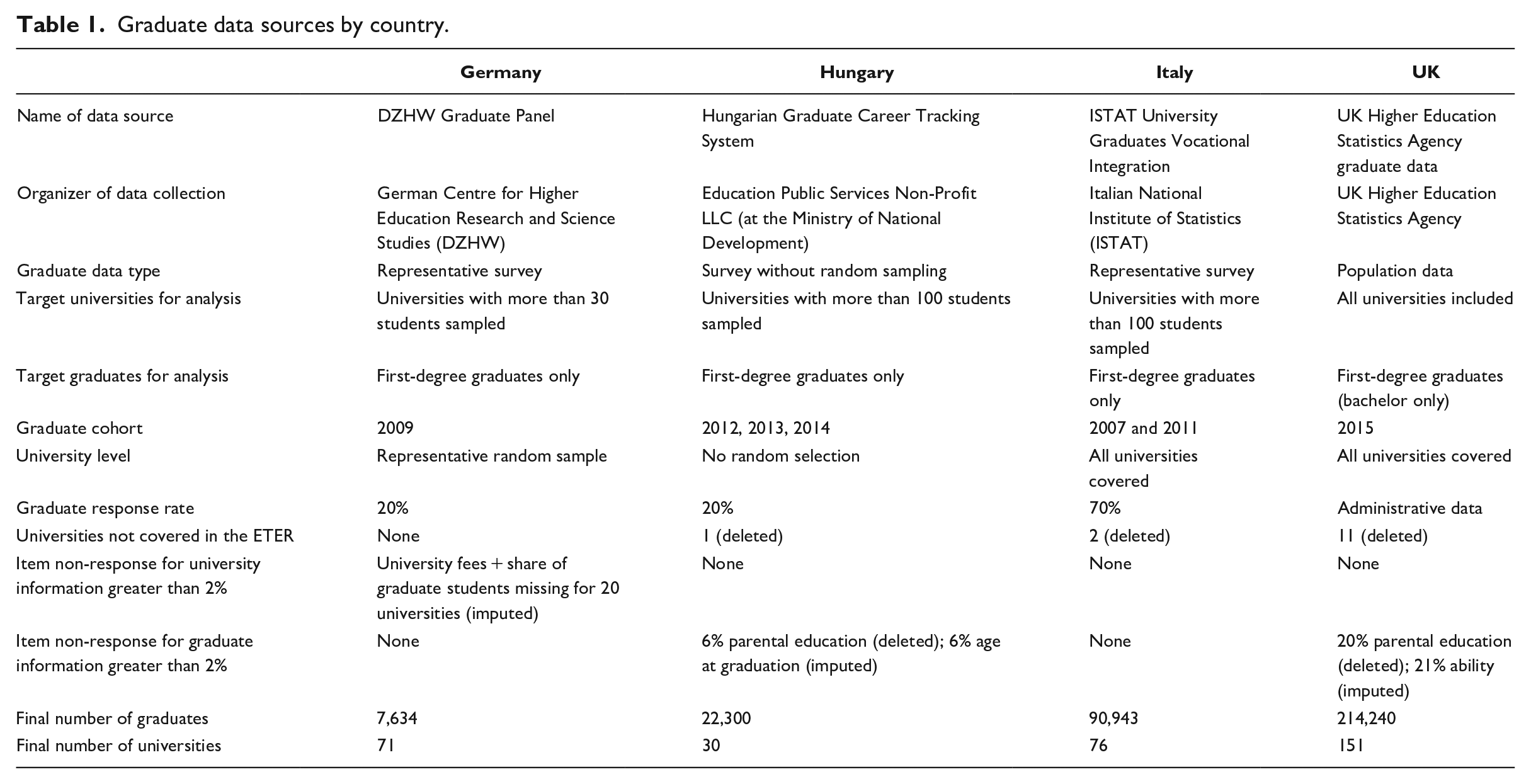
Graduates investigated pertain to the graduation years 2009 in Germany, 2007 and 2011 for Italy, 2012–2014 for Hungary, and 2015 for the UK. The funding structure and implementation of the Erasmus higher education mobility program has not changed greatly during this maximum 8-year difference between cohorts as a comparison between the program descriptions covering the time frame of data collection shows. The UK’s data quality is highest given the use of administrative data on all graduates. Representative graduate surveys are used for Germany and Italy. While German data collection employs two-stage cluster sampling at the university and graduate level, the Italian ISTAT survey uses a sampling frame comprising all graduate students from which it randomly samples. In Hungary, universities could voluntarily participate in the survey. Universities that opted in cover 90% of the graduate population. The graduate response rate is high in Italy, at 70%, but very low in Germany and Hungary, just around 20%. The results presented adjust for a possible unit non-response bias with weights, which are correlated with the inverse of the respondents’ probability of responding to the survey (more information can be found in Table A2.1 of Supplemental Appendix A2). Given the high non-response rate, we cannot claim that our data in these two countries are representative.
The item non-response of graduates is generally negligible, with the exception of a small number of variables in Hungary and the UK. In Hungary, 6% and in the UK 20% of graduates are missing information on parental education. These graduates are not taken into account for the analyses. In addition, 6% of graduates in Hungary lack information on age at graduation and 9% in the UK on upper secondary school results. We impute the mean and create additional imputation variables that are equal to 1 for individuals for which data were imputed. These dummy variables are insignificant for all models except one (Hungary for age; see Tables A4.2 and A4.4 in Supplemental Appendix A4). Supplemental Appendix A5 shows that the results are robust to either using imputation or running the regressions excluding graduates with missing data in the UK.
Students who have at least one parent having completed tertiary education are considered to have a higher socio-economic status compared to those without any tertiary educated parent. This uni-dimensional measure of socio-economic status has a number of disadvantages, for example differences between countries in terms of tertiary education enrollment level and definition of what tertiary education constitutes (for more details see Jerrim et al., 2019).
Our data sets are unusually rich by also including information on student ability, a variable available for three countries. For Italy and Germany, students below the 25th percentile in the continuous upper secondary school degree, and in the UK students who did not achieve at least one A grade for their A-levels, are defined as having lower ability. For Hungary, we proxy ability by the type of secondary school attended.
Our data set does not contain information on students’ financial resources and language skills, two variables discussed as important determinants of mobility uptake. Socio-economic status and ability might be correlated to some extent with both of these unobservables (Bourdieu, 1986). Nevertheless, the general lack of these variables across European graduate surveys is a limitation for representative European ISM studies.
All four data sources include university identifiers, making it possible to take the clustering of students in universities and country-specific university types into account. For each university in each country we can calculate two segregation measures: the percentage of students with low ability and the percentage of students with low parental education (see Tables A2.2 and A2.3 in Supplemental Appendix A2). It is important to note that these university statistics, being based on student survey data (which is the case for Germany, Hungary, and Italy) and used as explanatory variables in a regression design, are subject to sampling variation. This leads to a measurement error. As a consequence, for the calculation of these segregation measures, we only consider universities with 100 or more sampled students so that possible downwards bias toward zero of estimated university group coefficient is limited (Hausman, 2001).
In order to measure university excellence, we add to our data the Shanghai Ranking of universities, regarded as one of the most influential and widely observed university rankings (Docampo and Cram, 2014). Furthermore, we also receive another measure of research excellence (% of papers published by university staff that are included in the top 10% most cited journals) by merging our data with the 2014 European Education Tertiary Register (ETER). ETER provides also additional university-level information (Daraio et al., 2017) important to condition on: like size of universities, student teacher ratio and student fees. In the UK, 11 universities, in Hungary 1 and in Italy 2 are not covered in the ETER. These graduates are not considered for the analysis.
For Germany, we merge different cohort data (in addition covering 2005 and 2013 cohorts, see Supplemental Appendix A1.1) to estimate university characteristics, thereby achieving larger sample sizes, which is important to minimize measurement error. However, for cross-national comparison purposes, the analysis is based only on 2009 data. Multilevel modeling requires a minimum number of about 30 observations at level 1 (Maas and Hox, 2005), we therefore exclude about 50% of universities because these had fewer than 30 students sampled. As a result, the sample size of students decreases by about 10%. Supplemental Appendix A1.1 shows that the exclusions lead to a slightly positively selected sample of students.
The final sample covers 7634 graduates in 71 universities in Germany, 22,300 graduates in 30 universities in Hungary, 90,943 graduates in 76 universities in Italy, and 214,240 graduates in 151 universities in the UK.
Methodology
In order to investigate the unequal uptake of ISM, we first run single-level logistic regressions not taking university-level factors into account.
Let

Then, the probability of student mobility by a logistic model for mobility participation

where
Considering university characteristics, we employ a multilevel approach. This approach also allows us to estimate the variance partition coefficient (VPC), which provides the proportion of variation in the underlying student mobility propensity that is due to differences between higher education institutes. Results on the importance of universities on student uptake measured across four countries is novel in the literature of student mobility, which has focused predominantly on the association of student factors with mobility uptake only. The multilevel model can be written as follows.
Let

Then, the probability of student mobility by a general two-level random coefficients logistic model for mobility participation

where
Table A2.0.1 in the Supplemental Appendix describes the variable definitions, and Table 2 provides descriptive statistics by country.
Descriptive statistics.
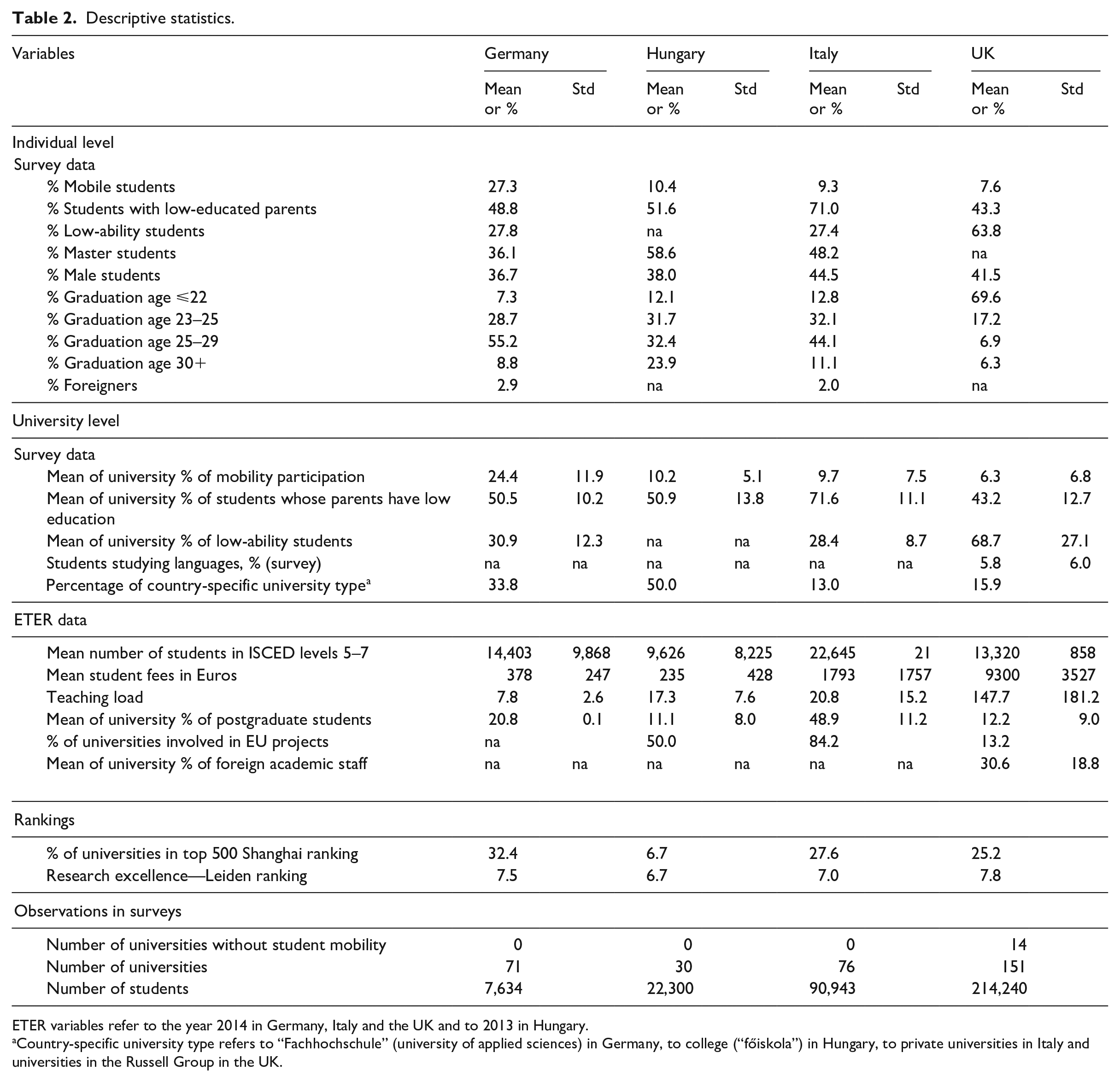
ETER variables refer to the year 2014 in Germany, Italy and the UK and to 2013 in Hungary.
Country-specific university type refers to “Fachhochschule” (university of applied sciences) in Germany, to college (“főiskola”) in Hungary, to private universities in Italy and universities in the Russell Group in the UK.
Results
In the following, advantaged students are defined as those having at least one parent with a tertiary degree, and disadvantaged students are those whose parents did not study at higher education institutes. On average, around 70% of Italian graduates, 50% of German and Hungarian graduates, and 40% of UK graduates are disadvantaged following this definition (see Table 2).
How big is the differences in mobility uptake between advantaged and disadvantaged students? Figure 1 focuses on the level of mobility for both groups. For example, in Germany 35% of students with highly educated parents but only 24% of students with less educated parents take part in ISM, a 9 percentage point difference in mobility uptake. As expected, this gap is considerably large in all four countries. It is also important to consider the ratio gap. In Italy and the UK, graduates with at least one parent who completed tertiary education are about twice as likely to take part in mobility schemes compared to graduates with less educated parents. In Hungary, the disadvantaged are even worse off, while the relative gap is smallest in Germany. It is these level and ratio gaps that lead to the literature stating that ISM may conserve social stratification by distributing mobility advantages predominantly to better-off students.
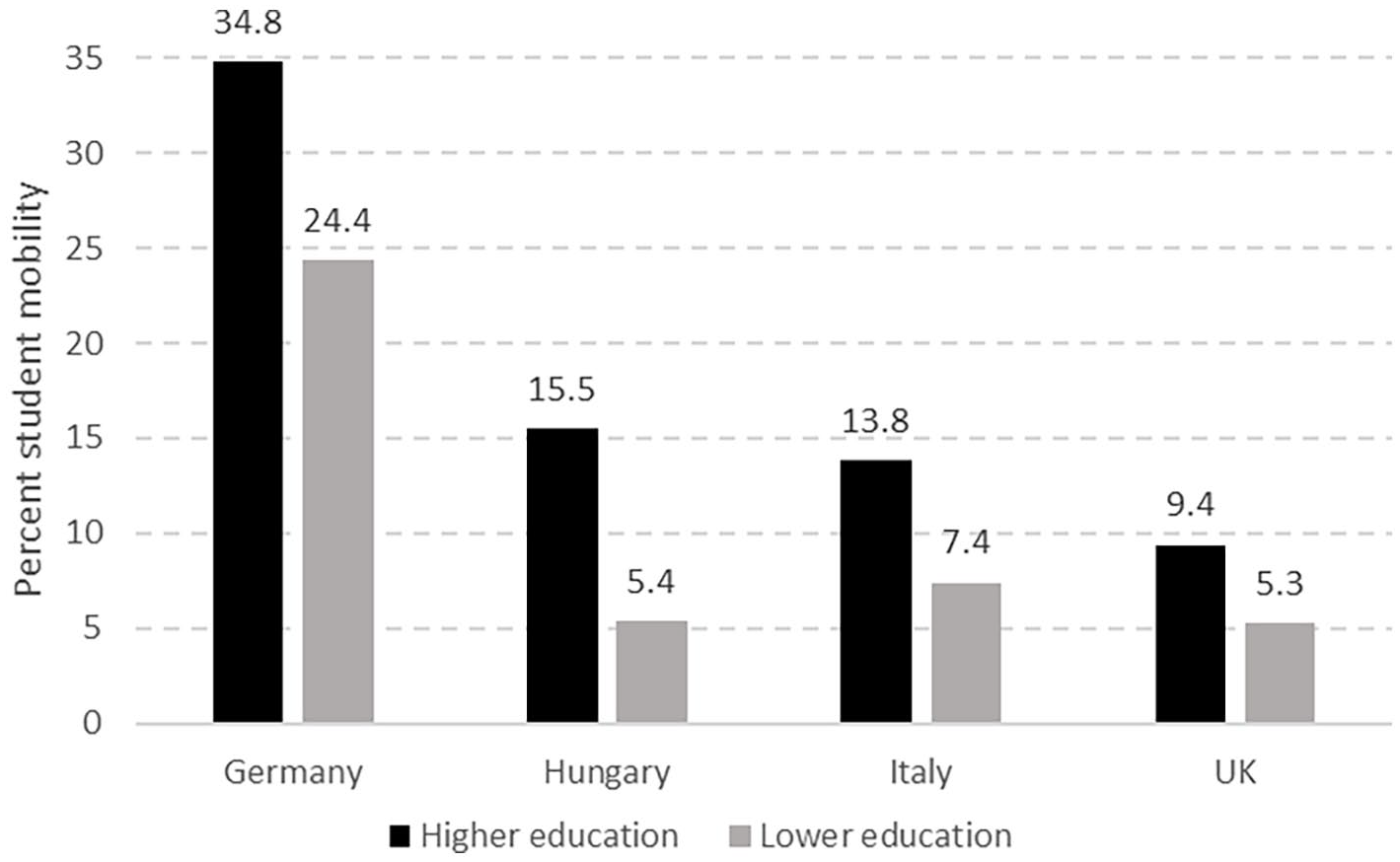
Student mobility by parental education and country.
As discussed above (Hypothesis 2), universities’ student body and excellence could be of importance in explaining unequal mobility uptake. Disadvantaged students could be clustered in universities where mobility opportunities are lower. Figure 2 sheds light on this distributional pattern, displaying the percentage of mobile university students on the y-axes. Obviously, within countries universities differ greatly in the share of students they send abroad. For example, in Germany mobility uptake varies between as much as 5% and 60% and in the UK between 0% and 30%, depending on the universities students attend (see Table 2 for means and standard deviations of mobility uptake in universities). This can indicate both, different university policies with regard to fostering ISM as well as their varying success in bidding for mobility grants.
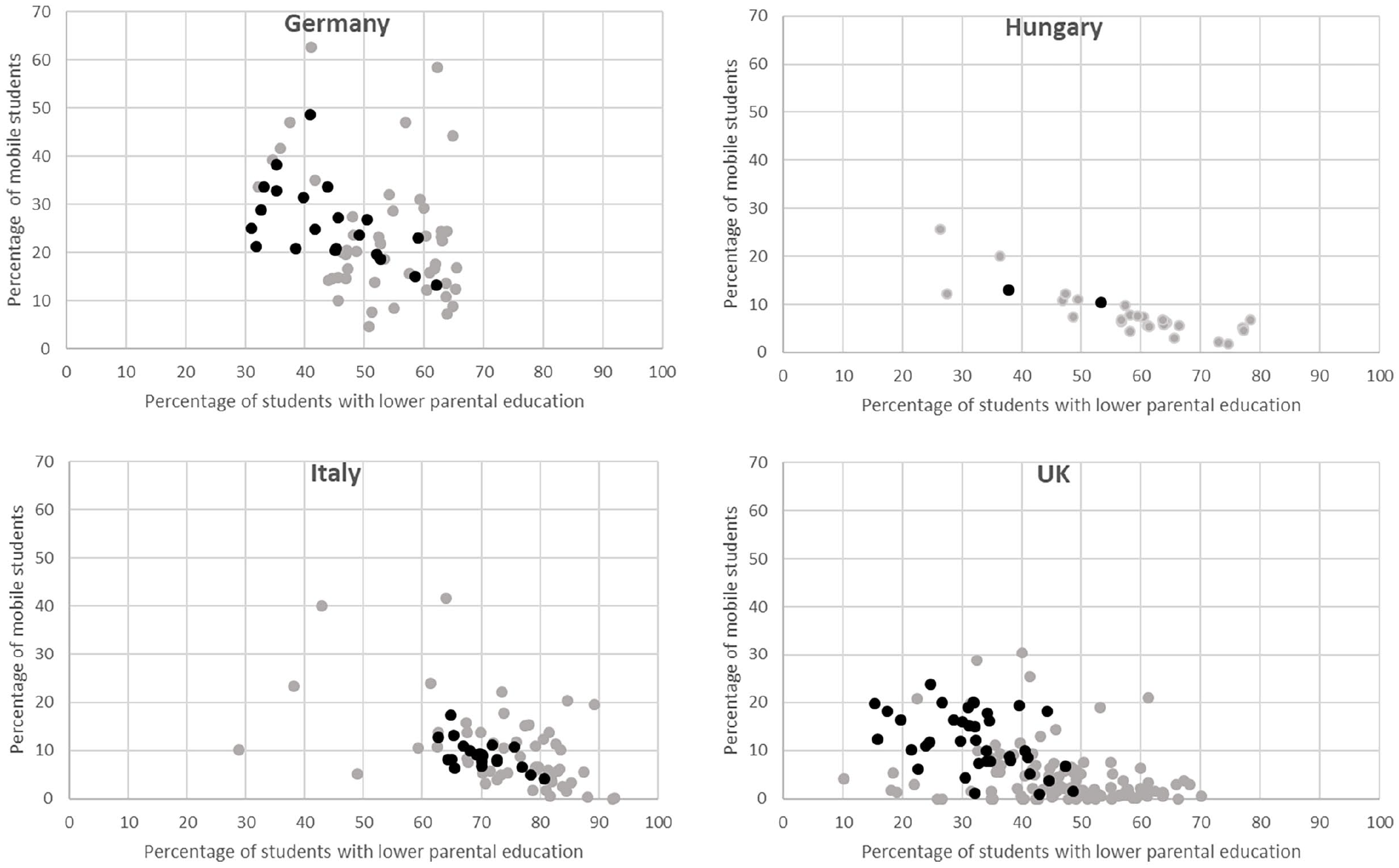
Percentage of ISM and percentage of students with low parental education by university and country.
The x-axis presents the percentage of disadvantaged students in universities. Across all four countries, universities attended by a higher share of disadvantaged students have a lower average mobility uptake, with a correlation coefficient of −0.83 for Hungary, −0.47 for the UK, −0.46 for Italy, and −0.34 for Germany.
This negative correlation between universities’ average student mobility is similar if social segregation is defined by student ability (calculating the percentage of students with low upper-secondary school results enrolled in universities; see Table A2.3 for descriptive results in the Supplemental Appendix) and remains significant even conditional on a variety of university characteristics (given OLS regression results, available from the authors).
Given that disadvantaged students tend to study in universities with lower mobility uptake, this overall unequal student distribution drives some of the overall socio-economic gap in mobility uptake.
Does university excellence matter? The graph indicates more prestigious higher education institutes (here defined as those being among the top 500 universities in the world according to the Shanghai Ranking) in black. Clearly, more prestigious universities tend to offer more mobility opportunities than their counterparts.
However, these university variables are unconditional on individual and other university variables that could be of interest (like university size and student fees). To examine these associations, nested logistic (multilevel) regressions are applied with the dependent variable of student mobility (coded as one if students were mobile). Table 3 provides a selection of coefficients; these are drawn from full model results provided in Supplemental Appendix A3 for all countries. Coefficients for all models presented refer to average marginal effects, from which we can derive the percentage point change in ISM uptake if the explanatory variables change by one unit. All continuous variables are scaled as proportions.
Selection of logistic and multilevel regression coefficients (marginal effects) for different nested regression models by country. Dependent variable: student ISM uptake.
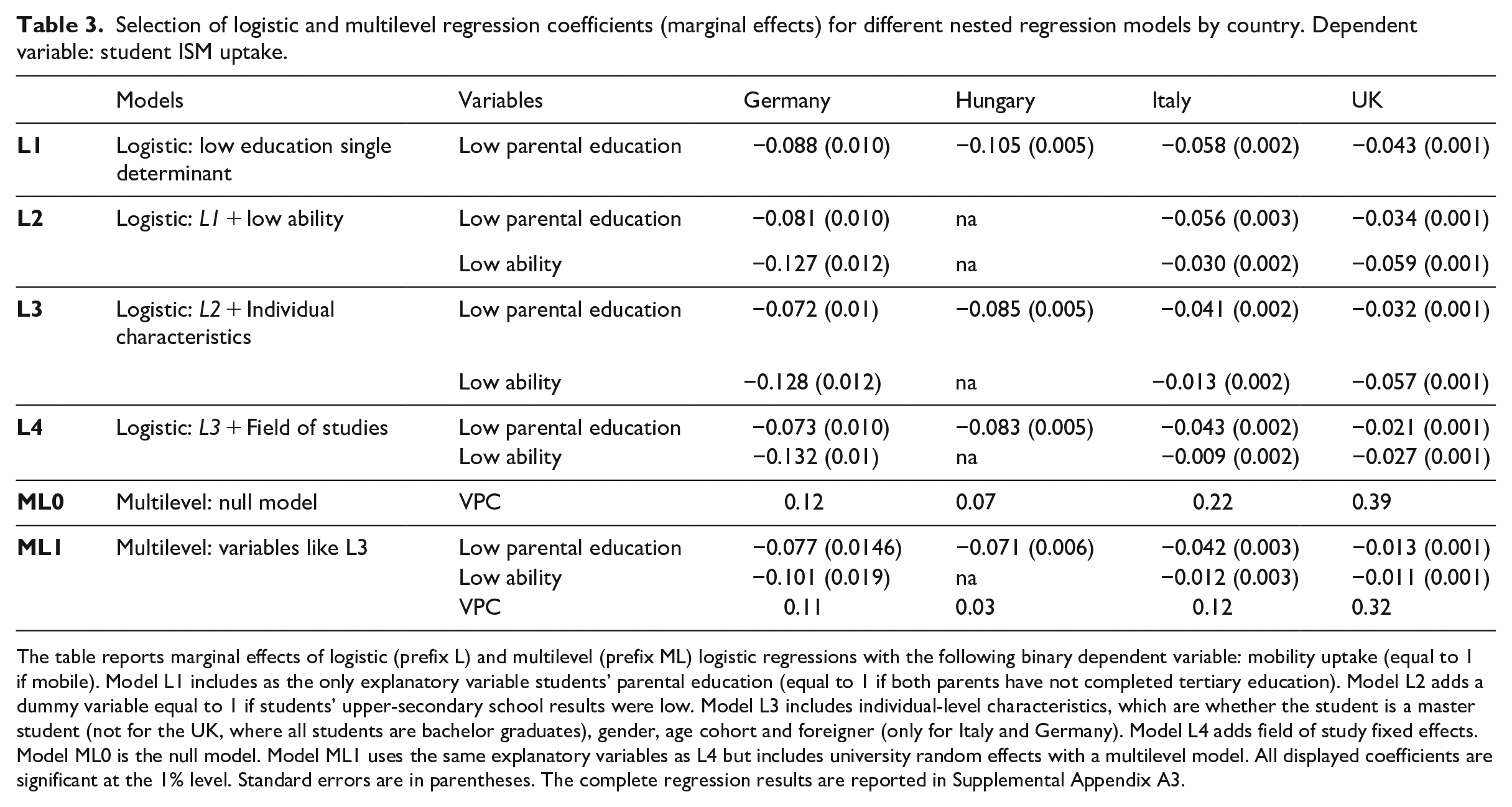
The table reports marginal effects of logistic (prefix L) and multilevel (prefix ML) logistic regressions with the following binary dependent variable: mobility uptake (equal to 1 if mobile). Model L1 includes as the only explanatory variable students’ parental education (equal to 1 if both parents have not completed tertiary education). Model L2 adds a dummy variable equal to 1 if students’ upper-secondary school results were low. Model L3 includes individual-level characteristics, which are whether the student is a master student (not for the UK, where all students are bachelor graduates), gender, age cohort and foreigner (only for Italy and Germany). Model L4 adds field of study fixed effects. Model ML0 is the null model. Model ML1 uses the same explanatory variables as L4 but includes university random effects with a multilevel model. All displayed coefficients are significant at the 1% level. Standard errors are in parentheses. The complete regression results are reported in Supplemental Appendix A3.
Individual level
We start by focusing on individual level characteristics, as those are the ones generally discussed in the literature. Models L1 to L4 refer to logistic regressions not taking information on universities into account and thereby focusing on the association between individual factors and mobility only, as in the majority of existing studies. Model L1 includes as the only explanatory variable graduates’ socio-economic status (proxied by a dummy that is equal to 1 if students are disadvantaged). As expected, the marginal effects are close to the unconditional gap of mobility uptake previously presented in Figure 1. Disadvantaged students study abroad less than advantaged students by about 11 percentage points in Hungary, 9 percentage points in Germany, 6 in Italy, and 4 in the UK. It is important to keep in mind that marginal effects refer to level differences: a 4 percentage point gap in the UK means that disadvantaged students have only half the chance of their advantaged counterparts to take part in ISM. In contrast, for Germany, a much bigger gap of 9 percentage points translates into “only” an about one-third reduced mobility chance of disadvantaged students compared to their counterparts.
Is ability important for explaining the socio-economic uptake gap as discussed above? (Hypothesis 1) Conditioning on ability (see model L2) decreases the association of individuals’ parental education on the probability of being mobile for the three countries, for which we have a measure on individuals’ ability. While disadvantaged students have a 4.3 percentage point lower chance to be mobile (given an overall mobility uptake of 7.6, see Table 2) unconditional on ability, this gap decreases to 3.4 percentage points if ability is set constant in the UK. In Germany, this decline reflects 0.7 and in Italy only 0.2 percentage points. The decrease is however only significant for the UK, the country with a high sample size of students. Hence, ability does matter but is most important in the UK. Results therefore indicate that ability selection, generally implemented at the university level, has the potential to contribute to the mobility gap.
It is interesting to note that ability is a very important determinant of mobility uptake for all three countries. In Hungary, graduates’ school results are not available but a variable likely to proxy ability by indicating whether graduates attended lower reputation schools (non-elite, 4-year comprehensive or vocational upper secondary schools). Results indicate that, in line with the other three countries, this crude proxy for lower ability is also negatively associated with mobility participation (see Table A3.2 in the Supplemental Appendix).
Model L3 also conditions on graduates’ gender, age cohort, and citizenship. Men are more likely to participate in ISM in Germany and Italy and women in Hungary and the UK. Not having the country’s nationality has a negative association with ISM uptake in Italy and Germany, the only two countries for which this variable is available. For all countries, older students are less likely to take part in ISM (Supplemental Appendix A3). Conditioning on gender, age, and citizenship decreases the socio-economic ISM gap in Italy and Hungary by 1% to 2 percentage points but leads to a more marginal decline in the UK and Germany (Table 3). However, consistently across countries mobility differs greatly across fields of study, with language subjects generally having higher mobility uptake (results not shown). Conditioning on field of study (Model L4 in Table 3) decreases the association between socio-economic status and mobility only for the UK, indicating that enrollment into field of study is segregated by socio-economic background (Schnepf and Colagrossi, 2020). In sum, while across all countries only higher ability and younger graduation age is consistently associated with greater ISM probability, ability is the only individual level variable that seems to more consistently decline the socio-economic gap in ISM uptake.
Overall, it is important to note that with the exception of the UK, not even half of the gap in mobility uptake is accounted for by conditioning on individual variables. One explanation for this might be that individuals’ motivation and personality traits are difficult to observe with graduation survey data. While the ability measure is likely to proxy some of those unobserved variables, they may have additional explanatory power, the size of which we cannot investigate.
University level
Another explanation for the relatively low power of individual level factors for explaining the gap is the importance of university characteristics. This is examined by switching to multilevel models. As discussed above (Hypothesis 2), it is assumed that universities matter for explaining mobility uptake and its socio-economic gap. The null model (see ML0 model (Table 3)), which denotes a model not including any explanatory variables but measuring the random effects of universities denotes the variance partition coefficient (VPC). As much as 39% of the variance in individual mobility uptake stems from the variation in mobility uptake between universities in the UK; this is around 20% in Italy and still around 10% in Germany and Hungary. This indicates that even though to a different extent universities are very important for explaining ISM uptake in all countries.
Do universities also matter for explaining the socio-economic uptake gap? (Hypothesis 2) The first way to investigate this, is to examine whether just including university random effects leads to a decrease in the coefficient capturing students’ parental education. Model ML1 does exactly this. It includes the same individual-level characteristics as the logistic regression model L4 but takes the clustering of students in universities into account. Comparing both models, the socio-economic gap decreases by about 1 percentage point in Hungary and the UK, but this decline is only significant in the UK, where it represents about one quarter of the total uptake difference between advantaged and disadvantaged students.
Another approach for measuring the importance of university characteristics on unequal uptake is to examine the association of university level characteristics linked to socioeconomic background with ISM uptake probability, like the percent of students with lower educated parents or lower ability attending a specific university. Figure 2 shows that universities attended by disadvantaged students have on average lower ISM uptake. Does this association also hold conditionally on individual characteristics? This is tested in model ML2, displayed in Table 4, which now captures in addition to ML1 the proportion of disadvantaged (as presented in Figure 2) and low-ability students in universities (see Table 4). Clearly, social and ability segregation in universities is sizable and significant in explaining mobility uptake. In Germany, a student attending a university having a one standard deviation (12.3 percentage points; see Table A2.3) higher share of students with lower ability faces a 5 percentage point decline of ISM uptake probability compared to a student attending a university with a mean composition of ability in its student body. In Hungary, Italy and the UK, students in universities with a 10% greater share of disadvantaged students compared to the mean university are, on average, around 1 percentage point less likely to participate in ISM. Clearly, a 1 percentage point change in mobility matters given that overall mobility in these three countries is 10% or less (see Figure 1). It is important to remember that the estimated associations for all countries except the UK are likely to be biased downwards (see Section 3) since university segregation is calculated with sample data (see method section above).
Selection of multilevel regression coefficients (marginal effects).
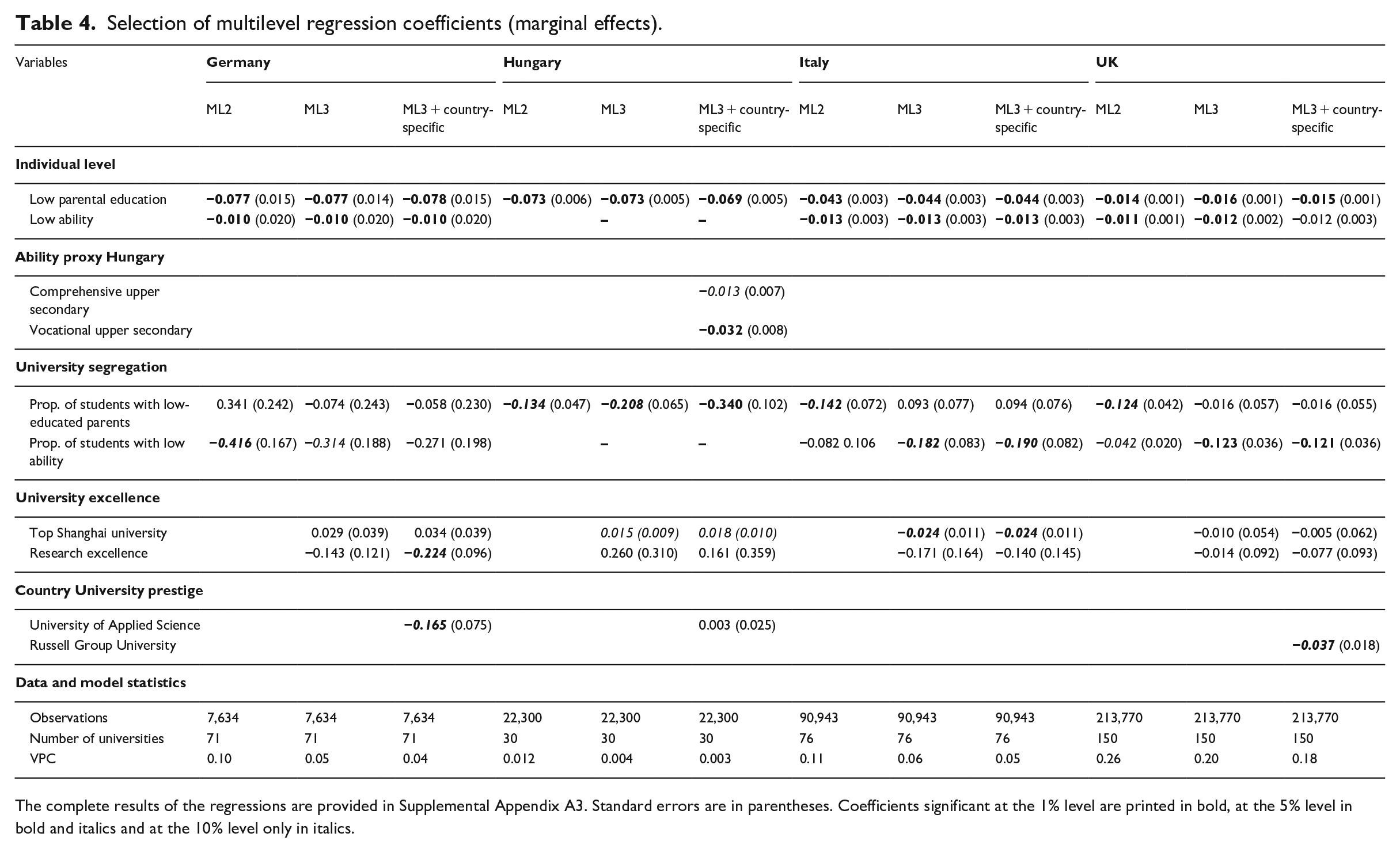
The complete results of the regressions are provided in Supplemental Appendix A3. Standard errors are in parentheses. Coefficients significant at the 1% level are printed in bold, at the 5% level in bold and italics and at the 10% level only in italics.
This significantly negative association of both university segregation and lower socio-economic background with mobility uptake demonstrates the double burden disadvantaged students face in enrolling in mobility programs. They are not only less likely to study abroad due to their socio-economic background but also due to their higher chance of attending a university with fewer mobility opportunities.
Up to now, the focus was on universities’ student bodies, in terms of students’ segregation by ability and parental background. Does university’s academic excellence also matter for explaining the unequal ISM uptake? (Hypothesis 2) While not ideal, we proxy academic excellence by two well-known university’s rankings: first, being named as a top university in the Shanghai Ranking and second, having achieved a high citation record using the Leiden Ranking. In contrast to the unconditional analysis (see Figure 2) model ML3 shows that these measures of university excellence are generally not associated with mobility uptake. Only in Italy students in universities ranked among the top 500 in the Shanghai Ranking have about a 2 percentage point lower probability of taking part in mobility. In addition, the coefficient for students with low parental education does not change if university excellence is included in the model, indicating that excellence is not important in explaining the socio-economic uptake gap.
Institutional differences related to the specific internal structure of the countries’ higher education systems is most straightforward to measure. In Germany, students attending generally less-renowned applied science universities (so-called “Fachhochschulen”) have as much as a 17 percentage point lower probability of being mobile. Attendance at Hungarian applied science universities (“főiskola”) does not diminish students’ chances of mobility. High-status Russell Group universities have conditionally, on average, lower-than-expected mobility uptake in the UK, a rather surprising result. In sum, the internal structure of the national institutional systems show varying importance and different associations with mobility.
Are there other university characteristics that are of importance? Ideally, we would like to have a good measure on student mobility support. Instead, we have only university variables likely to be associated with student support, like size of university, teaching load (number of students enrolled in levels 5–7 of the International Standard Classification of Education (ISCED) divided by the academic staff/1000; see Table A2.1 in the Supplemental Appendix for more details) and university fees. Results show that there is no clear association between these three university characteristics and mobility uptake across countries (see Supplemental Appendix A3). This is most likely to indicate that we cannot capture student support well with these variables. In addition, whatever university variables we add, the socio-economic gap (measured by the coefficient for low parental education) does not decrease in any of the countries, indicating that these additional university characteristics cannot help explain it.
In sum, which university a student attends can explain a considerable part of the variation in mobility uptake in all countries. Using a number of university characteristics, what matters across all countries consistently is the social and ability segregation in universities which is associated with the socio-economic mobility gap. Typically used measures of university excellence do not have a consistent association with mobility uptake conditional on other individual and university characteristics. While we cannot measure the association of student support with the socioeconomic mobility gap, other variables likely to be associated with support do not yield any consistent results. However, it is important to note that the university characteristics we focus on matter. When including our university variables, the VPC decreases by almost one-half for all countries. Only in the UK, could a substantial part of the variance in mobility explained by university variation (18%: VPC of ML3) not be accounted for.
Finally, what conclusions can be drawn in terms of country differences in results? Clearly, many country differences appear when comparing the unconditional socio-economic background coefficient (model L1) with our most sophisticated model in terms of controls (ML3). Most obvious is the different explanatory power of individual and university level variables for explaining the unequal gap in mobility uptake. In the UK, we can explain as much as two-thirds of the socio-economic mobility gap, in contrast, it is just about 30% in Hungary, 20% in Italy, and 10% in Germany. This is crudely calculated by dividing the remaining conditional gap of model ML3 (e.g. 0.015 for the UK) by the unconditional gap of L1 (0.043), Table 3. Lower explanatory power for Hungary, Italy, and Germany might be due to a more positive selection of disadvantaged students into their universities. The three countries are characterized by a lower tertiary education uptake which goes hand in hand with a higher ability selection of students for university attendance. In the UK, with tertiary education enrollment close to 50% (OECD, 2016), ability instead has considerable explanatory power.
Further in Hungary, which is an EU country with relatively low living standard costs associated with European wide low purchase power parity, a considerable part of the unexplained unequal mobility uptake could be due to the additional financial constraints students face if they study in countries where living costs are considerably higher. However, our data set does not include any measures on students’ financial constraints.
University characteristics are of considerable importance for explaining the socio-economic mobility gap in the UK and Hungary. Conditioning on university characteristics decreases the association of graduates’ lower status with mobility uptake in the UK (by about 25%) and Hungary (by around 10%). This greater importance of universities in both countries could be due to higher segregation of the tertiary education systems in the UK and Hungary—as shown by our social segregation measures presented in Table A2.2 in the Supplemental Appendix.
Discussion
Policies supporting international student mobility are a social investment to prepare young people for the challenges they face in globalized and multicultural environments. However, given that disadvantaged students miss out on this opportunity, student mobility policies are sometimes discussed as preserving societal inequalities (Netz and Finger, 2016). While policymakers aim to improve the inclusiveness of mobility programs, it is far from clear which policy designs would be successful. This study goes beyond existing research by focusing not only on individual-level characteristics but also—as the recent literature suggests—on university characteristics such as universities’ student composition and excellence in explaining the socio-economic mobility gap. In addition, this work is novel in using rich graduate survey and administrative data merged with university-level ETER data across four countries (Germany, Hungary, Italy, and the UK) in order to examine whether there are country commonalities that could be addressed by intergovernmental policies.
As far as individual characteristics are concerned, results show that across all four countries disadvantaged students are less likely to take part in ISM unconditional and also conditional on a wide range of individual and university characteristics. This is a novel result, since it indicates that not even the new focus on institutional features of universities can explain the parental education gap in mobility uptake.
For all three countries with information on ability proxied by upper secondary school results, conditioning on ability decreases the socio-economic gap in ISM uptake. Since disadvantaged students generally have lower ability than their advantaged peers, the merit-based selection of students into ISM seems to be a driving factor generating inequalities in ISM participation. In contrast to students’ ability, other individual characteristics like gender, field of study, study program, or age at graduation cannot consistently explain the socio-economic ISM gap across countries.
Overall, it is important to note that with the exception of the UK, not even half of the gap in mobility uptake is accounted for by individual variables. This might very well indicate that our individual level variables are limited, even though our data sets are comparatively rich by covering besides parental education also students’ ability. Nevertheless, we cannot account for important potential drivers like individuals’ financial status, travel experience and language skills.
The low explanatory power of individual level factors derives partly from the fact that students’ university context is important. Indeed, results of a multi-level null model indicate that 40% of the variation in ISM participation in the UK, 22% in Italy, 12% in Germany, and 7% in Hungary can be explained by university factors. As such, taking universities into account when estimating mobility probabilities is important for all countries even though to a different extent.
Unconditional results show for all four countries, that universities attended by more disadvantaged students have on average lower ISM participation rates. Also conditional on individual and university variables, for all models and countries universities attended by on average higher shares of low-performing students or socio-economically disadvantaged students have much reduced opportunities for ISM participation. For example, an Italian student enrolled in a university with 83% disadvantaged students (university mean plus one standard deviation) has about a 2 percentage point lower probability of mobility than a student attending a university with only 72% disadvantaged students (mean university), conditional on student ability and socio-economic background. A 2 percentage point change in the probability is huge given that overall mobility participation is 8% in Italy. “Effect” sizes are similar in the other three countries. University segregation by socio-economic status and by ability is therefore key to explaining unequal mobility uptake in all four countries. This result indicates that disadvantaged students not only lose out on mobility experiences due to their background but also due to being clustered in universities with fewer mobility opportunities.
However, in contrast to unconditional results, our measures of university excellence are not any more associated with unequal mobility uptake conditional on individual and other university characteristics. In addition, there are no consistent patterns across countries regarding the association of university variables that could proxy student support, like student size, teaching load and fees with overall and unequal ISM participation. Nevertheless, we do not have information on other university characteristics of interest, like for example direct measures of universities’ student mobility support and inter-institutional mobility arrangements.
Given country similarities in terms of the results on segregation of universities and ability, intergovernmental policies could first be aimed at distributing grants and mobility opportunities more equally across all universities (independent of who attends them), and second consider whether the selection of students based predominantly on ability is the right approach for distributing mobility grants at the university level.
Nevertheless, it is important to note that considerable country differences exist in terms of the explanatory power of individual- and university-level variables. First, in the UK about 60% of the socio-economic gap is accounted for by individual and university characteristics, in Hungary this is 30%, in Italy 20%, and in Germany only 10%, indicating that mechanisms driving the gap are likely to differ considerably across European countries. Second, with the exception of university segregation, the importance of certain university level characteristics differs for explaining mobility uptake. For example, attending an applied science university compared to a general university is of great importance for explaining ISM participation and its socio-economic gap in Germany but not so in Hungary. Such differences well justify the need for country specific policies for decreasing barriers in mobility uptake for disadvantaged students.
This study is novel, since it provides analyses of four country graduate surveys that include information on which university students attend. Certainly, using these different data sources has also a number of limitations. First, for Germany the construction of a social segregation measure implies that 50% of universities (and with that 10% of the original student sample) cannot be taken into account for the analyses (see Table A1.1 in the Supplemental Appendix for more details). Second, for 20% of graduates in the UK information on parental education is missing, so these students are excluded from the analysis. Third, for Hungary, individual level ability information is not available but only a proxy. Fourth, European graduate data miss in-depth information on individual and university variables likely to be linked with ISM. This challenges a comprehensive modeling of the socio-economic uptake gap. Fifth, using country specific data sets based on different data collection methods challenges the comparison of results.
As a consequence, future ISM research would benefit from access to comparable graduate data covering many European countries that could enable university-level analyses as conducted in this study. In order to model and explain the socio-economic mobility uptake better in the future, data quality would need to be considerably improved, for example information on individual characteristics such as student perceptions of the advantages and disadvantages of mobility experiences, students’ financial resources and language skills as well as universities’ student support and ISM strategies would need to be collected.
Supplemental Material
sj-docx-1-eer-10.1177_14749041221135080 – Supplemental material for What can explain the socio-economic gap in international student mobility uptake? Similarities between Germany, Hungary, Italy, and the UK
Supplemental material, sj-docx-1-eer-10.1177_14749041221135080 for What can explain the socio-economic gap in international student mobility uptake? Similarities between Germany, Hungary, Italy, and the UK by Sylke V Schnepf, Elena Bastianelli and Zsuzsa Blasko in European Educational Research Journal
Footnotes
Acknowledgements
The authors thank colleagues from the European Commission’s Joint Research Centre Fairness Working Group and two anonymous referees for valuable comments and suggestions. Special thanks go to Anne Weber and Florence Baillet for extracting and merging data from the German DZHW graduate Panel and to Rebecca Hobbs for extracting the data from the Higher Education Statistics Agency (HESA) Student Records Data for this study.
Disclaimer
The views expressed are purely those of the writers and may not under any circumstances be regarded as stating an official position of the European Commission. Neither the DZHW, Higher Education Statistics Agency Limited, HESA Services Limited or other providers of data used in this paper accept responsibility for any inferences or conclusions derived by third parties from their data or other information supplied.
Declaration of conflicting interests
The author(s) declared no potential conflicts of interest with respect to the research, authorship, and/or publication of this article.
Funding
The author(s) received no financial support for the research, authorship, and/or publication of this article.

Supplemental material
Supplemental material for this article is available online.
Author biographies
References
Supplementary Material
Please find the following supplemental material available below.
For Open Access articles published under a Creative Commons License, all supplemental material carries the same license as the article it is associated with.
For non-Open Access articles published, all supplemental material carries a non-exclusive license, and permission requests for re-use of supplemental material or any part of supplemental material shall be sent directly to the copyright owner as specified in the copyright notice associated with the article.
