




Abstract
Erasmus student mobility is the most recognised element of Erasmus+ and clearly popular with an increase in student uptake from 3,000 in 1987 to over 300,000 today. Recent studies show that students from lower socio-economic backgrounds are less likely to study abroad than better-off students, thereby benefitting less from improved employment opportunities and language competences often associated with mobility. Unequal uptake is generally explained by students’ choices: disadvantaged students hold lower social capital which leads them to decide against mobility. However, not much is known about the importance of students’ selection into universities and fields of study. Using multilevel logistic regressions, this article examines whether social segregation in universities and field of study matters beyond individual characteristics for explaining unequal Erasmus mobility uptake. The study exploits rich population data of around 200,000 UK first-degree graduates of the year 2014/2015 deriving from the Higher Education Statistics Agency (HESA) data. Results show that while student characteristics like ability and social status are important predictors of Erasmus mobility, they only explain one part of unequal uptake. In addition, social segregation of universities and fields of study contribute to the unequal mobility pattern found. Student mobility is less common for students enrolled in fields of study and universities attended by disadvantaged students conditional on student characteristics. This implies that student mobility could become more inclusive if grant funding and incentives targeted universities attended by a high proportion of disadvantaged students.
Keywords
Introduction
Erasmus student mobility which refers to students spending some time abroad during their degree programme at a home institute is the most recognised element of the Erasmus+ programme, a major and well-known European Union (EU) policy. Higher education mobility has increased from 3,000 in 1987 to over 300,000 today (European Commission, 2009, 2018). This trend will increase in the future. A communication adopted by the European Commission (2017a) on ‘Strengthening European identity through education and culture’ sets the vision of building a European Education Area by 2025, which among other purposes aims to make mobility a reality for all.
The UK has the fifth highest Erasmus mobility rate with around 17,000 students in 2016/2017. However, given its population size, it can be characterised as a country with low mobility compared to Germany and Spain with around 40,000, Italy with 37,000 and France with 35,000 students participating in Erasmus (European Commission, 2018).
Student mobility policies are a social investment to increase European integration and tolerance and prepare for challenges in today’s multicultural environment. Furthermore, fostering student mobility can be seen as an efficient and effective policy to enhance employability in labour markets shaped by globalisation. Indeed, research showing that studying abroad has a positive impact on students’ future professional career is increasing. For example, student mobility increases individuals’ employment probability (Schnepf and D’Hombres, 2018), their chances of working abroad (Parey and Waldinger, 2011), their language competences (Sorrenti, 2017) and European values (Souto-Otero et al., 2013).
However, student mobility policies are not only a strategy to tackle challenges deriving from global labour markets but could also have the potential to preserve social stratification in European societies. In times of higher education expansion, students with advantageous socio-economic backgrounds might choose mobility as an additional pathway to safeguard their privileged position and differentiate themselves from other less advantaged students attending higher education (Netz and Finger, 2016). Indeed, opportunities of international mobility are unequally distributed across social groups, a fact widely acknowledged in the literature (e.g. Hauschildt et al., 2015; Netz and Finger, 2016).
Policymakers are aware of the unequal uptake of student mobility. The European Commission stresses the importance of inclusion in a variety of documents. For example, the legal framework of Erasmus+ (European Commission, 2017b) states, ‘There is a need to widen access for members of disadvantaged and vulnerable groups [. . .] in the implementation of the Programme’. This is also subject of a tweet by Tibor Navracsics (2017), former European Commissioner for Education, Culture, Youth and Sport, from 24 July 2017: ‘How can we make #ErasmusPlus even more open to people from all backgrounds?’
The answer to this question depends on the mechanism that created mobility to be unequal. Existing literature explains the gap by focusing entirely on different choices and limitations of students with high and low socio-economic backgrounds thereby generally leaning from rational choice and social capital theory. Most recently, this focus on students only has been criticised (Bilecen and Van Mol, 2017), given that students’ decisions are embedded in education institutions. Indeed, many students are likely to decide about student mobility only after having enrolled in a field of study at a specific university. This is especially the case in the UK, where upper secondary school degrees determine which universities and fields of study students can choose. Consequently, not only student choices but also the opportunities of the university and field of study in which the students are enrolled could affect their mobility uptake.
Many university characteristics could be important for explaining the socio-economic gap in student mobility, like information and support provided to students during their studies. This article does not examine these university characteristics but rather investigates whether selection into universities and, with that, social segregation, hence the clustering of students with different socio-economic backgrounds in specific universities and fields of studies, can explain the socio-economic mobility gap. Multilevel models allow examining the importance of universities in addition to student characteristics.
The policy relevance of the topic is obvious: if only student characteristics count for explaining unequal uptake policymakers need to counteract diverse choices of different social groups. This could be done by, for example, improving the support for and decreasing the costs of studying abroad for the socially disadvantaged (as concluded by Hauschildt et al., 2015; Loerz et al., 2016; Souto-Otero et al., 2013). However, if unequal uptake reflects that individuals with varying socio-economic backgrounds segregate into universities and fields of studies that offer different mobility opportunities, policymakers could foster incentives for mobility in those universities that are attended by the less privileged and distribute funds more equally between higher education institutes and fields of study.
In this context, the UK, which has one of the most stratified tertiary education systems in Europe, represents an interesting case study, as results found might serve as an upper bound benchmark for the relevance of university characteristics in explaining unequal uptake of mobility.
Erasmus student mobility in the UK
Almost all higher education institutions in the UK have signed the Erasmus Higher Education Charter in order to be eligible for applying for Erasmus grants. The Charter states that institutes need to ensure fair and equitable opportunities for potential participants including those with lower socio-economic backgrounds (European Commission, 2016). One year before mobility takes place, universities apply for grants to the British Council, which is the National Agency responsible for Erasmus mobility. The exact mechanism of allocation of grants to universities is not documented, but the authors’ exchange with the British Council suggests that the numbers of previously mobile students in universities are of importance. For the majority of student mobilities, the Erasmus programme does not set any merit-based requirements for the selection of students.
Students cannot visit any programme country university. Instead, the choice of host institutes depends on the field of study related inter-institutional agreements that need to be actively pursued generally at the faculty level.
Students’ application for Erasmus mobility is associated with several administrative tasks including the collection of recommendations and the writing of motivation letters (Piaz, 2017). The students’ home faculty as well as the host university both need to select students based on the institutions’ specific selection criteria. Hence, at the university level, merit-based requirements for the selection of students such as performance generally come into play if students’ applications exceed the number of mobilities that can be funded.
Erasmus mobility can last between 3 and 12 months. The monthly UK student grant for mobility within Programme Countries is between €280 and €330. Students from disadvantaged backgrounds (defined as those living in households with annual household income below £25,000) currently receive €120 in addition per month (2017/2018) (British Council, 2017). The grant aims to contribute to additional costs deriving from studying abroad and not to cover all costs.
What is the incentive for universities to participate in the Erasmus mobility programme? First, there is no negative incentive in terms of revenues. Most mobile students (those being abroad for less than a full academic year) continue to pay their tuition fees to their home university while host institutes cannot charge additional student fees. Second, the opportunities to study abroad can demonstrate a university’s international orientation towards teaching and research. While the official funding-relevant evaluation of UK academic institutions on research, the so-called Research Excellence Framework, does not take university performance on student mobility into account, it is an important indicator for the international university ranking indicator, the so-called U-multirank.
Socio-economic gap in mobility, existing literature and the importance of university and field of study
Existing literature agrees on student mobility being disproportionally taken up by those individuals with a higher socio-economic background. Hauschildt et al. (2015) show the trend for European countries in general, Wiers-Jenssen (2011) for Norway, Munk (2009) for Denmark and Sweden, Netz and Finger (2016) for Germany and Carbonell (2014) for the UK.
Figure 1 presents the problem at stake for the UK using population data on first-degree graduate students, which will be described in greater detail in the next section. Between the graduation cohort of 2006/2007 and 2014/2015, the percentage of undergraduate students studying temporarily abroad rose from 2.6 to 4.1 percent. There is a considerable difference between countries in the UK. In the most recent cohort, Erasmus uptake is highest in Northern Ireland with 5.9 percent, followed by Scotland with 4.7 percent and lowest in England and Wales with 3.4 percent (results not shown).
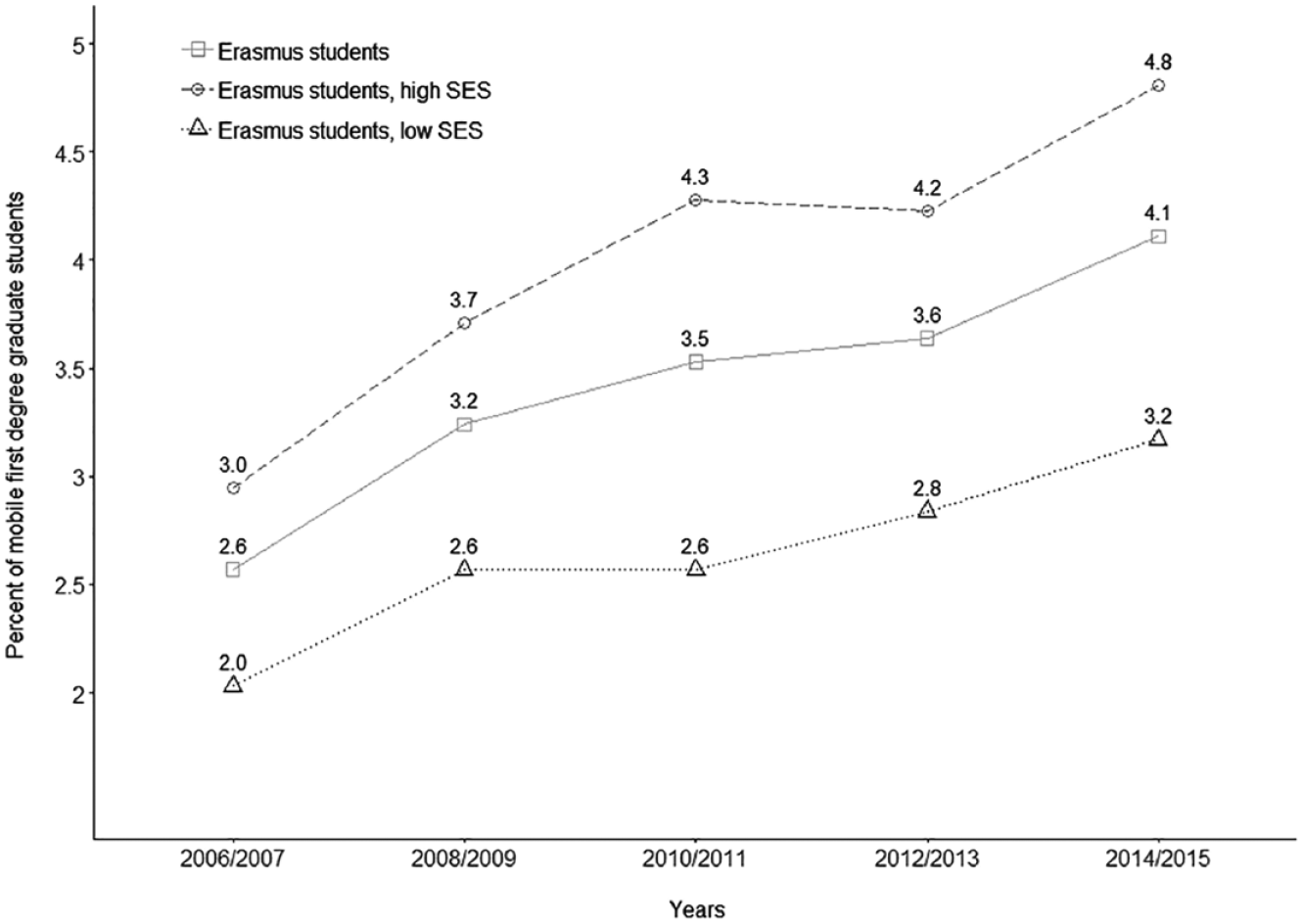
Percentage of Erasmus mobile students among all first-degree graduate students in the UK by year and socio-economic background.
The uptake of studying abroad, however, is unequal: in the 2014/15 graduation cohort 4.8 percent of individuals whose parents have managerial and professional occupations enrolled in Erasmus mobility compared to just 3.2 percent of students whose parents hold lower skill positions. In addition, the social selectivity of Erasmus increased significantly between 2006/2007 and 2014/2015.
Theoretical explanations on unequal mobility uptake derive from theories of rational choice (Breen and Goldthorpe, 1997) and economic, social and cultural capital (e.g. Bourdieu, 1986). Rational choice theory predicts that for students with a high socio-economic background, the benefits of studying abroad outweigh the costs of doing so while it is the other way around for their counterparts with a lower socio-economic background. This can be explained with economic, social and cultural theory. In contrast to students from lower socio-economic backgrounds, advantaged students can rely on higher financial resources that can stock up the Erasmus grant. They are also more likely to build on higher social capital having encountered people who were mobile before and therefore benefit from effortless access to information on mobility schemes. The cultural capital of students is important as well and can be associated with travel experience abroad and skills of and ease with foreign languages. (For a more detailed theoretical discussion, see Netz and Finger, 2016.)
Cultural reproduction in the framework of educational expansion states that higher socio-economic background students aim to protect their advantageous position by searching actively for prestigious educational qualifications. Student mobility could be one educational path to do so, given that in times of higher education expansion the completion of tertiary education is more common (Bourdieu, 1984; Triventi, 2013).
Current literature confirms these theoretical considerations. Underprivileged students evaluate studying abroad as less beneficial compared to more privileged counterparts (Loerz et al., 2016). Hauschildt et al. (2015) show that in most European countries especially students with higher education background receive financial support. Finances to cover additional costs deriving from mobility and ‘social context’ (e.g. separation from family) are perceived as the most significant barriers by non-mobile students and especially those with a low socio-economic background (Orr et al., 2011). Low language skills play a further role (Loerz et al., 2016). In addition, some studies show that mobile students have a higher share of parents holding prior experience of living abroad (Wiers-Jenssen, 2011).
Nevertheless, existing literature explains unequal mobility uptake entirely with individual characteristics. Most recently, this focus has been criticised (Bilecen and Van Mol, 2017): students’ decisions are also likely to be shaped by mobility opportunities of the fields of study and the university in which they are enrolled.
To the knowledge of the authors, this is the first study examining the importance of university and field of study in the context of student mobility. Why should both matter for unequal uptake? First, staff in different universities and fields of study could behave differently in terms of advertising mobility opportunities and provision of extra support for students considering student mobility. These actions are likely to benefit those students with lower social and cultural capital.
Second, unequal uptake might just reflect an unequal distribution of students with a higher and lower background in universities and fields of study that differ in their offer of mobility schemes. For example, we could imagine a very simplistic scenario: all high socio-economic background students study languages while low socio-economic background students enrol in other fields of study. Imagine further that Erasmus mobility mainly takes place among language students. In this case, mobility uptake would be very much unequal by socio-economic background due to individuals’ enrolment into fields of study paired with unequal distribution of Erasmus opportunities across these fields. Another naïve scenario is the one where all students from a higher socio-economic background (and none from lower) attend universities where international mobility is highly promoted and supported.
This study does not focus on varying staff behaviour in universities and fields of study (due to data limitations). Instead, it examines whether clustering of students with different socio-economic backgrounds in specific universities and fields of study contributes to the socio-economic mobility gap beyond student characteristics that are generally discussed in the literature.
Data and methods
Data
The analysis in this article relies on unique administrative rather than graduate survey data as commonly used in the literature. Data derive from the UK Higher Education Statistics Agency’s (HESA) Student Record Data (copyright Higher Education Statistics Agency Limited), which covers information on the entire population of students registered in UK higher education institutes each year. For this study, HESA extracted the population of all UK domiciled full-time first-degree graduates studying a degree with an expected length of study of at least three years, excluding graduates who were not on the same course at the same higher education provider in the two years prior to the graduation year.
HESA data are available for five graduate cohorts (2006/2007, 2008/2009, 2010/2011, 2012/2013 and 2014/2015). Data quality increases considerably with time since missing values on a number of individual characteristics are lowest in the last cohort. Therefore, the data analysis is generally based on the most recent graduate cohort (272,466 students and 152 universities in 2014/2015), covering about 70 percent of the entire population.
The data are unusually rich in the information provided. First, they contain information about socio-economic background, which students provided when applying for university through the Universities and Colleges Admissions Service (UCAS). Students report whether at least one of their parents completed tertiary education and their parental occupational category. The latter is available only if the student was below 21 years old at university entry, which is the case for 87 percent of students.
Second, the data structure allows students to be attributed to their field of study and the university from which they graduated. Furthermore, quite unusual for graduate data, student data includes information on upper secondary school results which can be used as a proxy for ability.
We construct our 2014/2015 working population data by removing all those students who took up a mobility programme different to Erasmus (3.9 percent). For the multivariate analysis, we also exclude 3.9 percent of students enrolled in 22 universities which do not have any students participating in Erasmus mobility. Universities with and without Erasmus mobility do not differ significantly on a variety of university characteristics (see supplementary material Tables A1, A2 and A3). This confirms that the choice of removing these universities is robust to the results we find.
In the 2014/2015 cohort, information is missing on parental education for 20 percent and parental occupation for 27 percent of students. For the main analysis, we focus on parental education excluding missings on that variable. However, we conduct robustness checks on all our analyses using also parental occupation and a mix of both parental variables as a proxy for socio-economic status. Reported results are confirmed (see supplementary material). Information about secondary school results is also missing for 9 percent of the population. These students are included in the analysis by imputing average ability. No other variables have missings above 0.1 percent.
Our final sample used for the regression analyses comprises 197,340 graduates in 130 universities for the 2014/2015 cohort.
Method
To investigate students’ Erasmus mobility, a multilevel modelling approach is employed, recognising the clustering of students within universities. The multilevel approach has a number of advantages. First, estimates of standard errors account for the clustering of students within higher education institutes. Failing to do so would lead to an overstatement of the statistical significance of associations. Second, it allows what is central for this study’s research question: the investigation of university associations with students’ mobility uptake. Third, determining the relative importance of factors at different levels gives key insights to the level at which the action lies. The variance partition coefficient (VPC) is interpreted as the proportion of variation in the underlying student mobility propensity that is due to differences between higher education institutes.
Let

Denoting the probability of student mobility by a general two-level random coefficients logistic model for mobility participation can be

where
Since in the 2014/2015 cohort almost 4 percent of graduates had participated in Erasmus, covering around 8,000 students, a small sample bias due to rare event data is not problematic for this study (King and Zeng, 2001).
Results
Figure 2 presents the percentage of 2014/2015 graduates both of whose parents have not completed tertiary education for the population of 152 accredited higher education institutions in the UK (22 of those have no Erasmus mobility) at the x-axis. On average across the UK, 44 percent of students fall into this so defined ‘disadvantaged’ category. Oxford and Cambridge have only around 15 percent disadvantaged students compared to the University of Wolverhampton with as many as 70 percent. This clearly shows that social segregation of universities in the UK is high. This might be due to several factors. First, students are selected into universities depending on their upper secondary school results (generally called ‘A-levels’). Second, England is characterised as a country where high tuition fees are paired with high subsidies in the form of student loans (Garritzmann, 2016). In principle, student loans can decrease the regressive nature of high tuition fees. Nevertheless, students from lower socio-economic backgrounds are averse to risks and high debts and therefore more prone to choosing less prestigious study programmes (Moulin et al., 2016). Third, England stands out as a market-oriented higher education model due to high competition between universities and audit (Dobbins and Knill, 2014). Fourth, the 1992 unification of the previously binary higher education system and the recent higher education expansion did not lead to a decline in social segregation in English and Scottish universities (Croxford and Raffe, 2013). In international comparison, the UK displays the greatest association of parental education with the probability of graduating from a top institution in a comparison of eleven European countries (Triventi, 2013). Hence, the social segregation of UK universities shown on the x-axis is likely to be one of the highest in the European context.
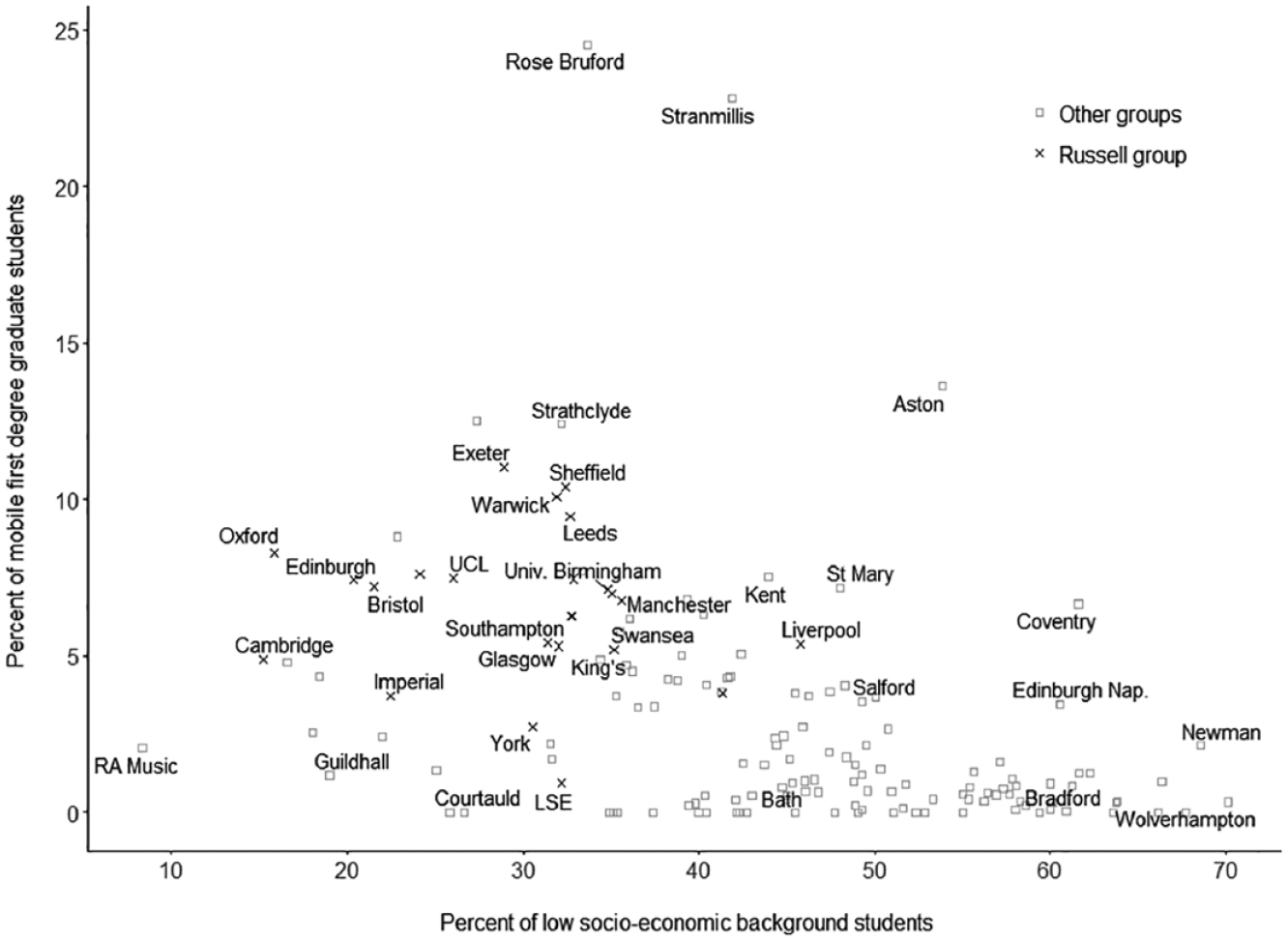
Percentage of first-degree graduate students having participated in Erasmus and percentage with low socio-economic background by university, 2014/2015.
The y-axis presents the percentage of first-degree graduate students having participated in Erasmus. It is important to note that the average student participation in Erasmus is 3.2 percent across universities with the 25th percentile of 0.4 percent, a median of 1.5 percent and the 75th percentile of 5.0 percent, reflecting a highly positive skew of the distribution of the share of mobile students in universities.
The correlation coefficient is −0.42 for all universities and −0.13 for the Russell Group (which are regarded as covering more prestigious higher education institutes) and −0.30 for non-Russell Group universities, respectively. If disadvantaged status is differently defined by just focusing on those students both of whose parents have low occupational status, the correlation stays similar: −0.41 for all, −0.19 for Russell and −0.27 for non-Russell Group universities (see Figure A1 in the supplementary material).
Consequently, there is a clear link showing that those universities that have an intake of socially disadvantaged students have also a lower share of mobilities abroad.
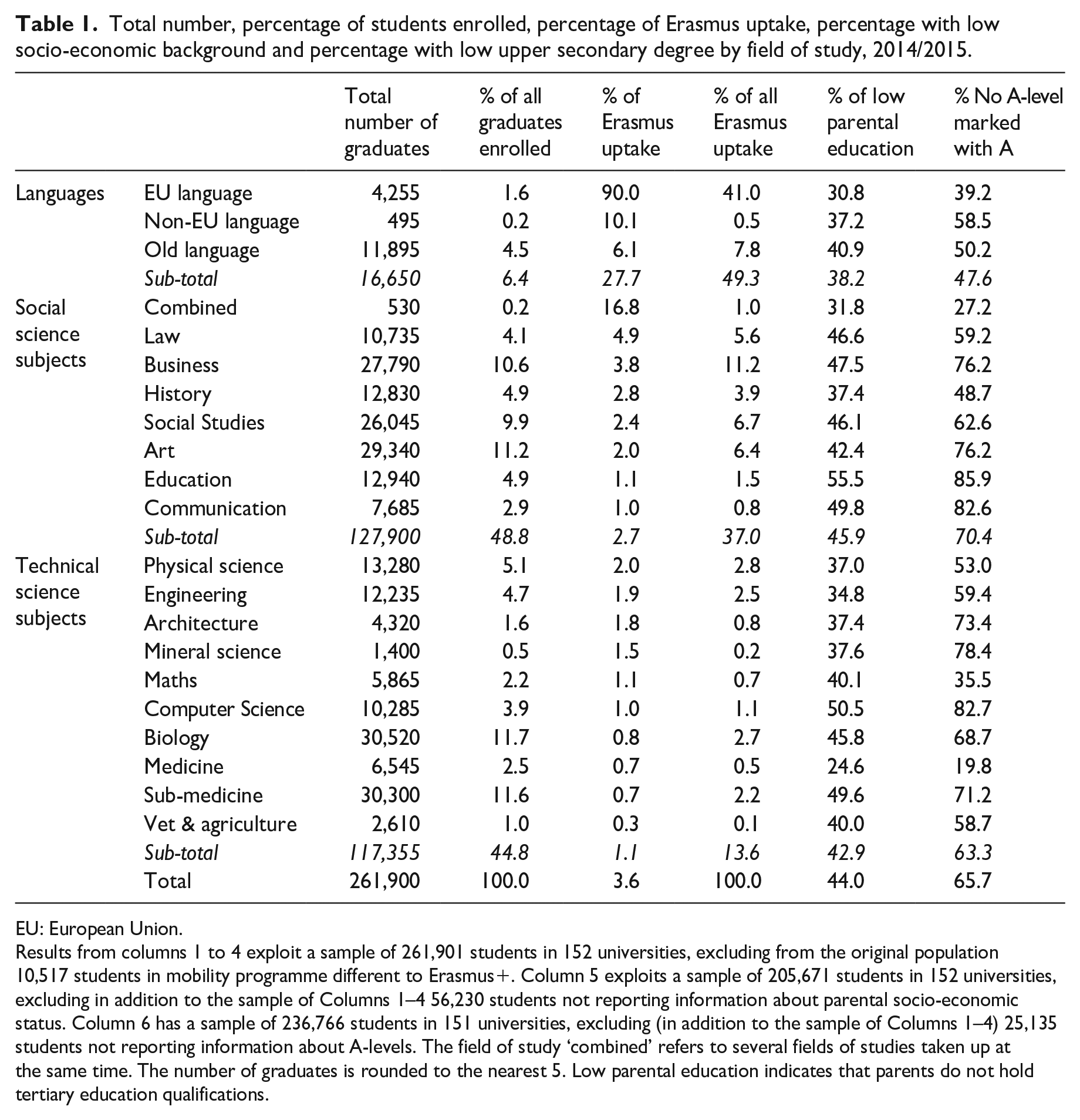
Do we find a similar pattern once the focus is on fields of study? Table 1 provides descriptives by fields of study categorised into languages, social and technical science subjects and ordered by percent uptake of Erasmus.
Total number, percentage of students enrolled, percentage of Erasmus uptake, percentage with low socio-economic background and percentage with low upper secondary degree by field of study, 2014/2015.
EU: European Union.
Results from columns 1 to 4 exploit a sample of 261,901 students in 152 universities, excluding from the original population 10,517 students in mobility programme different to Erasmus+. Column 5 exploits a sample of 205,671 students in 152 universities, excluding in addition to the sample of Columns 1–4 56,230 students not reporting information about parental socio-economic status. Column 6 has a sample of 236,766 students in 151 universities, excluding (in addition to the sample of Columns 1–4) 25,135 students not reporting information about A-levels. The field of study ‘combined’ refers to several fields of studies taken up at the same time. The number of graduates is rounded to the nearest 5. Low parental education indicates that parents do not hold tertiary education qualifications.
90 percent of European language students take part in Erasmus and they constitute as many as 41 percent of all Erasmus students. Looking at all language students together, they constitute 50 percent of all Erasmus students even though they represent just 6.4 percent of the graduate population. This high concentration of Erasmus mobility among language students is another special feature of the UK.
Focusing across subject areas, 2.7 percent of social science students and only 1.1 percent of technical science students study abroad.
In addition, it appears that the higher the mobility uptake for a field of study, the lower the average ability of students defined as the percentage of students who did not achieve an A for their A-levels. Based on figures presented in Table 1, Erasmus uptake is negatively correlated with low ability (correlation coefficient r=−0.34) and with disadvantaged background (r=−0.37). These correlations do not change much in size if we exclude the field of study ‘languages’.
Why do we find this surprisingly robust result that disadvantaged students are clustered in those fields of study and universities where mobility uptake is low? First, it could be that the pattern is entirely guided by students with lower socio-economic backgrounds not being interested in mobility, and hence the subjects and universities they enrol in reflect this lower demand in mobility. However, it is important to note, that first-degree students generally attend a 3-year programme. Their opportunities of mobility are probably set during their first year of study since universities need to apply for grants one year before mobility takes place. As discussed above, there also seems to be an unwritten rule that mobility grants are distributed according to universities’ previous mobility levels. As such, it is unlikely that if more disadvantaged students wanted to take up mobility abroad the university or faculty could oblige. Since universities tend to use students’ performance to distribute mobility grants it is the disadvantaged students with lower ability who lose out.
A second mechanism could be that disadvantaged students tend to enrol in universities and subjects where the opportunities of mobility are lower. As shown in Figure 1, student mobility is highest in those universities that are more prestigious, which at the same time are more difficult to get access to for disadvantaged students. Universities and faculties with a high share of disadvantaged students might be less concerned about their international orientation, but more about teaching and provision of additional learning support to facilitate degree completion. The latter might crowd out efforts to achieve inter-institutional arrangements necessary for allowing Erasmus mobility to take place. Less prestigious universities probably also face more problems in attracting institutions abroad for exchange programmes.
With our data it is not possible to investigate the mechanisms discussed above in detail. However, we can investigate whether (a) universities matter as such for mobility uptake and (b) whether social segregation into universities and field of study is of importance beyond individual characteristics like socio-economic background and ability. The latter would be a clear indication that unequal uptake is not just due to student choice but also derives from institutional social segregation.
Modelling student mobility
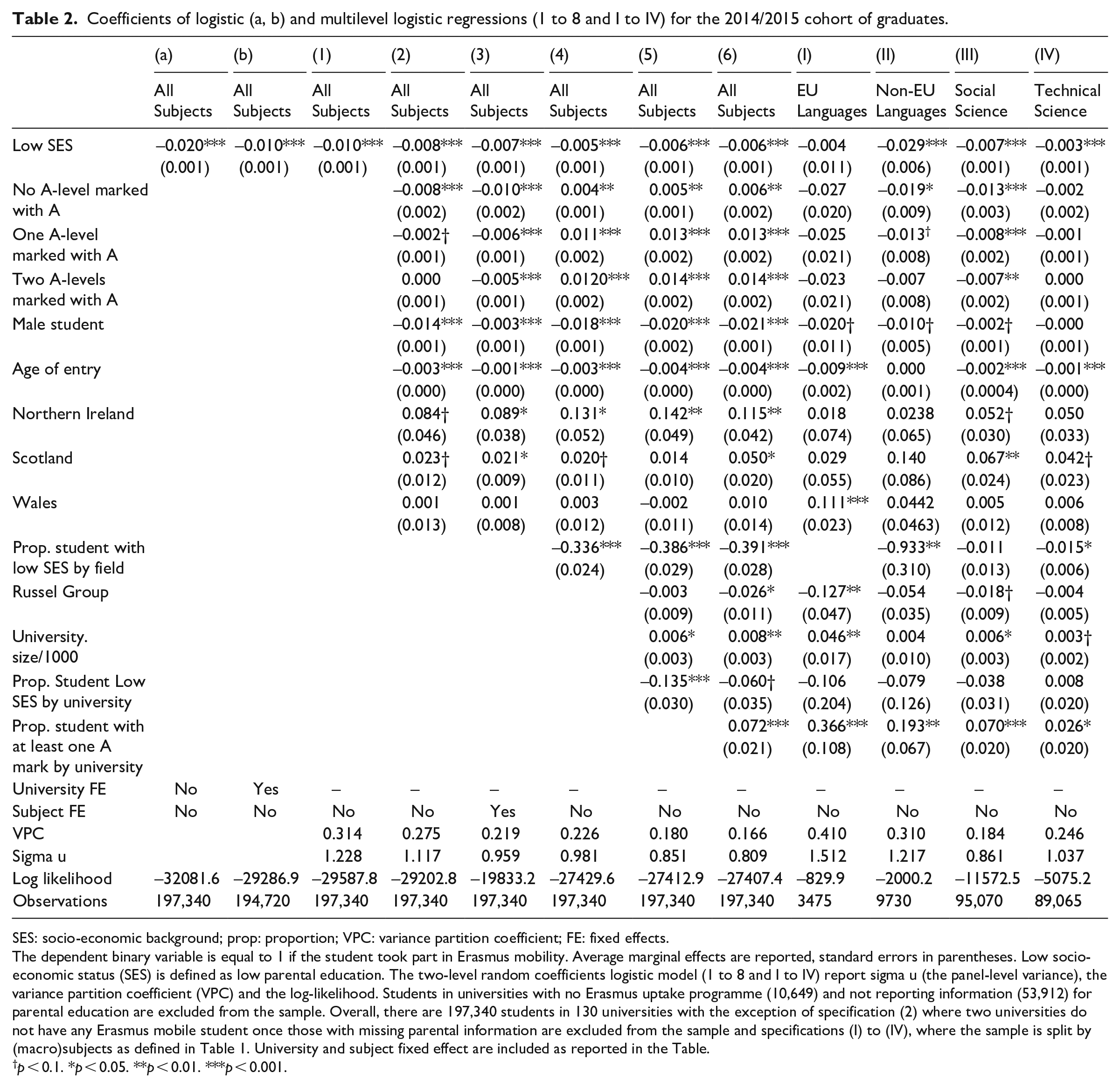
Results from the logistic regression modelling are presented in Table 2 and based on the 2014/2015 graduate cohort. The dependent binary variable is equal to 1 if students participated in Erasmus mobility and 0 otherwise. Models 1 to 6 provide estimates from multilevel modelling based on all students in all subjects. While multilevel modelling is the preferred approach since it takes clustering of students in universities into account, it is still of interest to explore the association of socio-economic background with mobility using (single-level) logistic models the results of which are shown in columns (a) without and (b) with university fixed effects. The coefficients provided in Table 2 show average marginal effects from which we can derive the percentage point change in Erasmus mobility uptake if the explanatory variable changes by one unit. All continuous variables are scaled as proportions.
Coefficients of logistic (a, b) and multilevel logistic regressions (1 to 8 and I to IV) for the 2014/2015 cohort of graduates.
SES: socio-economic background; prop: proportion; VPC: variance partition coefficient; FE: fixed effects.
The dependent binary variable is equal to 1 if the student took part in Erasmus mobility. Average marginal effects are reported, standard errors in parentheses. Low socio-economic status (SES) is defined as low parental education. The two-level random coefficients logistic model (1 to 8 and I to IV) report sigma u (the panel-level variance), the variance partition coefficient (VPC) and the log-likelihood. Students in universities with no Erasmus uptake programme (10,649) and not reporting information (53,912) for parental education are excluded from the sample. Overall, there are 197,340 students in 130 universities with the exception of specification (2) where two universities do not have any Erasmus mobile student once those with missing parental information are excluded from the sample and specifications (I) to (IV), where the sample is split by (macro)subjects as defined in Table 1. University and subject fixed effect are included as reported in the Table.
p < 0.1. *p < 0.05. **p < 0.01. ***p < 0.001.
Column (a) shows that students whose parents did not complete tertiary education have a 2 percentage point lower probability of participating in Erasmus mobility. Given that on average the overall probability of Erasmus mobility is low (about 4 percent of students take up mobility) a 2 percentage point increase reflects a 50 percent increase in overall Erasmus+ mobility. The logistic regression result is close to unconditional results shown in Figure 1 (which due to lack of data on parental education over time focuses on parental professional occupation).
Once university fixed (model b) or random effects (model 1) are introduced, the coefficients of socio-economic background halve to one percentage point showing that a considerable part of the unequal uptake is determined by universities. Indeed, the multilevel null model (not presented) shows that as much as 32 percent of the variation in students’ underlying mobility propensities is due to differences between universities. This association decreases with different models as indicated by the VPC but it remains substantial with 17 percent even conditional on university and individual characteristics (model 6).
Clearly, universities do matter considerably for explaining unequal uptake of Erasmus mobility. One reason for this could be that more able students go to better universities and have greater chances of taking up an Erasmus grant. Model 2 adds students’ ability proxied by upper secondary school results. In the population, around 6 percent of students achieve three or more A-levels marked with an A. They build the reference category, while the model includes dummies for individuals who have no (67 percent), one (17 percent) or at least two A-levels marked with an A (10 percent in the population). The model also covers regions of the university (England (control group), Scotland, Wales and Northern Ireland), gender (41.8 percent in the population are male) and age at enrolment (mean age is 19.7 years). Results show that ability matters for mobility uptake: an individual with no A-level marked with an A has an about 0.8 percentage point lower probability of studying abroad than a student having achieved three As. Surprisingly, however, ability explains only marginally the association found between socio-economic background and mobility. The socio-economic background coefficient does not decline significantly. Model 2 also shows that men experience a 1.4 percentage point lower chance in mobility than women. Being 10 years older at the time of enrolment decreases the probability of Erasmus uptake by 3.3 percentage points.
If ability cannot fully explain the unequal uptake of Erasmus, perhaps students’ choice of fields of study can. As shown in Table 1, disadvantaged students are underrepresented in those fields of study with the highest Erasmus uptake. The importance of fields of study choice is examined with models 3 and 4. Model 3 uses field of study fixed effects. Model 4 instead includes a coefficient capturing the proportion of disadvantaged students by field of study. The inclusion of the measure field of study decreases the relevance of the socio-economic background variables and improves the model estimation measured with log-likelihood considerably. Once social segregation into field of study is taken into account, a clear association appears: the more a field of study is taken up by less privileged students, the lower is the Erasmus uptake. This shows that conditional on ability and other individual characteristics, switching from one field of study to another with a 10 percent higher share of disadvantaged students decreases Erasmus uptake by as much as 3.4 percentage points. As expected, the coefficients for the disadvantaged decreases at the same time by a significant 33 percent (compared to model 2), showing that students’ unequal socio-economic distribution to fields of study explains around one-third of the unequal uptake of Erasmus mobility. Oddly, the coefficient direction for ability changes, indicating that lower ability conditional on field of study segregation increases Erasmus uptake.
How important is social segregation in universities for explaining unequal uptake of Erasmus? Model 5 adds a variable capturing the proportion of disadvantaged students in universities. Social segregation matters hugely. Enrolling in a university that has 10 percent more disadvantaged students (which would be similar to a move from the University of Southampton to Liverpool University, see Figure 2) decreases the probability of Erasmus uptake by as much as 1.4 percentage points (model 5).
Another proxy for social segregation could be ability selection by university. Social segregation and average ability at university (measured by the proportion of students who achieved at least one A in their A-level results in universities) are highly associated with a correlation coefficient of −0.54 (result not shown) for the 130 universities covered in the model. Model 6 shows that once average ability at university level is added, the coefficient of universities’ proportion of disadvantaged students declines and is significant only at the 10 percent level. Students’ average ability in universities clearly matters: moving from one university to another that has 10 percent better-marked students increases the probability of Erasmus uptake by 0.7 percentage points. Given that there is a great variation in the proportion of low socio-economic background students across universities (around 15 percent for Oxford and Cambridge and 70 percent for Wolverhampton University, see Figure 2) and in the proportion of students having achieved at least one A in their A-level results (the 25th percentile of universities have only 14 percent of these students and the 75th percentile have as many as 96 percent), the size of these conditional coefficients are huge.
We also examine whether social segregation in universities differs for individuals with varying parental background and other individual and university characteristics. Results with significant interactions and university variables are presented in Section B in the supplementary material. They show that coefficients hardly change and no clear additional picture can be drawn beyond what is shown in Table 2.
Up to now, results were modelled for all students in UK universities together. However, as Table 1 showed, Erasmus mobility differs by field of studies. Therefore, models I to IV provide results separately by field of study based on model 6.
The most obvious differences between field of study categories are the following: first and in contrast to all previous results, if students study European languages, their socio-economic background is not directly linked with student mobility. This might indicate that if student mobility is expanded to a higher share of students the programme might be less socially selective. (It is important to remember that 90 percent of all European language students are mobile.) Second, for all fields of study models (I to IV) the proportion of students with low socio-economic background does not matter conditional on ability selection by universities, but the latter is hugely important for explaining mobility. Third, the disadvantage of conducting analysis by field of study categories is that not many data points (or even none for European languages) can be used for estimating the association between social segregation in subject areas and mobility. Still, for two out of three models, the coefficient is significant. (The size of the coefficient is large for non-European languages due to out of range predictions: it reflects a change from 0 to 1 in terms of the proportion of low parental background, while the actual change taking place is just from 0.372 to 0.409 – see Table 1.)
We conduct several robustness tests. First, we examine whether the imputation of average ability is robust by replicating Table 2 excluding students with missing information on ability (see Table C1 in the Supplementary Material). Second, we examine whether the results found change if three universities with extremely high mobility are excluded (Table C2). Third, we run the analysis increasing the population to three cohorts (2010/2011, 2012/2013 and 2014/2015) covering more than 500,000 graduates and defining socio-economic background by parental education (Table C3). Fourth, we investigate whether the choice of the socio-economic background definition affects the results (Tables C4, C5 and C6). Results reported in Table 2 are robust to all these tests.
Conclusion
Social investments in student mobility programmes are likely to support individuals’ skill acquisition needed for global labour markets. At the same time, mobility policies seem to have the disadvantage of being taken up predominantly by students with an advantaged parental background, so that they could preserve social stratification in societies.
What can be done against the disadvantage of mobility policies? This depends on how we can explain unequal access. Existing literature highlights that students with different socio-economic backgrounds evaluate student mobility differently as predicted by rational choice and social capital theories. However, using population data this study argued that opportunities of mobility differ between education institutions and fields of study, the enrolment into which are also determined by socio-economic background. Therefore, the value added of this study was to examine whether beyond individual characteristics selection into universities and fields of study can explain the socio-economic mobility gap found for Erasmus higher education mobility in the UK.
In line with the existing literature and the theoretical framework, results of nested multilevel models show that individuals with a higher socio-economic background are much more likely to take part in Erasmus mobility. This association, however, halves once university characteristics are taken into account showing the importance of universities for shaping inclusive access to mobility. Surprisingly, students’ ability cannot explain much unequal uptake. The direct link between socio-economic background and mobility disappears completely only once the focus is merely on European language students of which 90 percent take part in Erasmus mobility (in contrast to just 2.7 percent of students of social and 1.1 percent of students of technical science subjects). This could indicate that the currently planned expansion of Erasmus student mobility could lead to a more inclusive outcome.
Social segregation in fields of study and university explains unequal uptake beyond individual characteristics. For example, individuals moving from a field of study to another with a 10 percent higher share of disadvantaged students decrease their probability of mobility uptake by more than 3 percentage points. This is a huge effect considering that the interquartile range of the variable is as high as 82 percent. In addition, moving from one university to another attended by a 10 percent higher share of disadvantaged students decreases the probability of mobility uptake by 1.4 percentage points. Given that there is a great variation in the proportion of low socio-economic background students across universities (around 15 percent for Oxford and Cambridge and 70 percent for Wolverhampton University), this association is considerably high. It disappears though once average ability within universities is added to the model. Students’ average ability in universities proves to be highly important confirming that even once individual and other university characteristics are taken into account prestigious universities have many Erasmus mobilities, non-prestigious universities far fewer.
Consequently, not just students’ choices explain the sizable socio-economic gap in Erasmus mobility uptake. Instead, students with low socio-economic background face a double disadvantage: first, they have a lower probability of mobility given their background characteristics; second, they are likely to be clustered in those universities and fields of study where opportunities of mobility are low.
Policy conclusions depend on the mechanism behind the result found, which the data cannot unveil. Mobility uptake could be low in those universities attended predominantly by disadvantaged students, since those students have no demand for mobility. On the other hand, student mobility is highest in those universities that are more prestigious and as such more difficult to attend for disadvantaged students.
Whatever the causality of the mechanism is, there are two ways for improving unequal access to student mobility: either reduce social segregation or make the uptake of mobility more equal across universities and fields of study. The former is unlikely to happen. The latter is more feasible: if funds were distributed equally across universities independent of their socio-economic composition the opportunity structures of the disadvantaged would be more equal. For example, the fund distribution criteria could be made dependent on the number of students enrolled in a university in contrast to a universities’ previous mobility uptake. Incentives could be provided to those universities with low Erasmus uptake to increase mobility. This is likely to be successful: some universities currently already use strategies for making Erasmus mobility more inclusive, which can be derived from the importance of unobservable university characteristics for explaining the socio-economic gap in uptake.
This study focused on the UK which has one of the most stratified tertiary education systems in Europe. Therefore, the importance of social segregation on unequal uptake found is likely to be at the higher end in the European context. Future research would benefit from cross-nationally comparable graduation data to examine the importance of specific institutional characteristics for making Erasmus mobility more inclusive.
Supplemental Material
Supplemental_material – Supplemental material for Is unequal uptake of Erasmus mobility really only due to students’ choices? The role of selection into universities and fields of study
Supplemental material, Supplemental_material for Is unequal uptake of Erasmus mobility really only due to students’ choices? The role of selection into universities and fields of study by Sylke V. Schnepf and Marco Colagrossi in Journal of European Social Policy
Footnotes
Acknowledgements
We thank two anonymous referees and conference participants of the ‘Pathways into, through and out of higher education – an international and interdisciplinary conference’ (Hannover, September 2017), seminar participants of the European Commission’s Joint Research Centre Fairness Working Group (Ispra, November 2017), Traute Meyer and Mabel Sanchez Barrioluengo for very helpful comments and suggestions. Special thanks go to Rebecca Hobbs for extracting the data analysed in this study from the Higher Education Statistics Agency (HESA) Student Records Data. We also very much appreciate the time staff from the British Council and different UK universities’ student exchange offices took to answer our questions on Erasmus mobility practice in the UK.
Disclaimer
The views expressed are purely those of the writers and may not under any circumstances be regarded as stating an official position of the European Commission. Neither the Higher Education Statistics Agency Limited nor HESA Services Limited accepts responsibility for any inferences or conclusions derived by third parties from data or other information supplied by HESA Services.
Funding
The author(s) received no financial support for the research, authorship and/or publication of this article.
Supplemental material
Supplemental material for this article is available online.
References
Supplementary Material
Please find the following supplemental material available below.
For Open Access articles published under a Creative Commons License, all supplemental material carries the same license as the article it is associated with.
For non-Open Access articles published, all supplemental material carries a non-exclusive license, and permission requests for re-use of supplemental material or any part of supplemental material shall be sent directly to the copyright owner as specified in the copyright notice associated with the article.
