




Abstract
During the COVID-19 pandemic, children with disabilities were confronted with ableist discourses that justified unfair policy measures. This study is concerned with the discourses recorded in a range of education documents, published during the pandemic within the Republic of Cyprus. It employs an interdisciplinary framework, informed by Critical Discourse Analysis, Inclusive Education, and Critical Disability Studies, to examine the powerful actors and the ideologies that influenced the formation of discourses. The paper undertakes a critical interpretation of the disability discourses developed in Cyprus during the pandemic, links this with other relevant research conducted in other European countries prior to and during the pandemic, and suggests policy actions/measures that value children with disabilities and their families.
Introduction
Discourses that construct people with disabilities as dependent, inferior, passive, and unable to meet the standards of the society were being interrogated in the literature well before the start of the COVID-19 pandemic (Corbett, 1996; Fulcher, 1989; Goodley, 2017; Tomlinson, 2017). Nonetheless, the pandemic has led to the growth of these discourses at different levels, including public discourses about education policies, which must be identified and interpreted. Making sense of such discourses is linked with unpacking education policies claiming to promote the rights of children with disabilities. This introductory section aims to set the scene for the need to record and interpret discourses about the education of children with disabilities during the pandemic, considering the common aspects of education policy contexts and discourses that were in place prior to the pandemic in many European countries.
In the 1980s, many European countries developed integration policies to legitimise the move from segregated education in special schools to the placement of some children with disabilities, believed to have the ability to cope, in the mainstream school (Armstrong et al., 2010). Integration systems favoured the co-existence of special and mainstream schools, and created segregated settings in the mainstream school for specialist provision. In 1994, the Salamanca Statement (UNESCO, 1994) proposed ‘inclusive education’ and suggested a better use of special education resources in the mainstream school. More recently, the broad understanding of inclusion refers to the right of all children to receive quality education alongside their peers in the mainstream school and participate in all school and class activities (Florian and Black-Hawkins, 2011). Although the need to turn towards inclusive education policies has been documented in key international and European policy documents (see General Comment No 4, United Nations, 2016; Council Conclusions on equity and inclusion in education and training in order to promote educational success for all, Council of the European Union, 2021), policies of integration are still in place. Such policies legitimise exclusion through special schools and special settings in the mainstream school, and promote special curricula that lead to poor education (see Barton and Armstrong, 2008, special issue edited by Ainscow et al., 2019). Not only that, but research verifies that many countries in Europe, Australia and the United States use the term ‘inclusive education’ to describe systems that promote segregation and marginalisation, and even if statistic information shows an increase of children educated in mainstream schools, percentages do not reflect the exclusion that occurs in segregating settings (Armstrong et al., 2010; Graham, 2020; Slee, 2018).
The amplification of educational inequalities was to be expected in view of the fact that unjust policies were in place before the pandemic, and because countries made rapid decisions about emergency policy measures for the completely new area of distance education. During the COVID-19 pandemic, policy decisions have been influenced by a number of factors, such as epidemiological developments, the conditions of the economy and health sectors, and lobbying from different interest groups. Some of the emergency measures involved the closure of schools, a transition to distance education, the provision of technological equipment to children, and the use of learning management systems. It is argued that, in many European countries, these policy decisions considered mainly privileged families and ‘able’ children (see Van Hove, 2020 for Belgium; Börnert-Ringleb et al., 2021 for Germany; Couper-Kenney and Riddell, 2021 for Scorland; Kelly et al., 2021 for England, Germany and Italy). A study of four Central and East European countries (Romania, Hungary, Bulgaria and Republic of Moldova) suggests that, during the first wave of the COVID-19 pandemic, non-state actors (e.g. the civil society, researchers and transnational actors participating in policy debates) actively participated in public policy debates, arguing that emergency policy measures did not reach children with disabilities (Mitescu-Manea et al., 2021). Separate policy measures regulated the education of so-called ‘special education children’ and were indicative of unequal educational approaches that were justified by oppressive discourses.
The aspiration that the COVID-19 era may develop into a historical moment that encourages reflection, acts of solidarity, and change (Karagianni, 2020) formed the motivation for the study. I focussed on the Republic of Cyprus (hereafter Cyprus), a country that favours integration rather than inclusive education, to uncover the discourses that resulted from emergency policy measures during the pandemic. The research question that guided the study was: What kind of discourses regarding the education of children with disabilities emerged in Cyprus during the pandemic, and how were these constructed? To answer the research question, I take an interdisciplinary framework, informed by Critical Discourse Analysis, Inclusive Education, and Critical Disability Studies, and I examine the interplay between powerful and less powerful actors and their ideologies.
It is expected that this paper will initiate a critical interpretation of the discourses developed in Cyprus during the pandemic that will be useful for the wider literature and other European countries. This paper can contribute in unpacking critical issues in the fields of Inclusive Education and Critical Disability Studies, such as the discussion about how ableist discourses in education construct two groups of learners (e.g. dependent and independent) and justify separate systems of education provision. Furthermore, the findings of the study can be useful for people with disabilities, teachers and policy-makers in Europe who are involved in inclusive education policy development without truly understanding the meaning of inclusive education. Also, teacher educators of inclusive education, based in countries that favour integration, can consider employing the findings of the study in their teaching for comparative purposes.
This paper is structured as follows. The first section elaborates on the concept of discourse and presents key disability concepts related to education, such as ableism, and the medical and social models of disability. The next section details the policy context in Cyprus prior to the pandemic, and the emergency policy measures that were taken during the first two pandemic school years (i.e. 2019–2020 and 2020–2021). The methodology of the study is explained in the next section, followed by the findings, which outline how some of the key policy decisions for children with disabilities revived pre-existing discourses and constructed them anew. The last section presents the conclusions stemming from the discourses that prevailed during the pandemic, and explains why understanding the real meaning of inclusive education is crucial for policy development and practice in the near and distant future.
Discourses of disability and education
There are different schools of thought in relation to the concept of discourse, and different strands in Critical Discourse Studies. However, there are some common principles adopted by scholars in Critical Discourse Analysis (Fairclough and Wodak, 1997; van Dijk, 2001), which is the analytical approach adopted in this study. In particular, Critical Discourse Analysis scholars suggest that discourse is the use of language as a form of social practice which constructs the social world. Critical Discourse Analysis suggests a discourse analytical research ‘that primarily studies the way social power abuse, dominance, and inequality are enacted, reproduced, and resisted by text and talk in the social and political context’ (van Dijk, 2001: 352). In this sense, discourses are of interest in the disciplines of Inclusive Education and Disability Studies because they construct children and adults with disabilities as pitiful, inferior, and dependent, and they justify inequalities that take place at educational, social and political level.
Ableism is a key concept that is linked with thinking and discourses that reflect social power abuse in issues related to disability. According to Bolt (2015: 4) ‘ableism is the process by which non-disabled people are systematically rendered supreme’. Ableism relies on the assumption that ‘being able is akin to being fully human’, thus, people with disabilities, considered to be less able, are less human (Goodley, 2021a: 79). As a result, decisions and actions rely on the experience of people without disabilities. For example, a number of policies consider only people without disabilities, many buildings are not accessible to people with disabilities, and oppressive judgements are made in the mass media or in the literature which present people with disabilities as unhappy and in need of cure. Goodley (2021a) notes that the problem with ableism is that it relies on the assumption of a particular kind of human being and does not recognise the unstable nature of humanity. Not only that, but ableism takes for granted that people are independent and self-sufficient, and therefore, they can cope in the existing social structures.
Ableist thinking created and continues to feed ableist language and ableist discourses. Some examples of ableist language in education are linked with the use of the word ‘special’, in systems favouring integration, to characterise children, programmes, processes, and materials. Children with ‘special needs’ are seen as a distinct group of learners: they are ‘special’ because they deviate from the norm, and they have ‘needs’ which require specialist support from specialist staff. The use of ‘special’ to describe segregating settings (e.g. special schools, special units, special classes) legitimates the high level of expertise provided in these settings, and silences the fact that children are segregated and excluded from mainstream classes and curricula on the basis of their impairment (Tomlinson, 2017). Last but not least, the language of diagnosis, assessment, and categorisation legitimates expert knowledge and leads to labelling and stigmatising rather than providing access in education (Corbett, 1996). In inclusive education, children with disabilities are part of the child population, they are referred to with respect, and are not labelled in order to be segregated or excluded. Activists, researchers, and individual persons prefer either the term ‘children with disabilities’ (person-first language) or the term ‘disabled children’ (identity first language) and reject ‘special needs’ and other offensive terms.
The narrow understanding of people with disabilities as people who do not have the ideal body-mind (Campbell, 2012; Lawthom, 2012) leads to ableist discourses which individualise, depoliticise, and professionalise disability (Fulcher, 1989). Viewing children with disabilities as ‘less able’ leads to discourses that justify their exclusion from the mainstream school and the curriculum. According to Tomlinson (2017: 167) the ‘manufacture of inability’ is wrapped in ableist discourses which present special education programmes, treatments offered during school hours, and low attainment programmes, as beneficial. Ableist discourses in education view children with disabilities as patients, passive, and miserable. Thus, their exclusion while they are at school, and throughout their life (e.g. exclusion from employment, less life chances) is naturalised.
Linked to ableism and ableist language and discourses is the medical model of disability, discussed in Disability Studies. According to activists with disabilities, the medical model guided and still guides policy development and thinking in many countries. It views impairment as the source of disability. Impairment is what makes a person deviate from the norm, and it needs to be cured through medical treatment or intervention. The medical model perpetuates ableism, it ignores human diversity, and justifies educational segregation and exclusion on the basis of impairment. Activists with disabilities counter proposed the social model of disability, according to which the society is the source of disability. Activists used it as a tool to campaign for the removal of social barriers in all areas of life. Although the social model has been criticised for not considering the role of the impairment in a persons’ life and (Shakespeare, 2006), it is argued that it is useful for inclusive education. Thinking in terms of the social model enables teachers and other education stakeholders to think how they can remove environmental barriers, differentiate teaching and assessment, and use alternative materials and approaches in order to achieve learning for all (Graham et al., 2020).
The education context in Cyprus prior and during the pandemic
As is the case for many countries, Cyprus still follows a dual system of education that involves segregating children with disabilities from able-bodied and able-minded children. The Integration and Training of Children with Special Needs Act, N. 113(I)/1999, which was inspired by the 1981 Education Act of England (Jones and Symeonidou, 2017), has been in place for more than two decades. The Act introduced the ‘special needs’ terminology and legitimised a dual system of education favouring the education of children with disabilities in special schools or their education in the mainstream school, combined with specialist provision in segregated settings which are based in the mainstream school (i.e. special units and special classes). Notwithstanding the rhetoric of inclusive education that has occasionally been employed ever since (Liasidou, 2016), in 2018 the Ministry of Education, Culture, Sports and Youth – MoECSY (hereafter Ministry of Education) initiated a ‘special education reform’ (Ministry of Education Culture Sports and Youth [MoECSY], 2018: 7). In this context, children with disabilities are seen as ‘special education children’ and special education is understood as a distinct ‘level’ of education alongside pre-primary, primary, and secondary education. Research at local level suggests that policy actors justify the segregation of children with disabilities after labelling them as ‘dependent’ or ‘not independent enough’ (Symeonidou and Mavrou, 2020, p. 5: 77). In addition, the curriculum paves the way for teachers to employ oppressive pedagogies (Symeonidou, 2022). Last but not least, teachers strongly believe that their role in the education of children with disabilities is limited (Symeonidou and Phtiaka, 2009).
During the COVID-19 pandemic, Cyprus has enforced two lockdowns that affected schooling (i.e. March–May 2020 and January–February 2021). Emergency policy measures required the closure or selective opening of schools and a shift to distance education in both its synchronous and asynchronous forms. The following Table 1 summarises important decisions about the closure/opening of schools and children attendance.
Important policy decisions for the school years 2019–2020 and 2020–2021.
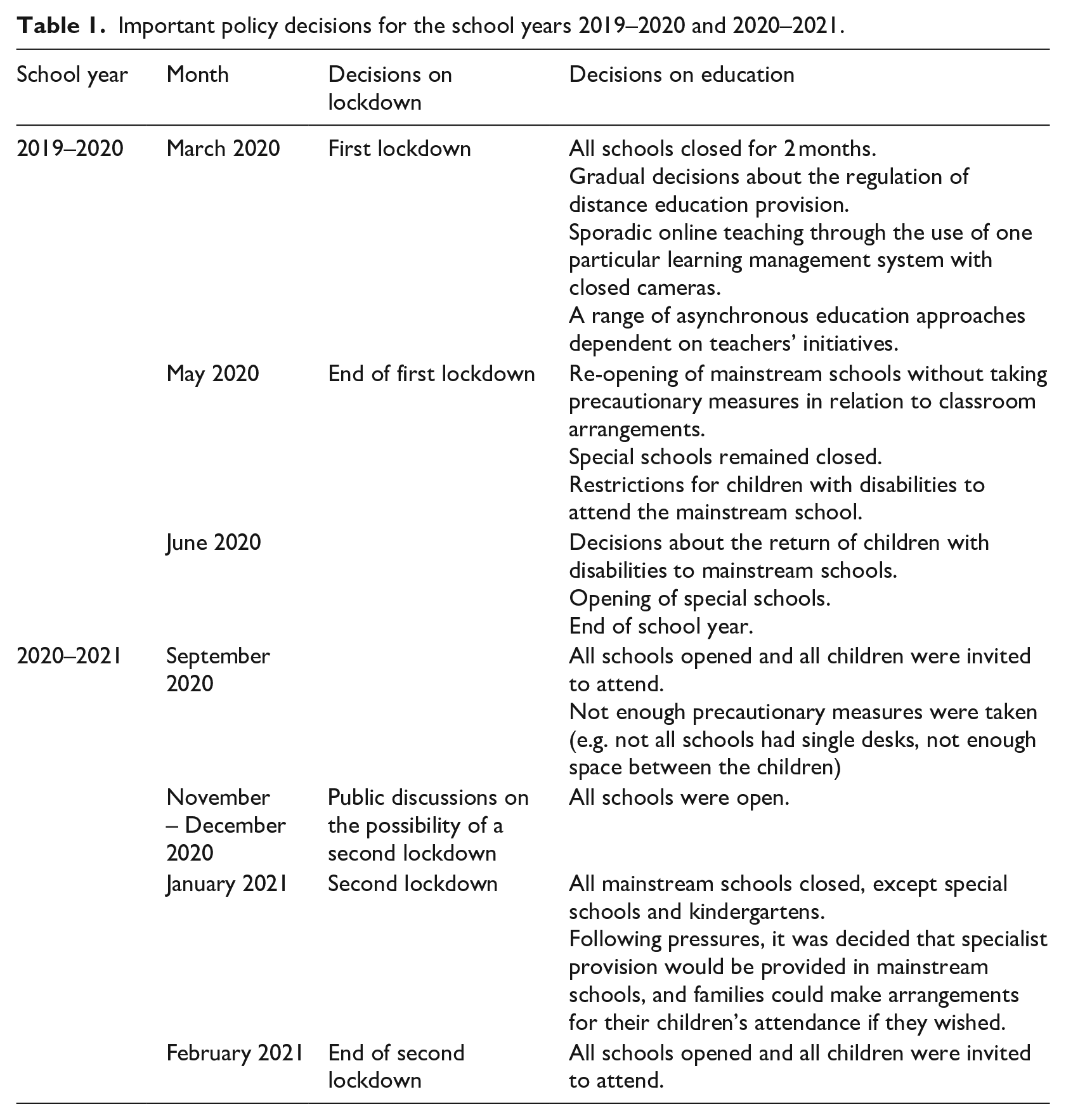
After the announcement of the first lockdown in March 2020, the education system dysfunctioned for a few weeks. Ministerial decisions regarding how teachers were expected to work in distance education were announced through circulars (e.g. MoECSY, 2020a). Teaching unions and teacher movements characterised these as ‘Pythia’s circulars’ – Pythia was an ancient Greek high priestess, known for her ambiguous prophecies (AKIDA Teacher Movement, 2020; DH.An.A. Teacher Movement, 2020; Proodeftiki Secondary Education Teacher Movement, 2020). Following the publication of a statement from the president of Cyprus in which he characterised teachers as the ‘weak link’ in distance education (Politis, 2020), teacher movements detailed the problems they experienced during lockdown, such as belated training for distance education and an insufficient supply of technological equipment to children (AKIDA Teacher Movement, 2020; PADED Protoporia, 2020; Proodeftiki Primary Education Teacher Movement, 2020; Proodeftiki Secondary Education Teacher Movement, 2020). Gradually, distance education was regulated by policy measures and targeted only children that were considered able to follow online teaching. A significant number of children with disabilities were excluded from distance education because reasonable accommodations (e.g. collaboration between education staff, personal assistants and families; option for personal assistants to work from the child’s home, possibility to use the most appropriate learning management system, etc.) were not provided. Recent studies record the inequalities experienced by children with disabilities over this period because of the policy measures taken (Commissioner for the Protection of the Rights of the Child, 2022; Damianidou and Georgiadou, 2022).
Methodology
The methodology of this study offers a historical, interpretative, and explanatory stance on the policy discourses developed in Cyprus during the pandemic, and aims to explore the predominant beliefs and interests. In doing so, the study seeks to create ‘spaces of rupture, dissent, and criticality’ in disability research during these critical times (Goodley, 2021b: no page number available). Seventy-two documents published between March 2020 and February 2021 were included in the study. The documents comprised of presidential decrees related to the pandemic, circulars issued by the Ministry of Education, reports issued by the Commissioner for the Protection of the Rights of the Child and the Commissioner for Administration and for the Protection of Human Rights, press releases from key organisations such as teacher unions, teacher movements, parental organisations and the umbrella organisation for people with disabilities (Cyprus Confederation of Organizations of Disabled People), and articles and opinion papers published in the press or on news websites, reflecting the views of all the stakeholders mentioned above. The creation of the dataset entailed trawling the websites of the aforementioned organisations, the education-news website Paideia-News.com, and a keyword search (e.g. ‘disability’, ‘special needs’, ‘pandemic’, ‘education’, ‘special units’, ‘special schools’) on Google. In addition, when collected documents identified other relevant sources, these sources were also included in the database.
The exclusion and segregation of children with disabilities from mainstream schools, as well as the tendency not to consider them in general education policies (Symeonidou and Mavrou, 2020; Mavrou and Symeonidou, 2014), is a key social and political problem which I intended to examine by drawing upon key concepts stemming from Inclusive Education and Disability Studies. Critical Discourse Analysis, suggested by Fairclough and Wodak (1997), offered a useful framework of analysis because it focuses on social problems and political issues. It is a particular strand of Critical Discourse Studies which allows researchers from different disciplines to engage in discourse analysis which does not focus on specific areas, such as the linguistic theory of Systemic Functional Linguistics (Halliday and Hasan, 1989), the social theory of discourse (Foucault, 1969), etc. In this study, the Critical Discourse Analysis framework was useful in the identification and interpretation of the ‘discourse-power circle’ (van Dijk, 2001: 354). Therefore, the interpretative nature of the study was a means to understand how social power was gained through control, and how discourses exercised this power. Another point of interest was how dominant groups exercised power through laws and rules, whereas less dominant groups were engaged in less-influential discourse (van Dijk, 2001). Yet another point of interest was how specific forms of discourse were formed when less powerful groups gained power through the media (van Dijk, 2001); the examination of the sets of documents and how discourses and policy decisions changed within a few days proved useful in this regard. Finally, the way discourses were involved in dominance, a condition known as ‘power abuse’, was also of interest during the interpretation phase (van Dijk, 2001: 352, 2008).
Given the interdisciplinary links of Critical Discourse Analysis with other disciplines in which social inequalities and powerful discourses play a central role, this study draws on the theoretical frameworks of Inclusive Education and Critical Disability Studies. Both disciplines address the creation of policies and legitimation of discriminatory practices and beliefs. Given the barrage of separate policy decisions concerning the education of children with disabilities, as well as the interference of all stakeholders who did their utmost to influence the discourse and policy changes, of particular interest in this study was the way in which ‘discourse structures enact, confirm, legitimate, reproduce, or challenge relations of power and dominance in society’ (van Dijk, 2001: 353). The contradictions, self-contradictions, and the inconsistences in the emerging discourses were situated in the existing social inequalities and discourses of exclusion that characterise the local context (Fairclough and Wodak, 1997).
The analysis of documents followed two paths. First, each document was read for its underlying arguments and messages, and the discourse(s) employed. A detailed memo was prepared for each document (Patton, 2002). Second, sets of documents, published following significant policy decisions that sparked public thinking and subsequent discussion, were read and interpreted in relation to each other. This was necessary to try to identify the powers that constructed, justified, and eventually consolidated the discourses. The powerful and less powerful agents that constructed, challenged, or enhanced discourses in the name of ‘good intentions’, were critically examined through a Critical Discourse Analysis lens.
Findings
According to the discursive analysis, ableist discourses, wrapped in human-rights rhetoric, were embedded in the discourses on the education of children with disabilities during the pandemic. Two main assumptions guided the development of the discourses: the ‘naturalisation of vulnerability’ and the ‘naturalisation of inequalities in education’.
The ‘naturalisation of vulnerability’ discourse
The ‘naturalisation of vulnerability’ (Tremain, 2020), which is the assumption that children with disabilities are more likely to have health problems, was embedded in ministerial circulars that regulated the return to schools after the end of the first lockdown (May 2020). In particular, after the end of the first lockdown, the Ministry of Education announced the reopening of all mainstream schools but not the reopening of special schools. The Ministry provided no justification for its decision on special schools. In addition, despite the reopening of mainstream schools, children who attended the mainstream school but received specialist provision in special units and had a personal assistant, had to follow a bureaucratic process before being allowed to return to school.
Primary schools and gymnasiums will reopen and will follow the Health Protocols. Special and fortified protective health measures need to be taken for those children who attend Special Units or have serious health and adjustment problems (and their needs are served by personal assistants/escorts), before they return to school (MoECSY, 2020b).
This decision was announced the evening before the reopening of schools and clearly conveyed the understanding that children with disabilities were vulnerable and needed to be protected. According to the ‘special and fortified measures’, families were required to file an application and submit a recent medical report to a special committee comprised of doctors. Once the committee provided permission for attendance, children could attend school, provided that they and their teachers presented a COVID-19 test. Other children and teachers were not required to undergo this procedure or take a COVID-19 test. It is important to note that some children could indeed be more vulnerable if they were infected compared to others (e.g. children with respiratory problems). These could be children without an impairment, or children with an impairment who did not attend a special unit. In this case, an inclusive approach would be to provide all children and families with the option for distance education, rather than deprive a particular group of children with disabilities of education. In addition, for children who returned to school, there should be a focus on a curriculum that raises awareness at school level on how to protect oneself and others, and follow a process that would help minimise the risk for all children (e.g. require a COVID-19 test from all teachers and children).
Tremain (2020) notes that people with disabilities are ‘rendered vulnerable’ through a ‘naturalised apparatus of power’. In this case, the Ministry of Education, as a key powerful agent, constructed people with disabilities as vulnerable subjects and excluded them from school. There may be different reasons for the policy, but no official justifications were provided. One possible reason may have been the intention to protect staff rather than children. In both special-school classes and in mainstream-school special units the ratio of adults to children may be two or three adults (one special teacher and one or two personal assistants) to six children. In either setting, some children receive care during their everyday activities and hygiene (e.g. eating, washing hands, using the toilet, etc.). Thus, the staff might felt that they had increased chances to get infected. The requirement for a COVID-19 test, in case they were allowed to attend school, reflected this feeling of fear, since children without disabilities and mainstream class teachers were not asked to follow this process at the time.
Education stakeholders resisted the dangerous discourse initiated by the Ministry of Education (Abrams and Abbott, 2020). Their main argument was that children with disabilities should not be seen as patients who are more vulnerable to COVID-19 compared to children without disabilities. Furthermore, they should not be seen as more vulnerable compared to children with disabilities who did not have a personal assistant. All political parties except the governing party condemned the decision in the press. They denounced the ‘discrimination and unequal treatment’ and ‘ostracism’ of children with disabilities, they accused the government for ‘sloppiness’, ‘thoughtlessness’ and they characterised the decision ‘unacceptable and disgraceful’. Some of their arguments reflected feelings of pity towards children with disabilities; for instance, ‘the government should show sensitivity’ (Kathimerini, 2020). Both the Commissioner for the Protection of the Rights of the Child (2020) and the Commissioner for Administration and the Protection of Human Rights (2020) reacted immediately and issued reports highlighting ‘discrimination on the basis of disability’. The Commissioner for the Protection of the Rights of the Child (2020) adopted a human-rights discourse and rejected the medical model of disability: With this announcement the Ministry discriminates children on the basis of disability. It reminds us of the dangerous and obsolete medical model of disability, and creates false impressions to society that disability is a synonym for illness. This victimises children and creates inequalities. Moreover, it contradicts recent proclamations of the Ministry of Education about inclusive education; rather it maintains and imposes segregating measures on the basis of disability.
Inclusive Education scholars also protested with opinion articles published in the press and denounced the policy of exclusion on the basis of disability (Symeonidou, 2020; Kourea et al., 2020; Phtiaka, 2020). All opinion papers included statements that this decision was a continuation of the exclusionary policies that had been in place before the pandemic, and the papers questioned the identification of disability with vulnerability. Primary and secondary teacher unions also disagreed strongly with the decision. The former characterised it as ‘unacceptable, unfair and an unexpected last-minute decision’ (POED, 2020), and the latter as a ‘wrong decision that equates to discrimination’ (OELMEK, 2020). Parents used a variety of resources to expose the inequities of the decision, although they also employed contradictory discourses. They issued press releases, talked on radio shows, they made statements in the press, and they organised a protest outside the Ministry of Education on 22nd of May, 2020. Some examples of their statements reveal their intention to expose the government and accuse it for not showing commitment to inclusive education: Unfortunately, we are experiencing the culmination of disablism in Cyprus [. . .] shame on them [. . .] a great faux pas of the Republic of Cyprus (Dialogos, 2020; statement by Yioula Pitsiali, the president of the parental organization ‘Agalia Elpidas’). We shouldn’t be blaming COVID-19, the problem is our ideology. [. . .] Any time a serious issue arises, like the pandemic that we now experience, our deficiency is revealed. [. . .] We trumpet equality in education, but not for all children. We trumpet inclusion in education, without including all children (opinion paper by a teacher and parent of a child with disability; Stavrou, 2020).
In a few cases, parental discourse employed ableist language which presented children with disabilities in need of therapies and rehabilitation, and families as victims. Here is an example: Schools open today, but the children of special units and special schools will not attend [. . .]. This [. . .] sends the message that children with disabilities are seen as patients; a racist stance. We invite the President of Cyprus [. . .] to offer essential access to the education and the therapies they need, such as speech therapy, occupational therapy, music therapy, physiotherapy, etc. [. . .] Following two months of confinement at home, the families of children with disabilities have literally reached the end of their tethers. Homes are now turned into prisons [. . .]. President Anastasiades, open the home-prisons so that the families of children with disabilities are allowed out (Politis News, 2020; extract from the press release of the Organisation of Parents and Friends of Children with Autism).
It needs to be noted that parents are not to be blamed because they asked for the services they were entitled to, but it is worth noting that this discourse presents rehabilitation services the only services available and suitable for children with disabilities. In addition, parents could have pointed out the right of families to have support at home through carers services. It is also worth commenting on the phrase ‘homes are now turned into prisons’ which is a response to President Anastasiades. In particular, the President ended his second proclamation to the citizens of Cyprus by saying: ‘Fellow-citizens, stay at home, in your shelters, and we will make it’ (Press and Information Office, 2020).
In summary, the Ministry of Education relied on an assumption of ‘naturalisation of vulnerability’ and used ableist discourses powerfully to articulate and legitimate exclusion. The families and allies of children with disabilities had a common objective: to achieve a return to school for all. Thus, the imposed powerful discourse was strongly interrogated. The outcome of this pressure did not lead to the withdrawal of the decision. However, in the following days, the Ministry did ask head teachers to notify a significant number of primary and secondary school children with disabilities who ‘are served by personal assistants, but do not have health problems’ to return to school (MoECSY, 2020c, 2020d). The remainder of the children with disabilities who attended mainstream schools and were considered vulnerable to COVID-19 were still expected to follow the ‘special process’. Special schools opened 3 weeks later than mainstream schools.
The ‘naturalisation of inequalities in education’ discourse
During the second lockdown (January 2021), the Ministry of Education decided to close all mainstream schools and keep all special schools and mainstream kindergartens open. Apparently, this decision was in complete contrast to the decision announced at the end of the first lockdown, since ‘vulnerability’ was no longer used as an argument. The new cycle of discourse led to the ‘naturalisation of inequalities in education’ discourse. Three ableist arguments supported this discourse: the need for specialist provision, the need to depreciate the money spent for children with disabilities, and the need to treat children with disabilities as a homogeneous group who cannot be educated in the same way as children without disabilities. The different actors who engaged in this ‘discourse-power circle’ (van Dijk, 2001: 355) constructed a discourse that naturalised inequalities. As I explain below, teachers criticised the decision of opening the special schools and the kindergartens while the mainstream schools were closed, but at the same time they suggested ways to improve their functioning. Parents and the Commissioner for the Administration and Protection of Human Rights demanded that attendance of children with disabilities in special units was allowed, even if mainstream schools were closed.
Both the primary and secondary education teacher unions (Pancyprian Organisation of Greek Teachers-POED and Organisation of Greek Officials in Secondary Education-OELMEK) stated their ‘reservations’ about the decision to keep special schools and kindergartens open. A member of an independent teacher movement wrote an opinion paper, in which he argued that this decision is absurd.
Education can be compared with a building. This building has many rooms, one for each class. The education building is on fire because of the pandemic, and the decision is to evacuate most rooms, but the kindergarten and special school rooms not only remain open, but the Ministry of Education does not even provide a ‘fire extinguisher’ to protect the children and the teachers (Hadjiloizou, 2021).
However, teachers offered a series of suggestions for the implementation of the policy to ensure the safe functioning of schools (e.g. placement of fewer children in the class, frequent rapid tests to teachers and school staff, increase of support staff, provision of thermometers and protective uniforms for the special school staff, etc. see POED, 2021).
The following days, parents demanded that all children with disabilities should be treated in the same way. They argued that all ‘special needs’ children had the right to receive specialist provision from specialist staff and personal assistants, and suggested two options: either personal assistants could work from the children’ homes or children could receive specialist provision in special units (Savva, 2021). The first option was valid, but the way it was presented conveyed the message that personal assistants would cover the gap between conventional and distance education, by substituting the teachers. The second option gave the calls for inclusion away since it revealed that children with disabilities who attend the mainstream schools are not expected to be educated alongside their peers. Rather they should receive specialist provision outside the mainstream class. Parents utilised many avenues (e.g. appearing on radio shows, issuing statements in the press, and filing a complaint with the Commissioner of Administration and the Protection of Human Rights) to put pressure to the Ministry of Education. Campaigning for specialist provision instead of campaigning for quality education, verifies the argument that ‘when the additional support is focused only on the special needs of some pupils’ the result is ‘the repetition of exclusion’ (Allan, 2006; Kim et al., 2022: 14).
Ableist discourse flourished in the Report, published by the Commissioner for Administration and the Protection of Human Rights (2021), which supported parents’ demands. The Report referred to children with disabilities as ‘special unit children’ and ‘children with special characteristics’ who cannot participate in distance education and can only benefit from special unit programmes. The notion of ‘labelled’ children and the taken-for-granted inability to participate in the same form of education as independent and able children, lie at the centre of the ableist discourse. The principle that ‘discrimination on the basis of disability is illegal’, which is usually employed to demand inclusion, was used to demand specialist provision. The argument was that children with disabilities who attended mainstream school special units were discriminated against because they were not allowed to attend special units when other children with disabilities were allowed to attend special schools.
The Report provides an example of how the ‘control of discourse means preferential access to its production and hence to its contents and style, and finally to the public mind’ (van Dijk, 2008: viii). The Report includes selected parts from the policy framework that were extracted from policies with contradictory ideologies (e.g. Law N. 113(I)/1999 on special education and integration, and the United Nations ‘Convention on the Rights of Persons with Disabilities’ and ‘General Comment Number 4’ on inclusive education). It highlighted the following issues: the principle of non-discrimination on the basis of disability; the need for reasonable adjustments on the basis of individual needs; and the need for specialist provision. After presenting this fabricated policy framework, the Commissioner argued that, because ‘it was correctly decided that children with disabilities can attend special units based in the kindergarten and special school classes’, not allowing ‘the special unit children’ to attend special units ‘consists unequal treatment’. Adopting this line of reasoning, leads to the false conclusion that all children with disabilities should be treated in the same way because they all ‘belong’ in the same category.
The Report concludes: The education they receive in special units, obviously, cannot be replaced with asynchronous or synchronous distance education. For this reason, the Ministry should take into consideration that, the personal assistants and special unit teachers are required to go to school. Thus, there could be regulations and reasonable adjustments so that children are benefited from their services. Distance education is particularly difficult or impossible for children with special characteristics. Thus, it is less favourable treatment and is considered discrimination. Without the necessary differentiation/adaptation, they are in unfavourable condition compared to the other children. Objectively, there is a weakness to adopt all or part of the education programme to the context of distance education (Commissioner for Administration and the Protection of Human Rights, 2021).
Three assumptions in the above quotation require interpretation: the taken-for-granted quality of education provided in the special units; the cost of specialist provision that needs to be depreciated; and the understanding that children with disabilities cannot engage in distance education. All three constitute the ‘naturalisation of inequalities in education’ discourse.
First, the understanding that children with disabilities can only learn in segregated settings and from specialist ‘experts’ is at the heart of the ableist discourse employed in education (Tomlinson, 2017). It is the basis of the ‘biased discourse’ (van Dijk, 2008) that justifies and perpetuates existing separate structures for children who do not meet the standard of ‘learner-as-able’ and ‘ideal learner’ (Goodley, 2017). As explained by Mallett and Runswick-Cole (2014: 44), children with disabilities are ‘considered not to develop normally’, and this excludes them from the category of the ‘resilient’ child. Children who are not ‘resilient’ are believed to need protection and specialist provision in segregated settings. Rather than suggesting alternative ways in which children with disabilities could be educated from home, they invited ‘special unit children’ to attend special units placed in mainstream schools, at a time when their peers without disabilities were restrained at home (Hajdiyiannakou, 2021). Maintaining communication with their peers without disabilities and learning together in an inclusive community was not an issue because, at the end of the day, specialist provision and not education is falsely believed to be what children with disabilities are entitled to.
Second, the Report’s conclusion relies on the understanding that educating children with disabilities is costly and therefore, decisions about the use of personnel should consider this. Titchkosky argues that this particular conceptualisation of ‘disability = cost’ is linked with a ‘sense-able sayable’ (Titchkosky, 2020: 28) and is often constructed by international and national organisations and mass media. The argument expressed in the Report is that since the personal assistants and special teachers are expected to go to school and they are paid for their services, why not make the best use of the money spent on their salaries? Mainstream class teachers were also paid during the second lockdown and they were expected to work in distance education. However, it was assumed that they would engage in distance education with able children who could follow online teaching.
Third, in the Report, the digital exclusion of children with disabilities is presented as natural. Despite the well documented arguments and guidelines on digital access as a right and on digital empowerment as a way to reduce educational and social exclusion (Hoogerwerf and Mavrou, 2021; Lewthwaite et al., 2019), the Report insists on conventional education. It takes the ableist pedagogy for granted, and does not realise that forcing children to sit in front of the screen without considering alternative pedagogical approaches for distance education will not work. One would expect that a report that claims equal treatment and non-discrimination on the basis of disability would also consider some of the problems in the way distance education was implemented in Cyprus. For example, the chosen learning management systems were inappropriate for some children, the requirement to keep cameras switched off during online teaching was problematic for a number of children, no adaptations were made so that personal assistants could best support children’s learning in collaboration with the teachers during distance education. The umbrella organisation of people with disabilities raised these problems a few days earlier (Cyprus Confederation of Organisations of Disabled People, 2020), but their positions were not made widely public since the media did not reproduce them to the extent it reproduced other views. The hegemony of the ableist ideology supported the understanding that children with disabilities, living in ‘abnormal’ and ‘inferior’ bodies, have no place in distance education, which is for children whose bodies fit ableist standards (Campbell, 2009). The ‘effect’ of this discourse was the policy decision that children with disabilities could receive specialist provision in mainstream schools after an appointment with their specialist teachers and personal assistants (van Dijk, 2008).
Conclusions
The links between the ableist discourse with the power of the stakeholders to control or influence policy developments led to the development of two discourses in Cyprus, namely the ‘naturalisation of vulnerability’ and the ‘naturalisation of inequalities in education’ discourses. The juxtaposition of arguments between the Ministry of Education (the powerful agent in education) and the key stakeholders in the society (e.g. parents, teachers, Commissioners, people with disabilities, researchers) created these two discourses, and either challenged or enhanced them.
First, the Ministry of Education exercised power through the ‘naturalisation of vulnerability’ discourse. This discourse justified the decision that children with disabilities were not allowed to return to school after the end of the first lockdown, whereas all other children could. Even though all education stakeholders challenged this discourse, the Ministry continued to express ableist views that constructed children with disabilities as children at risk, because they had a ‘special needs’ label, had a personal assistant, and attended special units. During the second lockdown, key stakeholders (i.e. teachers, parents, the Commissioner for the Administration and Protection of Human Rights, and the Ministry of Education), constructed the ‘naturalisation of inequalities in education’ discourse. This discourse relied on the belief that children with disabilities require specialist provision and therapies, they are not able enough to participate in and be benefited from distance education, and their status as learners hinders a ‘value for money’ outcome during the lock down, because their personal assistants and teachers were getting paid without providing services. Thus, at a time when mainstream schools were closed, policy measures suggested the opening of special schools, and later on, the functioning of special units and specialist provision settings placed in the mainstream school.
If ableist thinking did not guide policy decisions, and all children were equally valued, emergency policy measures and related discourses would be different. The Ministry of Education would organise the return to school after the first lockdown more carefully, avoiding the ‘naturalisation of vulnerability’ discourse. Ideally, it would suggest to all parents to report whether their children, either with or without disabilities, are at risk to be infected and provide them with alternatives. It would not equate all children with disabilities with children at risk. Children who faced an increased danger if infected could have the option to continue with distance education. In this case, distance education should be understood in its broad meaning. It could be synchronous (with the opportunity to choose the most appropriate learning management system according to the child’s individual characteristics, option to keep the cameras on, use of alternative technological equipment when necessary) and/or asynchronous (with the collaboration of teachers and personal assistants who would work on finding the best possible ways to provide quality education). If distance education was not conceptualised in an ableist way, the ‘naturalisation of inequalities in education’ discourse, that emerged during the second lockdown, would not thrive, because the different stakeholders who perpetuated it, would understand that children with disabilities learn when pedagogical approaches enable them to learn. In parallel tracks, the return to school after the first lockdown could be followed by raising the awareness of all children about how they can protect themselves and their peers, and specific environmental measures that would ensure the safety of both children and staff (e.g. single desks, plexiglass dividers, masks for children whose age and health conditions allow for their use). However, these measures were not taken when the schools reopened after the first lockdown in May 2020, or when the new school year started in September 2020. The ableist conversations unpacked in this paper would be avoided if education circulars considered all children both as children who needed to be protected from COVID-19 and children who had the right to learn.
Both the ‘naturalisation of vulnerability’ and the ‘naturalisation of inequalities in education’ discourses reflect ableist thinking, but they serve different purposes. The former was employed to protect staff by excluding children with disabilities; the latter served as justification for a specialist provision to a group that was perceived as homogeneous and unable to participate in distance education. This discourse viewed children with disabilities in need of therapies and specialist provision, but not as vulnerable, and therefore it created the public belief that they could attend schools at a period when children without disabilities were restricted to their homes to minimise the risk of being infected. The effects of these discourses were that children with disabilities were excluded from education, and were considered unable to participate in regular or distance education. Evidently, education stakeholders viewed attendance in the mainstream school and participation in distance education as sites of education that are suitable for the learning of children without disabilities. Attendance in the mainstream school and distance education could be organised in so many different ways to protect and reach all children.
Significantly, the discursive analysis of this study demonstrates that understanding the principles of inclusive education and valuing all children equally is more important than ever. If we accept that all children are humans who are ‘cared about, cherished and valued’ (Mallett and Runswick-Cole, 2014: 137), then we will strive to increase access, participation, and collaboration in education (Florian and Black-Hawkins, 2011; Vlachou and Fyssa, 2016). However, if we continue to treat children as belonging to two broad categories – unable or able, dependent or independent, special or normal – we will continue to develop and implement policies of exclusion. Even worse, we will call these policies inclusive.
I hope that my research on the discourses that emerged during the pandemic will encourage us to rethink pre-existing inequalities. The critical discursive analysis presented in this paper suggests that pre-existing ableist discourses were strengthened during the pandemic. Similarly, pre-existing segregation policies promoted the further exclusion of children with disabilities. I agree with Runswick-Cole (2020) who maintains that ‘crisis or no crisis’, decisions about people with disabilities should not rely on labels and dichotomies of ‘us’ and ‘them’. Any moves towards change entail the interrogation of hegemonic discourses that devalue children with disabilities and consider the disabling effects of these discourses during the pandemic. As Kent et al. (2019: 7) note, our shared commitment ought to be to reduce discrimination on the basis of disability to ‘a historical footnote’.
Footnotes
Declaration of conflicting interests
The author declared no potential conflicts of interest with respect to the research, authorship, and/or publication of this article.
Funding
The author received no financial support for the research, authorship, and/or publication of this article.
