




Abstract
Connections between linguistic heterogeneity, educational choices and (family) biographies are complex and ever shifting. With this paper, my aim is to explore the question how social spaces are constructed by multilingual families in migration societies and how they situate social spaces ‘in between’, thereby challenging both binary and national logics and creating third spaces. Especially in view of national educational institutions, family decisions on language transmission and use are reflected upon and at times re-evaluated.
Analysis of family interviews with German migrants in Norway shows how both continuity and change are relevant for the parents as they try to produce an uninterrupted family biography but at the same time need to be open to adaptations to new situations. Expectations, language ideologies and perspectives that transcend one’s own family spaces gain relevance while (national) institutions may call for changes in language regimes and practices.
Introduction
Connections between linguistic heterogeneity, educational choices and (family) biographies are complex and ever shifting. The construction of multilingual social spaces and languages as local practices (Pennycook, 2010) seems particularly relevant in moments when decisions on education in light of different languages and transnational alignments need to be taken and justified. Especially in view of national educational institutions, family decisions on language transmission and use are reflected upon and at times re-evaluated (Purkarthofer, 2019). With this paper, my aim is to explore the question how language choice is commented upon by multilingual families with regard to education in migration societies and how they situate themselves in social spaces ‘in between’, thereby challenging binary and national logics. Social spaces are produced through practices, planned representations and lived experience and are dynamic and relational, multiple and discoherent, produced and performed (Lefebvre, 1991; Massey, 2005, see also Haley, 2016).
Methodologically, the research is based on linguistic repertoires (Busch, 2017), understood as the entirety of linguistic resources, knowledge about its use and affects and emotions connected to languages and their social meaning. The lived experience of language of parents and children is in focus, and deals with family language policy and practice (King and Lanza, 2019). Expectations, language ideologies and perspectives that transcend one’s own family spaces gain relevance while (national) institutions may call for changes in language regimes and practices.
I will start in Section ‘Through a spatial lens’ by discussing social space and spatial organization, first with a specific focus on families and educational institutions and second with regard to negotiations of belonging. Section ‘Data, methods and context’ provides information on the context, data and methods of the empirical study, before in Section ‘Example 1: This is ours, except it isn’t’, I analyse selected data to illustrate how expectations, decisions and belonging are negotiated and point to and form social spaces ‘in between’. Finally, in Section ‘Conclusions and open questions for future research’, I discuss the findings in light of research on family language policy and educational research more broadly to understand the implications of transnational education for multilingual families.
Through a spatial lens
Families and schools as social spaces
The production of space is done by social actors and societies over time, through a myriad of actions, some of them very distinct and visible, some (or most) as part of the almost unnoticed everyday life (Lefebvre, 1991). While space has gained attention in recent years (cf. Schroer, 2006 regarding the spatial turn) the notion of social space appeared already in the beginning of the 20th century when German sociologist Georg Simmel and French anthropologist Emile Durkheim both saw space as one expression of the social, as a momentary recording of society, that could be seen and analysed (Simmel, 1992: 689, transl. by the author).
The spatial and the social are inseparably intertwined, therefore providing a particularly fruitful lens into spatialized language practices as social phenomena. Harvey, in his publication on space, justice and difference (1996), summarizes four main points about the relationship between the spatial and the social – and while we might be well acquainted with the idea of social constructedness, I find it well worth to be reminded of its main characteristics: 1. Social constructions of space and time are not wrought out of thin air, but shaped out of the various forms of space and time which human beings encounter in their struggle for material survival. [. . .] 2. Conceptions of space and time depend equally upon cultural, metaphorical, and intellectual skills. [. . .] 3. Social constructions of space and time operate with the full force of objective facts to which all individuals and institutions necessarily respond. To say something is socially constructed is not to say it is personally [212] subjective. [. . .] 4. Social definitions of objective space and time are implicated in processes of social reproduction. [. . .]” (Harvey, 1996: 211-212)
Given the nature of social space as linked to humans and social processes, we are also operating in a field of experience and memory and spaces are not only constructed in the moment but are inscribed with a history and an imagined future. For the purpose of my analysis, I developed a trifold understanding of social space for the sake of my analysis (see also Purkarthofer, 2016): (1) Social space is relying on social interactions and is stretched out between actors, it is thus different from physical spaces, rooms we can enter and leave without necessarily changing them. It is in nature relational and dynamic, as it is constantly changing within the same space as the relations change and as people might enter or leave the conversation. (2) A multiplicity of stories can be found and make up spaces, in the moment but also linked to the past or (imagined) future, and they not necessarily align to be part of the same story, thus we can read space as being multiple and incoherent. And finally (3), given its social nature, space is constructed and performed by speakers – a quality that presents itself maybe most readily to sociolinguistic analysis. By highlighting these three qualities, I find ample ways to relate concrete experiences to the more abstract concept of social space.
For the purpose of this article, I am inspired by Harvey’s research question of why and by what means human subjects individually and collectively construct spaces so that they are imagined as loci of institutionalized power and how and to which purpose this power is then used (Harvey, 1996: 320). Before turning to the empirical examples, I will reflect on families and educational institutions as social spaces, analysing the interactions, stories and constructedness of each of the spaces. Finally, I will turn to the concept of the third space, introduced by Soja (1996) to understand the non-binary nature of the here-and-there, also used thirding-as-Othering as a social practice of rendering the known into something else, thereby challenging the assumed order of things. Bhabha’s (2004) ‘third space’, originating in literary studies, is comparable in referring to a place that is other than either the place of origin nor of destination. Bhabha in a way points to the third alternative, whereas Soja is concerned with the alternative reading of what is still a known place. Both thinkers provide inspiring accounts of how we experience the known and the unexpected and I will explore the thirding potential of transnational spaces of families and education.
For families, their own practices, representations and spaces are in a way a private matter – but at the same time, as members of communities and societies, families are under constant supervision. Rawls (2001) named the family a ‘basic institution’, important to transmit social values (and, we may add, also languages). To summarize, it is evaluated against social values like good parenting, situated in specific power dynamics (which might be even more complicated for transnational families, esp. regarding language use, cooperation and loyalty) and is at the same time a specific group of individuals and their private environment, at times following their own rules. According to Eleanor Ochs and Tamar Kremer-Sadlik, ‘[f]amily is both a legal institution and social achievement, and talk plays an important role in its formation.’ (Ochs and Kremer-Sadlik, 2015: 88) The authors’ perception of the twofold aim and nature of families summarizes the often implicit social connections but it also points us to the explicit regulations governing the life of families. One moment where this legal contract becomes particularly apparent is when families meet national educational institutions: from social expectations linked to the age of children entering child care (ranging from 6 months to 3 years of age for most European countries) to regulations demanding that children either take part in the public education system (which is the case in Norway and Germany) or else, can be taught at home under the condition that their progress is externally monitored (typically once a year, i.e. in Austria). Opting for different types of schooling, as a teacher as well as for one’s children, is thus a complex matter, in particular for multilingual families who feel pressured to navigate between generally recognized certificates and increased support for learning. In their study on deaf parents’ choices between regular and special education in Flanders, De Meulder and Murray (2021) report the parents’ (sole) reliance on their own skills to ensure sign language exposure which they perceive as not guaranteed in general education. This relates to Thoma’s (2020) findings on the schooling choices of a bilingual teacher, being torn between making her bilingual skills useful in special schools or else being recognized as an Austrian teacher through opting for a (monolingual) mainstream school.
Schools, on the other hand, are in themselves national actors and in Europe mostly perceived as a public service, with relatively few exceptions of privately owned (often faith-based) schools which are required to follow a curriculum rather close to the public system. In terms of language policy, schools where (and are) the main actors to influence substantial language developments as they are able to target large cohorts of students and every language introduced in the curriculum will gain importance not only through the knowledge of students but also due to the need for teachers, the availability of resources (or their production) and other cultural and symbolic capital. At the same time, the monolingual habitus of nation-state schools (Gogolin, 2004 [1994]) enforces hesitancy towards multilingual realities and can foster children’s resistance to learning and using any marginalized or just ‘other’ language.
However, schools are also spaces where social spaces are produced in many different ways: following specific, overt and covert language regimes, and being in constant negotiation through interactions between students, teachers and parents as well as other members of the (school) community. This work owes to the idea of language regimes (Kroskrity, 2000, 2018): the dynamic and relational character of space asks for regimes of language to be constantly constructed and performed – but they also see the potential parallelity of regimes which might align or contradict each other, and thus add the notion of multiplicity. Regimes can be supported or challenged by all speakers, but depending on social status and specific positioning in a given social space, their attempts might be more or less powerful. Silverstein’s (1998) idea of ideological sites is taken up, of specific sites like court rooms or schools among others where regimes of languages are enforced and negotiated. The language regimes of the space, composed through practices, representations and discourses, have an important influence on the speakers and their developing linguistic repertoires. The focus on spatial practices should of course not neglect the importance of other influences on the repertoire: gendered and racialized experiences impact on the repertoire (Oostendorp, 2022) and practices in turn influence the speakers’ developing options (Napier, 2021).
Language and education in transnational spaces
Transnational families have to find their own spaces for their (migrant) selves and in acting out language policies and practices they establish certain ways to act and interact. The excerpts from two families illustrate how spaces of multilingual expression are found but also have to be actively constructed with regard to educational choices and in relation to language use and learning. Parallel and multiple spaces exist and might be interconnected across diverse lines.
Canagarajah rephrases this in the following quote: [Migrants] make spaces for their places, voices and norms as they contest dominant language ideologies and orders. Often they are able to persuade even native/local speakers who are invested in traditional norms to move to a different scale of interaction where plural norms can be negotiated in more democratic terms.” (Canagarajah, 2013: 221)
In the following three subsections, I will describe expectations and intentions, decision-making and finally belonging as relevant concepts for transnational families and will then illustrate these concepts with the help of two examples from my empirical research in Sections ‘Data, methods and context’ and ‘Analysis and findings’.
Expectations and intentions
Both families and schools are as institutions carriers of expectations for individuals and communities. Lived experiences of language of parents and children influence the ways family members see their own and others’ ways forward: depending on the developments of linguistic repertoires (Busch, 2017), certain potentials are opened or seem particularly promising. Already early in the life of a family, parents’ own experiences foreshadow biographical choices for their (even unborn) children (Purkarthofer, 2019). Ideological assemblages (consisting of language ideologies and regimes, Kroskrity, 2018) contribute to the language-related choices of families and the offers that schools are making to their students. Ballweg (2022) in a study on highly multilingual families in Germany stresses the influence of perceived profits of language competence that lead parents to pursue some but not all of their family languages. Profit is often enough defined through educational value, intertwined with issues of class and race, thereby constructing hierarchies of spatialized language practices. In a different example, a study on the Trump family’s multilingualism, Wright (2020) highlights the invisibility of a bilingual family life in order to comply with expectations of a monolingually-imagined USA. In the discussions about intentions, Ochs and Kremer-Sadlik bring two competing ideologies to the fore: on the one hand, ideologies of communitarism such as that social attachments are crucial to one’s well-being and on the other hand of individualism (where i.e. personal freedom, will, rights and self-sufficiency are prioritized) need to be navigated and influence in turn new expectations for one’s family life and education. In terms of constructed social spaces, these examples demonstrate the constant efforts necessary to maintain certain ideological assemblages and the link them to spatial practices. What might be normalized as monolingual orientations of educational institutions is just as much the product of ideological intentions as is the seemingly simple multilingualism present in many transnational families. However, neither of these spaces are clearly separated from other spaces and experiences and ideologies might happen in-between or in a third space.
Decision-making, policy and practice
Language policy is well researched in education and decision-making was an initial focus of family language policy, when FLP was originally narrowly defined as ‘explicit and overt planning in relation to language use within the home among family members’ (King et al., 2008: 907). Early research had a firm anchoring onto the decision-making processes families undertake in the home and how these may relate to child language learning outcomes. In Spolsky’s (2012) view, language ideologies, language practices and language management are the crucial aspects of language policy in the family. A recent overview is provided by Lanza and Lomeu Gomes (2020). The link between policy and practice is key when results of language policy are in focus, be it in the family or in educational contexts. Language practices in schools can either foster language-friendly environments or else contribute to the hegemony of one particular language or variety. Often enough, the intentions might speak of multilingualism while the practice clearly favours a certain language (Purkarthofer, 2021a). Selleck, in her study of Somali mothers and daughters in the UK, quotes a participant on the changes in spatialized practices once the children start attending educational institutions: ‘I understand but it makes me sad (.) it all starts when they start school (.) they go from being Somali children in the family to Bristol children’ (Selleck, 2022: 8). This observation immediately links to belonging, as discussed in the following section.
Belonging
Relationships of belonging are a relatively recent concept, yet it seems fruitful to capture the attachment of individuals to their environments, both families and communities, and even connections that transcend national (and even temporal) borders. In Girard and Grayson’s (2016: 2) understanding, ‘relationships of belonging are never individual in the strict sense, they are so many and varied that, for each individual, they make up a combination distinct from all comparable combinations’. He names families and schools as the earliest space of belonging, securing social integration. Hearst (2012: 41) points to the ‘boundaries of belonging [that] can be an explosive matter because these disputes strike at the very heart of how individuals, communities, and nations understand themselves’. Busch (2017b) in her study on the French-German binational upbringing of a bilingual speaker quotes the speaker saying that ‘whenever I am in one language/place, my ‘other eye’ watches out’. His description of the constant monitoring of himself in the space-in-between is a well-known feeling for many members of transnational families. For families in transnational contexts, relationships of belonging might, in addition to individual intention and decisions, govern educational choices for their children – in an attempt to ensure the children’s opportunities to lead a successful life.
Data, methods and context
Analysing transnational families and relationships unavoidably happens in a particular context, inscribed in specific histories of emigration and immigration, fuelled by economical, political and other reasons. As varied as the biographies of migrants are the kinds of transnational relations that they engage in and that shape their lives and the lives of their children. In the case of this study, research was conducted with Germans who migrated to Norway for work reasons as part of my post-doctoral project at the Center for Multilingualism in Society across the Lifespan (University of Oslo). I worked with three couples and their pre-school aged children over the course of 12 months and collected data from interviews with the parents, family interactions with parents and children and creative tasks involving drawing and playful ways of reflecting the family spaces with LEGO building blocks. Biographical interviews with the parents and multimodal and creative methods in the family were used to acquire interpretations of multilingual family life and gain insights into the intentions, decisions and relationships of belonging.
Interviews were done mainly in German, but were infused with Norwegian and sometimes English utterances, which in this respect is relatively typical for the multilingual lifeworlds of the participants (an extended discussion of the project is presented in Purkarthofer, 2021b). For the presentation of data, the original multilingual transcripts which served as the basis for the analysis are presented in parallel with English translations. Some details have been omitted for reasons of anonymity, in particular with regard to children and their biographies.
In this article, I will focus on two families, who moved to Norway initially due to job offers for one partner and decided to stay in Norway for the time being (see Table 1). With all participants holding university degrees, the two couples are representative of the profile of German migrants to Norway, as they mostly are attracted by the good job opportunities in medical, social and academic professions. Germans are the ninth largest group of migrants in Norway with about 27,000 persons living in Norway at the moment (Statistics Norway, 2019). Travel between Germany and Norway is relatively easy, due to geographical proximity, frequent plane connections and even a ferry service to Germany directly from Oslo (and other places). Both main languages German and Norwegian are part of the Germanic language group and the typical learning process is rather fast (Tveit, 2011). Cultural similarities can be attributed to shared historical and religious influences of protestant religions, but other aspects of the social welfare state, family values and ideas of communal life can also differ considerably (see also Czerniawski, 2011).
Overview of the participants.
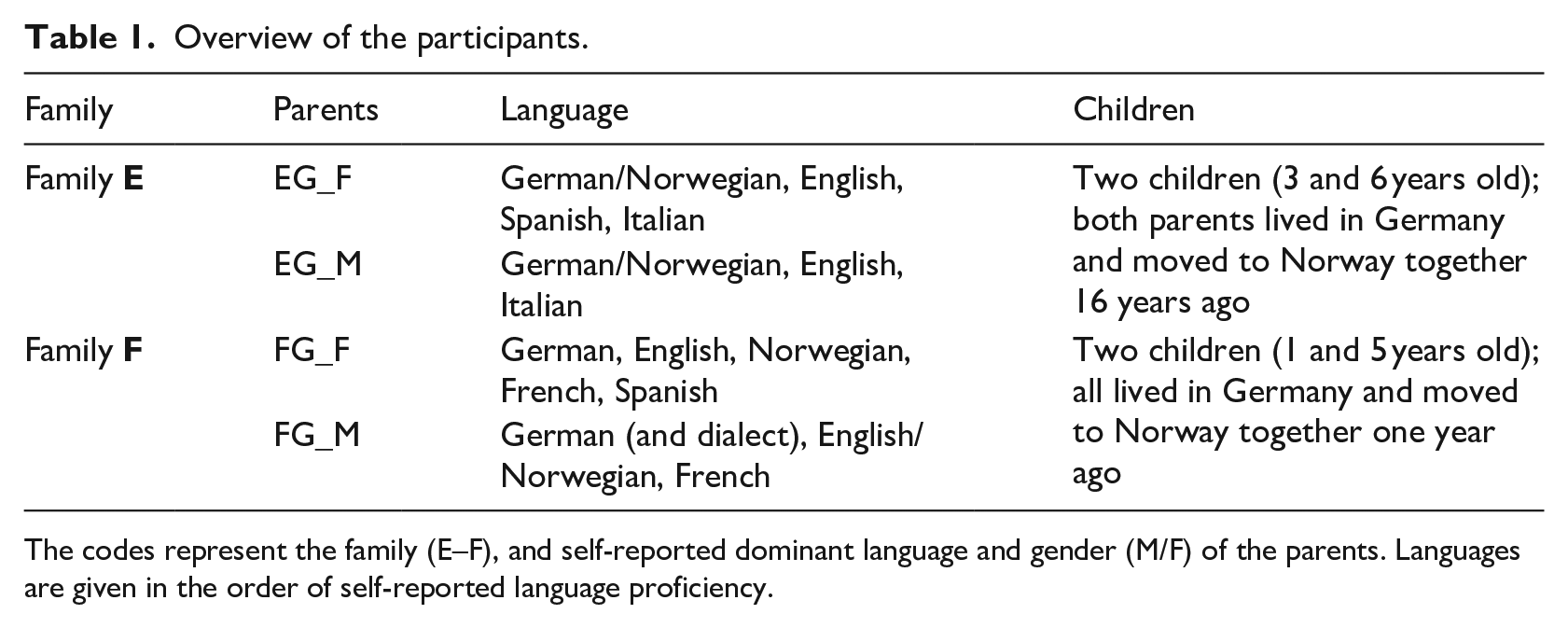
The codes represent the family (E–F), and self-reported dominant language and gender (M/F) of the parents. Languages are given in the order of self-reported language proficiency.
For the scope of the study the relative proximity of the anchors of transnational relations was interesting as it allowed insights into fine-grained perceptions of difference. It also raised the question of ‘unseen’ difference as some participants talked about their feeling of not being perceived as ‘real migrants’ (see among others Ruokonen-Engler, 2012).
Analysis and findings
Exploring the question how language choice is commented upon by multilingual families with regard to education in migration societies, data from two families is presented here to illustrate how transnational connections can be analysed with a focus on intentions, decisions and finally relationships of belonging. I analyse the interview excerpts to understand how the parents situate themselves in social spaces in Norway, in Germany and finally ‘in between’, thereby challenging binary and national logics. These expressions of belonging seem particularly relevant with regard to language use and language learning, as language use opens spaces that are perceived as other or third spaces, neither completely Norwegian nor German (or English). While interviews took place in the family homes, the (Norwegian) institutions and their institutionalized power were part of the conversation as their (language) policies were constructed as frames of reference.
Example 1: This is ours, except it isn’t
Family F had rather recently moved to Norway at the time of the first interview and was still settling in their new surrounding. Their family language was overwhelmingly German, with one parent and the older child being exposed to Norwegian in the workplace and pre-school and the other parent (who had come to Norway without prior knowledge of Norwegian) attending Norwegian classes for second-language learners. In the biographical interviews with the parents, German was constructed as important in the family domain, and both parents agreed that Norwegian would sooner or later challenge the status of German, as was already visible in language changes with the child’s friends and in neighbourhood exchanges. English was for the moment also a very relevant resource, in particular in the workplaces but also in conversations covering complex topics where Norwegian was deemed not yet adequate. After less than a year in Norway, questions of language adaptation were still mentioned frequently.
Excerpt 1 displays one occasion where one parent talks about her discomfort to ‘force’ others to change language to adapt to her (perceived) lack of language skills. The partial intercomprehensibility of German and Norwegian would allow her to follow conversations in Norwegian, even if her active speaking might not be up to this level. While both parents voice their own availability and comfort to adapt to others’ language competences (i.e. through switching to English if others are not speakers of German), the same is seen as less comfortable when being the reason for such an accommodation. In light of continued education for adults, this excerpt is relevant as we also see the parent who is a learner of Norwegian, attendee of language classes and thus eager to learn and speak, in a position that denies her learning opportunities.
Excerpt 1: FG_F: das ist mir auch immer so peinlich, wenn ich die einzige ausländerin bin und die norweger englisch sprechen mit mir, und die dann unter anderem/ untereinander alle englisch miteinander sprechen, dann denk ich mir [ausatmen] ja, ihr könnt ruhig norwegisch sprechen FG_F: I always am ashamed when I am the only foreigner and the Norwegians have to speak English with me, and then they themselves/with each other, everybody speaks English with each other, and then I think [sighs/exhales] yes, you can just speak Norwegian with each other
The family setting is in this case extended to include friends and acquaintances – and multiple language use is constructed as the default casue. However, the link between national contexts (being the foreigner) and expected language use is voiced also in this setting. While German and Norwegian are associated with two specific countries, English becomes the third option for those out of place. In other comments, the children’s use of different languages is described as an expected process, and both parents are wondering about the dynamics that the predominantly Norwegian pre-school will have on their household and family interactions.
Along with language and interaction that present a rich source of narratives, cultural practices are mentioned that are, half-jokingly, integrated in the family representation of social spaces. In an activity to map the family’s social spaces (see Purkarthofer, 2021b), stereotypical representations of Norwegian country life are mentioned: a small hut in the woods (called hytte), an outhouse and endless forests. For now, they are constructed as imagined spaces of the future and the joking tone of the exchanges points to the stylization of Norwegianness that might be rather far from life in the capital city. At the same time, the constructed promises of Norwegian happiness indicate a positive attitude towards the new environment and a certain trust in a positive outcome of this migratory adventure. However, certain elements of transnational challenges are also mentioned. In Excerpt 2, a flag and flagpole are used to illustrate knowledge about Norwegian rituals.
Excerpt 2: FG_F: aber wir versuchen uns auch zu integrieren, deshalb die [norwegische] Fahne [die zu Geburtstagen gehisst wird] . . . die deutsche Fahne würde hier keinem was ausmachen, aber uns würde es was ausmachen, und meine Mutter würde einen Anfall kriegen und das Haus nicht mehr betreten FG_F:and we are trying to integrate [laughing] and that’s why the [Norwegian] flag [which is usually flown for birthdays] [continues more seriously] the German flag would not bother anybody here, but it would bother us, and my [German] mother would have a fit and would never set foot into the house again
The Norwegian flag is traditionally raised for birthdays, in front of a house or as part of the birthday decoration. Following Norway’s independence in 1905, the flag is used as a symbol of celebration for different occasions (also including Christmas) and small flags feature on different household items. The mentioning of the flag as one attempt to adapt to Norwegian rituals is immediately set in context to the potential use of the German flag as a celebratory accessory. In a way, claiming the Norwegian flag is part of a process of blending in – on the other hand, it seems only ever possible because it is for this family not the main national affiliation. The corresponding German flag in contrast, is much more closely associated with nationalist ideas and can thus, by this family of worldly migrants, never be used to express affiliation in the same way. Even less for the (grand-)parent generation that grew up in post-war Germany.
In terms of ideological assemblages, the analysis with a focus on transnational interpretations reveals on the one hand a strong orientation towards interactants: each person is expected to move in multiple social spaces and diverse language use helps to distinguish and create these spaces and the personae associated with them. The languages are in a way situated between speakers in a continuum that allows movement. Intentions and decisions are presented as aligning means that are supposed to ensure each speaker’s language potential. At the same time, cultural differences are acknowledged and mocked, while they are also presented as potential subjects of appropriation. The Norwegian hytte is within reach, and so is the future in more than one language. Finally, there is a complexity in the relationships of belonging that is beyond the immediate individual experience: being neither completely here nor there is also linked to knowledge about historical, political and social events. The reference to the Norwegian flag is possible because it is not ‘ours’ (the family’s) and thus positioned in a distance. The German flag, as much as it may be more ‘adequate’ in terms of national belonging, is even less possible due to the social understanding of nationalist ideas transported by its use. While the Norwegian flag is thus for this family a concrete singularity, the German flag is in their specific surrounding linked to a much broader social space.
Example 2: This is the special place where he can ‘not be special’
The second example concerns Family E, having lived in Norway for over 15 years after initially moving to Norway due to a job offer for one partner. The family settled in Oslo after some years in a smaller Norwegian town, both children were born in Norway and the older has attended Norwegian pre-school. The family language was reportedly mostly German, but with both parents working in Norwegian-dominant work places, Norwegian also played a huge role in the family with regard to friends and activities. Contacts and travel to Germany was frequent, the direct ferry connection to Germany was highlighted as a positive aspect of living in Oslo. At the time of the interview, the parents had recently taken an important decision to have their children attend the bicultural German-Norwegian school and pre-school instead of the Norwegian public school and pre-school. Naturally this topic was discussed in the interview and Excerpt 3 presents one parent’s reasoning about the options and opportunities available to them.
I will speak about three parts of the transcripts, a division that helps to highlight the different references that are evoked in the text. Part I is concerned with the emotional state of the older child, Part II deals with feelings of belonging of the mother and Part III finally brings the school in a larger context of belonging, transcending the individual decision as well as the two main national references.
Excerpt 3: Part1: EG_F: Und ich glaub, für ihn [den Sohn] ist das schon auch toll, dass er/ also er war ja vorher immer der Ausländer und plötzlich ist er halt zusammen mit lauter Leuten, also er ist quasi nicht mehr besonders, weil [das Kind] ein Typ ist, der nicht gern besonders ist, ist das für ihn unglaublich entspannend. Also weil keine komische Sprache geredet wird, und dass seine Mutter keine Fehler macht und so, Part II: und ich finde auch, dass das schön ist, weil natürlich mein Kind mir dadurch viel ähnlicher wird. Weil er halt seine Referenzen sind deutsch, meine Referenzen sind Deutsch, aber das ist natürlich .. ein Ausstieg aus dem Mainstream hier, aber wenn er halt in die Norwegische Schule ginge, wäre er halt 100 Prozent Norweger geworden. Wo ich natürlich, wie jeder Migrant, auch meine Probleme damit hab. Part III: aber ich bin letztlich froh, also die Schule, ich find/ ja, ich bin schon froh, weil ich finde, es ist ja schon so ‘nen bißchen eine Entscheidung, also wenn wir jetzt hierbleiben, eine Entscheidung für so ne Internationalität, also ich mein, die werden trotzdem wahrscheinlich Norweger irgendwie Part I: EG_F:And I think for him, it is also great. before, he was the foreigner and now, and now he is together with people, and so he is no longer special And to him, who does not like to be special, this is incredibly relaxing: that no strange language is spoken and that his mother is not making errors and so on Part II:
and I also like it, because my child will as such be more like me, because his references are German, my references are German but it is also stepping out of the mainstream here [in Norway]
But if he would go to the Norwegian school, he would become 100 percent Norwegian. And, like every migrant, I have my problems with that
Part III: but in the end, that the school, I mean I am happy because I find it is a decision, if we stay here, it’s a decision towards internationality,
I mean they will become Norwegians after all in some way
In the rather monologic excerpt the mother speaks about her evaluation of the opportunities that present themselves following the choice of schooling. As attendance rates for public schools are extremely high in Norway (private schools are rare) there is an interactive need to explain and maybe even justify the ‘unusual’ choice. Earlier in the interview the parents express their trust and satisfaction with the Norwegian pre-school experience of their older child and they mention limited spots in pre-school as an initial motivation to turn to the bicultural pre-school (where places are assigned earlier). The choice of school for the older child is thus also motivated by the necessity to have both children in the same environment, thereby avoiding longer commutes in the morning and afternoon. While the first reasons given address the practical decisions of family life, the intentions of being able to follow through with plans (i.e. knowing about available places soon enough), the final reasoning in Excerpt 3 is mostly concerned with relationships of belonging and as it becomes clear from the transcript, these relationships are by no means monodimensional.
In Part I, the educational choices are reflected in the immediate changes for the child: in contrast to the Norwegian public school, the bicultural school has a majority of multilingual children from transnational families, thereby reflecting the family’s own status in Norway. Referring to the specific mindset of the child who prefers to blend in rather than to stand out (to ‘be not special’), the mother describes relief. The child itself would be able to blend in, but the perceived ‘shortcomings’ (strange language, errors) are attributed to the family in particular to the mother. In this part, the institutional power of schools becomes very clear: both the public (Norwegian) school and the bicultural (German and Norwegian) school feature their own language regime associated with ideological assemblages. Children (and their parents) are subject to evaluations based on the values of these specific spaces – and according to the empirical data collected in this project, families are not expected to challenge (or even change) the institutional compositions. The parents in my study aim to comply with educational goals, thereby assuring that their children perceive school as a trustworthy institution – evaluative and in particular negative comments are made in my presence but not in the presence of the children. If the gaps between schooling and family policies become too wide, a change of school is more likely than a change of school policies or practices. Referring to Canagarajah’s quotation about the opportunities of migrants to change the spaces in their environment, these changes must thus be seen as courageous endeavours, which are likely met with resistance.
Part II changes the perspective and the mother now reflects on her own feelings of having the child in a school that is closer to her own upbringing (in Germany). She sees potential for the child to develop connections (or references) that might be known to her – one can easily think of literature and arts, but also language input that adds to the family’s language policy. At the same time, and in an admitting tone, she speaks of her awareness that the choice of schooling signifies a step away from the Norwegian mainstream education. And in this last section of Part II, the option of the ‘here and there’ becomes most visible: on the one hand, the ease of access to Norwegian society is described as a desired goal and as unavoidable. On the other hand, the parents’ status as migrants might become invisible if the child blends in too well and might even at some point lose German as the main language of shared experience. In this short excerpt, the desire to fit in and the desire to continue one’s own repertoire and biographical choices becomes very clear and is not solved in the discourse.
In Part III, the choice of schooling is finally set in a new context: the first section sounds like a coda, evaluating the choice as a positive development for the family. The final reason for this evaluation is then linked to a space-in-between, in the ‘here and there’: by choosing a non-Norwegian school, the children are more likely to experience a type of internationality that is evaluated favourably by the parents. What could have been interpreted as an attempt to establish a closer link to the country of origin, thereby buying into binary ideas of the before and after, is instead interpreted as a step towards a third space, an international future yet to come. In this way, the German bicultural school is imagined and constructed as a space between (national) spaces – and for the family this means one way to also claim for themselves a space ‘here and there’.
Conclusions and open questions for future research
Analysis of family interviews with German migrants in Norway shows how both continuity and change are relevant for the parents. From the excerpts, we can see how different experiences and reflections influence how parents (and children) position themselves vis-a-vis their languages and spaces where languages can be used. It is striking that languages are rarely presented as strictly bound to social spaces but are rather linked to interactants.
These specific examples are interesting as the transnational orientation becomes particularly salient when long-term perspectives are called for or earlier experiences are to be reproduced. The broader analysis of the family interviews shows how both continuity and change are relevant for the parents as they try to produce an uninterrupted family biography but at the same time need to be open to adaptations to new situations. In their children’s biographies, they find themselves responsible for transmitting experiences but they also voice their role as enabling change, often in connection with children’s agency.
In both families, the need to adapt to Norwegian everyday life is clearly visible and is described as a desirable goal. This includes educational choices where Norwegian plays a relevant role. However, the option of being ‘0 or 50 or 100% Norwegian’ is valued as well. Persistence when it comes to family practices and the expectation to continue certain biographical experiences (see also Purkarthofer and Steien, 2019) are present in the families. At the same time, some actions are perceived as challenging binary or national norms: choice of family rituals as well as educational choices. It is in particular the last excerpt (3) that highlights the value of internationalism, of transnational attachment – where the goal is not to blend in perfectly, but rather to shape spaces that allow for multilingual and multidimensional belonging.
In terms of spaces to inhabit, the experiences of the here-and-now are expressed in concrete examples. Family rituals as well as experiences with schools are commented upon from the point of view of the parents and the children. At the same time the parents’ intentions, decisions and relationships of belonging take place in the here-and-now as well as in the then-and-there, and in a third space that can be seen as a space-in-between. With the other eye on a speaker’s intentions, decisions and belongings, there is a permanent monitoring going on that might open spaces for humorous comments but also for orientations towards a community that transcends either national group. In Soja’s words, the thirding potential is present through the position of the speakers who construct themselves as belonging to the German as well as the Norwegian sphere. Anchored in both worlds, the parents are able to criticize but also align and thereby transcend the expected boundaries. In terms of education this plays out in the flexibility to choose among several actions: German-speaking parents report on several occasions that their children are not seen as the ‘typical’ migrants in Norwegian schools – this also includes that their choices of schooling are not constructed as an evasion from the Norwegian system, which might be the case for speakers of other languages.
Footnotes
Acknowledgements
I am grateful to the editors of this special issue for providing a space for discussion across disciplines and to the reviewers for their thoughtful comments.
Declaration of conflicting interests
The author declared no potential conflicts of interest with respect to the research, authorship, and/or publication of this article.
Funding
The author disclosed receipt of the following financial support for the research, authorship, and/or publication of this article: This work was partly supported by the Research Council of Norway through its Centres of Excellence funding scheme, project number 223265 and FriPro – MultiFam (project number 240725).
