




Abstract
Reinforcement of differences in educational systems and school curricula may be expected in Europe due to societal crises and transformations. Thus, it is likely that cultural “variants of a capitalist spirit” and different concepts of economic education will become evident in a corresponding curriculum analysis. In this study, we focused on cultures of economic education at the level of grammar school curricula in a federal, multilingual context. We aimed to compare subject content in curricula and identify structural characteristics (e.g. regional language, graduation rates, and cantonal university) associated with differences in subject content. Taking Switzerland as an example, we compiled a representative dataset with 47 curricula and qualitatively analyzed subject content. The results showed that subject content clearly differs in terms of curriculum language, but no clear pattern was found regarding other structural characteristics. We concluded that cultural “variants of a capitalist spirit” are present differently across language regions. This perspective on local differences may help us to understand conflicting goals and measures when facing economic crises on a global level.
Introduction
In institutional theory, the structure of educational systems is understood to be a driver for varieties of capitalism within Europe (Gingrich, 2013; Hall and Soskice, 2001). Popularization of economics textbooks has been central to cross-border dissemination of notions of liberal political economy, thereby “creating an economic reader” (Augello and Guidi, 2012: 3). Nonetheless, the way that economic knowledge is taught in schools has led to path dependencies and cultural varieties of thinking about economics (Fourcade, 2009). This entanglement of different forms of capitalism with different school systems is therefore also due to the historical role of schools in dissemination of economic knowledge. Societal crises and transformations may, in turn, have contributed to greater heterogeneity in school curricula (Boltanski and Chiapello, 2003). This phenomenon again became evident following the banking crisis of 2007/2008 and in a boom in “entrepreneurship education” (Fejes et al., 2019; Galvão et al., 2018) and “financial education” (Aprea et al., 2016; Davies, 2016). Therefore, cultural “variants of a capitalist spirit” (Münnich and Sachweh, 2017) and different concepts of economic education are likely to become evident in a corresponding curriculum analysis.
In our study, we explored different conceptions of economic education in curricula in a multilingual comparison, focusing our attention on grammar school curricula in Switzerland and asking: How does the curricular content of economic education vary with respect to different structural characteristics? With the direction of our research set by this question, our intentions were as follows: (1) to compare curricular content, that is, whether the curricula are homogenous or heterogeneous; and (2) to identify structural characteristics associated with differences in subject content, that is, whether there are different cultures of economic education.
Switzerland, as a federal state with a decentralized educational system and multiple language regions, constitutes an interesting case for a curriculum analysis. It may also allow for international comparison and theorization of different cultures of economic education. Switzerland is often discussed as a “laboratory” for both educational policy analyses (Gonon et al., 2009; Tröhler, 2018) and conceptual state policy considerations (Altermatt, 2011; for an outside perspective, see Garçon et al., 2017). However, in this study, we were neither interested in mechanisms and modes of operation within such a laboratory, nor in the processes of curriculum development and enactment as a core task in educational policy (Giudici, 2018).
Curricular differences are presumably more pronounced at upper secondary school level (e.g. grammar schools and vocational schools), where economic education is more closely linked to the scientific discipline. Furthermore, it is likely that curricular differences will be more apparent in a federal and highly differentiated educational system. However, relatively little is known about differences in economic education in Switzerland and beyond. This especially applies to compulsory and post-compulsory education that is not part of higher education. At secondary school level in particular, economic education is not intended to shape subsequent disciplinary specialists but rather to prepare students for future “demanding tasks in society” (Eberle and Brüggenbrock, 2013: 10–13).
Our approach is to detect nuances in the understanding of economic education in an explorative way. Inductively identified differences in economic education may indicate the existence of different cultures in this domain. Moreover, we do not presuppose cultures as (national) containers. In our curriculum analysis, we draw on central criteria that are considered important in the literature for the development of the federal education systems, such as linguistic, demographic, economic, and political structures (Bonoli and Vorpe, 2022; Tröhler and Lenz, 2015). In this study, we thus focused on structural characteristics such as graduation rates from grammar school, access to cantonal university, regional language, and regional demographic, and economic structure. These structural characteristics serve as proxies to nuance different cultures of economic education and thus to the above-mentioned observation of cultural “variants of a capitalist spirit” (Münnich and Sachweh, 2017). Demographic and economic characteristics stem from the concept of cleavages (Rokkan et al., 1967), used in political science and the history of education. Additionally, regional language (Giudici, 2018), graduation rates and access to a (cantonal) university (Bayard et al., 2022; Criblez, 2014; Glauser and Becker, 2016) are considered relevant for development of educational systems from the perspective of history and the sociology of education, especially in decentralized states like Switzerland. In this comprehensive, explorative curriculum study of federal, multilingual Switzerland, we sought to contribute to both understanding of different cultures of economic education and understanding of different cultures of curriculum design. In addition, we intended to contribute to the ongoing reform of grammar school curricula in Switzerland.
In Section 2, we introduce curricula as normative documents that convey different cultures of thought in a discipline. This, in turn, is the basis for differing and partly opposing conceptions of economic education that might emerge in a federal educational system like that of Switzerland. In Section 3, we describe the methodological approach, and in Section 4, we present the results pertaining to the research question. Finally, we discuss the results as well as the limitations and potential of our study from a national and international perspective.
Theoretical background and state of research
Understanding and functions of curricula
There is no common understanding of “curriculum” in the literature. In the Anglo-Saxon tradition, curriculum is usually understood as a compilation of textbooks, teaching material and didactics (Cuban, 1998). In contrast, in the German-speaking tradition, “Lehrplan” primarily defines the structural framework of teaching and learning, that is, structuring into subjects, topics and teaching sequences (Horlacher, 2018). In this sense, curricula have a programmatic function of accountability for transmission of societal knowledge to the next generation (Künzli and Hopmann, 1998) and thus a normative, political dimension. When debating curricula, societies discuss the question of what is important and meaningful for them. Depending on different traditions, however, educational goals tend to be ordered hierarchically, indicating learning outcomes that are measurable through rationalized procedures (Autio, 2014; Criblez, 2006). Curricula are, first of all, political documents that derive their legitimacy not only from scientific expertise or practical usefulness but also from political bodies and their implementing power (Pinar, 1995). In the context of this study, the “powerful knowledge” to be transmitted via curricula (Young, 2014: 9), that is purposeful and normative formation of students’ knowledge, is knowledge about economics. Respective disputes about the role of economic education as part of curricula can be traced throughout Europe, especially from the 1960s onward. In German-speaking countries like Germany or Austria, we have a good overview of how private interest groups have significantly influenced curricular implementation of economic education – even in compulsory education (Ruoss, 2020).
Besides the aim of preparing citizens to become functioning members of the nation-state, curricula are instrumental in normative fixation of the socially unequal placement of people in society (Pinar, 1995; Tröhler, 2014). By defining distinctive knowledge for different types of schools (and therefore for different students and their foreseen socioeconomic role in society), curricula may assign social differences. Especially from a comparative perspective, curricula are a very productive means of understanding different cultures; a central means of perpetuating culturally framed social orders (Popkewitz, 2009). Our understanding of “curriculum” is therefore in line with that of the “Lehrplan” (syllabus) as a political-normative document in which normatively fixed ideas are embedded, to be handed down to successive generations of citizens.
Cultures of thought in economics
Following the tradition of curriculum theory outlined above, on the one hand, the subject content of economic education in grammar school curricula can be understood as essentially political and normative, shedding light on different cultures of thought. On the other hand, Fourcade’s (2009) seminal study examined cultural differences in the emergence of different economics discipline formations and corresponding cultures of thought. For economists in France, she speaks primarily of “state engineers,” who place a strong emphasis on operational microeconomics and are comparatively positive about state intervention measures regarding, for example, tariffs, minimum wages and exchange rates (Fourcade, 2009: 11). Foucault (1979) had already distinguished this focus on a social market economy in France from the ordoliberal tradition of thought in Germany, which was more oriented toward price stability and the balance of payments, rather than full employment. Institutional theory literature on varieties of capitalism (Thelen, 2012) also contrasts a state-led market economy (with a focus on legal regulation and coordination of action via hierarchies) with a coordinated market economy (with a focus on social partnership and coordination of action via networks).
In the case of German-speaking Switzerland, there is a “fragmentation” between the two disciplines of business administration and economics, and a “cognitive closure” of business administration since the 1960s (Burren, 2010: 110). The extent to which this emphasis on business administration can also be found in Swiss French-speaking curricula has yet to be examined. Fourcade (2009: 250) states that “the shape of the educational system is extraordinarily important to understanding how people make jurisdictional claims to theorize about and act on the economy.” Since curricula have been at the center of political debate about modern teaching and learning ever since (Kliebard, 1986), it is all the more surprising that curriculum studies have so far primarily dealt with issues of political education and cultural, linguistic and identity issues, but only marginally with economic education (Ackermann, 2021a). However, as economic education touches upon normatively contentious content, its analysis may be of major importance for the theorization of curriculum politics.
Conceptions of economic education
Cultural differences in the economics discipline may affect conceptions of economic education. In subject-specific literature, various conceptions of economic education can be found that follow different normative presumptions (Hedtke, 2011; Kruber, 1997). With regard to school curricula, conceptions of economic education are relevant in two ways (Ackermann, 2021a). On the one hand, they provide the theoretical framework for curriculum design, formulation of subject goals as well as selection and structuring of subject content. On the other hand, they provide an analytical framework for curriculum analysis to develop and probe a code system. The different and opposing conceptions of economic education found in literature may be contrasted by perspective, reference discipline, subject field, and target group (Ackermann, 2021b).
Perspective
Conceptions of economic education either focus on economics as a scientific field or economy as a reality field. Conceptions of economics address the scientific discipline and deal with paradigmatic schools of thought (e.g. behavior theory, systems theory and order theory) (e.g. Kaminski, 1997; Kruber, 1997; May, 2010) and with theoretical concepts and models. In contrast, conceptions of economy address real phenomena and problems in personal, professional and societal life spheres (Ackermann, 2021b; Hedtke, 2018b; Tafner, 2016). They consider that economic action is embedded in social contexts; economic relationships are established between human beings; and real phenomena and situations can be experienced episodically and recorded systematically. Further conceptions address both economics and economy but demand a clear distinction: economic education illustrates the potential and limitations of the model world (e.g. homo economicus and the free market), as well as integrating social and ethical aspects into real life (e.g. Tafner, 2016, 2017; Ulrich, 2005).
Reference discipline
Multidisciplinary conceptions are oriented toward social sciences, particularly economics, politics, and sociology (e.g. Fischer and Zurstrassen, 2013; Hedtke, 2018a). Monodisciplinary conceptions are oriented toward economics (e.g. Beck, 1989; Seeber et al., 2012). Within (monodisciplinary) economic science, most conceptions refer to mainstream economics, and fewer relate to non-mainstream economics (e.g. Dequech, 2012; Thieme, 2019).
Subject field
Narrow conceptions of economic literacy define a single disciplinary subject field: economics, divided into microeconomics and macroeconomics (e.g. Soper, 1979; Walstad et al., 2013a, 2013b). Broader conceptions of economic literacy extend the subject field to economics and business administration (e.g. Schumann and Eberle, 2014).
Target group
Conceptions of economic education address a specific school level (e.g. primary school, lower and upper secondary school, BA and MA degrees at university). With regard to upper secondary school level, most conceptions address general educational schools (e.g. Hedtke, 2018a; Kaminski, 2001, 2017; Kaminski and Eggert, 2008; Weber, 2005), and fewer address both general educational schools and vocational schools (e.g. Dubs, 2013; Eberle, 2015; Tafner, 2017).
However, general education in Swiss grammar schools traditionally follows a monodisciplinary approach with a broader conception of economic education. Thus, subject fields in grammar school curricula are structured according to the respective scientific field. Nevertheless, the occurrence and weighting of specific subject content between schools remain unknown.
Grammar schools and curricula in Switzerland
Switzerland has 156 state-approved grammar schools (“Gymnasium,” “lycée,” and “liceo”) (Staatssekretariat für Bildung, Forschung und Innovation, 2019). These grammar schools are characterized by considerable heterogeneity regarding entry requirements and graduation rates, which has evolved historically and is politically intended. At the same time, grammar school degrees (“Maturität,” “maturité,” and “maturità”) are widely recognized and serve as university entrance qualifications without a numerus clausus. In addition to entry requirements and graduation rates, grammar school curricula differ substantially among Swiss cantons (as political entities responsible for educational issues) and even among schools (Bonati, 2017).
The Grammar Schools’ Recognition Regulation (MAR) for the year 1995 defines legal conditions and minimum standards for the graduation diplomas for all Swiss cantons, such as superior educational goals, school years, teacher qualifications, introductory and major subjects, and norms relating to what constitutes a “pass” for the graduation diploma. The national curriculum framework for grammar schools describes disciplinary and interdisciplinary competences, but subject fields and content are only vaguely elaborated. Accordingly, there are now political demands for a revision of the national regulation and the curriculum framework (EDK, 2019; Schweizerischer Verband der Lehrkräfte für Wirtschaft und Recht, 2020). This is based not least on a debate in education policy about the density of regulations and freedom of instruction in gymnasiums. This struggle for an appropriate degree of heterogeneity, of room for maneuver and standardization, is not only taking place between cantons and the federal government but also within the cantons themselves. It should also be noted that grammar schools in Switzerland are nationally regulated, with certain uniform types of subjects defined as compulsory.
However, a comparative, cross-linguistic curriculum analysis of these different but equivalent schools is not yet available. This even holds true for subjects beyond economic education. While existing comparative curriculum analyses for Switzerland are somewhat older in date (Eigenmann et al., 1978; Künzli and Hopmann, 1998), current studies focus on science education (Marty and Ligozat, 2019). In general, literature points to the fact that curricula in the French-speaking context in particular are strongly oriented toward didactic, subject-specific requirements and less toward applied and moral traditions (Marty et al., 2018).
Methodological approach
Data basis
The first step was to collect and index all 95 curricula of the state-approved grammar schools for juveniles in Switzerland (Staatssekretariat für Bildung, Forschung und Innovation, 2019). The Swiss educational system allows for cantonal curricula (i.e. all schools in the canton have a common curriculum) and for school curricula (i.e. each school in the canton has its individual curriculum). Bonati (2017) distinguishes three types of curricula according to the regulations of the 26 cantons: type 1 has a cantonal binding curriculum (12 cantons); type 2 has a cantonal curriculum framework but different school curricula (5 cantons); and type 3 covers independent school curricula (9 cantons).
The second step involved compiling a dataset with 47 curricula. They are representing all Swiss cantons and covering the three language regions of Switzerland: German (# 36, 77%), and French and Italian (# 11, 23%). Sampling was done for type-3 cantons with a large number of grammar schools (Lucerne and Zurich), alongside the criteria of urbanization and school tradition (gender segregation and discipline tradition). For type-2 cantons (Aargau, Basel, Grisons, Ticino, and Thurgau), the cantonal curriculum framework and the curricula of the individual schools were taken into account.
In the third step, we selected sections in the curricula pertaining to the subject of “economics and law.” “Economics and law” as an introductory subject is compulsory for all grade 9 students, and students can choose to study it further as a major subject or a minor subject. In this study, we mainly concentrated on the major subject since this serves as a general introduction to the academic discipline, and it has a propaedeutic function with regard to scientific specialization in students’ educational biography. In some cases, we also made comparisons with the introductory subject, which covers economics as part of general education.
Data analysis
The first step entailed analysis of the subject content of “economics and law” in the curricula of grammar schools, using a coding system. In the second step, the explorative results were controlled for the enactment year of the curriculum, timetable of the subject and interdisciplinary subject references. In the third explorative step, we compared the subject content according to structural characteristics such as curriculum language, school tradition (humanistic or commercial), grammar school graduation rates in cantons (Bundesamt für Statistik, 2020), cantonal university (Swissuniversities, 2020), and cantonal demographic and economic structure (i.e. metropolitan area). These characteristics were captured by statistical data such as the proportion of economic sectors, population density and the proportion of foreign residents (Bundesamt für Statistik, 2019).
The curricular content of the school subject “economics and law” was qualitatively analyzed using a coding system (Mayring, 2015). The coding system was deductively derived from academic research and “economics” and “business administration” teaching disciplines (Ackermann, 2021a; Schumann et al., 2010) and was applied to the data. Thus, it referred to a science-oriented and multidisciplinary conception of economic education, as is known to be the case with Swiss grammar schools. The coding system encompassed 30 codes in total. “Economics” was divided into three main categories and 17 codes, and “business administration” was divided into four main categories and 13 codes (see Table 1). Alternative coding systems referring to either a situation-oriented or multidisciplinary social science conception of economic education (Hedtke, 2018a; Weber, 2005) were not considered adequate for Swiss grammar schools.
Coding system for discipline-oriented economic education.
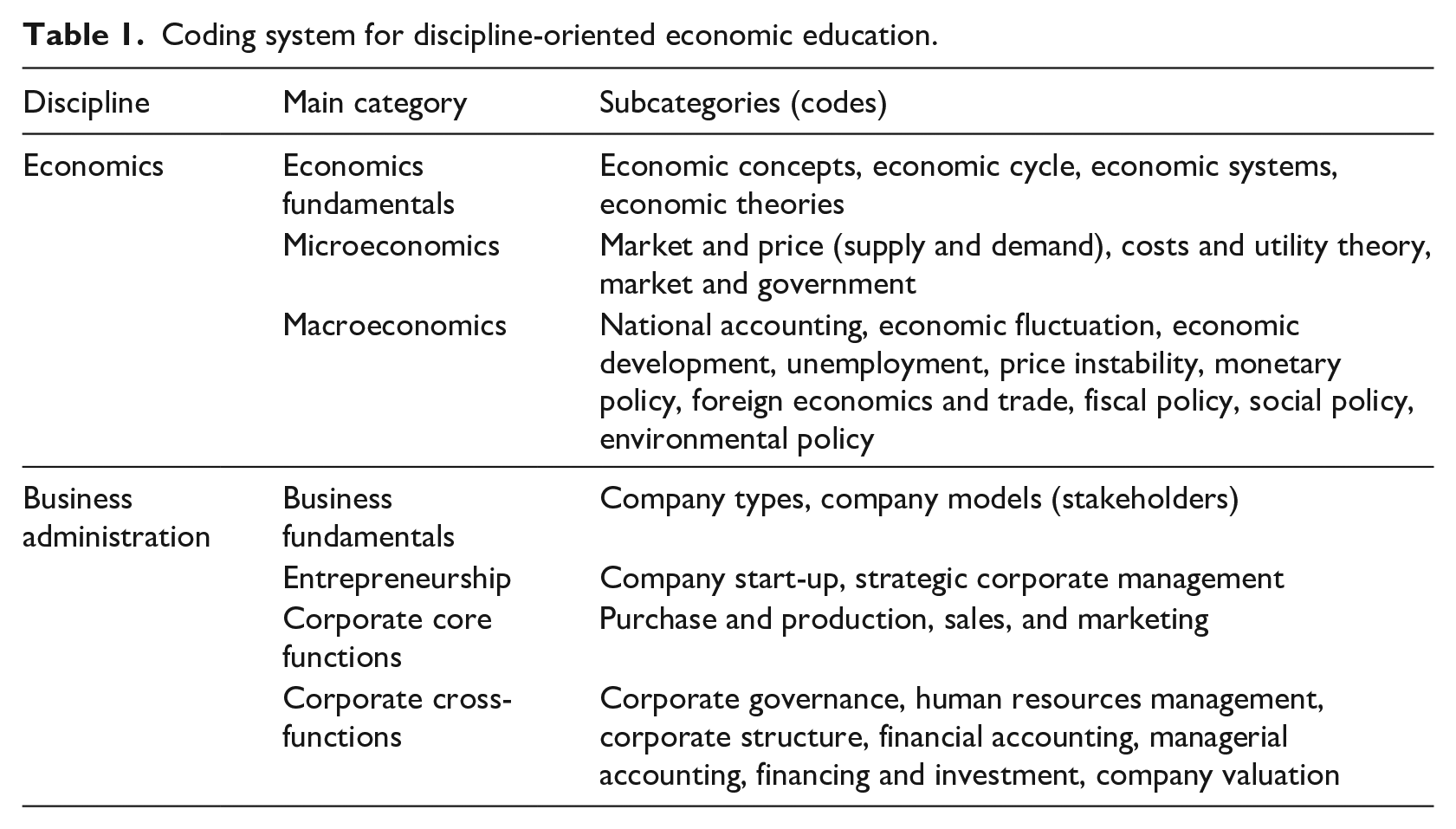
In addition, a second coding system was inductively developed from the data. This coding system encompassed three main categories: “interdisciplinarity,” for explicit references to other subjects (e.g. geography, history, mathematics, and languages); “practice,” for references to situations in various life spheres (e.g. private budgeting, private insurance, and private investments); and “topicality,” for references to current societal problems (e.g. referenda). Furthermore, we systematically indexed the enactment year and the timetable for each curriculum in order to control for content categories coded.
Data analysis was performed with MAXQDA 2020 (VERBI Software, 2019). As each document had its own layout and structure, it was difficult to define general coding units. Thus, each document was coded for consensus by two coders (Döring and Bortz, 2016). The consensus codings for each document were binarized for descriptive analysis because we were interested in occurrence and variations in the content of each subject (code) between curricula (documents) but not in the density of subject content within a curriculum. The frequency counts of binarized codings were comparatively analyzed by cross-tabling with theoretically derived criteria: curricular language, school subject tradition, graduation rate, and metropolitan area. By cross-tabling the frequency counts, a comprehensive picture was drawn.
Results
Occurrence and scattering of subject content in curricula
In order to examine different cultures in economic education, we analyzed the homogeneity/heterogeneity of content in the subject “economics and law” in the selected curricula. The major subject showed a dense pattern of content and clear homogeneity between the analyzed curricula; the subject tended to have a common gravitational point with a few outliers. This could be explained by presumably silent consensus on the conception of economic education: the major subject contributes to specific study skills (science propaedeutics) and develops social maturity. Conversely, the introductory subject “economics and law” showed a scattered pattern of content and a heterogeneity between the curricula. This may be explained by a different and opposed understanding of the subject’s contribution to general education in grammar schools.
The results with regard to the major subject indicated that some curricula escape this pull of the norm and have an alternative content emphasis, with fault lines associated with the curriculum language. However, they did not yet show us which content-related criteria were decisive for this scattering. At the same time, we were able to control for the age of the document (the curricula studied were put into effect between 1995 and 2020) and found no correlation with distribution of the content. The only content aspect examined here that was affected by the age of the curricula was the emphasis on “topicality references,” which were emphasized more frequently with decreasing age.
Subject content and curriculum language
Regarding language areas in Switzerland, we assumed that subject content differed according to the curriculum language and that this would become evident in the differentiation between the two subject fields of “economics” and “business administration.”
In the major subject, the main categories of “economics” were found to be relatively equally weighted in the German- and Roman-language (i.e. French and Italian) curricula (see Figure 1, below). All main categories of “business administration” had a descriptively higher proportion in the German-language curricula than in the Roman-language ones. Moreover, subcategories of “business administration” varied descriptively to a greater extent in the German-language curricula, compared to the Roman-language curricula. This applied to both the major subject and the introductory subject, but the difference was more pronounced in the latter (see Figure 1, above).
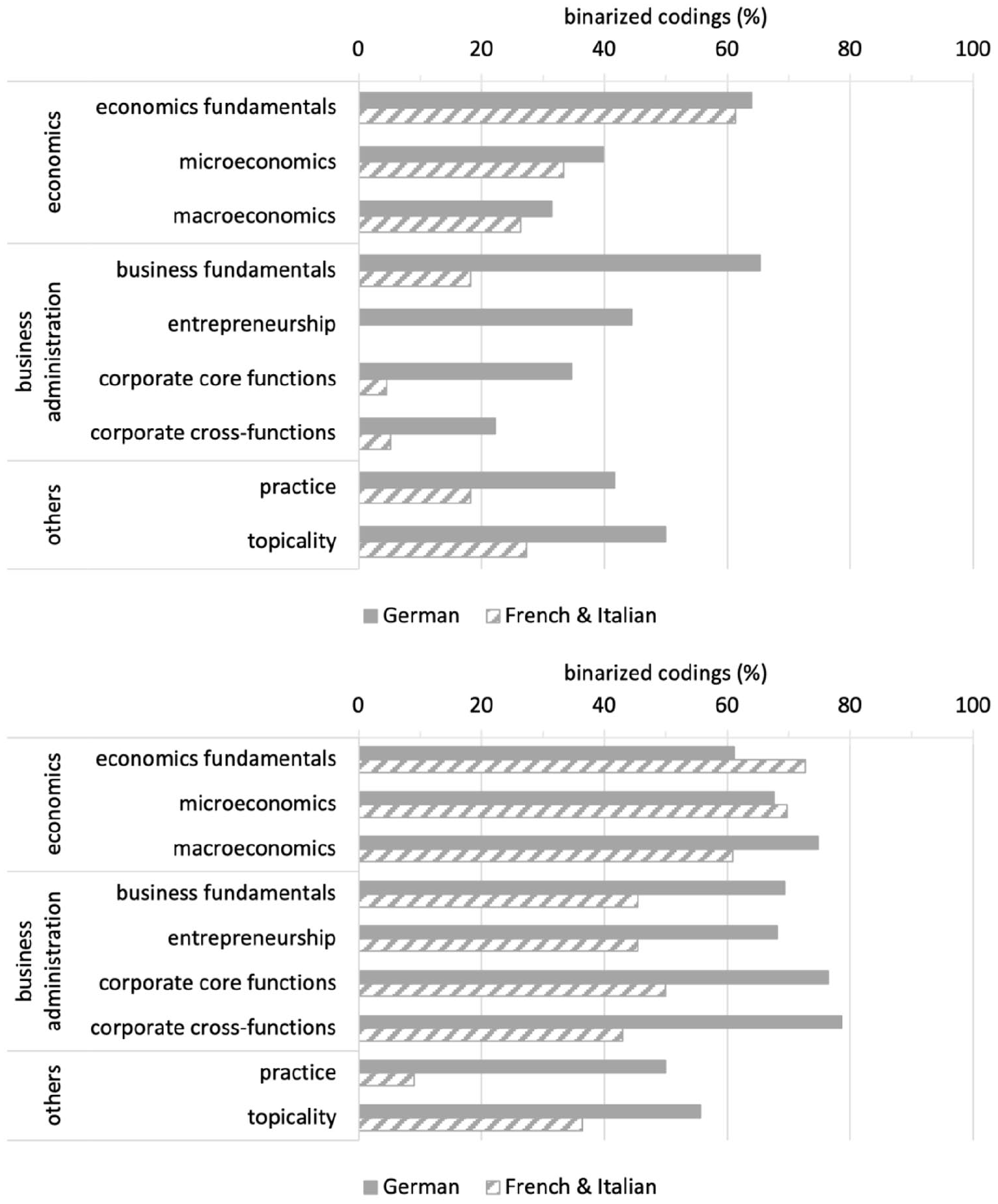
Subject fields and content of the minor subject (above) and the major subject (below) by curriculum language.
Furthermore, subcategories of “business administration” were less differentiated in the Roman-language curricula than in the German-language curricula, and these subcategories were clearly marginalized, compared to the subcategories of “economics.” Similarly, explicit reference was made to practice projects (e.g. company visits and business weeks) in about 50% of the German-language curricula but only in 10% of the Roman-language curricula (i.e. in only one curriculum).
This relative coherence within the subject field of “economics” may be deceptive, however, if we look at the level of individual codes. For a few subcategories, there were some clear outliers. For example, the subcategory “economic theories” was emphasized by 64% and “social inequality” by 82% in the Roman-language curricula but only by 33% and 67%, respectively, in the German-language curricula. Conversely, the subcategory “economic fluctuation” was emphasized by 89%, “unemployment/labor market” by 72%, and “public spending/fiscal policy” by 72% in the German-language curricula, in contrast to 36%, 46%, and 55% in Roman-language curricula. For the other 12 subcategories, the curriculum language differences were smaller than 25%. For some subcategories, such as “market and price” (94%/91%), “economic development” (81%/82%), and “ecology” (39%/36%), the proportions were almost identical.
References to other subjects differed clearly according to the curriculum language (see Figure 2): Roman-language curricula hardly made any interdisciplinary references within the subject content, but German-language curricula did. Across all curricula, four different groups of interdisciplinary subject references could be distinguished, as follows: (1) four subjects were explicitly listed as alliance subjects in about half of all curricula: history, geography, mathematics and philosophy/religion; (2) another four subjects were listed in at least 10 curricula, with specific interdisciplinary references: “computer science/technology,” “civics,” “biology,” and “languages”; (3) the subjects of “visual arts” and “pedagogy/psychology” were still explicitly referred to in more than 10% of all curricula; (4) in the case of the subjects “music,” “physical education,” “education for sustainable development,” and “sports,” there were very few (single) references.
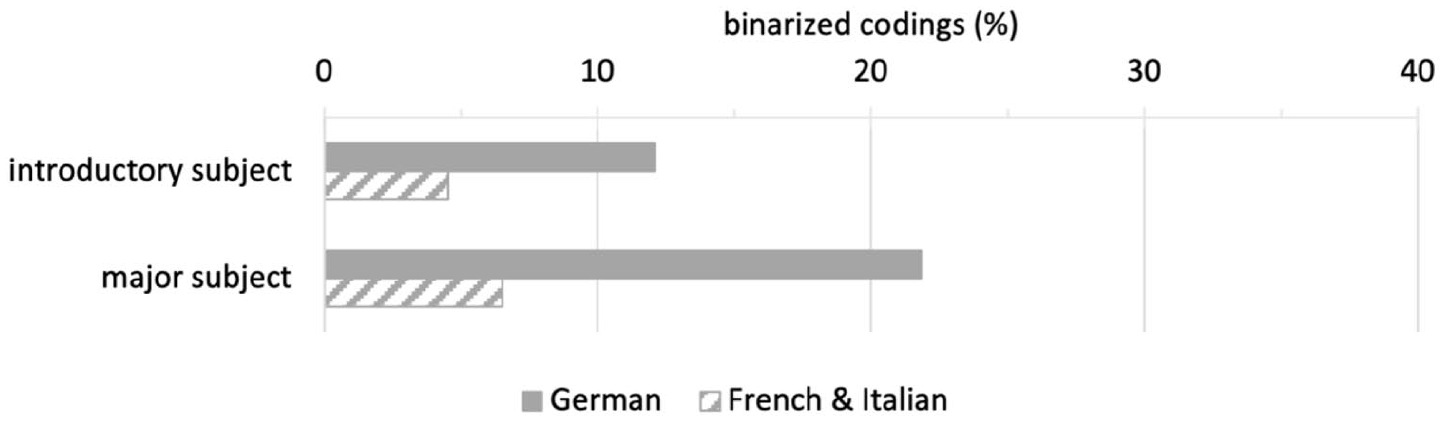
Interdisciplinary subject references by subject type and curriculum language.
In order to further explain the results presented above, we controlled the pattern of subject content for the subject timetable. The minimum number of hours in “economics and law” was very loosely regulated in the Grammar Schools’ Recognition Regulation (between 10% and 20% for social sciences and humanities as a whole). In practice, there was also significant heterogeneity and a spread of between 11 and 18 hours per week for 1 year of “economics and law” (with a weighted average of 14.2 hours). Following the results above, we expected to find a higher number of hours in the German-language curricula due to the significantly higher degree of differentiation of the subject content to be taught. However, this was not confirmed. Despite the much greater degree of specification and differentiation of the subject content in the German-language curricula, a more extensive timetable was not planned for the major subject. In contrast, students in Roman-speaking Switzerland studied the subject for an average of 0.7 hour more than in German-speaking Switzerland (14.0–14.7 hours). This showed a higher density of content regulation in curricula in German-speaking Switzerland, with fewer teaching hours available for this subject over the entire duration of grammar school education.
The results clearly showed that curriculum language was a central category in determining differences in the content of economics. Controlling according to timetables additionally confirmed this result: this distinction was not a consequence of different resources but of content-related focal points.
Subject content and structural characteristics
Finally, we examined other structural variables: school tradition, cantonal graduation rate, cantonal university, and cantonal demographic and economic structure.
Grammar schools in Switzerland have different subject-related traditions. After 1972, former commercial schools (“Handelsschule,” “école de commerce,” and “scuola commerciale”) were recognized at the national level as grammar schools, with general access to higher education. Until the 1980s, many of these former commercial tracks were newly recognized as entry qualifications for university. We distinguished between two school traditions: “commercial tradition,” encompassing schools with a subject tradition in business administration, and “other traditions” (i.e. humanistic or science), encompassing schools that introduced “economics and law” only after the grammar school reform in 1995. We expected to find that schools with a “commercial tradition” specified a broader range of learning content. Indeed, the results showed that schools with a “commercial tradition” had a more differentiated, propaedeutic curriculum design than schools emerging from other traditions. The largest difference in the subject field of “economics” was found in the thematization of ecology (67% vs 25%). In the subject field of “business administration,” schools without a tradition as business schools showed a significantly higher level in three subfields: strategic and internal business management, as well as accounting. Moreover, former business schools had a higher average number of hours (14.3 vs 13.6 hours).
Grammar school graduation rates are a key indicator in comparisons of different cantonal education systems for grammar schools in Switzerland. In 2019, the graduation rate varied between 12.5% (in the canton of Glarus) and 34.2% (in the canton of Geneva) (Bundesamt für Statistik, 2020). In order to analyze the relation between curricular subject content and cantonal graduation rate, we constructed the variable “graduation rate” and classified the cantons into five groups. The results showed that, the higher the cantonal graduation rate, the more differentiated were the categories in “economics fundamentals” and the less differentiated were the categories in “business fundamentals” and the whole subject field of “business administration.” This relationship was particularly pronounced in curricular proposals for practical teaching elements (e.g. company visits and business weeks). In the cantons with the lowest graduation rate, 57% of the curricula defined such components, and in cantons with the highest graduation rate, only 14% did so.
Higher education in Switzerland recognizes 10 cantonal universities and two federal universities (ETH Zürich and EPF Lausanne). In order to analyze the relation between curricular content and cantonal university, we constructed the dichotomous variable “university canton.” The results showed that in the “economics” subject field, both groups were very similar. Conversely, in the “business administration” subject field, non-university cantons had a higher degree of differentiation in application-oriented subject content (especially relating to corporate models, strategic and internal corporate management, organization, and accounting). At the same time, timetabling as a control variable showed that the higher content regulation density in non-university cantons (in “business administration”) was also reflected in a slightly higher allocation of timetabled hours in these non-university cantons (14.4 vs 14.0 hours).
The results relating to the demographic and economic structure of cantons and grammar schools showed no clear pattern with regard to the main categories in subject fields. Regarding subcategories, however, two codes showed particular distinctiveness: firstly, the role of the economy and its impact on ecology: the more urban, the more “ecology” was addressed; and secondly, explicit reference to current issues in society: the more metropolitan the area, the more explicit references were made.
Discussion and outlook
The aim of this study was to examine cultures of economic education in grammar school curricula in federal, multilingual Switzerland. We aimed to determine (1) what subject content in curricula could be found and whether the curricula are homogenous or heterogeneous; and (2) the structural characteristics of such differences, that is, whether there are different cultures of economic education. The selected curricula in the dataset were representative for the whole of multilingual Switzerland, which allowed for various conclusions regarding locally different interpretations of subject traditions and cultures in economic education.
Curriculum language was found to show the clearest differences in subject content. On a general comparative level, there was clear homogeneity in the content of the major subject for German-speaking Switzerland. Compared to German-language curricula, but also in a mutual comparison, the Roman-language curricula showed much greater heterogeneity. Cultural differences in economic education, though, may be seen at regional level in terms of curriculum language. Theoretically assumed cultural “variants of a capitalist spirit” are clearly reflected in the curricula of different language regions. However, this still says little about actual teaching and learning in classrooms, and thus school cultures. Regional differences regarding explicit interdisciplinary references hint at different traditions of curriculum design. Curricula in different language regions of Switzerland may show a different orientation with regard to didactics (Marty et al., 2018). The large differences we found in language regions regarding interdisciplinary subject references in “economics and law” underline this point.
On a detailed comparative level, a clear discrepancy was revealed between language regions regarding the content of “business administration.” This, in turn, is highly relevant for “economics and law” as an introductory subject, since it is intended to impart general knowledge in order to prepare students for academic studies and for “demanding tasks in society” (Art. 5 Abs. 3 MAR; Eberle and Brüggenbrock, 2013: 10–13). It could be concluded that these socially demanding tasks are interpreted differently in different language regions. This is consistent with theoretical assumptions in view of the assumption of “state engineers” in French-speaking countries, who are to be trained primarily in theory, compared to business administrators in ordoliberal thinking, who are committed to the logic of efficiency.
Beyond this, Roman-speaking curricula have a more extensive timetable on average with a less differentiated curriculum, especially in the field of “business administration.” On the one hand, the weighting of “economics” points to a theory-oriented culture of economic education in French-speaking Switzerland. This different emphasis on theoretical aspects of economic education became particularly clear in the major subject. On the other hand, the weighting of “business administration” implies a more practice-orientated culture of economic education in German-speaking Switzerland. Furthermore, this finding applies to cantonal graduation rates as well. Cantons with a low graduation rate place an emphasis on practice-oriented content. In the subject content of these curricula, skepticism about a general education path with a stronger focus on theory may be interpreted. This, in turn, is also evident in students’ education biographies in cantons with a low graduation rate.
Few of the structural framework conditions (e.g. demography and economic structure, graduation rate, and cantonal university) showed a clear relationship with the content of “economics and law.” This applied to both the major and the introductory subject, and particularly to a general distinction in relation to the two subject fields of “economics” and “business administration.” However, when looking at single subject content, two unexpected results stand out. Firstly, “ecology” was the subject content in grammar school curricula with the greatest variance among all structural characteristics: more weight is given to “ecology” in metropolitan areas, in university cantons and in schools with a longer tradition in economic education. In view of current environmental challenges, many grammar schools may experience pressure to develop their curricula in the direction of social and ecological issues relating to the economy. Thus, this result indicates different cultures of economic education according to the demographic and economic characteristics of regions, at least for interdisciplinary subject content such as “ecology.” Secondly, the curricula of grammar schools with low cantonal graduation rates and without a cantonal university put a stronger emphasis on practice-oriented teaching elements (e.g. internships, company visits, and business games) and have a higher level of differentiation in “business administration.” This result can be interpreted as a less pronounced orientation toward propaedeutic teaching and a stronger orientation toward the immediate requirements of the labor market in these cantons.
With reference to curriculum theory, different normative and political conceptions of economic education are thus reflected in subject content. Curricula fix these ideas and make them accessible for comparative studies. At the same time, curricula function as a central means of passing on culturally framed social orders. As a school subject, economic education, with its models of socioeconomic relationships, contributes to the formation of such varying social orders. In the long run, the cultural “variants of a capitalist spirit” are not only reflected in these value-based economic curricula but also, in turn, become stabilizing factors for these differences. The example of the subject content of “ecology” shows that change is possible if the societal conditions favor it. At the same time, however, this seems to create new differences and new cultures of economic education between urban and rural areas.
For the debate on cultural “variants of a capitalist spirit,” our findings also imply that regional language and linguistically different terms and concepts are influencing factors for cultures of economic education. At the same time, cultures of economic education must not be reduced to language: such cultures may vary within a language region or may be similar between language regions. Moreover, our findings imply that we should make such cultures empirically evident rather than assume these cultures as a container concept for economic education.
This study has some limitations and opportunities for future research. To further examine curriculum cultures and cultures of economic education, four lines of enquiry could be pursued, as follows: firstly, a deeper analysis of the curricula in our dataset by using a situation-oriented coding system to highlight social contexts of individual action; secondly, an additional curriculum analysis with respect to the conceptual relation between subject goals and subject content to emphasize conceptions of economic education in curricula; thirdly, a comparison of grammar school curricula and university curricula in the two language regions; and finally, an analysis of teaching practices in classrooms, that is, the enacted curriculum (Orlowski, 2012) and school cultures.
Our analysis of Switzerland as a “laboratory” allowed us to obtain findings regarding curricular traditions and cultures of economic education in grammar schools. These findings may also be relevant for an international comparison of curriculum design and economic education. An international comparison will evoke, at the same time, tensions between global adaptation of content and structure and local traditions. Such regional differences can be understood as a consequence of divergent organizational structures, but they are also exacerbated by regional sociocultural trends and local developments (McLeod et al., 2018; Scandurra et al., 2021). This might be fruitful in two directions: it can be made visible through an analysis of the specific learning content of economic education in grammar schools, and it may help us to understand conflicting goals and measures when facing economic crises on a global level.
Footnotes
Acknowledgements
The authors would like to thank Alexandra Taras for assisting with the literature review and coding procedure, and Lea Hägi for critical feedback on the manuscript.
Declaration of conflicting interests
The author(s) declared no potential conflicts of interest with respect to the research, authorship, and/or publication of this article.
Funding
The author(s) received no financial support for the research, authorship, and/or publication of this article.
