




Abstract
In this paper, we aim to understand the implications of the structural changes of the Bologna process from a student perspective. We investigate how bachelor’s degree students’ in a post-Bologna era with three-year bachelor’s degree and two-year master’s degree units construct their post-bachelor’s choice narratives in two different science degree programmes (chemistry and natural resources) at a Danish research-intensive university. We pay special attention to how science students’ narrative repertoires and imagined futures interact with and set the scene for their choice narratives in specific disciplinary settings. We draw on theoretical ideas of science identities including ‘narrative repertories’ and ‘imagined futures’, combined with disciplinary cultures and institutional capital. The analysis draws on small-scale rich qualitative material including 12 narrative interviews and focus groups with 44 students, including reflective essays, drawings and word-cloud brainstorms. Results show that the post-bachelor’s trajectory is a choice that students must relate themselves to in their identity negotiations. We document how students within the same faculty are presented with different narrative repertoires to construct and negotiate their choices from and as a result experience different choice processes and negotiations due to the different disciplinary settings they encounter. The implications for higher education institutions are given.
Introduction
Literature on students’ choices in relation to higher education has mainly focussed on either the choice of entering higher education (Ball et al., 2013; Bøe, 2012; Gale and Parker, 2014; Holmegaard et al., 2014a, 2014b, 2014c; Lykkegaard and Ulriksen, 2019) or the choice of later career paths (Holmegaard, 2021; Kyndt et al., 2017; Wong, 2016). Hence, the literature on the ‘middle’ years is sparse (Milsom et al., 2015; Willcoxson et al., 2011). As outlined by Nielsen (2021) in her review of the literature, two reasons for this missing attention on students’ post-bachelor’s choices can be put forward. One reason is the fact that the choice is considered unproblematic as students are considered to be already familiar with higher education when they are bachelor’s degree students, while the other reason is the fact that in most European countries, a post-bachelor’s choice has only been relevant within the last two decades following the Bologna Declaration (Bologna Declaration, 1999). Adding to this, we argue that reasons can also be found in the sparse political attention the post-bachelor’s choice has received in comparison to the political interest in influencing and regulating students’ choice of higher education, especially to encourage students to pursue a STEM career (European Commission, 2004; OECD, 2008) and to secure diversity in the workforce (European Commission, 2005). Such political agendas penetrate the discourses and set the scene for funding and support of research as a vehicle to accumulate societal and economic impact (Chubb and Reed, 2018).
Within the sparse literature on the post-bachelor’s choice in the post-Bologna era, quantitative and qualitative research has been done, although mainly concerning Germany and the UK (Nielsen, 2021). In a German context, quantitative studies have been done on both the social stratification of the new two-cycle structure (Neugebauer, 2015; Sarcletti, 2015) and the role of social background in the choices a person makes about pursuing a master’s programme (Lörz et al., 2015). In the UK context, where, as opposed to Germany, the two-cycle structure is not new, the post-bachelor’s choice has been researched from a greater diversity of perspectives (Nielsen, 2021). This includes research on the reasons mature students return to university for a master’s programme (Mellors-Bourne et al., 2014) and on students’ experiences of the transition to a master’s programme (Heussi, 2012; McPherson et al., 2017).
Hence, the Bologna process has brought different changes in the various European higher educational systems depending on their existing systems (Vögtle, 2019). In Denmark, the two-cycle structure was introduced in 1993 and fully implemented by the Danish University Reform in 2003. This meant that study programmes had to reorganise their five-year programmes into a two-cycle degree structure of closed 3-year Bachelor units and two-year Master units (European Commission, 2012, 2018). Hence, students are now presented with a new decision point after completing a bachelor degree. Little research has addressed students’ choice-making process at this decision point, and no studies have, to our knowledge, addressed how science students’ narrative repertoires and imagined futures interact with and set the scene for their choice narratives in specific disciplinary settings – which is the aim of this paper.
Theoretical framework
We use the theoretical lens of science identity to centre our attention on the relationships between on the one hand the students’ identity negotiations in their post-bachelor choice-making processes and on the other hand on the study programme and disciplinary setting they experience. We understand choices as an individual endeavour and conceptualise choices as being in interaction with and embedded within the cultural and disciplinary setting of selected science study programmes. In the following, we first unfold our approach to identity, and then outline the two constructs of ‘narrative repertoires’ and ‘imaginary futures’ that we use as our analytical lenses to study students’ identity negotiations and their choice-making process. We end the theoretical framework by outlining how we use the disciplinary setting as a background for understanding the students’ choice narratives.
Students’ choices and identities
As the literature on students’ post-bachelor’s choices is sparse, our understanding of students’ choices in the following are based on literature on choices in general, and thus not exclusively on post-bachelor’s choices.
The literature on students’ choices has tended to emphasise interest as a key component (Krogh and Andersen, 2013; Mikkonen et al., 2009; Schreiner, 2006), and recent studies show how students weight and negotiate different interests and match them with potential educations to make a suitable choice (Vulperhorst et al., 2018). Common for such research is how interests are multidimensional and entail both content-specific cognitive as well as affective aspects (Krapp and Prenzel, 2011).
However, while interests interact with students’ considerations about their future, they fail to fully grasp the complexity of the choice process and, for example, why some students’ refrain from pursuing their interest in their choice of study. This is the case in the work by Archer et al. (2020) and Holmegaard et al. (2014b) who find that even students who find science interesting do not necessarily consider choosing it. They show how some students either are challenged in seeing science as something for them or are prevented in being recognised as someone belonging within science. Both suggest that identity as a theoretical lens can enhance our understanding of students’ choices, as put forward by Archer et al. (2013). Within such a framework, science identities are not conceptualised as accumulative over time, stable or coherent, but continuously performed and negotiated through discourse, relations of power, cultural settings and social structures (Avraamidou, 2020).
Applying identity as a lens can thus enable a focus on the deep-seated and ongoing negotiation processes in the choice-making process of how students engage in identity work to create a sense of fit with their past, present, and their expectations to the future (Archer et al., 2010; Bergerson, 2009; Holmegaard, 2020). Such negotiations are embedded within the constraints and resources available within a particular disciplinary context. In their seminal paper on science identities, Carlone and Johnson explain that such negotiations entail a focus on what and who are promoted and marginalised within the particular science context, on the ways students within the context make meaning of what engaging in science entails of experiences, skills, knowledge and beliefs, and on the extent to which engaging in the science context demands changes in who they are and who they desire to become (Carlone and Johnson, 2007).
In this paper we position ourselves in line with this thinking. We approach students’ identities as ongoing, constructed and negotiated in relation to on the one hand the disciplinary context they are part of and on the other to the resources, experiences over time and overall life circumstances they bring with them (Crossley, 2000; Roth and Tobin, 2007). Moreover, inspired by narrative psychology, we are interested in how the students make meaning of their choices. Meaning-making is an expression of how students perceive the surrounding world and how they relate themselves to it. What is highlighted or left out of a narrative are thus related to how we construct the world and the way we position ourselves in it (Sarbin, 1986). Thus, in their post-bachelor’s choices, students face a potential turning point in which they are choosing their future, however in order to gain recognition for the stories they tell, they are restricted by the overall storyline of how a proper choice is expected to be performed (Holmegaard, 2015). We draw on two analytical concepts to approach this negotiation process – narrative repertoires and imagined futures.
Choices and narrative repertoires
We understand students’ ideas about their choices to be drawn from a repertoire of resources linked to two sources. On the one hand, we have ‘cultural and institutional formations larger than the single individual’ (Somers, 1994: 619). The cultural setting of the discipline sets the scene for which practices are considered natural and valued as proper ways of doing and for which practices are considered inappropriate or as not being the right way of studying (Hasse, 2002; Johnson, 2020). Thus, the cultural setting of the discipline is both the mechanism that unites students on a programme so they feel special and not alike students on other programmes, and is the lens through which the students see what a proper future looks like (Holmegaard, 2021). On the other hand, the students’ ideas about their choices also draw from a repertoire of resources linked to what they bring with them in the form of the assets and experiences accessible in and throughout the students’ lives (Holmegaard et al., 2015). These two perspectives have been termed narrative repertoires (Ibarra and Barbulescu, 2010).
This means that when students consider their post-bachelor’s choice, the available choices identified and recognised by the individual student are both a product of the characters, capacities and circumstances in their life (Crossley, 2000; Holmegaard, 2015), as well as a product of the available narratives embedded within the disciplinary cultural setting they are situated in. However, balancing these different perspectives in a way that creates a feeling of coherence is not easy. In this paper, we are interested in this process of balancing, namely the ways in which the students construct their choice narratives.
Choices and imagined futures
The future often tends to be described as an open book waiting passively to be filled out by the author (Adam and Groves, 2007). The ‘imagined’ or ‘possible’ in the construct of imagined futures entails ‘evoking a narrative sequence that moves from the present towards the future’ (Henderson, 2018: 28). This narrative sequence is part of the identity negotiations when students make their post-bachelor’s choice. It is important that the future projections that we practice ‘do have an influence on action’ (Mische, 2009: 699), hence the students’ imagined futures play a role in their current choices, even though the results of these actions might be different from the imagined future that motivated the action (Mische, 2009).
Different students experience and negotiate the future differently – as the ability to imagine the future requires insights into which future pathways are available and into how to navigate to get there. Henderson points out that a clearer imagined future can act as a support in actually reaching this future (Henderson, 2018). However, research also shows that students can approach the future in different ways – they can be dreamers who are optimistic in hoping for an encouraging future image of themselves as resilient and self-confident, or they can be judgemental of their own capacities, and qualifications (Kim et al., 2018). This paper focuses on what students on different study programmes recognise as viable future pathways and on how they use their narratives and construction of a science identity to create a sense of fit with their past, present, and who they desire to become.
Choices within disciplinary settings
When students’ choice negotiations are approached with an identity lens as a foreground, we are interested in paying attention to the cultural settings of the discipline the students’ choice narratives are performed within. To address this, we use disciplinary cultures (Becher, 1989) and institutional capital (Bourdieu, 1988), not as an independent theoretical lens, but as a background to discuss how the students’ choice narratives are negotiated within a disciplinary setting.
A common distinction between different academic disciplinary cultures has to do with their different ‘ethnoi’ (Huber, 1990) and disciplines being characterised as pure or applied (Becher, 1989; Becher and Trowler, 2001; Biglan, 1973). Whereas the applied disciplines are concerned with the application of knowledge and research outcomes, the pure disciplines orient themselves towards research and academic knowledge in its own right (Becher, 1989). This distinction is, however, not as clear today as previously argued, as also disciplines within research-intensive universities are becoming increasingly concerned with knowledge for and to society and cooperation with industry and practice outside the university (e.g., Etzkowitz and Zhou, 2017; Etzkowitz et al., 2000). A discipline is the result of battles of what is considered inside and outside the discipline and what is considered in the centre or periphery. Thus the discipline produces a set of social norms and expectations of what are recognised as proper, legitimate and desirable ways of practicing within the discipline (Messer-Davidow et al., 1993). However, at the same time, the discipline is not a stable unit, but something that is being produced and reproduced by the people that inhabit it over time, producing changing power relations (Trowler, 2014). This means that the disciplinary culture that the students negotiate their choice narratives within is played out locally and must be studied in this context.
The work of Bourdieu is indispensable in understanding the interplay of habitus, capital and field. Based on his ideas, the differences in the position of disciplines hold consequences for students’ capital. Thus, the classical disciplines with a pure theoretical focus and the newer disciplines, sometimes cross-disciplinary in focus and with a practical, applied and empirical focus, are ascribed different statuses (Bourdieu, 1988). Consequently, students from the same university and even within related disciplines within the same university can receive a diploma with different value (Bourdieu, 1988). Whereas classical programmes offer an embodied symbolic capital to their students, new programmes offer, according to Bourdieu, a freedom in terms of vagueness of the future, with the consequence that the individual is required to invest a greater effort in gaining capital (Bourdieu, 1988). In our analysis, we are interested in the ways in which this institutional capital together with the disciplinary culture sets the scene for the students’ choice narratives.
Methodology
The research presented here is part of a larger quantitative and qualitative longitudinal study of students’ choice-making processes in higher education institutions in a post-Bologna era. This paper draws only on the qualitative material in Denmark that focuses on students’ choice-making processes.
Situating the chosen bachelor’s degree programmes and participants
We analyse data from interviews, essays, drawings and word-cloud brainstorms with students on the bachelor’s degree programme in chemistry and the bachelor’s degree programme in natural resources as they represent different structures and different post-bachelor’s possibilities for the students. Chemistry is a so-called traditional single-discipline study programme that had a strong tradition of students doing both a 5-year (MSc) + 3-year (PhD) structure before 2003, with a high number of master’s degree students continuing to the PhD level. Natural resources on the other hand is a new interdisciplinary programme born in the 3-year (BSc) + 2-year (MSc) structure, giving access to a number of different master’s degree programmes. This allows us to study science students’ choice narratives within two very different disciplinary settings. All participants were in their second or third year of studies. All names used are anonymised.
Essay writing, drawings and word-cloud brainstorms
We held focus group activities for students at the two degree programmes that addressed students’ individual and shared meanings and interpretations (Liamputtong, 2011). We made initial contact with gatekeepers in each degree programme that made it possible for us to contact students during teaching sessions, where we invited them to an out-of-class focus group. In total, 44 students participated in the focus group activities (23 at chemistry and 21 at natural resources). The students were taken through a series of activities with questions and prompts to elicit data on their experiences and considerations about their choice of MSc programme. The activities were:
- Essay writing based on the following two questions (1) ‘Describe your considerations about your choice of path after your bachelor’s degree, what do you think right now and why?’ (2) ‘What has influenced your choice? Describe the ways in which the choices you have made during your bachelor’s degree programme have influenced your considerations about the future?’
- Drawing based on the prompt ‘draw yourself in three years’.
- Word-cloud brainstorm based on a digital prompt allowing four entries of words in response to the question: ‘what possible paths do you believe exist after a bachelor’s degree in [the discipline]?’. The brainstorm was followed by a discussion of the word cloud.
Qualitative interviews
We carried out narrative interviews with 12 selected students, six in each of the two degree programmes. We used the following sampling strategy. First we did a sorting of all participant’s (44) essays on their considerations about their choice. The sorting focussed on how the students narrated their choices in different ways. We then selected six students in each degree programme that represented different types of narratives. In the selection, we strived to select students with narratives and future imaginations that allowed us to achieve the maximum possible case variation based on our data, as described by Flyvbjerg (2006), and at the same time we ensured that we included both male and female students in the sample for each programme.
We held individual interviews to which we applied a narrative approach. The interviewer encouraged stories and descriptions and focussed on how the participants ascribed meaning to and made sense of the narrative (Andrews et al., 2008; Hollway and Jefferson, 2000). All interviews lasted 1–1.5 hours and were tape recorded and transcribed verbatim. We used time as an organising structure in the interviews to explore the students’ educational pathway from upper secondary school to present. The students were asked to draw a timeline (Adriansen, 2012) and prompts were used to elicit data on how the students narrated their educational choices, including their wider social and family issues, which provided insights into the students’ identity negotiations and choice narratives (Holmegaard, 2015).
Analytical strategy applied
We approached the narrative interviews following a thematic analytical approach (Braun and Clarke, 2006). Based on the aim of this study and the theory, we formulated questions to approach the analysis (Figure 1). Next, we carefully read the transcriptions, and quotes from the interviews were organised under each analytical question. Finally, patterns and contradictions within each analytical question were identified, and we selected student cases that represented these (Søndergaard, 1996). This was a process of going back and forward between theory and data. The themes were organised, compared and contrasted in relation to the constructs outlined in the theory. The theory enabled us to unfold and explore the material further. In our presentation of the themes in the analysis, we use the students’ individual choice narratives to illustrate the themes. In doing so, we are able to examine the richness of the narratives, including the essays, drawings, and word-cloud brainstorms from the focus-group activities.
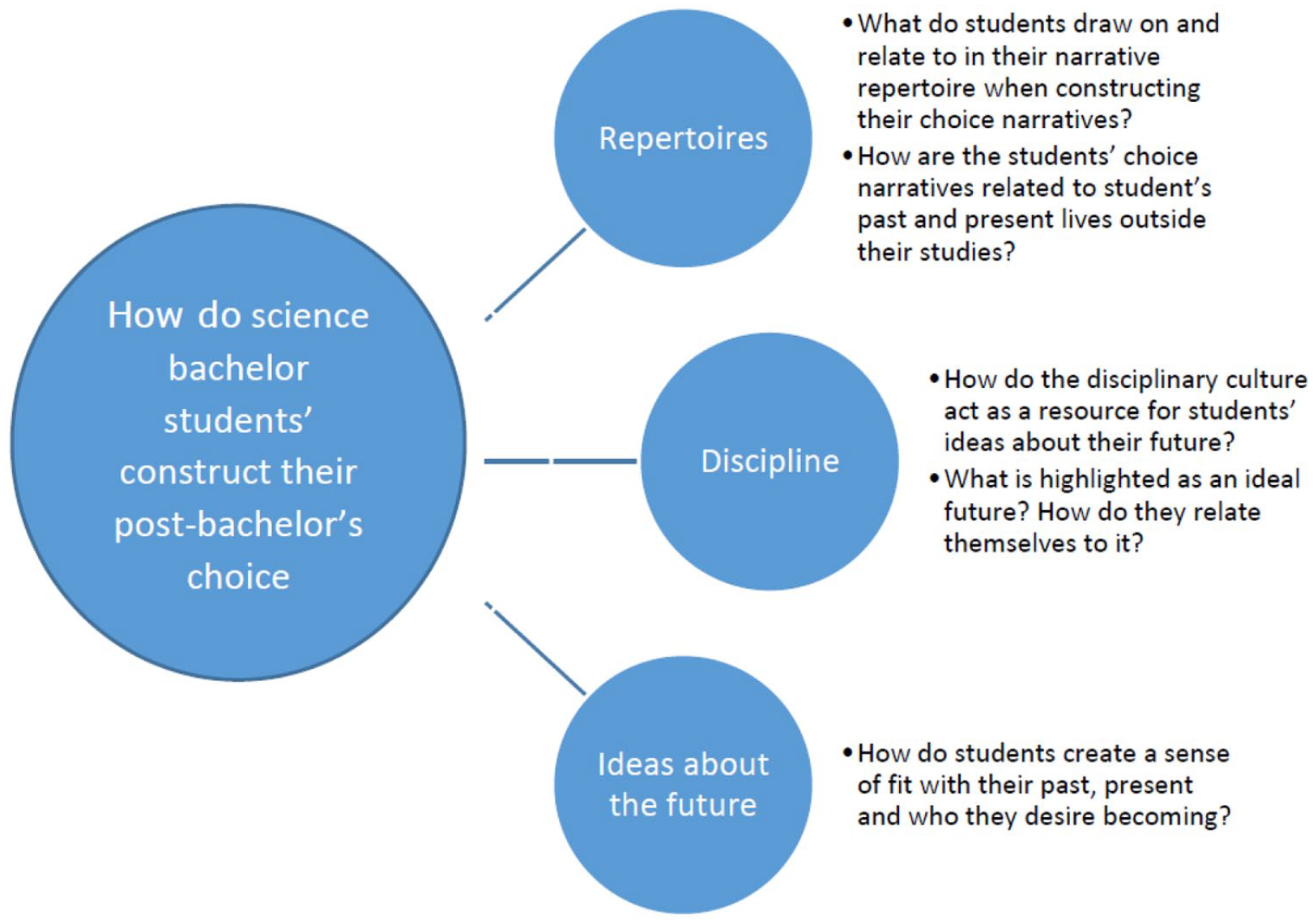
Analytical questions used in the thematic analytic approach to understand how science bachelor students’ construct their post-bachelor’s choice narratives. This is done by studying how students’ repertoire on the one side and their disciplinary culture of their bachelor programme on the other interact with and set the scene for their ideas about the future.
Analysis
As pointed out in the introduction, the new two-cycle degree structure presented Danish higher education with a substantial change in 2003. Our analysis shows how this reform was not only a structural change embedded at the institutional level, but that it indeed presents students with a post-bachelor’s choice at the individual level as well. This is particularly interesting, as quantitative studies of changes in Danish students’ choice patterns show limited changes following the new degree structure (Thomsen, 2021). We present the analysis in two parts: the bachelor’s degree programme in chemistry and the bachelor’s degree programme in natural resources, each of which presents students with a specific disciplinary setting. Each part of the analysis is divided into three sections. Firstly, the repertoires the students have access to and use in their choice narratives are analysed, secondly, the imagined futures expressed in the students’ choice narratives are analysed, and finally, the choice narratives are situated within the specific disciplinary setting.
The bachelor’s degree programme in chemistry
Chemists’ choice narratives and repertories
The choice narratives of bachelor’s degree students in chemistry reflect a narrow repertoire that is mainly based on how the students have experienced and negotiated what they have met in the degree programme within their first years as chemistry students. As we shall see, the repertoire is centred on interest in chemistry in itself, which draws on the content of chemistry as well as the students’ experiences with research and teaching. Hence, the analysis produced one main theme of being interested in chemistry – with variations as we outline in the following.
The chemistry students’ choice narratives were closely intertwined with their motivation for chemistry. One of the students, Ole, elaborated on his intrinsic motivation for chemistry: ‘The more I learned about chemistry [during secondary education]. . . the more I realised that I just find chemistry really exciting in itself’. This description of the discipline of chemistry itself driving Ole’s motivation was a sentiment often mirrored by other students’ choice narratives. The repertoire used by the students to narrate this perception of chemistry as interesting in itself was very much related to specific content matter such as them being especially interested in one part of chemistry compared to another part of chemistry, which they used to legitimise their choice of specialisations within the programme of chemistry.
Often, the students’ interest in chemistry itself related to their experiences of being involved in research activities during their bachelor’s degree programme. The students described how they became affiliated with research groups in different laboratories where they did projects during their bachelor’s degree programme, and at the same time, contributed to the research group as extra manpower. In the focus group activities, the students reflected on their choices. One student explained how he looked at which professors were assigned to the programme as teachers when considering different specialisations within the master’s degree programme in chemistry. Another student pointed out that the teachers are also the professors who one will get the opportunity to work with in the laboratory while doing projects. Another student explained how she spent a lot of time exploring what kind of chemist she found herself being, and that she had been part of different research groups to explore who she is and wishes to become as a chemist. Hence, teaching was part of the students’ repertoire and often acted as a gateway for being involved in research activities.
However, the students also gained a repertoire to draw on in their choice narratives by participating in the social activities in the programme. An example is Marie, who elaborated on how her choice of bachelor’s degree project drew on her interaction with teachers at social events: ‘In one of my first-year courses, I had a teacher that I came to sit next to at the gala party [a yearly gathering for both students and faculty that includes a menu and dance]. He kept saying that I should join him [in his research group] to do my bachelor’s degree project’. They discussed different ideas to match her interest and she described her bachelor’s degree project as really interesting because: ‘it was like how reactions run and what happens with the molecules in the reaction’.
Altogether, the students on chemistry programme drew on a narrow repertoire that was closely intertwined with the content, teaching and social culture of the discipline. All three are closely related to the virtues of research in the choice narratives. As such, the choice narratives seem to be embedded in an internal rationale, as framed by Ole, in that they were interested in and aspired towards ‘chemistry in itself’. We now take a closer look at how these narratives interact with the students’ imagined futures.
Chemists’ choice narratives and imagined futures
As we will see in the following, the chemistry students’ imagined futures mainly concerned the near future of what aspects within chemistry they should select as their post-bachelor’s choice. The distant future was not as present in their choice narratives. However, when prompted, most students’ imagined themselves within research.
The majority of students of chemistry considered a master’s degree in chemistry as continuation of their bachelor’s degree, as shown in Figure 2.
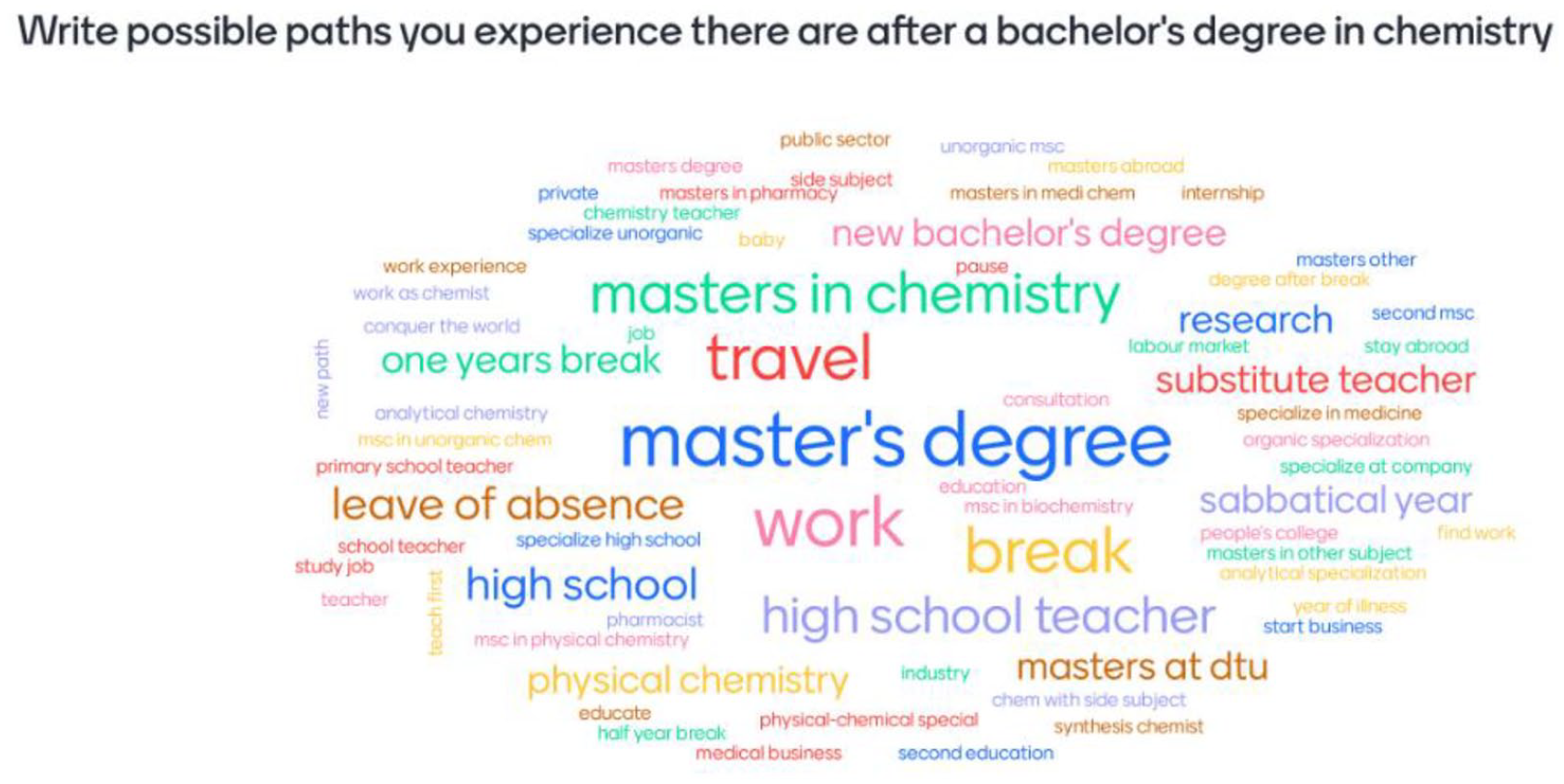
Chemistry students’ answers on a digital prompt allowing four entries of words to the question: ‘what possible paths do you believe exist after a bachelor’s degree in chemistry?’ If more than one student enter the same word the word is displayed accordingly bigger (N = 23).
When elaborating on what master’s degree programmes the students envisioned after completing their bachelor’s degree programme, few of the students mentioned master’s degree programmes at other institutions or outside the subject of chemistry. When choosing a master’s degree programme, for most students, their distant future or life after university seems largely absent. This was the case for Ole, who became part of a research group in which he appreciated the fact that he was considered a full member and was allowed to do his own experiments. He found it very motivating, and this experience clearly made him aspire towards doing research and becoming a full member of a similar research group. His imagined future was closely linked to his intrinsic motivation for chemistry in itself and did not include life after university. In Figure 3, Ole has illustrated himself three years from now.
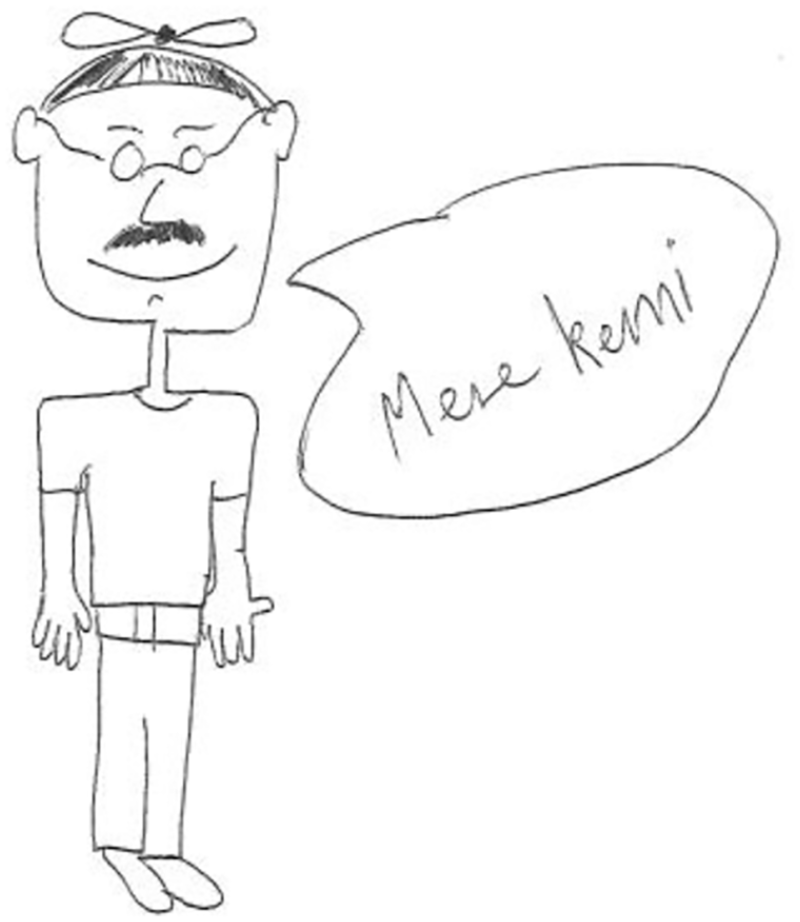
Drawing made by Ole, illustrating his imagined futures. The drawing illustrate an imagined future within the disciplinary setting, the speech bubble says: ‘Mere kemi’, which means ‘More chemistry’.
However, when asked about his decision to study chemistry, Ole explains that he was initially interested in the medical industry and selected his degree programme due to its location in an area with many companies in the medical industry, as he saw himself getting a job there after graduating. Ole was not the only student we met that had distant imagined futures when entering the chemistry degree programme, also Finn had aspired, although more vaguely than Ole, to a distant future, in Finn’s case this was teaching chemistry in secondary school. During Finn’s bachelor’s degree programme he constructed an imagined future within chemistry research. These two students are examples of how it is difficult within the disciplinary culture of chemistry to keep one’s imagined futures if they include a future outside of chemistry. As we shall see later, this stands in contrast to the students on the natural resources degree programme.
Hence, very few of the chemistry students included imaginaries of a future outside university in their choice narratives – it seems to be absent in their narrative repertoires. When prompted to make a drawing of themselves in 3 years’ time most students drew themselves within the disciplinary culture of chemistry (being a researcher behind a laptop, working in a laboratory), or as Ole above, as just desiring more chemistry. However, a few of their narrative repertoires included family (baby in womb while working in the laboratory), travelling (either in relation to conferences or vacation) and life more broadly (bicycling to work, drinking wine with friends).
Johanne’s choice narrative is an example of one of the few students who did not desire chemistry in itself. She had previously qualified as a laboratory technician and had worked in industry for 3 years. The degree programme in chemistry was not her preferred choice, however, she needed the degree – as she explained: ‘I had got the position I wanted [in industry] but could see that it was not. . . in the long run it would be really difficult to advance and then I thought it is now that I should do something’. When meeting the university setting, she explained that she was extremely surprised at how difficult it was to see the relevance of what they were supposed to learn. As a consequence, she planned her time in a very detailed manner and selected when to be at campus and to allow for time to see family and maintain her study job in a company. Johanne’s post-bachelor’s degree choice was a compromise between what she expected she could use when she returned to working in industry and where she imagined that the teaching would be most relevant, the latter related to her experience of the teaching she met: ‘I think, maybe there is not so much of the teaching that necessarily has been focussed on what you will meet when you enter the other side [the job market]. It is more like now we learn these things’. She planned to begin writing her thesis during the summer break in order to finish sooner and get a proper income. Likewise, another student, Julie, shared imagined futures with a focus on working in industry. She had a short-cycle education and had been on the job market for some years before starting on the chemistry degree programme. As part of the programme, she did both a research internship and her bachelor’s project in a start-up company. However, like the intrinsically motivated students, her choice was embedded in chemistry, but was linked to the craftsmanship of chemistry, for example the handling of chemicals, rather than to research: ‘I found out that with this part of chemistry I could use it more as a craftsmanship’.
These examples show how an imagined future outside chemistry can be negotiated, but also that we only found this imagined future maintained for students that entered the degree programme with strong relations to the job market outside university. Other students, such as Finn, who had aspired to being a chemistry teacher, did not manage to keep their previously imagined futures included a future outside of chemistry.
Chemists’ choice narratives and the disciplinary setting
To understand the chemistry students’ narrow repertories and research-oriented imagined futures we turn to institutional capital (Bourdieu, 1988). The degree programme is situated at a research-intensive university and can be perceived as an example of a discipline that emphasises pure science and pure knowledge and where virtues of research are cherished both in teaching and social situations. Further, chemistry is a classic discipline that for centuries has received and reproduced academic status in society. Hence, students attending the degree programme gain embodied merits and assets per default by completing the degree programme. This allows the students to strive for pure research and for interest-driven choices. Many students become members of research groups while doing their bachelor’s projects, and develop aspirations towards becoming PhD students at the department (Nielsen, 2021). As a result, two-thirds of the student population continue into pure research (Nielsen and Holmegaard, 2016). Despite the strong research focus, experiences of working in industry are also present in students’ internships and projects (Nielsen, 2021). In that sense, the disciplinary culture is not pure in line with what is sketched by Becher and Trowler (2001), as the application of chemistry and cooperation with industry are also present within the degree programme. Despite this, we found that the strong emphasis on research within the degree programme set the scene for students’ post-bachelor’s narratives. Redeeming the available institutional capital requires the students to find chemistry to be interesting in itself. This is very much in line with other studies that show how students within physics need to engage in performing a pure physics interest in order to gain recognition from fellow students and teachers (Johansson et al., 2018). If not tapping into this narrative of the discipline about pure research as a natural and personal desire, we find that students were left to construct individual narratives and that the degree programme did not seem to be of much support. Such an example was Johanne, who struggled to find the teaching in chemistry interesting in itself and struggled to find it applicable to her imagined future within the industry. Further, she found it hard to see any personal relevance. Hence, the chemistry students in our study submitted themselves to their research-centred and short-term imagined futures rather than considering a job outside university as they first and foremost strove to become chemists. As a consequence, their post-bachelor’s choice was not considered challenging in itself, but demanding in terms of identifying one’s personal interest rather than fitting it into the future.
The bachelor degree programme of natural resources
Natural resources’ choice narratives and repertories
The bachelor’s degree students in natural resources had choice narratives that drew on a wide repertoire including relations to family, a desire for making a difference by ‘saving the world’, a sense of own happiness and being interested. Hence, the analysis presented in the following produced four themes.
Common for students on the degree programme in natural resources was a strong desire to make the world a better place and save nature. This was expressed in a variety of forms, exemplified by the following two students: ‘it was man’s interaction with nature I felt was exciting and how we approach nature’ (Anton); ‘It had to be something with nature and to make a difference’ (Helle).
Helle is an example of a student with a choice-narrative that reflects being in close contact with nature but also her own ideas of what life she desires. She grew up in the countryside, she had very little knowledge of what to do after upper secondary school and took a number of jobs, moved to the city and after a year considered: ‘okay some of my friends are applying for university, maybe I should also try’. She and her partner became interested in nature and in growing their own vegetables, and she, by coincidence, found out about the degree programme in natural resources as a perfect match for her life: ‘this is the coolest, this is what I want to do, this is my dream education’. She started on the bachelor’s degree programme, and at the same time, she moved out of the city and into the countryside. After studying for a year, she travelled abroad and worked for a living on different farms for a year and had many discussions about how to use the land in new ways without leaving prints: ‘this was inspirational, thoughts about how one would like the world to be, so it kind of developed’. The ‘saving the world’ desire was strong throughout Helle’s choice narrative, both in relation to the degree programme in natural resources and to her life outside the university. When constructing her post-bachelor’s degree choice, Helle drew on her ideas of saving the world, but also prioritised her own happiness, for example she assessed the individual courses in the different master’s degree programmes in relation to the extent to which she expected to be happy while taking them. She planned to study part time to avoid stress and she had moved further out of the city: ‘I do not know if I would be able to study [if not having this new place]. . .it is really, really important to have something that gives peace in your mind’. This shows how her choice-narrative is strongly linked to a feeling of being able to fit the choice to perceptions of the present self. It also shows how her desire towards making the world a better place can co-exist with her degree programme and choices both outside and within the disciplinary culture. This contrasts with the chemistry students whose repertoires drew solely on issues within the disciplinary culture.
In one way, Helle’s choice narrative is unique compared to the other students’ narratives in the concrete decisions and the narrative repertoire she draws on (travelling for a year and living in the countryside while studying in the city was quite unusual). However, on the other hand, her choice narrative is exemplary of other natural resources students in the sense that the repertoire she uses in her post-bachelor’s degree choice narrative relates to issues both inside and outside the disciplinary field of natural resources. Morten is such a student, who in his narrative repertoire also drew on issues both inside and outside the disciplinary field of Natural Recourses. However, his post-bachelor’s degree choice narrative also reflected a strong and close relation between his past, present and envisioned future, as shown in the following. He had been brought up in a farming family and had been working within farming before entering the natural resources degree programme. He stated: ‘I like this relation between it being seasonal, it is both outside and indoors and it is based in the real world. This is why I basically think agricultural science is very, very exciting’. He often visits his family home: ‘it is a hell for my family when I’m at home, because I just need to compress a whole week’s lectures of what I have learned for my dad over the dining table’.
Morten’s post-bachelor’s degree choice was the master’s degree programme in agricultural science, and throughout his bachelor’s degree, he had chosen all possible courses related to agriculture. Morten had strong links to the profession of agriculture and envisioned it being easy to get some experience working as a consultant as a student while doing his master’s degree. Morten’s choice narratives are strongly interwoven with his upbringing, family, the profession, and imagined future within the profession. In a sense, this is in line with the choice-narrative of Helle, and we see that the repertories of students of natural resources included ideas of saving the world, relations to family and the perceptions of the present self.
Some students of natural resources expressed interest as an issue for their post-bachelor’s degree choice – this was the case for Signe. She is interested in how climate change affects nature. She specialised in forestry and explained her post-bachelor’s degree choice as a process where she became more and more interested in a specific topic, especially during her studies during an exchange programme abroad. However, for Signe and other students of natural resources, such an interest is one out of a number of issues drawn on in the choice narrative. This was the opposite of what we saw for chemistry students, where interest was expressed as an intrinsic motivation from the discipline itself (e.g. in Ole’s narrative). When reflecting on her choice, Signe elaborated: ‘I also think. . . in these times, where there are so many choices. . . I have chosen to put blinkers on. This is what I do. . .now I have chosen this and it will probably be good. . .and then one must find a way’.
Later in the interview Signe returned to this issue about making choices and explained that a choice is made at the expense of other things but: ‘as long one has been happy doing it, then it is good enough’. This shows how interest is interwoven with being able to gain happiness in the present time. A common issue we found for many of the students of natural resources was that they were engaged in identity negotiations of making personal sense of the study they were engaged in. Their negotiations of science identity often had both a present time and a horizon in the form of an imagined future, which we elaborate in the following.
Natural resources choice narratives and imagined futures
According to the students of natural resources, the programme provides access to a range of many different futures. One can become an agricultural consultant, an environmental manager, move to the countryside and become self-supplying, become a researcher, an environmentalist, even an inventor. In contrast to the chemistry students, many of the natural resources students expressed an imagined future in their post-bachelor’s degree choices. Some had more clear imagined futures, as illustrated by Morten, who had a clear idea of his future within the agricultural profession. Other students, such as Helle and Anton, did not express a clear imagined future, but certainly as many of the other students expressed ideas of their possible futures. Many of these imagined futures were strongly linked to ‘saving the world’, as illustrated in Figure 4, and also showed both short-term and the long-term horizons of these imagined futures.
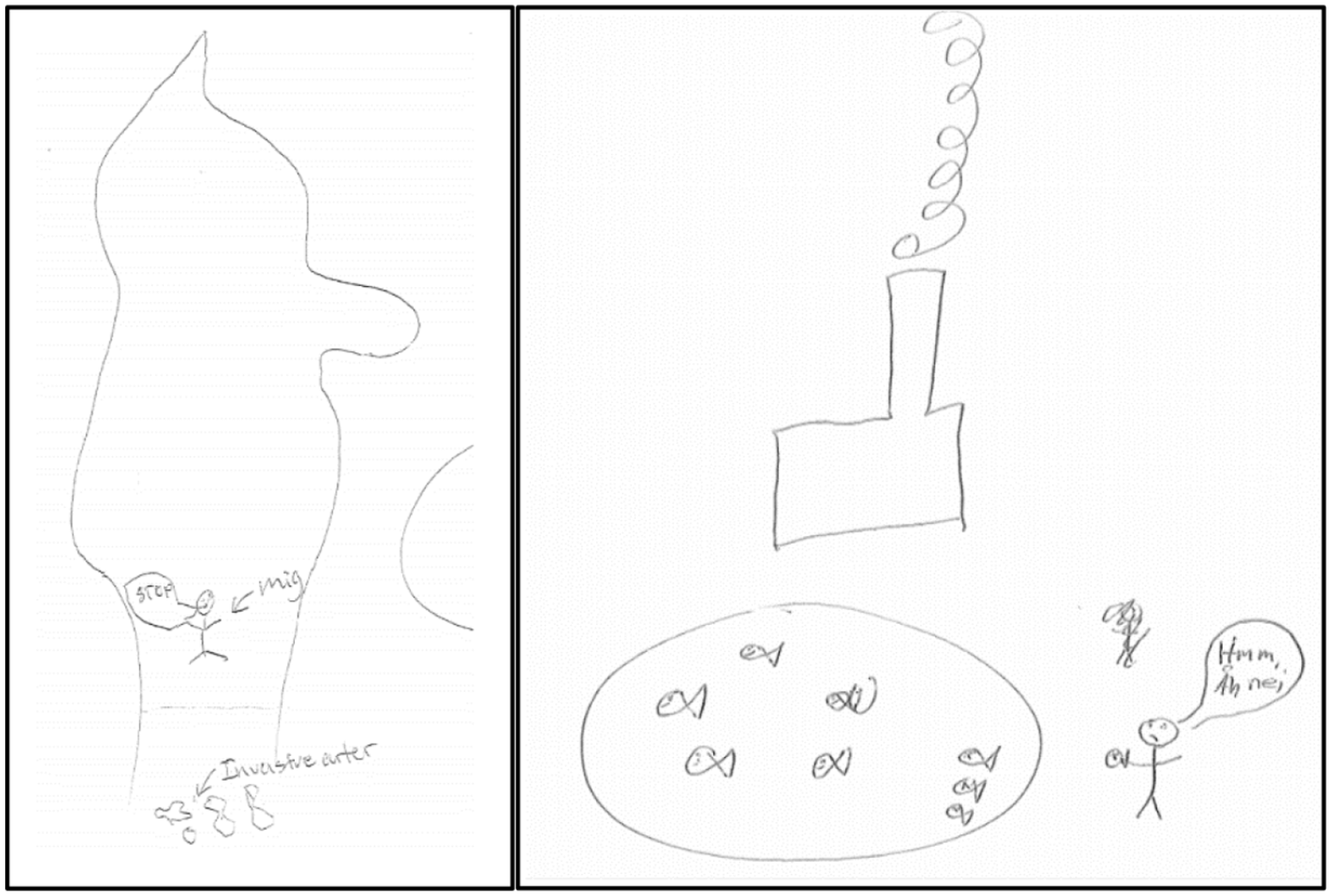
Drawings by two Natural Resource students’ illustrating their imagined futures. Both drawings illustrate a ‘save the world’ approach (addressing pollution in a lake with dead fish, stopping invasive species at the Danish border to Germany).
Also another difference appeared in the imagined futures of natural resources students in relation to the imagined futures of students of chemistry. Students of natural resources were able to bring their imagined futures into the degree programme and keep them during their studies, maybe due to the urge the students experienced to construct their own programme within the degree programme, as shown in Marlene’s post-bachelor’s degree choice narrative. Marlene entered natural resources to: ‘know more about what is then out there. What is it that makes it contaminated? Why doesn’t it work? And what are the causes?’. During her studies, Marlene pursued her imagined futures through her selection of courses and as a result ended up doing her bachelor’s project at another department. After her bachelor’s degree, she worked in a consultancy specialised in ‘solving the greatest societal challenges’, before entering one of the master’s degree programmes ‘naturally’ following the natural resources bachelor’s degree programme. However, to follow her imagined future, she was in a constant process of organising how to combine the mandatory courses with courses and relations to researchers at another department, and at the time of the interview, she was studying part-time because: ‘I simply just could not deal with choosing a course because [. . .] as long as you take mandatory courses, you just take them, but as soon you need to choose, it is also an opt out [. . .] I think it can be very confusing to tailor your own education and when you enter the other side [the job market] what is it then you can, it is not very defined’.
Natural resources choice narratives and the disciplinary setting
The choice narratives of students of natural resources demonstrated that the degree programme was not considered as automatically opening doors to a desired distant future. This led the students to actively engage in more reflections on how to reach various potential futures. As such, imagined futures became a driver for their choices of courses. To understand this, we use the ideas of disciplinary cultures (Becher, 1989) and institutional capital (Bourdieu, 1988).
Natural resources is a new degree programme that was launched in 2005. Three existing bachelor’s degree programmes merged into natural resources as part of a mobility and internationalisation strategy with reference to the Bologna process (Malm et al., 2016). The degree programme is cross-disciplinary and contains elements from various disciplines, for example agricultural science, forestry, environmental science, and economics. There is not one but a range of master’s degree programmes that the students perceive as ‘natural’ continuations of the bachelor’s degree programme. The disciplinary culture is in the terminology of Becher and Trowler (2001) applied in the sense that the present degree programme is related to challenges in the world outside academia, including farming, climate, and management. Traditionally, employment has primarily taken place within the professions of agriculture, forestry and economics, however, at present, graduates’ employment patterns are more diffuse – as the general employment in these professions has declined. As such, the degree programme in natural resources does not offer the same kind of institutional capital (Bourdieu, 1988) to its students’ as the degree programme in chemistry, both due to its status as a new interdisciplinary ‘discipline’, but also due to its more applied virtues. Hence, students of natural resources are not able to rely on the merits and value of the degree programme and instead they experience an urge to take action themselves both in relation to combining courses to gain the right profile and to ensure that their degree programme makes personal sense to them and is well aligned with their future ideas and desires. This urge was strongly presented in Marlene’s choice narrative of constructing her own degree programme with courses from different departments. Her imagined future worked as a driver for choosing courses and a master’s degree programme rather than the other way around, as she did not rely on the degree programme’s ability to provide her with the institutional capital she needed for her imagined future. In other words, she did not expect the institutional capital to translate into the capital required for her to navigate outside the university chemistry. However her strategy of ensuring the right form of capital did not come without costs, as she had had to convert to being a part-time student. Many of the students of natural resources took the responsibility of creating a coherent choice narrative within their degree programme upon themselves. On the one hand this caused frustrations and insecurities about whether they were on the right track to an attractive future, on the other hand, their narratives reflected strong individual ownership of their pathways.
Discussion and concluding remarks
In this paper, our aim was to investigate how bachelor’s degree students in a post-Bologna era who are presented with a new decision point after completing a bachelor’s degree construct their post-bachelor’s degree choice narratives. We do so in two different disciplinary settings by studying the degree programmes in chemistry and natural resources at a Danish research-intensive university.
We found that all students in our study negotiated the post-bachelor’s degree trajectory as an active choice that they had to relate themselves to. But more importantly, our study clearly documents how even students within the same faculty are presented with different repertoires to construct their choices from, and as a result encounter different choice processes and negotiations. Chemistry students engaged in negotiations of constructing identities within chemistry itself, and consequently they navigated towards short-term and research-centred imagined futures rather towards considering a job outside university, for example. The negotiations of the chemistry students’ identities were thus played out within the discipline and the post-bachelor’s choice was not considered challenging in itself, but demanding in terms of identifying personal interests rather than fitting them into the future. This we suggest is a result of the institutional capital that is held in disciplinary culture of chemistry, an institutional culture that the students can rely on. However, students who did not align themselves with such choice narrative about chemistry research as a natural and personal desire were left to find other ways to construct individual narratives without getting support from their degree programme. For example, this was the case for students striving towards becoming teachers. In contrast, the students of natural resources did not consider their degree programme to automatically open doors to a desired distant future. We suggest this to be a result of the disciplinary culture of natural resources not holding an institutional capital in itself. Rather, students actively engaged in the identity work of identifying and reaching various potential future scenarios. In doing so, the students of natural resources drew on a wide repertoire when narrating the future, and in particular they strived to imagine a future where job and life were intertwined coherently. We argue that students of natural resources cannot to the same degree as students of chemistry rely on the merits and value of their degree programme in itself. Therefore, they are required to take action themselves both in relation to combining courses to gain the right profile and to ensure that their degree programme makes personal sense to them and is well aligned with their future ideas and desires.
These findings are interesting, as the idea of a coherent, discipline-specific five-year degree programme still exists among Danish students, as pointed out by Hovdhaugen and Ulriksen (2021). Also, quantitative studies of Danish students’ movements between the bachelor’s and master’s degree levels show that the new decision point ‘has had little effect, as most bachelor’s students continue their master’s within the same subject’ (Thomsen, 2021: 7). This indicates that the choice processes outlined in the current paper are often invisible. However, following the introduction of the two-cycle degree structure and hence a new decision point, an increasing number of students have been found to move from less prestigious institutions to the old universities (Thomsen, 2021). This implies that institutional capital, which in our study we found to interact with the students’ choice narratives, can also be found at the more general level of students’ movements.
In conclusion, we argue that our findings raise a range of implications for higher education. Our study shows that there is great potential for higher education institutions to support bachelor’s degree students’ choice processes. Especially supporting students’ choices is important in countries such as Denmark where the Bologna process has introduced a new decision point between bachelor’s and master’s degrees.
Counselling at master’s degree level has tended to focus on enhancing individual student employability (Dey and Cruzvergara, 2014), however a strong focus on the individual has been criticised for reproducing and masking the distribution of social positions (Moreau and Leathwood, 2006). Our study shows that there is great potential for higher education to work on expanding individual bachelor’s degree students’ repertoire and ideas about their futures and for striving to collectively support a diverse group of bachelor’s degree students in identifying more varied pathways. A first step could be to make different futures visible collectively amongst students. In a second step, attention could be turned to the role of teachers and other staff who interact with students and their role in providing varied storylines and narrative repertoires about the future. This is however not easy, as power dynamics of what a ‘proper future’ looks like are heavily embedded within disciplinary cultures. Finally, higher education must strive to support a diversity of students and their futures. This requires initiatives that aim to open up futures that seem impossible for some students, for example due to their background, gender or ethnicity. However, it is important to emphasise how this is not a task for collective extra-curricular counselling alone, but something that requires disciplinary activities such as ensuring that cases and examples applied in teaching reflect a diversity of applications.
Footnotes
Acknowledgements
We want to thank all the students who participated in this study for sharing their time and thoughts with us not only in relation to their disciplinary higher educational study programme but also in relation to their personal experiences and perceptions concerning their past, present and future life trajectories. In addition, we want to express our appreciation for the work by the anonymous reviewers for their valuable comments that significantly improved the paper. All usual disclaimers apply.
Declaration of conflicting interests
The author(s) declared no potential conflicts of interest with respect to the research, authorship, and/or publication of this article.
Funding
The author(s) disclosed receipt of the following financial support for the research, authorship, and/or publication of this article: This work was supported by the Independent Research Fund Denmark under Grant Number: DFF – 7013-00104.

Author biographies
Lene Møller Madsen is an associate professor at the Department of Science Education, University of Copenhagen, Denmark. She holds a PhD in geography and is a qualitative researcher. Her main research interest is on student’s learning processes and their possible ways of becoming members of disciplinary science cultures; hence academic navigation, identity processes, and the use of fieldwork are central. She works with teacher training at both the secondary and tertiary level.
Henriette Tolstrup Holmegaard is an associate professor at the Department of Science Education at University of Copenhagen in Denmark. Her research centers around understanding children and young peoples’ identitywork within science education settings. Most of her work is qualitative and of longitudinal nature. Recent publications entails work on students` choices of and transition into, through and out of higher education science. Her current work investigates equity and social justice within Danish science education practices in primary and secondary education.