




Abstract
This paper focuses on the support given by schools to students who are likely to leave Swedish compulsory education without the grades required to enter upper secondary education (USE). The aim is to increase knowledge about career counselors’ and teachers’ strategies and work in lower secondary schools in order to facilitate this critical transition, and to examine factors influencing this support. It takes as its starting point theoretical frameworks stressing the agency of professionals in welfare organizations, and the importance of support during the educational transitions of young people at risk. The paper builds on interviews with 20 teachers and career counselors in six municipalities of varying character. Teachers’ and career counselors’ micro-choices have a major impact on the support provided to students. Their work consists of direct and indirect support, with the former referring to prescribed professional assignments. Indirect support, taking the form of advocacy, relational, and emotional work, is not officially recognized, but appears to be a necessary precondition for the direct support. The transition seems to be at risk of becoming overly fragile unless the support is characterized by sustained collaboration between school actors in compulsory school, and between compulsory and USE levels.
Keywords
Introduction and objectives
For the last decades, the objective of reducing the number of poorly educated European older children and young adults has been high up on national and European Union policy agendas, because completing upper secondary education (USE) is generally a prerequisite for gaining a foothold in working and adult life (Gillies and Mifsud, 2016; van der Graaf et al., 2019). Lacking such qualifications tangibly increases the risks of forming weak and unsafe connections to the labor market, of social vulnerability and poor health (Dale, 2010; Plenty et al., 2018). Hence a range of preventive, interventive and/or compensating policies and practices are implemented in order to reduce the numbers of young people who do not complete USE, including dropouts and young people not in employment, education or training, NEETs (see e.g. Oomen and Plant, 2014). Leaving compulsory school and proceeding to USE constitutes an enforced structural, and also critical, transition point, especially for those not meeting the requirements of the educational system. The strategies of school professionals in addressing young people at the threshold of such critical transitions have received limited research attention.
The processes contributing to early school leaving and problematic transitions are usually long-lasting and involve a range of interacting factors: non-academic, related to the individual, family and friends, and academic, related to the student, school, teachers, and school-mates (González-Rodríguez et al., 2019). Research has, however, tended to focus on student characteristics, while schools and other factors have received far less attention. In their research review, Freeman and Simonsen (2015) thus concluded that the bulk of research on prevention of high school dropout has either been focused on identifying risk factors or conducting intensive interventions addressing students (see also De Witte et al., 2013a, 2013b).
Tarabini et al. (2019) concluded that the social composition of students, management of student heterogeneity and teachers’ expectations are the most important school factors explaining students’ opportunities for success, but students’ perceptions of support, help, and encouragement from the teachers are also crucial. Several studies highlight the significance of high-quality instruction and career counseling for facilitating and supporting educational transitions (Anderson et al., 2000; Kalalahti et al., 2020; Oomen and Plant, 2014), especially for students from socioeconomically disadvantaged families (Hooley, 2014; Hughes et al., 2016) and from a migrant background (Sundelin, 2015, 2017). Kamm et al.’s (2020) study of bridge-year courses between compulsory and non-compulsory school in Switzerland underlines the importance of individually oriented approaches. In a study of four European countries, Cuconato et al. (2015) identified three constellations of teachers’ roles as transition actors: support focused on employability, on access and opportunities, and on students’ well-being, respectively. Even if there were similarities between the countries, Cuconato et al. (2015) also noted context-related differences in how teachers perceive their professional roles as gate-keepers and/or supporters of transitions to the next educational level. Svensson’s (2019) research into the dilemmas teachers face between satisfying policy goals related to immigration and educational objectives in encounters with asylum-seeking students adds to our understanding of the professional work with students, as does Linde et al.’s (2021) analysis of career counseling in this critical transition.
Anderson et al. (2000) conclude that the support given to students at risk of school failure and dropout needs to be comprehensive, and involve parents and the receiving school. They emphasize the significance of efforts to create a sense of belonging to the next step in the education system. The absence of this sense of belonging may lead to disengagement from the school, dropout and engagement in marginalized groups. Other research underlines the significance of a sense of belonging, academically and emotionally, in educational transitions and choices (Lund, 2015, 2020).
This exploratory article focuses on teachers’ and counselors’ career support to grade 9-students who run a high risk of leaving Swedish compulsory school without the eligibility to join a 3-year academic or vocational upper secondary program, and who, therefore, need additional, remedial education to acquire such qualifications. This, in turn, means that the students’ more or less clear educational and vocational desires are impossible to realize in the short run. Furthermore, attending a remedial educational program may, in itself, constitute a risk, as stigmatization tends to accompany such trajectories (Walther et al., 2015).
The aim of the article is to
- What are the significant elements of counselors’ and teachers’ support to students approaching these critical transitions?
- What are the important factors influencing counselors’ and teachers’ choices and priorities when enacting the support?
Situating the Swedish case
Supporting development and the goal attainment of students at risk of failing completion
According to the Swedish Education Act, all students should receive the support they need for developing, as far as possible, in accordance with the national educational goals and their own capabilities (SFS, 2010: 800). Schools are required to provide education for students with special needs, career guidance and counseling, and services from a health team. If a student shows signs of not reaching the goals, the headteacher is responsible for promptly initiating an investigation into the student’s need for extra support, and providing such support based on an action plan (SFS, 2010: 800). The reception of newly arrived migrant students follows similar rules. An individual study plan, to be formulated within 2 months, should include information on how the student will be supported to become eligible for an upper secondary program. The headmaster may decide to place the student in a so-called transitional class, if she/he is not able to follow instruction in the ordinary classroom directly (SFS, 2010: 800, c.f. Nilsson and Bunar, 2016).
The Swedish education system has undergone far-reaching decentralization, repositioning responsibility to the local and school level, since the late 1980s–early 90s. Increasing the ability to meet varying student needs and adapt to different local preconditions was a prominent aim of the decentralization reforms, but evaluations have shown that they, combined with school choice reforms, led to great inequalities between municipalities and schools, including in relation to measures for preventing and tackling leaving school early (Lundahl and Olofsson, 2014). A veritable school market was established in the 1990s, based on a voucher system and generously tax-funded private schools. The school choice reforms have resulted in increased numbers of schools and educational alternatives, and hard competition over students and resources, including extensive marketing, particularly at upper secondary level. This development in turn has led to increased segregation between schools and difficulties of overview and choice of education (Lundahl et al., 2020a; Yang Hansen and Gustafsson, 2016).
Supporting the transition to upper secondary education
State governing of career education and guidance is limited; municipalities and schools have considerable discretion to decide how to reach the national goals. Supporting students’ career learning is the whole school’s responsibility, but evaluations have shown that this is usually delegated to the career guidance counselors. Career guidance is allocated too little time and comes too late to give students a basis for well-founded choices of future trajectories (Swedish Parliament, 2018). This is particularly unfortunate for students at risk of difficult transitions, as high quality career education and guidance is especially important to these individuals (see above).
In Sweden, as in most other European countries, the transition between compulsory and post-compulsory education normally takes place at the age of 16 (European Commission/EACEA/Eurydice 2018). Almost all Swedish teenagers continue to a 3-year academic or vocational USE program, or in cases of being ineligible for such a program, to one of four remedial introduction programs (IP): Program-oriented Choice, Individual Alternative, Vocational Introduction, or Language Introduction. Since 2011, students are required to have approved grades in Swedish or Swedish as a second language, English and Mathematics, and in at least five additional subjects to be eligible to enter the vocational programs, or in nine additional subjects for the academic programs.
Fourteen percent of the grade 9 students were ineligible to enter vocational USE programs in 2019/20, and a somewhat larger proportion to enter the academic programs. The level of non-completion was significantly higher among children with poorly educated parents or whose parents were both born abroad. Roughly 70% of newly arrived students were ineligible to enter a 3-year USE program when leaving grade 9 (National Agency for Education, 2019). 1
The aim of the IPs is to make the students eligible for regular USE programs or work. To our knowledge, the IPs have no direct international counterparts as they are placed at upper secondary level, in contrast to offering, for example, bridging courses or a 10th year, which is the case in some other countries. Unlike the rest of USE, the IP lacks a national syllabus, learning outcomes, and a specified duration.
Theoretical framework
The current study is informed by Lipsky (2010) work on street-level bureaucracy. Lipsky argues that employees in the public sector can be regarded as street-level bureaucrats, who shape and enact the actual policies of schools. Since the work settings rarely have strict regulations in relation to how public policy should be implemented in complex situations with diverse clients, street-level bureaucrats often have to rely on their own judgment and discretionary power. They manage the dilemmas related to perpetual discrepancies between their clients’ needs and available resources by making pragmatic micro-choices and using their discretion in creative ways, often by developing simplified routines in their practice. Their strategies, invoked in response to scarce resources, include advocacy, alienation, and resistance (Gilson, 2015; Lipsky, 2010). Later research shows that in addition to the organization’s internal and external conditions, the strategies are influenced by (a) the individual decision-maker’s professional norms, role definition, personal interests, moral values, gender, ethnicity, and personal meaning and (b) client characteristics and needs, self-perceived or attributed by others (Gilson, 2015).
Lipsky’s work on street-level bureaucracy is relevant in this study for understanding the school actors’ strategies and work with critical transitions. As the support for educational transitions in Sweden is formed largely locally and without targeted resources, we assume that school actors’ decisions and actions are of substantial importance for designing support to young people at risk of critical transitions. We expect the school actors’ micro-choices to vary between schools and municipalities, thus constituting local conditions for educational transitions.
The study also relates to the conceptual framework on educational transitions by Anderson et al. (2000), including concepts such as preparedness, support, and belonging when addressing how to facilitate successful transitions for students at risk of school failure and dropout.
Methodology
The paper is based on case studies including six schools in six varying local contexts: (a) two commuting municipalities, in suburban areas near large cities, (b) two small towns/municipalities (15,000–40,000 inhabitants), and (c) two rural municipalities. The study used an ethnographic approach (Jeffrey and Troman, 2004) and included field observations of career-guiding activities and interviews with school actors and students at risk of becoming ineligible for USE. This paper builds mainly on interviews conducted in the six schools in 2019–2020 with seven career counselors and 13 teachers (Table 1). The interviews focused on the work of facilitating the transition to USE, targeting newly arrived students and students who risked not receiving the necessary grades for other reasons. The individual alternative (IA) and language introduction (LI) were the IPs that could be relevant for these students.
School characteristics and professionals interviewed.
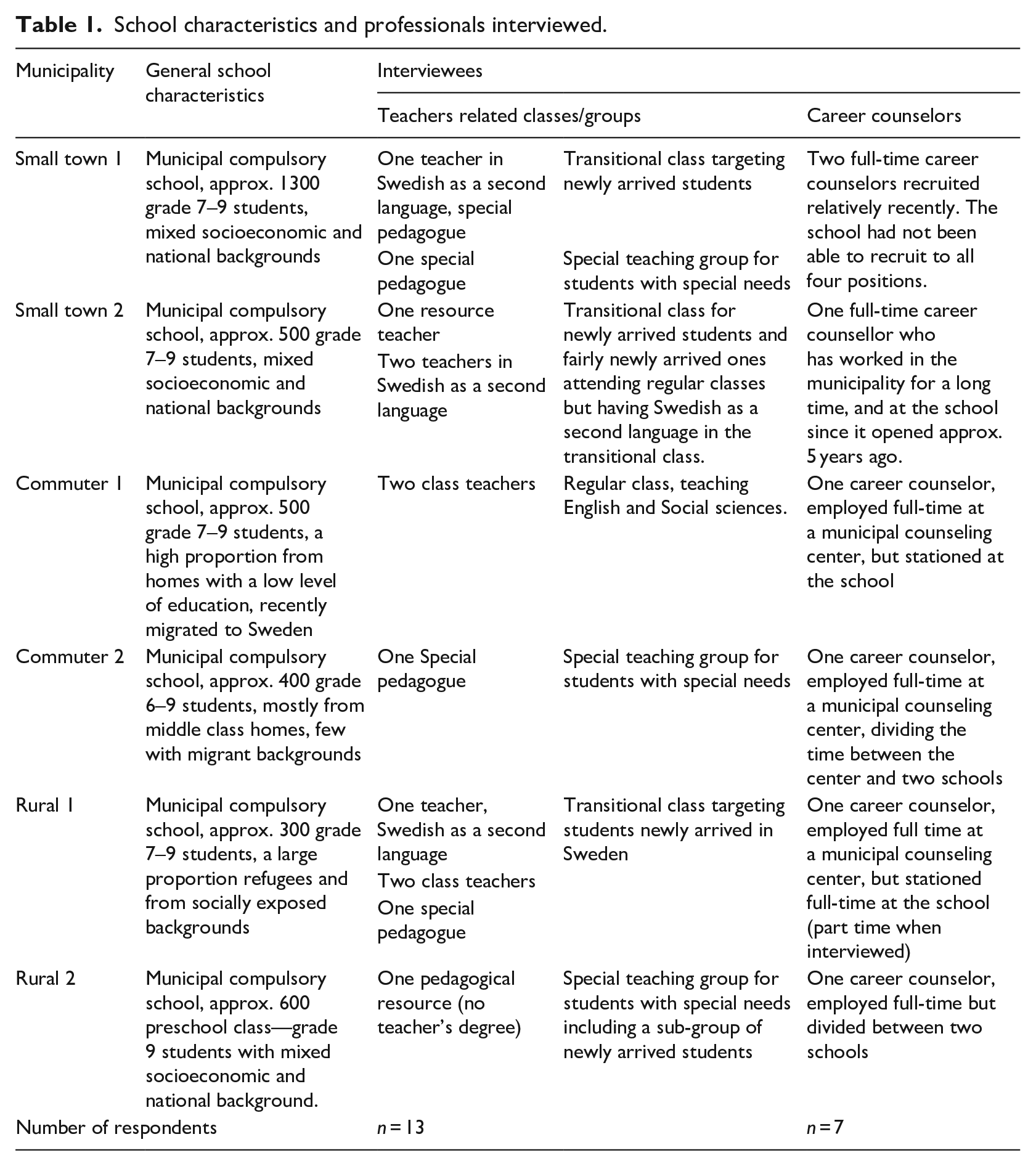
The counselors had agreed to participate in the study at the beginning of the research project, while the teachers were selected for interviews based on counselors’ and students’ statements about important school actors in relation to the research subject. The teachers were class teachers, teachers in Swedish as a second language or special pedagogues, and worked in regular classes, teaching groups for newly arrived students and with students with other special support needs (Table 1). Through this procedure, we were able to cover a variety of support designs and examples of good practice.
The interviews were semi-structured, and took their point of departure from an interview guide developed collectively by the research team. All interviews were recorded and transcribed except one, due to recording problems, with the special teacher at Small town school 1, which was written down directly after the interview. Most of the interviews were individual, but the teacher interviews in Small town school 2, Commuting school 1, and Rural school 1 were conducted as group interviews. In addition, the two counselors at Small town school 1 were interviewed together.
Two limitations should be noted. Focusing on support for transitions, we did not include the school’s student health team in our study, even though this is often an important part of schools’ work with students who will not receive adequate grades from compulsory school. In addition, we did not analyze the work involved in producing appendices addressed to the receiving school that often supplement USE applications from students at risk of not being eligible to enter a national program. These appendices can also form the basis for a free quota application. This refers to a limited number of places set aside for students who, due to special circumstances, should be given priority over the other applicants. Our data did not cover this aspect sufficiently.
The findings and conclusions are based on an empirically and theoretically informed content analysis conducted in three phases. Initially, an open reading of the interview material was undertaken to capture the central and recurring aspects in the respondent’s statements. Here, certain patterns of how school actors perceive their role and factors influencing their work with critical transitions emerged; these were further investigated in the second and third phases. The second phase aimed at capturing the methods school actors use to support students who are at risk of not being eligible for the national programs (NP) in USE. This analysis used as its starting point Anderson et al.’s (2000) conceptual apparatus and focused especially on how school actors worked to prepare, support, and create a sense of belonging to USE. The analysis in the third phase used as its starting point Lipsky’s perspective on school actors’ micro-choices, and examined the interviews with a focus on how the school actors organize and prioritize their work and how they argue for this. The analysis in the first and second phases resulted in a typology of school actors’ work with respect to critical transitions, including both activities used by different school actors and strategies that appear to be particularly important.
Findings
Significant elements of the support to students approaching critical transitions
Influenced by Frelin and Grannäs (2015) categorization of the relational interaction between school staff, students, and subject matter, we use a distinction between direct and indirect work, reflecting the relationships between school actors’ work and the exposed situation for young people at risk of critical transitions. The categories denote two different kinds of school actors’ work, and the relationship between them (Table 2).
Direct and indirect support: activities, course of action, actors, and target groups.
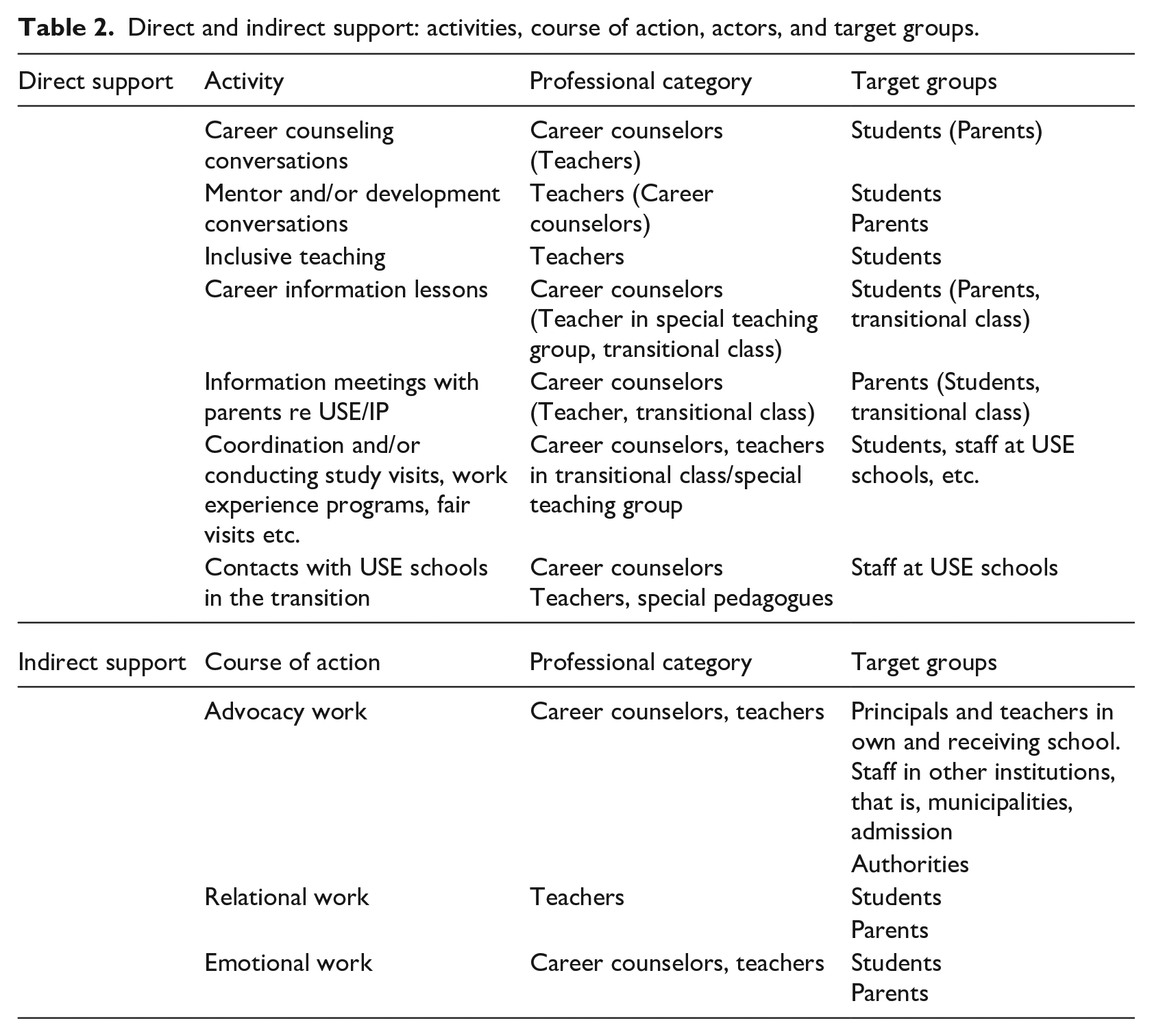
Direct support comprises activities that are directly related to the school actors’ assigned functions and have an explicit purpose with respect to facilitating the transition for students who are at risk of not being eligible for USE. The direct support primarily takes place through interaction with the students and/or their parents/guardians (hereafter referred to as “parents”), as for example career counseling conversations, but the category also includes organizing and coordinating work.
Indirect support applies to courses of action that school actors use that are indirectly related to school actors’ assigned functions but appears to be essential to facilitate critical transitions by creating and improving preconditions for the direct support to succeed. Three overarching forms of indirect support have been identified: advocacy work, relational work, and emotional work. Like direct support, indirect support can target the students, parents, colleagues, principals, and/or staff in other authorities/settings.
Direct support
According the interviewees the school actors’ direct support of students mainly takes place in conversations and meetings with students and parents, and the occupational groups work separately. The counselors’ claim that their work is dominated by individual counseling conversations with the students, mainly in year 9 (c.f. Lundahl et al., 2020a; Rosvall, 2020). And, intensified during the spring term in grade 9, when the students have received the preliminary admission decision making it obvious that they risk not being accepted to a national USE program. The career guidance work is often initiated based on concerns of mentors, students, and/or parents.
There are quite a few mentors who want me to contact this and this parent because they are worried and because they have realized that they [the students] won’t become eligible. So, mentors mainly, but some parents have contacted me as well (Counselor 1, Small town 1)
Similarly, teachers describe that their direct support takes place predominantly in conversations with students, but also with the parents. There seems to be an ongoing conversation between the teachers and the students about the future, both spontaneously in teaching situations and organized during development and mentoring conversations. The question of students’ future opportunities is primarily introduced by the teachers, and they seem to work directly with the parents to a greater extent than the counselors.
Furthermore, the given examples of collaboration between the different school actors foremost concern meetings with students and parents, especially when the teachers realize that students are at risk of not being eligible for the national USE programs. A more developed and organized example of collaboration is found in the transitional class in Small town school 1, where the counselor regularly visits the class to talk about future education opportunities. Another example is found in the transitional classes at Small town school 2, where the school actors cooperate in a work experience program (prao). The counselor organizes the program for the students and the teachers visit the students at the workplaces. All students are expected to participate unless they have arrived in Sweden very recently. The counselor argues that it is especially important that newly arrived students get an opportunity to participate in prao in order to create new networks.
Because they have no network, they have no parents who have worked in different companies. They just came here, they do not know. So for them, it is even more important that this internship is open to everyone (counselor, Small town school 2)
A few examples of more comprehensive and long-term work were identified in the interviews. Mainly the teachers involved with special teaching groups or transitional classes seem to work strategically to support the students’ transition by, for example, visits to upper secondary schools and USE fairs, and teaching about USE alternatives. In particular, the teacher in the transitional class in Small town school 1 strives to support the students’ transition. In addition to organizing study visits to upper secondary schools and several other places, she describes that she regularly teaches about future issues, both by herself and together with the counselor. She also strives to involve the parents in order to increase their knowledge about career opportunities in Swedish society.
I’ve had a lot of career guidance, for example. “Because if you do not understand the system and your children have to acts as parents, it is not possible. Now you have to know this and read this.” And I’ll go through things (teacher, Small town school 1)
Another example of comprehensive and long-term work with critical transitions in regular classes is found at Commuting school 1. The teachers describe how they try, as early as possible, to identify students who may have difficulties getting all the required grades, in order to undertake planning for USE together with the students, their parents and the career counselor.
It’s usually like this that when you notice that a student is going to find things difficult, then you have to find a goal around this. We have worked for such a long time that we have a good sense of how much you can make up for in how long, what is reasonable. (. . .) That’s why we engage the career counselor very early. (—). Already in the seventh grade, we are talking about USE applications and we look at different programs and what you can become (Teacher 2, Commuting school 1)
Furthermore, they claim that the starting point for their teaching is that it should include all students’ different needs and they describe how they adapt teaching situations, examinations and materials to make the school manageable for the students. Their striving seems to be to motivate and support students at risk of not getting the necessary grades in every conceivable way to take on school work: Interviewer (I): /—/ how do you try to manage the differences if you have students who have difficulty achieving the goals, precisely in teaching situations? Teacher 1 (T1): You give them different opportunities, oral compensations, bribes (laughter). Read these ten pages and you will get five candies. T2: Simplified material, alternative examinations, additional briefings, you take time explaining why it is important both for me as a teacher and the student. You have to explain the benefit of fixing this, you have to explain why. (Teachers, Commuting school 1)
During the transition stage, contacts between the school actors at compulsory and upper secondary schools are described as mainly taking place at handover conferences. Involving parents and students, as illustrated below, is perceived to be beneficial but seems to be an exception.
Sometimes from case to case there has been a lot of handover so there has been a meeting at the school with parent and student, special teacher (. . .) already in April (—). It is great, then you prepare both the student and the school for the student and everything and the family and get handover information and it’s amazing (Counselor, Commuting school 2).
In general, the counselors express that they would like to work more individually with the students to prepare them for USE, but they return to the fact that there is not enough time for that. Rural school 1 constitutes an exception; here, the counselor describes a close collaboration with the receiving USE school, which, among other things, provides an opportunity for a gradual transition for students into introduction programs.
The fact that you know each other makes things much easier, it becomes easier that you can contact each other directly and not wait for it to be time for a handover meeting or something but you know well in advance in this school year, this student comes from that school and can prepare in a completely different way. We also have the opportunity to (. . .) enroll students in upper secondary school. Some may need to visit over several months, that way they get to look at the classrooms and the staff they will have. (Counselor, Rural school 1)
This collaboration seems to be due to the spatial closeness between the compulsory and upper secondary schools, and the counselors being organized within a municipal counseling center. They have insight into each other’s work and can easily have contact with each other. The teachers are also involved in the transition support and have other contacts with the USE school concerning students with special needs and from transitional classes. Furthermore, a recurring mandatory 2-week summer school for all students who are not eligible for national programs contributes to a picture of a more developed and individually tailored transitional program in Rural municipality 1 than in the other local sites.
Indirect support
Advocacy work
This theme includes school actors’ descriptions of how they work to counteract injustices to which students at risk of not successfully completing compulsory schooling may be exposed. The advocacy work is initiated by the school actors, paying attention to conditions they consider to be unfair or unclear to the students and with the aim of protecting students’ rights and interests and increasing their future educational opportunities. Unlike the relational and emotional work, the advocacy work does not address students but mainly principals and teachers in their own school, or external organizations, such as school admission authorities, municipalities, and places of work.
Both teachers and counselors testify to the need to protect students from ending up in difficult transition situations due to the decisions of other staff or opinions at the school. Several of the counselors describe the need to argue with teachers about the consequences of programs of action targeting students with difficulties at school, for example, the impact on the students’ chances of being eligible for USE.
You have to argue a bit with the teachers about that, they want the best for their students when they construct action programs but may not always think about the future consequences; implementing an action program when they are in eighth grade affects the choice of upper secondary education when they finish ninth, you have to be in and poke, “now you have removed subjects for Kalle here, when will he have them back again”? (Counselor, Rural school 1)
The quote above refers to a situation when a school is planning to remove students from regular classes in particular subjects. As for students in transitional classes, teachers note that they have to argue with principals for their students’ right to study enough subjects and to participate in regular classes: I: Do they have all the subjects? (—) T: Yes! They have to. Otherwise I’ll be angry. It is also a question of democracy. People say to me, “No, but we’ll take that away.” I’m arguing with the principals. “Now we are removing physics and chemistry and biology.” But it’s not good, is it? Why should they be denied? They (students) may think this is the best subject they’ve had. I don’t think that is good. Should they just sit here and read Swedish and Math all day? There are such schools where you do that. Swedish, “Yes, they must learn Swedish.” But Swedish is found in all subjects as well. That doesn’t work either, I think. (Teacher, Small town school 1)
Advocacy work is also initiated when the counselors try to find possible educational paths for the newly arrived students after compulsory school. The conditions associated with the students’ future opportunities may be highly unclear and associated with great uncertainty due to migration legislation (c.f. Linde et al., 2021). These students are often in a vulnerable position and do not fit into the education system, the counselors claim.
Yes, first there are laws and rules that apply to the student. Compulsory school is simple in the way that they should attend, in upper secondary school you are not obliged to receive students in that way, it is a lot to check out what applies and what we can do for this student. Many students come and have not received a residence permit, can I get some paperwork so that I can be admitted to upper secondary school? And so, it will be far more challenging for this student and you want to help as best you can. (Counselor, Rural school 1)
Unnecessary obstacles, created by the USE admission systems for newly arrived students also result in the need for counselors advocacy work. Many newly arrived students have difficulties getting a passing grade in English, which is a compulsory subject for admittance to the national USE programs. It is possible to apply for an exemption for this, but it is often not granted and the students are referred to an extra year at the IP. The counselor at Small town school 2 has contacted the principal for support for two students whom he claims are well placed to cope with NPs at USE and considers it would be a waste of time for them to undertake the IP.
. . . it’s completely insane. It’s a waste of everything. And I - so now I have told the school management that they have to call the principal of the upper secondary school, because should this - if she does not get this, then they can change the grade afterward, then they can give a passing grade for example. One girl must go to science and the other girl to economics. If Swedish students were half as ambitious as these two are, then we would have no problems in USE. You must be able to see individuals even if you have a set of rules. (Counselor, Small town 2)
Advocacy work targeting students directly is also found at Small town school 2, in the schools’ strategic work with the work experience program. The counselor tries to match workplaces to students with different needs and to prepare the supervisors for students who might need extra support to cope with the challenge of being in a new environment. The counselor describes this work and how she removed a student from a workplace that turned out to be racist: But then we may have steered a little, because it may be good that you have prepared the workplace. You can also do this with other students with various disabilities or diagnoses such as ADHD etc., as well as having to talk to the supervisor that this student is so and so. — at some points over the years, it has gone really badly, when the situation has been purely racist, I can say, from the company. — So then I removed that student from there and placed them somewhere else, and I have never used this company ever again either. (Counselor, Small town 2)
The most radical example of advocacy work is provided by the teacher in transitional class, Small town 1, who states that the students need more help with school work than can be delivered by the school staff. Through a collaboration with the municipality’s labor market unit, unemployed people with a migrant background get tutor assignments in the transitional class. The tutors often have some kind of pedagogical training and speak the students’ languages. The teacher supervises these tutors. In this way, in addition to contributing to the tutors inclusion, the teacher seeks to make sure that there are many supporting adults present in the classroom for the students.
Relational work
Relational work is primarily about teachers’ recurring descriptions of how they strive to create trusting collaborative relationships with the students and their parents. It is considered to be essential to support students at risk of not getting adequate grades due to learning challenges.
T1: It is important when you are in a small teaching group that we who work here believe in the student and are demanding. Even though you are a small teaching group, it must not be that you lower the requirements too much, it is a fingertip feeling. T2: The most important thing is to believe in the student. If you do not do that, they do not believe in themselves either. (Teachers, Rural school 1)
It may seem that the teachers attach greater importance to relational work than to their teaching, but they rather regard a trusting relationship as a prerequisite to be able to support the students further in their studies (c.f. Lund and Lund, 2016). The teachers at Commuting school 1 describe their attempts to develop an interpersonal relationship with the students and show that they genuinely care about them. They claim that this creates motivation in the students to take on schoolwork.
T2: (—) I think they do quite a lot for our sake because we care. Even though they may not see why they should do it, they do it because they see that we care and it means something to us. I: They feel that you care? T2: Yes. T1: And trust that what we say is in their best interests. (Teachers, Commuting school 1)
A significant part of teachers’ relational work is directed toward the parents. The teachers return to the fact that a large part of their work involves supporting parents and creating conditions that make it possible to cooperate with them. The special pedagogue at Small town school 1 claims that a third of his time involves working with parents. The parents worry more than the children about the future, he says. The teachers at Commuting school 1 act strategically to make parents trust the school’s support for their children’s schooling and transition to USE by, for example, increasing parents’ knowledge about future opportunities. If the parents are anxious and stressed about what will happen to their children, the concern will spread to their children and affect their school work, and, vice versa, if parents feel safe about their children’s future, the relationship between the parents and the children improves. This, in turn, places the students in a better situation for taking on school work, the teachers argue. In summary, the teachers perceive relational work with parents to be a key function to support the students’ ongoing school work and their transition to USE.
Emotional work
For both students and parents, the transition to the introduction programs is loaded with strong emotions, and a significant part of school actors’ work involves managing their concerns and resistance to these programs. The theme “emotional work” signifies this work. The counselor at Small town school 2 describes it as a hopeless war against the students’ negative emotions and opinions about the IPs: they have so many preconceived notions about IP so it’s breaking them, because it’s just shit to go there, it’s worse than death to end up there. But still we try to talk about it, we let IP come here, you bring students who have attended or are going to attend IP,(—) we have some resources here in which the situation is also explained to the students, “but I did not have a full set, I had to have more grades, I went there a year, and it has gone very well for me.” But it is as if they don’t listen, many of them are terrified. They have been up for a visit. So we have to try to show and visit, but then Lisa (teacher at IP) says that many, once they start there, then it goes very well. But here with me, it’s completely hysterical at times. (counselor, Small town school 2)
Counselors’ emotional work is also aroused in connection to the institutional gap that often seems to exist in the transition from compulsory school to IA in particular, which causes worries for both the students and their parents. Especially in the suburban areas, with many different USE school alternatives, students may have to live in uncertainty about what school to attend until the start of the IP in the middle of August. The counselor at Commuting school 2 describes how she strives to instill confidence in the students that they will have a school to attend to make them feel better despite the uncertainty.
C: I try to say it very clearly, that you will have a place, it is your municipality and we take care of everyone. Then maybe it feels good anyway (Counselor, Commuting school 2)
The emotional work also becomes evident in teachers’ descriptions of how they manage their conversations with the students. The teachers at Commuting school 1 highlight the importance of how the conversations about the future are conducted with students who are at risk of not being eligible for NPs. The students are in a vulnerable situation and the teachers need to avoid contributing to any stigmatization. They emphasize the importance of never speaking negatively about the students’ future opportunities and state that they must express a value-free attitude themselves toward various future alternatives and school performance in order to avoid reinforcing students’ feelings of failure.
It is important that when we talk [about the] USE application that it must never be judgmental, or say here are those who have succeeded and here you are, the ones who fail. It is important to catch this group because if you treat them a little harshly and start suggesting that they will never get in, then you lose them and they lose their self-confidence. There must be a path for them and you have to instill a sense of hope and that there is a way forward. (Teacher 2, Commuting school 1)
Factors influencing school actors’ strategies and work with critical transitions
Local resources and school actors’ discretion and opportunities
In line with Lipsky (2010), we found that the teachers and counselors have rather wide discretion concerning their work with students at risk of critical transitions, but their strategies and work are framed by a situation where the need for support exceeds available resources. No explicit goals or guidelines were found in any of the six schools with respect to the support given to students who risk not being eligible for the national programs at upper secondary level. Commuting school 1, however, has an additional counselor resource of 10% compared to other schools in the municipality because of the many students from disadvantaged families. The counselors work and priorities do not differ considerably from the other counselors in the study, but the counselor and the teachers in grade 9 seem to work more closely together than at the other schools. They emphasize that this close collaboration is crucial for supporting the students’ transition.
As in other studies (Lundahl et al., 2020a; Rosvall, 2020; Sundelin, 2015), the career counselors in this study have extensive assignments and limited time for their work. The counselors compromise between all students’ right to career guidance and students in need of extra support, and use their discretion pragmatically in response to resources and the students’ needs (c.f. Gilson, 2015). The counselors largely organize their work on their own and arrange their working time based on their resources (time in relation to number of students). They tend to focus on individual career counseling and refrain from, for example, making study visits to upper secondary schools with the students. Priorities in the work do not seem to be discussed with the school management to any great extent; the example that was found concerned priorities between tasks in general, not in relation to students’ need for support.
Relationships and student composition
The study provides several examples of teachers playing an important role in the work with students’ transitions. In cases where the work starts earlier and is more organized, the teachers have a rather active and important role. Among other things, this seems to be linked to their close relationships with the students. The interviews testify to the teachers’ opportunities to prepare the students for the transition through their regular contact with both the students and their families, through teaching and mentoring. They regularly meet and develop long-term relationships with the students and their parents.
Furthermore, by studying the support given to both newly arrived students and students with a Swedish school background, a difference emerges in how the support is designed for the two groups. Students in transitional classes seem to receive more developed support in the transition than students in other groups. Organized opportunities for career learning for both students and parents are mostly offered by teachers in transitional classes. The students are a fairly homogeneous group in terms of the reasons for the transition and included in the same class. In addition, it appears that the position of fostering for Swedishness that teachers who work with newly arrived students take (Högberg et al., 2020), has positive consequences regarding students’ and parents’ opportunities for career learning. These teachers also describe their close relationships with the students.
Knowledge, values, and advocacy
As Lipsky 2010 claims, it is not only limited resources that shape street-level bureaucrats’ micro-choices, but also values and understanding of clients’ needs. The support that the teachers at Commuting school 1 and in the transitional class at Small town school 1 give to their students bring this to the fore. The teachers at Commuting school 1 pursue a strategy that starts from an understanding of both the students’ and the parents’ situation and feelings when the student may not be eligible for NPs at USE. This is expressed both in their direct and indirect support, as described earlier. The teacher in the transitional class (Small town school 1), who is the individual who works most actively with career education, builds her work on knowledge and understanding of the newly arrived students’ and their parents’ situation, but moreover on her fundamental values. Her work derives from a strong commitment to integration and democracy and she regards career education and guidance as a question of democracy for newly arrived students.
I think it is one of the biggest issues of democracy, that they should have the right to choose based on who they are and that they should have the opportunity to access information and make good choices and so on. (Teacher, Small town school 1)
In addition, there are examples of actors using advocacy arguments in response to scarce resources (Lipsky, 2010), which reflects a strategy to protect students’ interests. The teacher quoted above is anxious that both the students and their parents will receive information about future opportunities and wishes to increase the students’ awareness of themselves as an individual who can make choices. The special pedagogue at Small town school 1 states that he needs to prepare the students for USE more now since the career counselor resource has been insufficient for a long period of time due to the difficulty of hiring trained career counselors in the municipality. His students often need more support in the transition to USE than the counselor has time to offer, he says. The teachers consider that the students have a great need for support in the transition and compensate for the counselors limited time.
Geographical and relational closeness
Geographical and relational closeness also affect the school actors’ work to prepare the students for the transition and create a sense of belonging to USE (Anderson et al., 2000). In rural societies, the closeness between the compulsory and USE schools and between the school actors seem to provide opportunities for more interconnected work with students. This applies to both of the rural municipalities with only one school offering IP, and where the compulsory and USE schools are situated next to each other. Moreover, in Rural municipality 1 the counselors at compulsory and USE levels are organized within the common municipal counseling center. Contact appears to be easier and more frequent in the rural societies than in the commuting municipalities where distances between the schools are greater and there are several alternatives in terms of IP. The students in the commuting municipalities may have more choices regarding schools with IPs, especially in Commuting municipality 2, but the school actors’ opportunities to support students’ belonging to USE seem limited.
Conclusions and discussion
This article aimed to explore the strategies and choices teachers and career counselors apply to facilitate educational transitions of grade 9 students running a high risk of not being eligible for USE. Here, we present and discuss our conclusions about the school actors’ strategies and support to these young people, and highlight what appear to be key factors in supporting young people approaching critical transitions.
Our analysis resulted in a typology of school actors’ work that distinguishes between direct and indirect support. We start by emphasizing that this is an analytical distinction. In practice, these forms of support are intertwined and interact with each other. The indirect work emerges in relation to emotions and situations that arise through the direct work. The indirect support, especially the emotional and relational work, appears as a prerequisite for the direct support to function in the way it is intended. The indirect work thus testifies to the vulnerability and fragility of critical transitions and that an understanding of this is necessary as a starting point for the direct work with the students.
The direct support activities appear to be generally accepted practices. With some exceptions, they primarily take place during conversations in the schools and at the end of compulsory education. “Systemic transition models,” including planned, long-term and multifaceted work involving several staff groups, are recommended for supporting students risking critical transitions (Anderson et al., 2000). The overall picture is that no such institutionalized programs exist to any great extent in the schools. In the identified exceptions, teachers’ discretion play a crucial role for establishment of a long-term and systematic work (c.f. Barberis et al., 2016). Our results underline the importance of teachers’ knowledge about and involvement in critical transitions, and indicate that if teachers do not use their discretion to support students in regular teaching groups who risk non-completion, these students are likely to become particularly vulnerable in the transition. We also conclude that transition work characterized by collaboration between school actors is a prerequisite for facilitating critical transitions (c.f. Anderson et al., 2000).
Another important conclusion of the study is that school actors need an awareness of the stigmatization process that a remedial education trajectory often implies, to avoid inadvertently reproducing the inherent oppression of the system. The results highlight that supporting students at risk of critical transitions involves managing stigmatization processes and emotions related to remedial educational trajectories. This is a delicate situation; feelings of belonging are crucial for students’ educational choices (Lund, 2015, 2020), but these students may be referred to schools and programs they do not want to belong to. The school actors’ attempts to make the students and their parents accept the situation despite this resistance risk strengthening the students’ feelings of becoming stigmatized. This situation also emanates from the school system and underlines the importance of school actors paying attention to social injustices (c.f. Sultana, 2014). In addition, our study provides examples of how school actors, at least to some extent, can counteract this through strategic and conscious work and a value-free attitude toward different educational pathways. Our interviews also indicate that the IPs create a sense of belonging to the school among students and are important in restoring students’ image of themselves as learning subjects (c.f. Lund and Lund, 2016).
Micro-choices and priorities
The study suggests that the school actors’ pragmatic micro-choices play a major role in the support for students at risk of non-completion in their educational transitions. Not only limited resources, but knowledge, values and understanding influence the teachers’ micro-choices in particular, and contribute to strengthening their commitment in supporting the students’ transition. We therefore conclude that by strengthening teachers’ knowledge of and understanding of their role in critical transitions, the students’ transition can be strengthened.
The counselors’ strategies and micro-choices, however, appear to be a reconciliation between the needs of the students and limited local resources, and as the routine work that Lipsky (2010) argues that street level bureaucrats develop to deal with this kind of conflict. The counselors adopt a consultative expert role in the work with critical transitions, which seems reasonable, considering the available resources. Considering the counselors expertise in relation to career transitions, they could however have a more central role in leading and coordinating the support for these students’ transitions. As with Linde et al. (2021), this study underlines career counselors important role in counteracting institutional restrictions and finding educational pathways for disadvantaged young people. The study furthermore indicates that counseling young people at risk of not being eligible for USE can be regarded as what Linde et al. (2021) defines as high-stakes counseling because the transition is framed by great uncertainty as well as a high risk of stigmatization.
The study illuminates the school actors’ micro-choices and their consequences for students at risk of critical educational transitions. It makes thus consequences of limited resources visible but also reveals that the responsibility for these consequences falls on the school actors. For example, the counselors decide on priorities on their own, without explicit considerations or discussions with school management. As Lipsky argues, priorities need to be made visible and require the awareness and reflexivity of officials, in this case school actors. The result can thus be used for professionals to highlight, reflect upon and explicitly discuss priorities with respect to support for different groups, and furthermore to address consequences of resource allocation to those responsible. To avoid critical transitions turning into fragile transitions, local decision makers have a particular responsibility to decide on allocation of resources that can contribute to more solid educational transitions for those who are the most vulnerable in the education system.
Final comments
The analysis of school actors’ strategies displays that they perceive working with and involving parents of students at risk of critical transitions as crucial. Research indicates that supporting such parents is crucial in many ways. Studies have shown that support from parents and other significant adults is of great importance for young people’s results in school and successful students identify emotional support from their families as critical (Barberis et al., 2016; Osman et al., 2021). In addition, parents, regardless of social background, are strongly involved in their children’s educational transitions (Bennet, 2018; Ule et al., 2015). However, the increasing responsibilization of students and parents with regard to career choices poses difficulties for families from lower and marginalized classes when supporting their children. At the same time, studies suggest that teachers are poorly prepared for work with parents and disadvantaged young people (Ule et al., 2016). This highlights the need for further studies on school actors’ work with parents in critical transitions and the importance of school actors’ education, developing competence to work with parents and disadvantaged young people.
Finally, according to Rosvall (2020), transitions to USE may be more difficult in rural areas than in cities. However, as also found by Lundahl et al. (2020b), our study suggests that this does not have to be the case for students at risk of critical transitions. Geographical and relational closeness between schools in rural areas seem to provide stronger support for the next educational step for these students, in particular in terms of belonging. In contrast, there may be a risk that a critical transition becomes overly fragile in urban areas. With a multitude of educational alternatives within commuting distance, it is difficult to create a sense of belonging and to avoid a transitional gap which causes students to leave compulsory school whilst still uncertain about their next step. It is urgent that schools and municipalities in urban areas review their work and organization of these educational transitions to avoid these students, and their families, being abandoned in the transition.
Footnotes
Declaration of conflicting interests
The author(s) declared no potential conflicts of interest with respect to the research, authorship, and/or publication of this article.
Funding
The author(s) disclosed receipt of the following financial support for the research, authorship, and/or publication of this article: The paper originates from the project Moving on, Youth attending an introduction program and their career support in varying local contexts, funded by the Swedish Research Council [ref. no. 2017-03591].
Research ethics
The research project Moving on, including the present sub-study, follows the Swedish research ethics legislation and recommendations (Swedish Research Council 2017) and has been approved by the Regional Ethical Review Board in Umeå (ref. no. 2018/173:31).

Notes
Author biographies
Åsa Sundelin, PhD in Education and senior lecturer at the Department of Education at Stockholm University, Sweden, has a special interest in the career counselling field. In her dissertation, she analyzed career counselling conversations with young migrants. She has later continued researching the support for career learning and career choices of different groups of young people.
Lisbeth Lundahl, senior professor at the Department of Applied Educational Science at Umeå University, Sweden. Her research interests concern education politics, youth politics and the school-to-work transitions of young people, and she has been the PI of a number of larger research projects addressing such questions.