




Abstract
Age-classes are a salient feature of modern schooling. Yet how did age-grouping come to prevail in entire school systems? And how was this form of grouping related to educational and pedagogic discussions at the time of its emergence? The article addresses these issues by looking at the historical context within which age classes came to a dominant position: the European nineteenth century. From the perspective of a governmental theorising of modern schooling, the article reconstructs the pace of their imposition and the main arguments in their favour through the analysis of a sample of 125 manuals of school management and organization of teaching. Against the usual description of age classification as a clear sign of the bureaucratic nature of modern schooling, the manuals show a concern about educational issues such as (de)motivation, encouragement and intelligence when discussing the role of age for the organization of elementary schools. The general idea of the modern school as an ‘assembling’ calls for more nuanced historical analyses of different combinations of the pastoral and the bureaucratic as techniques defining this institution.
Age-classes: A whipping boy of school critique
The expert commission that authored one of the best-known documents of neo-conservative educational policy in the United States, ‘A Nation at Risk’, was decisively against ‘mediocrity’ (1983: 30). The commission recommended counteracting this diagnosed mediocrity by challenging, among other things, a salient feature of modern schooling: age-classes. The commission argued against ‘rigid adherence to age’ and recommended grouping schoolchildren based on attainment levels (1983: 30). It was a remarkable association to link age-classes to the production of mediocrity in the US-school systems since age classification of pupils accompanied both the growth of mass schooling and the breakthrough of the US as an economic heavyweight and a global power. The ‘rigidity’ invoked in the document echoed a deep-rooted notion, one that exists well beyond the US, that has circulated since age classification became a dominant phenomenon: age-classes represent all things deemed ‘petrified’ (Hummel, 1977: 121–122), bureaucratic, arbitrary, centralistic and stagnant in education systems (Alvarez and Dehaene, 2017; Feldmann, 2015: 149).
When did age grouping come to prevail in entire school systems? How was age grouping related to the increasingly ‘rigid’ regulation and bureaucratization of modern schools? I will show that the coming of age as a leading criterion for the classification of schoolchildren into classes represents quite a late innovation in the development of modern education. Moreover, I will also argue, following theoretical insights from a governmental perspective on the modern school, that age classification was to a certain degree a genuinely educational question as well. This principle for the ordering of primary school pupils may have resorted to bureaucratic techniques, but it essentially needed educational considerations to be accepted. I will address these issues by looking at the historical context within which age-classes increasingly came to a dominant position: the European nineteenth century. Certainly, similar changes favouring age classification of students in schools existed in other geographies (Angus et al., 1995; Cohen, 1982; Thretewey, 1998). However, European innovations in schooling were almost unrivalled as purported models of progress for other countries and colonies (Roldán Vera, 2005; Schriewer, 2001). I will advance evidence for the rise of ‘age’ as a criterion for the formation of primary school classes in four Western European countries and discuss the main arguments that flanked its gradual institutionalization. In a first step, I will pose the question of age-classes within the broader problem of assembling modern schooling as this has been theorized in Governmentality Studies, particularly by Ian Hunter. (2.) Next, I will introduce and discuss the main documents upon which I base my analysis: a sample of 125 manuals of school management and organization of teaching published in four Western European countries after 1830 when the organization of classes, due to the massification of schooling, undeniably became an urgent question. (3) Then I will analyse the question of regulation and bureaucracy in the imposition of age-classes by looking into both national regulations and their treatment in the sample of manuals. (4) In a further step, the analysis addresses the question of educational and pedagogical considerations invoked in the manuals of school management and organization for the grouping of children based on their age. (5) In a final section, I summarize my findings and, consequently, I briefly propose to differentiate the very idea of ‘assembling’ in the historical view of the modern school. In so doing, this contribution seeks to discuss a structural feature of modern schooling that has been more presupposed than analysed in historical scholarship.
Age-classes within the theory of schooling: Bureaucracy and Pastorate
Age-classes have been considered in theories of schooling as a social institution. Since Parson’s article (1959) about the school class as a social system, the question of learning with children of the same age has intrigued researchers. Mostly, authors inspired by anthropology characterized the formation of age categories in various cultures as the forerunners of age-classes (e.g. Eisenstadt, 1966); other authors, in turn, emphasized the specific socializing effects of being grouped with children of the same age (Krappmann, 1994; Luhmann, 2004). Generally, works hinted at the highly artificial situation of a strict age classification in schools (e.g. Rogoff et al., 2005).
‘There is no adequate history of the evolution of graded schools’ (Schultz, 1973: 343; recent overview: Caruso, 2021a). This almost 50-year-old historiographical insight is still largely valid, particularly for the case of age grading. Historical accounts dealing with the institutionalization of age grading in schools are rare: for specific contexts like Prussia, careful analyses of the introduction of age-classes in grammar schools, including detailed reconstruction of regional developments, are available (Lohmann, 2014: 73–97; Scholz and Reh, 2016). Nonetheless, scholarship has not dealt with age-grouping in mass, compulsory, or primary schooling in due depth. Whereas for the United States (Angus et al., 1995; Cohen, 1982) and, to some degree, England (Simon, 1978), short overviews about age grading exist, more detailed scholarship is only available for colonial Australia (Thretewey, 1998). Even major works dealing with the transformations of the organization of mass schooling and teaching in Europe stop short of looking into the pace and characteristics of age grading (Hamilton, 1989; Jenzer, 1991). Indeed, the gradation of schooling in general and age-grading in particular plays a role in analyses postulating the existence of a ‘grammar of schooling’ (Cuban, 1982; Tyack and Cuban, 1995). Yet this concept has included age-classes only as an element in its catalogue of features characterizing the purportedly unchangeable grammar of modern schooling. I do not follow this path of analysis that rarely exceeds conceptual description and does not focus on the emerging of age for the formation of school classes (Caruso, 2021b).
The questions of the historical pace of the imposition of age-classes and their association with the increasing bureaucratization of schools suggest considering versions of school theory where bureaucracy constitutes a central element. One such a theory has been advanced by Ian Hunter in the context of governmentality studies. Hunter has made a strong case for a consideration of modern school as an institution that not only emerged in a particular setting and time, but also with a specific design (Hunter, 1994: 1). His point of departure is to offer a historical account of the school in the context of the Foucauldian theory of modern governmentality (Foucault, 1991, 2007). ‘Government’ attempts to regulate and to direct human conduct through various techniques and forms of knowledge. Not only state agencies, but also groups and organizations in society as well as the self, as in the case of self-governing, employ these techniques and forms of knowledge (Dean, 1999: 11–16). Modern forms of ‘government’ combine two main sets of techniques and forms of knowledge: those stemming from pastoral power and spiritual guidance and those derived from the legal-political realm (Foucault, 1991: 102–104). The amalgamation of these two sets of techniques in modern government resulted in the advancement of a ‘state pastorship’ (Burchell, 1991: 121).
Following this main argument, Ian Hunter advanced a theory of the modern school as a ‘moral and physical milieu’ (Hunter, 1996: 148) for governing individuals, groups, and even entire populations. Schools of the modern, governmental type emerged at the end of the 18th century ‘as an improvised reality, assembled from the available moral and governmental “technologies”, as a means of coping with historical contingency’ (Hunter, 1994: 3). The ‘assembling’ of schooling (Hunter, 1996) came into existence by patching together components of existing, available institutional orders. First, bureaucratic organization is an inherent, not an accidental element of modern schooling, providing this institution with untold powers, reach and efficacy. Second, a pastoral pedagogy, derived from the religious techniques of Christian spiritual guidance, informs life in schools. Following this, school educators are basically members of a ‘pastoral bureaucracy’ (Hunter, 1994: 62).
Against this background, the classification of schoolchildren according to their age may be one major indication of the power of bureaucratic regulation. Certainly, since the late nineteenth century, additional concepts of age such as ‘mental age’, ‘anatomical age’ and others posed alternative parameters for ‘age’ (Beauvais, 2016) that occasionally attracted the attention of education administrators (Ryan, 2011). But it was chronological, state-registered age that, propelled by compulsory education laws, remained the most widespread definition of age for the classification of schoolchildren (Brownscombe, 1908). If both bureaucracy and pastoral guidance are themselves sets of ‘techniques’ (Hunter, 1994: 67), the techniques of bureaucracy seem to be the triumphant ones in this field.
Materials and method: Manuals of school management and classroom teaching
Schooling based on age-classes affected all countries and territories that set up ‘modern’, mostly meaning Western style, school systems. At the same time, observers from different cultural settings deemed the type of schooling associated with age-classes as an increasingly salient feature of European schools (Dhammasami, 2018; Hoda, 2012). In the following, I present the results of an analysis of 125 European manuals dealing with school management and classroom teaching in primary schools from the last three quarters of the nineteenth century (see Table 1). I unpack the general term ‘European’ by looking at texts from four Western European countries: France, Ireland, Spain and the United Kingdom. This selection of countries includes industrialized countries as well as agrarian ones. They also show diverging forms of educational governance along the axis of centralized and decentralized structures. Since age-classes may appear as being urban and expensive as well as bureaucratic, these two selection criteria – economic structure and educational governance – seem pertinent. With this selection, without claiming representativity, I avoid simply extrapolating one specific and national path of school change as fully representing ‘European’ developments.
Sample of the manuals of teaching and school organization by country and decade (1830–1900).
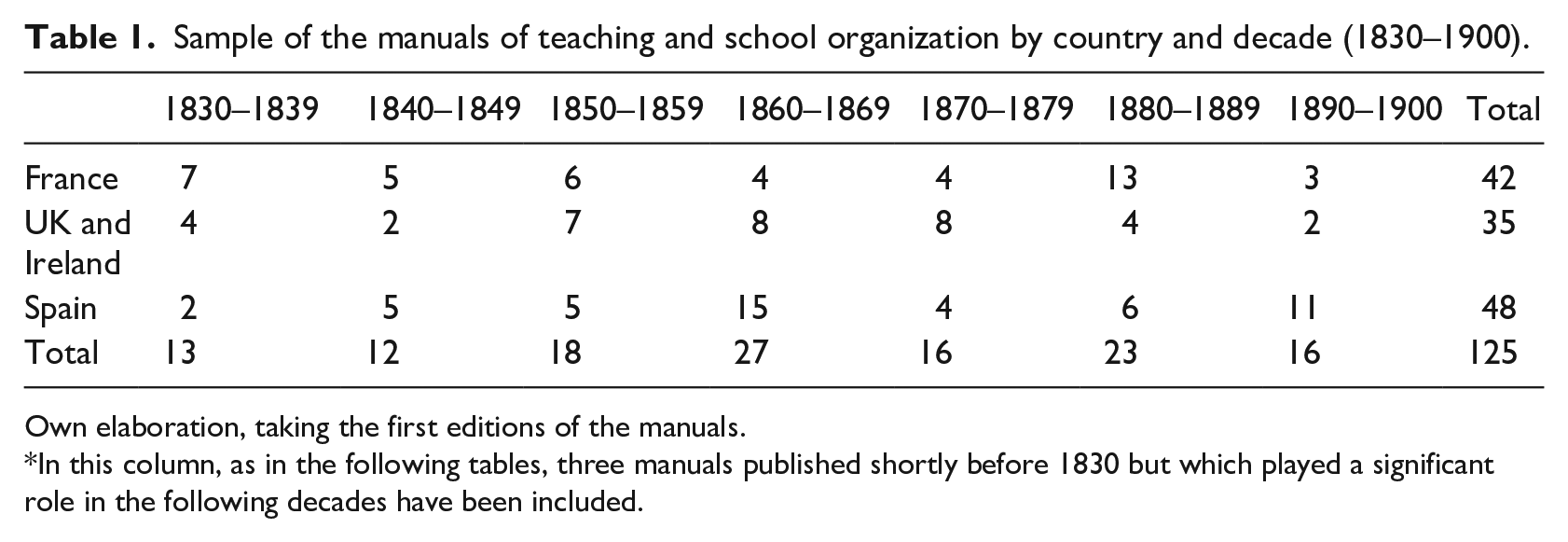
Own elaboration, taking the first editions of the manuals.
In this column, as in the following tables, three manuals published shortly before 1830 but which played a significant role in the following decades have been included.
The period begins with the decline of monitorial or mutual teaching (around 1830), prompting a search for new strategies for organizing classrooms and grouping children, and ends in 1900, when the main decisions about the shape of compulsory schools had been made. I also included three manuals from the late 1820s from France and Ireland that were reprinted many times after 1830 and remained influential for decades. For the sake of simplicity, the tables in the following pages will count these three manuals together with those published in the 1830s.
I consider these manuals as being relevant for assessing the question of how the different rationales for modern schooling played out when discussing the question of age-classes. In this sense, these manuals may provide insights about the pace of the imposition of age-classes and the arguments, both bureaucratic and educational, that developed in this process. They are rather practical introductions for schoolteachers and trainees in normal schools and teachers’ colleges. The many editions of some of these manuals clearly followed a steady and considerable demand from schoolteachers and normal school attendants (Doyle, 2003; Rabazas Romero, 2001; Robinson, 2003).
The bulk of the authors of these manuals were school inspectors and directors of teacher training institutions, but authorship also included schoolteachers such as ‘three schoolteachers from Cuenca’, a provincial town in Spain. In general, manuals written by simple schoolteachers were thinner and more pragmatic in tone than those published by high-ranked inspectors and directors of teacher training institutions in capital cities. The manuals were explicitly normative in character and by no means intended to only describe classroom practice. Between normative and pragmatic discourse, between prescription and description, they existed in relatively large numbers. I consider them a valuable proxy for both the concrete normative expectations and for issues related to classroom practice for at least four reasons. First, their authors knew the field of teaching quite well. In particular, the numerous school inspectors knew the realities of life in classrooms and schools. In accordance, the manuals offer keenly specific observations about general patterns of work, practical problems and even singular anecdotes. Second, these manuals, while mostly conveying the expectations of the educational establishment, did not merely emphasize official regulations and norms. These manuals generally presented norms and expectations under the premise of their application in schools. Third, these manuals were successful works as indicated by the many editions published (total: 334, see Table 2). Their availability and accessibility were unparalleled in comparison with other works, such as the many volumes and higher prices of encyclopaedias. Apparently, these manuals conveyed a type of knowledge that resonated with actual and future schoolteachers. Fourth, scattered evidence shows that the manuals were available in schools and teachers referenced them (Eble, 2020: 335, 354) suggesting that many schoolteachers may have used these manuals as compendiums and guidelines. In sum, these manuals were indeed connected with official expectations of organizing elementary schools, but they also display a perspective strongly connected to the actual conditions of local schooling.
Sample of the editions of manuals of teaching and school organization by country and decade (1830–1900).
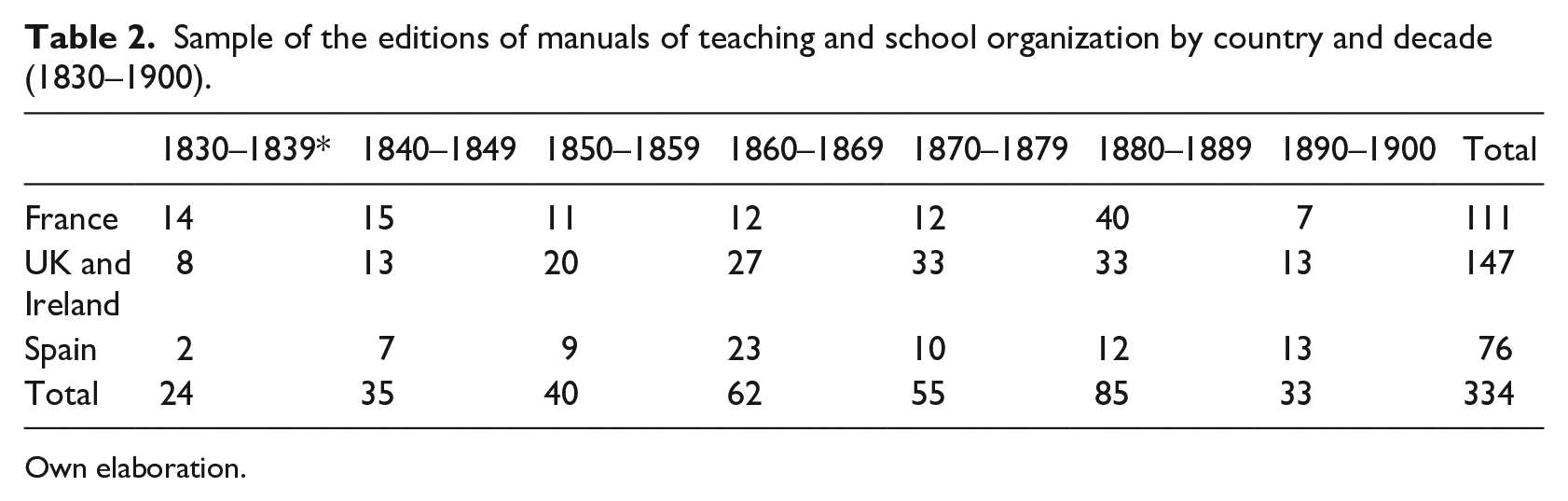
Own elaboration.
The sample includes works in which the whole situation of classroom teaching and school organization is extensively reviewed. The total number of manuals and their editions (Tables 1 and 2) do not represent a full census of this type of text. The sample includes 29 out of 36 manuals Pierre Giolitto found for France (Giolitto, 1983: 277–278), while adding some new manuals to the list, and 48 out of 62 manuals identified by Teresa Rabazas for Spain (Rabazas Romero, 2001: 317–453). Furthermore, the number of editions in the sample is intentionally underestimated. I only counted those editions for which at least a bibliographic register is available. For instance, Henry Dunn’s manual had its 19th edition in 1870 but I did not count Dunn’s manual 19 times. Only those identified editions in library catalogues – 11 out of 19 – have been counted. The sample describes rather a baseline for the developments in focus.
The contents of these manuals related to the classification of children into different groups, sections and classes were coded. An initial open coding produced three categories showing different options for the classification of schoolchildren into classes:
a. Age: This is the central category of my discussion. It includes not only exact chronological age, but also approximative age and it hints to a rather general understanding of ‘age’ that does not include ideas of ‘mental age’, ‘anatomical age’ or other constructs advanced in early 20th century psychology (Beauvais, 2016).
b. Attainment: This includes all references to the state of instruction and knowledge of the schoolchildren as well as their skills as far as they refer to prior school experiences/attendance and school contents.
c. Capacity: Under this category, I subsume all characteristics attributed to the personality and capacities intrinsic to the students, quite independently from school results.
Certainly, arguments for the grouping of schoolchildren may have used combinations of these categories as well. Lastly, considering the bureaucratic shape of modern schooling, I also coded for one additional type of argument:
d. Regulations. This was normally a shortcut argument when discussing options for classifying children, because, in most cases, a short reference to the existing regulations sufficed. Only in a few cases, allusions to regulations promoted a more elaborated reasoning on classification and grouping.
Whereas the last criterion will be the central one for discussing the question of regulatory frames and bureaucracy in the following section, the first three criteria point at the multiple options available for the classification of children from the perspective of educational and instructional guidance.
Bureaucracy: Regulatory frames, manuals and the forming of school classes
Efforts for reorganizing crowded elementary classrooms, focusing on the disciplining of the young and following a rationalized model of grouping and routines, had certainly mushroomed all over Europe since the eighteenth century (Caruso, 2016; Milne, 1997; van Horn Melton, 1988). These efforts and the excitement of the public around these projects resulted in the unprecedented and impressively quick spread of monitorial or mutual schools in the early nineteenth century (Kaestle, 1973), the epitome of disciplinary pedagogy (Foucault, 1982; Hogan, 1990). But after 1830, this general and established sense of ordering and controlling also had to face the reality of growing numbers of students. The expansion of school attendance was indeed a secular trend propelled both by modernization requirements and an intensified interest in schooling (Flora, 1977). But the imposition of compulsory school attendance in the countries under scrutiny here – Spain in 1857, England in 1880, France in 1882 and, finally, Ireland in 1892 – confirmed that entire age cohorts were now supposed to regularly attend school.
On the question of forming school classes, the regulatory frames in all four countries were either sketchy, or rather indirect and derivative. The regulation for French primary schools from 1834 defined, for instance, broader age categories. There, all primary schools were supposed to classify their children into three divisions according to age – 6–8, 8–10 and 10–12 (1835: 14). The Spanish national regulation for primary schools adopted exactly the same rule a few years later (1838: 30). It would be deceptive to accept these documents as a proxy of local school organization and practice (Eble, 2020). Aside from widespread poor compliance, something still very common in primary school matters, these rules based on age norms always allowed for exceptions. The age intervals definitely shifted following the French decree from January 18, 1887 (7–9, 9–11 and 11–13), a regulation that, without strictly invoking age-classes, strongly pushed for them. Still, influential proponents of a more sophisticated classification of children, like the Parisian school inspector Octave Gréard, considered school attainment to be the first ‘pedagogical truth’ when classifying children (Gréard, 1889: 65).
In the cases of the United Kingdom and Ireland, regulations that may have favoured age as a grouping criterion were in fact derivatives of other regulations aimed not at ordering classroom organization but at a different purpose. Since the introduction of monitorial schools, British and Irish schools had practised a grouping of children largely based on their attainment in each individual subject. One measure that indirectly promoted age-classification without directly introducing it was the adoption of national regulations for primary schools in England in 1862. The ‘revised code’ introduced annual examinations comprised of reading, writing, and arithmetic in six different ‘standards’ (1862: 9). The results of these examinations represented the main basis for calculating the value of the subsequent school grant. This system of ‘payment by results’ in England lasted until 1897.
These standards indirectly pushed the idea of a classification according to age in many respects. First, the examinations took place annually. Secondly, the grouping of content in ‘standards’ affecting all subjects loosened the strict orientation towards individual school subjects when grouping children. Third, the standards were associated with the age of the children. Fourth, and most importantly, although it was not intended ‘in these examinations by age to interfere with the classes in the school’ formed following other criteria, examinations by age certainly tightened the options when classifying children and motivated a reduction of the age range present in individual classes (A school manager, 1862: respectively 12, 21). Lastly, the accompanying rule that children under 6 years of age could attend school, ‘subject to a report by the inspector that such children are instructed suitable to their age’ (1862: 8) may have functioned as an additional age-related implicit norm for organizing schools. Still, a new revision of the code and its standards in 1896 stated that changes intended ‘to give freedom of classification according to the attainment, abilities and opportunities of the scholar’ (Simon, 1978: 204), confirm that age was still not the most legitimate reference when grouping schoolchildren. In Ireland, authorities introduced the main lines of the system of payment-by-results after 1871 (Akenson, 1970: 317–323). In accordance, the annual reports of the commissioners of national education changed their classification of children, which for a long time had followed the title of the books used in each section, moving over to a system of ‘classes’ (1879a: 510). In sum, in the United Kingdom and Ireland age-classes were not mandatory, but central rules for curriculum and examinations did foster age as a main criterion when grouping pupils.
Manuals of school management and school teaching in the four countries followed these shifts in official documents and policies in their own specific ways. Although many of their authors were officials in different capacities, they did not emphasize regulations when discussing options for the grouping of children in schools (see Table 3).
Types or arguments for the classification of schoolchildren in classes and sections, by country.
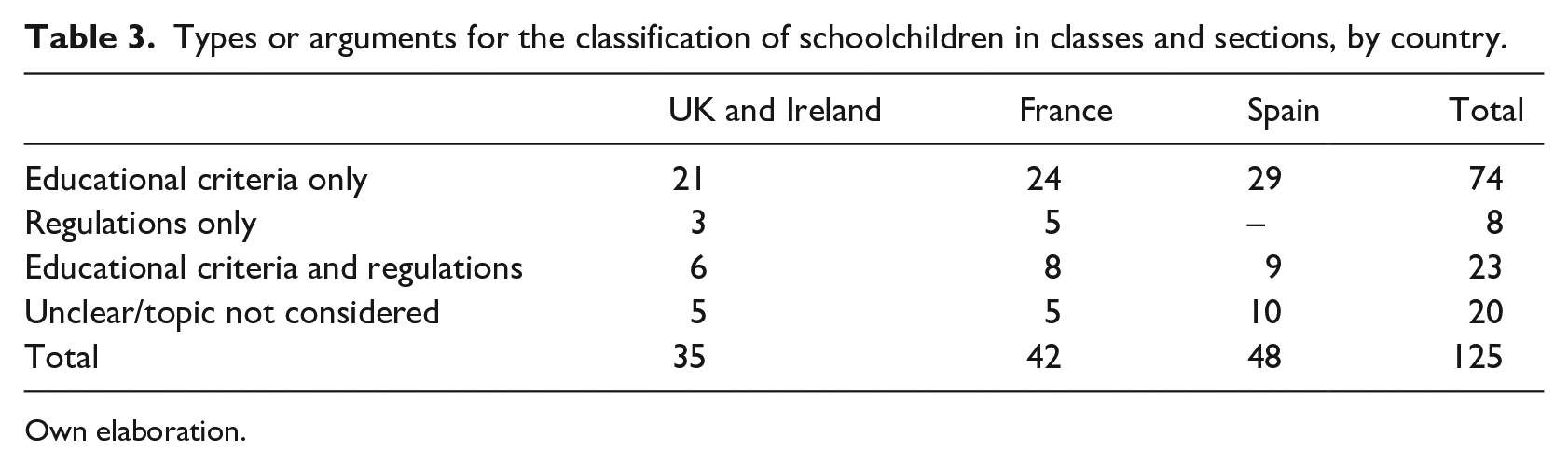
Own elaboration.
The coming of ‘age’ as an organisational criterion was not primarily the outcome of bureaucratic regulation in a top-down model in the cases of France and Spain, where laws and national regulations clearly mandated the classification of children according to age following a 2-year interval (6–8, 8–10, 10–12). French and Spanish manuals of the following decades seldom referred to these central regulations when discussing the classification of children and they rarely addressed age (see next section). In the case of England, the revised code of 1862, having introduced ‘age’ for the sole purpose of examinations in the context of payment by results, pushed for a kind of ‘teaching to the age’. Since one particular age equated to a particular level of instruction and this equation constituted a clear benchmark for the distribution of resources, schoolteachers took notice of this and acted correspondingly. Some years later, the commission examining the state of elementary education in England and Wales complained that the ‘effects of the Government examination (. . .) on the classification and the teaching are evidently very great’: ‘Many teachers allege that the result is to discourage every other form of classification, and to destroy altogether their freedom of organisation’ (1888: 172). The reforms introduced in 1896, leaving the classification of pupils entirely to the teachers, ostensibly reacted to this state of affairs. Even if age-classes emerged as major pattern of school organization in these decades as a derivation of rules for the financing of schools, age classification was not yet truly legitimate. Not only occasional complains, but also the notable reluctance of British manuals to recommend age as a sound principle for classification shows this (see next section). Only four of the 21 manuals published after the issuance of the New Code in 1862 mentioned age, albeit mostly in combination with other criteria, for the grouping of children. The manuals were not merely conveying official knowledge; they also navigated the turbulent waters between norms and schools.
Regulations and bureaucracy were clearly not enough. Authors conceded that regulations advancing age as the most important grouping criterion, such as the French rules from 1887, were ‘a half-administrative, half-pedagogical document’ (Carré and Liquier, 1897: 216). Undeniably, authors looked for a more convincing argument than only the mandates of the regulations in force. Some saw them as contradictory to the educational tasks of schools. Framing this problem as an international one, an English author made this point: ‘In Prussia, where all children are compelled to begin schoolwork at the same age, each of these grades really covers one year’s work. A rigid system of this kind has administrative advantages, but it has its defects so far as the children are concerned (. . .)’ (Landon, 1883: 203). Similarly, Gabriel Compayré pointed at a foreign bad example when trying to legitimate the French regulations. Quoting a Belgian school inspector, who refused to promote children to the next class, if these children were not of the age ‘defined in the regulations’, he added: ‘We, in France, do assign less importance to the brutal age classification than in Belgium’ (Compayré, 1890: 19, my emphasis; similarly, Rousselot, 1890: 373). The fact that not a single author in Spain consequently referred to the official classification of children in the primary school regulations from 1838 confirmed that legal arguments alone did not suffice.
In sum, regulations addressed directly or indirectly the issue of age grouping. Yet a bureaucratic imposition of regulatory framings neither was immediately effective, nor gained decisive legitimacy in the decades under consideration. Simple enforcement of rules does not explain the increasing ascendancy of age grouping. Bureaucratic measures may have been necessary for the long-term imposition of age-classes in these West European mass school systems, but they were by no means a sufficient condition. The perceived rigidity of age collided with a general sense that mass schooling in modern times should consider more nuanced approaches, attuned to the variety and individuality of schoolchildren. Additional meanings were much needed to position age-classes not only as a convenient, but also as a good and accepted form of grouping children.
Pastorate: Educational arguments, manuals and legitimacy
Still, a major context of this expansive dynamic was the fact that the most wide-spread type of primary school in Western Europe in the nineteenth century was the one-classroom school, in which the whole course of primary studies took place. Classroom management was, in many cases, identical to school management. Under these circumstances, the question of the general order of the classroom and the classification and promotion of learning groups remained a central concern for the emerging educational administrations. The main alternatives for the organization of school and, in the case of bigger schools with numerous classrooms, teaching itself did not prioritize ‘age’ as a viable criterion: The simultaneous system (Chapoulie, 2005), the mutual system (Jacquet Francillon, 1995) and mixed systems of both (Manique da Silva, 2015) foresaw groupings following similar attainment, not age.
Certainly, the manuals largely reflect these organizational preferences. Looking for similar attainment, typically in each school subject, represented the dominant approach (91) compared to consideration of age (46). This is clearly the case in the two main groups of manuals: those adopting only one criterion for the classification of children, and those combining different criteria. As for the first ones, 55 out of the 105 manuals considering the topic of classification of children recommended only one criterion. From these, several manuals preferred attainment (47) over age (5) or capacity (3). As for the remaining 50 manuals combining different criteria, 44 also mentioned attainment. Yet it is in this second group, where considerations about the age of the pupils played a more prominent role: 41 of these 50 manuals mention age as a coequal or, at least, subordinate criterion to attainment (See Table 4).
Frequency of the criteria for the classification of schoolchildren in classes and sections, by country (1830–1900).
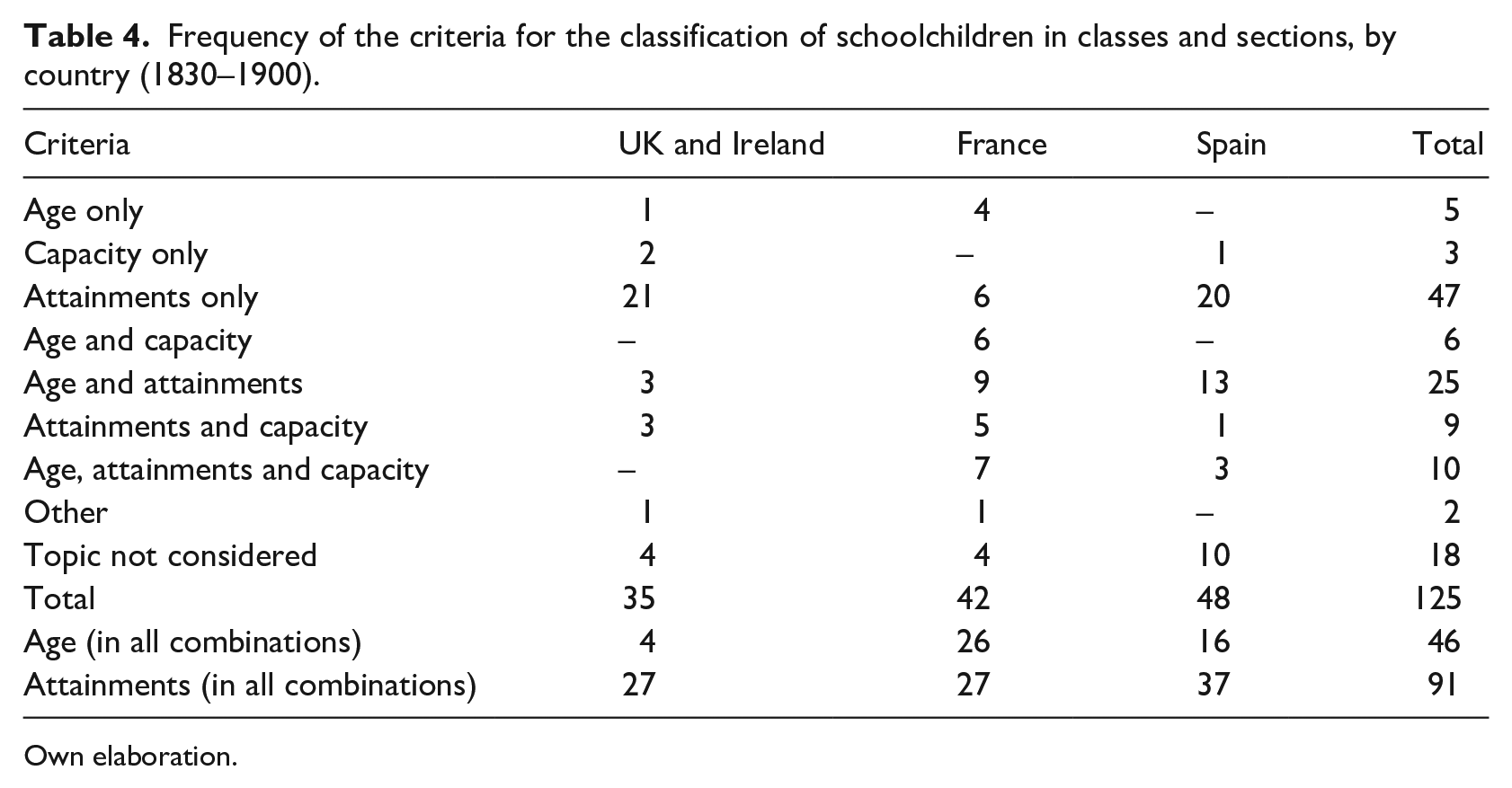
Own elaboration.
Moreover, the importance of age for classification of children experienced a boost over time. Whereas in the first decades under consideration, authors included age in one fourth to one third of the manuals, in the last decades half of the manuals did include it (See Table 5). Under the surface of the dominance of a classification following attainment, age slowly developed into a complementary reference for the classification of children. This includes four manuals, all of them from France, recommending a classification of pupils only by age. In other cases, nonetheless, frequent references to age were not consequential. In Spain, age clearly remained a subordinate criterion (see Table 6). The dominance of attainment as the most suitable basis for the organization of schools and classrooms also continued in the first Spanish experiments with ‘graded’ schools (escuelas graduadas) from 1898 onwards (del Pozo Andrés, 2005; Viñao Frago, 1990). Only the Royal Decree from 25 February 1911 demanded a classification based on the different ages of the pupils for this – still very small – group of schools (Vicente Jara, 1991: 72–73).
Criteria for the classification of schoolchildren in classes and sections (France, United Kingdom, Ireland, Spain), by decades.
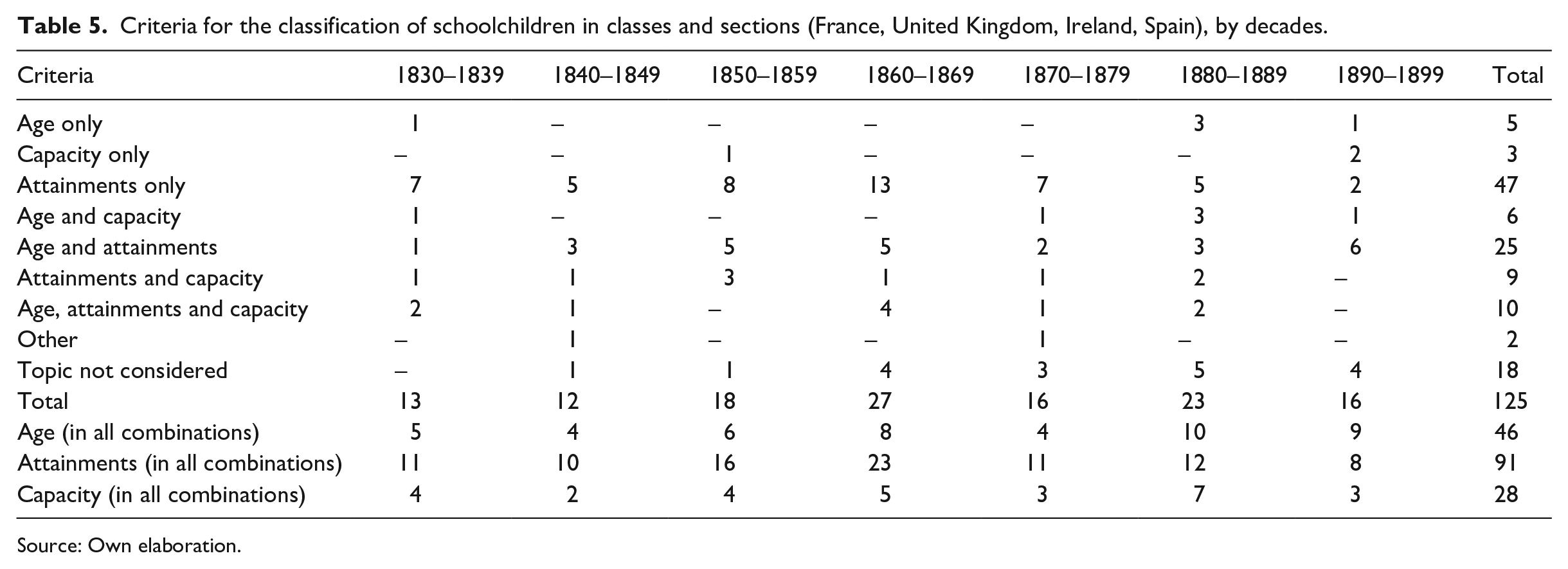
Source: Own elaboration.
Age as the main criterion for the classification of schoolchildren in classes and sessions, by country (1830–1900).
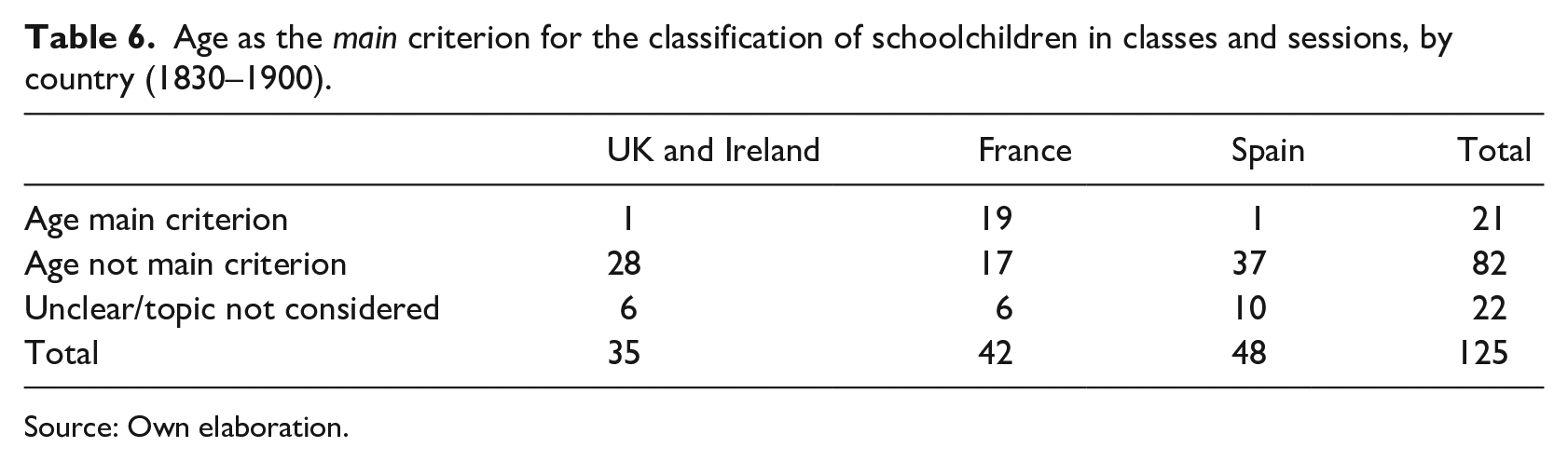
Source: Own elaboration.
In sum, the coming of ‘age’ as an organizational criterion, as reflected in the manuals, was a multi-layered process. They show that the function attributed to age as a criterion for classification of pupils grew constantly and eventually became dominant, as in France at the end of the 19th century. The reluctance of British manuals to recommend age did not point to a minor role of age in organizing schools, but quite the contrary. The manuals seem to underemphasize age exactly because it had become a major issue in the context of educational standards, examinations and payment by results, leading to a very cautionary tone about relying only on this criterion for school organization. In Spain, where age was supposed to have been a basic principle of classification since 1838, manuals showed that age was a concern, but a subordinate one in comparison to the equality of attainment. Throughout the four countries under scrutiny, the normative ascendance of age was at least underway.
Educational arguments substantiated the ascendant position of age. ‘Educational arguments’, similar to Hunter’s ‘pastoral guidance’, comprise questions related to the direction of a class/school, convenient arrangements for teaching and learning and the relationships between teachers and pupils as well as the relations among the latter. As shown in Table 3, two thirds of the manuals entertain only these kinds of considerations when discussing grouping and the formation of school classes, while only eight out of 125 cases treated, quoted, or remitted to regulations alone. Yet references to age when discussing the grouping of schoolchildren into classes greatly varied.
Especially in monitorial and mixed schools, where the classification of children in classes and sections primarily followed the attainment of the children in each subject, age also helped to make decisions. In particular, monitors or instructors in charge of a small group of pupils should be ‘older than the children they teach’ (Zabala y Argote, 1866: 20). This was critical because older children were rather ‘firm in character’ (1844: 65–66) and, on this basis, they could lead their younger schoolmates (Daligault, 1853: 106; Matter, 1843: 154). Another recurrent theme was the use of age as an overall consideration for deciding which kind of methods a teacher should use. For instance, a French manual recommended that young children had to recite and repeat; with older children, teachers should use the catechetical method and only begin to use explanations ending in the ‘socratique-catéchétique’ method (Braun, 1872: vol 2, 58). Sometimes, age was relevant for grouping when teaching some of the rather newer subjects of the primary school curriculum, for instance, history (Avendaño, 1846: 1239). In this sense, the coming of ‘age’ was not the imposition of a completely new type of consideration, but rather the application of an already familiar criterion to the question of the general organization of teaching.
Things turned towards ‘age’ only slowly. One crucial shift affected a change of preferences about what should be classified. In monitorial and mixed schools during the 19th century, the dominance of content-related criteria was evident in the so-called multiple classification of children in school subjects. This notion entailed that one child could be at different levels according to his/her specific attainment in each subject. One acceptable reader would be in a middle section in reading, but in a lower section in writing, if he/she showed poor results. Over the century, authors increasingly disfavoured multiple classification and advocated a single classification. Now, the ‘whole’ child, not only his/her attainment in particular areas was in focus. The problem was how to think of a general classification, on which basis one teacher or school director may assess children ‘in general’. In this respect, opinions varied greatly. One British manual proposed, even before the standards were introduced, a single classification as follows: ‘As the basis of the above classification, the degree of attainment in reading may be regarded as fixing the section to which any child in the lower portion of the school belongs; and skill in arithmetic may determine position in the upper’ (British and Foreign School Society, 1856: 5). For other authors, a good single classification included a double, but simultaneous test assessing ‘the pupil’s knowledge of English and Arithmetic’ (Prince, 1879: 18). James Currie, the director of the Normal School in Edinburgh, recommended a subtle variation, namely ‘to apply a double test; the pupil’s knowledge of English, modified by his knowledge of arithmetic, will determine his place’ (Currie, 1861: 170). Another author recommended following the subject ‘which is most dependent upon sound class teaching’: ‘This is undoubtedly arithmetic’ (Landon, 1883: 203–204). It was not only the English material that showed that the slogan of a single classification did not solve the problem of which specific elements should be considered as its basis.
It is under the growing pressure of adopting a single classification for grouping children that the old reliance on content-related criteria and its multiple classifications failed to deliver a satisfactory solution. In the last decades of the century, manuals increasingly argued that the exact and content-related classification was of minor value; they looked for an approximative classification. A lecturer in the Training College in Birmingham conceded: ‘We have to fix upon certain points as forming a roughly correct criterion, and strike an average. We must be content with approximate results; nor is an exceedingly minute and exact classification to be wished for. Up to a certain point difference is valuable; it provokes more emulation, gives greater variety to the work, and allows the teacher greater freedom’ (Landon, 1883: 199). An approximate average was the key for a single classification, a French author wrote. The idea of a perfect classification guaranteeing ‘an absolutely homogeneous school class’ was an ‘ideal conception that cannot be realised even in the most favourable conditions, no matter how many schoolteachers are available’ (Chaumeil, 1886: 195–196). Not strict homogeneity, but ‘sufficient homogeneity’ (Chaumeil, 1886: 196) was in focus. A pertinent proxy for the whole child was key to a satisfactory single classification.
According to the prevalent tradition of content-related grouping, a specific content could provide for this proxy: ‘In the rough, it may be said that boys having a similar knowledge of reading are at a similar stage of development. Reading, accordingly, affords on the whole the best basis of classification’ (Laurie, 1867: 148; similarly, Zabala y Argote, 1866: 9). At the same time, authors still emphasized that the school attainment of a particular child could be very different in different subjects (Daligault, 1853: 132; Fonoll, 1860: 28; Gill, 1876: 58; Richards, 1854: 15). This had been the classic argument in favour of a multiple classification and hence meant that a content-related single classification was not completely convincing.
Increasingly, authors looking for a suitable general classification alluded to abstract constructions such as ‘development’, ‘intellectual development’ or ‘capacity’ for classification (Isensee and Töpper, 2021). But this general estimation of intellectual development was itself obscure. No generally applicable instruments existed for this task, let alone the preparation of the schoolteachers for systematic observation and diagnosis. If single classification in schools constituted a proxy technique for securing acceptable, but not perfect, homogeneity, its operation also required a proxy of its own: age. Manuals published in the last decades of the century advanced the following view: ‘The age of the child should only be taken into account so far as it may guide the teacher in estimating the stage of mental development reached by the child’ (Collins, 1884: 19), or, as a French author wrote, age was associated with ‘different periods of development of the faculties of the child’ (Trabuc, 1887: 37). A growing consensus maintained that age was associated to ‘natural development’ (Horner, 1887: 41), or, as Pedro de Alcántara García in Spain put it, age ‘commonly corresponds with the state of instruction and intellectual development of the children’ (de Alcántara García, 1891: 231). It was, of course, a fragile association, only an approximative correspondence, or a ‘general indication’ (Carderera, 1866: 343–344). For this reason, Gabriel Compayré cautioned teachers about dealing with this proxy: ‘Rightly understood, age is given only as an indication; it alone cannot pose an absolute rule. But, in general, age precisely corresponds with the degree of intellectual advancement in such a way that, when grouping schoolchildren of the same age, one essential condition for the organization of a course is guaranteed (. . .)’ (Compayré, 1890: 8). Beyond all cautions, the close association between development and age consolidated a view, in which ‘teaching should follow the progress of age and intelligence’ (Pape-Carpentier, 1887: 129), as the educationalist and activist Marie Pape-Carpentier put it, or classes of the same age facilitated ‘that children understand the language of the teacher’, as the schoolteacher Crespi in Palma de Mallorca put it (Crespi, 1891: 126). Age overtook any kind of content as the suitable proxy for single or general classification.
It is not only in this sense that elements of pastoral care and educational knowledge contoured the rise of age as a sorting criterion. Specific pedagogic considerations informed this process as well. An English author, otherwise favouring ‘a very subordinate place’ of age in classification, made an important exception: When an older child was not sent to school at a proper age, it would be too harsh to put him in the first class; he would ‘associate his degradation with learning’: ‘Here, then, for the good of himself and others, we must make allowances, place him on account of his age considerably higher than we should otherwise do, and encourage and help him as much as possible’ (Landon, 1883: 205–206). If schoolteachers followed attainment as a grouping criterion too closely, these older children’s self-respect ‘would be injured, and all heart in their work lost (. . .)’ (Gill, 1876: 58), or it would be ‘impaired to such a degree as to weaken his motives to exertion’ (Currie, 1861: 171). Age became crucial for school effectivity because inequality of ages could be as detrimental to instruction as the difference in attainment was (Compayré, 1897: 449).
Further arguments complemented this pedagogic and educational approach to age. The Alsatian pedagogue Joseph Willm, one of the earliest proponents of a wider consideration of age for the classification of children, put it plainly: ‘(. . .) It is mainly age than the degree of the children’s instruction that should determine the place each of them has to take; the reason for this is that education, and not instruction strictly speaking, is the essential aspect’ (Willm, 1843: 67). If older children in a village come to school without instruction it ‘is less inconvenient placing them, despite their ignorance, with the children of their age than to classify them, despite their age and very often despite their corruption, with the beginners of a tender age’ (Willm, 1843: 67). These older children may not progress as desired but, in the case of not considering age, ‘there is a peril for the innocence of those with whom they are associated with. This last consideration should necessarily prevail’ (Willm, 1843: 67). In the sample of manuals, the earliest arguments favouring age in relation to the grouping of children strongly referred to discipline: To associate schoolchildren of too different ages was ‘a danger for discipline, and even for morals’ (Daligault, 1853: 132) and, as a consequence, ‘those of very different age should not be reunited or associated [in a class]’ (Carderera, 1866: 341). James Currie assented with this position: ‘The age of the pupils is a subordinate element in classification. There is but one case in which it can be allowed to have any weight. Owing to early disadvantages a particular pupil may not have made the progress natural to his years; so that the test of attainment alone might lead us to place him in a class of which the members are much his juniors. But there are certain moral considerations to be taken account of here. (. . .) The influence he may exercise over the class, in virtue of the great difference with which children look up to those of their comrades who have greater experience than themselves, may not be conducive to its good (. . .) In such a case, therefore, the interests of the class and of the pupil himself may require a relaxation of the test of attainment, to a certain extent, in favour of that of age’ (Currie, 1861: 171). Even at the end of the century, Rufino Blanco y Sánchez, one of the proponents of graded schooling, echoed this view. If schoolteachers do not consider age when classifying pupils, ‘there would be sections with younger and elder children, and these kinds of mixtures are disastrous in all aspects, particularly in moral respect’ (Blanco y Sánchez, 1901: 198). In sum, classification should consider age, at least, as a corrective criterion. The eminent pastoral and educational problem of order, obedience and conduct was at stake (Carderera, 1891: 95).
Age-classes: Bureaucracy and pedagogy in the modern school
The historical analysis of this transnational sample of manuals allows for the following summary in view of the initial questions. First, the ascendance of ‘age’ as the main criterion for the classification of schoolchildren only took off in the last decades of the nineteenth century. Manuals of teaching and school organization do show that age was one consideration among others when grouping children into school classes. But only during the last two decades of the nineteenth century did it become a more pervasive criterion for the classification of children, and, in a few cases, authors of the manuals defined age as the sole criterion for grouping. Of course, non-graded schoolrooms still existed, but expected school careers critically used age as an organizing principle. From a historical perspective, age-grading seems to be quite a new feature of mass schooling even for Western Europe, where critical developments in modern school took off earliest.
Second, the case of the imposition of age-classes showed that first impressions about specific techniques of schooling may be deceiving. The analysis of manuals suggests that the initial characterization of age-classes as basically bureaucratic in the light of Hunter’s theory of school must be complemented, at least for the time of their institutionalization. The reconstruction of central national regulations and the analysis of the content of manuals of school management and organization of teaching give rise to the conclusion that bureaucratic practices may not have posed the sole driving force in imposing age-classes. National regulations mandating age-classification, such as in France and Spain in the 1830s, were largely ignored in the manuals. Output-oriented standards of examination in England and Ireland promoted age-classification with some success. Yet this was more representative of a side effect of a curricular-cum-financial regulation and not a clear administrative requirement to be complied with. Beyond these national differences, manuals from all four countries rarely referred, if at all, to these regulations when discussing suitable forms of organizing schools and classifying children. Moreover, questions related to guidance and educational relationships flanked the emergence of age classification in a very substantive way. Educational criteria were more dominant than bureaucratic references in the analysed sample of manuals. Discussions about (de)motivation, encouragement, and school discipline circulated. Age proved a considerably more educational and pastoral issue than the idea of age-classes as a simply bureaucratic phenomenon would suppose. From the viewpoint of the analysed materials, age-classes appear to be a pastoral strategy in need of some bureaucratic operationalization rather than a bureaucratic strategy in need of some pastoral legitimation.
Finally, this historically informed characterization of age-classes suggests reconsidering or refining Hunter’s innovative idea of an ‘assembling’ of the modern school in two respects. First: Not all assemblages are the same. Hunter’s definition of modern teachers as a ‘pastoral bureaucracy’ (Hunter, 1994: 62), or Burchell’s characterization of modern institutions as participating in a ‘state pastorship’ (Burchell, 1991: 121) show in principle two different varieties of ‘assembling’. It is not the same to see modern schools essentially as bureaucracies partially operating through pastoral techniques, or essentially as pastorships partially using bureaucratic techniques for their organization. Schools display some elements stronger related to pastorship and others primarily oriented towards bureaucracy. Whereas all things related to examinations demand a quite strict regulation and centralization, all things related to daily teaching and with the more socializing work of schools heavily rely on pastoral/educational considerations. The analysis of age-classes showed the potentials of bringing the idea of assembling into the school and differentiating assemblages within schools. Second: Assemblages came about not once and for all. A more situated consideration of specific school assemblages in time (Wilkins, 2019), following, for instance, the transformation of age-classes in the twentieth century, may show that these techniques became later increasingly bureaucratic in their operations. In sum, Hunter’s general idea of assembling may not only be taken seriously for specific sets of techniques and operations within schools, but it would also suggest to integrate the idea of recurring, situated re-assemblings (Dussel, 2013) into the history of modern Western schools.
Footnotes
Declaration of conflicting interests
The author declared no potential conflicts of interest with respect to the research, authorship, and/or publication of this article.
Funding
The author disclosed receipt of the following financial support for the research, authorship, and/or publication of this article: This work was supported by the Deutsche Forschungsgemeinschaft (DFG) (Project number 280705321, ‘Die Bürokratisierung der Gruppierung’).
