




Abstract
Sport is a key educational and leadership arena for societal change and today’s sustainability challenges. Sports organisations have the potential to provide, initiate and create processes, situations and spaces for learning, socialisation and meaning making that go beyond traditional schooling and lead community change and capacity building towards sustainable development. This article is located in the research fields of public pedagogy and the intersection of leadership and sport for development, and contributes knowledge about how sports organisations’ public pedagogical practices and leadership support community change towards sustainability. The study is confined to soccer and the non-governmental sports organisation Futebol dá força (Football gives strength). The approach of public pedagogical leadership is developed and used to analyse and reflect on the function of sports organisations’ pedagogical leadership in community change and capacity building towards sustainability.
Introduction
What kind of world do we want to live in and want future generations to inherit? The question of sustainability is existential and value-laden, based on ecological conditions and integrated into social, political and economic systems and the needs of current and future generations. Public pedagogy, leadership and sport are all relevant fields of study that in different ways deal with sustainability and its intricate web of relations. In this article, pedagogy and leadership are viewed as necessary for creating sustainable societies and for development and change in and through sport.
Public pedagogy has become a driving force for exploring and theorising the nexus of culture, learning, education and social change. Research has been interested in different forms, processes, sites and pedagogical practices beyond formal schooling, such as learning in museums, zoos, popular culture, (social) media, literature, commercial spaces, the internet, sites of social movements and political activism (Burdick et al., 2014; Cooper and Sandlin, 2020; Sandlin et al., 2010, 2017; Wildemeersch et al., 2021). A phenomenon that has so far not been explored in the field of public pedagogy, and hardly at all in sport for development (SFD), is pedagogical leadership. In SFD, researchers have started to hypothesise the leadership functions of sports organisations and how they bring about change. Some studies have also started to explore shared leadership as ‘a particularly valuable type of leadership’ (Svensson et al., 2019: 1) for developing sustainable efforts in and through sport. However, there is ‘an overall lack of leadership research within the SFD literature’ and ‘there remains a need for empirical analyses of different leadership approaches’ (Jones et al., 2018: 83).
We now know that sport functions as a central political and educational arena for dealing with societal concerns and conflicts, building stronger and safer communities, enhancing public health, equality and environmental sustainability, supporting positive identity, strengthening communication and leadership skills, social responsibility, gender equity, enjoyment and engaging at-risk and disadvantaged children and young people (Andersson, 2020a, 2020b; Duffey et al., 2019; Ekholm, 2018; Hancock et al., 2013; Jones et al., 2018; Parnell et al., 2015; Spaaij, 2009; Svensson et al., 2019; Whitleya et al., 2019). Participation in sport not only influences the quality of athletes’ performances and health, but also their citizenship status, political identities, attitudes, norms and behaviour, as well as their ability to learn about and even change their community’s political culture by conveying core democratic principles such as tolerance, justice, equality, solidarity, respect, participation and cooperation (Andersson, 2020a, 2020b; Beutler, 2008; Hancock et al., 2013; Parker et al., 2019). Parker and colleagues (2019: 307) suggest that ‘sport has much to offer as a mechanism via which young people might gain not only a sense of personal and behavioural development, but also a sense of social engagement and community cohesion’.
Sports organisations have the potential to contribute to social harmony and peace, and initiate, provide and create processes and spaces for learning, as well as the socialisation and meaning-making that occurs both within and beyond the realm of formal educational institutions. However, sport also has the potential to fuel conflicts and encourage nationalism, racism, corruption, friend–enemy distinctions, violence and the violation of human rights (Schnitzer et al., 2013; Svensson and Levine, 2017). It should also be noted that it is not sport ‘that is likely to achieve many of these outcomes, but sporting organizations; it is not sport that produces and sustains social capital, enters into partnerships and mobilizes resources, but certain types of social organization’ (Coalter, 2010: 310). Sport is a public pedagogy concern and a space for civic participation and societal change in which interpersonal relations and social organisation affect the kind of person and community that is fostered. It is a vital leadership practice for the common good and community change towards sustainability.
The aim of the article is to contribute knowledge about the public pedagogy practices and leadership of sports organisations in their efforts to support societal change towards sustainability. The study is confined to soccer and the non-governmental sports organisation Futebol dá força (FDF) and explores:
Which forms of public pedagogy are actualised in FDF when working for local community change towards sustainability?
What characterises the leadership of FDF in these forms of public pedagogy?
The article makes use of public pedagogical leadership and empirical knowledge to understand sports organisations’ pedagogical leadership practices and their function in promoting and supporting community change and capacity building for sustainability. The study takes place in the intersecting fields of public pedagogy, leadership and SFD.
The contextual background to the study is described by focusing on sustainable development, SFD and the empirical case Futebol dá força. This is followed by a theoretical and methodological elaboration of public pedagogical leadership to inform the analysis. The method is then described and critiqued. Finally, the empirical results are presented and discussed.
Sustainability and SFD
Sustainable development, or sustainability, can be seen as the processes, resources and actions that are needed to ensure the continued existence of something that is valuable – ‘a process that maintains and preserves the value and practices associated with this state of affairs’ (Bottery, 2016: 15) and is likely to improve the resilience of what is being maintained. Sustainability can also refer to a change of values, developing structures and strategies that do not currently exist, ‘as what is currently in place is seen as failing to meet current values, needs and challenges’ (2016: 16). Accordingly, sustainability is a matter of continuity and change and a process in which humans, both individually and collectively, maintain or change that which is valued, desired and needed.
SFD is both a phenomenon and a policy platform for sport and is used as a vehicle to contribute to and exert positive influence and outcomes in public health, economic development, social inclusion, education, gender equity, reconciliation and peacebuilding. It is also a catalyst for building social capital and developing and maintaining healthy communities (Coalter, 2015; Schnitzer et al., 2013; Skinner et al., 2019; Svensson and Levine, 2017; Whitleya et al., 2019). Sport has been promoted as a catalyst and vehicle to achieve some of the goals in the 2030 Agenda for Sustainable Development (Dudfield, 2019). However, in research the relationship between sport and the Sustainable Development Goals (SDGs) in the Agenda has not been thoroughly explored. There is therefore a ‘need for expanded analysis of the ways in which the SDGs and associated Targets bring into focus the policies, practices and impacts of a wider array of sporting bodies, organisations and stakeholders’ (Lindsey and Darby, 2019: 794). The Agenda states that sport contributes to ‘the realization of development and peace in its promotion of tolerance and respect and the contributions it makes to the empowerment of women and of young people, individuals and communities as well as to health, education and social inclusion objectives’ (UN General Assembly, 2015, para. 37, 10). Four goals are especially relevant in the context of sports organisations like FDF:
SDG 4: Ensure inclusive and equitable quality education and promote lifelong learning opportunities for all.
SDG 5: Achieve gender equality and empower all women and girls.
SDG 16: Promote peaceful and inclusive societies for sustainable development, provide access to justice for all, and build effective, accountable and inclusive institutions at all levels.
SDG 17: Strengthen the means of implementation and revitalise the Global Partnership for Sustainable Development.
SDG 4 can be used to ‘eliminate gender disparities in education and ensure equal access to all levels of education and vocational training for the vulnerable’ (Lindsey and Chapman, 2017: xvii). SDG 5 addresses ‘gender inequalities at all levels of participation and leadership’ and can also serve to ‘challenge broader discriminatory norms and offer specific opportunities for gender empowerment’ (2017: xii). SDG 16 can be used to draw ‘on the cross-cultural status of sport and the work of skilled leaders and appropriate role models’ (2017: xiv), while SDG 17 opens up for ‘various private and civil society organizations, including sport federations’ which can ‘be configured in different ways to collectively contribute to sustainable development’ (2017: xv). Lindsey and Chapman argue that ‘Some major and now well-established international non-governmental organizations (NGOs) have, over time, contributed to sport and development across multiple countries through building networks, developing specific sport-based curricula and providing funding and other resources’ (2017: 6). This is also the case for FDF.
According to Coalter (2010), it is clear that some SFD organisations can support and offer compensation for certain aspects of weak civic structures, assist and develop human and social capital, provide education, support gender equity and so forth. However, this must be critically analysed, rather than ‘seeking simply to assert sport’s almost magical properties’ (2010: 311). To date we do not know very much about the potential role of sport as a vehicle for building community and its capacity for change. ‘More research is needed to understand sport’s ability to promote capacity building through collective action, developing value systems that support democracy and inclusion’ (Edwards, 2015: 6). There is therefore a need to openly explore social and political processes and the consequences of using sport as a vehicle for societal change, to explore local micro-level processes through sustained initiatives and programmes and to identify their relations to macro-level changes in society at large (Coalter, 2010, 2015; Hancock et al., 2013; Schnitzer et al., 2013; Svensson and Levine, 2017). In future explorations it should also be considered that ‘the contribution of sport to sustainable development can occur both through sport (i.e. using sport as a tool) and within sport’ (Dudfield, 2019: 121).
Developing community capacity has been recognised as important when trying to change local communities through sport. Edwards (2015) and Svensson and Levine (2017) have listed seven principles for building community capacity. The first is to develop physical and human resources in terms of access and skills, networks and partnerships, infrastructure and knowledge. The second is to promote social capital and create social norms that support a sense of community characterised by attitudes of trust and reciprocity and a collective capacity to work together. Third, to establish structures, mechanisms and spaces for community dialogue, problem-solving and collective action. Fourth, develop individual and organisational community leadership and systems for leadership development. Fifth, promote civic participation and community power, by for example publicly interacting during leisure time. Sixth, constitute a shared value system that supports democracy and values like equity, collaboration, inclusion and responsibility. Seventh, develop community learning cultures that facilitate critical reflection and thinking, consider alternative means of acting, critically evaluate and recognise failure and share best practices and the lessons learned. These principles can increase the potential of SFD initiatives and help organisations to change local communities towards sustainability by increasing the local capacity to innovate.
A heads-up in taking on the mission of community capacity building concerns the risk of reproducing ‘hegemonic relations and provide little sustainable community development’ (Edwards, 2015: 16). To avoid this, the development process that is imposed or directed by outside organisations needs to be gradually taken over and led by local residents in order to build local capacity and ensure ‘meaningful relationships, processes, and collective action form among residents to insure they can take over directions of change within the community’ (Edwards, 2015: 17). This type of leadership ‘can help strengthen social relations and build local skills and knowledge’ (Jones et al., 2018: 82) – a leadership argued to be used by FDF.
Futebol dá força (Football gives strength)
Soccer has been used to initiate change and strengthen communities all over the world. Worldwide soccer is shaped and reflected in politics, economics and culture and is often used as a political tool for improving health and communities, fostering social cohesion and social inclusion, building community networks, improving relationships in community and as an instrument for socialisation and integration (Al Ganideh, 2018; Andersson 2020a, 2020b; Duffey et al., 2019; Parnell et al., 2015). FDF is one of many sports organisations in this context and one that describes itself as a social movement that ‘will change the world’.
The organisation is an independent foundation that uses soccer to achieve the vision of ‘all girls in the world getting access to their rights and the opportunity to reach their full potential’. (www.futeboldaforca.com, 2018–12-23) The purpose of the organisation is to ‘build structures and safe places through education, support and inspiration, to give girls improved self-esteem, knowledge about their rights and tools to transform their dreams into goals’. The organisation states that it wants to lead change and strive to be a bridge between an old world and a new one, where everyone is included . . . By basing our work on co-creation, we can be everything we need to be and also make sure that we are relevant in the local contexts where we work.
Co-creation based on values such as equality, inclusion, trust and transparency is the organisation’s working model. FDF involves approximately 1400 leaders, 17,000 girls and young women in 134 communities and 25 countries and works explicitly with SDGs 3, 4, 5, 10, 16 and 17 in the 2030 Agenda. The organisation uses what it calls evidence-based methods to educate and empower leaders through leadership training, so that they are equipped to ‘empower girls as well as people in their community – thus enabling everyone to be part of the solution’. As well as educating soccer clubs in leadership and in being more inclusive, FDF also conducts educational activities with private companies in value-based leadership, equality, diversity, change management and inclusion, arranges public seminars and lectures and appears and is active in the daily press, on television and on the radio, which means that the social and political influence of FDF is visible in public media.
FDF engages and educates soccer coaches (both face-to-face and online), mainly young women, as leaders and role models, who in turn educate new leaders. This strategy, train-the-trainer, is useful for smaller organisations with limited staff and budgets to multiply impact (Hull et al., 2020: 92). It is a strategy to strengthen young females’ leadership in local communities, so that ‘leadership experiences gained through sport-based initiatives may make distinctive contributions to their empowerment in other social, economic and political spheres’ and localised ‘female role models can have an especially strong impact (Lindsey and Chapman, 2017: 82).
Through collaboration with mainly local actors (e.g. ministries, organisations, municipalities, clubs, companies, etc.), FDF tries to have a more long-term and systematic impact on local communities, with a specific focus on changing norms and attitudes in order to increase girls’ and young women’s empowerment, health, equality, inclusion, good education, lifelong learning and partnership through soccer. Thus, FDF co-creates public pedagogical practices as an NGO working within the field of SFD by building local community capacity for change towards sustainability.
Public pedagogical leadership
The concepts of public, pedagogy and leadership are synthesised into what is called public pedagogical leadership. These concepts deserve a deeper elaboration than is possible here. What is offered is an approach to understand the public and pedagogical dimension of leadership in common affairs and strivings for a preferred future.
Public + pedagogy
The word public signifies that everything that appears in public ‘can be seen and heard by everybody and has the widest possible publicity’ (Arendt, 1958/1998: 50). It is the presence of others ‘who see what we see and hear what we hear’ that ‘assures us of the reality of the world and ourselves’ (1958/1998: 50). According to Arendt, when we leave our private sphere and confirm our individuality by acting and engaging in common affairs, the appearance constitutes our reality and creates a ‘public realm’. Public also signifies the world itself – the common world in which all humans are gathered and relate to each other and that we enter when we are born and what we leave behind when we die . . . It is what we have in common not only with those who live with us, but also with those who were here before and with those who will come after us. (1958/1998: 55)
Accordingly, the permanence of our common world, its civility, human flourishing and belonging, is dependent on the extent to which it is public and, thus, the public quality of spaces and places and human togetherness in becoming public.
Pedagogy is a process that begins with ‘the intention of one subject to influence the life of another’, is ‘always intentional and goal directed’ (Gaztambide-Fernándes and Arráiz Matute, 2014: 56) and aims to induce change even if the change or goal is ‘not always necessarily explicit or even articulated’ (2014: 57). When new ways of thinking, acting and knowing ‘that also transform knowledge, self-experience, awareness, understanding, appreciation, memory, social relations, and the future’ (Ellsworth, 2005: 37) are sought after, we can define it as a pedagogical intent. When we come to know differently, when our view of the world and ourselves meets the outside world, and when self and other, personal and social are disrupted and refigured, something has become pedagogical. ‘Pedagogy stages encounters with the unthought – encounters with the future as in the making’ (Ellsworth, 2005: 38). Thus, pedagogy as a practice and process qualitatively transforms the ways in which we think and act in the world and, while doing this, also changes the world. It provides opportunities and enables new things to happen, as a process of continuation, emergence and change and supports new ways of knowing, feeling and being in the world.
In a broad sense, public pedagogy concerns the learning, socialisation, meaning making and personal formation that occurs both within and beyond the realm of formal educational institutions (cf. Sandlin et al., 2011). It involves social, interpersonal and intrapersonal processes and situations, the staging of encounters with unfamiliar aspects that have not previously been considered but that could qualitatively transform how we think and act. It also changes the world by allowing for the birth of something new (Andersson, 2017; Ellsworth, 2005). A vital actor in public pedagogy is the public pedagogue, the catalyst that in some way actualises, designs, governs or sparks pedagogical processes and situations. The public pedagogue then becomes both a source and a leader of social, cultural and political change oriented to the public good (Roberts and Steiner, 2010). As a leader, the public pedagogue takes on the responsibility to ‘maximize participation and inclusion in the public deliberation of normative values’ to promote ‘subjective re-articulation . . . in the interest of developing critical social agency oriented to the public good’ (Roberts and Steiner, 2010: 26). Biesta (2012, 2014) distinguishes between three types of pedagogical practices. In each type there is a pedagogue, described as ‘someone who conducts intentional educational work – but what distinguishes the three modes of public pedagogy lies precisely in what the public pedagogue does’ (Biesta, 2014: 21).
Pedagogy for the public is about information and instruction, where the public pedagogue instructs citizens and tells them what to think and how to act (Biesta, 2012, 2014). This form of directed and closed pedagogy is oriented towards specific world views, thereby reducing plurality and difference and the possibility to openly engage in and explore the world. It is enacted when individuals are told to follow specific rules and are inspired and motivated to behave in specific ways. That is, it is a pedagogy that is conducted from the outside. The public pedagogue tells groups of individuals what to do, think and be and where the groups are acted upon as a mass (cf. a silent majority, Baudrillard, 1978/2007) and as objects of instruction and inspiration. Thus, pedagogy for the public is a specific-world-view-approach through which participants become objects of influence.
Pedagogy of the public is about learning and developing critical awareness. This is done by the public themselves, but where the public pedagogue assists with values, norms, knowledge and understandings that will prepare them for action. The pedagogical work is located ‘within democratic processes and practices’ (Biesta, 2012: 692). The logic is learning and socialisation first and then – following from the correct understanding and specific norms and values – agency and action. It can be described as a citizenship-as-achievement-approach (Biesta and Lawy, 2006), where citizenship is viewed as a status, with specific claims that individuals as rights holders can achieve using the ‘best’ methods and attitudes: ‘a status that is achieved only after one has traversed a particular developmental and educational trajectory’ (2006: 42). Thus, pedagogy of the public is a pedagogy that is conducted from the inside, where the public pedagogue helps participants with values, norms, knowledge, methods and understandings that will help them to become better actors, motivated and prepared for action.
Pedagogy in the interest of publicness ‘is about the invention of new ways of being and doing’ (Biesta, 2014: 23). This is a form of pedagogy that is ‘entirely public, both in its orientation and in its execution’ (Biesta, 2014: 23) and is about learning in relation, action and plurality. Here the public pedagogue invites people into relations with the future as open and staged possibilities for participants and events to become public with ‘multiple beginnings and middles and no knowable ends’ (Ellsworth, 2005: 107). The logic is interruption and entanglement with a concern for the public quality of human togetherness. It is a pedagogy of undecidability and for creating opportunities in which ‘we come to know the world by acting in it, making something of it, and doing the never-ending work and play of responding to what our actions make occur’ (Ellsworth, 2005: 56). This form of pedagogy can be described as a citizenship-as-practice-approach (Biesta and Lawy, 2006), where citizenship is viewed as an inclusive and relational concept that assumes that everyone in society is moving through citizenship as a practice and is ‘routinely engaged in a continuous and thoroughgoing public dialogue’ (2006: 44). Thus, pedagogy by publicness is a pedagogy in the making, where the public pedagogue invites people into a relation with the future as open and stages possibilities for participants and events to become public without having the last word about how things really are, who we are and should be, thereby keeping open the possibility of a space where freedom (i.e. action) can appear (Arendt, 1958/1998).
Table 1 is a summary of the three types of public pedagogy that can be used to identify, categorise and qualify different forms of pedagogical practices.
Analytical schema of public pedagogy practices.
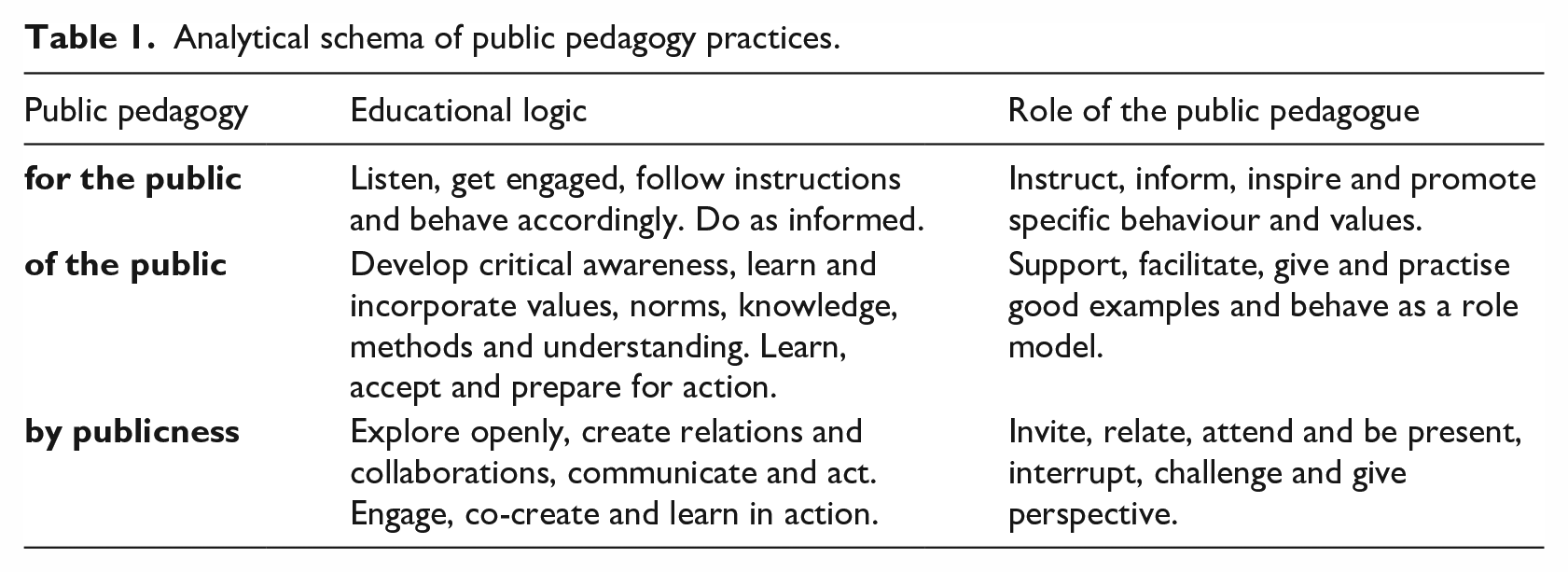
Table 1 is used in the analysis of FDF in order to identify the types of pedagogical practices that are present and their leadership logics and actions.
Leadership
Leadership is not an individual responsibility for a designated leader with a title, but is a collective process and responsibility for all stakeholders. Leader is not the same as leadership. Leadership is a relational, power-sensitive, context-dependent, co-created process of social influence that aims to reach concrete and task-related goals at group level. It involves dealing with norms, struggling with ideals, values and pressures and managing meaning, and calls for insightfulness, negotiation and pragmatism in the search for the common good (cf. Alvesson and Einola, 2019). Leadership can be said to emerge as an adaptive solution to various group or community challenges.
According to Heifetz (1994), leadership can be seen as ‘an activity to mobilize adaptation’ (1994: 27) and help people ‘to make progress on the adaptive problems they face’ (1994: 245). Adaptive work requires learning, a change in values, norms, beliefs, attitudes and behaviour. Accordingly, the task of leadership consists of ‘choreographing and directing learning processes’ (1994: 244); a process that requires educative strategies in which appointed leaders engage stakeholders in facing challenges and conducting processes of inquiry. These democratic processes and activities of collective decision-making, formation, conservation and transformation of life in association with others (Dewey, 1927/1997) enable all stakeholders to become involved, thereby facilitating communication and critical inquiries that will increase the possibility of finding more and perhaps better ideas and solutions.
Based on the above, leadership can be defined as the creation of direction, alignment and commitment. When a group of people gets things done by agreeing on ‘the direction that defines what they want to achieve, align their efforts and resources to achieve that direction, and commit to helping each other and maintaining the work over time’, leadership is in the making (Hull et al., 2020: 8).
Direction is a matter of agreeing on what is to be accomplished and identifying what success looks like and what kind of shared visions and goals should be reached. It is a dynamic dimension of leadership that often changes when ‘stakeholders learn from, and with, each other, and from encountering the future they co-create’ (Hull et al., 2020: 65). This is part of the adaptive work and is a process of learning, articulating the gap between aspirations (values) and reality, being open to new solutions, constantly exploring possible actions, creating new knowledge and solving problems together. Acting in what Dewey (1938/1997) would call an intelligent way, leadership requires that we do not block the road to inquiry, that we constantly try to find out what works best at the moment by acting and reflecting on the consequences and before acting again try to identify and navigate new actions towards preferable consequences.
To do the work, solve and deal with problems and keep the direction, stakeholders have to coordinate and align their efforts. Alignment can be achieved when ‘time, talent, and resources are coordinated so that all necessary activities occur at the right times and places’ (Hull et al., 2020: 65). Alignment, like direction, needs to be responsive to learning and changing contexts.
Commitment is needed to make progress and involves investing own resources, taking responsibility for ‘the success and well-being of the collective effort’ (Hull et al., 2020: 66), trusting one another and sticking to the task in difficult times. Commitment can be promoted by ‘continuous communication and shared measurements that hold everyone accountable’ (2020: 99), as a way of building trust, being inclusive and transparent and clarifying and adjusting the vision and goals as stakeholders learn.
The concepts of public, pedagogy and leadership are all defining elements of the public pedagogical leadership approach, which is the adaptive, socialisation and learning-oriented collective process with a shared direction, alignment and commitment that occurs both within and beyond the realm of formal and informal educational institutions.
Method
FDF has been chosen as one of many NGOs using sport (soccer) as a vehicle for changing local communities towards sustainable development. As an empirical object FDF is public, easily accessible and transparent, has a strong educational aim and a social equality pathos. The organisation is explicit in what it stands for, how it is organised and financed, how it works and why – all of which is described and exemplified on its three-version (Swedish, English and French) website (www.futeboldaforca.com). It is an international well-known organisation with a good reputation for being innovative and adaptable to local conditions and contexts. Accordingly, it could be argued to be a ‘favourable case’ with strategic importance in relation to the studied phenomenon (Flyvbjerg, 2006). If the empirical findings are valid for this case, they are likely to be usable and valid for other cases too, and vice versa.
By means of a purposeful sampling of data (Patton, 2015), and using the analytical schema of public pedagogy practices shown in Table 1, the data consists of downloaded public posts on Facebook in English and Swedish in 2018. The public posts sometimes link to other web-text material, such as reports of FDF in public news media. These reports are also included in the data. However, pictures, audio and video material are not included. All the data has been analysed as one large text about the public pedagogical practice of FDF. Accordingly, the data consists of self-reported web and social media material and reports from public news media.
Analysis
The analysis is purpose driven and theoretically informed (Patton, 2015: 527) and uses the three forms of public pedagogy and public pedagogical leadership operationalised in a three-step analysis.
Step 1: The transcript is thoroughly and systematically re-read in order to understand and become more familiar with the content.
Step 2: The analytical schema in Table 1 is used to inform the analysis in order to identify and qualify FDF’s different forms of public pedagogy practices. The analytical question is: Which forms of public pedagogy practices are evident in the data?
The data is coded by using the schema and categorised to pedagogical forms (practices). This is followed by a qualification of each main form into sub-forms and their qualitative common characteristics. In other words, the data is condensed into meaningful units in terms of key concepts and expressions that are empirically close to the data (coding). Similar codes are synthesised and renamed, categorised and clustered to sub-forms of the public pedagogical practice. The main form of public pedagogy is then labelled based on the characteristics of the sub-forms. Thus, the schema is used as a lens to ‘read’, code and categorise the data.
Step 3: The concept of public pedagogical leadership is used to analyse what characterises the leadership of FDF in each of the public pedagogy practices identified in step 2. The methodological principle is to look for descriptions of leadership situations that include direction, alignment, commitment and pedagogy (as described in the theoretical section). The analytical questions are: In which type of situations does FDF function as a public pedagogical leader? What characterises the influencing actions of the typical situations of FDF’s leadership?
All the identified situations are named (coded) and categorised into main themes, i.e. the typical situations of FDF’s public pedagogical leadership and actions are identified.
Research ethics
Before conducting the study, the country director of FDF in Sweden was contacted by e-mail to describe the study. This resulted in a telephone call to discuss the possible approaches and ways forward together. FDF consented to the use of all its material on the website and its social media platform (Facebook) and provided extra material describing its educational programmes and ways of working. Information from the website and additional material has been used to describe the organisation.
It should be noted that the data transcript mainly consists of FDF’s self-reported information. The information has different purposes, such as marketing FDF, communicating its values and activities, reporting on ongoing events, communicating internally and externally, etc. The information could be viewed as a description of how the organisation wishes to be perceived by itself and by others. To find out how FDF functions as a public pedagogue and leader in practice and how its leadership impacts community change – and not simply trust its self-reported contribution – it has to be explored in action, e.g. by using observations and interviews. The result should be valued in accordance with this obvious short-coming of the study.
Results
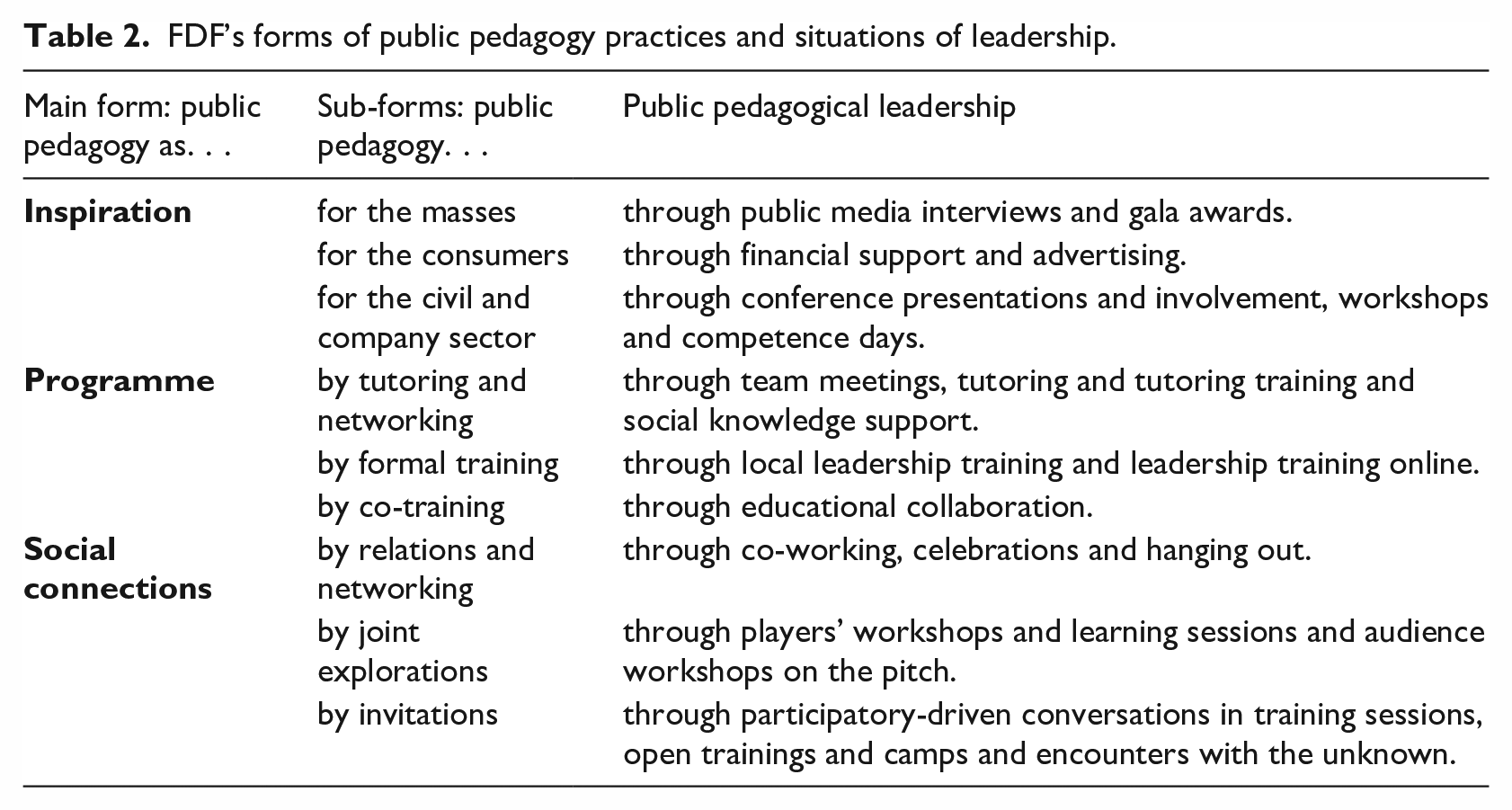
Three main forms of public pedagogy practices have been identified, each constituted by a set of sub-forms with characteristic leadership situations. Table 2 answers the research questions by summarising FDF’s forms of public pedagogy and leadership characteristics.
FDF’s forms of public pedagogy practices and situations of leadership.
Public pedagogy as inspiration
Public pedagogy as inspiration is for the masses through public media interviews and gala awards, for the consumers through financial support and advertising and for the civil and company sector through conference presentations and involvement, workshops and competence days.
The masses
Influence is through public media interviews, such as talking about the organisation, its activities and aims, and sharing FDF’s knowledge and methods. Appearing on national television and in radio broadcasts and national and regional newspapers is common for the organisation. For example: This morning our founder Cecilia joined TV4 News Morning and talked about how we strengthen leaders who create safe meeting places for girls on and off the soccer field, all over the world through FDF Movement where we train leaders online wherever they are in the world and give them tools and support to strengthen girls’ self-esteem. (FDF Facebook, 2018-04-24)
FDF has also received a couple of national awards for its successful work, participated in gala awards, given short speeches and received appreciation. For example: Wow what an evening! Yesterday several of our leaders gathered in Stockholm to attend the Sverige United Gala to celebrate initiatives promoting integration and inclusion through football . . . we congratulate Ella and Sahar who won the award Guldhanden! (FDF Facebook, 2018-02-16)
By being publicly awarded and frequently occurring in different types of public media, FDF gains recognition as an influencing sport NGO nationally and internationally by indicating direction, using its common resources, engaging others and informing the masses based on its knowledge.
The consumers
FDF receives financial support by publicly collecting money and securing its finances in order to make it possible for girls to play soccer. This is part of its alignment and commitment. At the same time as indicating the direction, it wants others to join. This advertisement is typical: A new season of soccer leagues is about to begin in Mozambique & Zambia – and this year we will reach 10,000 girls with soccer, self-esteem, more knowledge about their rights and tools to turn their dreams into goals! And of course, we need more footballs – help us by SWISHING A ⚽ . . . One football costs 50 SEK(FDF Facebook, 2018-02-16).
Advertising is also directed towards companies and organisations by promising inspirational talks, competence development and the delivery of usable knowledge and methods to establish an inclusive leadership practice. FDF also uses merchandise to promote its messages, runs a web shop and distributes its products at different events. For example: ‘The girls at our Summer Camp in Södertälje, Sweden, also got their “Yes, she can” t-shirts today’ (FDF Facebook, 2018-08-08).
The civil and company sector
FDF influences and engages different organisations, municipalities, confederations and the like in the civil sector through conference presentations and involvement, by for example presenting, discussing, having dialogues with, taking part in and learning together with these actors. The following is one of many representative examples: Our founder Cecilia Safaee was invited by Stockholms Fotbollförbund to participate at Tele2 Arena and talk about gender equality and inclusion last Saturday. Cecilia talked about the importance of leadership and role models . . . A big thanks to Stockholms Fotbollförbund for creating this opportunity and to all clubs, federations and organizations that took part of the day – together we’re doing a great job in the right direction to create an equal and inclusive environment both on and off the football fields in Sweden (FDF Facebook, 2018-09-10).
FDF also plans, hosts and facilitates workshops, provides mentoring and talks and shares its experiences regionally, nationally and internationally. This is one of many examples: Today at the Laureus Sport for Good Global Summit, our founder Cecilia had the honor of facilitating a workshop around how to create a safe space in sports . . . Happy to share our methods with other inspiring organizations and people from all over the world!
For companies, FDF conducts customised competence days with inspirational talks, discussions and the sharing of tools and experiences, for example: Today our founder Cecilia joined EY in Skaraborg County to talk about value-based leadership and share our lessons learned and methods from the football field adapted for businesses . . . 120 people were inspired, but also left the day with more knowledge and practical tools to work with value-based leadership in their teams! (FDF Facebook, 2018-12-05)
FDF is shown to be a recognised and influential actor in both the civil and company sector in Sweden, as well as internationally through its public pedagogical activities of promoting values and visions, strengthening its resources, engaging and aligning with other actors and contributing to organisational learning.
Public pedagogy as a programme
Public pedagogy as a programme consists of tutoring and networking through team meetings, tutoring and tutoring training and social knowledge support, formal training through local leadership training and leadership training online, and co-training through educational collaborations.
Tutoring and networking
FDF uses different types of team meetings and arranges meetings within the organisation as well as together with national and local stakeholders in order to plan, give support and discuss activities and aims. One typical example is the following: In Mozambique, we’re having a busy week with team days with our whole team gathered in Maputo from all over the country to work out how 2018 can be the best year ever – the year we reach 10,000 girls in Mozambique and train all our coaches in value based leadership, sexuality and SRHR, and how to create a safe space for our girls on and off the football field so that our girls can create better future prospects for themselves with no teenage marriages, early unwanted pregnancies and interrupted schooling (FDF Facebook, 2018-02-27).
Tutoring and tutor training are fundamental educational dimensions of FDF in which leaders in FDF are coached, supported, helped, given advice, inspired, encouraged and fostered in the right mindset and methods of the organisation. Leaders are also trained to become tutors within FDF and to support other leaders. There are also formal positions with a broader responsibility: We are so happy to announce and welcome our new colleague and community manager Inger to our team. Inger will be working with our network in Sweden & the Åland Islands, coaching all FDF-leaders as well as all football clubs that work with us. She will support, help, inspire and encourage all our leaders in their daily work in empowering girls through football while also support them in their own development as leaders (FDF Facebook, 2018-04-23).
FDF also functions as a social and knowledge support hub by contributing new knowledge, maintaining a shared vision (direction), creating supportive conditions and energising, encouraging and connecting leaders (alignment and commitment) within the organisation. A leader reports the following: It is very important & empowering to be part of a network where everyone works for everyone’s equal opportunities & value. Through FDF, I have received support in how girls’ self-esteem & rights can be strengthened, both on the football pitch and in the community (FDF Facebook, 2018-11-23).
FDF maintains and strengthens direction, alignment and commitment through regional, national and international networks, conducts tutoring within the organisation and educates new tutors when needed.
Formal training
Locally based formal leadership training of future and active leaders, mainly young women, has been one of the most common activities for FDF to grow, influence and support communities nationally and internationally according to its goals and agendas. Leadership training is conducted locally, where FDF educators try to inspire, motivate, discuss, critically reflect, support, encourage, plan, practice, equip and prepare the participants by giving them the right knowledge and methods and fostering the FDF mindset. Formal training is often conducted in collaboration with national and local stakeholders and partners that support and facilitate valuable resources. The following is one of many examples: What a week in Pongola, South Africa! Sarita, Mike & Frida, our Country Director . . . are holding our full six days Leadership Training for 27 leaders in the community . . . the leaders have already been equipped with knowledge and methods on how to empower girls through football – and they already talk about when they will start Pongola’s first girls teams ever! How cool?! A big thanks to Insamlingsstiftelsen . . . for a great collaboration, you make this possible! (FDF Facebook, 2018-06-28)
In order to have a global reach and a wider influence and support in local communities, FDF conducts online leadership training to equip new leaders worldwide with knowledge and methods and to foster the FDF mindset. One person who finished his online training ‘has since then started his first girls’ football team and safe space in Bungoma outside Nairobi, Kenya, and is about to start yet another one’ and has also started to empower other leaders who are joining in ‘the quest to empower girls through football in Kenya’ (FDF Facebook, 2018-07-10).
Formal training both locally and online is a dominating influencing activity of FDF that enables the organisation to include new members and impact more communities worldwide.
Co-training
FDF spreads its vision, aligns its resources with others and engages with different stakeholders through educational collaborations with clubs, organisations and federations by co-designing, planning, customising and conducting educational programmes. One example of this is from Sweden: This weekend we kicked off our collaboration with IF Brommapojkarna for real! IF BP is Europe’s biggest football club that has taken a strategic decision to become the first gender equal club in Sweden (and perhaps the world?!) – of course something that we support. As a first step we trained some of their core female leaders in Value based Leadership this weekend (FDF Facebook, 2018-08-31).
The FDF programme, i.e. a specific body of knowledge, aims, values, attitudes, exercises, methods and techniques, etc., is used as a basis for influencing by tutoring, tutor training, formal leadership training locally and online and co-designed educational programmes (but not single learning activities such as inspirational talks and competence days).
Public pedagogy as social connections
Public pedagogy as social connections is constituted by relations and networking through co-working, celebrations and hanging out, by joint explorations through players and audience workshops and learning sessions on the pitch, and by invitations through participatory-driven conversations in training sessions, open trainings and camps and encounters with the unknown.
Relations and networking
FDF uses co-working as a leadership strategy by building international, national, regional and local networks with stakeholders. Activities are planned and carried out together with local actors, who are empowered to build structures and work for sustainable change by becoming independent of the organisation: We’re ending this week in the best possible way in the province of Inhambane, Mozambique, were [sic] we this year will reach 14 districts – and in all districts, our programs will be coordinated by this amazing team from the District Departments of the Ministry of Education. We believe that in the long run we shouldn’t be empowering girls – but governments, school systems, football federations and community leaders should! Therefore we integrate all our activities within local structures, to step by step incorporate our programs into sustainable structures enabling girls’ empowerment today – and tomorrow. In Inhambane, this team of officials from the District Departments of the Ministry of Education are ready to rock together with our amazing 144 coaches in the province that this year will improve the future aspects of an estimated 4,320 girls only in the province of Inhambane! (FDF Facebook, 2018-03-23)
Another type of leadership action is to attend celebrations, come together and hang out in the local community: Happy with our friends at Tillsammans Cup, founders Erik & Marica, celebrating diversity and how much better we are together! Come and join in the celebrations at Enskede IP in Stockholm, or all over the country at the local events. Let’s stand up for Sweden and celebrate our National Day in the best way possible, with love, football and good vibes! (FDF Facebook, 2018-06-06)
Hanging out and celebrating is a leadership action through which FDF influences by simply being there, showing commitment, support and care.
Joint explorations
A recurring activity in the countries in which FDF arranges national leagues for girls’ soccer is players’ workshops and learning sessions on the pitch. The leadership strategy, which FDF calls ‘the first half’ of every game, is that workshops are conducted with the players by means of discussions, role play and open conversations to, for example, learn about their rights. During the game audience workshops are also arranged in which the gathered audience performs role play, theatre, debates and open conversations: During the past weeks of games in our national football league Mutola Cup in Mozambique, we’ve worked on children’s rights with our 14,000 girls, their parents and communities, in our weekly first half of the game. Few have been aware of and respect children’s rights, as we’ve noted throughout the stories, comments and questions asked by our girls and the audience at our football fields (FDF Facebook, 2018-07-08).
Soccer games are used as opportunities to discuss and have a dialogue with the players and the people gathered, thereby leading by values and influencing the norms and behaviour in the local community.
Invitations
Participatory-driven conversations are used in girls’ training sessions as a way of opening up conversations based on the players’ questions, worries, ideas and needs so that FDF leaders can create safe spaces for the girls to talk, support and care for each other. This pedagogical method is called Talkbox time: Talkbox-time occurs in Albera’s team once a week, when a training session is transformed into a safe space to talk about whatever the girls in the team have put in the Talkbox. The Talkbox is a box where all girls in the team can put notes with topics they want to discuss, something they want to learn more about or questions they want to ask. The notes are all anonymous, and Albera can then understand what’s going on in the girls’ lives and what she can help them with (FDF Facebook, 2018-01-11).
In this way, FDF influences the participants by inviting them to contribute content to in-group conversations for and by the participants with preparation, support, active listening and help from the leader.
Other leadership strategies and ways of influencing are by offering open trainings and camps. Locally, FDF arranges open trainings and camps for girls, free of charge with food and ‘fika’ and without notification requirements, often in collaboration with clubs and other local stakeholders: This is how happy our FDF-coaches . . . became when they finally got a training time at the field waiting since January. Do you live close by and want to join? Just show up on Fisksätra IP on Thursdays between 16.00 and 17.00 with ‘fika-time’ afterwards (FDF Facebook, 2018-06-04).
FDF also uses what could be called encounters with the unknown by arranging and inviting to events and encounters with people and places. One example of this is the girls’ team from Mozambique, which participated in the largest youth soccer tournament, Gothia Cup, in Gothenburg, Sweden, all of which was made possible by FDF and financial support from sponsors: The girls and their trainers had a wonderful but difficult time on the ice with the Swedish team Frölunda Indians! Good job girls! They fell a couple of times, but for being their first time on ice they did an absolutely great job! (FDF Facebook, 2018-07-17)
During the same tournament FDF invited people to come and meet and cheer for the team together with a former national men’s soccer team player. By inviting people to these types of open events, FDF influences by building relations between people and between people and places and creating open learning opportunities with the public.
Discussion
Leadership is never easy or painless, especially not in community changes towards sustainability. Adaptive work often stimulates resistance and creates risks, conflicts and instability because it challenges people’s values, habits and beliefs (Heifetz, 1994; Heifetz and Linsky, 2017; Hull et al., 2020). It asks people to accept loss, live with uncertainty and question loyalties to people and community cultures. It could even redefine aspects of identity and challenge the sense of competence. Analysing self-reports and ‘positive’ news reports in the media will hardly capture processes of resistance, instability, loss, pain and conflict. It will not seize cultural and local singularities and differences in communities involved in the work of FDF around the world. To study these kinds of aspects, more ethnographical and culturally adjusted studies would need to be conducted. Having said this, it could be concluded that sports organisations like FDF are important actors for exercising a public pedagogical leadership that supports individuals and local communities in their endeavours to change towards sustainability. However, how this is done and what the results will be is a matter for further studies. In relation to the 2030 Agenda, it has been shown that SDGs 4, 5 and 17 are explicitly addressed in FDF’s public pedagogy practices. Taking this conclusion as a stepping-stone, the discussion continues to focus on sports organisations by using FDF as a ‘favourable case’ of public pedagogical leadership that seems to impact on community change and capacity building towards sustainability.
The principles for building community capacity (Edwards, 2015; Svensson and Levine, 2017) are all taken up by FDF in its mission to ‘change the world’ and its vision of ‘all girls in the world getting access to their rights and the opportunity to reach their full potential’ by building ‘structures and safe places through education, support and inspiration’. The leading principle in public pedagogy as inspiration is to create a shared value system (direction) by reaching out to the masses and raising money through marketing, products and presentations in the civil and company sector. These activities are often carried out by public media interviews and conference presentations, which has the leadership function of supporting learning, reaching out with the vision and engaging other stakeholders. In public pedagogy as a programme, the leading principles of building physical and human resources, developing community leadership and systems for leadership development and shared value systems are highly influential. Locally based leadership programmes could for example strengthen community capacity by contributing to a ‘pool of leaders from diverse cultural and religious backgrounds with diverse perspectives and visions to respond to new social, economic and environmental challenges’ (Skinner et al., 2019: 304). In public pedagogy as social connection all the principles are used, where building social capital, creating infrastructures for community dialogue, problem-solving and collective action, civic participation and community power and creating a community learning culture are all highly influential. These are carried out by co-working with local stakeholders, workshops and learning sessions during games and participatory-driven conversations and open trainings. It would seem that FDF avoids the risk of reproducing ‘hegemonic relations and provide little sustainable community development’ (Edwards, 2015: 16), which supports its claim to lead change by basing its work on co-creation and making sure it is relevant in the local contexts in which it works and by gradually allowing local residents to take over the process. Accordingly, public pedagogy as social connection could support practices in which people from different economic, social and cultural backgrounds are brought together, influencing the growth of social capital in terms of belonging, trust, cooperation, teamwork, inclusion and respect (cf. Skinner et al., 2019).
Public pedagogy, as in the form of social connections, with a concern for the public quality of human togetherness, characterised by learning in relation, action and plurality, where the public pedagogue invites people into relations and stages possibilities for participants and events to become public, seems to be a highly influential way of building sustainable local community capacity for change. This main democratic, pluralist and ‘intelligent’ collective problem-solving form of public pedagogy, which in the leadership process opens up for communication between participants and critical group inquiries, is conditional and dependent on the other forms of public pedagogy in which educated public pedagogues (leaders) with a local, regional, national and global network of knowledge, social support, collaboration and resources can support and facilitate local community work together with participants and local actors. It is clear that sustainability does not simply happen by itself.
Sustainability is dependent on social transformation based on learning and action and anchored in practices, institutions and organisations in which social context, social relations, conflicts and power conditions are integral parts of the process (Boström et al., 2018). Accepting the world as it is and only striving to maintain the status quo could end up destroying our common world. As an alternative, the political practice of sustainable development must be directed towards new ways of thinking and acting. According to Hannah Arendt (1954/2004), it is the possibility to act that makes the human a political creature, thereby creating a possibility to reach understanding, act in concert and undertake directions and aims not at first imaginable by the separate individual. Or, to put it differently, handling problems together in public pedagogical leadership practices.
The continued existence of our common world is dependent on which values we aim for, what we preserve and what needs to be changed. Our common world is dependent on its publicness, our human actions, ways of knowing, attitudes and norms, willingness and abilities to lead and, thus, our common capacity to create something new and change society. Continual empirical research, together with involved actors, is needed to explore how and why sports organisations contribute to community change and capacity building towards sustainability (Dudfield, 2019; Skinner et al., 2019). Further knowledge is needed to better understand and support sports organisations in their ambitions to contribute to a sustainable world. The approach of public pedagogical leadership is one possible way of moving ahead.
Footnotes
Declaration of conflicting interests
The author declared no potential conflicts of interest with respect to the research, authorship, and/or publication of this article.
Funding
The author received no financial support for the research, authorship, and/or publication of this article.
