




Abstract
This paper examines whether the implementation of the Bologna bachelor’s + master’s structure has been followed by an increase of university students from under-represented groups, and whether the Bologna structure has been accompanied by new forms of student mobility between Danish university institutions. Looking at student movements from bachelor’s to master’s degrees from 1993 to 2011, I do not find that the implementation of the Bologna structure has been followed by changes in the inclusion of under-represented groups. The social gap in progression to master’s degrees remained small and constant across the period. However, the formal instalment of a new transition point in the Danish university system (from bachelor’s to master’s) has provided bachelor’s degree holders with the opportunity to flee less lucrative fields of study and less prestigious institutions, and they increasingly do so. I discuss the implications of these movements in the light of the aim to make higher education more inclusive.
Introduction
In 1999, a number of European countries initiated the Bologna Process in an effort to make European higher education (HE) more coherent and competitive, facilitate student mobility and – through subsequent communiqués (2001, 2007, and 2009) – place emphasis on the ‘social dimension’ in HE. Some of the most far-reaching effects of the Bologna Process have been the establishment of a common quality framework, a pan-European credit system and the implementation of the bachelor’s + master’s + PhD structure (3+2+3) in HE systems in all 48 participating countries. In many of these countries, this structure introduced a new transition point with the awarding of a bachelor’s degree after three years of study. For stratification scholars, the introduction of a new transition point from bachelor’s to master’s degrees has attracted interest. Studies have shown that each transition point in education systems may affect educational inequalities (Breen and Jonsson, 2005; Mare, 1981; Shavit et al., 2007) and more specifically that the share of master’s level graduates with low educated parents have decreased with the two-cycle structure (Neugebauer et al., 2016). Such interest is even more warranted given that key dimensions of the Bologna Process is to strengthen social mobility in HE and ‘widen opportunities for access and completion for students from disadvantaged backgrounds’ (Kottmann et al., 2019: 5).
This paper examines whether the instalment of the Bologna structure has been followed by an increase in the share of under-represented students in university programmes. In contrast to many other countries, Danish universities adhered to a five-year one-cycle candidatus programme structure before the introduction of the bachelor’s + master’s (3+2) structure. The instalment of the new two-cycle structure may have had opposite effects on the inclusion of students from disadvantaged backgrounds. On the one hand, the new possibility to enter the labour market earlier may have proved attractive to students from disadvantaged backgrounds who would otherwise refrain from embarking on five years of study, deeming this an overly risky endeavour. On the other hand, the 3+2 system may have worked to divert the same students towards only obtaining a bachelor’s degree, in contrast to their privileged counterparts, who are more likely to progress to the master’s level. Other processes of differentiation may also have occurred. For example, some groups of students may have taken advantage of the new bachelor’s–master’s transition point and sought to move to desirable master’s programmes. Students who for one reason or another did not previously have the opportunity to enrol in their preferred bachelor’s course may have used the transition point as a compensatory strategy to shift to a more sought-after programme or institution. In examining whether new forms of differentiation within Danish universities have accompanied the Bologna Process, I take advantage of high-quality administrative data. These data allow me to look at the total cohort of bachelor’s enrollees, from the instalment of the bachelor’s degree in 1993 up until 2011. Specifically, I examine if the implementation of the Bologna structure has been followed by an increase of students from under-represented groups in Danish university programmes, and whether the structure has been accompanied by new forms of student mobility between Danish university institutions. 1
I discuss these movements not only in the light of the implementation of the Bologna structure, but also with an eye to other important educational changes that have taken place in the period under study. The paper proceeds as follows. I set out by contextualizing the analysis and subsequently present my data and methods for examining the data attained. Thereafter, I present my analysis and conclude with a short summary and discussion.
Context: The Bologna Process and the Danish educational system
The Bologna Process was initiated in 1999 as an example of pan-European cooperation with regard to HE programmes, aiming to homogenize programme structures and strengthen European HE internationally. This goal was to be achieved by making HE degrees more comparable across member states, introduce a common 3+2+3 study structure, promote mobility and the free movement of student, teachers, and researchers, to adopt a common system of credits (European Credit Transfer and Accumulation System (ECTS)) and to promote a common framework for quality assurance (Bologna Communiqué, 1999). In the Prague Communiqué (2001), ministers further emphasized the social dimension of mobility, and the goal of including students from under-represented groups was promulgated in the London Communiqué, stating that the ministers ‘reaffirm the importance of students being able to complete their studies without obstacles related to their social and economic background’ (London Communiqué, 2007: 5). In the Leuven Communiqué from 2009, ministers agreed that each country should set up ‘measurable targets for widening overall participation and increasing participation of under-represented groups in higher education’ (Leuven Communiqué, 2009: 2). Later communiqués reaffirmed the goal to increase the inclusion of under-represented groups (see the Bologna Process implementation report (European Commission, 2018) for a detailed discussion).
Denmark has gone a long way in implementing the Process’ initiatives. Six years prior to its initiation, university reforms began introducing a bachelor’s–master’s degree structure. The political rationale behind splitting up the five-year candidatus programme into a two-cycle structure in 1993 was to combat dropout by introducing a shorter degree (the bachelor’s), to offer employers a more flexible qualifications system and to align Danish university programmes with Anglo-Saxon ones (Rasmussen, 2019). Since then, Denmark has implemented the ECTS credit points at all levels and aligned its bachelor’s, master’s and PhD programmes, with a university reform passed in 2003 stipulating that all university programmes follow the 3+2+3 structure. As most Danish university programmes before 1993 were uninterrupted five-year candidatus programmes, the implementation of the 3+2+3 structure formally restructured Danish higher education, but with a few practical implications. For most traditional liberal arts and professional programmes, the introduction of the 3+2 structure in 1993 was a mere formality, with programme profiles continuing to be pre-packaged, offering little flexibility in terms of content or curricula.
National policy changes in 2003 may have done more to fuel increasing movement between fields and institutions. As part of the universal implementation of the 3+2 structure in 2003, bachelor’s and master’s programmes were required to formulate labour market profiles as part of the implementation of a qualification framework as laid out in the Bologna agreement (Danish Evaluation Institute, 2017). Following this, from 2007 to 2016 twice as many new master’s as bachelor’s programmes emerged (121 and 59, respectively) (Ministry of Higher Education and Science, 2018). These programmes should also be seen as the outcome of new institutional strategies for attracting students in an increasingly competitive HE market. Since the 1980s, universities have been partly financed by a pay-per-student arrangement and the possibility of establishing new master’s programmes following the Bologna Process and the 2003 University Act has given institutions more economic incentives to attract out-of-institution students, thereby increasing cross-institutional transfers from bachelor’s to master’s programmes.
The introduction of the bachelor’s degree in Denmark has taken place in a system where young people experience fewer constraints on their educational choices and transitions than elsewhere. Compared to the Organization for Economic Co-operation and Development average (Organization for Economic Co-operation and Development, 2012: 135), unemployment rates among tertiary education graduates have historically been relatively low and social security in Denmark provides considerable support. Day care is universal and affordable and there is no tracking in compulsory school (grade 0 to 9), although an increasing number of students attend private schools (with the state subsidizing three-quarters of the tuition fees). Apart from private elementary schools as well as a few private high schools, there are no tuition fees in education and all HE students are entitled to a government grant of 840 euros monthly (2020 figures) while studying.
Danish children begin their educational career with 10 years of compulsory education in public or private non-profit schools: grades zero to nine, for six-year-olds to fifteen-year-olds, with an optional 10th grade. After compulsory school, two-thirds of all students enrol at a HE preparatory upper secondary school – called a ‘gymnasium’ – with a general academic track and two vocationally oriented academic tracks (technical and business-oriented). Other students opt for a vocational education and training (VET) programme, attaining qualifications for craft occupations such as carpenters, electricians, construction and service work. Applications to HE programmes are centrally coordinated by a public body. A diploma from a gymnasium formally grants access to a HE programme if that programme has the space to accept all applicants. This is the case for most programmes, but for several university programmes demand exceeds supply and so the applicants’ gymnasium grade point average (GPA) determines admission (with a small share being admitted on the basis of extracurricular qualifications). The HE system comprises business academies, university colleges and universities. Business academies host two-year to three-year programmes primarily directed towards the private sector. University colleges offer three-year to four-year semi-professional bachelor programmes primarily educating welfare state civil servants (teachers, nurses and childcare, and social workers). Universities hold a wide range of traditional liberal arts and professional programmes, offering three-year bachelor’s programmes, two-year master’s programmes and three-year PhD programmes. 2
Students in Denmark enrol in a bachelor programme with a relatively fixed subject (e.g., a Sociology bachelor’s) and all bachelor’s students are legally entitled to continue into the corresponding master’s programme after graduating (e.g., a Sociology master’s). This is by far the most common entry route into a master’s programme. It also means that unlike in many other countries, bachelor’s students do not have to apply to gain entry into the applicable master’s programme. If, however, bachelor’s degree holders wish to pursue a master’s programme in another department (or in another institution), they must apply directly to that department. The department assesses their application individually, often focusing on the student’s curricular activities on their bachelor’s programme. More than four out of five bachelor’s students obtain a master’s degree. With a few exceptions, there is de facto not a labour market for university bachelor’s degree holders in Denmark, as employers tend to expect mature candidates with master’s qualifications (Danish Agency for Labour Market and Recruitment, 2003), despite political efforts to strengthen a labour market for university bachelor’s degree holders (Ministry of Higher Education and Science, 2018: 32). 3
Mechanisms of differentiation in HE
Although there is a voluminous literature documenting persistent social inequalities in access to HE (e.g., Breen and Jonsson, 2005; Thomsen et al., 2017; Shavit et al., 2007), relatively few studies have examined the effects of the Bologna Process on educational inequality. Studies from Portugal and Italy have identified a positive effect on overall enrolment (Neugebauer, 2015). However, the introduction of bachelor’s degrees in Germany has been found to have had no positive effect on bachelor’s enrolment among students of lower socio-economic status and the share of master’s students of lower socio-economic status has decreased since the introduction of the two-cycle structure (Neugebauer 2015; Neugebauer et al., 2016).
The introduction of a new degree level brings with it new possible forms of differentiation in HE. A new bachelor’s degree may lead some of those students who previously studied a five-year one-cycle candidatus degree to pursue a three-year bachelor’s degree only. Students from working-class backgrounds are generally more risk averse (Breen and Goldthorpe, 1997; Goldthorpe, 1996) and more likely to leave with just a bachelor’s degree. However, a short three-year bachelor’s degree may also lead to the inclusion of working-class students, as they may view it as more realistic and manageable than its five-year counterpart (Schindler and Reimer, 2011). Regardless of the outcome, there are reasons to doubt if any of these mechanisms have been powerful in Denmark. First, working-class students are more likely to pursue qualifications at university colleges, where ‘professional bachelor’s degrees’ (e.g., teacher, social worker, nurse, and childcare worker) grant fast access to the labour market (Thomsen et al., 2013). Second, even though working-class university students may in theory be more prone to leaving after attaining a bachelor’s degree, the legal right to continue into a master’s programme (and the fact that there are no tuition fees in Danish HE and students receive generous grants while studying) may offset these dispositions. Additionally considering that a labour market for university bachelor’s degree holders in Denmark has never materialized, an early labour market entry mechanism may be hard to identify in the Danish case.
However, it may be the case that the bachelor’s–master’s structure has introduced a new form of horizontal differentiation, where students use the new transition point as a channel for moving to programmes or institutions that they consider more attractive than where they attained their bachelor’s degree. Several studies have pointed to the choice of institution, field of study and programme as important areas of distinction as the HE system has expanded (Davies and Guppy, 1997; Hällsten, 2010; Thomsen, 2015). These patterns of differentiation have been given a theoretical underpinning in the theory of effectively maintained inequality (EMI), where inequality refers to inequality in access to different types of education. This theory states that students from high socio-economic status backgrounds seek out advantages in the education system wherever there are advantages to be found. Lucas shows how these students seek out qualitative advantages in high school (i.e., better quality tracks) where high school attendance is universal (Lucas, 2001). In an analogous fashion, university students may seek out qualitative advantages where they are available. This may be the case where students seek out master’s programmes in fields or institutions that grant access to more lucrative or prestigious social positions than those available had they stayed within the same field or institution of their bachelor’s degree. In the same vein, cultural reproduction theory places weight on how the privileged social classes (i.e., highly educated families), endowed with large amounts of cultural capital, use the education system strategically to maintain advantages for their children (Bourdieu, 1996; Lareau, 2011; Reay et al., 2005). Movements between fields or institutions may, in a rational choice perspective (Breen and Goldthorpe, 1997), be viewed as strategic adjustments that maximize utility, when students make use of the possibility of transferring into a new field or institution with more attractive job prospects (e.g., working-class students moving to programmes that are deemed a less risky choice). I use these theories as my point of departure to analyse student movements as a way of securing privileges and attractive labour market prospects. In order to examine these mechanisms of differentiation, I present relevant data in the next section. Thereafter, I analyse movements between bachelor’s and master’s programmes, fields and institutions and examine if and how these movements are related to social background and cognitive ability.
Data and methods
To examine student movements between bachelor’s and master’s programmes, I use de-personalized administrative data from Statistics Denmark on all bachelor’s enrollees from 1993 to 2011. I restrict the analysis to bachelor’s and master’s programmes at universities, as the 3+2 structure is only fully implemented at the university level. University colleges do not have a master’s degree level like universities do and a ‘professional bachelor’s degree’ from a university college (e.g., teacher, nurse, and childcare worker) does not automatically qualify for application into a master’s programme at a university. 4 I link registers holding information on educational trajectory and academic achievement (GPA) with background characteristics (gender and social origin). In the analyses, I use enrolment and graduation from bachelor’s and master’s programmes as independent variables. In addition, I include information on the specific programme (e.g., Sociology, Biology, and Medicine), on the programme’s field of study (humanities, social sciences, natural sciences, and health) and on the programme’s institution (name of university while attending a bachelor’s or master’s programme). As background characteristics, I include GPA, gender and parental education, measured as the highest level of education obtained by the mother or father, operationalized as short, medium or long education. Short education covers no upper secondary education or VET diploma; medium education covers a business academy or university college degree; and long education refers to a university degree. I refer to students from homes with no upper-secondary education (short) as less privileged students, and students from university-educated homes (long) as privileged students. I present results from cross tabulations and linear probability models (LPMs). Cross tabulations provide an overview of key associations, while LPMs present these associations adjusted for selected characteristics (e.g., movements between institutions adjusted for the student’s GPA). 5
Analysis
I begin by surveying student movements between programmes, fields and institutions. Figure 1 shows the likelihood of opting for a master’s degree in a subject different from one’s bachelor’s degree (e.g., moving from a Sociology bachelor’s to History master’s). Figure 1 shows the average for all university institutions and for the two old, multi-faculty institutions holding traditional university programmes, to see if the introduction of a new transition point has led to a propensity to divert from the traditional five-year candidatus study profile.
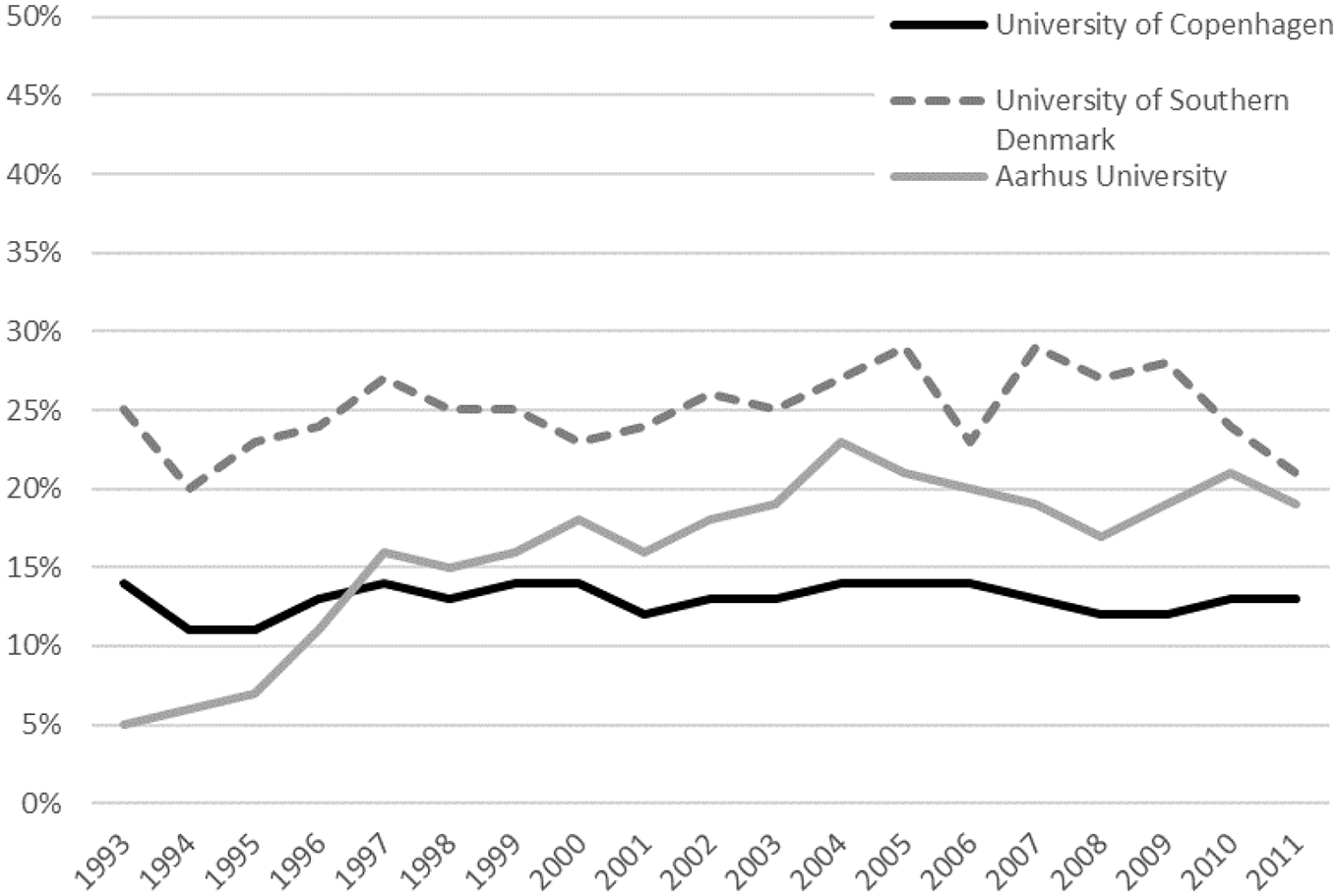
Share of bachelor’s degree holders continuing into a master’s programme in a different subject, by year of bachelor’s enrolment.
The overall trends are relatively stable across the period with no indication of shifts following the universal formalization of the Bologna structure in 2003. For the two traditional multi-faculty university institutions, Figure 1 suggests a picture of continuity in Denmark in terms of shifting to a master’s degree that is not the logical continuation of the bachelor’s degree. The oldest university – the University of Copenhagen – exhibited the lowest share of students changing to a different master’s subject, followed by the second-oldest university, Aarhus University. For programmes that were historically conceived as five-year one-cycle candidatus programmes, this picture confirms the assumption that splitting one cycle into two has had little effect, as most bachelor’s students continue their master’s within the same subject.
Figure 2 examines the movement between fields of study from bachelor’s to master’s (e.g., moving from a social science bachelor’s to a natural science master’s). Some fields of study are clearly more professional and hence less interdisciplinary than other fields. For example, practically all bachelor’s graduates in health subjects enrolled in a health programme at the master’s level, a trend that remained constant across the period. In the main, this is probably because certification in Medicine or Dentistry (for example) requires both a bachelor’s and a master’s degree in Medicine vis-à-vis Dentistry. In addition, programmes in the field of health are sought-after, competitive programmes for which students need high GPAs to enter, making them less likely to move elsewhere.
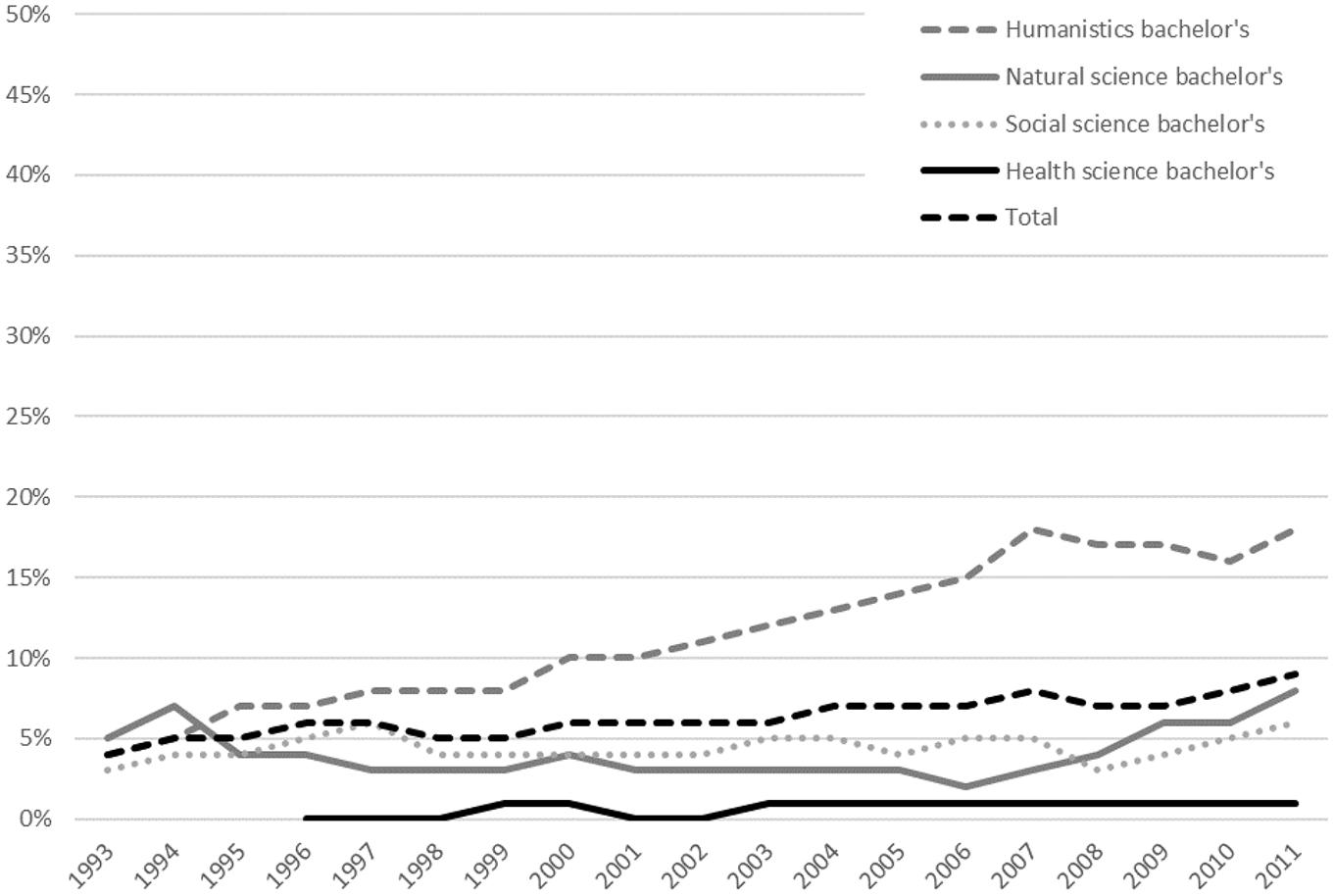
Share of bachelor’s degree holders moving into a different field of study at the master’s level, by bachelor’s field of study and year of bachelor’s enrolment.
Nevertheless, the social sciences also constitute a field in which very few bachelor’s students opted for a master’s elsewhere, despite being less profession-oriented and sought-after than health. The share of bachelor’s degree holders in the social sciences choosing a master’s degree in the same field remained constant and high (around 96%) across the period. By contrast, bachelor’s degree holders in humanities subjects increasingly opted for a master’s degree in another field. In 1993, 4% did so, with this share quadrupling in the final period considered, when close to one in five bachelor’s humanities bachelor’s degree holders chose to pursue a master’s in another field. A closer inspection of where these students moved reveals that almost all entered a social science master’s (88% in the latest enrolment year, figures not shown). There may be several explanations for this pattern. The humanities have long been problematized in public discourse as a field with high unemployment rates and relatively low earnings compared to others (Danish Agency for Labour Market and Recruitment, 2003; DJØF [trade union for social sciences], 2013; Groes et al., 2004). Students may initially be guided by subject interest, but may later place more weight on prospects for employment. In addition, many humanities programmes may be regarded as less prestigious than some social science programmes, for instance, for which the GPA needed to gain entry is generally higher.
Low movement between some fields does not necessarily translate into low movement between institutions. A bachelor’s degree holder in Medicine, for example, may well choose to apply for a master’s programme in Medicine at another institution. Figure 3 addresses movements between institutions from bachelor’s to master’s degrees.
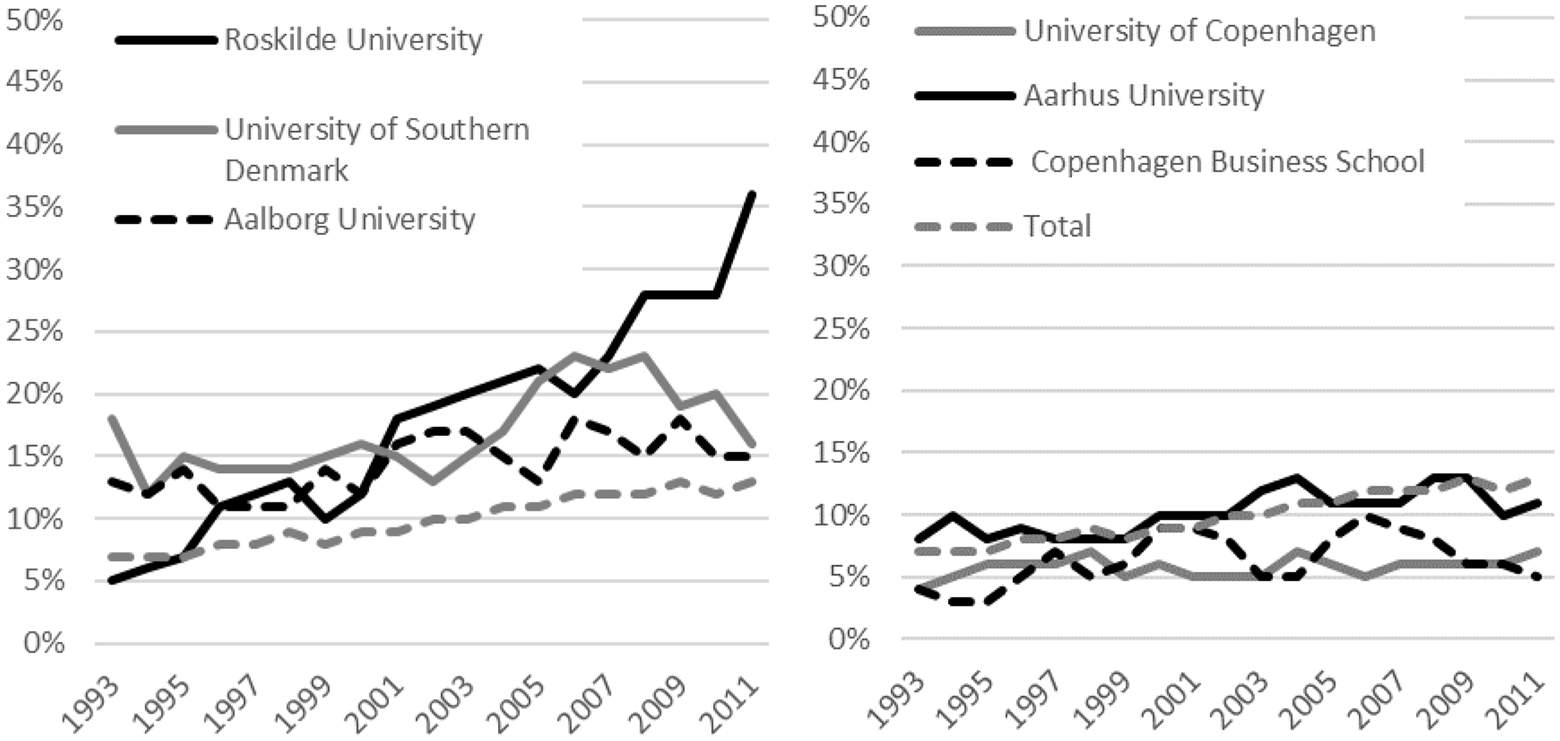
Share of bachelor’s degree holders moving into another institution at the master’s level, by year of bachelor’s enrolment.
Figure 3 shows bachelor’s degree holders’ movements from new and old universities separately. The average movement for all institutions (shown in both graphs) displays a steady and modest rise in between-institution transfers from 1993 to 2011, from 7%–13%. There is no indication of a dramatic shift following the universal introduction of the bachelor’s degree in 2003. When the institutions are considered individually, a clear pattern emerges. Degree holders from the old universities of Aarhus and Copenhagen or from profession-oriented, mono-faculty institutions such as the Copenhagen Business School showed stable trends across the period, with bachelor’s students being unlikely to transfer to another institution (with only 5%–10% doing so). Bachelor’s degree holders from newer, less sought-after university institutions situated further away from Denmark’s big cities were somewhat more likely to move to a master’s programme at another institution. During the period under study, students increasingly moved away from Roskilde University, which sent more and more bachelor’s degree holders to other institutions (5% in 1993 to 36% in 2011). Several mechanisms may be driving this pattern. As Danish students do not tend to live on campus but rather in the big cities (e.g., most students at Roskilde University live in Copenhagen and commute from there), programmes at institutions located in Copenhagen may be considered more attractive and convenient. These institutions also hold more prestigious and lucrative programmes with a higher share of high-achieving students than Roskilde University. Unsurprisingly, the receiving institutions for bachelor’s degree holders from Roskilde University are mainly the Copenhagen Business School and the University of Copenhagen (figures not shown). In addition, the unemployment rate among master’s degree candidates from Roskilde University is higher than that among candidates from similar fields at other institutions (Economic Council of the Labour Movement, 2015). In contrast, Aalborg University is the only university in its region, with a programme profile different from the university closest to Aalborg (Aalborg University has a number of engineering and technics programmes that Aarhus University does not offer).
Movements by background characteristics
The overall movements between programmes, fields and institutions presented in the previous section may be being driven by specific groups and vary over background characteristics, such as cognitive ability and social origin. This section explores these issues by looking at movements by GPA and parental education.
Figure 4 shows the tendencies to move to another master’s programme, field or institution by GPA (coded into quintiles, i.e., five equally big groups). A clear GPA gradient appears. The tendency to move away from one’s subject, field or institution was highest among students with the lowest GPAs and lowest among students with the highest GPAs. In addition, the gap widened during the period under study, most markedly after 2003. Generally, students with the lowest GPAs were more than three times as likely to move away from their subject, field or institution than students with the highest GPAs. There may be several explanations for these patterns. More students in the low GPA range do not enter their first-choice bachelor’s, as their relatively low GPA limits their programme choices. By contrast, high-GPA students are more likely to enrol in their preferred bachelor’s programme. Following this, low-GPA students are more likely to use the bachelor’s transition point to try to move to a master’s programme that is more aligned with their interests, more sought-after or holds prospects that are more lucrative. In addition, students may try to apply for a more sought-after master’s as they deem a study environment with a greater share of high-GPA students more attractive. These mechanisms may all contribute to a process where low-GPA students compensate for their below-average academic qualifications by applying for master’s programmes that they consider more attractive, a possibility that has increased with the introduction of the bachelor’s degree.
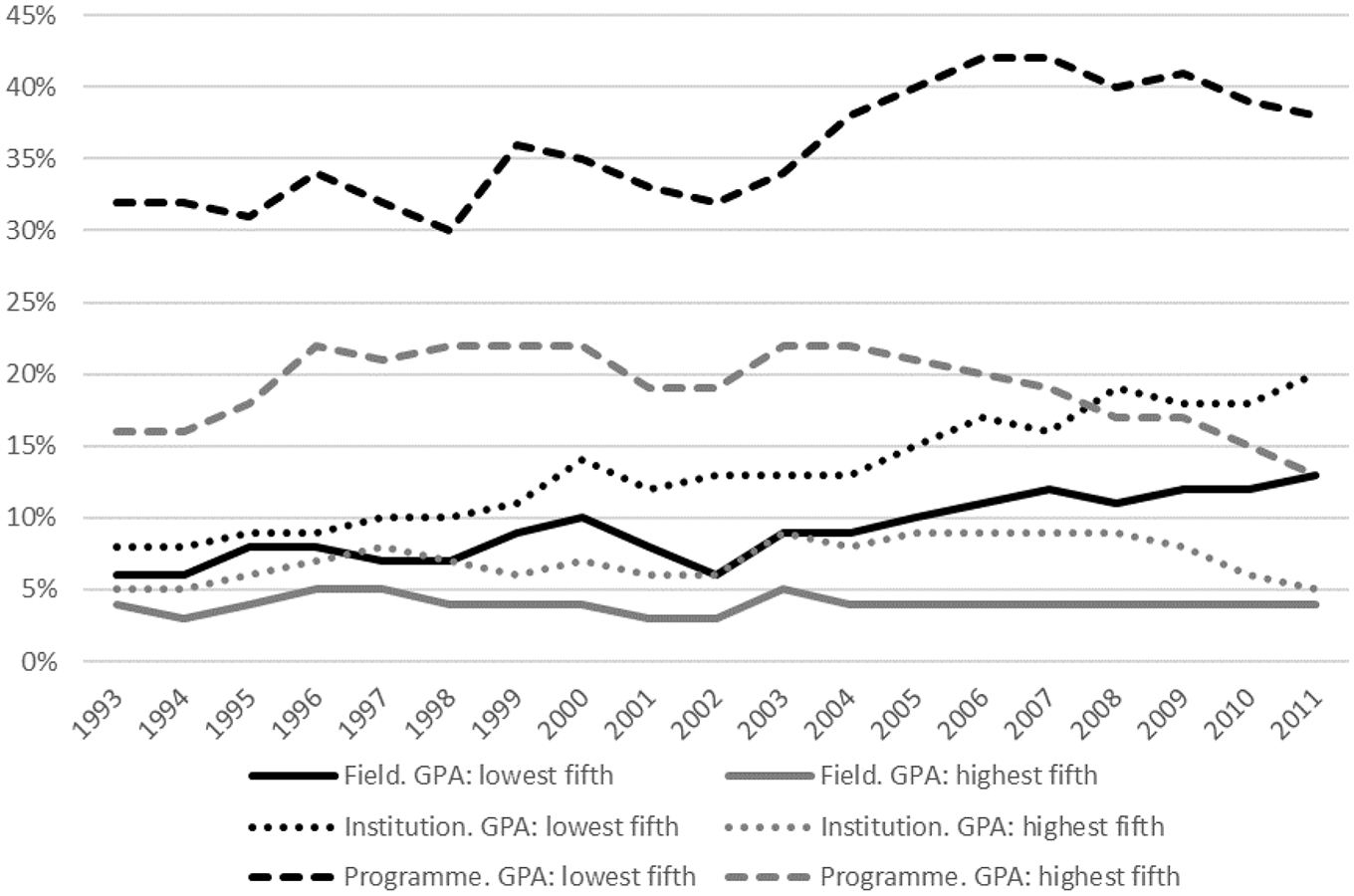
Share of bachelor’s degree holders moving into a new master’s subject, field or institution, by gymnasium grade point average and year of bachelor’s enrolment.
Figure 5 presents this pattern in more detail by showing the probabilities of changing institutions using two LPMs (before and after 2003), with GPA and institution interacted and adjusting for parental education (Tables A1 and A2 in the Appendix). Generally, more students moved in the later period than in the earlier period and the tendency for bachelor’s degree holders to move to another institution was greatest among those from newer institutions. In the later period, the tendency for low-GPA bachelor’s degree holders to move institutions was most pronounced at Roskilde University, where 31% of the graduates with the lowest GPAs moved, as opposed to 16% with the highest GPAs. This pattern adds to the above explanations that low-achieving students from programmes at less sought-after institutions opt for programmes that they consider more attractive (e.g., more prestigious, lucrative or with more high-GPA students).
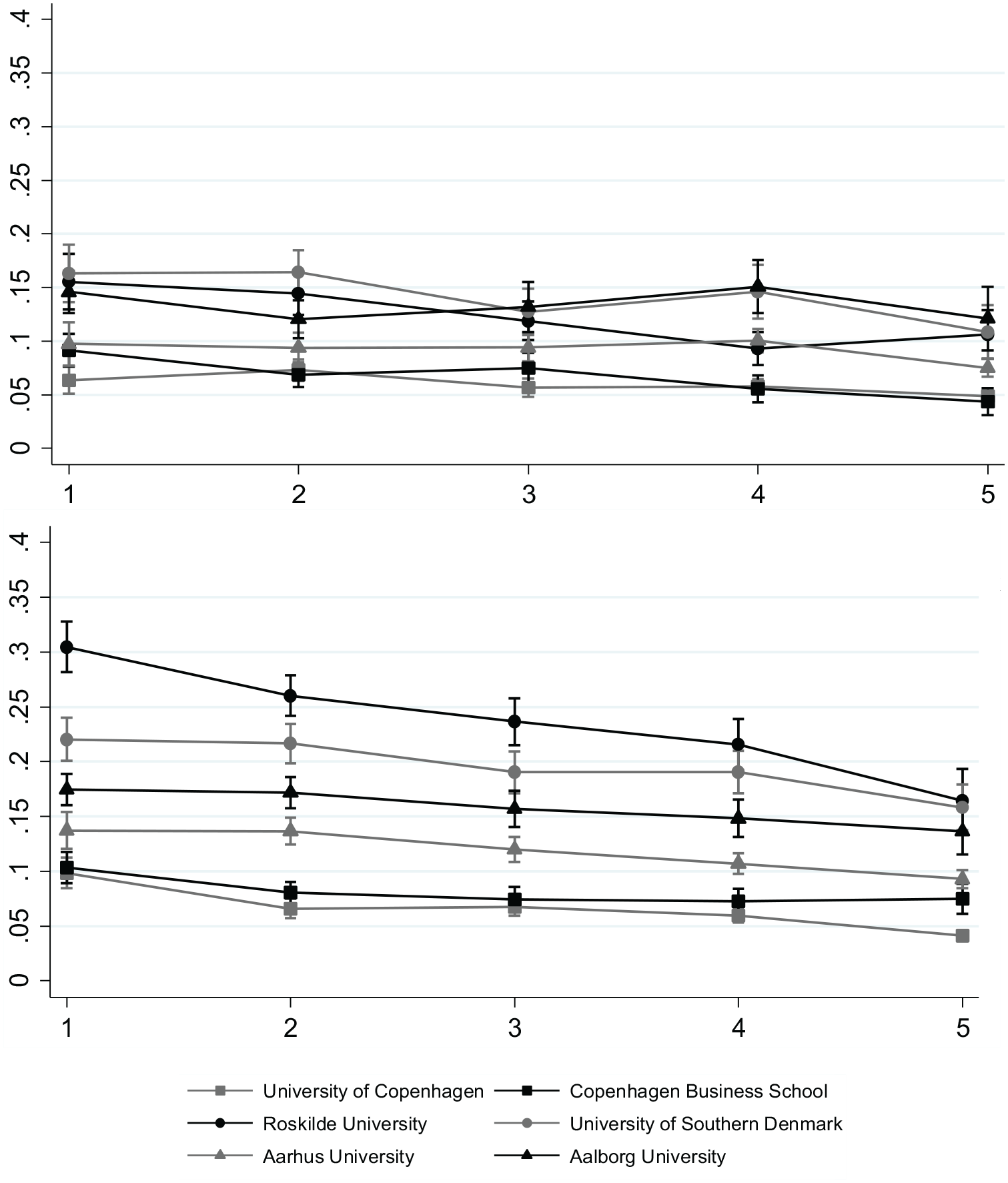
Likelihood of moving to a new institution at the master’s level by gymnasium grade point average (GPA) (quintiles) with bachelor enrolment before 2003 (1994–2002, upper graph) and after 2003 (2004–2011, lower graph) presented separately.
Figure 6 shows the tendencies to move to a different master’s subject, field or institution by social background (parental education). In contrast to movements by GPA, gradients are less apparent here. However, by breaking down movements to the institutional level, some important differences emerge.
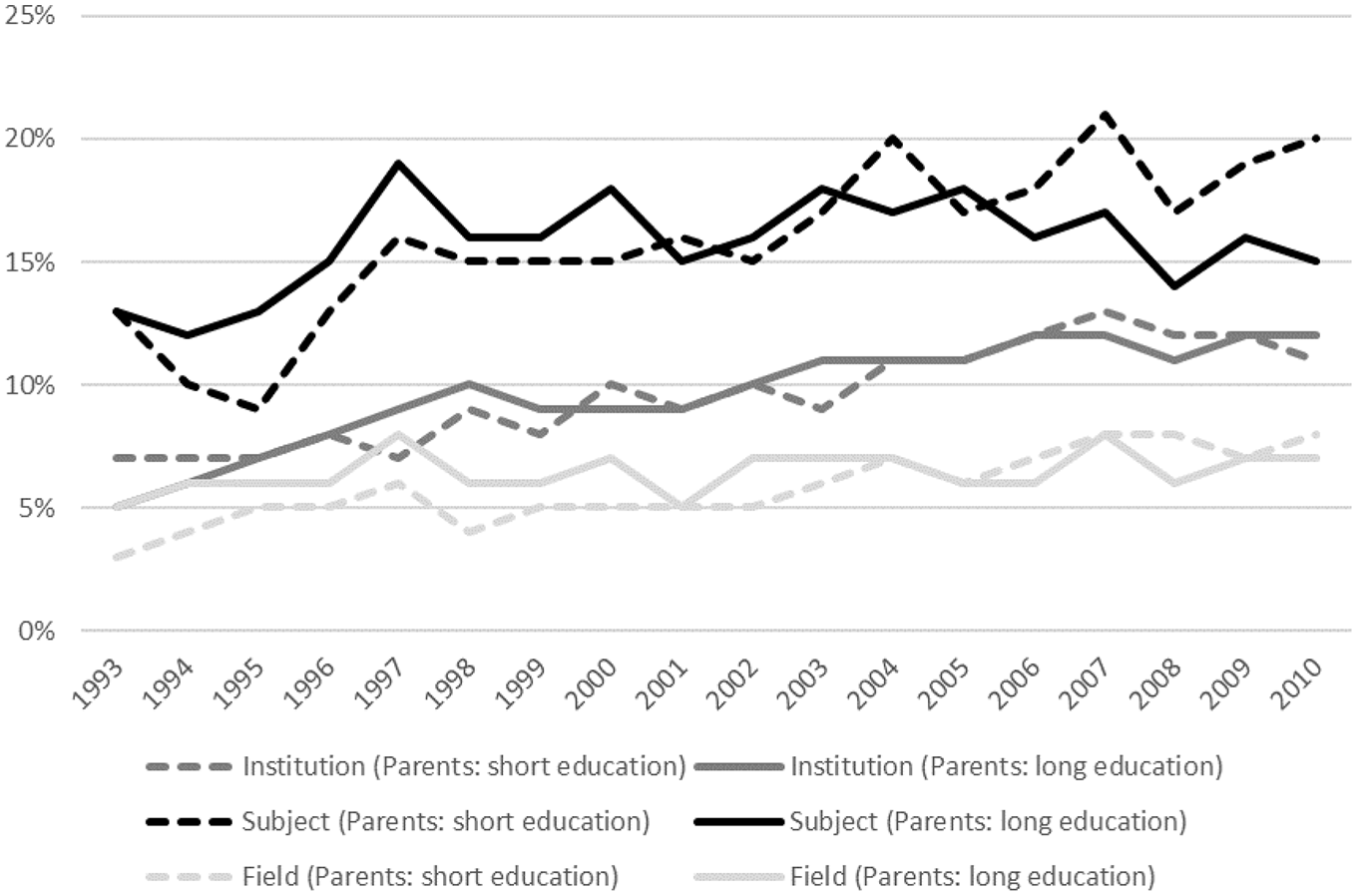
Share of bachelor’s degree holders moving into a master’s subject, field or institution different from the bachelor’s, by social background (parental education) and bachelor’s enrolment year.
Figure 7 shows the social gaps in institutional movement for individual institutions from two LPMs (before and after 2003), with social background and institution interacted and adjusting for enrolment year and GPA (Tables A3 and A4 in the Appendix). The patterns are generally similar for both periods. Two newer universities stand out as having many students who moved away after their bachelor’s degree and as having a significant social gradient in these movements: bachelor’s degree holders from the University of Southern Denmark and Aalborg University were more likely to move if their parents were highly educated. A closer examination reveals that these privileged students from highly educated homes increasingly opted for sought-after professional degrees at other institutions. 6 For example, in the later period, 44% of the privileged bachelor’s degree holders in Medicine from the University of Southern Denmark moved to the master’s programme in Medicine at the University of Copenhagen, while only 14% of the less privileged students did so (figures not shown).
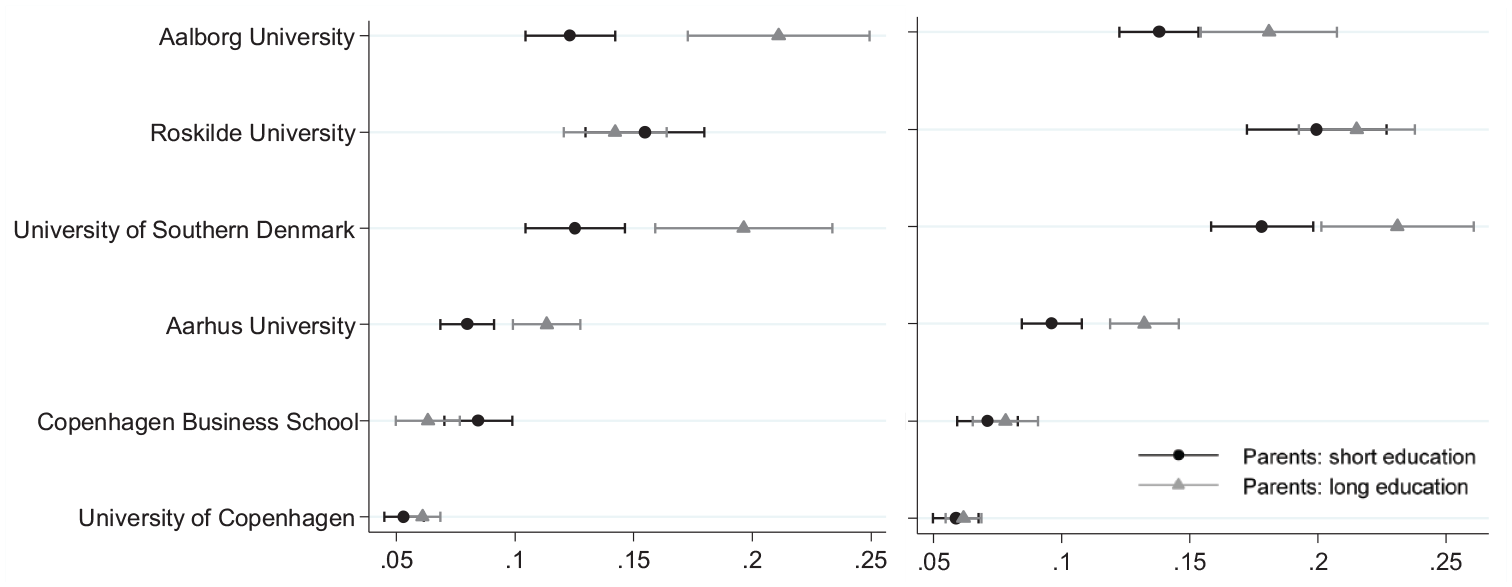
Social gaps in institutional movement from bachelor’s to master’s degrees, by individual institution. From two linear probability models (bachelor’s enrolment year 1998–2002 (left) and 2003–2007 (right)), with social background and institution interacted and adjusting for enrolment year and gymnasium grade point average.
Finally, I examine whether there is a social and cognitive gradient in the likelihood of altogether transitioning to a master’s programme. GPA may be correlated with the propensity to progress to a master’s and privileged students may be more likely to enter a master’s programme than their less privileged counterparts. Studies from Germany have found that the instalment of the Bologna structure has exacerbated this pattern (Neugebauer et al., 2016). However, social inequalities will likely be smaller in Denmark, where bachelor’s degree holders are legally entitled to progress to the designated master’s programme following the attainment of a bachelor’s degree.
Figure 8 shows the risk of not obtaining a master’s degree using a LPM interacting bachelor’s enrolment year and social background and adjusting for gender and GPA (Table A5 in the Appendix). The social progression gap was small and constant across the period: around 6%–7%. Contrary to German findings (Neugebauer et al., 2016), there is no indication that the new bachelor’s transition point should have countered social inclusion, for example by increasing the share of students from disadvantaged backgrounds only obtaining a bachelor’s degree. This is not particularly surprising given that: (a) bachelor’s degree holders are legally entitled to enter the applicable master’s programme following their bachelor’s graduation; (b) both bachelor’s and master’s students receive generous government grants while studying; and (c) there is no labour market for bachelor’s degree holders (as discussed earlier).
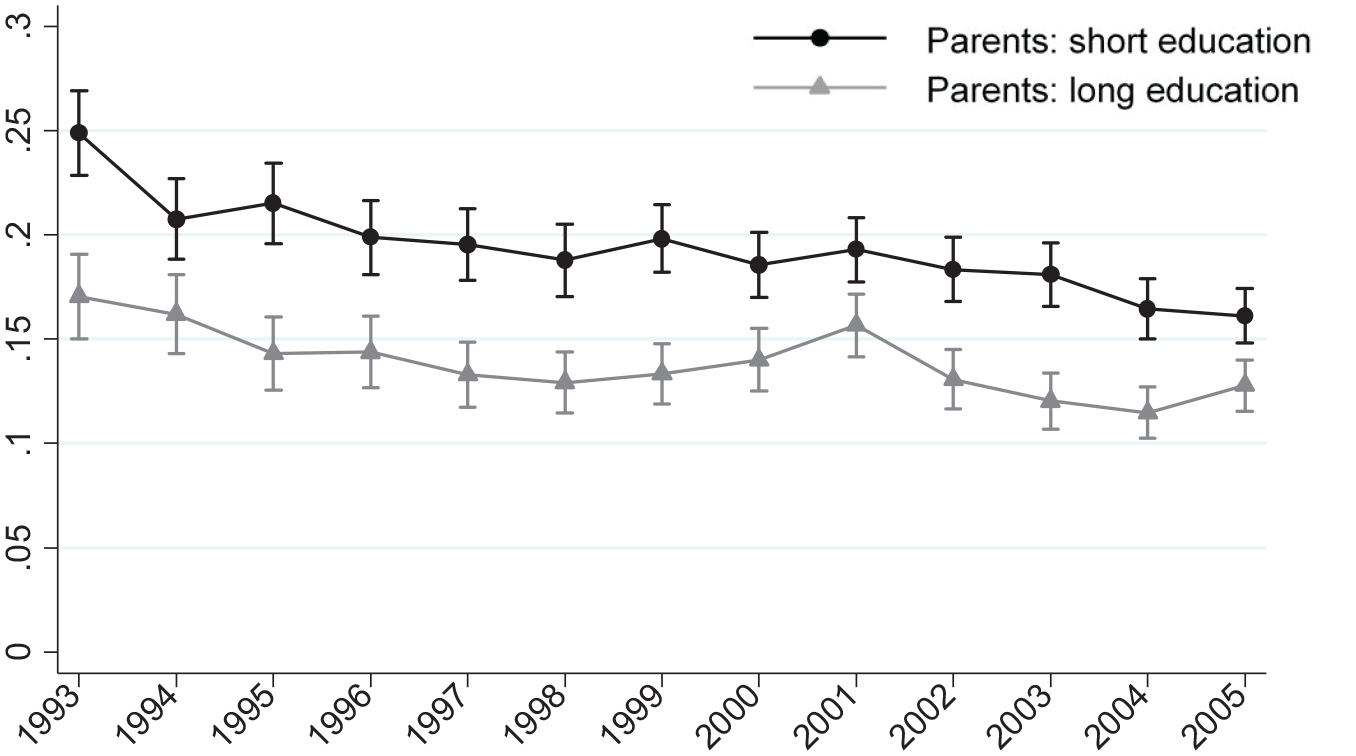
Risk of not obtaining a master’s degree. From linear probability model interacting bachelor’s enrolment year and social background, adjusting for gender and gymnasium grade point average.
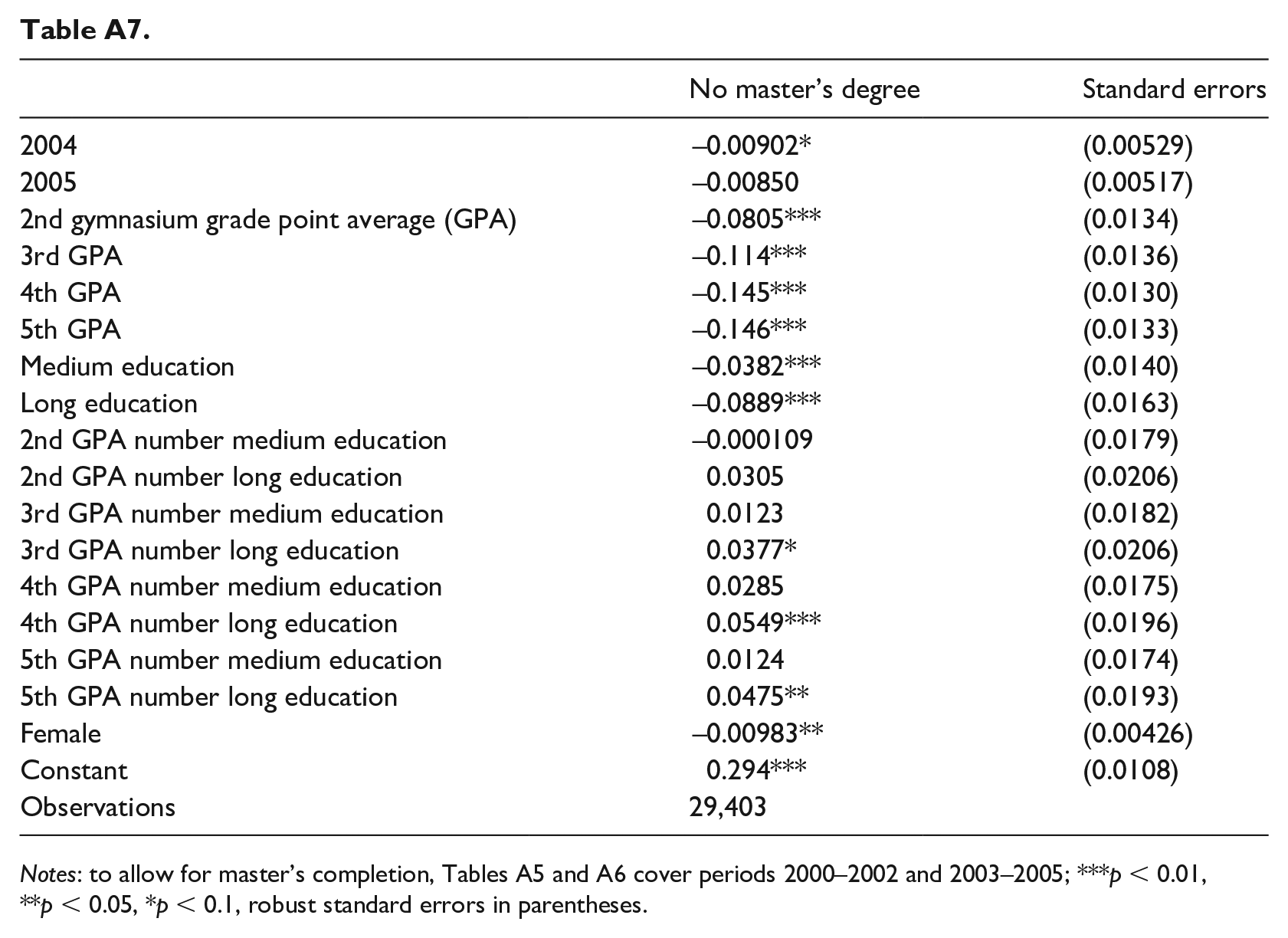
Figure 9 shows the risk of not obtaining a master’s degree using two LPMs (one before and one after 2003), interacting social background and GPA and adjusting for gender (Tables A6 and A7 in the Appendix). Low-achieving students with highly educated parents may enjoy a compensatory advantage, as the latter may help and support their educational transitions, making up for the former’s below-average academic qualifications; Contini et al. (2018) and Herbaut (2020) evidence this compensatory mechanism in HE. If this were the case in Denmark, we would observe that low-achieving students with more highly educated parents are more likely to transition than low-achieving students with less educated parents. Figure 9 does not support the presence of any such mechanism in Denmark. Apart from confirming that the likelihood of obtaining a master’s increases with GPA, the social gap was constant across the GPA range both before and after 2003. There is no indication that low-achieving, privileged students are able to take greater advantage of the new transition point than low-achieving, less privileged students. Had they been able to do so, we would observe a larger gap among the students in the lowest GPA range than we would for higher achieving students.
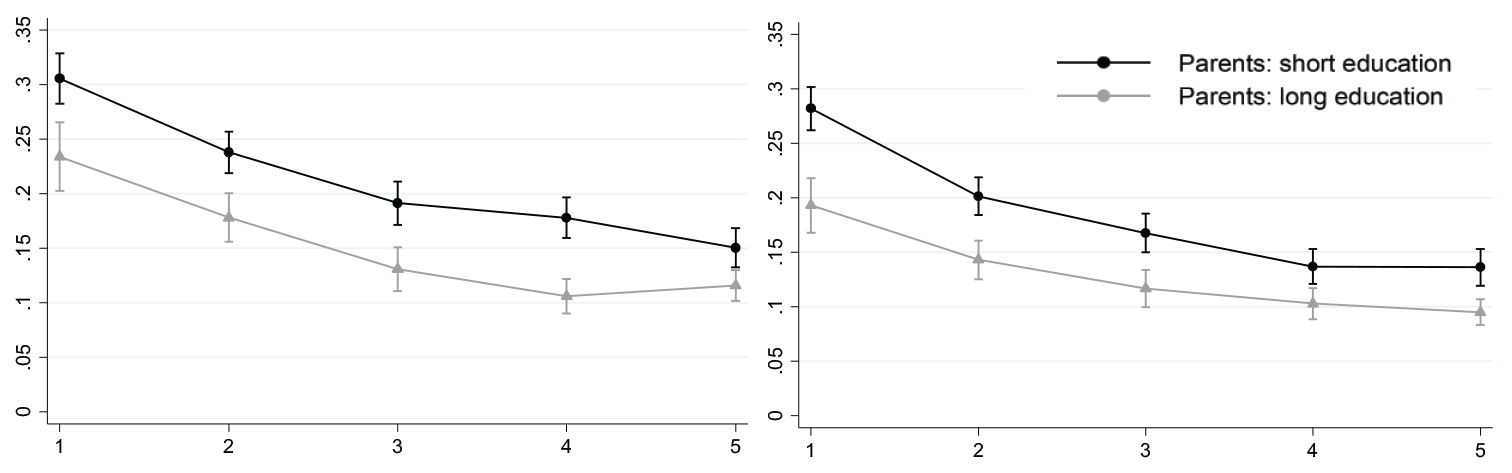
Risk of not obtaining a master’s degree. From two linear probability models (one before and one after 2003) interacting social background (parental education) and gymnasium grade point average (GPA) (quintiles), adjusted for gender.
Summary and conclusion
This article has examined whether the introduction of a bachelor’s degree following the Bologna Process has led to new patterns of differentiation among Danish university students. This examination is relevant, given that one of the aims of the Bologna Process has been to include under-represented groups in HE. The Bologna Process has affected the organization of all levels of higher education in Denmark (Brøgger, 2019; Nielsen and Sarauw, 2017; Rasmussen 2019). However, this paper has focused on the university institutions and on the implementation of the 3+2 structure only, investigating progression to university master’s programmes and movements between university bachelor’s and master’s programmes by subject, field of study and institution from 1993 to 2011, a period during which the 3+2 bachelor’s–master’s structure was introduced in Denmark. While the impact of the Bologna Process in Denmark has been far-reaching in other areas, it has had little impact on the university degree system: most programmes have carried on like de facto uninterrupted five-year candidatus programmes, as they were before the introduction of the 3+2 structure. Most students, especially at the old, traditional universities continue to move into the master’s attached to their bachelor’s. In addition, the instalment of the bachelor’s degree has not produced a labour market for university bachelor’s degree holders, with employers still preferring master’s degree holders.
Looking at movements between field of study and institution, I have found evidence of students fleeing less attractive fields and institutions in favour of more lucrative or sought-after master’s programmes. In particular, the instalment of the bachelor’s degree has increasingly enabled humanities bachelor’s to opt for master’s programmes in other fields, most often in the social sciences. In an analogous fashion, bachelor’s degree holders from the newer Roskilde University have increasingly moved away from their institution in favour of master’s programmes at the University of Copenhagen or Copenhagen Business School. These movements likely cover two mechanisms, one where holders of bachelor’s humanities degrees opt for fields of study with more favourable labour market prospects and one where bachelor’s degree holders opt for institutions with higher status and with programmes that are more favoured by employers.
These movements illustrate how some groups of students have taken advantage of the new transition point to apply for entry into master’s programmes that are deemed more attractive, whether in terms of being more prestigious, lucrative, likely to lead to employment or holding a greater share of high-achieving students. In addition, a closer inspection has revealed that students with low GPAs are particularly likely to use this opportunity, alongside privileged students with a bachelor’s degree from a less sought-after institution. In sum, I have found that these groups of students seek out advantages where advantages can be found – patterns that can be explained by the theoretical approaches outlined in the ‘Mechanisms of differentiation in HE’ section (namely EMI and relative risk aversion), analysing student movements as ways of securing privileged or desired social positions. The instalment of the 3+2 structure has made these opportunities more easily available, but we should be cautious about pinning this on the part of the Bologna Process that concerns harmonization of degree structures, as the degree structure was well in place before the formal instalment of the Bologna Process. As such, the Bologna Process to a wide degree can be seen as a continuation of already existing degree structures.
The changes considered in this paper have taken place in a country with no tuition fees, with generous government grants for students at both bachelor’s and master’s levels and where bachelor’s degree holders are legally entitled to continue into the corresponding master’s programme. All these elements would suggest that social disparities in the Danish university system are less pronounced than in other countries. Following this, I have not found that the Bologna structure has neither reduced nor exacerbated social inequalities. Indeed, the social gap in the transition to a master’s degree between privileged and less privileged students has remained constant across the period. I have also not found any evidence of mechanisms of compensatory advantage, that is, where highly educated parents compensate for their children if they have sub-standard academic qualifications. Relative to the social gap across the GPA range, low-achieving students from privileged backgrounds are not more likely to progress to the master’s level than are low-achieving students from less privileged backgrounds.
In sum, although I have not found evidence of decreasing or increasing social gaps in the transition to a master’s degree, I have identified that some groups of students use the new transition point as an opportunity to move to more attractive institutions in Denmark. These patterns may be associated with the 3+2 structure, as the instalment of a new transition point has made bachelor’s degree holders more able to move to new master’s programmes, but other factors may have fuelled these new movements, too. For example, during the period investigated, a pay-per-student financial system has given institutions incentives to attract as many students as possible and they have established many new master’s programmes in an effort to attract students from other institutions.
I have not found that the inclusion of under-represented groups has increased in a period where the Bologna Process has been implemented. From a policy perspective, shifting Danish governments have done little to accommodate the Bologna Process’ aims of making HE more inclusive. In Denmark, if we disregard lip service, there have been no policies introduced with the aim of widening under-represented groups’ participation. Denmark is not the only country to fall behind, as only a handful of countries (Austria, France, the Czech Republic, and the United Kingdom) have set up long-term targets for the participation of under-represented groups (European Commission, 2018: 170). Policy debates often put forward arguments that if we want to reduce educational inequality, we should target our efforts at children’s early years (e.g., good quality day care and primary schools), as the investment return per euro spent here is much higher than at the university level, for instance. However, these arguments may also serve as a way of diverting attention away from making HE more inclusive. Policy discussions about how to widen participation by introducing (for example) affirmative action measures such as context-sensitive admissions are needed for a more serious engagement with the Bologna Process’ social dimension.
Footnotes
Appendix
| No master’s degree | Standard errors | |
|---|---|---|
| 2004 | –0.00902* | (0.00529) |
| 2005 | –0.00850 | (0.00517) |
| 2nd gymnasium grade point average (GPA) | –0.0805*** | (0.0134) |
| 3rd GPA | –0.114*** | (0.0136) |
| 4th GPA | –0.145*** | (0.0130) |
| 5th GPA | –0.146*** | (0.0133) |
| Medium education | –0.0382*** | (0.0140) |
| Long education | –0.0889*** | (0.0163) |
| 2nd GPA number medium education | –0.000109 | (0.0179) |
| 2nd GPA number long education | 0.0305 | (0.0206) |
| 3rd GPA number medium education | 0.0123 | (0.0182) |
| 3rd GPA number long education | 0.0377* | (0.0206) |
| 4th GPA number medium education | 0.0285 | (0.0175) |
| 4th GPA number long education | 0.0549*** | (0.0196) |
| 5th GPA number medium education | 0.0124 | (0.0174) |
| 5th GPA number long education | 0.0475** | (0.0193) |
| Female | –0.00983** | (0.00426) |
| Constant | 0.294*** | (0.0108) |
| Observations | 29,403 |
Notes: to allow for master’s completion, Tables A5 and A6 cover periods 2000–2002 and 2003–2005; ***p < 0.01, **p < 0.05, *p < 0.1, robust standard errors in parentheses.
Acknowledgements
I am grateful for valuable comments on earlier versions of this paper from David Reimer, Ulrike Schwabe and Lars Ulriksen.
Declaration of conflicting interests
The author declared no potential conflicts of interest with respect to the research, authorship, and/or publication of this article.
Funding
The author disclosed receipt of the following financial support for the research, authorship, and/or publication of this article: This work was supported by the Independent Research Fund Denmark under Grant Number: DFF – 7013-00104.
