




Abstract
The Bologna process and the 3+2-degree structure presents students with several decision points in higher education, both which bachelor’s programme to choose, and whether to continue beyond bachelor. Based on a small-scale survey containing both closed and open-ended questions, this paper studies reasons the students give for entering a master’s programme. We compare students in Norway and Denmark who have entered a master’s programme in educational studies. In both countries, students mention multiple reasons for choosing to enter the master’s level, and reasons related to career and access to interesting jobs were most frequently mentioned. Additionally, academic motives and identity motives were mentioned. There are also differences between Norwegian and Danish students, but these differences are mainly linked to aspects of the transition. In Denmark, students who change institution when entering the master’s level state different reasons, while in Norway, differences are related to whether students enter a master’s programme directly or delayed. Further, differences in labour market structure also affects these transitions. These differences point to historical understandings of national status differences between degrees and institutions still being important, even if the implementation of the Bologna structure in the educational system should have led to a harmonisation.
Introduction
Choices is the main thing characterising a person’s educational path. A body of research has studied the choices of students related to the transition into higher education (Bergerson, 2009), often with a particular focus on the role of social background (see for example Mare, 1980; Reay et al., 2005). These studies in students’ choice of higher education degrees have mainly focused on the first-degree choice students make: which undergraduate degree to pursue. However, with the introduction of the Bologna process and the common degree model of bachelor-master across Europe it becomes relevant to also study the transition from bachelor’s level to master’s level.
Compared to the transition from upper secondary to bachelor’s level, as well as the transition into a PhD programme, the transition from bachelor’s level to master’s level is relatively under-studied, perhaps because students choosing postgraduate studies are considered ‘expert students’ after having completed a bachelor’s degree (or most of it) (Tobbell and O’Donnell, 2013). Some studies have explored the decision process with an interest in students’ acquiring information (Jepsen and Varhegyi, 2011; Towers and Towers, 2020).
In some countries, university programmes had been one-degree master’s programmes and in those countries the Bologna process introduced an additional decision point between the bachelor’s and the master’s level, just as it required changes in curricula and programme design. There have been some studies exploring the consequences of these changes (see the paper by Reimer and Schwabe in this issue and, for example, Neugebauer et al. (2016)), but there is still a scarcity of research concerning this. One of the few research reports on the transition rate from bachelor’s level to master’s level can be found in the Eurostudent VI data that found that most bachelor students were planning on continuing their studies, either directly or after some delay, but that there were differences across countries (Hauschildt et al., 2018: 78).
Like Germany, the Scandinavian countries needed to change the university programmes following the Bologna process. Furthermore, over the past two decades, after the introduction of the Bologna process, the number of students taking a master’s degree has risen, both in Norway and in Denmark (Börjesson et al., 2014). This is partly the result of educational policies focusing on increasing the number of higher education graduates. However, Jónasson (2006) argues that the general expansion of higher education is partly driven by students’ aspirations, as this function as a driver for expansion due to credentialism. Today one needs more and more credentials in order to enhance one’s employability. Jónasson (2006) sets up three things driving student’s aspirations: status, recognition of degrees and the opportunity to earn a living.
Thus, the transition from bachelor’s degree to master’s studies that due to the Bologna process has become a decision point for higher education students across Europe still calls for closer examination from research, particularly concerning the reasons students have for choosing to pursue a master’s programme after having achieved a bachelor’s degree. Most of the studies of students’ choices at this transition point so far have adopted a quantitative approach, leaving a need for examining the nuances and complexities in the students’ choice process.
The present paper contributes to filling this gap. It presents the results from a small-scale study of students’ reasons for entering a master’s programme. To explore these reasons we compare data from Norway and Denmark because they have similarities related to the degree structure before the Bologna process, while at the same time exposing some significant differences concerning the transition from bachelor’s to master’s level. One of these differences concerns whether students delay their transition from bachelor’s to master’s level or not.
On average, the Eurostudent study found that two-thirds of master’s students entered the master’s programme directly from a completed bachelor’s degree. However, in Norway this is true for only 46% of students entering a master’s programme, while in Denmark the corresponding proportion is 81% (Hauschildt et al., 2018: 76, figure B3.6). This difference is also evident when looking at bachelor students’ plans after completion of their bachelor’s degree: 77% of university students in Denmark state that they intend to continue within a year after finishing their bachelor’s degree, while this is only true for 47% of Norwegian university bachelor students (Hauschildt et al., 2018: table B3.4). This indicates that Danish university students in general are much more determined to continue to the master’s level, and that direct transition is much more common in Denmark than in Norway.
Our main interest in this paper is to explore students’ choice of master’s programme, and the concerns they had when deciding to enter a programme. Further, we have an interest in whether the structure of the educational system in a country affects the students’ reflections. The two systems lend themselves to this comparison because the two systems in some respects are very similar, but have substantial differences when it comes to the admission of students to the master’s level. This leads us to the following research questions:
What are students’ own reasons and rationales for entering a master’s level degree programme?
Do reasons differ according to country?
In particular, do the reasons differ according to whether students move directly from bachelor’s level to master’s level?
The higher education systems in Norway and Denmark
Denmark and Norway were originally separate countries, but for over 400 years, from 1380 to 1814, they were united as one country, or formally in a union. In that period, most of the governing of the two countries was done from Copenhagen, which today is the capital of Denmark. The University of Copenhagen was founded in 1479, and Norwegian students who wished to study had to go to Denmark. This was the only university in the union until 1811, when a separate university was founded in Oslo by the Danish king Frederik VI and named King Frederik’s University (Det Kongelige Frederiks Universitet – Universitas Regia Fredericiana).The university carried that name until 1939, when it changed the name to University of Oslo. Hence, the two universities were originally part of the same higher education system, as the university in Oslo was founded by the Danish king while the two countries were still in a union. Further, the two institutions have similar underpinnings, both stemming from the Humboldtian university ideal.
Therefore, there are still important similarities between the higher education systems in Norway and Denmark. Both Norway and Denmark have historically been seen as binary higher education systems with a divide between university degrees on one hand and university college degrees on the other (Kyvik, 2004). Both systems have roots in the Humboldt university tradition, and when the Bologna 3+2 structure was introduced both systems had to adjust. However, these adjustments were made in slightly different ways, resulting in differences at the master’s level.
Another similarity between Norway and Denmark is that they adapted to the Bologna process quite early. Both countries had already implemented the three-year bachelor’s degree and the two-year master’s degree shortly after the millennium. Further, in both Norway and Denmark, the introduction of the Bologna process and the 3+2-degree system changed the way university programmes were designed.
In essence, the Danish university study programmes had since 1993 consisted of a three-year bachelor’s degree followed by a two-years’ master’s programme, but this division into two separate levels had little or no actual effect at the universities in practice, as study programmes were perceived both by students and institutions as five-year programmes (Rasmussen, 2019). With the university reform in 2003 that implemented the Bologna process in Danish higher education legislation, the 3+2 structure obtained a more pronounced position at the universities, but at the same time the statutory right to continue to the master’s level was introduced. Thus, the distinction between bachelor’s and master’s level was emphasised, but university students were guaranteed that that they could pursue five years of university study.
In Norway, university education was already divided into an undergraduate part and a graduate part before the introduction of the Bologna process and the 3+2-degree system. Prior to the reform the undergraduate part lasted for four years, while the graduate, master’s level lasted for two years. Hence, in the Norwegian system, the introduction of the Bologna process implied that the study time required to reach the master’s level of education was reduced from a total of six years to five years (of efficient study time), as the bachelor’s degree was shortened by a year.
In both countries, the changes introduced by the Bologna reform affected the relationship between the bachelor’s and the master’s level. Further, both countries have an elaborated welfare model where students receive financial support during their studies in form of grants or loans on favourable terms. Also, the process for general admission to higher education is similar in the two countries. Admission to the bachelor’s level is administered centrally and is primarily based on grades from upper secondary education. Admission to the master’s level is administered locally in both countries, and there are differences in requirements for admission to the master’s level.
Nonetheless, changes in the overall educational patterns of the population in both Norway and Denmark have meant that pursuing education up to the master’s level has become more attractive. As a greater share of the youth cohorts become students in higher education, the value of credentials is reduced and there is a push for taking more and more education in order to distinguish oneself (Thomsen, 2015) and to enhance employability. As mentioned earlier, Jónasson (2006) argues that credentialism is to some extent also driven by students and their aspirations, which is why this study focuses on reasons for continuing to the master’s level.
Differences between the two countries
While the two systems are similar in many ways, there are also significant differences between the two countries, which may have contributed to creating different framework conditions for the transition to master’s level. Historically, Danish higher education has been strongly segmented, with universities being institutions that carried out research as well as teaching, with strict admission criteria for their mainly five-year programmes. University colleges provided shorter professional degrees and did not carry out research. Hence, university colleges did not have the right to provide master’s degrees, which was reserved for the universities (Rasmussen, 2004). In 2000, the Danish parliament passed an Act that substantially changed the institutional landscape for the medium-cycle professional degrees (primary school teachers, nurses, social workers, etc.). These degrees were offered at designated institutions (teacher training colleges, nursery schools, etc.), but the Act merged these approximately 100 institutions into around 20 Centres for Higher Education (CVU). These institutions were further merged into seven university colleges (professionshøjskoler) with an Act passed in 2007, still offering shorter professional programmes. However, these changes did not concern the fundamental division of labour between institutions, substantiated by universities offering master’s programmes and PhD studies, and university colleges offering professional bachelor’s degrees.
Norway used to have a similar division of labour, as the universities were more research oriented and provided master’s degrees and university colleges provided only short professional degrees. However, because of the implementation of a comprehensive reform in 2003, adjusting Norwegian higher education to the Bologna process, university colleges got the opportunity to apply to become a university. There were several prerequisites which an institution had to meet in order to be able to become a university, and one of these was to establish master’s level degrees. Hence, following the reform, university colleges could also provide master’s degrees, and as several university colleges have become universities the binary divide has eroded (Kyvik, 2009). So, while there still is a status difference between universities and university colleges in Denmark, this status difference has diminished in Norway, making universities and university colleges more alike, both in how they are organised and the status of degrees they provide (Pinheiro and Kyvik, 2009).
In Denmark, a professional bachelor’s degree and a university bachelor’s degree are formally equal in terms of status, but they differ when it comes to admission to the master’s level. Students completing a university bachelor’s degree have a statutory right to priority admission to one of a minimum of two master’s programmes that the university has identified as the natural continuation of the bachelor’s programme. For some of the attractive programmes, all available study places at master’s level are taken by students with a statutory right to admission.
Conversely, a professional bachelor’s degree does not necessarily grant access to a university master’s degree. Students with a completed professional bachelor’s degree would need to apply for admission to a university master’s programme and their academic qualifications would be assessed before entry to the master’s programme. In 2019, only 10% of students entering a university master’s programme had a professional bachelor’s degree. 1 Hence, despite the policy ambition to create better opportunities for professional bachelors, a professional bachelor’s degree is not necessarily accepted as sufficient for entering a university master’s programme, except in a few cases, such as some engineering programmes and education. Consequently, many professional bachelors in practice experience the two institutional types as entirely separate, reflecting the consistent division between universities and university colleges found in the Danish legislation (cf. above).
To have students moving between universities and university colleges is much more common in Norway, and there have been several aims to further integrate the two sectors (Pinheiro and Kyvik, 2009). This is visible through different changes: firstly, university colleges can provide master’s programmes, and students coming from a professional bachelor’s programme may be eligible to apply to a university master’s programme in the same field of study. At universities, admission to the master’s level is administered locally, and all applicants who fulfil the requirements for admission (usually by majoring in the subject of the master), also those coming from outside the university, are eligible to apply and compete for admission. Hence, this implies that admission to the master’s level is a competition for admission for all applicants in Norway, and this admission is based on results acquired in higher education. Thus, the main differences between the two countries’ admission rules for master’s level is that in Denmark most students are admitted to the master’s level via their admission to a bachelor’s degree, where admission is made based on results from upper secondary education. In Norway, admission to the master’s level is done separately from the bachelor’s admissions system, and admission at this level is not based on results from upper secondary education, but rather on results accomplished in higher education.
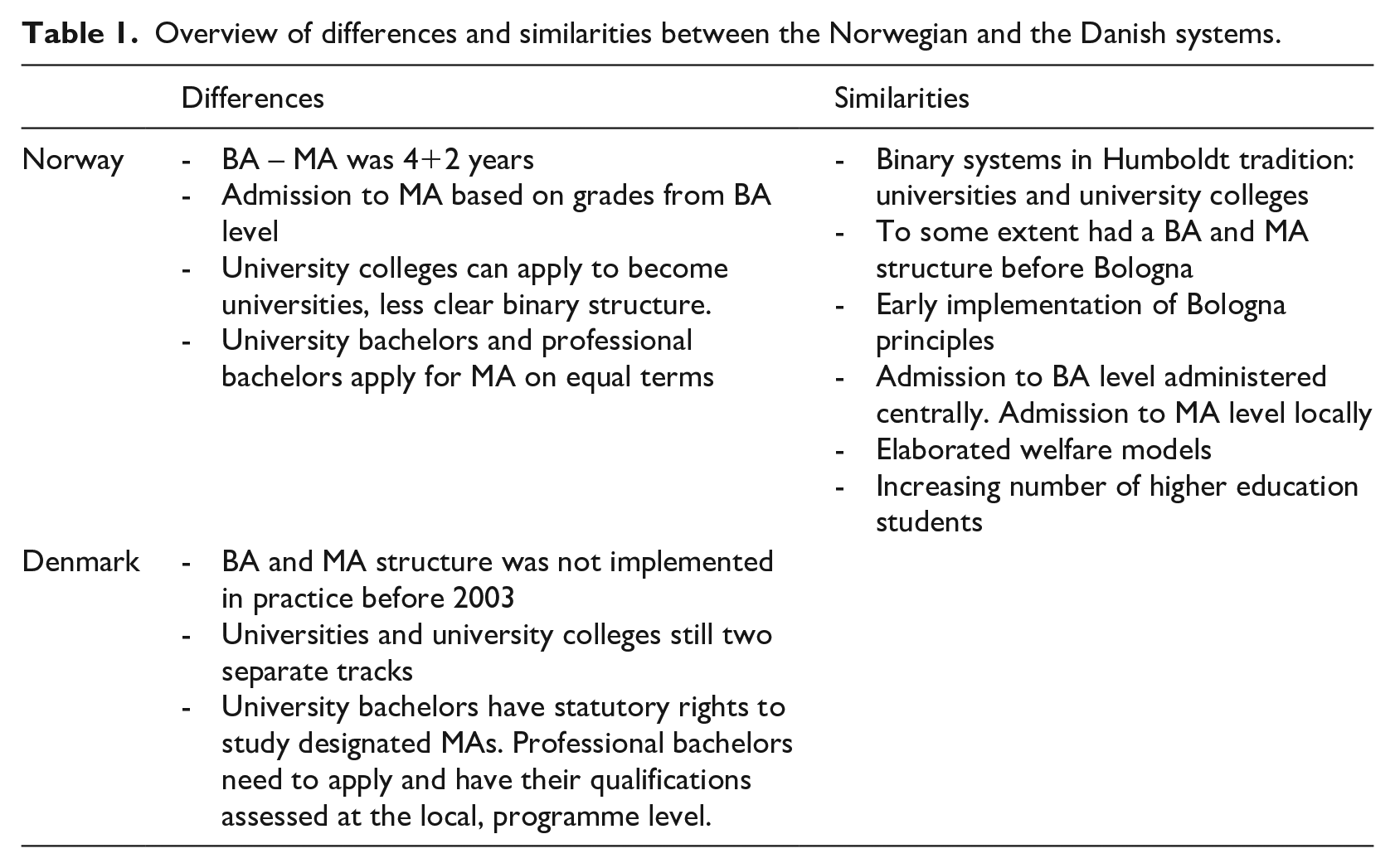
A brief summary of differences and similarities is presented in Table 1.
Overview of differences and similarities between the Norwegian and the Danish systems.
Theoretical approach: motives for entering a master’s degree
As already mentioned, the transition from the bachelor’s degree to master’s studies has received limited attention in research. We therefore draw on theory and research on reasons for choosing to study in general.
A dominant line of research into choice of undergraduate programmes has interpreted young people’s choice of higher education within a rational choice framework (Stocké, 2019). This framework implies that students always will aim to preserve their social status and avoid downward mobility (Breen and Goldthorpe, 1997). They do this by choosing the best option available to them (usually measured in financial terms), and thus function as rational actors. However, this framework is mainly designed to explain why students from educated backgrounds tend to go on to higher education more often than students from families without higher education. As this relationship is not the focus of this paper, in addition to that explanation being better suited to explain difference at the bachelor’s level, we will not use this as our theoretical framework. However, if one rather considers this as the utility the person would receive from various higher education options it might be more relevant (DesJardins and Toutkoushian, 2005).
Further, in her review of research on college choice, Bergerson (2009) found that there was a move away from developing comprehensive models for understanding college choice to study more specific groups of students. This research emphasised the need for capturing the complexity of the choice process (Bergerson, 2009: 37). A similar focus on complexity has emerged in inquiries into the choice of science, technology, engineering and mathematics (STEM) higher education, often with a particular focus on identity issues and the perception of choice as a process where the young people consider and weigh different elements against each other.
Cleaves found that students enrolling in post-compulsory science ‘make the choice in several ways that involve a variety of organizing principles’ (2005: 483). Holmegaard (2015) argued that choices were made in a process of negotiations and a construction of a choice narrative related to their ideas of whom they would like to become and how they expected the choice would be perceived by friends and family.
Bøe et al. (2011) used the expectancy-value framework (e.g. Eccles and Wigfield, 2002) for analysing young people’s decisions to enter STEM study programmes or not, and related this framework to theories of youth and the late-modern zeitgeist (Beck and Beck-Gernsheim, 2002; Ziehe, 1991). They argued that issues related to interest and to identity were important for the students’ choices. Likewise, Jensen and Henriksen (2015) analysed 784 short, qualitative responses to an open-ended survey question using expectancy-value framework. They found that about two out of three of the responses mentioned interest and enjoyment as important factors when choosing which bachelor’s programme to enter. Less frequent, but still mentioned by almost every fifth student, was the utility value of the programme, by rendering them a high income or a wide variety of job opportunities.
The strong emphasis that students put on interest is found in many studies, but, as pointed out by Vulperhorst et al. (2020), young people often have several interests that they need to balance in the process of choice. They found that in this process of balancing different interests, students also considered the future perspectives of pursuing a particular interest, including job opportunities, as well as their abilities. In a comparison of English and German undergraduate students’ orientations, Budd (2017) found that students ‘were to differing degrees ex- and intrinsically, instrumentally, and altruistically motivated – sometimes all at the same time’ (35).
This simultaneous presence of different reasons and factors and the need to balance them is indeed an important point made in several studies. In a study of Danish high school students’ choice of higher education, one student expressed the quintessence of what was at the heart of most of the students’ choice reflections. When deciding what to study, the student would consider if she found the field of study interesting, whether she could imagine working and having a job within that field for the rest of her life, and whether she experienced being good at it (Ulriksen et al., 2013: 312).
Career perspectives are also linked to another societal development: the emphasis on employability in higher education policy (Clegg, 2010). This focus implies that students as well as institutions are expected to prioritise future employment as the pivotal concern in choice of study. However, Budd (2017) makes the point that students do not necessarily comply with the political discourse in the country, and Brooks et al. (2020) found that students’ ideas about the purpose of higher education combined more dimensions where possible future employment could be one. Therefore, even though students are expected to focus on future employment and indeed are concerned about what possible future the choice might lead to (Henderson et al., 2019), this need not be the main concern in their choice of programmes.
We expect that the reasons given by students for choosing a master’s programme will have similar patterns to those found in the research on students’ choice of higher education. We expect that the students would balance different aspects, including their interest in the content of the programme, the narratives they can construct related to the choice, the possible futures they can imagine related to the choice, their ideas of whom they would become, and the cost and risks related to the choice. We would expect the different concerns to relate to one or more of the following three motives:
Academic motives: interest in the subject and in learning more
Identity motives: whom would I like to become, and what possibilities does this programme offer in this respect?
Professional motives: specific aspirations concerning a profession (e.g. medical doctor), general aspirations (e.g. something with people or something creative) or more general (e.g. can I get a job?).
Data and methods
Selection of study programmes
In the introduction, we presented the reasons for comparing Norway and Denmark. However, because of the differences between the two countries, we had to select a field of study where there in Denmark is some variation in the transition patterns of bachelor students and some transition between professional bachelor’s degrees and university master’s programmes; that is, an atypical or extreme case (Flyvbjerg, 2006). Selecting a typical case would have offered little insight into the concerns of students with delayed entry, because there are so few in Denmark.
We therefore decided to do the study on educational science master’s programmes (hereafter: education) which is a discipline in Denmark that to some extent admits students with a professional bachelor’s degree. According to Eurostudent VI, this is the field of study, along with health and welfare, with the highest proportion of students delaying the transition to master’s level (Hauschildt et al., 2018).
In Norway, we selected a master’s programme at one research-intensive university that admits students who have completed an undergraduate degree majoring in pedagogy. This implies that students who have a general bachelor’s degree in pedagogy qualify for admission, as well as students who have completed a teacher’s degree which contains at least 90 credits of pedagogy or didactics.
In Denmark, we selected two different master’s programmes in education at two different research-intensive universities. At one of the universities, the master’s programme in education had a long tradition of admitting students with a professional bachelor’s degree, and who after some years of work within their profession had decided to pursue a master’s degree. The other programme had only recently begun to admit students with professional bachelor’s degrees. For both programmes, students who have taken their bachelor’s degree at the university have a statutory right to admission. Students with professional bachelor’s degrees or university bachelor’s degrees from other universities would have to apply for admission.
Data collection
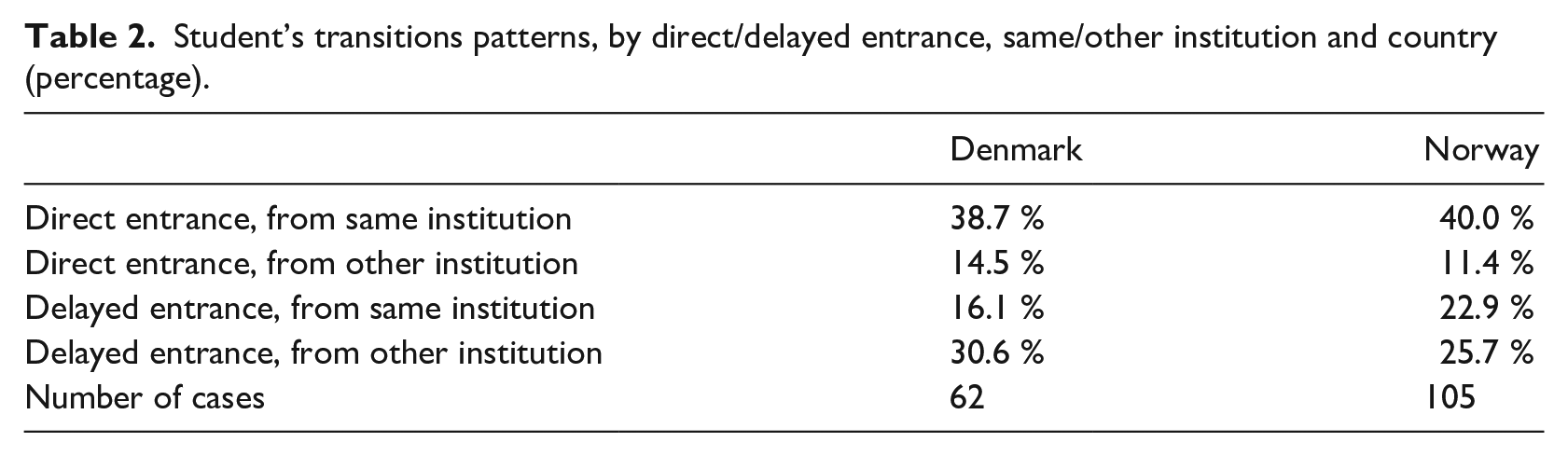
To collect data, we used a short survey, distributed through a digital online format (Mentimeter and Socrative). The students were approached during a lecture early in the first semester of their master’s programme and answered the questions online while in class. This means that only students attending lectures had the opportunity to take part. Hence, the drawback of this approach is that you only get those attending the teaching as potential participants. On the other hand, among those attending the lecture over 85% in all groups filled out the survey. The high response rate points to the respondents being representative for students who actively attend lectures. The number of respondents is shown in Table 2.
Student’s transitions patterns, by direct/delayed entrance, same/other institution and country (percentage).
The survey
The survey consisted of multiple-choice questions with fixed answering categories and questions with open text response. The multiple-choice questions concerned whether they entered straight after completing their bachelor’s degree, and whether they had moved to a different higher education institution. A third question presented the students with nine possible reasons for why students would decide to enter a master’s programme. The respondents could select as many reasons as they wished to give them the opportunity to indicate if there was one reason or several reasons for starting a master’s degree. The opportunity to select more than one reason was in line with the research on choice of bachelor’s programme presented earlier, and we expected that this might also be the case for the choice of master’s programmes. Because the students could select several reasons, the ranking between all the reasons is not so relevant. Rather, we will consider the reasons that are most and least common among the students. The survey further included an open-ended question: ‘Why did you choose to take a master’s degree?’
Education is a heavily female-dominated field of study: less than 20% of students are male. We therefore decided not to ask students about their gender.
Analysis
The quantitative results of the multiple-choice questions were analysed using descriptive statistics, comparing the answers from students in Norway and Denmark. This is partly due to few respondents, but also since more advanced analyses are not called for to conduct the analyses.
The primary focus of the analysis is on the open-ended, qualitative responses, which were analysed using an inductive approach. The responses were divided into four groups depending on whether or not they were entering with a delay, and if they changed institution (cf. Table 2). Next, we identified themes in the responses within each of the four groups. This generated a large number of themes that were in the next step collected into two overarching themes with a number of nuances within each. These two themes concerned a focus on professional or academic aspects. A third theme related to the respondents’ thoughts about being students. In the following, we will organise the presentation of the results within these three themes.
Thus, the inductive analysis reflected reasons that were found in research on choice of bachelor’s programme as well. Although the coding, as noted by Braun and Clarke (2006), does not occur in a theoretical vacuum and our previous theoretical knowledge therefore was present when we made the initial coding, the similarity in the reasons for choosing a bachelor’s and a master’s programme was at the same time what we expected.
Results
We focus on two formal aspects of the transition: if students make the transition directly or not, and if they continue at the same institution. The idea is that these two aspects are important, as students continuing directly at the same institution may be seen as if students perceive the programme as one, as a continuous run which could have been organised as one programme.
The quantitative data shows that among the Norwegian students entering a master’s degree in education, 63% had their undergraduate degree from the same institution, while in Denmark the corresponding proportion is 55%. The difference is not statistically significant. Hence, the proportion of students transitioning from bachelor’s level to master’s level at the same institution is quite similar in Denmark and in Norway. This finding might be linked to the field of education, as the master’s level in this field of study in both countries opens up for students with professional degrees to enter the programme. This allows for more transfers between institutions.
Additionally, for the proportion of students moving directly from one level to the next, we also find no clear difference. As shown in Table 2, about 4 out of 10 students entered a master’s programme directly at the institution where they received their bachelor’s degree. If we add the share entering directly in a master’s programme at another institution, the total of students entering directly amounts to a little over half of all respondents (53% for Denmark, 51% for Norway).
Hence, Table 2 shows that students in education in Norway and Denmark are similar in their transition patterns to the master’s level, both in terms of continuing at the institution where they obtained their bachelor’s degree and whether they enter directly or not. This provides a good foundation for cross-country comparison of the reasons stated by students who have made the transition to the master’s level.
As stated, we used two different approaches to map the reasons for making the transition to master’s level. First, the students were prompted with a list of reasons, and then asked an open-ended question.
When presented with the list of possible reasons, students in both countries commonly named several reasons, and the majority named at least three different reasons. This suggests the complexity of the choice process; that it is not just one thing affecting the choice, but a range of reasons why students choose to continue at the master’s level. Table 3 displays the share indicating each reason, and as they could select as many reasons as they wanted the columns do not sum to 100%.
Frequency of reasons for entering a master’s degree in general (percentage).
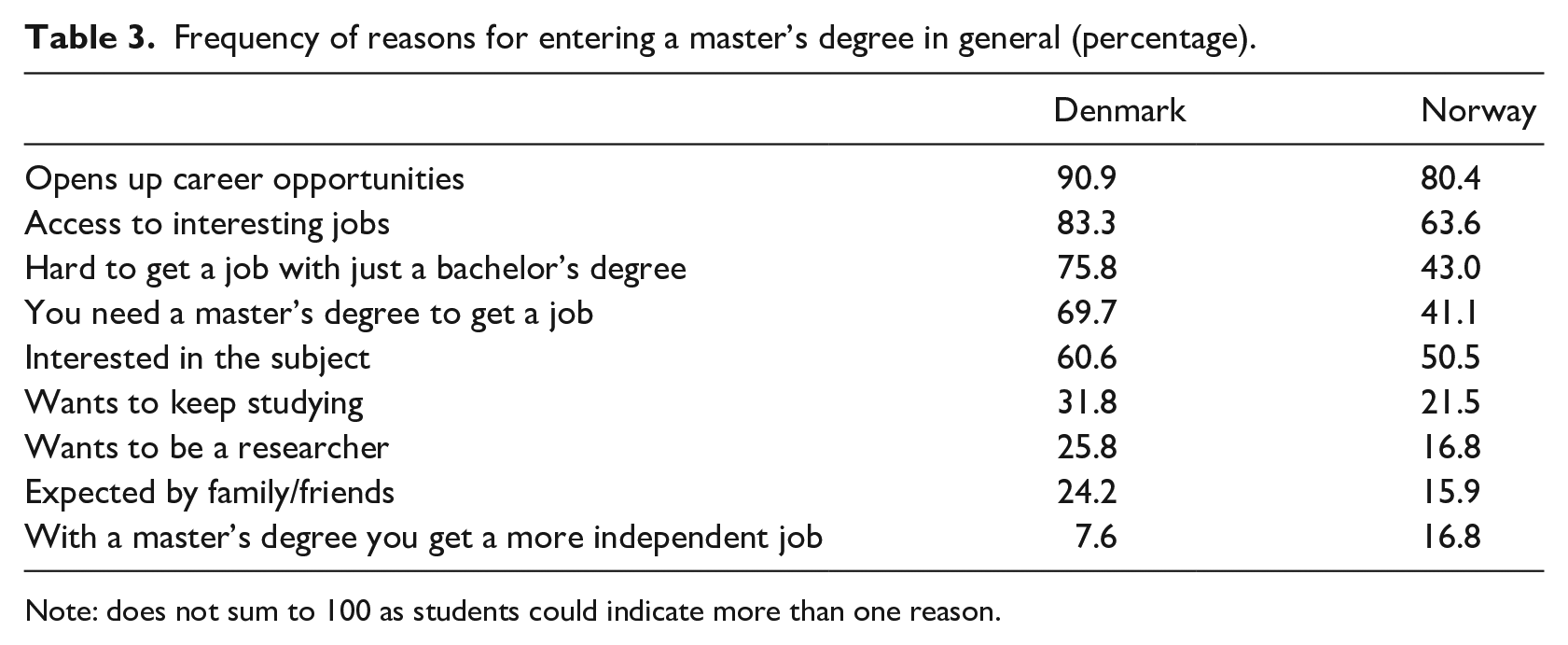
Note: does not sum to 100 as students could indicate more than one reason.
In general, Danish students named more reasons than Norwegian students did. Hence, except for one reason, the last one on the list in Table 3, all items were selected by a larger share of the Danish students than of the Norwegian students. Still, the responses show some common patterns. Students in both countries rated career opportunities and access to interesting jobs as the most important reasons while wanting to be a researcher and ‘expected by family and friends’ were rated as the least important reasons.
However, there are some interesting country differences. A substantially higher share of Danish students selected ‘hard to get a job with just a bachelor’ or ‘you need a master’s to get a job’. It could appear that the Norwegian students in line with the Danish students see a master’s degree as an access to career opportunities, but that the Norwegian students do not perceive it as necessary for getting a job to the same extent that Danish students do. This may be linked to the general labour market situation in the country, as a clear majority of students in Norway do get a job upon degree completion, and unemployment among higher education graduates is low. Conversely, Norwegian students tend to rate ‘interest in the subject’ comparatively higher than Danish students.
One possible interpretation of the fact that three out of four Danish students focus on that they cannot get a job with a bachelor’s degree is that, for students attending a bachelor’s degree at a university, is it expected that they will continue to the master’s level. Hence, they put more emphasis on holding a master’s degree in general. Further, these students may have internalised the idea that they are supposed to continue to the master’s level and therefore do not see the bachelor’s degree as enough. As such, this finding can be seen to illustrate the statutory right to admission to master’s level that Danish university bachelor students have. However, this may also be an effect of the labour market situation in Denmark. The professional bachelor’s degrees by definition point towards particular professions (nurse, social worker, etc.) while, according to a committee scrutinising the Danish university studies, there is no discernible specific labour market for university bachelors (cf. Udvalg om bedre universitetsuddannelser, 2018).
Analysis of Norwegian qualitative data
A clear majority of students state more than one reason for taking a master’s degree, and this finding cuts across all groups, regardless of whether they entered directly or delayed, and whether they entered at the institution where they received their bachelor’s degree or not. Most common are reasons linked to general interest in the subject, as well as to career opportunities that a master’s degree opens up: ‘To get more opportunities and more interesting jobs, and that I did not feel ready or competent enough for working life yet’ (Delayed, same institution).
The quote illustrates that students consider many different aspects when they choose to take a master’s degree. Even though reasons related to career are more prominent, they are usually not the only reasons, and in the cases where the multiple reasons are mainly career or job related, there might be different aspects of the career that students are considering when making the argument for why they take a master’s degree.
Professional interests
The most commonly cited reason by far for taking a master’s degree is some form of professional interest; that a master’s degree opens up career opportunities – to more jobs, different kinds of jobs or to better-paid jobs. Students in all groups cite this kind of reason, but in slightly different ways. Students who did not enter at master’s level directly and are now returning to higher education are somewhat more oriented towards getting something that they did not have in their previous degree. It may be opening up to more types of jobs, more qualified jobs as well as other types of jobs than their earlier degree qualified for. In some cases, students are actively stating that they use the opportunity to take a master’s degree to reorient their career, because they wanted to change jobs or they were fed up with the job they had: Took my master’s degree to have a career that is different from what I had done before. (Delayed, same institution) Personally, I wanted to develop in a different direction. I wanted to take a master’s degree to open up more career opportunities. (Delayed, other institution)
However, the general idea of a master’s degree opening up career opportunities is prominent in many comments. Students who continue at master’s level directly after completion of their bachelor’s degree are oriented towards general employability. This implies that they believe that specialising and further qualifying themselves through a master’s programme will make it easier to find a job once they have completed their degree. One interesting finding here is that it is only students who continue directly who use the word ‘specialisation’ and who comment that a bachelor’s degree is very general. This implies that university bachelor students do not see exactly what kinds of jobs they may qualify for, and therefore would like to further specialise themselves through a master’s degree. A few students also indicate that a master’s degree is needed to get a well-paid job or to get an interesting job, and this finding cuts across groups, which means that both students who enter their master’s degree directly and those who delay the transition to the master’s level consider salary. Hence, by further qualifying themselves they hope to increase their chances of getting a job as well as increasing the chances of getting a better-paid job.
Academic interests
Quite a few students point to their interest in the subject field when justifying why they have entered the master’s programme. Academic interest is expressed in terms of general subject interest, but also interest in acquiring more knowledge in general. One could think that the comment mentioned above about the need for specialisation, made by students making the transfer directly to master’s level, would be linked to academic interest. However, this is only true for one case, where the connection between specialisation and more knowledge is made. In all the other cases the arguments linked to specialisation can be interpreted as a way to become employable.
The identity of being a student
Some of the students who make the transition to master’s level directly are focused on the idea of staying a student, either because they like to have the identity of being a student, or that they did not feel done with studying: Because I did not feel finished studying, so I took a master’s degree. (Direct, same institution) I like being a student and because I have to have a job someday. The subject is also quite interesting. (Direct, same institution)
These two statements can on the one hand be interpreted as the same thing, namely that having an identity as a student is the driver to continued education. However, the first statement may also be interpreted as academic interest in general, while the second statement points more to an identity as a student, embracing the opportunities which lie in being a student. In total, though, this again points to the fact that students may have several different reasons for taking a master’s, and nuances in similar statements might point to different reasons.
Analysis of the Danish qualitative data
Like the Norwegian students, most of the Danish students mentioned more than one reason when they wrote an open response about why they chose to enter a master’s programme.
Professional interests
Professional interests are mentioned by most of the students. Many of the students entering directly from their bachelor’s degree expressed that there is no labour market for students with a bachelor’s degree only. One student wrote that ‘the idea of a bachelor labour market is an illusion’, while another wrote that ‘the job opportunities with a bachelor are few’. One compared with Norway: Because I know that it is not easy in Denmark to find an acceptable job related to one’s BA from university, compared to other countries, including Norway, where it is possible to enter the labour market after having completed a BA in education. (Direct, same institution)
Some students had the impression that there was an expectation from the labour market and the ‘global competitive society we live in’ to pursue a master’s after the bachelor’s degree: ‘I do not feel that I would be able to explain (or defend) at a job interview why I chose not to take an MA. It seems to be a necessary add-on to a university BA degree’ (direct, same institution). For many of the students, continuing to a master’s programme after having completed a university bachelor’s degree did not really appear as a choice at all, or at least as a choice of necessity.
Another frequent reason given was that a master’s degree opens up to more jobs or more interesting jobs, in line with the comment about ‘acceptable job’ quoted above. The more general notion that a master’s degree is a road to more and better jobs is more common among students delaying their entrance to the master’s programme and those entering from a different institution: ‘I chose a master’s degree to expand my opportunities at the job market, so that I can work in more areas and at more levels’ (direct, different institution). Some of the students with delayed entry from a different institution emphasised achieving a qualitative difference in their professional life, either by changing job or by developing the present job situation. A couple of students mentioned that they wished to become better at what they were doing.
Thus, a vast majority of the students mentioned professional reasons for entering a master’s programme, but there were differences between the groups of students concerning what aspects of the professional life they emphasised. University bachelor (same-institution) students hardly perceived it as a choice. Students with a professional bachelor’s stressed that a master’s degree opened up more and better job opportunities, but also that they could work with qualitatively different tasks within their field.
Academic interests
Quite a few of the students mentioned academic interests as a reason for entering a master’s programme. They mentioned that the discipline was interesting, and that they had an interest in the field of study. Some students mentioned a wish to learn more about the discipline, and other students mentioned that they wished to develop as individuals. A few mentioned particular topics, but most comments were general, like having an interest in the discipline or a wish for immersing oneself into the discipline.
Students with a university bachelor’s degree entering directly appeared to mention academic interests less frequently than the three other groups, maybe because they did not perceive it as a choice as such. A rather large group of students entering directly from the same institution mentioned that entering a master’s was the natural thing to do. The students saw the bachelor’s and the master’s programmes as integrated: ‘I feel it appears obvious that coming with an academic [university] bachelor’s degree, that you continue into your MA’ (direct, same institution). Another student described it as ‘a part of completing what I had set out to do’. It was, as a third student wrote, ‘natural and necessary’.
Another aspect was that some students did not feel sufficiently prepared or competent for the work life if they stopped studying after the bachelor’s degree. These students, who were students entering from the same institution – that is, mainly university bachelors – experienced that the bachelor’s degree was incomplete in terms of being prepared for the labour market.
No students entering from a different institution mentioned that entering a master’s programme was natural.
The identity of being a student
Some students wrote that they liked studying and being a student, or that they did not feel they were done with studying. These comments were made by students entering from same institution as well as from different institutions, but, overall, it was not a very common comment. Two students with delayed entrance from a different institution had broader perspectives related to identity. One mentioned that as a kindergarten or pre-school teacher working ‘on the floor’ one had very little say concerning the work and was not heard further up in the system. This could be interpreted as a wish to change the position at work and through this obtain more agency. Another student wrote: ‘Felt something new had to happen, so I made a leap into it, without having any idea about what I am going to use it for or what the programme as such entails’ (delayed, other institution). The motivation for this student appears to be rooted in issues related to identity and a wish to develop herself or himself. This could involve a change of career as well, but the main driver appears to be a personal, identity-related wish to change.
Comparative conclusion
The findings in the analysis show many similarities in the reasons or motivations Norwegian and Danish students give for entering a master’s degree. First, in both countries, students give multiple reasons for entering a master’s programme, regardless of whether or not they are prompted with a list of reasons to choose from or if asked to write short, qualitative responses. Hence, it is not only when presented with a number of possible reasons that students pick more than just one. When asked to provide a short account of their reasons for choosing, most of the students offer more than one reason. Thus, the decision to take a master’s degree is based on more than one single concern.
This is in line with earlier findings on students’ choice of higher education in general and that the choice of study programme is a process of balancing different interests and concerns. The reasons offered by the students in this study included professional, academic and identity components. The identity components concerned the identity as a student as well as the future professional identity.
A second similarity was that in both Norway and Denmark, professional concerns were dominant in the qualitative responses. The choice of whether to continue to a master’s programme or not was related to reflections about the students’ future possibilities in the labour market. In neither of the countries did it appear as if the students were aiming at particular future jobs or careers, except for the few mentioning an interest in doing research. Instead, their interests seemed to be to widen their labour market opportunities because a master’s degree would give access to more jobs, but also to get access to what the students called better jobs. What ‘better’ meant in this context was rarely specified, but some students mentioned having more influence, working more theoretically and getting access to a more prestigious job. These refer to qualities of the job as well as to a wish for status.
The very short open-ended answers do not allow us to conclude in much detail and nuance about how the students perceive and relate to this job orientation. The answers suggest that future job opportunities are important for the students when choosing a master’s programme, particularly the qualitative dimensions of the job. These students are not looking for any job or employment, and they are not looking for status irrespective of the qualitative aspects of the job. They are looking for jobs and careers they would find interesting and satisfying, which does not support the idea of credentialism.
The students’ focus on future careers aligns with the political focus on employability and could suggest that students are instrumental in their choices. However, the emphasis on qualitative aspects of the jobs, combined with the students mentioning more than one reason, rather supports the assumption that complexity and balancing of different interests is not just an issue when choosing a bachelor’s study programme (cf. Budd, 2017). Students have several ideas about the reasons for studying at the same time. This does not present a conflict, but a nuanced perception of higher education where instrumental concerns co-exist with personal interests and goals (cf. Brooks et al., 2020).
The responses also revealed some differences between the responses of students in Norway and Denmark. These suggest that differences in historical educational structures indeed affect the way students reflect on their choices. In Norway, the difference between students concerning reasons given for entering a master’s degree is mainly related to whether the student enters the master’s programme directly or delays. In Denmark, the most important distinction appears to be whether the students come from the same institution or not. This reflects a structural difference between the educational systems in the two countries.
In the Danish sample, change of institution in most cases relates to students entering with a professional bachelor’s degree. Common for students changing their institution is that they all have to apply to get admission to the master’s level, while those continuing at the same university usually would be entitled to a place in a master’s programme without having to reapply. In Norway, all students, regardless of which institution they come from, have to apply and compete for a place in the master’s programme.
This difference has two implications. First, the Danish students entering a master’s programme directly after completing a bachelor’s degree at the same institution were all university students. They perceive this transition as ‘a natural thing’, and that they are only completing what they have commenced. This suggests that the idea from the previous degree structure at Danish universities, where a university degree was a five-year programme, still exists as an idea. Moving on to a master’s programme is perceived as the natural continuation for students who hold a statutory right to access to the master’s level.
The structure in Norway communicates to the students that moving from bachelor’s to master’s level is indeed a new beginning where all students apply on equal terms, given that they fulfil the formal requirements for access to the master’s programme (usually linked to a particular major or specialisation at the bachelor’s level). In a way, the Norwegian structure is like the situation for Danish professional bachelor students, only in Norway it applies to all students.
This difference in structure also reflects another difference concerning the institutional landscape. In Norway, the distinction between universities and university colleges has become less strong over the past couple of decades, as both institutional types can offer master’s programmes. In Denmark, this is not the case as master’s programmes only are offered at the universities. Thus, the two tracks – the professional at the university colleges and the academic at universities – are reflected in the way students perceive the movement to master’s level, as an active choice or not.
The second structural issue affecting the students’ responses and their educational trajectories concerns the labour market. Many of the Danish students entering a master’s programme directly at the same institution mention that they cannot see any labour market for university bachelors, and therefore continuing into a master’s programme is a necessary, natural choice in order to get a job. Most of the Danish students changing institution were students with a professional bachelor’s degree from a university college who wished to change their future career. For them, there was a professional bachelor labour market, but they wished to move away from that.
In Norway, many returning students also state that they would like to change their career, usually after having worked for a while. The difference compared to Denmark is that university bachelor students in Norway can get a job based on their bachelor’s degree. This difference in whether the main variation is between students entering directly or not (in Norway) or changing institution or not (Denmark) was reflected in the Eurostudent survey (Hauschildt et al., 2018) where Norwegian students were more inclined to delay their transition from bachelor’s to master’s level.
Implications for understanding the Bologna process
This paper adds to the under-researched field of choice of master’s programmes. The analysis showed that the choice to enter a master’s programme was based on several balancing reasons. Future career and job opportunities were important reasons for most but not all of the students, just as academic and identity factors played a role. This finding corroborates previous studies of students’ choice of higher education undergraduate programmes and a recent study about European students’ perception of the purpose of higher education (Brooks et al., 2020). This suggests that the students’ choice of master’s programme should be considered as equally complex as the choice of undergraduate programme.
Whether the choice of master’s programme differs between students in countries with free higher education and subsidies for students, like Norway and Denmark, and in countries with tuition fees requires further research. There is, however, reason to assume that the complexity of choices also beyond the choice of bachelor’s degree is universal, which in turn has implications for the Bologna process, and therefore needs to be reflected in policy. Thus, our paper also adds to the limited research on how students act out the changes following the Bologna process.
There are two ways in which our findings are relevant for the Bologna process and the ambition of constructing a European Higher Education Area through harmonising the curriculum structure to a 3+2 model. Firstly, our findings signify that the status of different types of degrees, as well as the status hierarchy of institutions in a country, may have an overarching impact on students’ reasons for entering a master’s level degree. This implies that even though bachelor’s and master’s degrees formally are equivalent across countries, as the Bologna process postulates, historic ideas of status differences between degrees or institutions may still influence access to and reasons for entering the master’s level. Even in two systems as similar as the Norwegian and the Danish, sharing historical roots, there are differences in status between higher education institutions, as well as between programmes. These differences have implications for the way students move within the higher education area.
Secondly, our findings suggest that there is a limit as to how far it is possible to create one common higher education area across Europe, simply by stipulating a common degree structure of 3+2. The structure of the degree programmes is only one element shaping students’ choices. We found that differences in the conditions for students’ choice processes were located within the educational system (e.g. the statutory right for Danish students to enter a master’s programme) as well as outside the educational system (whether the students believed there was a labour market for bachelor graduates in their country or not).
This means that the implementation of the 3+2 structure is not only a question of changing the educational structure. The educational system and the students are embedded in other systems that affect students’ possibilities and decisions. The implication of this is not necessarily to try to change the other systems. Rather, it should be to appreciate these differences and to acknowledge that the common higher education area may be inhabited in different ways by different Europeans.
Footnotes
Declaration of conflicting interests
The authors declared no potential conflicts of interest with respect to the research, authorship and/or publication of this article.
Funding
The authors disclosed receipt of the following financial support for the research, authorship and/or publication of this article: This work was partially supported by the Independent Research Fund Denmark under Grant DFF – 7013-00104
