




Abstract
The period of confinement in the spring of 2020 is of great interest in highlighting the parental work of educational support. While parental support is usually more diffuse, and is secondary in relation to what is done at school, occurring at different moments of daily life, home schooling during lockdown revealed new ways of helping and framing schoolwork. This article looks at parenting practices in higher socio-economic status (SES) families in France. Based on a massive questionnaire (N = 31,764) and a series of additional interviews (N = 15) conducted during lockdown, the aim is to investigate what makes parental assistance specific in high SES environments. Our findings show that such families have less difficulty carrying out schooling at home. What makes them consider this experience as ‘not a big deal’, as they say, is that they have organisational and pedagogical (i.e. objective) resources that enable them to respond to its challenges. In addition, however, we show that home schooling is experienced in these families as less contrived. In effect, they use schoolwork techniques that help to obscure (from others, but also from themselves) the effort that schoolwork requires.
Introduction
What do home learning practices during lockdown tell us about the creation of educational inequality? From work on the seasonality of learning (Downey et al., 2004; Von Hippel et al., 2018), we know that educational inequality increases during periods of school interruption, especially in the summer holidays when social gaps in learning are at their widest.
Admittedly, the home learning period during lockdown is somewhat unusual. Although autonomous (families had to fend for themselves), schoolwork was compulsory, unlike during holiday periods when pressure to do homework drops off. It should be added that France, more than most other countries, placed great emphasis on the need to keep up with schoolwork during the confinement period (Cordini and Caciagli, 2021). While some countries explicitly chose to suspend new learning, or even assimilated the period of confinement with a school holiday, France diverged through its injunction to maintain school continuity (la continuité pédagogique), repeatedly emphasised by French school leaders.
However, this compulsory schooling encompasses very different home learning practices, depending on social background. We might therefore assume that inequality increased sharply during the lockdown from March to June 2020. In France, national assessments of pupils conducted in September 2020 (particularly for CP/CE1, the first reading lesson classes) provide an initial objective picture of such inequalities. The purpose of this article is different. We are less interested in measuring inequality than in apprehending the feelings and documenting the practices of the home learning period. There is no doubt that the period of confinement affected the daily lives of families and that the need to keep children home-schooled proved very difficult for some parents. However, the experience varied greatly according to social background. The aim of this article is therefore to show how families coped differently with the home-schooling obligation.
During the lockdown triggered by the COVID-19 pandemic, the author conducted a questionnaire survey with parents of pupils in the French school system (N = 31,764). The questionnaire was supplemented by a set of semi-directive interviews with parents from higher SES (N = 15). The survey gave rise to a simple observation: the period was experienced differently by families, depending on their social background. More specifically, breaking down the impression of ‘experiencing difficulty’ according to socio-economic status provides the data in Table 1.
Parents reporting ‘experiencing difficulty’ in the home learning setting.
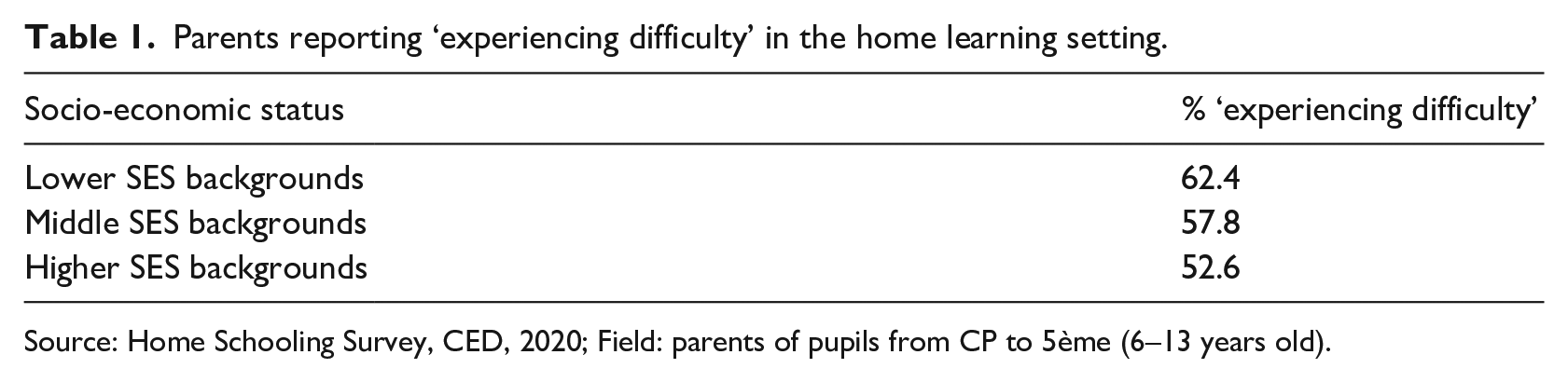
Source: Home Schooling Survey, CED, 2020; Field: parents of pupils from CP to 5ème (6–13 years old).
It is noteworthy that high SES families clearly encounter fewer difficulties in home schooling. Similarly, in interviews, these parents often tended to minimise teaching or relational difficulties, describing the two months without attendance at school as ‘not a big deal’.
What does this ‘not a big deal’ mean? What advantages do higher SES families have that help them to cope with the lockdown experience?
Certainly, these families tend to have the cultural and educational resources that enable them to deal more easily with this unprecedented situation. Parents spontaneously displayed the willingness and skills needed to organise their children’s schoolwork within a stable spatio-temporal framework and to support them in the acquisition of school input, as illustrated in the first part of this article.
However, if, according to their claims, the effort these families needed to make was not so great, it may also be because it was not experienced as an effort. This is reflected in the invisibility of school effort mechanisms observed in such socio-economic environments. In the second part of the article, therefore, I examine the processes by which parental support can significantly reduce the laborious aspect of schoolwork. In particular, I show that the use of humour or recourse to informal learning situations enables them to take on this role and helped them to manage the period of confinement.
Methodology
At the beginning of April 2020, I launched an online questionnaire for parents. I decided to extend my outreach to parents through schools. As the French education system is highly centralised, I was able to distribute the questionnaire on a very large scale by going through the administrative email addresses of schools. Illustrating the significant interest in the topic, by the time I closed the questionnaire shortly before school resumed on 11 May, I had collected 31,764 responses from parents. The sample is broadly representative of the parent population, although I noted an over-representation of teachers, no doubt because the questionnaire generally passed through teachers before reaching parents. I therefore corrected my sample a posteriori by underweighting the teachers’ answers in order to obtain a representative social background. I used national statistical categories (the classification of the PCS, SES indicator by INSEE, the French institute of statistics) to make this correction.
The questionnaire contains 120 questions. The first part of the questionnaire (45 questions) covers information on the parents’ socio-demographic profile, their general approach to their child’s schooling, and the child’s learning conditions. The second part (75 questions) relates to their home-schooling support practices during lockdown, including various, more specific, issues (lockdown conditions, material conditions and work organisation, transmission techniques, resources and teaching choices, difficulties encountered, relationship with the child). When parents had several children, they were asked to answer for just one of the children, specifying which profile they had chosen.
As my focus was on school monitoring practices, I restricted my analysis to parents of pupils from ‘CP’ to ‘5ème’ (in the United Kingdom, more or less equivalent to primary school through to Year 8) (N = 19,454). The classes preceding CP and early reading involve very different forms of home-based learning. Moreover, after 5ème, I noted a quantitative decline in parents’ monitoring behaviour (Figure 1).
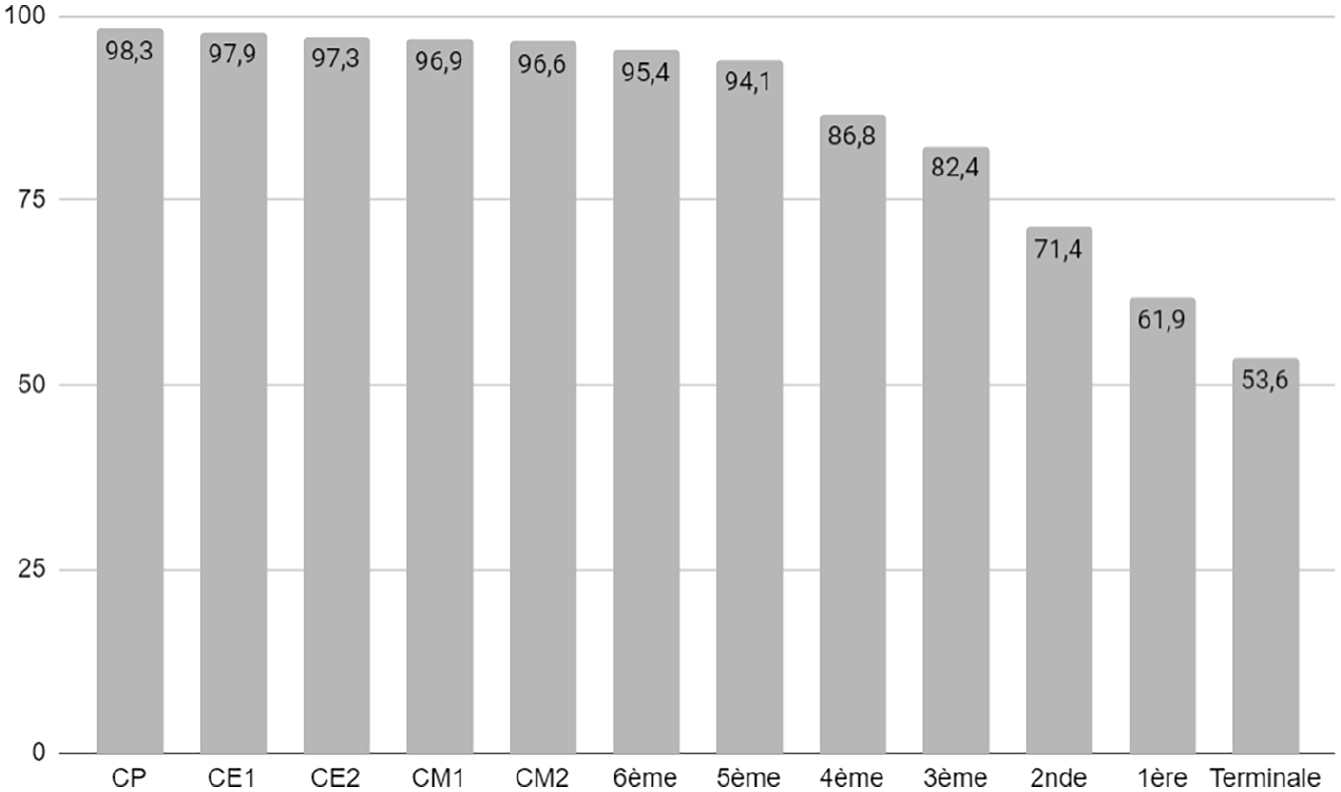
Percentage of parents (N = 31,764) declaring that they ‘supervise their child’s work’, according to the child’s school year.
In the rest of the article, I mainly measure the impact of SES on support practices. I thus constructed an SES variable from the two-digit PCS variables completed by parents on the questionnaire. For single parent families, I used the PCS of the responding parent. For two-parent and stepparent families, I combined the PCS of both parents according to a normative method which I detail in the appendices. I also decided to create a division between lower and higher SES. This choice could be criticised for neglecting internal diversity within each category. Obviously, within the lower SES backgrounds, blue-collar and white-collar workers adopt various learning support practices, just as forms of parental support vary among the higher socio-economic categories (Ball et al., 2004; van Zanten, 2009). However, I opted for a principle of SES background uniformity in order to identify relatively clear-cut contrasts in practices.
While the questionnaire is very rich and precise (it includes questions that are absent from large questionnaires on schooling produced by major statistics institutes), and benefits from a wide range of respondents, in some points it suffers from the haste with which it was written. It was sometimes difficult to exploit certain variables because the questions or the methods of answering them lacked relevance, or because they could not be tested and corrected beforehand. This is a key concern at present, and while we may regret some hasty methodological choices, the data are nonetheless of high quality and I am grateful to have been able to collect as much information – even imperfect – in this highly unusual period.
The questionnaire can also be criticised for being administered online as it meant that many families were prevented from responding due to lack of digital equipment or familiarity with the digital tool. This is an inherent bias of online surveys and of questionnaire surveys more generally. Nevertheless, I believe that the results obtained, which confirm the existence of inequalities between social backgrounds, are likely to have been even more consequential if I had been able to reach the populations that did not respond to the questionnaire.
In order to address the shortcomings of the questionnaire approach, I extended the data from the questionnaire after 11 May by way of a series of semi-directive telephone or face-to-face interviews with higher SES parents (N = 15). The aim was to gain qualitative insights into the support practices adopted by these social groups. One original feature of this article is that the statistics enabled us to objectivise certain findings regarding parents’ transmission-of-school-knowledge practices, generally identified by qualitative surveys using interviews and observations. However, certain learning input choices and support techniques, embedded in complex interactions, can only be understood through interviews. I questioned the parents about how they set up the work and their approach to school knowledge. During the interviews, I strongly encouraged parents to relate anecdotes. As the lockdown period was relatively long and involved a certain number of routines, I wanted to highlight the key facts.
‘It’s not a big deal’: Objective resources used by higher SES families to compensate for school closure
The higher SES families have certain educational and learning resources that make it easier for them to manage a home-schooling situation. On closer inspection, we found that families were not left entirely alone during the school closure period. Over 90% of the parents told us they had the time needed to devote to school support, with no differences noted between social backgrounds. Moreover, they had numerous educational tools and resources at their disposal, including school learning content proposed by teachers, online resources, special educational TV programmes devised for the occasion, etc. Curiously, therefore, it was less a lack of time or absence of educational resources and more the abundance of the latter that appeared to be a challenge. The loss of temporal reference points and the seemingly longer time available during lockdown had to be managed (‘Spatial and temporal organisation of schoolwork’) and parents needed to be able to select and make good use of the educational content on offer (‘Knowledge transmission’).
Spatial and temporal organisation of schoolwork
‘We wanted to recreate a mini school’: Caroline, Maxence’s mother (CE2, third grade), told us. Caroline meant that she wanted to recreate the space and scheduling conditions of school at home. This was by no means obvious. Lockdown throws time and space into confusion: time is sometimes so distended that we do not know how to occupy it, while, on the contrary, space is confined within the home, so it is difficult to make room for all the activities. The challenge is therefore to implant a school sanctuary in a disrupted domestic time and space.
From a disciplinary point of view, the school institution in France was established according to a very specific temporal and spatial order (Durkheim, 1956; Foucault, 1991, p.171 ff.). Studies on the school format show how the pedagogical relationship has become the dominant educational form, clearly emphasising the export of a spatio-temporal school framework (Vincent, 1994). School time and space are neither random nor neutral. How do certain parents manage to recreate a school space-time in the domestic setting? What resources are deployed by high SES families to facilitate their children’s work?
Table 2 shows daily schoolwork time by SES. Contrary to expectations, we can see that it is the parents from the lower SES who devote the most time to home schooling. How can this apparent paradox be explained? In fact, inequality between social backgrounds can probably be observed less in terms of the availability of time, or time spent on schoolwork, and more with respect to the uses made of this learning-oriented time.
Average daily school-at-home work time by socio-economic status.
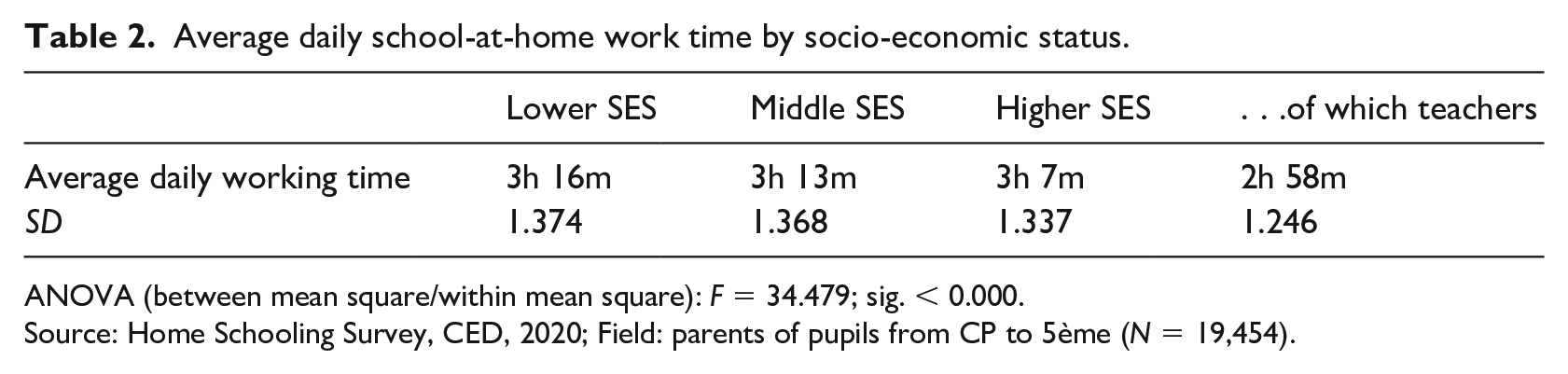
ANOVA (between mean square/within mean square): F = 34.479; sig. < 0.000.
Source: Home Schooling Survey, CED, 2020; Field: parents of pupils from CP to 5ème (N = 19,454).
Indeed, Table 3 shows some of the differences in the organisation of school time:
Structure of schoolwork time according to socio-economic status.
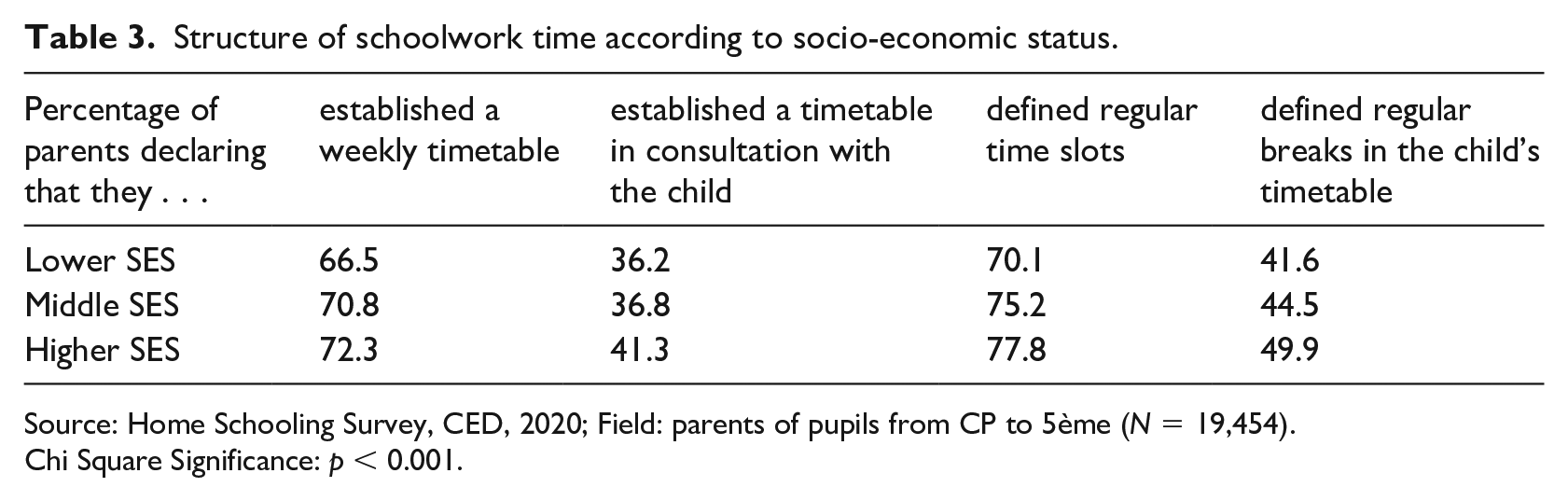
Source: Home Schooling Survey, CED, 2020; Field: parents of pupils from CP to 5ème (N = 19,454).
Chi Square Significance: p < 0.001.
It is noticeable that ‘working-class’ parents made less use of techniques for structuring school time. They did not always define regular working hours and tended not to formalise schoolwork with a timetable.
Studies on forms of time and socialisation over time (Lahire, 1995; Beaud, 2002; Millet and Thin, 2005; Lareau, 2011) describe a more spontaneous, that is, less ascetic (immediate satisfaction is less rejected) and less structured (time divisions are not formalised) relationship with activities in the working classes. Consequently, children in working-class families are socialised through forms of experience of time at variance with the schedule associated with the logic of learning at school. ‘Elastic time’ (Beaud, 2002), that is, absence of a structured rhythm of life and lack of temporal organisation of family activities, runs counter to the demands of school time and partially explains the school failures that can be observed in working-class environments. The ‘elastic’ nature of time also probably explains the dilution of working time in working-class groups, as observed in Table 2. With no well-defined work schedule, school activities tend to extend beyond the objectives.
Conversely, in higher SES families, there was more frequent use of a weekly timetable. Figure 2 shows the timetable of Maxence (CE2, father a teacher in an art school; mother a physiotherapist):
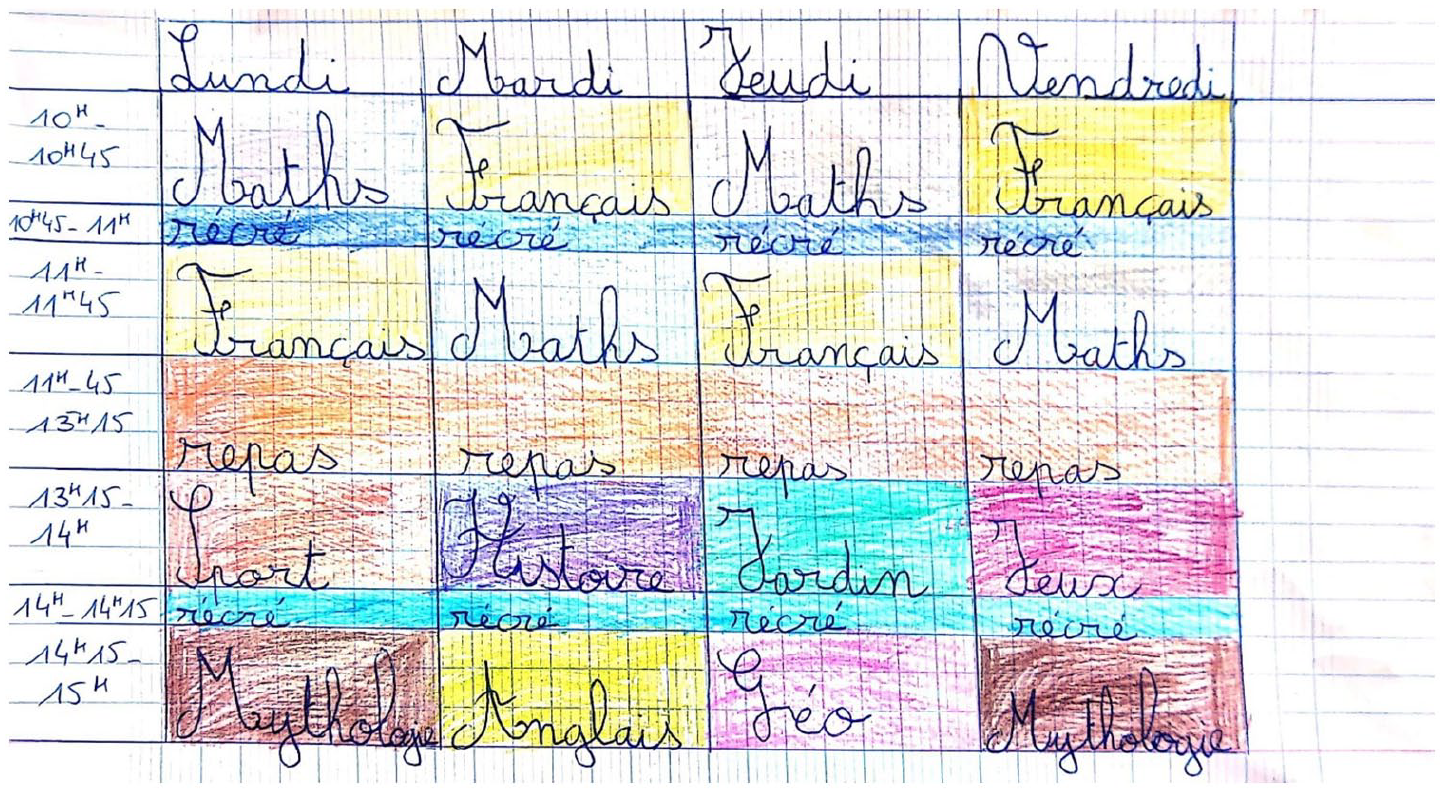
Maxence’s timetable (CE2).
Maxence’s schoolwork time is divided into four sessions of 45 minutes each over a four-day week. Each session corresponds to a learning area. Maxence also used a very clear colour code to indicate this. Maxence’s daily working time is shorter than usual (only 3 hours a day), but the timetable covers the four-day school week during the whole school period. Caroline, Maxence’s mother, explained that it was closely modelled on habits adopted at school. It is formally very similar to Maxence’s normal school timetable (lessons interspersed with recess and mealtime breaks), it respects the Wednesday and weekend breaks, and no schoolwork is done during the holidays. Moreover, although it would have been possible to compress the short working hours into half days, Caroline justifies the choice of a decentralised timetable: We could have put everything into the morning [Monday to Friday mornings]. But what do I do with the children if we don’t plan anything for them in the afternoon? [. . .] You mustn’t give them too much free time, they end up getting bored, don’t they? It’s smarter to spread it out like the school timetable, I think, it helps them to keep the same rhythm and covers the days better. Occupying their time every day was an important issue.
The timetable is thus designed according to two principles: first, to respect the usual timetable structure which the children are familiar with at school and, second, to avoid too much ‘free’ time, which can lead to idleness and disincentive.
We can see that the core lessons (French and maths) are scheduled in the morning. This was an element imposed by Caroline, who uses the notion of ‘concentration’ to justify her choice: ‘the children are fresher in the morning, it’s easier, [. . .] it’s more efficient, we’re all more concentrated.’ Caroline is well informed regarding recommendations by child psychiatrists on school rhythms and spent much of the interview time explaining them to me.
Another striking fact I observed was the way parents worked hard to defend their schedule. The format of the sessions was maintained by using time-delay techniques (slowing down the pace of a session) or postponement (starting again the next day). The sessions were also strictly timed. There was no compromise on the timetable, which had to be respected.
Various techniques were adopted to allow for temporal scansion and alternating between work and free time. Many rituals were introduced derived from school habits. In a deliberately ridiculous way, for instance, children would line up to go into the room in the house where they worked. Before starting the class, one or two children would be called by name. The day’s weather forecast was drawn. The mobile phone was rung to signal the end of a lesson. The parents clapped their hands to end playtime. These little rituals might appear pointless since they do not perform the same function as that usually assigned to them at school, where they serve a disciplinary purpose (getting children to line up to restore calm). Here, such rituals are useful to mark temporal breaks, to make time divisions, and to separate working time from free time. Each day, they serve as markers, helping to structure the days and to maintain the schooling effort over the entire lockdown period.
Working time is thus strictly organised in higher social background families. It is formalised in writing, reproduces the school calendar, allocates defined learning time slots, and alternates work and free time in a balanced way. This temporal organisation reflects a regime of supervision of children’s schooling, typical of the middle-high SES background (Lareau, 2011).
Similar differences between social backgrounds can be observed in the organisation of spaces for schoolwork at home, as shown in Table 4.
Differences in the spatialization of schoolwork.
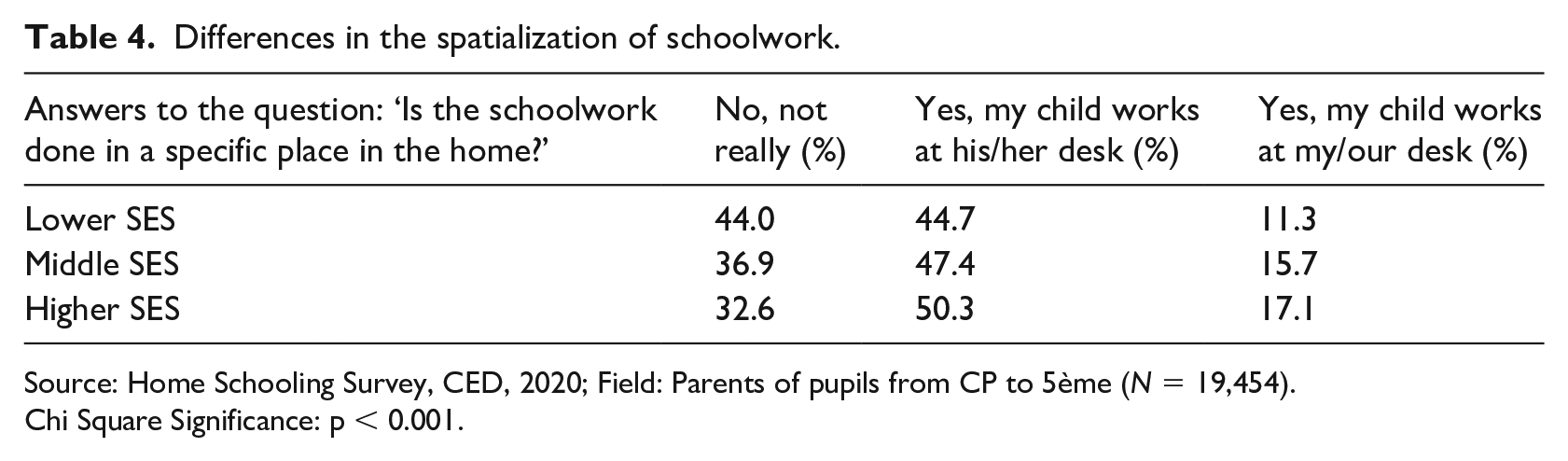
Source: Home Schooling Survey, CED, 2020; Field: Parents of pupils from CP to 5ème (N = 19,454).
Chi Square Significance: p < 0.001.
It should be noted that home schooling tends to be more spatialised in the upper echelons of society: these families are more likely to reserve a specific space for the children’s schoolwork. Such differences are most probably linked, above all, to housing inequalities. According to the INSEE (RP 2017, complementary exploitation), 59.9% of P&Ms live in homes of over 80 m2, compared with 49.1% of blue-collar workers and 45.3% of white-collar workers. The size of the home obviously has an influence on the feasibility of dedicating a specific space to schoolwork. Case studies of children from precarious families show how cramped housing can be experienced: lack of space impinges on the capacity to make oneself available for schoolwork (Lahire et al., 2019: 939). More generally, there is a widely acknowledged negative effect of domestic population density (number of people per room) on educational success (Goux and Maurin, 2005; Solari and Mare, 2012).
In this respect, within the constraints of the domestic space, it seems that spatial trade-offs differ according to social background. In particular, a differentiated disposition to the ‘pedagogisation of space’ has been demonstrated (Lahire et al., 2019: 943 onwards The well-off families I met did indeed create separate spaces for schoolwork during the lockdown period. In spacious homes, the work is organised in a separate room (study, guest room, playroom, or the child’s room when large enough). However, in high SES households, this logic of spatial separation of schoolwork sometimes takes another form. In smaller homes, parents do not take over a more or less free area of the house, but instead, create one, assigning it to the children’s schoolwork. This was the case for Alban, who lives with his partner and their two children in a 65 m2 three-room flat. (Alban is a human resources manager, his wife a social worker, and their two children are in CP and CM1, equivalent to first and fourth grade). Given the space constraints, the family decided to prioritise schoolwork: I preferred to give them room on my desk [a large desk in the parents’ bedroom] and I would sit in the dining room when I was working. I made myself a small space, it wasn’t great, but it was good enough for the time I was in lockdown. But for them, it was brilliant, they had their own room for school, with their things staying there all the time, no need to move them. I think it wasn’t bad, in the end they had their own classroom in a way . . . (Alban)
The domestic space was thus clearly differentiated, with a specific learning function assigned to a place in the home. The aim, described by Alban, was to avoid confusion between activities, especially leisure and work: ‘When you close the bedroom door, you’re no longer really in the house, it immediately creates a working atmosphere.’
Alban continued talking about the need to maintain order. At the end of every school day at home, the children had to put away their day’s work in folders and binders. These were then lined up on a shelf, which, like the desk, had also been cleared for the occasion. In other families I met, they labelled and created ‘lockdown notebooks’ for each subject, filed, tidied up and indexed. In this way, they objectified the work, ensuring that it did not ‘fly away’ or ‘get lost’ (as two parents told me). They imprisoned it in objects and in easy-to-preserve forms. The work accomplished and the progress made in the education programme was thus visible.
Storage and organisation-of-space practices, like the separation-of-time practices, are therefore socially situated. The specific and meticulous spatio-temporal organisation of the home learning period clearly reflects the spontaneous social dispositions of the high SES parents. However, the help parents give their children is not limited to creating a framework (i.e. good material conditions for schoolwork), but extends to learning support.
Knowledge transmission
We observed earlier that, contrary to expectations, the working time of children from working-class families is longer than the working time of children from the higher SES background (Table 2). However, we also showed that the way time is organised differs according to the social background. We can also note that the nature of the work engaged in during this time differs. In particular, I analysed the way knowledge was transmitted and the effective appropriation of learning, in line with French studies that focus on concepts of school knowledge (théories du ‘rapport au savoir’) among pupils and their parents.
French sociology relative to learning and knowledge examines the effective appropriation of school knowledge by pupils from different social backgrounds (Charlot, Bautier and Rochex, 1992). Behind the formal curriculum, the requirements specified by teachers and the apparent school regulations, there is in fact a whole set of unspoken, implicit expectations (Bernstein, 1996) which children and their parents, without necessarily realizing it, are supposed to be able to decipher.
Analysis of parents’ teaching practices during lockdown shows that the different social classes are unequal in this exercise. In the questionnaire, I asked parents around fifteen questions regarding their specific techniques for transmitting knowledge. Figure 3 indicates the most striking findings.
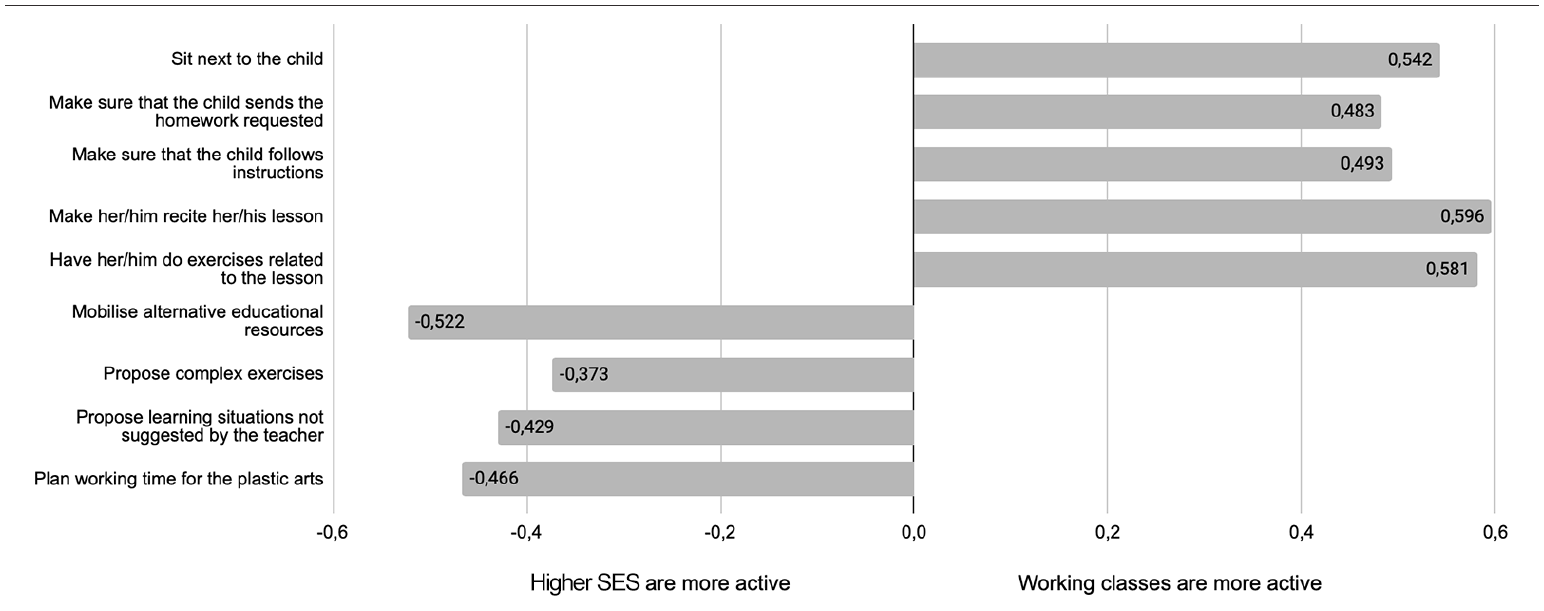
Differences in teaching practices. B-values in the ‘working classes’ modality (ref. ‘higher SES).
The use of statistical data makes it possible to objectify findings in French sociology on the relationship with school knowledge, usually obtained through qualitative surveys. Working-class families are, all things being equal, more active in direct school support techniques: sitting next to their children while they work, making sure they send in the homework demanded, that they respect instructions, making them recite their lesson, etc. These techniques help to satisfy the most formal aspects of school orders. ‘Formally completing the school task’ (l’acquittement formel de la tâche scolaire), observable in the way parents follow homework assignments at home, is typical of the working-class attitude of respect towards the school institution (Kakpo, 2012). However, parents from working-class families tend to lack insight into the logic behind the creation of school expectations and rarely offer their children alternative, indirect or decontextualized learning situations.
High SES parents, on the other hand, adopt more diverse transmission techniques. They frequently offer their children more complex exercises (i.e. exercises which mobilise knowledge acquired in other learning contexts), take advantage of alternative teaching resources and use learning situations designed or chosen by themselves. They therefore have a more autonomous attitude towards the teacher and school instructions, using support techniques that involve decoding expectations and analysing the epistemology of school knowledge and the way it is produced.
These postures of course refer to ideal types. It is important to avoid social class reification and to resist the temptation to attribute homogeneous and pre-determined behaviours to them. Sociological research has put a great deal of emphasis on internal differences between social classes and backgrounds, particularly in terms of the distribution of cultural and economic capital (Bourdieu, 1985; Ball, 2003; Jarness, 2017; in France, see the work of van Zanten, 2009). In this context, it is therefore interesting to observe exactly how this particular posture of pedagogical support occurs in practice in certain higher social class configurations.
The interview with Elise (high school teacher, husband an architect), Tom’s mother (in CE1), clearly illustrates this attitude towards school knowledge. Anxious to complete the CE1 curriculum with her son, Elise bought a commercial teaching manual (an ‘evening notebook’) to use as a support during the lockdown. She did not choose it at random, but compared it with the other textbooks on offer, explaining that she selected this particular one as she found it ‘better presented and more comprehensive’. During the interview, she then discussed a particular session she remembers, one on grammar and types of sentence. Elise explained the logic behind the way this point in the programme was presented in the textbook: it starts with quite a concise lesson point, ‘almost key words’, followed by exercises that break down the different points, each focusing on a specific element presented in the lesson. She then described the presentation as ‘transparent’, because it is ‘easy’, she said, ‘to make the links, point by point, between what you see in the lesson and what the exercise makes you work on.’ We should add that what she calls ‘easy’ or ‘transparent’ can only be ‘easy’ or ‘transparent’ for her, whose reading codes correspond to the school exercise. Used to helping with homework and understanding school expectations (she has a Master’s degree and closely follows the schooling of Tom’s older brother, now in 9th grade), Elise immediately picked up on the learning input intention behind the presentation of the chapter on sentence types.
Elise then told me how she conducted the lesson on sentence types with Tom. In order to explain the different types of sentence (declarative, interrogative, injunctive), she overplayed the main features (e.g. by raising her voice very high at the end of the interrogative sentences, frowning during the injunctive sentences. . .). She would exaggerate and change her expression to illustrate the differences between the families of sentences that everyday speech prevents us from perceiving. Thus, Elise did not read the lesson in a linear way and did not get her child to ‘recite it by heart’. Here, we find a similarity with French research on relations with school knowledge. For instance, Bonnéry and Joigneaux (2015) studied story-telling techniques for very young children in different families. In many working-class families, reading bedtime stories tends to be very linear: it consists of a literal oralisation of the text, well-articulated and rarely interrupted, ‘as if the text were self-sufficient’ (Bonnéry and Joigneaux, 2015: 26). In high SES families, on the other hand, reading is more targeted, children are encouraged to formulate interpretative hypotheses, there are frequent interruptions, and the clues left by the narrator are emphasized. Reading is thus more dramatic so as to draw the child’s attention to the implicit meaning of the text. Similarly, investigating teacher-parents homework help strategies, Kakpo and Rayou (2018) noted that the latter try to get the child to identify the learning issues in ‘integrated’ school exercises in which the didactic contract is unclear. In a writing assignment, for instance, a mother recited a fictitious, very raw text of descriptions to make her daughter aware of the descriptive issue in the exercise. Thus, Elise’s method of exaggerating the characteristic features of each type of sentence follows the same logic of identifying and highlighting the learning input.
High SES parents thus develop learning transmission techniques that go beyond formal instructions. These techniques penetrate the epistemology of school knowledge, and aim to clarify and highlight relevant elements. There is nothing ‘easy’ about this work, as Elise pointed out, leaving many parents more inclined to follow instructions formally.
In short, we saw that parents from high SES families have tools that ‘facilitate’ their home learning experience. If they find being supportive ‘easier’, if they consider that home schooling is not ‘a big deal’, it is because they are better equipped to meet its challenges. Nevertheless, we should add that differences between social backgrounds are not only objective, but are also subjective, reflecting differences in the perception of school effort.
‘It’s not a big deal’: negation of school effort in high SES families
Our study of high SES parents clearly shows the existence of an ‘invisibility’ factor in school effort mechanisms in these families. Parents intervene in a way that makes school constraints acceptable. Through the use of indirect, more diffuse home learning techniques that trivialise or bypass effort, high SES families tend to reduce the laborious aspect of school activities. In order for learning effort to be maintained over time during lockdown, schooling is not viewed as hard work. Here, I show in particular that parents use informal situations to develop or extend learning and adopt humour in home schooling moments to escape or circumvent the inevitable difficulties of the home learning experience, as outlined below.
The use of informal education
Figure 4 shows the use of informal activities during confinement.
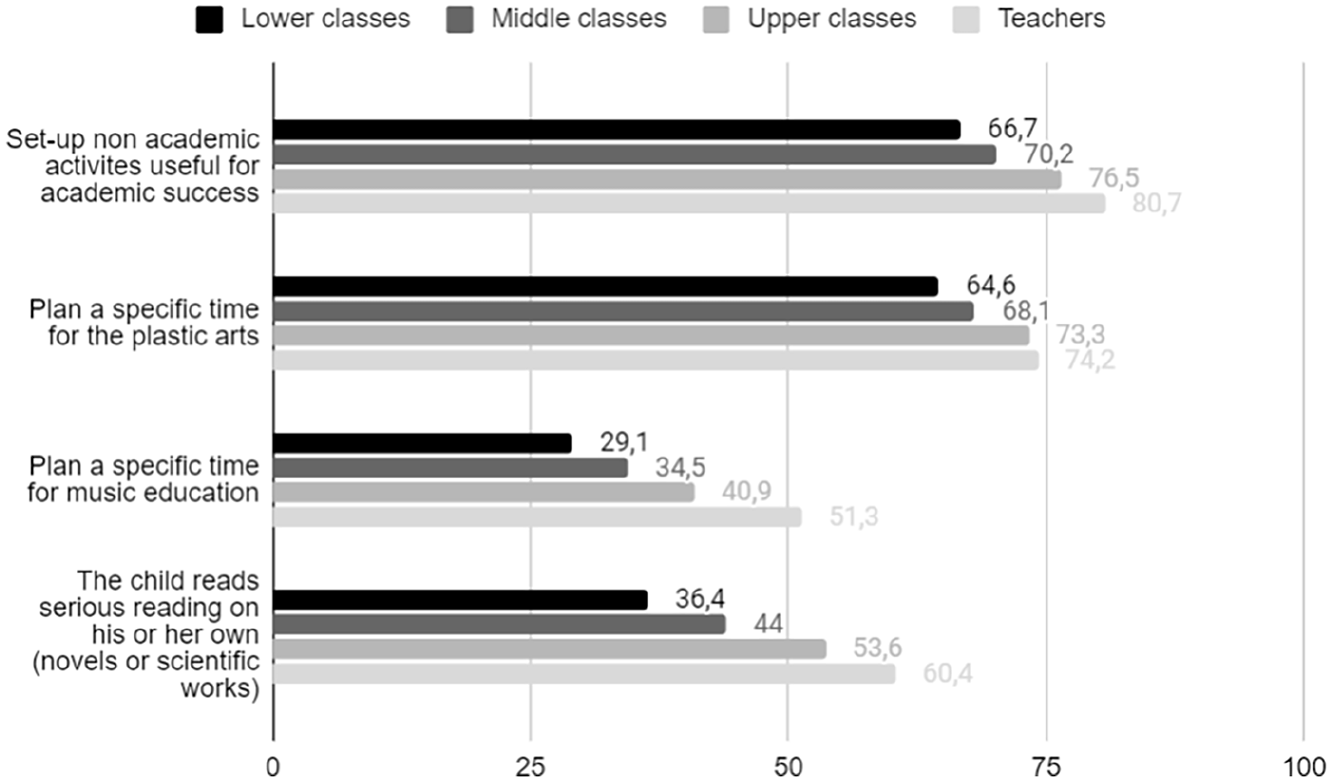
Informal home-schooling activities according to SES.
There is a systematic hierarchy between socio-economic backgrounds. High SES parents appear to introduce more extracurricular learning situations such as art or music, and their children turn to reading more spontaneously.
Let us return for a moment to one surprising finding in Table 2, namely, that lower SES children apparently spend more time on schoolwork than high SES children. However, this is based on the question that asks parents to report their children’s formal school time, while, in higher SES families, much of the schoolwork is informal. It is more diffuse as it extends to informal everyday situations. Annette Lareau clearly showed how, in certain social environments, the intellectual and practical dispositions that are most academically profitable mesh with the most banal family routine activities. The construction of academic success is thus inherent in many of the informal family activities and interactions.
In high SES homes, the boundary between school activities and leisure time is often extremely blurred. Online museum visits were far more frequent in France during the lockdown, and during the interviews, parents frequently said that they had taken virtual visits to the Musée d’Orsay or the Louvre. ‘It was a nice and useful way to spend part of the afternoon’, Sandrine explained. Obviously, the visit is not completely work-free. The children take notes or complete what they have seen by researching in art books found in their parents’ library. Entry to the school exercise is informal, however: ‘We had the impression that we were taking a short cultural visit, like in the holidays.’ As during holidays, serious work is pursued in a seemingly relaxed way, in a ‘nice and useful’ way. The expression ‘joindre l’utile à l’agréable’ (combining business with pleasure) was used several times by parents to refer to this kind of activity. It is thus understood that schoolwork is separated from its laborious dimension, in other words, work is valued as a form of pleasure.
The project by François and his son Yanis (in CE1, second grade) to build a hut during lockdown is another example of how learning can be merged with pleasure. The project was presented as separate from home schooling (done on Wednesdays and at weekends, but not on school days). Looking at it more closely, however, it ties in with schoolwork, informed by learning tools. François told me that he advanced the maths lessons on measurement to meet the construction needs. As they were planning the hut layout, François took advantage of this to make Yanis do some easy maths exercises (adding and subtracting lengths, optimising the use of materials . . .). Higher SES children are thus constantly learning through a gentle approach, even outside formal school time. In these ‘invisible’ school times, learning occurs in a more relaxed and enjoyable, decontextualized way. In these social groups, use of informal learning activities thus inevitably helps to create a confident and positive relationship with schooling.
To be clear, effort is not absent in such situations. On the contrary, it is transformed, embedded in the pleasure of learning. Contrary to appearances in Table 2 which suggest that high SES parents spend less time working with their children, they are no less active in supporting learning, and in fact appear to integrate schoolwork more regularly into daily interactions and practices. These findings reflect what Bernstein calls the ‘invisible pedagogy’ (Bernstein, 1975), and the support practices adopted in this context are no less effective or less structured. In fact, the ‘not a big deal’ expression does not mean that less schoolwork is done in high SES homes. On the contrary, the effort required for learning situations is more sustained while, at the same, it is less didactic.
The use of humour
Learning effort is also euphemised by the use of humour in home-schooling interactions, which is frequently used by high SES parents. Philippe (engineer in a computer company, wife a primary school teacher) related the following anecdote. In the first weeks of lockdown, he worked on a maths problem with his son Raphaël, in the second grade. After working out the answer to the problem, Philippe told Raphaël that, to save time, he did not have to write the concluding sentence usually demanded by his teacher. The child told him that the teacher would not tolerate this type of omission in class. Philippe then explained that he knew this, that he agreed with Raphaël, and reaffirmed that he must do it at school. They agreed that the omission was only allowed ‘between [them]’, he told me with a smile triggered by the memory of a moment of complicity with his son. When Raphaël had finished his exercise, Philippe took the notebook to check his answers. Everything was correct but, without comment, Philippe took his red pen and wrote in the margin, with feigned annoyance: ‘Where is the concluding sentence????’ and then wrote at the top of the page: ‘Insufficient. To be reviewed’. Raphaël found his father’s joke funny and the lesson ended on a very good note.
This example is rich in lessons. Here, humour has first and foremost a learning function. Paradoxically, by freeing the child from the usual instructions, Philippe raised his son’s awareness of them, at the same time, reminding him of the need to respect the school setting. However, he steered his child towards another point of the exercise, thereby clearly showing the specificities of the two expectations (maths solutions and literary form). Philippe explained to me that he thought it was important to emphasise the purely numerical aspect: For me, what’s important in the exercises is that he finds the right way to do it, that he understands that you have to use subtraction when you try to measure a deviation. Afterwards, the conclusion is pure form. It’s important, of course, to instil good habits, but I want him to concentrate on understanding what he’s doing mathematically. [ . . . ] It’s two different things, the number work and its presentation, and he needs to understand that it’s two different things.
For Philippe, the ‘automatism’ of the concluding sentence should not be neglected. It is a ‘good habit’. However, he wanted his child to distinguish it from the mathematical goal, that is, to identify it as belonging to another order of expectations. The concluding sentence is a disciplinary rather than an intellectual requirement, and Philippe wanted to make his child see the different aspect of what the exercise set out to achieve. The joke, here, thus served as an oblique way to introduce a principle of distinguishing the expectations that lie behind strict instructions. Humour allows routines in responding to school instructions to be called into question, putting the child in a situation where he or she can analyse them. This helps them to develop a conceptual distinction between the mathematical expectations (selecting the right operation, applying it and finding the answer) and the literary and disciplinary expectations (synthesising the result in an agreed literary form) of the exercise.
In the example of Philippe and Raphaël, however, humour also, and above all, has a relational regulatory function. Philippe explained that the small transgression (not writing a sentence at the end of a maths exercise), which is only possible in interactions with one’s child, produces ‘something special, a moment of complicity’. The episode left its mark on him and speaking about it clearly brought back good memories. With the – very controlled – loosening of the school’s constraints, complicity thus developed between the parent and child in a situation that could otherwise have created conflict. The home-schooling experience is inevitably made up of moments of tension, as when a rule has to be repeated, when something has to be recited, when a troublesome exercise has to be done. Humour, on the other hand, tends to downplay the effort required and the constraining nature of parental support.
Anne (teacher in an alternative school, husband a bank executive) explained that she used the ridiculous figure of an owl on a drawing in front of her daughter’s desk (CM2 class). By imitating the bird in a falsely inquisitive tone, she reminded her daughter of familiar school instructions: ‘You haven’t forgotten any Ss in your sentence, have you? Read it again carefully, the grand duke is looking at you!’ Or when the child got a lesson right: ‘The grand duke thanks you!’ Recalling knowledge such as grammar rules can create a source of relational tension; here, the use of humour relaxes the parent-child relationship, and cultivated a productive working atmosphere in the high SES families studied.
This is not to say that humour is not present in lower SES ‘working-class’ families. Rather, this article draws attention to the social uses of humour. Here, I note the use of humour by some high SES families as a pedagogical tool to reinforce their children’s learning at school, as well as a tool to temper their relationship with their children.
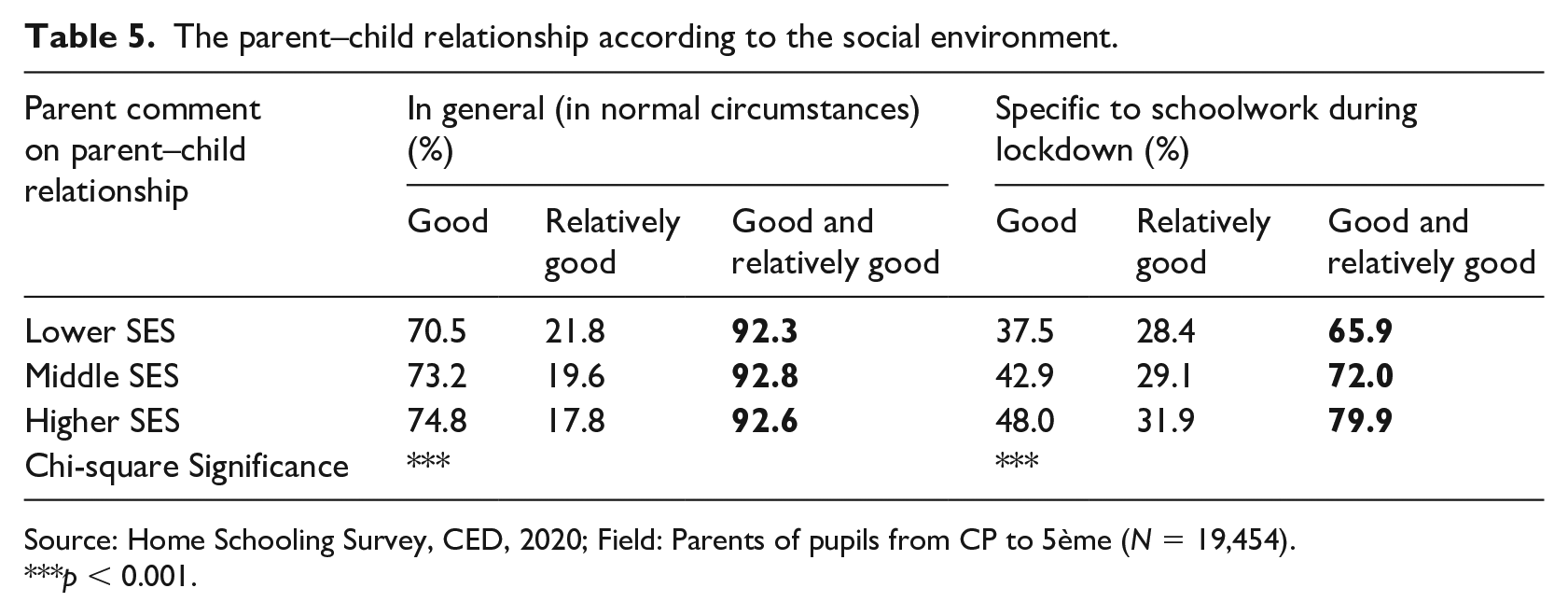
There is no doubt that humour can be used by high SES families to establish a peaceful parent-child relationship and a more serene working climate. In Table 5 we can see clear differences between social backgrounds in terms of the parent-child relationship.
The parent–child relationship according to the social environment.
Source: Home Schooling Survey, CED, 2020; Field: Parents of pupils from CP to 5ème (N = 19,454).
p < 0.001.
While Table 5 shows that there are normally few differences between families in terms of the parent–child relationship, the deterioration of this relationship in the context of home schooling appears to be greater in lower SES environments.
The confinement and monitoring of home schooling certainly contributed to the development of relational tensions: 34% of working-class families sometimes encountered difficulties in their relationship with their child, compared with 20% of those in the higher SES classes. This relational dimension should not be overlooked in learning effectiveness as a peaceful relationship is obviously more conducive to learning. However, it is not easy to create a serene, benevolent learning context with peaceful relations and parents are urged to be patient. What is expected of them through this injunction is in fact to develop a form of relational and emotional distance from their children, something that is naturally the case between a teacher and pupil at school. In school, the learning situation is generally based on an institutionalised relational contract in which everyone respects a social role. It is this contract that needs to be recreated at home. The figures above on the parent–child relationship show that not all social backgrounds are able to achieve this in the same way. The humour of high SES parents may thus be deployed as one way of reducing the drama of schoolwork.
The effort required of children, although objectively very demanding, is mitigated by the use of humour and informal learning situations. This is a paradox: while the learning effort of children in the high SES family is relatively sustained; it is frequently invisible and is not viewed as an effort as such. By breaking down the separation between school activities and free time, reconfiguring the relationship between school learning and play and humour, reducing school discipline during home learning activities or, conversely, generalising school discipline to more banal household activities, high SES parents manage to reduce the apparent effort required for schoolwork. The omnipresence of effort and its transfiguration into hedonic and playful activities contributes to scaling down the level of effort made by parents and children. In these conditions, we can easily see why home schooling may not be ‘a big deal’ for them.
Conclusion: what ‘concerted cultivation’ hides
This article uses the COVID-19 health crisis situation as a kind of natural experiment that confronts all socio-economic groups with the same obligation, that is particularly strong in France, that is, to continue schooling despite the confinement of lockdown. In giving families control of their children’s education for two months, the lockdown period revealed usually latent learning practices in higher SES environments.
I identified various objective resources used by high SES families to compensate for the difficulties associated with the school closure situation. In line with work on the seasonality of learning, I found that high SES families adopt various techniques to organise schoolwork (e.g. recreating a learning space-time) and transmit knowledge (e.g. decoding instructions, insistence on understanding implicit knowledge) that offer solid learning advantages compared with other social groups.
However, another advantage of high SES families which makes it easier for them to manage home learning also lies in their capacity to make their efforts invisible as they tend to adopt gentler, more deflective forms of learning support. They dilute the school effort into daily activities, to the point where it no longer feels like work. They also use humour as an educational tool to overcome relational issues.
These school support practices are similar to the ‘concerted cultivation’ parental regime described by Annette Lareau (2011). In structuring the timetable, parents develop anticipation and organisation habits conducive to academic success. In the same way, by favouring less authoritarian forms of communication, and by negotiating and justifying domestic rules, high SES parents give their children self-esteem and a ‘sense of entitlement’.
There is, however, a potential misunderstanding around this notion of concerted cultivation that we need to dispel. In the families I met, discussion and criticism of rules was central. On the other hand, not everything was discussed or negotiated regarding home schooling during the lockdown. On the contrary, key principles regarding the organisation of school time and space were established unilaterally by the parents. Lesson content followed the year’s curriculum, without being questioned. The sequence of lessons also remained very much under the parents’ control. The parents had a very elaborate and pre-determined technique for presenting the teaching content. They knew the sequence of their sessions and controlled their children’s activities within this framework. In short, although the mode of interaction was apparently more relaxed and concerted, it was nonetheless extremely structured. Concerted cultivation does not therefore mean that there are no constraints, but rather that the constraints are blurred through a process of ‘invisibility’.
This effort to make the work invisible is facilitated by a certain autonomy with respect to school regulations. The high SES parents are often seen as colluding with the school culture. However, if they collude more with the school culture in the sense that they have a better command of its secrets, they are also more autonomous with regard to its regulations. This paradox was previously noted by Bourdieu and Passeron. In their well-known text on the ‘jeu du sérieux’ (serious games), they clearly show how realisation of the school order involves its negation. Paradoxically, in order to produce successful work, it is necessary to go beyond the formal expectations on which its evaluation is based, displaying autonomy in order to demonstrate mastery. In parental support, the seriousness of the game is expressed through the relaxed appearance of certain activities: reading a book, doing sport, building a hut, talking about impressionist painters, and so on. In all these activities, the implicit intention of high SES parents is to give their offspring a taste for schoolwork, while obscuring the effort implicitly involved. It is only when the effort, however real, does not appear as such that the home-schooling experience can be considered as ‘not a big deal’.
Footnotes
Appendices
Declaration of conflicting interests
The author declared no potential conflicts of interest with respect to the research, authorship, and/or publication of this article.
Funding
The author received no financial support for the research, authorship, and/or publication of this article.
