




Abstract
Strategic government interventions in public education have shifted and blurred the boundaries between state, market and civil society modes of governance. Within this matrix of interdependent relations, schools operate under increasingly hybrid accountability arrangements in which public accountability can both complement and compete with market and social regimes and their associated institutional logics, goals, values and mechanisms. During the first wave of the COVID-19 pandemic, however, national governments implemented a wide range of emergency measures which had consequences for the mixes and layers of school accountabilities. This article examines the principal policy changes in Denmark, England and Italy. Drawing on state theories and the concept of ‘hybrid accountability’, semi-structured interviews with national and local policymakers and school practitioners were analysed thematically. While cultural nuances exist between the cases, our findings reveal that state interventions reinforce a public–professional accountability hybrid and hierarchies of control and command within and outside networks. Concomitantly, state non-interventions and the distinct underlying institutional logics associated with national large-scale assessments suggest policy inertia with implications for professional accountability and institutionalised change. Future research might investigate whether educators’ experiences influence the direction of national and local accountability policy reforms in a post-pandemic era.
Introduction
In less than half a century, the governance of public education in Europe has transformed from a largely national state project to a site of multi-scalar modes of social coordination (Papanastasiou, 2019). This reconfiguration can be explained in part by the growing influence of, and significant consensus between, international and regional organisations such as the Organisation for Economic Cooperation and Development, the United Nations Educational, Scientific and Cultural Organization, the World Bank and the European Union (EU), whose programmes, initiatives and frameworks have set the standard for ‘quality education’ in a global economy (Grek, 2010; Lewis, 2020; Mundy et al., 2016; Ydesen, 2019). Concomitantly, in many EU Member States, neoliberal processes of decentralisation, deregulation and privatisation have enabled new networks of public, private and civil society actors to enter local and national education policy arenas (Cone and Brøgger, 2020; Milner et al., 2020; Winchip et al., 2019). Understanding the workings of education today therefore requires sensitivity to these multiple scalar agents, and the data, technologies, knowledges, instruments and discourses that constitute and are constituted by the complex, interconnected spaces in which they interact (Christensen and Ydesen, 2015; Robertson, 2018).
Politically and legally, the principle of subsidiarity ensures that education remains a national competence for EU Member States (Ertl, 2006), while, theoretically, scholarly research points to the continued relevance of the state within a multi-scalar governance complex (Levinson et al., 2020; Tröhler, 2020). Indeed, Jessop (2001, 2016) has argued that state managers draw strategically on a range of interrelated modes of governance – state, market and network – through processes of meta-governance. Within such relational social systems, in which various actors collaborate and/or compete over policy directions, public education is delivered under increasingly hybrid accountability regimes, each with their own underlying institutional logics, goals, values and steering mechanisms. Thus, while the state acts as primus inter pares (first among equals) (Jessop, 2016), educators must provide targeted ex-post accounts of their actions to diverse social actors at distinct times (Benish, 2020; Benish and Mattei, 2020).
During the first wave of the COVID-19 pandemic in Europe, the strategic interventions of national governments in public education were visible in two key emergency measures: (a) the full or partial closure of schools and subsequent shift to remote education; and (b) the cancellation, postponement or reconfiguration of national large-scale assessments (NLSAs) (Stanistreet et al., 2020). Such actions were perhaps expected as, historically, the strong state has tended to emerge stronger in times of crisis (Boin et al., 2016; Lodge, 2013). However, no two states are the same, neither in their capacity to respond to crises nor in their choice of modes of governance over different spatio-temporal horizons (Jessop, 2010, 2016). It is therefore of empirical interest to investigate whether and, if so, how individual governments’ policy responses redefined the pre-existing mixes and layers of school accountabilities in different governance contexts. This will not only advance our knowledge of state involvement in education, but provide an opportunity to consider anew the accountability research agenda.
In this article, we make an empirical and theoretical contribution to research on education in crises with a qualitative study of policymaker and practitioner experiences during the COVID-19 pandemic in three European contexts: Denmark, England and Italy. These countries have distinctive educational governance arrangements which means that the mixes and layers of hybrid accountability are organised and experienced differently by school actors in each context. For instance, in England, the Conservative–Liberal Democrat Coalition (2010–2015) and successive Conservative governments since have promoted a self-improving school-led system based around ‘families’ of schools working together in multi-academy trusts, chains and federations (Greany and Higham, 2018). With a reduced role for local government, however, policymakers have argued that system improvement can only be achieved if such autonomy is counter-balanced with increased accountability (see Department for Education (DfE), 2010, 2016). By contrast, in Denmark, recent years have seen incremental changes to the traditional Nordic model of education, largely characterised by state-funded comprehensive education with a significant level of local autonomy (Oftedal Telhaug et al., 2006). Since the 1990s, marketisation reforms revolving around free school choice, increased top-down accountability mechanisms, and key performance indicators have meant a reshuffling in accountability compositions in the education system (Skedsmo et al., 2021). Finally, in Italy, the central state has maintained its governance structures since the 1950s; these are based on top-down hierarchical modes of coordination of educational institutions and stakeholders. Even a major 1990s reform trend associated with the autonomisation of schools from central controls failed to deliver a substantive decentralisation of the Italian educational system (Mattei, 2012). Given these distinctions, our research aims to respond to the following questions:
What were the principal education policy changes in Denmark, England and Italy during the first wave of the COVID-19 pandemic?
How did these state interventions influence school policies and practices and the mixing and layering of accountabilities?
What were the implications for educational governance during the global health crisis?
Drawing on state theories (Jessop, 2015, 2016; Schön, 1973) and the concept of ‘hybrid accountability’ (Benish, 2020), we analyse thematically semi-structured interviews with teachers, school leaders, and national and local policymakers in each country case. As a result, we argue that policy changes reinforce the public–professional accountability hybrid and hierarchies of control and command. However, state non-interventions and the underlying institutional logics associated with standardised assessments suggest policy inertia with implications for the nature of professional accountability and institutionalised change.
Our analysis is developed through five sections. First, we explore state theories of governance and crisis and compare the pre-pandemic approaches to educational governance in Denmark, England and Italy. Following this, we examine the concept of ‘hybrid accountability’ and describe our own analytical framework. In the subsequent two sections, we outline our methodological approach before presenting our individual cases studies. Finally, we discuss the theoretical implications of our findings for accountability and governance in times of crisis.
States in crisis: conceptual and contextual considerations
Although the COVID-19 pandemic is predominantly a global health crisis, state theories frequently define crises as economic and political events (Jessop, 2015; Lodge, 2013; Peters, 2019; Peters and Pierre, 2016). Historical studies on the 1970s crisis of the welfare state underlined the transformative capacity of the state through neoliberal ideological reform (Cerny, 1997; Hood, 1991; Majone, 1994). Conversely, in an era of economic and political globalisation, contemporary theorists suggest the power of the state to intervene in crises, and reinvent itself, is contingent. Indeed, in his analysis of the 2008 global economic crisis, Jessop (2010) highlights the ‘return’, but limited and differential powers, of the national state in the world market.
While crises are ‘a potential moment of decisive intervention’, in which resolute action may lead to radical transformation (Jessop, 2015: 97), governments tend to favour policy inertia (Mattei, 2005; Stern, 1997). Far from a notion of stasis, inertia here refers to the incremental process of adopting minor adjustments that could produce substantive change (Mattei, 2005). Dynamic conservatism is a type of inertia often characterised as an attribute of policy immobilism. Coined by Schön, it is defined as ‘the resistance to change exhibited by social systems . . . a tendency to fight to remain the same’ (1973: 73). For as social systems engage in relentless activism to remain in equilibrium, they resist change with equal and opposing energy to the change introduced. Thus, dynamic conservatism is recognisable as a radical attempt to transform political and administrative systems. For this investigation, we therefore understand policy inertia as active resistance to change.
In light of these theoretical considerations, the COVID-19 crisis provides a unique opportunity to re-examine established state theories of governance in terms of: (a) the diversity of state responses; and (b) the potential for institutionalised change. In education, however, certain variation is already perceptible in governance structures which support or curtail the involvement of state and non-state actors at various scales of coordination.
England
Since the late 1980s, UK government policy has generally supported the decentralisation of education administration in England. The ‘reluctant state’ (Ball, 2012) is evident in the 1988 Education Reform Act, through which the Thatcher Conservative government (1979–1990) legislated the local management of schools, and, later, in the Conservative–Liberal Democrat Coalition (2010–2015) expansion of New Labour’s (1997–2010) academies programme and creation of multi-academy trusts (MATs), networks of academies under private-sector or charitable sponsorship (Rayner et al., 2018). A recent aim has been the promotion of a self-improving school-led system based around ‘families’ of schools, a local solutions approach, and system leadership (Hargreaves, 2010, 2012). This has transformed the middle tier of government from local democratic state institutions to a heterarchical governance environment shaped by systems of new public management and a neoliberal ideological priority where marketisation and competition stand central (Greany, 2020). While ‘reluctant’ towards state management of schools, however, UK governments have retained considerable control over the content of education. The 1988 Education Reform Act also introduced a national curriculum and new national assessments for 16-year-olds, the General Certificate in Secondary Education (GCSE). Later, the 1992 Education (Schools) Act established a national inspectorate, the Office for Standards in Education (Ofsted), and legislated the publication of performance league tables to make schools more accountable to parents and other key stakeholders (West et al., 2011). Alongside systems of performance management, these state interventions have contributed significantly to the intensification and extensification of teachers’ work (Milner and Stevenson, 2019; Stevenson, 2017).
Denmark
The decentralisation of public education in Denmark, by contrast, can be traced to the 1855 Free School Act and linked to ‘a political tradition of limiting the power of the state over its citizens’ (Dovemark et al., 2018: 12). Distinct from the English quasi-market, the Danish education system operates within a universal welfare state model in which the municipalities have progressively gained responsibility for the financial and administrative management of schools. In the 1990s, market-oriented policies of free school choice and ‘taximeter regulation’, whereby school funding follows the student, were implemented (Ydesen, forthcoming). However, like England, the state expanded its control over curriculum and assessment. Following criticism over a lack of ‘evaluation culture’ (Ekholm, 2004), in 2006, a centre–right coalition government made the Year 9 leavers’ examination mandatory and introduced national tests at various stages of compulsory education (Sørensen, 2011). This was followed in 2008 by the Quality Reform which obliged municipalities to implement a quality assurance framework and publish annual reports (Dovemark et al., 2018). In June 2019, the current Social Democrat-led government announced the suspension of the 2019/2020 national tests while the Ministry of Education commissioned a review. This concluded that the national tests were fundamentally flawed, in both their design and implementation, and recommended their immediate termination (Bundsgaard and Kreiner, 2019).
Italy
The Italian education system is highly centralised and controlled by the Ministry of Education in Rome. Despite decentralisation reforms in the late 1990s, it is widely accepted that there was limited impact on educational governance in Italy (Capano and Terenzi, 2019; Grimaldi and Landri, 2006; Mattei, 2020). Viewed as a form of ‘decentralized centralism’ (Karlsen, 2000), the central state has retained control over the content of the national curriculum and, through the use of national public competitions, human and financial resources. Conversely, municipalities have only residual powers, such as responsibility for school buildings and professional training. Unlike England and Denmark, the Italian education system continues to be institutionally structured according to the post-World War II principles of welfarist education, whereby the state provides services directly and other private providers remain at the margins. Still, an emphasis on performance management and the measurement of ‘added value’ (Calvini and Vivanet, 2010) is the cornerstone of a neoliberal ideology that has led to changes in the structure of the National Evaluation System (SNV). Its current configuration includes the National Institute for the Evaluation of the Education and Training System (INVALSI), the National Institute for Documentation, Innovation and Educational Research (INDIRE), the inspection body (Contingente ispettivo) and External Evaluation Units (NEV). INVALSI is responsible for the design, implementation and administration of national standardised tests in three main areas: use and understanding of the Italian language, use and understanding of the English language, and mathematical skills (Grimaldi and Serpieri, 2016). The tests are administered at several stages of students’ education and participation is compulsory for admission to the school leavers’ examinations.
Hybrid accountability: the mixing and layering of accountability regimes
The extent to which the aforementioned modes of governance persisted during the COVID-19 pandemic has implications for the hybrid accountability regimes under which schools operated. Hybrid accountability is defined as ‘the integration of accountability arrangements between and across the boundaries of the public, market and social regimes of accountability’ (Benish and Mattei, 2020: 4). Transcending the traditional analytical foci of horizontal and vertical accountabilities (see Hooge et al., 2012), this concept emphasises the potential conflicts and compatibilities between the regimes’ underlying institutional logics, goals, values and steering mechanisms (Benish, 2020). Consequently, it is an appropriate theoretical lens through which to decipher ‘actor configurations, sets of tools, sensemaking, and the problematisation of the policy by local and intermediate actors, their political struggles, and local logics of action’ (Maroy and Pons, 2019: 3).
The mixing and layering of accountabilities occurs when (a) two or more regimes are applied to an education system simultaneously; and (b) new logics are layered over pre-existing ones (Benish, 2020; Benish and Mattei, 2020). For instance, in England and Italy, systems of New Public Management (NPM) have imported the market logics of managerialism and consumerism into public education through open enrolment, teachers’ performance-related pay, and the publication of performance league tables and inspection reports (Checchi and Mattei, forthcoming; Marsden, 2015; West et al., 2011).
Following Mashaw (2006), Benish (2020) has proposed a framework for the systemic analysis of hybrid accountability in public services of contemporary welfare states (see Figure 1). This groups accountability regimes into three distinct types: public, market and social. Professional accountability is the most prominent variant of social accountability; it functions through more informal and horizontal networks and societal trust in professions. Despite the centrality of agency theory to this concept, however, the agents in Benish’s (2020) framework are limited to ‘citizens’, ‘customer’ and ‘client’, highlighting, perhaps inadvertently, the privileged status of these diverse ‘publics’ in contemporary hybrid systems of governance (see also Clarke and Newman, 2009).
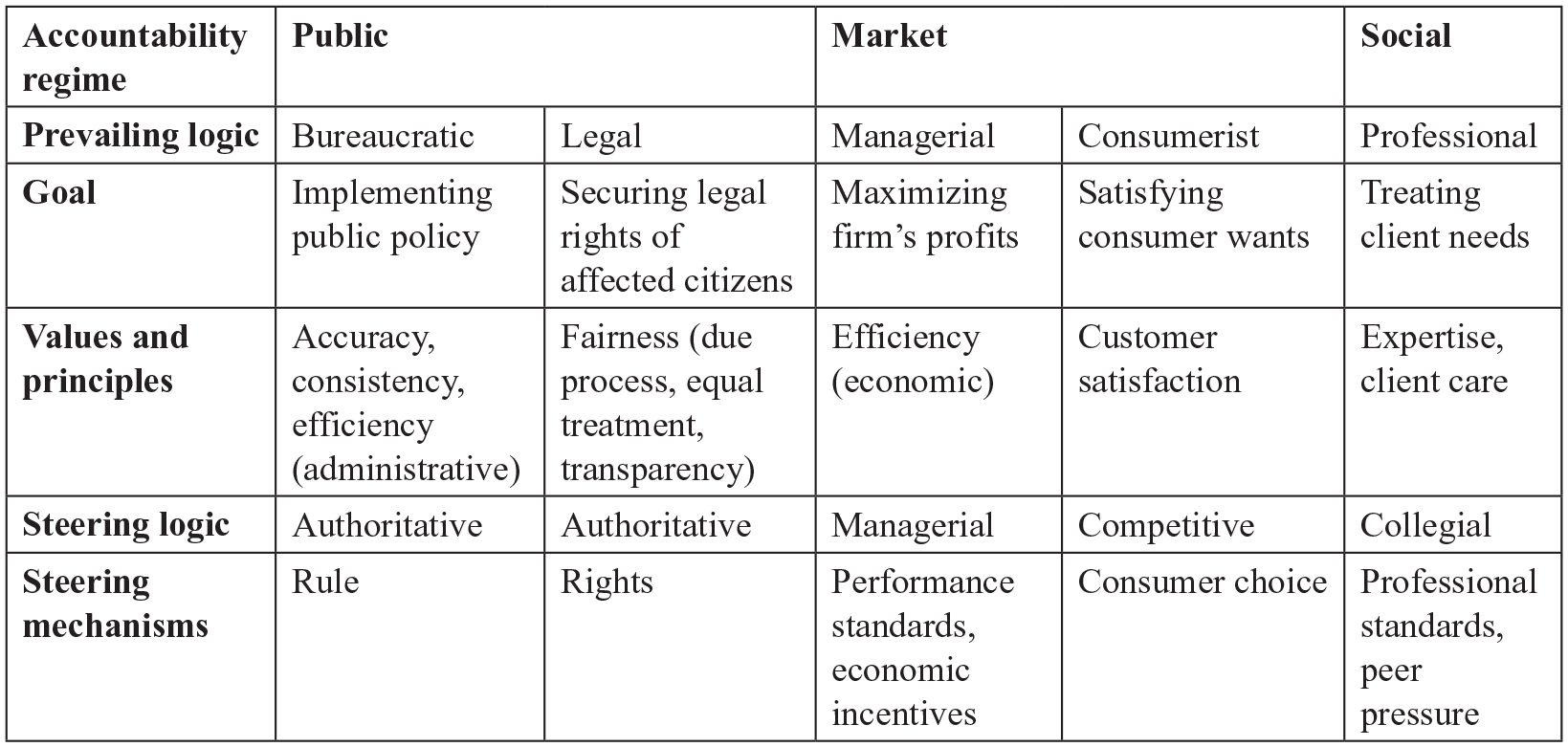
Logics of accountability (Benish, 2020).
West et al. (2011) have investigated the multiple types of accountability, and their associated sanctions and effects, in the English school system. While no specific reference is made to ‘hybridity’, these scholars identify seven accountability types: professional, hierarchical, market, contract, legal, network and participative, with the final four representing different forms of public accountability. Their analytical framework focuses more intently on agents and reveals the complex relations between account-holders and account-givers, the significance of standardised assessments as steering mechanisms across accountability types, and the considerable sanctions of ‘failure’ to account.
Although limited by their spatial and temporal contingency, the aforementioned frameworks are useful heuristic tools for understanding accountability regimes in different contexts during the COVID-19 pandemic. Inspired by these approaches, we responded to research question 2 through the following sub-questions:
To whom and for what were teachers and school leaders accountable during the COVID-19 pandemic?
Which accountability regimes, and associated values, logics and steering mechanisms, became significant as a result of education policy changes in each context?
Methodology
Semi-structured interviews with teachers, school leaders, trade union representatives and local and national civil servants were our principal method of data collection. In England, we interviewed 10 headteachers and teachers in 3 academies (1 stand-alone and 2 in the same MAT) in 1 county and 2 national policymakers. In Denmark, we interviewed 12 school leaders and teachers in 3 public schools (folkeskoler) in 2 neighbouring municipalities and 12 national and municipal policymakers. Finally, in Italy, we interviewed 30 school leaders and teachers in 6 large public schools in 2 large cities.
Given the complex research context and the huge pressures on educational stakeholders, interviews were arranged at times convenient to the participants between June and November 2020. Due to intermittent COVID-19 restrictions, these interviews were conducted face to face or online via Microsoft Teams or Zoom. Resultantly, data were generated at different stages of the pandemic and certain participants were able to respond to policy changes implemented over a greater time frame. Therefore, we do not claim to make generalisations but highlight similarities and differences in experiences and perspectives at the various moments in which participants were able to pause, reflect and attempt to make sense of their highly unprecedented situation. Indeed, the strength of qualitative interviews is that it allows the interviewees’ ‘voice’ to be heard in context (Creswell and Clark, 2007).
Each interview was transcribed and coded inductively to develop categories which were then compared to reveal the dominant themes in each case. These themes were subsequently analysed in relation to the two accountability frameworks (Benish, 2020; West et al., 2011). From the interview data, we ascertained the most significant policy documents of this period. These represent several genres of text, reflective of the diverse institutional approaches to policy formation across the contexts: government press releases, ministerial statements, parliamentary committee minutes, official reports, emergency executive orders and legislation, position statements, administrative ordinances, administrative regulations and school guidance documents. Produced between March and September 2020, all documents were available in the public domain and form the basis of narratives on policy change in the following section.
Findings
Denmark
On 11 March 2020, Mette Frederiksen, the Danish Prime Minister, announced a complete lockdown of Danish society and appealed to Danes’ ‘sense of society’ (samfundssind) in the face of an uncertain situation. The lockdown involved the immediate physical closure of all educational institutions (Sundheds- og Ældreministeriet, 2020). On 19 March 2020, Parliament passed an executive order for ‘emergency education’ which granted Pernille Rosenkrantz-Theil, Minister for Children and Education, legislative powers over the framework and scope of educational provision, including remote learning, and the authority to cancel, postpone or replace examinations with continuous assessment grades (standpunktskarakterer), if the health crisis continued (Børne- og Undervisningsministeriet, 2020a). At that point, compulsory public school (folkeskoler) Year 9 leavers’ examinations were expected to take place in May and June 2020.
On 6 April 2020, the Prime Minister announced the first phase of the reopening of Denmark. From 15 April 2020, primary schools opened for students in Years 1–6 (0. – 5. klasse). New health rules included the division of classes into smaller groups in different classrooms, outdoor education, frequent handwashing and minimal teacher rotation. Years 7–10 (6. – 9. klasse) continued to be home-schooled (Børne- og Undervisningsministeriet, 2020b). On 23 April 2020, an executive order was passed on the cancellation of all oral and written examinations, including the Year 9 leavers’ examination (Børne- og Undervisningsministeriet, 2020c). Students in Years 7–10 returned to school on 18 May 2020 and certain health rules were eased.
Emergency responders
With the implementation of an emergency education executive order, teachers were initially legally accountable for students’ remote education and a continued onsite offer for special needs pupils. At the beginning, teaching online was considered difficult, involving greater preparation time, and one teacher highlighted how his working day had extended into the evening. Contact with students varied but some teachers noted that they had been able to make connections that had been difficult in the normal classroom environment. On the return to school, with no terminal examinations and a reduced role for academic goals, teachers no longer had to cover curriculum content. Without these performance indicators, which previously fed into municipal quality reports, teachers could be more creative in their practice. Outdoor education was considered particularly successful by both policymakers and practitioners, while teachers of younger students praised the smaller class sizes in phase one of reopening which, with the support of teachers of older students, enabled them to meet more easily the needs of every learner.
Teacher assessment as a professional task
During lockdown, teachers continued to assess and provide feedback to students. However, some teachers highlighted the importance, but notable absence, of classroom interactions to the assessment of student understanding and progress. One assistant principal stated that social distancing, and the extra resources required, had discouraged class tests. Even so, practitioners and policymakers noted the significance of formal assessment to students who had not put in the required effort during the academic year. Indeed, two teachers spoke of attempts to model the cancelled Year 9 leavers’ examinations, with one noting: They did both written and oral tests in Danish and English and mathematics, in fact, when they came back in Year 9. They were not ‘test tests’. They were not real, but similar. So, they did well enough in them. Because it was actually something we sat and worked on. Because we hoped that they would come back and be able to do these tests.
Where students did not take modified examinations, teacher-led assessment became more meaningful. Union representatives reflected on the general trust in teacher judgement. Similarly, policymakers and practitioners commented that continuous assessment grades were already a feature of evaluation, therefore this renewed emphasis on professional expertise was largely unproblematic. As one teacher remarked: So, I had to grade them, assessed on what they did previously. So, of course, it caused some difficulties, but I haven’t had any complaints regarding grades. I think I was lucky to know their level. Before we were closed down. So, maybe this proves that it is possible to assess and grade the kids without putting them to tests.
Stepping up and stepping back
In general, teachers and leaders felt that the government had acted appropriately in legislating emergency education and praised relations between the Ministry, municipalities and schools. The almost daily online meetings between municipal and school leaders were deemed ‘helpful’ and ‘informative’. One municipal leader noted that strategic performance management goals were put aside to focus on the day-to-day operational needs of schools. For instance, to ensure consistency, his municipality managed all written communication between schools and parents. School leaders and teachers supported these local interventions: So, from the beginning from when we were sent home, they’ve been there. They’ve definitely stepped up. And they’ve been very supportive for all the schools. And I think it was important that all schools were regulated like that.
After the summer vacation, school leaders had increased responsibility with the municipality only assisting if there was an outbreak in an individual establishment. Some teachers wished for a return to the old system for, as one remarked, there were ‘too many discussions’ about what course of action to take ‘instead of just being told “do this”’.
One trade union representative remarked on the collaboration of diverse groups at the local scale in the fight against the pandemic. This inter-professional cooperation, and the willingness to put aside interests, was deemed particularly important in the negotiation of the new national collective agreement in August 2020:
As teachers and a union, we have our boxes. We want this and we will do this. And only this and not that. Those boxes were also taken away. We have the understanding that you have to work together against COVID-19. So, giving up our normal policy objectives, we met together in a new third perspective. Not yours, not mine, but ours. That was very educational for everybody.
Innovations in individualised support
Since all families had internet access and some form of digital device, there were few technical problems in maintaining contact between teachers and students. Nonetheless, some students would not engage in online class meetings or respond to individual communication. In the case of the former, one inclusive education teacher set up one-on-one online ‘learning coaching’ between teachers and the most vulnerable students. This continued with absentees on the return to school. In the case of the latter, one national trade union representative commented that teachers would often do home visits.
Back to the old normal
With the return of all students in September 2020, schools reimplemented formal classroom-based assessments and national goals. As one assistant principal commented: Now we put the pressure back on. And I wish that sometimes we could take it off and let them be creative and say, ‘you know what, you’re gonna get so much more out of taking the mountain bikes up there. And you’re gonna learn so much more about life’ . . . But we don’t choose.
Parents too were keen to know the attainment levels of their children. In one school, home–school conversations were moved forward and its school leader remarked that certain parents needed to be convinced that their children had progressed through more experimental and process-oriented teaching. One teacher reflected on her colleagues’ frustration that the Ministry would most likely reimplement national tests the following year. Although trade union representatives and civil servants commented that the Ministry was keen to learn from the positive experiences of pandemic, it was later announced that national tests would be reintroduced in the spring of 2021 to assess students’ learning progress on their return to school.
England
On 18 March 2020, Gavin Williamson, Secretary of State for Education, announced that, from 23 March 2020, schools in England would close and revert to remote education, except for the children of key workers, and vulnerable children and young people. For those eligible, schools would continue to provide free school meals or vouchers for local supermarkets. Additionally, Williamson confirmed the cancellation of the summer GCSE and A level examinations for 16- and 18-year-olds respectively and, following recommendations from the Office of Qualifications and Examinations Regulation (Ofqual), the implementation of a centre assessment grade (CAG) system (Department for Education and the Rt Hon. Gavin Williamson CBE MP, 2020). Ofqual had also proposed a ‘teacher certificate’; however, one civil servant noted that there had been ‘no appetite for this from government’ possibly due to the potential stigma of non-regulated qualifications for the 2020 cohort. On 23 March 2020, Williamson stated that the CAG system would require teachers to use their professional judgement. However, students could appeal the process or sit an examination, if they felt that the grade did not reflect their performance. School performance data for 2020 would not be published (Williamson, 2020).
Schools graded and rank-ordered their students based on evidence from mock examinations, non-examination assessment and homework. Examination boards subsequently standardised these grades using a statistical model developed by Ofqual and devised from previous national results in the subject, students’ prior attainment compared to previous years, and individual schools’ results in recent years (Ofqual, 2020a). In May 2020, Ofqual (2020b) published guidance on how to ensure objectivity in teacher judgement but, on 10 June 2020, in oral evidence to a parliamentary committee, state and civil society actors raised concerns over teachers’ unconscious bias and the possible under- and over-prediction of grades (House of Commons Education Committee, 2020).
On 12 August 2020, the Secretary of State for Education announced a new ‘triple lock’ process; students could accept their calculated grade, appeal to receive a valid mock results or sit autumn examinations (DfE, 2020). However, on 17 August 2020, the UK government made a U-turn. Following widespread criticism of the algorithm used to calculate A level grades, Ofqual announced that A level and GCSE students would be awarded the CAG or the calculated grade, whichever was higher (Ofqual, 2020c).
Challenges of and to teacher judgement
The move to a CAG system meant that teacher-led assessment took on greater importance in students’ grades. Headteachers and teachers commented on their stress over this policy, which had been intensified by late communication and last-minute government U-turns. While some teachers were comfortable using their professional judgement, others ‘needed lots of reassurance’. One assistant headteacher highlighted the complexity of the situation: Lots of teachers crave complete individual autonomy . . . but they’ve also have been brought up in a system that demands everything to be done in a certain way, over and over again. And you’ve got to test, test, test and you end up teaching to the test . . . And then, when you give the autonomy to the members of staff, and say that, actually, you’re in control of it now . . . they then worry that they’re not doing it right, and they want to check, and they want to have a formal process and a rigid tight way of doing things.
All school participants commented on the rigorous and robust processes involved in grading and ranking students. To ensure consistency and avoid grade inflation, middle and senior leaders moderated teacher assessments prior to their submission to examination boards. Headteachers felt that grades were ‘representative’ of their institution; however, some teachers and heads of department were unhappy that decisions had been overruled by senior leadership. Moreover, despite the absence of accountability mechanisms, Ofqual civil servants stated that there had been ‘massive generosity’ in the CAG system.
One school noted that certain ‘middle-class’ parents had attempted to influence the CAG process with assessment data from private tutors. Here, some teachers had felt ‘threatened’ to award higher grades. Although students generally received good grades, one teacher remarked that the process had damaged relations and decreased trust between some parents and teachers. As students could initially make freedom of information requests on the grade allocation process, one headteacher felt that they had been ‘hung out to dry’ by the government. A teacher spoke specifically of blame-shifting: The minute it’s not the government’s fault, it’s the school’s fault. If students haven’t done as well as they wanted to. So, that’s difficult. That removes the layer that’s normally there. Where it’s a formal exam that’s nothing to do with the school.
Stepping into the void
All participants noted the failure of the UK government to set direction, with one headteacher describing its inaction as ‘incompetence bordering on criminal negligence’. In the absence of national and regional leadership, MATs and education trade unions ‘stepped into the void’. Headteachers in MATs reflected on the importance of this strong professional network for support, resource procurement, and shared approaches to teaching, learning and assessment. Conversely, teachers in a stand-alone academy felt that they were ‘having to do a lot of the leg work’ themselves. The Association of School and College Leaders (ASCL) daily briefings were considered ‘invaluable’ for their advice on the CAG system, while teacher union school representatives were praised for their honesty and involvement in risk assessments. Indeed, one participant remarked that it had taught them ‘the value of a good professional body to be able to go to in uncertain times’.
Doing state work
Where the state failed to provide support to the most disadvantaged pupils and families, schools ‘stepped up’. Delays to a government-funded laptop scheme forced headteachers to loan or buy laptops for pupils. Schools provided free school meals and even free school breakfasts throughout the lockdown and school holidays. When the government lunch voucher scheme did not function, schools set up their own in-house systems. One school delivered hampers of food and personal hygiene products to families, while another provided food parcels and meal plans. In one school, senior leaders ‘triaged’ students, with those in most need receiving one-on-one support. Headteachers continued safe-guarding obligations and, with the closure of social services, staff were asked to pay home visits on their behalf. While one headteacher referred to this as ‘community work’, another reflected on the continuity in this role: I just feel that social work and the input from social services has been in decline in the last 10 years. And, what it’s really proved is that, when you take the service away, a school like ours, that thinks pastoral care and social inclusion is important, we’ve stepped up a bit, but it just proves that, actually, we do most of it anyway.
Assessing the future
Teachers and headteachers commented on changes to school assessment systems as a result of the pandemic. This included the implementation of more frequent and earlier formalised common assessment points and contingency plans for potential future lockdowns. All participants expressed concern over proposals for a teacher-led assessment model, noting the potential for grade inflation. Indeed, one teacher questioned calls for trust in teacher-led assessment as ‘too simplistic’. Two participants felt that linear examinations were more objective and all supported continued standardisation. Similarly, an Ofqual civil servant argued that the current assessment approach was appropriate for the high-stakes accountability system in which schools operated; however, one headteacher commented that the pandemic had highlighted its inherent weaknesses: It has to be about more things than that, I think. Because if you have an entire Ofsted and accountability structure that’s based on outcomes, when you don’t have those outcomes, or those outcomes come with an asterix, what then do you judge the quality of schools on?
Italy
Following the declaration of a state of emergency on 31 January 2020, and the national lockdown introduced by Executive Decrees of the Prime Minister (DPCM) on 8 and 9 March 2020 in response to the COVID-19 health emergency (Presidente del Consiglio, 2020a, 2020b), all public schools (primary and secondary) in Italy were closed and school leaders were instructed to organise remote learning. The educational lockdown lasted until mid-September 2020 when schools reopened for the start of the new academic year. In the first wave of the pandemic, the Prime Minister retained a strong hold over policy responses in the education system. Indeed, during the state of emergency, more powers were centralised and local governments were only allowed to adopt more restrictive measures after consultation with the Ministry of Health. Educational governance was submerged completely into the health care crisis management system, with very limited authority given to the Minister of Education. Local municipal and institutional autonomy was invoked only to implement health and safety measures within the school community.
The cancellation of the 2019–2020 INVALSI tests was a necessary policy consequence of the complete educational lockdown. These annual national tests of reading, mathematics and (recently) English for grades 2, 5, 8 10 and 13 are used to evaluate the Italian school system and are part of a growing collection of statistical data used by the Ministry to monitor student performance and school effectiveness. INVALSI usually publishes an annual report which is available publicly online. However, with the cancellation of INVALSI tests, there was a reduced emphasis on students’ performance, apart from in some isolated cases (approximately 6%) where students had had the opportunity to undergo the test before the national lockdown. With the cancellation of standardised summative assessments, teacher-led assessment became the only feasible instrument with which to assign students a formal grade. One school leader commented that she had advised the teachers in her school ‘to enjoy the cancellation of assessment by INVALSI as much as possible’, arguing that it was ‘a once in a lifetime opportunity to return to formative assessment’. Despite this positivity, the Ministry decided that the INVALSI tests would take place in March 2021. However, due to the health emergency, schools were closed in early March and the tests were postponed to May 2021.
Continuity and change
During the COVID-19 pandemic, all teaching activities continued remotely for all students in all schools without exception. However, the upper secondary school (scuole secondarie) leavers’ examinations, the so-called Maturità, went ahead as planned (Ministry of Education, Universities and Research (MIUR), 2020), underlining the relative importance of formal summative assessments. Despite high uncertainty and the ongoing health care crisis, upper secondary students were called back to the classrooms to sit the Maturità in June 2020. In general, teachers agreed with the government decision to hold these final-year examinations in person as students had been working towards this academic goal and were keen that they should take place. One school leader welcomed back each of her students outside the classrooms. She felt that they were happy to have the opportunity to take the exam in person, highlighting that it was ‘a very important moment for their educational development and personal life’.
While the Maturità went ahead as planned, the method of assessment changed significantly. Normally, external members are invited to join the examination committee but, during the COVID-19 pandemic, this was formed only by internal members. The two written tests, which were usually part of the examination, were abolished and integrated into the oral examination programme. One of these two written examinations is traditionally related to a specialist subject (mathematics or physics, or Latin and Greek) but this did not continue in the new format. Instead, the final written examinations were converted into an analysis of a text live on video (first test) and the presentation of an extended written essay agreed in advance with the internal committee (second test). Revealing trust in professional standards and their own subject expertise, yet set within a national standardised framework for assessment, nearly all teachers suggested that the change in examination format had not prevented a rigorous assessment of students’ skills and knowledge. Indeed, over half supported the retention of the new format in the future. Overall, teachers indicated that the COVID-19 pandemic had had minimal impact on their ability to evaluate their students’ performance effectively. As one teacher remarked: My academic judgement was not impacted by the pandemic and I felt that I could maintain the same rigour and impartiality of assessment. I would say that it was a very good idea not to suspend the Maturità. It would have been a disaster to do things as in England and cancel it at the last minute.
For teachers, another positive dimension of the revised Maturità was the new weight afforded to students’ cumulative progress over previous years. There was an overall consensus that lessons could be drawn from the national policy changes during the pandemic and most teachers expressed a desire for this system to continue in the post-pandemic assessment era.
Professional autonomy in assessment
In terms of the formative assessment of students’ work, teachers and school leaders revealed that evaluation methods were highly heterogeneous, ranging from take-home examinations and essays to oral and written tests and teamwork tasks. Teachers had increased autonomy in the design and implementation of formative and summative assessments for their subjects. In many cases, evaluation was based on the delivery of online tasks and homework. However, a minority of teachers said that the predominant approach during the lockdown was to avoid both summative and formal assessments whenever possible. Indeed, teachers found it very challenging to maintain the same formal methods of assessment during the pandemic, particularly for subjects such as Ancient Latin and Greek. Emphasising a high level of discretion, one teacher remarked: I have focused my teaching ethos much more on student participation in common activities than on formal assessment. In order to keep them active and engaged. For this reason, I did not use formal one-to-one oral tests. I suspended them during the closure of schools and on-line teaching.
Concluding discussion
The global health crisis provides a unique context for the empirical analysis of state interventions in public education. In this section, we return to our primary research questions and explore the utility of the concept of ‘hybrid accountability’ and state theories (Jessop, 2015, 2016; Schön, 1973) for understanding the relative impact of policy responses on accountability regimes and educational governance in each case.
During the first wave of the COVID-19 pandemic, the national governments of Denmark, England and Italy adopted similar measures for educational provision. While Italy closed all schools fully within the framework of a state of emergency, England and Denmark continued to offer some form of onsite provision for vulnerable, special needs and key workers’ children. Despite some political hesitation, national large-scale assessments and leavers’ examinations were either cancelled (Denmark and England) or reconfigured (Italy). Practitioners in all cases supported strong state intervention in the crisis but revealed distinctions in the speed, appropriateness and effectiveness of responses.
Intensification and extensification of the public accountability regime
Taking the framework of West et al. (2011) as a starting point for analysis, it could be argued that teachers’ and leaders’ accountabilities to members of their school community remained intact, albeit intensified and through different operational modes in all three contexts. With the full or partial closure of schools, teachers were still professionally accountable for students’ learning and assessment, whether in online, onsite or blended formats. Where necessary, school leaders and teachers attempted to address individual educational and social needs, which had been exacerbated as a result of remote learning and the social and economic consequences of the health crisis, through one-on-one support via emails, telephone calls and home visits. In England, the social service role of schools was extended as local authority support diminished and household food insecurity increased in the school community. With the return to onsite provision in each context, schools’ legal accountability for the health and safety of students took on new meaning as social distancing, handwashing and self-isolation became features of daily routines. This indirectly affected teachers’ professional accountability since teaching and assessment methods had to be adapted to the new COVID-secure environment. Ultimately, the legal requirement for educational provision ensured a degree of constancy in the accountable relations across the three cases. Interpreted through the Benish (2020) framework, the prevalence of administrative and legal logics – namely, the implementation of public policy through formal and hierarchical processes and respect for the students’ human rights (to education, healthy food and social protection) – could be said to reinforce the public accountability regime, upheld by professional values and goals related to clients’ needs and care (see also Benish and Mattei, 2020).
Mixing and layering of accountability for assessment in the market
The cancellation, postponement and reconfiguration of national large-scale assessments similarly bolstered the public–professional accountability hybrid. However, the extent to which policy approaches valued teacher expertise, and the legacy of institutional logics in relation to standardised tests, had implications for the nature of professional accountability. In Italy, the reconfiguration of the Maturità, and the use of formative assessment, granted teachers some degree of autonomy, raising the status of professional standards and peer review as steering mechanisms and allowing the professional logic to come briefly to the fore. By contrast, in England, the national CAG system and locally implemented moderation, which sought to replicate the formal examination process and abide by historical trends in institutional performance, reinforced prevailing bureaucratic and managerial logics and thus restricted teachers’ professional discretion in grade-setting. Finally, in Denmark, despite the cancellation of school leavers’ examinations, and general confidence in continuous assessment grades, Year 9 teachers were keen to provide their students with a formal test experience, revealing practitioner adherence to a complex mix of bureaucratic and professional logics. In two cases, (middle-class) parents requested (Denmark) or attempted to influence (England) student attainment levels, underlining the differential weight of the consumerist logic in education markets. In England, the residual market regime was reinforced further by civil servants’ claims of grade inflation despite the reduced role of league tables and inspections as managerial steering mechanisms. Equally, the durability of the market can be seen in plans to reinstate national large-scale assessments, alongside quality assurance indicators, in all cases.
Policy inertia in governance and reform
Overall, the three cases reveal government attempts to retain a high level of consistency in modes of educational governance during the pandemic. Beyond the school community, teachers and school leaders remained hierarchically accountable to diverse state and non-state actors reflective of their governance situation. In Denmark, these hierarchies were decentralised; national legislation was largely operationalised at the local scale through municipalities and wider inter-professional networks with trade unions. In Italy, however, schools’ direct hierarchical accountability to central government remained unabated; beyond the INVALSI and the Maturità, the Ministry regularly issued formal directives and ordinances to school leaders, including guidelines for teachers on how to continue with formative assessments and assign summative grades. Finally, in England, formal hierarchies were apparent in and between the institutional (teachers, middle and senior leaders) and national scales (Ofqual, examination boards, the DfE) and, in the absence of ‘the middle layer’, within intra-professional networks (trade unions and MATs), although the latter operated from both a collegial and a bureaucratic logic. Here, the local solutions approach was necessitated by state non-interventions in the national crisis. And although the re-layering of the network (as a mode of governance and an accountability type) might be considered an opportunity for enhanced democratic engagement (Jessop, 2016), less individualism and greater social cohesion (West et al., 2011), dialogue was linked to ‘membership’ and market inequalities endured through the competitive advantage of the MAT in resource procurement.
The pre-eminence of the public–professional accountability hybrid (Benish, 2020), and the privileging of state and network modes of governance, are perhaps consistent with the crisis context in centralised and decentralised systems. Equally, certain teachers’ desires to assess within a standardised framework suggest compatibility, rather than conflict, between bureaucratic and professional logics in educators’ work. However, it would be erroneous to suggest that this ‘moment’ represented either policy statis or the radical elimination of the market logic.
In Denmark, policy changes to the design of national tests were already underway prior to the pandemic; nevertheless, the general political consensus was towards revision rather than reform. In England, despite suggestions for a ‘teacher certificate’, and U-turns over assessment procedures, central government was unwilling to remove GCSE and A level qualifications as standards for attainment. In Italy, the Maturità was postponed, not cancelled, while the INVALSI was temporarily reconfigured from above. Change occurred at the margins to policy and practice. These operational adjustments are congruent with Schön’s (1973) concept of dynamic conservatism in that there was no intolerable threat to the essential functions or identity of the system in each context. And although inspections, league tables and quality reports were suspended, their influence was still perceptible in school behaviour in England, while governments in all cases have actively resisted their removal from future plans.
Ultimately, ‘the triple A triangle’ of (hybrid) accountability, assessment and attainment appears to be sustained by underlying managerial and consumerist logics and the various account-holders who see their continued relevance. Resultantly, if one side is removed, the other two are resilient enough to maintain the overall system. This could imply that increased trust in teachers’ expertise, pedagogical innovation and creativity, and more formative models of assessment, are hindered by stakeholder ideologies and resistance to radical educational reform. Nevertheless, our analysis shows that policymakers and practitioners have been exposed to new educational experiences, which might, to a greater or lesser extent, play a role in future collaborations and struggles over policy direction.
Footnotes
Acknowledgements
The authors would like to thank the teachers, school leaders and national and local policymakers who participated in the research. Additionally, they would like to acknowledge the helpful comments from peer reviewers and the editorial team during the production of this article.
Declaration of conflicting interests
The authors declared no potential conflicts of interest with respect to the research, authorship and/or publication of this article.
Funding
The authors disclosed receipt of the following financial support for the research, authorship, and/or publication of this article: The work of Alison L. Milner and Christian Ydesen was supported by Danmarks Frie Forskningsfond (Independent Research Fund Denmark) (grant number 8047-00063B).
