




Abstract
International research on adult education systems reaches certain limitations when explaining differences between and within countries. Often, research within the multilevel system of adult education examines issues located at the macro-level, meaning policy and legal frameworks, and at the micro-level, dealing with impacts on learners. This article focuses on the meso-level of adult education in two sample countries, referring to providers and their educational offers of publicly financed basic and community education. Guided by the theoretical approaches of educational governance and neo-institutionalism, we identify governance regimes and organizational fields and analyze the impacts of legal and financial regulation on providers and their provision. Based on document review and expert interviews, relations at the national and regional levels are analyzed. We find a decentralized system supporting the regional provision of basic adult education in Spain and a mixture of national and regional regulations leading to regional provision based on learners’ needs in England.
Keywords
Introduction
International and national public and policy debates emphasize the role of adult learning as a crucial part of lifelong learning and for personal, societal, and economic development (Council of the European Union, 2021; UNESCO & UIL, 2016). However, a common understanding or definition of the concept of adult education does not exist—neither nationally nor internationally. Therefore, adult education research and evidence-based policymaking face challenges conceptually and concerning empirical observation (Desjardins, 2017a; UIL, 2013). To understand factors that influence successful policies on adult education and their implementation, integrative model approaches conceptualize adult education as multilevel systems (Boeren, 2016; Schrader, 2010). They highlight reciprocal relationships between characteristics at the macro- (legal and financing frameworks), meso- (provision and providers), and micro-level (individual's participation and learning processes). However, comparative information on provision structures (at the meso-level) is scarce (Desjardins, 2017b). Suggested differentiations of Adult Learning Systems (ALS) according to broader categories of stakeholder involvement in governance issues tap into the field of provider structures (Desjardins, 2017a). Nevertheless, an explicit examination of the relations between providers and their environment, their institutional contexts, and how these influence their provision would deepen the understanding of relationships within multilevel ALS. Finally, provision is usually organized at the regional level (Boeren, 2016). Therefore, our analysis focuses on interrelations between institutional settings (at the macro-level) and the provision of adult education (at the meso-level). We examine the translation of national frameworks into regional regulations using the example of two countries, England and Spain, and the regions Greater Manchester Combined Authority (GMCA) and the Autonomous Community (AC) Aragon.
This paper reduces complexity by analyzing (primarily) publicly funded adult education instead of addressing all forms of provision because this form of funding usually falls under state regulations. We assume that (non-)monetary state-regulated institutional frameworks influence provision and providers, which are thus potential target groups for policy interventions. To increase comparability, we focus on basic and community adult education 1 . For such offers, public support is often an important financial source, funding is often supply-oriented, and eligibility connects to public interest (Ioannidou & Lattke, 2021).
The following section introduces current research on national and regional regulation of adult education and its implications for providers and their provision. Then we elaborate on our theoretical framework. Following this we describe the methodology, combining document review and content analysis of expert interviews. The “Results” section presents our empirical results for the two sample countries and their regions. Based on this we summarize our findings and bring them into a comparative perspective in the next section. Concluding, we suggest accounting for certain characteristics to better understand the complexities and relations within multi-level adult education systems in an international comparative perspective.
International Research on the Regulation and Provision of Adult Education
National and international studies analyze education, skill formation, and labor market systems and their interrelations between the participation habits of young people and adults in lifelong learning opportunities (e.g., Dämmrich et al., 2014; Roosmaa & Saar, 2012, 2017). Attempts to explain cross-national patterns on the basis of existing typologies from economics or political science such as the welfare state system (Esping-Andersen, 1990) or the varieties of capitalism (Hall & Soskice, 2001), deviate from the ideal types of country classifications (e.g., Desjardins & Ioannidou, 2020; Knauber, 2017; Reichart & Kaufmann-Kuchta, 2021). Applications of typologies and indicators from neighboring disciplines do not seem viable (Roosmaa & Saar, 2017) and questions arise if and how structures of adult education systems correspond to them at all. Instead, their interplay of institutional contexts on all levels and “how adult learning is embedded in wider institutional configurations” should be considered (Rees, 2013, p. 211). Accounting for the latter, Desjardins (2017a) proposes alternative ideal-type regimes, distinguishing between state versus market involvement on the existence (supply) and take-up (demand) of adult learning opportunities specified as market-led, state-led, and stakeholder-led. By applying a “political economy of learning lens” (p. 1), he touches on relations between institutional frameworks and provision structures and identifies features that favor effective ALS. As such, providers and their provision are included implicitly. However, the impact on providers, their relations among each other, and their offerings is not explicitly elaborated.
Another factor that existing typologies often ignore is regional variance in provision within countries, although delivery is in most cases organized at the regional level (Boeren, 2016; Treviño-Eberhard & Kaufmann-Kuchta, 2020). Especially in cases where similar national regulations lead to variations of governance structures and participation rates within a country's regions, questions arise if and how it is necessary to go beyond the examination of national conditions. Research shows that stronger regional responsibility can promote demand-oriented offerings and thus increase reaching certain target groups (Martin et al., 2016). The latter is also achieved by collaborative programing and delivery (Martin & Muders, 2018). Regional institutional and policy frameworks can affect participation, especially of disadvantaged, low-educated groups (Cabus et al., 2020).
Available classifications refer to types of provision, learning contents, target groups, or certifications, resulting in overlapping categories (Boeren et al., 2017; Desjardins, 2017a; Hefler & Markowitsch, 2013), or they refer to national contexts only (Orton, 2009; Schrader, 2011). Boeren et al. (2017) distinguish between public, private, and third-sector providers and offer an overview on opportunity structures for low-educated adults in ten countries. Due to regional differences, they conclude that additional analyses at this level are necessary. Accordingly, our article asks the following research questions:
What role do regional frameworks play in the regulation and implementation of adult education provision? Is it necessary to go beyond the examination of national conditions for (inter)national research concerning adult learning systems? What significance do regional regulations and the inclusion of local actors into strategy development have for adult education providers and offers?
By examining national and regional legal and financial mechanisms and their impact on actor constellations and their interactions, we identify associated governance regimes and organizational fields within our sample cases.
Theoretical Approaches
Because the educational governance approach reflects on relations and actions of actors within a multilayered system's levels (Altrichter, 2010), it offers a suitable theoretical frame for our study. Governance refers to forms of steering and regulation that include different actors within the state, the economy, and civil society (Benz et al., 2007). From an analytical perspective, the governance approach aims at analyzing structures, mechanisms, and effects of actions of interdependent actors in society systems. Therefore, it is particularly suitable for our analysis of the relevance of national and regional regulations for adult education provision.
To account for the interdependencies of actors, principles of action coordination and actor constellations are of central interest (Benz et al., 2007). These must be empirically determined (Herbrechter & Schemmann, 2019), so the analytical units for our analysis are four coordination forms: (1) Hierarchical actions arise as reciprocal relations of and between superiors and subordinate actors, though the subordinate obeys the superior due to power distribution. When referring to (2) market actions, all actors involved remain autonomous, defending their own interests. Regulation occurs anonymously without actors’ direct involvement; action is based on negotiations and contracts. (3) Network coordination is characterized by a plurality of loosely connected actors who are equal and act independently from each other with common interests. In comparison, (4) community coordination is based on trust and shared cognitive beliefs; actors are in reciprocal relationships (Dupriez & Maroy, 2003). Since many hybrid forms of action coordination appear in practice, governance regimes define certain combinations of actors and modes of coordination. These can change in reaction to education policy discourses and programs (Walther et al., 2017).
To account for national and regional institutional frameworks and thus to specify governance regimes within countries and their implications for the provision of basic and community education, we additionally refer to assumptions of environmental neo-institutionalism. As our research focuses on the coordination of action between actors, a neo-institutional lens allows us to examine “whether forms of action coordination between actors change according to the degree of structuring” (Herbrechter & Schemmann, 2019, p. 188, authors’ translation). Although actor-centered institutionalism also deals with interactions of interdependent actors, it focuses on institutional structures as independent and dependent variables, meaning structuring social actions but also being subject and result of social actions (Schimank, 2007). Instead, the (organizational sociological) neo-institutional perspective focuses on organizations’ behaviors within and influenced by institutional structures (Herbrechter & Schemmann, 2019). Hence, every organization is embedded in an organizational field, defined as “those organizations that, in the aggregate, constitute an area of institutional life: key suppliers, resource and product consumers, regulatory agencies, and other organizations that produce similar services or products” (DiMaggio & Powell, 1983, p. 148). The authors (1983) mention four factors for structuring fields: (1) increased interactions among organizations involved; (2) the formation of clearly defined domination and coalition patterns between organizations; (3) an increased level of information organizations must deal with; and (4) the development of participants’ mutual awareness of organizations’ joint ventures.
Organizational fields can be described by categories of density which can change over time (Herbrechter & Schemmann, 2019). In this context, we understand a dense organizational field as characterized by a variety of actors who are relevant for adult education regulation and provision. Intermediary density relates to a mixture of actors; and low density to few involved. To examine density, we look at actors’ domination and coalition patterns, levels of information load, and participants’ mutual awareness. Referring to the educational governance perspective, the four forms of action coordination influence providers’ behavior and can be specified by the field density of our cases.
Thus, we analyze coordination mechanisms of national and regional stakeholders from public, private, and third sectors to understand the regulation and delivery of adult education and characterize governance regimes resulting from actors’ interactions.
Research Design
To serve the complexity of the research object and its questions regarding interactions between institutional settings at the macro-level and the provision of publicly financed basic and community education for adults at the meso-level, we follow a qualitative case study design. Case studies deal with “persons, events, decisions, periods, projects, policies, institutions, or other systems that are studied holistically by one or more methods” (Thomas, 2011, p. 531). They are suitable for analyzing phenomena within different contexts and identifying typical characteristics (Yin, 2009). The comparative case study approach is particularly appropriate for social research dealing with policy and practice (Bartlett & Vavrus, 2017).
We identified our sample countries according to existing typologies and chose countries as contrastive cases. England represents the liberal welfare state (Esping-Andersen, 1990) and the liberal market economy (LME) (Hall & Soskice, 2001) and belongs to market-led ALS regimes (Desjardins, 2017a). Spain incorporates characteristics of a coordinated market economy (CME) as well as characteristics of LME and acknowledges the family's influence on the welfare state (Hall & Soskice, 2001; Saar et al., 2013). It experiences state involvement in social expenditure and stakeholder coordination, based on “fragmented arrangements with a lack of execution of stated strategies and policies” (Desjardins, 2017a, p. 31). The two countries share certain characteristics, such as being industrial nations, OECD, and (former) EU member states. They differ concerning their administrative structures: highly centralized in England, decentralized in Spain. Furthermore, we concentrated on regions that represent an average for each country in terms of demographic, economic, and social aspects. According to year-averaged and reweighted EU Labour Force Survey data, working age population (16–64 years) in GMCA is 63.3% and 62.5% in UK (Office for National Statistics [ONS], 2020); in Aragon 63.8% and 65.1% in Spain (Instituto Nacional de Estadística [INE], 2020). Employment rate in GMCA is 72.7% compared to 75.6% nationally. Regional unemployment is 5.1%, nationally it is 4.0% (ONS, 2020). The Aragonese employment rate is 69.1%, and the unemployment rate is 10%, similarly, percentages are 64.3% and 14.9% nationally (INE, 2020). Operationalization of the highest levels of school education differs but looking at in-country information both regions remain average with 22.4% in GMCA and 20.8% in UK (ONS, 2020) and 13.5% in Aragon and 13.8% in Spain (INE, 2020). Both regions contain urban and rural areas; to guide the final selection, we consulted national experts.
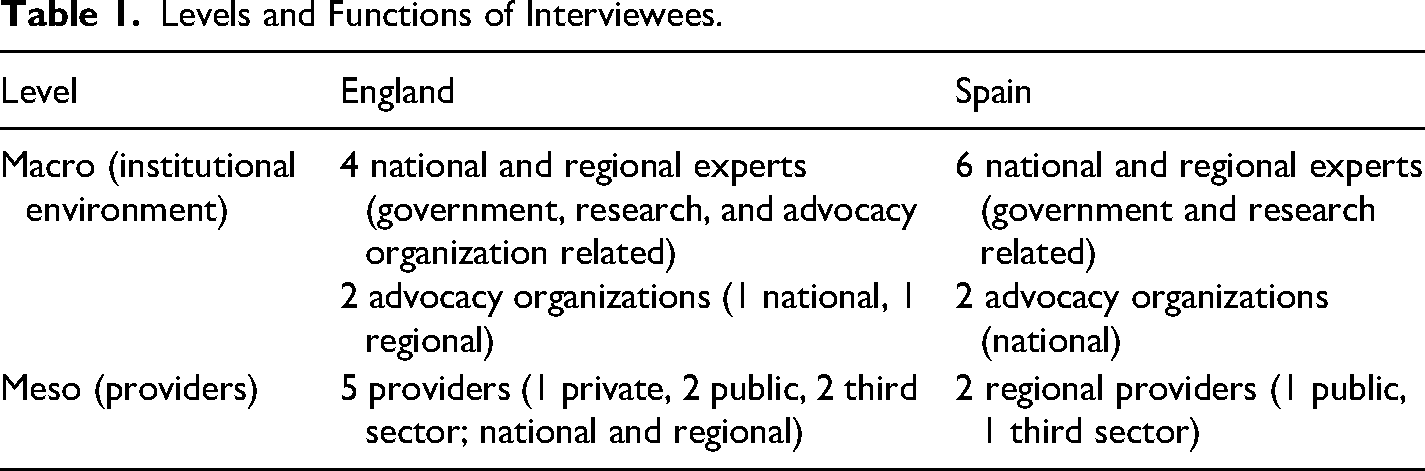
For the case analysis, we chose an iterative process of document review and expert interviews (Bowen, 2009). The documents covered national and regional legislative texts (laws, orders, white papers, and funding rules) and delivered information about legal, political, and financial regulations at the national, and their translation into action at the regional level. Fourteen such documents were analyzed for England, and eight for Spain. Thereby, we identified relevant stakeholders and interview partners as well as issues for the interview guidelines. Between October 2019 and December 2021, we undertook eleven interviews in England and ten in Spain. Interviewees included national and regional government representatives, experts from academia, providers, and representatives from national association’s interest groups (see Table 1).
Levels and Functions of Interviewees.
The interviews were semistructured, nonstandardized, and conducted in English and Spanish 2 . Our guidelines contained the same key questions for each country. To analyze the interview data, we developed a deductive code system using qualitative content analysis and categorized text segments according to superordinate categories: general statements on the system; national and regional rights of disposal and legislation; national and regional financing; coordination of action by hierarchy, market, community, and networks; and provision. In a second step, we inductively refined this code system and built subcategories. For consistency, two researchers undertook the coding process in parallel, their resulting categories were compared and if needed, adjusted for conformity (Kuckartz & Rädiker, 2020). Finally, we summarized relevant text segments (Mayring, 2014).
Results
The following chapter presents central governance characteristics of publicly funded basic and community adult education in England and Spain. Focusing on documents, current regulations (starting around 2010), and information from our interviewees, we draw conclusions regarding the governance regimes and providers’ organizational fields and the impacts these have on providers’ behavior and their service delivery.
England: Interplay of National and Regional Regulations and Market Coordination
The Further Education (FE) sector is the dominant partner in the delivery of adult education in England. The government defines FE as “any study after secondary education that is not part of higher education (that is, not taken as part of an undergraduate or graduate degree)” (GOV.UK, 2022). The field is characterized by flexibility and complexity and there is “less of a system, than you would see in other European countries” (ENG_2: 43), as a national research expert explains. However, there is agreement on a conceptualization of basic education in an economic context, and that adult education should increase individual employability. This concurs with the idea of a liberal governance regime with limited social services (Knauber, 2017). Several documents confirm the picture of a complex sector, referring to the vast amount of legislation, and the high number of public and private providers, learners, and funding possibilities (e.g., Hubble et al., 2021; Policy Connect & Learning and Work Institute, 2020). Since the 1980s, frequently changing governments and policies have weakened FE provision (City & Guilds Group, 2019), leading to hierarchical structures that are reinforced by funding mechanisms in place. Overall, there has been a substantial decline in public funding for FE over the past 15 years. Participation rates have also dropped significantly (Britton et al., 2020; Education & Skills Funding Agency [ESFA], 2021).
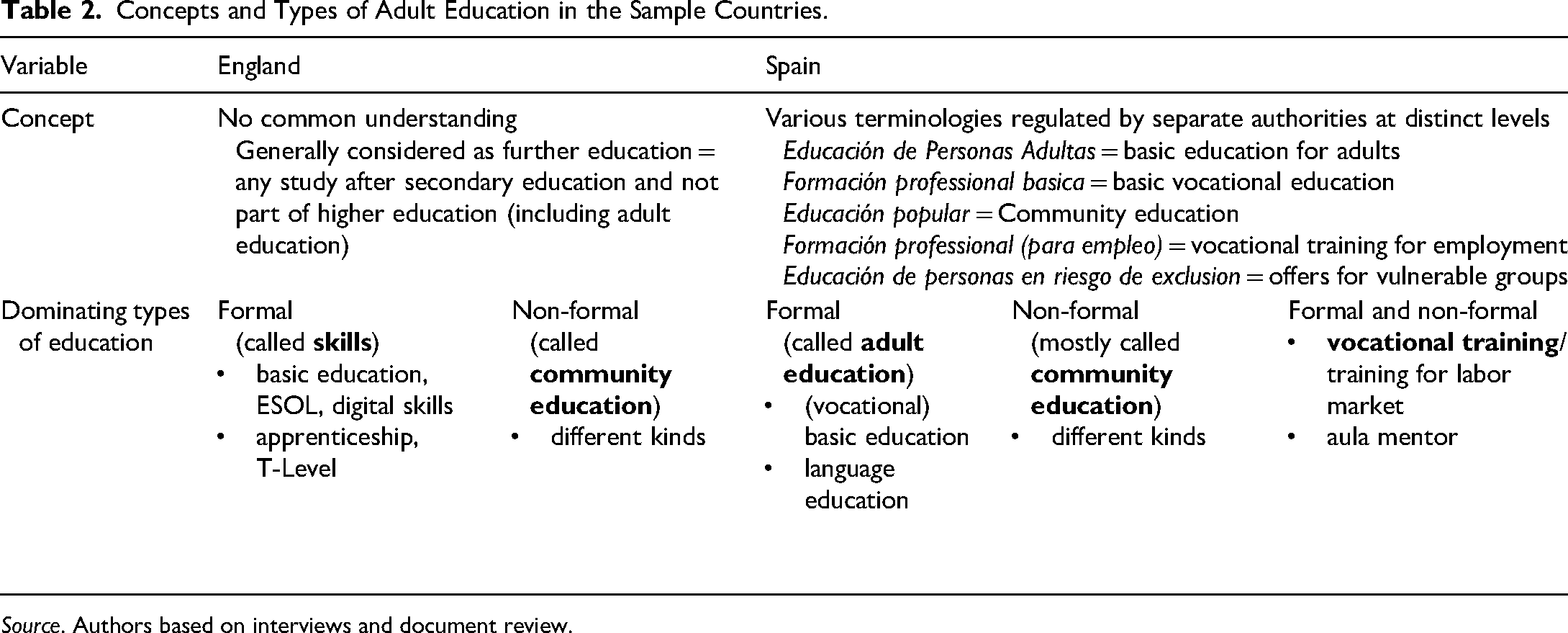
The most relevant regulating mechanism concerning basic and community education (see Table 2 for definitions) is the Adult Education Budget (AEB), defined annually by the national government and administered by the ESFA. If national providers follow annually published funding and performance management rules (e.g., ESFA, 2021), referring to two national acts (Apprenticeships, Skills, Children and Learning Act, 2009; Education Act, 2002), they obtain grants per learner. The main providers of FE funded by AEB are 163 general FE colleges (Association of Colleges, 2021), though private training organizations and local authorities can also bid in competitive procurement exercises. Providers must perform according to Ofsted's (national Office for Standards in Education, Children's Services and Skills) quality criteria; only those who obtain at least the mark “good” from this controlling body are eligible for receiving AEB. Another condition is the accomplishment of monthly reporting duties, listing all participants per course and hour. Installments are only distributed if learners participate for a certain time; they are raised if they pass the final exam and are calculated based on an individual course formula. Few community education offers lie outside these formula-based payments: Responsibility to check learner's eligibility for funding always lies with providers.
Concepts and Types of Adult Education in the Sample Countries.
Source. Authors based on interviews and document review.
In sum, financial frameworks in England are so complex, that annual planning procedures are complicated and financial pressures arise. They hamper “providers’ ability to respond effectively to changing skills needs” (Department for Education [DfE], 2021, p. 8). A national research expert thinks that these structural features lead to program design that is guided by “what you think it [the provider] can deliver and what you think you can get learners to do” (ENG_2: 54). One national third-sector provider declares that “it's the funder rules that really drive behaviors” (ENG_12: 60), meaning relations between funding bodies and providers are clearly guided by hierarchical coordination of action, supplemented by market-based action coordination. Especially since public FE funding was reduced, providers stepped back from collaborating. A national research and government expert explains that political emphasis was laid on competition and made it “hard to get public funding for uncertified, non-formal adult education” (ENG_1: 44), forcing many providers to pause the delivery of community education and focus instead on delivering business benefits. This also impacted collaboration between providers: One national third-sector provider states “resources are very, very tight … so, while we would like to collaborate … it isn't always possible. Just for pragmatic reasons of resource and time” (ENG_12: 113). Most providers must respond to the market. A national research expert reiterates the lacking systematic support, which “creates competitive behavior, which can create gaps and … duplication and inefficiencies” (ENG_2: 67). Providers experience pressure to secure funding by attracting participants leading to a situation in which several learners just move “… around the circle [of] training courses” (ENG_16: 59), a regional third-sector provider shares.
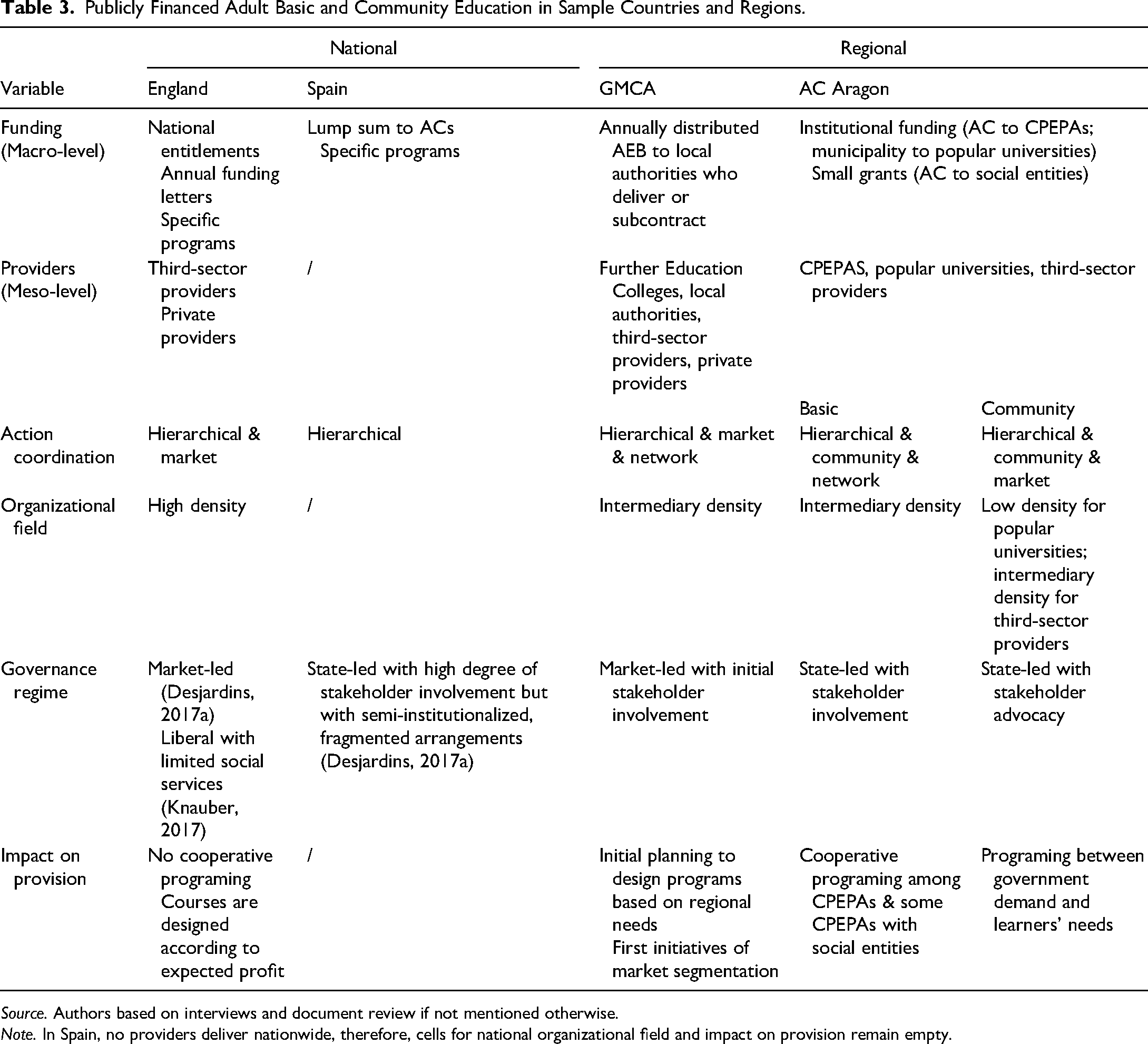
At the national level, the main providers of basic and community education are large, nationally operating third sector and private providers, whereas at the regional level providers are FE Colleges, local authorities, and community centers (see Table 3). In few cases, integrated provision offers flexible pathways between education opportunities (Desjardins, 2017a), but one civil society network representative describes that the various national funding streams are “linked together only by providers. … Not by policy” (ENG_8: 67). The organizational field at the national level is highly condensed, as there are two regulating bodies (ESFA and Ofsted) and large, national providers are competing in procurement processes with smaller, regional providers and vice versa (see Table 3). The dominating forms of hierarchical and market action coordination at the national level favor provision that is designed to yield profit, and thus risk duplicated delivery. Providers withdraw from cooperation with other providers; their relation is competitive.
Publicly Financed Adult Basic and Community Education in Sample Countries and Regions.
Source. Authors based on interviews and document review if not mentioned otherwise.
Note. In Spain, no providers deliver nationwide, therefore, cells for national organizational field and impact on provision remain empty.
For a few years, 3 the national government has realized measures to decrease density and complexity in further and adult education. In the devolution process, in which to date ten combined authorities have received authority over their own AEB (Foster, 2019), entitlements for basic skills (English, math, IT) remain national, but combined authorities manage local provision. In contrast to the manyfold national FE regulations, the only regional mechanism is an annually changing document specifying performance and management rules for AEB (Greater Manchester Combined Authority [GMCA], 2020). Like the national rules, they spell out learners’ and providers’ eligibility for public funding, but they set different criteria. Collaboration across all providers and their supply chains is expected “to enable high quality learner pathways, both at a local level and across GM” (GMCA, 2020, p. 38). Regional interviewees repeatedly state initial cooperation between local providers within the overall market-driven system and name the formulation of “The Manchester Adult Education and Skills Plan 2019–2025” (Manchester Adult Education, 2019) as one example. For the first time, a collective plan defining local priorities was developed in a participatory process involving stakeholders from education, skills, and health sectors, from local authorities, employers, and the police. Local providers agreed to separate their markets: FE colleges run higher level and the council runs foundational programs; as one regional public provider remarks, this “was what was agreed as most practical because many of the higher-level programs requiring specialist staff and equipment” (ENG_14: 113). Collaboration started without a legislative mechanism requesting it. One paragraph within the guiding document speaks of collaboration but refers only to providers of community education who should “reduce duplication of courses in a locality, and signpost residents to other partners as and when appropriate” (GMCA, 2020, p. 46). Despite the relatively short timeframe that has passed since this expectation was formulated, there are local examples for action coordination via community. One regional public provider explains that around 15 organizations collaboratively developed an English for Speakers of Other Languages (ESOL) advisory service, including a common initial assessment process, after which “the team allocates people to places where the provider is most suitable for the resident” (ENG_14: 46). Another regional public provider calls devolution of AEB a “sort of driver for … avoiding duplication” (ENG_15: 52) because organizations stopped offering similar courses at similar times to similar people.
In parallel to this community action coordination, market competition and regulation via hierarchy also exist. For example, providers shall individually set work plans, which GMCA authority agrees upon. In future, providers shall agree who will deliver what to further increase regional collaboration—towards a more strategic provision based on learners’ needs. The organizational field at the regional level is intermediary-condensed: Providers start to divide the field between each other, there are increased interactions and mutual awareness among providers and new joint ventures. At the same time, coalition patterns between organizations are not clearly defined, they need to be negotiated. Therefore, the level of information providers must deal with is, on one hand, higher compared to the national level. On the other hand, regional providers may focus on regional needs only and have an advantage in procurement processes. Funding bodies prioritize smaller regional providers over nationals due to their presumably better knowledge of the localities. One regional public provider finds this “is one of the ideas of devolution, that you get local providers coming up with local solutions, and therefore targeting the funding that is available more effectively” (ENG_14: 50). This leads us to a regional governance regime that is market-led with initial stakeholder involvement within an intermediary condensed organizational field. The given action coordination via hierarchy, market, and community leads to innovative and collaborative program planning based on regional needs and to the flourishing of initial market segmentation initiatives.
Focusing on one sample region only, we do not account for the complex processes of devolution all-over England. These have been described as progressing unevenly and slowly, being preferably implemented in urban areas and excluding local communities in the initial planning stages (e.g., Housing, Communities and Local Government Committee, 2021).
Spain: Decentralized Regional Regulation and Hierarchical, Community, and Network Coordination
Education in Spain is characterized by decentralization, transferring responsibilities for policy implementation and administration of funding to 17 autonomous communities (ACs) and two cities (OECD, 2018). The Spanish Constitution indicates that all public authorities should promote Spaniards’ right to education and training but neither defines lifelong learning nor adult education. Generally, Spanish adult education comprises three areas: (1) adult education (understood as basic (vocational) education for adults); (2) community education (called popular education); and (3) vocational training (see Table 2). All three are guided by separate legislative and financial regulations, which are located at the national, regional, and local levels, segmented by providers. One representative of a national civil society network says this segmentation leads to “a terrible mess because there is the central government, the autonomous community, the provincial councils and in some cases the comarcas [districts]” (ESP_8: 90).
Also, terminologies for adult learning areas are poorly defined which leads to misunderstandings when translated into English. The term educación de personas adultas [adult education] is generally understood as equal to basic education in the formal system. Interviewees from all levels confirm this understanding; one government expert states “when we talk about adult education, we are thinking … about the educational offer for the population that needs to acquire the title of compulsory secondary education” (ESP_5: 14).
The legislative context of adult education is fragmented not only due to three pillars of learning contents but also to Spain's decentral nature. ACs are free regarding the distribution of their annually received lump sums from the national government. They are also free to interpret national legal guidance (Maiztegui-Onate et al., 2020). Nine of the 17 ACs adopted their own adult education and/or lifelong learning law (Código de leyes educativas, 2021). Interviewees from all levels stress that ACs deliver diverse adult courses and that the only “common element is formal education [basic education for adults], access to qualifications …. in all the autonomous communities,” as one national research expert states (ESP_4: 151). Throughout the country, learners participate in basic (vocational) education in one of 1409 publicly managed Centros Publicos de Educación de Personas Adultas [adult education centers, CPEPAs], or 144 adult classrooms within the premises of regular schools (Eurydice España, 2020). There is also a wide range of publicly funded formal distance programs, locally implemented through technical equipment supplied to CPEPAs, for example, the national Aula Mentor (Boeren et al., 2017). Due to this extreme form of decentralized governance, we cannot define a governance regime, nor an organizational field for basic and community education at the national level. According to Desjardins (2017a), Spain's ALS is state led with a high degree of stakeholder involvement but with semi-institutionalized and fragmented arrangements (see Table 3).
At the regional level, we find hierarchical action coordination between the government of our sample AC, Aragon, its three provinces and 40 public centers. Generally, only these 40 CPEPAs and two authorized private centers can issue qualifications, other providers can train but cannot administer exams. Every four years, each province formulates an agreement with the regional government to “lay the foundations of how the collaboration and coordination and planning of adult education in Aragon is going to be” (ESP_15: 53), a regional government experts explain. Aragon adopted its renewed lifelong learning act in 2019 (Ley 2/2019) based on a history of related legislation since the 1980s. The same expert reiterates that this act was developed by over 500 actors, showing action coordination via community. Even though it took two years to agree, our interviewee calls its final version “highly valued by everyone, by both public and private sectors” (ESP_15: 39).
There is also strong cooperation between public CPEPAs in the “Network of Adult Education Centers” without any competition for funding, as a national research expert confirms: “In basic adult education (there) is no competition” (ESP_2: 379). CPEPAs receive institutional funding from the regional government annually to cover costs for housing and staff salaries. Already in 2002, legislation suggested that the CPEPA network should not only support program design according to local needs but also foster the cooperation of CPEPAs with local administrations and third-sector social entities (Ley 16/2002). Several interviewees confirm the coordination of action via community among CPEPAs and via network between CPEPAs and third-sector providers. One regional public provider says: “The relationship is one of cooperation” (ESP_14: 100), which is confirmed by a regional third-sector provider, describing her entity and the related CPEPA as collaborative: “When a person arrives at [name of CPEPA] or a person they think can't attend, they call us, they refer them to us….” She adds that there is no competition with Universidades Populares [popular universities] either, because “…the popular university reaches a different population than we do” (ESP_16: 96).
In many ACs, CPEPAs and vocational training centers share the provision of basic vocational education for adults, whereas labor market–related vocational training is provided by chambers, companies, and vocational training institutes. The latter are regulated by the national employment authority, which provides a framework curriculum and funding to ACs (Cedefop & Fundae, 2019). In Aragon, basic vocational education for adults is provided by the Aragonese Employment Institute (INAEM) and by the CPEPAs, which have wider local coverage then INAEM centers.
Although legal arrangements for regional stakeholder cooperation have been in place since 2002 (Ley 16/2002), interviewees state that network coordination of action takes place based on providers’ initiatives only. A supporting multisectoral advisory body was revived within Law 2/2019 (Aragonese Lifelong Learning Council, formerly Council of Permanent Education established in Decree 150/2004)—but interviewees reported that it was not active yet. Altogether, the governance regime of basic (vocational) adult education at the regional level can be described as state-led with stakeholder involvement. There is not only hierarchical action coordination between regional government and public providers but also action coordination by community between public providers and network coordination between public providers, social entities, and popular universities. The organizational field is intermediary dense: CPEPAs and INAEM share the provision of basic vocational training, with clearly defined coalition patterns. Relations between CPEPAs and popular universities are similarly precise, as only CPEPAs may certify qualifications. CPEPAs maintain interactions with other CPEPAs as well as social entities, not least by referring participants to each other. The level of information providers must deal with is intermediate since domination and coalition patterns are unambiguous. Overall, the combination of hierarchical, community, and network action coordination in an intermediary condensed organizational field enables cooperative programming for basic adult education among CPEPAs and partly between CPEPAs and social entities.
Coming to non-formal education, popular universities are the main providers, primarily financed by and attached to the Ayuntamientos [municipalities] or smaller towns (Sánchez-Martínez & Sáez, 2016). Their offer includes literacy, formal basic education, intermediate levels, access to university courses, professional training, and personal development. They depend on a small share of institutional funding, solely for projects that are financed by municipalities together with the Association of Popular Universities (FEUP), leading to hierarchical relations between them. The governance regime can be described as state-led with stakeholder advocacy, because on one hand popular universities depend on the government “…because that's who has the powers in Spain to have educational regulations and legislation,” as one regional public provider frames it (ESP_14: 77). On the other hand, one national civil society network representative explains that “whatever ideological color it [the municipality] may be, it maintains the popular university because the population demands it” (ESP_13: 87), meaning learners or social movements can influence provision through their advocacy.
The offers of popular universities are unique, there are no real competitors leading to an organizational field of low density. Partnerships between popular universities and CPEPAs depend on personal ties. Relations among popular universities are characterized by a strong sense of community: “We support each other, we have training resources that we can exchange” (ESP_13: 73). The combination of hierarchical and community action in low condensed organizational field results in program design negotiated between local governments and stakeholder demand.
Other providers of basic and community education are third-sector social entities, which offer non-formal education for the general population, but also specifically for people at risk of exclusion. These providers can take part in tender processes at the regional level cooperate with CPEPAs and often national institutes for targeted programs. We see hierarchical and market action coordination in their relationship with national institutes and public centers. Several of these entities ally within an association, in which we find community coordination. The related organizational field, therefore, seems intermediary dense and implies programing accounting for government requirements and learners’ needs.
Summary and Comparison
Varying concepts and types of adult education between countries make international comparisons challenging, even between two countries (see Table 2). Nevertheless, focusing on publicly funded basic and community education for adults in England and Spain, this paper highlights how specific national and regional features of adult education governance impact provider structures and their provision.
A summary of the empirical findings (see Table 3) shows that national frameworks imply differing action coordination at the national and regional levels: In England, hierarchical and marketized coordination dominate at the national level. Annually changing rules for receiving public support influence providers’ programing. At the regional level, the fast moving and complex adult education sector seems to be in transition from a market-led regime towards a more cooperative environment, even though lacking an overall sector strategy when data were collected. The devolution-related developments in GMCA show that cooperation between providers and actors can be initiated without legal obligations.
In Spain, we see a nationwide focus on providing formal basic education for the attainment of certificates, guided by hierarchical coordination. This is despite the strictly regional implementation, where we find hierarchical, community, and network coordination. Legal arrangements for cooperation among stakeholders in Aragon exist, but the supporting multisectoral advisory body is not yet active. Between public CPEPAs, less financial pressure (compared to public providers in England) encourages community coordination. Budgets are not linked to the actual number of teaching hours and learners provided for, and budgets for the following year do not depend on the offer realized.
Conclusion
By comparing the coordination mechanisms resulting from national legal frameworks and funding mechanisms in two sample countries, our paper confirms that these variables are an insufficient focus for international comparisons. Results from document analysis and interviews illustrate that for country comparisons the inclusion of regional perspectives highlights details that support a holistic picture of multilevel adult education systems and their supply structures. Changing responsibilities and incoherent understandings of what constitutes adult education are factors that influence providers and their offerings. Referring to research question 1, we conclude that regional frameworks play a relevant role in the regulation and implementation of adult education provision. For (inter)national comparative research on ALS, their composition, their equality and equity, it seems crucial to go beyond the examination of national conditions.
Referring to research question 2, we find that regional regulations calling for cooperation among providers in program delivery are not always translated into action and therefore, do not necessarily have an impact on provision. Vital for a demand-based adult education provision, however, seems to be the inclusion of local actors in regional strategy development.
Drawing on the educational governance perspective, this article analyzes relations between the macro-level (national and regional institutional frameworks) and the meso-level (national and regional providers and their provision) of ALS in our sample countries. Referring to existing research and typologies (Desjardins, 2017a), we see that in the market-led regime of England, corresponding forms of action coordination dominate and lead to providers’ expected behaviors, program design, and implementation. At the regional level, however, there is structured cooperation between providers despite the lacking legal basis. In Spain, where Desjardins (2017a) describes state involvement in social expenditure and stakeholder coordination as nationally fragmented, basic education providers do network, even though the legally defined body for its promotion is inactive. In neither country is there a clear common understanding nor definition of adult education.
To compare adult education provision at international level, combining the theoretical approach of educational governance and the neo-institutional perspective allowed us to focus on providers’ behaviors within and influenced by institutional structures. Defining organizational fields’ density and analyzing coordination mechanisms of national and regional stakeholders from public, private, and third sectors helped us to understand the regulation and delivery of adult education and to characterize governance regimes. Like this, we identified varying national and regional organizational fields and highlighted the necessity to include regional perspectives into country comparisons.
From these findings, we conclude that there are three additional characteristics whose presence or absence should be considered when comparing and analyzing information on adult education systems: (1) a common understanding of terms and concepts (confirming suggestions by Desjardins, 2017a); (2) specific regional regulations supporting actors’ collaboration; and (3) a reliability of bodies in charge, policies in place, and government priorities set.
Two major limitations of our research are that its empirical findings rely on two country cases, each with one regional case only, and that we limit our analysis to a narrow area of provision. Further case studies should verify the three characteristics we suggest by looking at other countries, regions, and fields of delivery. Possible analysis could focus on private sector provision or examine governance regimes and organizational fields of vocational education and training because many governments prioritize job-related provision of education for adults.
Footnotes
Acknowledgements
The authors would like to express their gratitude to Prof. Sir Alan Tuckett (England) and Prof. Dr. Ramón Flecha (Spain) for participating in the study and providing indications to identify interviewees. They facilitated the gateway to the country-specific contexts of adult education. Many thanks, of course, to all interview partners, without whose contributions our research would not have been possible. The authors would like to also thank Ms Diana Treviño-Eberhard for her translation and academic support and Ms Lea Heck and Mr Timo Kann for their research assistance.
Declaration of Conflicting Interests
The author(s) declared no potential conflicts of interest with respect to the research, authorship, and/or publication of this article.
Funding
The author(s) received no financial support for the research, authorship, and/or publication of this article.
