




Abstract
This study explores international students’ perceptions of the transition to the online learning environment while they were studying on an Erasmus+ Study Mobility Programme at host universities in Europe during the COVID-19 pandemic in spring 2020. Applying the theoretical framework based on the affective, behavioural and cognitive aspects of adaptation in the case of international students, this study reveals what adaptive responses and decisions sojourners made, and how their study experience and learning capabilities were challenged by the restrictive measures introduced at host universities due to the state of emergency declared in the host countries. Fourteen semi-structured interviews with both incoming and outgoing international students were conducted. Results reveal that studying online with reduced social interaction was a real challenge to Erasmus students. They were lacking cultural knowledge of the destination country as well as the insights typically arising from face-to-face teaching and social interactions. However, findings also expose students’ satisfaction with their academic accomplishments. In this regard, specific proposals are made for universities that consider virtual mobility programmes for international students in the future.
Keywords
Introduction
The year 2020 brought unprecedented changes and challenges for the entirety of higher education (HE) across Europe due to the spread of the COVID-19 pandemic (Teräs et al., 2020). Universities had to switch to emergency remote teaching (ERT) mode (Hodges et al., 2020; Marinoni et al., 2020), which forced university officials, faculty and staff to work out quickly adaptable solutions to ensure the continuity of education online. ERT placed unexpected burdens on the shoulders of both faculty and students as they had to adapt to the new forms of teaching and learning.
The COVID-19 pandemic had instant effects on the Erasmus+ Mobility Programme, the flagship initiative of the European Union’s (EU) education policy framework. With the closures of university campuses, international students studying on an Erasmus exchange found themselves in the middle of lockdown far from their home countries, universities, families and acquaintances. These students needed immediate assistance from their host and home universities alike. However, most universities were not prepared for a severe health emergency, and they had to find prompt solutions to ensure the continuity of the Erasmus+ Mobility programme for both incoming and outgoing international students.
In this unforeseen situation, international students at the beginning – or in the middle – of their Erasmus programmes were in a peculiar situation. Similarly to other international students located in distant destinations outside the framework of the Erasmus+ Mobility programme, they encountered significant difficulties and major anxieties (Feng et al., 2021; Nguyen and Balakrishnan, 2020). Erasmus students still had a more advantageous position as they were relatively close to their home countries and had the possibility to return to their country of origin and to their home university. Yet those who chose not to interrupt their study programmes with the host institutions experienced the transition from real physical mobility to a virtual one, which faced students with serious challenges.
What reactions did these students have to the transition? How and what did they feel while they were trying to solve the puzzles precipitated by the complete lockdown? This study seeks to gain insights into Erasmus students’ real-life experiences and reveal what adaptive responses and decisions sojourners made, and how their Erasmus study experience and learning capabilities were challenged due to the pandemic. A large body of research is available on international students’ academic adjustment and transition processes in pre-COVID times (Hernández-Nanclares, 2016; Leask and Carroll, 2011; Ramsay et al., 1999; Rienties and Jindal-Snape, 2016; Zhou et al., 2008). However, little research has been conducted so far on international students’ mobility experiences in Europe during the COVID-19 pandemic. How Erasmus students endure a challenging period and overcome major obstacles in their mobility programmes needs further investigation. The study presented here aims to fill this gap and contribute to a better understanding of similar situations in the future and assist policymakers and the HE community in finding solutions to critical incidents.
Benefits and challenges of international mobility programmes
The European literature on international mobility in HE reports a combination of benefits and challenges. International mobility has transformed the HE ecosystem, accelerated the internationalization of HE (Dias et al., 2021), improved the comparability of academic programmes and course syllabi, enriched diversity on campus (Knight, 2012; Nada et al., 2018) and promoted the diversification of HE institutions (Dakowska, 2017). It also brings further benefits for the students: it opens new opportunities for academic development; it improves students’ transferable skills including communicative competence, language skills and digital communication skills (Aguaded Gómez and Pozo Vincente, 2011); and it boost students’ employability (European Commission, 2019). The richness of the programme lies in the combination of the academic experience and the social-cultural experience of living in a foreign country. In fact, the importance of out-of-classroom experiences cannot be overlooked, as it has proved to contribute substantially to international students’ transformative learning (Nada et al., 2018).
The comparability and consistency of degree programmes are still to be improved (Ruiz-Corbella and Alvarez-Gonzalez, 2014). The risks of brain-drain and the impact of international rankings (Knight, 2012), the inequalities observed in student access to mobility and the differences in socio-economic status (Ballatore and Ferede, 2013; Pineda et al., 2008; Powell and Finger, 2013) are among the further challenges faced by European HE. Both benefits and challenges are tangible proofs of a long process towards the completion of the free movement of researchers, knowledge and technology within the EU (Leemann, 2018).
In the last decade, virtual exchange and virtual mobility have gained importance as new instruments with a great potential to promote the internationalization of HE institutions (European Commission, 2019; O’Dowd, 2017; Vriens et al., 2010), albeit with less impact on students’ real-life experiences. In the past few years, the expansion of virtual exchange projects (for example, https://europa.eu/youth/erasmusvirtual_en; https://coil.suny.edu/) has provided evidence for its popularity among university faculty and students, and it may become a potential complement to physical mobility programmes in the future (Helm and Beaven, 2020). Today, when European HE is facing even more challenges due to the COVID-19 crisis, virtual exchange could play a key role in HE in the 2020s. Even if physical mobility recovers, a wider implementation of blended mobility programmes can be projected, as virtual exchange shares some of the benefits of physical mobility. Virtual exchange projects provide extended academic experience and develop students’ digital, linguistic and intercultural competence (Helm, 2019).
The augmented role of virtual exchange may come as a side-effect of the replacement of classroom teaching with distance learning due to the COVID-19 pandemic. However, the increased intensity of virtual learning has a positive impact on students’ satisfaction (Suleri, 2020), as well as their study habits and performance (Gonzalez et al., 2020). These findings agree with national and cross-national reports on the impact of COVID-19 on HE, which purport positive reactions to ERT by institutions and international students (German Academic Exchange Service (DAAD), 2020; Quality and Qualifications Ireland (QQI), 2020). Institutions responded quickly by mobilizing their online resources and technical infrastructure, but also by renewing student assistance services. Therefore, students could maintain their interest and motivation for continuing the mobility programmes.
Overall, the sudden changes prompted by the COVID-19 crisis suggest that some key issues will determine the quantity and the quality of online HE in the future (Teräs et al., 2020). On the students’ side, connectivity and extracurricular issues, and the level of students’ motivation and study skills, influence their virtual learning. On the institutional side, professors’ expertise in online teaching pedagogies, the structure of incentives introduced by education policies and the information technology (IT) infrastructure in place will contribute to the successful operation of online HE.
Research context and aims
The COVID-19 health crisis had a major effect on student mobility programmes across the globe. At the start of the crisis, up to 89% of HE institutions reported a negative impact on international student mobility (Marinoni et al., 2020). Six of 10 institutions reported that COVID-19 had increased virtual mobility and/or collaborative online learning as alternatives to physical student mobility (Marinoni et al., 2020). These two consequences were related to the options faced right away by many exchange students in Europe in spring 2020. They had to choose between abruptly ending their mobility or staying at the host university and continuing with online learning, social distancing, isolation and quarantine. The third option was returning to their country of origin and following their courses remotely in the digital space, as if it were an unanticipated virtual mobility.
Given the opportunity that this situation offered for empirical research, the aims of this study are twofold. First, the research inquires into the extent to which online learning may be an alternative to physical student mobility programmes. Online learning is an instrument that could help safeguard internationalization of HE in the short and medium term before the COVID-19 crisis is over. However, its potential as a substitute for physical mobility may be limited. The experience of international students on Erasmus mobility programmes in the spring term of the 2019/2020 academic year can shed light on this possibility, given that they experienced both the traditional mobility and the online learning conditions. Second, this study aims at providing an analysis of students’ reactions to the COVID-19 crisis and their perceptions of the transition to ERT. Thus, our study explores sojourners’ personal experiences and their adaptation process to the new learning environment during the pandemic to reveal how these circumstances affected their study experience and academic achievement.
Theoretical framework and research questions
The Erasmus students studying abroad during the health crisis were first confronted with critical decisions about whether to pursue or interrupt their mobility programmes abroad. Then, once their decisions were made, they had to go through the transition process from physical to virtual mobility, adapting to the ERT introduced by their hosting universities. To explore international students’ perceptions of their transition to ERT due to the COVID-19 pandemic, the theoretical framework based on the affective, behavioural and cognitive (ABC) aspects of adaptation (Ward et al., 2001) was applied.
The ABC model was designed to analyse how people (travellers, business people, students, migrants, refugees) confront cultural differences due to their immersion in another culture. The model provides insights into people’s ABC responses given to cultural distance, intercultural communication and social relations experienced during their transition process towards acculturation; that is, the degree of adjustments to the new cultural environment.
The affective domain helps explore students’ feelings and emotional reactions related to the decisions they had to make. Their psychological well-being or ill-being reveals how they confronted the situation initially, and how they adapted to the upcoming events. The behavioural domain provides insight into sojourners’ socio-cultural adaptation as well as their relations with peers, university staff, professors, academic authorities and other agents. It may also indicate how these social relations changed due to the new situation. Finally, the cognitive domain implies how Erasmus students accepted the challenge of pursuing their mobility programmes under ERT and other restrictive measures in place. Furthermore, the impact of ERT on students’ learning capabilities and academic achievement under the changed circumstances can be revealed.
The processes of cultural acculturation and the phenomenon of potential culture shock have been widely investigated in the past (for example, Brown and Holloway, 2008; Chapdelaine and Alexitch, 2004; Gbadamosi, 2018; Oberg, 1960; Searle and Ward, 1990; Winkelman, 1994). Also, academic adjustment and transition processes have received abundant attention in the literature (Leask and Carroll, 2011; Ramsay et al., 1999; Zhou et al., 2008). In this context, applying the ABC model as a framework to analyse transitions and adaptation processes of international students in HE has proved to be a feasible approach. Zhou et al. (2008) suggest this theoretical framework to examine the pedagogical adaptation of international students attending HE institutions abroad. The authors address the ABC aspects of adaptation, arguing that this approach offers ‘a more complex but more robust and predictively powerful model’ that is more capable to project and suggest practical actions than other alternatives (Zhou et al., 2008: 73). Rienties and Jindal-Snape (2016) analyse different aspects of transitions experienced by international students in HE through the lens of the ABC model. Hernández-Nanclares (2016) applies this framework concretely to understand multidimensional transitions of Erasmus students, unpacking their motivation and academic performance using social networks.
Currently, little is known about international sojourners’ experiences during the first wave of the COVID-19 pandemic in Europe. This study reveals the challenges faced by students due to the transition process amid the COVID-19 crisis, which meant a shock to all. Therefore, the selected approach and theoretical framework used for analysing similar situations in previous studies seem to be well suited to the purpose of the current investigation. By using the ABC model, we would like to organize and interpret students’ ABC aspects of their responses to the crisis and their adaptation to the new academic and social environment. Hence, this study seeks to answer the following research questions:
What were the affective, behavioural and cognitive reasons behind students’ decisions about pursuing their studies with the host universities amid the COVID-19 crisis?
What affective, behavioural and cognitive elements of students’ perceptions and attitudes determined their transition from real to virtual mobility during the COVID-19 crisis?
Methods and participants
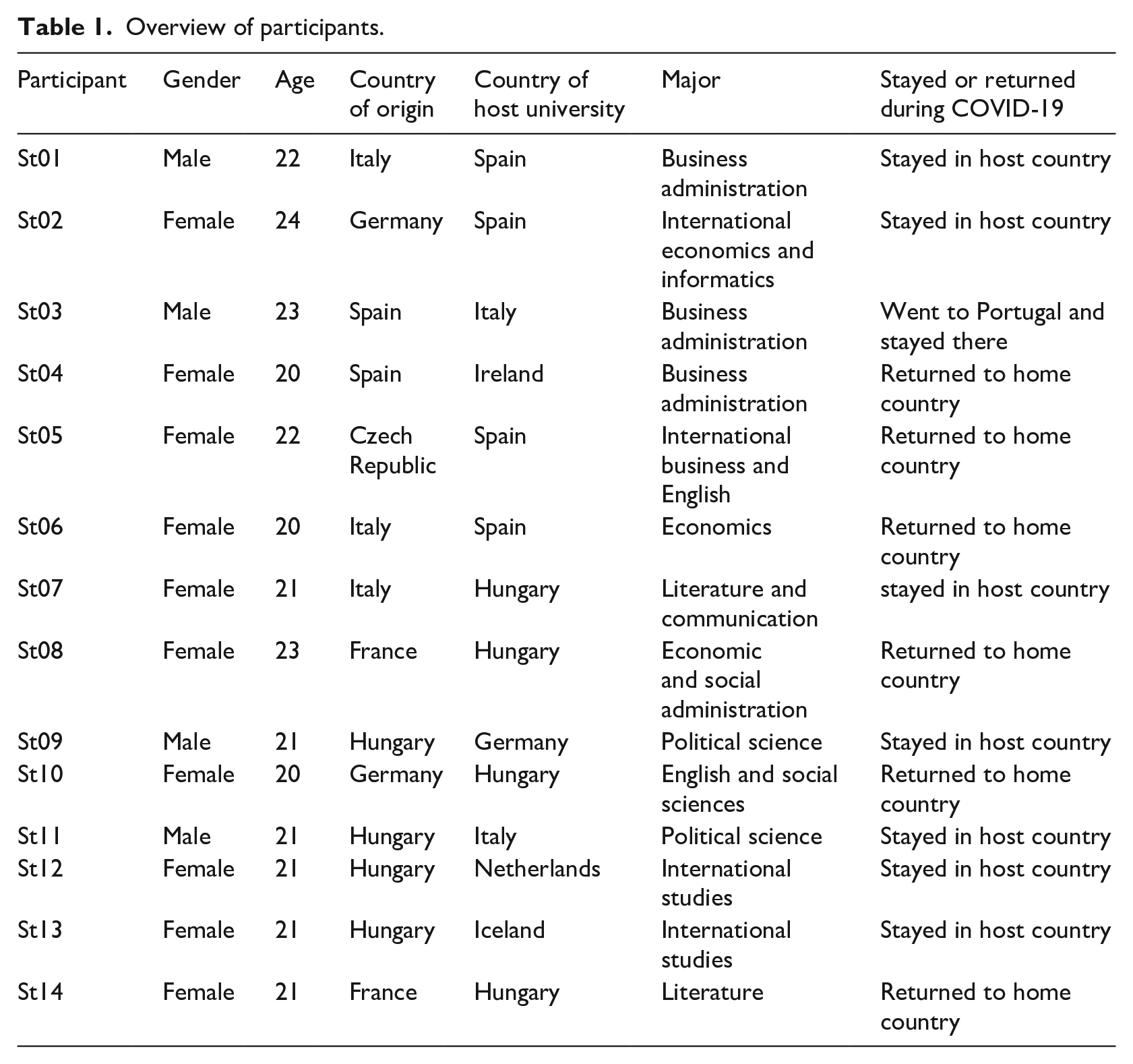
Our research aimed at exploring students’ personal, real-life experiences of their Erasmus mobility programmes during the COVID-19 pandemic. Therefore, the study followed a qualitative approach and involved in-depth semi-structured interviews (Galletta, 2013) with undergraduate university students studying on Erasmus mobility programmes during the spring semester of the 2019/2020 academic year. Participants were recruited for interviews using stratified purposeful sampling strategy (Patton, 2015) with the aim of ensuring that both incoming and outgoing undergraduate students were involved in the study, and the largest variety of nationalities and countries were represented. The 14 participants were incoming or outgoing international students of 2 European universities: one in Spain and another one in Hungary. They were from six European countries and studying on an Erasmus mobility programme at eight European universities. The overview of participants is provided in Table 1.
Overview of participants.
First, the students were informed about the aims and procedures of the study, and their written consent was obtained. Participation was voluntary and students could decide to withdraw from the study at any time. The study was conducted in compliance with the internal ethics protocol of the authors’ universities. The qualitative inquiry followed the interview guide approach using preset questions and guiding prompts (Cohen et al., 2018; Galletta, 2013). The interviews were conducted online and ranged from 40 to 90 minutes. The recorded interviews were transcribed using an online application tool, and the transcripts were analysed by applying the constant comparative method (Creswell, 2013). The identified units of analysis were coded and assigned to categories corresponding to the ABC domains of the theoretical framework. Data coding, assignment and interpretation were reviewed and cross-validated by the co-researchers to prevent researcher bias and ensure objectivity. The qualitative inquiry, which served the purposes of the current study and yielded valuable results, allowed insights only into the perceptions of the participants, and findings cannot be generalized to other students studying on Erasmus mobility programmes during the pandemic.
Results
The first part of the semi-structured interviews focused on students’ personal and educational background, their motivation to apply for an Erasmus mobility programme and their short study experience at the host universities before the lockdown. In the second part of the interviews, students explained what had happened when the host countries and universities introduced restrictive measures due to the spread of COVID-19, and they were asked to give a detailed account of their Erasmus experience during ERT, their adaptation to the online learning environment and their perceptions of the transition from real to virtual mobility. The findings are presented in the order of the research questions and structured according to the three domains of the ABC model.
Students’ critical decision-making
The participants explained that the most critical moment of their semester had been when they had realized the gravity of the COVID-19 situation and the restrictions had reached the host countries. Some students (St02, St03, St04, St05, St10, St13) suggested that they had not expected the situation to be so serious and had not thought about it having dire consequences for their mobility programmes. Other students (St01, St06, St07, St08, St09, St12) said they had projected what was coming and had been more prepared to face the situation.
Students had been informed of the closures of university campuses, and institutions had switched to ERT. Interviewees remembered that they had found themselves in the middle of a health emergency over the course of one day and had faced uncertainties about the near future. They had to make a critical decision whether to interrupt their physical mobility at the host university and return home or continue their Erasmus exchange and stay in the host country. Students reported fear (St06), confusion (St10), panic (St08) and anxiety (St01, St07) as responses to the uncertainty of the situation. As St07 described the situation: ‘I remember that very strong anxiety for me because at the beginning, nobody had the answers, nobody knew what to do and how to cope with the situation.’ St06 suffered from great stress as she was afraid to lose the entire semester and would not be able to pass the exams. St06 and St10 highlighted that they had not received any information from either the home or the host university, and they had not been advised on how the semester would continue. Other interviewees (St04, St08, St10) mentioned that they had left the host countries without knowing whether they would need to come back for the exams or not. St06 and St10 were not sure what the academic consequences would be if they returned home. As St06 recalled, ‘I did not know [. . .] if I could continue Erasmus or not if I came back home. So, I was also worried about this.’
Reasons behind interrupting or pursuing the studies with the host universities
The interviews revealed the ABC reasons that influenced students’ decisions. Out of the 14 participants, 6 students decided to return home and 7 students stayed in their host countries. One student (St03) went to Portugal for a short visit and could not return due to the imposed travel restrictions, so he stayed there with a friend and returned to his home country in May. All students decided to pursue their studies with their host universities remotely, and some of them (St02, St09, St11, St12, St13) could complete the courses of both their host and home universities online.
Affective reasons
Among the affective reasons, participants described their emotions, fears and worries that were responsible for their actions and responses to the emergency. Students had to assess the risks associated with either option to arrive at a firm conclusion. St08 had to decide whether she was taking less of a risk by travelling or by staying in Hungary. St01 had to face the possibility of getting infected with the virus as one of the students tested positive. Therefore, he had to consider the health condition of his parents when deciding on staying or leaving Spain: I decided to isolate myself [. . .] before the Spanish government ordered the confinement. [. . .] It was hard for me not to go home in Italy, but my parents are not young anymore, so I was worried about their health condition, and I think it was the right thing to do [staying in the host country]. (St01)
Students (St04, St06, St10) also expressed their concerns about the possibility of staying alone in a flat in a foreign country without close contact with their friends and family. Fears of loneliness during a possible curfew and lockdown restrictions seemed to drive their decisions. St10 had realized that she would have been alone in the flat without anyone to talk to, which she wanted to avoid.
Behavioural reasons
Regarding the behavioural factor, family and peer pressure had determined students’ choices. All interviewees explained that their families and friends had helped them in making the final decision on whether to stay in the host country or travel back home. Local peer pressure had also highly influenced the participants, and in most cases the fact that other international students had left made them feel insecure. St02, St12 and St13 revealed their stress associated with the fact that other students and flatmates had travelled home while they had stayed in the host country, despite the circumstances. At that point, they had questioned whether they had made the right decision or not: ‘When all German students started to pack and go [. . .] I thought to myself “I am surely doing something wrong” and I had the feeling that I had made the wrong decision’ (St13). Alternatively, students staying together could support each other. In the case of St07, for example, she had stayed in the flat with two other international students and she could rely on their comfort and company.
Cognitive reasons
Academic achievement and successful course completion had been among the cognitive reasons to sway students’ decisions. In the case of all interviewees, the home universities contacted the students, and university coordinators either advised them to interrupt their Erasmus exchange in the host country or provided recommendations and options to assist students abroad. St08 insisted that she had not wanted to leave while she had classes at the host university to ensure that she would fulfil the requirements of the courses: ‘As soon as I knew that I would not have classes, I took the first flight and I went back home.’
Other students (St09, St11) emphasized the financial implications of their decisions when considering the interruption or continuation of their Erasmus exchange. Both St09 and St11 pointed out that they would have been at a disadvantage returning to their home institutions. The initial information they received had been that students interrupting their mobility programmes would need to pay back their grants. This news had caused confusion and stress among the students. Later, universities had confirmed that the COVID-19 health emergency had been a case of ‘force majeure’, hence funding and additional expenses associated with the health crisis would have been reimbursed for the students regardless of their decisions. Interrupting the Erasmus mobility programme also had serious consequences for the Hungarian students in terms of their academic advancement. Had they decided to return to Hungary and give up their Erasmus exchange, their semester at the home university would have become passive. This meant that they would have been able to continue their studies only in the following semester, missing out a complete semester without earning any credits. This option had not been acceptable to the students (St09, St11) and therefore they had concluded they would remain in the host country and carry on with their original course of studies abroad.
Overall, students who had interrupted their stay abroad all reported a sense of disappointment and they claimed to apply for another Erasmus exchange in the following semester. As St06 put it: ‘[When] I came back home, I was anxious because it was my experience and I did not want to finish it like that.’ St08 had similar observations: ‘But it [packing and leaving Budapest] was hard because for me, it was like the end of my Erasmus.’
Students’ perceptions of their transition from real to virtual mobility
Affective factors
As regards the affective domain of adaptation, most students (St02, St03, St04, St05, St07, St08, St09, St10, St12, St13, St14) had reacted positively to ERT and could easily adapt to the new situation despite their initial anticipation of difficulties. Others (St01, St06, St11) believed that they regarded the change as a major challenge and had needed more time to adapt to the new learning environment. St11 highlighted his negative feelings of being in a flat alone without physical contact with family, friends and other international students. In the first month of confinement, St01 reported his state of agony and disorientation, which he could slowly overcome: ‘I was incapable of being efficient in anything. I lost my willingness of doing anything, I was not reading, not studying, not meeting people, it was hard for me in the first month.’ St11 had had similar problems during lockdown as the two-month confinement had caused psychological tension, which negatively influenced his intellectual performance. Despite the initial reservations, the students had accepted the situation: ‘I missed many things at the beginning [. . .] but due to the situation I missed less things, because we were all in the same situation and we could not do anything’ (St04). For St07, health and personal safety had been key priorities: ‘I knew that it was the safest solution. So, I was willing to accept it.’
The level of motivation after the transition to ERT had varied among the participants. St07 could keep her motivation high, explaining that she liked her major and found her online courses interesting, so it was easy for her to pursue her studies remotely. St09 and St11 mentioned the lack of motivation during online teaching and reported a loss of interest in some subjects. Despite lower levels of motivation, students had tried to find strategies to arouse enthusiasm and high spirits. As St02 recalled: I realized [during the quarantine] I could really study a lot. I had a lot to do with the university, a lot of things to be read. So, I was busy and that is how it [helped her maintain good mode in spite of some worse moments] helped a lot, being busy and working all the time. (St02)
Behavioural factors
Assessing the behavioural factors, the short period of time that students could spend in the host countries before the restrictive measures were introduced was not enough to get to know their peers and other international students. Therefore, the participants (St07, St08, St14) had few and limited contacts with other students during confinement. St02, St05 and St07 claimed to have kept contact with other Erasmus students, but they perceived that they had limited opportunities.
The regulations of confinement in all countries had not allowed room for social and cultural events and had forbidden social gathering. Interviewees (St04, St05, St09, St10, St11, St12, St13, St14) said that they had missed social interactions the most out of their Erasmus experience. St02 phrased what all the students had been feeling: ‘Just being in a room [. . .] I have always had the feeling I am missing out something when I am not going out.’ St05 emphasized the cultural aspects of the experience: ‘When you go to the place, you are enriched with so much more, with the people, with the culture.’
Participants (St05, St07, St14) also considered study groups and learning with peers to be important elements of the mobility experience. During lockdown, students could not study with their classmates and could not go to the library, but instead had spent a considerable time indoors, often alone, which St05 and St07 experienced differently. St05 lamented the absence of study groups, while St07 appreciated the time she had had for reading and studying alone.
Opinion was divided as to teacher–student relationship and communication during the Erasmus exchange. Participants (St02, St04, St05, St10, St12, St13) reported that teachers at the host universities had been helpful, open to answering their questions and assisting them in their studies. Some students (St10, St11), however, had not had the chance to meet faculty members in person and found it difficult to establish a good teacher–student relationship.
Cognitive factors
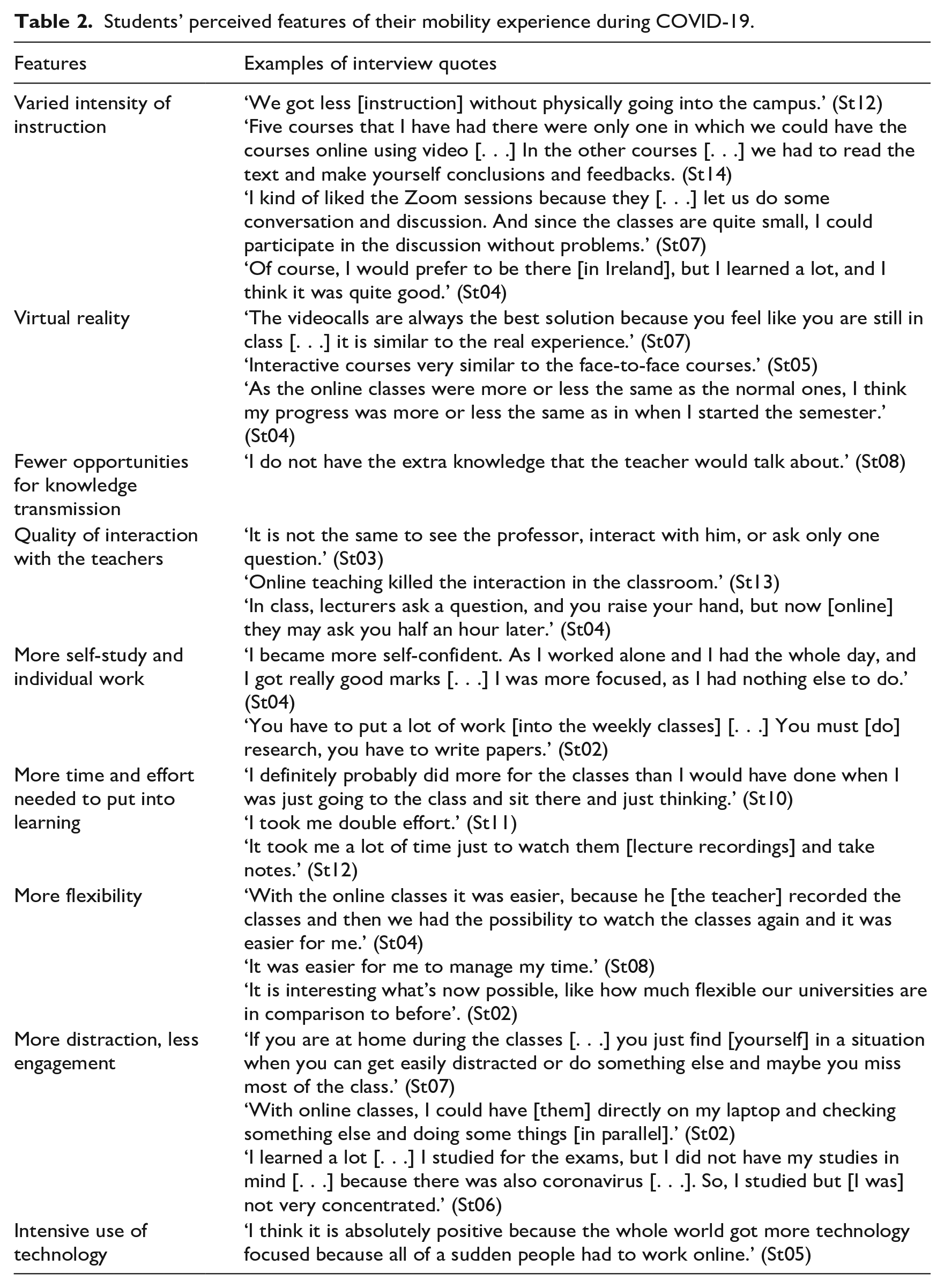
Considering the cognitive elements of adaptation, all participants perceived that their study experience online during the COVID-19 pandemic had been different to what an exchange would normally have been. Participants pointed out that the intensity of instruction had varied at the universities as not all courses had been organized to run synchronously. In the case of interactive online courses, students felt that these video meetings had closely resembled face-to-face classes. However, students reported that teachers had generated fewer opportunities to transfer knowledge in the online learning environment than in a normal teaching mode. The quality of teacher–student interaction had also showed differences in the sample: some students described positive examples of faculty members being open, aiding and even tutoring students to maximize their academic achievement. The interviewees believed that ERT had involved more self-study and individual work, which had resulted in having to put more time and effort into their studies. Despite the lower level of student engagement, students welcomed the use of technology and the flexibility of ERT, which provided new methods for learning. The distinct features of the Erasmus mobility programme during the COVID-19 pandemic are summarized in Table 2 together with students’ quotes from the interviews.
Students’ perceived features of their mobility experience during COVID-19.
Another feature that all students reported as having affected their transition to ERT was the need to cope with nonconformity in academic procedures and teaching methods. The difference represented in the proportion and weight of continuous and summative assessment methods was noticeable. St02 explained that she had put a lot of effort into preparation for the weekly class sessions at the Spanish host university, whereas in Germany she usually needs to take an exam at the end of the term. Another difference related to the type of courses was highlighted by St07. In Italy, most university courses were theoretical courses as opposed to the practical seminars she had taken in Hungary. As St07 phrased it: ‘[Seminars] really opened my mind about the type of knowledge I can access.’ Also, the expected difficulty of exams may have also been misperceived by students due to the lack of informal references and face-to-face class interactions with peers and faculty members. St06 had encountered several problems with the exams of the host university as she did not know what to expect. St08 also highlighted the importance of personal interaction with the teachers: It is more difficult to communicate [online] and to know what the emphases in the class are [. . .] what the requirements for the exam will be, whether the teacher would be nice or not [. . .] as we don’t know the teacher, we don’t know what’s going to happen.
The examination procedures also prompted reactions that, in this case, may resemble those of physical mobility: ‘I was used to the Italian system, where you can refuse a mark, i.e. ignoring a passing grade if it’s not as good as you expected’ (St06). Despite the confusion academic differences caused, students had a positive attitude: ‘[It was] definitely eye-opening and it helped me realize and discover new forms of teaching, new forms of communication [. . .] and in overall I realized that things ought to be taken seriously’ (St05).
Discussion and suggestions to integrate virtual mobility into university programmes
Affective domain
Both virtual off-campus Erasmus sojourners and on-campus students need more intensive social networking and support from the local student community and teacher body at the host university. Members of the latter groups could be organized to assist, orient and guide the virtually enrolled international students. This idea is not new to the field in the case of physical mobility (Leask, 2009; Nada et al., 2018), and conclusions drawn by Nada et al. (2018) stress the importance of social components in the case of international mobility. Student network services may be different for on-campus Erasmus students and for off-campus remote students. In the case of virtual mobility programmes, the integration of off-campus students requires more structured and institutional organization. Students participating in previous Erasmus exchanges may be more willing to participate in these initiatives, as they have experienced studying in a foreign country at a host university and may be more aware of the needs and type of support. Local students and staff should be encouraged to participate in the support networks with credit bonus or academic reward schemes. Informal integration strategies (such as learning guides, online peer-mentoring system, virtual conversation groups, online cross-cultural events) could be adapted to the virtual context following the recommendation of Leask (2009). Universities should implement online technologies to be able to support and offer a regular virtual meeting place for their student population. Using available tools and platforms aims at providing students with a space for socializing and building emotional and social connections with their local and international peers.
Behavioural domain
A critical aspect of a fruitful international study programme is the students’ adaptation to the socio-cultural environment of the host country. Socio-cultural adaptation proves to be even more burdensome in the virtual mobility context where contact with the host culture may only be limited to the synchronous remote class sessions. Host universities should consider ways to improve the experience of virtual mobility beyond formal educational courses. Virtual socio-cultural immersion programmes and out-of-classroom parallel sessions can be devoted to informing students about the special characteristics of the host culture, thus extending students’ intercultural horizons. Zhou et al. (2008) have shown that pre- and post-departure orientations of students enhance the quality of the mobility experience. The same observation can be made for virtual contexts and these programmes could be moved to the virtual space. In line with the considerations of Messelink et al. (2015), we argue that promoting intercultural learning in the context of virtual mobility is paramount.
Cognitive domain
Studying remotely is rather demanding and requires great willpower. If universities want to incorporate virtual mobility into their educational programmes, they should offer students solid tutoring structures to scaffold their academic performance. Teaching and administrative staff need to play a pivotal role in supporting virtual mobility students online, as they lack knowledge of the host university’s teaching practice including teaching methods, styles and examination requirements. The fact that Erasmus students must cope with marked differences in educational practices and learning environments has been emphasized in the literature (Klemenčič et al., 2017; Simões et al., 2017). However, the pandemic-induced learning environment shed light on the degree of variation in teaching and administrative models, channels of communication and use of technology at various institutional contexts, which determined the degree of easiness or difficulty of students’ adaptations.
Students participating in virtual mobility depend on substantial assistance by answering their questions, doubts and concerns related to their academic responsibilities and educational development. Listening to student voices is crucial to understanding the experiences that these students go through and the problems they face. Our arguments correspond to the claims made by Klemenčič et al. (2017) that HE practitioners should strive to understand international students’ problems. Meeting the needs of virtual students is coherent with the call by Dakowska (2017) for a long-term internationalization process that makes European universities more competitive.
Local and off-campus students enrolled in the same modules could be organized into mentor programmes or study groups under the leadership of the teaching staff. These initiatives should be integrated into the modules in which Erasmus students are enrolled and working groups should be organized to develop various activities and assignments related to the given modules. University practices of assigning students to classes – regardless of their delivery modes; that is, online, blended, hybrid – should reflect a mixture of different cohorts (local students, on-campus Erasmus students, off-campus Erasmus students). Beyond alphabetical order or timetable principles, students should be placed into classes following more social network analysis principles. Hence, teaching and administrative staff are expected to adopt a more personalized, student-centred attitude and approach to programme management.
Conclusion
The conclusions drawn from the analysis of 14 interviews conducted with Erasmus students offer a dual perspective. The negative impact of reduced social interaction influenced students’ ABC domains of adaptation. It provided fewer opportunities for knowledge transmission and reduced the quality of interaction with the teaching staff. However, Erasmus students associated direct benefits with the new social and academic measures and the critical changes introduced during the health crisis. Initially, students had perceived the situation to be emotionally and intellectually demanding when the crisis had struck. Serious decisions had to be made, autonomous learning had to be exercised, new technologies had to be operated, and Erasmus students were confronted with all these challenges in a restrictive context with scarce availability of formal and informal resources. In the end, students felt self-satisfaction at meeting the challenges following the accomplishment of their virtual academic work. Thus, one of the main contributions of this study is that it highlights how Erasmus students were deprived of access to the cultural knowledge of the destination country as well as of the insights typically arising from face-to-face teaching and social interactions.
The shock of the COVID-19 health crisis shed light on the vulnerability of social and academic relations, and it calls for an acknowledgement of the crucial importance of those relations and the need for prompt actions by HE institutions. Thus, the study contributes to the field by proposing several ways to improve social and academic interactions for virtual mobility students in the future: social networking and support schemes in the affective domain; out-of-classroom sessions devoted to cultural issues in the behavioural domain; and tailor-made tutoring structures, study groups and class organization changes in the cognitive domain. The development of these measures is a challenge for universities aiming to recuperate the vivacity required by internationalization, and it is also a promising field for future research on the suggestive topic of the interaction between real and virtual mobility.
Footnotes
Declaration of conflicting interests
The authors declared no potential conflicts of interest with respect to the research, authorship and/or publication of this article.
Funding
The authors received no financial support for the research, authorship and/or publication of this article.
