




Abstract
Worry conversations (in Danish, bekymringssamtale) and other network meetings are normally described as offering integrated solutions to complex problems by connecting a variety of views and resources. Adopting a systems-theoretical approach, this article suggests that worry conversations can be better understood if viewed as a loosening technology. Based on a case study, the article presents the hypothesis that worry conversations and network meetings can connect normally disconnected views and knowledge, and, more importantly, disconnect elements normally connected. By disconnecting observations made in a school context from the education system, schools can invite other organisations and function systems to turn what is vaguely formulated as a worry into a problem in their own systems. This increases connectivity, but also the risk that the worry will fail to be specified as a problem and the talk to develop into decisions.
Keywords
Nowhere in today’s Denmark can one find a state-funded school not working with some version of interprofessional meetings and conversations. Such meetings, sometimes referred to as ‘worry conversations’ (in Danish, bekymringssamtale), are also widely used in other Nordic countries (Arnkil, 2006; Hjörne and Säljö, 2004; Lidbom et al., 2016; Seikkulla et al., 2006) and, to some extent, across Europe, most prominently in the UK. In Denmark, these meetings tend to have similar structures. Six to 12 professionals, ranging from teachers, psychologists and social workers to various therapists and education managers, meet with parents and sometimes the child/adolescent concerned for about an hour to discuss the problematic situation from various perspectives, such as teachers’ competencies, cooperation issues, and the child’s family life, mental capabilities, self-esteem or medical issues. Normally it is claimed that the interprofessional nature of such network meetings and worry conversations helps ensure early intervention, integration and a holistic approach. For examples and analyses of such meetings (in Danish), see Folkesundhed & Kvalitetsudvikling og Socialstyrelsen (2012), Hansen et al. (2020), Hedegaard-Sørensen and Hansen (2016), Højholt (2009), Knudsen and Khawaja (2017), Servicestyrelsen (2011), Socialstyrelsen (2019).
Educational researchers often look to these interprofessional meetings as a way for differing professional groups to more collaboratively define and solve problems. By examining the potential of and challenges to this form of discussion, researchers hope to help foster multi-agency, interprofessional, timely and culturally sensitive services that can reduce the number of children excluded from school (Daniels et al., 2007; Edwards, 2004, 2012; Gaskell and Leadbetter, 2009; Greenhouse, 2013; Hedegaard-Soerensen et al., 2018; Hymans, 2008; Leadbetter et al., 2007). These studies often focus on new forms of professional identity and their negotiation, professional learning, and the expertise gained from sharing perspectives, integrating work practices and creating a detailed holistic picture of the child. Although the scholars responsible for this literature acknowledge that boundaries can be blurred and roles subject to negotiation, they maintain their faith in the holistic approach as a means for diverse professionals to confer on the best solution for a child with issues.
Rather than adopt a holistic approach, however, in this article I draw on systems theory to determine how worry conversations and network meetings connect normally disconnected views and knowledge, as well as disconnect elements normally connected. I use a case study carried out by myself and another researcher to hypothesise that worry conversations are more productively viewed as a loosening technology than as an exercise in integration. The case study involves a 7th-grade girl with a 50% school absence rate. The analysis reveals that the worry conversation conducted fails to lead to categorisations, problem descriptions, decisions or solutions. Instead, the worry remains only vaguely formulated, thus opening for various systems to articulate the problem, each in their own way.
To understand such school processes, some recent studies have focused on the conflicts between various agents and interests (Højholt and Kousholt, 2020: 43). Our study takes a systems-theoretical approach, as our interest lies more in the frictions between social systems than in people, agents and actions. Making a sharp distinction between social systems and human beings (Vanderstraeten, 2000), we look for different streams of communication, drawing on the work of Niklas Luhmann to observe social systems as recursive networks of communication (Luhmann, 1995, 2006b; Pors, 2015). In our study we observe not the conflicts between agents but how different function systems, seen as different streams of communication, are observing. How do they observe the ‘same’ case, the same ‘child’ differently? And how do they observe each other’s observations of the ‘same’ case or child? Friction sometimes occurs between social systems, while at other times one might see what Gunther Teubner (1991a, 1991b, 1992) has called ‘productive misunderstandings’. In other words, systems might misread each other, but this creates productive noise, not friction, thus allowing the single system to make internal order out of a ‘misunderstanding’. We see these new interprofessional worry conversations and network meetings as a local organisational answer to increasingly interdependent global function systems. As such, we have sought to observe how worry conversations and network meetings invite different streams of communication into them and how these streams might be connected or not. In this article I suggest that worry conversations and network meetings endeavour to keep the various communication streams loosely connected. Such a connection can facilitate a form of communication that oscillates between different codes, thus allowing for productive misunderstandings capable of producing new potentialities in the many function systems involved. This understanding is consistent with a number of current welfare management studies that apply the terms ‘potentialisation’ and ‘potentiality-seeking communication’ (Andersen, 2020; Andersen and Pors, 2016, 2021; Bjerg, 2013; Bjerg and Staunæs, 2018; Juelskjær et al., 2011; Müller and Groddeck, 2013; Raffensøe and Staunæs, 2014): Thus, a new responsibility of public managers is to seek out new conceptions of education, care, health and so on, beyond what we are able to imagine in the present. For lack of better words, we refer to this as ‘potentialisation’; that is, the creation of possibilities for renewal beyond our present conceptions. (Andersen and Pors, 2016: vi)
Contemporary school governance installs constant shifts and experiments as a mode of schools’ existence (Andersen and Pors, 2021). To seek potentiality, one must be open to and search for future possibilities rather than settle on a single specifically defined problem description or decision. The potentiality-seeking organisation regards the multiplicity of function systems as a resource, continuously reflecting on and questioning categories, problems or solutions and thus eschewing fixed expectations that reduce the potential of the situation concerned.
The analysis presented here shows potentialisation arising from the communication-seeking characteristics of the worry conversation. It contributes to the literature on potentialisation by analysing everyday interaction and focusing on ‘disconnectivity’ and ‘looseness’ as analytical terms. Looseness becomes a mode of management, a social technology for producing independent organisational elements and for weakening, sometimes even cutting, links that are too tight. In line with Stäheli (2018), Karppi et al. (2021) and Andersen (2020), I suggest that looseness can be used as a diagnostic category for contemporary society.
Worry conversations and network meetings
Many institutions besides schools, including social departments (Hougaard and Højbjerg, 2018), health institutions and police departments, initiate worry conversations, and such professionals as doctors, social workers and teachers also sound the alarm if concerned. 1 They use a range of risk assessment tools to categorise behaviour and worrying signs. The ‘child ruler’, for example, operates with five zones describing the child’s or adolescent’s well-being and parental resources. The five zones are summed up in three colour categories: green (well-being and moderate well-being), yellow (vulnerable) and red (at risk of marginalisation) (Lyngby-Taarbaek Kommune, 2019). Risks to be avoided include exclusion from school, incest, criminality and radicalisation. Some signs indicating a child may need support include difficulty relating to other children or adults, school absence, age-inappropriate dressing, and toxic friendships. What is observed as a risk is not a self-evident epistemic object, and reflexivity about risk descriptions has become a norm (Ratner, 2019).
A worry conversation is arranged when an institution or professional identifies a worrying situation but cannot handle it alone. As the analysis will show, the worry is kept indeterminate and open to various potential interpretations and so is not specifically a problem, as a problem is articulated in connection with possible solutions. This vagueness thus enables a problem to be articulated as such in various ways, and the term ‘worry’ can therefore be understood as a second-order problem in the sense that it explores possible problems. The head teacher in our case emphasises the ideal of presenting ‘uninterpreted observations’ to avoid an insistence on the use of professional terms.
Cases are regarded as complex and indefinite, and institutions like the aforementioned take other factors into account by inviting in other views and initiatives. Here, monofunctional structures are seen as a problem (Roberts, 2000). Seeing a young person on the wrong track, the police may hope for a pedagogical or social intervention, while a teacher may hope a child experiencing problems will get the medical diagnosis and treatment she needs. The term ‘worry conversation’ seems to stem from the Norwegian police (Knudsen and Khawaja, 2017), who have used such conversations as a structured preventive method since the late 1990s (Politidirektoratet, 2011). The first Danish descriptions of worry conversations refer to the Norwegian model (Pedersen, 2013).
The case of Maja
The empirical case I analyse in this article is a worry conversation held at a Danish school a couple of years ago and involving a 14-year-old girl in the 7th grade. Using this case, I make a hypothesis aimed to provide a more widely applicable understanding of such meetings. In certain respects the conversation was ordinary; it was based on ideals about interdisciplinarity and the student’s and her parents’ active participation in the conversation, as well as on the understanding that a student causing concern requires an early response. The organisation and duration of the conversation was also standard; it took one hour, had two rounds of discussion and a variety of professionals were present.
Some characteristics of the case make it rather extreme. For example, the school staff and social services participants had either never or only briefly met the girl. Moreover, the head teacher was about to leave the school, the family consultant did not turn up, the class teacher was on long-term sick leave, the girl did not attend and the social worker was new at her job. The head teacher described the conversation as ‘going smoothly’ and as successful. The description of the conversation as successful despite its not culminating in a mutual problem description, diagnosis or decision makes it an interesting case for an analysis exploring the function of this kind of meeting in the Danish welfare state today. My ambition here is not to provide any strong, general conclusions based on this single case, but to generate a hypothesis offering understandings of such meetings as being driven by something other than integration, coordination or consensus. This makes an extreme or atypical case a relevant choice, because such cases activate and reveal mechanisms that are more basic in the situation studied (Flyvbjerg, 2006: 292). The typical or average case is often not the richest in information. The conversation presented here is relevant as an analytical case because the organisers call it successful, and because it illustrates the problems and challenges of interprofessionalism and cooperation.
Before analysing the worry conversation, I will provide a step-by-step description of the case. My colleague Iram Khawaja and I observed, recorded and transcribed the conversation, focusing on the school and its inclusion practice. Although it would have been interesting to follow the case, the various municipal people involved and the family itself, this was not within the scope of our research project at the time, as we were building a broad understanding and therefore conducting observations and interviews with teachers, consultants, head teachers, children and parents in three different municipalities. We took part in the meeting as observers of the conversation, sitting at the table but not actively participating. I refer to the professionals by their titles, and the girl by a name other than her given one. 2 The empirical evidence I draw on here comprises our observations, audio recordings and transcriptions of this single conversation as well as an interview with the head teacher and the inclusion consultant. The description and selection of excerpts from the conversation reflect, as far as possible, its course and logic. Had I been interested in the participants’ positioning and their individual tactics, for instance, I would have chosen other excerpts. Instead, I have focused on the connection and disconnection of the communication, and on the presentation of problems, a diagnosis and possible solutions.
First round: the worries in the worry conversation
The worry conversation takes place in a second-floor room overlooking a car park at a medium-sized, provincial Danish school one Friday morning in December. Seven people are seated around a long table, with two researchers at the far end. The head teacher welcomes everybody and sets the scene. He reminds participants that they are here to focus on, look into and act upon the situation of a 7th-grade girl whose school attendance rate has dropped to about 50%. He stresses the mutual dialogue and collaborative action acutely needed to help her. The conversation has two rounds in which all participants – the head teacher, inclusion consultant, maths teacher, social worker, psychologist, mother and father – are asked to present their individual points of view. Although invited, the girl does not attend. In our subsequent interview with the head teacher and the inclusion consultant, they describe this conversation as ordinary – the kind they have at least once a week in this school, in this room. They also tell us that they regard it as successful.
The head teacher sets the framework for the conversation as follows: Maja is also new to me and new to quite a few of us. So, the purpose of the meeting today is to first go round the table and gather information and tell each other how we see the situation and how we interpret what Maja says . . . Then after the first round, the question will be: ‘Do we have a problem?’ If we feel there is a problem, we’ll go round the table again and look at questions such as: ‘What can we do? What can we do for Maja? Is there anything we need to adjust or do differently? Do we need to take any measures?’
The head teacher suggests two rounds of discussion and asks that the meeting have an enquiring, open tone. In our interview with him, he underlines the ideal of presenting ‘uninterpreted observations’. The first round focuses on how the various parties see the situation, whether they are worried and, if so, what about. Introducing the first round, the head teacher says: Six months have passed, and there are a few things we’ve noticed and are trying to address. We’ve noticed that Maja isn’t doing well. We certainly have a number of concerns about her well-being, how she is coping – also coping with the changeover to a new school.
The inclusion consultant then talks about her conversations with Maja, and the head teacher sums up, focusing on Maja’s contact with other students: What we’re hearing is that changes, especially big changes – like going from [a small] school to this large institution – are a challenge for her. Her self-perception and self-confidence are up and down. Sometimes she feels strong and in control, and other times not. What we’re concerned about, the reason why we’re sitting here, is her contact with the other students. I presume she uses social media, etc. Or can you tell us more about that?
At this point, he passes the ball back to the inclusion consultant, who has had more contact with Maja than the rest of the staff. The inclusion consultant responds: What I feel worried about is that she prefers contact through online chatting because it’s easy for her and she feels safe, but that she’s forgetting ‘the real world’, as I call it – she’s forgetting to spend some of her energy on making friends. When she’s in the classroom, I don’t really get the impression that she realises there is a real world out there that would actually like her to join in.
The inclusion consultant rather indeterminately worries about Maja’s resistance to relating to the real world and her lack of effort to make friends. Maja’s mother is then asked how she sees the situation. She expresses concern about Maja’s self-esteem, adding that a knee operation has prevented Maja from participating in physical education lessons. The mother also mentions her own depression as an excuse Maja uses to miss school, but Maja’s mother is particularly worried about the school’s changing structures: You’re absolutely right about her having difficulty with change. She’s unable to cope with something new all the time; it’s really hard for her. She needs to feel more secure, needs something that’s not so huge and confusing. She needs more peace and quiet. That’s one reason why her moods change so much. For example, straight after school started, they had a project week and everything was moved around, and, in those weeks where everything moved round again and again, she kept having to readjust.
When invited to describe the problem, Maja’s mother calls on the teachers to accept that since the problem, and thus the solution, lies in the school, the teachers must deal with it. She repeats these declarations several times during the conversation, but the communication continues on other topics. When the head teacher asks the mother to tell about Maja’s experiences from her former, small school, the mother recounts the safe environment there and the extra support Maja received. The communication could have connected to this and continued on how to understand Maja’s current behaviour in the classroom context, how to diagnose the problem in educational terms, and how to support Maja. The head teacher asks the mother if the extra support helped Maja and if things have become worse since she changed schools. The mother replies: ‘Well, right now I think it’s really bad. She cannot at all . . . I’m afraid she’s absent 50% of the time. I think it’s just not good enough.’ The psychologist picks up on this, asking: ‘What’s the reason she doesn’t leave [home] – does she say anything about that?’ A rather long pause occurs after this question, probably because it indicates the problem to be Maja’s staying home and not her avoidance of school. The mother replies: ‘Well . . . then she’s feeling bad one day and . . .’ After another pause, the psychologist says: ‘Does she have a stomach ache? Headache? What does she say when she’s feeling bad?’ Again the problem is disconnected from the school, directed instead to Maja’s physical or mental health. Every time the mother points to the school, the communication continues on other topics without connecting to her description of the situation. A little later, the mother tries again, saying: I think she needs a smaller group to relate to. I think that’s it . . . it’s, among other things, her problem that there are too many things she has to deal with all the time at a big school in a big class, and the teachers, they’re so busy with everything.
The psychologist picks up on this, suggesting that the reason for Maja’s low attendance resides in her perception of the situation: ‘But if it turns out that she has some specific problems with understanding things, or with following the pace and speeding up, then maybe that’s also what makes her get quickly tired of these big groups.’ A look at the parts of the conversation with the richest connections (where most participants join in) and most intense discussion reveals that they relate to issues of Maja’s self-esteem, her mother’s depression and unemployment, and the family dynamics. Regarding family dynamics, the specific problem that Maja’s older sister has a dominating influence on her life elicits a reaction from almost all the discussion participants. In addition, as mentioned, when the school’s structural framework and the professional infrastructure around Maja are mentioned, the connections remain few. This lack of connections concerns previously articulated issues such as changing teachers, timetables and counsellors; a family therapist who fails to turn up for meetings with the family; and a head teacher about to leave the school. Maja’s mother explains that these issues often cause Maja problems, but the communication switches to other topics with higher connectivity.
Second round: attempts to direct the issue
In the second, solution-finding round, the head teacher turns to the social worker and says: ‘OK, so now I’d like to hear what you have to say.’ She answers: ‘What I have to say? Well, as I said before, it’s the first time I’ve met the parents. I haven’t met Maja at all yet and am totally new to this, but I’ve taken a look at the case notes.’ She goes on to present the case set out by the family counsellor: She doesn’t feel well when she has to go to school, she complains of stomach aches and headaches and says she can’t breathe properly and that her hands and feet tingle. And then there’s what [the family counsellor] has written in her assessment – that she feels emotionally frustrated and confused, she feels anxious when it comes to going to school. She needs considerable support from the adults to cope socially and have the energy to be receptive to learning.
The social worker states that, so far, her department has carried out a programme in accordance with §11 of the Danish Act on Social Services, which involves discussions with family counsellors, and that, if further action is needed, a paediatric §50 assessment 3 should be carried out. She also suggests that a visit to the family support centre be arranged for the parents. At this point, the head teacher comments: ‘I know this is your area of expertise, not mine, but I’d just like to say that it seems to me that you should do a §50 assessment as well as taking extra initiatives. But, of course, that’s up to you.’ The head teacher expresses satisfaction, even relief, at the social worker’s suggestion, as she is taking some responsibility for the case.
Maja’s mother is also invited to contribute. Having problems herself, she explains that her depression makes it difficult to work. The head teacher remarks that older children often feel trapped if their parents are having trouble.
That’s also part of the picture, and I’m very glad you’re telling us about it, because it means we can go around the table and find out what we need to sort out. We’re looking at the whole picture – so what you’re telling us is very useful. Do you feel you’re getting enough help?
Apparently, looking at the whole picture means considering the situation of the family and how best to help it (Andersen and Knudsen, 2016). When the head teacher asks the mother what she thinks needs to be done for her to help Maja, she answers: ‘It’s not as if I don’t want to help her, but I haven’t got the energy to cope with it all – I just haven’t.’
The psychologist is invited to give her input. She has not met Maja, but refers to a cognitive examination done when Maja was in 2nd grade. It showed that Maja had average intelligence but was vulnerable. The psychologist suggests testing Maja again, an idea her father and the head teacher support. They all agree that Maja will be retested to determine whether she has reached her ‘cognitive limit’ and try to ascertain what is troubling her.
The head teacher brings the school into the equation when it comes to homework. He accepts Maja’s homework as a situation the school should handle, offering two options: Maja should be exempt from homework, as it should not inhibit her or make her feel worse; or Maja should do homework with her parents’ support so that she can build up her self-confidence and self-esteem. The head teacher stresses that parental support should not become parental pressure.
The homework issue becomes predominant during the head teacher’s minutes speaking. He sums up: ‘So should I try to write down that we will adapt the homework to reflect what Maja is capable of?’ This is the closest they get to a mutual decision. Maja’s mother sounds sceptical, saying: ‘Yes, but I have my doubts . . . sometimes it’s just too much . . . so yes, when she can manage it.’ She then directs the issue to Maja’s older sister, saying: ‘I was going to say – it’s almost Emma you have to talk to.’
The head teacher rounds off: We cannot change things overnight, as you’re well aware, but we’ll start from here and improve the situation. I would say we have achieved quite a lot today, and it was a good idea to meet. You [Maja’s father, with whom Maja is staying that day] can tell Maja about what’s going on. We’ll send you the minutes of the meeting.
The head teacher notes that the family counsellors at the local family support centre should also receive the minutes. ‘We should work towards her being as happy as possible at the school. We’ll send the minutes to [the family counsellors] and hope that they keep an eye on her and help her make progress.’
The conversation has four immediate outcomes: a (possible) psychological test, a possible §50 assessment (depending on the social work administration), the hope that the family counsellors will keep an eye on Maja, and a recommendation that the parents give Maja homework support if she feels it will boost her self-esteem and not be a pressure. The mother more or less rejects the latter because Maja’s older sister is in charge of homework. Meanwhile, the head teacher seems to be following a script, introducing the discussion with an open invitation to address the worry and concluding with a forward-looking affirmation that help is imminent because attention has been drawn to the problem.
After the conversation, we talk briefly with the head teacher and the inclusion consultant, immediately mentioning that the discussion must have been difficult. ‘It’s heavygoing’, we comment and express our sympathy for Maja, who is clearly struggling. The inclusion consultant replies: ‘I don’t find it too heavygoing, but that’s probably because we have so many [of these conversations].’ Neither does the head teacher feel troubled by the discussion, saying: ‘Actually it’s going smoothly, and we’re working together well. This was definitely quite an easy meeting.’ The inclusion consultant adds: ‘Also because the parents are open-minded.’
Scanning function systems and potentialising decisions
The following analysis centres on a research question concerning the possible function of the worry conversation. How can the head teacher and inclusion consultant consider this worry conversation successful when it leads to no real decisions, common understanding or solutions to the girl’s problems? Why is the fact that so few participants know, much less have met, the girl not considered a problem? What is actually ‘going smoothly’, and what does this term mean? I contend that the worry conversation scans function systems other than education to understand and describe ‘Maja’ – for example, the legal system, the care system and the love system. I further suggest that the worry conversation potentialises decisions in the participating organisations and that as a technology it loosens Maja from the educational setting by virtue of how the conversation is organised. This is the precondition for a ‘smooth’ scanning and potentialisation.
Continuing the analysis, I take inspiration from Luhmann to distinguish between organisation systems and societal function systems. A school is an organisation that communicates in decisions. These decisions are often coded in the educational function system, which communicates through teaching and instructions in the code better/worse and forms the medium of the human life course (sometimes referred to as ‘the child’) observing students as potentials (Baraldi and Corsi, 2017: 54–59; Luhmann, 2006a Luhmann and Schorr, 2000). However, decisions can also be coded in other function systems. Education is one global function system among numerous others, closed around a self-defined function. Function systems have different functions: economy functions to allocate scarce resources, law to serve as society’s immune system, education to form humans, and politics to make collective decisions on society’s behalf (Luhmann, 1982a, 2004, 2012; Philippopoulos-Mihalopoulos, 2010). Each system has its own symbolically generalised medium that increases the probability of communication. Constituting the recursive streams of communication, binary coding is used to close function systems on the object dimension. Each new communication can connect to either the positive motivation side of the code or the negative reflection side. To see how the worry conversation might connect to function systems other than education, I regard this conversation as streams of functional communication. Luhmann writes: ‘Communication is made, so to speak, from behind, contrary to the temporal course of the process’ (1995: 143). The single stream of communication is closed operationally from within, meaning that a new operation in the stream must connect to the connectivity already produced and only becomes communication if further operations connect to it (Luhmann, 1992; Pors, 2015). Communication should not be described by means of a transmission metaphor, as this would direct attention to the person issuing an utterance, and ‘the utterance is nothing more than a selection proposal, a suggestion’ (Luhmann, 1995: 139).
One can try to reconstruct subsystem-building inductively by analysing how ‘inside a society forms of connectivity of communications develop expectations in which further connections are more probable’ (Nassehi, 2005: 4). Within functional differentiation, a number of functional streams of communication can be seen, such as law, education, care and love. Communication can only take place within, not between, the streams. The education system perceives the child as a student, not as a client, and cannot see that it does. As Luhmann says: ‘An observer cannot see what he cannot see. Neither can he see that he cannot see what he cannot see’ (1994: 28). However, the education system seems to see that it cannot see and acknowledges the need for other observers to further codify the case and the child. The streams of law, education and care cannot intercommunicate, but can consistently observe each other, communicate about each other and react to each other with the operational closure of the single stream. Care might observe law, but it cannot see law as law sees itself. Care sees law from a care perspective.
What Maja is depends on the observer. Maja is constructed as a child, a student and a client. As Luhmann stresses: ‘A communication does not communicate [mitteilen] the world, it divides [enteilen] it’ (1994: 25). How Maja is constructed depends on the stream of communication observing her. To the care system she is a care and support recipient, to the education system a student, to the law system a subject of law with rights and duties, to the economic system an expenditure and an investment, and to the love system someone loved unconditionally. There is no supercode, no way to decide between the codes and no possibility of consensus. Although highly interdependent, the streams of communication all construct their environment from within and have no external observation point from which to be observed or coordinated. Teubner (1991a: 135) suggests the metaphor of ‘productive misunderstanding’: system A observes something in system B and gives it a completely different meaning that makes sense for system A, thus causing new communication this punctuation should follow ‘communication’. Teubner (1991a: 136) suggests the concept ‘ultracycle’ to describe how mutual productive misunderstandings between different streams of communication work auto-catalytically, thus strengthening the single streams. This does not work, however, unless the different streams are clearly differentiated. In the case of the worry conversation, this means that all issues in the conversation must be replicated in the single stream. ‘Maja’ cannot belong to one system. No single stream can declare to have a monopoly on her description. One system cannot insist on its particular problem definition, for sharply defining the problem as either educational or social would detract from the exploratory nature of the worry conversation. Different functional streams of communication should be able to describe the problem and propose solutions, after which the conversation could continue in the relevant organisations and professional contexts.
None of the participants insist on their description of Maja; all are open to other constructions and avoid demanding the use of their professional language. From a function system viewpoint, the worry conversation could take the form of a consultation in which an expert – the psychologist – advises the other meeting participants on how best to handle the teaching and psychological issues relating to Maja. 4 Installing one person as the expert would have stopped the potentiality-seeking communication and defined the problem as, say, a matter of health.
Using this perspective enables one to look for (parallel) streams of communication in the worry conversation. One becomes able to see communication as an interplay between connectivity (Anshlussfähigkeit) and connection (Anschluss) (Luhmann, 1995; Tække, 2019), with connectivity being a matter of how utterances open for potential selections, and connection a matter of actualised selections. The connectivity of the worry conversation is high, as evinced by the number of function systems scanned for clues to understanding Maja. She is observed from the medical, care, legal and educational points of view.
As for my second thesis concerning decisions, the worry conversation offers extremely limited avenues for making them. In systems theory, decisions are considered as communicative operations and not just individual choices, as an individual choice is insufficient to constitute an organisational decision. Luhmann (2018a) understands decisions as communication that absorbs uncertainties through a fixation of expectations. A decision ‘can be treated only as a decision in a specified context of alternatives: as a decision for this and against that’ (148). As communication in general, however, decisions are always recursively created by the next decision. Decision-making is a recursive practice (Luhmann, 2018b), and, as Niels Åkerstrøm Andersen puts it: Decisions establish expectations about the future but are made retrospectively . . . A decision cannot decide for itself whether it has been decided or not. In order to become a decision, it needs subsequent decision to assign it the character of decision. (2013: 29–30)
In other words, a decision is not really a decision until the next decision recognises it as a decision premise.
The worry conversation, however, refuses to reject any possible alternatives, refuses to say ‘this way – not that way’. Instead, the aim is to produce alternatives and to increase contingency. The worry conversation says both–and. Additionally, in our case, we see few recursive confirmations of decisions. A §50 assessment might be done, homework might be adjusted, but all this depends on later communication in other organisations. The head teacher encourages the social worker to do a §50 assessment in an attempt to absorb uncertainty, but this encouragement is not a decision, as only the social work administration can make that decision at a later stage. Organisations consist of decisions (Nassehi, 2005), and the worry conversation connects organisations but is not in itself one. The conversation is a network in nature, and, in networks, decisions need double attribution to work as such. The meeting participants are members of other organisations, not of the worry conversation. The worry conversation is, of course, itself decided – the school has decided to have this conversation and whom to invite from other organisations. Moreover, these organisations have decided to send participants, who thus attain a manner of double membership, their being a part of both the network and the organisation employing them. The school can decide neither what the social work administration will decide nor what the family decides for itself. The worry conversation thus becomes a medium for potentialisation, for making new possibilities visible to the other systems.
Going smoothly: sending the worry to the cloud
Denmark today has taken a semantic turn from a focus on teaching and special education to one on learning and inclusion. As such, school cannot solely communicate in the education system, its being responsible for not only the teaching, but all factors conditioning the individual student’s learning processes – and exclusion is not an option (Ratner, 2012). If a child is not thriving, the school is expected to consider the issue from every angle, including the student’s informal social relations, circumstances at home, and the child’s and parents’ health issues, to name but a few. Indeed, the school has neither legal nor practical access to the relations within a family’s various constellations, and its power to decide is limited. This may explain why a number of technologies are used to give the child and her parents some responsibility for her learning and well-being (Andersen and Knudsen, 2015, 2016; Knudsen, 2009; Knudsen and Andersen, 2014; Matthiesen, 2018). When learning and not teaching becomes the school’s core task, teachers – and teaching – lose their sole ownership of what happens and is considered relevant in school. The move from education as a fixed purpose to learning as an empty horizon means that school and education cease to have a fixed coupling, instead becoming loosely coupled to a number of function systems.
Similarly, since the success of the conversation appears not to depend on prior knowledge about the situation and the child, one can describe the function of the worry conversation as a matter of disconnecting the case from the school as an organisation and from the educational function system, and this disconnection makes productive misunderstandings possible in other systems. Rather than focus on agreeing about what Maja’s problems are and how to help her, I suggest that the function of the conversation be understood as a matter of inviting other organisations and function systems to adopt Maja as a problem they can describe and be responsible for.
This function takes an active effort, an effort to loosen Maja from the education system and from the school’s sphere of responsibility and to look, as Urs Stäheli does, for ‘acts of separation, practices of interruptions, and modes of producing disconnections’ (2012: 241; see also Stäheli, 2018, 2021; Karppi et al., 2021). He cites, for instance, a TripAdvisor list of the world’s top 10 beaches as an act of separation and disconnection. The travel platform invites people to rank beaches on a list that thereby connects otherwise separate elements. However, this connection also disconnects elements, because not every story about discovering a secluded beach or befriending someone there will be listed.
The worry conversation emerges on the school’s initiative and is based on an educational description of Maja. To be potentially connected to other settings, Maja must first be disconnected from the educational one. If the head teacher insists that the conversation be premised on the educational description of Maja, the other streams of communication cannot generate their productive misunderstandings of Maja and make her a relevant topic in their respective communications. In the conversation, Maja is mainly articulated as a ‘child’, not a student, and educational elements are generally avoided. When the mother brings up project weeks and other school-related subjects, the communication moves on to other topics. Communication connects when the topic relates to the family – for example, the mother’s low mood, the older sister’s intrusive control over Maja’s life, and the authorities’ failure to support the family. Communication also connects when the topic relates to Maja herself, such as her fluctuating self-esteem, her online chatting, her inability to participate in larger contexts, her possible ‘cognitive limit’ and her risk of depression.
Some of the central elements of education communication are teachers, students, learning, teaching, peers, lessons, homework, (registration of) absence, discipline, assessment, learning objectives, motivation and progression. Homework is discussed as a matter of self-esteem, not of training or learning progression. The head teacher and inclusion consultant refrain from describing Maja in educational terms, and the absent class teacher is in no position to insist on an educational form of communication. Professional, educational knowledge seems to be unnecessary for the meeting to continue. Indeed, the very notion of a conversation that has gone smoothly depends on Maja’s absence not being connected to school issues. The worry conversation increases connectivity by disconnecting Maja from the education system.
If function systems other than education are to be scanned, then the themes, issues and problems generated in the school and formed by function and codes of education have to be loosened up so that other observers can give them new meaning. If Maja’s problem is tightly connected to educational observations, it will have difficulty causing communication in other function systems, as in those systems the problem would be no more than noise if articulated as a matter of education. Thus, I would argue that the act of potentialising Maja only really works when the communication is rather diffuse and indeterminate, and this high degree of looseness in the communication renders it observable as making sense in systems other than the one producing it. The indeterminacy of the problem description enables other parts of the municipal system to decide on actions to help Maja or her family. These decisions are not part of the worry conversation but (may) take place after the conversation in the various organisations concerned. The worry conversation invites the parties to connect to the conversation in their system. The worries are sent to the cloud (see Figure 1), and the extent of their afterlife in the family or various organisations and function systems remains an open question. The worry is connected to the legal system by way of the §50 assessment and to the care system via the considerations regarding Maja’s well-being. This willingness to accept the problem, especially on the social worker’s part, and the parents’ lack of resistance are important factors in the head teacher’s relief about the conversation’s outcome. Although the level of connectivity is high, the extent to which the communication actually connects and is continued in the various systems is uncertain, in this case both generally and empirically. A year after our observations, we contacted the school to hear about Maja. They were still worried about her. For three months, they had provided a service to collect her every morning, but no longer had the resources for this. The new head teacher did not know whether Maja or her family had been referred to social services, the §50 assessment been made or further initiatives been put in place for her.
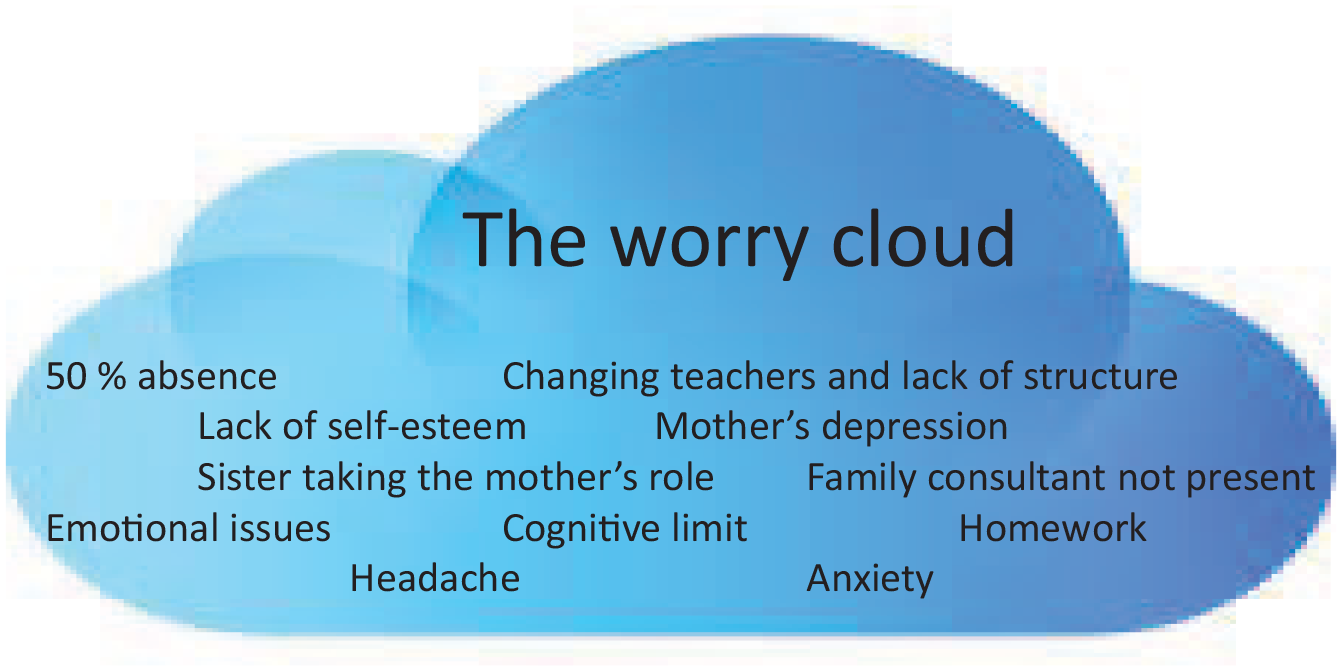
Illustration: The worry cloud. The worry cloud becomes an ultracycle linking the many function systems (care, education, law, love) as well as the family and various municipal organisations (school, social work administration, pedagogical/psychological counselling). For this to be possible, the child must not belong to the education system but have a plasticity and looseness that allow the various function systems to construct and observe her differently.
A head teacher in another municipality reported her dissatisfaction with the open outcome of the worry conversations at her school. She therefore decided to hold biannual follow-up meetings with all participants and quarterly meetings with every professional involved. This practice allowed her to follow up on whether the worries were withdrawn from the cloud and the communication continued in the various administrative units and professional settings involved. Thus, worries were turned into problems and talk into decisions in the organisations represented at the worry conversations. However, there were three consequences: she was inordinately busy having conversations, felt a higher degree of obligation and was ultimately asked by the managing director of the social work administration to stop interfering with his staff. She did not have the authority to oblige other departments to make decisions regarding, for example, resource prioritisation.
Loosening techniques and the worry as a second-order problem
The success of these conversations seems to depend more greatly on connectivity than on decisions, accurate descriptions or precise diagnoses of the problem. Contingency and indeterminacy are turned into potentials in the worry conversation. They are the backbone of ultracycles between systems, and looseness in itself may be the main form of the conversation. In this section, I examine how connectivity is provided and indeterminacy maintained. Elements normally connected are disconnected: case is disconnected from context, diagnosis from observation, resources from responsibility, meeting from decision. Looseness seems to be not only a lack but also a structuring mechanism (Stäheli, 2018) that connects otherwise separate systems. Looseness potentiates the likeliness of productive misunderstandings between the different streams of communication: Looseness is not a deficiency (as in a loose screw), but a precondition for establishing connections, networks, and social systems. . . . [T]oday looseness is increasingly inscribed into social systems, thus creating a media effect of its own. Looseness is no longer primarily the precondition for the construction of forms, but it becomes a form itself as the case of modularity exemplified. (Stäheli, 2018: 24)
I describe the worry conversation as a loosening technology, and will now point to specific techniques used in this connection. Luhmann (1990) suggests that a technology observes repeatable cause–effect relations and, in different circumstances of application, can repeatedly achieve a desired effect. I see techniques here as the elements or mechanisms that technology forms and makes use of. A technology can be a method, a tool, a concept or all of these, and involves a number of techniques such as schemes, questioning techniques, furniture and roles. The worry conversation as a loosening technology is always expected to achieve the same effect of decoupling the case and the particular child from its conception in the educational stream of communication. This loosening makes a wealth of productive misunderstandings possible in other streams of communication, and, when best constructed, engenders a kind of ultracycle wherein the single function system provides the possibility of contributing.
The worry conversation as a technology involves at least three loosening techniques: (a) the use of the term ‘worry’; (b) roundtable discussions; and (c) the inclusion of the child’s view (in this case represented by the inclusion consultant).
According to Luhmann, all communication involves three meaning dimensions: the factual dimension, which concerns the selection of themes and objects; the social dimension, which concerns the selection of identity; and the temporal dimension, which concerns the selection of what is past and what is future (1982b: 307; 2013, vol. 2: 341). The term worry has some consistent characteristics relating to all three dimensions. The term is vague on the factual dimension: a worry is neither a problem nor a challenge. There seems to be no core in the core task (Andersen and Pors, 2021), and no problem in the worry. Functional differentiation is based on operational closure, an operation in which the code is fixed and the case determined. The systems have ‘the function of determining the still indeterminate, and of regenerating indeterminacy’ (Luhmann, 2013, vol. 2: 88). In the worry conversation, the multifaceted problem can supposedly be addressed in its complexity. To define something as a worry makes it possible to explore potential problems, unbounded by certain perspectives.
On the temporal dimension, the term ‘worry’ shifts the attention from the present, as worrying implies a wish to anticipate the future and prevent potential problems. Signs of worry often point to future rather than present problems. On the social dimension, the term gives rise to an openness, and administrative silos among municipal departments are viewed as problematic, as is the risk of a mono-professional approach. The term also enables a professional, whether a teacher or a police officer, to point to a problem she can see but is outside her field. ‘Worry’ can be understood as a second-order problem in the sense that it explores possible problems (i.e. the function system in which it should be formulated), possible future problems and possible addressees to handle the problem (i.e. the organisational unit ostensibly responsible for the problem) (Luhmann, 1993). Worries potentialise connections between elements like the child, the parent, knowledge, the profession, the problem, the solution and the context, thereby loosening up the premises for subsequently articulating problems.
The worry conversation is organised in rounds. This makes it possible to move onto another subject or angle without breaking the normal expectations of interaction. The round allows for parallel streams of communication because no one expects recursive connections – other than that each person speaks in turn, passing the right to speak to the next person along the line when done. Meeting participants are usually expected to interpose with an answer to a question or an argument for or against a point. Talking in rounds, however, allows them to refrain from connecting to the communication and simply give the next in line her turn. Despite the mother’s repeated suggestions that Maja’s school absence might be due to the school itself, no one connects to this; the conversation simply passes to the next person in the roundtable discussion. Such discussion loosens expectations regarding the next communicative connection, thereby increasing the connectivity of the communication. What is more, the use of roundtable discussions indicates that no single system perspective or problem description is considered stronger or more valid than any other. Latently contradictory statements can be articulated in loosely coupled parallel streams of functional communication without the risk of negating each other. A statement about Maja’s mental issues can co-exist with utterances about family relations. There is room for many productive misunderstandings.
The inclusion consultant has no particular professional expertise to offer, but talks on behalf of the child and, as such, from an indefinable place. Her function in the conversation is to potentialise the problem. She can counter any attempt by the various functional streams of communication to define the situation because she can talk from the child’s point of view and mark the worry as something irreducible to a compartmentalised problem. The inclusion consultant protects the worry conversation against a unilateral codification of the worry, thereby preventing any one function system from defining and monopolising the worry, which would halt the potentialisation process. The inclusion consultant can even contradict the mother’s statements, because she is talking on Maja’s behalf.
Conclusion: a loosening technology
In this article I have mainly sought to determine the function of the worry conversation and how it can be considered successful without it having led to any clear decisions, mutual understandings or qualified problem descriptions. The analysis shows that the worry conversation succeeded because it managed to loosen the school case from its tight connection to the educational stream of communication, thus making many productive misunderstandings in other streams of communication possible. A kind of ultracycle was constructed wherein the single function system sees its own possibilities and relevance in the case. Maja was observed both as a student, a client, a child in need of care, and a potential patient. These various observations disturb each other in a productive way where one system may accellerate the operations of the other. This also leads to lowered expectation certainty.
Drawing on a systems theoretical vocabulary enables one to see that the worry conversation may in fact function not to resolve but to uphold or even enhance the level of indeterminacy. The conversation is regarded as going smoothly because the worry can be articulated in various function systems, without knowledge stopping the ‘uninterpreted observations’ in order to scan possibilities in the various function systems. Connectivity is increased by disconnecting Maja from the education system and the elements normally defining the context of a student. Various function systems are scanned for possible descriptions. Paradoxically, this scanning does not lead to a qualified description or articulation of the problem, as an insistence on determining the situation would hinder the continued scanning of potential descriptions. Connectivity is increased, but so are the improbability and insecurity regarding if and how the communication will proceed.
This analysis is in line with other recent welfare management descriptions indicating that potentialisation and loosening are current tendencies. Dwelling on a single case makes it possible to spot the everyday consequences of these current ideals, and to see the loosening techniques that increase connectivity in communication processes. In this case the techniques include the term ‘worry’, the inclusion consultant and roundtable discussion.
A search for connections as well as disconnections reveals that a worry conversation may work despite its lack of solutions and decisions, for its success may lie in how it loosens connections. A child should not be categorised as simply a student or regarded as only an element connected to education. At that meeting one December morning, the case (the child and her absence) in question was made connectable to systems with structural linkages between organisations and function systems other than the school. This increased the potential for continued communication, but also the risk that communication would cease, which is to say that Maja was not articulated as a problem for whom anyone was responsible. Sending the worry to the cloud makes sense when schools are forced to depend on function systems other than education without having the authority to compel other municipal departments or the family to take responsibility.
Footnotes
Acknowledgements
Much of the empirical and analytical work presented here was carried out with my colleague Iram Khawaja. We have co-written several texts on this project, and this article is single-authored only because of its systems-theoretical approach.
Declaration of conflicting interests
The author declared no potential conflicts of interest with respect to the research, authorship and/or publication of this article.
Funding
The author disclosed receipt of the following financial support for the research, authorship, and/or publication of this article: This article is a spinoff from a larger project funded by the Danish Ministry of Education in collaboration with three Danish municipalities.
