




Abstract
The European Credit Transfer System (ECTS), one of the main pillars of the Bologna Process, was heavily influenced by external forces such as internationalisation, globalisation and market values. It was also immune to national/regional policy influences and differences between academic disciplines. The authors investigated a) Irish teacher educators’ perceptions of the reasons for the introduction of the ECTS and b) the influence of the ECTS on teacher educators’ practice. A Qualtrics survey including both closed and open-ended questions was sent to all Irish teacher educators. Asked about the rationale for the introduction of the ECTS and about its influence on their professional work, these respondents rated and ranked the importance of student mobility and the transferability of their academic achievements ahead of teaching and learning aspects. These findings, which were confirmed by participants’ open-ended responses, are discussed from the following macro-contextual perspectives: inattention to general HE curriculum issues in an environment dominated by discipline-based silos; the limitations of top-down reform, particularly at the implementation stage; low ERASMUS participation rates of Irish student teachers; and the ECTS focus on skills, competences and pre-determined learning outcomes. The influence of these contextual factors is summarised in the conclusion, along with some implications for teacher education.
Keywords
Introduction
At a time when higher education (HE) was coming under increasing pressure to contribute more directly to economic development, the signing of the Bologna Declaration (European Commission, 1999) by 29 European countries indicated a commitment to providing ‘opportunities to study abroad and gain authentic real world learning experiences [which] are considered to be fundamental to graduate employability’ (Robson, 2011: 622). This Declaration marked the beginning of what has come to be known as the Bologna Process (BP) with its main goal of harmonising higher education systems in order to create the European Higher Education Area (EHEA) (Davies, 2008). The resulting standardisation enables European higher education ‘to become “transparent” [and] governable’ (Lawn, 2011: 263) and the EHEA Qualifications Framework, another example of standardisation, identified international transparency, recognition of qualifications and mobility of learners and graduates as key aspects of HE (Flores, 2011; Report of Steering Committee for National Consultation, 2006).
The BP emphasised preparation for the workplace, a task for which the associated Working Group on Qualifications Frameworks (European Commission, 2005: 23) felt universities and academic institutions were not adequately managed or oriented. Pursuit of the BP’s economic imperatives resulted in the development of an architecture of transnational quality assurance structures and procedures with a view to making HE more transparent, coherent and responsive to employers’ needs (Karseth and Solbrekke, 2010). The BP includes multiple agreements to support the comparability of standards and quality of qualifications within the European HE sector and the European Credit Transfer System (ECTS), the focus of the current article, became ‘a key tool of the European Higher Education Area’ (European Commission, 2015: 14) with its Vocational Education equivalent (ECVET) being introduced in 2009 (Winterton, 2005). The ECTS Users’ Guide (European Commission, 2015: 7) tells us that the implementation of the ECTS ‘encourages the paradigm shift from a teacher-centred to . . . Student-Centred Learning (SCL) [which is] an underlying principle of the EHEA’ and which it defines as ‘a process of qualitative transformation for students . . . through an outcome-based approach’ (European Commission, 2015: 15).
The National Qualifications Authority of Ireland (2006: 8) lost little time in confirming that ‘the national approach to credit will be compatible with ECTS and The Teaching Council of Ireland (2017: 7) set out ‘for the first time in the history of teacher education in the State, learning outcomes for all graduates of ITE programmes’ that were ‘aligned to the National Qualifications Framework [so as to] encompass the standards of teaching, knowledge, skill and competence together with the values, attitudes and professional dispositions which are central to the practice of teaching’ (The Teaching Council of Ireland, 2017: 24).
A ‘practical guide to writing and using learning outcomes’ (Kennedy, 2007: 16), co-funded by the Irish Higher Education Authority and described on their website as ‘an international bestseller [that] has already been translated into ten languages’, stated that the implementation of the BP will require that all modules and programmes be expressed in terms of what ‘students should be able to do at the end of the learning period’. The ECTS User’s Guide (European Commission, 2015: 10) defines ECTS credits in terms of ‘the volume of learning based on the defined learning outcomes and their associated workload’.
While this new emphasis on student-centred learning outcomes represents one of the most significant curriculum development initiatives across European HE, there is a dearth of associated research regarding faculty perceptions of the ECTS and its influence on HE curriculum design and practice. Against that background, and given their ready access to Irish teacher educators, the authors sought to address the following research questions:
What are Irish teacher educators’ perceptions of the rationale for the introduction of the ECTS?
How has the introduction of the ECTS influenced the practice of these teacher educators?
Macro context
It quickly emerged from our background reading that the following contextual aspects of contemporary HE provide important macro context of considerable relevance to development and implementation of the ECTS, namely internationalisation and globalisation, HE curriculum (with particular reference to the ECTS) and teacher education.
Internationalisation, globalisation and HE
The internationalisation of HE, which can be traced back to medieval times, involves ‘the international movement of staff, students, education materials and research’ (Dobson and Hölttä, 2001: 243). The international HE market has grown exponentially in recent times as evidenced by the increased emphasis on education for export and the associated potential for overseas income (Jiang, 2008). As noted by Cantwell et al. (2009: 289) ‘academic journals are now filled with research and scholarship addressing higher education globalisation and internationalisation’. For example, drawing on the 2016 EERA conference, a special issue of European Educational Research Journal (March 2019) focusing on internationalisation was published. Meanwhile, bodies such as the World Trade Organisation (WTO), the World Bank (WB) and the Organisation for Economic Cooperation and Development (OECD) have been focusing increasingly on the economic benefits of internationalisation and the WTO has been lobbying against barriers to HE trade since the early 1990s.
De Wit (2002: 83ff) identifies four main rationales for internationalisation – political, economic, social/cultural and academic. The economic rationale for internationalisation is reflected in the interchangeable use of knowledge and information captured so effectively by T S Eliot (1934) in his poem, The Rock, where knowledge is seen as a commodity that increases individual and national competitiveness in the global marketplace. Universities that ignore these economic and societal norms are in danger of becoming ‘moribund and irrelevant’ (Altbach, 2004: 6). In an environment where HE has become increasingly vocational (Moodie, 2008), the demands of industry (Barnett, 1990) 1 and profit making (Jiang, 2006; Middlehurst and Woodfield, 2007) are paramount, and international trade in university education is growing exponentially. Following the Bologna Declaration that European HE should ‘acquire a world-wide degree of attraction equal to our extraordinary cultural and scientific traditions’, the EHEA established the Bologna Global Strategy in 2007, which Antunes (2016) calls the Europeanisation of education.
Ireland is particularly susceptible to internationalisation and globalisation due to its open economy and heavy dependency on foreign direct investment, particularly in high-tech industries. The Education White Paper (DES, 1995) included an explicit policy commitment to the development of Ireland as an international education centre and the number of international students attending Irish universities increased from 4,184 in 2000/01 to 10,981 in 2012/13 (Finn and Darmody, 2017). In their recent study Clarke et al. (2018: 7) found that internationalisation featured prominently in the strategic plans of Irish HE institutions (HEIs) where it was normally ‘driven by the [university] President and the senior management team’.
Internationalisation is closely associated with ‘the policy-based responses that educational institutions adopt as a result of the impact of globalization’ (Naidoo, 2006: 234) in an environment where ‘education is deeply implicated in the spatial consequences of globalization’ (Trent, 2012: 51). The incidence of international agreements and arrangements drawn up to manage global interactions has increased alongside the growing emphasis on economic rationales, marketisation, competition and management (Reinalda and Kulesza, 2006). Such trends are exemplified in the attempts of the BP to harmonise HE systems across all EU member states (Braband, 2012; Dobbins and Knill, 2009; Voegtle et al., 2011) and in the promotion of exchange programmes such as ERASMUS, 1 characterised by Teichler (2017: 182–183) as a ‘success story’ that emphasises ‘student mobility as the single most important aim within the Bologna reform process’.
However, while transnational education policies strongly influence national education policies, they do not determine them (Savage and O’Connor, 2015; Wahlström and Sundberg, 2017) and the concept of glocalisation (Dale, 2010) gives due recognition to national and local policy contexts ‘whereby the global and the local – the universal and the particular – increasingly interpenetrate, creating a new hybridity of cultural styles and mixes’ (Green, 1999: 55). This process of glocalisation is defined by Collinson et al. (2009: 5) in terms of ‘a blending of global and local’, with Goodson (2014: 769) regarding national education systems as ‘refractors of world change forces’ which result in ‘hybrid education systems that retain many distinctive features’ (Priestley, 2002: 122). This phenomenon of glocalisation is evident for example in Štech’s (2011: 273) observation of ‘great differences with regard to the implementation of the individual objectives set forth in the Bologna Declaration’ across both member states and individual institutions of HE (see also Sin, 2014; Teelken, 2012). Introducing the idea of cross-field effects and inter-relations between policy fields, Lingard et al. (2005) identify a mismatch between global policy and national and localised educational policies and practices where individual HE faculty members may perceive and/or respond differently to reforms such as the ECTS.
Curriculum in HE
Under the influence of internationalisation and globalisation, credit transfer and student mobility were key features of the ECTS in HEIs where curriculum provision is dominated by subject disciplines and specialisation (Palmer et al., 2010; Shay, 2015). Operating in their disciplinary silos, academics have little incentive to critically engage with generic aspects of curriculum design and development. The resulting disinterest has given rise to various understandings of HE curriculum (Fraser and Bosanquet, 2006; Margolis, 2001). As captured in the title of Fraser and Bosanquet’s (2006) paper, HE curriculum is seen primarily in terms of content knowledge to be taught by disciplinary specialists. Such disinterest is evident in the National Report on Australia’s HE sector (Hicks, 2007). Similar trends are evident in Irish policy documents insofar as the only mention of curriculum in the Irish Universities Act (Section 28) states that the academic council shall, ‘subject to the financial constraints determined by the governing authority control the academic affairs of the university, including the curriculum’. Since the academy has devoted little attention to curriculum change and development (Karseth, 2006) there is a ‘dearth of writing on the subject’ (Hicks, 2007: 2). For example, the concept of curriculum was completely absent from HE discourse in the UK for many years (Barnett and Coate, 2004) and the same can be said of Ireland’s ‘National Strategy for Higher Education to 2030’ (Higher Education Authority, 2011).
Seen as a social construct, curriculum reflects societal values (Goodson, 1997; Morgan, 2015) that refracts the socio-political and cultural contexts in which it is developed (Karseth, 2006). As such it has become a key driver of international competition and economic development (Yates and Young, 2010). For example, South African HE curriculum discourse is driven by political and institutional priorities such as the National Qualifications Framework (Ensor, 2004) with ‘the final say on what gets into a curriculum design [being] determined by the level of leverage the agents have’ (Ramrathan, 2016: 4).
Meanwhile, globalisation influences are causing curriculum to be increasingly uniform (Ball, 2012; Lingard, 2010) at all levels of education in response to market-related forces, such as the demand for transferable skills, and greater HE participation rates. According to Biesta (2009: 36), this shift away from knowledge to skills and competencies has resulted in a narrowing of curriculum and a downgrading of the intentional act of teaching – ‘the “learnification” of education: the transformation of an educational vocabulary into a language of learning’.
Curriculum as experienced involves pedagogy and assessment as well as content (Crook, 2002; Fullan, 2016) with Jones and Killick (2013) suggesting that the internationalisation of the curriculum needs to be linked to discussions about pedagogy and the contexts that shape disciplines. This adds enormously to the complexity and difficulty of curriculum reform, multifaceted as it is (Davis, 2003). As Woodrow Wilson, President of Princeton University, remarked, ‘it is easier to move cemeteries than to change the curriculum’ (Van Damme, 2001: 423). Externally mandated reform, introduced in a top-down manner, rarely transcends the modification of content to challenge educator/institutional practices, beliefs and values and bring about deep curriculum change (Fullan, 2016: 39–53). Such change goes beyond the modification of content to challenging educator/institutional practices, beliefs and values. That is why most curriculum reforms fail to make a lasting impact on the beliefs and values that underpin pedagogical and assessment practices in educational institutions (Cuban, 1998; Sarason, 1990).
In response to increased levels of expansion and competition (Karseth, 2006; Lindén et al., 2017) there is a growing awareness of the need to focus on the whole HE curriculum. For example, noting the intervention of international organisations such as the EU in curriculum decisions, the European Educational Research Journal (2016) published a special issue, ‘Curriculum on the European policy agenda’. In her reflective essay in this issue, Yates (2016) notes the importance of both macro and micro curriculum perspectives and the increased emphasis on competency and outcomes-centred curriculum forms. She concludes, in a remark that is redolent of the ECTS, that the prevailing ‘conception of curriculum is an economist’s vision of what curriculum should produce as its outcome [with a resulting] interest in “competence” rather than “content” as an agenda for schools’ (Yates, 2016: 371).
In summary, then, influenced heavily by internationalisation and globalisation forces and moderated by glocalisation, HE curriculum, seen primarily in terms of course content, has received little critical attention. Against that background it is appropriate that we should now consider the ECTS as a curriculum reform.
The ECTS as curriculum reform
Following the signing of the Bologna Declaration, the Berlin Communiqué (2003: 4), ‘Realising the European Higher Education Area’, encouraged member states to ‘describe qualifications in terms of workload, level, learning outcomes, competences and profile’ and to place ‘the student at the centre of the educational process’. Given that ‘curriculum reform [was] one of the BP’s areas of action’ (Antunes, 2012: 452), the Berlin Communiqué (2003: 4) emphasised the ‘important role played by . . . ECTS in facilitating student mobility and international curriculum development’.
Although not enjoying legal status within EU member states, the ECTS represents an excellent example of top-down curriculum reform and its widespread adoption fell into the category of ‘soft law’ (Kupfer, 2008; Ravinet, 2008). Antunes (2012: 452) sees the ECTS as an example of a technical-political instrument of educational regulation where ‘curricular and pedagogical changes . . . acquire a central and radical nature as well as a tone of political legitimation’. Whereas Karran (2004) opines that the very simplicity of the ECTS accounts for its success, Karseth (2006) laments the failure of HEIs to develop the necessary management tools to implement the ECTS effectively. While the initiation of reform is one thing, its implementation is another, as noted by Teelken (2012), Sin (2014) and others. For example, Van Damme (2001: 436) suggests that the implementation of the ECTS frequently suffered from ‘short-sightedness’ with an emphasis on ‘quick and uncomplicated answers’ with limited attention to curriculum issues in comparison to ‘more formal comparable characteristics of programs’. While on the one hand, ‘the curricular and pedagogical dimension [of the ECTS] appears as an agenda which is simultaneously secondary and derivative, and indeed instrumental’ (Cheps et al., n.d.: 19), on the other, the ‘perception that, in a final analysis, it is on the shop-floor level that educational action effectively occurs’ was gaining traction.
Sin (2014: 1824) characterises the implementation of the ECTS as an ‘engineering approach to higher education’ where the interactions between ‘autonomous actors . . . multiple interests . . . and diffusion of authority’ at transnational, national and local levels of the educational policy field came into play. Suggesting that the reform appears ‘to rely, rather naively, on a linear model of implementation [with] rather vague and generic guidelines’, Sin (2014: 1825) argues that this has ‘enabled their reinterpretation and adaptation according to national and institutional actors’ preferences, capacities and beliefs’ – in other words, glocalisation. Sin offers the example of Portugal where:
[a] discrepancy has emerged between the national implementation of learning outcomes, officially in place, and academics’ take-up as a mere bureaucratic exercise, probably partly due to the lack of consultation with the academic community in the elaboration of the qualifications framework. (Sin, 2014: 1832)
In undertaking the current study, the authors hoped to establish whether the Irish experience of the ECTS was similar.
With growing recognition of the importance of the ‘shop-floor’, SCL 2 became increasingly prominent in HE curriculum discourse, with Sin (2014: 1824) remarking that ‘learning outcomes have gradually moved from a peripheral position to become a central concern of the Bologna Process’. Their strongly behavioural orientation (Gleeson, 2013) came to be seen as the embodiment of student-centred pedagogy with the European Universities Association identifying this ‘change of educational paradigm as Bologna’s’ most significant legacy’ (Sin, 2014: 1823), Meanwhile, the London Ministerial Communiqué (2007: 2) would highlight the ‘move towards student-centred higher education and away from teacher-driven provision’ as a significant outcome of the BP.
Teacher education perspective
As Hudson and Zgaga (2008: 18) have observed, the ‘Europeanisation and internationalisation’ of teacher education is ‘a much more complex and complicated process than Europeanisation and internationalisation in higher education in general’. This arises because the principle of subsidiarity is particularly strong in the case of teacher education, and Harford (2010: 349) notes that the ‘reluctance of national governments to cede power in the area of education policy reflects the complex manner in which education policy is inextricably linked to nationality, cultural identity, political stability, social mobility and economic prosperity’. Reflecting the reality of glocalisation, Caena (2014: 119) identifies ‘common tensions and diverse glocal developments of the European dimension of teacher education’ against a background where national policies are influenced by ‘historical peculiarities linked to state control of teacher education programmes, selection and recruitment mechanisms, cultural models of teachers’ roles and careers, as well as quality control mechanisms’ (Caena, 2014: 108). Such peculiarities include the emphasis on knowledge and content in French curricula and the focus on accountability, professional standards and teacher qualifications in England.
Curriculum planning is a fundamental aspect of the teacher education topic as student teachers prepare for the school-based practicum and educationalists have been debating the advantages and disadvantages of measurable student learning outcomes for decades (Deng, 2018; Hopmann, 2015; Stenhouse, 1975; Tyler, 1949). Within the ECTS paradigm, student learning outcomes are delineated in behavioural terms, with student learning outcomes seen as competencies.
In the context of the Irish National Qualifications Framework, the Teaching Council was strongly influenced by the admonition of the ECTS Users’ Guide that the use of ‘learning outcomes and workload in curriculum design and delivery . . . places the student at the centre of the educational process’. The upshot is that the Teaching Council’s (2017: 25ff) Criteria and Guidelines for Initial Teacher Education Programme Providers include some 60 ‘Learning Outcomes for Graduates of Programmes of ITE’, many of which are expressed in behavioural terms of what ‘students will be able to’.
The fundamental question posed by the ECTS is: ‘how can a nation-state or a local entity . . . resist reductive forces of globalisation and protect its market of higher education?’ (Loomis et al., 2008: 243). As noted by Bouckaert and Kools (2018: 32), in an environment where ‘teaching student teachers about curriculum content has been a major concern of teacher educators, there has been little research [regarding] the role of [the teacher educator] as curriculum developer’ (Bouckaert and Kools, 2018: 43). Against that background, and in an Irish environment of increased accountability where ‘reform initiatives and the accelerated pace of change [have] increased significantly the influence of the performativity agenda on teachers’ (Sugrue, 2006: 192), the authors sought to establish Irish teacher educators’ perceptions of the rationale behind the introduction of the ECTS and its influence on their practice.
Evidence base and methodology
The survey was designed using Qualtrics software and response logic (see https://unioflimerick.eu.qualtrics.com/jfe/form/SV_b9ny05YGg9bBo2N). 3 Including a combination of closed and open-ended questions, the survey was designed with the following key principles, as set down in the ECTS User’s Guide (European Commission, 2015), in mind: transparency of teaching, learning and assessment processes; quality of higher education; credit accumulation and transfer; student mobility; recognition of prior learning; and programme development and evaluation. Open-ended questions provided participants with an opportunity to explicate their understanding of the rationale behind the introduction of ECTS and its influence on their professional practice.
Findings from the quantitative data are presented first, followed by our analysis of the open-ended responses. Response logic was built into the survey design. For example, when a respondent indicated that they had not been working in HE when the ECTS was introduced (Q 6), the next two question (Qs 7 and 8) regarding the respondent’s role at that time were skipped and Q 9 (what is your understanding of why the ECTS was introduced?) came up next.
Ethical approval for this study was granted by the authors’ universities. Having received permission from Heads of Irish teacher education departments/schools, the survey was distributed online with a view to facilitating participation. In the first instance Heads were asked to circulate the survey link and the associated information letter to all full-time teacher educators. One month later, drawing on faculty listings provided on each Department/School website, individual follow-up reminders were sent to all 340 individual teacher educators.
The first section of the survey gathered demographic data about participants and the remaining sections focused on participants’ understandings of the reasons for the introduction of the ECTS, its impact on their practice and their associated sense of efficacy. Participants were requested to rate their level of agreement with a series of relevant statements using a 7-point rating scale (where 7 indicated strong agreement and 1 indicated strong disagreement). The use of response logic meant that all survey questions were not relevant to all respondents.
Having discussed various drafts of this instrument among themselves the authors sought the feedback of a critical friend with extensive expertise in the development of online questionnaires. The instrument was then piloted with four tutors involved in pre-service teacher education and this resulted in further amendments to the ordering of questions and the wording of some statements in order to promote clarity and focus for participants.
Whereas 152 teacher educators completed some element of the online questionnaire, when incomplete responses were removed the total valid sample was 136 (n = 136) representing a 40% response rate. Over three-quarters of the respondents (76%) identified as Lecturers or Senior Lecturers while 18% were either Professors or Associate Professors. Other respondents included three Teaching Assistants, one Placement Officer and one Senior Researcher while two respondents did not state their positions. Some 39% of respondents were involved in primary teacher education with the remaining 61% being secondary teachers. Two-thirds had been teaching in HE prior to the introduction of the ECTS, mostly at Lecturer or Senior Lecturer level.
Data analysis
In order to explore participants’ perceptions of the motives behind the introduction of the ECTS and the support that the ECTS provides in various aspects of their work, the responses to Qs 11 and 13 (15 items per question) were subjected to factor analysis using image factoring and oblimin rotation (delta = 0). Independent-sample t-tests and one-way analysis of variance tests were conducted to compare the mean scores of different categories of respondents across these questions and component items. For example, an independent-sample t-test was conducted to compare the mean scores for educators of primary and of post-primary teachers regarding their perceived level of understanding of the ECTS. Respondents’ mean rankings of the most important reasons for the introduction of the ECTS and its impact on their teaching were weighted by scoring five points for most important, four points for next most important, etc.
A total of 90% of respondents answered the open-ended question regarding reasons for the introduction of the ECTS while 28% responded to the open-ended item regarding the influence of the ECTS on their own practice. Using a thematic approach (Dumas and Anderson, 2014), coding of open-ended survey responses was conducted independently of the quantitative analysis. Drawing on the six-step process proposed by Braun and Clarke (2006), the authors:
Became familiar with the data by reading and re-reading the responses.
Identified initial codes through a process of open coding.
Organised codes into themes.
Reviewed these themes by revisiting the data to confirm accuracy of themes, identify overlap and relationships between themes and identify sub-themes. At this stage the authors ensured that data saturation had occurred (Fusch and Ness, 2015).
Defined the themes through consensus. As Braun and Clarke (2006: 92) suggest, this step focused on ‘identify[ing] the “essence” of what each theme is about’.
Wrote up the data.
For example, the open-ended responses to Q 15 regarding ‘the impact of the ECTS on teaching and learning’ were initially identified as positive, mixed and negative. These responses provided our main themes and sub-themes were then identified within each. For example, those who believed that the ECTS was having minimum impact on their practice fell into four main sub-themes, categorised as:
The ECTS is an administrative reform rather than teaching related.
I was doing this already.
I am philosophically opposed to the ECTS.
Changes made are due to something other than the ECTS.
As well as serving to illuminate the quantitative data (Parlett and Hamilton, 1976), comparison of the two forms of response data facilitated triangulation, with many of the responses emerging from the open-ended responses aligning with the outcomes of the factor analysis.
Results
While respondents were positively disposed towards the ECTS with an average score of 4.91 out of 7 (median of 5; SD = 1.81), it appears to have had little impact on their workloads (mean = 3.82; median = 4; SD = 2.02) or teaching (mean = 3.69/7; median = 4; SD = 1.70). When respondents were invited to rate their understanding of the ECTS their mean rating was rather low (3.35 out of 7) and an independent-sample t-test (t = −.053; p = 0.958) found no statistically significant difference in scores for primary (M = 3.34; SD = 1.77) and post-primary (M = 3.36; SD = 1.99) level teacher educators. Findings are set out under two headings based on the research questions outlined earlier.
Irish teacher educators’ perceptions of the reasons for the introduction of the ECTS
Respondents were invited to rate the importance of 15 given reasons for the introduction of the ECTS and these ratings were subjected to factor analysis using image factoring and oblimin rotation (delta = 0). The eigenvalue >1 guideline indicated a three-factor solution that explained 70.1% of the variance and was supported by the scree-plot.
The first factor, which we have named ‘Teaching and learning’, consists of 10 items; the second factor, labelled ‘Mobility and comparability’, consists of 4 items; the third factor, labelled ‘Student contact hours’ consists of just 1 item. The strength of this three-factor solution is supported by the high Cronbach’s alphas for the first two of these factors where α = .87 and .91 respectively (see Table 1).
Perceived reasons for the introduction of the ECTS: pattern and structure (P/S) matrix.
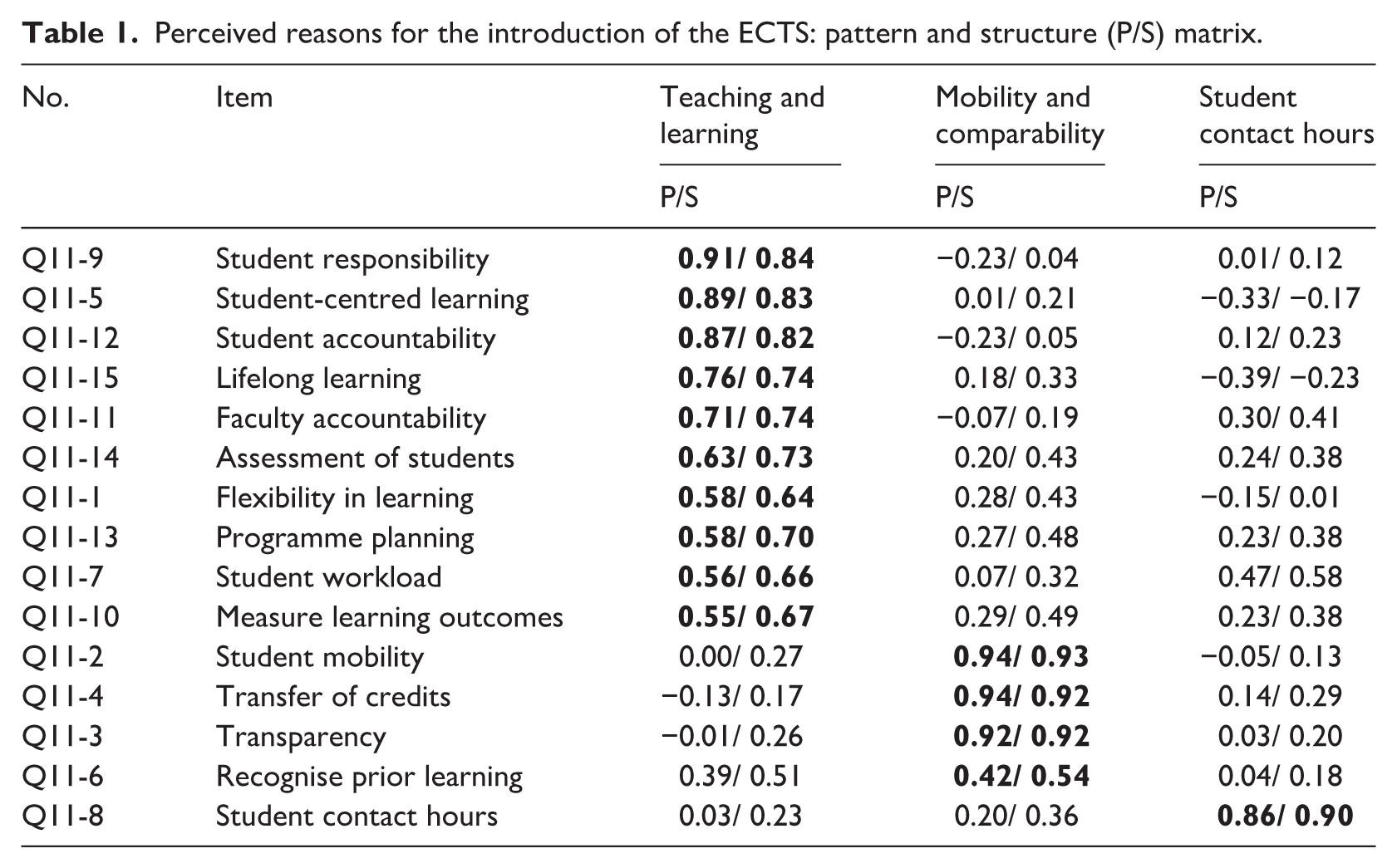
Although pattern and structure coefficients for some items loaded highly (i.e. >.30) on more than one factor, the differences between loadings for the main factor and such cross-loadings are relatively high (~.3). The primary pattern coefficients ranged from .42 (e.g. item 6 – ‘recognise prior learning’) through .91 (item 9 – ‘student responsibility’) for items on their respective factors (median = .76). Furthermore, the structure coefficients ranged from .54 (e.g. item 6 – ‘recognise prior learning’) to .93 (item 2 – ‘student mobility’) for items on their respective factors (median = .74). This loading suggests a strong correlation between their respective component variables and the three factors identified.
The means, standard deviations and reliabilities for these three factors are presented in Table 2.
Factors associated with respondents’ understandings of reasons for introduction of the ECTS: reliabilities, means and standard deviations.
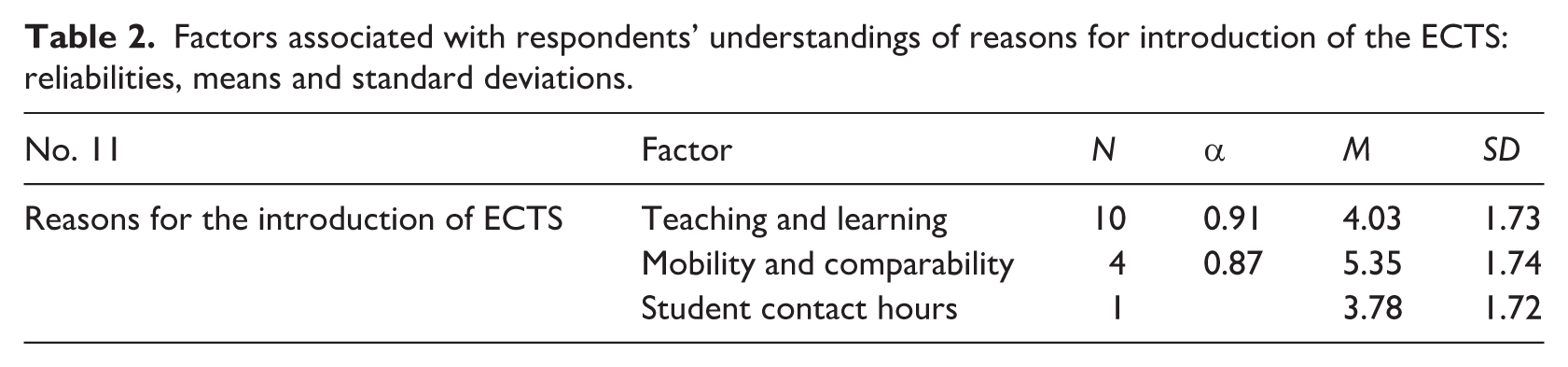
‘Mobility and comparability’, with a mean response of 5.35 (SD = 1.74) on the 7-point rating scale, was seen as the most important reason for the introduction of the ECTS followed by ‘Teaching and learning’ (M = 4.03; SD = 1.73). Although not statistically significant, the differences between these means represent 1.32 points on the rating scale.
Respondents were also asked to rank five of the given reasons for the introduction of the ECTS in order of importance. Five points were awarded to the most important reason, four points to the second most important and so on. Mean scores were then calculated for each reason and the main reasons emerging were as follows:
Facilitate the transfer of credit (2.95).
Increase levels of student mobility (2.91).
Greater transparency across countries (2.86).
Facilitate recognition of prior learning (1.18).
Increase levels of flexibility in the learning process (0.93).
As in the case of ratings, transferability, mobility and transparency scored highly by comparison with items to do with teaching, learning and assessment while ‘more measurable student learning outcomes and competences’ were ranked sixth. These ratings and rankings were supported by participants’ qualitative responses to the open-ended Q 9 with two main rationales for the introduction of the ECTS being provided. Firstly, participants suggested that the ECTS was introduced to support the standardisation of courses and programmes. Typical comments included:
The credits function as an important benchmark – without them, anything goes. [They were] introduced as a standard to enable comparison of courses and programmes of academic study, attainment and performance between higher education institutions across the European Union. To generate a common framework across the EU, to generate a common meaning and understanding of qualifications for accreditation purposes.
Student mobility and transferability was the second rationale for the introduction of the ECTS, with respondents believing that the ECTS was introduced to ensure a common language and understanding and to enable comparison of student workload between HEIs. Enabling the movement and ‘smooth transition’ of students across HEIs, particularly on an international basis, was viewed as fundamental. The ECTS was seen as ‘the intellectual equivalent of the Euro currency’, which ‘enables students to engage in inter-institutional study with greater administrative ease’. As well as providing greater flexibility for students across universities, respondents also recognised the important role of the ECTS in the ‘recognition of prior learning’.
It is noteworthy that only five respondents saw the rationale for the ECTS in terms of ‘teaching and learning’ or ‘student-centred approaches’ whose aim is to ‘improve the learning experience of students’. As one respondent remarked ‘we now focus on what the student is expected to know or understand by the end of the module or programme. When I started teaching in 2002 that was not the main focus’. Some reservations were also expressed regarding the student-centredness of the ECTS.
Influence of the ECTS on Irish teacher educators’ practice
When respondents were invited to rate the extent to which 15 given aspects of the ECTS supported them in their work, factor analysis indicated a two-factor solution which was supported by the scree-plot. The first of these two factors, which for the purpose of this study we have named ‘Developing the learning environment’, consists of 12 items. The second factor, which we have labelled ‘Transferability’, consists of three items. The Cronbach’s alphas for both factors were high, ranging from α = .95 and α = .84 respectively (see later in Table 4), and this two-factor solution explained 69.5% of the variance and converged in five iterations. The pattern and structure coefficients are presented in Table 3.
Teacher educators’ practice: pattern and structure (P/S) matrix.
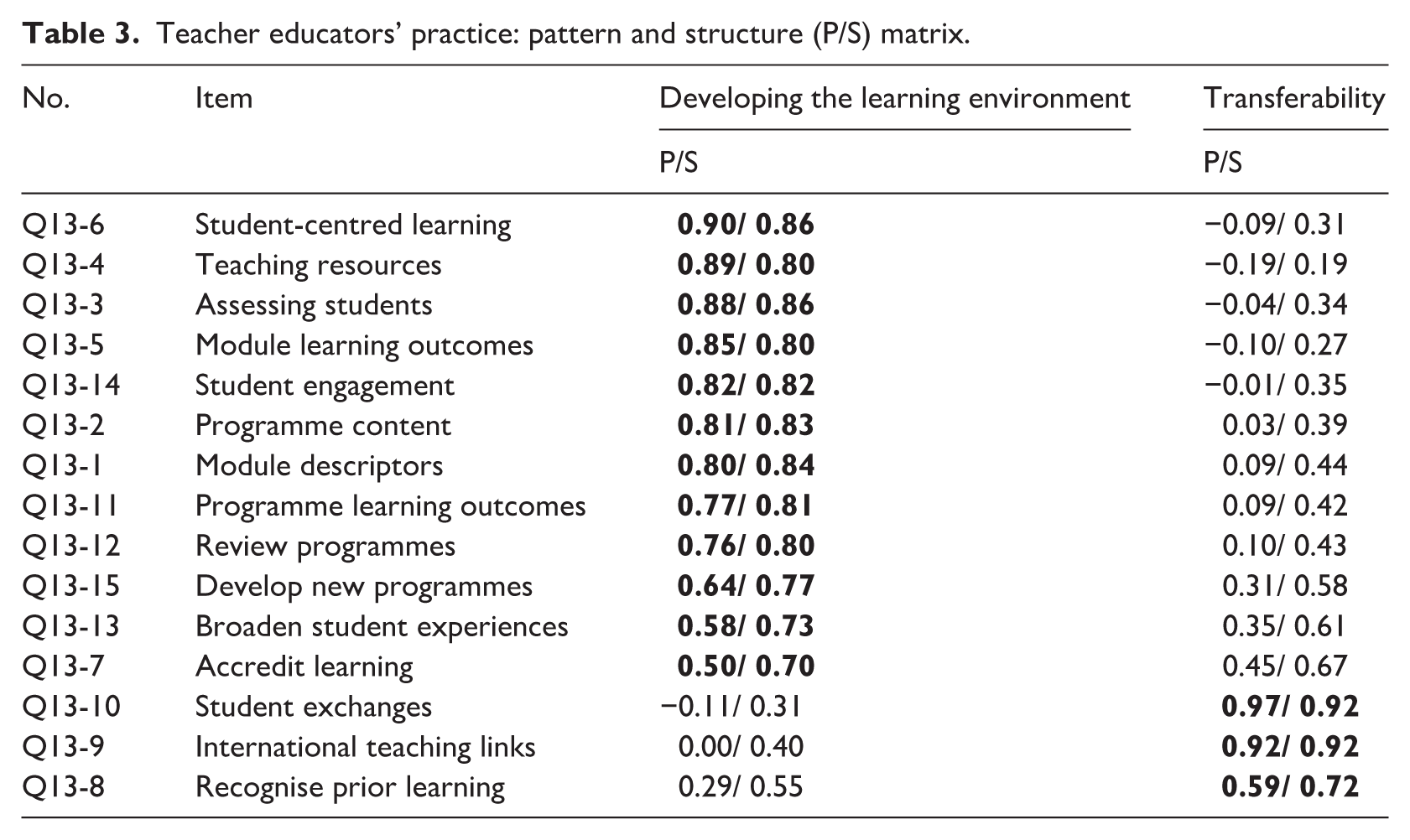
Although several items loaded highly (i.e. >.30) on more than one factor, having examined the correlation matrix and checked the internal consistency for each factor using Cronbach’s alpha, it was decided not to remove any items. While item 7, ‘accrediting student learning’, loaded relatively highly on both factors, this was deemed to make structural sense since accreditation of learning can be used both in support of student/knowledge transferability and the development of the learning environment.
The means, standard deviations and reliability levels for both factors are presented in Table 4.
Factors associated with teacher educators’ practice: reliabilities, means and standard deviations.

The factor ‘Transferability’ (M = 4.24; SD = 1.96) provided most support in their work, higher than ‘Developing the learning environment’ (M = 3.89; SD = 1.80).
Respondents were also asked to rank the five areas of their work in which the ECTS has had the greatest impact. Five points were awarded to the area where most impact was reported, four points to the second area and so on. Mean scores were then calculated for each area and the main areas of impact were as follows:
Accreditation of student learning (2.38).
Promoting student exchanges (2.03).
Writing module learning outcomes (1.82).
Developing module descriptors (1.69).
Developing international teaching links (1.57).
Three of these highly ranked items (1, 2, 5) have to do with transferability and mobility rather than teaching and learning, while the two teaching-related items are essentially technical in nature. Meanwhile, the mean scores for ‘promoting student-centred learning’, ‘promoting student engagement’ and ‘reviewing programme strengths and weaknesses’ were particularly low.
Respondents’ overriding concerns with transferability and mobility are reinforced when respondents’ ratings of the impact of individual survey items on their day-to-day work are considered. The mean score for ‘alignment across programmes’ was 4.40 and the perceived impact on their assessment strategies (mean of 4.08) was greater than it was on their teaching (3.61), student learning (3.67), student-centred teaching (2.63) and student engagement (2.47).
These rather indifferent reactions to the influence of the ECTS on respondents’ teaching and student learning were reflected in the rather mixed nature of their responses to the open-ended question regarding the impact of the ECTS on their own practice. As one respondent put it, the ‘ECTS means more to some lecturers than others’. Various respondents identified positive, negative and minimum impacts on their teaching. Those who identified a positive influence suggested that the introduction of the ECTS:
a) influenced the types and amount of student assessment, e.g. ‘it has enhanced the range of assessments that are used [while] preventing over-assessment’.
b) increased their awareness around student workload, e.g. ‘ECTS helped ensure that the work assigned reflects the numbers of ECTS credits assigned to the module’.
c) afforded them an opportunity to review or ‘rethink’ courses, modules and programmes, e.g. ‘[The ECTS] extrinsically motivated all academics to substantially review their existing modules and course outlines’.
Others saw the reduction in teaching time and direct contact with students and the increased focus on ‘student directed learning’ associated with the ECTS as negative aspects of the reform and felt they had ‘a detrimental effect on students’ engagement with college and their programme’. Typical comments include:
The substantial reduction in the time allocated to students to learn their Subject Content Knowledge and Pedagogical Content Knowledge [means that] students are not as well prepared for a lifetime of teaching as pre-ECTS students were. Having to cover a curricular topic within a ten-week period . . . does not allow student teachers to digest, implement and reflection on it and develop their Pedagogical Content Knowledge adequately.
Negative views were also recorded regarding the increased focus on learning outcomes, with some respondents suggesting that learning outcomes are ‘in essence, not good for students’ learning’. It was felt that certain learning outcomes and/or disciplines do not lend themselves to measurement, e.g. ‘some learning outcomes, particularly in the arts, are not always measurable’ and that learning outcomes ‘restricted academic freedom [and reduced] the freedom of the lecturer to respond to emerging concerns and issues in their discipline’. There was also a sense that learning outcomes constitute a form of control:
Bureaucrats love to control and to measure is to control. The process of learning has become submerged in the metrics of measurement. Attitude change can’t be captured/measured as a learning outcome.
Respondents who felt that the ECTS had minimum impact on their practice advanced four main reasons. Firstly, it was suggested that the ‘ECTS is essentially an administrative, not a pedagogical, concern . . . another box to tick to keep bureaucrats happy. The ECTS says nothing about anything’. Secondly, some felt that, as members of an Education Department/School, they had already developed an understanding of the core ECTS principles and that these were consistent with their approaches to teaching and philosophy of education:
My teaching has always been quite learner centred so I don’t think ECTS has impacted on that. Although ECTS has been restrictive in some instances it has never determined or influenced my teaching philosophy, which has always been student centred.
Thirdly, those for whom the ECTS was inimical to their philosophy of education simply continued as before while working within the ECTS structure:
I continue to teach in the way I used to, and students continue to learn (or not) in the way they used to. The entire exercise has been a waste of time. Alas, the lunatics long since took over the asylum in education. The best that most of us can do is remain true to conscience and vocation and ignore as much of the madness as possible.
Respondents who had been pressurised to structure modules in terms of learning outcomes resisted by ‘avoiding the kind of language that is amenable to metrics . . . just writing educational aims’ or by ‘exercising much caution and keeping module and programme descriptors “open” and “flexible” to truly work in accordance with good student-centred learning philosophies and practices’. As one respondent put it: ‘one uses one’s discretion in terms of how closely the policy meets the practice’.
Finally, a number of respondents were reluctant to attribute any changes in their teaching to the ECTS, suggesting that any such changes were due to their increased use of technology or other influences:
I think my student engagement and teaching strategies have changed . . . but not necessarily due to the introduction of ECTS – rather as a response to evidence re teaching and learning and more diverse student needs.
It is also noteworthy that the ‘rushed manner’ in which the ECTS were introduced into their institutions was a matter of concern for some respondents who felt that this had resulted in ‘much confusion and opposition’. As one respondent put it, ‘more explanation and direction would have been welcome. One only has one chance to make a first impression’.
Discussion
When Irish teacher educators were asked to rate and rank the importance of various given reasons for the introduction of the ECTS and its influence on their professional practice, they consistently rated and ranked credit transfer, student mobility and transferability more highly than teaching and learning aspects. Indeed, their ratings and rankings for the contribution of the ECTS to the promotion of student engagement and student-centred teaching were particularly low. This focus on student mobility and credit transferability, the focus of the first part of this discussion section, suggests that, under the influence of internationalisation, globalisation and market values, respondents saw the ECTS primarily in terms of administrative convenience rather than student-centred curriculum, teaching and learning. The relatively low impact of the ECTS on teacher educators’ professional practice is considered from the twin perspectives of the implementation of mandated top-down curriculum reform and behavioural learning outcomes, both key aspect of the ECTS. This is followed by a discussion of the implications of our findings for teacher education.
Focus on transferability and mobility
This aspect of our findings is particularly surprising given that Ireland welcomes twice as many ERASMUS students as it sends abroad and is categorised as a ‘good importer only’ member of the ERASMUS network (Breznik et al., 2013).
Furthermore, as may be seen from Table 5, Irish student teachers’ ERASMUS participation rates have been particularly low. This is due to cultural and environmental factors such as language differences and Teaching Council regulations. The majority of Irish student teachers would not have the necessary language skills to teach in schools where English was not the first language while the ability to teach the Irish language is a requirement for all primary teachers wishing to work in Ireland. Teaching Council regulations for registration requires the applicant to confirm that her/his teaching practice was directly supervised by the third-level institution attended and Irish teacher education institutions are not in a position to directly supervise teaching practice outside of the jurisdiction. School curriculum specifications vary from country to country and applicants for registration must state the specific subjects for which recognition has been granted, with secondary teachers being required to have experience of teaching their specialist subjects to Leaving Certificate level.
Irish student/student teacher participation in ERASMUS (2014–2017).
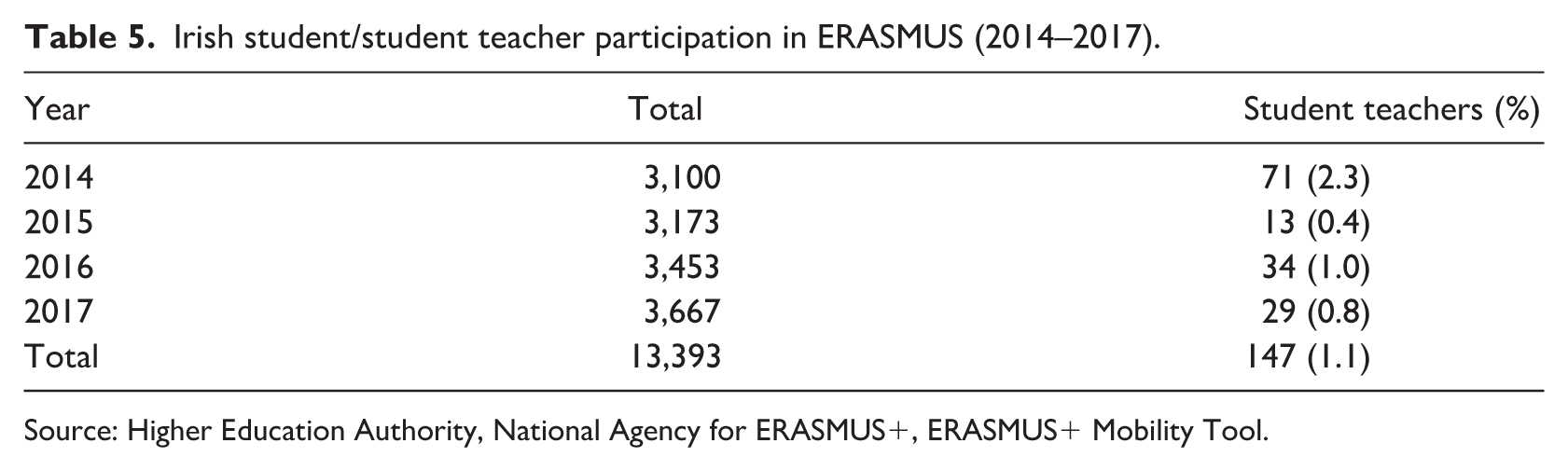
Source: Higher Education Authority, National Agency for ERASMUS+, ERASMUS+ Mobility Tool.
It is particularly significant, then, that the influence of the external forces such as internationalisation, globalisation, standardisation and neo-liberal values on Irish teacher educators is so strong. This finding certainly confirms Keeling’s (2006) argument that the whole BP, of which the ECTS is a key aspect, has introduced a discourse based on globalisation, knowledge economy and mobility as well as Sin’s (2014: 1834) contention that the current emphasis on educational outputs is indicative of New Public Management with its focus on ‘outcomes rather than processes and a re-conceptualisation of public service users as customers’.
In an environment where education is a ‘multi-billion-dollar industry’ (Asmal, n.d.: 3), policymakers see the university as ‘an engine for the production of knowledge, and for national competitiveness in a globalized world’. As suggested by Johansen et al. (2017: 264–266), the Bologna documents are characterised by ‘a general business metaphor where the university has come to be seen as a production facility, where knowledge and graduates are the products’. This commodification and marketisation of knowledge trumps political, academic, cultural and social concerns insofar as it provides an exportable commodity that meets the demands of a global labour force and reflects a mentality that ‘has gradually penetrated from the international to the national, university, faculty and departmental levels of current higher education institutions in Europe’ (Teelken, 2012: 272). This all leads to an environment where HEIs are heavily subject to neo-liberal influences (Lynch, 2006), ‘including its significant influence on the curriculum’ (Gyamera and Burke, 2018: 451).
While the BP also sought to advance Europe as a cultural entity (Sin et al., 2016: 204), Zgaga (2019: 454–455) highlights the ‘contradictory nature of two aspects of HE policy [insofar as] some of these social and cultural values are in opposition to the principles of the liberalised HE trade’. Tensions result between the two distinct cultures of ‘cooperation’ and ‘competition’. The difficulty in reconciling these diverse goals has also been recognised by Johansen et al. (2017) in their study of HE political discourses in Denmark and Ireland.
From an Irish perspective recent school curriculum reforms have been informed by globalisation forces (Gleeson et al., 2020) while our HE system is heavily influenced by university league tables and increased demand for research outputs (Gleeson, 2013). It is particularly difficult in this milieu for HE faculty members to avoid neo-liberal influences (Lynch, 2006), notwithstanding their obvious implications for teacher autonomy and professionalism (Sugrue and Solbrekke, 2017).
HE curriculum and learning outcomes
The general neglect of curriculum at HE level, noted earlier, is evidenced by the fact that there is just one reference to curriculum in Ireland’s Universities Act: ‘each university shall have an academic council which shall . . . control the academic affairs of the university, including the curriculum of, and instruction and education provided by, the university’. Meanwhile, universities have become increasingly concerned with ‘effecting “innovation” in the higher education curriculum to meet “international standards”, to compete in the “global market” and form partnerships with business and industry’ (Gyamera and Burke, 2018: 451). This has the effect of:
[u]ndermining the value background of higher education, epistemologically, through relativistic theories of knowledge and, sociologically, through the loss of academic autonomy as a result of the increasing influence of the state, industry and other agencies over what goes on in universities. (Hyland, 2001: 677)
As Fullan (2016: 10) reminds us, such ‘top-down change doesn’t work because it fails to garner ownership of, or commitment to, or even clarity about the nature of the reforms’. The aforementioned inattention to HE curriculum generally (Karseth, 2006; Van Damme, 2001) may help to explain the failure of the national-level reformers to engage with faculty members on the ground in order to develop some sense of ownership of the ECTS. This failure to recognise the complexity of meaningful curriculum change has important implications for the implementation of a curriculum reform such as the ECTS. Drawing on the ideas of Lingard et al. (2005) regarding cross-field interactions between policy players, Sin (2014: 1825) employs the notion of the ‘implementation staircase’ to illustrate:
[t]he importance of constructing policy from the perspectives of the main actors within policy fields [and] the way in which each group acts both as receiver and agent of policy messages, a process through which the message undergoes translation and acquires different understandings according to the unique and situated experience of each field.
This staircase has three levels – national responses to European Commission policy, academic practices at institutional level and students’ experiences of policy implementation with the phenomenon of glocalisation coming into play at the latter two levels. For example, Sin (2014) found clear evidence of disparities in the student experiences of the ECTS in her study of the usage and understanding of learning outcomes in three countries with diverse HE traditions (England, Portugal and Denmark). While the Bucharest Communique issued by the European Higher Education Area (EHEA) Ministerial Conference asserts that ‘the development and understanding and practical use of learning outcomes is crucial to the success of ECTS’ (EHEA, 2012: 3), what purported to be ‘an easy-to-grasp overview of student knowledge, abilities and skills’, has simply been ‘lost in translation’ (Sin, 2014: 1823).
The findings of the current Irish study would certainly suggest that the introduction of the ECTS had little effect on respondents’ adoption of student-centred pedagogy or student learning outcomes. While many of them claimed to practise and promote student-centred pedagogy, they were less than enthusiastic about the ECTS learning outcomes. This is hardly surprising given the top-down approach to the introduction of the ECTS and the complexities of the ‘implementation staircase’. For example, the adoption of the ECTS ‘to allow for credit accumulation’ (Buckley, 2010: 44) was a prerequisite for eligibility for the Recurrent Grant Allocation Model for Irish universities introduced in 2005. This represents a good example of ‘soft power’ in action and the ‘quiet resistance’ of our respondents would suggest that they see the ECTS in terms of bureaucratic, top-down reform rather than a serious effort at curriculum development. Borrowing from the title of Teelken’s (2012) paper, pragmatism dictates compliance, and our respondents had little choice but to conform technically with the ECTS. The current findings provide further evidence of the ineffectiveness of technical-political curriculum reform as observed by various curriculum researchers.
Sin (2014: 1835) highlights the disparity between the rhetoric of the Bologna policy principles including the ECTS and the realities of localised practices, with the reformers mistakenly assuming ‘that the introduction of formal tools and instruments [such as] learning outcomes . . . will automatically trigger a shift to student centred learning [and that] formal procedures and tools precede and bring about cultural change, rather than the other way around’. As Hussey and Smith (2008: 114) remarked ‘the further away from students and the teacher in the classroom, the more remote, generalised and irrelevant statements of learning outcomes become’.
The ECTS focus on learning outcomes
The ECTS User’s Guide (European Commission, 2015: 20ff) specifies learning outcomes in three categories, namely ‘knowledge, skills and competence . . .[where] competences are statements of what a learner knows, understands, and is able to do on completion of a learning process . . . In order to facilitate assessment, these statements need to be verifiable’. Of course, the latter provides a platform for assessment-led curriculum in an environment where ‘the dominance of unquestioned assessment practices in higher education has served to sculpt, rather than respond to, curriculum design and educational provision’ (Lynch and Hennessy, 2017: 1752).
When presenting programmes and modules for ECTS accreditation, faculty members engaged in a curriculum re-design exercise involving completion of a common template requiring student-centred learning outcomes expressed in behavioural terms of what students ‘will be able to do’. The European Universities Association (2005) believed that the adoption of the ECTS had the potential to play an important pedagogical role in developing the quality of teaching and learning activities. However, Crosier et al. (2007: 8) would soon acknowledge that ‘the use of a learning outcomes approach . . . [presents] a medium-term challenge’ while the 2009 Leuven Communiqué (Conference of European Ministers, 2009) identified student-centred learning as a priority for the decade to come, a message reiterated in the Bucharest Communiqué.
The ECTS focus on learning outcomes is a prime example of rational curriculum planning (RCP) insofar as it epitomises classical scientific method and ‘assumes a determinate and linear universe in which the specialnesses of setting are irritants that science should rise above’ (Knight, 2001: 372). While the ‘common sense’ nature of RCP ‘fits well with the managerialisms that have been sent to the public sector and . . . plays well as a populist political position’ (Knight, 2001: 373), Knight identifies three major problems with learning outcomes:
The difficulty of reducing complex learning ‘to precise statements predicting what the outcomes will be’.
People do not plan ‘rationally’ and teachers, who are no exception, begin their planning by thinking about how to organise the content in light of the prevailing context.
Whereas RCP maps an ‘elegant pathway from goals, to objectives, delivery, reception and so on . . . creativity, innovation and flexibility depend on there being slack, spaces or spare capacity in a system’.
Based on his negative experience of management rationality and the associated Outcomes Based Education approach in South African HE, Ramrathan (2016: 7) calls for ‘a deliberate shifting away from a counting exercise [since] the curriculum spaces for deep curriculum transformation lie beyond the public propositional element of accounting’.
Some complementary, alternative perspectives on student learning outcomes that are of considerable relevance to the work of teacher educators are now briefly considered. Knight (2001: 379) proposes a process model of curriculum design that is ‘inspired by complexity theory, which is more appropriate to thinking about learning in higher education than any rivals based on Enlightenment rationalism and hubris’. The Director of the Humanities Curriculum Project at the University of East Anglia, UK, Lawrence Stenhouse, was a strong proponent of the process model of curriculum design. Stenhouse (1975) identified four separate aspects of the teaching process: training, instruction, induction and initiation. Whereas measurable learning outcomes are quite appropriate in the cases of training and instruction, he recognised their inadequacy when it comes to the induction of students into the thought systems of particular disciplines. And that, surely, is what a university education should be about! Drawing on the distinction between information and knowledge, Stenhouse argued that ‘education as induction into knowledge is successful to the extent that it makes the behavioural outcomes of the students unpredictable’ (Stenhouse, 1975: 82). Meanwhile, the classical German culture of Didaktik (Hopmann, 2015; Westbury, 2000) focuses on the ‘unfolding by learning [of] a process of the formation of the student self’ (Pantic and Wubbels, 2012: 65), generally known as Bildung. Just like Stenhouse, Knight and others, this tradition recognises the importance of ‘unintended learning outcomes’. On the other hand, the focus of the Anglo-Saxon/US curriculum culture (Hamilton, 1990), epitomised by the ECTS, is on the development of skills and knowledge expressed in terms of measurable learning outcomes. This distinction between curriculum as product and process (Gleeson, 2013) raises a fundamental challenge for HE institutions as they seek a reasonable balance between the development of homo economicus and enlightened citizenship (Johansen et al., 2017). The recommendation of Clarke et al. (2018: 88ff) that ‘more consideration needs to be given to the process of curriculum design and development in general’ is indeed timely!
Teacher education perspective
Teelken (2012: 287) reported a:
[c]lear move [in universities based in three countries] towards more measurable standards of performance in the working environment of the respondents . . . for example in terms of international publications or external grants and funding. In teaching, there are similar developments, which emphasise the importance of student evaluations.
Such managerialism was particularly pronounced in the case of research, a conclusion supported by the findings of Gleeson et al. (2017) regarding the research capacity and activities of Irish teacher educators who found that managerial pressures were felt more intensely by those who are engaged in both teaching and research. The introduction of the ECTS has been advantageous in that respect with reduced student contact time and the increased focus on student responsibility affording faculty members more space to observe the mantra, ‘publish or perish’.
However, while the ECTS behavioural focus on competence is appropriate for what Stenhouse calls training and instruction outcomes, it is simply inappropriate for what he calls induction into knowledge as opposed to information which ‘is successful to the extent that it makes the behavioural outcomes of the students unpredictable’ (Stenhouse, 1975: 80). Induction ought to be a major focus in HE!
The pre-specification of what students will be able to do is consistent with an increasing focus on performativity (Sugrue, 2006) and with a pedagogy based on transmission rather than constructivist beliefs in an environment where Irish teachers ‘hold somewhat weaker constructivist beliefs, and somewhat stronger transmission beliefs, than teachers in comparison countries’ (Gilleece et al., 2009: 73). 4 Transmission beliefs were more likely to be associated with structuring teaching practices while constructivist beliefs were more likely to be associated with student-oriented practices and/or enhanced activities.
The strong influence of Bologna and the ECTS on the Irish Teaching Council Guidelines for Initial Teacher Education has been noted above. If our teacher educators were to conform fully with the ECTS learning outcomes philosophy, this would serve to promote what Stenhouse calls training and instruction at the expense of induction while enculturating student teachers into the uncritical use of behavioural learning outcomes. Based on the evidence presented above, however, this is unlikely to happen.
Conclusion
The significance of the macro-contextual factors set out in the early part of this article has been confirmed in our discussion of our findings in a variety of ways:
- The significant influence of internationalisation, globalisation and market values on Irish HEIs is evidenced by their ready and uncritical adoption of the ECTS. Ireland’s heavy dependency on direct foreign investment, particularly in high-tech industries, is a key underlying factor.
- The fact that Irish teacher educators see the reasons for the introduction of the ECTS primarily in terms of enabling student mobility and credit transferability rather than promoting student-centred learning and developing competencies, is particularly noteworthy in an environment where Irish student teachers’ uptake of ERASMUS placements is minimal.
- Notwithstanding the official rhetoric, the influence of the ECTS on Irish teacher educators’ practice is low. This is indicative of the ineffectiveness of the top-down curriculum reform and ‘soft power’ in bringing about meaningful change and of curriculum studies at HE level.
- It appears that the introduction of the ECTS means that teacher educators have more time at their disposal to devote to research. There is a real danger however that, notwithstanding our respondents’ general indifference to pre-determined learning outcomes, the requirement to comply with the ECTS will buttress a culture where spontaneity and unintended learning outcomes are sacrificed at the altar of performativity.
From a teacher education perspective, the approach adopted for the introduction of the ECTS fits the conclusion reached by Cochran-Smith et al. (2018: 572) that most ‘reforms have positioned teachers, teacher educators, and teacher education institutions/programs as the objects, rather than the agents, of reform’. Based on their study of the re-accreditation of Irish initial teacher education programmes, Sugrue and Solbrekke (2017: 144) suggest that this accreditation process is indicative of current tensions within HE between ‘being accountable to increasing external prescriptions and being loyal to professional commitments’. The dilemma facing teacher educators is neatly summed up in the title of Teelken’s (2012) paper, ‘Compliance or pragmatism: How do academics deal with managerialism in higher education?’ Our respondents would appear to have adopted a strategy of ‘quiet resistance’ as indicated in their open-ended responses reported earlier. Since it seems reasonable to suggest that teacher educators are better positioned to critically appraise the ECTS than other HE colleagues, the replication of our study with faculty in other disciplines might be a good place to begin. In light of our findings regarding learning outcomes and the associated critique of same, it would be particularly interesting to investigate the work of Academic Development Units in HEIs in supporting the integration and implementation of the ECTS principles.
Footnotes
Declaration of conflicting interests
The authors declared no potential conflicts of interest with respect to the research, authorship and/or publication of this article.
Funding
The authors received no financial support for the research, authorship and/or publication of this article.
