




Abstract
Accounts focusing on the relation between conceptualisations of parenthood and neuroDiscourse are missing within educational philosophy. This lacuna forms the background of this paper, which reports on a case study on the level of social policy documents addressing parents of the Flemish governmental branch office Kind & Gezin (Child & Family). The case’s focus is a critical analysis of discursive constructions of parenthood, and the extent to which results of neuroscience, as they appear in the documents, exert a change in these discursive constructions of good parenthood. The study deploys critical metaphor analysis to explore the conceptualisations of parenthood that are metaphorically constructed, what these constructions convey about good parenthood, and how they relate to neuroDiscourse. The analysis, firstly, points at neuroDiscourse of parenthood being operational in the documents, but operating in a different manner than that described in the literature. Nevertheless, neuroDiscourse of parenthood exerts a narrowing effect on the way parenthood is conceptualised in parenthood Discourse. Secondly, the analysis exposes the assumption that parenthood advice is best grounded in scientific evidence, facilitating the further occurrence of parenting advice based on neuroscience. Thirdly, in relating Kind & Gezin’s mission of optimal preventive family support to neuroDiscourse of parenthood, the possibility of neuro-governance of parents arises.
Introduction
Critical research about the implications of neurodiscourse in relation to parenthood and the parent-child relationship has been done from the perspective of neuro-ethics (see Hens et al., 2017; Van de Werff, 2018), psychology (see Busso and Pollack, 2015), nursing theory (see Einboden et al., 2013), communications studies (see Thornton, 2011), human geography (see Pykett, 2015) and, to a large extent, sociology; for instance (but not exclusively), via work of scholars of the Centre for Parenting Culture Studies and the Centre for Research on Families and Relationships in the UK (see, inter alia, Broer and Pickersgill, 2015; Edwards et al., 2015, 2016; Macvarish, 2016). From the perspective of educational philosophy, which is my field of research, substantial accounts with a specific focus on the relation between parenthood and the parent–child relationship on the one hand, and neuroDiscourse on the other, are missing. This lacuna forms the background of this paper, which takes this focus to the specific context of Flanders (the northern, Dutch-speaking part of Belgium) on the level of social policy concerning parenthood. Reasons to address this context are twofold. Nothing in the literature currently indicates research regarding this topic having or being done in the context of Flanders on the level of social policy. Second, to date, research on this issue predominantly comes from investigated contexts of Anglo-Saxon countries and regions, such as the situation in the UK studied from sociological perspective by inter alia Macvarish (2016). Bearing in mind that formulated conclusions from Anglo-Saxon contexts cannot just be transferred to the Flemish continental context, this paper intends to contribute to the debate on what it means to be a good parent, on the evidence base of parenting advice, and on neuro-governmentality through parenting advice.
Previous research on parenting addressed how parenting discourse engenders an array of scientific advisory information, framing childrearing in terms of parenting tasks that demand specific knowledge and competence (see, inter alia, Furedi, 2001, 2008; Ramaekers and Suissa, 2012). Additionally, several authors (e.g. Macvarish (2016); Rose and Abi-Rached (2013)) pointed out that parents are increasingly confronted with discourse containing arguments from neuroscience (to which, hereafter, I will refer as neuro-arguments). Building on parenting discourse research, and against the background of a pedagogical view of parenthood in the intergenerational context of family life (an understanding of which is drawn from authors such as Arendt (2006) and Langeveld (1983)), the paper reports on a case study that critically explored two questions. It scrutinised, firstly, how parenthood and the parent–child relationship are conceptualised in documents of the Flemish governmental branch office Kind & Gezin ((K&G) Child & Family; my translation), in particular in its digital newsletters and magazines addressing (expectant) parents. As a Flemish governmental branch office, K&G is ‘an agency that works actively in (the) “Public Health, Welfare and Family” policy area’ and focuses ‘on preventive treatment and guidance of young children geared to good outcomes in the future’ (Kind en Gezin, n.d.d.: para. 2). It is ‘responsible for support for registration of high-quality child care, optimal support for parents-to-be and parents with young children, (and) the criteria that adoption agencies have to meet’ (Kind en Gezin, n.d.d.: para. 3). The documents that were analysed fall under the banner of optimal preventive family support. Secondly, the case study examined to what extent neuroDiscourse of parenthood is present in these documents and in what way it synthesises 1 with discursive constructions of ‘good parenthood’. In line with the critique of the ‘scientisation of parenting’ (Ramaekers and Suissa, 2012), the case study consequently addressed the question of whether a discursively constructed ‘neuroscientisation of parenting’ is becoming visible in the K&G documents.
The study’s data were delivered by K&G in November 2018 and consisted of several documents: 68 digital newsletters and their linked K&G webpages, 2 and 4 digital magazines with a total of 144 pages. The documents address (expectant) parents from the onset of pregnancy until the child reaches the age of three. All newsletters and magazines are freely available to (expectant) parents who subscribe to the newsletters link on the K&G website homepage. 3 Magazines can also be downloaded freely, or parents can, equally for free, order a magazine and have it sent to their home. 4
To better understand the concept of discourse, the study deployed the notion of discourse of James Paul Gee (1999, 2004). Gee’s view was used as an underlying theoretical framework to be able to discern the different features in the discourse under study, and to better understand the relation between parenthood and neuroscience in the corpus. Gee refers to discourse as ‘language-in-use’ (2004: 46) or ‘stretches of language (like conversations or stories)’ (1999: 17). He uses the notion of Discourse (with a capital D) to refer to a specific way of using ‘language integrated with “other stuff” ’ (Gee, 2004: 46, original emphasis). He describes this ‘other stuff’ as ‘a distinctive way of thinking, being, acting, interacting, believing, knowing, feeling, valuing, dressing and using one’s body’ while deploying various ‘ “props” like books and magazines’ (Gee, 1999: 18), ‘symbols, images, objects, artefacts, tools, technologies, times, places and spaces’ (Gee, 2004: 46). Such Discourses ‘recruit specific . . . ways with words and . . . taken for granted stories, which in turn encourage people to . . . read context in given ways’ (Gee, 2004: 41). Furthermore, they exist ‘as the work we do to get people and things recognized in certain ways’, and ‘as maps that constitute our understandings’ (Gee, 1999: 23). Drawing on Gee’s view, the study conceived of parenthood Discourse as ‘Discourse about parenthood, stuffed with specific values, thoughts, knowledge, images, objects, technologies, and so forth’. NeuroDiscourse of parenthood was conceived of as ‘Discourse about results of neuroscientific research about the functioning and development of the brain, stuffed with specific values, thoughts, knowledge, images, objects, technologies, and so forth, and standing in relation to parenthood’. I worked with the discursive perspectives of parenthood Discourse and neuroDiscourse of parenthood, to be able to study what Gee calls ‘the whole package’ (1999: 40) with respect to parenthood and neuroscience. As distinct perspectives, parenthood Discourse and neuroDiscourse of parenthood facilitated two things. From the two perspectives it was, firstly, possible to get a better understanding of the relation under study: the relation between discursive conceptualisations of good parenthood, and the discursive presence of results of neuroscientific research in connection to parenthood. Secondly, the perspectives enabled me to investigate the performativity of neuroDiscourse in reference to parenthood Discourse. That is, they enabled me to investigate if and in what way the neuro-arguments in neuroDiscourse exert an effect on – or produce a change relative to – arguments in parenthood Discourse.
For its methodology, the case study drew on critical metaphor analysis (CMA). Before reporting on the main findings, the following first highlights some characteristic features of CMA according to Charteris-Black (2004).
On metaphor and critical metaphor analysis
This case study investigated the modes of textual (written words) and visual (images) material in the data. 5 To enable a further focus within and across these modes, I used a lens on metaphor as a discursive entry into parenthood Discourse and neuroDiscourse of parenthood. Using metaphor as a discursive entry into the discourses under study is no coincidence. Several authors have shown that metaphor is present in neuroscientific research revolving around the development and functioning of the brain (see e.g. Bennett and Hacker, 2003), in popularised science books and magazines (see e.g. Choudhury et al., 2012; Thornton, 2011) and in discourse that addresses parents regarding children’s brain development (see e.g. Van de Werff (2018) for a study in the context of the Netherlands) and also at the level of social policy (see e.g. Macvarish, 2016).
The study’s CMA was predominantly inspired by Charteris-Black’s (2004) theory in Corpus Approaches to Critical Metaphor Analysis (itself partly built on Lakoff and Johnson’s (2003) classical work Metaphors We Live By). According to Charteris-Black, CMA is ‘a way of revealing underlying ideologies, attitudes and beliefs – and therefore constitutes a vital means of understanding more about the complex relationships between language, thought and social context’ (2004: 42). As such, CMA functions, on the one hand, as an analytic discursive possibility that enables us to get a view on the broader level of the discourses under study and their possible underlying ideologies. On the other hand, CMA aids in increasing critical language awareness with regard to metaphorical constructions of good parenthood.
CMA enables the bringing forward of what Charteris-Black (2004: 244) describes as the hierarchical organisation of metaphors. This starts with linguistic metaphors, goes on to conceptual metaphors and ends with conceptual keys. Linguistic metaphorical language is found in the documents. Conceptual metaphors find themselves one step higher up the metaphorical hierarchy. They can be specific, accounting for a set of related linguistic metaphors, or generic, accounting for a set of related specific conceptual metaphors. At the top level of the metaphorical hierarchy are the higher-level conceptual metaphors, called conceptual keys (Charteris-Black, 2004: 16). 6 They account for a set of related conceptual metaphors. Conceptual metaphors and keys are ‘abstract inferences’ from the linguistic metaphorical language in the documents: ‘there is no reality to them other than as working models that further analysis confirms or rejects’ (Charteris-Black, 2004: 244).
In this study, the concept of ‘metaphor’ relates to ‘metaphorical language’. As mentioned, Charteris-Black (2004) draws (also) on Lakoff and Johnson (2003). For them, ‘metaphor is not just a matter of language, that is, of mere words’ (Lakoff and Johnson, 2003: 6). It is, ‘on the contrary, human thought processes (that) are largely metaphorical . . . Metaphors as linguistic expressions are possible precisely because there are metaphors in a person’s conceptual system’ (6; original emphasis). Lakoff and Johnson (2003: 3–4) argue that human beings’ conceptual system is largely metaphorical, which shapes their thinking and acting, and that conceptual metaphors are reflected in everyday language through varieties of expressions and words. During the study’s analysis I conceived of metaphor in the same way. I continuously bore in mind that words and expressions in the documents were potential reflections of underlying conceptual metaphors with respect to conceptualisations of good parenthood. 7
In connecting the research questions with CMA, they were rephrased as follows:
Which are the metaphorically constructed conceptualisations of parenthood and the parent–child relationship in the data?
What do these metaphorically constructed conceptualisations seem to convey about good parenthood?
To what extent does neuroDiscourse of parenthood affect the way parenthood is metaphorically conceptualised in the whole of the data?
Main findings
Parenthood Discourse
With regard to parenthood Discourse, the analysis demonstrated two things. CMA allowed, firstly, to bring forward that parenthood is metaphorically conceptualised as going on a journey, as protecting, as building and as managing. These conceptualisations are generic conceptual metaphors. Each of them has underlying specific conceptual metaphors. Figure 1 shows both generic and specific conceptual metaphors which are connected to each other in a certain way. We see, for example, the generic conceptual metaphor parenthood is going on a journey (in the box with bold border and font, top left). This metaphor has several underlying specific conceptual metaphors (in the boxes without bold borders which are connected to this box with bold border): (a) parenthood is having a way to go, parenthood is falling and getting up; (b) parenthood is going in a direction, parenthood is following and showing directions; and (c) parenthood is to get moving, parenthood is moving forward. I grouped together these specific conceptual metaphors based on the linguistic metaphorical language in the documents from which they are abstracted. (Linguistic metaphorical language is not included in the scheme.) Furthermore, the lines that connect specific conceptual metaphors to each other indicate a substantive relation in their underlying linguistic metaphorical language. For example, the specific conceptual metaphor parenthood is securing (emotional) safety and support (box without bold border, bottom left) is equally connected to the specific conceptual metaphor parenthood is building relationships, patterns and environments (box without bold border, in the middle), which visualises a relation in their underlying linguistic metaphorical language.
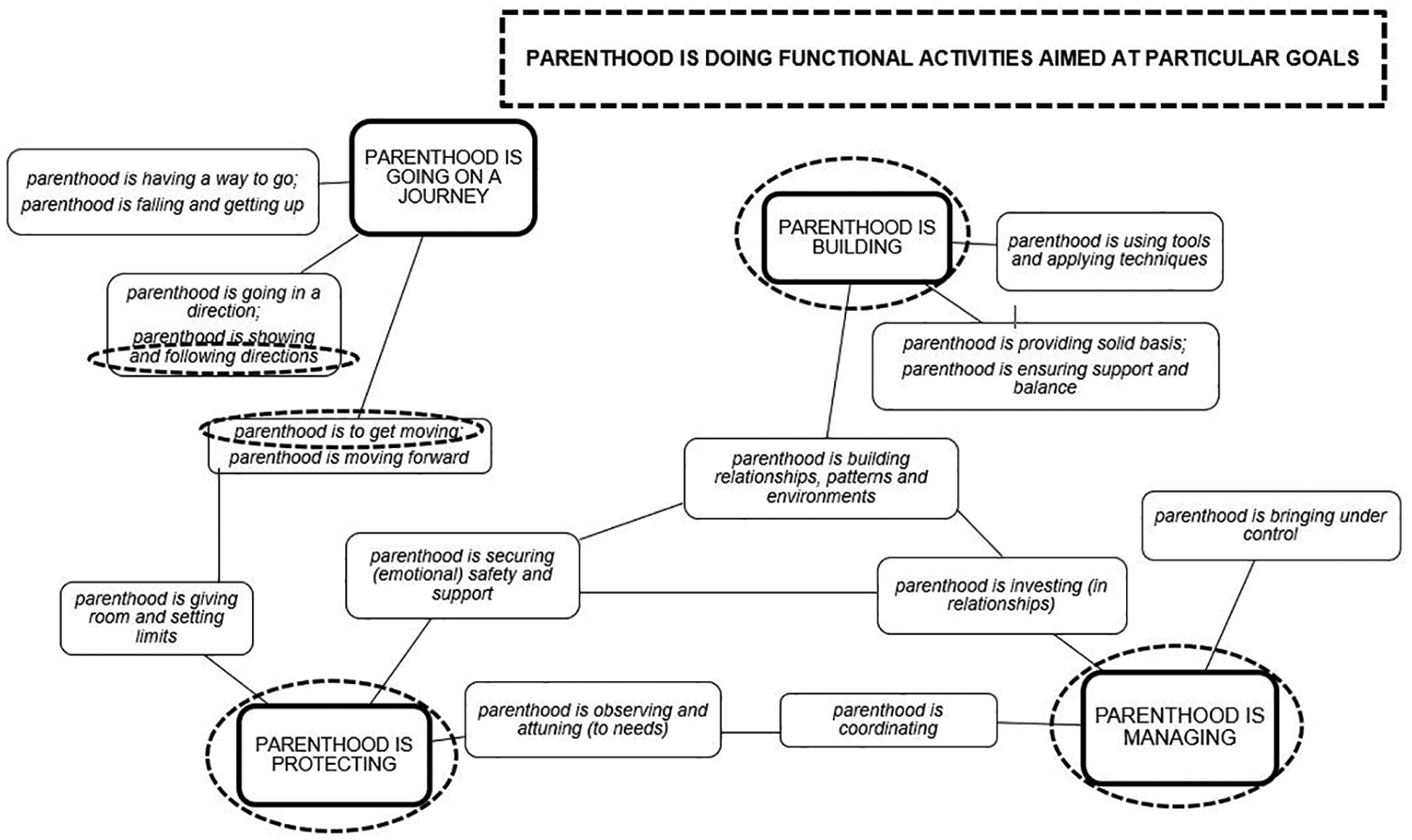
Conceptual metaphors in parenthood Discourse in K&G documents.
Secondly, the analysis demonstrated that most of the conceptual metaphors have a ‘means–end’ nature, describing parenthood in ways that express what parents (ought to) do, how and to what end. 8 All specific conceptual metaphors of parenthood is managing, protecting and building hold a means–end nature. Parenthood is going on a journey only carries some means–end specific conceptual metaphors (see Figure 1. Means–end metaphors are encircled in dashed line). I could group together all means–end metaphors in a conceptual key: parenthood is doing functional activities aimed at particular goals.
To illustrate the metaphorical hierarchy that I constructed based on the analysis, the following will give some examples of metaphors for each generic conceptual metaphor, including some linguistic metaphorical language. To clarify the hierarchy, these letters will be mentioned: L (linguistic metaphorical language), S (specific conceptual metaphor), G (generic conceptual metaphor) and K (conceptual key). 9
Parenthood is building
The conceptual metaphor parenthood is building (G) is evoked in two ways: by descriptions that express parenthood being a sort of building (as in the activity of building), and by descriptions that express what needs to be built during parenthood. Present in the documents is the figurative sense of ‘building’ as ‘constructing something by putting parts or material together’ (OxfordDictionaries.com, 2019), as well as ‘building’ in the sense of ‘making or becoming stronger or more intense’ (OxfordDictionaries.com, 2019). It is, for instance, expressed that parents form ‘a safe basis’ for their child (Letters from baby till toddler, Month 13: para. 11, link 1:28-1:30) (L), that they should ‘work on a solid structure during the day’ (Letters from baby till toddler, Week 14: para. 3, link para. 2) (L), and should be a ‘pillar at any difficult time’ (doctor, Magazine Pregnant with first child: 5) (L). With respect to what parents are building, the documents express that it needs to be done in a balanced way (also to prevent it from falling apart). In this sense, it is stated that ‘parenthood is refinding the balance there has been, or finding a new balance’ (couples therapist, Magazine Pregnant with first child: 18; couples therapist, Magazine Sibling on the way: 23) (L), or ‘finding back the emotional and organisational balance’ (couples therapist, Magazine Sibling on the way: 18) (L). Striving for balance as such is praised: ‘striving for balance is certainly a good idea. Balance for the children, yourself, your partner, and you as a couple’ (couples therapist, Magazine Sibling on the way: 18) (L). In the analyses, I have put these utterances under the metaphors parenthood is providing solid basis (S) and parenthood is ensuring support and balance (S). In turn, these metaphors are part of the metaphor parenthood is building (G).
Within this metaphor, K&G presents itself as one of various other parties (besides experts, books or websites) that can supply advice to back up parents during their building activities of parenthood: ‘K&G supports you in bringing up your child’ (Letters from baby till toddler, Week 4: para. 4; Magazine Sibling on the way: 2) (L). In a sense, K&G takes the role of being the basis for parents, when they are exploring how to do their building (much like parents are the basis for their child(ren)). In turn, K&G also has a basis from which they build their advice: scientific research. This is illustrated by the following expression in the context of breastfeeding: ‘For me this is most important: listening carefully to the mother’s story, but especially watching meticulously . . . And then giving scientifically based advice. That advice is firmly supported, and based on our expertise plus our experience with breastfeeding mothers’ (lactation consultant, Magazine Pregnant with first child: 16) (L).
Parenthood is managing
With respect to parenthood is managing (G), the documents express that a lot of activities in parenthood require planning. In relation to child care and the combination with family life and parents’ jobs, it is, for instance, stated: ‘plan well in advance, a good schedule does a lot. It is best if you think this through beforehand’ (mother, Magazine Sibling on the way: 9) (L). When making fixed plans is somewhat discouraged, what is expressed still bears an idea of planning: ‘Do not plan the day too full . . . make it easy on yourself by following their (your toddlers’) tempo (and by for example foreseeing time for an afternoon nap). Plan a quiet day at home for the day after’ (mother, Magazine Toddler: 7) (L). Next to planning, dividing tasks is presented as a solution to cope with the many tasks that come with parenthood: ‘You cannot be available 24 hours a day. Divide the tasks with your partner, trust your network’ (Magazine Baby: 21) (L). As illustrated already in the latter example, dividing parenthood tasks requires parents to have a network of people (such as the other parent, a family member, a neighbour, people from day care and so forth) whom they can rely on. The importance of parenthood networks, or forming a parenthood team, is expressed in the following examples in a positive way: ‘happily, my husband and me are a solid team, each of us having our “better” parent qualities. We learn and grow in our role as parents’ (mother, Magazine Toddler: 3) (L); and ‘I knew busy days were coming, but I also knew we would be able to handle it together’ (father, Magazine Sibling on the way: 12). In this example it is again expressed, but in a negative way: ‘I see a lot of beautiful couples get pregnant, having children, being happy . . . And yet several year later they split up. Because they are no longer a team’ (doctor, Magazine Sibling on the way: 5) (L). In addition, keeping things under control and maintaining an overview about how all tasks are going is praised in the documents. The following example relates this to the mother figure: ‘You finally realise how much women can handle and how many things they can manage at the same time. Or another thing: keeping an overview’ (father, Magazine Baby: 11) (L). I grouped together all these expressions under the metaphor parenthood is bringing under control (S), itself part of parenthood is managing (G).
K&G takes up a particular role in this metaphor. It presents the idea of ‘good enough parenting’ (or ‘realistic parenting’) to, on the one hand, reassure parents that being a perfect parent is not required and that it is okay to not have things always under control and feel uncertain about it: ‘other parents seem to have everything under control, while your household permanently finds itself at the verge of collapse. But are we alone in that insecurity?’ (child psychiatrist, Magazine Toddler: 42) (L). On the other hand, the idea presents a certain (implicit) standard that parents should best strive for: ‘realistic parenting: 7/10 is the perfect score’ (Letters from baby till toddler, Month 12: para. 7, Month 18: para. 9, Month 24: para. 7) (L), or ‘if you do fairly right for about 70% of the time, and you are wrong 3 times out of 10, you are doing very well’ (child psychiatrist, Magazine Toddler: 42) (L). In other words, the documents express that parents should be successful in bringing things under control, preferably, for 7 times out of 10.
Parenthood is protecting
In relation to parenthood is protecting, the idea of protection is connected to the figures of the parent and the child. First, parents need to protect themselves from (or at least be well prepared for) the difficulties in parenthood, especially when they become a parent: ‘I would call it a positive trauma’ (father, Magazine Baby: 11) (L). Nuances are also expressed: ‘Having children, it is hard and difficult, but you also share something very intense’ (father, Magazine Baby: 11) (L). In this respect, K&G presents itself as being a supporting partner, or mediator in referring to specific expertise: ‘The birth of a child can be quite overwhelming . . . We understand that you have minor or major questions and are there for you, listening, with information or advice, support when things get tougher’ (Pregnancy letters, Week 40: para. 10, link para. 1; Letters from baby till toddler, Month 28: para. 7, link para. 1) (L). So, parents had best keep themselves safe, preventively, and also as individuals: ‘Seek help and support in time to prevent the situation from getting to you’ (Letters from baby till toddler, Month 13: para. 8, link para. 17) (L). Safeguarding can relate to beginning parenthood, severe situations (such as post-partum depressions) or any situation that ‘a parent or counsellor experiences as a problem’ such as toddlers’ tantrums which can make parents ‘tired and impatient’ (Letters from baby till toddler, Month 13: para. 5, link para. 4) (L), or the parent–parent relationship: ‘How does my relationship survive those first baby weeks’ (couples therapist, Magazine Pregnant with first child: 18). K&G’s guidelines, such as ‘do not shut out your partner’ and ‘involve him as much as possible in caring for the baby’ (couples therapist, Magazine Pregnant with first child: 18) (L), take the role of making parents aware of possible ‘pitfalls’ to prevent ‘distance’ from coming between them through which they would ‘grow apart’ (couples therapist, Magazine Pregnant with first child: 18) (L). Additionally, the safekeeping of the parent–parent relationship serves yet another purpose – which connects to the second idea: the child’s protection.
Parents ought to protect their child in two ways: by taking certain actions, and by not doing certain actions. Illustrative of the former is parents taking actions that concern the protection of the child’s physical health and hygienic condition. Through having their child vaccinated, for instance, parents provide their child ‘with a little backpack she will carry with her and which shields her’ from infectious diseases (professor of medicine, Magazine Baby: 37) (L). Additionally, this is expressed to be ‘societal protection’; for example, it is said to have societal advantages: the more babies that are being vaccinated, the less germs can pass from one person to another (professor of medicine, Magazine Baby: 37) (L). Advantages that come as an ‘extra’, on top of a protection guideline, are regularly expressed. A recurrent example is that of breastfeeding. Not only does it protect the child from ‘chronic conditions’ in the long term, it is ‘the most natural nutrition’ a mother can give, and ‘attuned to baby’s needs, growth, immune system, and environment during lactation’ (Pregnancy letters, Week 17: para. 4) (L). Then, in relation to societal advantage: ‘Extensive research shows that breastfeeding has many benefits for your baby, yourself, your family, and society’ (Pregnancy letters, Week 17: para. 4) (L). Illustrative of actions that parents ought not to do to protect their child is, for instance, not shaking a baby: ‘never shake a baby . . . The muscles of the neck are not strong enough to hold the little head upright and brain and blood vessels are very vulnerable’ (Letters from baby till toddler, Week 2: para. 3, link para. 2) (L), or not drinking or smoking: ‘Without a doubt, alcohol and tobacco are poisonous for a foetus’ brain, in whatever degree. The younger your pregnancy, the more fragile. Do not drink nor smoke, that still is the best’ (doctor, Magazine Pregnant with first child: 5) (L). In this sense, K&G takes the role of safeguarding the child against possible harmful actions on the part of the parents, due, possibly, to parents’ lack of knowledge. The following examples express this in the context of premature birth: ‘parents are rarely familiar with the vulnerability of a premature baby’ (Pregnancy letters, Week 26: para. 7, link para. 1) (L). Therefore, they need to learn about necessary medical actions (like those during baby’s stay in neonatal intensive care) and their own actions. Parents must ask medical staff ‘to lay baby on their chest. This is called “kangarooing”. It gives your baby a feeling of safety’ (Pregnancy letters, Week 26: para. 7) (L). Parents who protect their child thus act in certain ways and not others, to not jeopardise their child’s development and the child’s feeling of security. In the analysis, I grouped together all mentioned expressions under the metaphor parenthood is securing (emotional) safety and support (S), which is itself part of parenthood is protecting (G).
Parenthood is going on a journey
The metaphor parenthood is going on a journey (G) is evoked in various ways that relate to the figures of the parent, the child and the expert. With regard to the figure of the parent (often the mother figure), it is, for instance, expressed that mothers who have just given birth to a child begin a journey of discovery in terms of what it means to be(come) a parent: ‘The first weeks are a major voyage of discovery’ (Pregnancy letters, Week 40: para. 12, link para. 1) (L). The child needs the help of her/his parents to begin her/his own journey; for example, a journey towards adulthood: ‘raising a child is helping the child on her way to adulthood’ (Letters from baby till toddler, Month 12: para. 9, link para. 1) (L), or: ‘every (future) parent’s dream is to raise children to adults who find their way in life and feel good about it’ (Magazine Pregnant with first child: 23) (L). K&G intends to also take the road, together with the parents: ‘I assist mums and dads like you on their search. Not to tell you what you can or cannot do, but to help you on your way, to think together about solutions, or, to just be there’ (parenting practitioner, Magazine Baby: 3) (L). According to the documents, parents do not have a map at their disposal to show them the way while being on their parenthood journey: ‘You do not get a manual at birth, no codes, no guarantee, no road map. Raising a child is by trial and error’ (Magazine Pregnant with first child: 14) (L). In Dutch, ‘by trial and error’ is articulated linguistically by the expression ‘by falling and getting up again’. Both expressions hint at how the parenthood journey is not always an easy one. Parents start their journey, walk, try, act, fall, get up again and proceed. In other words, they learn how to walk their journey while being on their way, uncertain about where they are going, for they have ‘no road map’. The mentioned expressions have been put under the metaphor parenthood is having a way to go (S) and parenthood is falling and getting up (S).
In contrast to the idea of parents having no road map to guide them on their way, the documents equally tell a different story: they are filled with guidelines that do advise parents to take certain steps, and how to take them, for the sake of their child’s journey or their own. They show parents in which direction they can go: ‘you want to give your baby the best possible start in life. You do this with breastfeeding’ (Pregnancy letters, Week 39: para. 16, link para. 1) (L). In this sense, parents do not just go in a particular direction, they follow a particular direction to go ahead in a certain way (and thus not another way). K&G, strikingly, also presents the right direction for parents to follow during their parenthood journey: ‘sometimes, you can find the right way quite quickly as a parent, sometimes intensive guidance is necessary via “parenting support” ’ (staff member parenting support K&G, Magazine Pregnant with first child: 15) (L). This quotation is written in the context of what is called ‘positive parenting’: ‘Research shows that children benefit most from warm, supportive parents who offer clarity and set limits. This is called positive parenting’ (Magazine Pregnant with first child: 14) (L). Parents are encouraged to follow this direction through expressions such as: ‘Every educator can apply the principles of positive parenting’ (Letters from baby till toddler, Week 4, Month 10, Month 33) (L) and ‘children who experience a lot of affection and security, develop more balanced and quickly than children who miss this positive relationship’ (Letters from baby till toddler, Week 4: para. 4) (L). K&G seems to offer the method of positive parenting to provide parents with the tools to take the ‘right’ steps during their (often difficult) walk. In turn, the method seems to promise that making use of those tools will provide the child with ‘a firm backpack to go discovering things with a feeling of security’ (Magazine Pregnant with first child: 23) (L). Next to this, several ‘agents of expertise’ (expert figures such as physicians, gynaecologists, nurses and care workers, and centres of expertise given voice by their employees, or in booklets, brochures or references) take up the role of providing directions, while walking the parenthood journey alongside parents. An example:
In the brochure ‘Sexual education of children years 0 till 6’ of Rutgers, the Dutch centre of expertise with regard to sexuality, is explained, step by step via text and illustrations, how children’s development progresses between 0 and 6 years and how as parents you can guide your child in this. (Letters from baby till toddler, Month 36: para. 4, link para. 6) (L)
I grouped together the above-mentioned expressions under the metaphor of parenthood is going in a direction (S) and parenthood is following directions (S). The difference between the latter metaphor, and the former parenthood is going in a direction (S) and the previously described metaphors of parenthood is having a way to go (S) and parenthood is falling and getting up (S), is that it bears a means–end nature within. Through the various given guidelines, it describes – or, better, prescribes – what parents should best do through during their parenthood journey. Parents then do what they do in order to (attempt to) reach a particular goal. In that sense, parenthood is following directions (S) is part of the more abstract metaphor parenthood is doing functional activities aimed at particular goals (K). As mentioned, this key also resides in the other metaphors of parenthood is building (G), managing (G) and protecting (G).
After these descriptions of the metaphorical conceptualisations of parenthood in parenthood Discourse, I now proceed with a description of how the neuro-arguments in the corpus relate to the rest of the corpus. Thereafter, I describe the specificities of this particular neuroDiscourse.
NeuroDiscourse of parenthood
Look at what your baby is able to do, and offer her, on the basis thereof, stimuli and little toys . . . Emotional and social stimuli are at least as important: give your baby kisses and hugs, tickle her, smile at her, talk to her, play ‘peekaboo’. All these things are stored in the subconscious and play a role later in life. (Neuroscientist, Magazine Baby: 9) (L)
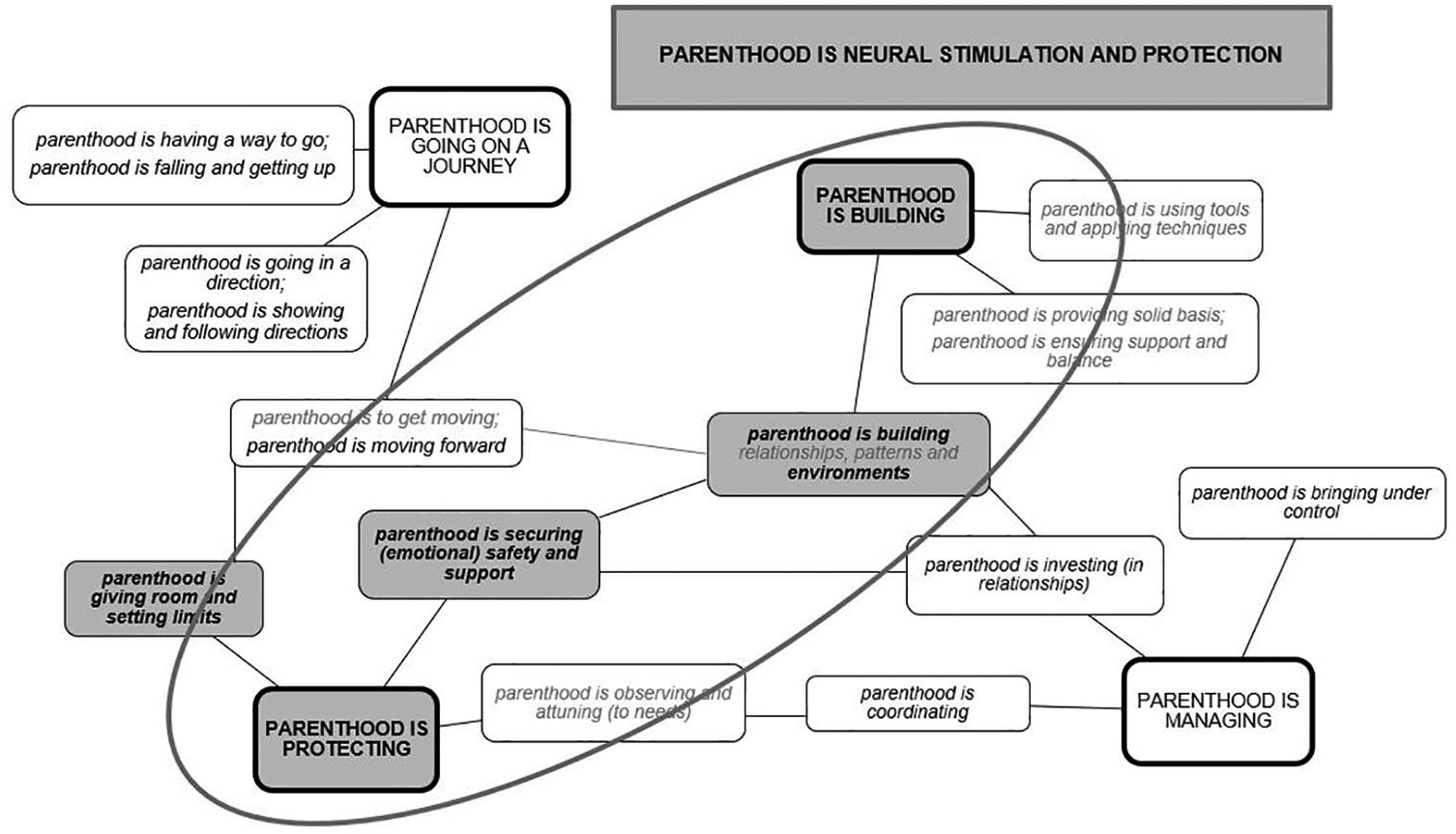
Conceptual metaphors in neuroDiscourse of parenthood in K&G documents.
Furthermore, it is expressed that offering stimuli can already start before birth:
Science says . . . that perception and possibly consciousness are there from the moment a central nervous system has developed. That is important. Babies already hear and feel in the womb . . . In new international research we saw that the baby brain is activated by sounds and light flashes. My son . . . was part of this research and, being in the womb, his brain reacted to sounds and even changes in sounds. (Neuroscientist, Magazine Baby: 8; original emphasis) (L)
In addition, parents must offer their baby stimuli in a balanced way; that is, they have to make sure they provide enough stimulation, so not too little, but not too much either: ‘We must not be afraid of overstimulation, because if we stimulate the brain insufficiently, it will fail to make crucial connections’ (neuroscientist, Magazine Baby: 9) (L). This utterance about overstimulation is, however, immediately followed by this:
On the other hand, we must also ensure rest and structure. Sleep is crucial to allow our brain to develop well, during the day and at night. We process all we have learned then. It is best babies sleep in a calm, dark, not too warm environment. (Neuroscientist, Magazine Baby: 9) (L)
The above utterance is part of the metaphor parenthood is protecting (G), which in neuroDiscourse of parenthood accounts for utterances that express that parents should protect their child’s brain development; for instance, by offering safe sleeping (such as in the example above). So, by providing a baby with a sleeping environment that is calm, dark and not too warm, parents can ensure an environment in which the baby can sleep well. That is said to be not only beneficial, but crucial for the baby’s brain development.
Secondly, when studying if and how the neuro-arguments connect to other arguments in the documents, it turned out that some can be associated, associating at the same time their conceptual metaphors (see boxes with metaphors in grey font in Figure 2). The recurrent slogan ‘moving babies have got one step ahead’ (Letters from baby till toddler, Week 3, 4, 8, 12, 16; Month 5, 6, 8, 9, 11, 12) (L) exemplifies this. Since it is expressed that moving is beneficial to the child’s brain development, this neuro-argument takes the role of explaining why moving babies have got one step ahead:
Moving stimulates growth, the feeling of balance and mental resistance of your baby. Plenty of learning processes are closely linked to movement. You support the development of the brain, via new neural pathways that are essential for motor development. So give your baby opportunities and space to move in a safe environment, as much as possible. (Magazine Baby: 23) (L)
Hence, moving is not only expressed as being an important stimulator in the building metaphor in neuroDiscourse of parenthood. Movement utterances are ‘instrumentalised’ in light of the child’s optimal brain development.
It turned out, thirdly, that some arguments and metaphors cannot be associated with neuro-arguments and, thus, are absent from neuroDiscourse of parenthood (see metaphors in black font in white boxes in Figure 2). Parenthood is going on a journey (G) and parenthood is management (G) are ‘marginalised’ in that sense. Partly, that is: because, for instance, the specific conceptual metaphor parenthood is to get moving (S) can be associated with neuro-arguments (as described above), whereas parenthood is having a way to go (S), to name just another, cannot.
Given that neuro-arguments about the brain can instrumentalise arguments in light of what is expressed to be beneficial to the child’s brain, and can marginalise others, I argue that neuroDiscourse of parenthood functions in a way that structures and reorganises parenthood advice in parenthood Discourse. Differently put, what this analysis shows is how neuroDiscourse of parenthood operates, and that it has a performative force in the way parenthood is metaphorically conceptualised in the documents.
Lastly, in neuroDiscourse of parenthood, the conceptual key parenthood is neural stimulation and protection (K) underlies the conceptual metaphors that relate to the brain. It is inferred from expressions that tell that parents should stimulate their baby’s brain in a manner that is attuned – as expressed in the documents – to what their baby’s ‘neural antenna’ is able to receive. It appears via utterances such as ‘babies absorb all stimuli. Their antenna is always operational’ (neuroscientist, Magazine Baby: 8) (L), or:
Babies do not have a filter yet. Their antenna is always on, they pick up all stimuli. Their brain still needs to learn which connections it wants to keep and which it will break down. It needs to learn to focus. That way the brain grows up. (Neuroscientist, Magazine Baby: 9) (L)
So, on the one hand, babies are said to have a neural antenna that picks up and reacts to stimuli. This relates to parenthood is neural stimulation (K). On the other hand, babies’ neural antenna is ‘always operational’ and is not yet able to focus and filter out stimuli that are possibly too much to handle. This is where parents need to protect their baby’s neural antenna, which relates to parenthood is neural protection (K). I brought together in the key ‘neural stimulation and protection’, since they are closely tied together in this discourse. Parenthood here is about attuned neural stimulation and protection, in a manner that is tailored to the parents’ baby in her/his own particularity and her/his own particular family situation:
Every situation, every child, every parent is different. Look at what your baby is able to do and offer, on the basis thereof, stimuli and little toys. Does your baby start to see clearly, then stimulate her with little toys or activities that stimulate looking. If you once in while ask yourself what you do and why, you are already doing really well as a parent. (Neuroscientist, Magazine Baby: 9) (L)
Discussion and conclusion
Clarifying the situation concerning neuroDiscourse and parenthood at social policy level in Flanders was necessary, since no research had been found that addresses this specific continental context. This study illustrated, firstly, the metaphorical layering of discursive constructions of good parenthood in the documents addressing parents; and secondly, the fact that neuroDiscourse of parenthood is present in the analysed documents, but to a small extent. That is, in the whole collection of documents it is not widely present. Nevertheless, it is operational and has shown to be performative with respect to the way it can structure and reorganise parenthood advice, thereby also affecting the way parenthood is metaphorically conceptualised in parenthood Discourse. In this Discourse, parents are invited to think about parenthood in metaphors of going on a journey (G), protecting (G), building (G) and managing (G). This implies that parents are invited to think about parenthood, predominantly, in terms of things that need to be done, how these things need to be done and to what end things need to be done, all in order for their child(ren) to develop well. This resonates in parenthood is doing functional activities aimed at particular goals (K). In neuroDiscourse of parenthood, a sharpening of the latter key becomes visible: parenthood is doing the functional activities that are associated with building and protecting the child’s brain, and that are aimed at the goal of the optimal development of the child’s brain. This implies not only a narrowing-down of how parenthood is metaphorically conceptualised, which resonates in parenthood is neural stimulation and protection (K), but also of how the child-focused view in the documents is presented: from a focus on the child’s development – in a general sense of the concept – to a focus on the development of the child’s brain. In sum, the neuro-arguments in neuroDiscourse of parenthood exert a narrowing effect on the way parenthood is conceptualised in parenthood Discourse. This is the operational performativity in the discourses: the way in which neuroDiscourse of parenthood is performative relative to parenthood Discourse.
Next to that, it is interesting to look at the performativity through the discourses, in particular the change that neuroDiscourse of parenthood can effectuate in terms of what it might mean to be a parent. I situate this possible effect within a transnational (European) context to highlight differences from and similarities to what has been studied already therein. In reference to what is described in literature about Anglo-Saxon contexts,
10
neuroDiscourse of parenthood in the analysed documents seems to operate somewhat differently. Firstly, it is less immediately visible, a feature which can be operationalised through (inter alia) the use of brain scans, and which is referred to as neuro-realism. This concept
gathers interpretations that neuroimaging research yields direct data on brain function despite the complexities of data acquisition and image processing involved. Observed brain activation patterns are, as a result, portrayed as the ultimate proof that a phenomenon is real, objective, and effective. (Racine et al., 2005, quoted in Racine et al., 2010: 728)
In the Flemish studied documents, no such neuro-realism has been found. Contrastingly, in social policy documents from the UK, scholars such as Macvarish (2016) have demonstrated that brain scans were visibly very present and misused; for instance, through what happened with the ‘Perry image’. This image shows a scan of a ‘normally’ developed brain of a three-year-old child and a scan of a ‘damaged’ brain of a three-year-old child who has lived in a long-lasting situation of severe deprivation and neglect. 11 The image was used as a front cover for policy reports of January and July 2011 revolving around early intervention. The brain scan images were extracted from their original research context and manipulated (see Figures 3(a) and 3(b)) to legitimise early intervention and normalise parent training initiatives (Macvarish, 2016).
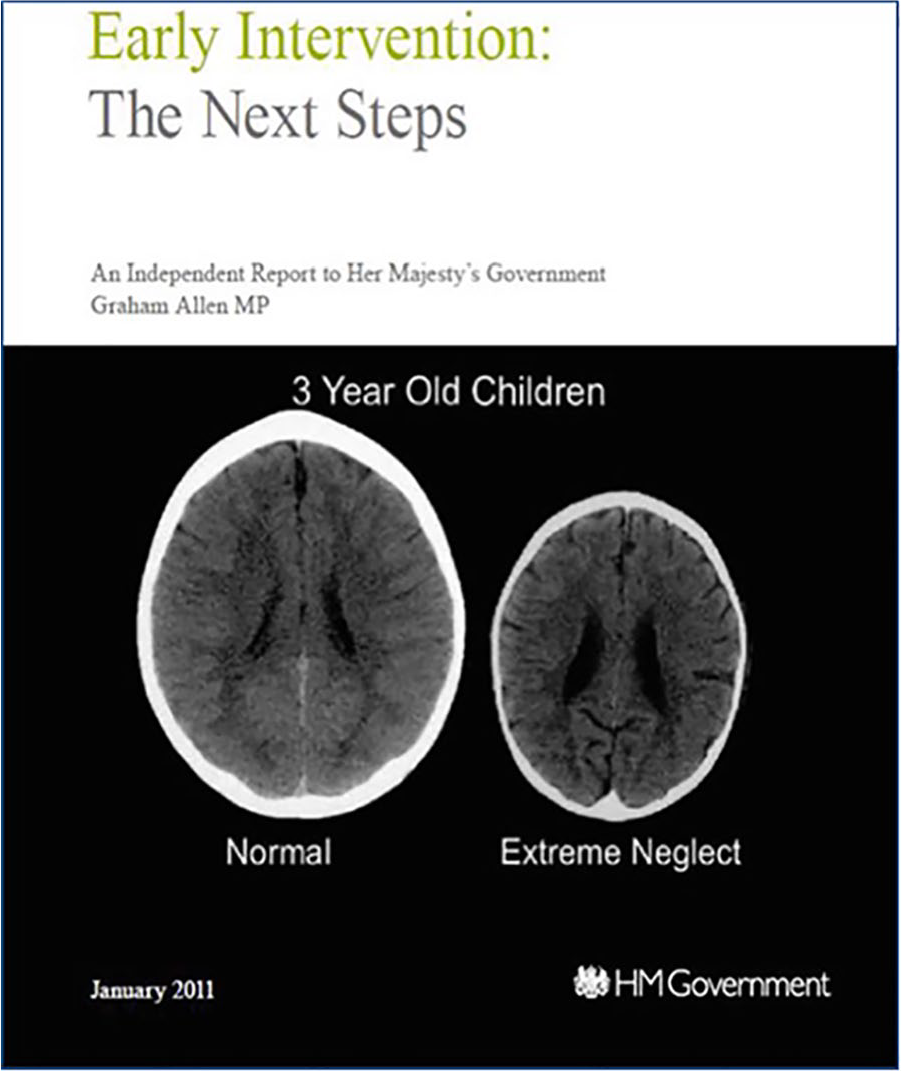
Front cover of UK government report, January 2011, Early intervention: The next steps. Crown Copyright 2011 (Macvarish, 2016: 3).
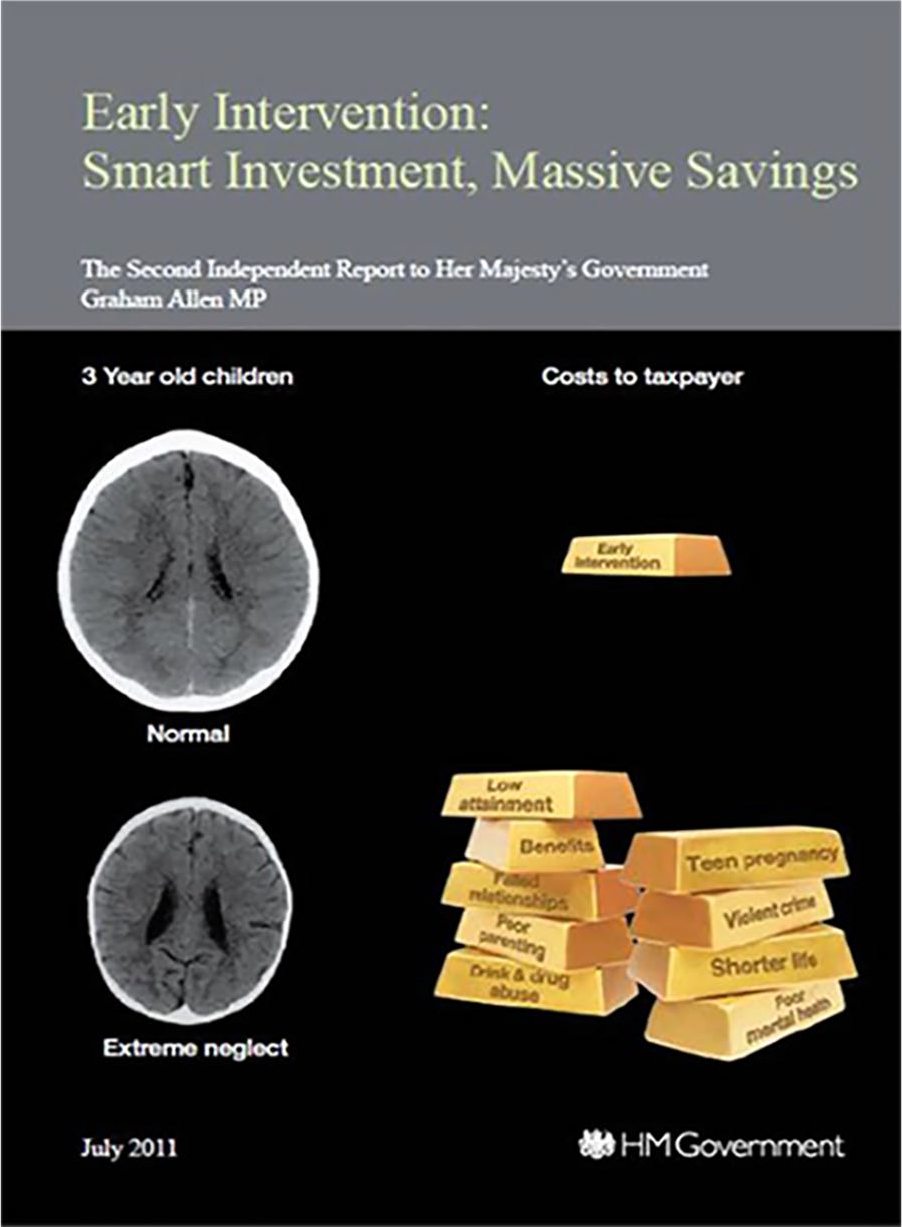
Front cover of UK government report, July 2011, Early intervention: Smart investment, massive savings. Crown Copyright 2011 (Macvarish, 2016: 4).
In neuroDiscourse of parenthood in the analysed documents, such use of brain scans and related statements was not found. The only image relating to a brain scan that was found was one that shows a neuroscientist in laboratory clothing with a baby in his arms. Behind them, a computer screen shows a brain scan (see Figure 4).
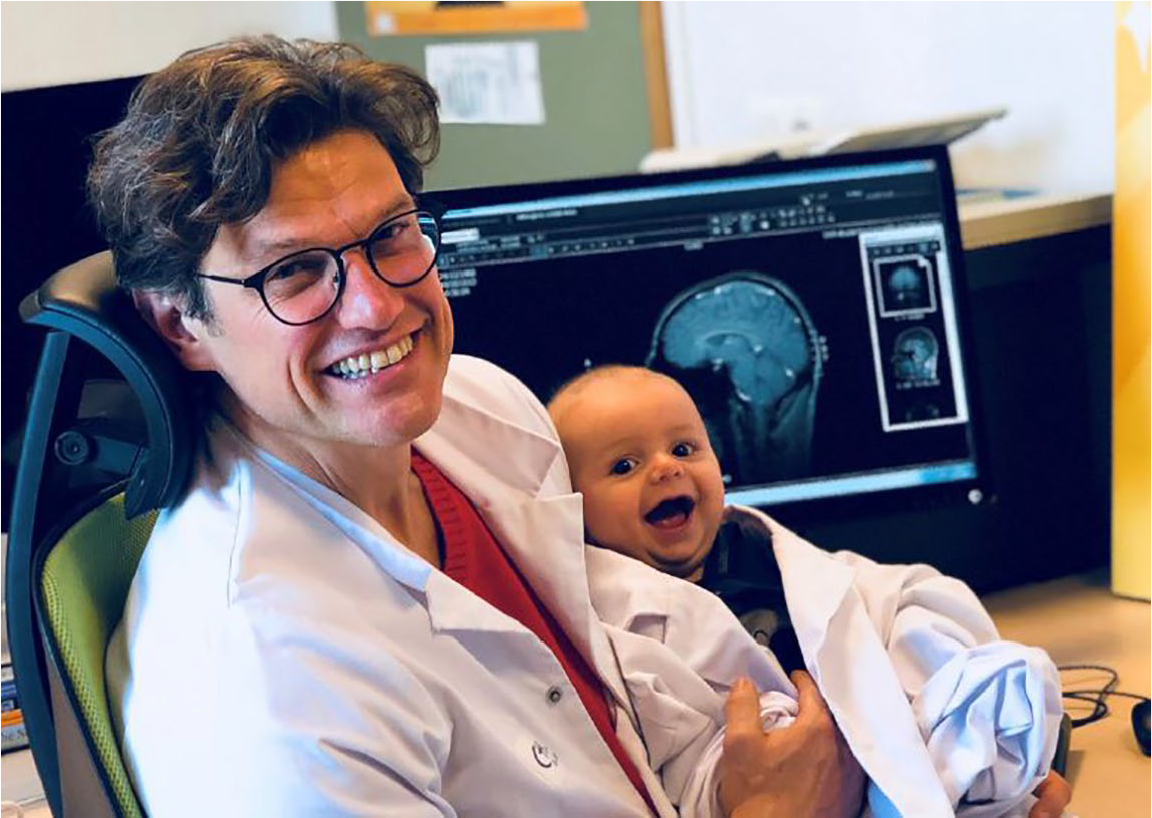
Neuroscientist with baby. ©Kind & Gezin, Magazine Baby: 8.
Drawing on McGimpsey et al. (2017), it might be said that this neuroscientist – Steven Laureys, who is a renowned prize-winning Belgian scholar in the global neuroscience community with regard to the study of consciousness – operates as an ‘academic guru . . . who has come to embody the new knowledge’ (2017: 909–910), and through whom neuroscientific knowledge is translated into contexts of Flemish social policy and social policy production. Still, this guru does not attend to the ‘neurologically damaged child’ (McGimpsey et al., 2017: 912), a concept constituted as a policy problem that needs to be addressed (as through the Perry image, for instance). What this guru does implicitly attend to is how parents need to protect and build the child’s brain, in normal circumstances (I come back to the performativity of this trope further on in the text). This relates to the second element in how the neuroDiscourse in the Flemish documents operates somewhat differently from in the Anglo-Saxon contexts.
NeuroDiscourse in the analysed documents operates much less via neuro-essentialist claims and neuromyths. 12 Neuro-essentialist claims are ‘interpretations that the brain is the self-defining essence of a person, a secular equivalent of the soul’ (Racine et al., 2005, quoted in Racine et al., 2010: 728). A typical neuromyth is the ‘myth of the first three years’. Already identified and critiqued by John Bruer (1999), it proclaims the ‘belief that the trajectory of neurodevelopment is essentially fixed after three years of age’ (Howard-Jones, 2014: 820; see also, Macvarish, 2016: 20; my emphasis). This myth was not found in the analysed documents. Neuro-arguments containing neuro-essentialist claims and myths are part of what is described as ‘neuroscientism’; that is, the ‘mistaken belief that the natural sciences (physics, chemistry, biology and their derivatives) can or will give a complete description and . . . explanation of everything, including human life’ (Tallis, 2011: 28), thereby being part of the ideological attempt to find the essence of being human inside the brain (Tallis, 2011, quoted in Macvarish, 2014: 166). Here, as with neuro-realism, results of brain research are often drawn out of their original research contexts by interpreters of neuroscience (such as policy makers, care workers, social professionals, educators and academics – but non-neuroscientists) to make a case for their own cause (see also Bruer, 1997, 1999, 2014). 13 Though most neuroscientists are critical about advocacy based on brain research (Macvarish, 2014) and nuance claims that are made in the public field (Bruer, 2014), scholars nevertheless indicated that some neuroscientists offer suggestions that reach beyond their actual research (see, inter alia, Bruer, 2014; Pykett, 2015). The line distinguishing neuroscientism from neuroscience can therefore appear as somewhat blurred. In the analysed documents, however, the neuro-arguments do not breathe neuroscientism, but rather stay closer to original research contexts (also visualised in Figure 4). Nowhere in the corpus are utterances made about children having ‘critical developmental windows through which future behaviour is . . . shaped’ (Pykett, 2015: 26–27), or ‘science is helping to understand how love and nurture by caring adults is hard wired into the brains of children’ (see Macvarish, 2016: 8). Granted, critical readers might argue that there are utterances in the documents about what parents should do to offer all kinds of stimuli in order to trigger neural connections in their child’s brain, 14 which resembles the message in the myth of super-enriched environments. 15 In addition, there are two sentences in the corpus reflecting a neuro-essentialist message (‘Their brain still needs to learn which connections it wants to keep and which it will break down. It needs to learn to focus’ (neuroscientist, Magazine Baby: 9)). But, importantly, these utterances do not express that offering such stimuli will essentially fix the child’s neural constellation or will ensure a successful future for the child. They only link what most parents already do when caring for their baby (like kissing, hugging, talking, smiling, offering little toys) to the development of the baby’s brain. Further, the neuroscientist uses a careful language, including utterances and terms such as ‘we think that’, ‘other scientists think that’ and ‘probably’ (neuroscientist, Magazine Baby: 8–9), thus keeping away from the static claims that are typical for neuro-essentialism.
Thirdly, a strict form of parental determinism related to the brain has not been found in the analysed documents. Parental determinism is ‘a form of deterministic thinking that construes the everyday activities of parents as directly and causally associated with “failing” or harming children, and so the wider society’ (Lee et al., 2014: 3). It predates neuroDiscourse of parenthood, but at the same time underlies it and is reinforced by it in several Anglo-Saxon contexts (see, inter alia, Macvarish, 2016). Parenthood Discourse in the documents, contrarily, leaves room for utterances that express that parenthood is never certain; parenthood, in that sense, is undetermined and undetermining: ‘You do not get a manual at birth, no codes, no guarantee, no road map. Raising a child is by trial and error’ (Magazine Pregnant with first child: 14) (L). Also, neuroDiscourse of parenthood stays away from causal linear expressions about the effects of parental actions on the child’s brain development and, with it, long-lasting consequences for child, parents and society (as mentioned and critiqued by many scholars such as Edwards et al. (2015), Macvarish (2016) and McGimpsey et al. (2017)). Present in the studied parenthood Discourse, however, are metaphorical expressions of protection and building that are nevertheless associated with the idea of parental determinism, such as:
Extensive research shows that breastfeeding has many benefits for your baby, yourself, your family, and society. (Pregnancy letters, Week 17) (L)
By vaccination you ensure that your child builds up resistance against . . . infectious diseases. You give your child . . . a little backpack she will carry with her and which shields her (from diseases) . . . Secondly: the more children we vaccinate, the larger the societal advantage. (Professor of medicine, Baby Magazine, Kind en Gezin, n.d.c: 37) (L).
Utterances such as these do not per se express deterministic thinking. They do, however, relate to parental actions aimed at avoiding risk and so at protecting (or not harming) child, family and society (for instance, not breastfeeding one’s child can be interpreted as a risk that withholds benefits for baby, parent, family and society; not vaccinating one’s child can be interpreted as a risk that increases the spreading of diseases among the population). In sum, on the basis of the analysed documents, it cannot be concluded that neuroscientific research results or neuromyths are instrumentalised to effectuate a social policy agenda, as was the case in Anglo-Saxon regions (see, inter alia, Broer and Pickersgill, 2015; Edwards et al., 2015, 2016; Featherstone et al., 2014; Macvarish, 2016). There is too little evidence in the documents to speak of neuro-policy, which describes the rapid transfer of neuroscience research into policy by neuro-essentialist and neuro-realist ways (Racine et al., 2010: 729).
Nevertheless, in relating the studied neuroDiscourse of parenthood to K&G’s mission of providing optimal preventive family support geared to good child outcomes, an image of neuro-governmentality appears. Though the documents in this case do not fall under early intervention (in the sense of programmes targeted at ‘identifying and providing effective early support to children . . . at risk of poor outcomes’ (Early Intervention Foundation, 2020: para. 1)), the discourse in the documents can be conceived of as ‘an intervention’ in the early days of parenthood. That is, the documents can be seen as possibly intervening in each parent’s thought and actions, through the discourse they bring forward. An intervention, thus, that conceivably reaches every parent in Flanders (and not only parents of children at risk of poor outcomes). Through ‘guru-neuroscientist’ Laureys, goals of mastery and optimisation are rationalised. CMA exposed the assumption that parenthood advice is best grounded in scientific evidence (predominantly stemming from psychological research, and complemented with results of neuroscientific research). This hints not only at the wider ‘narrative that situates scientific knowledge as a means of achieving mastery over human nature’ (Thornton, 2011: 15). It also confirms a discursively constructed ‘scientisation of parenting’ (see Ramaekers and Suissa, 2012) in the documents, facilitating the way towards a discursively constructed ‘neuroscientisation of parenting’. Relying on an evidence-based advice ideology can serve as a basis paving the way for the appearance of advice that shifts from being based on psychological research to being based on neuropsychological research. Yet the use of results of neuroscience in parenting advice can have ‘real effects, unintended consequences and cumulative impacts’ (Pykett, 2015: 173) for parents in real life, since parents are incited to ‘rethink the basis’ (174) of their parent–child interaction. By referring to the child’s neural antenna, the basis for parental action is rendered technical and manageable (building and protecting the brain in this and that way), the figure of the parent is turned into a technical manager of the antenna, and the advice based on neuroscience is becoming the instruction manual. That way, ‘a space is opened up through which’ parents can optimise brain development, ‘govern themselves . . . and be governed through’ (Pykett, 2015: 26, original emphasis) the brain. The idea that parents are driven to optimise their child’s brain functioning, continuously working to attune their actions to this optimisation process, requires them to endlessly conform to a process of ‘normalisation’. Normalisation is ‘associated with control’ and ‘encourages the management of natural processes in order to maximize gain and minimize harm’. It is like limitless optimisation (Thornton, 2011: 21). This resonates precisely with K&G’s mission of providing optimal, preventive support. Because the optimisation is rendered manageable – via the instructions of building and protecting the brain – K&G’s discourse might be ‘a powerful governmental discourse’ (Thornton, 2011: 12). This might be the performative force of the studied neuroDiscourse of parenthood at societal level. By ‘encouraging self-supervision and reducing the need for top-down institutional regulation’ (Thornton, 2011: 18), parents are governed via deployed neuroscientific research results: neuro-governmentality appears. 16 This resonates with what De Vos (2016) has called ‘neurologisation’ in the sense that neuroDiscourse of parenthood would contribute to the invitation towards parents to neurologise their parent–child relationship. 17 It aids, in other words, parents’ internalisation of ‘a neuromolecular gaze’ (Pykett, 2015: 24).
Whether or not K&G is on the verge of increasingly turning parenthood Discourse into neuroDiscourse of parenthood is a question for which future developments have to be awaited. Furthermore, since K&G has recently merged with the agency Jongerenwelzijn (Youth welfare; my translation) and (a part of) the agency VAPH (Flemish Agency for Persons with Disabilities; my translation) to form the agency Opgroeien (Growing up; my translation), 18 follow-up on Discourses of parenthood, including policy statements, speeches and internal documents, seems pressing. Especially because the Flemish social policy model increasingly tends to resemble the model of the UK, emphasising by its current organisation a logic of risk prevention (Van Crombrugge, 2013: 249): ‘children’s health, wellbeing and development must be guarded, and risks and problems must be dealt with as efficiently and effectively as possible’ (Van Crombrugge, 2013: 247). Unlike the French social policy model where parents are positioned in the centre of family support networks, in the models of the UK and Flanders, children are at the centre of attention, and parenthood is conceived of as guidance of children’s development and problem solving (Van Crombrugge, 2013: 247). Indeed, the analysis showed that the concept of parenthood relates to a focus on the figure of the child, guidance by experts, evidence-based advice, a (rather high) degree of difficulty that needs to be overcome, associations with a sense of deterministic thinking, 19 strategies for successful parenting, parents’ learning (for more about this, see Noens, 2017: 25–27), the idea of parenting as a job that requires specific skills and knowledge, monitoring of children’s development, parents’ professionalisation driven by experts and aimed towards ‘good parenting’, 20 and parental responsibility to foster the child’s potential (for more about this, see Gillies, 2012; see also Ramaekers and Suissa, 2012). In other words, parenthood is rather understood as an active verb – for example, parenting – and the figure of the parent as a ‘parenter’ (Daly, 2013: 227–228). In that sense, the documents largely align with the so called ‘culture of parenting’ examined in the UK (see, inter alia, Furedi, 2001, 2008; Gillies, 2012; Lee et al., 2014; Macvarish, 2014, 2016), and their parenthood Discourse can (for the largest part) better be conceived of as Discourse of parenting. The vastness of the scientised advisory information in the documents, and the intertwined emphasis on parenthood as parenting, entails that the few understandings of parenthood that can relate to a pedagogical understanding of what it means to be a parent – such as the issue of how to introduce children into a world full of meaning (see, inter alia, Langeveld, 1983) or how to care for the child as she/he develops as a living being, and for the continuance of the world (Arendt, 2006) – are overclouded. Since it seems interesting to see what lies beneath this cloudy veil, I will end this paper with a metaphorical expression from the documents that does leave room for a pedagogical understanding of parenthood: ‘the parent is the lighthouse that steadfastly sets out the direction by its flashing lights, and the child is the little boat at sea’ (child therapist, Magazine Toddler: 43).
Footnotes
Declaration of conflicting interests
The author declared no potential conflicts of interest with respect to the research, authorship and/or publication of this article.
Funding
The author received no financial support for the research, authorship and/or publication of this article.
