




Abstract
Education policies can be understood as discursive strategies often used to foreground political ideologies and shape pedagogic practice. This chapter focuses on the ways in which the notion of ‘teaching excellence’ has received a renewed focus in the context of the introduction of a Teaching Excellence and Student Outcomes Framework for higher education in England. The study adopted a hybrid approach to Critical Discourse Analysis to explore the interplay of discourses underpinning teaching excellence in the context of a policy purporting to assess the standard of teaching in higher education. Drawing on the English case, textual data comprised a White Paper and two policy announcements outlining the introduction of the Teaching Excellence and Student Outcomes Framework alongside 22 written submissions to the ‘Assessing Quality in Higher Education’ inquiry. Findings revealed four competing discourses: quality enhancement, quality assurance, widening participation and graduate employability. A disjuncture between policy claims and institutional practice was highlighted, with discursive silences regarding access, participation and employability. It is argued that the performative culture generated by such a policy inadvertently encourages institutions to focus on accountability and reputational concerns at the expense of processes which reflect the broader value of establishing teaching excellence in higher education.
Keywords
Introduction
In a climate of increasing ‘technologisation of discourse’ (Fairclough, 1996), education policies can be understood as discursive strategies which reflect local, national and global influences while simultaneously seeking to shape wider social and educational processes (Ball, 2015; Marginson and Rhoades, 2002). The ascendency of neoliberal ideology in the governance of education in Western countries, in particular, has been noted (Gillies, 2008). For example, Organisation for Economic Cooperation and Development (OECD) reports have underlined the role of education in serving the economy (Lynch, 2006). Similarly, amid the creation of the European Higher Education Area (EHEA), which has led to increased mobility of students and staff, Boden and Nedeva (2010) identified two legitimising discourses: one of equal access to a socially just higher education (HE) system, and one associated with the production of a workforce which meets employers’ needs to enable a nation to compete in the global knowledge economy. Consequently, a trend has emerged for government intervention in ‘defining the content of employability, developing the employability agenda, identifying employability skills and attempting to measure university performance by measuring employability’ (Boden and Nedeva, 2010: 44). Meanwhile, the massification of HE has reinforced a highly marketised system in which institutions increasingly pursue an international reputation for excellence (Boden and Nedeva, 2010; Raaper, 2017; Robinson and Hilli, 2016). Given that Ingleby (2015) noted good teaching was often acknowledged within the broader political, economic, cultural or philosophical agenda, this has implications for perceptions of the quality of teaching and learning in HE.
The HE agenda is increasingly incorporated into harmonisation strategies at a national and European level (Krejsler, 2006). In a 2013 report to the European Commission, the High-Level Group on the Modernisation of HE made recommendations to improve the quality of teaching and learning in Higher Education Institutions (HEIs) across the EHEA (McAleese et al., 2013). Further, in a report published by the European Association for Quality Assurance in HE (Brusoni et al., 2014: 37), a ‘commonly accepted framework for excellence’ was advocated for the ‘comparative analysis of institutional performance as an alternative to league tables’. Subsequently. in 2017, Education Ministers discussed a Renewed EU Agenda for HE (European Commission, 2017). Four priorities for action were identified, including a commitment to enhance the quality and relevance of learning and teaching by fostering employability, ensuring inclusivity and implementing sustainable frameworks. The agenda championed the phenomena of cross-national attraction and policy borrowing (Phillips and Ochs, 2004) with the suggestion that a focus on the development of frameworks offering comparable measures of performance would provide a basis for discussions within and between nations and institutions. For example, we have already seen Ukraine adopt systems of accreditation and evaluation from the pan-European template (Antonowicz et al., 2017).
Against the backdrop of the broader European context, political priorities in England were expressed through the White Paper ‘Success as a Knowledge Economy: Teaching Excellence, Social Mobility and Student Choice’ (Department for Business Innovation and Skills (DBIS), 2016a), which tied the quality of teaching to the concept of employment (Frankham, 2016). The White Paper signalled the introduction, in 2017, of a ‘Teaching Excellence and Student Outcomes Framework’ (TEF2017) to enable comparable judgements regarding teaching and the student experience, with metrics placing an emphasis on how universities promoted social mobility and graduate employability. Although the policy was designed for the English context, eligible HEIs across the UK had an opportunity to participate and engage with the debate on teaching quality in HE. The framework has since been subject to significant development, including a move to subject-level judgements on HEI performance and mandatory participation for English HEIs from 2020. Consequently, the introduction of TEF2017 delivered a renewed focus on the purpose of HE and the meaning of teaching excellence.
TEF2017 is used here as an illustrative example to interrogate discourses underpinning teaching excellence. The study has three objectives:
(a) to analyse the discourses underpinning teaching excellence in the context of TEF2017;
(b) to evaluate the rhetorical strategies used by policymakers to foreground political discourses of teaching excellence;
(c) to evaluate the extent to which political discourses of teaching excellence are adopted or resisted when translated into institutional practice.
This study does not seek to define teaching excellence. It examines the ways that discourses foregrounded by political and social actors might constrain, shape or reify different forms of pedagogic practice. Despite drawing on a national case, policymakers and HEIs across the EHEA will recognise similarities with their own experiences of the emergence of interventions to nurture teaching excellence at institutional and national levels.
The emergence of teaching excellence in European education policy
Global university rankings, such as those which have been published by the Times Higher Education Supplement since 2004, are an indicator of the emergence of quality as an issue in HE policy. Throughout the early 21st century, the ‘rankings movement’ (Rostan and Vaira, 2011: vii) encouraged governments and quality assurance agencies to engage in the development of policies and systems to promote the enhancement and accountability of the results of teaching and research in HE. Consequently, HEIs are under increased pressure to take action to achieve world-class quality and compete in the global market.
We have witnessed a shift in the meaning, value and goals of the competition for quality, with an increasing emphasis on the pursuit of excellence ‘as a means for enhancing the quality of university teaching and research’ (Brusoni et al., 2014: 19). The excellence approach was an alternative to league tables whereby all providers could gain recognition in the national and international context by striving for the standards associated with excellence, rather than perceiving it as an unattainable goal (Bleiklie, 2011). Consequently, a range of initiatives for the recognition and promotion of excellence have emerged across the EHEA. Furthermore, Rostan and Vaira (2011: viii) noted how excellence has emerged as an ‘identity mark’ which is ‘embodied by institutions to represent themselves in the global competitive arena’. They explained that, through institutionalisation, excellence has become a process of legitimation rather than a state to be reached. Consequently, the processes of teaching and research have become more important than outputs.
Evidently, if a national government aims to improve the position of its HEIs in global rankings, it will focus its efforts on strategies to identify and support its strongest institutions. Indeed, the Modernisation Agenda has brought the pursuit of teaching excellence to the fore in European HE policymaking (Gunn and Fisk, 2013), driven by the recognition of its contribution to ‘delivering utilitarian and economic objectives’ (Sin, 2015: 338). As such, policy reforms for the pursuit of excellence in HE have tended to adopt a traditional conception which emphasises the research dimension rather than one associated with teaching and learning. This likely stemmed from the belief that excellent teaching corresponds to excellent research (Shulman, 2003; Smith, 2003). Indeed, Bleiklie (2011) noted that several excellence initiatives in Europe have focused on research practices within a limited number of institutions. The purpose of identifying excellence is strongly linked to the allocation of research funding. Indeed, most European countries have introduced ‘performance based research funding systems’ for their institutions (Sivertsen, 2017). National programmes, such as those in Spain where teaching excellence is pursued through the introduction of a framework of threshold standards, and Germany with its national competition for teaching excellence, have enabled successful HEIs to access additional funding as well as establish their status, reputation and international recognition as sites of excellence (Courtney, 2014). Similarly, Brockerhoff et al. (2014) identified how funding incentives were tied to measures for evaluating teaching excellence in Finland and Sweden. Brusoni et al. (2014) argued that although these sorts of initiatives were implemented to ensure the emergence of a small number of HEIs capable of competing on a global scale, a much larger number of actors, who saw this as an opportunity to increase their institution’s funding and reputation, were mobilised.
Excellence in teaching and learning has received less attention due to the difficulties in measurement which arise from the range of institutions, contexts, purposes and missions residing within the sector (Rostan and Vaira, 2011). While there are only a few significant examples of policies implemented in a centralised, top-down fashion, other nations have opted for approaches which acknowledge contextualised perspectives on teaching excellence. In Belgium and Slovenia, HEIs are required to contribute to the development of institution-based centres of instruction for university teachers (Courtney, 2014). Here, responsibility for determining the standards of teaching excellence lies with individual institutions. Linked to this are HEIs which do not necessarily operate within a framework, but which have adopted institution specific incentives and programmes for teaching excellence. An example is the introduction of the Teachers’ Academy at the University of Helsinki (nd). However, as highlighted by Antonowicz et al. (2017) in their examination of systems in Poland and the Czech Republic, where multiple actors are involved in translating the concept of excellence to the local context, there is greater potential for confusion over meaning, value and purpose of the pursuit of teaching excellence. Although critics argue that ‘excellence’ is an ideological construct reinforced by power, and that the ways in which universities can support and acknowledge teaching excellence are unclear (Robinson and Hilli, 2016), there remains an ongoing European concern for teaching excellence.
There is no denying that in the English context, TEF2017 ‘deliberately echoes and parallels’ (Beech, 2017: 3) the Research Excellence Framework (REF) which has applied the concept of excellence to a quantitative evaluation of the quality of research activity in HEIs. Policymakers may be quick to point out that, in TEF2017, assessments of teaching quality were based on an evidence narrative of teaching and learning activities alongside the examination of data related to teaching quality, learning environment, student retention and graduate outcomes. However, both TEF2017 and REF shared a reliance on quantitative metrics and the allocation of funding based on the degree of ‘excellence’ attained. Arguably, this serves as an indication that policymakers were cognisant of the longstanding emphasis on research activity at the expense of those dimensions of teaching and learning which are likely of greater relevance to prospective students when choosing where to study. Therefore, while excellence has emerged as a normative concept (Elton, 1998) which is pursued as a core value in HE, it remains ambiguous when associated with dimensions of teaching and learning.
Understandings of teaching excellence
Excellence in teaching and learning implies the presence of distinguishing features. For example, in their analysis of the discourses of teaching excellence, Burke et al. (2015) identified the phrases: ‘holistic learning’, ‘creating independent learners’, ‘providing opportunities for extra-curricular activities’, ‘employability’, ‘developing skills’, ‘student engagement’ and ‘student-centred teaching’. Nevertheless, despite the number and diversity of teaching techniques, there is no national or international definition of teaching excellence (Canning, 2017). Similarly, Moore and Kuol (2007) concluded that the understanding of excellence in HE is incomplete. This is because competencies, orientations and priorities can differ across contexts and disciplines, often contradicting generic models of excellent teaching.
Skelton (2007) identified four broad approaches to achieving teaching excellence, while Stevenson et al. (2014) built on these ideas by offering four facets of teaching excellence in practice. Skelton’s ‘traditional approach’ was based on mastery of the discipline and could be achieved by providing students with theoretical knowledge. The ‘performative approach’ in which Skelton considered education was amenable to measurement, aligns to Stevenson et al.’s notion of meeting standards and quality thresholds. What Skelton termed a ‘psychologised approach’ focused on student-teacher interactions, could result in the development of lifelong learners. Finally, the politically driven ‘critical approach’, which Skelton considered involved a commitment to social justice, corresponds to concerns over access to employment.
In contrast, excellence has been defined by quality analysts as ‘that which best satisfies and exceeds customers’ needs’ (Sallis, 1996: 17). Filippakou (2011) noted that although teaching and research remain at the heart of institutional activities, there has been a shift towards ensuring the quality of these practices since the 1980s. McLean and Blackwell (1997) and Saarinen (2008) attributed this to demands for accountability and efficiency brought about by the massification of HE. Indeed, much of the controversy surrounding the introduction of TEF2017 has been concerned with the association of with discourses of quality, and therefore how teaching quality might be measured. This debate is not new, and the ways in which universities might recognise and enhance teaching quality has been the feature of HE research for a number of years (Biggs, 2011; Ramsden, 2003). For example, Canning (2017) identified observation of teaching, examining student work, interrogating quality processes and student evaluations as possible measurements of quality.
However, as Ingleby (2015) posited, the purpose of HE must be clarified in order for measurement to be effective. Filippakou’s (2011) research identified a network of quality discourses which included wide ranging principles such as efficiency, student satisfaction, improvement and academic development, although two dominant discourses of quality assurance and quality enhancement were identified. These findings confirmed Sabri’s (2010) observation that quality assurance and quality enhancement are to be distinguished from one another. Accordingly, Kleijnen et al. (2013) revealed that teachers’ conceptions of quality were aligned to either an accountability or an improvement process. The metrics supporting TEF2017 are far removed from the measurement of teaching and learning experience and instead are much more focused on quantifiable outcomes, largely associated with quality assurance (Robinson and Hilli, 2016). The dismissal of a holistic, qualitative approach to measurement of quality enhancement is indicative of the context-specific nature of teaching excellence whereby discourses of quality are constructed and perpetuated in different contexts (Filippakou, 2011) and that the work of an excellent teacher is therefore ‘always located in a broader institutional (and social) context’ (Skelton, 2005: 73).
The lack of consensus regarding the meaning, value and purpose of the pursuit of teaching excellence explains what Courtney (2014) described as the ‘scarcity of teaching assessment exercises worldwide’. Nevertheless, policymakers across the EHEA seem intent on operationalising a common framework for teaching excellence. Policy texts reveal elements of discourses competing for dominance (Gillies, 2008). When ideologies representing different social interests are reinforced by power, there is the potential for some voices to be brought to the fore while others are supressed. Power helps to sustain the ideological character and influence of a construct, so although there are many actors with individual perceptions of teaching excellence, a quality regime such as TEF2017 is likely to reinforce particular interpretations (Filippakou, 2011). As discussed, HEIs in several nations have already been impacted by the development of teaching excellence policies at national or institutional level and these have experienced mixed results. Meanwhile, other nations are not yet in a position to introduce national policies and instead are concerned with research into existing frameworks or initiatives (Courtney, 2014). The next section will demonstrate how, through an examination of the interplay between discourses in policy production and interpretation, implications for policymakers and practitioners in the ongoing or future pursuit of teaching excellence can be identified.
Methodology
Drawing on Fairclough’s (1992) framework for Critical Discourse Analysis (CDA), the present study was concerned with the interplay of discourses underpinning the prescription and perception of teaching excellence in the context of TEF2017 as a ‘discursive event’. As Fairclough (2003) explained, discursive events construct and constitute social entities and relations. For example, TEF2017 as a discursive event has generated a renewed discussion surrounding the meaning of teaching excellence. Acting upon Fairclough’s (2001) advice, CDA was applied selectively with an emphasis on how discursive practices take the form of ‘regimes of truth’ which convey ideological messages. This offered a useful analysis of how people understand concepts of teaching excellence (Bourke and Lidstone, 2015; Lim, 2014).
To analyse the discourses underpinning teaching excellence, the selection of textual data was guided by Saarinen’s (2008) observation that analysis should focus on situations where both policymakers and those responsible for implementation are likely to engage with the policy discourse. The first textual dataset comprised section two of the DBIS (2016a) White Paper ‘Success as a Knowledge Economy: Teaching Excellence, Social Mobility and Student Choice’ in which arrangements for TEF2017 were set out, and two policy announcements which accompanied its introduction (DBIS, 2016b; DBIS and Johnson, 2015). Analysis of this dataset highlighted which political objectives were emphasised, and subsequently permitted an evaluation of rhetorical strategies used to foreground discourses. However, this would not reveal the extent to which policy discourses might be adopted or resisted when translated into institutional practice. Therefore, the second dataset comprised a selection of written submissions to the ‘Assessing Quality in Higher Education (QHE) Inquiry’ commissioned in 2015 by the Business Innovation and Skills Strategy Select Committee (BIS Committee, 2016). The inquiry invited contributions on the objectives, merits and implementation of a potential framework to monitor and assess the quality of teaching in England. In total, 83 written submissions were offered from a wide range of stakeholders including universities, academics, student and funding bodies. It was beyond the scope of this chapter to analyse submissions from all types of stakeholder and so analysis has focused on the interpretation of policy by English universities, from which there were 29 submissions. Analysis was further limited to two of six predetermined questions (Q3. What should be the objectives of a Teaching Excellence Framework? and Q5. What are the challenges in implementing a TEF?), as these were deemed most pertinent to the research aims. An initial trawl of submissions revealed some to have omitted a response to the aforementioned questions and were consequently deemed invalid. Following exclusion of such material, the second textual dataset was formed of 22 submissions.
CDA is useful for exploring the implications of discursive tactics for the interpretation and implementation of policy, and in highlighting competing discourses in policy texts, including how they may be ‘ideologically shaped by relations of power’ (Taylor, 2004: 435). However, Ball (1990: 9) noted how CDA tends to be dominated by ‘commentary and critique’, so Saarinen (2008) and Lim (2014) advocated more systematic approaches to analysis than is ordinarily seen in Fairclough’s work, particularly where policy texts are concerned. Indeed, Fairclough (2001) agreed that CDA should be combined with other methods relevant to the investigation. Analysis was therefore conducted in two stages. The first focused on developing a discursive profile for each data set to illuminate key ideological structures. The second stage involved an evaluation of how emerging discourses were shaped ideologically through social, cultural and political practices and power relations. Presentation and discussion of results follows in the next two sections.
Analysis of emerging discourses: The what, the who and the why of teaching excellence
In the first stage of analysis, discursive profiles for each dataset were established to catalogue the usage and prevalence of vocabulary and identify emerging discourses. Using NVivo11, a ‘word frequency’ query was run on each dataset and limited to the 20 most frequently occurring words (including stemmed words) containing more than three letters. Generic vocabulary was omitted using the ‘stop words’ feature, along with occurrences of ‘teaching’ and ‘excellence’ included within the phrase ‘Teaching Excellence Framework’ or titles of policy documents. For comparison purposes, a ‘word search’ query was also used to obtain data for vocabulary which was present in results for only one of the two datasets. Subsequently, the prevalence of vocabulary was expressed as a count, as a percentage of the corresponding dataset; and finally, ‘ranking’ denotes the placing of terms within the 20 most frequently occurring of each dataset.
Drawing on an approach adopted by Mautner (2005), emerging discourses were then illuminated in the form of ‘motifs’, or analytical categories which captured similar content. As shown in Table 1, results highlighted three discursive bundles, revealing considerations of what the focus of teaching excellence is, who the key political and social actors are, and thirdly, why the pursuit of teaching excellence is necessary.
Discursive profiles: The what, who and why of ‘teaching excellence’.
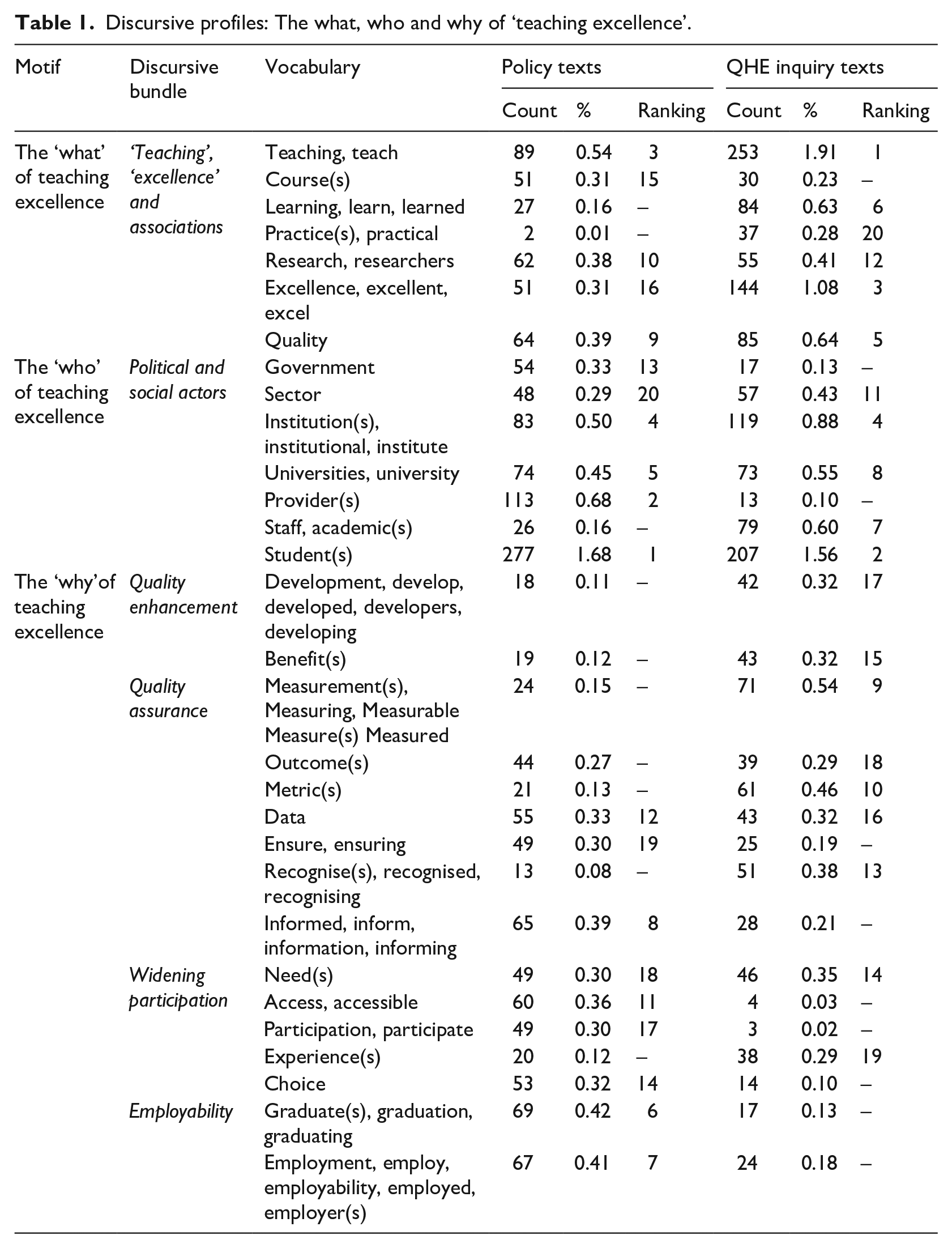
Similarities were noted across datasets, particularly with respect to the ‘what’ and ‘who’ of teaching excellence. For example, collocations of ‘teaching’ and ‘excellence’ featured prominently across written submissions. Reflecting a similar finding from Stevenson et al. (2014: 37), ‘teaching’ and ‘excellence’ appear to have become ‘uncontested buzzwords’ among those responsible for implementing policy. This is surprising given that excellence is essentially just the measurement of something else (Saunders and Blanco Ramirez, 2017), but as Canning (2017: 5) suggested, ‘one way to obscure what you want to do is to take care of it in the title’. Furthermore, use of the phrase teaching excellence is strategic; it implies the evaluation of pedagogic practices and it is therefore unsurprising that notions of ‘learning’, ‘practice’ and ‘quality’ emerge alongside it. In contrast, the third discursive bundle revealed four competing discourses underpinning the purpose of a framework for assessing teaching excellence. These were quality enhancement, quality assurance, widening participation and graduate employability.
Evaluation of discursive practices: Why teaching excellence?
Mautner (2005) explained that the presence, absence or prominence of motifs could be used to support an evaluation of discursive practices. The second stage of analysis therefore sought to evaluate discursive practices relating to the notable disjuncture between discourses underpinning the purpose of pursuing teaching excellence. This permitted an exploration of the interplay of discourses in policy and practice, thus attending to the remaining two research objectives. Such an approach to evaluation emphasises the discourse as a central concept, seeing policy as a process involving ‘production, reification and implementation’ (Hyatt, 2013: 836). Policy texts were therefore scrutinised first, using Hyatt’s (2013) framework for Critical Policy Discourse Analysis. Specifically, his interpretation of Fairclough’s (2003) ‘Modes of Legitimation’ was used to examine the ways in which strategies of ‘authorisation’, ‘rationalisation’, ‘moral evaluation’ and ‘mythopoesis’ were used to legitimise policy. Subsequently, this evaluation was combined with a thematic evaluation of the potential influence of rhetorical strategies on the ways in which discourses are adopted or resisted when translated into institutional practice. Raw data extracts from policy texts and numbered submissions to the QHE Inquiry (see BIS Committee, 2016 for copies of submissions) were identified to illustrate key observations.
Teaching excellence for quality enhancement?
Within the discursive bundle of ‘quality enhancement’, the salience of the term ‘benefit’ was particularly notable and consequently it might be suggested that rhetorical strategies, specifically those of ‘rationalisation’, employed by policymakers have had their desired effect. TEF2017 was rationalised through frequent reference to the broad theme of ‘fulfilling potential’. In relation to the HE sector, emphasis was on notions of productivity leading to students receiving value for money. Adjectives such as ‘quicker’, ‘easier’ (DBIS, 2016a: 6) and ‘simpler’ (DBIS, 2016b: 2) elicited positive, perhaps indisputable, messages regarding the productivity of the proposed system. For additional impact, these words were contrasted with reference to potential grievances such as ‘reducing burdens’ (DBIS, 2016b: 5) and, interestingly, the HE and Research Bill factsheet displays positive language in bold type font. Accordingly, submissions drew reference to how ‘HEIs should be able to benefit’ (QHE09) and how they might ‘benefit reputationally’ (QHE12), despite minimal use of the term ‘benefit’ in policy texts. These findings reflect Teichler’s (2003, cited in Brockerhoff et al., 2014) observation regarding the exploitation of labels to increase the reputation of the institution.
The HE and Research Bill Factsheet (DBIS, 2016b) displayed a range of issues with the current system clearly in bullet form. This refers to a strategy which Fairclough (2003) termed ‘mythopoesis’, which appeals to the reader’s morality and is reinforced through accounts of the potential repercussions of choosing to adopt or resist the ideas outlined in the policy text. Furthermore, the policy text itself painted a particularly dire picture using language such as ‘decline in the status of teaching’ (DBIS, 2016a: 12) and ‘cause for concern’ (DBIS, 2016a: 11), and claiming that a poor student experience can prove ‘costly not just for them but for the broader economy and taxpayer’ (DBIS, 2016a: 11). Here, just as the benefits to a range of stakeholders have been outlined elsewhere, the text speaks to those same stakeholders to outline the negatives. Furthermore, the text cites research revealing ‘distracted academics and instrumentalist students’ in the US HE system (Palfreyman and Tapper, 2014, cited in DBIS, 2016a: 12) in order to illustrate potential consequences of resistance to TEF2017. The use of academic rather than anecdotal evidence or government statistics adds weight to an argument directed at academics themselves. In the opening few pages of the document it is stated that ‘the teaching that students receive can transform their life chances’ (DBIS, 2016a: 11), reinforced later in paragraph 29, and revisited towards the end of the chapter, with the claim that ‘thousands of life opportunities wasted, young dreams unfulfilled, all because teaching was not as good as it should have been’ (DBIS, 2016a: 46). Arguably, the contrasting nature of positive opportunities against the negative consequences of not pursuing these leaves, to the rational mind, the content in between unquestionable.
Although the premise of the policy text was to argue that teaching excellence is desirable, there appeared to be a deliberately vague explanation of its meaning. For example, ‘we define teaching broadly’ (DBIS, 2016a: 46), ‘excellent teaching can occur in many different forms’ (DBIS, 2016a: 43) and ‘it is not the intention of the TEF to constrain or prescribe the form that excellence must take’ (DBIS, 2016a: 43). Brady and Bates (2016: 163) referred to the dangers of a focus on the effectiveness of teaching and learning as a set of predetermined outcomes, leading to a ‘pedagogy of confinement’ whereby the learning process is neglected. Yet, other areas of the policy text appear to do just this, for example in the claim that ‘we take a broad view of teaching excellence, including the teaching itself, the learning environments in which it takes place, and the outcomes it delivers’ (DBIS, 2016a: 43). In contrast, it is noteworthy that notions of development were prevalent across written submissions. Indeed, Nixon (2007: 22) alluded to the idea of teaching excellence as being synonymous with a ‘process of growth, development and flourishing’. Examples included ‘development of teaching’ (QHE16, QHE70), enabling ‘students to develop resilience, autonomy and ownership’ (QHE28), alongside ‘developing and improving processes and policies’ (QHE70). Reference to ‘professional development’ (QHE35, QHE16) is also interesting, corroborating Scott and Scott’s (2016) findings regarding the perceived effectiveness of professional development activities in supporting staff to promote student learning. The policy texts did acknowledge the types of teaching activity which may reflect excellence, including ‘student support, course design, career preparation and “soft skills”’ (DBIS, 2016a: 11) such as ‘critical thinking, analysis and teamwork, along with the vital development of a student’s ability to learn’ (DBIS, 2016a: 43). Crucially, from the perspective of ‘moral evaluation’, such attributes are congruent with pedagogic language and serve to mask the questionability of the assessing of teaching excellence in practical terms.
Submissions contained frequent references to teaching, learning and the broader institutional infrastructure, aligning with cultural and structural activities designed to enhance quality (Brockerhoff et al., 2014). Of note in some submissions, however, was an individualistic focus on teachers and the students themselves. This arguably reflects the philosophies of a bottom-up approach to development of teaching excellence, and bears similarity to the approach of some Finnish institutions which develop their own incentives and programmes for teaching excellence. The disparity reflects the distinction between two types of quality: ‘procedural’, associated with simply proving quality, and ‘transformational’, which focuses on the customer as an individual (Sallis, 1996), and consequently highlights the priorities which different universities operating in different contexts might be guided by.
Teaching excellence for quality assurance?
Despite vague definitions, teaching excellence was frequently linked to notions not only of achieving quality but doing so through a form of measurement: ‘by introducing the TEF, we will tackle the challenge of measuring teaching quality’ (DBIS, 2016a: 13). Accordingly, Dixon and Pilkington (2017) noted the rise of a competitive culture of measurement, evident in submissions which appear to accept the inevitability of a ‘outcomes metrics-based system’ (QHE09) to ‘measure teaching quality’ (QHE60) or include ‘measures of value-added’ (QHE12) all of which are ‘measured properly’ (QHE40). It should be noted that while a number of university submissions demonstrated acknowledgement of the value of measurement, they did highlight the ‘limitations of the measures’ (QHE65) which are not a ‘measure of teaching quality and would therefore be highly misleading’ (QHE60) and questioning ‘how do we observe the process of learning in order to measure excellence . . . are we measuring individuals, departments or institutions?’ (QHE16). This can be explained by Brady and Bates (2016) who observed that the idea of educational quality instead becomes absorbed into discourses of outcomes, skills and competencies. In this sense, the notion of quality ‘illuminates and defines certain objects and obscures and hides others for governance purposes’ (Grek et al., 2009: 5). It might therefore be argued that by offering a rationale centred on productivity, policymakers have championed the value of quantitative measurement of teaching excellence. These findings corroborated those revealed by Wood and Su’s (2017) study in which academic staff raised concerns that a genuine commitment to excellence in teaching may be reduced to an evidence gathering quality assurance process. It was also suggested that ‘measuring good or excellent teaching requires a more nuanced approach’ (QHE28) and a need to ‘take into consideration the cohort of students and range of complicated factors associated with achievement and graduate destinations’ (QHE80). Indeed, Lynch (2006) argued that the use of rankings and league tables, emerging both within and between nations, do not focus sufficiently on the quality of experiences. Similarly, Wood and Su (2017) noted that diversity could not be captured by standardised metrics, but that although process measures would be better indicators of teaching quality than outcome-based metrics, they remain underdeveloped. Consequently, the divide between formal processes and procedures, and the day-to-day performance of teaching practice becomes exacerbated, arguably foregrounding quality assurance at the expense of pedagogical quality (Brady and Bates, 2016; Martensson et al., 2014; Saunders and Blanco Ramirez, 2017).
Furthermore, the prevalence of the notion of ‘recognition’ is interesting given the relative lack of attention in policy documentation. Results though are perhaps unsurprising given the performative culture that has emerged through a focus on measurement, which as Canning (2017) indicated, places an emphasis on presage and, as Cadez et al. (2017) suggested, therefore provides incentives for academics. Indeed, the role of recognition in encouraging a motivation towards change and development is highlighted by Scott and Scott (2016) and Madriaga and Morley (2016). Observations support Wood and Su’s (2017) finding that many staff, despite highlighting issues with quality measurement, also valued the introduction of TEF2017 in raising the profile of teaching.
The policy texts carefully avoided criticism of current practice, despite a clear focus on the need for change. Rather, they appeared to draw on French and Raven’s (1959, cited in Raven, 1993) six bases of power, deliberately assigning legitimate power to universities by highlighting their position of authority through their ‘paramount place in an economy driven by knowledge’ (DBIS, 2016a: 7), and complementing this with techniques of reward power and ingratiation to praise the good work that universities do. It is, then, without doubt that the prioritisation of measurement in many of the university submissions reflects the permeation of neoliberal ideologies of marketisation of HE (Brady and Bates, 2016; Saunders and Blanco Ramirez, 2017). Arguably, authorisation strategies were influential in generating what Behari-Leak and McKenna (2017) referred to as a ‘gold standard’ discourse through acknowledgement of the world-class HE provision offered by UK universities.
However, the differences in focus among submissions perhaps highlights the tensions that arise between the needs of learners in different educational contexts. This might explain what Martensson et al. (2014) noted as an increasing move, particularly among politicians, beyond quality assurance for its own sake towards a focus on longer-term outcomes.
Ten years ago, the CHERI Report (Little et al., 2007) identified the need for clearer explanations of the meanings attached to the word ‘excellence’, warning that more traditional notions of excellence, which did not align with the increasingly diverse HE system, might be implicitly privileged. Through the use of moral evaluation strategies, it appears that these calls have been ignored, allowing definitions of teaching and learning excellence, and therefore approaches to its measurement, to be manipulated by government through policy to ultimately advance broader ideological outcomes (Dixon and Pilkington, 2017). This argument is reinforced by observations of the assumption that ‘excellent teaching, whatever its form, delivers excellent outcomes’ (DBIS, 2016a: 43). Furthermore, contradicting pedagogic literature (e.g. Biggs, 2011; Ramsden, 2003), the ministerial speech makes direct reference to the focus on product rather than process of learning: ‘I expect the TEF to include a clear set of outcome-focused criteria’ (DBIS and Johnson, 2015). Indeed, the phrase ‘outcomes’ is frequently collocated with ‘positive’ (e.g. DBIS, 2016a: 49), arguably restricting the articulation of alternative perspectives.
Teaching excellence for social justice and economic prosperity?
Policy texts referenced the role of a ‘One Nation Government’ (DBIS, 2016a: 13, 54), a phrase commonly used more broadly in the UK to highlight the intention of policymakers to act in the interests of all sections of society. Although reinforcing the inevitable authority of the Government in the production of TEF2017, the phrase encompassed notions of ‘political warrant’ (Hyatt, 2013) whereby the policy is justified in terms of national interest. This, however, can be contrasted with references to the Conservative manifesto (DBIS, 2016b) and meeting ‘the PM’s commitment’ (DBIS and Johnson, 2015), which perhaps offers insights into how the government is using the policy to translate further political visions into action. Similarly, the frequent use of phrases such as ‘we will’ presented a seemingly positive image of policymakers working alongside key actors to ensure the effective implementation of TEF2017. However, TEF2017 highlights the ‘tendency of politicians to offload’ (Canning, 2017: 7) responsibility for successful implementation to others. With policymakers claiming an array of positive policy outcomes, but leaving delivery to universities, concerns over accountability may be raised. Therefore, while on face value the policy texts seem to champion the authority of universities as the country’s ‘greatest national assets’ (DBIS, 2016b), closer inspection revealed they were simply being used as a vehicle to mobilise the discourses of what claims to be a ‘One Nation Government’.
A system of measurement is portrayed as being desirable to a range of stakeholders through a focus on what key actors ‘deserve’, ‘need’ or ‘have a right to expect’ (DBIS and Johnson, 2015), reflecting theories of social justice. For example, ‘students get the teaching they deserve, and employers get graduates with the skills they need’ (DBIS and Johnson, 2015), ‘raising teaching quality and standards so students and employers get the skills they need’ (DBIS, 2016b), ‘students deserve excellent teaching’ (DBIS, 2016a: 7). These points were complemented with seemingly positive statements regarding the benefits for universities such as ‘recognition of excellent teaching’ (DBIS and Johnson, 2015), and ‘a framework to recognise universities offering the highest quality teaching’ (DBIS, 2016b). For those outside the key stakeholder groups, the wording of the policy text targets brings the reader’s moral stance into question, stating ‘teaching excellence matters, not only for students and tax payers, but also for those who care about social mobility’ (DBIS, 2016a: 13).
In terms of government imperatives concerning widening participation, the policy text claims to ‘make real progress on widening access and success for students from disadvantaged backgrounds to support social mobility’ (DBIS, 2016a: 41), arguing that it will promote ‘equality of opportunity across the whole lifecycle for disadvantaged students’ (DBIS, 2016a: 56). In fact, the ministerial speech directly references the current widening participation strategy (‘National Strategy for Access and Student Success’): ‘we are committed to ensuring that the TEF supports the Government’s aims in Widening Participation’ (DBIS, 2016a: 48). It is unsurprising then that the most frequently used terms in policy texts were those associated with ‘access’ and ‘participation’, factors which arguably could be reduced to quantitative assessment. The political rhetoric across Europe is similar, with documentation and debates surrounding the Bologna Process drawing reference to national targets for widening participation and lifelong learning (Brusoni et al., 2014). In contrast, university submissions focused on the more subjective and qualitative aspects of teaching practice, which correlates with their rejection of quantitative quality assurance measures, and preference for viewing enhancement in terms of an ongoing process of development rather than a target. Terms commonly emerging in submissions tended to relate to notions of ‘support’ and ‘experiences’, with emphasis on the diversity of the student population, for example a need to offer a ‘first-rate teaching experience via a supportive and innovative environment for both staff and students’ (QHE80), ‘understanding the interrelationship between effective support for students with specific and complex needs (e.g. mental health), and academic performance’ (QHE35) and ‘make visible, the ways that diverse higher education experiences equip students from diverse backgrounds and with diverse interests to enter graduate employment and develop their ability to contribute to society as a global citizen’ (QHE35). This disparity appears to suggest that policymakers use of moral evaluation strategies has had limited effect in promoting a widening participation rhetoric based on social justice. This supports suggestions that the description of excellence in generic terms results in simplification and a discourse of performativity which fails to understand student needs in different contexts (Behari-Leak and McKenna, 2017; Saunders and Blanco Ramirez, 2017). Given the focus on placing students at the heart of the system, this rejection of rhetoric seems inevitable.
A further policy driver appears to be that of ‘employability’. Indeed, employability has also been understood as a measure of HE quality across Europe and consequently a principal driving force of the Bologna Process (Stiwne and Alves, 2010). Interestingly, the TEF2017 policy text cites one of the problems of the current HE system as being the variation in graduate outcomes and earnings, referencing evidence that ‘one in five employed graduates were not working in a professional or managerial role three-and-a-half years after graduation’ (DBIS, 2016a: 12). This contradicts claims elsewhere in the document that there is more to university than financial gain and the observation in the ministerial speech that ‘many graduates will consciously choose to go into occupations that do not maximise their incomes – we must remember that education is about more than wage returns’ (DBIS and Johnson, 2015). It can be argued that the policy documentation reflects a shift in the understanding of the purpose of HE from ‘a broader notion of the public good, to a relentless promotion of employability’ (Burke et al., 2015: 29), evident through the legitimising strategies of moral evaluation. Moreover, it places little value on the outcomes beyond the acquisition of work, with substantial emphasis on ‘graduate outcomes’, ‘graduate (un)employment’, ‘graduate earnings’, ‘graduate jobs’. However, themes of graduate employability received considerably less attention across all written submissions. This could be particularly concerning for policymakers, indicating further ineffectiveness of the legitimising strategies used to mobilise the neoliberal ideology that asserts the role of HE in the production of a skilled workforce which serves the economy.
These findings might be attributed to the contradictory claims evident throughout policy documents. On the one hand, the values of education beyond high earnings are emphasised, while on the other, the proposed metrics place a strong emphasis on the employment destinations of graduates. Government itself recognised that a range of factors, beyond excellent teaching, will determine the career path that students choose (DBIS, 2016c); these include economic performance of the UK, individual characteristics, students’ professional development activity and employer recruitment behaviour (Blyth and Cleminson, 2016). Based on this evidence it might be hypothesised that academic staff will naturally focus on the metrics that they can control through the day-to-day practices of teaching and learning, such as student satisfaction. This may arguably reflect the transcendence of life-wide and life-long learning theories into the discourse of employability (Speight et al., 2013), suggesting that educationalists may tend to view employability as an indirect outcome of effective teaching, therefore focusing their attention on the shorter-term purposes of TEF2017, such as quality enhancement and assurance. Interestingly, this situation may have been exacerbated by the performative culture created through the introduction of those very same quality measures. In an examination of the European context, Brusoni et al. (2014) noted the tensions that HEIs experience in terms of being encouraged, on the one hand, to become sites of excellent knowledge production sites, while at the same time ensuring that an increasingly diverse range of learners have access to such knowledge. If policymakers are to counter resistance to neoliberal notions of HE being about employability, then they need to reconceptualise its own understandings of employability as ‘preparation for life rather than a specific job . . . about capabilities rather than specific skills’ (Speight et al., 2013: 121).
Conclusion and recommendations
This article explored the discourses underpinning teaching excellence in the context of a framework for assessing the standard of teaching in English HE. Findings emphasised a disjuncture between policy claims and institutional priorities through four competing discourses: quality enhancement, quality assurance, widening participation and graduate employability.
Drawing on Skelton’s (2007) four approaches to teaching excellence, the article highlighted the ‘critical’ rhetoric in UK education policy exemplified by a focus on economic prosperity and social mobility. However, legitimising strategies adopted by UK policymakers appear to have had limited influence on discourses adopted at an institutional level. Notably, discursive silences regarding access, participation and employability among institutional documentation revealed that the sector may be driven instead by a preoccupation with the notion of quality. Indeed, once the layers of legitimising strategy are pulled back, it is clear to see how political constructs of teaching excellence have become instruments of neoliberal ideology (Saunders and Blanco Ramirez, 2017). Furthermore, the massification and marketisation of HE has heightened the debate over its purpose. For example, shifting between notions of public versus private good (Burke et al., 2015), pursuing excellence versus achievements (Speight et al., 2013), and resulting in the production of a skilled workforce versus personal development and social mobility (Skelton, 2005).
The concept of excellence in education is not new; neither is it confined to the English context. Echoing developments in the wider European context, it is evident that a framework which purports to assess the standard of teaching in HE will naturally encourage a performative culture whereby institutions are motivated to attend to immediate standards, accountability and reputational concerns (Kleijnen et al., 2013; Teichler, 2003, cited in Brockerhoff et al., 2014), rather than pedagogical priorities which may reflect the broader purposes of establishing teaching excellence in HE (Stevenson et al., 2014). In the present article, this was reflected in the dominance of ‘quality assurance’ and ‘quality enhancement’ discourse in institutional documentation.
Teaching excellence is a buzzword too readily accepted by institutions but poorly defined by policymakers. This article did not seek to define the concept of teaching excellence, as any attempt to do so would fail to do justice to its complex and highly contextualised nature. Furthermore, findings support the suggestion that the translation of excellence discourses to a local level is a complex task, particularly where multiple actors are involved (Antonowicz et al., 2017). It is therefore clear that conceptualisations of the value in pursuing teaching excellence must be acknowledged from a ‘policy perspective, a professional perspective, an institutional, discipline or personal perspective’ (Wood and Su, 2017: 462) before a complete understanding of teaching excellence can be realised. Indeed, nations such as Belgium and Slovenia, which have successfully adopted more contextualised notions of teaching excellence which afford greater responsibility to the institutions themselves, exemplify the opportunities for development of teaching excellence initiatives. Meanwhile, despite considerable development in policy, the problem of excellence remains. Until clarity is reached, education policy will continue to draw reference to a highly contested concept which is difficult to operationalise within HEIs.
The phrase teaching excellence should be treated with caution. This article highlights tensions in the prescription and perception of the drive towards standardised frameworks for excellence across the EHEA. It is recommended that institutions develop a deeper understanding of pedagogic practice in relation to teaching excellence by engaging with the perspectives of academic staff. Meanwhile, policymakers should open a dialogue with a range of stakeholders in order to establish the perceived value and purpose of ‘excellent teaching’ in HE. Further research on the UK case, for example, might draw on Hyatt’s (2013) ‘policy trajectory approach’ to explore the TEF2017 policy and its impact through recontextualisations beyond the one presented here.
Footnotes
Declaration of conflicting interests
The author declared no potential conflicts of interest with respect to the research, authorship and/or publication of this article.
Funding
The author received no financial support for the research, authorship and/or publication of this article.
