




Abstract
Entrepreneurship promotion in higher education is a highly controversial issue. Yet entrepreneurship education is nowadays part of the education system all over Europe. In order to be legitimate, entrepreneurship education implemented in higher education institutions is expected to serve multiple stakeholders, among them society, students and faculty members. Yet previous studies have demonstrated that students and faculty members also object to entrepreneurship education. This article adopts a frame analytic perspective on entrepreneurship education and examines attempts to make sense of entrepreneurship education in a way that aligns various stakeholders’ interests. The data analysed in the article consists of interviews (N = 11) with people who implement entrepreneurship education in a Finnish university. The article calls for more research on university students’ and graduates’ relation to social entrepreneurship and entrepreneurial work life agency emphasized in the implementers’ framings.
Introduction
Following the lead of the Organization of Economic Cooperation and Development (OECD) and the European Union, most European countries have adopted entrepreneurship education as part of their education system. In the context of higher education, the goal of entrepreneurship education is to enable graduates’ smooth transition from university to working life but also to create innovative start-ups and growth enterprises that promote economic and social development (OECD, 2015: 17). At a glance, entrepreneurship education seems to kill two birds with one stone; while serving students’ interests in seeking an easy transition to working life, universities also serve societal interests in employment, venture creation and industrial development.
In reality, entrepreneurship education in higher education context is a controversial issue. Even though OECD (2015) highlights the idea that entrepreneurship education serves students’ interests by facilitating their university-to-work transition, students and graduates have not been solely thrilled. European youth has a rather positive attitude towards entrepreneurship, but only a minority views entrepreneurship as a desirable or probable career option for themselves (European Foundation for the Improvement of Living and Working Conditions, 2015). Furthermore, students and graduates have been concerned about incremental competition and market steering that they connect with entrepreneurship in the higher education context (Tunstall, 2018).
Another group that has not been thrilled about entrepreneurship education in higher education context consists of university researchers and teachers. Previous studies have demonstrated that researchers and teachers object to entrepreneurship education on the basis that entrepreneurial values of private gain, market steering and competition violate ‘pure academic values’, such as academic freedom and the common good (Laukkanen, 2003; Shore and McLauchlan, 2012; Ylijoki, 2003). According to Jongbloed et al. (2008: 317), faculty members define ‘their identity as characterized by an independence of thought and action and do not want to be driven by external demands’. If entrepreneurship education does not serve the interests of the internal stakeholders (Jongbloed et al., 2008), such as students and faculty members, the legitimacy of the action can be called into question (Donaldson and Preston, 1995).
While students and faculty members connect entrepreneurship education with capitalism and business venture creation (Jongbloed et al., 2008; Tunstall, 2018; Ylijoki, 2003), researchers and implementers of entrepreneurship education argue that entrepreneurship education is more than business making (Johannisson, 2016). Instead of mere venture creation, entrepreneurship education fosters active, creative and initiative citizens, also called self-entrepreneurs (Gibb, 1993; Holmgren and From, 2005; Kyrö, 2015). These self-entrepreneurs are change agents who may contribute to economic development but also to social development and community welfare (Leffler, 2009). Interest in societal forms of entrepreneurship called social or environmental entrepreneurship has been increasing during the last decade, and educational institutions are one scene where such entrepreneurship can be promoted (Berglund and Wigren, 2012; Berglund and Verduijn, 2018).
Researchers agree that entrepreneurship education can be framed in competing ways, for example, as venture creation or self-entrepreneurship promotion (Kyrö, 2015). The existence of multiple framings means that different universities can frame entrepreneurship education in differing ways, and that also different groups within universities can frame it in differing ways (Tunstall, 2018). Multiple framings is often seen as a problem that should be solved. However, this article demonstrates that, besides a topic of dispute, multiple framings can be useful for entrepreneurship education implementers: the availability of numerous framings enables strategic interactions with stakeholders, some of whom might have difficulties accepting venture creation and economic profit as goals pursued in the context of higher education.
Empirically, this article focuses on framing processes that take place in the Finnish higher education context. At the University of Helsinki – the largest university in Finland – the first highly visible investment in entrepreneurship education has been the establishment of the Helsinki Think Company (HTC), a communal co-working, meeting and networking space, which also serves as a venue for events such as pitch nights, business advisory services and entrepreneurship courses. The HTC was established in 2013 to serve the faculties of arts, theology, law, and social and behavioural sciences. The target group is interesting because it has been found to be especially uninterested in profit making, self-employment and business ownership (Helkama, 2009; Neittaanmäki et al., 2017). Considering the alleged disinterest of the internal stakeholders, students and faculty members, this article focuses on the framings of people who established the HTC. Two research questions are posed: (a) ‘how is the action of the Helsinki Think Company framed by the founders’, and (b) ‘how are the interests of multiple stakeholders aligned?’
The framing processes are studied from the perspective of relational social psychology. Instead of asking what truly happens in the HTC and whose interests are truly being served, the article assumes that the action and the interests it serves receive their nature and meaning in transaction processes (Emirbayer, 1997: 287). The interpretations of HTC action are studied by adopting Erving Goffman’s (1974) frame analytic perspective. According to Emirbayer (1997), Goffman’s work is a good example of a relational approach. The next section introduces Goffman’s frame analytic perspective, and the ensuing one presents the data and method used in the study. The fourth section presents the empirical results, which are then further discussed in the last section.
The frame analytic perspective on entrepreneurship education
Entrepreneurship research in general and research on entrepreneurship education in particular can be divided into functionalist, interpretive and critical (or radical) research (Grant and Perren, 2002). Functionalist research aims to make enterprises successful (Grant and Perren, 2002) and to improve the way entrepreneurship is taught (Jack and Anderson, 1999; Kuratko, 2005; Römer-Paakkanen, 2001). Critical research focuses on power and subjugation in entrepreneurship (Grant and Perren, 2002). Critical researchers view entrepreneurship education as an embodiment of neoliberal governance, and they question the unambiguous goodness of entrepreneurship education that is assumed by functionalist researchers (Korhonen et al., 2012; Laalo and Heinonen, 2016; Peters, 2001). Instead of a functionalist yes or critical no research approach (Tunstall, 2018), this study represents interpretive research; the goal is to analyse the multiple meanings given to entrepreneurship and entrepreneurship education without endorsement or resistance (see Grant and Perren, 2002).
As mentioned in the introduction, this article adopts the frame analytic perspective that was originally formulated by Goffman (1974). Frame analysis focuses on the organization of social experience in terms of the question ‘what is going on in here?’ (Goffman, 1974: 7). In his book Frame Analysis, Goffman (1974) distinguishes between two kinds of primary framework: natural and social. Occurrences framed as natural are purely physical, whereas occurrences framed as social include an agent who is guiding the occurrence. Entrepreneurship education is a social primary frame. Occurrences framed as entrepreneurship education are understood as occurrences where business ventures are created and economic interests are served (Holmgren and From, 2005; Kyrö, 2015). That is not to say other primary frameworks are unthinkable. In Frame Analysis, Goffman (1974) discusses numerous troubles in defining what it is that is going on. People face, for example, ambiguities regarding primary frameworks. Perhaps what is going on at the university is not entrepreneurship education but rather civic or another type of education.
Instead of the difference between the two types of primary framework, and the difference between possible social primary frameworks, this article focuses on frame transformations, which Goffman (1974) calls keyings. Any occurrence may be meaningful in terms of some social primary frame. Keyings, however, transform the experience of what is actually going on: the activity is the same, but the interpretation of what is going on changes. ‘What appears to be something isn’t quite that, being merely modelled on it’ (Goffman, 1974: 45). Keying is not an alternative primary framework; in keying, the original primary framework is maintained but also reinterpreted. In Frame Analysis, Goffman discusses various types of keying but regarding the discussion on entrepreneurship education, two of them are especially relevant: regroundings and technical redoings (see Goffman, 1974: 58–77).
According to Goffman (1974: 43–44), regrounding means that ‘what is involved is the performance of an activity more or less openly for reasons or motives felt to be radically different from those that govern ordinary actors’. In short, some motives for action are considered ordinary, whereas others are extraordinary. Entrepreneurship education is primarily framed as action that serves economic interest (Holmgren and From, 2005; Kyrö, 2015), but it can also be regrounded as action that, in the end, serves social interest (Leffler, 2009; OECD, 2015; Rae, 2010). Action is not reframed as purely social by nature. The economic nature of the action is maintained, but the principal aim is now social.
Technical redoing is another type of keying: it means that an action is performed out of its usual context and that the original outcome of the action will not occur (Goffman, 1974: 59). One such technical redoing is practice. Entrepreneurship education is primarily framed as action whereby experts help students start their own companies, but it can also be framed as action whereby experts help students practise self-entrepreneurship – entrepreneurial skills and mindset – without specific intentions of increasing their self-employment (Gibb, 1993; Holmgren and From, 2005; Johannisson, 2016).
The empirical part of the paper includes an analysis of the ways in which people who established the HTC frame the action of the HTC. Special attention is given to the issue of interest alignment and the functionality of the selected framings. The data and method used in the empirical study are described in the next section.
Data and method
Graduates’ university-to-work transition has become more difficult all over Europe. However, together with southern Europe and Turkey, Finland has the highest unemployment rate of people with tertiary education (OECD, 2017). Although the Finnish Ministry of Education has stressed the need for entrepreneurship education throughout the school system for the last decade, most Finnish universities have quite recently started to invest in entrepreneurship education. Groundwork for the HTC was carried out in two projects (2012–2014) conducted in collaboration with the University of Helsinki, Helsinki-Uusimaa Regional Council and a think tank called Demos Helsinki (Siitonen, 2016).
To analyse the framings of the founders of the HTC, 11 interviews were conducted in autumn 2014. The interviewees included managers, the rector and the chancellor of the University of Helsinki, and representatives from University Research Affairs, Career Services, and Communications and Community Relations. Besides representatives of the University of Helsinki, the interviewees also included representatives of the city of Helsinki and the Demos Helsinki think tank. In addition, two business experts whose expertise was utilized at the time of the foundation of the HTC were interviewed.
The interviews were semi-structured, and the data collection followed the principles of the qualitative attitude approach (Vesala and Rantanen, 2007; also e.g. Niska et al., 2018; Nousiainen et al., 2009; Peltola and Vesala, 2013; Pesonen et al., 2013; Pyysiäinen, 2010). In the interviews, 10 questions were presented to the interviewees one by one, and the interviewees were asked to freely comment on them. The questions concerned academic entrepreneurship in general and the HTC in particular (see Appendix 1). Instead of searching for simple answers, the questions were used as prompts that generated discussion about entrepreneurship education at the HTC. The average duration of an interview was an hour. The interviews were recorded and transcribed verbatim in Finnish (transcription conventions are presented in Appendix 2). The excerpts presented in the results section are translated into English by the author.
In line with Silverman (2006), interviews are interaction situations that take place between the interviewer(s) and interviewee(s). The interviewer does not collect ‘facts’ from the interviewee but is an essential part of the interaction situation, for example, by asking questions and encouraging responding (Potter and Hepburn, 2005). Furthermore, it is relevant who the interviewer is. Interview talk is normally functional in the sense that both the interviewer and the interviewee try their best to make sense and present themselves in a positive light (Goffman, 1959). In this particular interview situation, a student and a researcher from the faculty of social sciences (the interviewers) asked the interviewees to frame what is going on at the HTC. The interviewees, thus, constructed the framings to representatives of the group that is, according to previous studies, at least somewhat hostile to entrepreneurship education in higher education context.
To begin with, I focused on framings. I searched for similarities and differences in the descriptions of the action taking place in the HTC (literal reading, Mason, 1996). After this coding, the second stage of the analysis used the theoretical concepts of framing and keying to read the categorized data (interpretive reading, Mason, 1996). While using the primary frame and the keyings, the interviewees also evaluated the action in terms of how well it serves the interests of the stakeholders: society, students and representatives of the University of Helsinki. However, interestingly, the interviewees also evaluated the frames in terms of their functionality (also Pesonen et al., 2013). The latter part of the results section focuses on a dispute over the functional way of framing the action of the HTC.
Results
The interviewees framed the action of the HTC in three different ways. In line with the primary frame, entrepreneurship education, the action was framed as promotion of for-profit entrepreneurship. However, the interviewees also constructed keyings and reframed the action as promotion of social entrepreneurship and promotion of self-entrepreneurship. Regardless of the frame, interviewees argued that the action of the HTC serves the interests of society, students and faculty members.
Promotion of for-profit entrepreneurship
In line with the primary frame, some interviewees argued that action at the HTC encourages students to start new, for-profit enterprises. However, the interviewees disagreed on what type of for-profit entrepreneurship serves the interests of the stakeholders. In excerpt 1, interviewee 5 argued that the goal of the HTC is promoting new, growth-oriented enterprises because mere self-employment without employees is not enough to serve societal interests.
X: So, what about this latter one? What do you think, what should be the goal of this ((entrepreneurship)) promotion action? I5: It should genuinely generate business enterprises. Seriously, that is how the action should be evaluated: will there be new business enterprises. Will they arise faster, will they receive private funding, and will they start to grow. - - Of course, it is OK that there are enterprises that support one person. If you can manage with consultancy or service or you are an expert or a writer or something, well fine, there is nothing wrong with that. But let’s be honest, that is not going to save Finland ((laughter)).
In excerpt 2, the same interviewee 5 argued that mere self-employment (in excerpt 2, owning a hot-dog stand) is not enough to serve students’ interests in proper profit.
I5: - - Students get excited about the way we process ((entrepreneurship)). They see that hey there is something concrete here. This is a possibility for a different kind of a career. This is not like owning a hot-dog stand and trying to work from eight to eight and this will kill me and I make no money. - - This is like pursuing business growth, finding technological products that can be sold at global markets. And thinking about that kind of a career. That is a totally different type of entrepreneurship.
Although interviewee 5 framed the action of HTC as the promotion of growth-oriented for-profit enterprises, other interviewees also framed the action of HTC as the promotion of self-employment. These interviewees argued that besides hefty profit, self-employment via for-profit entrepreneurship serves students’ interests in employment. In excerpt 3, interviewee 3 suggested that action of the HTC – framed as for-profit entrepreneurship promotion – is crucial because paid work is not available for all students.
Z: How did you come up with the idea of the Helsinki Think Company? I3: Well, the idea has been to improve career opportunities for the students and graduates of the University of Helsinki, now that it is clear that the public power or public sector will not grow as it used to, which means that people who have an education traditionally connected with civil servants will not find jobs from the public sector.
Besides serving the interests of society and students, the promotion of for-profit entrepreneurship was presented as an action that serves the interests of the higher education institutions, in this case the University of Helsinki. In excerpt 4, interviewee 8 opined that for-profit entrepreneurship promotion improves the image of the University of Helsinki.
Z: Why now? Why is ((entrepreneurship)) promoted so strongly right now in the 2010s? I8: Well of course, the society has changed that way. And of course we have recognized that we have not paid enough attention to that. We need to take care of the career opportunities of our graduates. But then there is also this other motif, which is the image of the University of Helsinki. - - People think we do not appreciate entrepreneurship and we want to change that image of the University of Helsinki so that we are more up to date.
Previous studies have suggested that the primary frame (for-profit entrepreneurship promotion) is a problematic frame for entrepreneurship education because neither students nor faculty members care for business and profits (Laukkanen, 2003; Tunstall, 2018; Ylijoki, 2003). Nevertheless, in this data, some interviewees asserted that students are thrilled about start-ups and growth enterprises, which are also important for the university’s image. Even if business and profit are not in the interests of the faculty members, the university’s up-to-date image most likely is.
Promotion of social entrepreneurship
While describing the action of the HTC, the interviewees also transformed the motive of the action. According to these regrounding types of keyings (Goffman 1974), the HTC helps students start new business enterprises, but the pivotal motive behind this action is not economic but social. The HTC strives to achieve positive societal change with the help of entrepreneurship. In excerpt 5, interviewee 7 stated that profitable business enterprises are mere tools that can be used while making the world a better place.
I7: - - Academic entrepreneurship is value-driven entrepreneurship. We do not create business enterprises per se, but enterprises are tools that can be used to achieve other goals. - - I would want the university and the Think Company to be places that always remember that hey, let’s see what the importance of this is to the world and how we can increase its relevance. - - Entrepreneurship is quite a good tool to make an impact. That way you can use your time for it ((laughs)), your whole workday.
While framing the action of the HTC as creating tools to solve societal problems, the interviewees explained that students’ interests are non-economic by nature anyway. In excerpt 6, interviewee 10 praised the project that preceded the HTC for recognizing students’ interest in producing solutions to social and environmental problems of the world.
I10: I think that the project ((preceding the HTC)) should be credited for bringing the problems of the world to the heart of the matter. That entrepreneurship is the way to solve these problems. And then one has really understood that when it comes to our students, the interests that guide them to choose a specific discipline, they are not economic . . . but specifically like the environment, problems of developing countries or . . . ability to understand the world. - - And now in a way the thing . . . how we can make people think about how they, through taking the role of an entrepreneur, are able to solve the same problems which traditionally were solved being civil servants or third sector people or being researchers.
Besides serving the interests of society and students, promotion of social entrepreneurship was portrayed as action that serves the interests of the University of Helsinki. Social entrepreneurship promotion was connected with the third mission – engagement with social demands. In excerpt 7, interviewee 4 argued that by promoting social entrepreneurship, university transfers know-how to society and humankind.
X: How would you describe your role and your actions pertaining to entrepreneurship promotion? I4: Yes, I’ll say it is true of course that I am part of entrepreneurship promotion. One thing that takes a lot of my time is making the University of Helsinki more open to society and highlighting our social responsibility. We can be top researchers and top teachers, but we are only halfway there if we the top researchers discuss good things together, nationally and internationally. It is our responsibility to make sure our know-how is actively transferred to society, to our society and to benefit humankind.
Instead of economic development, making a difference and enabling social change are abstract principles that university representatives commonly cherish (e.g. Tunstall, 2018).
Promotion of self-entrepreneurship
While the interviewees described the action of the HTC, they also used another type of keying that Goffman (1974) calls a technical redoing. In these framings, the HTC does not create new enterprises, but stimulates students’ self-entrepreneurship or entrepreneurial agency. This active and adaptive agency can be used for business creation but it is not restricted to business context. An entrepreneurial agent recognizes his or her know-how and is able to verbalize and realize this know-how. In excerpt 8, interviewee 11 depicted the ideal working life agent.
I11: You need to know how to wrap things up, activity, networking, all that. Those are the skills you need in the working life of the future. People need to adapt more and more. Careers change and jobs change all the time, you need to know how to sell your know-how whether it is for an employer or in your own enterprise.
According to the interviewees, project courses where students solve the problems of actual organizations and enterprises are crucial means for entrepreneurial agency promotion. In line with Leffler (2009), the interviewees argued that entrepreneurs are not just business people – they are change agents. According to the interviewees, these change agents are important for society. In excerpt 9, interviewee 7 maintained that entrepreneurial agency lays the foundations for actual business ownership. In line with Kolhinen (2015), interviewee 7 also argued that entrepreneurial agents are desirable employees for the government and the public sector.
I7: - - But then we also have project courses. - - We have partners in cooperation who give us some challenges. Then they ((students)) define and select the problem in these challenges and start producing solutions to the problem. And if we do not have a foundation like this, well then the leap will be huge, for those who eventually start their own companies. But what you need for successful academic entrepreneurship, I’ll return to that one. Well that can also mean you know intrapreneurs. We need them a lot. We need them within the university but we also need them in the ministries and municipalities.
When entrepreneurship was portrayed as starting and owning a company (either for-profit entrepreneurship or social entrepreneurship), the interviewees emphasized the voluntary nature of the HTC activities; they are only meant for students who are truly interested in business ownership. However, the interviewees said that self-entrepreneurship promotion (e.g. project courses) are suitable for all students. In excerpt 10, interviewee 10 highlighted the idea that entrepreneurial agency promotion at the HTC does not violate students’ interests by trying to lure them into self-employment.
I10: - - The idea behind project courses was to promote students’ agency, activity also you know . . . is it entrepreneurial agency? People talk about intrapreneurship. You know like solution orientation. It does not matter whether one owns a business or is employed by others. - - Since the beginning really there was an understanding that promotion of this kind ((of action)) does not mean enterprise promotion but development of modus operandi and pedagogical models that can be used in either paid work or entrepreneurship. And I think that everyone has been OK with that. It is not like we are luring . . . the poor ((students)) into something ((i.e. self-employment)).
Besides serving the interests of society and students, the interviewees claimed that entrepreneurial agency promotion also serves the interests of the University of Helsinki. In excerpt 11, interviewee 7 opined that the promotion of students and graduates’ entrepreneurial agency boosts the relevance of the University of Helsinki.
I7: - - Universities in Finland when they were established were you know Humboldtian education universities that created educated citizens who serve the nation. And then now we have the innovation services . . . phase and universities are now part of the innovation system and economic system. And universities need to demonstrate that they are relevant in a new way. - - And one thing I noted was that what is wanted is that university students and graduates use their know-how, like that they understand better what they know and are not afraid of using their know-how. - - Like I say, I do not care if you end up self-employed. But what is important is that they exploit their know-how. These are the reasons why entrepreneurship is discussed more nowadays.
The students’ and graduates’ self-entrepreneurship was portrayed as important for the university and its representatives in two ways. First, as with start-up and growth enterprise promotion, knowledge transferred from universities to society improves the university’s relevance or image (excerpt 11). Secondly, intrapreneurship and the ability to problem solve are inherently important for universities (excerpt 9).
Dispute over functional framing
In the interviews, interviewees used the primary frame (for-profit entrepreneurship promotion) and two keyings (social entrepreneurship and self-entrepreneurship promotion) to make sense of what is going on at the HTC (see Figure 1). While using these framings, they argued that the action serves the interests of crucial stakeholders: society, students and faculty members.
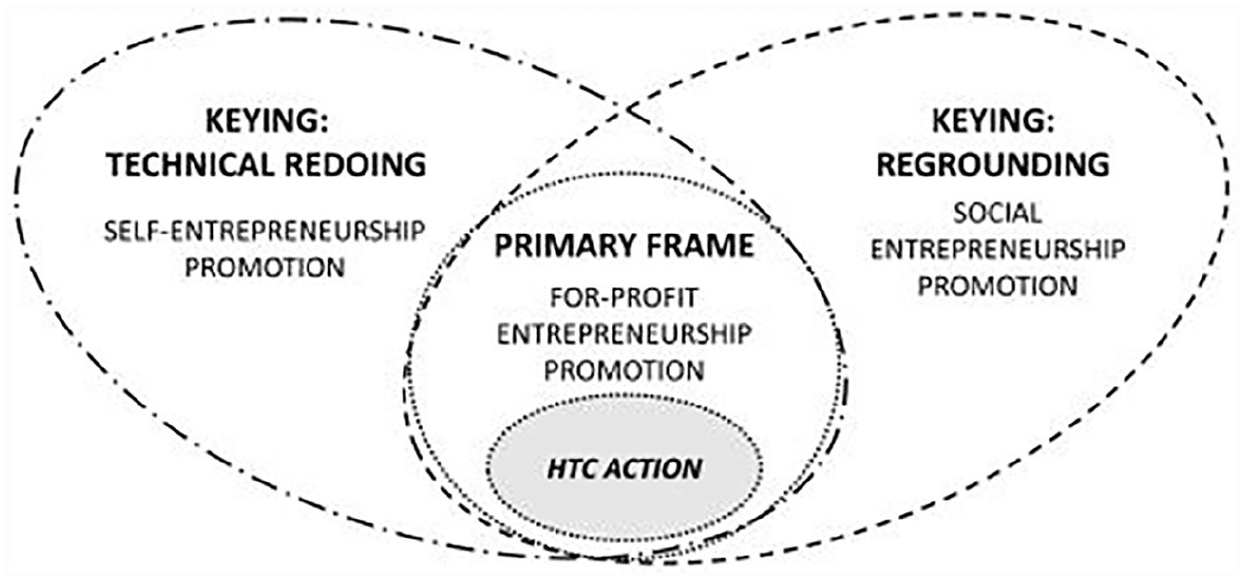
Framings of HTC action.
However, besides using the framings, interviewees also evaluated the framings in terms of their functionality. While some interviewees argued that the primary frame is dysfunctional, others argued that the regrounding keying is dysfunctional. At the heart of this dispute is the question of students’ and graduates’ interests – and, to some extent, those of faculty members.
As the preceding sections demonstrate, some interviewees stuck to the primary frame and interpreted the action of the HTC as promotion of for-profit entrepreneurship (e.g. I5 in excerpts 1 and 2). However, other interviewees asserted that the primary frame should be eschewed and keyings preferred, especially while interacting with students. Since students are not interested in venture creation and economic profit, primary framing alienates students from the HTC action. This is well explicated by interviewee 2 in excerpt 12.
Z: Well, if we go to the evaluation of the Helsinki Think Company. What do you think the goal is? I2: Well, the main goals is, or it has been quite a difficult process. We have these ((colleagues)) and their main goal is that, hey, growth-enterprises to Helsinki. - - Like, hey, at the university three per cent of people who graduate will be entrepreneurs within five years of their graduation, so this is like pretty nascent ((laughs)) action. - - Like if we start talking about entrepreneurship right away and, hey, now put your ideas to paper and towards growth-entrepreneurship, well we will be pretty like shut down. - - While interviewing and asking and meeting people and seeing what inspires them, well it was finding solutions to societal problems. - - I have seen during the last decades that this academic entrepreneurship is something different actors and policy programmes and others try to push in, and it has not led to any change. So, should we change discourse into something that suits our university?
The interviewees who stuck to the primary frame were well aware of this criticism. However, instead of accepting the criticism, they insinuated that regroundings are dysfunctional because they are not constructed to please students who are interested in business and profit, but to please faculty members who oppose entrepreneurial values, such as profit maximizing.
I5: We had this huge cultural difference. That ((colleague)) saw this entrepreneurship so that it is great if an enterprise solves societal and important problems. University has an influence and we make some good things happen. And I was like what, shouldn’t enterprises make money so someone gets rich? And ((colleague)) was like you cannot say such things here at the university. That university is not here for that. And I said that well that is what enterprises are for ((laughter)) - - And ((my colleague)) was like let’s not talk about that first, let’s start with the challenges ((laughter)).
Some interviewees suggested that the primary frame is problematic because it does not align the societal interests with students’ interests. Other interviewees argued that the primary frame does align societal interests with students’ interests, and the problem is with the faculty members and their interests.
Discussion and conclusions
Entrepreneurship education has been under rapid growth all over the world (Holmgren and From, 2005; Kuratko, 2005; Li et al., 2003). This is interesting considering the lack of consensus on what entrepreneurship education is (Pittaway and Cope, 2007; also Holmgren and From, 2005) and whose interest entrepreneurship education serves (Tunstall, 2018). According to OECD (2015), entrepreneurship education promotes global, national and regional economic and social development. Nevertheless, in order to attract students, it also needs to convincingly serve the interests of students (Laalo and Heinonen, 2016: 700), while preferably not violating the academic interests of higher education institutions and their faculty members (O’Leary, 2017).
This article adopted Goffman’s (1974) frame analytic perspective and studied framings of action conducted at the HTC, at the University of Helsinki. Analysis demonstrated that the founders of the HTC made various, even conflicting framings of the action that takes place at the HTC. The action was framed as the promotion of (a) for-profit entrepreneurship, (b) social entrepreneurship, and (c) self-entrepreneurship. Regardless of the framing, action was portrayed to serve the interests of society, students and the University of Helsinki and its faculty members.
When actions are framed in multiple ways, one might naturally ask what is really going on at the HTC. According to Goffman (1974), various framings are understandable because multiple things are usually happening simultaneously and framing is, thus, inevitably a simplification based on selective perception. One possible explanation would be that various framings take place because various actions take place. In the data, some actions, such as project courses, were typically framed as the promotion of self-entrepreneurship, while other actions, such as business knowledge services, were typically framed as the promotion of self-employment and business ownership.
However, while the interviewees evaluated the framings, they did not evaluate which framings are true and which ones are false. Rather, they evaluated the functionality of the framings. The data included a dispute over the functional way of framing the action of the HTC. Some interviewees argued that the primary frame should not be used because students, graduates and faculty members are not interested in for-profit entrepreneurship. These interviewees argued that the primary frame is dysfunctional because it alienates students from the action at the HTC. By contrast, other interviewees asserted that students are interested in for-profit entrepreneurship and that the regrounding keying is merely used to please the higher education institution, especially faculty members who oppose for-profit entrepreneurship.
It is understandable that differing and yet credible arguments over students’ interests take place. University students are naturally interested in their future employment (O’Leary, 2017). However, it is less clear how students interpret desirable employment. According to previous studies, Finnish university students in general are increasingly interested in self-employment and business ownership (Aarnio, 2015). At the same time, students of arts and social and behavioural sciences – the target group of the central campus HTC – have been found less interested in self-employment and business ownership than, for example, business students (Neittaanmäki et al., 2017: 20). Several interviewees alleged that students do not object to self-employment and business ownership, rather they object to the ideals of private gain and profit maximization. This argument is well in line with previous studies: students of arts and social and behavioural sciences are typically assumed to shun profit maximization and instead value highly the principles of social and environmental well-being (Helkama, 2009; also Ylijoki, 2003). In this sense, social entrepreneurship promotion regrounding seems to align the interests of the stakeholders better than the primary frame of for-profit entrepreneurship promotion. University students’ and graduates’ actual relations to social entrepreneurship and its promotion in the higher education context provide an interesting and important topic for future research.
However, the keying that no one contested was the one of self-entrepreneurship promotion. Interviewees seemed to agree that promotion of entrepreneurial agency serves the interests of society, students and faculty members. Komulainen et al. (2011) have described this keying of entrepreneurship education as the Trojan horse of the neoliberal governance of education. In line with the teachers in the study by Komulainen et al. (2011), the founders of the HTC constructed the view that even if every student could not and should not become self-employed, every student should and could be encouraged to become a proactive and self-responsible work life agent. Whether this is actually true remains arguable.
Researchers have noted the incremental celebration of individual agency in the European educational context (Arnesen et al., 2010). This progression has also been criticized. Competition for a livelihood has become harder for university graduates; permanent employment is decreasing alongside the significance of academic degrees (Brown, 2003). An emphasis on personal responsibility for employment and a de-emphasis on structural and institutional power create the potential for self-blame, where graduates fail to employ themselves (Arnesen et al., 2010; Brown, 2003; Vallas and Prener, 2012; also Halpin and Guilfoyle, 2004). It is, thus, by no means self-evident that students construct self-entrepreneurship promotion as action that serves their interests. Laalo and Heinonen (2016) demonstrate that business students are willing to adopt the position of an entrepreneurial work life agent. However, the relation of students of arts and social and behavioural sciences to entrepreneurial agency remains unknown, and would make an important topic for future research (also Laalo and Heinonen, 2016: 710).
This study is obviously not without limitations. First, the data contained interviews with people who founded the HTC. This means that the data understandably lacks critical interpretations of the HTC action. According to previous research, critical interpretations connect entrepreneurship promotion in the higher education context to academic capitalism that endangers, for example, basic research and academic values (Kolhinen, 2015: 16–17, Tunstall, 2018; Ylijoki, 2003). Secondly, the study is conducted by analysing interview data. The fact that interviewees framed the action in a certain way in an interview context does not mean that they are unable to use different framings in different contexts. Nevertheless, these framings are arguably also available in other contexts. Interviewees actively discussed whether the frames they used in the interview context should or should not be used while interacting with students. Thirdly, the study is a case study from the University of Helsinki. It is naturally possible that entrepreneurship education at other universities is framed in different ways (Tunstall, 2018). At the same time, the interpretations of entrepreneurship education as for-profit entrepreneurship promotion, social entrepreneurship promotion and self-oriented entrepreneurship promotion are not Finnish by nature (Gibb, 1993; Leffler, 2009; Rae, 2010). Rather, these interpretations are available all over Europe, and interest alignment is a task faced by all universities that provide self-imposed entrepreneurship education.
Footnotes
Appendix 1:
Acknowledgements
The author wants to thank docent Kari Mikko Vesala and PhD Antero Olakivi for their insightful comments on earlier drafts. The author is also grateful to M.Soc.Sci. Jaan Siitonen for his invaluable contribution to data collection.
Declaration of conflicting interests
The author(s) declared no potential conflicts of interest with respect to the research, authorship, and/or publication of this article.
Funding
The author(s) disclosed receipt of the following financial support for the research, authorship, and/or publication of this article: This work was supported by grants from the Ella and Georg Ehrnrooth Foundation and the City of Helsinki.
