




Abstract
In 2010, the Swedish Education Act introduced new provisions stating that education at all levels should ‘rest on scientific grounds and proven experience’. These requirements led to greater policy activities at the state level and enhanced the cooperation emerging between the municipality and higher education as well as between teachers and researchers at both the middle and micro levels. This study was conducted in a Swedish municipality that adopted a local strategy to meet the Education Act’s scientific requirements for teaching. As part of this strategy, together with a university the municipality designed a postgraduate programme, corresponding to a one-year master’s level under the Bologna Agreement, made up of four years of part-time studies and with a focus on practical research and school development. This article examines how a sample of 15 teachers participating in this postgraduate programme, and their school leaders, perceive this policy (namely, education being based on scientific grounds) within the development of the teaching profession’s practice and which dilemmas they face while trying to interpret and handle the Education Act’s provisions in their schools. Our overall theoretical perspectives are those of policy enactment, academic drift and activity theory. The results indicate that the teachers’ participation in the postgraduate course has caused tension among their colleagues. Moreover, the teachers expressed a feeling of being ‘isolated cogs’ in an organisation and lacking supporting structures. For some, their participation is a step in a more individualised project that contributes primarily to their own professional development; for others, it is more of a collective project with which one can ‘lift’ one’s school and colleagues.
Introduction
The academisation of teachers is an international trend in educational policy also found in Scandinavian and European countries (Caena, 2014; Cain, 2015; General Teaching Council for Scotland, 2012; Lunenberg et al., 2007; Skagen, 2006). For example, regulations contained in the Swedish Education Act of 2010 (SFS 2010:800) The citation placed substantially higher academic demands on teachers in Swedish schools. In authoritative terms, the Act asserted that education at all levels should ‘rest on scientific grounds and proven experience’ (5§). While ostensibly quite an explicit demand, when considered more closely it proved to be a relatively vague formulation that was then handed over to agents who were lacking profound scientific experience (i.e. policymakers, school leaders and teachers) to interpret, translate and find ways to realise the policy in the day-to-day work of school teachers.
In the role of policy implementer, the National Agency for Education upheld the view that ‘scientific grounds and proven experience’ is comparable to evidence-based teaching and that teachers’ experience-based knowledge, as a value, should be verified by several teachers (Swedish National Agency for Education, 2013). Previously, state authorities in Sweden and other countries had emphasised the discourse of school development research as particularly useful for teachers and school leaders in practical school development work (Berg and Scherp, 2003; Carlgren and Hörnquist, 1999; Dahlin, 1994, Engeström, 2008; Evans, 1996; Giacquinta, 2005; Hopkins, 2005; Lieberman, 2005).
Our study was conducted in a Swedish municipality that adopted a local strategy to meet the Education Act’s scientific requirements for teaching. As part of this strategy, together with a university the municipality designed a postgraduate programme that corresponds to a one-year master’s level under the Bologna Agreement and comprises four years of part-time studies with a focus on practical research and school development. In this study, we examine how 15 participating teachers and their school leaders perceive the policy of schooling being based on scientific grounds and its effect on the development of practice in the teaching profession. Further, the study establishes their views on the dilemmas they face while trying to interpret and handle the Education Act’s provisions.
The study adopts an actor’s perspective where the pressure stemming from the government and the ongoing policy of development at the municipality level is assumed to be the hardest, and the distance to science and the academy the longest. These actors are experienced preschool, primary, secondary and upper secondary school teachers without an advanced education, and some are ‘first-teachers’. Our study is situated at the intersection of policy requirements on the academisation of school practice, issues about what counts as a scientific basis, what constitutes knowledge that governs teachers’ work within the framework of their academic endeavours and, ultimately, advancement in a system that rarely speaks of career.
The specific aim of our study is to identify and analyse the systemic contradictions and ‘dilemmas’ (Daniels, 2010; Le Maistre and Paré 2004) that emerge between teachers, higher education and the local municipality, along with the problems of integrating scientific methods into school (academisation) and teachers’ practice. Our research questions are:
(1) Which dilemmas appear in the teachers’ narratives about their engagement with academic studies and the demands for the academisation of teachers’ work?
(2) Which ideas, strategies or discourses about professional identity do they use to manage these dilemmas in practice?
The study context: multiple academisation reforms
Along the lines of ‘scientific grounds and proven experience’ as specified in the current Swedish Education Act, the Swedish government has introduced several reforms to strengthen the idea of research-based education. For example, in 2013 a career reform along with two career steps (‘first-teacher’ and ‘senior subject-teacher’) was introduced (Ministry of Education, 2013) for credentialed, experienced teachers working in nine-level compulsory schools or in upper secondary schools. To be appointed to the position of first-teacher, no academic requirements beyond the teacher exam are needed. Hardy and Rönnerman (2018) believe this has increased tensions between teachers at the municipal and school levels, given that it focuses largely on salary and status as vehicles for improving teaching and student outcomes. However, to be considered for a senior subject-teacher position, teachers must pass an exam at the licentiate or doctoral level. According to the national guidelines on career reform, first-teachers are expected to investigate and implement research-based knowledge in school and among their colleagues whereas senior-subject teachers are expected to conduct research-based studies within schools. In this article, we study the master’s-degree students, their dilemmas and the different ways they find to comply with the reform. Although we do not further investigate the impacts of the career reform, we note that it also brings dilemmas for them.
The reform has also seen changes being made at the university level; in 2016, the government initiated a two-year postgraduate school (Education Committee, 2016). In 2017, the government introduced a programme for long-term collaboration between municipalities and academia (Swedish Government, 2017). In this five-year project, four universities are mandated to initiate and test how to strengthen and develop models for long-term collaboration on practical research among universities, municipalities and independent schools (Committee Terms, 2017: 27). Both the programme and the governmental investigation (Swedish Government, 2018) stress that teachers and researchers must collaborate so as to create a knowledge base for teachers able to contribute to and improve teaching and learning. In summary, the different reforms and investigations are all state-level policy actions seeking to raise the pressure for the academisation of teachers’ work in school practice. These reforms carry with them different, sometimes contradictory, ideas of what teachers should do, and how to realise the policy’s intention in school that are critically important for the teachers in our study who have chosen to learn more about research and development in school through academic studies.
Our study was conducted in a Swedish municipality that adopted a local strategy containing objectives to meet these different and higher demands for the academisation of teachers’ work at the national policy level. This study forms part of two ongoing research and development projects in the municipality involving a total of six researchers. 1
Research overview
Teachers are important actors and co-researchers in our project. In a critical tradition, our study builds on the complexity of the relationship; that is, one that is contradictory, situational and practice-oriented. We study governance in practice, the arena in which policy is enacted (Ball, 1993; Braun et al., 2011; Moore and Clarke, 2016). In that respect, we connect our study to a specific part of critical policy research: ‘the governance turn’ (Ball, 2009). Studies within this field in various countries show that the introduction of new ways of governing the school – that is, New Public Management (NPM) – has given general evidence-based and measurable knowledge great value in policy, and led to increased supervision and control (Biesta, 2011; Bergh, 2015; Hudson, 2007). By replacing detailed rules with greater controls over teachers’ performances, a narrative about a school in crisis has been created, followed by a political project that has pointed out the ‘correct’ knowledge and science for school (Carlgren, 2012; Liedman, 2011). The complexity of the policy process has also grown; today, several new players and new markets are claiming power and influence in the education sector (Ball and Junemann, 2012).
Bergh (2015) contends that accountability in systematic quality work has transformed the view of knowledge. During the 1990s, it shifted from something socially, historically and culturally designed to something quantifiable and assessable. The demand for quality control increased pressure on the system and its actors to adopt a reflexive approach to themselves and to take responsibility for their own knowledge-building. At the same time, the view of what may be counted as legitimate knowledge has become ever narrower (Ball, 2003). The arrival of NPM has further restricted teachers’ freedom; their pedagogical professional skills have been subordinated to technical and economic approaches (Brante, 2014; Hansson, 2014).
A study from England, with a long history in academisation, shows that the change to a research-based way of working imposes great challenges for teachers, school leaders and non-academic organisations like municipalities (Bryan and Burstow, 2017). These challenges go back to the divide between, on one hand, research-based knowledge and, on the other, teachers’ contextualised-based, experience-based knowledge; in the literature this is referred to as ‘the knowledge problem’ (Cain, 2015; Dewey, 1929; Levin, 2013).
The different perception of research-based education at the macro level is shaping student teachers’ identities as teachers and the different ways they construct the work of teachers (Alvunger and Wahlström, 2018). The scientific grounds can, if perceived from an action research model, strengthen the teaching profession by encouraging teachers to conduct their own research in schools (Elliot, 2001; Rönnerman, 1998; Weiner, 2005). According to Evers et al. (2017), the reform may thereby lead to higher student achievements and greater teacher professionalism.
Yet there is a need to involve school leaders in the process (Bergmark and Kostenius, 2012; Håkansson and Sundberg, 2016). Studies of school leaders and their understandings of research-based education show that the intention expressed in the Act has been renegotiated and understood by them as something that is already being done in practice (Rapp et al., 2017). Moreover, they view research as being (too) theoretical and hence less desirable than experience and practice.
Theoretical perspective
The theoretical perspectives we draw upon in this study are activity theory, policy enactment, and academisation/academic drift. The activity theory is based on conceptualising activity as the smallest entity through which to study conceivable changes in practice. It is used to analyse the underlying and systemic contradictions that cause dilemmas for teachers in activities based on the interaction of different activities, activity systems; for example, collaboration between the municipality and academia (Daniels, 2010; Le Maistre and Paré 2004). An activity system contains different elements (subjects, object, community rules, mediating tools, work unit, division of labour) and when new ways of working are introduced in an organisation – for example, by a master’s degree programme – systemic contradictions can appear in and between these various elements or between different cooperating activity systems, such as municipalities and universities (Engeström, 2015). The outcome of an activity is linked to the theory of ‘expansive learning’. Changes in systems depend on the way the subjects manage to apply their historically, socially and culturally formed knowledge and the way they inventively find ways to manage the systemic contradictions and expand their learning (Engeström and Sannino, 2010; Lektorsky, 2009; Prenkert, 2006).
Policy enactment (Ball and Junemann, 2012) is based on awareness of the shortcomings of implementation research, with the policy’s logic being taken for granted. The problem is that such a standpoint disregards the processes, obstacles and the knowledge-in-practice when trying to realise a policy. Policy enactment seeks to explore the ways in which different types of policy become interpreted, translated, reconstructed and remade in different, but similar, policy practices.
Academisation, which Kyvik (2009) calls academic drift, is regarded as a common and global trend of transforming educational training programmes at the post-compulsory level. It entails a process by which knowledge that was more closely tied to experience becomes more closely integrated with scientific knowledge. Academic drift is grounded in Durkheim’s (1966) theory of the social division of labour and is seen as a tendency whereby occupational groups with lower status are gaining higher status through the education and training associated with higher status groups (Tight, 2015). This suggests that academic drift might be applied at different levels in the system. Neave (1979) and, more recently, Kyvik (2009) distinguish different levels at which the academisation processes, academic drift, can occur. Kyvik believes academic drift can occur at different levels of the education system: for example, programme drift (programme level), policy drift (governmental level), institutional drift (institutional level) and staff drift (staff level).
Academic drift is a process over time that can be more or less active at different levels depending on existing competencies and the dominant culture in the activity system. The incorporation of teacher education into university structures in 1977 in Sweden was a result of activities at the overall system level; that is, a programme and/or policy drift. These drift activities were followed by activities seeking to promote institutional and staff drift. Academic drift can also appear at different levels of the education system and be active over a long period of time. For example, over 30 years after the teacher education reforms, the Swedish Education Act of 2010 provided that all education in Sweden should ‘rest on scientific grounds and proven experience’ (Swedish Education Act, SFS 2010:800, 5§). The academisation of education also impacts the profession as such in terms of both content and form. In our study, we use Kyvik’s (2009) taxonomy (system drift, policy drift, institutional drift and staff drift) to analyse the governing logics at different drift levels used by teachers to try to find ways to meet the Education Act’s requirements.
Methods
In this article, we are studying the dilemmas teachers encounter when the policy that all education in Swedish schools should ‘rest on scientific grounds and proven experience’ is enacted in a specific activity, namely, teachers taking advanced-level academic courses focused on research-based development work in school. The dilemmas recounted in the teachers’ stories about the master’s degree programme provide analytical points of orientation via which we try to understand and discuss the systemic contradictions (Hansson, 2014).
We conducted our study in a Swedish municipality that adopted a local strategy with the aim to meet the scientific requirements for teaching at school; that is, that it be based on scientific grounds and proven experience. As part of this strategy-related work, the municipality employed a scientific leader at administrative level who, together with a university, designed a postgraduate programme corresponding to a one-year master’s level under the Bologna Agreement, divided into four years of part-time studies, with a focus on practical research and school development. The first master’s programme started in 2016 and involved 43 participating teachers from different schools in the municipality, including preschool, leisure, special education, primary, secondary and upper secondary teachers of various subjects. The master’s programme’s purpose is to enable the teachers, after completion, to integrate their studies into their teaching, undertake practical analyses of practical work, further pursue their own postgraduate studies aimed at a doctoral degree, participate in joint research projects and/or serve as support for the school leader and colleagues in efforts to integrate research and development at their schools. As a parallel process and as a result of the career reform, the municipality appointed 65 first-teachers during the period 2013–2016. A first-teacher in the municipality was expected to teach but also expected to improve teaching and increase the student results for a school subject. The local documents make no references to the Education Act’s demands for scientific grounds and proven experience. The appointment was for three years. The local requirements for the position were broadly based on the same principles as in the national policy, stipulating that the job expectations included having proven experience and being considered by others as an especially excellent and successful teacher.
This study forms part of two bigger research and development projects involving a total of six researchers. The municipality initiated both projects. The problems each addresses are the outcome of a process led by the scientific researcher/leader in which teachers and school leaders identified their need for knowledge about practical work so as to meet the scientific grounds and proven experience requirements. In this analysis, the scientific researcher/leader is not only one of the authors of this article, but has also been active in designing the content and form of the master’s programme. Being a researcher with these two positions may be classed as an auto-ethnographical method that can help to strengthen credibility and scientific accuracy and bolster the researcher’s awareness of the difficulties involved in moving between the roles of driving actor and researcher (Chang, 2008; Ellis, 2004).
A robust project entails preliminary results being given to the participating teachers as both part of their academic education and a way to deepen the analysis. Therefore, the methodological approach is derived from combining the theory of activity (Engeström and Sannino 2011), narrative (Mishler, 2004) and what Harding (1991) calls strong reflexivity. In line with Harding (1991), we methodologically distinguish between light reflectivity (research reflected on by the researchers themselves) and strong reflexivity (research reflected on by the researcher and the participants). With strong reflexivity, participants who are experienced in the field reflect on the researcher’s project, led by a researcher who tries to look at the research conducted from the participants’ positions and backgrounds (Magnusson, 1998). For that reason, data are analysed following the condensing of the content, divided into two phases or steps (Alvesson and Sköldberg, 2008).
Phase I
As mentioned, 43 teachers (38 female and 5 males) started the master’s course in the autumn of 2016, of whom 15 teachers (13 women and 2 men) were interviewed for this study with respect to their views on science and practice in their different school contexts. Even though gender is not a focus of this study, it is interesting to note that few male teachers commenced the master’s course. However, this seems to be an international pattern within the educational sector. For example, teacher-education research of examples from both Sweden and Canada shows that women are generally more interested in research: men more frequently identify with the practitioner model of a teacher educator, while women are more likely to view research as a welcome extension and enhancement of their practice and career. Whereas men are more likely to define themselves as ‘good teachers’ within the confines of a ‘traditional’ teacher education, women claim a space as continually developing professionals in a climate of change and opportunity (Erixon Arreman and Weiner, 2007; Hamel and Larocque, 2003).
The selection of interviewees for this study was based on the criterion that all four school forms be represented: preschool, primary school, secondary school and upper secondary school. The interviewees came from 10 different schools in the municipality: 3 preschools, 3 primary schools, 3 secondary schools and one upper secondary school. After one term of study, 27 master’s students continued their studies, but after the second term only 17 students remained in the programme, making a total of 26 teachers of the initial 43 not completing the programme. In a follow-up study one year later with those who had dropped out, several different reasons emerged, of which the most important seems to have been lack of time. Other reasons mentioned were that the school leaders did not offer time for them to conduct their studies. Further, some of them expressed the need or desire to do other things in life beyond work and study.
The first course, ‘Research and Development in School’, started on 22 August 2016. The interviews were thus conducted when the teachers were at the very beginning of the master’s programme and had just been introduced to the aim and scopes of the first of seven courses. The interviewed teachers, their schools and school forms in phase I are presented in Table 1.
Interviewed teachers in phase I.

Our data collection is based on a narrative research-interview approach (Lieblich et al., 1998; Mishler, 1991). Our chosen interviewing method entailed a compromise between how to obtain both rich self-narratives and the need to focus on certain concepts and dilemmas. The teachers were initially asked to tell their professional life story as a teacher in relation to their expectations and to explain their choice to participate in the master’s programme. They were also presented with open-ended questions that allowed them to express themselves in terms of both content and the level of abstraction. The interviews each lasted around 40–50 minutes and were conducted either on-site at school or in a room at the local education administration during working hours, audio-recorded and later transcribed.
In order to conduct text-based analysis of the transcribed data, we used an analytical prism; that is, a combination of different qualitative analytical tools such as narrative analysis and activity theory (Denzin and Lincoln, 2011). Data were analysed based on a mix of different qualitative content analysis methods: content condensation and narrative analysis (Bergström and Boréus, 2005; Kohler Riessman, 2008). First, the transcripts were read using an inductive approach in order to reach an overall understanding of the content. Second, the meaning units (dilemmas) were identified, read and condensed. The dilemmas were coded with keywords based on the content, similarities and/or differences between the dilemmas in the teachers’ narratives. Third, with the aim of uncovering the units of different dilemmas, the content was edited, condensed and thematised. In this third and final step, the analysis was directed to analysing the systemic contradictions that might be responsible for the teachers’ dilemmas.
Phase II
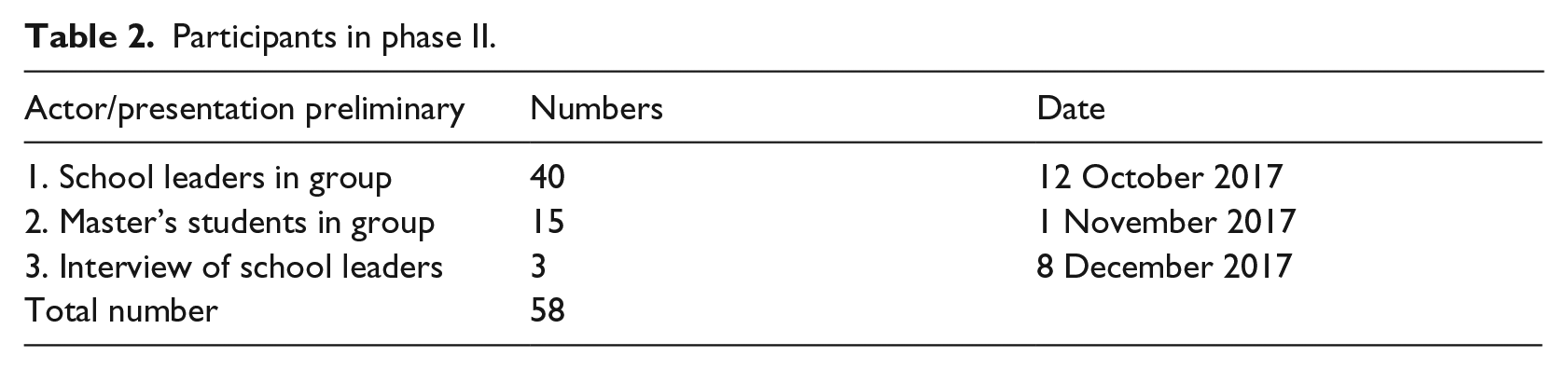
After the first analysis, in line with our qualitative analytical tools we presented our preliminary results and themes in phase II to three different groups: (1) the respective school leaders; (2) then the entire group of participating teachers remaining in the master’s programme – that is, 15 of the remaining group of 17 participating teachers; and (3) finally, to 3 of the school leaders from the first group. The groups in phase II are presented in Table 2.
Participants in phase II.
After presenting the preliminary result, the group of teachers and the school leaders were placed in smaller groups of four to five people. In order to use their reflections to enrich and deepen the analysis (Kilpatrick et al., 2010), they were asked to discuss and write down their comments on a piece of paper and later hand it to us. Our presentation did not include our theoretical concepts; hence, the participants were invited to develop their own analytical categories in order to enrich the study. To support their reflections and analysis, the following questions were posed after the presentation:
Is the result of the analysis credible, and do you recognise yourself?
Did anything in the result surprise you?
What do you as a teacher/school leader think about when you see these results?
What are the consequences for your role as a teacher/school leader?
Which strategies do you need to support the students in the project doing their master’s?
In the interview with the school leaders, we used the same method for reflection, although the presentation contents were now based on the results of both our and the school leaders’ and teachers’ analysis. We recorded, transcribed and analysed the interview.
Findings
Setting: curved career paths
Prior to their master’s studies, the majority of the 15 interviewed teacher/master’s students had undertaken different types of further education. Among them, only Åsa (8) was still in the profession for which she was initially educated; that is, as a preschool teacher.
For various reasons, the others have been involved in different kinds of further education. Some have followed a traditional, teacher-oriented career path by acquiring formal skills for teaching older students (Fia, 4; Siv, 6). Another traditional career path pursued by other teachers is to become a school leader (Sigbritt, 7). Some in the programme found it difficult to obtain a permanent job (Tove, 12; Florence, 5; Eva, 1), and further education was therefore seen as necessary.
Moreover, in connection with the requirement for a teacher’s certificate, Nina (9) started to complement her former education (for teaching levels 1–7 ) in Swedish and the social sciences with several small courses. For secondary school teacher Emelie (11), it was more about personal interest that made her study and become qualified for an additional school subject; that is, for the school subject religion. Four master students have work experience from areas outside the teaching profession (Tea, 2; Tina, 10; Frida, 14; Ture, 13).
When the possibilities of studying for a master’s became a reality in 2016, many of the teachers had been waiting for this opportunity, or, as Eva (1) puts it, for something to come: ‘I would love to do research sometime in the future. Then this is an incredible and excellent opportunity.’
Florence (5) is aware of the pros and cons and the opportunities offered if you complete the studies: [I]f you get an opportunity to study, you take it. I had been trying to study earlier, but there was no opportunity because you then would have had to do it in addition to your full-time job. It should not be linked together, although they each touch on the other.
In summary, and due to lack of structural career support, teachers who had previously taken part in academic studies mainly regarded them as an individual project. But now, both Eva (1) and Florence (5) express the expectation that the practical conditions, like structures and financial conditions, will this time be better than before.
1. Emerging dilemmas
The career reform bringing new career steps for teachers and introducing ‘first-teachers’ in the municipality, for whom academic studies were not formally required for the position, may be considered a new element in the school activity system (Engeström, 2015). Even though only five of the master’s students in our study had been appointed as a first-teacher prior to starting their master’s studies, the new career created dilemmas for them all, not only within the group of master’s students, but also between these students and their colleagues at schools, and between colleagues. Certain specific factors causing dilemmas for teachers and the strategies used in response are elaborated below.
(a) Tension and envy: In order to fulfil the requirements of the master’s courses the students need time to complete their studies. However, while some have as much as one day a week provided as part of their employment to do that, others have had to rely on their designated yet limited time for competence development for the master’s courses. For Siv (6) who is also a first-teacher in Phase I, lack of time is a problem touching on her ability and willingness to complete her master’s studies: ‘I have a year left as a first-teacher, and then I’ll see. Because it’s clear that I’ll lose my time and I’ll have to decide if I’ll continue.’ As a first-teacher and in the current circumstances Siv (6) is able and willing to continue her studies but leaves open the question of when her contract as a first-teacher will be terminated. Åsa (8) is critical of the logic underlying the policy: Spontaneously I think that they (politicians and leaders) are trusting that we’ll fix it [laughing]. That we are so hungry to study and learn more . . . they rely on the fact that we have a conscience and that we have a sense of duty.
As a result, when the master’s students are expected to use their ordinary time for professional development to accomplish their studies, they do not have time to participate in activities with their colleagues. This may lead to some kind of estrangement from one’s colleagues.
The introduction of new career steps in the form of the first-teacher position has frustrated both teachers who were offered such a position and those who were not, since appointment also brought a substantial wage increase. Siv (6), one of those selected as a first-teacher, receives a higher salary and is now suffering from guilt when around her colleagues: ‘It hangs over me like this dark cloud because I’ve known that I now have that position as a first-teacher and, compared to my colleagues who are incredibly skilled, what makes me worth this money?’ Consequently, when Siv (6) receives her master’s degree she envisions paying this debt back to her colleagues. From this point of view, the master’s education will act as a ‘remission of sins’. In doing so, she turns inwards and blames herself.
There is thus a tension between those who have been appointed as a first-teacher and others who have not been appointed, given that there are no formal requirements for the appointment, thus bringing the basis for the appointment into question. Moreover, when the first-teacher assignment expires the teachers are expected to take part in the ordinary programme for competence development and become one of the others.
Concerns were also expressed by the master’s students who had not been given a first-teacher appointment. They reflected on which role, after finishing their master’s studies, they might hold in relation to the first-teachers. Tyra (3) expresses the tensions that may arise: ‘At our school, we have first-teachers who have been studying, and now they only take the best thing, and so they present it to their colleagues, so to speak.’ Tyra (3) is unclear about the hierarchy and what the master’s degree will lead to and what new role, if any, they will receive upon completing their studies. Who will be superior to the other, and who will be in the position of distributing which tasks – she or the first-teachers? Florence (5) says: ‘I do not really know what will come out of this, really. How to use our new competence or what shall we do?’ Even though Tyra (3) imagines that after her master’s studies are completed she will be given the task of developing the school and colleagues’ skills in various areas, she has some qualms. If she is not a first-teacher, she wonders what the result of these studies would be.
The master’s students in Phase II all recognised the dilemmas described in this section entitled ‘Tension and envy’. The gravity of these dilemmas is further shown by the fact that up to 26 teachers abandoned their studies during the first year of their study: ‘The recognition factor is high, including the dilemmas’ (Group 2). The idea that teachers should be responsible for their own education and integrate research and scientific knowledge into the school is particularly demanding. The master’s students thus argued that the master’s degree has in some cases attracted resistance among both school leaders and colleagues: It was surprising to see that there is a sense of shame when it comes to educating yourself as a teacher. Why is it so hard to create career paths in our profession? Why are colleagues sceptical about science? Is it envy? Everybody had a chance to apply for the educational opportunity. (Group 1)
Further, the teachers felt that they themselves had developed a certain vulnerability as a result. They found it astonishing that the teachers in this interviewed group themselves held different views about the purpose of master’s education, in some cases seeing it as an individual project and in others as a collective project; that is, entailing a willingness to work for the development of the entire school. Still others claimed that the individual’s driving force was a precondition for completing the studies and, in the long run, for developing the whole school and the teaching profession: ‘If you do not benefit yourself, you cannot complete the education. In the end, one wants to help others in their professional activities, which means that the assignment is definitely collective’ (Group 3). Nevertheless, the school leaders in Phase II believed the results were credible and recognised how teachers typically act and think at the start of ‘new projects’. They were familiar with the complexity and dilemmas presented in our study, yet some regarded this as an indication of a ‘demanding culture among teachers’: ‘We recognise the answers. The results are not surprising’ (Group 2). The school leaders have thus handed over a mandate to the teachers to develop the school on a scientific basis, thereby transforming it into an individual project.
In summary, we find that the academisation policy prescribed by the Swedish authorities, involving expectations that teachers will ensure teaching on a scientific basis, imposes on the teachers the obligation to interpret and reconstruct the said policy; that is, to ‘fix it’, to cite one teacher (Ball and Junemann, 2012). Through their own academic studies, they see themselves as representatives of the new policy but, given their relationships to other positions in the system – ones that do not require academic studies – they express a sense of perplexity. They are vulnerable and looking for advice, support and a set of rules on how to handle the dilemmas, but there are none.
(b) Lack of structures and dead ends: School leaders are expected to support the master’s students in their scientific development. In this position, they are thus becoming some type of gatekeeper. In Phase I, Tyra (3) gives an insight into how it works: ‘When I search for research, I usually go and have a conversation with my school leader . . . about what in her eyes is right now and up-to-date.’ Likewise, Eva (1) addresses her school leader with respect to adjusting her timetable in order to complete her studies: I asked my previous school leader last spring if it was okay that I was looking for it and if it would work, and that was the case. She thought it was a good idea, but when she left she said that I should talk with the new school leader about compensation and other things.
In this case and similar ones, the school leader’s support is often limited to saying ‘good luck’ without any other opportunities or obligations for the school leader to act. There are no structures in existence to support scientific work in school. Despite this, most of the master’s students, like Eva (1), have chosen to continue with their studies: So far, most of my time I have been reading. It [the study] has not really begun to be incorporated into my own work as a teacher – for various reasons. . . . I read a lot at home, and so it has been a lot of mess at home, because we have been so sick [laughing] So it’s been like-eh . . . hard to catch up with.
According to the master’s students’ view in Phase II, the benefits of their education can only serve the collective assignment if clear expectations and requirements are expressed by the management and school leaders. The deficient support and lack of structures might encourage the participating teachers to regard the education as an individual project: ‘How can we, as individuals, have an influence on our colleagues? What strategy and route is the right one to take? 100% support from the school leaders is a prerequisite’ (Group 2). The dilemma touches on the individual–collective relationship. Teachers see themselves and their studies as part of a major organisational effort for change. They acknowledge the problem, but have no specific answers.
In summary, we find the master’s students in Phase I are concerned and do reflect on the role they will play after finishing their education, particularly in relation to the appointed first-teachers. They have acquired new skills that will challenge the hierarchies and structures; that is, the current balance in the school as an activity system (Engeström, 2008). Those master’s students who are appointed as first-teachers expect some sort of time will ensue in which they must ‘repay to society’ but may also express a kind of ‘bad conscience’ about having been selected and rewarded with a higher salary. The ‘recognition factor’ is strong for both the master’s students and school leaders in Phase II, yet the conclusion diverges. The absence of supporting structures for research and development work is due to the school being designed for teaching, not for scientific work. There is no superior scientific or competent person whom teachers can address regarding urgent scientific issues, only the school leader who lacks scientific competence.
2. Strategies used
It is left up to the teachers themselves to encourage the founding of the school’s goals and programmes on a scientific basis. Many master’s students in Phase I adopt an offensive approach and try to find ways to work with their colleagues on the task of introducing ‘science at school’. Tea (2) says: ‘I think we obtain tools through this education, to convey research in school in a good way; how we can work with it in our everyday lives, without getting crazy and really busy and so forth.’ In that regard, Tea (2) and Tyra (3) wish to be a light in the darkness. Otherwise, ‘there will be no change’, Tyra (3) claims. Florence (5) also intends to ‘lift’ her colleagues by making them aware of the skills they already possess. Both Tyra and Florence believe their colleagues already hold knowledge and skills that can and must be made visible with their help. On the contrary, Sigbritt (7) does not seem convinced about her colleagues’ competencies: ‘Because there are quite big differences there. . . . They are not really there for their professional reflections, I can feel.’ Moreover, there seems to be reason not to hold too great expectations regarding the commitment of the school management or colleagues. Getting along with one’s colleagues would, according to Nina (9), just be a ‘bonus’. She seems to vacillate between security and uncertainty when it comes to her colleagues’ commitment and support: I want them to reach as far as possible, and so that they somehow realise that knowledge is great to carry. And when I am thinking about knowledge, I’m not just thinking about subject content, I’m thinking about social issues as well.
Another strategy is to respect the boundaries between private and professional life. For example, Åsa (8) has adult children and grandchildren she wants to be with. For her, it is therefore important to mark the private/professional boundary. Sigbritt (7) also makes a distinction between private and professional life. However, she regards the boundaries between privacy and studies as fluid; her studies do not primarily focus on building structures and competencies in school together with her colleagues. The master’s study is largely an individual project for her, as it is for Tove (12) who has other plans and thinks about a professional future at university: ‘So, I think that it would be fun if I was able to work half-time, i.e. both as a regular teacher, and also with those who are studying to become teachers.’ For Fia (4), it is also a step within a more individual project that is chiefly intended to help her own development as a teacher: ‘What is the next step? How do I continue with my profession, do I want to do something else? . . . So this is how I think right now.’
The master’s students not only face optimistic and encouraging backdrops, but also distrust, envy and tensions. In this situation, they adopt different strategies to help deal with situations involving their colleagues. For example, Fia (4) is self-confident and does not really care about comments coloured by dissatisfaction, suspicion or envy, while Tyra (3) is trying to circumvent an upcoming conflict by not clearly imposing herself in a matter: ‘I’m not afraid to stand up for myself. . . . I’m quite good at adapting to different people in different hierarchies.’ Humour is another effective tool used by Florence (5), while when approached by suspicious colleagues Tyra (3) makes a comparison with the medical profession and doctors’ education. She reminds her colleagues of the differences between teachers and doctors in terms of requirements for further education and to follow the scientific development of the profession. Her message is clear: the scientific demands on teachers should be as high as they are on doctors. ‘Attack as a defence’ is one of several possible strategies.
In Phase II, some master’s students thought an individual project without a school leader’s support could be used as a strategy for creating togetherness since the vulnerability and lack of support might trigger compassion from colleagues and reduce the risk of being questioned or excluded: ‘We find that many colleagues show compassion. They ask me: Do you not get any compensation? You have good energy!’ (Group 2). At the same time, the master’s students would like their knowledge to be used and acknowledged by their colleagues. Since the master students tend to neutralise the tension and seek their colleagues’ compassion, they can find it difficult to fully take advantage of the knowledge they acquire during their master’s education.
Initially, the school leaders in Phase II find it strategically difficult to handle the teachers’ dilemmas and identify approaches for dealing with colleagues’ resistance by ‘fooling’. This creates a sense of inadequacy among them: Yes, I recognise a lot of it. But it still amazes me that there are so many who answer that they have to fake it and that there is still such a lot of envy among colleagues. . . . Even if you do what you can do in order to prevent it. (School leader 1)
The three school leaders have given their teachers time to complete the master’s programme. They therefore become concerned by the teachers’ claim of a lack of time to complete the studies. They are also concerned that the teachers feel they need to use strategies to ‘fool’ their colleagues in order to take on the role as a master’s student. The school leaders thus reflect on their own role and how to handle the situation: what the visions should look like; which openings exist?
In summary, we find that the master’s students in Phase I encounter distrust, envy and tension and that they develop different strategies and logics concerning how to enact the reform in their different practices (Ball, 2015). For some, their participation is a step in a more individual project that primarily contributes to their professional development; for others it is a more collective project with which one can ‘lift’ one’s school and colleagues. In Phase II, both the master’s students and school leaders reflect on how to handle the situation.
Discussion
The academisation of teachers has become an internationally spread idea in educational policy and follows contemporary trends in Scandinavian and European countries (Caena, 2014; Cain, 2015; General Teaching Council for Scotland, 2012; Lunenberg et al., 2007; Skagen, 2006). The Swedish Education Act of 2010 (SFS 2010:800) provides that education at all levels should ‘rest on scientific grounds and proven experience’ (5§), with this leading to substantially greater academic demands on teachers in Swedish schools and increased state-level policy activities forcing universities and municipalities to work together on co-configuration (Daniels et al., 2010: 49), namely, a collaboration that gives possibilities for the subjects to be active and over time contribute solutions for how the policy ideas can be brought to life.
This stipulation that schools be based on scientific grounds has seen teachers face several dilemmas in trying to fulfil this mandate. This article focuses on the underlying and systemic contradictions responsible for teachers’ dilemmas and their learning and expanding (Engeström and Sannino 2011; Le Maistre and Paré 2004) and does so by focusing on teachers participating in a master’s programme for experienced teachers, as an example of policy enactment (Ball and Junemann, 2012). Viewed from an activity theoretical perspective, the main object for teachers to find ways to handle is the Education Act while the master’s programme is an artefact (Engeström, 2015, 2008). This means that the master’s programme’s form and content is interpreted, translated in another activity, and entails collaboration across organisational boundaries between a municipality and a university. Namely, an activity where subjects other than the interviewed teachers, researchers and senior lecturers have been working together to form a master’s programme to serve as ‘a stepping stone’ (Daniels et al., 2010: 67) and an artefact for teachers to co-configure; that is, to learn together with peers and external actors, expand their ways of working and integrate a research-based way of working in school. This complex task requires a new agency, qualities that Engeström believes develop when individuals work together, in relation to previous experiences and in interaction with others while trying to find ways to solve what the individual sees as (personal) dilemmas but which the activity theory view regards as systemic contradictions for keeping the system stable and preventing change (Engeström, 2008).
Our study is divided into two phases. The results for phase I, based on interviews with 15 teachers participating in a master’s programme, provide answers to our first research question, namely, which dilemmas are faced by teachers? Our findings show that participating teachers who start a demanding a higher education programme not only encounter optimistic and encouraging support from school leaders and their fellow colleagues, but are also subject to what they refer to as distrust and tension among their colleagues. For that reason, they express the feeling of being isolated ‘cogs’ in an organisation and they feel supporting structures are lacking. One disturbing factor is the unclear hierarchy between the appointed first-teachers and the master’s students, and whether there would also be a career path on formal grounds (i.e. academic master’s studies), and which of these two would be superior to the other. About one-third of the teachers specifically acknowledge the lack of school leaders’ support. One crucial point is that systemic contradictions cannot be observed directly and can only be identified through their discursive manifestations. In this study the dilemmas in the teachers’ stories (Engeström and Sannino, 2011) are used to understand the outcome of change efforts in organisations, and not individual shortcomings.
However, in phase II the master’s students recognised the dilemmas presented and claimed that the lack of support and lack of structures might lead them to regard education as an individual project. At the same time, they also tended to blame the school leader. Notably, the school leaders acknowledged the answers but did not find the results surprising.
As concerns our second research question on which ideas and strategies the participating teachers use to handle the dilemmas in phase I, some interviewees feel great self-confidence and are not affected by comments influenced by dissatisfaction, suspicion or envy; others try to avoid an upcoming conflict by not clearly posing a question. Others feel somewhat guilty. For some, it is a step in a more individual project that mainly contributes to their professional development, while for others it is something with which one can ‘lift’ one’s school and colleagues. Some emphasise a sharp dividing line between their teaching profession as teachers and academic master’s studies; others see academic studies as principally a means to develop the teaching profession. The time available for studies is a problem for many. Consequently, a large number has dropped out of the programme, underscoring the problems involved in following their studies. In phase II, the master’s students asked for support and understanding from their colleagues and claimed that without the school leader’s support their master’s education would exclusively be an individual project. The school leaders were concerned to hear the master’s students had difficulties completing their education due to a lack of time. They were also concerned that some teachers felt they must ‘fool’ their colleagues in order to put their knowledge so acquired into practice. However, they could not offer any specific solutions to the dilemma.
The answers to our two research questions show that systemic contradictions are hidden but become recognised when practitioners articulate and construct them by way of words, actions and dilemmas. The material and historical power of a systemic contradiction is irreducible to situational articulations and subjective experience. To begin with, in this study underlying systematic contradictions appear between various elements within and between the two complex activity systems: the university and the municipality (Daniels, 2010; Le Maistre and Paré, 2004).
For example, systemic contradictions between the two activity systems emerge between the subject, object, mediations, rules, community and in the division of labour. Universities contain established research structures, such as researcher (subject), special funding for research (rules), seminars for the critical discussion of emerging research (mediation tools) and a long-developed culture in which research is considered important (well-defined object), as well as a professional hierarchy (division of labour) based on formal criteria (rules), etc. On the other hand, schools lack such structures, rules, tools and concepts as well as the subjects, teacher and school leader competency, forums, and financing for research and teachers’ further development. Moreover, within the education sector, the university sits at the top of a hierarchy, which creates a problem with balance; even if the ambition is that there should be symmetry, the subjects in the community (teachers and school leaders) find it hard to apply their experienced-based knowledge (mediating tools) to handle the dilemmas. Not only do the structures (rules, division of labour, community and mediating tools) look different, but the view of the object is also different, meaning that subjects from both systems are unfamiliar with each other’s historical, social and cultural background and purpose. In addition, systemic contradictions may appear (Engeström, 2015) if research issues involve critical views on a certain school in a certain municipality could create conflicts, for example. This indicates a systemic contradiction between the different rules governing knowledge production on one hand at the university and, on the other, the rules of municipalities (Hansson, 2014). Although the cooperation between the two activity systems in our case is based on a symmetrical idea and ambition, the university may easily be perceived as superior to the school by teachers, school leaders and school administrators, as well as by researchers from the university.
We envisage that when new requirements and new ways of working enter an activity system like a school, an imbalance is generated in that activity system. The predicted content (view of the object) and structures (mediating tools, division of labour) are challenged and must be renegotiated; for example, between research-based knowledge and teachers’ contextualised-based, experience-based knowledge – in the literature this is referred to as ‘the knowledge problem’ (Cain, 2015; Dewey, 1929; Levin, 2013) – as well as hierarchies between different categories of teachers and school leaders, demands and expectations on teachers etc. For example, among the university researchers holding high scientific competence are advisors and supervisors (mediation tools), while counter intuitively school leaders are expected to take on the role of supervisor and advisor when it comes to research development. School leaders are also expected to replace forums for discussions of scientific issues. At the same time, studies of school leaders and their level of understanding research-based education (the object) show that the mandate given in the Education Act has been renegotiated and understood by them as something that is already being done in practice (Rapp et al., 2017), and that research is overly theoretical and thereby less desirable than experience and practice. For many school leaders, the requirement of scientific grounds and academisation may therefore be perceived as an invading culture that must be resisted.
Under the influence of NPM, the Swedish Education Act (SFS 2010:800) brings forth evidence based and measurable knowledge, and thereby something quantifiable and assessable, as a pattern for science and research that involves increased supervision and control (Biesta, 2011; Bergh, 2015; Hudson, 2007). In this situation, teachers and school leaders seem to have embraced the narrative about a school in need of the ‘correct’ knowledge and science in order to overcome crises (Carlgren, 2012; Liedman, 2011).
Based on these systematic contradictions appearing from a non-shared view of the object and from a school culture not being based on a scientific working tradition, and that scientific research is not conducted in school – the collaboration between the two activity systems of school and higher education creates dilemmas for teachers in school. Although in our study the master’s students are the focus, it should be remembered that the changes are also triggering new strategies with the other teachers and that in certain circumstances these dilemmas may provide a stepping stone for both the subjects’ and organisations’ learning and expanding (Engeström and Sannino, 2010). The master’s students acknowledge the contradictions, but do not analyse the shortcomings of the system. They appear to be lone agents in a system systematically unable to handle the requirements contained in the Education Act, even though it was assumed these requirements would be fulfilled without destabilising the system. Due to this not happening, they are blaming the school leaders who have become a symbol for all the systemic, structural and financial shortcomings.
The contradiction arising within the activity system of the municipality between several elements, the subjects (master’s students), the master’s programme (mediation tools) and the division of labour and rules is highlighted by the fact that the recently introduced first-teacher career path does not require any specific formal (academic) education. At the same time, the master’s students are working to acquire academic skills which are not a formal requirement to become a first-teacher but might be in a future career system. Further, the tensions identified by Hardy and Rönnerman (2018) can be deduced from the systemic contradictions in the system since a teacher’s job is basically a collective job built on cooperation and equality. In that respect, both the master’s programme and the introduction and recruitment of first-teachers challenge the historically non-hierarchical division of labour structure in school, a structure that the system is reacting to defend (Engeström, 2008).
The policy of ‘scientific grounds and proven experiences’ (SFS 2010:800) is forcing teachers and school leaders to make their own interpretations and translations of the policy (Ball and Junemann, 2012). It is becoming clear that the master’s students must carry and support, on their own shoulders, the intentions of a school grounded on a scientific basis. They are unable to shift any responsibility over to the school leaders. Thus, so as to survive, one must set one’s ambitions at a low level. This also eradicates the dividing line between the private and work spheres of a teacher. It will be tough for those who establish boundaries between private and work life, with this being the cause of many of them dropping out of the master’s programme. Frustrated others ‘take revenge on the system’ by privatising the assignment and, instead of raising (improving) the school, aim for an academic career; regarding it as a private duty rather than something that is a duty owed to the organisation. This example shows that changes in activity systems’ way of working depend on the agentive dimensions of activity such as identity, emotions, ethics, morality, identifications, responsibility and solidarity. These aspects of regulative effect are important for understanding the possible changes in practice not only as a matter of structures but also as to what agents in specific historical, social and cultural contexts see as possible for them to learn (Hansson, 2014). Emotions cannot be overlooked (Roth, 2009).
In other words, this increased pressure on the activity system has been shifted over to its actors (i.e. the teachers and school leaders) to adjust to the new and unclear conditions and hierarchies, develop strategies to cope with the task, initiate a reflexive approach to themselves, and take responsibility for their own knowledge building (Ball, 2003).
We consider the higher academic demands on teachers prescribed by the Swedish Education Act (SFS 2010:800) as a ‘policy drift’. Due to the absence of both research structures and research culture, it does not appear that the school has yet undergone any ‘institutional academic drift’ (Kyvik, 2009; Neave, 1979). Instead, our perspective is that the master’s students represent what Kyvik (2009) calls individual academic ‘staff drift’. Clearly, they are remoulding their identities as teachers and the way they construct their work, even if at a conceptual level (Alvunger and Wahlström, 2018). In that sense, they are dealing with the ‘knowledge problem’ (Cain, 2015; Dewey, 1929; Levin, 2013) and are on the verge of overcoming it. For the school leaders, their attitudes are more rhetorical than practical and represent a ‘policy drift’ at the micro level. We find few signs of an ‘institutional academic drift’ in that sense. Therefore, one remaining issue is, with reference to Bryan and Burstow (2017): how to involve school leaders in this unstoppable school development?
Conclusion
The methodological limitations of this study concern the representativeness of the 15 master’s student interviewees. They have a particular ambition to pursue further studies and perhaps a more explicit view on the issues in our study, which may distinguish them from other teachers and their opinions. Further, values and group norms might to some extent express differences in the students’ attitudes to academia between the ‘collective thinking’ in the focus groups and their ‘individual thinking’ in individual interviews (Kitzinger, 1995: 300). In the individual interview conducted in phase I they could be more honest about their ambitions; in the more ‘collective thinking’ situation in phase II they were more restricted by each other. They might also problematise and place higher demands on the organisations and the non-existent structures after their one year of experience in the master’s programme in phase II.
We are aware of the criticisms due to conducting research in a context where the researcher is closely involved and that this closeness can negatively affect the quality of the research (Närvänen, 1999). However, we believe a greater ethical problem would arise if researchers with good insight into a context were required to refrain, thereby ensuring that the knowledge and voices the study would contribute remain silent or neglected (Hansson, 2014).
In this article, we look at how the school as an activity system is affected by ‘academic drift’ at a policy level in the form of the Swedish Education Act (SFS 2010:800). One conclusion is that this imposes considerable challenges on teachers, school leaders and municipalities (Bryan and Burstow, 2017). Another conclusion is that a need emerges for school leaders (Bergmark and Kostenius, 2012; Håkansson and Sundberg, 2016) and the university to be involved in the process in order to develop the necessary and permanent structures for teachers’ further development. This is an issue we shall deal with in a forthcoming article.
Footnotes
Declaration of conflicting interest
The author(s) declared no potential conflicts of interest with respect to the research, authorship, and/or publication of this article.
Funding
The author(s) received no financial support for the research, authorship and/or publication of this article.

Notes
Author biographies
Kristina Hansson is head of research in Education for Schools and Teachers, in the Municipality of Piteå, affiliated researcher at Umeå University, Department of Creative Studies specialising in Sociology of Education. Her recent research have focussed on the governance of education change, tensions between policy and practice and teachers’ subject positions, agency and dilemmas in practice.
Per-Olof Erixon is a professor of Educational Work at the Department of Creative Studies, Umeå University, Sweden. He has published articles and books in the fields of mother tongue education, Teacher Education and Academic Literacies.