




Abstract
Despite growing European and global interconnectedness, questions of national identity have only gained in importance in recent years. Yet the role researchers play in perpetuating norms of national belonging has gone largely unexamined. Who is included in unmarked national group labels such as German, Dutch, or Danish, who is understood as Other, and how terminology relates to exclusionary notions of national identity warrants greater investigation. Thus, using an exploratory review of recent research in the German context, the current study aimed to (a) identify relevant terminology in empirical education and psychology studies; (b) employ constructionist analysis to examine its situated meaning; (c) discuss societal and methodological implications; and (d) propose guidelines for more accurate and inclusive research. Based on a constructionist thematic analysis, a reiteration of a white ingroup and perceived immigrant Other was found. This dichotomy reinforces an exclusionary notion of who is German while omitting relevant information, such as participant generation or citizenship, from analyses. In doing so, researchers are perpetuating essentialized notions of national belonging while reporting incomplete and potentially inaccurate findings. Though selecting demographic information can be complex, recognizing the impact of labels and acknowledging heterogeneity are essential elements of inclusive and representative research.
Keywords
At a recent conference on migration and integration in Germany, a respected education researcher emphatically stated that “the vast majority of teachers in this country are German.” On its face, this sentence seems not only innocuous but self-evident. The conference was in Germany, the presenter was German, and she was speaking about the German school system. By positioning the word “German” against an implied Other, however, she drew discursive, racialized boundaries around the perceived national group (Lentin, 2016). Though making this statement to highlight the underrepresentation of minoritized individuals working in the German education system, her use of the word “German” to include only those perceived as having German heritage reinforced the notion that to be German is to be white, and, therefore, to be non-white is to be non-German. This normative meaning was understood by the audience without further explanation, as “German” is common parlance for white German (e.g. Müller, 2011), just as Danish, Dutch, or Belgian, for instance, are often used without qualification to reference individuals from those nations perceived as not having heritage from elsewhere. This overlaying of nationality and ethnicity stems from centuries of nation building, yet the borders of belonging drawn by such unreflected usage clash with the daily realities of millions of people living in an increasingly ethnically and culturally diverse Europe.
At the same conference, a presenter in the following session addressed this topic, arguing that the unthinking usage of “German” to exclude anyone with roots from elsewhere can cause real harm, making Germans of color in particular into a perpetual Other by underscoring the implicit link between ethnicity, heritage, and national belonging—a generally unspoken relation increasingly explored in research (e.g. Müller, 2011; Silverstein, 2005; Sow, 2011). As a self-identified German of color and prominent scholar of national identity and racialized discrimination, the second presenter argued that regardless of the content of what one is saying, using the term “German” to mean white German is necessarily exclusionary. Based in a constructionist understanding of both language (Fairclough, 1989) and identity (Bhatia, 2007), which recognize the dynamic process of creating and reiterating situated meaning on race and ethnicity (Condor, 2006), this argument highlights how such unintentional slights can work to reify racialized boundaries around the perceived national group.
Such boundaries are created and reinforced in talk, and through more formal channels, including empirical research. As migration within and to Europe continues, and instability within the European Union grows, a critical assessment of national belonging and its reiteration through empirical research is warranted. Thus, in the current study, we examine terminology used in peer-reviewed academic research in the areas of education and psychology to investigate how researchers studying minoritized populations draw discursive boundaries with the group labels they employ. Although cross-national collaborations are increasingly common, and findings are highly relevant across borders, academic research remains nationally situated. We therefore focus on Germany in order to anchor this research in a specific context, while noting that the question of national belonging and how it is reiterated through empirical research is extremely relevant across Europe and beyond.
Immigrants, migrants, migration background
In Germany today, although roughly one in three children has at least one grandparent or parent not born in Germany, the majority of this group has German citizenship, and therewith, according to legal definition, is German (Göttsche, 2017). A recent representative study also found that over 80% of individuals with heritage from outside of Germany feel German (Foroutan et al., 2014). Yet, as described above, many of these individuals are not included when the label “German” is used, instead referred to as “im/migrants,” 1 or “people with migration background.” The latter term was first introduced in the 2005 census, with a definition including anyone with at least one grandparent who immigrated to Germany after 1950 (Hanewinkel and Oltmer, 2015). A major overhaul to German citizenship took effect in 2000, allowing non-heritage-based citizenship for the first time. After this change, parlance began to shift away from a dichotomous “German” and “foreigner” (Ausländer). Up to that point, though millions of individuals without German ancestry resided in Germany, the coterminous “German” encompassing both ethnicity and nationality was supported by jus sanguinis citizenship law (Brubaker, 2001). With the shift towards (partial) jus solis citizenship, this use of “German” became factually incorrect. Yet a reticence to acknowledge or discuss race and ethnicity has led to the continued use of “German” to implicitly reference both ethnicity and nationality, and the creation of “migration background” for individuals perceived as not part of the constructed ethno-national group (Elrick and Schwartzman, 2015). To further complicate matters, the census operationalization of “migration background” has since changed, meaning there is no single designation regarding who is part of this group. Most researchers follow the “narrow” definition, including anyone who has at least one parent who did not have German citizenship at birth (Göttsche, 2017), though there is no consensus in either policy or academia.
Germany is not alone in using such terminology. While no continental European country gathers data on race or ethnicity (Simon, 2017), an increasing number have begun to track citizenship in conjunction with the place of birth of parents and grandparents (Simon and Piché, 2012), including the Netherlands, Belgium, and the Scandinavian nations. As Elrick and Schwartzman noted in their analysis of German parliamentary discourse regarding this term, “People with migration background is a derived category, not one that respondents can self-identify with” (2015: 1543), meaning that unlike many racial or ethnic labels, such as Asian American or Black British, there is (to this point) no “migration background” identity—it is wholly a top-down, socially constructed concept. Yet “migration background” is a highly racialized category (Leinonen, 2012; Lentin, 2016). It is generally used to refer to anyone perceived as having ancestry from outside the given nation, regardless of generation or citizenship, particularly those perceived as being of Turkish, Arab, or African descent (Elrick and Schwartzman, 2015; Yildiz, 2010). This means that a child born to white immigrant parents from elsewhere in the European Union, for instance, may never be recognized as having a “migration background,” because their heritage is not readily visible in nations in which whiteness is understood as normative. Thus, the term acts as a stand-in for race or ethnicity without ever naming these categories (Will, 2016). Moreover, “migration background” is often used interchangeably with “im/migrant,” not necessarily to mean someone who has moved countries, but based solely on phenotypical characteristics.
Following a constructionist perspective, the applied usage of these terms carries more weight than their official definitions, as the way they are understood and reiterated in interaction is what impacts the lived experiences of those they address (Bessone, 2013). As Fatima El-Tayeb put it, “the term ‘migrant’ describes someone who moves across borders, but also includes all racialised European communities, which are re-framed as non-European through their ascribed permanent status as migrating” (2014: 76). This highlights how terminology created to avoid reification of race and ethnicity can reinforce racialized conceptions of belonging. It is widely accepted among researchers today that race and ethnicity are socially constructed, but that the intersubjective impact of perceived and/or ascribed belonging to a given group is real (e.g. American Psychological Association (APA), 2017). The impact of labels such as “migrant,” “migration background,” and a non-inclusive “German” can have a similarly real impact on the identity and belonging of the individuals both ascribing and being ascribed such terms.
Othering through terminology
Group labels can aid in efficient processing of complex information (Hinton, 2016) and offer scaffolding for adaptive identity construction (Rivas-Drake et al., 2014). Yet they can also work to create and strengthen boundaries and inequitable social hierarchies (Miller, 2007). In general, individuals have less favorable views of those understood as belonging to an outgroup, particularly one that has been historically denigrated or oppressed (Tajfel and Turner, 2004). Yet simultaneous emphasis on shared identity can improve perceptions of the same individuals (e.g. Dovidio et al., 2009). For instance, researchers in the Netherlands found that Dutch participants without so-called migration background rated “Turks” and “Moroccans” significantly more negatively than “Turkish Dutch” and “Moroccan Dutch” (Verkuyten and Thijs, 2010). In the German context, the political scientist Feyzi Baban argued that, “The term ‘Turkish-German’ is a political position and dislocates the homogeneous representation of German national identity by indicating that there exist Germans with Turkish origin” (2006). This argument captures the significance of representing the lived realities of everyday individuals while pushing against culturally essentialist notions of belonging. Particularly in the realms of education and psychology, which focus increasingly on the relations between individuals and groups in an ever more globalized world, being cognizant of the potential impact of group-based terminology is crucial.
On an interpersonal level, research into racial-ethnic microaggressions has highlighted how small, often unintentional acts of exclusion can add up to have negative physical and psycho-social consequences (for a review, see Wong et al., 2014). A common form of microaggression involves the perpetual foreigner stereotype, in which an individual’s national belonging is questioned through banal queries including “where are you from?” (Armenta et al., 2013). Arguably, the exclusionary usage of national group labels and the complementary use of “im/migrant” to describe everyone else is a microaggression—seemingly benign, commonly used, and generally not intentionally harmful. Following the notion that discourse does ideological work (Wodak and Fairclough, 1997), however, the repeated use of these and related terms creates cultural meaning reflected not only in interpersonal interactions, but also through policymaking (Elrick and Schwartzman, 2015), media (Cotter, 2011), textbooks (Kotowski, 2013), and, as we argue in this study, academic research. The words chosen by researchers to describe populations under study perpetuate situated meaning, doing so from a position of relative power (Wagner et al., 1999). Moreover, as minoritized individuals remain underrepresented in academic research, what is perceived as valid knowledge is often perpetuated by non-minoritized researchers (e.g. Syed, 2017).
Following APA guidelines, ethnicity and/or heritage should be ascertained systematically and applied appropriately to all individuals in a sample, ideally based on self-reported data (2017). Research guidelines available through the European Education Research Association (EERA), the German Society for Psychology (DGPs), and the German Society for Education Research (DGfE), however, do not include such recommendations. As in most of continental Europe, country of birth and citizenship are often self-reported in research in Germany, while the group-level terminology authors choose to describe their participants (i.e. “im/migrant” or “migration background”) generally is not. Though selecting inclusive terminology can be a complex task, recognizing the impact of labels should be part of reflexive and responsible research. This study answers recent calls for such reflexivity in the German and European contexts (Lindblad, 2014; Tucci, 2016). Though multiple articles in recent years have evaluated researcher integrity and validity in reporting participant demographics (Ford and Kelly, 2005; Stenius, 2016), we are unaware of any focusing on ethnicity/nationality/heritage labels in the European context, or the related impact on individuals under investigation. We aim to fill this gap by exploring the following research question: Among recent studies published in the fields of psychology and education, which terminology is used to describe diverse populations and how do the labels used relate to notions of exclusion, belonging, and a racialized understanding of who is German?
Current research
To investigate this question, we conducted an exploratory review of psychology and education research focusing on im/migrants and their descendants within the German context. We chose the fields of psychology and education for multiple reasons. First, research in both disciplines has become increasingly empirical (e.g. Zapp and Powell, 2016), meaning it tends to include demographic information regarding participants under study. Second, the education system in Germany has long been a site of social stratification (Maaz et al., 2008), and a growing body of research focuses not only on the so-called attainment gap, but also on systemic discrimination of children with non-German heritage (Gomolla and Radtke, 2009; Mecheril, 2004). Moreover, across Europe, school is cited as a key space of “integration” (e.g. Frankenberg et al., 2013), and as the primary location for both national and ethnic identity development (e.g. Kotowski, 2013). Thus, the ways in which researchers frame and discuss cultural diversity in the school setting is of utmost importance for broader narratives of inclusion and intercultural relations. Finally, psychological research over the decades has been fraught with controversial and sometimes unethical practices regarding minoritized individuals (Richards, 2012). For these reasons, research in these fields should particularly scrutinize how they work to either break down or reinforce inequitable boundaries of belonging.
The aim of this paper is not to offer a systematic review, but rather to shed light on a common yet under-examined issue in the hope of sparking discussion, reflection, and greater representativeness in Germany, Europe, and beyond. As diversity in Germany and research with diverse populations increase, we feel that such reflection is imperative, both from a perspective of social justice and for the sake of high-quality research.
Data and methods
We selected research with an express focus on “im/migrant” populations and their descendants. Because the overhaul to immigration and citizenship laws took effect in 2000, we included studies published from 2001, as anything prior would reflect different legal circumstances and related terminology. We chose to review abstracts rather than full articles, both because demographic terminology is generally included in the abstract and because abstracts are often the only element of academic research available to the public, meaning the type and use of terminology found there has the broadest discursive impact. We recognize that abstracts have a strict word limit and many researchers may use diverse terminology elsewhere in their studies. This heightens the importance of reflexivity, however, as scholars should reflect on the broad reach and potential impact of a manuscript’s abstract, which acts as the public face of any given study.
Thus, unlike in more traditional literature reviews, we focused not on the methods or results of the research examined, but on meaning-making through terminology employed (e.g. Fylkesnes, 2018) in publicly available research abstracts. That said, we recognize that terminological descriptions often reflect methodological choices; for instance, if generation status, heritage country, or participant nationality were left out of the analyses then they are not likely to be reported in the abstract. We will therefore also address the scientific implications of excluding such important variables in analyses, in addition to the discursive, identity-related impact. We used a constructionist thematic analysis for our approach, as this method reflects the poststructuralist notion that language is not merely reflective of reality, but is in fact a constitutive element of our social world (Farvid and Braun, 2006).
Abstract selection and coding
We conducted the literature search using PsycINFO and ERIC, primary databases for research in psychology and education, respectively. Each search included only peer-reviewed journal articles published in English or German between 2001 and 2017, using the following search terms: German OR Germany AND immigrant OR migrant OR migration background OR migrant background OR immigrant background. We chose not to include the terms foreign or foreigner, though these were the primary labels used to denote the Other in Germany and elsewhere in Europe for decades (Schneider, 2018), because we wanted to specifically focus on terminology widely perceived as neutral, and the dichotomous usage of German and foreigner has gained an explicitly right-wing connotation.
Our search yielded 1264 results in PsycINFO and 95 in ERIC. As this analysis is exploratory rather than comprehensive, we reviewed roughly equal numbers of abstracts from each database, rather than all found. Following guidelines for exploratory literature reviews (Pautasso, 2013), we sorted the PsycINFO results according to relevance before selecting the first 100 abstracts to review. Next, we did a first reading of the remaining abstracts, excluding studies focusing on a global perspective with only brief mention of Germany, those in which demographics were only control variables, and historical analyses. This resulted in a remaining 95 abstracts from PsycINFO and 72 from ERIC. Roughly one-quarter of the selected papers were published in German journals and the rest in international journals.
The remaining 167 abstracts were pooled for coding and analysis. All German language abstracts were read and compared with their English translations. Because none were deemed meaningfully different in terminology used, we used only English versions for analysis. Iterative coding was conducted by the first author, a white US American woman who has spent most of her adult life in Germany, and a trained research assistant, a black German man of both German and Moroccan heritage. We followed guidelines for constructionist thematic analysis (Braun and Clarke, 2006, 2012; Clarke and Braun, 2014), primarily choosing themes inductively, based on trends found in the abstracts under review.
Using MAXQDA 12, we first noted the use of all ethnicity/heritage/national group terminology, then examined and discussed patterns to generate themes. We did not limit the number of themes drawn from each abstract, as many abstracts contained multiple, sometimes conflicting, terminology, and we aimed to gain as full a picture as possible of all labels used across research. The discussions between the two coders were shaped by research training and personal experience, including the fact that the first author is generally understood as German because she is white, whereas the second coder is often perceived as Other because he is Black, although he was born and raised in Germany and identifies as German. Following a constructionist research perspective, which recognizes the organic and iterative nature of coding, no inter-coder reliability was calculated (Clarke and Braun, 2014; Durrheim, 1997), and all disagreements in coding were resolved through discussion.
Analysis
Based on the thematic analysis we selected eight themes and 11 subthemes. An overview can be found in Table 1. In the following section, we will delve more deeply into each theme and subtheme, offering examples from abstracts. Themes are numbered to offer clarity to the reader. The names of authors cited in exemplary extracts have been removed from the text of this manuscript, as the purpose of this review is not to call out specific researchers but to highlight the nature of the terminology used and its potential impact.
Overview of themes, subthemes, and exemplary terminology.
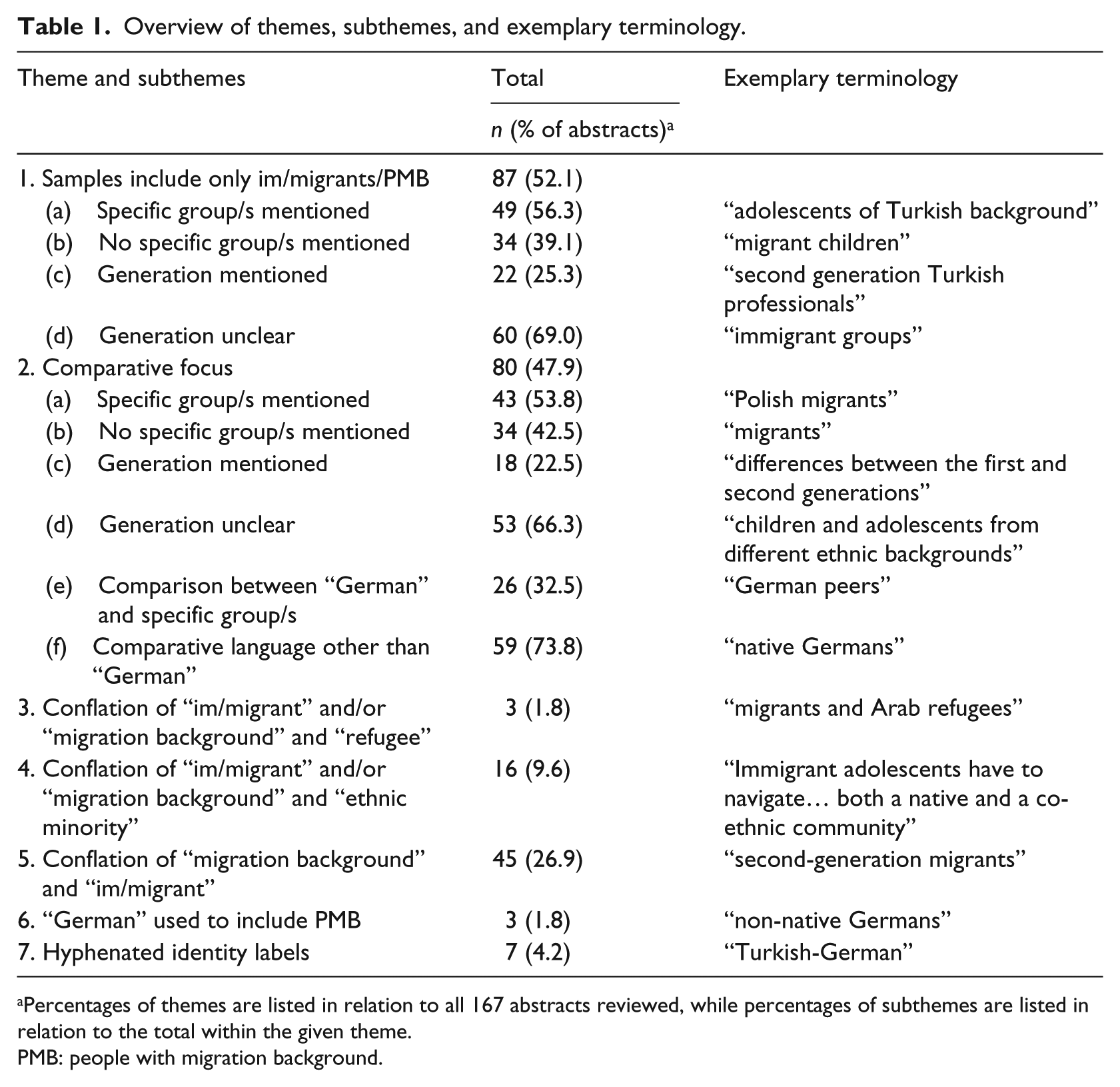
Percentages of themes are listed in relation to all 167 abstracts reviewed, while percentages of subthemes are listed in relation to the total within the given theme.
PMB: people with migration background.
1. Samples include only im/migrants / people with migration background (n=87)
All abstracts included in this theme mentioned a sole focus on individuals referred to either as im/migrants or people with migration background, with no mention of comparison or inclusion of Germans without migration background.
a. Specific group/s mentioned (n=49)
Although abstracts in this subtheme mentioned specific groups, the labels used and how they were situated varied widely. For instance, many studies first made broad mention of “im/migrants” before narrowing to refer to a particular group. Across all abstracts, Turkish heritage individuals were the most studied, followed by Russian heritage. An example of the segue from broad to narrow is as follows: A lot of research has been devoted to explaining immigrants’ acquisition of the language of the receiving country. … Our empirical analysis therefore explores which of these contexts is most statistically significant for the acquisition of the heritage language among children of Turkish immigrants. (Author, 2015)
Many abstracts in this section also went from narrow to broad, creating a parallel between terms such as “im/migrant” and individuals of Turkish heritage specifically. For instance, We assessed the association between acculturation and health-related quality of life (HRQoL) among persons with a Turkish migrant background in Germany. … Policies should support the integration of migrants, and health promotion interventions should target separated and marginalized migrants to improve their HRQoL. (Author, 2017)
b. No specific group/s mentioned (n=34)
Abstracts in this theme focused on “im/migrants” without mentioning any specific group, heritage country, etc. For example, The Socio-Economic Panel (SOEP) has outstanding analytical potential for research on immigrants’ mental health and quality of life. This article examines the quality of sampling, the composition and percentage of respondents in the SOEP sample with an immigrant background, and the indicators available in the SOEP on topics of mental health and quality of life. (Author, 2016)
In this abstract, the author not only takes a general focus, but also uses “immigrant” and “immigrant background” interchangeably, pooling anyone with non-German heritage into one category, regardless of country of birth or identity.
c. Generation mentioned (n=22)
Research has highlighted variability across generations, for instance in areas such as discrimination and feelings of belonging (Pollack et al., 2016), and life satisfaction (Kirmanoğlu and Başlevent, 2014). Yet we found that comparatively few abstracts included generation status. Furthermore, those that do vary considerably in how it is described. For instance, in the following example, it is clear that the group is divided into individuals born and raised in Germany and individuals now living in Turkey, though whether it was parents or grandparents of the former who came to Germany is unclear.
The study shows that young Turkish/German bilingual adults who were born and raised in Germany use fewer, and less complex embeddings than Turkish/German bilingual returnees who had lived in Turkey for eight years at the time of recording. (Author, 2007)
The following abstract is much clearer regarding generation.
Education is often seen as the most important mobility channel for children of immigrants. To what extent is this true? In this article, we look at successful second generation Turkish professionals in Sweden, France, Germany and The Netherlands. (Author, 2015)
In the opening sentence, the authors make evident that when they say “immigrants” they are referring to individuals who themselves migrated, while their children are then referred to explicitly as “second generation.” By making this so clear, these authors discursively reiterate the fact that individuals born and raised in the countries under study are themselves not immigrants, thereby pushing against the catch-all usage of the term for anyone with Turkish heritage.
d. Generation unclear (n=60)
Nearly two out of three abstracts in this theme left generation unclear, usually by omitting reference to it entirely. Although it is possible that some authors examined generation-based effects in their analyses, conflating across generations in the abstract leads to a homogenization of the perceived “im/migrant” Other. For example, in the following, the authors use “migrant” multiple times before switching to “migration background,” indicating that they may be referring to individuals across multiple generations. The vagueness leaves the reader to assume not only that effects are the same for those who recently migrated and those who might be third generation, but also that this is a homogenous group of individuals.
How does the German child and adolescent psychiatry system respond to the increasing number of migrant children and adolescents? … The migration background and the sex of child and adolescent psychiatrists influence the treatment of migrants. (Author, 2015)
Beyond the discursive impact of grouping all generations together into one category, the presumed exclusion of generation status within the analyses of these 60 studies poses a great risk to the accuracy and interpretability of research reviewed in this subtheme.
2. Comparative focus (n=80)
a. Specific group/s mentioned (n=43)
Slightly over half the comparative abstracts mention specific groups. Yet, if the labels used are neither inclusive nor generation-specific, exclusionary boundaries can still be reiterated. This can be seen in the following segment, In Germany, Turkish-origin migrants are stereotyped as low in verbal ability. We predicted that on a test diagnostic of verbal intelligence, endorsement of an entity TOI predicts stereotype threat effects for Turkish-origin students and stereotype lift effects for German students. (Author, 2016)
This abstract specifies that their research focuses on “Turkish-origin students” as compared with “German students,” without noting generation, citizenship, place of birth, or any other information that may recognize the “migrants” as belonging to the country in which they live. Moreover, by explicitly using the label “German” as the comparison group, Othering occurs, placing anyone with Turkish heritage outside the national group, regardless of legal or identity-based claims to the nation.
b. No specific group/s mentioned (n=34)
Nearly half of the comparative abstracts reviewed did not mention the specific group being contrasted with “Germans,” leaving a broad immigrant Other to be assumed. The following excerpt offers an example of such an omission.
Analysis of the health care utilisation of migrants with mental disorders compared to Germans… Reanalysis of the supplement survey “Mental Disorders” of the “German Health Survey” 1998 with a matched sample of migrants (n = 151) and Germans (n = 151) with a positive 12-month prevalence of mental disorders. (Author, 2012)
Not only does this abstract omit generation or citizenship status but, like all others in this subtheme, it omits basic information about the heritage or identity of half of the participants under study, while granting a clear identity to the “German” participants.
c. Generation mentioned (n=18)
As among the non-comparative studies reviewed, roughly a quarter of the abstracts included some information about participant generation. Yet, as can be seen in the following excerpt, though a definition of “immigrant” was given, analyses were not reported based on place of birth, but rather on all “immigrants” together.
Commonly, these studies refer to a single group of immigrants and in consequence general statements about the mental health of immigrants are impossible. If at least one parent was born abroad, people are classified as immigrants. (Author, 2009)
Thus, readers are still left to assume that im/migrants and their children (included in the “immigrant” label) have similar experiences on all variables being examined, which may very well not be the case, meaning that potentially important generational differences are lost in these analyses.
d. Generation unclear (n=53)
The remaining abstracts lump together anyone not included in the “German” category. Quite often, as can be seen in the following excerpt, researchers did not make clear who is being referenced, reiterating the perceived importance only of Otherness.
One hundred and six gamblers (61 migrants, 45 Germans) with varying degrees of gambling problems participated in the study. … Results suggest no differences between migrants and Germans regarding gambling patterns and the severity of gambling problems. However, findings indicate that migrants have higher motivation and craving to gamble. (Author, 2013)
e. Comparison between “German” and specific group/s (n=26)
Roughly one in three comparative abstracts included the label “German” in opposition to another group, who are thus understood as non-German. In the following extract, the authors not only exclude Turkish heritage individuals from an inclusive national group, but also label them as “migrants,” reiterating El-Tayeb’s notion of never being able to arrive.
The psychological strain of migrants has been increasingly discussed in recent years. … What is the degree of behavioral and emotional problems among Turkish migrant and German adolescents? (Author, 2015)
f. Comparative language other than “German” (n=59)
Although some abstracts are careful to use inclusive language when making group-level comparisons, many add qualifiers to the label “German” while still using “im/migrant” as the comparison, thus reiterating a similar discursive division. This can be seen in the following extract.
Our study investigated, first, developmental gains in children’s language competence, social support seeking, and self control following the transitions to kindergarten and school; second, whether native Germans, ethnic German repatriates, Russian Jewish and Turkish migrants differed in developmental gains following these transitions… (Author, 2011)
In other abstracts, authors use “home” and “host,” creating a clear implication of who belongs. For a second- or third-generation individual who has never lived outside of Germany, using “host” to describe the country in which they were born and raised and “home” for parents’ or grandparents’ country of origin may be not only exclusionary but factually incorrect. Yet this linguistic dichotomy was also commonly found. The following example includes the information that the students under study were second-generation before contrasting them with their “native” peers then referring to their “host society’s school system.”
This investigation examines the role of students’ home and school variables in producing the achievement gap between second-generation Turkish students and their native peers in Austria, Germany, and Switzerland. Using the data from PISA 2006, this study supports past findings that both home and school resources affect the educational outcomes of immigrant students in their host society’s school system. (Author, 2011)
3. Conflation of “im/migrant” and/or “migration background” and “refugee” (n=3)
Although the number of abstracts focusing on refugees and/or asylum seekers was quite small, each used “refugee” and/or “asylum seeker” interchangeably with “im/migrant” and/or “migration background.” For instance, People with a migration background are a risk group for psychiatric disorders. Innovative, transnational and sustainable projects are necessary to ensure adequate care for refugees and asylum seekers. (Author, 2017)
Blurring the practical, legal, and identity-based borders of these terms in research works to reify the notion of an immigrant Other, regardless of origin, identity, or migration story.
4. Conflation of “im/migrant” and/or “migration background” and “ethnic minority” (n=16)
Though the use of “ethnic minority” was not common, its role in the racialization of “German” should not be overlooked. For example, in the following extract, “migration status” and “ethnic differences” are used synonymously, and “majority population” is contrasted with “ethnic minorities.”
Despite substantial differences in labour market attainment according to gender and migration status, gender and ethnic differences in labour market behaviour are most often studied separately. … The double comparison aims to reveal whether gender gaps in these labour market outcomes among the majority population generalise to ethnic minorities. (Author, 2013)
To use “ethnic minorities” to describe anyone with non-German heritage implies “German” as ethnicity, reinforcing the coterminous notion of a single ethnic and national group. Because this understanding clashes with the lived reality of millions of non-ethnic German citizens of Germany, this perpetuates an exclusionary and inaccurate understanding of Germany as ethnically homogenous. Furthermore, these authors did not measure the ethnicity of their participants, but rather their “migration status,” creating a discursive link between non-German heritage and being an “ethnic minority.” In doing so, they reinforce the notion of the im/migrant Other as a racialized, non-white, non-German individual.5. Conflation of “migration background” and “im/migrant” (n=45)
Roughly one in four abstracts used “migration background” and “im/migrant” interchangeably, as can be seen here: The present article proposes to extend popular psychological frameworks … towards buyers with a migration background. Such potential factors are the strength of identification of migrants with their country of origin (COO) and their country of residence (COR). (Author, 2016)
This example also offers another commonly seen usage, namely “country of origin” to refer to individuals whose country of birth is not cited. As with “home” and “host,” to call the nation where an individual may have been born and raised “country of residence” and a country that may be entirely foreign “country of origin” underscores an enduring outsider status of anyone with non-German heritage. Yet this may also relate to translation confusion, as “Herkunftsland” in German is often translated as “country of origin,” when the meaning is arguably more similar to “country of heritage.” Yet, though a discussion of one’s heritage may be inclusive, as it could include ancestry and family rather than just nationality, the oppositional usage of “country of residence” and either “country of origin” or “country of heritage” remains exclusionary and culturally essentialist.
6. “German” used to include people with migration background (n=3)
Only three of the 167 abstracts reviewed used “German” to include individuals with migration background. Since most abstracts either specifically or implicitly addressed individuals from across generations, presumably a large percentage are German citizens, and, by definition, are German (Göttsche, 2017). Though this paper seeks to examine terminology used, this finding of what is not used is also revelatory. This lacuna cuts across research type and lays bare the continued reticence to acknowledge individuals with heritage from outside Germany as German. Even among the three abstracts perceived as using German inclusively, qualifiers were still used to indicate the Otherness of the diverse populations under study. One such example is as follows: Secondly, immigration to Germany is discussed in light of the recent results of the PISA-Study which suggests that Germany needs to reevaluate the education of non-native Germans in order to foster their integration into society. (Author, 2003)
7. Hyphenated identity labels (n=7)
Although the use of hyphenated labels, such as “Turkish-German” or “Russian-German”, is widespread and often preferred by individuals who identify as such (Baban, 2006; Foroutan, 2013; Holtz et al., 2013), this usage was very infrequent among abstracts reviewed in this study. Furthermore, six of seven abstracts in this subtheme used “Turkish” or “Russian” in addition to hyphenated labels, further blurring the boundaries of ethnicity and nationality, as can be seen here.
In this article, the authors present multiple interpretations of a transcript of a discussion with a group of Turkish-German girls in a kindergarten in Berlin, Germany. These five-year-old girls make statements suggesting they experience alienation from their non-Turkish classmates and teachers, and the wider German society. (Author, 2009)
Yet the implication is that these classmates and teachers are non-Turkish heritage, which does not negate the space for heterogeneity within the term “German.”
Discussion
The purpose of the current study was to elucidate the prevalence of Othering in contemporary psychology and education research, while highlighting the vast inconsistencies in terminological usage and the subsequent potential for erroneous or incomplete findings. This paper focuses on the German context, though we believe this work is highly relevant throughout Europe. Though many of the abstracts reviewed explicitly aim to promote positive intercultural and interethnic outcomes, many implicitly reiterate exclusionary boundaries through the use of non-inclusive and inaccurate group labels. Across the majority of abstracts, terms were used inconsistently and key demographic information was left out, indicating that it was also omitted from the analyses. By not referencing (or controlling for) place of birth, citizenship, or any self-reported identity information, these abstracts discursively construct a notion of a white, non-immigrant German and a racialized, homogenous immigrant Other. Moreover, they put forth incomplete and potentially inaccurate information by misrepresenting immigrants and their descendants as a single group with uniform lived experiences—apart from an essentialized, non-immigrant national group.
Ample research has highlighted the diversity of experiences among immigrants and their descendants, and this diversity should be acknowledged within empirical research. For instance, a recent German study found that while 54% of Turkish heritage participants had experienced interpersonal discrimination, only 26% of participants with heritage from a European Union country reported discrimination experiences (SVR-Forschungsbereich, 2018). It has also been found that individuals of the second generation tend to report more regular discrimination experiences than those who have themselves migrated (Uslucan and Yalcin, 2012). While these findings are themselves telling regarding who is understood as Other and who tends to be actively denigrated within German society, this also highlights the importance of recognizing and including nuanced demographic information in empirical research.
Yet we acknowledge that precisely which information should be gathered and how it should be reported is not always straightforward. Following a national conference in 2018 called Deutschland neu denken (Re-think Germany), roughly 80 organizations and initiatives representing second- and third-generation individuals from across professions published a list of what they perceive to be the most pressing issues regarding Germany as a country of immigration. The first on the list read, “We want to decide for ourselves how we are described.” This priority underscores the less than desirable nature of solely top-down, ascribed labels, and the need for critical reflection. We recognize that self-categorization is not always possible in empirical research, particularly in studies with children or large-scale data collection, yet scholars can and should work to represent individuals from marginalized and minoritized groups as accurately and inclusively as possible. The mere fact that the demand for self-labeling appeared at the top of a thorough list of important issues underscores the weight of this topic. The individuals making this plea were born and raised in Germany and were calling for an equal voice and representation in their own home. This is not an issue confined to the German context, but is highly relevant across Europe and beyond.
Preferred group labels do change over time, however, both in terms of top-down, official parlance and bottom-up, self-identification (Sigelman et al., 2005; Smith, 1992). Yet researchers have an obligation as knowledge producers to be reflexive in how they (re)construct group-based identity. As education and psychology researchers ourselves, we are familiar with the myriad steps between data gathering and manuscript publication, and the many challenges regarding demographic descriptions and methodological choices that can occur along the way. For instance, since publishing in international journals entails writing in English, language-based challenges and potential cultural mismatches arise as researchers tailor their findings for an international audience. We highlighted this in the arguable mistranslation of “Herkunftsland” into “country of origin” rather than “heritage country.” Such an error can become normative as myriad researchers reproduce it, both in the national and international context. Yet the potential for linguistic and cultural mistranslation does not negate the impact of chosen terminology, nor the problems associated with inconsistent, ill-defined labels, and the exclusion of key demographic information from analyses and subsequent interpretation of results.
Limitations and future directions
We chose to narrow our focus in this review to include only abstracts from recent psychology and education research, rather than full manuscripts. Although this decision was based on the awareness that abstracts are often the only element of research available to the general public, and therefore have the broadest discursive impact, we acknowledge this as a key limitation of the current study. It is possible that some authors used more inclusive terminology throughout their papers, or included demographic information in their analyses without reporting it in the abstracts due to limited space. Although we believe scholars should be reflexive and aware of the potential impact of what they choose to include in research abstracts, we also recognize this limitation as an opportunity for future research.
We believe it would be fruitful in future studies to delve deeper into two interrelated yet distinct strands of research. The first entails a more thorough investigation into the constructionist impact of group labels on identity and notions of belonging, either through a more in-depth review of full manuscripts and/or through interviews or focus groups with diverse researchers. The second strand comprises empirical research examining the accuracy of reported results when further demographic information is included in the analyses. This second line of research may be difficult, as we believe that demographic information such as place of birth, generation status, or citizenship is often not only not reported but also not gathered, but it would be revelatory to re-run analyses wherein this information is available in order to examine the potential impact it may have on conclusions drawn. In doing so, this would emphasize the importance of such information to which conclusions are made while also helping to de-essentialize both the national group and the constructed immigrant Other.
Conclusions
The tendency to use “German” as a coterminous label reflects the ongoing understanding of Germanness as based in ancestry and ethnicity (e.g. Ditlmann et al., 2011)—a dangerous idea in a time of increasing cultural and ethnic diversity. Recently, more than half of Turkish heritage individuals polled said they thought they would never be accepted as German by broader society (Pollack et al., 2016), underscoring how important it is that researchers take time to reflect on the knowledge they construct in regards to identity and belonging. Although supranational or alternate groupings may provide platforms for collective identity, the borders of nation states remain hugely significant, and how we perceive and perpetuate who belongs within a given nation has a real impact. Moreover, a key element of embracing Europeanization and globalization entails recognizing diversity at home. For instance, making clear when using “im/migrant” that only those with personal migration experience are referenced would help push against the racialized, generation-spanning use of this term. Additionally, conducting and reporting analyses based on participant generation would make clear the diversity among individuals with so-called migration background while also generating more precise empirical work. Using “German” and other national terms inclusively to reference all participants with citizenship, and/or all who self-identify as such, would also help to shift the construction of national belonging to more accurately reflect the contemporary population.
We therefore encourage researchers to actively reflect on the terminology they use to describe participants, as well as the demographic information they include in analyses. If a population under study includes German, Dutch, or Danish participants without migration background, for instance, as well as immigrants and descendants of immigrants, researchers should gather information on generation status, self-identification, and citizenship, include these in analyses, and report on them using representative terminology. Which terminology that entails necessarily depends on the populations under study, yet we compel researchers to discuss this with participants and to reflect on the meaning behind labels chosen.
On the other hand, the continued use of “German” and other national terms as exclusive, unmarked categories implies tacit intentionality on the part of researchers in upholding an unreflected, exclusionary norm of national identity (e.g. Gillborn, 2005). With this manuscript, we therefore put forth a plea for researchers to acknowledge the discursive power group labels hold, in Germany, Europe, and elsewhere. By reinforcing potentially harmful notions of belonging and reporting results based on incomplete analyses, we are telling our participants that they are not worthy of appropriate representation even from those who are making careers of studying and publishing work based on their lived experiences. This is a failing that can and should be amended in future research.
Footnotes
Acknowledgements
We would like to thank Marcel Badra for his thoughtful collaboration on this project throughout the coding and analysis process.
Declaration of conflicting interest
The author(s) declared no potential conflicts of interest with respect to the research, authorship, and/or publication of this article.
Funding
The author(s) received no financial support for the research, authorship, and/or publication of this article.