




Abstract
Political reforms of the 1990s ushered in sweeping socio-economic changes in the Nordic countries, including radical changes in their vocational education and training systems. However, the reforms led to a school-based vocational education and training system with a strong orientation towards higher education in Sweden, and a hybrid system with a stronger apprenticeship component in Norway. Drawing on comparative literature about institutional change in education systems, the aim of this article is to consider why such different vocational education and training systems emerged in countries that shared numerous commonalities following political reforms with similar neoliberal agendas. Our findings, based on secondary data analyses, show that national education reforms played a key role in transforming vocational education and training systems to promote greater flexibility and lifelong learning in line with societal changes. They also show that differences in the roles played by the social partners in Sweden and Norway in the reform processes, in conjunction with differences in political priorities, have led to major differences despite the similarities of national histories and attitudes.
Keywords
Introduction
The Nordic countries (Finland, Sweden, Norway, Denmark and Iceland) share a number of commonalities, such as universalist welfare states, exceptionally high levels of generalized trust, and egalitarian values (Antikainen, 2006; Esping-Andersen, 1990). This is partly related to deeply embedded coordinated wage formation systems, and powerful nation-statehood in which equal educational opportunity plays an important role (Bråthen and Fløtten, 2017).
In this article we examine how and why the vocational education and training (VET) systems of Norway and Sweden have developed along different lines since their respective educational reforms in the early 1990s. This historical period is seen as a critical juncture in the two countries’ VET systems, when pressure from high levels of youth unemployment (e.g. Albæk et al., 2015; Lundahl, 2012) constituted an ‘external shock’ which necessitated change. This pressure highlighted how VET could be better aligned with the changing needs of evolving labour markets to underpin economic development and, at the same time, help young people into productive and sustainable jobs.
Extending previous comparative research on the Nordic VET systems (Jørgensen and Tønder, 2018; Jørgensen et al., 2018), we argue that in coping with these challenges Norway and Sweden have in many ways converged towards similar institutional arrangements, but that significant differences nonetheless remain. In both countries, state interventions and political reforms have played key roles in the development of upper secondary school VET systems. However, VET arrangements have also been strongly influenced historically by industrial relations and the political tradition of corporatism (Jørgensen et al., 2018). That is, collaborations and negotiations between the labour market organizations and the state have played important roles in shaping institutional aspects of VET programmes and provision.
Analytically, the article draws on the comparative literature on national skill formation and typologies of VET systems (e.g. Busemeyer and Trampusch, 2012; Greinert, 2002), combined with a theoretical framework for understanding institutional change. A challenge to the former strand of literature is to explain how the different national models and institutions have been formed and how they change over time (Thelen, 2004). Thus, the article addresses a theoretical deficit by applying an institutional perspective which emphasizes the significance of political actors, power struggles, coalitions and compromises.
The aim of this article is to explore how and why political reforms in the early 1990s triggered substantially differing changes in VET in Norway and Sweden. The analysis of policy interventions, considering the interactions between various stakeholders, is expected to uncover some of the dynamics that contributed to significant changes in the national organizational and institutional VET arrangements (i.e. VET system) in each country. We address two specific questions: what challenges identified in the policy discussions triggered major national reforms in VET policy during this period, and how were the reforms managed through the cooperation between the state and the social partners?
In the following section, we outline the analytical framework for our comparative analysis, before presenting data and methods underpinning the study. Then, we describe the current Norwegian and Swedish VET systems, and subsequently consider the historical background of the 1990 reforms. In the concluding section we use insights drawn from the comparative analysis as a lens to illuminate current challenges and policy responses.
Analytical framework
In order to understand how the VET systems of Norway and Sweden developed along different lines, we apply an analytical framework that combines attention to institutional change with the comparative literature on national VET systems.
Starting with the latter, Greinert (2002) differentiates between three types of European training models: (a) the liberal market economy model; (b) the bureaucratic, state-regulated model; and (c) the dual corporatist model. The UK provides a typical example of a liberal market economy, where the relationship between training supply and demand is regulated by the market, with minimal state control and a low level of involvement by firms. Sweden can be characterized as a bureaucratic state-regulated model. Here, state bodies or bureaucrats determine the demand for training, and VET largely follows the logic of the general education system, financed by the state budget. The dual corporatist model, exemplified by Germany and Switzerland, has a twofold pattern involving both market and bureaucratic regulation. Companies are the primary location for learning, but young people also attend vocational schools subject to the rules of the general education system. Earlier research has described the current Norwegian model as a combination of the bureaucratic, the state-regulated and the dual corporatist model, with an established system of tripartite cooperation between social partners and the government (Nyen and Tønder, 2014).
Typologies such as the one developed by Greinert (2002) can be used as analytical tools to highlight similarities and differences between national VET systems. However, a common criticism of typologies is that they raise the risk of describing VET as isolated, homogenous and static systems that develop according to path-dependent historical patterns (Jørgensen et al., 2018: 4). An alternative analytical approach is to compare responses of different VET systems to similar challenges. Then, attention is paid to the interests and strategies followed by the main stakeholders in the VET system (Jørgensen et al., 2018).
Another potential pitfall is that the concept of VET systems can create a misleading impression of strong inner coherence (Jørgensen et al., 2018: 4). When applying the concept in this article, we refer to the development of VET within wider national institutional contexts. Earlier comparative research has shown how VET develops and functions in interaction with employment, industrial relations and production systems (Marurice et al., 1986). In this article, we particularly focus on interactions between the state and labour market partners in the development and implementation of VET reforms.
The concept of institutions is widely used, yet rarely well defined in the literature. Broadly, institutions are regarded here as the rules and regulations that structure social behaviour. They are based on formal elements such as legislation, bureaucratic regulations and/or large-scale agreements (Engelstad and Hagelund, 2015: 6). However, rules and regulations must be interpreted, a process that involves normative and cognitive elements (Scott, 2008). In this article we focus on regulative elements such as formal legislation, industrial relations and collective agreements regulating VET. These elements have shaped the development of VET in Norway and Sweden in the 20th and early 21st centuries. We argue that different industrial relations systems and apprenticeship legislation that developed over several decades provided different institutional conditions for educational reforms in Norway and Sweden in the 1990s.
Data and methods
This study forms part of a larger research project, Nord-VET 1 , covering four Nordic countries. Our methodological approach is to explore how basic challenges in VET, such as provision of access to the labour market and higher education, have been handled by stakeholders and coalitions in different countries (e.g. Jørgensen et al., 2018). The analysis presented here is based on earlier studies of the national VET systems in Norway (Hagen and Skule, 2007; Nyen and Tønder, 2014; Reegård, 2017) and Sweden (Persson Thunqvist, 2015), including previous historical studies published by participants in the Nord-VET project (Olofsson and Persson Thunqvist, 2018). However, extensive comparisons of the education reforms of the 1990s in Norway and Sweden have not been previously presented. Therefore, the article is also based on new analyses of original policy documents, government proposals and official reports relating to the key VET stakeholders. Government reports are important sources of information as they played a major role in the reform processes. 2 They also include written responses by employers’ organizations and trade union federations. Hence, in addition to the governmental perspective, the reports also provide valuable information on perspectives of key actors in the labour market. In the next section, we present the current VET systems of Norway and Sweden, before delving into the 1990s upper secondary reform processes of the two countries.
The current Norwegian VET system
The current Norwegian VET model can be characterized as a combination of a state-controlled school model and a corporatist model, with an apprenticeship system forming an integrated part of the formal education system (Nyen and Tønder, 2014; Olsen et al., 2014). Since 1994, students who have completed primary and lower secondary education have a statutory right to three years of upper secondary education. Nearly all students (96–97%) enter upper secondary education directly, following either a vocational programme or a general academic programme. There are (as of 2018) eight vocational programmes and five general academic programmes. Around half of all students enter a vocational programme, while the other half enter a general academic programme.
The main model for the vocational programmes is often called the 2+2 model. The first two years are school-based, followed by two years of apprenticeship in a company. The apprenticeship takes place in a training company and follows a national curriculum. During the apprenticeship period, apprentices are employed and receive wages from the training company. The training companies receive a state grant for each apprentice.
The apprenticeship contract is standardized and is signed by the apprentice, the employer or a local training agency, and the county authority. After the first two years in a vocational programme, students may switch from that programme to a third year of supplementary studies in school, thereby qualifying for higher education. The number of VET students choosing this path is increasing. In addition, the dropout rate from vocational programmes is relatively high. Consequently, only 59% of those entering a vocational programme end up with a trade or journeyman’s certificate (Statistics Norway, 2017).
The VET system in Norway became regulated only relatively recently, with the first Apprenticeship Act passed in 1950 and implemented in 1952 (Hagen and Skule, 2007; Skule et al., 2002). Among other regulations, the Apprenticeship Act introduced tripartite institutions (i.e. a framework for cooperation between the government and the social partners, see below), with the aim of controlling and regulating apprenticeships. Since the integration of the apprenticeship system within the formal education system, the mandates of the tripartite institutions have been redefined. Today, the social partners have an advisory role in the development and implementation of VET policies at all administrative levels. At the central level, the National Council for Vocational Education and Training advises the Ministry of Education.
The current Swedish VET system
In Sweden, since the late 1960s initial vocational education and training has been part of the state-governed upper secondary school system (Virolainen and Persson Thunqvist, 2016). Currently there are 18 national programmes, 12 of which are vocationally oriented, covering sectors such as industrial and construction work, auto mechanics, health care and handicraft. The VET programmes take three years to complete and are typically 85% school-based, supplemented by a 15-week period of workplace-based learning. Apprenticeship is one available option, but the number of apprentices is small.
Following the early 1990 reforms, upper secondary school education has become more decentralized and (inter alia) centrally set VET policies are implemented by municipalities (Olofsson and Persson Thunqvist, 2018). The degree of specialization in different vocational programmes varies across municipalities, as do opportunities for facilitating workplace training. Since upper secondary schools compete for students, this creates an educational mix that is partly determined by students’ choices and preferences within a system of free school choice.
Since 1990, upper secondary VET has been formally reformed twice, in 1991 and 2011. A main educational goal of the 1991 reform was to provide ‘double access’ to both the labour market and to higher education. All students in upper secondary school are required to pass mandatory core courses (e.g. mathematics, Swedish, English) at a level that is sufficient for entry into higher education. Hence, the reform entailed greater integration between general and vocational education.
The main goal of the reform in 2011 (driven by a centre-right political alliance) was to create stronger links between VET and the labour market. The programme structure established by the 1991 reform was replaced by a modified system encompassing three broad orientations: (a) general education, mainly for those intending to pursue higher education; (b) school-based vocational programmes; and (c) workplace-based apprenticeship (which is still in progress on a small scale). The reformed system aims to ensure that VET students acquire more specific vocational knowledge and skills. At the core of the reform is a clearer distinction between the upper secondary programmes that focus on preparing students for vocational careers and those which prepare students for academic higher education (Nylund, 2013). However, since the Social Democratic Party returned to power in 2014 (in alliance with the Green Party, and supported by the Left Party and the unions in educational matters), the new government has pushed for a return to equal access to higher education in VET. Falling enrolments in VET (from 36% in 2007 to 27% in 2016; National Agency for Education, 2017) have also stimulated changes to ease the transition from VET to higher education. It is now possible to become eligible for higher education within the framework of all upper secondary vocational programmes, by attending optional courses.
The developments in Sweden since the 1990s reflect both strong continuity with the underlying principles of the egalitarian educational model, and latent ideological conflicts within this system. These conflicts have manifested as recurrent shifts in educational policy over recent decades, which favour integration rather than differentiation between VET and general education. The main differences between the Norwegian and Swedish VET systems are summarized in Table 1.
Characteristics of upper secondary VET systems in Norway and Sweden (1994 onwards).
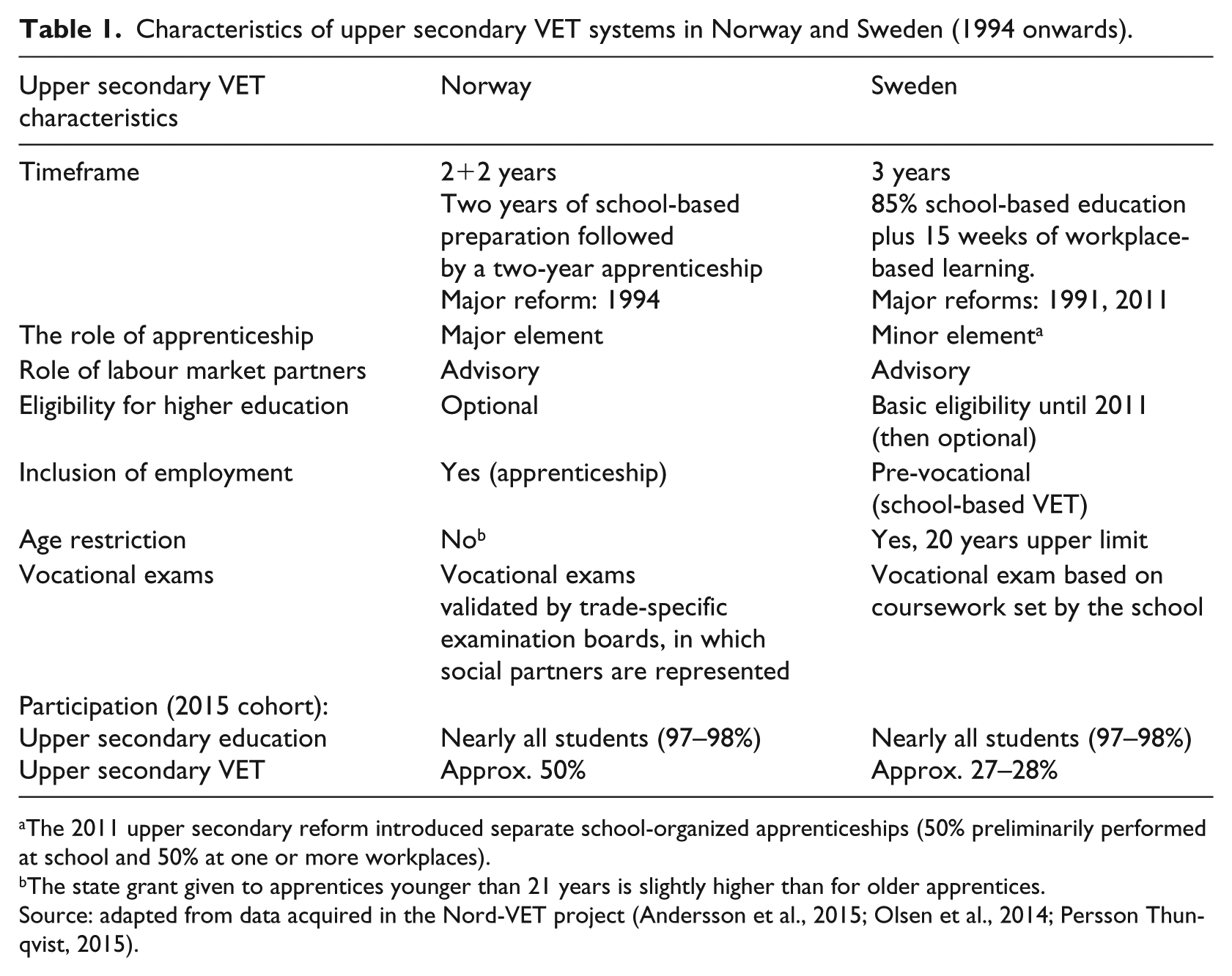
The 2011 upper secondary reform introduced separate school-organized apprenticeships (50% preliminarily performed at school and 50% at one or more workplaces).
The state grant given to apprentices younger than 21 years is slightly higher than for older apprentices.
Source: adapted from data acquired in the Nord-VET project (Andersson et al., 2015; Olsen et al., 2014; Persson Thunqvist, 2015).
The 1994 upper secondary reform in Norway
By the 1970s, apprenticeship training had declined in Norway. Only 2–3000 new apprenticeship contracts were being signed annually. Some political organizations, such as the youth organization of the Labour Party, were in favour of abolishing apprenticeship training altogether, claiming that it served to maintain and reinforce social inequalities. Opponents of apprenticeship training argued in favour of promoting social mobility through access to higher education, a privilege that had previously been reserved mainly for children of the middle classes (Høst and Hovdhaugen, 2013; Mjelde, 2002). However, apprenticeship training survived as a recruitment and skills development system outside the ongoing integration process in upper secondary education.
The 1974 Upper Secondary Education Act established a unitary school system at the upper secondary level. The programmes and traditions that had been developed in vocational schools over time continued to exist within the new institutional framework. The result was a heterogeneous structure with a wide variety of courses of different lengths and contents (Høst and Hovdhaugen, 2013).
In the 1980s, interest in apprenticeship training gained new momentum. New legislation and the establishment of training agencies to enhance cooperation between employers contributed to the expansion and renewal of the apprenticeship system. In 1981, the 1950 Apprenticeship Act was replaced by a new Act on Vocational Training. Its key objective was to strengthen the workplace as a site for vocational training. The new Act provided an institutional framework for closer cooperation between the government and social partners, thereby establishing a structure for tripartite cooperation with regard to Norwegian VET. The social partners strongly influenced the training content and it was in their interests to ensure that curricula reflected the needs of working life, whether training took place in schools or in workplaces.
Whereas the 1950 Apprenticeship Act only regulated apprenticeship training in cities and urban areas, the new Act on Vocational Training was applied across the country. The legislation was also extended to new sectors and trades. The establishment of new trades in areas such as food processing and timber manufacturing meant that previously unskilled and semi-skilled work could be upgraded to skilled work. In the mid 1980s, the number of new apprenticeship contracts had increased from 2–3000 to around 10,000 per year. Several reasons have been put forward for this increase: firstly, new legislation and the expansion to new trades and new geographical areas strengthened apprenticeship training in the early 1980s. Secondly, the state grant payable to training companies for each apprentice increased, and the appeal of receiving wages during the training period probably had a positive impact on interest in apprenticeship training amongst young people. Thirdly, a lack of capacity for VET programmes in schools, and fewer jobs for young people outside of the education system, made apprenticeships more attractive choices for many students (Michelsen et al., 2014).
In addition to the policy measures that were implemented, several new local training agencies (Opplæringskontor) were established by employers to strengthen cooperation in providing apprenticeship training. The training agencies are collective enterprises owned by a group of training companies. If a training company is a member of a training agency, the apprenticeship contract is signed by the apprentice and that agency. The training agencies also assist member companies in recruiting apprentices and monitoring the training contracts, thereby sharing responsibilities and reducing the costs to individual firms. The training agencies also work actively to recruit new companies and to find apprenticeship places from amongst the members (Bjørndal, 2005; Hagen and Skule, 2007; Kuczera et al., 2008).
Although these developments explain some of the increase in apprenticeship contracts in the 1980s, the trend was still strongly influenced by the economic cycle (Høst et al., 2008). This became particularly evident towards the end of the 1980s when the economic downturn dramatically altered the labour market situation. Changes in the youth labour market created a backdrop for further extensive reforms in upper secondary education and VET in Norway during the 1990s.
The youth labour market in Norway was severely affected by the decline in manufacturing employment during the 1970s and 1980s. In 1992, the number of teenagers employed in manufacturing had fallen by half since 1980. At the beginning of the 1990s, total employment among youth had declined by nearly 30% since the 1970s (NOU, 1994). In the face of reduced labour market opportunities, an increasing number of young people applied to upper secondary schools. The counties, which are responsible for upper secondary education in Norway, did not have the capacity to accept all of these applicants, meaning that a large number of them were turned down.
Every year, counties received more state funding so that they could increase the number of students. This resulted in the largest expansion of upper secondary education in Norwegian history. In 1980 there were around 137,000 students in upper secondary education; 10 years later, this had increased to more than 200,000 students.
A politically important goal for the social democratic government was to grant all young people a statutory right to upper secondary education. In 1989, a committee (the Blegen Committee), which included representatives from the Norwegian Confederation of Trade Unions (LO) and the main organization for Norwegian employers (NHO), was appointed to report on how to achieve this political goal (NOU, 1991). The committee’s work stimulated discussions between LO and NHO about how to secure the provision of skilled labour in the future and led to a key document, the ‘Joint declaration on vocational education and training in schools and workplaces’, being signed by LO and NHO. This document has been described as a cornerstone in the development of the reform (Bjørndal, 2005).
LO and NHO agreed that the fundamental theoretical elements of vocational programmes should be financed by the state and take place in upper secondary schools. They proposed that these courses should provide a broad basis for further training and focus on general subjects such as Norwegian, English and mathematics. The idea was that a broader basic education would give vocational students a better foundation for lifelong learning and continuing education and training to adapt to future needs within their trades. Vocational specialization and practical training in the trade would be mainly the responsibility of the workplaces in the second phase of the training programme. The social partners agreed to work to increase the number of apprenticeship places so that all youth who applied to follow a vocational programme would have an opportunity to complete their education.
The basic elements of Reform 94 were based on the report from the Blegen committee and the joint declaration by LO and NHO. The 2+2 model, with two years of school-based education followed by two years of apprenticeship training, was established as the main model for all VET programmes. With Reform 94, the apprenticeship system was formally integrated in upper secondary education, and vocational education and training became a shared responsibility of the state and the social partners. Establishing the 2+2 model as standard could be seen as a compromise which sought to balance the need for general education and breadth in vocational programmes with the need for vocational specialization and practical training in the workplace. It also established an institutional division of responsibility between schools and workplaces over the first and second parts of the training programmes. One of the Blegen committee’s main concerns, which was also reflected in parliamentary discussions about the reform, was to enable access to higher education for students in vocational programmes. The reform introduced a general university admission certificate as an entry requirement for all universities and university colleges. Those who complete the general programme in upper secondary school obtain this certificate, while those who complete a vocational programme obtain a trade or journeyman’s certificate, which does not give them access to higher education. The committee was split into three groups in the discussion about the requirements for vocational students who wanted to enter higher education. The proposal from the largest group was that vocational students should be able to qualify through a supplementary course along with Norwegian, English, social science, mathematics and natural science. A smaller group, including representatives from LO, the vocational students’ and apprentices’ organization, and the vocational teachers’ organization, argued that a completed upper secondary education, either in a general or a vocational programme, should qualify students for higher education without any additional requirements. Another group, including members from the teachers’ association, the gymnasium students’ organization, NHO and the Association of Local and Regional Authorities, argued that vocational students should have studied the same number of general subjects as students in general programmes before they could apply for higher education.
In their report to the Storting (the Norwegian Parliament), the Ministry of Education shared the view of the largest group in the Blegen committee and proposed that vocational students should be able to qualify for higher education through a third supplementary year. The proposal was supported by a majority in the Storting. A minority consisting of the Conservative Party and the Progress Party supported the minority view that vocational students should cover the same number of general subjects as students in general programmes in order to be enrolled in higher education.
The 1991 upper secondary reform in Sweden
The early 1990s have been characterized as a critical juncture for the state-governed school-based VET model in Sweden. This is partly due to shifts in the governance of education from the state to local levels, and the increased role that private schools and market forces could play in upper secondary education (Dobbins and Busemeyer, 2014). In addition to changes in schools’ governance, an upper secondary education reform enacted by a parliamentary decision (prop. 1990/91: 85) in 1991 was also important for curriculum changes in upper secondary VET. The central goal of the reform was to create small numbers of broad vocational and academic study programmes to promote flexibility, lifelong learning and equal access to higher education (Lundahl and Olofsson, 2014; Nylund, 2013). All VET programmes were extended to include a third year and more general subjects, in order to make vocational students eligible for higher education.
In this respect, the 1991 reform represents a continuation of the educational principles from the 1950s, favouring broad-based schooling for everyone. It reflects a long tradition of education policies being driven by social democratic values and supported by unions to reduce gaps between general and vocational education (Olofsson and Persson Thunqvist, 2018). However, the reform process also involved power struggles and conflicts. Next, we consider important stages in the development of the upper secondary VET system that emerged during the 1980s and was completed through implementation of the 1991 reform.
Creation of a new framework for the initial stages of VET involved a radical departure. It was intended not only to improve students’ preparedness for work and workplace-based learning, but also to introduce a curriculum geared towards improving access to higher education through VET (prop. 1990/91: 85). The 1991 reform coincided with a severe recession that strengthened the position of employers and weakened that of the unions in terms of influence over the negotiations behind the reform (Ball and Larsson, 1989: 13–15).
The public commission that started to prepare a vocational reform in the 1980s evidences some of the challenges in making compromises between ‘the equality version’ of upper secondary school (supported by the unions) and employers’ demands for better preparation of the workforce (SOU, 1986: 14). Both the Swedish employers’ organization and the Swedish Federation of Trade Unions took an active role in the public commission, and in evaluating a large pilot programme that preceded the 1991 reform (Lundahl, 1997). Both parties highlighted significant problems in the school-based VET system that had developed since 1968, and argued for the need for reform, albeit from different viewpoints.
From the perspective of the employers’ organization, the primary problem was framed in terms of inadequate labour market relevance and efficiency. Consistent with what centre-right political parties were saying, the employers’ organization argued for improvements to the quality of workplace-based training (SOU, 1986), but did not exert pressure in favour of apprenticeships. Rather, the employers wanted to exercise more influence over the school-based approach to VET, underlining the long-term economic value of VET. That is, they demanded that more general subjects within VET should better correspond to the needs of large-scale industries and be in line with technological innovation and global competition (Lundahl et al., 2010). Some debates were also inspired by a vision of a return to vocational schools being governed by industries, as had been the case in Sweden before and shortly after the Second World War (Olofsson, 2005). The employers’ central arguments for a reform favoured new curricula for school-based VET which had a clearer vocational orientation (SOU, 1986). In their view, these should be based on modules that clearly define the skills to be learned, include new forms of learning assessment (‘skill demonstration’), and have stronger ‘business-like’ institutional management arrangements which make courses accountable to representatives of industry, locally and nationally. A new subject was also suggested to promote students’ socialization into work by covering topics such as work morale, teamwork and entrepreneurship (Lauglo, 1993).
From the point of view of the trade unions, the major problems with the existing school-based model of VET were its shortcomings in integrating vocational and general education, and in breaking down social class and gender distinctions (Lauglo, 1993). In its report Labour Market Policy and Education (LO, 1986), the union argues that its redistributive views on education remain antagonistic to employers’ suggestions about reforming vocational education, and that in the compromise made by the public commission, the unions’ views on equality have lost out – and therefore must receive more attention.
Through a pilot programme launched in 1988 following a commission report (SOU, 1986), proposals from both the employers’ organization and the unions were considered and tested. The pilot scheme extended the two-year vocational programmes in upper secondary school by adding a third year and more general subjects. The aim was also to build a new structure of advisory boards for different specialties at local and national levels, through which employers and unions would regain direct influence over the content of vocational training. In line with the employers’ proposals, new curriculum and training modules were launched, and workplace-based training was to be developed (SOU, 1989). A critical question for the pilot programme to resolve, then, was how far it was possible to develop workplace-based training through voluntary cooperation with employers (Lauglo, 1993: 29).
Evaluations (SOU, 1989; UGY, 1990) found that weak institutional frameworks for cooperation between schools and companies contributed to difficulties in implementing training modules. Schools lacked the capacity to integrate different subjects and training modules, and to engage companies to provide students with training placements. However, vocational tracks focused on health care were more successful due to already well-developed cooperation between hospitals and schools, which gave students sufficient access to workplace training and supervisors.
In 1991, a new coalition government headed by the Moderate (conservative) Party came to power and promoted the idea of expanding apprenticeship. The Moderate Party criticized the pilot programme as a failure. The party suggested a more differentiated upper secondary approach that included different forms of apprenticeship tailored to the specific skills needed in different labour market sectors. Arguments in favour of a stronger apprenticeship component suggested that VET programmes preparing students for higher education were likely to result in increased dropout and unemployment rates (Lundahl et al., 2010: 50). However, a severe economic recession in the early 1990s aggravated the problem of inducing industries to share responsibility with schools in terms of providing training places. In effect, political plans for an expansion of apprenticeships were postponed (Lauglo, 1993: 30). At the same time, reform of private schools in 1992 soon moved higher up the agenda for the conservative-centrist coalition government. This reform also opened up greater opportunities for industries and profit-making school companies to establish various types of vocational schools (Persson Thunqvist, 2015). A lack of support from the employers’ organization further explains the downturn in interest in apprenticeship policies.
By the time the Social Democratic Party returned to power in 1994 and launched the delayed 1991 reform, there was a strong consensus among the employers’ organization, the unions and representatives of the large-scale industries regarding the need for generalist and pre-vocational school-based VET, but little support for apprenticeship (Andersson et al., 2015; Lundahl, 1997).
To summarize, in addition to partisan politics, an important reason for the consolidation of the school-based VET system during the 1990s was the support from the employers’ organization and unions at central level, and export industries dominating the Swedish economy. All parties supported school-based VET with a generalist character. Expansion of higher education was also prioritized to combat youth unemployment. However, the reform had unintended consequences in terms of a lack of institutional frameworks for cooperation between schools and employers. Consequently, involvement of the social partners in VET provision was weakened. The more recent 2011 reform (see above), driven by the goal to improve VET’s relevance to working life, was largely a response to the weak links between the world of school and working life, high youth unemployment and complicated school-to-work transitions.
Discussion
In recent years the merits of apprenticeship training and dual vocational training have been high on the European political agenda (CEDEFOP, 2018). Since 2015, the European Commission has been actively promoting dual training systems with Germany, Austria and Switzerland as prime role models. Dual training systems have been associated with a range of advantages, such as economic growth, industrial success and reduced youth unemployment, by providing smooth transitions from school to work (Raffe, 2008). In light of this development, it is interesting to examine the conditions for establishing apprenticeship training in countries lacking traditions for this kind of education. In this context, we argue that a comparative study of why the VET systems of Norway and Sweden have developed along such different lines since their respective educational reforms in the 1990s provides important insights.
To understand institutional change and the roles of organized actors within it, we have emphasized the effects of the cooperation between different institutions. In comparing histories of the development of upper secondary VET in Norway and Sweden since the early 1990s, we have shown how institutional change has been circumscribed by political reform and international trends. Firstly, Reform 94 in Norway and the 1991 upper secondary reform in Sweden show how decisively political ideology has influenced the shape and dynamics of VET institutions, significantly affecting the school-to-work transitions of young adults. Our analysis has shown how VET regulations and political compromises in the reform processes formed the basis for two quite different VET systems within apparently similar universalist upper secondary education regimes. Today these VET systems are largely intact (see Table 1 above), even though a reform in 2011 prioritized work-based learning and apprenticeship in Sweden. However, unlike in Norway, efforts to expand apprenticeship have not been successful, and school-based VET is still dominant. Hence, the present VET systems are influenced by the 1990 reforms in both countries.
In both countries, the reforms of the 1990s reinforced the integration between general and vocational education, and institutionalized models of gradual choice and specialization in all VET programmes. However, the two reforms differ significantly in that apprenticeship was prioritized higher in Norway than in Sweden. Meanwhile, the school-based system that was consolidated by the 1991 reform in Sweden was more oriented towards promoting equal access to higher education for all students, regardless of their social background (Jørgensen et al., 2018). An unintended consequence of the 1991 reform was that the institutional links between school-based VET and working life were weakened.
To some extent, these reforms in Norway and Sweden expressed developments also present in other European countries, favouring stronger ties between VET and the labour market to counteract youth unemployment (CEDEFOP, 2018; Raffe, 2008). However, the transitions to the labour market differ strongly between different labour market sectors; generally being quite smooth in technical and craft-based VET fields, but more extended and complicated in health care and the service sector (Reegård, 2017). In contrast, transitions to higher education are much easier in the latter female-dominated VET tracks (particularly health care) than in the former.
The 1990s were a period of considerable change in these two countries, which affected conditions for school-to-work transitions more broadly. The long-standing political influence of social democratic parties was under pressure, and in education policy it lost some ground to more neo-liberal approaches which emphasized individual choice with a view to making VET more attractive to young people. As described extensively in previous research (Jørgensen, 2013), the education systems in the Nordic countries have, to varying degrees, been decentralized, diversified and made more flexible to respond to the diverse demands of individual students.
In this respect, Sweden stands out as having taken the lead amongst the Nordic countries in allowing market forces and profit-making companies to influence schooling and VET (Lundahl and Olofsson, 2014). The shift towards more decentralization and privatization constituted a turning point for Swedish upper secondary school VET during the 1990s. A long tradition of state regulation of VET was weakened. This shift has encouraged more individual choice, increased competition between schools and more diversity in VET – including through the establishment of industry schools and other types of vocational schools run by school companies (Persson Thunqvist, 2015). An unintended consequence, however, is a greater mismatch between the educational institutions and the labour market. That is, profit-making school companies offer education programmes demanded by students, which is not necessarily the training that leads to jobs (Lundahl and Olofsson, 2014). Moreover, as many large industrial companies have adapted their recruitment strategies to school-based VET over time, they are reluctant to initiate partnerships with new actors in the education market (Persson Thunqvist, 2015).
The Norwegian case shows that state policies can expand the apprenticeship system within the framework of a universalist education system, as demonstrated through Reform 94. The early 1990s offered a ‘window of opportunity’ (cf. Engelstad et al., 2017), which enabled political action. Support from the state has meant that greater resources have been invested in apprenticeship, and that the overall educational architecture has been structured to support young adults to take advantage of this educational pathway (Olsen et al., 2014). However, path-dependent mechanisms evident in the different trades’ apprenticeship traditions are still evident today, and the relevant differences and compromises that have been made render the system vulnerable and unstable.
In contrast to Sweden, in Norway collaboration by corporations to establish apprenticeships and offer training placements was strengthened through the 1980s. In both Norway and Sweden, earlier apprenticeship models were confined to craft and industry. The revival and expansion of apprenticeship in Norway during the 1980s was partly a consequence of new legislation providing an institutional framework for tripartite cooperation in VET. In Sweden, as mentioned earlier, the state and labour market partners have never been able to reach an agreement on legislation in the field of VET (Olofsson and Persson Thunqvist, 2018). In both countries, the connections between apprenticeship and upper secondary education have historically been weak. Thus, Reform 94 was groundbreaking in institutionalizing a hybrid upper secondary VET model that integrated school-based and apprenticeship-based learning. In the wake of Reform 94, apprenticeship expanded into several new sectors such as commerce and office work, cleaning services and health care, and the number of students enrolled in apprenticeship tripled (Olsen et al., 2014).
The Swedish case demonstrates the conflicting and contradictory nature of education policies in the field of VET. Attempts to establish apprenticeships as a normal feature of upper secondary school have been driven by different perspectives and political goals. Firstly, large industrial companies that dominated the Swedish economy took a different stance towards apprenticeship than their Norwegian counterparts. Big industry seldom seriously questioned the role of the state in regulating VET. Secondly, in contrast to Norway and Denmark, the Swedish union (LO) and the employers’ organization have widely rejected government proposals to launch upper secondary apprenticeship as a form of employment (Andersson et al., 2015: 18–19). Instead, labour market representatives have favoured school-organized vocational training and apprenticeship, with schools and the government taking responsibility for this. Thirdly, the multifaceted educational goals of school-organized apprenticeships reflect competing perspectives on the function of apprenticeships: (a) to serve social inclusivity (e.g. targeting young adults at risk of social marginalization); (b) to provide pedagogical alternatives; or (c) to facilitate work-based learning and pathways into skilled employment.
While these functions, certainly 1 and 3 at least, are also apparent in Norway, they have been prioritized and institutionalized quite differently. One key difference is that apprenticeship in Norway is the responsibility of the training companies and derives its purpose from the employment context. In contrast, the Swedish education authorities mainly set standards for work-based learning. A strong focus is placed on the organizational arrangements and quality assurance framework for such learning (National Agency for Education, 2017). Hence, in Sweden, the role of apprenticeships is mainly considered in a school-based context. In the world of schools there is little trust that firms in the capitalist private sector will exercise responsibility for fostering democratic citizens.
Moreover, integrating general and vocational education in upper secondary school became more of a priority in Norway than in Sweden during the 1990s. In Sweden, while integration between general and vocational education remained a fundamental precept of policy-making throughout the economic recession in the 1990s, several experiments with apprenticeship have been conducted under the remit of social policies and youth labour market policy (Olofsson and Persson Thunqvist, 2018). The association between apprenticeship and social problems can partly explain why it proved difficult to attract wider groups of young people to the new apprenticeship track when the 2011 upper secondary school reform was launched.
Our findings reveal both similarities and differences between Norway and Sweden. National education reforms have played a vital role in transforming VET systems to promote greater flexibility and lifelong learning in line with societal changes. Reforms in both countries have reintroduced and strengthened apprenticeship training; however, the timing of and underlying arguments for apprenticeship training differ, as do their outcomes. On the one hand, a major weakness of apprenticeship is that it rarely supports progress to higher education. Workplaces are also seen as more restricted learning environments than schools when it comes to fostering democratic citizens and promoting social diversity (for instance in terms of gender and ethnicity). On the other hand, a major strength of modern apprenticeships to which the relevant social partners are strongly committed, as demonstrated by the Norwegian case, is their capacity to promote economic democratization by integrating young adults, often with non-academic backgrounds, into working life and skilled employment.
At present, across all the Nordic countries, work-based learning is regarded as a key to confronting the problems of youth unemployment and skills shortages in several major labour market sectors. As an increasing number of jobs throughout Europe will require intermediate and higher education in the future, the national VET systems’ abilities to provide young people with certificates that are of labour market value will be crucial.
Footnotes
Declaration of conflicting interest
The author(s) declared no potential conflicts of interest with respect to the research, authorship, and/or publication of this article.
Funding
The author(s) disclosed receipt of the following financial support for the research, authorship, and/or publication of this article: When submitting the article, the following information was given about the article being written as part of participation in a cross-cutting network “Justice through Education in the Nordic Countries” in part funded by Nordforsk, Nordic Centre of Excellence.