




Abstract
This paper addresses convergence as a political issue stemming from the political coordination of the European Higher Education Area. From the perspective of cultural theory, this issue relies on the fact that the influence of ways of life are not evenly influential in the political coordination of the European Higher Education Area. Convening the results of previous studies on the progress of Bologna, this paper underlines how goal displacement is challenging convergence in the ambit of the broader European Union political project. Additionally, the paper concludes that education within the European Higher Education Area is being configured by the prominence of the individualist and the fatalist ways of life.
Keywords
Introduction
Convergence in the European Higher Education Area (EHEA) is to be achieved on the basis of guarantees of compatibility and comparability of European higher education systems. While it is widely recognised that the Bologna reforms at the system and institutional levels are complying with the demands of procedural convergence, the actual use of the term ‘convergence’, seen from the perspective of the broader political project of building a European Union, is to be questioned.
Coordination is aimed at building coherence in policy enactment, and in the case of political coordination of the EHEA, it is about the governance of interdependent activities under the framework of the Bologna process developed at different levels. Governance puts emphasis on rule systems, both formal and informal, that promote values and norms affecting behaviours and attitudes of actors (Hall and Taylor, 1996; Kjaer, 2010). This perspective implies the assumption that policy dynamics of the EU ‘[do] not take place without the governments’ (Kjaer, 2010: 114). Coordination refers to: …the instruments and mechanisms used to enhance the voluntary or forced alignment of tasks and efforts of organisations [e.g. European Commission, governments, higher education institutions] (…) in order to create a greater coherence, and to reduce redundancy, lacunae and contradictions within and between policies, implementation or management (Bouckaert, Peters, and Verhoest, 2010: 16).
As an instrument of the EHEA, the Bologna process was expected to contribute to its development. This process was to be based on shared social values and common assumptions and principles to ‘(..) enrich the European citizenship, capable of giving its citizens the necessary competences to face the challenges of the new millennium, together with an awareness of shared values and belonging to a common social and cultural space’ (Bologna declaration, 1999 §2). However, while it is widely acknowledged that major reforms at the national and institutional levels are implementing the Bologna Process on the basis of procedural convergence, convergence on common social values remains to be seen.
Policy convergence in the ambit of the broader EU political project involves multilevel interactions leading to multiple, and sometimes, conflicting objectives (Veiga, Magalhães, and Amaral, 2015). As a process, convergence within the EHEA encompasses the idea that policy texts are rewritten, interpreted and translated into practices (Veiga and Neave 2015). The establishment of the EHEA is triggered by a cognitive logic of framing integration as the domestic impact of European policies is based on interpretation and making sense of political action. Following Knill and Lehmkhul (1999), policies of framing integration exist ‘when the European decision-making context allows for the adoption of only vague and more or less symbolic policies, giving the underlying conflict of interests between the member states’ (Knill and Lehmkhul, 1999: 3). These policies affect domestic arrangements by altering the beliefs and expectations of domestic actors (Knill and Lehmkhul 1999: 2). In other words, the adoption of Bologna instruments developed around the implementation of the degree structure, the credit system or the Diploma Supplement, induce actors’ meanings and change their expectations (Veiga, 2010; Neave and Veiga, 2013; Veiga and Neave, 2015) regarding the broader political project of building an EU on the basis of common social and cultural values. The fact that ‘actors at different levels of activity and responsibility assess, adjust and adapt both the Process and re-interpret their part in it’ (Neave and Veiga, 2013: 74) makes convergence more complex. In other words, because of multiple interdependencies, common goals associated with the creation of the EHEA are fading in favour of pragmatic goals such as the implementation of the Bologna degree structure, the credit system, or the student-centred approach.
In adjusting policy goals to the national and institutional agendas, pragmatism of policy implementation has been shaping and limiting the development of the EHEA. In this sense, Bologna may appear ‘to amount to nothing less than an “ends/means reversal” in which Bologna is itself viewed as an end, rather than as a means with the EHEA as the end result’ (Neave and Veiga, 2013: 74). Bologna reforms, thus, may hinder the major goal of policy convergence aimed at European social cohesion. By gaining primacy over the idea of the EHEA, Bologna reforms represent a political goal displacement, to use Hood’s (2000) terms. Rather than envisaging convergence in the ambit of the broader EU political project, the enactment of Bologna reforms triggered convergence based on national and institutional appropriations in complying with procedures promoted by the Open Method of Coordination (OMC).
The Council of Europe has defined social cohesion as the capacity of a society to ensure the well-being of all its members, underlining the importance of strategies and instruments aimed at minimising disparities and avoiding marginalisation to deal with differences and divisions (Council of Europe, 2010). Notwithstanding, the economic mandate addressed to the EU and to its members under the ideograph of the Europe of Knowledge has been influencing the meaning attributed to social cohesion. The development of the struggle to fix its meaning is visible, for instance, in the two alternative scenarios for 2015, traced by Michalski, Miller and Stevens (1997) for the Organisation for Economic Co-operation and Development. In the ‘individualistic’ scenario, social cohesion rests on ‘individual freedom and responsibility, allowing the verdict of unconstrained markets to provide the acute incentives associated with the prospect of great wealth or severe poverty’ (Michalski et al., 1997: 14). In the alternative ‘solidaristic scenario’, social cohesion is based ‘on collective organisations, universal rights and redistributive frameworks as ways of hedging risks and spurring the innovation markets demand’ (Michalski et al., 1997: 14). This struggle, while framing the tension between convergence on procedures, but possibly not to convergence on the meanings of European social cohesion influenced by the perspective of a ‘solidaristic scenario’, impinges on the political coordination of the EHEA.
In this paper, we contend that cultural theory may contribute to expanding our understanding of why political coordination of the EHEA is not promoting convergence of the European higher education systems on the basis of values related to the ‘solidaristic scenario’. We stem from the cultural theory assumption that political systems promote at least four ways of life: individualism, fatalism, hierarchism, and egalitarianism. The point being that the egalitarian perspective, inducing shared understandings about social cohesion, risks being sacrificed to individualism (e.g. focus on competition) and fatalism (e.g. focus on compliance with national and institutional agendas).
In discussing the political coordination of the EHEA, this paper convenes materials such as The Independent Assessment of the Bologna Reforms (CHEPS and INCHER-Kassel and ECOTEC Consortium, 2010), the European University Association (EUA) Trends Reports (Sursock, 2015; Sursock and Smidt, 2010), and Bologna with Students’ Eyes (European Students’ Union (ESU), 2012), The Implementation Reports (European Commission, 2012; European Commission/Education, Audiovisual and Culture Executive Agency (EACEA)/Eurydice, 2015) and research on Bologna and its translation into practices (e.g. Curaj et al., 2012; Neave and Veiga, 2013). These studies resulted from empirically based assessments of progress towards Bologna’s policy objectives. As EU political coordination cannot happen without the Member States, in this study, we selected three countries, which according to Mamadouh (1997) share an egalitarian way of life – Germany, Italy and Portugal.
We start by convening cultural theory to look at policy convergence in European higher education. Next, the dynamics of the political coordination within the EHEA and the primacy of Bologna instruments (e.g. degree structure, credit system, diploma supplement) and procedures are highlighted. We argue that the absence of elements of the egalitarian way of life in the political coordination of the EHEA makes convergence of European higher education systems problematic as it is essentially based on the compliance with common procedures, rather than on shared encompassing values, namely those stemming from the egalitarian way of life.
The cultural theory and policy convergence
Altman and Baruch (1998) emphasised that cultural theory could be used in a number of diverse situations, ranging from ecology (Douglas and Wildavsky, 1983) to industrial safety (Gross and Rayner, 1985) and risk behaviour (Douglas, 1992). Cultural theory has also been used in education. For instance, Maassen (1996) compared specific values and beliefs of German and Dutch academics, Frølich (2005) analysed the implementation of New Public Management in Norwegian universities, and Veiga and Amaral (2008) analysed how the Portuguese higher education institutions coped with the Bologna process. In the field of quality assurance in higher education, Harvey and Stensaker (2008) went a step ahead by developing the concept of ‘quality cultures’ anchored in the cultural theory and Veiga et al. (2011) used it to understand the extent to which quality assessment by influencing the group and grid dimensions affects higher education institutions.
From the perspective of cultural theory, in social contexts, values are continuously challenged by conflicting ideas stemming from ways of life. Within the EHEA, values underpinning the enactment of Bologna reforms have an impact on the development of the relationship between social cohesion values and education, making convergence a problematic endeavour.
Drawing on Mary Douglas’ (1992) grid/group analytical model, it may be assumed that awareness about the dynamics of competing ways of political coordination is at the centre of the stage. This model builds on viable frameworks featuring social contexts (Thompson, Ellis, and Wildavsky, 1990; Thompson, Grendstad, and Selle, 1999) and comprises two dimensions – sociality and social incorporation. ‘Sociality’ refers to the establishment of rules and norms regulating individual interactions (Thompson et al., 1999) and to the intensity of social prescriptions (i.e. grid). ‘Social incorporation’ refers to the extent to which the ‘individual’s life is absorbed in and sustained by group membership’ (Thompson et al., 1999: 4) (i.e. group). The combination of the grid/group dimensions generates four ways of life: hierarchy—high grid/high group; individualism—low grid/low group; egalitarianism—low grid/high group; fatalism—high grid/low group (see Figure 1). 1
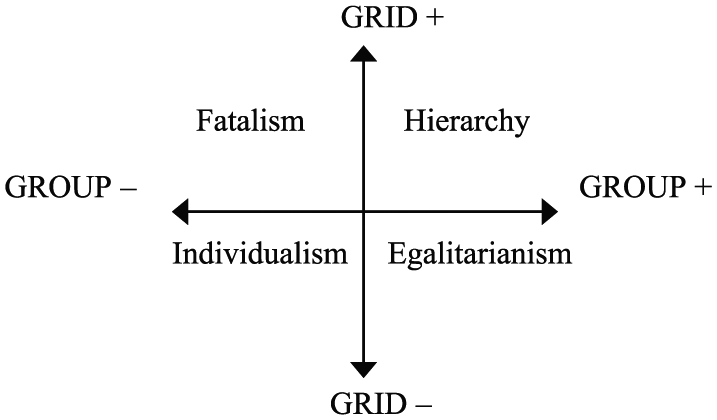
Grid-group analytical scheme.
The ways of life contribute to understanding how different assumptions sustain diverse meanings of policy convergence and of ‘Bologna reforms’. Hierarchy (high grid/high group) favours obedience to rules, trust of authority and expertise. This way of life is based on rule-following and strong incorporation of individuals into the social order with designated functions and roles. Under hierarchism (high grid/high group), authority of intergovernmental cooperation to ensure the ‘adequate’ interpretation of Bologna reforms promotes convergence on the basis of compliance of national education systems to a prescribed set of rules. Individualism (low grid/low group) emphasises autonomy, freedom and individual competence. This way of life favours entrepreneurial initiatives and the responsibility tends to be attributed to the individual. Under individualism (low grid/low group), policy convergence focuses on external public and private actors and interests, while favouring the competition of higher education systems. Egalitarianism (low grid/high group) mistrusts power and promotes the active participation of individuals in collective endeavours. This way of life rests upon peer-groups and on the building of shared collective values. From the egalitarian (low grid/high group) perspective, policy convergence results from networking between and among state and non-state actors with the objective of reaching social cohesion within the EHEA. Under this perspective, the expectation is that the meaning of social cohesion corresponds to: …shared values and communities of interpretation, reducing disparities in wealth and income, and generally enabling people to have a sense that they are engaged in a common enterprise, facing shared challenges, and that they are members of the same community (Maxwell, 1996: 3, as cited in Green, Preston, and Sabates, 2003: 456).
However, goal displacement may undermine this meaning while challenging convergence in the ambit of the broader EU political project. By making Bologna an end by itself, the convergence resting upon national and institutional agendas opens the way to fatalism (high grid/low group). Fatalists blame fate, do not believe in fairness, they view their individual autonomy as limited and they mistrust change. Under this way of life the world is seen as being out of individuals’ control, and the best one can do is to try to find ways of surviving. Based on fatalism (high grid/low group), Bologna reforms result from the decision of ‘others’ and convergence within the EHEA corresponds to emulating practices taken from elsewhere.
In the roots of convergence there is the tendency of European society to grow more alike, to develop similarities in structures and processes. However, European higher education systems are dealing with …persistent and growing social divisions: people from disadvantaged socio-economic and migrant groups remain far less likely to enter and complete higher education; academics and graduates are too often perceived as detached from the rest of society; and gender segregation by field of study is still pervasive (European Commission, 2017: 3).
Within the EHEA, convergence gained relevance as comparability and compatibility of national systems of higher education were expected to contribute to a ‘more complete and far-reaching Europe, in particular building upon and strengthening its intellectual, cultural, social and scientific and technological dimensions’ (Bologna declaration, 1999). In this sense, convergence is meant to strengthen belonging to a common social and cultural space. However, apparently there is not a consensus about the social principles and values, as those promoted by the egalitarian (low grid/high group) way of life, to drive the EHEA. This raises the question that, even if procedural convergence on Bologna instruments could be difficult to deny, ‘what may be “underneath” the shared catch-phrases’ (Hood, 2000: 204) is more problematic if one bears in mind a ‘more complete and far-reaching Europe’ (Bologna declaration, 1999).
According to cultural theory, ‘ways of life’ encompass the relationship between the cultural biases (e.g. shared values and beliefs) and the social relations (e.g. patterns of interpersonal relations). Their viability relies upon mutually supportive/conflicting relationships, and each way of life might not be equally influential. Within the EHEA, in each country and in higher education institutions, all four ways of life are to be present, albeit with different weights and influence.
As individualism (low grid/low group), hierarchism (high grid/high group), egalitarianism (low grid/high group), or fatalism (high grid/low group) cannot ‘serve “for all seasons” for the simple reason that incompatible administrative values cannot be pursued simultaneously (…) and none can ever win over its competitors by a knock-out’ (Hood, 2000: 20), building the EHEA based on only one way of life is likely to be impossible. In this sense, convergence within the EHEA depends on the extent to which the political coordination is able to promote mutually supportive relationships between ways of life precluding reversals resulting from goal displacement. Following from Hood (2000), reversals are associated with both the excessive reliance on only one way of life and the culture clash resulting from the imposition of one way of life. The extent to which these reversals are influencing the political coordination of the EHEA is at the core of the argument of this paper.
Policy coordination within the EHEA
The cultural theory has proven to be fruitful in understanding the role of transnational institutions in European governance (Verweij, 1999) and of the cultures of public management in public administration (Hood, 2000). Following from this, we identify the four ways of life and how their relationships influence the European dynamics within the political coordination of the EHEA. Additionally, to further capture the national dynamics within the political coordination of the EHEA, we convene the concept of political cultures defined as ‘patterns of successive alliances embedded in a specific cultural context’ (Mamadouh, 1999: 141). As the political coordination of the EHEA is about the governance of interdependent activities developed at the European and national levels, not to mention institutional ones, values and beliefs legitimating the ways of life are key to identifying what influences convergence within the EHEA.
The European dynamics
As the EHEA stemmed from intergovernmental cooperation, the interaction between the national and European levels has been shaped by the hierarchical (high grid/high group) way of life promoting top-down steering and tight procedures (Verweij, 1999). The EHEA is based on explicit agreements between state authorities (e.g. the Bologna declaration and subsequent communiqués), imposing these regulations on their citizens and institutions. These intergovernmental arrangements induced legal changes on national higher education systems aimed at convergence with regard to the values of education as a public good. However, the subsidiarity principle has been challenging the political coordination of the EHEA based on hierarchism (high grid/high group). Actually, the harmonisation of laws and regulations of the Member States (art. 165º Consolidated Version of the Treaty on the Functioning of the European Union, 2012) depends on each country’s willingness to comply with the European norms.
At the same time, echoing the assumption that ‘markets function properly’ (Verweij, 1999: 33), the Bologna process transformed ‘what were once state monopolies over academic degrees into competitive international markets’ (Dill et al., 2004: 330). Hence, the individualist (low grid/low group) way of life within the political coordination of the EHEA promotes the introduction of market-like mechanisms in higher education. Discourses on the assumption of transnational markets have been inducing the economic relevance of education (Ball, 1998; Dale, 2000) and the reconfiguration of students into individuals/clients. The goal of attractiveness of the EHEA articulates the idea of competition for incoming (and, in many cases, fee paying) students and national priorities and policies converge in reflecting the individualist (low grid/low group) way of life. Under this way of life, convergence is based on market regulation, relying on the negotiation and bargaining capacity of each higher education system and institution. Education is assumed as a private good and international cooperation between higher education systems and institutions is translated into competition between providers.
Soft law mechanisms are important elements of European coordination of higher education. These policy tools promote policy learning and exchange of ‘best practices’ within the EHEA as a convergence cornerstone. Guzman (2009) defines soft law as ‘nonbinding rules or instruments that shape states’ toward appropriate political and administrative action. In the case of the EU political coordination, soft law has been useful in generating compliance to specific political objectives.
Reputation is important in encouraging compliance with international law, which explains the ‘naming and shaming mechanisms’ that are usually associated with the OMC. When states fail in developing appropriate political and administrative action they risk losing international credibility ‘and this will make it more difficult to enter into future promises’ (Guzman, 2009: 22). Under the framework of the EHEA, OMC ‘appeared as a compromise between a desire for common action, on the one hand, and the governments’ desire to maintain some degree of control over tools they considered essential for their political future, on the other’ (Dehousse, 2002: 7).
As the OMC implies, tools used both to compare ‘best practices’ and to support actions putting pressure on Member States, the monitoring of convergence within the EHEA becomes highly relevant. In this case, stocktaking reports and scorecards, national reports on the implementation progress and national action plans on previous and future developments concerning specific issues (e.g. mutual academic recognition issues) have been widely used.
In turn, at the national level, governments used OMC as ‘an exercise in symbolic politics where national governments repackage existing policies to demonstrate their apparent compliance with EU objectives’ (Zeiltin, 2005: 17), and in the case of the Bologna process, the EHEA is confronted with: specific institutional contexts in the country where it is implemented. There is therefore no automatic and similar declination of this reform in each country: when the same measures are ‘applied’ on different national settings, the latter incorporate the European measures and transform them into a specific national mixture […]. The local adaptations, national translations and side effects attached to each domestic implementation weaken the convergence potential of Bologna (Musselin, 2009: 186–198).
In this sense, political coordination of the EHEA deals with a large range of national interests and contexts, not to mention institutional ones, challenging convergence in the ambit of the broader EU political project.
Fatalism (high grid/low group) assumes that the course of action is unpredictable and that international regimes are based on distrust of rational planning as ‘each actor, inevitably, is on their own, trying to cope with the vagaries of the international realm as best they can’ (Verweij, 1999: 34). In this sense, fatalism (high grid/low group) feeds the OMC features in political coordination of the EHEA. According to this way of life, policies depend on the degree of discretion of the Member States in the achievement of policy goals, the communication and coordination systems, the national traditions of political and administrative organisation and the presence or absence of institutional opportunities for entrepreneurship (Borrás and Radaelli, 2011).
Political coordination of the EHEA relies on the influence of hierarchist, individualist and fatalist ways of life. While hierarchism focuses on intergovernmental cooperation, the individualist way of life emphasises competition between higher education systems and institutions. In turn, the influence of fatalism in the Bologna reforms reflects, at best, national and institutional priorities to the detriment of policy convergence in the ambit of the European political project. It must be underlined that the egalitarian way of life did not emerge as influential at the European level showing that the political coordination was not able to promote mutually supportive relationships between the ways of life.
National dynamics
Cultural variation in Europe is key to understanding both the political context supporting different ways of life and the system of political coordination. Dynamics within the political coordination of the EHEA is also shaped by national political cultures. These national contexts induce specific cultural patterns of ‘doing politics’ and four types were identified (Mamadouh, 1997, 1999) on the basis of ‘conversations’ or ‘alliances’ between ways of life (see Figure 2). These alliances lead to cultural hybrids allowing the identification of the dominant conversations between ways of life.
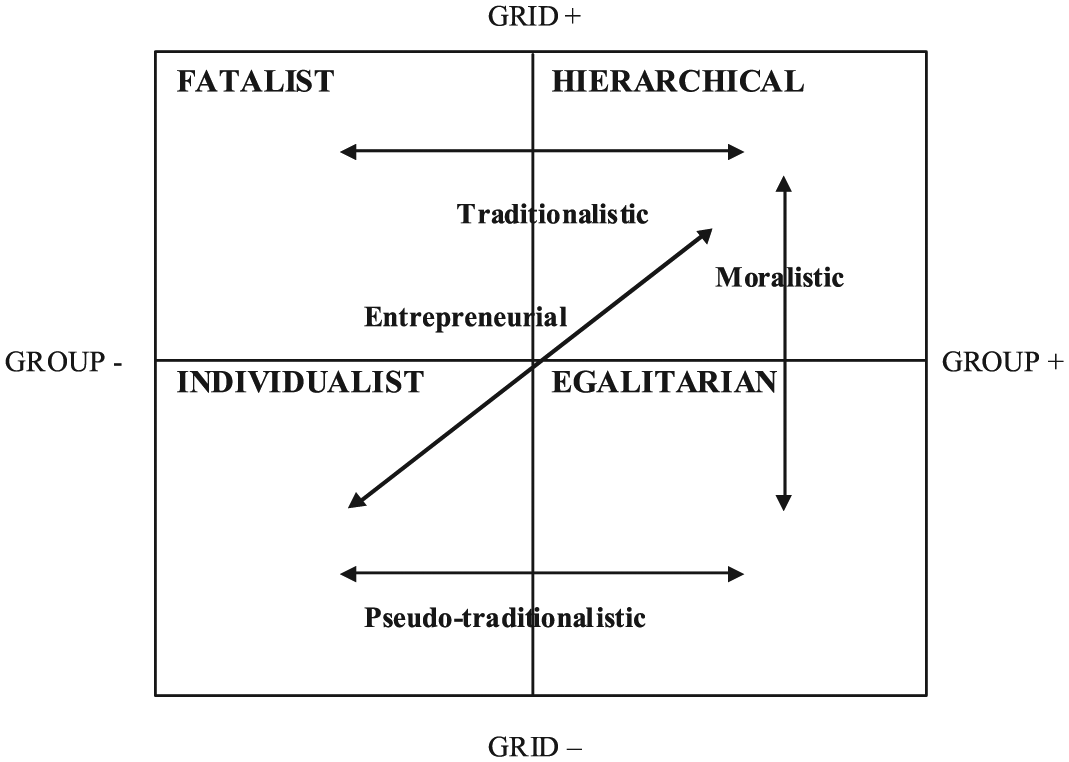
Ways of life and political cultures.
The ‘entrepreneurial political culture’ results from the ‘conversation/alliance’ between the individualist (low grid/low group) and the hierarchical (high grid/high group) ways of life. In this case, ‘The state is likely to be reduced to a minimal scope to perform the necessary functions that guarantee the working of the market’ (Mamadouh, 1997: 23). In this context, individualists (low grid/low group), although comfortable with contracts between state and non-state actors, fear that hierarchists (high grid/high group) restrict competition by enhancing state regulation.
The ‘moralist political culture’ results from the ‘conversation/alliance’ between the hierarchical (high grid/high group) and the egalitarian (low grid/high group) ways of life in which ‘the state is supposed to promote the achievement of a good society’ (Mamadouh, 1997: 23). This interaction has been also termed ‘social democracy’ (Grenstad and Selle, 1995) as ‘the egalitarian hope is to use hierarchical means to achieve redistributive ends’ (Thompson, et al., 1990: 89). In this context, hierarchists (high grid/high group) fear that egalitarians (low grid/high group) erode the top-down regulation and egalitarians (low grid/high group) worry that the means used by hierarchists ‘pervert egalitarian ends’ (Thompson et al., 1990: 89).
Referring to Germany, Mamadouh (1997) emphasised the presence of a ‘moralistic political culture’. In implementing the Bologna degree structure, German federal governments used ‘governance by coercion’ to enforce the replacement of traditional programmes (Kehm, Michelsen, and Vabo, 2010). However, since 2006 the legal competencies of the Länder in education policy have increased, triggering stronger competition between them, inducing an individualist (low grid/low group) way of life. Actually, ‘when German state governments increasingly adopted the NPM [New Public Management] model[,] the core message was: “Weaken the old regime, dominated by state-regulated profession, for the sake of the new regime, dominated by market-and state-driven organisation!”’ (Schimank and Lange, 2009: 60). This context made the stability of the alliance between hierarchal (high grid/high group) and egalitarians (low grid/high group) vulnerable, while promoting the influence of individualism (low grid/low group).
In the ‘pseudo-traditionalist political culture’, the individualistic (low grid/low group) and egalitarian (low grid/high group) ways of life are influential but not able to form a stable alliance prompting a political culture with a strong fatalistic (high grid/low group) component (Mamadouh, 1997). The alliance between individualism (low grid/low group) and egalitarianism (low grid/high group) enables the minimal intervention by state authority, but the egalitarian (low grid/high group) way of life (not allowing differentiation that would lead to inequality) brings forward their affinity with fatalists (high grid/low group). In Italy, according to Mamadouh (1997), a ‘pseudo-traditionalistic political culture’ prevails as ‘the strong anti-hierarchical bias of the egalitarian way of life apparently bolsters both egalitarianism and individualism which cannot form stable alliances’ (Mamadouh, 1999: 484). Despite a strong academic self-regulation reflecting elements of the egalitarian (low grid/high group) way of life, the room for manoeuvre of egalitarians (low grid/high group) is limited. As such, the driver of keeping up with the rest of Europe (Ballarino and Perotti, 2010) is induced by the fatalist (high grid/low group) way of life. At the same time, the enhancement of institutional autonomy and the enactment of the concept of evaluation of academic performance has been reinforced by the individualistic (low grid/low group) way of life.
According to Mamadouh, the Portuguese political culture is also ‘pseudo-traditionalistic’ and the unstable alliance between the individualistic (low grid/low group) and egalitarian (low grid/high group) ways of life leaves the floor to the hierarchist way of life (high grid/high group) (Mamadouh, 1999: 479). This triple alliance is tensional as, on the one hand, for instance, the responsibility for quality assurance remains in the hands of higher education institutions fed by the egalitarian (low grid/high group) way of life. On the other hand, the development of accreditation procedures aimed at coordinating institutions’ pedagogic autonomy appeared as a step towards a stronger and potentially more intrusive relationship between the state and higher education institutions, in line with the hierarchist (high grid/high group) way of life. Additionally, the pedagogic autonomy was increasingly constrained by the definition of performance-based instruments promoted by the individualist (low grid/low group) way of life.
Looking at the national dynamics, and differently from the European coordination dynamics, it appears that the egalitarian way of life is influential. However, the unstable alliances within national dynamics between egalitarians and hierarchists or egalitarians and individualists expose these alliances to individualism and fatalism, which are at the core of the European dynamics. The extent to which individualism and fatalism are influential in the development of the Bologna instruments will be analysed in the next section.
The political coordination of the EHEA and the Bologna instruments
The EHEA reveals shortcomings related to different speeds of implementation between countries (CHEPS and INCHER-Kassel and ECOTEC Consortium, 2010), gaps in the common understanding of concepts and objectives (European Students’ Union (ESU), 2012) and variety in policy translation at the national and institutional levels (Sursock and Smidt, 2010). These flaws are associated with a lack of convergence on European social values, hindering the goal of constructing a common social and cultural space, and putting under scrutiny whether or not the Bologna instruments, as a mean for the EHEA, are furthering this form of convergence.
The Bologna degree structure under the influence of hierarchism (high grid/high group) and individualism (low grid/low group)
Looking at the implementation of the Bologna degree structure resulting from intergovernmental cooperation and reflected in national legislation, the hierarchical (high grid/high group) way of life was not able to overcome the convergence on a common degree structure. The European Commission recognised that there was neither a single model of first-cycle, nor of second-cycle (European Commission, 2012). The duration of degree programmes varies across countries as in the case of Germany, where there are degree programmes based on semesters (State Examination, art and music). In the German context, research on the implementation of the Bologna degree structure reflected the ‘durability of Humboldtian legacy’ (Kehm, Michelsen, and Agnete, 2010). Other examples can be found in the integrated/long degree programmes not covered by the European directive on regulated professions (Directive 2005/36/EC 7 September 2005 on the recognition of professional qualifications). While in Portugal, longer programmes are offered on the basis of their compliance with a ‘recognised European practice’ in the professional field under consideration (Veiga, Sin, and Amaral, 2012), in Germany and Italy longer programmes in law exist outside the Bologna degree structure. In the selected countries, the BA-MA model is challenging convergence.
As European harder regulation is not possible in areas protected by subsidiarity, convergence of national degree structures promoted by intergovernmentalism is weak. At the same time, the European internal market, associated with increasing competition between countries, opens the door for the enhancement of individualism (low grid/low group), which tends to impose over hierarchism (high grid/high group). Apparently, the political coordination under the influence of individualism (low grid/low group) does not contribute to reinforcing cooperation between countries and higher education institutions to promote, for example, student and academic mobility. In line with this, the concept of mobility and the concern with matching the labour market needs have been increasingly pervaded by the goal of making attractive European systems.
The credit system and the Diploma Supplement under the influence of fatalism (high grid/low group)
The credit system and the Diploma Supplement are instruments associated with the adoption of ‘recommended models’ by the European Commission, Council of Europe and UNESCO/CEPES (Centre Européen pour l’Enseignement Supérieur). These instruments are implemented at the institutional level, and awareness about the alignment of the Diploma Supplement with mobility, on the one hand, and, on the other hand, of the credit system with comparability, illustrates convergence on political instruments at the national and institutional levels (Veiga, 2010).
Institutional perceptions indicated limited awareness about the role of the instruments in convergence on a common social and cultural space (Neave and Veiga, 2013). Additionally, the association established between the credit system and the student workload and the ‘student-centred approach’ was perceived as weak (Neave and Veiga, 2013). The Independent Assessment of the Bologna Reforms also mentioned that the use of the credit system needs attention and that only 12 countries had effectively linked the allocation of credits to student workload and learning outcomes (CHEPS and INCHER-Kassel and ECOTEC Consortium, 2010). Along the same lines, the report Bologna with Students’ Eyes argues, ‘progress in removing obstacles associated with the implementation of the degree cycles and ECTS [European Credit Transfer and Accumulation System] appears limited’ (European Students’ Union (ESU), 2012: 7). And the 2012 Implementation Report recognises that: Diploma Supplements are in many cases not prepared properly and hence do not provide the expected information to the users. Higher education institutions do not always follow the guidance for filling out Diploma Supplements adopted by the Intergovernmental Committee of the Lisbon Recognition Convention in 2007 and therefore a much wider dissemination of the Diploma Supplement explanatory notes as well as training of the appropriate staff is needed (European Commission, 2012).
In the case of the credit system, evaluation reports also called for further achievements, particularly with regard to ‘learning outcomes’ (European Commission, 2012; Sursock and Smidt, 2010). The 2012 Implementation Report suggests that ‘those countries that choose not to make a learning outcomes approach compulsory through laws and regulations should step up their activities to encourage implementation of a learning outcomes approach’ (European Commission, 2012: 50). The legal enforcement of ‘learning outcomes’ brings to the fore the tension between the hierarchical (high grid/high group) and the egalitarian (low grid/high group) ways of life. Convergence promoted by the hierarchical (high grid/high group) way of life reflects a bureaucratic approach that ‘expropriates university professors (…) as far as quality decisions are concerned’ (Huber, 2012: 217). In this sense, embeddedness of credits and of learning outcomes in a hierarchical (high grid/high group) way of life reinforces regulative requirements, which only guarantees the formalisation of the credit system and the Diploma Supplement. Under the fatalist (high grid/low group) perspective, local solutions emerge with the use of comparability of grades (Huber, 2012). This emphasised compliance, while inducing a goal displacement, turning the credit system and grades transfer into an end by itself. In actuality, the main purpose of guaranteeing fair recognition of study periods abroad is the ultimate policy goal.
From the perspective of the European Students’ Union, ‘without a common understanding of and increased efforts towards making to use ECTS properly, the variety of possible benefits of the ECTS implementation will be hindered or used only partially’ (European Students’ Union (ESU), 2012: 20). This aspect was also underlined in the Bologna with Student Eyes report as threatening the reliability of the EHEA. The translation of credit systems into institutional practices by the egalitarian (low grid/high group) way of life promotes a common social and cultural space. The diversity of perceptions found in different higher education institutions, disciplinary cultures and professional roles was furthermore recognised by the European University Association (EUA) 2010 Trends Report as leading to a diversity of practices across the EHEA and pointed out as an obstacle to comparability. Actually, ‘the conversion practices, both at the level of ECTS and of grades across European higher education institutions reveal great differences in the assessment of students’ performance and achievements’ (Huber, 2012: 213).
The political coordination of the EHEA based on the credit system and the Diploma Supplement is induced by a fatalist (high grid/low group) way of life. Under this framework, in Italy, the compliance with prescriptions stemming from the outside, hinders the development of practices based on shared values as the fatalist (high grid/low group) way of life assumes compliance as inevitable. By contrast, in Germany, the influence of elements of the fatalist (high grid/low group) way of life challenges the egalitarian (low grid/high group) perspective. In turn, in Portugal the implementation of these instruments under a hierarchical (high grid/high group) way of life underlines, for instance, issues associated with the need to control and centrally manage the development of institutional practices (Veiga and Neave, 2015).
The student-centred approach under the influence of egalitarianism (low grid/high group)
The Bologna process was perceived by academics and students, above all, as a ‘pedagogic reform’ in the Portuguese and Italian contexts (Neave and Veiga, 2013; Veiga, 2010). The egalitarian (low grid/high group) way of life, underlying the role of national and institutional political actors in decision-making, focuses on processes of teaching and learning weighting the group dimension and promotes a collegial academic-driven model of higher education management. From the egalitarian (low grid/high group) perspective, the extensive participation of citizens in decision-making is the preferred system of international governance (Verweij, 1999). However, in the case of the implementation of the Bologna process, effective participation of higher education institutions and institutional actors was absent (Neave and Veiga, 2013). The instrumental value of Bologna reforms, while emphasising a pragmatic shift towards successful and relevant curricular changes, does not necessarily drive shared meanings about the purpose of curricular reforms based on shared values of belonging to a common social and cultural space.
Following from cultural theory, the political coordination of the EHEA relies on the alliance between hierarchism (high grid/high group) and individualism (low grid/low group) with a large proportion of fatalists (high grid/low group), but fails to engage with the egalitarian (low grid/high group) way of life, which is potentially relevant in the student-centred pedagogical approach.
(Un)balanced influence of ways of life and risks for European convergence?
From the perspective of the cultural theory, political systems promoting all ways of life ‘are likely to do better than those that repress the requisite variety’ (Thompson et al., 1990: 96–97). As argued, the political coordination of the EHEA all four ways of life. Therefore, convergence of social cohesion values, visions and priorities for the EHEA under the egalitarian (low grid/high group) perspective is at risk. When addressing the social dimension of education, education Ministers recognised the need to promote the egalitarian (low grid/high group) way of life: The need to increase competitiveness must be balanced with the objective of improving the social characteristics of the European Higher Education Area, in aiming at strengthening social cohesion and reducing social and gender inequalities both at national and at European level (Berlin Communiqué, 2003).
However, the political coordination of the EHEA was not able to promote mutually supportive relationships between the four ways of life, thus enabling reversals on convergence in the ambit of a common social and cultural space. The excessive reliance on fatalism (high grid/low group), let alone individualism (low grid/low group), created blind spots. While individualism (low grid/low group) promotes competition and pragmatism in shaping the strategy of Bologna reforms, fatalism (high grid/low group) contributes to the appropriation of Bologna reforms by national and institutional priorities. The influence of these ways of life promoted goal displacement as the Bologna degree structure, the credit system, or the diploma supplement shifted into ultimate goals.
The excessive reliance of the political coordination of the EHEA on individualism (low grid/low group) was prompted by the increasing role of the European Commission (Amaral and Neave, 2009) in education. The 2000 Lisbon Agenda manifested both the concern with education as an economic competitive factor and the increasing competencies of the European Commission with regard to national regulations. The economic agenda for the competitiveness of European higher education systems gained momentum in parallel with global economic competitiveness. The economic arguments forged by the European Commission impinged on Bologna reforms adding pressure to increase, for instance, international student numbers and competition in university league tables. In turn, the reason for the prominence of fatalism (high grid/low group) appears to rely on the difficulties of establishing the EHEA à la hierarchy (high grid/high group) as this way of life collides with the principle of subsidiarity. OMC emerged as a way for national governments to demonstrate their willingness to comply with European priorities and coordination. The EHEA risks being caught by the technical expertise of national and European political coordination, via OMC, by the hegemony of economic concerns and by the competitive higher education markets.
In sum, the political coordination dynamics at the European and national levels are paving the way to hinder ‘a humanistic way of thinking about education (Geven and Attard, 2012: 168). Bearing in mind the words ‘when social relationships are not equitably balanced’ (Dewey, 1996: 64), education tends to be ‘an externally dictated order to do such and such things’ (Dewey, 1996: 71). In this paper, we showed that (un)balanced influences of ways of life in the political coordination of the EHEA impinge on convergence with implications on how these shape the nature and aims of European education itself.
Footnotes
Declaration of conflicting interests
The author(s) declared no potential conflicts of interest with respect to the research, authorship, and/or publication of this article.
Funding
The author(s) disclosed receipt of the following financial support for the research, authorship, and/or publication of this article: This work was financed by FEDER funds through the Operational Competitiveness Programme COMPETE and by national funds through the Foundation for Science and Technology (FCT), under project No. FCOMP-01-0124-FEDER-027445.